Here are chapter notes prepared from the provided sources on the "Particulate Nature of Matter":
***
### Chapter Notes: Particulate Nature of Matter
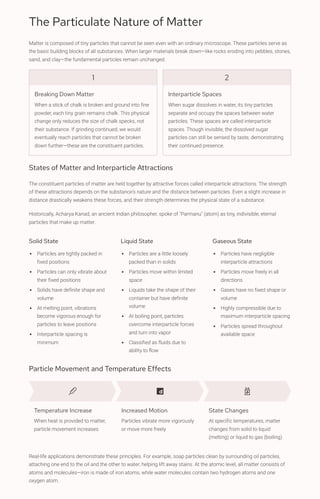
This chapter explores the fundamental concept that **matter is composed of tiny particles**. These particles are so small they cannot be seen even with an ordinary microscope.
#### 7.1 What Is Matter Composed of?
* **Breaking down matter:** Larger rocks break down into pebbles, stones, sand, and clay due to erosion.
* **Chalk example:** When a stick of chalk is broken and ground into fine powder (Activity 7.1), each tiny grain is still chalk. This is a **physical change** where only the size of the chalk specks is reduced, not their substance. If grinding continued, a stage would be reached where particles could not be broken down further.
* **Constituent particles:** These tiny, unbreakable units are the **basic building blocks** that make up a substance. Just like chalk, sand and clay are also made of numerous constituent particles.
* **Dissolving sugar example:** When sugar dissolves in water (Activity 7.2), sugar particles break up into their constituent particles, which can no longer be observed but can be sensed by taste. Each tiny grain of sugar contains millions of such particles.
* **Interparticle spaces:** When sugar dissolves, its tiny particles separate and occupy the **spaces between the water particles**. These spaces are called interparticle spaces.
#### 7.2 What Decides Different States of Matter?
The constituent particles of matter are held together by **attractive forces called interparticle attractions**. The strength of these attractions depends on the substance's nature and the distance between particles (interparticle distance). Even a slight increase in distance drastically weakens these forces, and their strength determines the physical state of a substance.
Historically, Acharya Kanad, an ancient Indian philosopher, spoke of "Parmanu" (atom) as tiny, indivisible, eternal particles that make up matter.
**7.2.1 Solid State**
* **Particle arrangement:** In solids, particles are **tightly packed** and held in **fixed positions** by very strong interparticle attractions.
* **Movement:** Particles can only vibrate or oscillate to and fro about their fixed positions; they cannot move past each other. The thermal energy of particles in solids is low, leading to strong attractive forces and restricted motion.
* **Properties:** Solids have a **definite shape and volume**.
* **Melting:** When solids are heated, their particles vibrate more vigorously. At the **melting point**, these vibrations become vigorous enough for particles to leave their positions, weakening interparticle forces and converting the solid into a liquid. The melting point is the minimum temperature at which a solid melts to become a liquid at atmospheric pressure. Solids with weak forces have low melting points, while those with strong forces have high melting points (e.g., Ice: 0 °C, Iro