Economic sustainability
Prepared by
Wrya hade nadir
Sustainability
• Sustainability refers to the ability to maintain or support a
process continuously over time. Or aims to maintain
economic advancement progress while protecting the long-
term value of the environment.
• Improving Financial Perspective
1. Life cycle cost analysis
2. Present, future, and annual worth evaluations
3. Rate of return analysis
4. Benefit/cost ratio assessment
Traditional Sustainable Economics
• Traditional economic considerations of sustainability
1. Local Impact
2. Material Savings
3. Reuse
• Local Impact and Economics
Sustainable practices create jobs and stimulate local economies
• Material Savings and Benefits
1. Reusing materials reduces upfront costs, transportation, and on-site
waste
2. Fewer natural resources used lead to future savings and less material
waste
• Limitations
1. Fail to consider maintenance and disposal costs
2. Uncertain long-term performance
LIFE CYCLE COST ANALYSIS
1-Definition:
LCCA is a method for quantifying the long-term economic
impacts of manufactured products or engineering infrastructure.
It takes into account both initial and discounted future costs to
identify the best value over the life of a project.
2-Common Costs and Assumptions:
LCCA compares different cost alternatives, and common costs
can cancel out, focusing on the costs that are different between
the alternatives. Assumptions made in the analysis are crucial
and can vary among different stakeholders.
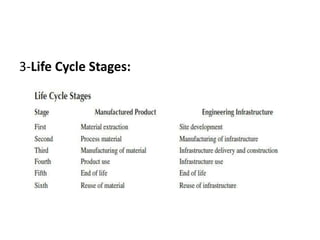
3-Life Cycle Stages:
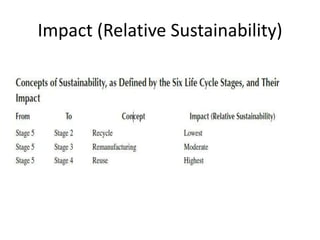
Impact (Relative Sustainability)
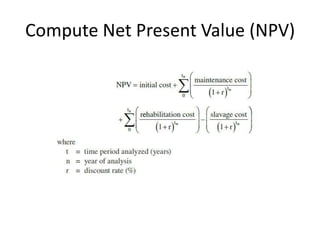
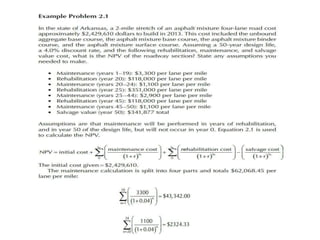
Compute Net Present Value (NPV)
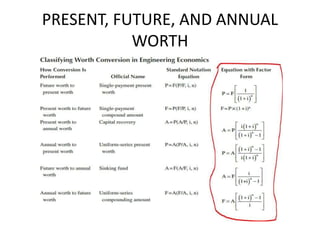
PRESENT, FUTURE, AND ANNUAL
WORTH
RATE OF RETURN
• The rate of return is like a measure that tells you how much money you
can make from an investment or project. It's usually shown as a
percentage, and it helps you figure out if the investment is a good idea. If
the rate of return is high, it means you can make a lot of money. If it's low,
you might not make much. It's a way to see if your money will grow or not
when you invest it.
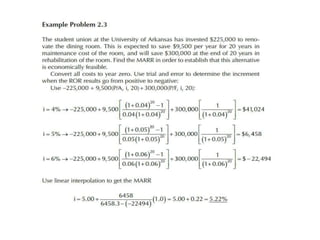
• The minimum attractive rate of return (MARR) is beneficial because it
helps decision-makers set a minimum standard for investment or project
profitability.
thanks

Economic sustainability.pptx

  • 1.
  • 2.
    Sustainability • Sustainability refersto the ability to maintain or support a process continuously over time. Or aims to maintain economic advancement progress while protecting the long- term value of the environment. • Improving Financial Perspective 1. Life cycle cost analysis 2. Present, future, and annual worth evaluations 3. Rate of return analysis 4. Benefit/cost ratio assessment
  • 3.
    Traditional Sustainable Economics •Traditional economic considerations of sustainability 1. Local Impact 2. Material Savings 3. Reuse • Local Impact and Economics Sustainable practices create jobs and stimulate local economies • Material Savings and Benefits 1. Reusing materials reduces upfront costs, transportation, and on-site waste 2. Fewer natural resources used lead to future savings and less material waste • Limitations 1. Fail to consider maintenance and disposal costs 2. Uncertain long-term performance
  • 4.
    LIFE CYCLE COSTANALYSIS 1-Definition: LCCA is a method for quantifying the long-term economic impacts of manufactured products or engineering infrastructure. It takes into account both initial and discounted future costs to identify the best value over the life of a project. 2-Common Costs and Assumptions: LCCA compares different cost alternatives, and common costs can cancel out, focusing on the costs that are different between the alternatives. Assumptions made in the analysis are crucial and can vary among different stakeholders.
  • 5.
  • 6.
  • 7.
  • 10.
  • 12.
    RATE OF RETURN •The rate of return is like a measure that tells you how much money you can make from an investment or project. It's usually shown as a percentage, and it helps you figure out if the investment is a good idea. If the rate of return is high, it means you can make a lot of money. If it's low, you might not make much. It's a way to see if your money will grow or not when you invest it. • The minimum attractive rate of return (MARR) is beneficial because it helps decision-makers set a minimum standard for investment or project profitability.
  • 14.

Editor's Notes

  • #3 To deal with these problems, we use tools that help us see how much money we save or make by doing things sustainably. These tools help us understand the full cost and value of what we're doing now and in the future
  • #4  Traditional economic considerations of sustainability focus on three main factors: local impact, material savings, and reuse. Sustainable practices not only benefit the environment but also provide employment and stimulate the local economy. Reusing existing materials can reduce upfront costs, transportation expenses, and on-site waste. Using fewer natural resources results in future savings and reduces the amount of waste going to landfills. Reducing Upfront Costs: Instead of buying new cardboard boxes for packing, a business can collect and reuse old ones from deliveries they've received. This saves money because they don't need to purchase new boxes. Lowering Transportation Expenses: Reusing the old boxes means they don't need to be transported to the business from a supplier. This reduces transportation costs and the fuel used for delivery. Minimizing On-Site Waste: Since they're reusing the boxes, there's less waste generated at the business location. They don't have to dispose of as many old boxes, which is better for the environment and saves on waste management costs. It's important to note that the concept of reuse has limitations as raw costs are not the only factor, and maintenance and disposal costs can vary based on the product or infrastructure.
  • #5 1-Common Costs: Some costs will be the same for both steel and concrete bridges. For example, the costs associated with the construction of bridge abutments, approaches, and labor may be similar regardless of the material used. These are common costs that can cancel out when comparing the two alternatives. 2-Different Costs: Now, let's focus on the costs that are different between the two options. Steel bridges may have a higher initial cost due to the price of the steel material, while concrete bridges might have a lower initial cost. However, steel bridges may require less maintenance over time compared to concrete bridges, which might need more frequent repairs. These are the differences in costs that you'll consider. 3-Assumptions: Here's where assumptions come into play. Different stakeholders in the project may make different assumptions about future costs. For instance, the steel industry might argue that steel bridges have a longer lifespan and lower maintenance costs, while the concrete industry might claim the opposite. These assumptions can significantly impact the outcome of your LCCA. If you assume a longer life for one material or significantly different maintenance costs, it can influence the cost-effectiveness of your decision.
  • #6 Example: Automobile Manufacturing 1-Material Extraction (Stage 1): In the case of automobile manufacturing, materials like steel, plastic, rubber, and glass are extracted or produced from raw materials or other components. 2-Processing (Stage 2): These materials are then processed to create the various components of the vehicle, such as the body frame, engine parts, and interior components. 3-Manufacturing (Stage 3): The vehicle components are assembled to create the finished automobile. This is the manufacturing stage. 4-Use (Stage 4): The car is sold to consumers and used for transportation over its lifespan. This stage includes regular maintenance, fuel costs, and other expenses associated with ownership. 5-End of Life (Stage 5): Eventually, the car reaches the end of its life, either due to age or damage. At this point, it may be sold for scrap or disposed of in an environmentally responsible manner. 6-Material Reuse (Stage 6): Some parts of the car, like the engine or transmission, may be reused in other applications or sold as used parts. Example: Construction of a Bridge 1-Site Development (Stage 1): The first stage involves preparing the ground, setting foundations, and ensuring the area is suitable for constructing a bridge. This may involve land clearing, excavation, and soil testing. 2-Infrastructure Manufacturing (Stage 2): This stage includes the fabrication of the necessary materials for the bridge, such as steel girders, concrete components, and road surface materials. 3-Materials and Product Delivery (Stage 3): The manufactured components are transported to the construction site and assembled to create the bridge structure. 4-Infrastructure Use (Stage 4): The completed bridge serves its intended purpose, facilitating transportation and connecting two points over a water body or another obstacle. 5-End of Life (Stage 5): Over time, the bridge may deteriorate due to factors like traffic loads and environmental conditions. This can lead to the need for rehabilitation or replacement. 6-Material Reuse (Stage 6): In some cases, components of the old bridge, like steel girders, may be reused in other construction projects to maximize their lifespan.
  • #7 Recycling: Recycling involves taking materials or products at the end of their life cycle and processing them to recover their constituent materials for use in creating new products or materials. It aims to reduce waste and conserve resources. Example of Recycling: Imagine a company that specializes in recycling old glass bottles. They collect used glass bottles from various sources, crush them into small pieces, and then melt and reshape the glass into new bottles. This process saves energy and resources compared to manufacturing new glass bottles from scratch. Remanufacturing: remanufacturing involves restoring used products or components to like-new condition. It typically goes beyond basic repair and often involves disassembling, cleaning, and refurbishing to meet original specifications or even improved ones. Example of Remanufacturing: A company that remanufactures automotive engines takes used engines, disassembles them, replaces worn-out components with new or refurbished parts, and reassembles them to meet original performance standards. The remanufactured engines are nearly as good as new, offering cost savings and resource conservation. Reuse: Reuse involves taking a product or component that has reached the end of its initial intended use and repurposing it for another use. It's the simplest and most sustainable of the two concepts because it requires the least material processing. Example of Reuse: Consider a scenario where old wooden pallets used for transporting goods are no longer needed by one company. Instead of discarding them, these pallets can be collected and reused by another company for a similar purpose. Reusing the pallets in their existing form reduces waste and conserves resources.