FINANCIAL PRINCIPALS
COST BENEFIT ANALYSIS
◼ The benefits of a given situation or business-
related action are summed and then
the costs associated with taking that action
are subtracted.
◼ Can be used to determine if project is
economicly viable or compare competing
products.
COST BENEFIT CALCULATIONS
◼Identify all costs and benefits
◼ Attach a monetary value (maybe a range)
◼ Estimate the future rates of interest and
discount the value of the project
◼ Compare the costs and benefits
https://www.youtube.com/watch?
v=PRmCHu55GrY
Cost Benefit Calculation -
Discounting
Discounting - The factor that reflects the future
value of $1 in today’s dollars, considering the
effects of both inflation and lost return on
investment
Discounting Example
For example, suppose that in the example of the dam construction cited above the cost of dam
construction ($1.1 million) is incurred at the beginning of the project (t=0), but the benefits ($1.2
million) arise one year later, after the dam is finished (t=1). Suppose the interest rate is 10%.
The present value of the benefits are:
PV is the present value of the amount invested;
Pt is the dollar value of the future amount in time t;
r is the discount rate; and
t is the year in which Pt is realized.
LIFE CYCLE COST
Life-cycle cost analysis (LCCA) is a method for assessing the total
cost of facility ownership.
◼Initial Costs—Purchase, Acquisition, Construction Costs
● Fuel Costs
● Operation, Maintenance, and Repair Costs
● Replacement Costs
● Residual Values—Resale or Salvage Values or Disposal Costs
● Finance Charges—Loan Interest Payments
● Non-Monetary Benefits or Costs
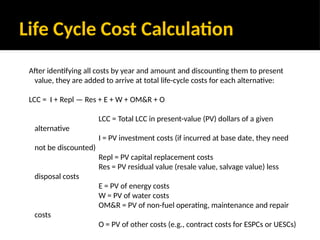
Life Cycle Cost Calculation
After identifying all costs by year and amount and discounting them to present
value, they are added to arrive at total life-cycle costs for each alternative:
LCC = I + Repl — Res + E + W + OM&R + O
LCC = Total LCC in present-value (PV) dollars of a given
alternative
I = PV investment costs (if incurred at base date, they need
not be discounted)
Repl = PV capital replacement costs
Res = PV residual value (resale value, salvage value) less
disposal costs
E = PV of energy costs
W = PV of water costs
OM&R = PV of non-fuel operating, maintenance and repair
costs
O = PV of other costs (e.g., contract costs for ESPCs or UESCs)
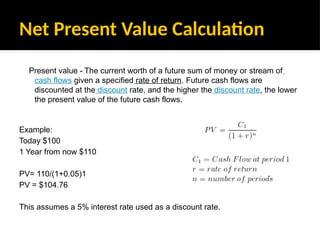
Net Present Value Calculation
Present value - The current worth of a future sum of money or stream of
cash flows given a specified rate of return. Future cash flows are
discounted at the discount rate, and the higher the discount rate, the lower
the present value of the future cash flows.
Example:
Today $100
1 Year from now $110
PV= 110/(1+0.05)1
PV = $104.76
This assumes a 5% interest rate used as a discount rate.
NET PRESENT VALUE
The net present value (NPV) is based on the following two premises:
● Inflation: The purchasing power of a dollar will be less one year from now
than it is today. If the rate of inflation is 3 percent for the next 12 months, $1
today will be worth 97 cents just 12 months from today. In other words, 12
months from now, you’ll pay $1 to buy what you paid 97 cents for today.
● Lost return on investment: If you spend money to perform the project
being considered, you’ll forego the future income you could earn by
investing it conservatively today. For example, if you put $1 in a bank and
receive simple interest at the rate of 3 percent compounded annually, 12
months from today you’ll have $1.03 (assuming zero-percent inflation).
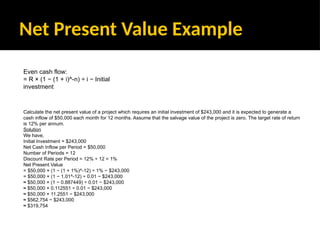
Net Present Value Example
Calculate the net present value of a project which requires an initial investment of $243,000 and it is expected to generate a
cash inflow of $50,000 each month for 12 months. Assume that the salvage value of the project is zero. The target rate of return
is 12% per annum.
Solution
We have,
Initial Investment = $243,000
Net Cash Inflow per Period = $50,000
Number of Periods = 12
Discount Rate per Period = 12% ÷ 12 = 1%
Net Present Value
= $50,000 × (1 − (1 + 1%)^-12) ÷ 1% − $243,000
= $50,000 × (1 − 1.01^-12) ÷ 0.01 − $243,000
≈ $50,000 × (1 − 0.887449) ÷ 0.01 − $243,000
≈ $50,000 × 0.112551 ÷ 0.01 − $243,000
≈ $50,000 × 11.2551 − $243,000
≈ $562,754 − $243,000
≈ $319,754
Even cash flow:
= R × (1 − (1 + i)^-n) ÷ i − Initial
investment
RETURN OF INVESTMENT
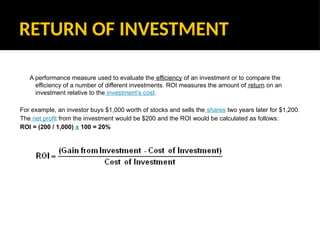
A performance measure used to evaluate the efficiency of an investment or to compare the
efficiency of a number of different investments. ROI measures the amount of return on an
investment relative to the investment’s cost.
For example, an investor buys $1,000 worth of stocks and sells the shares two years later for $1,200.
The net profit from the investment would be $200 and the ROI would be calculated as follows:
ROI = (200 / 1,000) x 100 = 20%
Resources
Cost benefit:
http://www.agecon.purdue.edu/staff/shively/
COURSES/AGEC406/reviews/bca.htm
Life Cycle Costs:
http://www.gsa.gov/portal/content/101197
http://www.wbdg.org/resources/lcca.php
Resources
Present Value:
https://www.youtube.com/watch?v=ks33lMo
xst0&index=3&list=PL9ECA8AEB409B3E4F
Net Present Value:
http://accountingexplained.com/managerial/
capital-budgeting/npv

FINANCIAL PRINCIPLES (1) for CSP Training .pptx

  • 1.
  • 2.
    COST BENEFIT ANALYSIS ◼The benefits of a given situation or business- related action are summed and then the costs associated with taking that action are subtracted. ◼ Can be used to determine if project is economicly viable or compare competing products.
  • 3.
    COST BENEFIT CALCULATIONS ◼Identifyall costs and benefits ◼ Attach a monetary value (maybe a range) ◼ Estimate the future rates of interest and discount the value of the project ◼ Compare the costs and benefits https://www.youtube.com/watch? v=PRmCHu55GrY
  • 4.
    Cost Benefit Calculation- Discounting Discounting - The factor that reflects the future value of $1 in today’s dollars, considering the effects of both inflation and lost return on investment
  • 5.
    Discounting Example For example,suppose that in the example of the dam construction cited above the cost of dam construction ($1.1 million) is incurred at the beginning of the project (t=0), but the benefits ($1.2 million) arise one year later, after the dam is finished (t=1). Suppose the interest rate is 10%. The present value of the benefits are: PV is the present value of the amount invested; Pt is the dollar value of the future amount in time t; r is the discount rate; and t is the year in which Pt is realized.
  • 6.
    LIFE CYCLE COST Life-cyclecost analysis (LCCA) is a method for assessing the total cost of facility ownership. ◼Initial Costs—Purchase, Acquisition, Construction Costs ● Fuel Costs ● Operation, Maintenance, and Repair Costs ● Replacement Costs ● Residual Values—Resale or Salvage Values or Disposal Costs ● Finance Charges—Loan Interest Payments ● Non-Monetary Benefits or Costs
  • 7.
    Life Cycle CostCalculation After identifying all costs by year and amount and discounting them to present value, they are added to arrive at total life-cycle costs for each alternative: LCC = I + Repl — Res + E + W + OM&R + O LCC = Total LCC in present-value (PV) dollars of a given alternative I = PV investment costs (if incurred at base date, they need not be discounted) Repl = PV capital replacement costs Res = PV residual value (resale value, salvage value) less disposal costs E = PV of energy costs W = PV of water costs OM&R = PV of non-fuel operating, maintenance and repair costs O = PV of other costs (e.g., contract costs for ESPCs or UESCs)
  • 8.
    Net Present ValueCalculation Present value - The current worth of a future sum of money or stream of cash flows given a specified rate of return. Future cash flows are discounted at the discount rate, and the higher the discount rate, the lower the present value of the future cash flows. Example: Today $100 1 Year from now $110 PV= 110/(1+0.05)1 PV = $104.76 This assumes a 5% interest rate used as a discount rate.
  • 9.
    NET PRESENT VALUE Thenet present value (NPV) is based on the following two premises: ● Inflation: The purchasing power of a dollar will be less one year from now than it is today. If the rate of inflation is 3 percent for the next 12 months, $1 today will be worth 97 cents just 12 months from today. In other words, 12 months from now, you’ll pay $1 to buy what you paid 97 cents for today. ● Lost return on investment: If you spend money to perform the project being considered, you’ll forego the future income you could earn by investing it conservatively today. For example, if you put $1 in a bank and receive simple interest at the rate of 3 percent compounded annually, 12 months from today you’ll have $1.03 (assuming zero-percent inflation).
  • 10.
    Net Present ValueExample Calculate the net present value of a project which requires an initial investment of $243,000 and it is expected to generate a cash inflow of $50,000 each month for 12 months. Assume that the salvage value of the project is zero. The target rate of return is 12% per annum. Solution We have, Initial Investment = $243,000 Net Cash Inflow per Period = $50,000 Number of Periods = 12 Discount Rate per Period = 12% ÷ 12 = 1% Net Present Value = $50,000 × (1 − (1 + 1%)^-12) ÷ 1% − $243,000 = $50,000 × (1 − 1.01^-12) ÷ 0.01 − $243,000 ≈ $50,000 × (1 − 0.887449) ÷ 0.01 − $243,000 ≈ $50,000 × 0.112551 ÷ 0.01 − $243,000 ≈ $50,000 × 11.2551 − $243,000 ≈ $562,754 − $243,000 ≈ $319,754 Even cash flow: = R × (1 − (1 + i)^-n) ÷ i − Initial investment
  • 11.
    RETURN OF INVESTMENT Aperformance measure used to evaluate the efficiency of an investment or to compare the efficiency of a number of different investments. ROI measures the amount of return on an investment relative to the investment’s cost. For example, an investor buys $1,000 worth of stocks and sells the shares two years later for $1,200. The net profit from the investment would be $200 and the ROI would be calculated as follows: ROI = (200 / 1,000) x 100 = 20%
  • 12.
    Resources Cost benefit: http://www.agecon.purdue.edu/staff/shively/ COURSES/AGEC406/reviews/bca.htm Life CycleCosts: http://www.gsa.gov/portal/content/101197 http://www.wbdg.org/resources/lcca.php
  • 13.