MECHANICAL
QA/QC
COCHIN | BENGALURU WWW.BLITZACADEMY.ORG
Introduction
Quality Assurance (QA) refers to the engineering activities implemented in a quality system so that the
requirements for a product or service will be fulfilled. Quality is the condition achieved when an item,
service, or process meets or exceeds the user’s requirements and expectations. Quality Engineering is
defined as “the branch of engineering which deals with the principles and practice of products service,
qualityassuranceandqualitycontrol.”
QA/QC is the combination of quality assurance, the process or set of processes used to measure and
assure the quality of a product, and its quality control, is usually described as the process of delivering
productsandservicesaspertheconsumerexpectations.
Quality assurance or QA refers to a program for the systematic monitoring and evaluation of the various
aspectsofaproject,service,orfacilitytoensurethatthestandardsofqualityarebeingmet.
Quality control emphasizes testing of products to uncover defects, and reporting to management who
make the decision to allow or deny the release, whereas quality assurance attempts to improve and
stabilize production, and associated processes, to avoid, or at least minimize, issues that led to the
defectsinthefirstplace.
QA/QC course helps to achieve knowledge of quality control processes in Oil &Gas Industry, as also the
imparttraininginvarioustypesofnondestructivetesting
Ensuring Product and Process Quality: Mechanical QA/QC professionals play a critical role in
ensuring that products and processes meet specific standards and requirements.They contribute to
the overall quality and reliability of mechanical components, equipment, and systems, leading to
saferandmoreefficientoperations.
Industry Demand: The demand for skilled QA/QC professionals is often high in industries such as
manufacturing, automotive, aerospace, construction, energy, and more. Companies prioritize quality
tomaintainacompetitiveedge,leadingtoaconstantneedforqualifiedprofessionals.
Job Stability and Growth: As long as mechanical systems and products continue to be essential in
various industries, the need for QA/QC specialists will persist. This can offer a sense of job stability
andpotentialopportunitiesforcareergrowthandadvancement.
Diverse Career Opportunities: Mechanical QA/QC professionals can work in various roles and
industries. They may be involved in inspecting, testing, auditing, developing quality procedures,
analyzing data, and implementing improvements. This diversity allows individuals to explore
differentfacetsofmechanicalengineering.
Contribution to Safety: Mechanical QA/QC specialists are instrumental in ensuring that mechanical
systems and equipment meet safety standards. By preventing and identifying potential flaws or
defects, they contribute to reducing risks and accidents in industries where mechanical components
arecritical.
Global Relevance: Mechanical QA/QC skills are sought after worldwide, allowing professionals to
exploreopportunitiesindifferentcountriesorregionsiftheydesiretoworkinternationally.
Why Choose Mechanical QA/QC ?
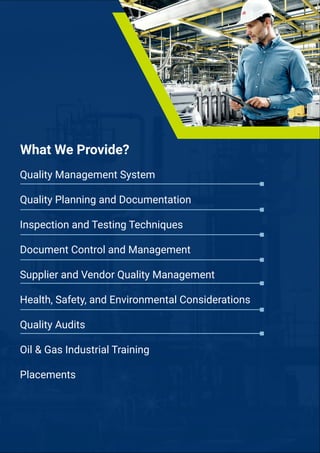
What We Provide?
Quality Management System
Quality Planning and Documentation
Inspection and Testing Techniques
Document Control and Management
Supplier and Vendor Quality Management
Health, Safety, and Environmental Considerations
Quality Audits
Oil & Gas Industrial Training
Placements
Program Structure
The NDT Level II program is a specialized training course designed for Non-Destructive Testing (NDT)
professionals seeking to enhance their skills and knowledge in the field. NDT is a group of testing techniques
used to evaluate the integrity and quality of materials and components without causing damage to the tested
objects. NDT plays a crucial role in various industries, such as aerospace, manufacturing, oil and gas,
construction,andtransportation.
The NDTLevel II program builds upon the foundational principlescovered in the NDTLevel I course and delves
deeper into the inspection methods, techniques, and equipment used in NDT. Participants who have
completed the NDTLevel I training and have acquired practical experience can pursue NDTLevel II to become
certifiedasNDTtechnicianswithmoreadvancedcapabilities.
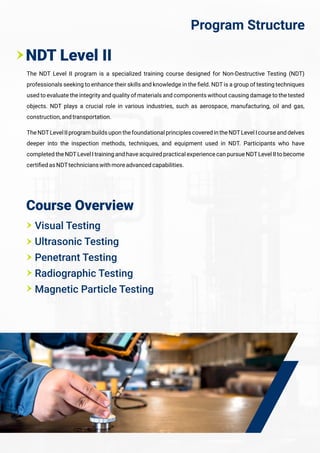
NDT Level II
Course Overview
Visual Testing
Ultrasonic Testing
Penetrant Testing
Radiographic Testing
Magnetic Particle Testing
This course is mainly intended to promote the knowledge and awareness in the field of Piping and inspection.
It provide through training and qualification for piping inspection personnel’s including Technicians,
Inspectors and Engineers called upon to witness, supervise or conduct visual piping inspection activities.The
practical aspects are emphasized by ensuring that theoretical training is complimented with practical
sessionsconcerningthedetailsofpipinginspection.
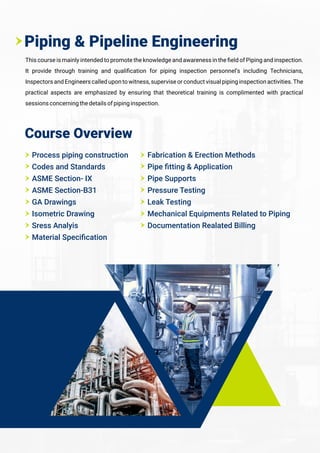
Piping & Pipeline Engineering
Course Overview
Process piping construction
Codes and Standards
ASME Section- IX
ASME Section-B31
GA Drawings
Isometric Drawing
Sress Analyis
Material Specification
Fabrication & Erection Methods
Pipe fitting & Application
Pipe Supports
Pressure Testing
Leak Testing
Mechanical Equipments Related to Piping
Documentation Realated Billing
Witness and monitor contractors material handling, welding activities, inspection and testin accordance with
the approved Quality Plan, ITP, WPS, Quality Procedures and etc. Ensure contractors welders are aware of
relevant,uptodatecodes,standards,specifications and drawings.
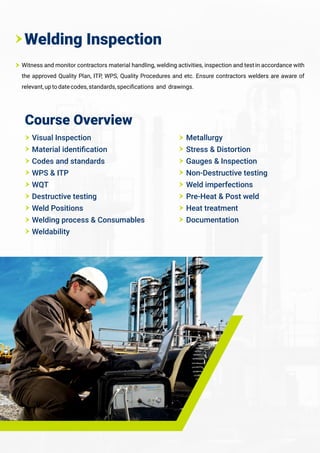
Welding Inspection
Course Overview
Visual Inspection
Material identification
Codes and standards
WPS & ITP
WQT
Destructive testing
Weld Positions
Welding process & Consumables
Weldability
Metallurgy
Stress & Distortion
Gauges & Inspection
Non-Destructive testing
Weld imperfections
Pre-Heat & Post weld
Heat treatment
Documentation
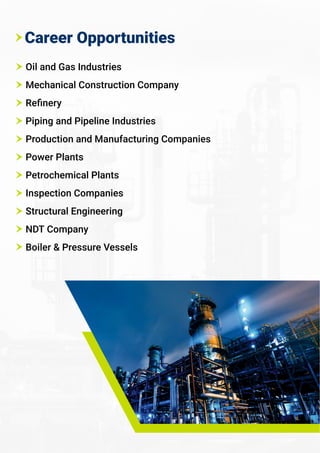
Career Opportunities
Oil and Gas Industries
Mechanical Construction Company
Refinery
Piping and Pipeline Industries
Production and Manufacturing Companies
Power Plants
Petrochemical Plants
Inspection Companies
Structural Engineering
NDT Company
Boiler & Pressure Vessels
+91 9061 106 007, 9061 903 007
info@blitzacademy.org www.blitzacademy.org
MG ROAD - Perumpillil Building, Mahatma Gandhi Rd, KPCC Junction
Opp Maharaja's Ground, Ernakulam, Kerala 682011
ERNAKULAM NORTH - 41/2553-D, 2nd Floor Metro Palace,
Opp.North Railway Station, Ernakulam 602018
BANGALORE
CORPORATE OFFICE - 3rd Floor, No.48, 100 Feet Road, Near Sony Signal
4th Block, Koramangala, Banglore-560034
ERNAKULAM

Mechanical courses in kerala | Blitz Academy

  • 1.
  • 2.
    Introduction Quality Assurance (QA)refers to the engineering activities implemented in a quality system so that the requirements for a product or service will be fulfilled. Quality is the condition achieved when an item, service, or process meets or exceeds the user’s requirements and expectations. Quality Engineering is defined as “the branch of engineering which deals with the principles and practice of products service, qualityassuranceandqualitycontrol.” QA/QC is the combination of quality assurance, the process or set of processes used to measure and assure the quality of a product, and its quality control, is usually described as the process of delivering productsandservicesaspertheconsumerexpectations. Quality assurance or QA refers to a program for the systematic monitoring and evaluation of the various aspectsofaproject,service,orfacilitytoensurethatthestandardsofqualityarebeingmet. Quality control emphasizes testing of products to uncover defects, and reporting to management who make the decision to allow or deny the release, whereas quality assurance attempts to improve and stabilize production, and associated processes, to avoid, or at least minimize, issues that led to the defectsinthefirstplace. QA/QC course helps to achieve knowledge of quality control processes in Oil &Gas Industry, as also the imparttraininginvarioustypesofnondestructivetesting
  • 3.
    Ensuring Product andProcess Quality: Mechanical QA/QC professionals play a critical role in ensuring that products and processes meet specific standards and requirements.They contribute to the overall quality and reliability of mechanical components, equipment, and systems, leading to saferandmoreefficientoperations. Industry Demand: The demand for skilled QA/QC professionals is often high in industries such as manufacturing, automotive, aerospace, construction, energy, and more. Companies prioritize quality tomaintainacompetitiveedge,leadingtoaconstantneedforqualifiedprofessionals. Job Stability and Growth: As long as mechanical systems and products continue to be essential in various industries, the need for QA/QC specialists will persist. This can offer a sense of job stability andpotentialopportunitiesforcareergrowthandadvancement. Diverse Career Opportunities: Mechanical QA/QC professionals can work in various roles and industries. They may be involved in inspecting, testing, auditing, developing quality procedures, analyzing data, and implementing improvements. This diversity allows individuals to explore differentfacetsofmechanicalengineering. Contribution to Safety: Mechanical QA/QC specialists are instrumental in ensuring that mechanical systems and equipment meet safety standards. By preventing and identifying potential flaws or defects, they contribute to reducing risks and accidents in industries where mechanical components arecritical. Global Relevance: Mechanical QA/QC skills are sought after worldwide, allowing professionals to exploreopportunitiesindifferentcountriesorregionsiftheydesiretoworkinternationally. Why Choose Mechanical QA/QC ?
  • 4.
    What We Provide? QualityManagement System Quality Planning and Documentation Inspection and Testing Techniques Document Control and Management Supplier and Vendor Quality Management Health, Safety, and Environmental Considerations Quality Audits Oil & Gas Industrial Training Placements
  • 5.
    Program Structure The NDTLevel II program is a specialized training course designed for Non-Destructive Testing (NDT) professionals seeking to enhance their skills and knowledge in the field. NDT is a group of testing techniques used to evaluate the integrity and quality of materials and components without causing damage to the tested objects. NDT plays a crucial role in various industries, such as aerospace, manufacturing, oil and gas, construction,andtransportation. The NDTLevel II program builds upon the foundational principlescovered in the NDTLevel I course and delves deeper into the inspection methods, techniques, and equipment used in NDT. Participants who have completed the NDTLevel I training and have acquired practical experience can pursue NDTLevel II to become certifiedasNDTtechnicianswithmoreadvancedcapabilities. NDT Level II Course Overview Visual Testing Ultrasonic Testing Penetrant Testing Radiographic Testing Magnetic Particle Testing
  • 6.
    This course ismainly intended to promote the knowledge and awareness in the field of Piping and inspection. It provide through training and qualification for piping inspection personnel’s including Technicians, Inspectors and Engineers called upon to witness, supervise or conduct visual piping inspection activities.The practical aspects are emphasized by ensuring that theoretical training is complimented with practical sessionsconcerningthedetailsofpipinginspection. Piping & Pipeline Engineering Course Overview Process piping construction Codes and Standards ASME Section- IX ASME Section-B31 GA Drawings Isometric Drawing Sress Analyis Material Specification Fabrication & Erection Methods Pipe fitting & Application Pipe Supports Pressure Testing Leak Testing Mechanical Equipments Related to Piping Documentation Realated Billing
  • 7.
    Witness and monitorcontractors material handling, welding activities, inspection and testin accordance with the approved Quality Plan, ITP, WPS, Quality Procedures and etc. Ensure contractors welders are aware of relevant,uptodatecodes,standards,specifications and drawings. Welding Inspection Course Overview Visual Inspection Material identification Codes and standards WPS & ITP WQT Destructive testing Weld Positions Welding process & Consumables Weldability Metallurgy Stress & Distortion Gauges & Inspection Non-Destructive testing Weld imperfections Pre-Heat & Post weld Heat treatment Documentation
  • 8.
    Career Opportunities Oil andGas Industries Mechanical Construction Company Refinery Piping and Pipeline Industries Production and Manufacturing Companies Power Plants Petrochemical Plants Inspection Companies Structural Engineering NDT Company Boiler & Pressure Vessels
  • 9.
    +91 9061 106007, 9061 903 007 info@blitzacademy.org www.blitzacademy.org MG ROAD - Perumpillil Building, Mahatma Gandhi Rd, KPCC Junction Opp Maharaja's Ground, Ernakulam, Kerala 682011 ERNAKULAM NORTH - 41/2553-D, 2nd Floor Metro Palace, Opp.North Railway Station, Ernakulam 602018 BANGALORE CORPORATE OFFICE - 3rd Floor, No.48, 100 Feet Road, Near Sony Signal 4th Block, Koramangala, Banglore-560034 ERNAKULAM