The Growth of Bacterial Cultures
Ways of monitoring and measuring
growth, directly and indirectly
Prof. Dr. Mohammad Minnatul karim
Department of Biotechnology and Genetic Engineering
Islamic University, Kushtia
Reproduction in Prokaryotes
• Bacteria normally reproduce through
Binary fission
• There are a few bacterial species that
reproduce through Budding,Conidiospores
(actinomycetes), or by Fragmentation
Binary Fission
Figure 6.11
Figure 6.12b
Generation Time
-Time required for cell to divide (and its population to double)
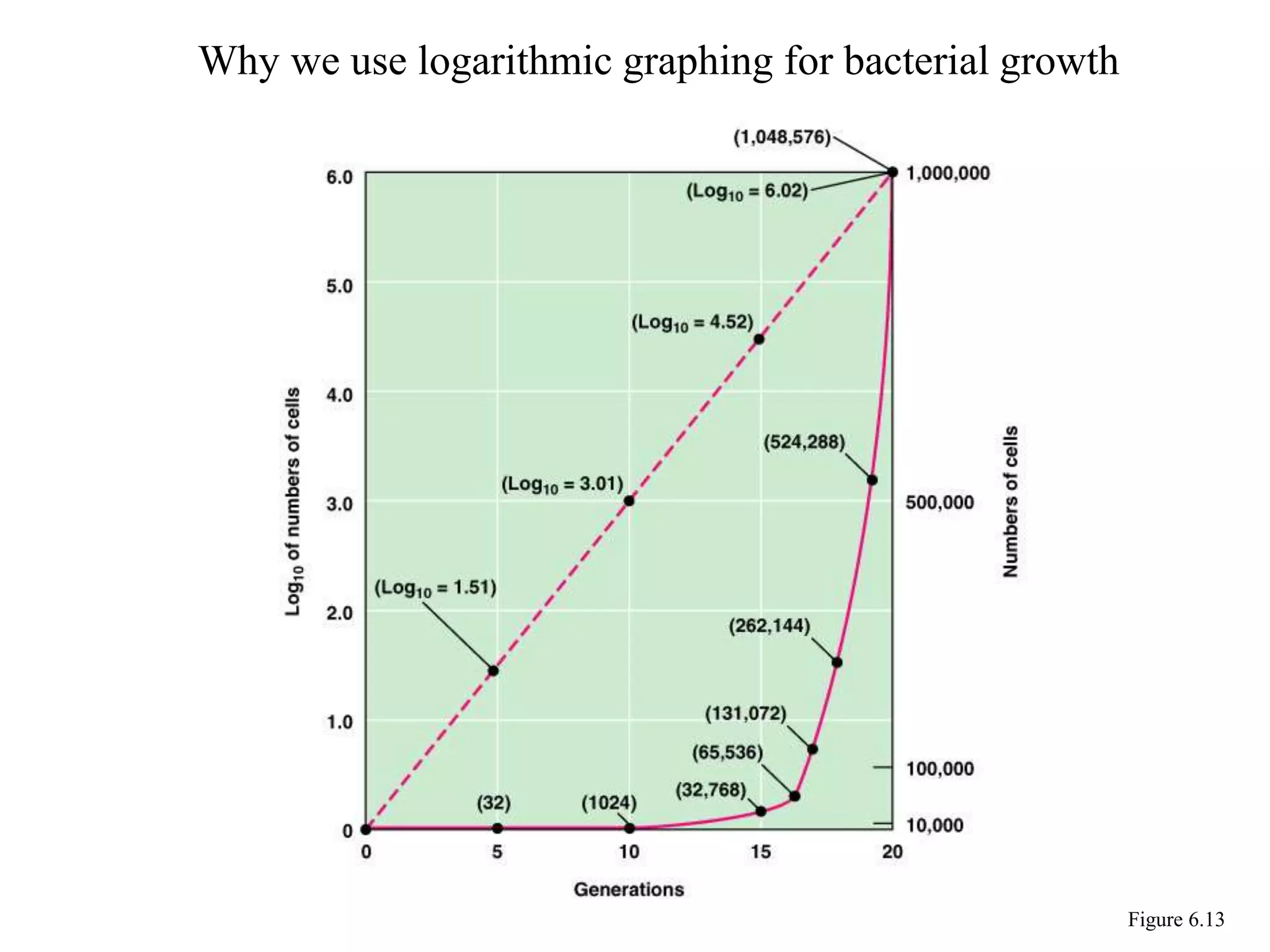
Figure 6.13
Why we use logarithmic graphing for bacterial growth
Calculations
• If 5 cells were allowed to divide 9 times
Then, 5 x 29 = 2560 cells
• To calculate the number of generations, you need to
convert into logarithms. The log of 2 (0.301) is used
because one cell divides into two
If 100 cells growing for 5 hours produced
1,720,320 cells:
= log 1,720,320 – log 100 = 6.2356 - 2 =14 generations
0.301 0.301
= 60 minutes x 5 hours = 21minutes/generation
14 generations
*These calculations are useful to compare growth conditions
Figure 6.14
Phases of Growth
Direct Measurements of Microbial
Growth
• Plate Counts
• Filtration
• Direct Microscopic Count
Direct Measurements of Microbial
Growth
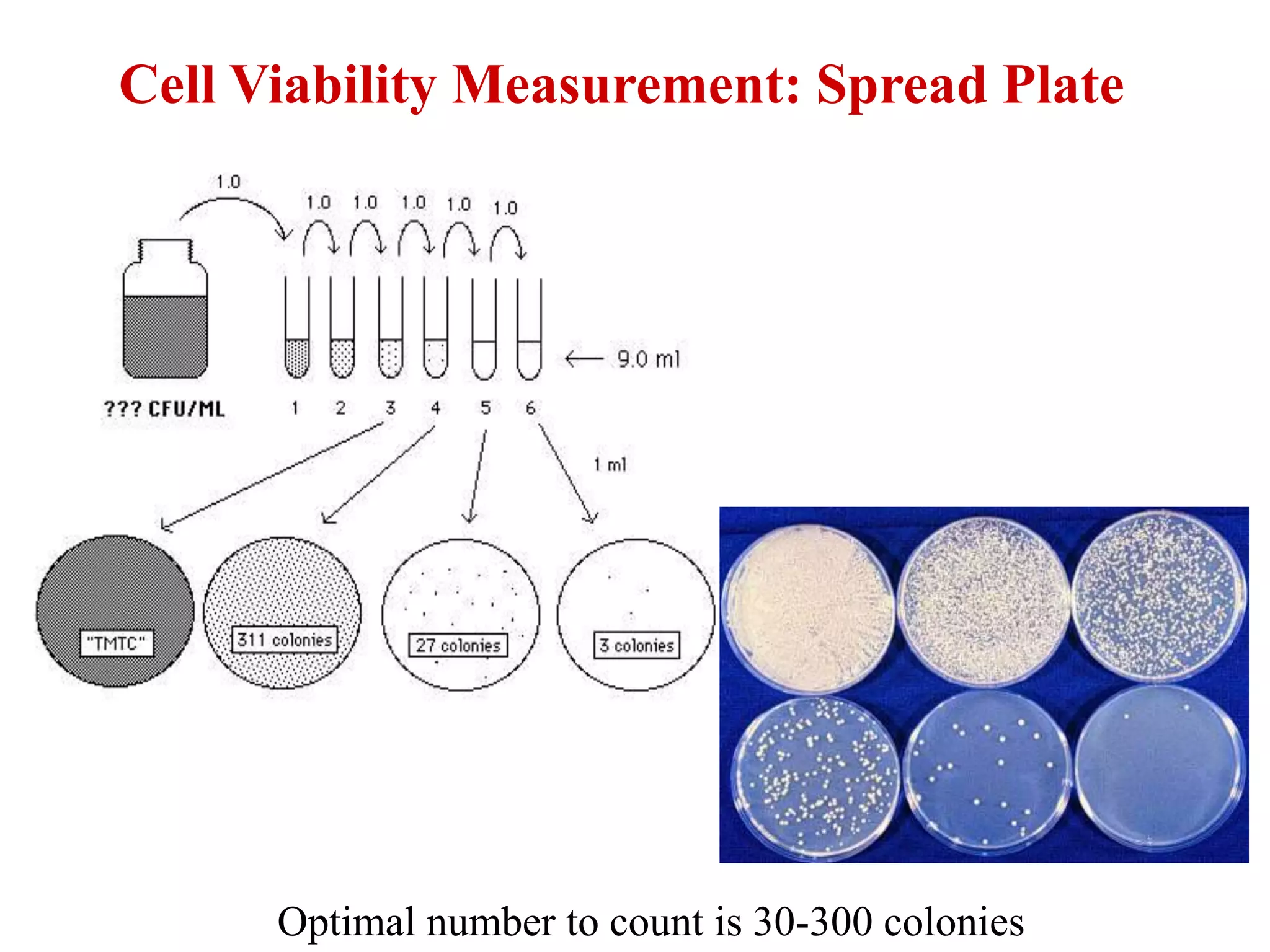
• Plate Counts: Perform serial dilutions of a
sample
Figure 6.15, top portion
Plate Count
• Inoculate Petri
plates from
serial dilutions
Figure 6.16
Plate Count
• After incubation, count colonies on plates that
have 25-250 colonies (CFUs)
Figure 6.15
Bacterial Lawn
Optimal number to count is 30-300 colonies
Cell Viability Measurement: Spread Plate
Direct Measurements of Microbial
Growth
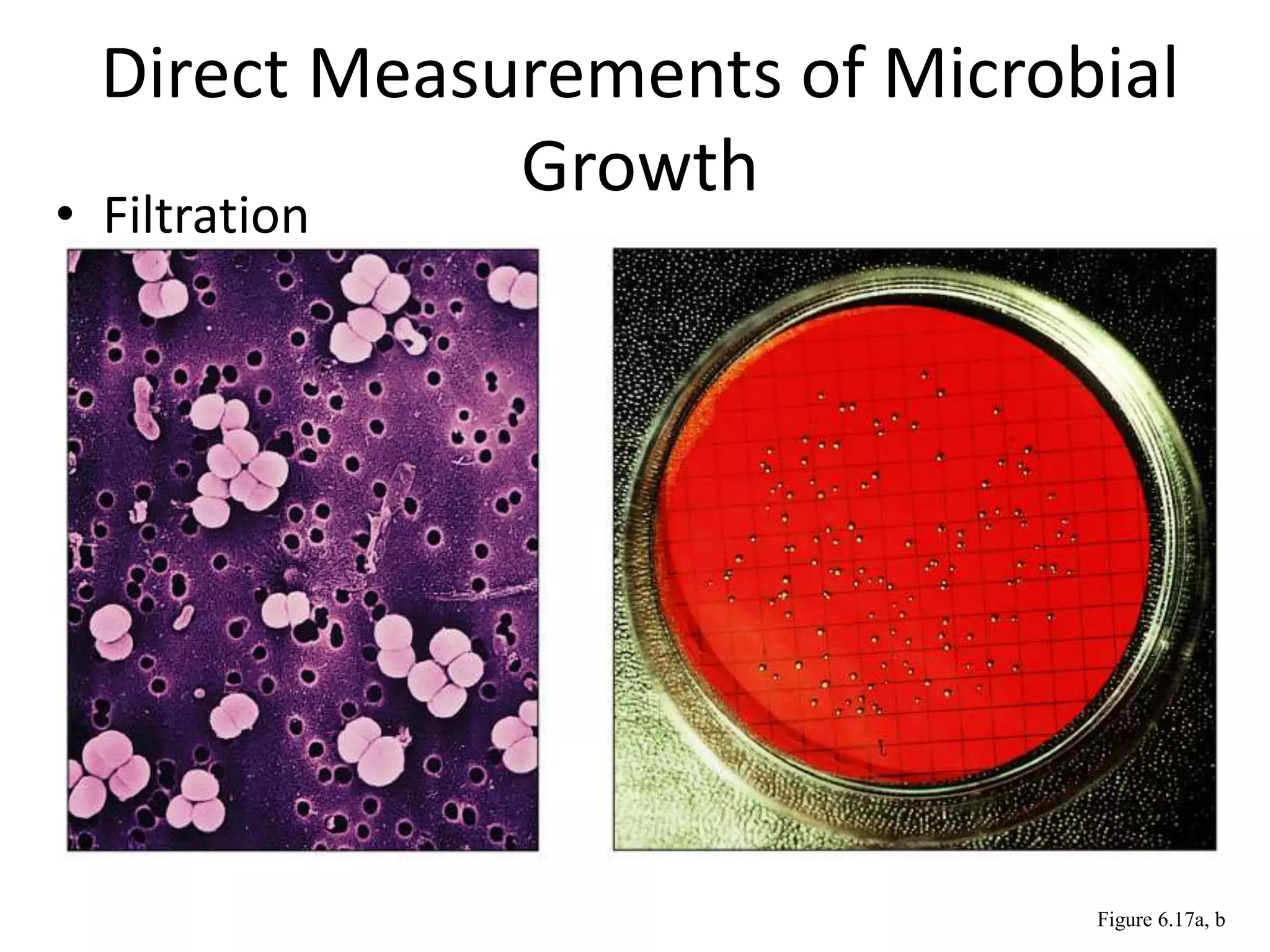
• Filtration
Figure 6.17a, b
Direct Measurements of Microbial Growth
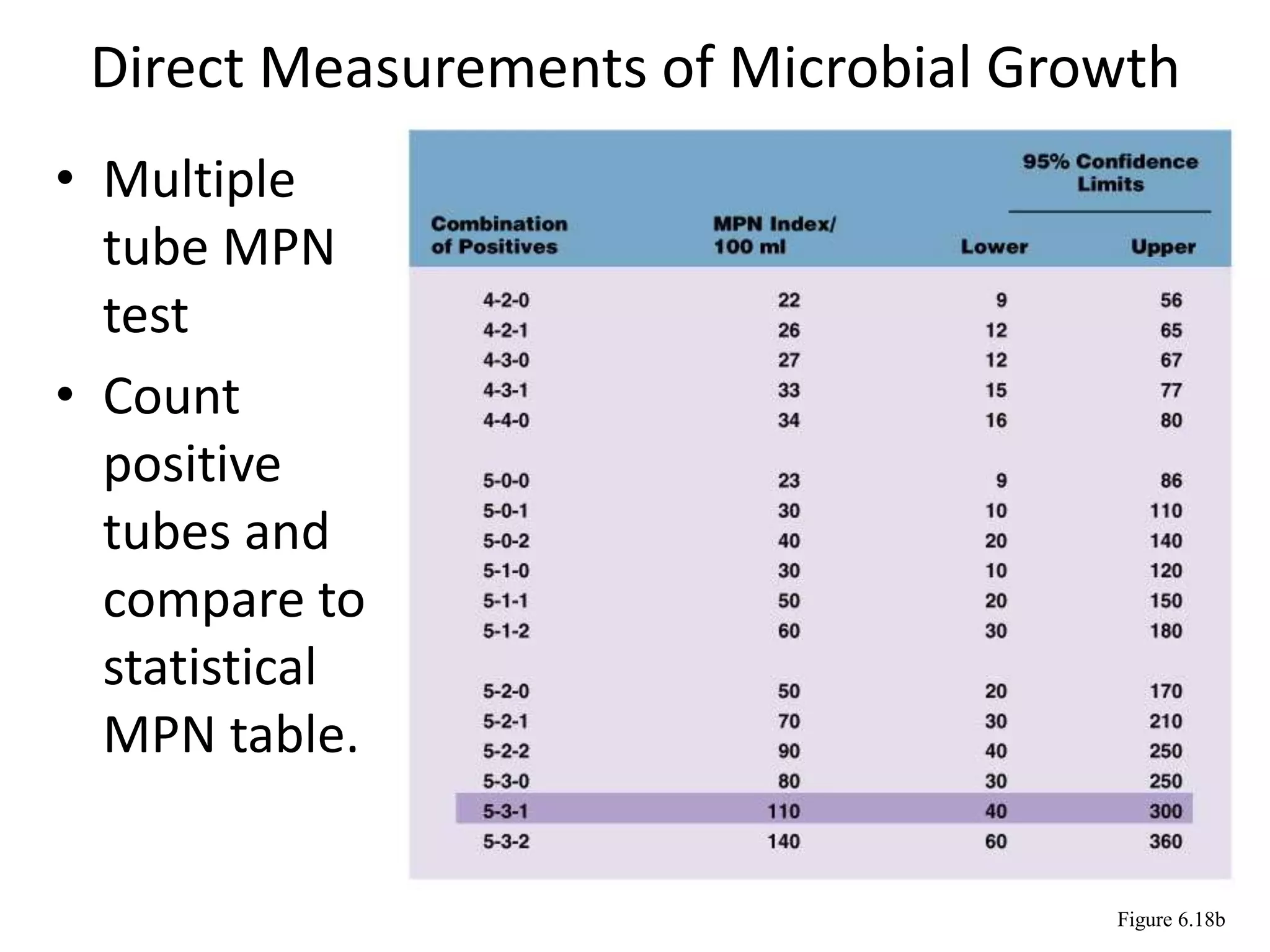
• Multiple
tube MPN
test
• Count
positive
tubes and
compare to
statistical
MPN table.
Figure 6.18b
Direct Measurements of Microbial
Growth
Figure 6.19
Direct Measurements of Microbial
Growth
• Direct Microscopic Count
Indirect Measurements of Microbial
Growth
• Turbidity
• Metabolic Activity
• Dry weight
Estimating Bacterial Numbers by
Indirect Methods
• Turbidity
Figure 620
600nm to measure Pichia growth
Optical Density Measurement
Estimating Bacterial Numbers by Indirect
Methods
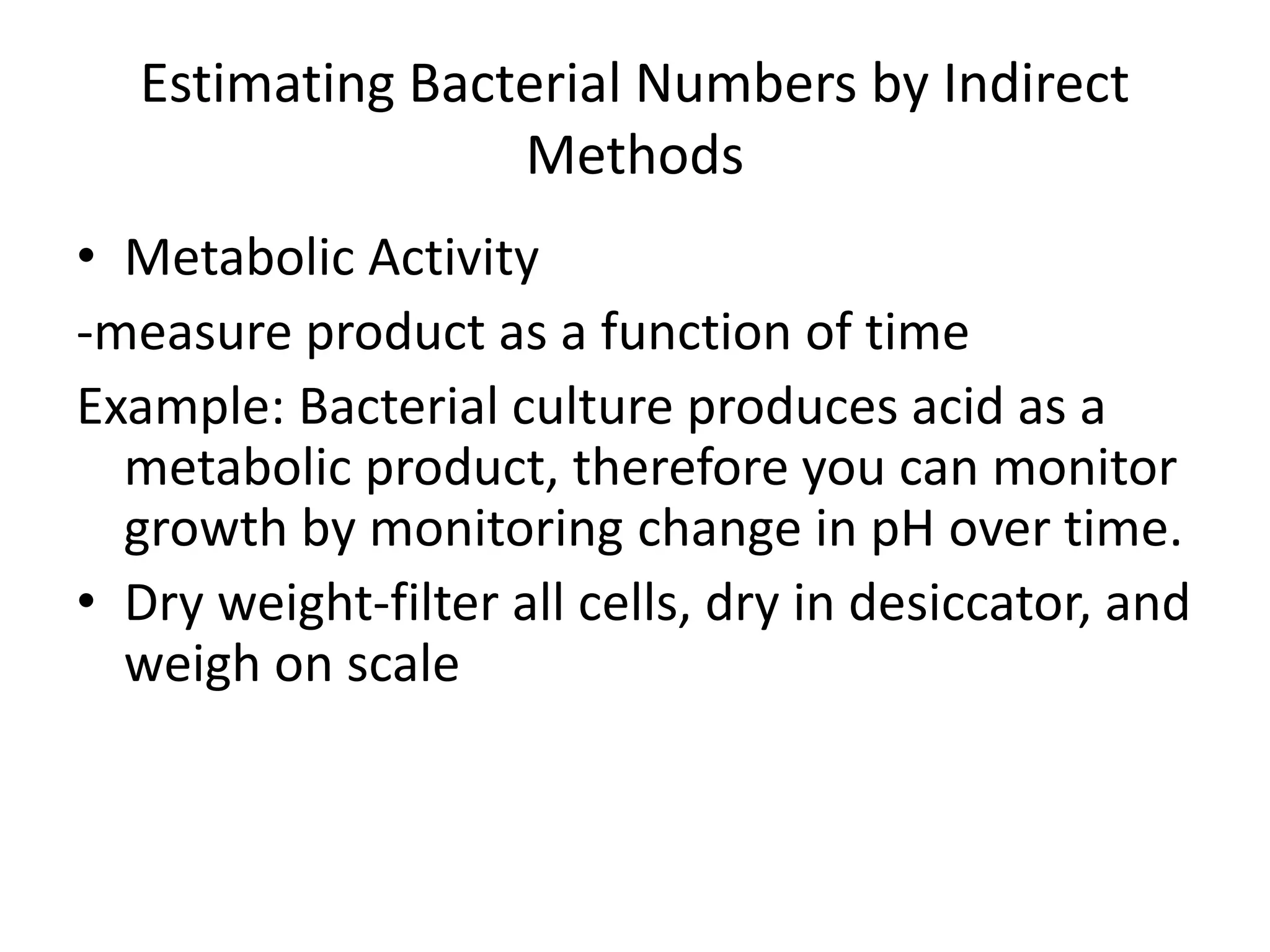
• Metabolic Activity
-measure product as a function of time
Example: Bacterial culture produces acid as a
metabolic product, therefore you can monitor
growth by monitoring change in pH over time.
• Dry weight-filter all cells, dry in desiccator, and
weigh on scale

Measuring Microbial Growth.ppt

  • 1.
    The Growth ofBacterial Cultures Ways of monitoring and measuring growth, directly and indirectly Prof. Dr. Mohammad Minnatul karim Department of Biotechnology and Genetic Engineering Islamic University, Kushtia
  • 2.
    Reproduction in Prokaryotes •Bacteria normally reproduce through Binary fission • There are a few bacterial species that reproduce through Budding,Conidiospores (actinomycetes), or by Fragmentation
  • 3.
  • 4.
    Figure 6.12b Generation Time -Timerequired for cell to divide (and its population to double)
  • 5.
    Figure 6.13 Why weuse logarithmic graphing for bacterial growth
  • 6.
    Calculations • If 5cells were allowed to divide 9 times Then, 5 x 29 = 2560 cells • To calculate the number of generations, you need to convert into logarithms. The log of 2 (0.301) is used because one cell divides into two
  • 7.
    If 100 cellsgrowing for 5 hours produced 1,720,320 cells: = log 1,720,320 – log 100 = 6.2356 - 2 =14 generations 0.301 0.301 = 60 minutes x 5 hours = 21minutes/generation 14 generations *These calculations are useful to compare growth conditions
  • 8.
  • 9.
    Direct Measurements ofMicrobial Growth • Plate Counts • Filtration • Direct Microscopic Count
  • 10.
    Direct Measurements ofMicrobial Growth • Plate Counts: Perform serial dilutions of a sample Figure 6.15, top portion
  • 11.
    Plate Count • InoculatePetri plates from serial dilutions Figure 6.16
  • 12.
    Plate Count • Afterincubation, count colonies on plates that have 25-250 colonies (CFUs) Figure 6.15 Bacterial Lawn
  • 13.
    Optimal number tocount is 30-300 colonies Cell Viability Measurement: Spread Plate
  • 14.
    Direct Measurements ofMicrobial Growth • Filtration Figure 6.17a, b
  • 15.
    Direct Measurements ofMicrobial Growth • Multiple tube MPN test • Count positive tubes and compare to statistical MPN table. Figure 6.18b
  • 16.
    Direct Measurements ofMicrobial Growth Figure 6.19
  • 17.
    Direct Measurements ofMicrobial Growth • Direct Microscopic Count
  • 18.
    Indirect Measurements ofMicrobial Growth • Turbidity • Metabolic Activity • Dry weight
  • 19.
    Estimating Bacterial Numbersby Indirect Methods • Turbidity Figure 620
  • 20.
    600nm to measurePichia growth Optical Density Measurement
  • 21.
    Estimating Bacterial Numbersby Indirect Methods • Metabolic Activity -measure product as a function of time Example: Bacterial culture produces acid as a metabolic product, therefore you can monitor growth by monitoring change in pH over time. • Dry weight-filter all cells, dry in desiccator, and weigh on scale