ALIVIE R. ABASCAR
MAED-TSCI I
MEASURING BIODIVERSITY
Biodiversity is the greatest treasure we have…
Its diminishment is to be prevented at all cost.
OBJECTIVES
a. Identify the concepts
of biodiversity.
b. Explain the method
that would be used to
analyze the biodiversity
in the area.
2
c. Realize the
importance of
biodiversity in daily life
setting.
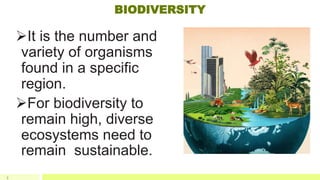
BIODIVERSITY
It is the number and
variety of organisms
found in a specific
region.
For biodiversity to
remain high, diverse
ecosystems need to
remain sustainable.
3
Figure 3.1A This newly discovered shark “walks” along
the bottom of the ocean in 2006
4
Figure 3.1B In 2007, It is one of the species of orchids
found in Vietnam
How many species are there on Earth?
Scientists have
identified about 2
million species.
Estimates of the
total number of
species on Earth
range from 5 million
to 100 million
5
Key Terms
Biodiversityis all
the different kinds of
life you'll find in one
area—the variety of
animals, plants,
fungi, and even
microorganisms like
bacteria that make
up our natural world.
6
Protect is to
guard legally from
harm a species
that is listed as
endangered,
threatened, or of
special concern
Biodiversity
hotspots are regions
that contain a high level
of species diversity,
many endemic species
(species not found
anywhere else in the
world) and a significant
number of threatened
or endangered species.
How Do Scientists Measure Biodiversity?
CANOPY
FOGGING
7
Is an effective way of
collecting information about
the biodiversity of insects.
A low dose of insecticide is
sprayed up into the top of a
tree. When the insects fall,
they are collected on a
large screen, shaped like a
funnel.
How Do Scientists Measure Biodiversity?
8
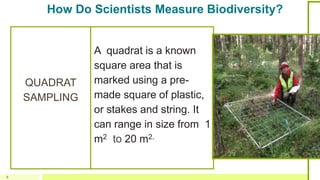
A quadrat is a known
square area that is
marked using a pre-
made square of plastic,
or stakes and string. It
can range in size from 1
m2 to 20 m2.
QUADRAT
SAMPLING
How Do Scientists Measure Biodiversity?
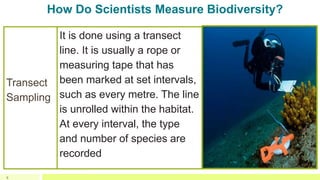
Transect
Sampling
9
It is done using a transect
line. It is usually a rope or
measuring tape that has
been marked at set intervals,
such as every metre. The line
is unrolled within the habitat.
At every interval, the type
and number of species are
recorded
How Do Scientists Measure Biodiversity?
Netting
10
Fine mesh nets are used to
capture birds and bats in
terrestrial ecosystem, and
fish and other organisms in
aquatic ecosystem.
Documenting Biodiversity and Its Distribution
• Museums house many
collections of preserved
specimens, such as the insects
11
Figure 3.2 Biological collections housed in the museum
have helped ecologists catalogue Earth’s species.
The Royal Ontario Museum
inToronto
The Canadian Museum
of Nature
12 4/21/2024 Add a footer
Canada’s Biodiversity
A large country with
many aquatic and
terrestrial
ecosystem, is home
to thousands of
species.
Figure 3.3A
Red Mulberry
Tree
Figure 3.3 B
Peary Caribou
It is a place where there is an exceptionally large number of
species in a relatively small area. Hotspots in Canada
include Carolinian Canada and the Leitrim Wetlands, both in
Ontario.
13 4/21/2024 Add a footer
Hotspots of Biodiversity
 most of the biosphere’s diversity hotspots are in the
tropics of South America, Africa, and Asia.
 In tropical East Africa, Lake Malawi is home to
about 1000 species of fish, many of which can
be found only in this lake. Lake Malawi has
about the same area as Lake Erie, which is
home to about 150 fish species.
14 4/21/2024 Add a footer
Biodiversity in the Tropics
Biodiversity Index
• Scientists can calculate the biodiversity index of an ecosystem
using a simple formula. The closer the biodiversity index is to
1, the higher the biodiversity of the ecosystem is.
Materials:
Model ecosystem provided
Procedure:
1. Choose one model ecosystem. Each colour of bead
represents a different species. Count the number of different
species in the ecosystem. Then count the number of individuals
of each species. Calculate the total number of organisms in the
ecosystem.
15 4/21/2024 Add a footer
Biodiversity Index
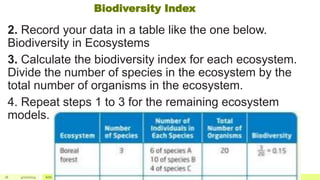
2. Record your data in a table like the one below.
Biodiversity in Ecosystems
3. Calculate the biodiversity index for each ecosystem.
Divide the number of species in the ecosystem by the
total number of organisms in the ecosystem.
4. Repeat steps 1 to 3 for the remaining ecosystem
models.
16 4/21/2024 Add a footer

Measuring Biodiversity.pptx_Methods&processes

  • 1.
    ALIVIE R. ABASCAR MAED-TSCII MEASURING BIODIVERSITY Biodiversity is the greatest treasure we have… Its diminishment is to be prevented at all cost.
  • 2.
    OBJECTIVES a. Identify theconcepts of biodiversity. b. Explain the method that would be used to analyze the biodiversity in the area. 2 c. Realize the importance of biodiversity in daily life setting.
  • 3.
    BIODIVERSITY It is thenumber and variety of organisms found in a specific region. For biodiversity to remain high, diverse ecosystems need to remain sustainable. 3
  • 4.
    Figure 3.1A Thisnewly discovered shark “walks” along the bottom of the ocean in 2006 4 Figure 3.1B In 2007, It is one of the species of orchids found in Vietnam
  • 5.
    How many speciesare there on Earth? Scientists have identified about 2 million species. Estimates of the total number of species on Earth range from 5 million to 100 million 5
  • 6.
    Key Terms Biodiversityis all thedifferent kinds of life you'll find in one area—the variety of animals, plants, fungi, and even microorganisms like bacteria that make up our natural world. 6 Protect is to guard legally from harm a species that is listed as endangered, threatened, or of special concern Biodiversity hotspots are regions that contain a high level of species diversity, many endemic species (species not found anywhere else in the world) and a significant number of threatened or endangered species.
  • 7.
    How Do ScientistsMeasure Biodiversity? CANOPY FOGGING 7 Is an effective way of collecting information about the biodiversity of insects. A low dose of insecticide is sprayed up into the top of a tree. When the insects fall, they are collected on a large screen, shaped like a funnel.
  • 8.
    How Do ScientistsMeasure Biodiversity? 8 A quadrat is a known square area that is marked using a pre- made square of plastic, or stakes and string. It can range in size from 1 m2 to 20 m2. QUADRAT SAMPLING
  • 9.
    How Do ScientistsMeasure Biodiversity? Transect Sampling 9 It is done using a transect line. It is usually a rope or measuring tape that has been marked at set intervals, such as every metre. The line is unrolled within the habitat. At every interval, the type and number of species are recorded
  • 10.
    How Do ScientistsMeasure Biodiversity? Netting 10 Fine mesh nets are used to capture birds and bats in terrestrial ecosystem, and fish and other organisms in aquatic ecosystem.
  • 11.
    Documenting Biodiversity andIts Distribution • Museums house many collections of preserved specimens, such as the insects 11 Figure 3.2 Biological collections housed in the museum have helped ecologists catalogue Earth’s species. The Royal Ontario Museum inToronto The Canadian Museum of Nature
  • 12.
    12 4/21/2024 Adda footer Canada’s Biodiversity A large country with many aquatic and terrestrial ecosystem, is home to thousands of species. Figure 3.3A Red Mulberry Tree Figure 3.3 B Peary Caribou
  • 13.
    It is aplace where there is an exceptionally large number of species in a relatively small area. Hotspots in Canada include Carolinian Canada and the Leitrim Wetlands, both in Ontario. 13 4/21/2024 Add a footer Hotspots of Biodiversity
  • 14.
     most ofthe biosphere’s diversity hotspots are in the tropics of South America, Africa, and Asia.  In tropical East Africa, Lake Malawi is home to about 1000 species of fish, many of which can be found only in this lake. Lake Malawi has about the same area as Lake Erie, which is home to about 150 fish species. 14 4/21/2024 Add a footer Biodiversity in the Tropics
  • 15.
    Biodiversity Index • Scientistscan calculate the biodiversity index of an ecosystem using a simple formula. The closer the biodiversity index is to 1, the higher the biodiversity of the ecosystem is. Materials: Model ecosystem provided Procedure: 1. Choose one model ecosystem. Each colour of bead represents a different species. Count the number of different species in the ecosystem. Then count the number of individuals of each species. Calculate the total number of organisms in the ecosystem. 15 4/21/2024 Add a footer
  • 16.
    Biodiversity Index 2. Recordyour data in a table like the one below. Biodiversity in Ecosystems 3. Calculate the biodiversity index for each ecosystem. Divide the number of species in the ecosystem by the total number of organisms in the ecosystem. 4. Repeat steps 1 to 3 for the remaining ecosystem models. 16 4/21/2024 Add a footer

Editor's Notes

  • #4 Biodiversity is the mix of different animals, plants, fungi, and microorganisms that make up our natural world[2]. For example, a forest containing many types of trees, dozens of bird species, and both big and small mammals, is described as having high biodiversity.
  • #7 Each of these species and organisms work together in ecosystems, like an intricate web, to maintain balance and support life.
  • #9 Each of these species and organisms work together in ecosystems, like an intricate web, to maintain balance and support life.
  • #10 Each of these species and organisms work together in ecosystems, like an intricate web, to maintain balance and support life.
  • #11 Each of these species and organisms work together in ecosystems, like an intricate web, to maintain balance and support life.