Learning Objectives
LESSO
N 1
LESSO
N1
• Explain the importance of standard system
of measurement;
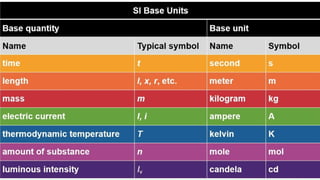
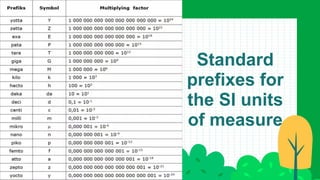
• Discuss the S.I. Units; and
• Solve problems involving conversion of units.
At the end of the 60-minute discussion, the Grade 12
students should be able to:
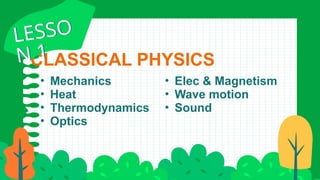
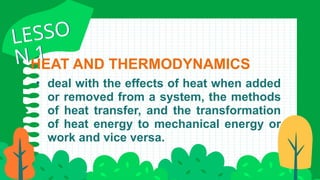
HEAT AND THERMODYNAMICS
•deal with the effects of heat when added
or removed from a system, the methods
of heat transfer, and the transformation
of heat energy to mechanical energy or
work and vice versa.
LESSO
N 1
LESSO
N 1
12.
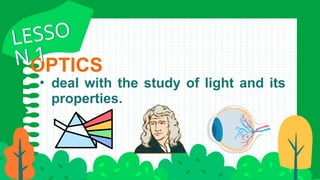
OPTICS
• deal withthe study of light and its
properties.
LESSO
N 1
LESSO
N 1
13.
ELECTRICITY AND MAGNETISM
•deals with phenomena associated with
electrical charges, magnetism, and the
relationship between electricity and
magnetism.
LESSO
N 1
LESSO
N 1
14.
• deals withproperties, transmission,
and perception of different types of
waves.
WAVE MOTION AND SOUND
LESSO
N 1
LESSO
N 1
15.
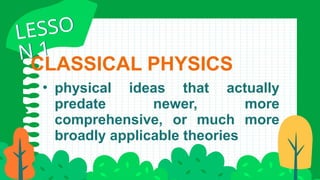
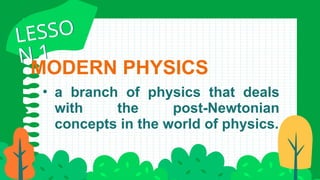
MODERN PHYSCIS
• NuclearPhysics
• General and Special Relativity
• Particle Physics
• Quantum Mechanics
LESSO
N 1
LESSO
N 1
16.
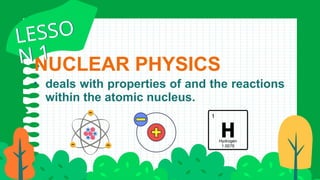
NUCLEAR PHYSICS
• dealswith properties of and the reactions
within the atomic nucleus.
LESSO
N 1
LESSO
N 1
17.
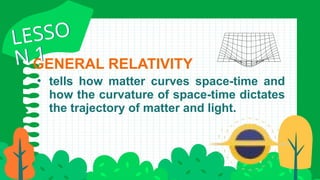
• tells howmatter curves space-time and
how the curvature of space-time dictates
the trajectory of matter and light.
GENERAL RELATIVITY
LESSO
N 1
LESSO
N 1
18.
• deals withphenomena associated when
an object moves with speed
approaching the speed of light in
vacuum.
SPECIAL RELATIVITY
LESSO
N 1
LESSO
N 1
19.
• deals withthe building blocks of
matter called elementary particles.
PARTICLE PHYSICS
LESSO
N 1
LESSO
N 1
20.
• deals withthe nature and behavior of matter
and energy on the atomic and subatomic
levels.
QUANTUM MECHANICS
LESSO
N 1
LESSO
N 1
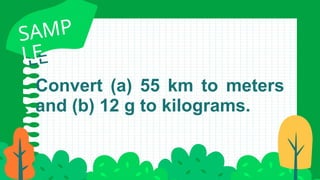
Convert (a) 55km to meters
and (b) 12 g to kilograms.
SAMP
LE
SAMP
LE
35.
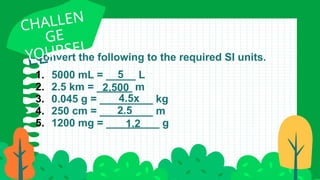
Convert the followingto the required SI units.
SAMP
LE
CHALLEN
GE
YOURSEL
F
1. 5000 mL = _____ L
2. 2.5 km = ______ m
3. 0.045 g = _________ kg
4. 250 cm = _________ m
5. 1200 mg = _________ g
5
2,500
4.5x
1.2
2.5