Physics 201
General Physics
Topics to be covered:
Kinematics, dynamics, statics, fluids,
elasticity, oscillations:
Prof. Tao Han
Prof. Marshall Onellion
Course information
• Course homepage
•  Let’s have a quick look:
• http://www.physics.wisc.edu/undergrads/courses/
spring10/201/
– Find there detailed information on syllabus, homework,
exams, grading, discussion, labs
• Syllabus:
– Lectures: Typically 1 Chapter per week from textbook
– Two discussion sessions, One lab each week
– One homework (Always due on Tuesdays at midnight)
- Three midterm exams + the Final
Textbook, e-book and WebAssign
• The textbook is available in electronic form as an
e-book.
– Paul Tipler and Gene Mosca,
Physics for Scientists and Engineers, 6th ed.
– You can read it from any computer with access to
internet. http://webassign.net/login.html.
– This is by far the cheapest solution. If you like to buy it in real
paper, it is also available as softcover in 2 volumes
(this course covers the 1st volume)
• WebAssign:
– This is our homework assignment system. Problems are taken from the
textbook but numbers are randomized.
–  Let’s have a quick look into WebAssign:
– Intro to WebAssign
– Student Guide to WebAssign
©2008 by W.H. Freeman and Company
Your Discussions: twice a week.
Labs: Once a week.
with Your TA’s:
Our team of Teaching Assistants will be your instructors in
discussions and labs:
Sections Your TA
--------------------------------
• 301 305 Yip, Stephen
• 302 312 Cho, Junghun
• 303 306 Dong, Zhe
• 304 310 Liu, Zhen
• 307 309 Schroeder, Daniel
There will be 12 hrs/week
See course web for time and room.
Physics is basic Science,
that includes “everything”
Mechanics: (this term’s topics)
Motion, forces, balance, energy, fluids, oscillations…
Optics:
Light, mirrors/lenses, cameras, Micro/Telescopes, Lasers.
Electricity & Magnetism:
Charges, currents, fields, thunders, radio/TV’s, heat …
Atomic, nuclear, elementary particles:
Microscopic world, basic building blocks/forces, HEP …
©2008 by W.H. Freeman and Company
Nature of Science -
Theory  Observation
Theories are made to explain observations.
Theories will make predictions (they are testable).
Observations and experiments are used to test
if the prediction is accurate.
The cycle continues for science advancement.
In history, physics and astronomy have set the ground
rules of modern science.
©2008 by W.H. Freeman and Company
Example: Determination of the Earth diameter by
Eratosthenes (276 BC– 195 BC)
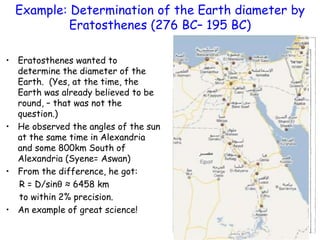
• Eratosthenes wanted to
determine the diameter of the
Earth. (Yes, at the time, the
Earth was already believed to be
round, – that was not the
question.)
• He observed the angles of the sun
at the same time in Alexandria
and some 800km South of
Alexandria (Syene= Aswan)
• From the difference, he got:
R = D/sinθ ≈ 6458 km
to within 2% precision.
• An example of great science!
Example: Determination of the Earth diameter by
Eratosthenes (276 BC– 195 BC)
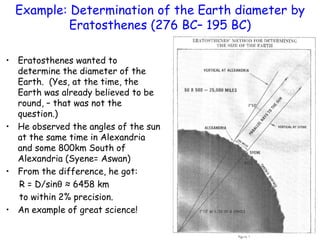
• Eratosthenes wanted to
determine the diameter of the
Earth. (Yes, at the time, the
Earth was already believed to be
round, – that was not the
question.)
• He observed the angles of the sun
at the same time in Alexandria
and some 800km South of
Alexandria (Syene= Aswan)
• From the difference, he got:
R = D/sinθ ≈ 6458 km
to within 2% precision.
• An example of great science!
Units
• Physical quantities have units!
• Example: Unit of length
– In the Middle ages many kingdoms had different definitions of
a foot, etc.
– Inch, foot, meter, mile, light-year …
• Today in science/engineering, the SI system of units.
Three basic units in mechanics:
– Length: Meter (Based on the speed of light: length of path
traveled by light in 1/299,792,458s)
– Mass: kg (Platinum cylinder in International Bureau of Weights
and Measures, Paris)
– Time: s (Time required for 9,192,631,770 periods of radiation
emitted by cesium atoms.)
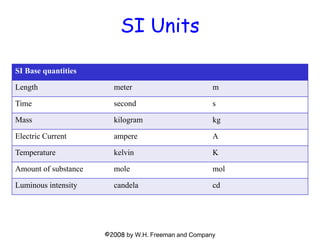
• There are 7 basic units
(including other branches of physics).
SI Units
SI Base quantities
Length meter m
Time second s
Mass kilogram kg
Electric Current ampere A
Temperature kelvin K
Amount of substance mole mol
Luminous intensity candela cd
©2008 by W.H. Freeman and Company
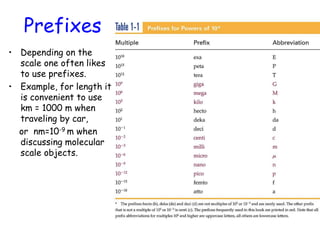
Prefixes
• Depending on the
scale one often likes
to use prefixes.
• Example, for length it
is convenient to use
km = 1000 m when
traveling by car,
or nm=10-9 m when
discussing molecular
scale objects.
Conversions
• Conversions between units are very important.
The use of different units has again and again led to errors,
sometimes with bad consequences in engineering and science
(and homework/exams), but it is easy to avoid.
1 mile = 1.609 km, 1 hr = 3600 s, 1 tonne = 1000 kg ...
• Avoid skipping the units
(for example, to save your writing time ?)
– Are all the ingredients for a problem in the same units system?
It is crucial to perform the conversion, BEFORE doing any algebra.
– Basic SI units are always safe
It is OK to use km or nm, but don’t mix them!
• We will expect you to give results with appropriate units,
in homework, exams, etc. as part of the correct answer!
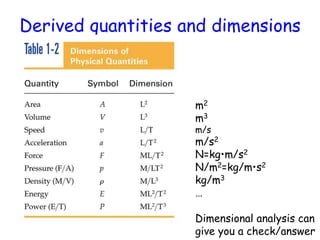
Derived quantities and dimensions
m2
m3
m/s
m/s2
N=kg•m/s2
N/m2=kg/m•s2
kg/m3
…
Dimensional analysis can
give you a check/answer
Measurement and Significant figures
• A measurement has a precision (or error):
Your instruments (ruler, scale, timer…);
Every time you perform a measurement, it isn’t always the same.
 (4.321 ± 0.001) m
• A significant figure is one that is reliably known
• All non-zero digits are significant (123.456)
• Zeros are significant when
– between other non-zero digits (100002)
– after a non-zero digit AND
BEFORE or AFTER the decimal point (100. and 1.00)
– can be clarified by using scientific notation
• Significant figures in a final result equals significant figures in
the least accurate of the factors being combined
Measurement and Significant figures
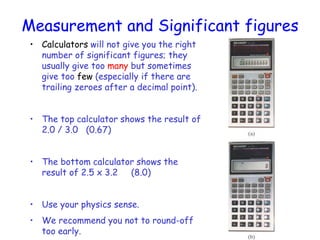
• Calculators will not give you the right
number of significant figures; they
usually give too many but sometimes
give too few (especially if there are
trailing zeroes after a decimal point).
• The top calculator shows the result of
2.0 / 3.0 (0.67)
• The bottom calculator shows the
result of 2.5 x 3.2 (8.0)
• Use your physics sense.
• We recommend you not to round-off
too early.
©2008 by W.H. Freeman and Company
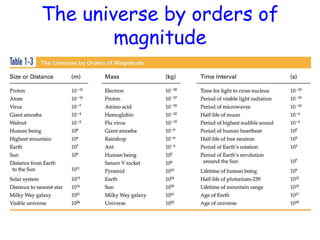
The universe by orders of
magnitude
A quick way to estimate a calculated quantity is to round off all
numbers to one significant figure and then calculate.
Your result should at least be the right order of magnitude; this
can be expressed by rounding it off to the nearest power of 10.
Such back-on-the-envelope estimates are very helpful for double
checking a result of a calculation.
Diagrams are also very useful in making estimations.
Order of magnitude: Rapid Estimating
©2008 by W.H. Freeman and Company
Tire treads
a few mm - cm
©2008 by W.H. Freeman and Company
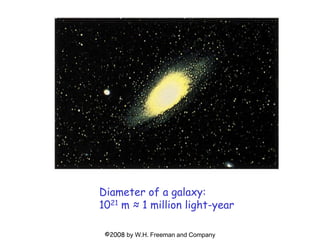
Diameter of a galaxy:
1021 m ≈ 1 million light-year
©2008 by W.H. Freeman and Company
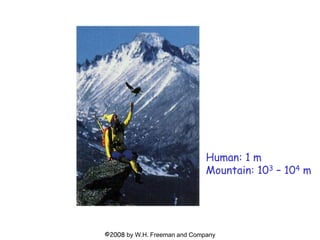
Human: 1 m
Mountain: 103 – 104 m
©2008 by W.H. Freeman and Company
Molecules on
material’s surface:
Nano meters
©2008 by W.H. Freeman and Company
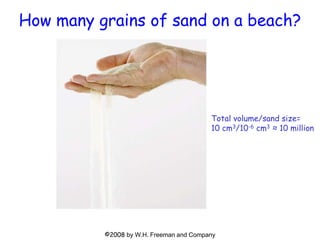
How many grains of sand on a beach?
Total volume/sand size=
10 cm3/10-6 cm3 ≈ 10 million

Lect1(unit).ppt

  • 1.
    Physics 201 General Physics Topicsto be covered: Kinematics, dynamics, statics, fluids, elasticity, oscillations: Prof. Tao Han Prof. Marshall Onellion
  • 2.
    Course information • Coursehomepage •  Let’s have a quick look: • http://www.physics.wisc.edu/undergrads/courses/ spring10/201/ – Find there detailed information on syllabus, homework, exams, grading, discussion, labs • Syllabus: – Lectures: Typically 1 Chapter per week from textbook – Two discussion sessions, One lab each week – One homework (Always due on Tuesdays at midnight) - Three midterm exams + the Final
  • 3.
    Textbook, e-book andWebAssign • The textbook is available in electronic form as an e-book. – Paul Tipler and Gene Mosca, Physics for Scientists and Engineers, 6th ed. – You can read it from any computer with access to internet. http://webassign.net/login.html. – This is by far the cheapest solution. If you like to buy it in real paper, it is also available as softcover in 2 volumes (this course covers the 1st volume) • WebAssign: – This is our homework assignment system. Problems are taken from the textbook but numbers are randomized. –  Let’s have a quick look into WebAssign: – Intro to WebAssign – Student Guide to WebAssign ©2008 by W.H. Freeman and Company
  • 4.
    Your Discussions: twicea week. Labs: Once a week. with Your TA’s: Our team of Teaching Assistants will be your instructors in discussions and labs: Sections Your TA -------------------------------- • 301 305 Yip, Stephen • 302 312 Cho, Junghun • 303 306 Dong, Zhe • 304 310 Liu, Zhen • 307 309 Schroeder, Daniel There will be 12 hrs/week See course web for time and room.
  • 5.
    Physics is basicScience, that includes “everything” Mechanics: (this term’s topics) Motion, forces, balance, energy, fluids, oscillations… Optics: Light, mirrors/lenses, cameras, Micro/Telescopes, Lasers. Electricity & Magnetism: Charges, currents, fields, thunders, radio/TV’s, heat … Atomic, nuclear, elementary particles: Microscopic world, basic building blocks/forces, HEP … ©2008 by W.H. Freeman and Company
  • 6.
    Nature of Science- Theory  Observation Theories are made to explain observations. Theories will make predictions (they are testable). Observations and experiments are used to test if the prediction is accurate. The cycle continues for science advancement. In history, physics and astronomy have set the ground rules of modern science. ©2008 by W.H. Freeman and Company
  • 7.
    Example: Determination ofthe Earth diameter by Eratosthenes (276 BC– 195 BC) • Eratosthenes wanted to determine the diameter of the Earth. (Yes, at the time, the Earth was already believed to be round, – that was not the question.) • He observed the angles of the sun at the same time in Alexandria and some 800km South of Alexandria (Syene= Aswan) • From the difference, he got: R = D/sinθ ≈ 6458 km to within 2% precision. • An example of great science!
  • 8.
    Example: Determination ofthe Earth diameter by Eratosthenes (276 BC– 195 BC) • Eratosthenes wanted to determine the diameter of the Earth. (Yes, at the time, the Earth was already believed to be round, – that was not the question.) • He observed the angles of the sun at the same time in Alexandria and some 800km South of Alexandria (Syene= Aswan) • From the difference, he got: R = D/sinθ ≈ 6458 km to within 2% precision. • An example of great science!
  • 9.
    Units • Physical quantitieshave units! • Example: Unit of length – In the Middle ages many kingdoms had different definitions of a foot, etc. – Inch, foot, meter, mile, light-year … • Today in science/engineering, the SI system of units. Three basic units in mechanics: – Length: Meter (Based on the speed of light: length of path traveled by light in 1/299,792,458s) – Mass: kg (Platinum cylinder in International Bureau of Weights and Measures, Paris) – Time: s (Time required for 9,192,631,770 periods of radiation emitted by cesium atoms.) • There are 7 basic units (including other branches of physics).
  • 10.
    SI Units SI Basequantities Length meter m Time second s Mass kilogram kg Electric Current ampere A Temperature kelvin K Amount of substance mole mol Luminous intensity candela cd ©2008 by W.H. Freeman and Company
  • 11.
    Prefixes • Depending onthe scale one often likes to use prefixes. • Example, for length it is convenient to use km = 1000 m when traveling by car, or nm=10-9 m when discussing molecular scale objects.
  • 12.
    Conversions • Conversions betweenunits are very important. The use of different units has again and again led to errors, sometimes with bad consequences in engineering and science (and homework/exams), but it is easy to avoid. 1 mile = 1.609 km, 1 hr = 3600 s, 1 tonne = 1000 kg ... • Avoid skipping the units (for example, to save your writing time ?) – Are all the ingredients for a problem in the same units system? It is crucial to perform the conversion, BEFORE doing any algebra. – Basic SI units are always safe It is OK to use km or nm, but don’t mix them! • We will expect you to give results with appropriate units, in homework, exams, etc. as part of the correct answer!
  • 13.
    Derived quantities anddimensions m2 m3 m/s m/s2 N=kg•m/s2 N/m2=kg/m•s2 kg/m3 … Dimensional analysis can give you a check/answer
  • 14.
    Measurement and Significantfigures • A measurement has a precision (or error): Your instruments (ruler, scale, timer…); Every time you perform a measurement, it isn’t always the same.  (4.321 ± 0.001) m • A significant figure is one that is reliably known • All non-zero digits are significant (123.456) • Zeros are significant when – between other non-zero digits (100002) – after a non-zero digit AND BEFORE or AFTER the decimal point (100. and 1.00) – can be clarified by using scientific notation • Significant figures in a final result equals significant figures in the least accurate of the factors being combined
  • 15.
    Measurement and Significantfigures • Calculators will not give you the right number of significant figures; they usually give too many but sometimes give too few (especially if there are trailing zeroes after a decimal point). • The top calculator shows the result of 2.0 / 3.0 (0.67) • The bottom calculator shows the result of 2.5 x 3.2 (8.0) • Use your physics sense. • We recommend you not to round-off too early.
  • 16.
    ©2008 by W.H.Freeman and Company The universe by orders of magnitude
  • 17.
    A quick wayto estimate a calculated quantity is to round off all numbers to one significant figure and then calculate. Your result should at least be the right order of magnitude; this can be expressed by rounding it off to the nearest power of 10. Such back-on-the-envelope estimates are very helpful for double checking a result of a calculation. Diagrams are also very useful in making estimations. Order of magnitude: Rapid Estimating
  • 18.
    ©2008 by W.H.Freeman and Company Tire treads a few mm - cm
  • 19.
    ©2008 by W.H.Freeman and Company Diameter of a galaxy: 1021 m ≈ 1 million light-year
  • 20.
    ©2008 by W.H.Freeman and Company Human: 1 m Mountain: 103 – 104 m
  • 21.
    ©2008 by W.H.Freeman and Company Molecules on material’s surface: Nano meters
  • 22.
    ©2008 by W.H.Freeman and Company How many grains of sand on a beach? Total volume/sand size= 10 cm3/10-6 cm3 ≈ 10 million