Process Control in Food Technology
An overview of the basic concepts of process control and its
application in food technology
01
02
03
04
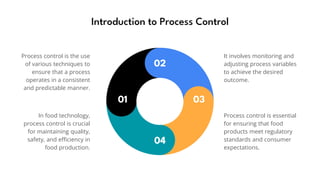
Process control is the use
of various techniques to
ensure that a process
operates in a consistent
and predictable manner.
In food technology,
process control is crucial
for maintaining quality,
safety, and efficiency in
food production.
It involves monitoring and
adjusting process variables
to achieve the desired
outcome.
Process control is essential
for ensuring that food
products meet regulatory
standards and consumer
expectations.
Introduction to Process Control
Key Components of
Process Control
● Measurement: Accurate
measurement of process variables
such as temperature, pressure, pH,
and flow rate is essential for
effective process control.
● Control: Control systems are used to
monitor and adjust process variables
to maintain optimal conditions.
● Feedback: Feedback loops provide
information about the current state of
the process and allow for
adjustments to be made in real time.
● Automation: Automation plays a
crucial role in process control by
01
03
02
04
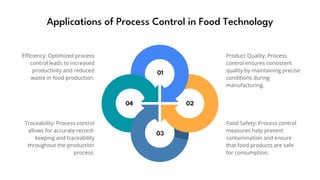
Product Quality: Process
control ensures consistent
quality by maintaining precise
conditions during
manufacturing.
Food Safety: Process control
measures help prevent
contamination and ensure
that food products are safe
for consumption.
Efficiency: Optimized process
control leads to increased
productivity and reduced
waste in food production.
Traceability: Process control
allows for accurate record-
keeping and traceability
throughout the production
process.
Applications of Process Control in Food Technology
Challenges and Future
Trends in Process Control
● Advanced Sensors: Development of
more advanced sensors for accurate
measurement and monitoring of
process variables.
● Data Analytics: Utilizing big data and
analytics to analyze process data and
optimize control strategies.
● Automation and Robotics:
Advancements in automation and
robotics for improved process control
and efficiency.
● Quality Management Systems:
Integration of process control with
quality management systems to
Thank you for your time and attention 🙂
Process Control Instrumentation for Food
Technology
This presentation provides an overview of process control
instrumentation in the field of food technology.
Definition of process control
instrumentation
Importance of process control
in food technology
Introduction
Overview of key components
Types of Process Control
Instrumentation
● Temperature control
● Pressure control
● Level control
● Flow control
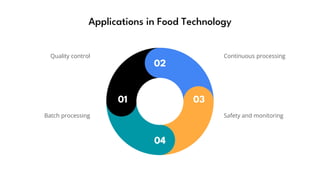
01
02
03
04
Quality control
Batch processing
Continuous processing
Safety and monitoring
Applications in Food Technology
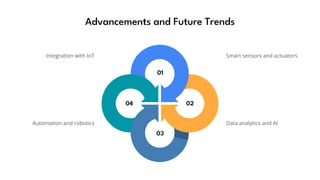
01
03
02
04
Smart sensors and actuators
Data analytics and AI
Integration with IoT
Automation and robotics
Advancements and Future Trends
Thank you for your time and attention 🙂

Presentation Food Technology Process Con

  • 2.
    Process Control inFood Technology An overview of the basic concepts of process control and its application in food technology
  • 3.
    01 02 03 04 Process control isthe use of various techniques to ensure that a process operates in a consistent and predictable manner. In food technology, process control is crucial for maintaining quality, safety, and efficiency in food production. It involves monitoring and adjusting process variables to achieve the desired outcome. Process control is essential for ensuring that food products meet regulatory standards and consumer expectations. Introduction to Process Control
  • 4.
    Key Components of ProcessControl ● Measurement: Accurate measurement of process variables such as temperature, pressure, pH, and flow rate is essential for effective process control. ● Control: Control systems are used to monitor and adjust process variables to maintain optimal conditions. ● Feedback: Feedback loops provide information about the current state of the process and allow for adjustments to be made in real time. ● Automation: Automation plays a crucial role in process control by
  • 5.
    01 03 02 04 Product Quality: Process controlensures consistent quality by maintaining precise conditions during manufacturing. Food Safety: Process control measures help prevent contamination and ensure that food products are safe for consumption. Efficiency: Optimized process control leads to increased productivity and reduced waste in food production. Traceability: Process control allows for accurate record- keeping and traceability throughout the production process. Applications of Process Control in Food Technology
  • 6.
    Challenges and Future Trendsin Process Control ● Advanced Sensors: Development of more advanced sensors for accurate measurement and monitoring of process variables. ● Data Analytics: Utilizing big data and analytics to analyze process data and optimize control strategies. ● Automation and Robotics: Advancements in automation and robotics for improved process control and efficiency. ● Quality Management Systems: Integration of process control with quality management systems to
  • 7.
    Thank you foryour time and attention 🙂
  • 8.
    Process Control Instrumentationfor Food Technology This presentation provides an overview of process control instrumentation in the field of food technology.
  • 9.
    Definition of processcontrol instrumentation Importance of process control in food technology Introduction Overview of key components
  • 10.
    Types of ProcessControl Instrumentation ● Temperature control ● Pressure control ● Level control ● Flow control
  • 11.
    01 02 03 04 Quality control Batch processing Continuousprocessing Safety and monitoring Applications in Food Technology
  • 12.
    01 03 02 04 Smart sensors andactuators Data analytics and AI Integration with IoT Automation and robotics Advancements and Future Trends
  • 13.
    Thank you foryour time and attention 🙂

Editor's Notes

  • #2 Entered text basic concepts of process control and its application in food technology Entered text Process control instrumentation for food technology