Meaningful Use Risk
Analysis
Who are we
 EHR 2.0 Mission: To assist healthcare
 organizations develop and implement
 practices to secure IT systems and comply
 with HIPAA/HITECH regulations.
  Education

  Consulting

  Toolkit(Tools, Best Practices & Checklist)

Goal: To make compliance an enjoyable
 and painless experience
Webinar Objective

Understand and Perform Meaningful Use
Risk Analysis that satisfies CMS
incentive and attestation requirement.


                                         3
Glossary

1.   HHS, CMS:

2. NIST:

3. Threats and Vulnerabilities:

4. Findings:

5. Risk Analysis:


                                  4
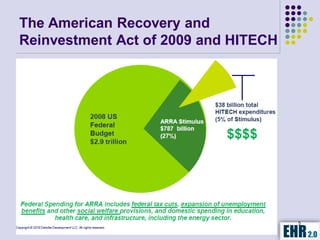
The American Recovery and
Reinvestment Act of 2009 and HITECH


                                      5
HITECH Act

The Health Information Technology for Economic and
Clinical Health (“HITECH”) provisions of the
American Recovery and Reinvestment Act of 2009
(“ARRA”, also referred to as the “Stimulus Bill”) codify and
expand on many of the requirements contained in the
Health Insurance Portability and Accountability Act of 1996
(“HIPAA”) and its regulations to protect the privacy and
security of protected health information (“PHI”).


                                                               6
HITECH
HITECH modifications to HIPAA including:

   Creating incentives for developing a meaningful use of
    electronic health records
   Changing the liability and responsibilities of Business
    Associates
   Redefining what a breach is
   Creating stricter notification standards
   Tightening enforcement
   Raising the penalties for a violation
   Creating new code and transaction sets (HIPAA 5010,
    ICD10)                                                  7
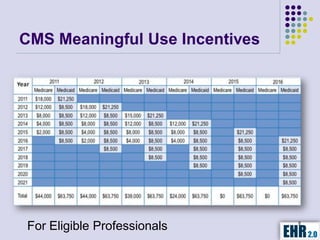
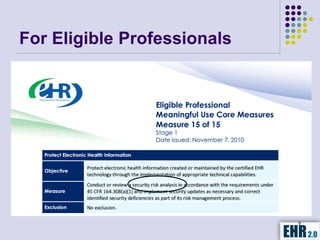
CMS Meaningful Use Incentives


For Eligible Professionals      8
For Eligible Professionals


                             9
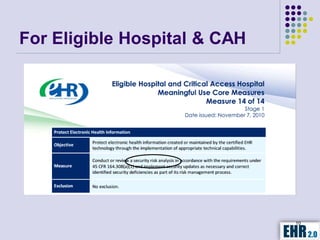
For Eligible Hospital & CAH


                              10
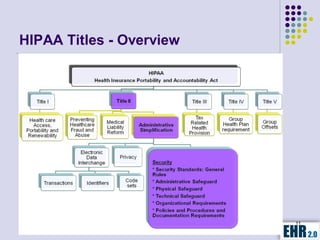
HIPAA Titles - Overview


                          11
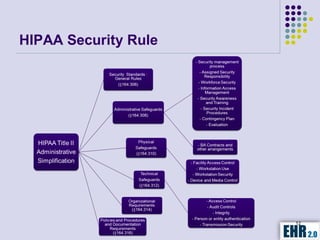
HIPAA Security Rule


                      12
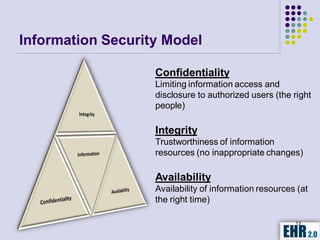
Information Security Model

                   Confidentiality
                   Limiting information access and
                   disclosure to authorized users (the right
                   people)

                   Integrity
                   Trustworthiness of information
                   resources (no inappropriate changes)

                   Availability
                   Availability of information resources (at
                   the right time)

                                                        13
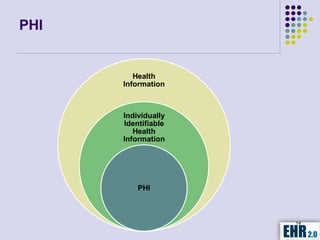
PHI


         Health
      Information


      Individually
      Identifiable
         Health
      Information


          PHI


                     14
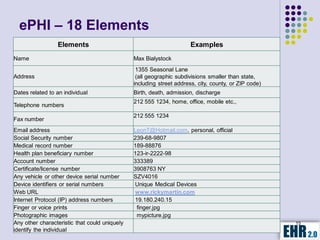
ePHI – 18 Elements
                 Elements                                             Examples
Name                                           Max Bialystock
                                                1355 Seasonal Lane
Address                                         (all geographic subdivisions smaller than state,
                                               including street address, city, county, or ZIP code)
Dates related to an individual                 Birth, death, admission, discharge
                                               212 555 1234, home, office, mobile etc.,
Telephone numbers
                                               212 555 1234
Fax number
Email address                                  LeonT@Hotmail.com, personal, official
Social Security number                         239-68-9807
Medical record number                          189-88876
Health plan beneficiary number                 123-ir-2222-98
Account number                                 333389
Certificate/license number                     3908763 NY
Any vehicle or other device serial number      SZV4016
Device identifiers or serial numbers           Unique Medical Devices
Web URL                                        www.rickymartin.com
Internet Protocol (IP) address numbers         19.180.240.15
Finger or voice prints                          finger.jpg
Photographic images                             mypicture.jpg
Any other characteristic that could uniquely                                                          15
identify the individual
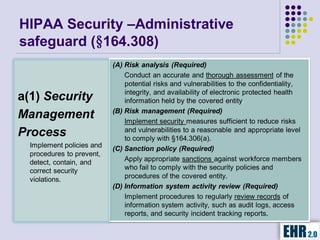
HIPAA Security –Administrative
safeguard (§164.308)
                           (A) Risk analysis (Required)
                               Conduct an accurate and thorough assessment of the
                               potential risks and vulnerabilities to the confidentiality,
                               integrity, and availability of electronic protected health
a(1) Security                  information held by the covered entity.
                           (B) Risk management (Required)
Management                     Implement security measures sufficient to reduce risks
                               and vulnerabilities to a reasonable and appropriate level
Process                        to comply with §164.306(a).
  Implement policies and   (C) Sanction policy (Required)
  procedures to prevent,
  detect, contain, and         Apply appropriate sanctions against workforce members
  correct security             who fail to comply with the security policies and
  violations.                  procedures of the covered entity.
                           (D) Information system activity review (Required)
                               Implement procedures to regularly review records of
                               information system activity, such as audit logs, access
                               reports, and security incident tracking reports.
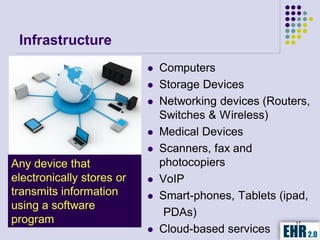
Infrastructure
                              Computers
                              Storage Devices
                              Networking devices (Routers,
                               Switches & Wireless)
                              Medical Devices
                              Scanners, fax and
Any device that                photocopiers
electronically stores or      VoIP
transmits information         Smart-phones, Tablets (ipad,
using a software
                                PDAs)
program                                                 17
                              Cloud-based services
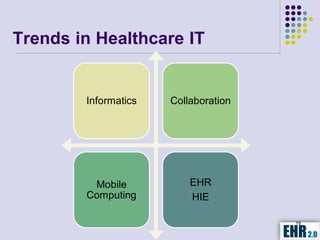
Trends in Healthcare IT


        Informatics   Collaboration


         Mobile           EHR
        Computing         HIE

                                      18
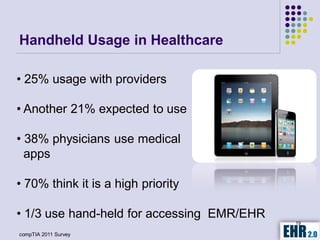
Handheld Usage in Healthcare

• 25% usage with providers

• Another 21% expected to use

• 38% physicians use medical
  apps

• 70% think it is a high priority

• 1/3 use hand-held for accessing EMR/EHR
                                            19

compTIA 2011 Survey
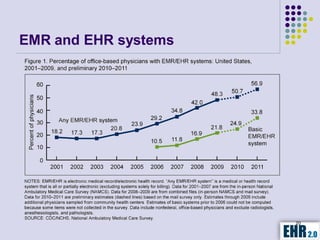
EMR and EHR systems


                      20
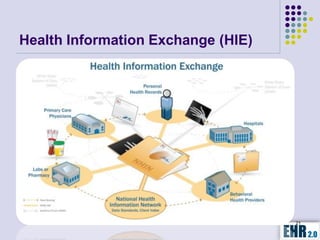
Health Information Exchange (HIE)


                                    21
Social Media
   How does your practice use it?

   How do your employees use it?

   Do you have policies?


                                     22
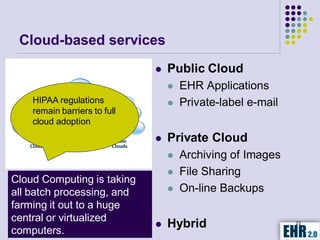
Cloud-based services
                                 Public Cloud
                                     EHR Applications
    HIPAA regulations                Private-label e-mail
    remain barriers to full
    cloud adoption
                                 Private Cloud
                                     Archiving of Images
                                     File Sharing
Cloud Computing is taking
all batch processing, and            On-line Backups
farming it out to a huge
central or virtualized
                                 Hybrid                     23

computers.
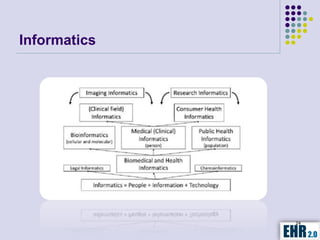
Informatics


              24
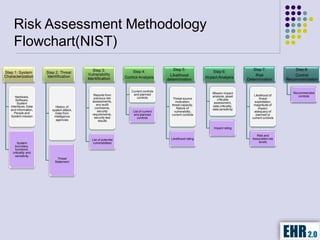
Risk Assessment Methodology
     Flowchart(NIST)
                                             Step 3:                                     Step 5:                                      Step 7:               Step 8:
Step 1: System        Step 2: Threat                                Step 4:                                     Step 6:
                                          Vulnerability                                Likelihood                                      Risk                 Control
Characterization      Identification                            Control Analysis                            Impact Analysis
                                          Identification                              determination                                Determination        Recommendation

                                                                   Current controls
                                                                                                               Mission impact                              Recommended
                                              Reports from          and planned                                                       Likelihood of
      Hardware,                                                                                                analysis, asset                                controls
                                              previous risk            controls          Threat source                                    threat
       Software,                                                                                                  criticality
                                             assessments,                                  motivation,          assessment,           exploitation,
        System                                  any audit                               threat capacity,       data criticality,      magnitude of
   Interfaces, Data        History of          comments,                                   Nature of           data sensitivity          impact,
   and Information,      system attack,          security           List of current       vulnerability,                              adequacy of
      People and           Data from         requirements,          and planned         current controls                               planned or
   System mission         intelligence        security test            controls                                                      current controls
                           agencies               results

                                                                                                                Impact rating

                                                                                                                                        Risk and
                                            List of potential                           Likelihood rating                            Associated risk
        System                               vulnerabilities                                                                             levels
      boundary,
      functions,
    criticality and
      sensitivity
                            Threat
                          Statement
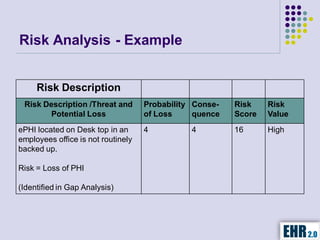
Risk Analysis - Example


     Risk Description
 Risk Description /Threat and       Probability Conse-   Risk    Risk
        Potential Loss              of Loss     quence   Score   Value
ePHI located on Desk top in an      4          4         16      High
employees office is not routinely
backed up.

Risk = Loss of PHI

(Identified in Gap Analysis)
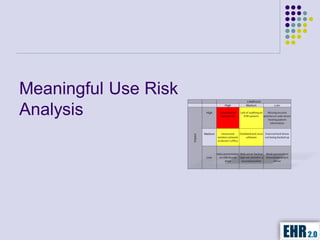
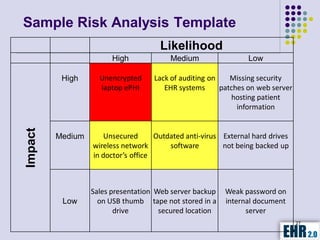
Sample Risk Analysis Template
                                      Likelihood
                        High             Medium                 Low

          High      Unencrypted     Lack of auditing on    Missing security
                    laptop ePHI        EHR systems      patches on web server
                                                           hosting patient
                                                             information
Impact


         Medium       Unsecured      Outdated anti-virus External hard drives
                  wireless network       software        not being backed up
                  in doctor’s office


                  Sales presentation Web server backup   Weak password on
          Low       on USB thumb tape not stored in a    internal document
                         drive        secured location         server
                                                                                27
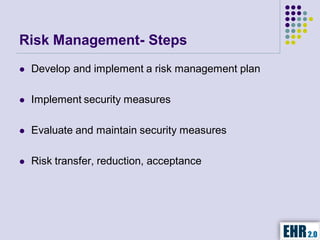
Risk Management- Steps
   Develop and implement a risk management plan

   Implement security measures

   Evaluate and maintain security measures

   Risk transfer, reduction, acceptance
Sanction Policy


Acceptable Use of PHI
      - Minimum Necessary
      - Sanction Exemptions
Disciplinary Actions

Sample sanction policy:
https://docs.google.com/document/d/1KSMZtdp9O
AHILfTAKWdCkUR6jv6vl9mGIDYvv-5gQ1o/edit
Information System Security Review -
Example
   Review of Security Incidents Response reports

   System user privileges grants and changes logs

   User-level system access logs, if available

   User level system activity logs, if available

   User level transaction log reports, if available

   Exception reports

   The required level of system activity logging and
    reporting capabilities, and the actual scope
Top 5 Recommendations
 1. Ensure encryption on all protected health information
 in storage and transit.(at least de-identification)
 2. Implement a mobile device security program.
 3. Strengthen information security user awareness and
 training programs.
 4. Ensure that business associate due diligence includes
 clearly written contract, a periodic review of
 implemented controls.
 5. Minimize sensitive data capture, storage and sharing.


                                                        31
Meaningful Use Stage 2 and Stage 3
Security Requirements

   Security Risk Analysis with encryption
    assessment
   Secure Messaging for ambulatory practices


                                                32
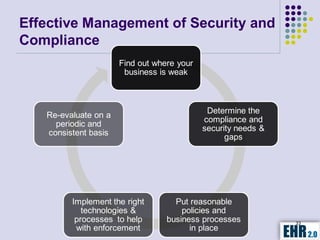
Effective Management of Security and
Compliance
                      Find out where your
                       business is weak


                                             Determine the
   Re-evaluate on a
                                            compliance and
     periodic and
                                            security needs &
   consistent basis
                                                  gaps


         Implement the right        Put reasonable
            technologies &            policies and
          processes to help       business processes           33
          with enforcement              in place
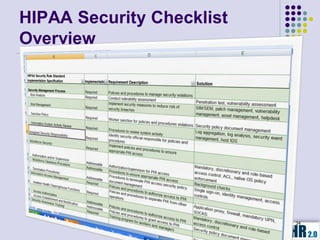
HIPAA Security Checklist
Overview


                           34
Key Takeaways
   Risk Analysis is foundation for an effective security
    program

   ePHI elements drives risk analysis scope

   There is no silver bullet for risk management. It is a
    journey of continuous assessment and improvement


                                                             35
Additional Resources


   NIST - Risk Management Guide for Information
    Technology Systems SP800-30

   Small Practice Security Guide


                                                   36
How can you help us?
   Follow-us on social media
    facebook.com/ehr20 (Like)
    linkedin.com/company/ehr-2-0 (Follow us)
    https://twitter.com/#!/EHR_20 (Follow)

   Next Webinar on Business Associate Assessment( 3/21)

   http://ehr20.com/services/


      We sincerely appreciate your referrals!          37
Thank you!!


              38

Meaningful Use Risk Analysis Webinar

  • 1.
  • 2.
    Who are we EHR 2.0 Mission: To assist healthcare organizations develop and implement practices to secure IT systems and comply with HIPAA/HITECH regulations.  Education  Consulting  Toolkit(Tools, Best Practices & Checklist) Goal: To make compliance an enjoyable and painless experience
  • 3.
    Webinar Objective Understand andPerform Meaningful Use Risk Analysis that satisfies CMS incentive and attestation requirement. 3
  • 4.
    Glossary 1. HHS, CMS: 2. NIST: 3. Threats and Vulnerabilities: 4. Findings: 5. Risk Analysis: 4
  • 5.
    The American Recoveryand Reinvestment Act of 2009 and HITECH 5
  • 6.
    HITECH Act The HealthInformation Technology for Economic and Clinical Health (“HITECH”) provisions of the American Recovery and Reinvestment Act of 2009 (“ARRA”, also referred to as the “Stimulus Bill”) codify and expand on many of the requirements contained in the Health Insurance Portability and Accountability Act of 1996 (“HIPAA”) and its regulations to protect the privacy and security of protected health information (“PHI”). 6
  • 7.
    HITECH HITECH modifications toHIPAA including:  Creating incentives for developing a meaningful use of electronic health records  Changing the liability and responsibilities of Business Associates  Redefining what a breach is  Creating stricter notification standards  Tightening enforcement  Raising the penalties for a violation  Creating new code and transaction sets (HIPAA 5010, ICD10) 7
  • 8.
    CMS Meaningful UseIncentives For Eligible Professionals 8
  • 9.
  • 10.
  • 11.
    HIPAA Titles -Overview 11
  • 12.
  • 13.
    Information Security Model Confidentiality Limiting information access and disclosure to authorized users (the right people) Integrity Trustworthiness of information resources (no inappropriate changes) Availability Availability of information resources (at the right time) 13
  • 14.
    PHI Health Information Individually Identifiable Health Information PHI 14
  • 15.
    ePHI – 18Elements Elements Examples Name Max Bialystock 1355 Seasonal Lane Address (all geographic subdivisions smaller than state, including street address, city, county, or ZIP code) Dates related to an individual Birth, death, admission, discharge 212 555 1234, home, office, mobile etc., Telephone numbers 212 555 1234 Fax number Email address LeonT@Hotmail.com, personal, official Social Security number 239-68-9807 Medical record number 189-88876 Health plan beneficiary number 123-ir-2222-98 Account number 333389 Certificate/license number 3908763 NY Any vehicle or other device serial number SZV4016 Device identifiers or serial numbers Unique Medical Devices Web URL www.rickymartin.com Internet Protocol (IP) address numbers 19.180.240.15 Finger or voice prints finger.jpg Photographic images mypicture.jpg Any other characteristic that could uniquely 15 identify the individual
  • 16.
    HIPAA Security –Administrative safeguard(§164.308) (A) Risk analysis (Required) Conduct an accurate and thorough assessment of the potential risks and vulnerabilities to the confidentiality, integrity, and availability of electronic protected health a(1) Security information held by the covered entity. (B) Risk management (Required) Management Implement security measures sufficient to reduce risks and vulnerabilities to a reasonable and appropriate level Process to comply with §164.306(a). Implement policies and (C) Sanction policy (Required) procedures to prevent, detect, contain, and Apply appropriate sanctions against workforce members correct security who fail to comply with the security policies and violations. procedures of the covered entity. (D) Information system activity review (Required) Implement procedures to regularly review records of information system activity, such as audit logs, access reports, and security incident tracking reports.
  • 17.
    Infrastructure  Computers  Storage Devices  Networking devices (Routers, Switches & Wireless)  Medical Devices  Scanners, fax and Any device that photocopiers electronically stores or  VoIP transmits information  Smart-phones, Tablets (ipad, using a software PDAs) program 17  Cloud-based services
  • 18.
    Trends in HealthcareIT Informatics Collaboration Mobile EHR Computing HIE 18
  • 19.
    Handheld Usage inHealthcare • 25% usage with providers • Another 21% expected to use • 38% physicians use medical apps • 70% think it is a high priority • 1/3 use hand-held for accessing EMR/EHR 19 compTIA 2011 Survey
  • 20.
    EMR and EHRsystems 20
  • 21.
  • 22.
    Social Media  How does your practice use it?  How do your employees use it?  Do you have policies? 22
  • 23.
    Cloud-based services  Public Cloud  EHR Applications HIPAA regulations  Private-label e-mail remain barriers to full cloud adoption  Private Cloud  Archiving of Images  File Sharing Cloud Computing is taking all batch processing, and  On-line Backups farming it out to a huge central or virtualized  Hybrid 23 computers.
  • 24.
  • 25.
    Risk Assessment Methodology Flowchart(NIST) Step 3: Step 5: Step 7: Step 8: Step 1: System Step 2: Threat Step 4: Step 6: Vulnerability Likelihood Risk Control Characterization Identification Control Analysis Impact Analysis Identification determination Determination Recommendation Current controls Mission impact Recommended Reports from and planned Likelihood of Hardware, analysis, asset controls previous risk controls Threat source threat Software, criticality assessments, motivation, assessment, exploitation, System any audit threat capacity, data criticality, magnitude of Interfaces, Data History of comments, Nature of data sensitivity impact, and Information, system attack, security List of current vulnerability, adequacy of People and Data from requirements, and planned current controls planned or System mission intelligence security test controls current controls agencies results Impact rating Risk and List of potential Likelihood rating Associated risk System vulnerabilities levels boundary, functions, criticality and sensitivity Threat Statement
  • 26.
    Risk Analysis -Example Risk Description Risk Description /Threat and Probability Conse- Risk Risk Potential Loss of Loss quence Score Value ePHI located on Desk top in an 4 4 16 High employees office is not routinely backed up. Risk = Loss of PHI (Identified in Gap Analysis)
  • 27.
    Sample Risk AnalysisTemplate Likelihood High Medium Low High Unencrypted Lack of auditing on Missing security laptop ePHI EHR systems patches on web server hosting patient information Impact Medium Unsecured Outdated anti-virus External hard drives wireless network software not being backed up in doctor’s office Sales presentation Web server backup Weak password on Low on USB thumb tape not stored in a internal document drive secured location server 27
  • 28.
    Risk Management- Steps  Develop and implement a risk management plan  Implement security measures  Evaluate and maintain security measures  Risk transfer, reduction, acceptance
  • 29.
    Sanction Policy Acceptable Useof PHI - Minimum Necessary - Sanction Exemptions Disciplinary Actions Sample sanction policy: https://docs.google.com/document/d/1KSMZtdp9O AHILfTAKWdCkUR6jv6vl9mGIDYvv-5gQ1o/edit
  • 30.
    Information System SecurityReview - Example  Review of Security Incidents Response reports  System user privileges grants and changes logs  User-level system access logs, if available  User level system activity logs, if available  User level transaction log reports, if available  Exception reports  The required level of system activity logging and reporting capabilities, and the actual scope
  • 31.
    Top 5 Recommendations 1. Ensure encryption on all protected health information in storage and transit.(at least de-identification) 2. Implement a mobile device security program. 3. Strengthen information security user awareness and training programs. 4. Ensure that business associate due diligence includes clearly written contract, a periodic review of implemented controls. 5. Minimize sensitive data capture, storage and sharing. 31
  • 32.
    Meaningful Use Stage2 and Stage 3 Security Requirements  Security Risk Analysis with encryption assessment  Secure Messaging for ambulatory practices 32
  • 33.
    Effective Management ofSecurity and Compliance Find out where your business is weak Determine the Re-evaluate on a compliance and periodic and security needs & consistent basis gaps Implement the right Put reasonable technologies & policies and processes to help business processes 33 with enforcement in place
  • 34.
  • 35.
    Key Takeaways  Risk Analysis is foundation for an effective security program  ePHI elements drives risk analysis scope  There is no silver bullet for risk management. It is a journey of continuous assessment and improvement 35
  • 36.
    Additional Resources  NIST - Risk Management Guide for Information Technology Systems SP800-30  Small Practice Security Guide 36
  • 37.
    How can youhelp us?  Follow-us on social media facebook.com/ehr20 (Like) linkedin.com/company/ehr-2-0 (Follow us) https://twitter.com/#!/EHR_20 (Follow)  Next Webinar on Business Associate Assessment( 3/21)  http://ehr20.com/services/ We sincerely appreciate your referrals! 37
  • 38.