Recent Trend & Technology
MERN Stack
By Surya Prakash Gupta
CSE Department
UCEM
Prerequisites for MERN stack
• HTML
• CSS
• JavaScript
• Knowledge of database.
Introduction
• MERN stands for MongoDB, Express, React,
Node, after the four key technologies that
make up the stack that is used for easier and
faster deployment of full-stack web
applications.
• MongoDB - document database
• Express(.js) - Node.js web framework
• React(.js) - a client-side JavaScript library
• Node(.js) - the premier JavaScript web server
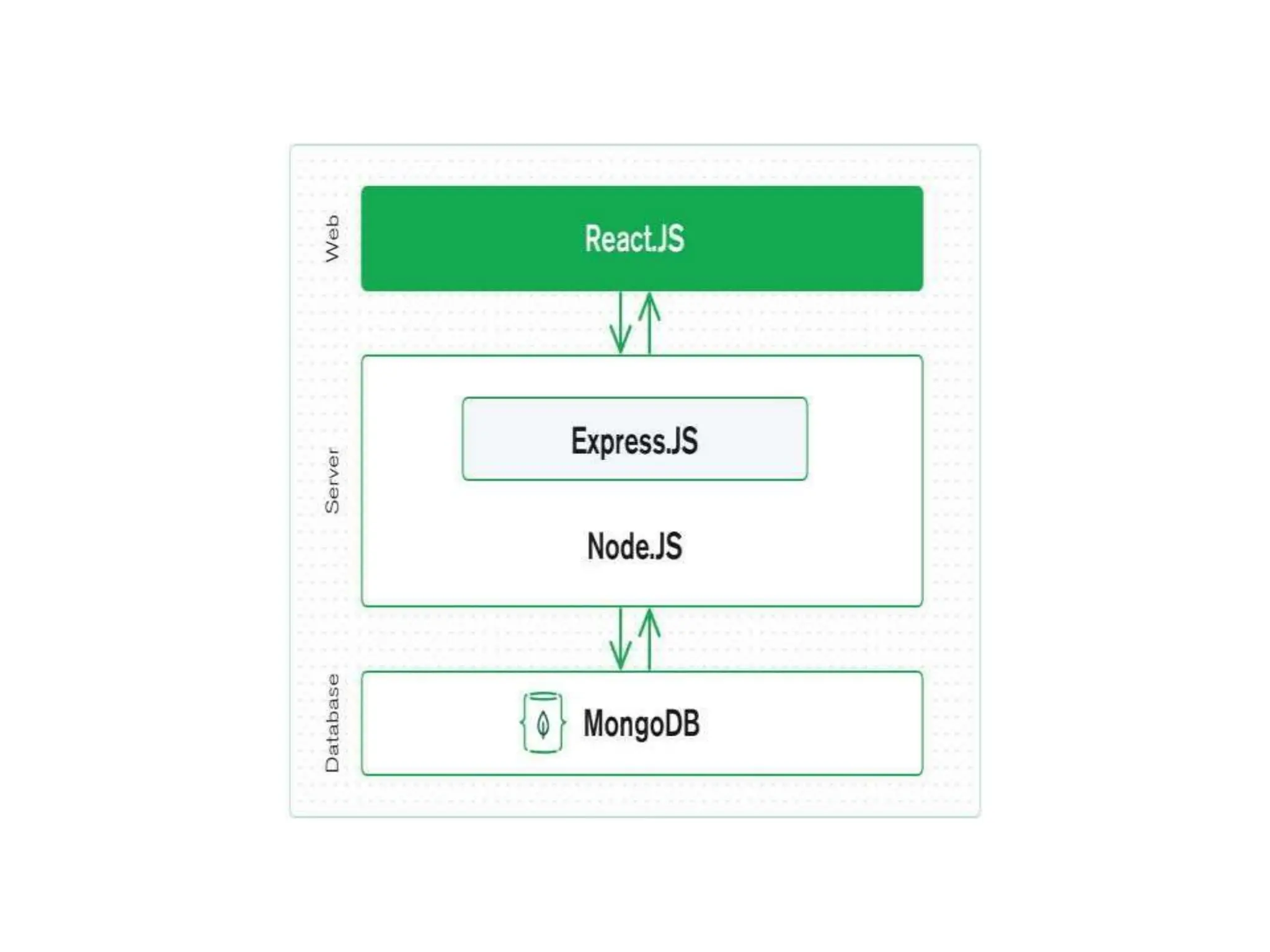
How does the MERN Stack work?
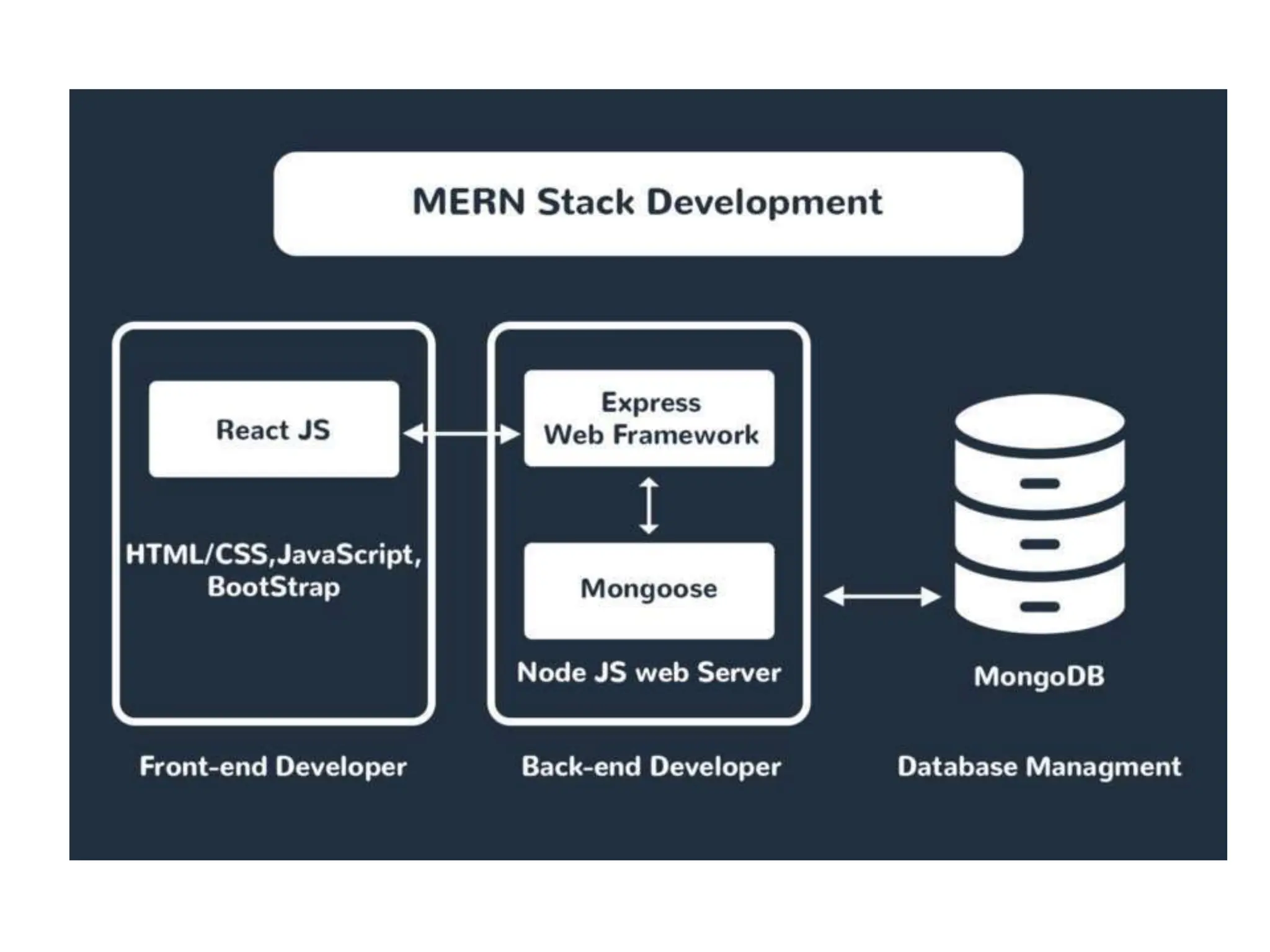
• The MERN architecture allows you to easily
construct a 3-tier architecture (frontend,
backend, database) entirely using JavaScript
and JSON.
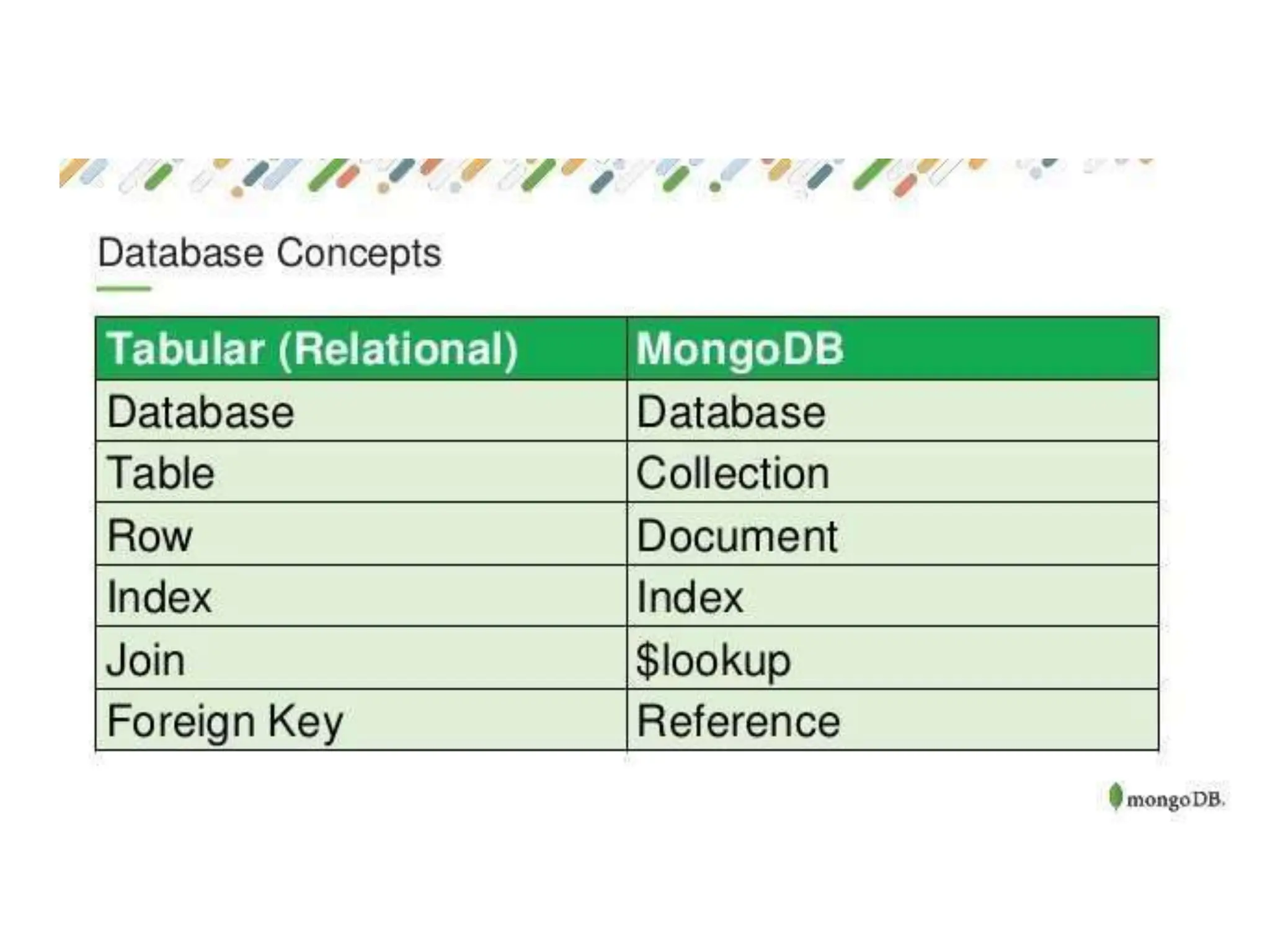
MongoDB
• NoSQL database used for high-volume data
storage.
• Open-source document-oriented database.
• MongoDB is written in C++.
• It stores data in JSON format.
• Can be easily used with Node.
• MongoDB uses BSON to query database.
• Documents containing key-value pairs are the
basic units of data in MongoDB.
Why MongoDB?
• Fast – Being a document-oriented database, easy to
index documents. Therefore a faster response.
• Scalability – Large data can be handled by dividing it
into several machines.
• Use of JavaScript – MongoDB uses JavaScript which is
the biggest advantage.
• Schema Less – Any type of data in a separate
document.
• Data stored in the form of JSON.
• Simple Environment Setup – Its really simple to set up
MongoDB.
NodeJS
• JavaScript run-time environment built on Chrome’s V8
JavaScript.
• Node.js allows you to run JavaScript on the server.
• It is free & open source, written in C++.
• Ryan Dahl developed Node.js in 2009. He embedded C++
code with Chrome’s V8 Engine and gave the name as
Node.js.
• Node.js runs single-threaded, non-blocking,
asynchronous programming, which is very memory
efficient.
Where to use NodeJS?
• Back-end services such as APIs.
• Highly scalable, data-intensive and real-time
apps.
• I/O bounds applications.
• Single page applications.
Where not to use NodeJS?
Node.js is not used in CPU-intensive apps which
requires calculations done by CPU.
ExpressJS
• Flexible Node.js framework that provides robust
set of features for web for web and mobile
application.
• It provides easy routing of requests based on
HTTP methods and URLs.
• It allows to set up middlewares to respond to
HTTP Requests.
• Allows to dynamically render HTML Pages based
on passing arguments to templates.
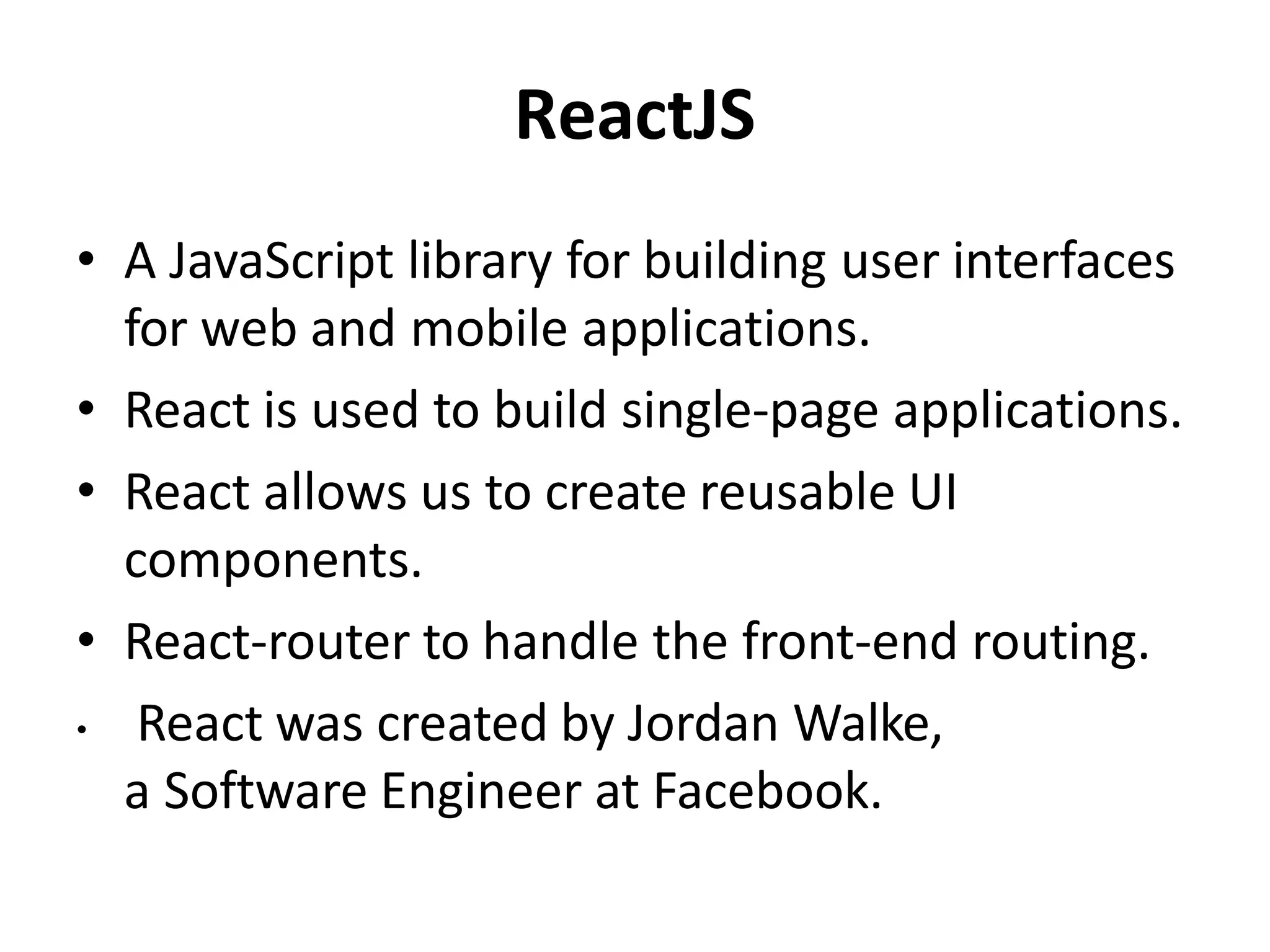
ReactJS
• A JavaScript library for building user interfaces
for web and mobile applications.
• React is used to build single-page applications.
• React allows us to create reusable UI
components.
• React-router to handle the front-end routing.
• React was created by Jordan Walke,
a Software Engineer at Facebook.
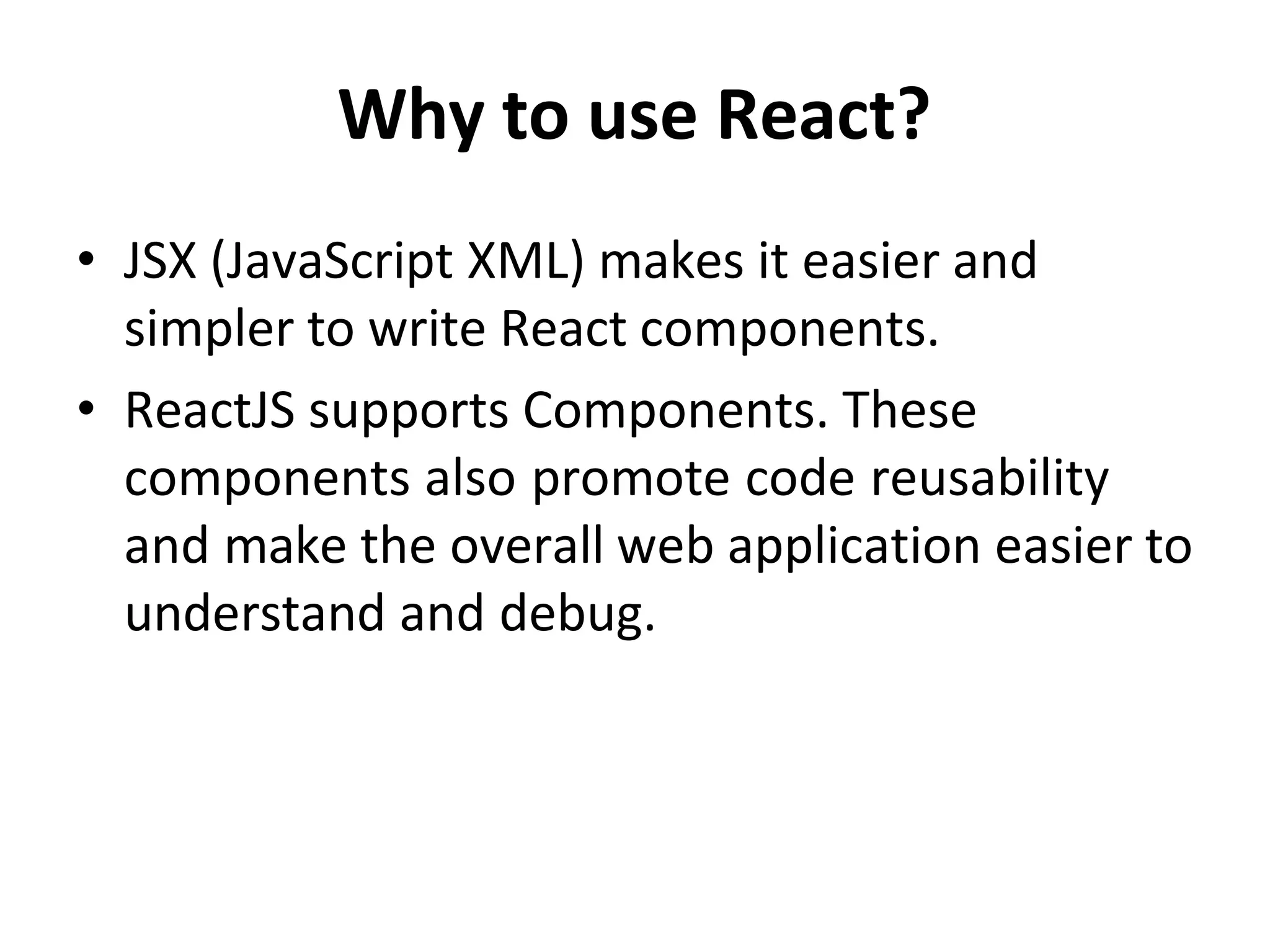
Why to use React?
• JSX (JavaScript XML) makes it easier and
simpler to write React components.
• ReactJS supports Components. These
components also promote code reusability
and make the overall web application easier to
understand and debug.
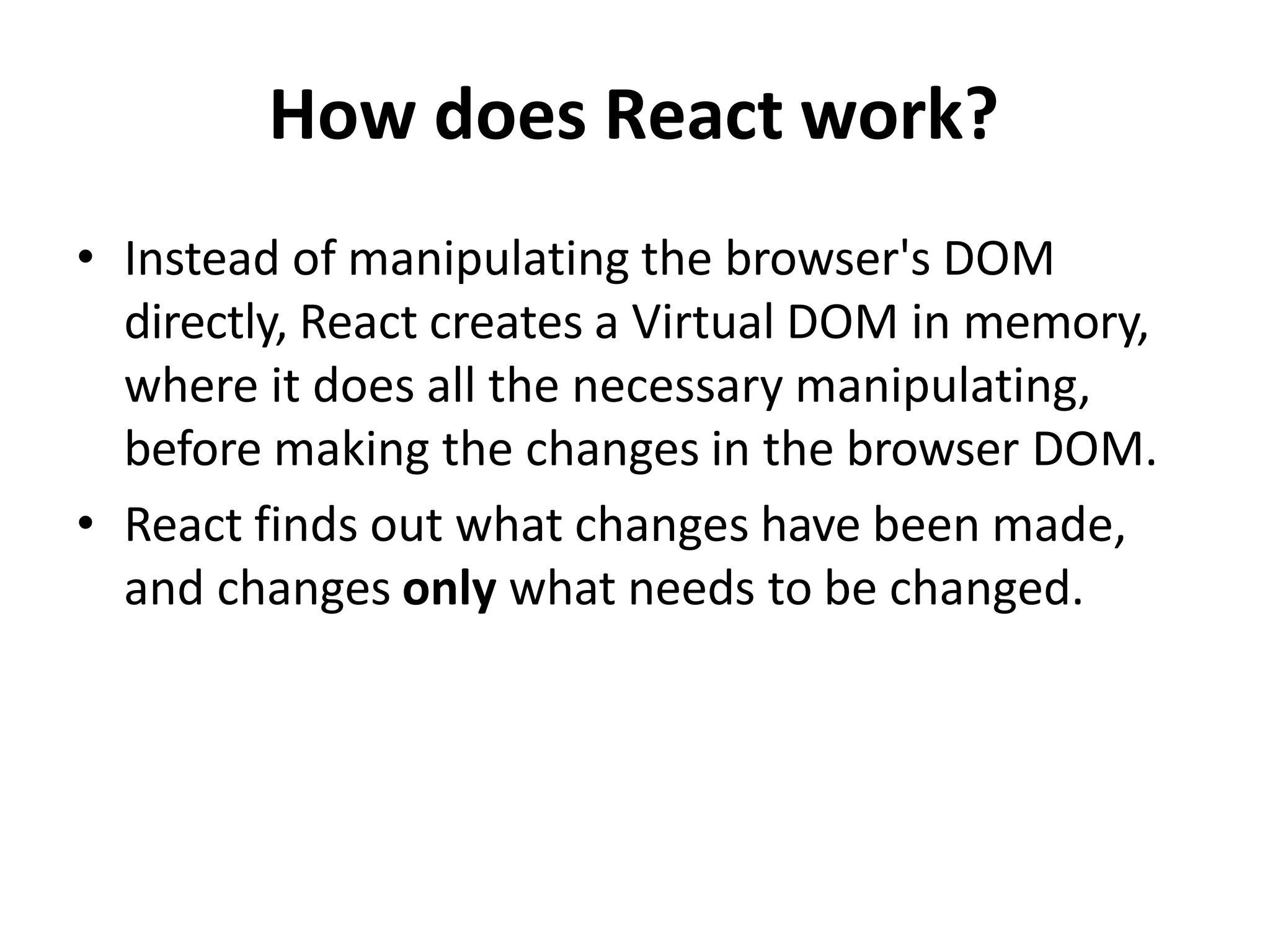
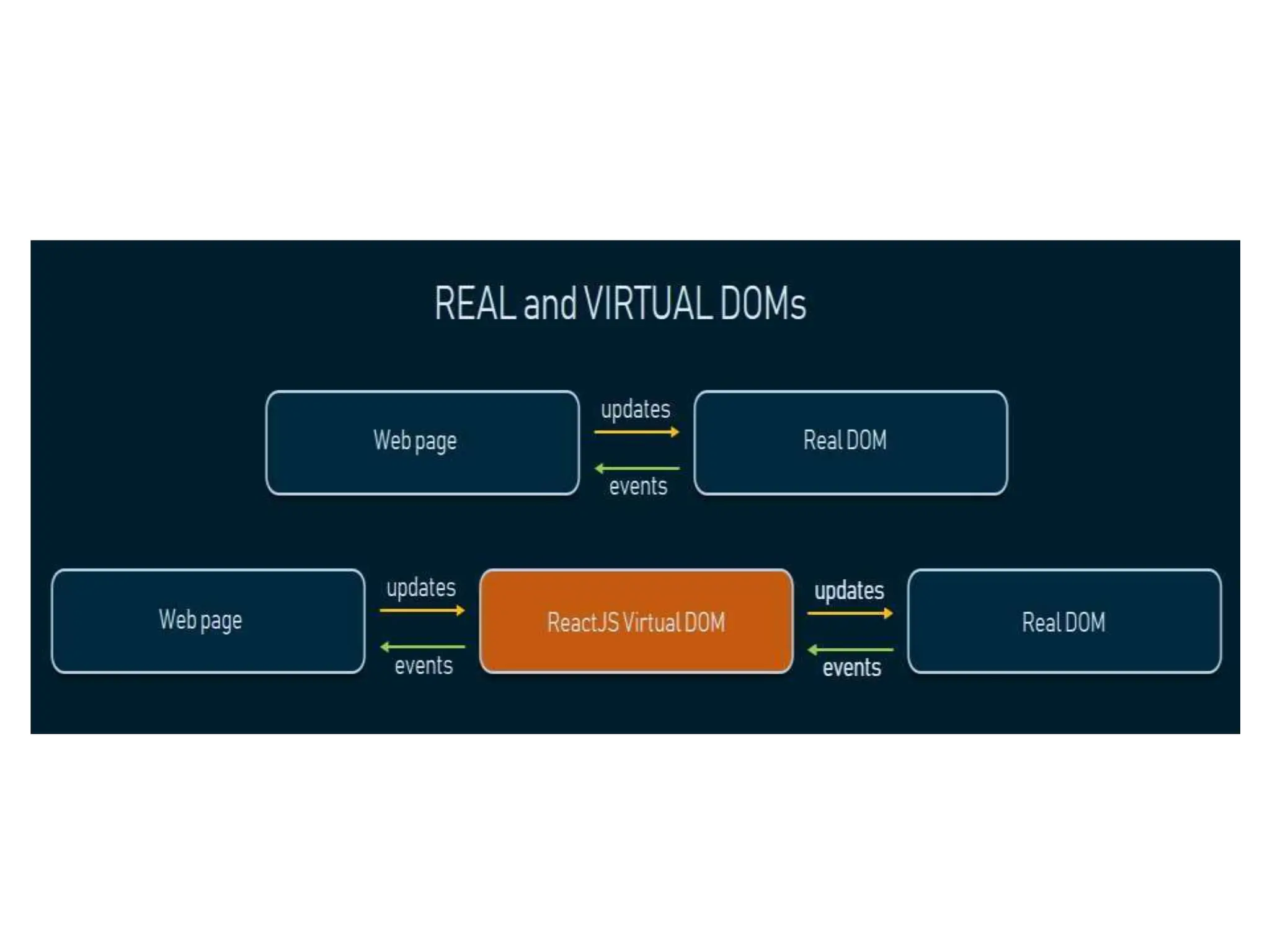
How does React work?
• Instead of manipulating the browser's DOM
directly, React creates a Virtual DOM in memory,
where it does all the necessary manipulating,
before making the changes in the browser DOM.
• React finds out what changes have been made,
and changes only what needs to be changed.
References
• https://www.mongodb.com/
• https://expressjs.com/
• https://reactjs.org/
• https://nodejs.dev/
Thank You

Final year presentation topicssssss in 1

  • 1.
    Recent Trend &Technology MERN Stack By Surya Prakash Gupta CSE Department UCEM
  • 2.
    Prerequisites for MERNstack • HTML • CSS • JavaScript • Knowledge of database.
  • 3.
    Introduction • MERN standsfor MongoDB, Express, React, Node, after the four key technologies that make up the stack that is used for easier and faster deployment of full-stack web applications. • MongoDB - document database • Express(.js) - Node.js web framework • React(.js) - a client-side JavaScript library • Node(.js) - the premier JavaScript web server
  • 5.
    How does theMERN Stack work? • The MERN architecture allows you to easily construct a 3-tier architecture (frontend, backend, database) entirely using JavaScript and JSON.
  • 8.
    MongoDB • NoSQL databaseused for high-volume data storage. • Open-source document-oriented database. • MongoDB is written in C++. • It stores data in JSON format. • Can be easily used with Node. • MongoDB uses BSON to query database. • Documents containing key-value pairs are the basic units of data in MongoDB.
  • 10.
    Why MongoDB? • Fast– Being a document-oriented database, easy to index documents. Therefore a faster response. • Scalability – Large data can be handled by dividing it into several machines. • Use of JavaScript – MongoDB uses JavaScript which is the biggest advantage. • Schema Less – Any type of data in a separate document. • Data stored in the form of JSON. • Simple Environment Setup – Its really simple to set up MongoDB.
  • 12.
    NodeJS • JavaScript run-timeenvironment built on Chrome’s V8 JavaScript. • Node.js allows you to run JavaScript on the server. • It is free & open source, written in C++. • Ryan Dahl developed Node.js in 2009. He embedded C++ code with Chrome’s V8 Engine and gave the name as Node.js. • Node.js runs single-threaded, non-blocking, asynchronous programming, which is very memory efficient.
  • 13.
    Where to useNodeJS? • Back-end services such as APIs. • Highly scalable, data-intensive and real-time apps. • I/O bounds applications. • Single page applications. Where not to use NodeJS? Node.js is not used in CPU-intensive apps which requires calculations done by CPU.
  • 15.
    ExpressJS • Flexible Node.jsframework that provides robust set of features for web for web and mobile application. • It provides easy routing of requests based on HTTP methods and URLs. • It allows to set up middlewares to respond to HTTP Requests. • Allows to dynamically render HTML Pages based on passing arguments to templates.
  • 17.
    ReactJS • A JavaScriptlibrary for building user interfaces for web and mobile applications. • React is used to build single-page applications. • React allows us to create reusable UI components. • React-router to handle the front-end routing. • React was created by Jordan Walke, a Software Engineer at Facebook.
  • 18.
    Why to useReact? • JSX (JavaScript XML) makes it easier and simpler to write React components. • ReactJS supports Components. These components also promote code reusability and make the overall web application easier to understand and debug.
  • 19.
    How does Reactwork? • Instead of manipulating the browser's DOM directly, React creates a Virtual DOM in memory, where it does all the necessary manipulating, before making the changes in the browser DOM. • React finds out what changes have been made, and changes only what needs to be changed.
  • 21.
  • 22.