Background
The MillenniumDevelopment Goals (MDGs) were
adopted by 189 member states in the Millennium
Summit of United Nations in 2000. These states
have pledged to achieve the MDGs by 2015.
Built upon earlier United Nations conferences and
summits in the 1990s
Used as a reference for National Development
Plans
4.
Background
For severalof these key areas, specific indicators
were included in the Millennium Declaration –
constituting the international development goals
(IDG)
Subsequently, IDGs from other declarations were
combined and harmonised with the IDGs set in the
Millennium Declaration goals
5.
Background
The resultingset of goals, numerical targets and
quantifiable indicators to assess progress
constitute the Millennium Development Goals…
(September 2001)
6.
Importance of MDGs
•Human rights
• Inequity in a smaller world
• Global threats: water, environment, diseases
• Impact on economic growth
• Improve quality of development efforts
• Raising political will for sustainable development
• Raising more funds from rich countries
• Creating partnerships and challenges
• Setting targets and monitoring progress
7.
What Is theMDGs?
8 Goals
18 Targets
48 Indictors
8.
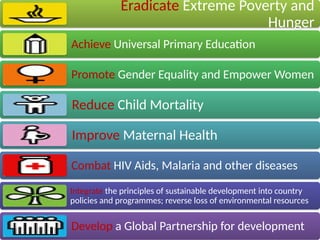
Eradicate Extreme Povertyand
Hunger
Achieve Universal Primary Education
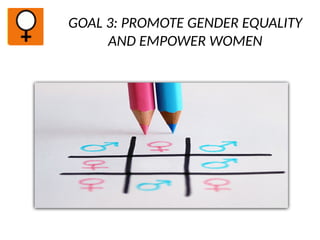
Promote Gender Equality and Empower Women
Reduce Child Mortality
Improve Maternal Health
Combat HIV Aids, Malaria and other diseases
Integrate the principles of sustainable development into country
policies and programmes; reverse loss of environmental resources
Develop a Global Partnership for development
9.
The MDGs are:
A set of targets;
of a quantitative nature;
that are time-bound;
and express key elements of human
development
10.
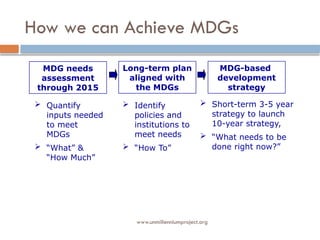
How we canAchieve MDGs
www.unmillenniumproject.org
MDG needs
assessment
through 2015
Long-term plan
aligned with
the MDGs
MDG-based
development
strategy
Quantify
inputs needed
to meet
MDGs
“What” &
“How Much”
Identify
policies and
institutions to
meet needs
“How To”
Short-term 3-5 year
strategy to launch
10-year strategy,
“What needs to be
done right now?”
11.
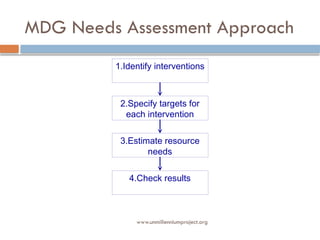
MDG Needs AssessmentApproach
www.unmillenniumproject.org
1.Identify interventions
2.Specify targets for
each intervention
3.Estimate resource
needs
4.Check results
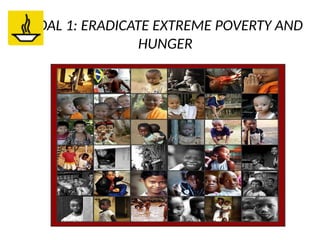
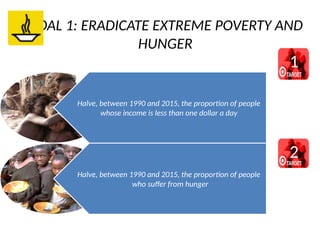
GOAL 1: ERADICATEEXTREME POVERTY AND
HUNGER
Halve, between 1990 and 2015, the proportion of people
whose income is less than one dollar a day
Halve, between 1990 and 2015, the proportion of people
who suffer from hunger
1
2
15.
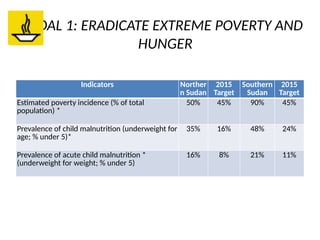
GOAL 1: ERADICATEEXTREME POVERTY AND
HUNGER
Indicators Norther
n Sudan
2015
Target
Southern
Sudan
2015
Target
Estimated poverty incidence (% of total
population) *
50% 45% 90% 45%
Prevalence of child malnutrition (underweight for
age; % under 5)*
35% 16% 48% 24%
Prevalence of acute child malnutrition *
(underweight for weight; % under 5)
16% 8% 21% 11%
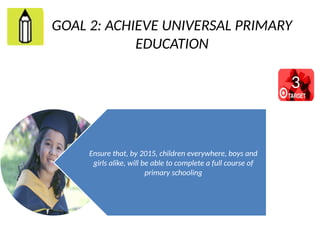
GOAL 2: ACHIEVEUNIVERSAL PRIMARY
EDUCATION
Ensure that, by 2015, children everywhere, boys and
girls alike, will be able to complete a full course of
primary schooling
3
GOAL 3: PROMOTEGENDER EQUALITY
AND EMPOWER WOMEN
Eliminate e gender disparity in primary and secondary
education, preferably by 2005, and in all levels of
education no later than 2015
4
21.
GOAL 3: PROMOTEGENDER EQUALITY
AND EMPOWER WOMEN
Indicators Northern
Sudan
2015
Target
Souther
n Sudan
2015
Target
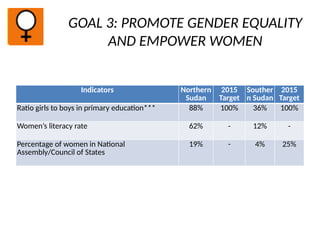
Ratio girls to boys in primary education*** 88% 100% 36% 100%
Women’s literacy rate 62% - 12% -
Percentage of women in National
Assembly/Council of States
19% - 4% 25%
22.
In Sudan,,,
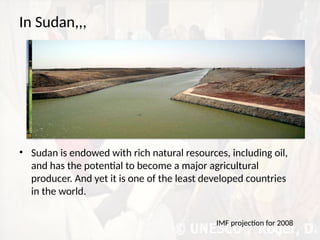
• Sudanis endowed with rich natural resources, including oil,
and has the potential to become a major agricultural
producer. And yet it is one of the least developed countries
in the world.
IMF projection for 2008
23.
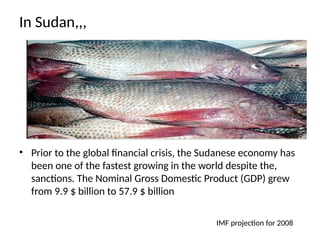
In Sudan,,,
• Priorto the global financial crisis, the Sudanese economy has
been one of the fastest growing in the world despite the,
sanctions. The Nominal Gross Domestic Product (GDP) grew
from 9.9 $ billion to 57.9 $ billion
IMF projection for 2008
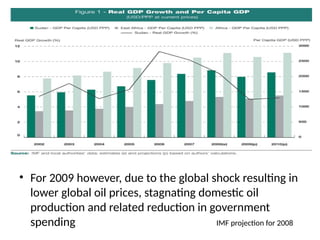
24.
• For 2009however, due to the global shock resulting in
lower global oil prices, stagnating domestic oil
production and related reduction in government
spending IMF projection for 2008
25.
A recentIMF report ranked Sudan as one of the
most vulnerable low -income countries in the global
financial crisis due to its high vulnerability to trade,
aid and remittances shocks.
26.
Poverty iswidespread in Sudan. Human
Development Report HDR ranked the country 147th
among 177 countries in 2009 compared to position
141 in 2006.
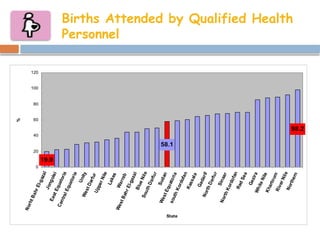
Births Attended byQualified Health
Personnel
19.9
98.2
58.1
0
20
40
60
80
100
120
State
%
37.
Goal 6: CombatHIV/AIDS,
malaria, and other diseases
Target 7: Have halted by 2015 and begun to
reverse the spread of HIV/AIDS.
Target 8: Have halted by 2015 and begun to
reverse the incidence of malaria and other
major diseases.
38.
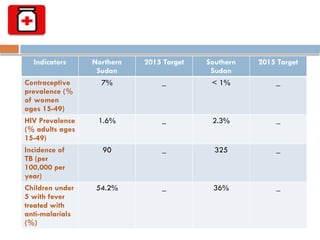
Indicators Northern
Sudan
2015 TargetSouthern
Sudan
2015 Target
Contraceptive
prevalence (%
of women
ages 15-49)
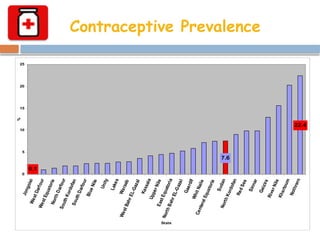
7% _ < 1% _
HIV Prevalence
(% adults ages
15-49)
1.6% _ 2.3% _
Incidence of
TB (per
100,000 per
year)
90 _ 325 _
Children under
5 with fever
treated with
anti-malarials
(%)
54.2% _ 36% _
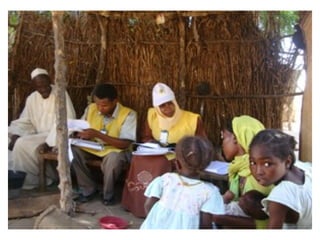
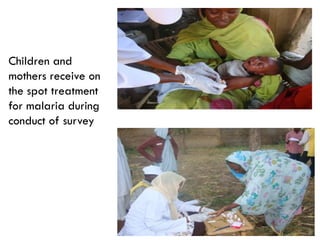
The NationalMalaria Control Programme
(NMCP), in collaboration with WHO is
currently entering data for the findings of the
national malaria survey conducted during the
period 19 October- 4 November2009.
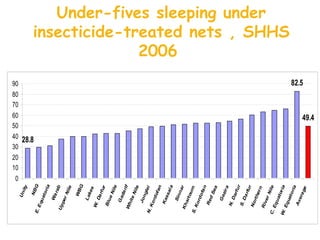
This survey was conducted in 11 states covering
a population of more than 17 million.
41.
This surveyaims to ensure that the most effective
malaria control interventions are being implemented in
the 11 states. These interventions include:
Home based management.
Improving clinical and laboratory diagnosis.
Ensuring availability of anti-malarial drugs.
Distribution of bed nets and scaling up of the
capacity of health workers.
The findings of the survey will ultimately improve disease
surveillance and epidemic management in the future.
42.
The NMCPand UNICEF have also distributed a
total of 1,000,0000 bed nets in the states of
South Kordofan, Blue Nile and Gadarif during
November 2009.
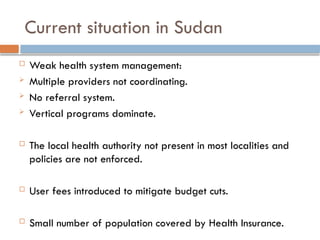
Current situation inSudan
Weak health system management:
Multiple providers not coordinating.
No referral system.
Vertical programs dominate.
The local health authority not present in most localities and
policies are not enforced.
User fees introduced to mitigate budget cuts.
Small number of population covered by Health Insurance.
47.
Positive points:
Emergencycases at hospitals free.
Exemptions include renal dialysis, immune
suppressants, chemotherapy, radiotherapy and
treatment of hemophilia.
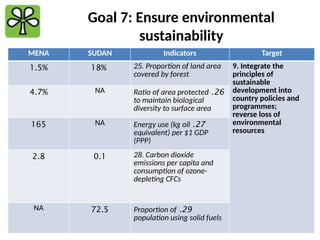
Goal 7: Ensureenvironmental
sustainability
MENA SUDAN Indicators Target
1.5% 18% 25. Proportion of land area
covered by forest
9. Integrate the
principles of
sustainable
development into
country policies and
programmes;
reverse loss of
environmental
resources
4.7% NA 26
.
Ratio of area protected
to maintain biological
diversity to surface area
165 NA 27
.
Energy use (kg oil
equivalent) per $1 GDP
(PPP)
2.8 0.1 28. Carbon dioxide
emissions per capita and
consumption of ozone-
depleting CFCs
NA 72.5 29
.
Proportion of
population using solid fuels
50.
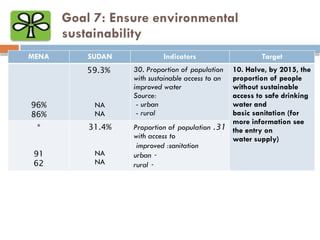
Goal 7: Ensureenvironmental
sustainability
MENA SUDAN Indicators Target
96%
86%
59.3%
NA
NA
30. Proportion of population
with sustainable access to an
improved water
Source:
- urban
- rural
10. Halve, by 2015, the
proportion of people
without sustainable
access to safe drinking
water and
basic sanitation (for
more information see
the entry on
water supply)
*
91
62
31.4%
NA
NA
31
.
Proportion of population
with access to
improved :sanitation
-
urban
-
rural
51.
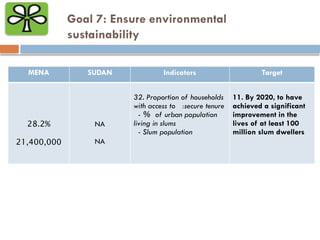
Goal 7: Ensureenvironmental
sustainability
MENA SUDAN Indicators Target
28.2%
21,400,000
NA
NA
32. Proportion of households
with access to :secure tenure
- % of urban population
living in slums
- Slum population
11. By 2020, to have
achieved a significant
improvement in the
lives of at least 100
million slum dwellers
Indicators Target
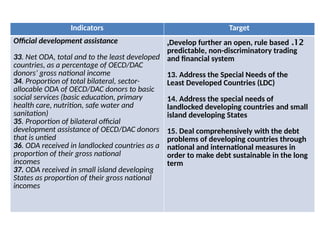
Official developmentassistance
33. Net ODA, total and to the least developed
countries, as a percentage of OECD/DAC
donors’ gross national income
34. Proportion of total bilateral, sector-
allocable ODA of OECD/DAC donors to basic
social services (basic education, primary
health care, nutrition, safe water and
sanitation)
35. Proportion of bilateral official
development assistance of OECD/DAC donors
that is untied
36. ODA received in landlocked countries as a
proportion of their gross national
incomes
37. ODA received in small island developing
States as proportion of their gross national
incomes
12
.
Develop further an open, rule based
,
predictable, non-discriminatory trading
and financial system
13. Address the Special Needs of the
Least Developed Countries (LDC)
14. Address the special needs of
landlocked developing countries and small
island developing States
15. Deal comprehensively with the debt
problems of developing countries through
national and international measures in
order to make debt sustainable in the long
term
54.
Indicators Target
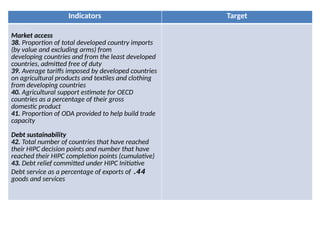
Market access
38.Proportion of total developed country imports
(by value and excluding arms) from
developing countries and from the least developed
countries, admitted free of duty
39. Average tariffs imposed by developed countries
on agricultural products and textiles and clothing
from developing countries
40. Agricultural support estimate for OECD
countries as a percentage of their gross
domestic product
41. Proportion of ODA provided to help build trade
capacity
Debt sustainability
42. Total number of countries that have reached
their HIPC decision points and number that have
reached their HIPC completion points (cumulative)
43. Debt relief committed under HIPC Initiative
44
.
Debt service as a percentage of exports of
goods and services
55.
Indicators Target
45
.
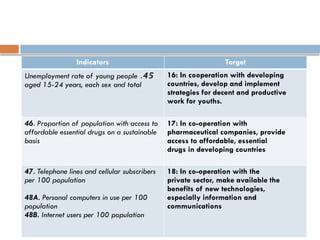
Unemployment rateof young people
aged 15-24 years, each sex and total
16: In cooperation with developing
countries, develop and implement
strategies for decent and productive
work for youths.
46. Proportion of population with access to
affordable essential drugs on a sustainable
basis
17: In co-operation with
pharmaceutical companies, provide
access to affordable, essential
drugs in developing countries
47. Telephone lines and cellular subscribers
per 100 population
48A. Personal computers in use per 100
population
48B. Internet users per 100 population
18: In co-operation with the
private sector, make available the
benefits of new technologies,
especially information and
communications
56.
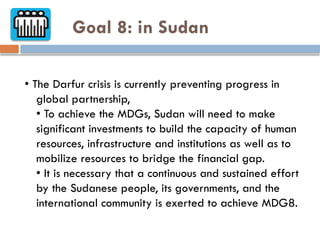
Goal 8: inSudan
• The Darfur crisis is currently preventing progress in
global partnership,
• To achieve the MDGs, Sudan will need to make
significant investments to build the capacity of human
resources, infrastructure and institutions as well as to
mobilize resources to bridge the financial gap.
• It is necessary that a continuous and sustained effort
by the Sudanese people, its governments, and the
international community is exerted to achieve MDG8.
57.
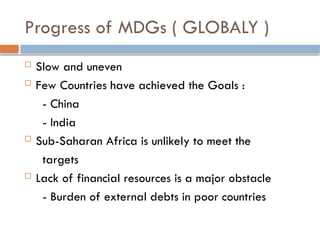
Progress of MDGs( GLOBALY )
Slow and uneven
Few Countries have achieved the Goals :
- China
- India
Sub-Saharan Africa is unlikely to meet the
targets
Lack of financial resources is a major obstacle
- Burden of external debts in poor countries
58.
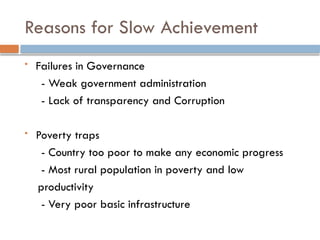
Reasons for SlowAchievement
Failures in Governance
- Weak government administration
- Lack of transparency and Corruption
Poverty traps
- Country too poor to make any economic progress
- Most rural population in poverty and low
productivity
- Very poor basic infrastructure
59.
Pocket ofpoverty
o Middle income countries moving from subsistence agriculture to commercial
agriculture
o Large proportion of population in urban areas
o Some groups in extreme poverty
Areas of specific policy neglect
o Policy makers unaware of challenges
o Unaware on what to do
o Specific groups are neglected: gender bias, needs of
specific groups e.g children, disabled, elderly
o Lack of public investment in specific areas e.g environment, nutrition, adolescent
health
60.
Recommendations, future prospectsand the way
forward
Achieving the Millennium Development Goals is based on
shared responsibilities among major stakeholders.
It requires many combined and complementary efforts
from rich and poor countries, international agencies,
local authorities, private actors and civil society
organizations.
Some actions will occur at the national level and some at
the level of the international system. These include much
larger investments in infrastructure, disease control and
Education.
61.
Role and actionby National Levels:
Sudan needs to develop goal-oriented and MDGs
based medium and long term plans in which the
sequence of investments and policy changes needed
to achieve the goals should be identified.
Our recommendation is to put the MDGs at the
center of national plans and the poverty reduction
strategies. Sudan and development partners must
move from words to action. If this is done, the
MDGs can still be achieved.
62.
Role and actionby development partners:
Development partners and donors need to take the MDGs
seriously as minimum targets over the coming 8 years
horizon. The MDGs should be at the center of national and
international poverty reduction strategies.
Resources needed to achieve the MDGs:
To implement the interventions recommended to
achieve the MDGs, Sudan needs to increase public
investments in social services, basic infrastructure,
and environmental management.
63.
There are severalinternational undertaking aimed
at estimating the cost implication to achieve the
MDGs. The recent one is the work of the WB, the
UN Millennium project.
Based on these we can estimate the cost of meeting
the Millennium Development Goals (MDGs) at the
country. Resources required will be in the range of
100-120 US$ per capita.