INDICATORS for Monitoring the Millennium Development Goals


                                 Definitions

                                 Rationale
                                 Concepts

                                 and Sources


                United Nations
ST/ESA/STAT/SER.F/95


       United Nations Development Group
                          Led by

            United Nations Population Fund

         United Nations Development Programme

              Department of Economic and
            Social Affairs–Statistics Division


Indicators for Monitoring the
Millennium Development Goals
Definitions Rationale Concepts and Sources


                  United Nations

                      New York

                          2003
Indicators for Monitoring the Millennium Development Goals


     NOTE


              The designations employed and the presentation of material in this publication do
              not imply the expression of any opinion whatsoever on the part of the United Nations
              concerning the legal status of any country, territory, city or area or of its authorities,
              or concerning the delimitation of its frontiers or boundaries. The term “country” as
              used in the text of this report refers, as appropriate, to territories or areas. The des-
              ignations of “developed”. “developing” and “least developed” countries are intended
              for convenience and do not necessarily express a judgement about the stage reached
              by a particular country or area in the development process. Reference to “dollars” ($)
              indicates United States dollars, unless otherwise stated.


              ST/ESA/STAT/SER.F/95
              United Nations Publication
              Sales No. E.03.XVII. 18
              ISBN 92-1-161467-8
              Copyright © United Nations 2003
              All rights reserved


              Graphic design and Desktop composition Andy Musilli


ii
Definitions, Rationale, Concepts and Sources


FOREWORD
    Building on the United Nations global conferences of the 1990s, the United Nations
    Millennium Declaration of 2000 marked a strong commitment to the right to devel-
    opment, to peace and security, to gender equality, to the eradication of the many
    dimensions of poverty and to sustainable human development. Embedded in that
    Declaration, which was adopted by 147 heads of State and 189 states, were what
    have become known as the eight Millennium Development Goals, including 18 time-
    bound targets.

    To monitor progress towards the goals and targets, the United Nations system,
    including the World Bank and the International Monetary Fund, as well as the
    Development Assistance Committee of the Organisation for Economic Co-operation
    and Development, came together under the Office of the Secretary-General and
    agreed on 48 quantitative indicators. The indicators built upon an intergovernmen-
    tal process to identify relevant indicators in response to global conferences. The
    Secretary-General presented the goals, targets and indicators to the General
    Assembly in September 2001 in his report entitled “Road map towards the imple-
    mentation of the United Nations Millennium Declaration”.

    The present handbook provides guidance on the definitions, rationale, concepts and
    sources of data for each of the indicators that are being used to monitor the goals and
    targets. It expands on an earlier exercise to provide the metadata for the socio-eco-
    nomic indicators that make up the United Nations Common Country Assessment
    Indicator Framework. The indicators for goals 1–7 are a subset of that framework.

    Preparation of the handbook was directed by an inter-agency working group of the
    United Nations Development Group, including the World Bank, chaired by the United
    Nations Population Fund and co-chaired by the United Nations Statistics Division and
    the United Nations Development Programme. On behalf of the United Nations
    Development Group, I would like to thank all the agencies and individuals (see below)
    who contributed to this handbook, including the Department for International
    Development of the Government of the United Kingdom, which funded the services
    of a short-term consultant who contributed to the handbook.

    I believe that this tangible example of interagency collaboration will prove useful to
    the international community by strengthening national statistical capacity and
    improving monitoring. And I sincerely hope that this will be sustained through future
    revisions in the same spirit.


    Mark Malloch Brown
    Chairman
    United Nations Development Group


    September 2003

                                                                                                iii
Definitions, Rationale, Concepts and Sources


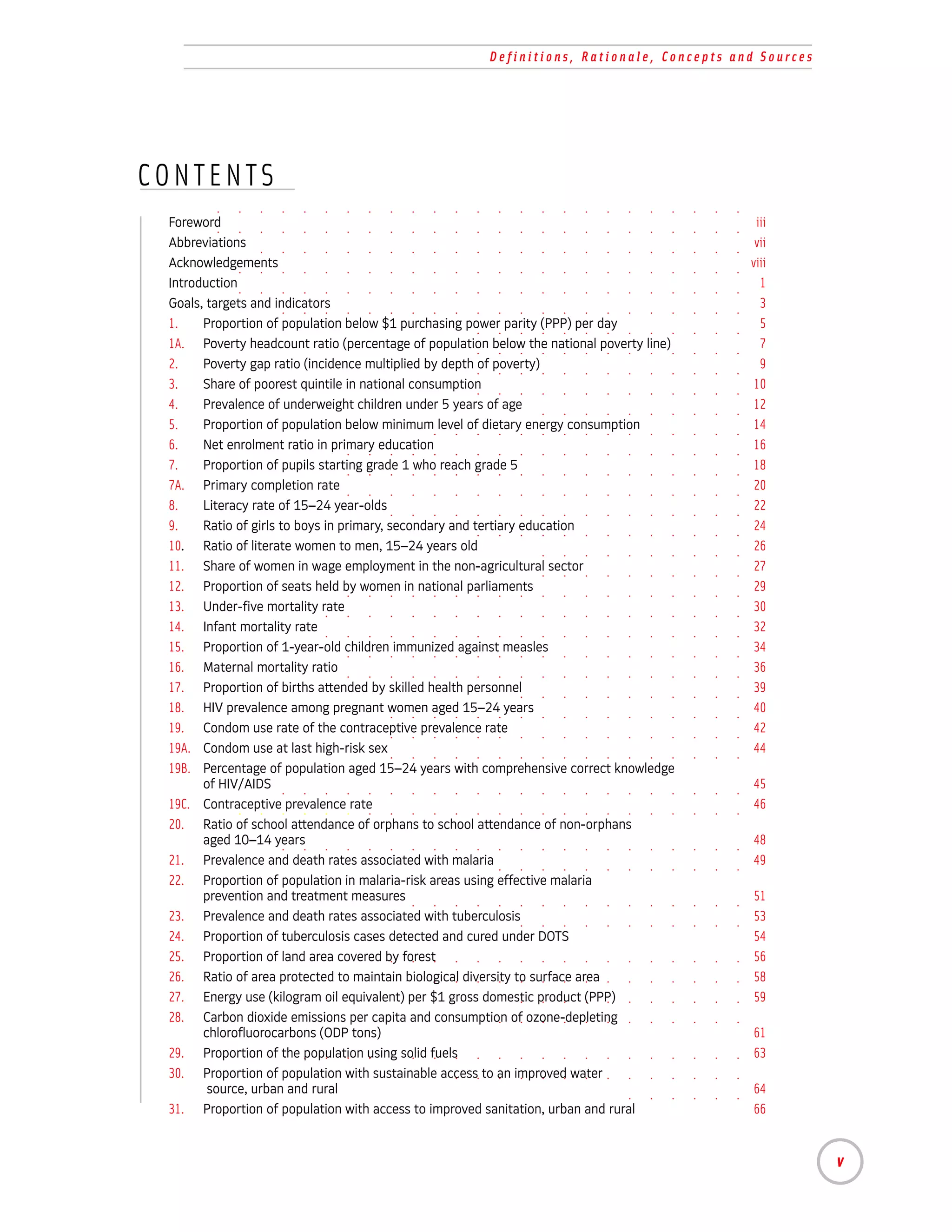
CONTENTS
.   .   .   .   .   .   .   .   .   .   .   .   .   .   .   .    .   .   .   .   .   .   .   .   .   .   .   .
.
    Foreword . . . . . . . . . . . . . . . . . . . . .
     .   .    .                                                                                      .   .   .
                                                                                                                  iii
.
    Abbreviations . . . . . . . . . . . . . . . . . . . .
     .   .    .   .                                                                                  .   .   .
                                                                                                                  vii
.
    Acknowledgements . . . . . . . . . . . . . . . . . . .
     .   .    .   .   .                                                                              .   .   .
                                                                                                                 viii
.
    Introduction . . . . . . . . . . . . . . . . . . . . .
     .   .    .                                                                                      .   .   .
                                                                                                                   1
.
    Goals, targets and indicators . . . . . . . . . . . . . . . .
     .   .    .   .   .  .    .   .                                                                  .   .   .
                                                                                                                   3
.
    1. . Proportion. of population below $1 purchasing power. parity (PPP) per day . . .
     .        .   .      .    .   .  .   .   .    .   .   .  .       .   .   .   .   .               .   .   .
                                                                                                                   5
.
    1A. . Poverty headcount ratio (percentage .of population below the national poverty line) .
     .        .   .   .  .    .   .  .   .   .        .   .  .   .   .   .   .   .   .   .  .        .   .   .
                                                                                                                   7
.
    2. . Poverty gap ratio .(incidence multiplied by depth .of poverty) . . . . . . .
     .        .   .   .  .        .  .   .   .    .   .   .      .   .                               .   .   .
                                                                                                                   9
.
    3. . Share .of poorest quintile in national consumption . . . . . . . . .
     .        .       .  .    .   .  .   .   .    .   .   .  .                                       .   .   .
                                                                                                                  10
.
    4. . Prevalence of .underweight children under 5 years of. age. . . . . . . .
     .        .   .   .       .   .  .   .   .    .   .   .  .                                       .   .   .
                                                                                                                  12
.
    5. . Proportion. of population below minimum. level of. dietary. energy. consumption . .
     .        .   .      .    .   .  .   .   .    .       .      .       .       .   .   .           .   .   .
                                                                                                                  14
.
    6. . Net enrolment. ratio in. primary education. . . . . . . . . . . .
     .        .   .   .       .      .   .   .    .                                                  .   .   .
                                                                                                                  16
.
    7. . Proportion. of pupils starting grade 1 .who. reach grade 5 . . . . . . . .
     .        .   .      .    .   .  .   .   .            .  .   .                                   .   .   .
                                                                                                                  18
.
    7A. . Primary completion rate . . . . . . . . . . . . . . . .
     .        .   .   .  .    .   .                                                                  .   .   .
                                                                                                                  20
.
    8. . Literacy rate of 15–24 year-olds . . . . . . . . . . . . . .
     .        .   .   .  .    .   .  .   .                                                           .   .   .
                                                                                                                  22
.
    9. . Ratio of girls to boys in primary, secondary and tertiary education . . . . .
     .        .   .   .  .    .   .  .   .   .    .   .   .  .   .   .   .   .                       .   .   .
                                                                                                                  24
.
    10. . Ratio of literate women to men, 15–24 years. old. . . . . . . . . .
     .        .   .   .  .    .   .  .   .   .    .   .                                              .   .   .
                                                                                                                  26
.
    11. . Share .of women in wage employment in the non-agricultural. sector . . . . .
     .        .       .  .    .   .  .   .   .    .   .   .  .   .   .       .                       .   .   .
                                                                                                                  27
.
    12. . Proportion. of seats held by women in. national parliaments . . . . . . .
     .        .   .      .    .   .  .   .   .        .   .  .   .   .                               .   .   .
                                                                                                                  29
.
    13. . Under-five mortality rate . . . . . . . . . . . . . . . .
     .        .   .   .  .    .   .                                                                  .   .   .
                                                                                                                  30
.
    14. . Infant .mortality rate . . . . . . . . . . . . . . . . .
     .        .       .  .    .                                                                      .   .   .
                                                                                                                  32
.
    15. . Proportion. of 1-year-old children .immunized .against. measles . . . . . .
     .        .   .      .    .   .  .   .        .   .      .       .   .                           .   .   .
                                                                                                                  34
.
    16. . Maternal mortality ratio . . . . . . . . . . . . . . . .
     .        .   .   .  .    .   .                                                                  .   .   .
                                                                                                                  36
.
    17. . Proportion. of births attended. by skilled health personnel. . . . . . . .
     .        .   .      .    .   .  .       .    .   .   .  .   .                                   .   .   .
                                                                                                                  39
.
    18. . HIV prevalence among pregnant women aged 15–24. years . . . . . . .
     .        .   .   .  .    .   .  .   .   .    .   .   .  .       .                               .   .   .
                                                                                                                  40
.
    19. . Condom use rate of the contraceptive prevalence rate . . . . . . . .
     .        .   .   .  .    .   .  .   .   .    .   .   .  .   .                                   .   .   .
                                                                                                                  42
    19A. Condom use at last high-risk sex . . . . . . . . . . . . . .                                .   .   .
                                                                                                                  44
    19B. Percentage of population aged 15–24 years with comprehensive correct knowledge
.    .   .
           of .HIV/AIDS . . . . . . . . . . . . . . . . . . .
                  .   .                                                                              .   .   .
                                                                                                                 45
.
    19C. . Contraceptive. prevalence .rate . . . . . . . . . . . . . .
     .        .   .   .       .   .      .                                                           .   .   .
                                                                                                                 46
    20. Ratio of school attendance of orphans to school attendance of non-orphans
.    .   .
           aged 10–14 years. . . . . . . . . . . . . . . . . .
              .   .   .  .                                                                           .   .   .
                                                                                                                 48
.
    21. . Prevalence and death. rates associated with malaria . . . . . . . . .
     .        .   .   .  .    .      .   .   .    .   .   .  .                                       .   .   .
                                                                                                                 49
    22. Proportion of population in malaria-risk areas using effective malaria
.    .   .
           prevention and treatment. measures . . . . . . . . . . . . .
              .   .   .  .    .   .      .   .                                                       .   .   .
                                                                                                                 51
.
    23. . Prevalence and death. rates associated with tuberculosis. . . . . . . .
     .        .   .   .  .    .      .   .   .    .   .   .  .   .                                   .   .   .
                                                                                                                 53
    24. Proportion of tuberculosis cases detected and cured under DOTS                                           54
.   25. . Proportion. of land. area covered by forest. . . . . . . . . . . .
     .        .   .      .        .  .   .   .    .                                                  .   .   .   56
.   26. . Ratio of area protected to. maintain biological diversity to surface area . . . .
     .        .   .   .  .    .   .      .   .    .   .   .  .   .   .   .   .   .                   .   .   .   58
.   27. . Energy use (kilogram oil equivalent) per $1 gross. domestic product (PPP) . . .
     .        .   .   .  .    .   .  .   .   .    .   .   .      .   .   .   .   .   .               .   .   .   59
.   28. . Carbon dioxide emissions .per. capita and .consumption of. ozone-depleting . . .
     .        .   .   .  .    .   .          .    .       .  .   .       .   .   .   .               .   .   .
           chlorofluorocarbons (ODP tons)                                                                        61
.   29. . Proportion. of the population using solid fuels. . . . . . . . . . .
     .        .   .      .    .   .  .   .   .    .   .                                              .   .   .   63
.   30. . Proportion. of population with. sustainable access. to an improved water . . . .
     .        .   .      .    .   .  .       .    .   .   .      .   .   .   .   .                   .   .   .
            source, urban and rural                                                      .  . .      .   .   .
                                                                                                                 64
.   31. . Proportion. of population with. access .to improved sanitation,. urban and .rural . .
     .        .   .      .    .   .  .       .        .   .  .   .   .       .   .       .           .   .   .   66
                    .   .   .   .   .   .   .   .   .   .   .    .   .   .   .   .   .   .   .   .   .   .   .

                                                                                                                        v
Indicators for Monitoring the Millennium Development Goals


           .   .
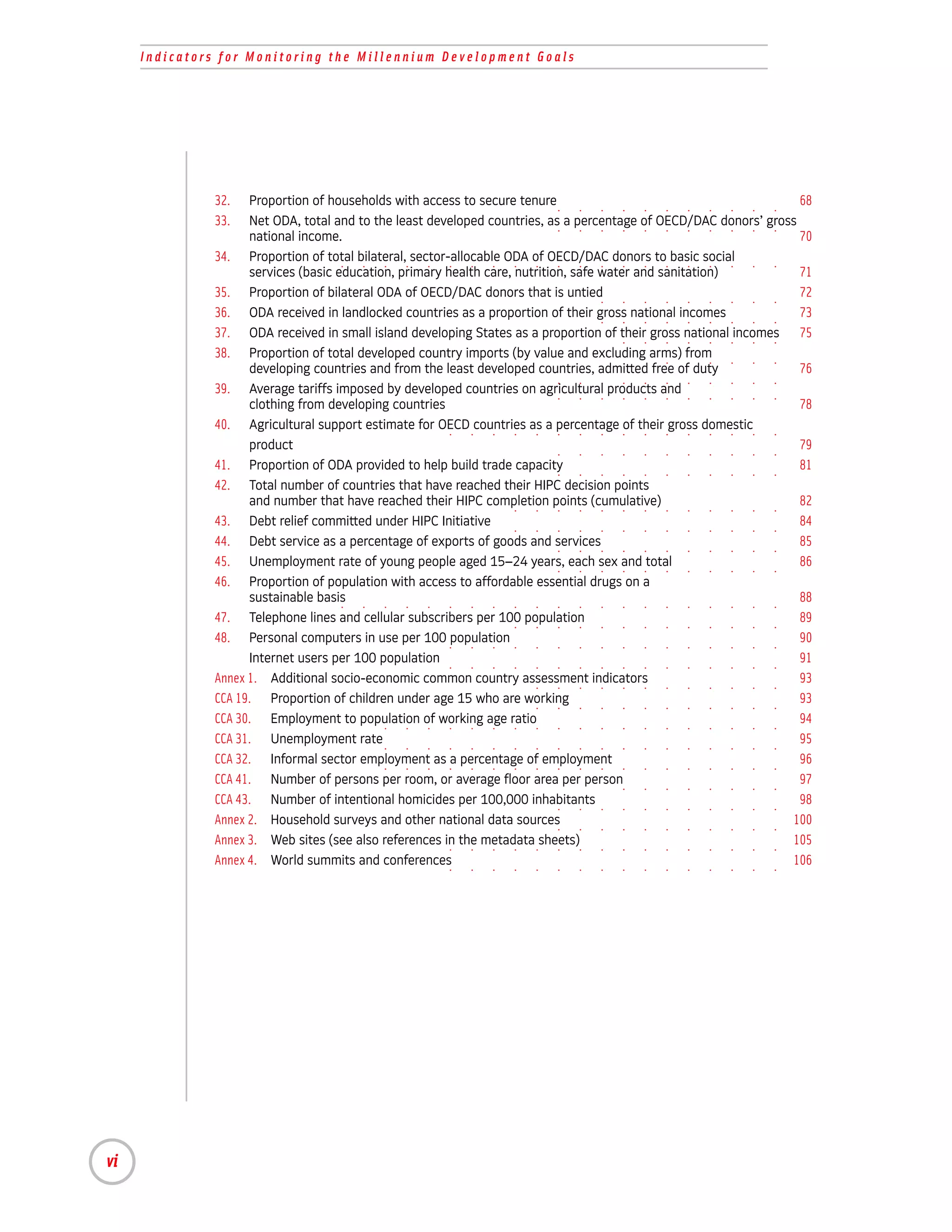
                 32. . Proportion of households with access to secure. tenure . . . . . . . . . . .
                         .  .    .   .   .   .   .   .    .   .   .   .        .
                                                                                                                               68
           .   .
                 33. . Net ODA, total and to the least developed countries, as. a percentage of OECD/DAC donors’ gross
                         .  .    .   .   .   .   .   .    .   .   .   .   .    .       .   .     .   .    .   .   .   .    . .
                       national income.                                                                                        70
           .   .
                 34. . Proportion of total bilateral,. sector-allocable ODA of OECD/DAC donors to. basic social . .
                         .  .    .   .   .   .   .        .   .   .   .   .    .    .  .   .     .   .        .   .   .
                       services (basic education, primary health care, nutrition, safe water and sanitation)                   71
           .   .
                 35. . Proportion of bilateral ODA of OECD/DAC donors that is untied. . . . . . . . .
                         .  .    .   .   .   .   .   .    .   .   .   .   .    .    .  .
                                                                                                                               72
           .   .
                 36. . ODA .received in .landlocked .countries as a proportion of their gross national incomes . . .
                         .       .   .       .   .        .   .   .   .   .    .    .  .   .     .   .    .   .   .
                                                                                                                               73
           .   .
                 37. . ODA .received in .small island. developing. States .as a. proportion. of their. gross national .incomes 75
                         .       .   .       .   .        .   .       .             .  .         .        .   .   .        . .
           .   .
                 38. . Proportion of total developed country imports (by value and excluding. arms) from. . . .
                         .  .    .   .   .   .   .   .    .   .   .   .   .    .    .  .   .     .        .   .
                       developing countries and from the least developed countries, admitted free of duty                      76
           .   .     .   .  .    .   .   .   .   .   .    .   .   .   .   .    .    .  .   .     .   .    .   .   .   .    . .
           .   .
                 39. . Average .tariffs imposed . by developed countries on. agricultural. products and . . . . .
                         .  .        .   .   .       .    .   .   .   .   .         .  .         .   .    .
                       clothing from developing countries                                                                      78
           .   .
                 40. . Agricultural support . estimate for OECD .countries as a percentage .of their .gross domestic. .
                         .  .    .   .   .       .   .    .   .       .   .    .    .  .   .         .        .   .   .
           .   .     .
                       product . . . . . . . . . . . . . . . . . . . . . . .
                         .  .
                                                                                                                               79
           .   .
                 41. . Proportion of ODA provided .to help .build trade .capacity . . . . . . . . . .
                         .  .    .   .   .   .   .        .       .   .        .    .
                                                                                                                               81
                 42. Total number of countries that have reached their HIPC decision points
           .   .     .
                       and number .that have reached their HIPC completion points (cumulative) . . . . . .
                         .  .    .       .   .   .   .    .   .   .   .   .    .    .  .   .     .   .
                                                                                                                               82
           .   .
                 43. . Debt. relief committed under. HIPC Initiative . . . . . . . . . . . . . .
                         .       .   .   .   .   .        .   .   .
                                                                                                                               84
           .   .
                 44. . Debt. service. as a percentage of. exports of .goods and services. . . . . . . . .
                         .       .       .   .   .   .        .   .       .    .    .  .
                                                                                                                               85
           .   .
                 45. . Unemployment rate .of young people aged 15–24 years, each sex and .total . . . . .
                         .  .    .   .   .       .   .    .   .   .   .   .    .    .  .   .     .        .
                                                                                                                               86
                 46. Proportion of population with access to affordable essential drugs on a
           .   .     .
                       sustainable basis . . . . . . . . . . . . . . . . . . . .
                         .  .    .   .   .
                                                                                                                               88
           .   .
                 47. . Telephone lines and .cellular .subscribers. per. 100 population . . . . . . . . .
                         .  .    .   .   .       .        .   .           .    .    .  .
                                                                                                                               89
           .   .
                 48. . Personal. computers .in use per 100 .population . . . . . . . . . . . . .
                         .  .        .   .       .   .    .       .   .
                                                                                                                               90
           .   .     .
                       Internet .users per 100 population . . . . . . . . . . . . . . . .
                         .  .        .   .   .   .   .    .
                                                                                                                               91
           .   .
                 Annex 1. Additional socio-economic common. country assessment indicators . . . . . .
                     .   .  .    .   .   .   .   .   .    .   .       .   .    .    .  .   .     .   .
                                                                                                                               93
           .   .
                 CCA.19. . Proportion of children under. age 15. who are working . . . . . . . . . .
                            .    .   .   .   .   .   .        .       .   .    .    .
                                                                                                                               93
           .   .
                 CCA.30. . Employment. to population of working age ratio. . . . . . . . . . . .
                            .    .   .       .   .   .    .   .   .   .   .
                                                                                                                               94
           .   .
                 CCA.31. . Unemployment rate . . . . . . . . . . . . . . . . . . .
                            .    .   .   .   .
                                                                                                                               95
           .   .
                 CCA.32. . Informal .sector employment. as .a percentage of. employment . . . . . . . .
                            .    .       .   .   .   .            .   .   .         .  .   .
                                                                                                                               96
           .   .
                 CCA.41. . Number of persons per room, or average floor area. per. person. . . . . . . .
                            .    .   .   .   .   .   .    .   .   .   .   .    .           .
                                                                                                                               97
           .   .
                 CCA.43. . Number of intentional homicides per 100,000 inhabitants . . . . . . . . .
                            .    .   .   .   .   .   .    .   .   .   .   .    .    .  .
                                                                                                                               98
           .   .
                 Annex 2. Household surveys and other national data .sources. . . . . . . . . . . 100
                     .   .  .    .   .   .   .   .   .    .   .   .   .        .
           .   .
                 Annex 3. Web .sites (see also references in the metadata .sheets). . . . . . . . . . 105
                     .   .  .        .   .   .   .   .    .   .   .   .   .         .
           .   .
                 Annex 4. World summits and conferences. . . . . . . . . . . . . . . . 106
                     .   .  .    .   .   .   .   .   .    .


vi
Definitions, Rationale, Concepts and Sources


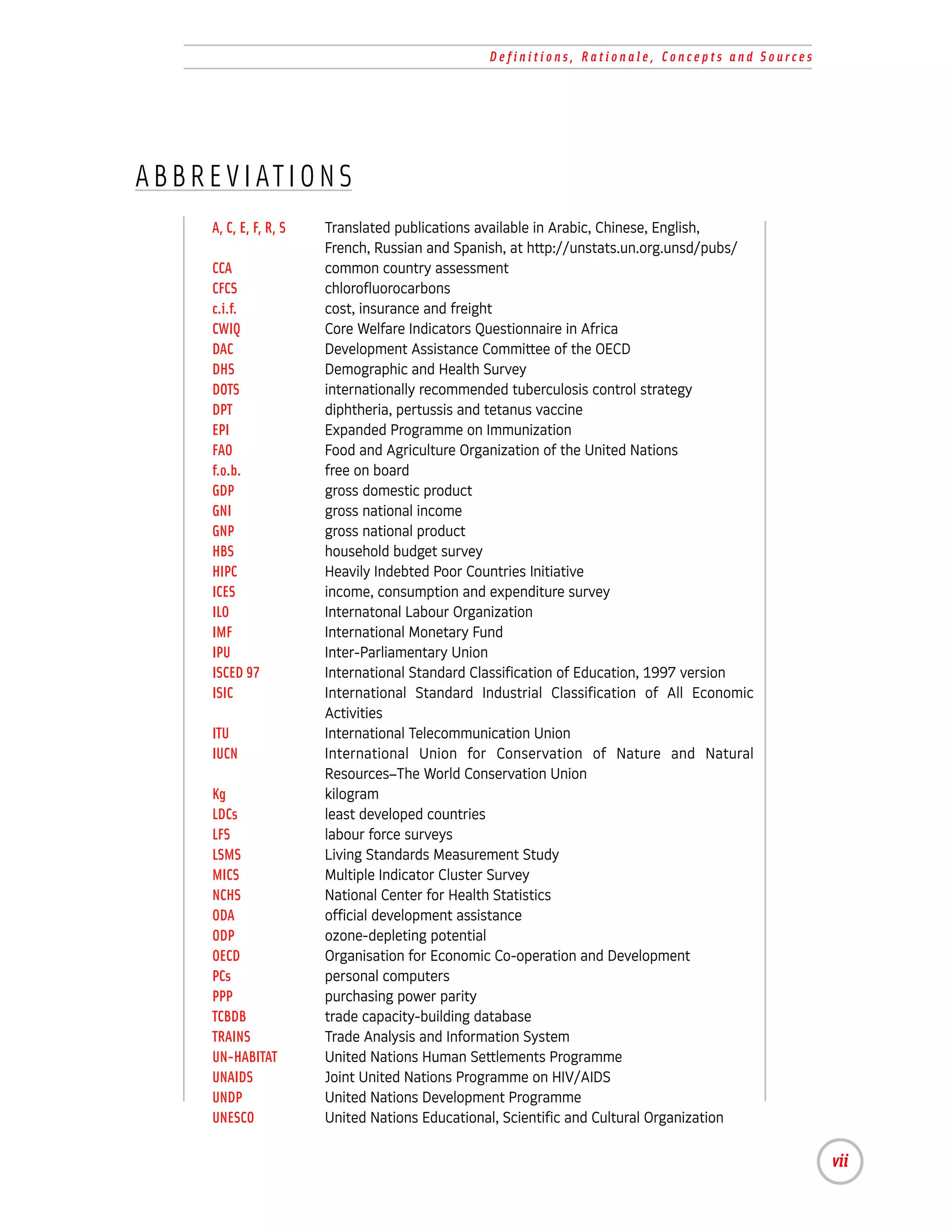
A B B R E V I AT I O N S
        A, C, E, F, R, S   Translated publications available in Arabic, Chinese, English,
                           French, Russian and Spanish, at http://unstats.un.org.unsd/pubs/
        CCA                common country assessment
        CFCS               chlorofluorocarbons
        c.i.f.             cost, insurance and freight
        CWIQ               Core Welfare Indicators Questionnaire in Africa
        DAC                Development Assistance Committee of the OECD
        DHS                Demographic and Health Survey
        DOTS               internationally recommended tuberculosis control strategy
        DPT                diphtheria, pertussis and tetanus vaccine
        EPI                Expanded Programme on Immunization
        FAO                Food and Agriculture Organization of the United Nations
        f.o.b.             free on board
        GDP                gross domestic product
        GNI                gross national income
        GNP                gross national product
        HBS                household budget survey
        HIPC               Heavily Indebted Poor Countries Initiative
        ICES               income, consumption and expenditure survey
        ILO                Internatonal Labour Organization
        IMF                International Monetary Fund
        IPU                Inter-Parliamentary Union
        ISCED 97           International Standard Classification of Education, 1997 version
        ISIC               International Standard Industrial Classification of All Economic
                           Activities
        ITU                International Telecommunication Union
        IUCN               International Union for Conservation of Nature and Natural
                           Resources–The World Conservation Union
        Kg                 kilogram
        LDCs               least developed countries
        LFS                labour force surveys
        LSMS               Living Standards Measurement Study
        MICS               Multiple Indicator Cluster Survey
        NCHS               National Center for Health Statistics
        ODA                official development assistance
        ODP                ozone-depleting potential
        OECD               Organisation for Economic Co-operation and Development
        PCs                personal computers
        PPP                purchasing power parity
        TCBDB              trade capacity-building database
        TRAINS             Trade Analysis and Information System
        UN-HABITAT         United Nations Human Settlements Programme
        UNAIDS             Joint United Nations Programme on HIV/AIDS
        UNDP               United Nations Development Programme
        UNESCO             United Nations Educational, Scientific and Cultural Organization

                                                                                                  vii
Indicators for Monitoring the Millennium Development Goals


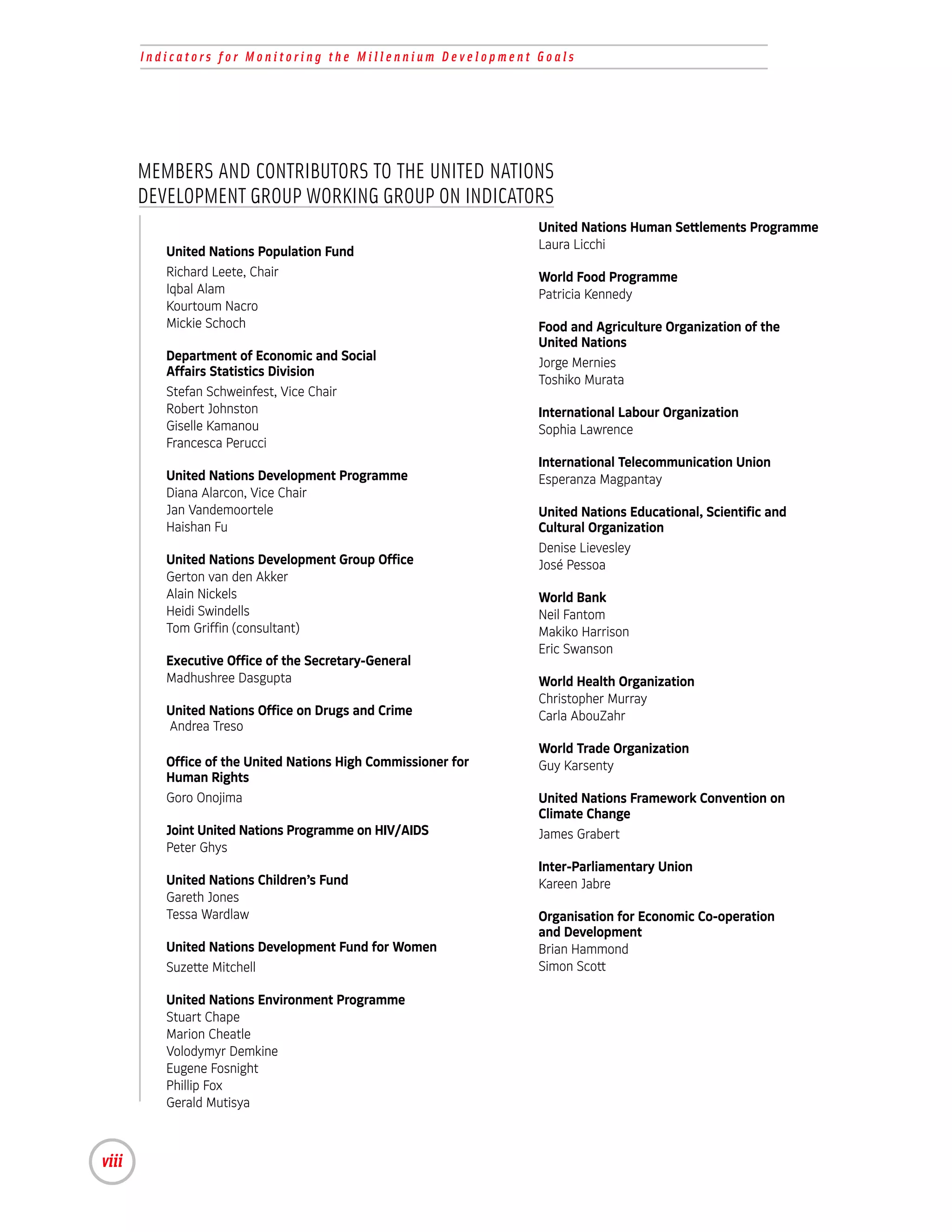
       MEMBERS AND CONTRIBUTORS TO THE UNITED NATIONS
       DEVELOPMENT GROUP WORKING GROUP ON INDICATORS
                                                               United Nations Human Settlements Programme
                                                               Laura Licchi
          United Nations Population Fund
          Richard Leete, Chair                                 World Food Programme
          Iqbal Alam                                           Patricia Kennedy
          Kourtoum Nacro
          Mickie Schoch                                        Food and Agriculture Organization of the
                                                               United Nations
          Department of Economic and Social                    Jorge Mernies
          Affairs Statistics Division
                                                               Toshiko Murata
          Stefan Schweinfest, Vice Chair
          Robert Johnston                                      International Labour Organization
          Giselle Kamanou                                      Sophia Lawrence
          Francesca Perucci
                                                               International Telecommunication Union
          United Nations Development Programme                 Esperanza Magpantay
          Diana Alarcon, Vice Chair
          Jan Vandemoortele                                    United Nations Educational, Scientific and
          Haishan Fu                                           Cultural Organization
                                                               Denise Lievesley
          United Nations Development Group Office              José Pessoa
          Gerton van den Akker
          Alain Nickels                                        World Bank
          Heidi Swindells                                      Neil Fantom
          Tom Griffin (consultant)                             Makiko Harrison
                                                               Eric Swanson
          Executive Office of the Secretary-General
          Madhushree Dasgupta                                  World Health Organization
                                                               Christopher Murray
          United Nations Office on Drugs and Crime             Carla AbouZahr
          Andrea Treso
                                                               World Trade Organization
          Office of the United Nations High Commissioner for   Guy Karsenty
          Human Rights
          Goro Onojima                                         United Nations Framework Convention on
                                                               Climate Change
          Joint United Nations Programme on HIV/AIDS           James Grabert
          Peter Ghys
                                                               Inter-Parliamentary Union
          United Nations Children’s Fund                       Kareen Jabre
          Gareth Jones
          Tessa Wardlaw                                        Organisation for Economic Co-operation
                                                               and Development
          United Nations Development Fund for Women            Brian Hammond
          Suzette Mitchell                                     Simon Scott

          United Nations Environment Programme
          Stuart Chape
          Marion Cheatle
          Volodymyr Demkine
          Eugene Fosnight
          Phillip Fox
          Gerald Mutisya


viii
Definitions, Rationale, Concepts and Sources


INTRODUCTION
    Indicators for Monitoring the Millennium Development Goals: Definitions, Rationale,
    Concepts and Sources contains basic metadata on the agreed list of quantitative
    indicators for monitoring progress towards the eight goals and 18 targets derived
    from the United Nations Millennium Declaration (table). The list of indicators, devel-
    oped using several criteria, is not intended to be prescriptive but to take into
    account the country setting and the views of various stakeholders in preparing
    country-level reports.

    Five main criteria guided the selection of indicators. Indicators should:
    I Provide relevant and robust measures of progress towards the targets of the

       Millennium Development Goals
    I Be clear and straightforward to interpret and provide a basis for international

       comparison
    I Be broadly consistent with other global lists and avoid imposing an unnecessary

       burden on country teams, Governments and other partners
    I Be based to the greatest extent possible on international standards, recommen-

       dations and best practices
    I Be constructed from well-established data sources, be quantifiable and be con-

       sistent to enable measurement over time

    The present handbook is designed to provide United Nations country teams and
    national and international stakeholders with guidance on the definitions, rationale,
    concepts and sources of the data for the indicators that are being used to monitor
    the Millennium Development Goals. Just as the indicator list is dynamic and will nec-
    essarily evolve in response to changing national situations, so will the metadata
    change over time as concepts, definitions and methodologies change.

    A consultation process, generally involving the national statistical office or other
    national authority, should be initiated in the selection and compilation of country-
    specific indicators. The consultation should take into account national development
    priorities, the suggested list of indicators and the availability of data. The United
    Nations country team should work collaboratively to help build ownership and con-
    sensus on the selected indicators.

    NATIONAL SOURCES
    Country data should be used for compiling the indicators where such data are avail-
    able and of reasonable quality. The data source for each indicator and the quantita-
    tive value of the indicator should be decided by consensus among the key stake-
    holders, especially the national statistical system. The national statistical system
    should own the data and related indicators.

    For any given indicator, a wide range of data sources may be available within the
    country, and each source should be critically reviewed. Existing data sources and
    reporting systems should be used where possible, particularly where line ministries
    have their own statistical systems. International data sources should be consulted

                                                                                                1
Indicators for Monitoring the Millennium Development Goals


             for validation and in the absence of national sources.

             METADATA SHEETS
             For each indicator used to measure progress towards the targets and goals, the
             handbook provides all or some of the following information:
                 I A simple operational definition

                I The goal and target it addresses

                I The rationale for use of the indicator

                I The method of computation

                I Sources of data

                I References, including relevant international Web sites

                I Periodicity of measurement

                I Gender and disaggregation issues

                I Limitations of the indicator

                I National and international agencies involved in the collection, compilation or

                   dissemination of the data

             The intention is not to provide an exhaustive amount of information for each item,
             but to provide a reference point and guidance for country teams and national stake-
             holders. The amount of information varies by indicator and tends to reflect the
             extent of national and international debate on its relevance. Limited information is
             available for some of the less well-established indicators. With further use of the
             indicators and greater recognition of the need for such data, fuller information is
             expected to become available.

             Monitoring of the Millennium Development Goals is taking place globally, through
             annual reports of the United Nations Secretary-General to the General Assembly and
             through periodic country reporting. For global reporting, use is made of indicators
             compiled by international organizations. Internationally compiled indicators, based
             on standard concepts, definitions and methodologies, more readily facilitate cross-
             country comparisons. For country reporting, use is generally made of indicators com-
             piled from national sources, generally by the national statistical system. The meta-
             data sheets for the indicators reflect national and international standards.

             ANNEX 1 provides metadata for some additional indicators included in the common
             country assessment indicator framework; the indicators for Millennium Development
             Goals 1–7 are a subset of that framework. ANNEX 2 supplies information on the house-
             hold surveys and national sources mentioned in the metadata for constructing the
             indicators. ANNEX 3 gives the World Wide Web addresses of the agencies involved. ANNEX
             4 lists the major world summits and conferences that have helped to shape the
             Millennium Development Goals and indicators.


2
Definitions, Rationale, Concepts and Sources


Goals, targets and indicators
                          GOALS AND TARGETS                                                          INDICATORS FOR MONITORING PROGRESS
                    FROM THE MILLENNIUM DECLARATION

  GOAL 1: ERADICATE EXTREME POVERTY AND HUNGER
                                                                                                                                                      a
  TARGET 1:    Halve, between 1990 and 2015, the proportion of people whose income is          1.     Proportion of population below $1 (PPP) per day
               less than one dollar a day                                                      1A.    Poverty headcount ratio (percentage of population below the national poverty
                                                                                                      line)
                                                                                               2.     Poverty gap ratio [incidence x depth of poverty]
                                                                                               3.     Share of poorest quintile in national consumption
  TARGET 2:    Halve, between 1990 and 2015, the proportion of people who suffer from          4.     Prevalence of underweight children under 5 years of age
               hunger                                                                          5.     Proportion of population below minimum level of dietary energy consumption

  GOAL 2: ACHIEVE UNIVERSAL PRIMARY EDUCATION

  TARGET 3:    Ensure that, by 2015, children everywhere, boys and girls alike, will be able   6.     Net enrolment ratio in primary education
                                                                                                                                                              b
               to complete a full course of primary schooling                                  7.     Proportion of pupils starting grade 1 who reach grade 5
                                                                                               8.     Literacy rate of 15–24 year-olds

  GOAL 3: PROMOTE GENDER EQUALITY AND EMPOWER WOMEN

  TARGET 4 :   Eliminate gender disparity in primary and secondary education, preferably       9.     Ratio of girls to boys in primary, secondary and tertiary education
               by 2005, and in all levels of education no later than 2015                      10.    Ratio of literate women to men, 15–24 years old
                                                                                               11.    Share of women in wage employment in the non-agricultural sector
                                                                                               12.    Proportion of seats held by women in national parliament

  GOAL 4: REDUCE CHILD MORTALITY

  TARGET 5 :   Reduce by two thirds, between 1990 and 2015, the under-five mortality rate      13.    Under-five mortality rate
                                                                                               14.    Infant mortality rate
                                                                                               15.    Proportion of 1 year-old children immunized against measles

  GOAL 5: IMPROVE MATERNAL HEALTH

  TARGET 6 :   Reduce by three quarters, between 1990 and 2015, the maternal                   16.    Maternal mortality ratio
               mortality ratio                                                                 17.    Proportion of births attended by skilled health personnel

  GOAL 6: COMBAT HIV/AIDS, MALARIA AND OTHER DISEASES

  TARGET 7 :   Have halted by 2015 and begun to reverse the spread of HIV/AIDS                 18.  HIV prevalence among pregnant women aged 15–24 years
                                                                                                                                                         c
                                                                                               19.  Condom use rate of the contraceptive prevalence rate
                                                                                               19A. Condom use at last high-risk sex
                                                                                               19B. Percentage of population aged 15-24 years with comprehensive correct knowl-
                                                                                                                     d
                                                                                                    edge of HIV/AIDS
                                                                                               19C. Contraceptive prevalence rate
                                                                                               20. Ratio of school attendance of orphans to school attendance of non-orphans
                                                                                                    aged 10–14years

  TARGET 8 :   Have halted by 2015 and begun to reverse the incidence of malaria and           21.    Prevalence and death rates associated with malaria
               other major diseases                                                            22.    Proportion of population in malaria-risk areas using effective malaria prevention
                                                                                                                              e
                                                                                                      and treatment measures
                                                                                               23.    Prevalence and death rates associated with tuberculosis
                                                                                               24.    Proportion of tuberculosis cases detected and cured under DOTS

  GOAL 7: ENSURE ENVIRONMENTAL SUSTAINABILITY

  TARGET 9 :   Integrate the principles of sustainable development into country policies       25.    Proportion of land area covered by forest
               and programmes and reverse the loss of environmental resources                  26.    Ratio of area protected to maintain biological diversity to surface area
                                                                                               27.    Energy use (kg oil equivalent) per $1 GDP (PPP)
                                                                                               28.    Carbon dioxide emissions per capita and consumption of ozone-depleting CFCs
                                                                                                      (ODP tons)
                                                                                               29.    Proportion of population using solid fuels
  TARGET 10 : Halve, by 2015, the proportion of people without sustainable access to safe      30.    Proportion of population with sustainable access to an improved water
              drinking water and basic sanitation                                                     source, urban and rural
                                                                                               31.    Proportion of population with access to improved sanitation, urban and rural
  TARGET 11 : By 2020, to have achieved a significant improvement in the lives of at least     32.    Proportion of households with access to secure tenure
              100 million slum dwellers


                                                                                                                                                                                 3
Indicators for Monitoring the Millennium Development Goals


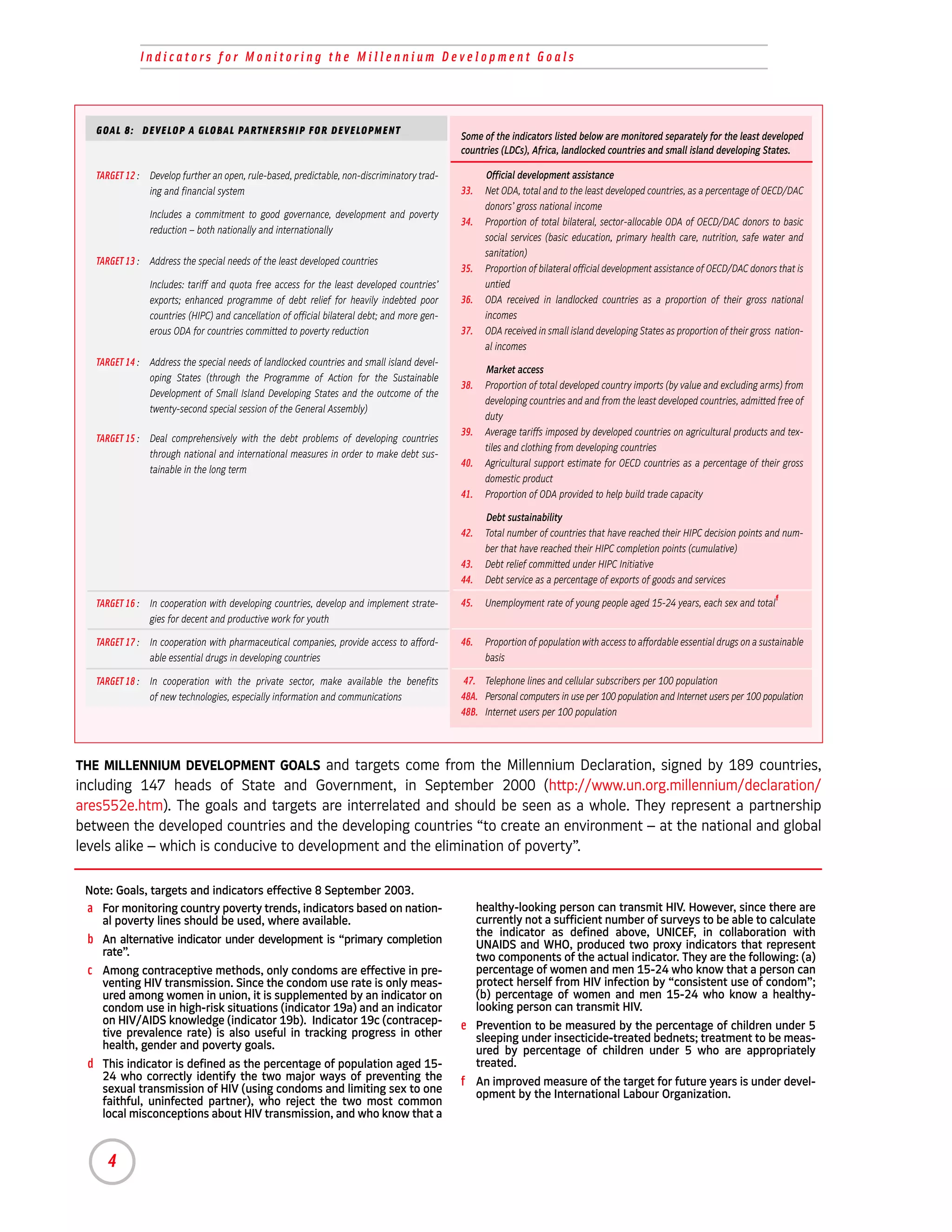
   GOAL 8: DEVELOP A GLOBAL PARTNERSHIP FOR DEVELOPMENT
                                                                                              Some of the indicators listed below are monitored separately for the least developed
                                                                                              countries (LDCs), Africa, landlocked countries and small island developing States.

   TARGET 12 : Develop further an open, rule-based, predictable, non-discriminatory trad-            Official development assistance
               ing and financial system                                                       33.    Net ODA, total and to the least developed countries, as a percentage of OECD/DAC
                                                                                                     donors’ gross national income
                Includes a commitment to good governance, development and poverty
                                                                                              34.    Proportion of total bilateral, sector-allocable ODA of OECD/DAC donors to basic
                reduction – both nationally and internationally
                                                                                                     social services (basic education, primary health care, nutrition, safe water and
                                                                                                     sanitation)
   TARGET 13 : Address the special needs of the least developed countries
                                                                                              35.    Proportion of bilateral official development assistance of OECD/DAC donors that is
                Includes: tariff and quota free access for the least developed countries’            untied
                exports; enhanced programme of debt relief for heavily indebted poor          36.    ODA received in landlocked countries as a proportion of their gross national
                countries (HIPC) and cancellation of official bilateral debt; and more gen-          incomes
                erous ODA for countries committed to poverty reduction                        37.    ODA received in small island developing States as proportion of their gross nation-
                                                                                                     al incomes
   TARGET 14 : Address the special needs of landlocked countries and small island devel-
                                                                                                     Market access
               oping States (through the Programme of Action for the Sustainable
                                                                                              38.    Proportion of total developed country imports (by value and excluding arms) from
               Development of Small Island Developing States and the outcome of the
                                                                                                     developing countries and and from the least developed countries, admitted free of
               twenty-second special session of the General Assembly)
                                                                                                     duty
                                                                                              39.    Average tariffs imposed by developed countries on agricultural products and tex-
   TARGET 15 : Deal comprehensively with the debt problems of developing countries
                                                                                                     tiles and clothing from developing countries
               through national and international measures in order to make debt sus-
                                                                                              40.    Agricultural support estimate for OECD countries as a percentage of their gross
               tainable in the long term
                                                                                                     domestic product
                                                                                              41.    Proportion of ODA provided to help build trade capacity

                                                                                                     Debt sustainability
                                                                                              42.    Total number of countries that have reached their HIPC decision points and num-
                                                                                                     ber that have reached their HIPC completion points (cumulative)
                                                                                              43.    Debt relief committed under HIPC Initiative
                                                                                              44.    Debt service as a percentage of exports of goods and services
                                                                                                                                                                                f
   TARGET 16 : In cooperation with developing countries, develop and implement strate-        45.    Unemployment rate of young people aged 15-24 years, each sex and total
               gies for decent and productive work for youth

   TARGET 17 : In cooperation with pharmaceutical companies, provide access to afford-        46.    Proportion of population with access to affordable essential drugs on a sustainable
               able essential drugs in developing countries                                          basis

   TARGET 18 : In cooperation with the private sector, make available the benefits             47. Telephone lines and cellular subscribers per 100 population
               of new technologies, especially information and communications                 48A. Personal computers in use per 100 population and Internet users per 100 population
                                                                                              48B. Internet users per 100 population


THE MILLENNIUM DEVELOPMENT GOALS and targets come from the Millennium Declaration, signed by 189 countries,
including 147 heads of State and Government, in September 2000 (http://www.un.org.millennium/declaration/
ares552e.htm). The goals and targets are interrelated and should be seen as a whole. They represent a partnership
between the developed countries and the developing countries “to create an environment – at the national and global
levels alike – which is conducive to development and the elimination of poverty”.

 Note: Goals, targets and indicators effective 8 September 2003.
 a For monitoring country poverty trends, indicators based on nation-                               healthy-looking person can transmit HIV. However, since there are
    al poverty lines should be used, where available.                                               currently not a sufficient number of surveys to be able to calculate
                                                                                                    the indicator as defined above, UNICEF, in collaboration with
 b An alternative indicator under development is “primary completion                                UNAIDS and WHO, produced two proxy indicators that represent
    rate”.                                                                                          two components of the actual indicator. They are the following: (a)
 c Among contraceptive methods, only condoms are effective in pre-                                  percentage of women and men 15-24 who know that a person can
    venting HIV transmission. Since the condom use rate is only meas-                               protect herself from HIV infection by “consistent use of condom”;
    ured among women in union, it is supplemented by an indicator on                                (b) percentage of women and men 15-24 who know a healthy-
    condom use in high-risk situations (indicator 19a) and an indicator                             looking person can transmit HIV.
    on HIV/AIDS knowledge (indicator 19b). Indicator 19c (contracep-                          e Prevention to be measured by the percentage of children under 5
    tive prevalence rate) is also useful in tracking progress in other                          sleeping under insecticide-treated bednets; treatment to be meas-
    health, gender and poverty goals.                                                           ured by percentage of children under 5 who are appropriately
 d This indicator is defined as the percentage of population aged 15-                           treated.
    24 who correctly identify the two major ways of preventing the                            f An improved measure of the target for future years is under devel-
    sexual transmission of HIV (using condoms and limiting sex to one                           opment by the International Labour Organization.
    faithful, uninfected partner), who reject the two most common
    local misconceptions about HIV transmission, and who know that a


     4
Definitions, Rationale, Concepts and Sources


 1 PROPORTION OF POPULATION                             tion) curves weighted by household size. In all
     BELOW $1 PURCHASING POWER                          cases measures of poverty to obtain Lorenz
PARITY(PPP) PER DAY                                     curves are calculated from primary data
                                                        sources rather than existing estimates.
DEFINITION
Proportion of population below $1 per day is            Poverty in a country is estimated by converting
the percentage of the population living on less         the one dollar a day poverty line to local curren-
than $1.08 a day at 1993 international prices.          cy using the latest purchasing power parity
The one dollar a day poverty line is compared           (PPP) exchange rates for consumption taken
to consumption or income per person and                 from World Bank estimates. Local consumer
includes consumption from own production                price indices are then used to adjust the inter-
and income in kind. This poverty line has               national poverty line in local currency to prices
fixed purchasing power across countries or              prevailing around the time of the surveys. This
areas and is often called an “absolute poverty          international poverty line is used to identify how
line” or measure of extreme poverty.                    many people are below the one dollar a day
                                                        threshold.
GOAL AND TARGET ADDRESSED
Goal 1. Eradicate extreme poverty and hunger            The PPP-based international poverty line is
Target 1. Halve, between 1990 and 2015, the             required only to allow comparisons across
proportion of people whose income is less               countries and to produce estimates of pover-
than one dollar a day                                   ty at the aggregate level. Most countries also
                                                        set their own poverty lines (SEE INDICATOR 1A).
RATIONALE
The indicator allows for comparing and aggre-           DATA COLLECTION AND SOURCE
gating progress across countries in reducing the        The indicator is produced by the World Bank
number of people living under extreme poverty           Development Research Group based on data
and for monitoring trends at the global level.          obtained from government statistical offices
                                                        and World Bank country departments. It is not
METHOD OF COMPUTATION                                   normally calculated by national agencies.
The World Bank regularly estimates poverty
based on the one dollar a day poverty line.             Data on household income, consumption and
Estimates are based on incomes or consump-              expenditure, including income in kind, are
tion levels derived from household surveys.             generally collected through household budget
Whenever possible, consumption is preferred             surveys or other surveys covering income and
to income for measuring poverty. When con-              expenditure.
sumption data are not available, income is
used.                                                   When available, household consumption data
                                                        are preferred to income data. National statis-
Consumption, which includes consumption                 tical offices, sometimes in conjunction with
for own production, or income per person, and           other national or international agencies, usu-
its distribution are estimated from household           ally undertake such surveys.
surveys. Household consumption or income is
divided by the number of people in the house-           Only surveys that meet the following criteria are
hold to establish the income per person.                used: they are nationally representative, include
                                                        a sufficiently comprehensive consumption or
The distribution of consumption or income is            income aggregate (including consumption or
estimated using empirical Lorenz (distribu-             income from own production), and they allow for


                                                                                                             5
Indicators for Monitoring the Millennium Development Goals


    the construction of a correctly weighted distri-   The one dollar a day poverty measure is used
    bution of consumption or income per person.        to assess and monitor poverty at the global
                                                       level, but like other indicators it is not equally
    The most recent estimates of PPP for devel-        relevant in all regions because countries have
    oping countries are based on data collected        different       definitions      of      poverty.
    between 1993 and 1996, standardized to             Measurements of poverty in countries are
    1993 international prices. Global price com-       generally based on national poverty lines.
    parisons are carried out by the International
    Comparison Programme of the World Bank             PPP exchange rates are used because they
    and others. New estimates of PPPs are              take into account the local prices of goods
    expected in 2006.                                  and services that are not traded internation-
                                                       ally. Although PPP rates were designed for
    PERIODICITY OF MEASUREMENT                         comparing aggregates from national
    Household budget or income surveys are             accounts, they may not fully reflect the com-
    undertaken at different intervals in different     parative cost of goods typically consumed by
    countries. In developing countries they typi-      the very poor.
    cally take place every three to five years.
                                                       There are also problems in comparing poverty
    PPP surveys are conducted at infrequent            measures within countries, especially for urban-
    intervals. The last price survey through the       rural differences. The cost of living is typically
    International Comparison Programme was             higher in urban than in rural areas, so the urban
    completed in 1996, and the next will begin in      monetary poverty line should be higher than the
    2003. It is, however, possible to extrapolate      rural monetary poverty line. However, it is not
    from PPP surveys, and the World Bank con-          always clear that the difference between the
    version factors are calculated in this way.        two poverty lines found in practice properly
                                                       reflects the difference in the cost of living.
    GENDER ISSUES
    Households headed by women tend to have            In considering whether to use income or con-
    lower incomes and are therefore more likely        sumption as a welfare indicator, income is
    to have incomes per person lower than one          generally more difficult to measure accurate-
    dollar. However, this relationship should be       ly, and consumption accords better with the
    carefully studied to take into account nation-     idea of the standard of living than income,
    al circumstances and the definition of head of     which can vary over time even if the standard
    household adopted in data collection, which is     of living does not. Nevertheless, consumption
    not necessarily related to being the chief         data are not always available, and when they
    source of economic support. Whether house-         are not there is little choice but to use income.
    holds are headed by women or men, gender
    relations affect intrahousehold resource allo-     There is also a problem with comparability
    cation and use. It is not possible to estimate     across surveys: household survey question-
    sex-disaggregated poverty rates from avail-        naires can differ widely, and even similar sur-
    able data.                                         veys may not be strictly comparable because
                                                       of differences in quality.
    DISAGGREGATION ISSUES
    It is sometimes possible to disaggregate this      Even if surveys are entirely accurate, the
    indicator by urban-rural location.                 measure of poverty can miss some important
                                                       aspects of individual welfare. First, using
    COMMENTS AND LIMITATIONS                           household consumption ignores inequalities


6
Definitions, Rationale, Concepts and Sources


within households. Second, the measure does                http://www.worldbank.org/poverty/library
not reflect people’s feeling about relative                /progr/2000-01/execsum.htm.
deprivation or their concerns about uninsured              WORLD BANK (2003 and annual). World
risks to their income and health.                          Development Indicators. Print and CD-ROM.
                                                           Table 2.6. Washington, D.C. Available in
Comparisons across countries at different levels           part from http://www.worldbank.org/data.
of development may also pose a problem, owing              WORLD BANK (2003). Data and Statistics.
to differences in the relative importance of con-          Internet site http://www.worldbank.org/
sumption of non-market goods.                              data . Washington, D.C.
                                                           WORLD BANK (2003). Poverty Reduction
REFERENCES AND INTERNATIONAL DATA                          Strategy Sourcebook, vol. 1, Core tech-
COMPARISONS                                                niques: Poverty Measurement and Analysis.
  CHEN, SHAOCHUA, and MARTIN RAVALLION                     Washington, D.C. Available from http://
  (2002). How Did the World’s Poorest Fare in              www. worldbank.org/poverty/strategies/
  the 1990s?, Working Paper No. 2409, pp.1-5.              sourcons.htm .
  Washington, D.C.: World Bank. Available
  from http://www.worldbank.org/research/                AGENCY
  povmonitor/publications.htm.                           World Bank
  HESTON, ALAN, ROBERT SUMMERS and BETTINA
  ATEN (2002). Penn World Tables 6.1. Internet
  site http://datacentre2.chass.utoronto.ca/pwt .
  UNITED NATIONS (1992). Handbook of the
                                                         1-A POVERTY HEADCOUNT RATIOBELOW
                                                             CENTAGE OF POPULATION
                                                                                     (PER-

  International Comparison Programme.                          THE NATIONAL POVERTY LINE)
  Series F, No. 62 (United Nations publica-
  tion, Sales No. E.92.XVII.12). Available from          DEFINITION
  http://unstats.un.org/unsd/pubs. (A, C, E,             The poverty headcount ratio is the proportion
  F, R, S)                                               of the national population whose incomes are
  UNITED NATIONS (2003). Millennium Indicators           below the official threshold (or thresholds) set
  Database. Statistics Division Internet site            by the national Government. National poverty
  http://millenniumindicators.un.org.                    lines are usually set for households of various
  UNITED NATIONS DEVELOPMENT PROGRAMME                   compositions to allow for different family
  (2003 and annual). Human Development                   sizes. Where there are no official poverty
  Report. New York: Oxford University Press.             lines, they may be defined as the level of
  Available from http://hdr.undp.org.                    income required to have only sufficient food
  UNITED NATIONS, COMMISSION OF THE EUROPEAN             or food plus other necessities for survival.
  COMMUNITIES, INTERNATIONAL MONETARY FUND,
  ORGANISATION FOR ECONOMIC CO-OPERATION AND             GOAL AND TARGET ADDRESSED
  DEVELOPMENT AND WORLD BANK (1994).                     Goal 1. Eradicate extreme poverty and hunger
  System of National Accounts 1993 (SNA                  Target 1. Halve, between 1990 and 2015, the
  1993), Series F, No. 2, Rev. 4 (United Nations         proportion of people whose income is less
  publication, Sales No. E.94.XVII.4), paras.            than one dollar a day
  9.45, 16.80-16.83. Available with updates
  from http://unstats.un.org/unsd/sna1993.               RATIONALE
  WORLD BANK (2001). Poverty Reduction and               The indicator allows for monitoring the pro-
  the World Bank: Progress in Operationaliz-             portion of the national population that is con-
  ing the World Development Report                       sidered poor by a national standard. Most
  2000/01. Washington, D.C. Available from               poverty analysis work for countries is based


                                                                                                            7
Indicators for Monitoring the Millennium Development Goals


    on national poverty lines. National poverty         cally take place every three to five years.
    lines tend to increase in purchasing power          GENDER ISSUES
    with the average level of income of a country.      Households headed by women tend to have
                                                        lower incomes and are therefore more likely
    METHOD OF COMPUTATION                               to have incomes per person below the pover-
    Household income (or consumption) and its           ty line. However, this relationship should be
    distribution are estimated from household           carefully studied to take into account nation-
    surveys (SEE INDICATOR 1). The incomes of various   al circumstances and the definition of head of
    household types, by composition, may then           household adopted in data collection, which is
    be compared with the poverty lines for those        not necessarily related to being the chief
    types of household. If the poverty lines are        source of economic support. Whether house-
    expressed in terms of income per adult equiv-       holds are headed by women or men, gender
    alent or some similar measure, the incomes of       relations affect intrahousehold resource allo-
    the households must be measured on a simi-          cation and use.
    lar basis. Household income may be convert-
    ed to income per adult equivalent by using          DISAGGREGATION ISSUES
    the modified equivalence scale of the               Disaggregation of the poverty headcount
    Organisation for Economic Co-operation and          index is normally limited by the size of the
    Development (OECD)—in which the first               household survey. It is common, however, for
    household member over 16 equals 1, all others       indices to be produced for urban and rural
    over 16 equal 0.5, all under 16 equal 0.3 —or       areas and for some subnational levels as the
    some other equivalence scale. Household             sample allows. Estimates at low levels of dis-
    incomes are then divided by the “equivalized”       aggregation may be made using “poverty
    number of people in the household (two adults       mapping” techniques, which use the lower
    would equal 1.5 according to the OECD scale)        levels of disaggregation available from popu-
    to establish income per person.                     lation censuses, particularly where the timing
                                                        of the population census and household sur-
    Once the number of households that are              vey is relatively close. Wherever household
    below the poverty line has been estimated,          surveys provide income or consumption data
    the number of people in those households is         disaggregated by sex of household heads,
    aggregated to estimate the percentage of the        these data should be used.
    population below the line.
                                                        COMMENTS AND LIMITATIONS
    DATA COLLECTION AND SOURCE                          The advantage of this indicator is that it is
    Data on household income, consumption and           specific to the country in which the data are
    expenditure, including income in kind, are          collected and where the poverty line is estab-
    generally collected through household budget        lished. While the one dollar a day poverty line
    surveys or other surveys covering income and        helps in making international comparisons,
    expenditure.                                        national poverty lines are used to make more
                                                        accurate estimates of poverty consistent with
    National statistical offices, sometimes in con-     the characteristics and level of development
    junction with other national or international       of each country. The disadvantage is that
    agencies, usually undertake such surveys.           there is no universally agreed poverty line,
                                                        even in principle, and international compar-
    PERIODICITY OF MEASUREMENT                          isons are not feasible.
    Household budget or income surveys are
    undertaken at different intervals in different      There are also problems in comparing poverty
    countries. In developing countries they typi-       measures within countries, especially for


8
Definitions, Rationale, Concepts and Sources


urban and rural differences. The cost of living
is typically higher in urban than in rural areas,
                                                          2 POVERTY GAP RATIO (INCIDENCE
                                                            MULTIPLIED BY DEPTH OF POVER-
so the urban monetary poverty line should be                   TY)
higher than the rural monetary poverty line.
But it is not always clear that the difference           DEFINITION
between the two poverty lines found in prac-             Poverty gap ratio is the mean distance sepa-
tice properly reflects the difference in the             rating the population from the poverty line
cost of living.                                          (with the non-poor being given a distance of
                                                         zero), expressed as a percentage of the
REFERENCES AND INTERNATIONAL DATA                        poverty line.
COMPARISONS
  CANBERRA GROUP ON HOUSEHOLD INCOME                     GOALAND TARGET ADDRESSED
  STATISTICS (2001). Expert Group on                     Goal 1. Eradicate extreme poverty and hunger
  Household Income Statistics: Final Report              Target 1. Halve, between 1990 and 2015, the
  and Recommendations. Ottawa. Available                 proportion of people whose income is less
  from http://www.lisproject.org/links/canb              than one dollar a day
  access.htm.
  SWEDEN, STATISTICS SWEDEN (1996). Engendering          RATIONALE
  Statistics: A Tool for Change. Stockholm.              The indicator measures the “poverty deficit”
  UNITED NATIONS (2003). Millennium Indicators           of the entire population, where the poverty
  Database. Statistics Division Internet site            deficit is the per capita amount of resources
  http://millenniumindicators.un.org.                    that would be needed to bring all poor people
  UNITED NATIONS DEVELOPMENT PROGRAMME                   above the poverty line through perfectly tar-
  (2003 and annual). Human Development                   geted cash transfers.
  Report. New York, Oxford University Press.
  Available from http://hdr.undp.org.                    METHOD OF COMPUTATION
  WORLD BANK (2003 and annual). World                    The poverty gap ratio is the sum of the
  Development Indicators. Print and CD-ROM.              income gap ratios for the population below
  Notes to table 2.6. Washington, D.C.                   the poverty line, divided by the total popula-
  Available in part from http://www.world                tion, which can be expressed as follows:
  bank.org/data.
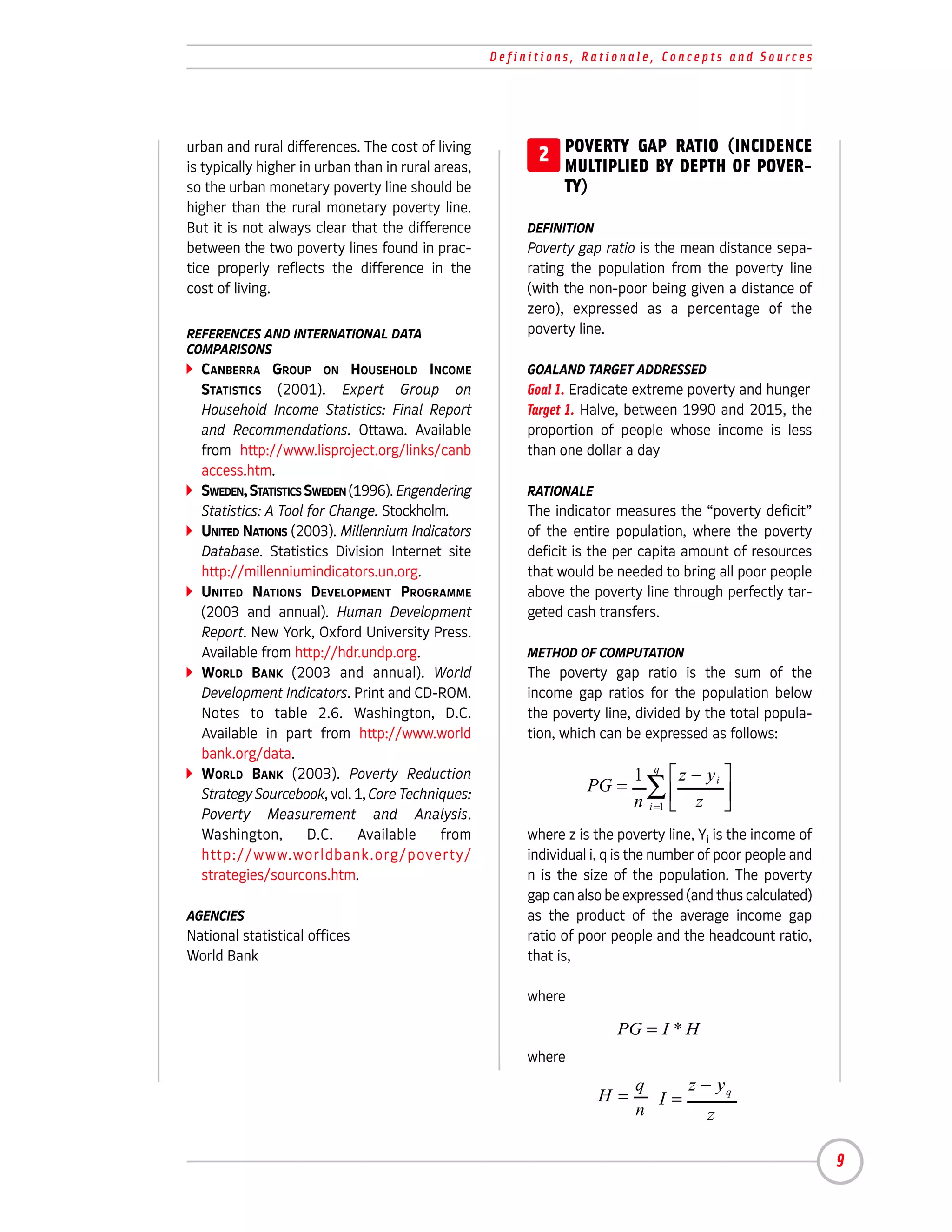
  WORLD BANK (2003). Poverty Reduction                                     1 q  z − yi 
  Strategy Sourcebook, vol. 1, Core Techniques:                    PG =      ∑
                                                                           n i =1  z 
  Poverty Measurement and Analysis.
                                                                                       
  Washington,        D.C.     Available   from           where z is the poverty line, Yi is the income of
  http://www.worldbank.org/poverty/                      individual i, q is the number of poor people and
  strategies/sourcons.htm.                               n is the size of the population. The poverty
                                                         gap can also be expressed (and thus calculated)
AGENCIES                                                 as the product of the average income gap
National statistical offices                             ratio of poor people and the headcount ratio,
World Bank                                               that is,

                                                         where

                                                                        PG = I * H
                                                         where
                                                                           q    z − yq
                                                                      H=     I=
                                                                           n       z

                                                                                                            9
Indicators for Monitoring the Millennium Development Goals


                            ,                           the distance is meaningful. For example, the
     where                                              poverty gap in education could be the number
                          1 q                           of years of education missing to reach the
                   yq =     ∑ yi
                          q i =1
                                                        defined threshold.

     All the formulas are calculated based on data      REFERENCES AND INTERNATIONAL DATA
     on individuals ( yi as individual income or con-   COMPARISONS
     sumption). If household-level data are used,         CHEN, SHAOCHUA, and MARTIN RAVALLION (2002).
     the formulas have to be adjusted by the              How Did the World’s Poorest Fare in the
     weight wi, which is the household size times         1990s? Working Paper No. 2409, pp.1-5.
     sampling expansion factor for every house-           World Bank, Washington, D.C. Available
     hold i.                                              from http://www.worldbank.org/research/
                                                          povmonitor/publications.htm .
     DATA COLLECTION AND SOURCE                           UNITED NATIONS (2003). Millennium Indicators
     When based on the $1 a day poverty line, this        Database. Statistics Division Internet site
     indicator is calculated by the World Bank.           http://millenniumindicators.un.org .
     When based on national poverty lines, the            WORLD BANK (2003 and annual). World
     indicator is commonly calculated by national         Development Indicators. Print and CD-ROM.
     agencies.                                            Washington, D.C. Available in part from
                                                          http://www.worldbank.org/data .
     The data required are the same as those for          WORLD BANK (2003). Poverty Reduction
     indicator 1.                                         Strategy Sourcebook, vol. 1, Core Techniques:
                                                          Poverty Measurement and Analysis.
     PERIODICITY OF MEASUREMENT                           Washington,      D.C.     Available     from
     Household budget or income surveys are               http://www.worldbank.org/poverty/
     undertaken at different intervals in different       strategies/sourcons.htm.
     countries. In developing countries, they typi-
     cally take place every three to five years.        AGENCIES
                                                        National statistical offices
     GENDER ISSUES                                      World Bank
     Households headed by women may be con-
     centrated in the bottom fifth. However, this
     relationship should be carefully studied to
     take into account national circumstances and
                                                         3 SHARE OFCONSUMPTION
                                                           NATIONAL
                                                                    POOREST QUINTILE IN

     the definition of head of household adopted
     in data collection, which is not necessarily       DEFINITION
     related to being the chief source of economic      Share of the poorest quintile in national con-
     support. Whether households are headed by          sumption is the income that accrues to the
     women or men, gender relations affect intra-       poorest fifth of the population.
     household resource allocation and use.
                                                        GOAL AND TARGET ADDRESSED
     COMMENTS AND LIMITATIONS                           Goal 1. Eradicate extreme poverty and hunger
     The comments under indicators 1 and 1A also        Target 1. Halve, between 1990 and 2015, the
     apply here.                                        proportion of people whose income is less
                                                        than one dollar a day
     This measure can also be used for non-mone-
     tary indicators, provided that the measure of


10
Definitions, Rationale, Concepts and Sources


RATIONALE                                                 World Bank tries to produce comparable data
The indicator provides information about the              for international comparisons and for analysis
distribution of consumption or income of the              at the aggregated level (regional or global).
poorest fifth of the population. Because the              Survey data provide either per capita income
consumption of the poorest fifth is expressed             or consumption. Whenever possible, con-
as a percentage of total household consump-               sumption data are used rather than income
tion (or income), this indicator is a “relative           data. Where the original household survey
inequality” measure. Therefore, while the                 data are not available, shares are estimated
absolute consumption of the poorest fifth                 from the best available grouped data.
may increase, its share of total consumption
may remain the same (if the total goes up by              PERIODICITY OF MEASUREMENT
the same proportion), decline (if the total               Household budget or income surveys are
goes up by a larger proportion) or increase (if           undertaken at different intervals in different
the total goes up by a smaller proportion).               countries. In developing countries, they typi-
                                                          cally take place every three to five years.
METHOD OF COMPUTATION
Household income and its distribution are                 GENDER ISSUES
estimated from household surveys. Household               Households headed by women may be con-
income is adjusted for household size to pro-             centrated in the bottom fifth. However, this
vide a more consistent measure of per capita              relationship should be carefully studied to
income for consumption. Household income is               take into account national circumstances and
divided by the number of people in the house-             the definition of head of household adopted
hold to establish income per person. The pop-             in data collection, which is not necessarily
ulation is then ranked by income. The income              related to the chief source of economic sup-
of the bottom fifth is expressed as a percent-            port. Whether households are headed by
age of aggregate household income. The cal-               women or men, gender relations affect intra-
culations are made in local currency, without             household resource allocation and use.
adjustment for price changes or exchange
rates or for spatial differences in cost of living        INTERNATIONAL DATA COMPARISONS
within countries, because the data needed for             Since the underlying household surveys differ
such calculations are generally unavailable.              in method and type of data collected, the dis-
                                                          tribution indicators are not easily comparable
                                                          across countries. These problems are dimin-
DATA COLLECTION AND SOURCE                                ishing as survey methods improve and
For international purposes, this indicator is             become more standardized, but achieving
calculated by the World Bank, but it may also             strict comparability is still impossible (see
be calculated by national agencies. The                   “COMMENTS AND LIMITATIONS” for INDICATOR 1).
Development Research Group of the World
Bank Group produces the indicator based on                COMMENTS AND LIMITATIONS
primary household survey data obtained from               Two sources of non-comparability should be
government statistical agencies and World                 noted. First, the surveys can differ in many
Bank country departments.                                 respects, including whether they use income
                                                          or consumption as the indicator of living stan-
Data on household income or consumption                   dards. The distribution of income is typically
come from household surveys. Since underly-               more unequal than the distribution of con-
ing household surveys differ across countries             sumption. In addition, the definitions of
in methods and type of data collected, the                income usually differ among surveys. Con-


                                                                                                            11
Indicators for Monitoring the Millennium Development Goals


     sumption is normally a better welfare indica-
     tor, particularly in developing countries (see
                                                        4 PREVALENCE OF YEARS OF AGE CHIL-
                                                          DREN UNDER 5
                                                                        UNDERWEIGHT

     “COMMENTS AND LIMITATIONS” for INDICATOR 1).
                                                       DEFINITION
     Second, households differ in size (number of      Prevalence of (moderately or severely) under-
     members), extent of income sharing among          weight children is the percentage of children
     members, age of members and consumption           under five years old whose weight for age is
     needs. Differences among countries in these       less than minus two standard deviations from
     respects may bias comparisons of distribution.    the median for the international reference
                                                       population ages 0–59 months. The interna-
     The percentile chosen here is the bottom fifth    tional reference population was formulated
     (quintile). The proportionate share of national   by the National Center for Health Statistics
     household income of this group may go up          (NCHS) as a reference for the United States
     while the proportionate share of some other       and later adopted by the World Health
     percentile, such as the bottom tenth (decile),    Organization (WHO) for international use
     may go down, and vice versa.                      (often referred to as the NCHS/WHO refer-
                                                       ence population).
     REFERENCES AND INTERNATIONAL DATA
     COMPARISONS                                       GOAL AND TARGET ADDRESSED
       RAVALLION, MARTIN, and SHAOHUA CHEN (1996).     Goal 1. Eradicate extreme poverty and hunger
       What Can New Survey Data Tell Us about          Target 2. Halve, between 1990 and 2015, the
       Recent Change in Distribution and Poverty?      proportion of people who suffer from hunger
       World Bank Economic Review. Washington,
       D.C. 11/2:357-82.                               RATIONALE
       UNITED NATIONS (2001). Indicators of            Child malnutrition, as reflected in body
       Sustainable Development: Guidelines and         weight, is selected as an indicator for several
       Methodologies. Department of Economic           reasons. Child malnutrition is linked to poverty,
       and Social Affairs, Division for Sustainable    low levels of education and poor access to
       Development. Sales No. E.01.II.A.6.             health services. Malnourishment in children,
       Available from http:// www.un.org/esa/          even moderate, increases their risk of death,
       sustdev/natlinfo/indicators/isd.htm .           inhibits their cognitive development, and
       UNITED NATIONS (2003). Millennium Indicators    affects health status later in life. Sufficient
       Database. Statistics Division Internet site     and good quality nutrition is the cornerstone
       http://millenniumindicators.un.org .            for development, health and survival of cur-
       WORLD BANK (2003 and annual). World             rent and succeeding generations. Healthy
       Development Indicators. Print and CD-ROM.       nutrition is particularly important for women
       Washington, D.C. Available in part from         during pregnancy and lactation so that their
       http://www.worldbank.org/data .                 children set off on sound developmental
                                                       paths, both physically and mentally. Only
     AGENCIES                                          when optimal child growth is ensured for the
     National statistical offices                      majority of their people will Governments be
     World Bank                                        successful in their efforts to accelerate eco-
                                                       nomic development in a sustained way.

                                                       The under-five underweight prevalence is an
                                                       internationally recognized public health indi-
                                                       cator for monitoring nutritional status and


12
Definitions, Rationale, Concepts and Sources


health in populations. Child malnutrition is            may be a sensitive issue in the country.
also monitored more closely than adult mal-             Gender differences may also be more pro-
nutrition.                                              nounced in some social and ethnic groups.

METHOD OF COMPUTATION                                   COMMENTS AND LIMITATIONS
The weights of the under-five child population          The weight-for-age indicator reflects body
in a country are compared with the weights              mass relative to chronological age and is influ-
given in the NCHS/WHO table of child weights            enced by both the height of the child (height
for each age group. The percentages of chil-            for age) and weight-for-height. Its composite
dren in each age group whose weights are                nature makes interpretation complex. For
more than 2 standard deviations less than the           example, weight for age fails to distinguish
median are then aggregated to form the total            between short children of adequate body
percentage of children under age 5 who are              weight and tall, thin children.
underweight.
                                                        Low height for age or stunting, defined as minus
DATA COLLECTION AND SOURCE                              two standard deviations from the median
At the national level, data are generally avail-        height for the age of the reference population,
able from national household surveys, includ-           measures the cumulative deficient growth
ing Demographic and Health Surveys, Multiple            asociated with long-term factors, including
Indicator Cluster Surveys and national nutri-           chronic insufficient daily protein intake.
tion surveys.
                                                        Low weight for height, or wasting, defined as
For international comparisons and global or             below minus 2 standard deviations from the
regional monitoring, the United Nations                 median weight for height of the reference pop-
Children’s Fund (UNICEF) and WHO compile                ulation, indicates in most cases a recent and
international data series and estimate region-          severe process of weight loss, often associat-
al and global figures based on data from                ed with acute starvation or severe disease.
national surveys.
                                                        When possible, all three indicators should be
PERIODICITY OF MEASUREMENT                              analysed and presented since they measure and
Household surveys are generally conducted               reflect different aspects of child malnutrition.
every three to five years.
                                                        REFERENCES AND INTERNATIONAL DATA
GENDER ISSUES                                           COMPARISONS
The data from national household surveys gen-             UNITED NATIONS CHILDREN’S FUND (2003).
erally show no significant differences in under-          Progress since the World Summit for
weight prevalence between boys and girls.                 Children. New York. Available from
However, those trends should continue to be               http://www.childinfo.org.
monitored, particularly at the subnational                UNITED NATIONS CHILDREN’S FUND (annual).
level and within subgroups of the population.             The State of the World’s Children. New York.
                                                          UNITED NATIONS (2001). Indicators of
DISAGGREGATION ISSUES                                     Sustainable Development: Guidelines and
Indicators of malnutrition generally show dif-            Methodologies. Department of Economic
ferentials between rural and urban settings. In           and Social Affairs, Division for Sustainable
some countries, child nutrition may vary                  Development. Sales No. E.01.II.A. Available
across geographical areas, socio-economic                 from http:// www.un.org/esa/sustdev/
groups or ethnic groups. However, showing                 natlinfo/indicitors/isd.htm.
and analysing data on specific ethnic groups              UNITED NATIONS (2003). Millennium Indicators


                                                                                                           13
Indicators for Monitoring the Millennium Development Goals


       Database. Statistics Division Internet site   RATIONALE
       http://millenniumindicators.un.org .          The indicator measures an important aspect
       WORLD BANK (2003 and annual). World           of the food insecurity of a population.
       Development Indicators. Print and CD-ROM.     Sustainable development demands a concert-
       Washington, D.C. Available in part from       ed effort to reduce poverty, including finding
       http://www.worldbank.org/data .               solutions to hunger and malnutrition.
       WORLD HEALTH ORGANIZATION (1986). The         Alleviating hunger is a prerequisite for sus-
       Growth Chart: A Tool for Use in Infant and    tainable poverty reduction since undernour-
       Child Health Care. Geneva.                    ishment seriously affects labour productivity
       WORLD HEALTH ORGANIZATION (2002 and           and earning capacity. Malnutrition can be the
       annual). World Health Report. Geneva.         outcome of a range of circumstances. In order
       Available from http://www.who.int/whr/        to work, poverty reduction strategies must
       en.                                           address food access, availability (physical and
       WORLD HEALTH ORGANIZATION (2003). Global      economic) and safety.
       Database on Child Growth and Malnutrition.
       Internet site http://www.who.int/nut-         METHOD OF COMPUTATION
       growthdb/. Geneva.                            Estimation of the proportion of people with
                                                     insufficient food (undernourishment) involves
     UNICEF and WHO produce international data       specification of the distribution of dietary
     sets based on survey data. In some countries,   energy consumption, considering the total
     ages may have to be estimated.                  food availability (from national global statis-
                                                     tics) and inequality in access to food (from
     AGENCIES                                        national household surveys). The distribution
     Ministries of health                            is assumed to be unimodal and skewed. The
     United Nations Children’s Fund                  log-normal function is used in estimating the
     World Health Organization                       proportion of the population below a mini-
                                                     mum energy requirement level or cut-off
                                                     point. The cut-off point is estimated as a pop-
      5 PROPORTION OF THE POPULATION
        BELOW MINIMUM LEVEL OF
                                                     ulation per capita average value, based on
                                                     dietary energy needed by different age and
          DIETARY ENERGY CONSUMPTION                 gender groups and the proportion of the pop-
                                                     ulation represented by each age group.
     DEFINITION
     Proportion of the population below the mini-    The estimates are not normally available in
     mum level of dietary energy consumption is      countries. The Food and Agriculture
     the percentage of the population whose food     Organization of the United Nations (FAO) pre-
     intake falls below the minimum level of         pares the estimates at the national level. They
     dietary energy requirements. This is also       are then aggregated to obtain regional and
     referred to as the prevalence of under-nour-    global estimates.
     ishment, which is the percentage of the pop-
     ulation that is undernourished.                 DATA COLLECTION AND SOURCE
                                                     The main data sources are country statistics
     GOAL AND TARGET ADDRESSED                       on local food production, trade, stocks and
     Goal 1. Eradicate extreme poverty and hunger    non-food uses; food consumption data from
     Target 2. Halve, between 1990 and 2015, the     national household surveys; country anthro-
     proportion of people who suffer from hunger     pometric data by sex and age and United
                                                     Nations country population estimates, in total
                                                     and by sex and age.


14
Definitions, Rationale, Concepts and Sources


PERIODICITY OF MEASUREMENT                              nificance of resulting estimates for assess-
Estimates for the most recent period and for            ment and policy-making. First, the estimates
selected benchmark periods (expressed as                are based on food acquired by (or available
three-year averages) are reported every year.           to) the households rather than the actual
                                                        food intake of individual household members.
GENDER ISSUES                                           Second, any inequity in intrahousehold access
Intrahousehold access to food may show dis-             to food is not taken into account. Third,
parities by gender. Also, cultural patterns of          changes in relative inequality of food distribu-
distribution and nutritional taboos may affect          tion through the assessed periods are not
women’s nutrition. Women’s higher require-              considered. However, FAO is monitoring any
ments for iron during pregnancy and breast-             evidence of significant changes over time that
feeding may result in iron deficiency anemia,           would require adjustment to the current esti-
which affects the result of pregnancy and               mation procedure.
may increase women’s susceptibility to dis-
eases. Although food consumption data do                Indicators should not be used in isolation.
not allow for disaggregation by sex, whenev-            Monitoring of the hunger reduction target
er household survey data are available by sex,          addresses two related problems: food depri-
efforts should be made to conduct a gender-             vation and child malnutrition. Analysis of food
based analysis.                                         deprivation is based on estimates of the
                                                        prevalence of undernourishment in the whole
DISAGGREGATION ISSUES                                   population. Analysis of child malnutrition is
In assessing food insecurity, it is important to        based on estimates of underweight prevalence
consider geographical areas that may be par-            in the child population. This is an indicator of
ticularly vulnerable (such as areas with a high         nutritional status of individual children (ade-
probability of major variations in production           quate weight for a given age), and the final
or supply or areas subject to natural disas-            outcome depends not only on food adequacy
ters) and the population groups whose access            but also on other multiple factors such as
to food is precarious or sporadic (due to struc-        infections, environmental conditions and care.
tural or economic vulnerability), such as eth-          Therefore, the combined use of both indica-
nic or social groups. However, showing and              tors would enhance the understanding of the
analysing data on specific ethnic groups may            changes in the food and nutrition situation.
be a sensitive issue in the country. Gender dif-
ferences may also be more pronounced in                 REFERENCES AND INTERNATIONAL DATA
some social and ethnic groups.                          COMPARISONS
                                                          FOOD AND AGRICULTURE ORGANIZATION OF THE
Considering the need for disaggregated esti-              UNITED NATIONS (2002). FAO Methodology
mates, the FAO methodology has been expand-               for Estimating the Prevalence of
ed to measure the extent of food deprivation at           Undernourishment. In Proceedings of the
subnational levels, making appropriate use of             International Scientific Symposium on
available household survey data. To support               Measurement and Assessment of Food
countries in preparing disaggregated esti-                Deprivation and Undernutrition. Rome.
mates, FAO is conducting capacity-building                FOOD AND AGRICULTURE ORGANIZATION OF THE
activities for national statistical offices.              UNITED NATIONS (annual). The State of Food
                                                          Insecurity in the World. Rome. Available
COMMENTS AND LIMITATIONS                                  from http://www.fao.org/sof/sofi/index_en.
The methods and data used by FAO have                     htm .
implications for the precise meaning and sig-             WORLD HEALTH ORGANIZATION (1985). Energy


                                                                                                           15
Indicators for Monitoring the Millennium Development Goals


       and Protein Requirements: Report of a Joint     dren might be enrolled at other levels of edu-
       FAO/WHO/UNU Expert Consultation. World          cation.
       Health Organization Technical Report 724.
       Geneva.                                         METHOD OF COMPUTATION
                                                       The indicator is calculated as the number of
     AGENCY                                            enrolled students within the appropriate age
     Food and Agriculture Organization of the          cohort according to school records as report-
     United Nations                                    ed to ministries of education, divided by the
                                                       number of children of primary school age.


      6 NET ENROLMENT RATIO IN PRI-
        MARY EDUCATION
                                                       DATA COLLECTION AND SOURCE
                                                       Data on school enrolment are usually record-
                                                       ed by the country ministry of education or
     DEFINITION                                        compiled from surveys and censuses. Data on
     Net primary enrolment ratio is the ratio of the   the population in the official age group for the
     number of children of official school age (as     primary level are available from national sta-
     defined by the national education system)         tistical offices, based on population censuses
     who are enrolled in primary school to the total   and vital statistics registration. Nationally
     population of children of official school age.    reported values will be the same as interna-
     Primary education provides children with          tionally reported values only if the same
     basic reading, writing, and mathematics skills    methods and population estimates are used.
     along with an elementary understanding of
     such subjects as history, geography, natural      For international comparisons and estimates
     science, social science, art and music            of regional and global aggregates, the
                                                       UNESCO Institute for Statistics regularly pro-
     GOAL AND TARGET ADDRESSED                         duces data series on school enrolment based
     Goal 2. Achieve universal primary education       on data reported by education ministries or
     Target 3. Ensure that, by 2015, children every-   national statistical offices and United Nations
     where, boys and girls alike, will be able to      population estimates.
     complete a full course of primary schooling
                                                       For countries for which administrative data are
     RATIONALE                                         not available, household survey data may be
     The indicator is used to monitor progress         used to assess school attendance rather than
     towards the goal of achieving universal pri-      enrolment. Among international surveys, the
     mary education, identified in both the            Multiple Indicator Cluster Survey and
     Millennium Development Goals and the              Demographic and Health Surveys (and some-
     Education for All initiative. It shows the pro-   times Living Standards Measurement Surveys
     portion of children of primary school age who     and     the     Core    Welfare     Indicators
     are enrolled in primary school. Net enrolment     Questionnaires in Africa) provide school
     refers only to children of official primary       attendance data.
     school age. (Gross enrolment includes children
     of any age.) Net enrolment rates below 100        PERIODICITY OF MEASUREMENT
     per cent provide a measure of the proportion      Enrolment data are recorded regularly by min-
     of school age children who are not enrolled at    istries of education and are available on a yearly
     the primary level. This difference does not       basis. Data derived from surveys and census-
     necessarily indicate the percentage of stu-       es, when administrative records on enrolment
     dents who are not enrolled, since some chil-      by age and sex are not available, are less fre-


16
Definitions, Rationale, Concepts and Sources


quent. Net enrolment rates produced by                   repeat years may mistakenly be included in
UNESCO are available on an annual basis for              the net figures. Children’s ages may be inac-
two thirds of countries, but usually one year            curately estimated or misstated. Census data
after the reference year. The United Nations             may be out of date or unreliable. There may
Population Division estimates population by              also be insufficient data on school enrolment
individual years of age biannually, although             by sex, but existing measurement problems
estimates may be based on population cen-                make it difficult to assess the situation cor-
suses conducted every 10 years in most                   rectly.
countries. Household survey data, such as
those from the Multiple Indicator Cluster                The indicator attempts to capture the educa-
Survey and Demographic and Health Surveys,               tion system’s coverage and efficiency, but it
are available for many developing countries at           does not solve the problem completely. Some
regular intervals of three to five years.                children fall outside the official school age
                                                         because of late or early entry rather than
GENDER ISSUES                                            because of grade repetition.
In situations of limited resources, families make
difficult choices about sending their children           Enrolment data compiled by UNESCO are
to school. They may perceive the value of ed-            adjusted to be consistent with the
ucation differently for boys and girls. Girls are        International Standard Classification of
more likely than boys to suffer from limited             Education, 1997 (ICSCED) and are therefore
access to education, especially in rural areas.          comparable across countries. National data
Nevertheless, where basic education is widely            derived from administrative records are not
accepted and overall enrolment is high, girls            necessarily based on the same classification
tend to equal or outnumber boys at primary               over time and may not be comparable with
and secondary levels.                                    data for other countries, unless exactly the
                                                         same classification is used. Similarly, the con-
DISAGGREGATION ISSUES                                    cepts and terms in household surveys and
Rural and urban differences are particularly             censuses do not necessarily remain constant
important in the analysis of enrolment data              over time.
owing to significant differences in school
facilities, available resources, demand on chil-         REFERENCES AND INTERNATIONAL DATA
dren’s time for work and dropout patterns. It            COMPARISONS
is also important to consider disaggregation               ASIAN DEVELOPMENT BANK. Gender Issues in
by geographical areas and social or ethnic                 Basic and Primary Education. In Gender
groups. However, showing and analysing data                Checklist:Education. Manila. Available from
on specific ethnic groups may be a sensitive               http://www.adb.org/documents/Manuals/
issue in the country. Gender differences may               Gender_checklists/Education.
also be more pronounced in some social and                 UNITED NATIONS (1998). Principles and
ethnic groups.                                             Recommendations for Population and
                                                           Housing Censuses, Revision 1. Series M, No.
COMMENTS AND LIMITATIONS                                   67, Rev. 1, para. 2.156 Sales No.
School enrolments may be overreported for                  E.98.XVII.1. Available from http://unstats.
various reasons. Survey data may not reflect               un.org/unsd/pubs (A, E, F, S).
actual rates of attendance or dropout during               UNITED NATIONS (2003). Millennium Indicators
the school year. Administrators may report                 Database. Statistics Division Internet site
exaggerated enrolments, especially if there is             http://millenniumindicators.un.org.
a financial incentive to do so. Children who               UNITED NATIONS CHILDREN’S FUND (2003).


                                                                                                            17
Indicators for Monitoring the Millennium Development Goals


       Monitoring Methods. New York. Internet site
       http:// unicef.org/reseval/methodr. html.        GOAL AND TARGET ADDRESSED
       UNITED NATIONS CHILDREN’S FUND (annual).         Goal 2. Achieve universal primary education
       The State of the World’s Children. New York.     Target 3. Ensure that, by 2015, children every-
       UNITED NATIONS DEVELOPMENT PROGRAMME             where, boys and girls alike, will be able to
       (2003 and annual). Human Development             complete a full course of primary schooling
       Report. New York: Oxford University Press.
       Available from http://hdr.undp.org .             RATIONALE
       UNITED NATIONS EDUCATIONAL, SCIENTIFIC AND       The indicator measures an education sys-
       CULTURAL ORGANIZATION (1978). Revised            tem’s success in retaining students from one
       Recommendations Concerning the Inter-            grade to the next as well as its internal effi-
       national Standardization of Educational          ciency. Various factors account for poor per-
       Statistics. Paris. See also UNESCO Statistical   formance on this indicator, including low qual-
       Yearbook, 1998, chap.2.                          ity of schooling, discouragement over poor per-
       UNITED NATIONS EDUCATIONAL, SCIENTIFIC AND       formance and the direct and indirect costs of
       CULTURAL ORGANIZATION (1997). International      schooling. Students’ progress to higher grades
       Standard Classification of Education, 1997       may also be limited by the availability of
       (ISCED). Montreal. Available from                teachers, classrooms and educational materials.
       http://www.uis.unesco.org. Path: Core
       Theme Education, Technical Guides.               METHOD OF COMPUTATION
       WORLD BANK (2003 and annual). World              The indicator is typically estimated from data
       Development Indicators. Print and CD-ROM.        on enrolment and repetition by grade for two
       Washington, D.C. Available in part from          consecutive years, in a procedure called the
       http://www.worldbank.org/data .                  reconstructed cohort method. This method
                                                        makes three assumptions: dropouts never
     UNESCO data since 1998 follow the 1997             return to school; promotion, repetition and
     version of the International Standard              dropout rates remain constant over the entire
     Classification of Education, 1997 ISCED, which     period in which the cohort is enrolled in
     enables international comparability between        school; and the same rates apply to all pupils
     countries. The time series data before 1998        enrolled in a given grade, regardless of
     are not consistent with data for 1998 and after.   whether they previously repeated a grade.

     AGENCIES                                           The calculation is made by dividing the total
     Ministries of education                            number of pupils belonging to a school cohort
     UNESCO Institute for Statistics                    who reach each successive grade of the spec-
                                                        ified level of education by the number of
                                                        pupils in the school cohort (in this case stu-
      7 PROPORTION OF PUPILS STARTING
        GRADE 1 WHO REACH GRADE 5
                                                        dents originally enrolled in grade 1 of primary
                                                        education) and multiplying the result by 100.

     DEFINITION                                         When estimated from household survey data,
     The proportion of pupils starting grade 1 who      the proportion is estimated as the product of
     reach grade 5, known as the survival rate to       the proportions of transition for each grade
     grade 5, is the percentage of a cohort of          up to grade 5. The estimation follows the
     pupils enrolled in grade 1 of the primary level    method of the United Nations Educational,
     of education in a given school year who are        Scientific and Cultural Organization (UNESCO).
     expected to reach grade 5.


18
Definitions, Rationale, Concepts and Sources


                                                          The method of computation has limits in
DATA COLLECTION AND SOURCE                                measuring the degree to which school
The indicator proposed by the UNESCO                      entrants survive through primary education
Institute for Statistics is based on grade-specif-        because flows caused by new entrants, re-
ic enrolment data for two successive years for a          entrants, grade skipping, migration or transfers
country and on grade repeater data.                       during the school year are not considered.

Household survey data are obtained from                   Wherever possible, the indicator should be
Multiple Indicator Cluster Surveys and                    complemented by the grade 1 intake rate, be-
Demographic and Health Surveys in a standard              cause together the indicators give a much
way and include information on current and last           better sense of the proportion of children in the
year school grade and level of attendance.                population who complete primary education.

PERIODICITY OF MEASUREMENT                                REFERENCES AND INTERNATIONAL DATA
Where the data are available, they are pub-               COMPARISONS
lished annually about two years after the ref-              UNITED NATIONS (1998). Principles and
erence year. Household surveys, such as                     Recommendations for Population and
Multiple Indicator Cluster Surveys and                      Housing Censuses, Revision 1, Series M, No.
Demographic and Health Surveys, are gener-                  67, Rev. 1, para. 2.156. Sales No.
ally conducted every three to five years.                   E.98.XVII.1. Available from http://unstats.
                                                            un.org/unsd/pubs . (A, E, F, S)
GENDER ISSUES                                               UNITED NATIONS (2001). Indicators of
Frequency and dropout patterns vary                         Sustainable Development: Guidelines and
between girls and boys. Reasons for leaving                 Methodologies. Department of Economic
school also differ for girls and boys and by                and Social Affairs, Division for Sustainable
age. Families’ demand on children’s time to                 Development.        Sales No. E.01.II.A.6.
help in household-based work is an important                Available from http://www.un.org/esa/
factor and is often greater for girls. Also impor-          sustdev/natlinfo/indicators/isd.htm .
tant for girls are security, the proximity of               UNITED NATIONS (2003). Millennium Indicators
school facilities and the availability of ade-              Database. Statistics Division Internet site
quate sanitation and other services in schools.             http://millenniumindicators. un.org.
                                                            UNITED NATIONS CHILDREN’S FUND (2000).
DISAGGREGATION ISSUES                                       Monitoring Progress toward the Goals of the
Rural and urban differences are particularly                World Summit for Children: The End-
important in the analysis of education data,                Decade Multiple Indicator Survey Manual.
owing to significant differences in school                  New York. Available at http://www.unicef.
facilities, available resources, demand on chil-            org/reseval/methodr.html.
dren’s time for work, and dropout patterns. It              UNITED NATIONS CHILDREN’S FUND (annual).
is also important to consider disaggregation                The State of the World’s Children. New York.
by geographical area and social or ethnic                   UNITED NATIONS DEVELOPMENT PROGRAMME
groups. However, showing and analysing data                 (2003 and annual). Human Development
on specific ethnic groups may be a sensitive                Report. New York: Oxford University Press.
issue in the country. Gender differences may                Available at http://hdr.undp.org .
also be more pronounced in some social and                  UNITED NATIONS EDUCATIONAL, SCIENTIFIC AND
ethnic groups.                                              CULTURAL ORGANIZATION (1978). Revised
                                                            Recommendations          concerning      the
COMMENTS AND LIMITATIONS                                    International Standardization of Educational


                                                                                                              19
Indicators for Monitoring the Millennium Development Goals


       Statistics. Paris. Also contained in UNESCO
       Statistical Yearbook 1998, chap.2.
                                                       7-A PRIMARY COMPLETION RATE
       UNITED NATIONS EDUCATIONAL, SCIENTIFIC AND
       CULTURAL ORGANIZATION (1997). International     DEFINITION
       Standard Classification of Education, 1997      Primary completion rate is the ratio of the
       (ISCED). Montreal. Available at http://www.     total number of students successfully com-
       uis.unesco.org. Select: Core Themes/            pleting (or graduating from) the last year of
       Education/Technical Guides.                     primary school in a given year to the total
       UNITED NATIONS EDUCATIONAL, SCIENTIFIC AND      number of children of official graduation age
       CULTURAL ORGANIZATION (2003). Education for     in the population.
       All: Year 2000 Assessment, Technical
       Guidelines. Paris. Available at http://www.     GOAL AND TARGET ADDRESSED
       unescobkk.org/infores/efa2000/tech.htm.         Goal 2. Achieve universal primary education
       UNITED NATIONS EDUCATIONAL, SCIENTIFIC AND      Target 3. Ensure that, by 2015, children every-
       CULTURAL ORGANIZATION (2003). World             where, boys and girls alike, will be able to
       Education Indicators. Internet site             complete a full course of primary schooling
       http://www.uis.unesco.org/en/stats/sta-
       tistics/indicators/indic0.htm. Montreal.        RATIONALE
       WORLD BANK (2003 and annual). World             The indicator, which monitors education sys-
       Development Indicators. Print and CD-ROM.       tem coverage and student progression, is
       Washington, D.C. Available in part from         intended to measure human capital formation
       http://www.worldbank.org/data.                  and school system quality and efficiency.

     Comparable survival rates are produced by         The indicator focuses on the share of children
     UNESCO for about 40 per cent of countries         who ever complete the cycle; it is not a meas-
     based on data from national administrative        ure of “on-time” primary completion. Various
     records. The number of countries reporting        factors may lead to poor performance on this
     data for this indicator has increased over time   indicator, including low quality of schooling,
     in part because of recent inclusion of esti-      discouragement over poor performance and
     mates obtained from household surveys such        the direct and indirect costs of schooling.
     as Multiple Indicator Cluster Surveys and         Students’ progress to higher grades may also
     Demographic and Health Surveys.                   be limited by the availability of teachers,
                                                       classrooms and educational materials.
     AGENCIES
     Ministries of education                           METHOD OF COMPUTATION
     UNESCO Institute for Statistics                   The numerator may include over-age children
                                                       who have repeated one or more grades of
                                                       primary school but are now graduating suc-
                                                       cessfully. For countries where the number of
                                                       primary graduates is not reported, a proxy
                                                       primary completion rate is calculated as the
                                                       ratio of the total number of students in the
                                                       final year of primary school, minus the num-
                                                       ber of students who repeat the grade in a
                                                       typical year, to the total number of children of
                                                       official graduation age in the population.


20
Definitions, Rationale, Concepts and Sources


DATA COLLECTION AND SOURCE                              obvious anomalies and estimates that are
The indicator is compiled by staff in the               suspect. The current database is a mixture of
Education Group of the World Bank’s Human               enrolment data and data based on different
Development Network based on two basic data             systems of graduation (examinations, diplo-
sources used to compute gross and net enrol-            mas, automatic promotion), limiting interna-
ment ratios: enrolment data from national               tional comparability.
ministries of education and population data
from the UNESCO Institute for Statistics. The           The indicator captures the final output of the
World Bank and the UNESCO Institute for                 primary education system, so responses to
Statistics are committed to monitoring this             policy changes will register only with time.
indicator annually in the future.
                                                        The age-specific estimates are less reliable
PERIODICITY OF MEASUREMENT                              than overall population estimates. This is
Annual.                                                 particularly an issue in countries with rela-
                                                        tively rapid changes in population and its age
GENDER ISSUES                                           and sex distribution resulting from such caus-
More understanding is needed on the pat-                es as internal and international migration,
terns of completion by gender.                          civil unrest and displacement. When age-spe-
                                                        cific population breakdowns are not available,
DISAGGREGATION ISSUES                                   the primary completion rate cannot be esti-
Rural and urban differences are particularly            mated.
important in the analysis of education data
owing to significant differences in school              Primary completion rates based on primary
facilities, available resources, demand on chil-        enrolment have an upward bias, since they do
dren’s time for work and dropout patterns. It           not capture those who drop out during the
is also important to consider disaggregation            final grade. This implies that once the data on
by geographical area and social or ethnic               actual graduates become available for a
groups. However, showing and analysing data             country, the completion rate of the country
on specific ethnic groups may be a sensitive            would appear to decline.
issue in the country. Gender differences may
also be more pronounced in some social and              REFERENCES AND INTERNATIONAL DATA
ethnic groups.                                          COMPARISONS
                                                          UNITED NATIONS EDUCATIONAL, SCIENTIFIC AND
COMMENTS AND LIMITATIONS                                  CULTURAL ORGANIZATION (1997). International
The indicator reflects the primary school                 Standard Classification of Education, 1997
cycle as nationally defined according to the              (ISCED). Montreal. Available at http://www.
International Standard Classification of                  uis.unesco.org. Select: Core Themes/
Education, as is the case for gross and net               Education/Technical Guides.
enrolment ratios.                                         WORLD BANK (2003). Millennium Development
                                                          Goals: Achieve universal primary education.
While the World Bank and the UNESCO                       Internet site http://www.development
Institute for Statistics are committed to mon-            goals.org/Education.htm. Washington, D.C.
itoring this indicator annually, systems for
collecting and standardizing the data from              AGENCIES
155 developing countries are not yet in place.          Ministries of education
As a result, the current database has many              UNESCO Institute for Statistics
gaps, particularly for small countries, earlier         World Bank
years and gender breakdowns, as well as


                                                                                                          21
Indicators for Monitoring the Millennium Development Goals


      8 LITERACY RATE OF 15–24 YEAR-OLDS                DATA COLLECTION AND SOURCE
                                                        Literacy data may be derived from population
                                                        censuses, household surveys and literacy sur-
     DEFINITION                                         veys, and total population is derived from
     Literacy rate of 15–24 year-olds, or the youth     national censuses or sample surveys. However,
     literacy rate, is the percentage of the popula-    not all censuses or surveys include specific
     tion 15–24 years old who can both read and         questions for assessing literacy. In some
     write with understanding a short simple            countries where literacy questions are not
     statement on everyday life. The definition of      included, a person’s educational attainment
     literacy sometimes extends to basic arith-         (years of schooling completed) is used to
     metic and other life skills.                       assess literacy status. A common practice is
                                                        to consider those with no schooling as illiter-
     GOAL AND TARGET ADDRESSED                          ate and those who have attended grade 5 of
     Goal 2. Achieve universal primary education        primary school as literate.
     Target 3. Ensure that, by 2015, children every-
     where, boys and girls alike, will be able to       Many household surveys, including the Multiple
     complete a full course of primary schooling        Indicator Cluster Surveys, Demographic and
                                                        Health Surveys, Core Welfare Indicators
     RATIONALE                                          Questionnaires in Africa and Living Standards
     The youth literacy rate reflects the outcomes      Measurement Studies, collect literacy data,
     of primary education over the previous 10          which can provide complementary data for
     years or so. As a measure of the effectiveness     countries without a recent census. However,
     of the primary education system, it is often       definitions are not necessarily standardized
     seen as a proxy measure of social progress         (see “COMMENTS AND LIMITATIONS”).
     and economic achievement. The literacy rate
     for this analysis is simply the complement of      Most of the available data on literacy are
     the illiteracy rate. It is not a measure of the    based on reported literacy rather than on
     quality and adequacy of the literacy level         tested literacy and in some cases are derived
     needed for individuals to function in a society.   from other proxy information.
     Reasons for failing to achieve the literacy
     standard may include low quality of school-        PERIODICITY OF MEASUREMENT
     ing, difficulties in attending school or drop-     Youth literacy rates may change more quickly
     ping out before reaching grade 5.                  than adult literacy rates and therefore need to
                                                        be measured more often. Since population
     METHOD OF COMPUTATION                              censuses normally occur only every 10 years,
     The usual method of computation is to divide       input from more frequently administered
     the number of people ages 15–24 who are lit-       labour force and household surveys are used
     erate by the total population in the same age      for annual estimates. Data are available for
     group and to multiply the total by 100. Since      consecutive five-year age cohorts starting at
     literacy data are not always available for all     15–19 years old. Household surveys are gen-
     countries and all censuses, the UNESCO             erally conducted every three to five years in
     Institute for Statistics uses modeling tech-       most developing countries.
     niques to produce annual estimates based on
     literacy information obtained from national        GENDER ISSUES
     censuses and surveys.                              Higher illiteracy rates for women are the result
                                                        of lower school enrolment and early drop-
                                                        outs. Moreover, because women generally


22
Definitions, Rationale, Concepts and Sources


have less access to information and training              REFERENCES AND INTERNATIONAL DATA
                                                          COMPARISONS
and literacy programmes, estimates based on
enrolments may overestimate literacy for girls.             UNITED NATIONS (1998). Principles and
                                                            Recommendations for Population and
DISAGGREGATION ISSUES                                       Housing Censuses, Revision 1, Series M, No.
Rural and urban differences are particularly                67, Rev. 1. Sales No. E.98.XVII.1. Available
important in the analysis of education data                 from http://unstats. un.org/unsd/pubs (A,
because of significant differences in school                E, F, S).
facilities, available resources, demand on chil-            UNITED NATIONS (2001). Indicators of
dren’s time for work and dropout patterns. It               Sustainable Development: Guidelines and
is also important to consider disaggregation                Methodologies. Sales No. E.01.II.A.6.
by geographical area and social or ethnic                   Available from http://www.un.org/esa/
groups. However, showing and analysing data                 sustdev/natlinfo/indicators/isd.htm.
on specific ethnic groups may be a sensitive                UNITED NATIONS (2003). Millennium Indicators
issue in the country. Gender differences may                Database. Statistics Division Internet site
also be more pronounced in some social and                  http://millenniumindicators.un.org.
ethnic groups.                                              UNITED NATIONS CHILDREN’S FUND (annual).
                                                            The State of the World’s Children. New York.
COMMENTS AND LIMITATIONS                                    UNITED NATIONS DEVELOPMENT PROGRAMME
Measurements of literacy can vary from sim-                 (2003 and annual). Human Development
ply asking “Are you literate or not?” to testing            Report. New York: Oxford University Press.
to assess literacy skills. In some cases, literacy          Available at http://hdr.undp.org.
is measured crudely in population censuses,                 UNITED NATIONS EDUCATIONAL, SCIENTIFIC AND
either through self-declaration or by assuming              CULTURAL ORGANIZATION (1978). Revised Rec-
that people with no schooling are illiterate.               ommendations concerning the International
This causes difficulty for international com-               Standardization of Educational Statistics.
parisons. Comparability over time, even for                 Paris. See also UNESCO Statistical
the same survey, may also be a problem                      Yearbook, 1998, chap. 2.
because definitions of literacy used in the                 UNITED NATIONS EDUCATIONAL, SCIENTIFIC AND
surveys are not standardized. The latest revi-              CULTURAL ORGANIZATION (2003). Education for
sion of Principles and Recommendations for                  All: The Year 2000 Assessment: Technical
Population and Housing Censuses advises                     Guidelines.     Paris.    Available    from
countries against adopting a proxy measure-                 http://www.unescobkk.org/infores/
ment based on educational attainment. It rec-               efa2000/tech.htm .
ommends that literacy questions be adminis-                 UNITED NATIONS EDUCATIONAL, SCIENTIFIC AND
tered as part of national censuses and house-               CULTURAL ORGANIZATION (2003). UNESCO
hold surveys, or as part of a post-census sam-              Institute for Statistics. Internet site
ple enumeration.                                            http://www.uis.unesco.org. Montreal.
                                                            WORLD BANK (2003 and annual). World
Shortcomings in the definition of literacy,                 Development Indicators. Print and CD-ROM.
measurement problems and infrequency of                     Washington, D.C. Available in part from
censuses and literacy surveys weaken this                   http://www.worldbank.org/data.
indicator as a means of monitoring education
outcomes related to the goal of achieving uni-            The main international source of data is the
versal primary education.                                 UNESCO international data series of annual
                                                          and projected estimates based on informa-
                                                          tion from national population censuses and


                                                                                                           23
Indicators for Monitoring the Millennium Development Goals


     labour force, household and other surveys.           data are not available, household survey data
     The estimates are available for approximately        may be used, although household surveys
     130 countries.                                       usually measure self-reported attendance
                                                          rather than enrolment as reported by schools.
     AGENCIES                                             Among international surveys, Multiple Indicator
     Ministries of education                              Cluster Surveys and Demographic and Health
     National statistical offices                         Surveys (and sometimes also Living Standards
     UNESCO Institute for Statistics                      Measurement Studies and Core Welfare
                                                          Indicators Questionnaires in Africa) provide
                                                          school attendance data.
      9 RATIO OF GIRLS TO AND TERTIARY
        MARY, SECONDARY
                          BOYS IN PRI-
                                                          For international comparison and estimation of
           EDUCATION                                      regional and global aggregates, the UNESCO
                                                          Institute for Statistics data series on school
     DEFINITION                                           enrolment can be used. The series is based on
     Ratio of girls to boys in primary, secondary and     data reported by education ministries or
     tertiary education is the ratio of the number        national agencies for enrolment.
     of female students enrolled at primary, sec-
     ondary and tertiary levels in public and pri-        UNESCO produces ratios of girls to boys at
     vate schools to the number of male students.         country, regional and global levels for use in
                                                          monitoring the Millennium Development Goals.
     GOAL AND TARGET ADDRESSED                            They are available at the Millennium Indicators
     Goal 3. Promote gender equality and empower          web site http://millenniumindicators.un.org.
     women
     Target 4. Eliminate gender disparity in primary      PERIODICITY OF MEASUREMENT
     and secondary education preferably by 2005,          Where official enrolment data are available,
     and in all levels of education no later than 2015    estimates from UNESCO are normally available
                                                          annually about one year after the reference
     RATIONALE                                            year. Data from household surveys may be
     The indicator of equality of educational oppor-      available for selected countries at various
     tunity, measured in terms of school enrolment,       intervals.
     is a measure of both fairness and efficiency.
     Education is one of the most important aspects       Official data on higher education are not as
     of human development. Eliminating gender             frequently reported as data on primary and
     disparity at all levels of education would help      secondary enrolment.
     to increase the status and capabilities of
     women. Female education is also an impor-            GENDER ISSUES
     tant determinant of economic development.            In situations of limited resources, families
                                                          make difficult choices about sending their
     METHOD OF COMPUTATION                                children to school. They may perceive the
     The indicator is a ratio of the number of en-        value of education differently for boys and
     rolled girls to enrolled boys, regardless of ages.   girls. Girls are more likely than boys to suffer
                                                          from limited access to education, especially in
     DATA COLLECTION AND SOURCE                           rural areas. However, where basic education is
     Data on school enrolment are usually record-         widely accepted and overall enrolment is high,
     ed by the ministry of education or derived           girls tend to equal or outnumber boys at the
     from surveys and censuses. If administrative         primary and secondary levels. The pattern is


24
Definitions, Rationale, Concepts and Sources


similar in higher education, but with larger               UNITED NATIONS CHILDREN’S FUND (annual).
differences between the two genders.                       The State of the World’s Children. New York.
                                                           UNITED NATIONS DEVELOPMENT PROGRAMME
COMMENTS AND LIMITATIONS                                   (2003 and annual). Human Development
Some 50 countries have no system of higher                 Report. New York: Oxford University Press.
education. Private education tends to be                   Available at http://hdr.undp.org .
underreported, but international coverage                  UNITED NATIONS EDUCATIONAL, SCIENTIFIC AND
has improved over the last four cycles of the              CULTURAL ORGANIZATION (1978). Revised
UNESCO Institute for Statistics survey.                    Recommendations concerning the Inter-
Household survey data may include higher                   national Standardization of Educational
and private education, but may not be com-                 Statistics. Paris. See also         UNESCO
parable between surveys.                                   Statistical Yearbook, 1998, chap. 2.
                                                           UNITED NATIONS EDUCATIONAL, SCIENTIFIC AND
The indicator is an imperfect measure of the               CULTURAL ORGANIZATION (1997). International
accessibility of schooling for girls because it            Standard Classification of Education, 1997
does not allow a determination of whether                  (ISCED). Montreal. Available at http://www.
improvements in the ratio reflect increases in             uis.unesco.org. Select: Core Themes/
girls’ school attendance (desirable) or decreases          Education/Technical Guides.
in boys’ attendance (undesirable). It also does            UNITED NATIONS EDUCATIONAL, SCIENTIFIC AND
not show whether those enrolled in school                  CULTURAL ORGANIZATION (2003). Education for
complete the relevant education cycles.                    All: The Year 2000 Assessment, Technical
                                                           Guidelines. Paris. Available at http://www.
Another limitation of the indicator is that the            unescobkk.org/infores/efa2000/tech.htm.
ratio reflects the sex structure of the school-            UNITED NATIONS EDUCATIONAL, SCIENTIFIC AND
age population. When the sex ratio in the                  CULTURAL ORGANIZATION (2003). World
school age population deviates significantly               Education Indicators. Internet site http://
from 1, the indicator will not adequately reflect          www.uis.unesco.org/en/stats/statistics/in
the actual differences between girls’ and                  dicators/indic0.htm. Montreal.
boys’ enrolment. This happens in countries                 WORLD BANK (2003 and annual). World
where boys outnumber girls at younger ages.                Development Indicators. Print and CD-ROM.
                                                           Washington, D.C. Available in part from
A ratio based on net enrolment (indicator 6)               http://www.worldbank.org/data.
or gross enrolment is a better measure for
this indicator as it takes into account the pop-         AGENCIES
ulation structure of the country.                        Ministries of education
                                                         UNESCO Institute for Statistics
REFERENCES AND INTERNATIONAL DATA
COMPARISONS
  UNITED NATIONS (2003). Millennium Indicators
  Database. Statistics Division Internet site
  http://millenniumindicators.un.org .
  UNITED NATIONS CHILDREN’S FUND (2000).
  Monitoring Progress towards the Goals of
  the World Summit for Children: The End-
  Decade Multiple Indicator Survey Manual.
  New York. Available at http://www.unicef.
  org/reseval/methodr.html.


                                                                                                          25
Indicators for Monitoring the Millennium Development Goals


      10 RATIO15–24LITERATE WOMEN TO
         MEN,
                OF
                    YEARS OLD
                                                          Health Surveys, Core Welfare Indicators
                                                          Questionnaires in Africa and Living Standards
                                                          Measurement Surveys, collect literacy data,
     DEFINITION                                           which can provide complementary data for
     The ratio of literate women to men, 15–24            countries without a recent census. However,
     years old (literacy gender parity index) is the      definitions are not necessarily standardized
     ratio of the female literacy rate to the male        (see “COMMENTS AND LIMITATIONS”).
     literacy rate for the age group 15–24.
                                                          PERIODICITY OF MEASUREMENT
     GOAL AND TARGET ADDRESSED                            Since population censuses normally occur
     Goal 3. Promote gender equality and empower          every 10 years, input from more frequently
     women                                                administered labour force, household and
     Target 4. Eliminate gender disparity in primary      other surveys are used for annual estimates.
     and secondary education preferably by 2005,          Household surveys are generally conducted
     and in all levels of education no later than 2015    every three to five years in most developing
                                                          countries.
     RATIONALE
     The indicator measures progress towards              GENDER ISSUES
     gender equity in literacy and learning oppor-        Higher illiteracy rates for women are the
     tunities for women in relation to those for          result of lower school enrolment and early
     men. It also measures a presumed outcome of          dropouts. Moreover, since women generally
     attending school and a key indicator of              have less access to information, training and
     empowerment of women in society. Literacy            literacy programmes, estimates based on
     is a fundamental skill to empower women to           enrolments may overestimate literacy for girls.
     take control of their lives, to engage directly
     with authority and to gain access to the wider       COMMENTS AND LIMITATIONS
     world of learning.                                   Measurements of literacy can vary from simply
                                                          asking “Are you literate or not?” to testing to
     METHOD OF COMPUTATION                                assess literacy skills. In some cases, literacy is
     The indicator is derived by dividing the litera-     measured crudely in population censuses,
     cy rate of women ages 15–24 by the literacy          either through self-declaration or by assuming
     rate of men ages 15–24.                              that people with no schooling are illiterate. This
                                                          causes difficulty for international comparisons.
     DATA COLLECTION AND SOURCE                           Comparability over time, even for the same
     Literacy data may be derived from population         survey, may also be a problem because defini-
     censuses, household surveys and literacy sur-        tions of literacy used in the surveys are not
     veys. However, not all censuses or surveys           standardized. The latest revision of Principles
     include specific questions for assessing literacy.   and Recommendations for Population and
     In some countries where literacy questions           Housing Censuses advises countries against
     are not included, a person’s educational             adopting a proxy measurement based on edu-
     attainment (years of schooling completed) is         cational attainment. It recommends that litera-
     used to assess literacy status. A common             cy questions be administered as part of nation-
     practice is to consider those with no schooling      al censuses and household surveys or as part
     as illiterate and defining those who have            of a post-census sample enumeration.
     attended grade 5 of primary school as literate.
     Many household surveys, including the Multiple       Shortcomings in the definition of literacy,
     Indicator Cluster Surveys, Demographic and           measurement problems and infrequency of


26
Definitions, Rationale, Concepts and Sources


censuses and literacy surveys weaken this               tion censuses and labour force, household
indicator as a means of monitoring education            and other surveys. These estimates are avail-
outcomes related to the goal of achieving uni-          able for some 130 countries.
versal primary education.
                                                        AGENCIES
REFERENCES AND INTERNATIONAL DATA                       Ministries of education
COMPARISONS                                             National statistical offices
  UNITED NATIONS (1998). Principles and                 UNESCO Institute for Statistics
  Recommendations for Population and
  Housing Censuses, Revision 1, Series M, No.
  67, Rev. 1, Sales No. E.98.XVII.1. Available
  at http://unstats. un.org/unsd/pubs. (A, E,
                                                         11 SHARE IN WOMEN IN WAGE EMPLOY-
                                                            MENT
                                                                  OF
                                                                     THE NON-AGRICULTURAL
  F, S)                                                       SECTOR
  UNITED NATIONS (2003). Millennium Indicators
  Database. Statistics Division Internet site           DEFINITION
  http://millenniumindicators.un.org.                   The share of women in wage employment in
  UNITED NATIONS CHILDREN’S FUND (annual).              the non-agricultural sector is the share of
  The State of the World’s Children. New York.          female workers in the non-agricultural sector
  UNITED NATIONS DEVELOPMENT PROGRAMME                  expressed as a percentage of total employ-
  (2003 and annual). Human Development                  ment in the sector.
  Report. New York, Oxford University Press.
  Available at http://hdr.undp.org.                     The non-agricultural sector includes industry
  UNITED NATIONS EDUCATIONAL, SCIENTIFIC AND            and services. Following the International
  CULTURAL ORGANIZATION (1978). Revised                 Standard Industrial Classification (ISIC) of All
  Recommendations concerning the Inter-                 Economic Activities, industry includes mining
  national Standardization of Educational               and quarrying (including oil production), man-
  Statistics. Paris. See also UNESCO Statistical        ufacturing, construction, electricity, gas and
  Yearbook, 1998, chap. 2.                              water. Services includes wholesale and retail
  UNITED NATIONS EDUCATIONAL, SCIENTIFIC AND            trade; restaurants and hotels; transport, stor-
  CULTURAL ORGANIZATION (2003). Education for           age and communications; financing, insurance,
  All: The Year 2000 Assessment: Technical              real estate and business services; and com-
  Guidelines. Paris. Available at http://www.           munity, social and personal services.
  unescobkk.org/infores/efa2000/tech.htm .
  UNITED NATIONS EDUCATIONAL, SCIENTIFIC AND            Employment refers to people above a certain
  CULTURAL ORGANIZATION (2003). UNESCO                  age who worked or held a job during a refer-
  Institute for Statistics Internet site                ence period. Employment data include both
  http://www.uis.unesco.org. Montreal.                  full-time and part-time workers whose remu-
  WORLD BANK (2003 and annual). World                   neration is determined on the basis of hours
  Development Indicators. Print and CD-ROM.             worked or number of items produced and is
  Washington, D.C. Available in part from               independent of profits or expectation of profits.
  http://www.worldbank.org/data.
                                                        GOAL AND TARGET ADDRESSED
The main source of international data is the            Goal 3. Promote gender equality and empower
United Nations Educational, Scientific and              women
Cultural Organization’s international data              Target 4. Eliminate gender disparity in primary
series of annual and projected estimates                and secondary education preferably by 2005,
based on information from national popula-              and in all levels of education no later than 2015


                                                                                                            27
Indicators for Monitoring the Millennium Development Goals


     RATIONALE                                          on other sources may be available annually or
     The indicator measures the degree to which         less frequently in some developing countries.
     labour markets are open to women in industry
     and service sectors, which affects not only        GENDER ISSUES
     equal employment opportunity for women             There are large differences between women and
     but also economic efficiency through flexibili-    men in non-agricultural employment, in particu-
     ty of the labour market and, therefore, the        lar in developing countries. This is the result of
     economy’s ability to adapt to change.              differences between rates of participation in
                                                        employment for women and men as well as the
     A significant global increase over the last        kind of employment in which they participate. In
     decade in women’s share in paid employment         many regions, women are more likely than men
     in the non-agricultural sector indicates that      to be engaged in informal sector activities and
     working women have become more integrat-           subsistence or unpaid work in the household.
     ed into the monetary economy through par-
     ticipation in the formal and informal sectors.     Wage employment in most of Africa and much
     However, labour markets remain strongly            of Asia and the Pacific is a middle-class, urban
     segregated. In many countries, productive          phenomenon. Outside of urban areas, most
     work under conditions of freedom, equity and       employment is agricultural, often for family
     human dignity is in short supply, and this dis-    subsistence. However, where non-agricultural
     proportionately affects women. Women are           employment is available, it is more likely to go
     much more likely than men to work as con-          to male members of the household.
     tributing family workers, without their own
     pay, and in the informal sector, although there    As economies develop, the share of women in
     are large differentials between countries and      non-agricultural wage employment becomes
     at regional and national levels, often mirroring   increasingly important. A higher share in paid
     the relative importance of agriculture.            employment could secure for them better
                                                        income, economic security and well-being.
     METHOD OF COMPUTATION                              However, this shift is not automatic, nor does
     The total number of women in paid employ-          it account for differentials in working condi-
     ment in the non-agricultural sector is divided     tions between men and women. Other vari-
     by the total number of people in paid employ-      ables need to be considered, such as level of
     ment in that same sector.                          education, level of remuneration and wage
                                                        differentials, and the extent to which women
     DATA COLLECTION AND SOURCES:                       and men benefit from labour legislation and
     Data are obtained from population censuses,        social programmes. Men more often hold reg-
     labour force surveys, enterprise censuses and      ular and better remunerated jobs, whereas
     surveys, administrative records of social          women are frequently in peripheral, insecure,
     insurance schemes and official estimates           less valued jobs, as home workers, casual
     based on results from several of these             workers or part-time or temporary workers.
     sources. Enterprise surveys and administra-
     tive records are likely to cover only large pri-   COMMENTS AND LIMITATIONS
     vate and public sector employers, in particu-      Although there are clear international stan-
     lar in developing countries. The other sources     dards for the relevant concepts, countries
     may cover the whole relevant population.           may use different defini tions for employment
                                                        status, especially for part-time workers, stu-
     PERIODICITY OF MEASUREMENT:                        dents, members of the armed forces and
     Results from population censuses are normally      household or contributing family workers. Also,
     available every 10 years, while estimates based    different sources of data may use different def-


28
Definitions, Rationale, Concepts and Sources


initions and have different coverage, with limit-          UNITED NATIONS (1998). Principles and
ed comparability across countries and over                 Recommendations for Population and
time within the same country. The employment               Housing Censuses, Revision 1, Series M, No.
share of the agricultural sector is severely               67, Rev. 1. Sales No. E.98.XVII.1. Available
underreported. In addition, studies have shown             from http://unstats. un.org/unsd/pubs. (A,
that employment activity questions on stan-                E, F, S)
dard censuses tend to grossly underestimate                UNITED NATIONS (2003). Millennium Indicators
the extent of female employment of any kind.               Database. Statistics Division Internet site
                                                           http://millenniumindicators.un.org.
REFERENCES AND INTERNATIONAL DATA                          WORLD BANK (2003 and annual). World
COMPARISONS                                                Development Indicators. Print and CD-ROM.
  ANKER, R., M.E. KHAN and R.B. GUPTA (1988).              Washington, D.C. Available in part from
  Women’s Participation in the Labour Force:               http://www.worldbank.org/data .
  A Methods Test in India for Improving Its
  Measurement. Women, Work and                           International data are compiled by the
  Development 16. Geneva: International                  International Labour Organization based on
  Labour Office.                                         data reported by countries. An increasing
  INTERNATIONAL LABOUR OFFICE (1988). Assessing          number of countries report economic activity
  Women’s Economic Contribution to                       according to the ISIC.
  Development. Geneva.
  INTERNATIONAL LABOUR OFFICE (2002). Women              AGENCIES
  and Men in the Informal Economy: A statis-             Ministries of labour
  tical picture. Geneva. available from http://          National statistical offices
  www.ilo.org/public/english/employment/g                International Labour Organization
  ems/download/women.pdf.
  INTERNATIONAL LABOUR ORGANIZATION (2000).
  Current International Recommendations on
  Labour Statistics, 2000 Edition. Geneva.
                                                          12 PROPORTION OF SEATS HELD BY
                                                             WOMEN IN NATIONAL PARLIAMENTS
  INTERNATIONAL LABOUR ORGANIZATION (2003).
  Laborsta—an International Labour Office                DEFINITION
  database on labour statistics operated by              The proportion of seats held by women in
  the ILO Bureau of Statistics. Internet site            national parliaments is the number of seats
  http://laborsta.ilo.org. Geneva.                       held by women expressed as a percentage of
  INTERNATIONAL LABOUR ORGANIZATION (annual).            all occupied seats.
  Key Indicators of the Labour Market.
  Geneva. Available in part from                         GOAL AND TARGET ADDRESSED
  http://www.ilo. org/kilm.                              Goal 3. Promote gender equality and empower
  INTERNATIONAL LABOUR ORGANIZATION (annual).            women
  Yearbook of Labour Statistics. Geneva.                 Target 4. Eliminate gender disparity in primary
  Available at http://laborsta.ilo.org .                 and secondary education preferably by 2005,
  SWEDEN,      STATISTICS   SWEDEN       (1996).         and in all levels of education no later than 2015
  Engendering Statistics: A Tool for Change.
  Stockholm.                                             RATIONALE
  UNITED NATIONS (1990). International                   Women’s representation in parliaments is one
  Standard Industrial Classification of All              aspect of women’s opportunities in political
  Economic Activities (ISIC). Series M, No. 4,           and public life, and it is therefore linked to
  Rev. 3.1. available from http://unstats.un.            women’s empowerment.
  org/unsd/cr/registry.


                                                                                                             29
Indicators for Monitoring the Millennium Development Goals


     METHOD OF COMPUTATION                             the resources, respect or constituency to
     The indicator is obtained by dividing the num-    exercise significant influence.
     ber of parliamentary seats occupied by women
     by the total number of seats occupied.            REFERENCES AND INTERNATIONAL DATA
     National parliaments consist of one or two        COMPARISONS
     chambers. For international comparisons,            INTER-PARLIAMENTARY UNION (2003). Women
     generally only the single or lower house is         in National Parliaments. Internet site
     considered in calculating the indicator.            http://www.ipu.org/wmn-e/world.htm.
                                                         Geneva.
     DATA COLLECTION AND SOURCE                          UNITED NATIONS (2003). Millennium Indicators
     At the national level, the data come from the       Database. Statistics Division Internet site
     records of national parliaments. National par-      http://millenniumindicators.un.org.
     liaments also report the total number of par-       UNITED NATIONS DEVELOPMENT FUND FOR WOMEN
     liamentary seats and the number occupied by         (2000). Progress of the World’s Women. New
     women and men to the Inter-Parliamentary            York. available from http://www.unifem.
     Union (IPU), which regularly compiles interna-      undp.org/progressww/2000.
     tional data series and global and regional          UNITED NATIONS DEVELOPMENT PROGRAMME
     aggregates.                                         (2003 and annual). Human Development
                                                         Report. New York: Oxford University Press.
     PERIODICITY OF MEASUREMENT                          Available at http://hdr.undp.org.
     The data are commonly available from national
     parliaments and updated after an election.        The IPU regularly compiles international data
     National parliaments also transmit their data     series and global and regional aggregates.
     to the IPU at least once a year and when the
     numbers change significantly, such as after       AGENCIES
     an election.                                      National parliaments
                                                       Inter-Parliamentary Union
     GENDER ISSUES
     Women are underrepresented in all decision-
     making bodies and within political parties,
     particularly at the higher echelons. Women
                                                        13 UNDER-FIVE MORTALITY RATE
     still face many practical obstacles to the full
     exercise of their role in political life.         DEFINITION
                                                       The under-five mortality rate is the probability
     COMMENTS AND LIMITATIONS                          (expressed as a rate per 1,000 live births) of a
     Parliaments vary considerably in their inde-      child born in a specified year dying before
     pendence and authority, though they generally     reaching the age of five if subject to current
     engage in law-making, oversight of                age-specific mortality rates.
     Government and representation of the elec-
     torate. In terms of measuring women’s real        GOAL AND TARGET ADDRESSED
     political decision-making, this indicator may     Goal 4. Reduce child mortality
     not be sufficient, because women still face       Target 5. Reduce by two thirds, between 1990
     many obstacles in fully and efficiently carry-    and 2015, the under-five mortality rate
     ing out their parliamentary mandate. Thus,
     being a member of parliament, especially in       RATIONALE
     developing countries and emerging democra-        The indicator, which relates directly to the
     cies, does not guarantee that a woman has         target, measures child survival. It also reflects


30
Definitions, Rationale, Concepts and Sources


the social, economic and environmental con-              ing countries. Household surveys that include
ditions in which children (and others in society)        questions on births and deaths are generally
live, including their health care. Because data          conducted every three to five years.
on the incidences and prevalence of diseases
(morbidity data) frequently are unavailable,             GENDER ISSUES
mortality rates are often used to identify vul-          Under-five mortality rates are higher for boys
nerable populations. The under-five mortality            than for girls in countries without significant
rate captures more than 90 per cent of global            parental gender preferences. Under-five mor-
mortality among children under the age of 18.            tality better captures the effect of gender dis-
                                                         crimination than infant mortality, as nutrition
METHOD OF COMPUTATION                                    and medical interventions are more important
Age-specific mortality rates are calculated              in this age group, while biological differences
from data on births and deaths in vital statis-          have a higher impact during the first year of
tics registries, censuses and household surveys          life (see also indicator 14, infant mortality
in developing countries. Estimates based on              rate). There may be gender-based biases in
household survey data are obtained directly              the reporting of child deaths.
(using birth history, as in Demographic and
Health Surveys) or indirectly (Brass method,             DISAGGREGATION ISSUES
as in Multiple Indicator Cluster Surveys). The           Under-five mortality generally shows large
data are then summed for children under five,            disparities across geographical areas and
and the results are expressed as a rate per              between rural and urban areas. Under-five
1,000 live births.                                       mortality may also vary across socio-econom-
                                                         ic groups. Children in some ethnic groups
DATA COLLECTION AND SOURCE                               might also be at higher risk of malnutrition,
At the national level, the best source of data           poorer health and higher mortality. However,
is a complete vital statistics registration sys-         showing and analysing data on specific ethnic
tem—one covering at least 90 per cent of                 groups may be a sensitive issue in the coun-
vital events in the population. Such systems             try. Gender differences may also be more pro-
are uncommon in developing countries, so                 nounced in some social and ethnic groups.
estimates are also obtained from sample sur-
veys or derived by applying direct and indirect          COMMENTS AND LIMITATIONS
estimation techniques to registration, census            Data on under-five mortality is more com-
or survey data. A wide variety of household              plete and more timely than data on adult mor-
surveys, including Multiple Indicator Cluster            tality. The under-five mortality rate is consid-
Surveys and Demographic and Health                       ered to be a more robust estimate than the
Surveys, are used in developing countries.               infant mortality rate if the information is
                                                         drawn from household surveys.
Several international agencies produce coun-
try estimates based on available national data           In developing countries, household surveys
for purposes of international comparisons                are essential to the calculation of the indica-
and assessment of global and regional trends             tor, but there are some limits to their quality.
(see below, “International data compar-                  Survey data are subject to recall error; in
isons”).                                                 addition, surveys estimating under-five
                                                         deaths require large samples because such
PERIODICITY OF MEASUREMENT                               incidences are uncommon and representative
Vital statistics are typically available once a          households cannot ordinarily be identified for
year, but they are unreliable in most develop-           sampling. Moreover, the frequency of the sur-


                                                                                                            31
Indicators for Monitoring the Millennium Development Goals


     vey is generally only every three to five years.     Tenth Revision (ICD-10), vol. 1. Geneva.
     Therefore, when using household surveys it is        WORLD HEALTH ORGANIZATION (2003). WHO
     important to take sampling errors into               Statistical Information System (WHOSIS)—
     account. In addition, indirect estimates rely        Evidence and Information for Health Policy.
     on estimated actuarial (“life”) tables that may      Internet site http://www3.who.int/whosis/
     be inappropriate for the population con-             menu.cfm. Geneva.
     cerned.
                                                        Mortality rates are among the most frequently
     There are also gender-based biases in the          used indicators to compare levels of socio-
     reporting of child deaths.                         economic development across countries. The
                                                        United Nations Population Division, the
     REFERENCES AND INTERNATIONAL DATA                  United Nations Children’s Fund and the World
     COMPARISONS                                        Health Organization regularly produce esti-
       UNITED NATIONS (2001). Indicators of             mates of under-five mortality based on avail-
       Sustainable Development: Guidelines and          able national data. The data series may differ,
       Methodologies. Sales No. E.01.II.A.6.            however, owing to differences in methodolo-
       Available from http://www.un.org/esa/            gies used to estimate data and differences in
       sustdev/natlinfo/indicators/isd.htm .            reporting periods.
       UNITED NATIONS (2001). Principles and
       Recommendations for a Vital Statistics           AGENCIES
       System, Revision 2. Series M, No. 19, Rev. 2.    Ministries of health
       Sales No. 01.XVII.10. Available from http://     National statistical offices
       unstats.un.org/unsd/pubs.                        United Nations Children’s Fund
       UNITED NATIONS (2003 and biennial). World        World Health Organization
       Population Prospects: The 2002 Revision,
       vol. 1. Comprehensive Tables (Sales No.
       E.03.XIII.6) and vol. 2, Sex and Age distribu-
       tion of the World Population (Sales No.
                                                        14 INFANT MORTALITY RATE
       E.03.XIII.7). Available from http://esa.
       un.org/unpp.                                     DEFINITION
       UNITED NATIONS CHILDREN’S FUND (2000).           The infant mortality rate is typically defined
       Monitoring Progress towards the Goals of         as the number of infants dying before reaching
       the World Summit for Children: The End-          the age of one year per 1,000 live births in a
       Decade Multiple Indicator Survey Manual.         given year.
       New York. Available from http://www.
       unicef. org/reseval/methodr.html .               GOAL AND TARGET ADDRESSED
       UNITED NATIONS CHILDREN’S FUND (annual).         Goal 4. Reduce child mortality
       The State of the World’s Children. New York.     Target 5. Reduce by two-thirds, between 1990
       UNITED NATIONS DEVELOPMENT PROGRAMME             and 2015, the under-five mortality rate
       (2003 and annual). Human Development
       Report. New York: Oxford University Press.       RATIONALE
       available from http://hdr.undp.org .             Although the target relates specifically to
       WORLD BANK (2003 and annual). World              under-five mortality, infant mortality is rele-
       Development Indicators. Print and CD-ROM.        vant to the monitoring of the target since it
       Washington, D.C. Available in part from          represents an important component of
       http://www.worldbank.org/data .                  under-five mortality.
       WORLD HEALTH ORGANIZATION (1992).
       International Statistical Classification of      Infant mortality rates measure child survival.
       Diseases and Related Health Problems,            They also reflect the social, economic and

32
Definitions, Rationale, Concepts and Sources


environmental conditions in which children              GENDER ISSUES
(and others in society) live, including their           Girls have a survival advantage over boys dur-
health care. Since data on the incidence and            ing the first year of life, largely based on bio-
prevalence of diseases (morbidity data) fre-            logical differences. This is especially so during
quently are unavailable, mortality rates are            the first month of life when perinatal condi-
often used to identify vulnerable populations.          tions are most likely to be the cause or a con-
                                                        tributing cause of death. While infant mortal-
METHOD OF COMPUTATION                                   ity is generally higher for boys than for girls, in
The indicator is the number of deaths of                some countries girls’ biological advantage is
infants under one year of age in the indicated          outweighed by gender-based discrimination
year per 1,000 live births in the same year.            (see also INDICATOR 13, “Under-five mortality
                                                        rate”). However, under-five mortality better
For data from vital statistics registrations            captures the effect of gender discrimination
(when reliable), the number of live births and          than infant mortality, as nutrition and medical
deaths in the same year of children under one           interventions are more important after age
year old are estimated. The number of deaths            one.
is divided by the number of births and the
result is multiplied by 1,000.                          DISAGGREGATION ISSUES
                                                        Infant mortality generally shows large dispar-
For data from household surveys, infant mor-            ities across geographical areas and between
tality estimates are obtained directly (using           urban and rural areas. Infant mortality may
birth history, as in Demographic and Health             also vary across socioeconomic groups, and
Surveys) or indirectly (Brass method, as in             the indicator is often used as a general indi-
Multiple Indicator Cluster Surveys). When               cator of social distress in populations. Infants
estimated indirectly, the under-one mortality           in some ethnic groups might also be at higher
estimates must be consistent with the under-            risk of malnutrition, poorer health and higher
five mortality estimates.                               mortality. However, showing and analysing
                                                        data on specific ethnic groups may be a sen-
DATA COLLECTION AND SOURCE                              sitive issue in the country. Gender differences
The best source of data is a complete vital sta-        may also be more pronounced in some social
tistics registration system—one covering at             and ethnic groups.
least 90 per cent of vital events in the popula-
tion. Such systems are uncommon in developing           COMMENTS AND LIMITATIONS
countries, so estimates are also obtained from          The infant mortality rate is considered to be a
sample surveys or derived by applying direct            more robust estimate than the under-five
and indirect estimation techniques to registra-         mortality rate if the information is drawn from
tion, census or survey data. A wide variety of          vital statistics registration.
household surveys, including Multiple Indicator
Cluster Surveys and Demographic and Health              In developing countries, household surveys
Surveys, are used in developing countries.              are essential to the calculation of the indica-
                                                        tor, but there are some limits to their quality.
PERIODICITY OF MEASUREMENT                              Survey data are subject to recall error, and
Vital statistics are typically available once a         surveys estimating infant deaths require large
year, but they are unreliable in most develop-          samples because such incidences are uncom-
ing countries. Household surveys that include           mon and representative households cannot
questions on births and deaths are usually              ordinarily be identified for sampling.
conducted every three to five years.                    Moreover, the frequency of the surveys is
                                                        generally only every three to five years.
                                                        Therefore, when using household survey esti-

                                                                                                              33
Indicators for Monitoring the Millennium Development Goals


     mates, it is important to take sampling errors     United Nations Children’s Fund and the World
     into account.                                      Health Organization regularly produce esti-
                                                        mates of infant and under-five mortality
     REFERENCES AND INTERNATIONAL DATA                  based on available national data. The data
     COMPARISONS                                        series may differ, however, owing to differ-
       UNITED NATIONS (1958). Multilingual              ences in methodologies used to estimate data
       Demographic Dictionary. Population Studies,      and differences in reporting periods.
       No. 29. Sales No. E.58.XIII.4.
       UNITED NATIONS (1999). World Population          AGENCIES
       Prospects: The 1998 Revision, vol. III,          Ministries of health
       Analytical Report. Sales No. E.99.XIII.10.       National statistical offices
       UNITED NATIONS (2001). Principles and            United Nations Children’s Fund
       Recommendations for a Vital Statistics           World Health Organization
       System, Revision 2. Series M, No. 19, Rev. 2.
       Sales No. 01.XVII.10. Available from http://
       unstats.un. org/unsd/pubs.
       UNITED NATIONS (2003 and biennial). World
                                                        15 PROPORTION OF 1-YEAR-OLD
                                                           CHILDREN IMMUNIZED AGAINST
       Population Prospects: The 2002 Revision,               MEASLES
       vol. 1. Comprehensive Tables (Sales No.
       E.03.XIII.6) and vol. 2, Sex and Age distribu-   DEFINITION
       tion of the World Population. (Sales No.         The proportion of 1-year-old children immu-
       E.03.XIII.7). Available from http://esa.         nized against measles is the percentage of
       un.org/unpp.                                     children under one year of age who have
       UNITED NATIONS CHILDREN’S FUND (annual). The     received at least one dose of measles vaccine.
       State of the World’s Children. New York.
       UNITED NATIONS DEVELOPMENT PROGRAMME             GOAL AND TARGET ADDRESSED
       (2003 and annual). Human Development             Goal 4. Reduce child mortality
       Report. New York: Oxford University Press.       Target 5. Reduce by two thirds, between 1990
       available from http://hdr.undp.org .             and 2015, the under-five mortality rate
       WORLD BANK (2003 and annual). World
       Development Indicators. Print and CD-ROM.        RATIONALE
       Washington, D.C. Available in part from          The indicator provides a measure of the cov-
       http://www.worldbank.org/data .                  erage and the quality of the child health-care
       WORLD HEALTH ORGANIZATION (1992).                system in the country. Immunization is an
       International Statistical Classification of      essential component for reducing under-five
       Diseases and Related Health Problems, Tenth      mortality. Governments in developing coun-
       Revision (ICD-10), vol.1. Geneva.                tries usually finance immunization against
       WORLD HEALTH ORGANIZATION (2003). WHO            measles and diphtheria, pertussis (whooping
       Statistical Information System (WHOSIS)—         cough) and tetanus (DPT) as part of the basic
       Evidence and Information for Health Policy.      health package. Among these vaccine-pre-
       Internet site http://www3.who.int/whosis/        ventable diseases of childhood, measles is the
       menu.cfm . Geneva.                               leading cause of child mortality. Health and
                                                        other programmes targeted at those specific
     Mortality rates are among the most frequently      causes are one practical means of reducing
     used indicators to compare levels of socio-        child mortality.
     economic development across countries. The
     United Nations Population Division, the


34
Definitions, Rationale, Concepts and Sources


METHOD OF COMPUTATION                                   GENDER ISSUES
The indicator is estimated as the percentage            Immunization programmes are generally free
of children ages 12–23 months who received              of charge and should not discriminate
at least one dose of measles vaccine either             between boys and girls. However, in some
any time before the survey or before the age            countries of south-central Asia and northern
of 12 months. Estimates of immunization                 Africa, girls’ immunization rates are lower
coverage are generally based on two sources             than boys’, probably due to cultural rather
of empirical data: administrative data and              than economic reasons.
coverage surveys (see “Data collection and
sources”). For estimates based on administra-           COMMENTS AND LIMITATIONS
tive data, immunization coverage is derived             The first dose of measles vaccine is supposed
by dividing the total number of vaccinations            to be administered to all children at the age of
by the number of children in the target popu-           nine months or shortly after. By 2000, most
lation. For most vaccines, the target popula-           countries were providing a “second opportu-
tion is the national annual number of births or         nity” for measles vaccination, either through a
number of surviving infants (this may vary              two-dose routine schedule or through a com-
depending on a country’s policies and the               bined routine schedule and supplementary
specific vaccine). Immunization coverage sur-           campaigns. Measles immunization coverage
veys are frequently used in connection with             is expressed as the percentage of children
administrative data.                                    who have received at least one dose.

DATA COLLECTION AND SOURCE                              Vaccination coverage for measles needs to be
The two sources available at the national level         above 90 per cent to stop transmission of the
are reports of vaccinations performed by service        virus—not only because measles is so conta-
providers (administrative data) and house-              gious, but also because up to 15 per cent of
hold surveys containing information on chil-            children vaccinated at nine months fail to
dren’s vaccination history (coverage surveys).          develop immunity. Some countries in the Latin
The principle types of surveys used as sources          America and Caribbean region, for example,
of information on immunization coverage are             administer the measles vaccine at 12–15
Expanded Programme on Immunization (EPI)                months of age. This has to be taken into
30 cluster surveys, Multiple Indicator Cluster          account in calculations of coverage based on
Surveys and Demographic and Health Surveys.             household surveys.
Routine data are compiled by national EPI
programme managers.                                     In many developing countries, lack of precise
                                                        information on the size of the cohort of chil-
The World Health Organization and the United            dren under one year of age makes immuniza-
Nations Children’s Fund compile country data            tion coverage difficult to estimate.
series based on both types of data, gathered
through the WHO/UNICEF Joint Reporting                  REFERENCES AND INTERNATIONAL DATA
Form on Vaccine-Preventable Diseases.                   COMPARISONS
                                                          GUNN, S.W.A., KLUWER ACADEMIC PUBLISHERS
PERIODICITY OF MEASUREMENT                                (1990). Multilingual Dictionary of Disaster
Administrative data are collected annually.               Medicine and International Relief.
Surveys are generally conducted every three               Dordrecht, The Netherlands. English/
to five years.                                            Français/Español/Arabic.
                                                          UNITED NATIONS CHILDREN’S FUND (2003).
                                                          Health. Internet site http://www.unicef.


                                                                                                           35
Indicators for Monitoring the Millennium Development Goals


       org/health/index.html. New York.               occurring between six weeks and one year
       UNITED NATIONS CHILDREN’S FUND (2003).         after childbirth.
       Routine Immunization. Internet site
       http://www.childinfo.org/eddb/immuni/in        GOAL AND TARGET ADDRESSED
       dex.htm. New York.                             Goal 5. Improve maternal health
       UNITED NATIONS CHILDREN’S FUND (annual).       Target 6. Reduce by three quarters, between
       The State of the World’s Children. New York.   1990 and 2015, the maternal mortality ratio
       WORLD HEALTH ORGANIZATION (1992).
       International Statistical Classification of    RATIONALE
       Diseases and Related Health Problems,          The indicator, which is directly related to the
       Tenth Revision (ICD-10), vol. 1. Geneva.       target, monitors deaths related to pregnancy.
       WORLD HEALTH ORGANIZATION (1999).              Such deaths are affected by various factors,
       Recommended Standards for Surveillance         including general health status, education and
       of Selected Vaccine-Preventable Diseases.      services during pregnancy and childbirth. It is
       WHO/EPI/GEN/99012. Geneva.                     important to monitor changes in health condi-
       WORLD HEALTH ORGANIZATION (2003).              tions related to sex and reproduction.
       Measles. Internet site http://www.who.int/
       health_topics/measles/en. Geneva.              METHOD OF COMPUTATION
       WORLD HEALTH ORGANIZATION (2003).              The maternal mortality ratio can be calculat-
       Surveillance. Internet site http://www.who.    ed by dividing recorded (or estimated) mater-
       int/vaccines-surveillance. Geneva.             nal deaths by total recorded (or estimated)
                                                      live births in the same period and multiplying
     WHO and UNICEF compile country data series       by 100,000. The indicator can be calculated
     based on administrative data and household       directly from data collected through vital sta-
     surveys, gathered through the WHO/UNICEF         tistics registrations, household surveys or
     Joint Reporting Form on Vaccine-Preventable      hospital studies. However, those sources all
     Diseases.                                        have data quality problems (see “Data collec-
                                                      tion and sources”). Alternative methods
     AGENCIES                                         include a review of all deaths of women of
     Ministries of health                             reproductive age (so-called Reproductive Age
     United Nations Children’s Fund                   Mortality Surveys, or RAMOS), longitudinal
     World Health Organization                        studies of pregnant women and repeated
                                                      household studies. All these methods, howev-
                                                      er, still rely on accurate reporting of deaths of
              MATERNAL MORTALITY RATIO                pregnant women and of the cause of death,
     16                                               something that is difficult to obtain.

     DEFINITION                                       Another problem is the need for large sample
     The maternal mortality ratio is the number of    sizes, which raises costs. This can be over-
     women who die from any cause related to or       come by using sisterhood methods. The indi-
     aggravated by pregnancy or its management        rect sisterhood method asks respondents
     (excluding accidental or incidental causes)      four simple questions about how many of
     during pregnancy and childbirth or within 42     their sisters reached adulthood, how many
     days of termination of pregnancy, irrespective   have died and whether those who died were
     of the duration and site of the pregnancy, per   pregnant around the time of death. However,
     100,000 live births. The 10th revision of the    the reference period of the estimate is at least
     International Classification of Diseases makes   10–12 years before the survey. The direct sis-
     provision for including late maternal deaths     terhood method used in Demographic and


36
Definitions, Rationale, Concepts and Sources


Health Surveys also asks respondents to                  PERIODICITY OF MEASUREMENT
provide the date of death, which permits the             Every 7–10 years.
calculation of more recent estimates, but
even then the reference period tends to cen-             GENDER ISSUES
ter on 0–6 years before the survey.                      The low social and economic status of girls
                                                         and women is a fundamental determinant of
Maternal deaths should be divided into two               maternal mortality in many countries. Low
groups. Direct obstetric deaths result from              status limits the access of girls and women to
obstetric complications of the pregnant state            education and good nutrition as well as to the
(pregnancy, labour and puerperium); from inter-          economic resources needed to pay for health
ventions, omissions or incorrect treatment; or           care or family planning services.
from a chain of events resulting from any of
these. Indirect obstetric deaths result from pre-        COMMENTS AND LIMITATIONS
viously existing disease or disease that devel-          The indicator is generally of unknown reliability,
oped during pregnancy and that was not direct-           as are many other cause-specific mortality indi-
ly due to obstetric causes but was aggravated            cators, owing to the difficulty in distinguishing
by the physiologic effects of pregnancy.                 deaths that are genuinely related to pregnancy
Published maternal mortality ratios should               from deaths that are not. Even in industrialized
always specify whether the numerator (number             countries with comprehensive vital statistics
of recorded maternal deaths) is the number of            registration systems, misclassification and
recorded direct obstetric deaths or the number           underreporting of maternal deaths can lead to
of recorded obstetric deaths (direct plus indi-          serious underestimation. Because it is a relative-
rect). Maternal deaths from HIV/AIDS and                 ly rare event, large sample sizes are needed if
obstetrical tetanus are included in the maternal         household surveys are used. Household surveys
mortality ratio.                                         such as the Demographic and Health Survey
                                                         attempt to measure maternal mortality by ask-
DATA COLLECTION AND SOURCE                               ing respondents about survivorship of sisters.
Good vital statistics registration systems are           While the sisterhood method reduces sample
rare in developing countries. Official data              size requirements, it produces estimates cover-
are usually obtained from health service                 ing some 6–12 years before the survey, which
records, but few women in rural areas have               renders the data problematic for monitoring
access to health services. So in developing              progress or observing the impact of interven-
countries, it is more usual to use survey data.          tions. In addition, owing to the very large confi-
The most common sources of data are the                  dence limits around the estimates, they are not
Demographic and Health Surveys and similar               suitable for assessing trends over time or for
household surveys. Available data on levels of           making comparisons between countries. As a
maternal mortality are generally significantly           result, it is recommended that process indica-
underestimated because of problems of mis-               tors, such as attendance by skilled health per-
classification and underreporting of maternal            sonnel at delivery and use of emergency obstet-
deaths. The World Health Organization, the               ric care facilities, be used to assess progress
United Nation’s Children’s Fund and the United           towards the reduction in maternal mortality.
Nations Population Fund have adjusted exist-
ing data to take account of these problems               The maternal mortality ratio should not be
and have developed model-based estimates                 confused with the maternal mortality rate
for countries with no reliable national data on          (whose denominator is the number of women
maternal mortality. It is those estimates that           of reproductive age), which measures the
are usually published in international tables.           likelihood of both becoming pregnant and


                                                                                                              37
Indicators for Monitoring the Millennium Development Goals


     dying during pregnancy or the puerperium                  WORLD HEALTH ORGANIZATION, and UNITED
     (six weeks after delivery). The maternal mor-             NATIONS CHILDREN’S FUND (1997). The
     tality ratio (whose denominator is the number             Sisterhood Method for Estimating Maternal
     of live birth), takes fertility levels (likelihood of     Mortality: Guidance Notes for Potential
     becoming pregnant) into consideration.                    Users. Geneva.
                                                               WORLD HEALTH ORGANIZATION, UNITED NATIONS
     REFERENCES AND INTERNATIONAL DATA                         CHILDREN’S FUND and UNITED NATIONS
     COMPARISONS                                               POPULATION FUND (2001). Maternal Mortality
       UNITED NATIONS (2003 and biennial). World               in 1995. Geneva.
       Population Prospects: The 2002 Revision,
       vol. 1. Comprehensive Tables (Sales No.               The World Health Organization, the United
       E.03.XIII.6) and vol. 2, Sex and Age distribu-        Nation’s Children’s Fund and the United
       tion of the World Population (Sales No.               Nations Population Fund have adjusted exist-
       E.03.XIII.7). Available from http://esa.              ing data to account for the problems and have
       un.org/unpp.                                          developed model-based estimates for coun-
       UNITED NATIONS (2003). Millennium Indicators          tries with no reliable national data on mater-
       Database. Statistics Division Internet site           nal mortality. It is those estimates that are
       http://millenniumindicators.un.org.                   usually published in international tables.
       UNITED NATIONS CHILDREN’S FUND (annual).
       The State of the World’s Children. New York.          AGENCIES
       UNITED NATIONS DEVELOPMENT PROGRAMME                  Ministries of health
       (2003 and annual). Human Development                  United Nations Children’s Fund
       Report. New York: Oxford University Press.            World Health Organization
       Available from http://hdr.undp.org .                  United Nations Population Fund
       UNITED NATIONS POPULATION FUND (1998).
       Issues in measuring and monitoring mater-
       nal mortality: implications for programmes.
       Technical and Policy Paper No.1. New York.
                                                             17 PROPORTION OF BIRTHS ATTENDED
                                                                BY SKILLED HEALTH PERSONNEL
       UNITED NATIONS POPULATION FUND (annual).
       State of World Population. Available from             DEFINITION
       http://www.unfpa.org/swp/swpmain.htm .                The proportion of births attended by skilled
       WORLD BANK (2003 and annual). World                   health personnel is the percentage of deliver-
       Development Indicators. Print and CD-ROM.             ies attended by personnel trained to give the
       Washington, D.C. Available in part from               necessary supervision, care and advice to
       http://www.worldbank.org/data .                       women during pregnancy, labour and the
       WORLD HEALTH ORGANIZATION (1991).                     post-partum period; to conduct deliveries on
       Maternal Mortality: A Global Factbook.                their own; and to care for newborns.
       Geneva.
       WORLD HEALTH ORGANIZATION (1992).                     Skilled health personnel include only those
       International Statistical Classification of           who are properly trained and who have appro-
       Diseases and Related Health Problems,                 priate equipment and drugs. Traditional birth
       Tenth Revision (ICD-10), vol. 1. Geneva.              attendants, even if they have received a short
       WORLD HEALTH ORGANIZATION (1999).                     training course, are not to be included.
       Reduction of Maternal Mortality: A Joint
       WHO/UNFPA/UNICEF/World Bank State-                    GOAL AND TARGET ADDRESSED
       ment. Geneva. Available from www.who.                 Goal 5. Improve maternal health
       int/reproductive-health.                              Target 6. Reduce by three quarters, between


38
Definitions, Rationale, Concepts and Sources


1990 and 2015, the maternal mortality ratio               tion of skilled health personnel is sometimes
                                                          difficult because of differences in training of
RATIONALE                                                 health personnel in different countries.
Measuring maternal mortality accurately is                Although efforts have been made to stan-
unusually difficult, except where there is                dardize the definitions of doctors, nurses and
comprehensive registration of deaths and                  midwives and auxiliary midwives used in most
causes of death. Several process indicators               household surveys, it is probable that many
have been proposed for tracking progress by               “skilled attendants” would not meet the crite-
focusing on professional care during pregnan-             ria for a “skilled attendant” as defined by the
cy and childbirth, particularly for the manage-           World Health Organization. Moreover, it is
ment of complications. The most widely avail-             clear that skilled attendants’ ability to provide
able indicator is the proportion of women who             appropriate care in an emergency depends on
deliver with the assistance of a medically                the environment in which they work.
trained health-care provider.
                                                          DATA COLLECTION AND SOURCE
METHOD OF COMPUTATION                                     Data are collected through household sur-
The number of births attended by skilled                  veys, in particular Demographic and Health
health personnel (doctors, nurses or mid-                 Surveys and Multiple Indicator Cluster
wives) is expressed as a percentage of deliv-             Surveys, as well as other national household
eries (or births if those are the only data avail-        surveys.
able) in the same period.
                                                          REFERENCES AND INTERNATIONAL DATA
GENDER ISSUES                                             COMPARISONS
The low social status of women in developing                UNITED NATIONS (2003). Millennium Indicators
countries limits their access to economic                   Database. Statistics Division Internet site
resources and basic education and thus their                http://millenniumindicators. un.org.
ability to make decisions related to health and             UNITED NATIONS CHILDREN’S FUND (annual).
nutrition. Some women are denied access to                  The State of the World’s Children. New York.
care when it is needed either because of cul-               UNITED NATIONS DEVELOPMENT PROGRAMME
tural practices of seclusion or because deci-               (2003 and annual). Human Development
sion-making is the responsibility of other                  Report. New York: Oxford University Press.
family members. Lack of access to or use of                 Available from http://hdr.undp.org.
essential obstetric services is a crucial factor            UNITED NATIONS POPULATION FUND (annual).
contributing to high maternal mortality.                    State of World Population. Available from
                                                            http://www.unfpa.org/swp/swpmain.htm.
PERIODICITY OF MEASUREMENT                                  WORLD BANK (2003 and annual). World
Household survey data on this indicator is                  Development Indicators. Print and CD-ROM.
generally available every three to five years.              Washington, D.C. Available in part from
                                                            http://www.worldbank.org/data.
COMMENTS AND LIMITATIONS                                    WORLD HEALTH ORGANIZATION (2001).
The indicator is a measure of a health sys-                 Reproductive Health Indicators for Global
tem’s ability to provide adequate care for                  Monitoring: Report of the Second
pregnant women. Concerns have been                          Interagency Meeting, 2001. WHO/RHR/
expressed that the term skilled attendant may               01.19. Geneva.
not adequately capture women’s access to                    WORLD HEALTH ORGANIZATION (2003). WHO
good quality care, particularly when compli-                Statistical Information System (WHOSIS)—
cations arise. Standardization of the defini-               Evidence and Information for Health Policy.


                                                                                                              39
Indicators for Monitoring the Millennium Development Goals


       Internet site http://www3.who.int/whosis/        percentage of all pregnant women in that age
       menu.cfm. Geneva.                                group whose blood is tested.

     AGENCIES                                           DATA COLLECTION AND SOURCE
     Ministries of health                               Data on HIV in pregnant women come from
     United Nations Children’s Fund                     tests on leftover blood samples taken for
     World Health Organization                          other reasons during pregnancy. The samples
     United Nations Population Fund                     come from selected antenatal clinics during
                                                        routine sentinel surveillance, chosen to reflect
                                                        urban, rural and other socio-geographic divi-
      18 HIV PREVALENCE AMONG YEARS
         NANT WOMEN AGED 15-24
                               PREG-                    sions in a country. HIV prevalence data in
                                                        groups with high-risk behaviour are collected
                                                        in serosurveys that are part of the surveil-
     DEFINITION                                         lance system or in ad hoc prevalence surveys.
     HIV prevalence among 15–24 year-old preg-
     nant women is the percentage of pregnant           Only the results of unlinked, anonymous
     women ages 15–24 whose blood samples               screening of blood taken for other purposes
     test positive for HIV.                             should be used in calculating this indicator of
                                                        HIV prevalence. Refusal and other forms of
     GOAL AND TARGET ADDRESSED                          participation bias are considerably reduced in
     Goal 6. Combat HIV/AIDS, malaria and other         unlinked, anonymous HIV testing compared
     diseases                                           with other forms of testing, such as in pro-
     Target 7. Have halted by 2015 and begun to         grammes that offer counselling and voluntary
     reverse the spread of HIV/AIDS                     HIV testing for pregnant women to reduce
                                                        mother-to-child transmission.

     RATIONALE                                          The data are gathered by the World Health
     HIV infection leads to AIDS. Without treatment,    Organization and the Joint United Nations
     average survival from the time of infection is     Programme on HIV/AIDS.
     about nine years. Access to treatment is
     uneven, and no vaccine is currently available.     PERIODICITY OF MEASUREMENT
                                                        The data are collated annually in many devel-
     About half of all new HIV cases are among peo-     oping countries.
     ple 24 years of age or younger. In generalized
     epidemics (with prevalence consistently at more    GENDER ISSUES
     than 1 per cent among pregnant women), the         Pregnant women are chosen for clinical sur-
     infection rate for pregnant women is similar to    veillance, not because of gender issues, but
     the overall rate for the adult population.         because they offer a unique opportunity to
     Therefore, the indicator is a measure of the       monitor HIV/AIDS.
     spread of the epidemic. In low-level and concen-
     trated epidemics, HIV prevalence is monitored in   Throughout the world, the unequal social status
     groups with high-risk behaviour because preva-     of women places them at higher risk for con-
     lence among pregnant women is low.                 tracting HIV. Women are at a disadvantage when
                                                        it comes to access to information about HIV pre-
     METHOD OF COMPUTATION                              vention, the ability to negotiate safe sexual
     The number of pregnant women whose blood           encounters and access to treatment for
     samples test positive for HIV expressed as a       HIV/AIDS once infected. As a result of those


40
Definitions, Rationale, Concepts and Sources


inequities and the dynamics of the epidemic, the             UNAIDS (2002). Monitoring the Declaration
proportion of women among people living with                 of Commitment on HIV/AIDS: Guidelines on
HIV/AIDS is rising in many regions.                          Construction of Core Indicators. Geneva.
                                                             Available from http://www.unaids.org/en/
DISAGGREGATION ISSUES                                        in+ focus/monitoringevaluation.
Data from surveillance of pregnant women at                  UNAIDS (2003). Report on the Global
antenatal care clinics are broken into urban pop-            HIV/AIDS Epidemic, 2002, biennial; AIDS
ulations and populations living outside major                Epidemic Update. Geneva.
urban areas. In many countries, data from rural              UNITED NATIONS (2003). Millennium Indicators
areas are rare. The indicator for pregnant                   Database. Statistics Division Internet site
women ages 15–24 should be reported as the                   http://millenniumindicators.un.org.
median for the capital city, for other urban areas           UNITED NATIONS CHILDREN’S FUND (annual).
and for rural areas.                                         The State of the World’s Children. New York.
                                                             UNITED NATIONS CHILDREN’S FUND, UNAIDS
COMMENTS AND LIMITATIONS                                     and WORLD HEALTH ORGANIZATION (2002).
The indicator gives a fairly good idea of relative-          Young People and HIV/AIDS: Opportunity in
ly recent trends in HIV infection nationwide in              Crisis. New York.
countries where the epidemic is generalized. In              UNITED NATIONS DEVELOPMENT FUND FOR
areas where most HIV infections are confined to              WOMEN (2000). Gender, HIV and Human
subpopulations with high-risk behaviours,                    Rights: A Training Manual. New York.
trends should be assessed in those populations.              Available from http://www.unifem.undp.
                                                             org/ resources/hivtraining.
In most countries, serosurveillance sites have               UNITED NATIONS DEVELOPMENT FUND FOR WOMEN
not been selected as representative samples                  (2001). Turning the Tide: CEDAW and the
of the country. Logistical, feasibility and cost             Gender Dimensions of the HIV/AIDS Pan-
issues guide the selection of these sites. In                demic. New York. Available from http://www.
addition, in many countries, the sites included              unifem.undp.org/resources/turningtide.
in the surveillance system have changed over                 WORLD HEALTH ORGANIZATION (2002). Second
time, making interpretation of trends more                   Generation Surveillance for HIV. Geneva.
difficult.                                                   Available from http://www.who.int/hiv/
                                                             pub/surveillance/en.
REFERENCES AND INTERNATIONAL DATA                            WORLD HEALTH ORGANIZATION (2002).
COMPARISONS                                                  Strategic Information. Geneva. Available
  CAROLINA POPULATION CENTER (2003).                         from        http://www.who.int/hiv/pub/
  National AIDS Programmes: A Guide to                       epdemiology/en.
  Monitoring and Evaluation. Chapel Hill.
  Available from http://www.cpc.unc.edu/                   AGENCIES
  measure/guide/guide.html .                               Ministries of health
  PAN AMERICAN HEALTH ORGANIZATION (2003).                 Joint United Nations Programme on HIV/AIDS
  Fact Sheet: Gender and HIV/AIDS.                         World Health Organization
  Washington,       D.C.    Available from                 United Nations Children’s Fund
  http://www. paho.org/english/hdp/hdw/                    United Nations Population Fund
  GenderandHIVFactSheetI.pdf.
  SCHWARTLÄNDER, BERNARD, and OTHERS
  (1999). Country-specific estimates and
  models of HIV and AIDS: methods and limi-
  tations. AIDS, vol. 13, No. 17.


                                                                                                            41
Indicators for Monitoring the Millennium Development Goals


     19 CONDOM USE RATE OF THE CON-
        TRACEPTIVE PREVALENCE RATE
                                                      Irrespective of the contraceptive prevalence
                                                      rate, if 10 per cent of those practising contra-
                                                      ception use condoms, then the rate for indi-
     DEFINITION                                       cator 19 is 10 per cent.
     Condom use rate of the contraceptive preva-
     lence rate is the number of women aged           The definition and method of calculation of
     15–49 years in marital or consensual unions      the indicator differ when it is used for moni-
     who are practising contraception by using        toring contraceptive use only. In that case,
     condoms as a proportion of all of women of       the numerator is the number of women ages
     the same age group in consensual unions who      15–49 in marital or consensual unions who
     are practising, or whose sexual partners are     report that they are using a condom as their
                                                                                                         19-A
     practising, any form of contraception.           main method of contraception.

     GOAL AND TARGET ADDRESSED                        DATA COLLECTION AND SOURCE
     Goal 6. Combat HIV/AIDS, malaria and other       Contraceptive prevalence data are obtained
     diseases                                         mainly from household surveys, notably the
     Target 7. Have halted by 2015 and begun to       Demographic and Health Surveys, Multiple
     reverse the spread of HIV/AIDS                   Indicator Cluster Surveys and contraceptive
                                                      prevalence surveys. For condom-use data,
     RATIONALE                                        married women are asked whether they have
     The condom use rate is used to monitor           ever heard of condoms and then whether
     progress towards halting and reversing the       they are currently using condoms to prevent
     spread of HIV/AIDS, as condoms are the only      pregnancy.
     contraceptive method effective in reducing
     the spread of HIV. Since the condom use rate     PERIODICITY OF MEASUREMENT
     is measured only among women in unions, the      Household surveys, such as Demographic and
     indicator needs to be supplemented by an         Health Surveys, Multiple Indicator Cluster
     indicator on condom use in high-risk situa-      Surveys and contraceptive prevalence sur-
     tions (see indicator 19a).                       veys, are generally conducted every three to
                                                      five years.
     METHOD OF COMPUTATION
     The number of women ages 15–49 in marital        GENDER ISSUES
     or consensual unions who report that they are    Statistics on contraception prevalence rates
     using a condom to avoid pregnancy (regard-       are based primarily on women, mainly
     less of whether they are also using additional   because contraception is more easily meas-
     methods) is divided by the total number of       ured in this way. Further, contraception, or its
     women ages 15–49 in unions who are practis-      absence, affects the health and well-being of
     ing, or whose sexual partners are practising,    women more than it does their sexual partners.
     contraception.                                   Similarly, condom use is still at the discretion
                                                      of male partners, and the female condom is
     The indicator is not equivalent to condom use    not as widely available. The rising number of
     prevalence, which is the number of women         women and girls infected by HIV/AIDS indi-
     ages 15–49 in marital or consensual unions       cates that condom use needs further promo-
     who are practising (or whose sexual partners     tion and that women need to be empowered
     are practising) contraception by using con-      to refuse unprotected sex.
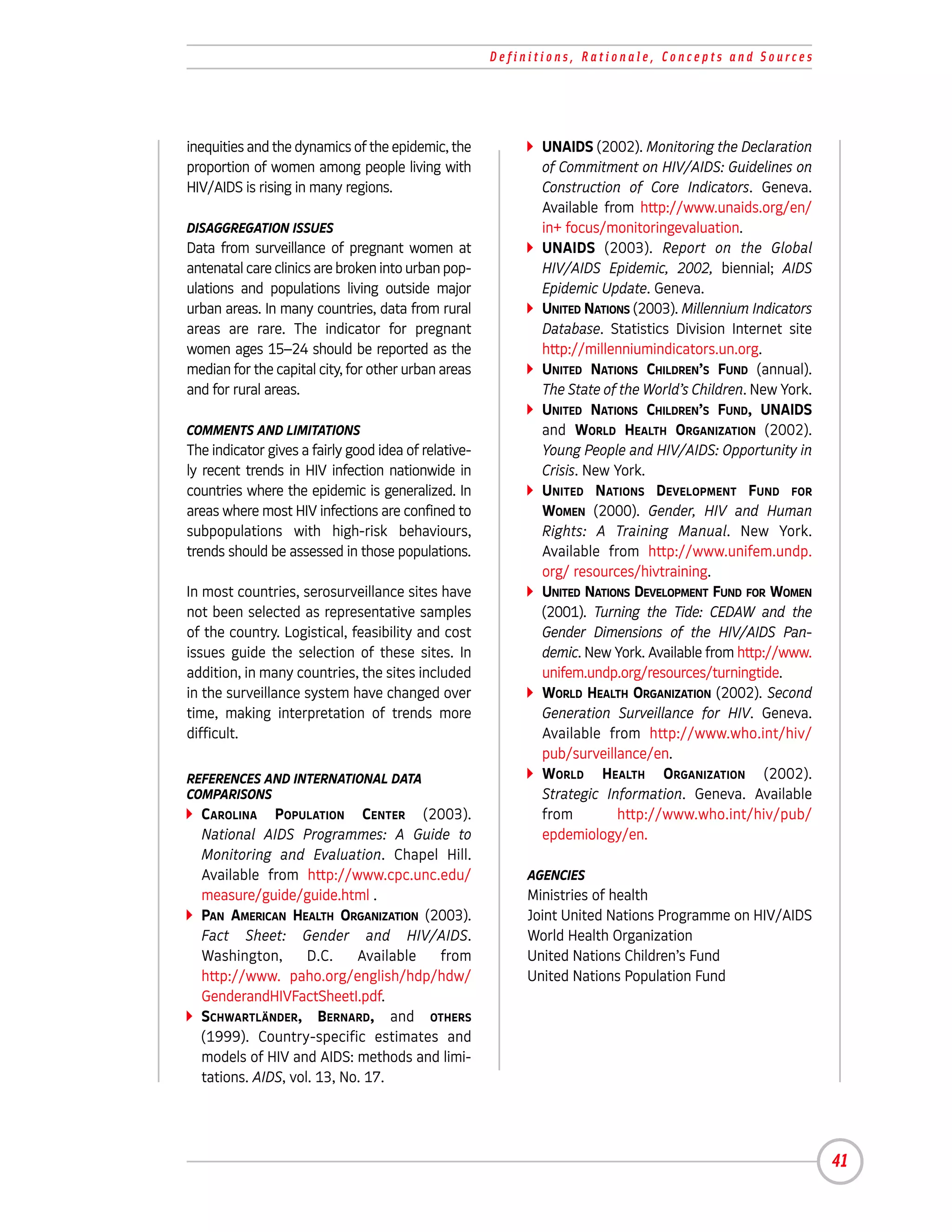
     doms as a percentage of the total number of
     women of the same age group (and same            DISAGGREGATION ISSUES
     marital status, if applicable) in the survey.    Condom use, as it is the case in general for
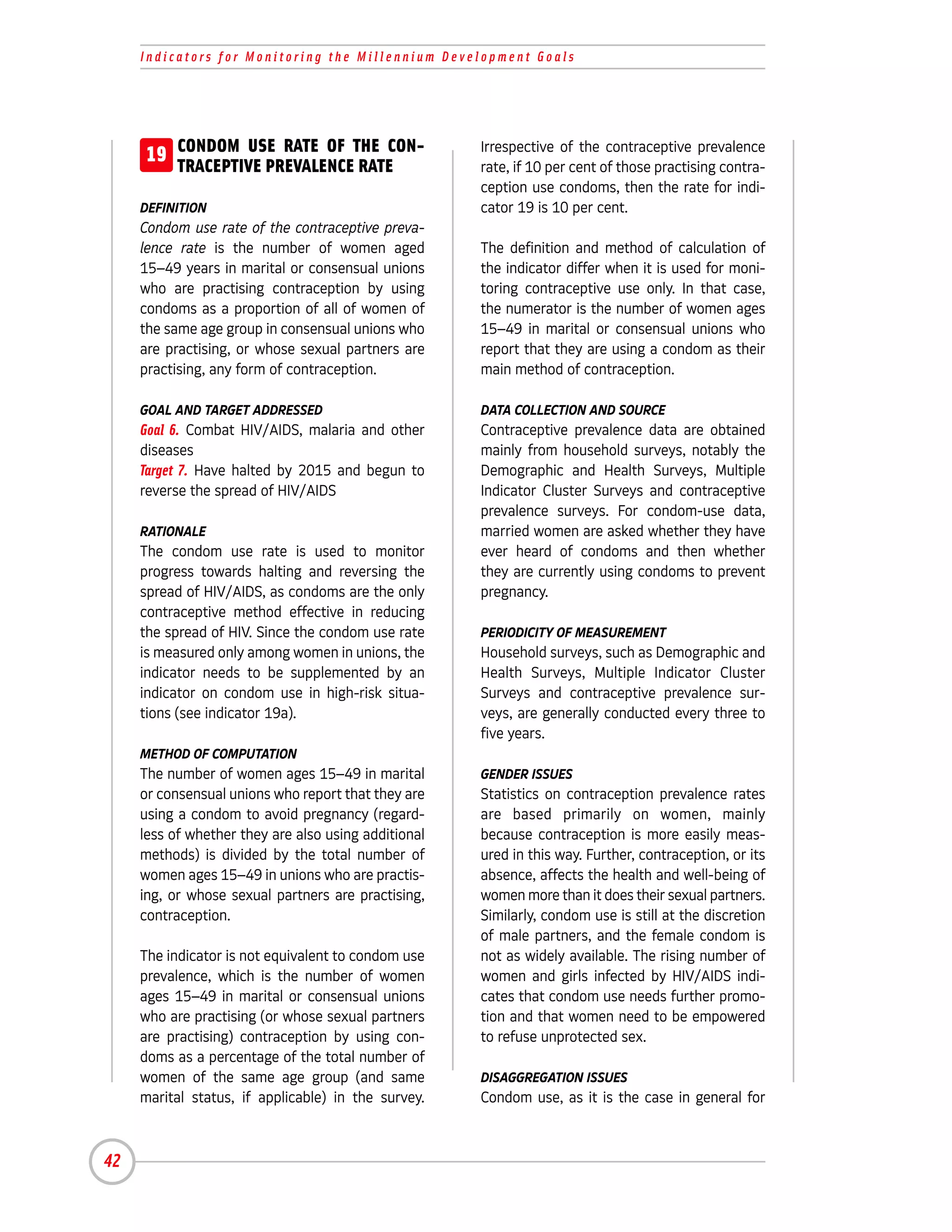


42
Definitions, Rationale, Concepts and Sources


contraceptive use, may vary significantly across            measuredhs.com. Calverton, Maryland.
socio-economic groups and regional and geo-                 UNAIDS (2003). Internet site http://www.
graphical areas. It is important that the analysis          unaids.org. Geneva.
address specific demographic groups, such as                UNITED NATIONS (1958). Multilingual
adolescents and unmarried women.                            Demographic Dictionary. Population Studies,
                                                            No. 29. Sales No. E.58.XIII.4.
COMMENTS AND LIMITATIONS                                    UNITED NATIONS (2001). Indicators of
The indicator does not reflect condom use for               Sustainable Development: Guidelines and
the unmarried population and people in groups               Methodologies. Sales No. E.01.II.A.6.
with high-risk behaviour. Data are generally                Available from http://www.un.org/esa/
collected for women in consensual unions and                sustdev/natlinfo/indicators/isd.htm.
in a particular age range, while the population             UNITED NATIONS (2001). Levels and Trends of
of concern includes all women of reproductive               Contraceptive Use as Assessed in 1998.
age, irrespective of marital status.                        Sales No. E.01.XIII.4. Available from
                                                            http://www.un.org/esa/population/unpop.
The spread of HIV through sexual relations                  htm.
depends on having unprotected sex with people               UNITED NATIONS (2003). Millennium Indicators
who also have other partners. Most monoga-                  Database. Statistics Division Internet site
mous relationships are cohabiting, although the             http://millenniumindicators.un.org.
reverse is not necessarily true. Partners who do            UNITED NATIONS CHILDREN’S FUND (2003).
not live together and who have sex only occa-               Progress since the World Summit for
sionally are most likely to have other partners             Children. New York. Available from http://
over the course of a year. These partnerships               www.childinfo.org; in Quick Access under
therefore carry a higher risk of HIV transmission           “Contraceptive prevalence”.
than partnerships that do not link into a wider             UNITED NATIONS CHILDREN’S FUND (annual).
sexual network. AIDS prevention programmes                  The State of the World’s Children. New York.
try to discourage high numbers of partnerships              UNITED NATIONS DEVELOPMENT FUND FOR
and to encourage mutual monogamy.                           WOMEN (2000). Gender, HIV and Human
                                                            Rights: A Training Manual. New York.
Indicator 19, therefore, is not a practical indi-           Available from http://www.unifem.undp.
cator for measuring the prevention of                       org/ resources/hivtraining.
HIV/AIDS. Information should be collected on                UNITED NATIONS DEVELOPMENT PROGRAMME
additional indicators on condom use in high-                (2003 and annual). Human Development
risk situations (indicator 19A) and on knowl-               Report. New York: Oxford University Press.
edge and misconceptions of HIV/AIDS among                   Available from http://hdr.undp.org.
15-24 year-olds (indicator 19B). Such indica-               WORLD BANK (2003 and annual). World
tors give a better picture of the proportion of             Development Indicators. Print and CD-ROM.
the population that engages in relatively high-             Washington, D.C. Available in part from
risk partnerships and that is therefore more                http://www.worldbank.org/data.
likely to be exposed to the sexual networks                 WORLD HEALTH ORGANIZATION (2002 and
within which HIV can circulate.                             annual). World Health Report. Geneva.
                                                            Available from http://www.who.int/whr/
REFERENCES AND INTERNATIONAL DATA                           en.
COMPARISONS
  ORC MACRO (2003). Demographic and Health                AGENCIES
  Surveys – Providing Information for                     Ministries of health
  Informed Decisions in Population, Health and            Joint United Nations Programme on HIV/AIDS
  Nutrition. Internet site http://www.                    United Nations Children’s Fund


                                                                                                           43
Indicators for Monitoring the Millennium Development Goals


     United Nations Population Division                of the number of respondents ages 15–24
     World Health Organization                         who reported having had a non-regular sexu-
     United Nations Population Fund                    al partner in the last 12 months.

                                                       PERIODICITY OF MEASUREMENT

     19-A CONDOM USE AT LAST HIGH-RISK
          SEX
                                                       Household surveys, such as Demographic and
                                                       Health Surveys, rural household surveys and
                                                       behavioural surveillance surveys, are general-
     DEFINITION                                        ly conducted every three to five years.
     Condom use at last high-risk sex is the per-
     centage of young people ages 15–24 report-        GENDER ISSUES
     ing the use of a condom during sexual inter-      Women’s risk of becoming infected with HIV
     course with a non-regular sexual partner in       during unprotected sexual intercourse is
     the last 12 months.                               higher than that of men. And the risk is even
                                                       higher for younger women. Social and cultur-
     GOAL AND TARGET ADDRESSED                         al factors may increase women’s vulnerability
     Goal 6. Combat HIV/AIDS, malaria and other        to HIV infection. For instance, cultural norms
     diseases                                          related to sexuality often prevent girls from
     Target 7. Have halted by 2015 and begun to        taking active steps to protect themselves.
     reverse the spread of HIV/AIDS
                                                       COMMENTS AND LIMITATIONS
     RATIONALE                                         A rise in the indicator is an extremely power-
     Consistent use of condoms in non-regular          ful sign that condom promotion campaigns
     sexual partnerships substantially reduces the     are having the desired effect among their
     risk of sexual HIV transmission. This is espe-    principle target market. However, condom
     cially important for young people, who often      promotion campaigns aim for consistent use
     experience the highest rates of HIV infection     of condoms with non-regular partners rather
     because they have low prior exposure to           than simply occasional use.
     infection and (typically) relatively high num-
     bers of non-regular sexual partnerships.          Some surveys have tried to ask directly about
     Consistent condom use with non-regular sex-       consistent use, but the question is subject to
     ual partners is important even in countries       recall bias and other biases.
     where HIV prevalence is low because it can
     prevent the spread of HIV in circumstances        The current indicator is therefore considered
     where non-regular relationships are common.       adequate to address the target since it is
     Condom use is one measure of protection           assumed that if consistent use rises, use at
     against HIV/AIDS. Equally important are           last high-risk sex will also increase.
     delaying age at first sex, reducing the number
     of non-regular sexual partners and being          DATA COLLECTION AND SOURCE
     faithful to one partner.                          Data on condom use with non-regular sexual
                                                       partners are available from household surveys
     METHOD OF COMPUTATION                             (such as Demographic and Health Surveys,
     The number of respondents ages 15–24 who          rural household surveys and behavioural sur-
     reported having had a non-regular (non-mar-       veillance surveys) that collect information on
     ital and non-cohabiting) sexual partner in the    sexual behaviour.
     last 12 months and using a condom the last
     time they had sex with this partner, as a share


44
Definitions, Rationale, Concepts and Sources


REFERENCES AND INTERNATIONAL DATA                      transmit HIV.
COMPARISONS
  CAROLINA POPULATION CENTER (2003).                   GOAL AND TARGET ADDRESSED
  National AIDS Programmes: A Guide to                 Goal 6. Combat HIV/AIDS, malaria and other
  Monitoring and Evaluation. Chapel Hill.              diseases
  Available from http://www.cpc.unc.edu/               Target 7. Have halted by 2015 and begun to
  measure/guide/guide.html.                            reverse the spread of HIV/AIDS
  UNAIDS (2002). Monitoring the Declaration
  of Commitment on HIV/AIDS: Guidelines on             RATIONALE
  Construction of Core Indicators. Geneva.             The indicator reflects the success of national
  Available from http://www.unaids.org/en/             information, education and communication
  in+ focus/monitoringevaluation.                      programmes and other efforts in promoting
  UNITED NATIONS CHILDREN’S FUND (annual).             knowledge of valid HIV-prevention methods
  The State of the World’s Children. New York.         and reducing misconceptions about the dis-
  UNITED NATIONS CHILDREN’S FUND, UNAIDS               ease. Common local misconceptions can be
  and WORLD HEALTH ORGANIZATION (2002).                determined by the context of the country.
  Young People and HIV/AIDS: Opportunity in
  Crisis. New York.                                    METHOD OF COMPUTATION
  WORLD HEALTH ORGANIZATION, JOINT UNITED              Since there are not enough surveys to calcu-
  NATIONS PROGRAMME ON HIV/AIDS and the                late the indicator as defined above, the
  UNITED NATIONS CHILDREN’S FUND (2002).               United Nations Children’s Fund, in collabora-
  Epidemiological Fact Sheets. Geneva.                 tion with the Joint United Nations Programme
  Available from http://www.who.int/emc-               on HIV/AIDS and the World Health
  hiv/fact_sheets.                                     Organization, has produced two proxy indica-
                                                       tors that represent two components of the
AGENCIES                                               actual indicator:
Ministries of health
United Nations Children’s Fund                            Percentage of women and men ages 15–24
United Nations Population Fund                           who know that a person can protect him or
                                                         herself from HIV infection by “consistent
                                                         use of condom”. The indicator is calculated
19-B PERCENTAGE OF POPULATION AGED
     15–24 YEARS WITH COMPREHEN-
                                                         as the number of respondents ages 15–24
                                                         who, in response to prompting, correctly
      SIVE CORRECT KNOWLEDGE OF                          identify consistent use of condoms as a
      HIV/AIDS                                           means of protection against HIV infection,
                                                         as a percentage of the total number of
DEFINITION                                               respondents ages 15–24.
Percentage of population aged 15–24 years
with comprehensive correct knowledge of                  Percentage of women and men ages 15–24
HIV/AIDS is the share of women and men                   who know a healthy-looking person can
aged 15–24 years who correctly identify the              transmit HIV. The indicator is calculated as
two major ways of preventing the sexual                  the number of respondents ages 15–24
transmission of HIV (using condoms and lim-              who, in response to prompting, correctly
iting sex to one faithful, uninfected partner),          note that a person who looks healthy may
who reject the two most common local mis-                transmit HIV, as a percentage of the total
conceptions about HIV transmission and who               number of respondents ages 15–24.
know that a healthy-looking person can


                                                                                                        45
Indicators for Monitoring the Millennium Development Goals


     DATA COLLECTION AND SOURCE                          Available from http://www.unaids.org/en/
     Data on knowledge of and misconceptions             in+focus/monitoringevaluation. Select:
     about HIV/AIDS are collected through house-         Guidelines on construction of core indica-
     hold surveys (such as Demographic and               tors.
     Health Surveys, rural household surveys,            UNITED NATIONS CHILDREN’S FUND (annual).
     behavioural surveillance surveys and Multiple       The State of the World’s Children. New York.
     Indicator Cluster Surveys).                         UNITED NATIONS CHILDREN’S FUND, UNAIDS
                                                         and WORLD HEALTH ORGANIZATION (2002).
     PERIODICITY OF MEASUREMENT                          Young People and HIV/AIDS: Opportunity in
     Household surveys, such as Demographic and          Crisis. New York.
     Health Surveys, rural household surveys,            WORLD HEALTH ORGANIZATION, JOINT UN
     behavioural surveillance surveys and Multiple       PROGRAMME ON HIV/AIDS and the UNITED
     Indicator Cluster Surveys, are generally con-       NATIONS CHILDREN’S FUND (2002). Epidemio-
     ducted every three to five years.                   logical Fact Sheets. Geneva. Available from
                                                         http://www.who.int/emc-hiv/ fact_sheets.
     GENDER ISSUES
     Women’s risk of becoming infected with HIV        AGENCY
     during unprotected sexual intercourse is          United Nations Children’s Fund.
     higher than that of men. The risk is even high-
     er for younger women. Social and cultural fac-
     tors may increase women’s vulnerability to
     HIV infection. For instance, cultural norms
                                                       19-C CONTRACEPTIVE PREVALENCE RATE
     related to sexuality often prevent girls from
     taking active steps to protect themselves.        DEFINITION
                                                       The contraceptive prevalence rate is the per-
     In many countries, girls are becoming infect-     centage of women who are practising, or
     ed and dying younger than boys, for various       whose sexual partners are practising, any
     reasons, especially in sub-Saharan Africa, the    form of contraception. It is usually reported
     region most affected by HIV/AIDS.                 for women ages 15–49 in marital or consen-
                                                       sual unions.
     COMMENTS AND LIMITATIONS:
     See “Methods of computation”.                     GOAL AND TARGET ADDRESSED
                                                       Goal 6. Combat HIV/AIDS, malaria and other
     REFERENCES AND INTERNATIONAL DATA                 diseases
     COMPARISONS
                                                       Target 7. Have halted by 2015 and begun to
       CAROLINA POPULATION CENTER (2003).              reverse the spread of HIV/AIDS
       National AIDS Programmes: A Guide to
       Monitoring and Evaluation. Chapel Hill.         RATIONALE
       Available from http://www.cpc.unc.edu/          The indicator is useful in tracking progress
       measure/guide/guide.html.                       towards health, gender and poverty goals. It also
       ORC MACRO (2003). Demographic and               serves as a proxy measure of access to repro-
       Health Surveys – Providing Information for      ductive health services that are essential for
       Informed Decisions in Population, Health        meeting many of the goals, especially the child
       and Nutrition. Internet site http://www.        and maternity mortality and HIV/AIDS goals.
       measuredhs.com. Calverton, USA.
       UNAIDS (2002). Monitoring the Declaration       Contraceptive methods include condoms,
       of Commitment on HIV/AIDS: Guidelines on        female and male sterilization, injectable and
       Construction of Core Indicators. Geneva.        oral hormones, intrauterine devices, dia-


46
Definitions, Rationale, Concepts and Sources


phragms, spermicides and natural family plan-            COMMENTS AND LIMITATIONS
ning, as well as lactational amenorrhoea (lack of        Data are generally collected for women in
menstruation during breastfeeding) where it is           unions and in a particular age range, while the
cited as a method. Since, among contraceptive            population of concern includes all women of
methods, only condoms are effective in pre-              reproductive age, irrespective of marital status.
venting HIV infections, specific indicators on
condom use are also considered (SEE INDICATORS           In addition, contraceptive methods may
19, 19A and 19B).                                        include traditional methods that are largely
                                                         ineffective. It is important, to the extent possi-
METHOD OF COMPUTATION                                    ble, to at least distinguish between traditional
The number of women ages 15–49 in marital                and modern methods.
or consensual unions who report that they are
practising (or whose sexual partners are prac-           Underreporting can occur when the inter-
tising) contraception is divided by the total            viewer does not mention specific methods,
number of women ages 15–49 (and same                     such as contraceptive surgical sterilization.
marital status, if applicable) in the survey.
                                                         REFERENCES AND INTERNATIONAL DATA
DATA COLLECTION AND SOURCE                               COMPARISONS
Contraceptive prevalence data are obtained                 ORC MACRO (2003). Demographic and Health
mainly from household surveys, notably the                 Surveys–Providing Information for Informed
Demographic and Health Surveys, Multiple                   Decisions in Population, Health and
Indicator Cluster Surveys and contraceptive                Nutrition. Internet site http://www.
prevalence surveys.                                        measuredhs.com. Calverton, Maryland.
                                                           UNITED NATIONS (1958). Multilingual
PERIODICITY OF MEASUREMENT                                 Demographic Dictionary, English Section,
Household surveys, such as Demographic and                 Population Studies, No. 29. Sales No.
Health Surveys, Multiple Indicator Cluster                 E.58.XIII.4.
Surveys and contraceptive prevalence sur-                  UNITED NATIONS (2001). Indicators of
veys, are generally conducted every three to               Sustainable Development: Guidelines and
five years.                                                Methodologies. Sales No. E.01.II.A.6.
                                                           Available from: http://www.un.org/esa/
GENDER ISSUES                                              sustdev/natlinfo/indicators/isd.htm.
Statistics on contraception prevalence rates               UNITED NATIONS (2001). Levels and Trends of
are based primarily on women, mainly                       Contraceptive Use as Assessed in 1998.
because contraception is more easily meas-                 Sales No. E.01.XIII.4. Available from
ured in this way. Further, contraception, or its           http://www.un.org/esa/population/unpop.
absence, affects the health and well-being of              htm.
women more than it does their sexual partners.             UNITED NATIONS (2002). World Contraceptive
                                                           Use 2001. Wall Chart. Sales No. E.02.XIII.7.
DISAGGREGATION ISSUES                                      Available from http://www.un.org/esa/
Contraceptive use may vary significantly                   p o p u l a t i o n / p u b l i c a t i o n s / c o n t ra c e p
across socio-economic groups and regional                  tive2001/contraception01.htm.
and geographical areas. It is important that               UNITED NATIONS CHILDREN’S FUND (annual).
the analysis address specific demographic                  The State of the World’s Children. New York.
groups, such as adolescents and unmarried                  UNITED NATIONS DEVELOPMENT FUND FOR WOMEN
women.                                                     (2000). Gender, HIV and Human Rights: A
                                                           Training Manual. New York. Available from


                                                                                                                              47
Indicators for Monitoring the Millennium Development Goals


       http://www.unifem.undp.org/resources/          families and bringing up children. As a result,
       hivtraining .                                  orphan prevalence is rising steadily in many
       UNITED NATIONS DEVELOPMENT PROGRAMME           countries, while fewer relatives within the
       (2003 and annual). Human Development           prime adult ages mean that orphaned chil-
       Report. New York: Oxford University Press.     dren face an increasingly uncertain future.
       Available from http://hdr.undp.org.
       UNITED NATIONS POPULATION FUND (annual).       Orphanhood is frequently accompanied by prej-
       State of World Population. Available from      udice and increased poverty—factors that can
       http://www.unfpa.org/swp/swpmain.htm.          further jeopardize children’s well-being.
       WORLD BANK (2003 and annual). World            Children and adolescents orphaned by AIDS
       Development Indicators. Print and CD-ROM.      face decreased access to adequate nutrition,
       Washington, D.C. Available in part from        basic health care, housing and clothing. They
       http://www.worldbank.org/data.                 may turn to survival strategies that increase
       WORLD HEALTH ORGANIZATION (2002 and            their vulnerability to HIV. They are likely to drop
       annual). World Health Report. Geneva.          out of school owing to discrimination, emotion-
       Available from http://www.who.int/whr/         al distress, inability to pay school fees or the
       en.                                            need to care for parents or caretakers infected
                                                      with HIV or for younger siblings. In sub-Saharan
     AGENCIES                                         Africa, only 60 per cent of orphans (ages
     Ministry of health                               10–14) who lost both parents attend school as
     United Nations Population Fund                   compared with 71 per cent of those with both
     United Nations Children’s Fund                   parents still living. The limited countries with
     United Nations Population Division               trend data indicate a widening of the gap. It is
                                                      important, therefore, to monitor the extent to
                                                      which AIDS support programmes succeed in
     20 RATIO OF SCHOOL ATTENDANCE OF
        ORPHANS TO SCHOOL ATTENDANCE
                                                      securing educational opportunities for
                                                      orphaned children.
           OF NON-ORPHANS AGED 10–14
           YEARS                                      METHOD OF COMPUTATION
                                                      The current school attendance rate of children
     DEFINITION                                       ages 10–14 for whom both biological parents
     Strictly defined, the number of children         have died is divided by the current school
     orphaned by HIV/AIDS is the estimated num-       attendance rate of children ages 10–14 whose
     ber of children who have lost their mother,      parents are both still alive and who live with at
     father or both parents to AIDS before age 15.    least one biological parent.
     In practice, the impact of the AIDS epidemic
     on orphans is measured through the ratio of      DATA COLLECTION AND SOURCE
     orphans to non-orphans who are in school.        Data for the indicator are collected through
                                                      household surveys (such as Demographic and
     GOAL AND TARGET ADDRESSED                        Health Surveys and Multiple Indicator Cluster
     Goal 6. Combat HIV/AIDS, malaria and other       Surveys).
     diseases
     Target 7. Have halted by 2015 and begun to       PERIODICITY OF MEASUREMENT
     reverse the spread of HIV/AIDS                   Household surveys, such as Demographic and
                                                      Health Surveys and Multiple Indicator Cluster
     RATIONALE                                        Surveys, are generally conducted every three
     HIV/AIDS is claiming the lives of ever-growing   to five years.
     numbers of adults just when they are forming


48
Definitions, Rationale, Concepts and Sources


GENDER ISSUES                                               and UNITED STATES AGENCY FOR INTERNATIONAL
Boys and girls are both affected. However, girls            DEVELOPMENT (2002). Children on the Brink
might be more likely than boys to leave school              2002: A Joint Report on Orphan Estimates
to care for ill parents and younger siblings.               and Program Strategies.
                                                            UNITED NATIONS CHILDREN’S FUND, UNAIDS
DISAGGREGATION ISSUES                                       and WORLD HEALTH ORGANIZATION (2002).
Data should be presented separately for boys                Young People and HIV/AIDS: Opportunity in
and girls.                                                  Crisis. New York.

COMMENTS AND LIMITATIONS                                  AGENCIES
The indicator is confined to children ages                Joint United Nations Programme on HIV/AIDS
10–14 for comparability, as age at school entry           United Nations Children’s Fund
varies across countries. Household surveys can
miss children in unstable households, and
orphaned children are disproportionately likely
to be in such households.
                                                          21 PREVALENCEWITH MALARIA RATES
                                                             ASSOCIATED
                                                                        AND DEATH


The indicator is not a direct measure of the              DEFINITION
number of children orphaned by HIV/AIDS,                  Prevalence of malaria is the number of cases
despite the wording. The indicator does not               of malaria per 100,000 people. Death rates
directly distinguish the cause of orphanhood.             associated with malaria refers to the number
However, it is believed that high proportions of          of deaths caused by malaria per 100,000
deaths of adults with school-age children in              people.
areas of HIV epidemics are likely to be related to
HIV/AIDS.                                                 GOAL AND TARGET ADDRESSED
                                                          Goal 6. Combat HIV/AIDS, malaria and other
REFERENCES AND INTERNATIONAL DATA                         diseases
COMPARISONS                                               Target 8. Have halted by 2015 and begun to
  CAROLINA POPULATION CENTER (2003).                      reverse the incidence of malaria and other
  National AIDS Programmes: A Guide to                    major diseases
  Monitoring and Evaluation. Chapel Hill.
  Available from http://www.cpc.unc.edu/                  RATIONALE
  measure/guide/guide.html.                               The indicator allows highly endemic countries
  UNAIDS (2002). Monitoring the Declaration               to monitor disease and death from malaria,
  of Commitment on HIV/AIDS: Guidelines on                which have been increasing over the last two
  Construction of Core Indicators. Geneva.                decades owing to deteriorating health sys-
  Available from http://www.unaids.org/en/                tems, growing drug and insecticide resist-
  in+ focus/monitoringevaluation.                         ance, periodic changes in weather patterns,
  UNITED NATIONS (1998). Principles and                   civil unrest, human migration and population
  Recommendations for Population and                      displacement.
  Housing Censuses, Revision 1, Series M, No.
  67, Rev. 1. Sales No. E.98.XVII.1. Available            METHOD OF COMPUTATION
  from http://unstats. un.org/unsd/pubs (A,               Where the only prevalence data available are
  E, F, S).                                               reported through the administration of health
  UNITED NATIONS CHILDREN’S FUND (annual).                services, they are expressed per 100,000
  The State of the World’s Children. New York.            population, using population estimates as the
  UNITED NATIONS CHILDREN’S FUND, UNAIDS                  denominator.


                                                                                                          49
Indicators for Monitoring the Millennium Development Goals


                                                        immunity to tropical diseases. Gender roles
     Where prevalence data on children under five       and relations influence the degree of expo-
     come from household surveys, the data may          sure to the relevant vectors and also to the
     be reported as percentages of children under       access and control of resources needed to
     five with fever in the last two weeks. The per-    protect women and men from being infected.
     centage may be multiplied by 1,000 to              Women’s immunity is particularly compro-
     express the rate per 100,000.                      mised during pregnancy, making pregnant
                                                        women more likely to become infected and
     The World Health Organization also produces        implying differential severity of the conse-
     model-based estimates of malaria-specific          quences. Malaria during pregnancy is an
     mortality.                                         important cause of maternal mortality.

     DATA COLLECTION AND SOURCE                         DISAGGREGATION ISSUES
     Data come from administrative sources,             All data should be classified by sex, as there
     household surveys and vital statistics regis-      could be differential death rates.
     trations. Administrative data are derived by
     health ministries from the administration of       Rural populations carry the overwhelming
     health services. Multiple Indicator Cluster        burden of disease, so urban and rural disag-
     Surveys collect information on the prevalence      gregation of the data is important in tracking
     of fever in the last two weeks for children        the progress made in rural areas. Multiple
     under five. The surveys also provide data on       Indicator Cluster Surveys data have shown
     all causes of under-five mortality.                substantial difference by wealth quintiles, and
                                                        where possible the data should be disaggre-
     Vital statistics registration systems collect      gated by a wealth index.
     data on cause of death, including deaths
     caused by malaria. Good quality information        COMMENTS AND LIMITATIONS
     requires that death registration be near uni-      Malaria statistics are reported in countries
     versal, that the cause of death be reported        where it is endemic, which includes almost all
     routinely on the death record and that it be       developing countries. However, data reported
     determined by a qualified observer according       by ministries are often only a fraction of the
     to the International Classification of Diseases.   number of cases in the population. Many
     Such information is not generally available in     report only laboratory-confirmed cases. In
     developing countries but is now compiled by        sub-Saharan Africa, clinically diagnosed
     WHO annually for approximately 70 (mainly          cases also tend to be reported.
     developed) countries.
                                                        Differences between male and female preva-
     PERIODICITY OF MEASUREMENT                         lence and incidence rates are difficult to
     Administrative data are, in principle, available   measure since malaria in women is more likely
     annually. Data from surveys are generally          to be undetected. The fact that health services
     available every three to five years.               focus almost exclusively on women’s repro-
                                                        ductive function means that opportunities are
     GENDER ISSUES                                      lost for detection of multiple conditions,
     Potential differences between men and women        including tropical diseases. Moreover, when
     are a function of the interaction between bio-     incidence rates in women and men are similar,
     logical factors and gender roles and relations.    there are still significant differences between
     Biological factors vary between men and            them in the susceptibility and the impact of
     women and influence susceptibility and             tropical diseases.


50
Definitions, Rationale, Concepts and Sources


                                                         menu.cfm. Geneva.
                                                         WORLD HEALTH ORGANIZATION and UNITED
                                                         NATIONS CHILDREN’S FUND (2003). Africa
REFERENCES AND INTERNATIONAL DATA                        Malaria Report. Available from http://www.
COMPARISONS                                              rbm.who.int/amd2003/amr2003/
  GUNN, S.W.A., KLUWER ACADEMIC PUBLISHERS               amr_toc.htm .
  (1990). Multilingual Dictionary of Disaster
  Medicine and International Relief. Dordrecht,        AGENCIES
  The Netherlands. English/Français/Español            Ministries of health
  /Arabic.                                             United Nations Children’s Fund
  UNITED NATIONS CHILDREN’S FUND (annual).             World Health Organization
  The State of the World’s Children. New York.
  UNITED NATIONS DEVELOPMENT PROGRAMME
  (2003 and annual). Human Development
  Report. New York: Oxford University Press.
  Available from http://hdr.undp.org.
                                                        22 PROPORTION OF POPULATION IN
                                                           MALARIA-RISK AREAS USING
  WORLD BANK (2003 and annual). World                        EFFECTIVE MALARIA PREVENTION
  Development Indicators. Print and CD-ROM.                  AND TREATMENT MEASURES
  Washington, D.C. Available in part from
  http://www.worldbank.org/data.                       DEFINITION
  WORLD BANK, UNITED NATIONS CHILDREN’S                Malaria prevention is measured as the per-
  FUND, WORLD HEALTH ORGANIZATION and                  centage of children ages 0–59 months sleep-
  UNITED NATIONS DEVELOPMENT PROGRAMME                 ing under insecticide-treated bednets.
  (2003). Roll Back Malaria (RBM). A Global            Malaria treatment among children is meas-
  Partnership. Internet site http://www.rbm.           ured as the proportion of children ages 0–59
  who.int/. Geneva.                                    months who were ill with fever in the two
  WORLD HEALTH ORGANIZATION (1992).                    weeks before the survey and who received
  International Statistical Classification of          appropriate antimalarial drugs.
  Diseases and Related Health Problems,
  Tenth Revision (ICD-10), vol. 1. Geneva.             GOAL AND TARGET ADDRESSED
  WORLD HEALTH ORGANIZATION (1998). Gender             Goal 6. Combat HIV/AIDS, malaria and other
  and       Health:      Technical      Paper.         diseases
  WHO/FRH/WHD/98.16. Geneva. Available                 Target 8. Have halted by 2015 and begun to
  from http://www.who.int/reproductive-                reverse the incidence of malaria and other
  health/publications. Select: Gender.                 major diseases
  WORLD HEALTH ORGANIZATION (2002 and
  annual). World Health Report. Geneva.                RATIONALE
  Available from http://www.who.int/whr/               The Roll Back Malaria initiative, established in
  en.                                                  late 1998 by the World Health Organization,
  WORLD HEALTH ORGANIZATION (2002). 2001-              the United Nations Children’s Fund and the
  2010: United Nations Decade to Roll Back             World Bank, identifies four main interventions
  Malaria: Monitoring and Evaluation.                  to reduce the burden of malaria in Africa:
  Geneva. Available from http://www.who.               I Use of insecticide-treated bednets, which

  int/inf-fs/en/informationSheet11.pdf.                   have been demonstrated to cut all-cause
  WORLD HEALTH ORGANIZATION (2003). WHO                   child mortality over the first two years by
  Statistical Information System (WHOSIS)—                20 per cent.
  Evidence and Information for Health Policy.          I Prompt access to effective treatment in or

  Internet site http://www3.who.int/whosis/               near the home.


                                                                                                          51
Indicators for Monitoring the Millennium Development Goals


     I   Provision of antimalarial drugs to symp-
         tom-free pregnant women in high trans-           GENDER ISSUES
         mission areas.                                   Girls may have greater exposure than boys to
     I   Improved forecasting, prevention and rapid       malaria-infested areas owing to their role in
         response to malaria epidemics.                   the provision of fuel, water and other supplies.

     In areas of sub-Saharan Africa with high levels of   DISAGGREGATION ISSUES
     malaria transmission, regular use of an insecti-     Disparities by sex, age, mother’s education
     cide-treated bednet can reduce mortality in chil-    and area of residence should be assessed.
     dren under five years of age by as much as 20
     per cent and has a significant impact on anemia.     COMMENTS AND LIMITATIONS
     Similar or greater benefits have been achieved       Survey data are subject to sampling errors
     in other regions and for pregnant women. The         and are undertaken only every few years. As
     prevention indicator will allow countries to mon-    the data on bednet use are new, no trend data
     itor widespread use of insecticide-treated mate-     are yet available.
     rials and other appropriate methods to limit
     contact between humans and mosquitoes.               REFERENCES AND INTERNATIONAL DATA
                                                          COMPARISONS
     Detection of epidemics requires timely, com-           GUNN, S.W.A. (1990). Multilingual
     plete surveillance of malaria cases and monitor-       Dictionary of Disaster Medicine and
     ing of weather patterns. Reserve drug stocks,          International Relief. Dordrecht, The
     transport and hospital capacity are needed to          Netherlands: KLUWER ACADEMIC PUBLISHERS.
     mount an appropriate response. In some epi-            English/Français/Español/Arabic.
     demic zones, well-timed and targeted vector            UNITED NATIONS CHILDREN’S FUND (2003). The
     control activities have minimized the impact of        Challenge – Scope of the Problem. Internet
     epidemics. The treatment indicator allows coun-        site http://www.childinfo.org/eddb/Malaria.
     tries to monitor detection and appropriate             New York.
     response to epidemics within two weeks of              UNITED NATIONS CHILDREN’S FUND (annual).
     onset.                                                 The State of the World’s Children. New York.
                                                            UNITED NATIONS DEVELOPMENT PROGRAMME
     METHOD OF COMPUTATION                                  (2003 and annual). Human Development
     For prevention, the indicator is calculated as the     Report. New York: Oxford University Press.
     percentage of children under five years of age         Available from http://hdr.undp.org.
     in the survey who slept under an insecticide-          WORLD BANK, UNITED NATIONS CHILDREN’S
     treated bednet the previous night.                     FUND, WORLD HEALTH ORGANIZATION and
                                                            UNITED NATIONS DEVELOPMENT PROGRAMME
     DATA COLLECTION AND SOURCE                             (2003). Roll Back Malaria - A Global
     The only data sources are household surveys,           Partnership. Internet site http://www.rbm.
     mainly Demographic and Health Surveys and              who.int. Geneva.
     the Multiple Indicator Cluster Surveys, malar-         WORLD HEALTH ORGANIZATION (2002). 2001-
     ia surveys and malaria modules added to                2010: United Nations Decade to Roll Back
     other ongoing household surveys.                       Malaria: Monitoring and evaluation.
                                                            Geneva. Available from http://www.who.
     PERIODICITY OF MEASUREMENT                             int/ inf-fs/en/informationSheet11.pdf.
     Data on coverage of insecticide-treated bed-           WORLD HEALTH ORGANIZATION (2002 and
     nets and treatment data should be collected            annual). World Health Report. Geneva.
     about every two to three years.                        Available from http://www.who.int/whr/


52
Definitions, Rationale, Concepts and Sources


  en.                                                 pressed per 100,000 population, using the total
                                                      population in the survey as the denominator.
AGENCIES                                              Tuberculosis prevalence is sometimes ex-
Ministries of health                                  pressed in absolute numbers of cases, while
United Nations Children’s Fund                        tuberculosis incidence in a given period (usu-
World Health Organization                             ally one year) is always per 100,000 people.

                                                      DATA COLLECTION AND SOURCE

23 PREVALENCEWITH TUBERCULOSIS
   ASSOCIATED
              AND DEATH RATES                         Direct measures of tuberculosis prevalence are
                                                      uncommon, and recent population-based sur-
                                                      veys have been confined largely to countries in
DEFINITION                                            East Asia and the Pacific . Direct measures of the
Tuberculosis prevalence is the number of cases        tuberculosis death rate come from vital statis-
of tuberculosis per 100,000 people. Death             tics registration. Reliable figures require that
rates associated with tuberculosis refers to          death registration be nearly universal and that
the number of deaths caused by tuberculosis           the cause of death be reported routinely on the
per 100,000 people. A tuberculosis case is            death record and determined by a qualified
defined as a patient in whom tuberculosis has         observer according to the International
been bacteriologically confirmed or diag-             Classification of Diseases. Such information is
nosed by a clinician.                                 not generally available in developing countries.
                                                      Vital statistics registration systems tend to
GOAL AND TARGET ADDRESSED                             underestimate tuberculosis deaths, although
Goal 6. Combat HIV/AIDS, malaria and other            time series data from some countries in Asia and
diseases                                              the Americas give a useful indication of trends.
Target 8. Have halted by 2015 and begun to
reverse the incidence of malaria and other            In the absence of direct measures of prevalence
major diseases                                        and death rates, a variety of techniques can be
                                                      used to estimate these values. Administrative
RATIONALE                                             data are derived from the administration of
Detecting tuberculosis and curing it are key          health services. Data can also be obtained from
interventions for addressing poverty and              such household surveys as Multiple Indicator
inequality. Prevalence and deaths are more            Cluster Surveys or the Demographic and Health
sensitive markers of the changing burden of           Surveys, although they usually refer only to chil-
tuberculosis than incidence (new cases),              dren under five and do not provide death rates.
although data on trends in incidence are far          Population data come directly or indirectly from
more comprehensive and give the best overview         population censuses.
of the impact of global tuberculosis control.
                                                      PERIODICITY OF MEASUREMENT
METHOD OF COMPUTATION                                 Administrative data are, in principle, available
Where the only data available are data report-        annually. Data from surveys are generally
ed through the administration of health serv-         available every three to five years. Results
ices, they are expressed per 100,000 popula-          from population censuses are generally avail-
tion, using population estimates as the               able every 10 years.
denominator.
                                                      GENDER ISSUES
Where the data come from household surveys,           At younger ages, the prevalence of infection is
prevalence (and more rarely deaths) is ex-            similar in boys and girls. At older ages, a higher


                                                                                                           53
Indicators for Monitoring the Millennium Development Goals


     prevalence has been found in men; in most              http://www.worldbank.org/data.
     of the world, more men than women are diag-            WORLD HEALTH ORGANIZATION (1992).
     nosed with tuberculosis and die from it.               International Statistical Classification of
     However, recent analyses comparing infection           Diseases and Related Health Problems,
     and disease rates suggest that the propensity          Tenth Revision (ICD-10), vol. 1. Geneva.
     to develop the disease after infection with            WORLD HEALTH ORGANIZATION (1998). Gender
     mycobacterium tuberculosis (the progression            and Health, Technical Paper. Geneva.
     rate) may be greater among women of repro-             Available from         http://www.who.int/
     ductive age than among men of the same age.            reproductive-health/publications.
     A recent review of socio-economic and cultur-          WORLD HEALTH ORGANIZATION (2002 and
     al factors relating to the suggested differ-           annual). World Health Report. Geneva.
     ences called for further research to clarify such      Available from http://www.who.int/whr/
     differences in the epidemiology of tuberculosis.       en.
                                                            WORLD HEALTH ORGANIZATION (2003). Global
     Although more men than women die of tuber-             Tuberculosis Control – Surveillance, Planning,
     culosis, it is still a leading cause of death from     Financing. WHO Report 2003. Geneva.
     infectious disease among women. Since                  WORLD HEALTH ORGANIZATION (2003). WHO
     tuberculosis affects women mainly in their             Statistical Information System (WHOSIS)—
     economically and reproductively active years,          Evidence and Information for Health Policy.
     the impact of the disease is also strongly felt        Internet site http://www3.who.int/whosis/
     by their children and families.                        menu.cfm. Geneva.

     DISAGGREGATION ISSUES                                AGENCIES
     It is important to compile data by sex and to        Ministries of health.
     take a gender perspective in the analysis.           World Health Organization.

     COMMENTS AND LIMITATIONS
     Tuberculosis prevalence and death rate data
     reported by ministries in developing countries
                                                          24 PROPORTION OF TUBERCULOSIS
                                                             CASES DETECTED AND CURED UNDER
     are usually only a fraction of the number of               INTERNATIONALLY RECOMMENDED
     cases and deaths from tuberculosis in the                  TB CONTROL STRATEGY
     population.
                                                          DEFINITION
     REFERENCES AND INTERNATIONAL DATA                    The tuberculosis detection rate is the percent-
     COMPARISONS                                          age of estimated new infectious tuberculosis
       GUNN, S.W.A.         (1990). Multilingual          cases detected under the internationally rec-
       Dictionary of Disaster Medicine and                ommended tuberculosis control strategy
       International Relief. Dordrecht, The               DOTS. DOTS combines five elements—politi-
       Netherlands: Kluwer Academic Publis-               cal commitment, microscopy services, drug
       hers . English/Français/Español/Arabic.            supplies, surveillance and monitoring systems
       UNITED NATIONS DEVELOPMENT PROGRAMME               and use of highly efficacious regimes—with
       (2003 and annual). Human Development               direct observation of treatment. The cure
       Report. New York: Oxford University Press.         rate is the percentage of new, registered
       Available from http://hdr.undp.org.                smear-positive (infectious) cases that were
       WORLD BANK (2003 and annual). World                cured or in which a full course of DOTS was
       Development Indicators. Print and CD-ROM.          completed. A tuberculosis case is defined as a
       Washington, D.C. Available in part from            patient in whom tuberculosis has been bateri-


54
Definitions, Rationale, Concepts and Sources


ologically confirmed or diagnosed by a clini-             the numerator.
cian.
GOAL AND TARGET ADDRESSED                                 DATA COLLECTION AND SOURCE
Goal 6. Combat HIV/AIDS, malaria and other                Data on both the detection rate and the treat-
diseases                                                  ment success rate are derived from World
Target 8. Have halted by 2015 and begun to                Health Organization DOTS programmes, which
reverse the incidence of malaria and other                monitor and report cases detected, treatment
major diseases                                            progress and programme performance.

RATIONALE                                                 PERIODICITY OF MEASUREMENT
Since tuberculosis is an airborne contagious              Administrative data are, in principle, available
disease, primary control is effected through              annually. Household surveys are generally
finding and treating infectious cases and thus            available annually. Household surveys are
limiting the risk of acquiring infection. The             generally available every three to five years.
recommended approach to primary control is                Data from DOTS programmes, though incom-
the DOTS strategy, an inexpensive strategy                plete, are updated frequently.
that could prevent millions of tuberculosis
cases and deaths over the coming decade.                  GENDER ISSUES
                                                          At younger ages, the prevalence of infection is
DOTS is a proven system based on accurate                 similar in boys and girls. At older ages, a higher
diagnosis and consistent treatment with a                 prevalence has been found in men; in most of
full course of a mixture of anti-tuberculosis             the world, more men than women are diagnosed
drugs (isoniazid, rifampicin, pyrazinamide,               with tuberculosis and die from it. However,
streptomycin and ethambutol). DOTS requires               recent analyses comparing infection and disease
government commitment, careful detection,                 rates suggest that the propensity to develop
consistent treatment, uninterrupted supply of             the disease after infection with mycobacteri-
anti-tuberculosis drugs and a monitoring and              um tuberculosis (the progression rate) may be
reporting system to evaluate treatment out-               greater among women of reproductive age
comes for each patient.                                   than among men of the same age. A recent
                                                          review of socio-economic and cultural factors
METHOD OF COMPUTATION                                     relating to the suggested differences called
The case detection rate is the ratio of smear-            for further research to clarify such differences
positive case notifications in a given year to the        in the epidemiology of tuberculosis.
estimated number of new smear-positive cases
arising in that year. For some countries, there           Tuberculosis is nevertheless a leading cause
is a margin of uncertainty in the estimation of           of death from infectious disease among
the denominator of this ratio.                            women. Since tuberculosis affects women
                                                          mainly in their economically and reproductively
The treatment success rates is the ratio of               active years, the impact of the disease is also
new, registered smear-positive (infectious)               strongly felt by their children and families.
cases that were cured or that completed a full
course of DOTS to the total number of new,                COMMENTS AND LIMITATIONS
registered cases. Treatment success rates can             Tuberculosis cases reported by ministries in
be monitored directly and accurately in                   developing countries are usually only a fraction
cohorts of patients treated under the DOTS                of the number of cases in the population. It is
strategy. Systematic evaluation of patient                estimated that in 2000 only 27 per cent of
progress and treatment outcomes provides                  new cases were notified under DOTS and only


                                                                                                               55
Indicators for Monitoring the Millennium Development Goals


     about 19 per cent of cases were successfully       tations. It refers to land with an existing or
     treated.                                           expected tree canopy of more than 10 per
     REFERENCES AND INTERNATIONAL DATA                  cent and an area of more than 0.5 hectare
     COMPARISONS                                        where the trees should be able to reach a min-
       GUNN, S.W.A., (1990). Multilingual Diction-      imum height of five metres. Forests are iden-
       ary of Disaster Medicine and International       tified by both the presence of trees and the
       Relief. Dordrecht, The Netherlands: Kluwer       absence of other land uses. Land from which
       Academic Publishers. English/Français/           forest has been cleared but that will be refor-
       Español/Arabic.                                  ested in the foreseeable future is included.
       STOP TB PARTNERSHIP (2003). Stop Tuber-          Excluded are stands of trees established pri-
       culosis, the Stop TB Partnetship. Internet       marily for agricultural production, such as
       site http://www.stoptb.org .                     fruit tree plantations.
       WORLD HEALTH ORGANIZATION (1992).
       International Statistical Classification of      GOAL AND TARGET ADDRESSED
       Diseases and Related Health Problems,            Goal 7. Ensure environmental sustainability
       Tenth Revision (ICD-10), vol. 1. Geneva.         Target 9. Integrate the principles of sustainable
       WORLD HEALTH ORGANIZATION (2002 and              development into country policies and pro-
       annual). World Health Report. Geneva.            grammes and reverse the loss of environmen-
       Available from http://www.who.int/whr/           tal resources
       en.
       WORLD HEALTH ORGANIZATION (2003). Global         RATIONALE
       Tuberculosis Control – Surveillance, Planning,   The indicator provides a measure of the rela-
       Financing. WHO Report 2003. Geneva.              tive importance of a forest in a country.
       WORLD HEALTH ORGANIZATION (2003). WHO            Changes in forest area reflect the demand for
       Statistical Information System (WHOSIS)—         land for other competitive uses.
       Evidence and Information for Health Policy.
       Internet site http://www3.who.int/whosis/        Forests fulfil a number of functions that are
       menu.cfm. Geneva.                                vital for humanity, including the provision of
                                                        goods (timber and non-timber products) and
     AGENCIES                                           services such as protection against flooding,
     Ministries of health                               habitat for biodiversity, carbon sequestration,
     World Health Organization                          watershed protection and soil conservation.
                                                        Large areas of the world’s forests have been
                                                        converted to other uses or severely degraded.
     25 PROPORTION OF LAND AREA COV-
        ERED BY FOREST
                                                        While substantial areas of productive forest
                                                        remain, there is now widespread recognition
                                                        that the resource is not infinite and that its
     DEFINITION                                         wise and sustainable use is needed for
     The Proportion of land area covered by forest      humanity’s survival.
     is the forest areas as a share of total land
     area, where land area is the total surface area    METHOD OF COMPUTATION
     of the country less the area covered by inland     The proportion of forest in the total land area
     waters, such as major rivers and lakes. As         is calculated from information provided by
     defined by the Food and Agriculture                countries or from satellite images or other
     Organization of the United Nations in Global       remote sensing information analysis. Changes
     Forest Resources Assessmen, 2000, forest           in the proportion should be computed to iden-
     includes both natural forests and forest plan-     tify trends.


56
Definitions, Rationale, Concepts and Sources


                                                          The proportion of total forest cover (including
DATA COLLECTION AND SOURCE                                both natural forest and plantation) may
FAO global forest resource assessments,                   underestimate the rate at which natural for-
regional forest resource assessments, special             est is disappearing in some countries.
studies and surveys, national forest invento-
ries and satellite images.                                It is also recommended that immediate users
                                                          or beneficiaries of wooded land be identified.
PERIODICITY OF MEASUREMENT
FAO global forest resource assessments are                REFERENCES AND INTERNATIONAL DATA
carried out every 5–10 years, incorporating               COMPARISONS
national forest resource variables, which                   FOOD AND AGRICULTURE ORGANIZATION OF THE
are measured in the national forest inventory               UNITED NATIONS (2000). Global Forest
process at different intervals (often 5–10 years).          Resources Assessment, 2000. Rome.
                                                            Available from http://www.fao.org/
GENDER ISSUES                                               forestry/fo/fra.
Men and women use forest products in different              FOOD AND AGRICULTURE ORGANIZATION OF THE
ways. Women typically gather forest products                UNITED NATIONS (2003 and biennial). State of
for fuel, fencing, food for the family, fodder              the World’s Forests. Available from http://
for livestock, medicine and raw materials for               www.fao.org/DOCREP/005/Y7581E/Y758
income-generating activities. Women are also                1E00.HTM.
often the chief sources of information on the               UNITED NATIONS ECONOMIC COMMISSION FOR
use and management of trees and other for-                  EUROPE (2000). Forest Resources of Europe,
est plants. Men, on the other hand, tend to                 CIS, North America, Australia, Japan and
use non-wood forest products, but also more                 New Zealand. Sales No. 99.II.E.96. Available
often cut wood to sell or use for building                  from http://www.unece.org/ trade/tim-
materials. Women’s access to forest products                ber/fra/ pdf/contents.htm.
may not be ensured—even where women                         UNITED NATIONS. ECONOMIC COMMISSION FOR
have ownership rights to land.                              EUROPE. CONFERENCE OF EUROPEAN STATISTICS
                                                            (1989).     ECE     Standard     Statistical
DISAGGREGATION ISSUES                                       Classification of Land Use. Geneva.
FAO provides a breakdown of forest cover                    Available from http://www.unescap.org/
between natural forest and plantation for                   stat/ envstat/stwes-class-landuse.pdf.
developing countries only.                                  UNITED NATIONS ENVIRONMENT PROGRAMME
                                                            (2003). Internet site http://www.unep.org.
COMMENTS AND LIMITATIONS                                    Nairobi.
National forest inventories and forest surveys              WORLD BANK (2003 and annual). World
are irregular in some countries and may be                  Development Indicators. Print and CD-ROM.
significantly out of date. Owing to climatic                Washington, D.C. Available in part from
and geographical differences, forest areas                  http:// www.worldbank.org/data.
vary in importance among countries. Over
time, changes in area covered by forests as               Although the FAO forestry-related definitions
well as area covered by forests should be doc-            are clear and applied at the international level,
umented. Longer time series may be difficult              countries have historically used their own
to compare directly without analysis of differ-           definitions in conducting national forest inven-
ences in definitions, methods and underlying              tories and assessments. Considerable efforts
data.                                                     have been made to adjust data based on


                                                                                                              57
Indicators for Monitoring the Millennium Development Goals


     national definitions to comparable internation-     harbouring an untold wealth of genetic re-
     al ones, and FAO documents those adjust-            sources; supporting thriving recreation and
     ments in Global Forest Resources Assessment.        tourism industries; providing for science,
                                                         research and education; and forming a basis
     AGENCIES                                            for cultural and other non-material values.
     Ministries of environment                           Those values continue to grow in importance.
     Food and Agriculture Organization of the
     United Nations                                      METHOD OF COMPUTATION
                                                         Protected areas, both terrestrial and marine,
                                                         are totalled and expressed as a percentage of
      26 RATIO OF BIOLOGICAL DIVERSITY
         MAINTAIN
                   AREA PROTECTED TO                     the total surface area of the country. The total
                                                         surface area of the country includes terrestri-
           TO SURFACE AREA                               al area plus any territorial sea area (up to 12
                                                         nautical miles).
     DEFINITION
     The ratio of area protected to maintain biolog-     DATA COLLECTION AND SOURCE
     ical diversity to surface area is defined as        Data are collected by ministries of environ-
     nationally protected area as a percentage of        ment and other ministries responsible for the
     total surface area of a country. The generally      designation and maintenance of protected
     accepted IUCN–World Conservation Union              areas. Data are stored in the World Database
     definition of a protected area is an area of land   on Protected Areas and can be accessed at
     or sea dedicated to the protection and main-        http://sea.unep-wcmc. org/ wdbpa/UN.cfm.
     tenance of biological diversity and of natural
     and associated cultural resources and man-          PERIODICITY OF MEASUREMENT
     aged through legal or other effective means.        Data are constantly updated in the World
                                                         Database on Protected Areas as new informa-
     GOAL AND TARGET ADDRESSED                           tion is received from countries.
     Goal 7 Ensure environmental sustainability
     Target 9. Integrate the principles of sustain-      GENDER ISSUES
     able development into country policies and          Mainstream agricultural, environmental and
     programmes and reverse the loss of environ-         related policies and programmes tend to envi-
     mental resources                                    sion farmers as men and often fail to recog-
                                                         nize women’s work, knowledge, contributions
     RATIONALE                                           and needs. This tendency has important con-
     Habitat conservation is vital for stemming the      sequences for biodiversity as well as for gen-
     decline in biodiversity. The establishment of       der equality.
     protected areas is an important mechanism
     for achieving that aim. Some areas, such as         COMMENTS AND LIMITATIONS
     scientific reserves, are maintained in their        The designation of an area as protected is
     natural state and closed to extractive use.         not confirmation that protection measures
     Others are partially protected and may be           are actually in force. The indicator provides a
     used for recreation or tourism.                     measure of Governments’ will to protect bio-
                                                         diversity. It does not measure the effective-
     In addition to protecting biodiversity, protect-    ness of policy tools in reducing biodiversity
     ed areas have become places of high social          loss, which ultimately depends on a range of
     and economic value: supporting local liveli-        management and implementation factors not
     hoods; protecting watersheds from erosion;          covered by the indicator.


58
Definitions, Rationale, Concepts and Sources


                                                         WORLD CONSERVATION MONITORING CENTRE
The indicator provides no information on areas           (2003). World Database on Protected Areas.
that are not designated as protected but that            Internet site http://sea.unep-wcmc.org .
may also be important for conserving biodi-              Cambridge, United Kingdom.
versity.                                                 WORLD CONSERVATION UNION (IUCN).
                                                         Biodiversity Policy Coordination Division.
The data also do not include sites protected             Internet site http://www.iucn.org/themes/
under local or provincial law.                           biodiversity.
                                                         WORLD CONSERVATION UNION, WORLD
No quantified target has been established for            COMMISSION OF PROTECTED AREAS with the
this indicator.                                          assistance of the WORLD CONSERVATION
                                                         MONITORING CENTRE (1994). Guidelines for
REFERENCES AND INTERNATIONAL DATA                        Protected Area Management Categories.
COMPARISONS                                              Cambridge, United Kingdom. Available from
  ORGANISATION FOR ECONOMIC CO-OPERATION AND             http://www.wcmc.org.uk/protected_area/
  DEVELOPMENT/DEVELOPMENT           ASSISTANCE           categories/eng.
  COMMITTEE (2003). Biodiversity and equality
  between women and men. In Tipsheets for              AGENCIES
  Improving Gender Equality. Available from            Ministries of environment
  http://www1.oecd.org/dac/gender/htm/                 United Nations Environment Programme,
  tipsheets.htm. Paris.                                World Conservation Monitoring Centre
  RAMSAR CONVENTION BUREAU and UNITED                  IUCN–World Conservation Union
  NATIONS EDUCATIONAL, SCIENTIFIC AND CULTURAL
  ORGANIZATION (2003). The Ramsar
  Convention on Wetlands. Internet site
  http://www.ramsar.org. Geneva.
                                                        27 ENERGY USE PER $1 GROSS
                                                           EQUIVALENT)
                                                                       (KILOGRAM OIL

  UNITED NATIONS (2001). Indicators of                       DOMESTIC PRODUCT (PPP)
  Sustainable Development: Guidelines and
  Methodologies. Sales No. E.01.II.A.6.                DEFINITION
  Available from http://www.un.org/esa/                Energy use (kilogram oil equivalent) per $1
  sustdev/natlinfo/indicators/isd.htm.                 gross domestic product (PPP) is commercial
  UNITED NATIONS. ECONOMIC COMMISSION FOR              energy use measured in units of oil equivalent
  EUROPE. CONFERENCE OF EUROPEAN STATISTICS            per $1 of gross domestic product converted
  (1989). ECE Standard Statistical Classifica-         from national currencies using purchasing
  tion of Land Use. Geneva. Available from             power parity conversion factors.
  http://www.unescap.org/stat/envstat/
  stwes-class-landuse.pdf.                             GOAL AND TARGET ADDRESSED
  UNITED NATIONS EDUCATIONAL, SCIENTIFIC AND           Goal 7. Ensure environmental sustainability
  CULTURAL ORGANIZATION (2003). The MAB                Target 9. Integrate the principles of sustain-
  Programme: World Network of Biosphere                able development into country policies and
  Reserves. Internet site http://www.unesco.           programmes and reverse the loss of environ-
  org/mab/wnbr.htm. Paris.                             mental resources
  UNITED NATIONS EDUCATIONAL, SCIENTIFIC AND
  CULTURAL ORGANIZATION (2003). World Heritage.        RATIONALE
  Internet site http://whc.unesco.org/nwhc/            The indicator provides a measure of energy
  pages/home/pages/homepage.htm. Paris.                intensity (it is the inverse of energy efficiency).
  UNITED NATIONS ENVIRONMENT PROGRAMME–                Differences in this ratio over time and across


                                                                                                             59
Indicators for Monitoring the Millennium Development Goals


     countries reflect structural changes in the           INTERNATIONAL ENERGY AGENCY (annual). Energy
     economy, changes in the energy efficiency of          Balances of Non-OECD Countries. Paris.
     particular sectors and differences in fuel mixes.     INTERNATIONAL ENERGY AGENCY (annual).
     In principle, the lower the ratio, the better the     Energy Balances of OECD Countries. Paris.
     energy efficiency.                                    UNITED NATIONS (1987). Energy Statistics –
                                                           Definitions, Units of Measure and Conversion
     METHOD OF COMPUTATION                                 Factors, Series F, No. 44. Sales No.
     Total commercial energy consumption is con-           E.86.XVII.21. Available from http://unstats.
     verted to metric ton oil equivalence using            un.org/unsd/ pubs. (E, F, R, S)
     standard tables. GDP data must be converted           UNITED NATIONS (2001). Indicators of
     using PPP tables so that real output is compared      Sustainable Development: Guidelines and
     with real energy input. National total GDP is         Methodologies. Department of Economic
     deflated (currently to 1995 US PPP dollars) by        and Social Affairs, Division for Sustainable
     reference to PPP tables derived from the              Development Sales No. E.01.II.A.6.
     International Comparison Programme. Energy            Available from http://www.un.org/esa/
     input is divided by GDP to derive the ratio.          sustdev/natlinfo/indicators/isd.htm.
                                                           UNITED NATIONS (2003). Energy Statistics.
     DATA COLLECTION AND SOURCE                            Internet site http://unstats.un.org/unsd/
     Energy consumption is calculated from national        energy.
     energy balance sheets. Real GDP comes from            UNITED NATIONS (2003). Millennium
     the national income accounts deflated by              Indicators Database. Statistics Division
     reference to PPP tables prepared by the               Internet site http://millenniumindicators.
     International       Comparison     Programme.         un.org.
     Traditional fuels, such as animal and vegetable       UNITED NATIONS. COMMISSION OF THE EUROPEAN
     waste, fuel wood and charcoal, are excluded.          COMMUNITIES, INTERNATIONAL MONETARY FUND,
                                                           ORGANISATION FOR ECONOMIC CO-OPERATION AND
     PERIODICITY OF MEASUREMENT                            DEVELOPMENT and WORLD BANK (1994).
     Data are available annually.                          System of National Accounts 1993 (SNA
                                                           1993), Series F, No.2, Rev. 4. Sales No.
     DISAGGREGATION ISSUES                                 E.94.XVII.4. Available with updates from
     This is a relatively crude indicator and needs        http://unstats. un.org/unsd/sna1993.
     to be broken down by sector of industry to be         WORLD BANK (2003 and annual). World
     interpreted.                                          Development Indicators. Print and CD-ROM.
                                                           Washington, D.C. Available in part from
     COMMENTS AND LIMITATIONS                              http://www.worldbank.org/data .
     As the input is commercial energy, it should
     be compared with the output from that ener-         AGENCIES
     gy, deflated by the purchasing power parities       International Energy Agency
     relevant to that output. Changes in the ratio       World Bank
     over time are influenced almost as much by          United Nations Statistics Division
     changes in the structure of the economy as
     by changes in sectoral energy intensities.

     REFERENCES AND INTERNATIONAL DATA
     COMPARISONS
       INTERNATIONAL ENERGY AGENCY (2003).
       Internet site http://www.iea.org . Paris.


60
Definitions, Rationale, Concepts and Sources


                                                       programmes and reverse the loss of environ-
28 CARBON AND CONSUMPTION PER
   CAPITA
          DIOXIDE EMISSIONS
                              OF
                                                       mental resources

   OZONE-DEPLETING CHLOROFLUORO-                       RATIONALE
   CARBONS (ODP TONS)                                  The indicators signify the commitment to
                                                       reducing carbon dioxide emissions and progress
DEFINITION                                             in phasing out the consumption of CFCs by
Carbon dioxide emissions per capita is the             countries that have ratified the Montreal
total amount of carbon dioxide emitted by a            Protocol. Carbon dioxide emissions are largely
country as a consequence of human (produc-             a by-product of energy production and use.
tion and consumption) activities, divided by           They account for the largest share of green-
the population of the country. In the global           house gases associated with global warming.
carbon dioxide emission estimates of the
Carbon Dioxide Information Analysis Center             The Vienna Convention for the Protection of
of Oak Ridge National Laboratory in the                the Ozone Layer (1985) and the Montreal
United States, the calculated country emis-            Protocol (1987) are now recognized as having
sions of carbon dioxide include emissions              been successful in preventing the global envi-
from consumption of solid, liquid and gas              ronmental catastrophe that could have been
fuels; cement production; and gas flaring.             caused by stratospheric ozone depletion. The
National reporting to the United Nations               Montreal Protocol aims to reduce and eventu-
Framework Convention on Climate Change,                ally eliminate the emissions of anthropogenic
which follows the Intergovernmental Panel on           ozone-depleting substances by ceasing their
Climate Change guidelines, is based on                 production and consumption. The phasing out
national emission inventories and covers all           of ozone-depleting substances and their
sources of anthropogenic carbon dioxide                replacement with less harmful substances or
emissions as well as carbon sinks (such as             new processes are aimed at the recovery of
forests).                                              the ozone layer.

Consumption of ozone-depleting chlorofluoro-           CFCs are considered most representative of
carbons (CFCs) in ODP (ozone-depleting poten-          the protocol’s efforts to phase out the use of
tial) tons is the sum of the consumption of the        ozone-depleting substances since they were
weighted tons of the individual substances in          the first to be targeted for elimination.
the group—metric tons of the individual sub-
stance (defined in the Montreal Protocol on            METHOD OF COMPUTATION
Substances that Deplete the Ozone Layer)               Carbon dioxide emissions per capita are cal-
multiplied by its ozone-depleting potential.           culated by dividing carbon dioxide emissions
An ozone-depleting substance is any sub-               by the number of people in the national pop-
stance containing chlorine or bromine that             ulation. Carbon dioxide emission estimates
destroys the stratospheric ozone layer. The            from 1950 to the present are derived primari-
stratospheric ozone layer absorbs most of the          ly from energy statistics published by the
biologically damaging ultraviolet radiation.           United Nations, using the methods outlined in
                                                       “Carbon dioxide emissions from fossil fuels: a
GOAL AND TARGET ADDRESSED                              procedure for estimation and results for
Goal 7. Ensure environmental sustainability            1950–82”. National reporting to the United
Target 9. Integrate the principles of sustain-         Nations Framework Convention on Climate
able development into country policies and             Change is based on the Intergovernmental


                                                                                                        61
Indicators for Monitoring the Millennium Development Goals


     Panel on Climate Change guidelines. Carbon         ecosystem response.
     dioxide emissions can be expressed in terms        REFERENCES AND INTERNATIONAL DATA
     of carbon dioxide or converted to carbon con-      COMPARISONS
     tent.                                                CARBON DIOXIDE INFORMATION ANALYSIS CENTRE
                                                          (CDIAC) (2003). Global, Regional, and
     The consumption of CFCs is the national pro-         National Fossil Fuel CO2 Emissions:
     duction plus imports, minus exports, minus           http://cdiac.ornl.gov/trends/emis/meth_
     destroyed quantities, minus feedstock uses of        reg.htm. Oak Ridge, Tennessee.
     individual CFCs. National annual consump-            CARBON DIOXIDE INFORMATION ANALYSIS CENTRE
     tion of CFCs is the sum of the weighted tons         (CDIAC)      (2003).      Internet      site
     (consumption in metric tons multiplied by the        http://cdiac.esd.ornl.gov/. Oak Ridge,
     estimated ozone-depleting potential) of the          Tennessee.
     individual CFCs.                                     MARLAND, G., and R.M. ROTTY (1984).
                                                          Carbon dioxide emissions from fossil fuels:
     DATA COLLECTION AND SOURCE                           a procedure for estimation and results for
     National carbon dioxide emissions are esti-          1950–82. Tellus, 36(B): 232–61.
     mated from detailed data on emission sources,        UNITED NATIONS (1996). Glossary of
     using source-specific emission factors. Emission     Environmental Statistics, Series F, No. 67
     inventories are usually compiled by energy or        (United Nations publication, Sales No.
     environment ministries. Annex I parties (dev-        E.96.XVII.12).        Available       from
     eloped countries) to the United Nations              http://unstats. un.org/unsd/pubs. (A, C, E,
     Framework Convention on Climate Change sub-          F, R, S)
     mit their data on greenhouse gas emissions to        UNITED NATIONS (2001). Indicators of
     the organization’s secretariat through an            Sustainable Development: Guidelines and
     annual reporting format. Reporting of Non-           Methodologies. Sales No. E.01.II.A.6.
     annex I parties is voluntary and occasional.         Available from http:// www.un.org/esa/
     Where national emission inventories are absent,      sustdev/natlinfo/indicators/isd.htm.
     official sources are supplemented by other           UNITED NATIONS ENVIRONMENT PROGRAMME
     sources and estimates.                               (2002). Production and Consumption of
                                                          Ozone-Depleting Substances under the
     Estimation of the consumption of CFCs requires       Montreal Protocol, 1986-2000. Available
     data on national production plus imports,            from http://www.unep.ch/ozone/15-year-
     minus exports, minus stocks destroyed.               data-report.pdf. Nairobi.
     Those can be derived from national produc-           UNITED NATIONS ENVIRONMENT PROGRAMME
     tion and international trade statistics.             (2003). The Ozone Secretariat. Internet site
                                                          http://www.unep.org/ozone/. Nairobi.
     PERIODICITY OF MEASUREMENT                           UNITED NATIONS FRAMEWORK CONVENTION ON
     Data are usually collected annually.                 CLIMATE CHANGE (2003). Greenhouse Gas
                                                          Inventory Database (GHG). Internet site
     COMMENTS AND LIMITATIONS                             http://ghg.unfccc.int. Bonn, Germany.
     For carbon dioxide emissions, trend data are         UNITED NATIONS FRAMEWORK CONVENTION ON
     more reliable than data comparisons between          CLIMATE CHANGE (2003). Internet site
     countries.                                           http://www.unfccc.int. Bonn, Germany.
                                                          WORLD BANK (2003 and annual). World
     For ozone depletion, the indicator does not          Development Indicators. Print and CD-ROM.
     reveal much about current trends in deterio-         Washington, D.C. Available in part from
     ration of the ozone layer owing to delays in         http://www.worldbank.org/data.


62
Definitions, Rationale, Concepts and Sources


  WORLD METEOROLOGICAL ORGANIZATION AND                  complex phenomenon and depends on inter-
  UNITED NATIONS ENVIRONMENT PROGRAMME.                  actions of pollution source (fuel and stove type),
  INTER-GOVERNMENTAL PANEL ON CLIMATE CHANGE             pollution dispersion (housing and ventilation)
  (2003). Internet site http://www.ipcc.ch.              and the time-activity budget of household
  Geneva.                                                members. The type of fuel and participation in
  WORLD RESOURCE INSTITUTE (2003).                       cooking tasks have consistently been the
  EarthTrends: The Environment Information               most important predictors of exposure.
  Portal. Internet site http://earthtrends.
  wri.org. Washington, D.C.                              METHOD OF COMPUTATION
                                                         The indicator is computed as the ratio of
AGENCIES                                                 households using one or more unprocessed solid
Carbon dioxide:                                          fuels (dung and crop residues, wood, char-
United Nations Framework Convention on                   coal, and coal) for cooking and heating, to the
Climate Change                                           total population, expressed as a percentage.
United Nations Statistics Division
Chlorofluorocarbons:                                     DATA COLLECTION AND SOURCE
United Nations Environment Programme,                    Data can be derived from household surveys,
Ozone Secretariat                                        such as Living Standard Measurement study
                                                         surveys and Demographic and Health Surveys
                                                         and from population censuses. Standard
                                                         questions for inclusion in all nationally repre-
 29 PROPORTION FUELS POPULATION
    USING SOLID
                OF THE
                                                         sentative household surveys have not yet
                                                         been developed and no internationally com-
DEFINITION                                               parable data are available.
Proportion of population using solid fuels is
the proportion of the population that relies on          GENDER ISSUES
biomass (wood, charcoal, crop residues and               More than half the world’s households cook
dung) and coal as the primary source of                  with unprocessed solid fuels, exposing prima-
domestic energy for cooking and heating.                 rily women and children to indoor air pollu-
                                                         tion, which can result in serious health prob-
GOAL AND TARGET ADDRESSED                                lems, such as acute respiratory diseases. In
Goal 7. Ensure environmental sustainability              addition, women spend more time than men
Target 9. Integrate the principles of sustain-           gathering wood for fuel.
able development into country policies and
programmes and reverse the loss of environ-              COMMENTS AND LIMITATIONS
mental resources                                         Development of standard questions for inclu-
                                                         sion in all nationally representative household
RATIONALE                                                surveys and censuses is needed to obtain
Incomplete and inefficient combustion of                 data for calculating the indicator and allowing
solid fuels results in the emission of hundreds          comparisons across countries.
of compounds, many of which are health-
damaging pollutants or greenhouse gases                  Since the use of solid fuels affects both the
that contribute to global climate change. There          environment and the population as a whole
are also important linkages between house-               and the health status of those directly
hold solid fuel use, indoor air pollution, defor-        exposed, guidelines should clearly set defini-
estation and soil erosion and greenhouse gas             tions and measurement standards for what is
emissions. Exposure to indoor air pollution is a         intended by “exposure”.


                                                                                                              63
Indicators for Monitoring the Millennium Development Goals


     REFERENCES AND INTERNATIONAL DATA                  30 PROPORTION OF ACCESS TO WITH
                                                           SUSTAINABLE
                                                                         POPULATION
                                                                                     AN
     COMPARISONS                                             IMPROVED WATER SOURCE, URBAN
       BRUCE, NIGEL, ROGELIO PEREZ-PADILLA and               AND RURAL
       RACHEL ALBALAK (2000). Indoor air pollution
       in developing countries: a major environ-       DEFINITION
       mental and public health challenge. Bulletin    The proportion of the population with sustain-
       of the World Health Organization 78 (9),        able access to an improved water source,
       1078-1092 Geneva.                               urban and rural, is the percentage of the pop-
       STAKEHOLDER FORUM (2002). Earth Summit          ulation who use any of the following types of
       Forum 2002. Internet site http://www.earth      water supply for drinking: piped water, public
       summit2002.org/es/issues/gender/gen-            tap, borehole or pump, protected well, pro-
       der.htm.                                        tected spring or rainwater. Improved water
       UNITED NATIONS (1982). Concepts and             sources do not include vendor-provided
       Methods in Energy Statistics, with Special      water, bottled water, tanker trucks or unpro-
       Reference to Energy Accounts and                tected wells and springs.
       Balances: A Technical Report, Series F, No.
       29. Sales No. E.82.XVII.13 and corrigen-        GOAL AND TARGET ADDRESSED
       dum. Available from http://unstats.un.org/      Goal 7: Ensure environmental sustainability.
       unsd/pubs (E, F, R).                            Target 10: Halve, by 2015, the proportion of
       UNITED NATIONS (1987). Energy Statistics –      people without sustainable access to safe
       Definitions, Units of Measure and Conversion    drinking water and basic sanitation.
       Factors, Series F, No. 44. Sales No.
       E.86.XVII.21. Available from http://unstats.    RATIONALE
       un.org/unsd/pubs (E, F, R, S).                  The indicator monitors access to improved
       WORLD BANK (2003). Briefing Notes on            water sources based on the assumption that
       Gender and Development - Energy.                improved sources are more likely to provide
       Available from http://www.worldbank.org/        safe water. Unsafe water is the direct cause of
       gender/resources/briefing. Washington,          many diseases in developing countries.
       D.C.
       WORLD HEALTH ORGANIZATION (2002). World         METHOD OF COMPUTATION
       Health Report 2002 – Reducing Risks,            The indicator is computed as the ratio of the
       Promoting Healthy Life. Geneva. Available       number of people who use piped water, public
       from http://www.who.int/whr/en.                 tap, borehole or pump, protected well, protected
                                                       spring or rainwater to the total population,
     The World Health Organization has produced        expressed as a percentage. The same method
     estimates of regional aggregates for this indi-   applies for the urban and rural breakdown.
     cator. However, no country data series are
     available to allow comparison across coun-        Access to safe water refers to the percentage
     tries or assessment of trends.                    of the population with reasonable access to
                                                       an adequate supply of safe water in their
     AGENCIES                                          dwelling or within a convenient distance of
     National statistical offices                      their dwelling. The Global Water Supply and
     World Health Organization                         Sanitation Assessment 2000 Report defines
                                                       reasonable access as “the availability of 20
                                                       litres per capita per day at a distance no
                                                       longer than 1,000 metres”. However, access


64
Definitions, Rationale, Concepts and Sources


and volume of drinking water are difficult to           GENDER ISSUES
measure, so sources of drinking water that              Women and men usually have different roles
are thought to provide safe water are used as           in water and sanitation activities. The differ-
a proxy.                                                ences are particularly pronounced in rural
                                                        areas. Women are most often the users,
The United Nations Children’s Fund (UNICEF)             providers and managers of water in rural
and the World Health Organization (WHO),                households and the guardians of household
through the Joint Monitoring Programme,                 hygiene. If a water system breaks down,
assess trends in “access to improved drinking           women are more likely to be affected than
water sources” by drawing a regression line             men because they have to travel farther for
through the available household survey and              water or use other means to meet the house-
census data for each country (details are avail-        hold’s water and sanitation needs.
able at http://www.childinfo.org). Regional
and global estimates are aggregated from the            DISAGGREGATION ISSUES
national estimates, using population-weight-            The indicator should be monitored separately
ed averages.                                            for urban and rural areas. Because of nation-
                                                        al differences in characteristics that distin-
DATA COLLECTION AND SOURCE                              guish urban from rural areas, the distinction
Since the late 1990s, data have routinely been          between urban and rural population is not
collected at the national and subnational levels        amenable to a single definition applicable to
in more than 100 countries using censuses and           all countries. National definitions are most
surveys by national Governments, often with             commonly based on size of locality, with rural
support from international development agen-            population as the residual of population that
cies. Two data sources are common: administra-          is not considered urban.
tive or infrastructure data that report on new
and existing facilities, and data from household        COMMENTS AND LIMITATIONS
surveys, including Multiple Indicator Cluster           When data from administrative sources are
Surveys, Demographic and Health Surveys and             used, they generally refer to existing sources,
Living Standards Measurement study surveys.             whether used or not. Despite official WHO defi-
Before the population-based data were avail-            nitions, the judgment about whether a water
able, provider-based data were used.                    source is safe is often subjective. In addition, the
                                                        existence of a water supply does not necessari-
Evidence suggests that data from surveys are            ly mean that it is safe or that local people use it.
more reliable than administrative records and           For those and other reasons, household survey
provide information on facilities actually used         data are generally better than administrative
by the population.                                      data, since survey data are based on actual use
                                                        of sources by the surveyed population rather
PERIODICITY OF MEASUREMENT                              than the simple existence of the sources.
Administrative data are often available annu-
ally. Household surveys are generally con-              While access is the most reasonable indicator
ducted every three to five years.                       for water supply, it still involves severe method-
                                                        ological and practical problems. Among them:
WHO and UNICEF annually compile interna-                I The data are not routinely collected by “the

tional data and prepare regional and global                sector” but by others outside the sector as
estimates based on household survey data.                  part of more general surveys.
                                                        I Water quality is not systematically addressed.

                                                        I The timing of collection and analysis of


                                                                                                               65
Indicators for Monitoring the Millennium Development Goals


       household survey data is irregular, with long     WORLD HEALTH ORGANIZATION (2002 and
       intervals between surveys                         annual). World Health Report. Geneva.
                                                         Available from http://www.who.int/whr/
     REFERENCES AND INTERNATIONAL DATA                   en.
     COMPARISONS                                         WORLD HEALTH ORGANIZATION AND UNITED
       ORC MACRO (2003). Demographic and                 NATIONS CHILDREN’S FUND (2000). Global
       Health Surveys – Providing Information for        Water Supply and Sanitation Assessment
       Informed Decisions in Population, Health          2000 Report, pp.77-78. Geneva. Available
       and Nutrition. Internet site http://www.          from http://www.who.int/docstore/water_
       measuredhs.com. Calverton, Maryland.              sanitation_health/Globassessment/GlobalTO
       UNITED NATIONS (1998). Principles and             C.htm.
       Recommendations for Population and
       Housing Censuses, Revision 1, Series M, No.     AGENCIES
       67, Rev. 1. Sales No. E.98.XVII.1. Available    National statistical offices
       from http://unstats.un.org/unsd/pubs (A,        United Nations Children’s Fund
       E, F, S).                                       World Health Organization
       UNITED NATIONS (2001). Indicators of
       Sustainable Development: Guidelines and
       Methodologies. Sales No. E.01.II.A.6.
       Available from http://www.un.org/esa/
                                                        31 PROPORTION OF POPULATION WITH
                                                           ACCESS TO IMPROVED SANITATION,
       sustdev/natlinfo/indicators/isd.htm.                  URBAN AND RURAL
       UNITED NATIONS (2003). Millennium Indicators
       Database. Statistics Division Internet site     DEFINITION
       http://millenniumindicators.un.org.             Proportion of the urban and rural population
       UNITED NATIONS CHILDREN’S FUND (2003).          with access to improved sanitation refers to
       Progress since the World Summit for             the percentage of the population with access
       Children. New York. Available from http://      to facilities that hygienically separate human
       www.childinfo.org.                              excreta from human, animal and insect con-
       UNITED NATIONS CHILDREN’S FUND (annual).        tact. Facilities such as sewers or septic tanks,
       The State of the World’s Children. New York.    poor-flush latrines and simple pit or ventilat-
       WORLD BANK (2003 and annual). World             ed improved pit latrines are assumed to be
       Development Indicators. Print and CD-ROM.       adequate, provided that they are not public,
       Washington, D.C. Available in part from         according to the World Health Organization
       http://www.worldbank.org/data.                  and United Nations Children’s Fund’s Global
       WORLD BANK (2003). Briefing Notes on            Water Supply and Sanitation Assessment 2000
       Gender Development - Water and Sanitation.      Report. To be effective, facilities must be cor-
       Washington, D.C. Available from http://         rectly constructed and properly maintained.
       www.worldbank.org/gender/resources/
       briefing.                                       GOAL AND TARGET ADDRESSED
       WORLD BANK (2003). The Living Standards         Goal 7. Ensure environmental sustainability
       Measurement Study of the World Bank             Target 10. Halve, by 2015, the proportion of
       (LSMS). Internet site http://www.world-         people without sustainable access to safe
       bank.org/lsms. Washington, D.C.                 drinking water and basic sanitation
       WORLD BANK (2003). Toolkit on Gender in
       Water and Sanitation. Washington, D.C.          RATIONALE
       Available from http://www.worldbank.org/        Good sanitation is important for urban and rural
       gender/resources/sectoraltools.htm.             populations, but the risks are greater in urban


66
Definitions, Rationale, Concepts and Sources


areas where it is more difficult to avoid con-           holds and the guardians of household hygiene.
tact with waste.                                         If a water system breaks down, women are
                                                         more likely to be affected than men because
METHOD OF COMPUTATION                                    they have to travel farther for water or use
The indicator is computed as the ratio of the            other means to meet the household’s water
number of people in urban or rural areas with            and sanitation needs.
access to improved excreta-disposal facilities
to the total urban or rural population, expressed        DISAGGREGATION ISSUES
as a percentage.                                         The indicator should be monitored separately
                                                         for urban and rural areas. Owing to national
DATA COLLECTION AND SOURCE                               differences in characteristics that distinguish
Since the late 1990s, data have routinely been           urban from rural areas, the distinction
collected at national and subnational levels in          between urban and rural population is not
more than 100 countries using censuses and               amenable to a single definition applicable to
surveys by national Governments, often with              all countries. National definitions are most
support from international development                   commonly based on size of locality, with rural
agencies. Two data sources are common: ad-               population as the residual of population that
ministrative or infrastructure data that report          is not considered urban.
on new and existing facilities, and data from
household surveys including Multiple Indicator           COMMENTS AND LIMITATIONS
Cluster Surveys, Demographic and Health                  When data are from administrative sources,
Surveys, and LSMS surveys. Before those                  they generally refer to existing sanitation
population-based data were available,                    facilities, whether used or not. Household sur-
provider-based data were used.                           vey data are therefore generally better than
                                                         administrative data, since survey data are
Evidence suggests that data from surveys are             based on actual use of facilities by the sur-
more reliable than administrative records and            veyed population rather than the simple exis-
provide information on facilities actually used          tence of the facilities.
by the population.
                                                         While access is the most reasonable indicator
Rural and urban population statistics come               for sanitation facilities, it still involves severe
directly from population censuses.                       methodological and practical problems,
                                                         including the following:
PERIODICITY OF MEASUREMENT                               I The data are not routinely collected by “the

Administrative data are often available annu-               sector” but by others outside the sector as
ally. Household surveys are generally conducted             part of more general surveys
every three to five years. WHO and UNICEF                I Facility   quality is not systematically
annually compile international data and pre-                addressed
pare regional and global estimates based on              I The timing of collection and analysis of

household survey data.                                      household survey data is irregular, with
                                                            long intervals between surveys
GENDER ISSUES
Women and men usually have different roles               The definition of access to improved sanita-
in water and sanitation activities. The differ-          tion facilities and methods for assessing it are
ences are particularly pronounced in rural               even more contentious than those for water,
areas. Women are most often the users, pro-              with national definitions of “acceptable” sani-
viders and managers of water in rural house-             tation varying widely.


                                                                                                               67
Indicators for Monitoring the Millennium Development Goals


     REFERENCES AND INTERNATIONAL DATA
     COMPARISONS
                                                        32 PROPORTION OF HOUSEHOLDS WITH
                                                           ACCESS TO SECURE TENURE
       ORC MACRO (2003). Demographic and
       Health Surveys – Providing Information for      DEFINITION
       Informed Decisions in Population, Health        The proportion of households with access to
       and Nutrition. Internet site http://www.        secure tenure is 1 minus the percentage of
       measuredhs.com. Calverton, Maryland.            the urban population that lives in slums. In the
       UNITED NATIONS (1998). Principles and           absence of data on number of slum dwellers,
       Recommendations for Population and              the United Nations Human Settlements
       Housing Censuses, Revision 1, Series M, No.     Programme (UN-HABITAT) produces estimates
       67, Rev. 1. Sales No. E.98.XVII.1. Available    based on a definition of slums as agreed by
       from http://unstats.un.org/unsd/pubs (A,        the Expert Group Meeting on Urban Indicators
       E, F, S).                                       in 2002. Those indicators will be adjusted,
       UNITED NATIONS (2001). Indicators of            and the definitions of secure tenure and
       Sustainable Development: Guidelines and         slums will be refined through future consulta-
       Methodologies. Sales No. E.01.II.A.6.           tions with Expert Group Meeting participants
       Available from http://www.un.org/esa/           and their related networks of professionals.
       sustdev/natlinfo/indicators/isd.htm.
       UNITED NATIONS (2003). Millennium Indicators    Secure tenure refers to households that own
       Database. Statistics Division Internet site     or are purchasing their homes, are renting pri-
       http://millenniumindicators.un.org.             vately or are in social housing or subtenancy.
       UNITED NATIONS CHILDREN’S FUND (2003).          Households without secure tenure are defined
       Progress since the World Summit for Children.   as squatters (whether or not they pay rent),
       New York. Available from http://www.            homeless and households with no formal
       childinfo.org .                                 agreement.
       WORLD BANK (2003) The Living Standards
       Measurement Study of the World Bank             UN-HABITAT defines a slum household as a
       (LSMS). Internet site http://www.worldbank.     group of individuals living under the same
       org/lsms. Washington, D.C.                      roof who lack one or more (in some cities, two
       WORLD HEALTH ORGANIZATION AND UNITED            or more) of the following conditions: security
       NATIONS CHILDREN’S FUND (2000). Global          of tenure, structural quality and durability of
       Water Supply and Sanitation Assessment          dwellings, access to safe water, access to
       2000 Report. Geneva. Available from             sanitation facilities and sufficient living area.
       http://www.who.int/docstore/ water_sani-
       tation_health/Globassessment/GlobalTOC.         GOAL AND TARGET ADDRESSED
       htm .                                           Goal 7. Ensure environmental sustainability
                                                       Target 11. By 2020, to have achieved a signifi-
     AGENCIES                                          cant improvement in the lives of at least 100
     National statistical offices                      million slum dwellers
     United Nations Children’s Fund
     World Health Organization                         RATIONALE
                                                       The indicator is intended to provide an
                                                       overview of the share of urban population liv-
                                                       ing in conditions of poverty and physical and
                                                       environmental deprivation.


68
Definitions, Rationale, Concepts and Sources


METHOD OF COMPUTATION                                    REFERENCES AND INTERNATIONAL DATA
The indicator is computed as 1 minus the ratio           COMPARISONS
of the number of households in urban areas                 CENTER ON HOUSING RIGHTS AND EVICTIONS
that lack one or more of the above-mentioned               (2003). Women and housing rights. In
conditions listed under “Definition”to the num-            Housing Rights. Geneva. Available from
ber of urban households, expressed as a per-               http://www.cohre.org/hrframe.htm.
centage.                                                   UNITED NATIONS (2003). Millennium Indicators
                                                           Database. Statistics Division Internet site
DATA COLLECTION AND SOURCE                                 http://millenniumindicators.un.org.
Data come mainly from household surveys                    UNITED NATIONS. COMMISSION ON HUMAN
such as the Demographic and Health Surveys,                RIGHTS. Women’s equal ownership of,
Multiple Indicator Cluster Surveys and Joint               access to and control over land and the
Monitoring Programme questionnaires. In                    equal rights to own property and to ade-
countries without such data from surveys,                  quate housing. Official Records of the
data can be derived from population and                    Economic and Social Council, Fifty-sixth
housing censuses, which usually include                    Session Supplemjent No. 3 (E/200/23-
questions about housing tenure.                            E/CN.4/2000/167), resolution 2000/13.
                                                           Geneva. Available from http://www.
UN-HABITAT produces slum population esti-                  unhabitat.org/programmes/landtenure/
mates based on those national sources for                  13.asp.
assessing regional and global trends.                      UNITED NATIONS HUMAN SETTLEMENTS PROGRAMME
                                                           (UN-HABITAT) (2002). Expert Group Meeting
PERIODICITY OF MEASUREMENT                                 on Urban Indicators – Secure Tenure, Slums
Household surveys are generally conducted                  and Global Sample of Cities. Nairobi.
every three to five years. Censuses are con-               Available from http://www.unhabitat.org/
ducted every 10 years.                                     programmes/guo/documents/EGM final
                                                           report 4 Dec 02.pdf.
GENDER ISSUES                                              UNITED NATIONS HUMAN SETTLEMENTS PROGRAMME
For women (more than for men), housing—                    (UN-HABITAT) (2003). Global Urban
beyond basic shelter—also often functions as               Observatory. Internet site http://www.
an important place of employment and social                unhabitat.org/programmes/guo. Nairobi.
interaction, and a place to care for children. It          UNITED NATIONS HUMAN SETTLEMENTS PROGRAMME
may offer respite from social instability and              (UN-HABITAT) (2003). Guide to Monitoring
violence. Discriminatory social and economic               Target 11: Improving the Lives of 100
practices within and outside the household                 Million Slum Dwellers–Progress towards the
may result in women being excluded from                    Millennium Development Goals. Nairobi.
many aspects of housing, including policy                  Available from http://www.unhabitat.org/
development, control over housing resources,               mdg.
rights of inheritance and ownership, commu-                UNITED NATIONS HUMAN SETTLEMENTS PROGRAMME
nity organizing or the construction of hous-               (UN-HABITAT) (2003). The Global
ing. Such exclusion can threaten women’s                   Campaign for Secure Tenure. Internet site
security of tenure by preventing women from                http://www.unhabitat.org/campaigns/
owning, inheriting, leasing, renting or remain-            tenure. Nairobi.
ing in housing and on land.
                                                           UN-HABITAT produces regional and global
COMMENTS AND LIMITATIONS                                   estimates of percentage of slum dwellers
Data are not yet generally available.                      based on national data. Internationally


                                                                                                          69
Indicators for Monitoring the Millennium Development Goals


       comparable data series at country level           Republic of the Congo, Djibouti, Equatorial
       have not yet been produced.                       Guinea, Eritrea, Ethiopia, Gambia, Guinea,
                                                         Guinea-Bissau, Lesotho, Liberia, Madagascar,
     AGENCY                                              Malawi, Mali, Mauritania, Mozambique, the
     United Nations         Human       Settlements      Niger, Rwanda, Saõ Tomé and Principe,
     Programme                                           Senegal, Sierra Leone, Somalia, the Sudan,
                                                         Togo, Uganda, the United Republic of
                                                         Tanzania and Zambia; Asia and the Pacific:
      33 NET ODA, TOTAL AND TO THEALEAST
         DEVELOPED COUNTRIES, AS PER-
                                                         Afghanistan, Bangladesh, Bhutan, Cambodia,
                                                         Kiribati, the Lao People’s Democratic
           CENTAGE OF OECD/DAC DONORS’                   Republic, Maldives, Myanmar, Nepal, Samoa,
           GROSS NATIONAL INCOME                         Solomon Islands, Timor Leste, Tuvalu,
                                                         Vanuatu and Yemen; Latin America and the
     DEFINITION                                          Caribbean: Haiti.
     Official development assistance comprises
     grants or loans to developing countries and ter-    GOAL AND TARGETS ADDRESSED
     ritories on the Organisation for Economic Co-       Goal 8. Develop a global partnership for devel-
     operation and Development/Development               opment
     Assistance Committee (OECD/DAC) list of aid         Target 12. Develop further an open, rule-based,
     recipients that are undertaken by the official      predictable, non-discriminatory trading and
     sector with promotion of economic develop-          financial system. Includes a commitment to
     ment and welfare as the main objective and at       good governance, development and poverty
     concessional financial terms (if a loan, having a   reduction—both nationally and internationally
     grant element of at least 25 per cent). Technical   Target 13. Address the special needs of the
     cooperation is included. Grants, loans and cred-    least developed countries. Includes: tariff and
     its for military purposes are excluded. Also        quota-free access for least developed coun-
     excluded is aid to more advanced developing         tries’ exports; enhanced programme of debt
     and transition countries as determined by DAC.      relief for heavily indebted poor countries and
                                                         cancellation of official bilateral debt; and
     Donors’ gross national income (GNI) at market       more generous ODA for countries committed
     prices is the sum of gross primary incomes          to poverty reduction
     receivable by resident institutional units and      Target 14. Address the special needs of land-
     sectors. GNI at market prices was called gross      locked countries and small island developing
     national product (GNP) in the 1953 System of        States (through the Programme of Action for
     National Accounts. In contrast to gross domes-      the Sustainable Development of Small Island
     tic product (GDP), GNI is a concept of income       Developing States and the outcome of the
     (primary income) rather than value added.           twenty-second special session of the General
                                                         Assembly)
     The General Assembly, on the recommenda-            Target 15. Deal comprehensively with the debt
     tion of the Committee for Development Policy,       problems of developing countries through
     through the Economic and Social Council,            national and international measures in order
     decides on the countries to be included in the      to make debt sustainable in the long term
     list of least developed countries (LDCs). As of
     January 2004, the list included the following       RATIONALE
     countries, by region: Africa: Angola, Benin,        Goal 8 addresses the way developed coun-
     Burkina Faso, Burundi, Cape Verde, Central          tries can assist developing countries to
     African Republic, Chad, Comoros, Democratic         achieve the other seven goals through more


70
Definitions, Rationale, Concepts and Sources


development assistance, improved access to               UNITED NATIONS, COMMISSION OF THE EUROPEAN
markets and debt relief. The International               COMMUNITIES, INTERNATIONAL MONETARY FUND,
Conference on Financing for Development,                 ORGANISATION FOR ECONOMIC CO-OPERATION and
held in Monterrey, Mexico in 2002, stimulated            DEVELOPMENT AND WORLD BANK (1994).
commitments from major donors to start to                System of National Accounts 1993 (SNA
reverse the decline in official development              1993), Series F, No.2, Rev. 4. Sales No.
assistance and focus more on poverty reduc-              E.94.XVII.4. Available with updates at
tion, education and health to help countries             http://unstats. un.org/unsd/sna1993.
realize the Millennium Development Goals.                UNITED NATIONS OFFICE OF THE HIGH
                                                         REPRESENTATIVE FOR THE LEAST DEVELOPED
METHOD OF COMPUTATION                                    COUNTRIES, LANDLOCKED DEVELOPING COUNTRIES
GNI is equal to GDP (which at market prices              AND SMALL ISLAND DEVELOPING STATES (2003).
represents the final result of the production            Internet site http://www.un.org/ohrlls.
activity of resident producer units) less pri-
mary incomes payable to non-resident units             AGENCY
plus primary incomes receivable from non-              Organisation for Economic Co-operation
resident units. In other words, GNI is equal to        and Development, Development Assistance
GDP less taxes (less subsidies) on production          Committee
and imports, compensation of employees and
property income payable to the rest of the
world plus the corresponding items receivable
from the rest of the world.
                                                        34 PROPORTION OF TOTAL BILATERAL,
                                                           SECTOR-ALLOCABLE ODA OF OECD/
                                                             DAC DONORS TO BASIC SOCIAL
DATA COLLECTION AND SOURCE                                   SERVICES (BASIC EDUCATION, PRI-
Data are compiled by the Development                         MARY HEALTH CARE, NUTRITION,
Assistance Committee of OECD.                                SAFE WATER AND SANITATION)

PERIODICITY OF MEASUREMENT                             DEFINITION
Annual.                                                Official development assistance comprises
                                                       grants or loans to developing countries and ter-
REFERENCES AND INTERNATIONAL DATA                      ritories on the OECD Development Assistance
COMPARISONS                                            Committee list of aid recipients that are under-
  ORGANISATION FOR ECONOMIC CO-OPERATION AND           taken by the official sector with promotion of
  DEVELOPMENT. DEVELOPMENT ASSISTANCE                  economic development and welfare as the main
  COMMITTEE (2003). Internet site http://www.          objective and at concessional financial terms (if
  oecd.org/dac . Paris.                                a loan, having a grant element of at least 25 per
  ORGANISATION FOR ECONOMIC CO-OPERATION AND           cent). Technical cooperation is included. Grants,
  DEVELOPMENT. DEVELOPMENT ASSISTANCE                  loans and credits for military purposes are
  COMMITTEE (annual). Development Co-opera-            excluded. Also excluded is aid to more
  tion Report. Paris.                                  advanced developing and transition countries
  ORGANISATION FOR ECONOMIC CO-OPERATION AND           as determined by DAC. Bilateral official develop-
  DEVELOPMENT. DEVELOPMENT ASSISTANCE                  ment assistance is from one country to another.
  COMMITTEE       (annual).      International
  Development Statistics. CD-ROM. Paris.               Basic education comprises primary education,
  UNITED NATIONS (2003). Millennium Indicators         basic life skills for youth and adults and early
  Database. Statistics Division Internet site          childhood education. Primary health care
  http://millenniumindicators.un.org.                  includes basic health care, basic health infra-


                                                                                                           71
Indicators for Monitoring the Millennium Development Goals


     structure, basic nutrition, infectious disease    DATA COLLECTION AND SOURCE
     control, health education and health person-      Compiled by the Development Assistance
     nel development. (For safe water and sanita-      Committee of the OECD.
     tion, see INDICATORS 30 and 31.)
                                                       PERIODICITY OF MEASUREMENT
     GOAL AND TARGETS ADDRESSED                        Annual.
     Goal 8. Develop a global partnership for devel-
     opment                                            COMMENTS AND LIMITATIONS
     Target 12. Develop further an open, rule-based,   Aid to water supply and sanitation is defined
     predictable, non-discriminatory trading and       as part of basic social services only if poverty
     financial system. Includes a commitment to        focused.
     good governance, development and poverty          REFERENCES AND INTERNATIONAL DATA
     reduction—both nationally and internationally.    COMPARISONS
     Target 13. Address the special needs of the         ORGANISATION FOR ECONOMIC CO-OPERATION
     least developed countries. Includes: tariff and     AND   DEVELOPMENT. DEVELOPMENT ASSISTANCE
     quota-free access for least developed coun-         COMMITTEE (2003). Internet site http://www.
     tries’ exports; enhanced programme of debt          oecd.org/dac. Under Topics, select: Aid sta-
     relief for heavily indebted poor countries and      tistics, Aid effectiveness and donor prac-
     cancellation of official bilateral debt; and        tices or Millennium Development Goals.
     more generous ODA for countries committed           Paris.
     to poverty reduction                                ORGANISATION FOR ECONOMIC CO-OPERATION
     Target 14. Address the special needs of land-       AND DEVELOPMENT. DEVELOPMENT ASSISTANCE
     locked countries and small island developing        COMMITTEE (annual). Development Co-opera-
     States (through the Programme of Action for         tion Report. Paris.
     the Sustainable Development of Small Island         ORGANISATION FOR ECONOMIC CO-OPERATION
     Developing States and the outcome of the            AND DEVELOPMENT. DEVELOPMENT ASSISTANCE
     twenty-second special session of the General        COMMITTEE (annual). International Development
     Assembly)                                           Statistics CD-ROM. Paris.
     Target 15. Deal comprehensively with the debt       UNITED NATIONS (2003). Millennium Indicators
     problems of developing countries through            Database. Statistics Division Internet site
     national and international measures in order        http://millenniumindicators.un.org .
     to make debt sustainable in the long term
                                                       AGENCY
     RATIONALE                                         Organisation for Economic Co-operation and
     The World Summit on Social Development at         Development/Development        Assistance
     Copenhagen in 1995 suggested the possibili-       Committee
     ty of “mutual commitment between interest-
     ed developed and developing country part-
     ners to allocate, on average, 20 per cent of
     ODA and 20 per cent of the national budget,
                                                        35 PROPORTION OF BILATERAL UNTIED
                                                           OECD/DAC DONORS THAT IS
                                                                                   ODA OF

     respectively, to basic social programmes”.
     These programmes comprise basic education,        DEFINITION
     basic health, population and reproductive         Official development assistance (ODA) com-
     health programmes, and poverty-focused            prises grants or loans to developing countries
     water and sanitation projects.                    and territories on the OECD Development
                                                       Assistance Committee list of aid recipients
                                                       that are undertaken by the official sector with


72
Definitions, Rationale, Concepts and Sources


promotion of economic development and wel-                effectiveness. Recognizing this, OECD/DAC
fare as the main objective and at concession-             member countries have raised the share of
al financial terms (if a loan, having a grant ele-        their aid that is untied. The share of untied aid
ment of at least 25 per cent). Technical coop-            to the least developed countries has risen rel-
eration is included. Grants, loans and credits            atively slowly, but the situation is likely to
for military purposes are excluded. Also                  improve with the implementation of the new
excluded is aid to more advanced developing               DAC Recommendation on Untying Official
and transition countries as determined by the             Development Assistance to the Least
Committee. Bilateral official development                 Developed Countries.
assistance is from one country to another.
Untied bilateral official development assis-              DATA COLLECTION AND SOURCE
tance is assistance from country to country               Data are compiled by the Development
for which the associated goods and services               Assistance Committee of OECD.
may be fully and freely procured in substan-
tially all countries.                                     PERIODICITY OF MEASUREMENT
                                                          Annual.
GOAL AND TARGETS ADDRESSED
Goal 8. Develop a global partnership for devel-           REFERENCES AND INTERNATIONAL DATA
opment                                                    COMPARISONS
Target 12. Develop further an open, rule-based,             ORGANISATION FOR ECONOMIC CO-OPERATION AND
predictable, non-discriminatory trading and                 DEVELOPMENT. DEVELOPMENT ASSISTANCE COMMITTEE
financial system. Includes a commitment to                  (2003). Internet site http://www.oecd.org/
good governance, development and poverty                    dac . Under Topics, select: Aid statistics, Aid
reduction—both nationally and internationally               effectiveness and donor practices or
Target 13. Address the special needs of the                 Millennium Development Goals. Paris.
least developed countries. Includes: tariff and             ORGANISATION FOR ECONOMIC CO-OPERATION AND
quota-free access for least developed coun-                 DEVELOPMENT. DEVELOPMENT ASSISTANCE COMMITTEE
tries’ exports; enhanced programme of debt                  (annual). Development Co-operation
relief for heavily indebted poor countries and              Report. Paris.
cancellation of official bilateral debt; and                ORGANISATION FOR ECONOMIC CO-OPERATION AND
more generous ODA for countries committed                   DEVELOPMENT. DEVELOPMENT ASSISTANCE COMMITTEE
to poverty reduction                                        (annual). International Development
Target 14. Address the special needs of land-               Statistics. CD-ROM. Paris.
locked countries and small island developing                UNITED NATIONS (2003). Millennium Indicators
States (through the Programme of Action for                 Database. Statistics Division Internet site
the Sustainable Development of Small Island                 http://millenniumindicators.un.org .
Developing States and the outcome of the                    UNITED NATIONS. OFFICE OF THE HIGH
twenty-second special session of the General                REPRESENTATIVE FOR THE LEAST DEVELOPED
Assembly)                                                   COUNTRIES, LANDLOCKED DEVELOPING COUNTRIES
Target 15. Deal comprehensively with the debt               AND SMALL ISLAND DEVELOPING STATES (2003).
problems of developing countries through                    Internet site http://www.un.org/ohrlls .
national and international measures in order
to make debt sustainable in the long term                 AGENCY
                                                          Organisation for Economic Co-operation and
RATIONALE                                                 Development, Development Assistance
Tying procurement from aid contracts to sup-              Committee
pliers in the donor country reduces its cost-


                                                                                                              73
Indicators for Monitoring the Millennium Development Goals


      36 ODA RECEIVED PROPORTION OF
         COUNTRIES AS
                      IN LANDLOCKED                       predictable, non-discriminatory trading and
                                                          financial system. Includes a commitment to
           THEIR GROSS NATIONAL INCOMES                   good governance, development and poverty
                                                          reduction—both nationally and internationally
     DEFINITION                                           Target 13:. Address the special needs of the
     Official development assistance comprises            least developed countries. Includes: tariff and
     grants or loans to developing countries and          quota-free access for least developed coun-
     territories on the OECD Development                  tries’ exports; enhanced programme of debt
     Assistance Committee list of aid recipients          relief for HIPCs and cancellation of official
     that are undertaken by the official sector with      bilateral debt; and more generous ODA for
     promotion of economic development and wel-           countries committed to poverty reduction
     fare as the main objective and at concession-        Target 14. Address the special needs of land-
     al financial terms (if a loan, having a grant ele-   locked countries and small island developing
     ment of at least 25 per cent). Technical coop-       States (through the Programme of Action for
     eration is included. Grants, loans and credits for   the Sustainable Development of Small Island
     military purposes are excluded. Also excluded        Developing States and the outcome of the
     is aid to more advanced developing and tran-         twenty-second special session of the General
     sition countries as determined by DAC.               Assembly)
                                                          Target 15. Deal comprehensively with the debt
     Recipient countries’ gross national income           problems of developing countries through
     (GNI) at market prices is the sum of gross pri-      national and international measures in order
     mary incomes receivable by resident institu-         to make debt sustainable in the long term
     tional units and sectors. GNI at market prices
     was called gross national product (GNP) in the       RATIONALE
     1953 System of National Accounts. In con-            The indicator addresses the special needs of
     trast to gross domestic product (GDP), GNI is        landlocked countries to achieve their develop-
     a concept of income (primary income) rather          ment goals.
     than value added.
                                                          DATA COLLECTION AND SOURCE
     The land-locked developing countries are, by         Data are compiled by the Development
     region: Africa: Botswana, Burkina Faso,              Assistance Committee of the Organisation for
     Burundi, the Central African Republic, Chad,         Economic Co-operation and Development
     Ethiopia, Lesotho, Malawi, Mali, Niger,
     Rwanda, Swaziland, Uganda, Zambia and                PERIODICITY OF MEASUREMENT
     Zimbabwe; Asia and the Pacific: Afghanistan,         Annual.
     Azerbaijan, Bhutan, Kazakhstan, Kyrgyzstan,
     the Lao People’s Democratic Republic,                REFERENCES AND INTERNATIONAL DATA
     Mongolia, Nepal, Tajikistan, Turkmenistan and        COMPARISONS
     Uzbekistan; Europe: The former Yugoslav                ORGANISATION FOR ECONOMIC CO-OPERATION AND
     Republic of Macedonia and the Republic of              DEVELOPMENT. DEVELOPMENT ASSISTANCE COMMITTEE
     Moldova (expected from 2003); Latin America            (2003). Internet site http://www.oecd.
     and the Caribbean: Bolivia and Paraguay.               org/dac. Under Topics, select: Aid statis-
                                                            tics, Aid effectiveness and donor practices
     GOAL AND TARGETS ADDRESSED                             or Millennium Development Goals. Paris.
     Goal 8. Develop a global partnership for devel-        ORGANISATION FOR ECONOMIC CO-OPERATION AND
     opment                                                 DEVELOPMENT. DEVELOPMENT ASSISTANCE COMMITTEE
     Target 12. Develop further an open, rule-based,        (annual). Development Co-operation Report.


74
Definitions, Rationale, Concepts and Sources


  Paris.
  ORGANISATION FOR ECONOMIC CO-OPERATION AND              Recipient countries’ gross national income at
  DEVELOPMENT. DEVELOPMENT ASSISTANCE COMMITTEE           market prices is the sum of gross primary
  (annual).      International    Development             incomes receivable by resident institutional
  Statistics. CD-ROM. Paris.                              units and sectors. GNI at market prices was
  UNITED NATIONS (2003). Millennium Indicators            called gross national product in the 1953
  Database. Statistics Division Internet site             System of National Accounts. In con-
  http://millenniumindicators.un.org.                     trast to gross domestic product, GNI is a con-
  UNITED NATIONS, COMMISSION OF THE EUROPEAN              cept of income (primary income) rather than
  COMMUNITIES, INTERNATIONAL MONETARY FUND,               value added.
  ORGANISATION FOR ECONOMIC CO-OPERATION AND
  DEVELOPMENT and WORLD BANK (1994).                      The small island developing States are by
  System of National Accounts 1993 (SNA                   region: Africa: Cape Verde, Comoros, Guinea-
  1993), Series F, No.2, Rev. 4. Sales No.                Bissau, Mauritius, Saõ Tomé and Principe, and
  E.94.XVII.4. Available with updates at                  Seychelles; Asia and the Pacific: Bahrain, Cook
  http://unstats.un.org/unsd/sna1993.                     Islands, Fiji, Kiribati, Maldives, Marshall
  UNITED NATIONS. OFFICE OF THE HIGH                      Islands, Micronesia (Federated States of),
  REPRESENTATIVE FOR THE LEAST DEVELOPED                  Nauru, Niue, Palau, Papua New Guinea,
  COUNTRIES, LANDLOCKED DEVELOPING COUNTRIES              Samoa, Singapore, Solomon Islands, Timor
  AND SMALL ISLAND DEVELOPING STATES (2003).              Leste, Tokelau, Tonga, Tuvalu and Vanuatu;
  Internet site http://www.un.org/ohrlls.                 Europe: Cyprus and Malta; Latin America and
                                                          the Caribbean: Antigua and Barbuda, Aruba,
AGENCY                                                    the Bahamas, Barbados, Belize, Cuba,
Organisation for Economic Co-operation and                Dominica, the Dominican Republic, Grenada,
Development/Development        Assistance                 Guyana, Haiti, Jamaica, Netherlands Antilles,
Committee.                                                St. Kitts and Nevis, St. Lucia, St. Vincent and
                                                          the Grenadines, Suriname, Trinidad and
                                                          Tobago, and the U.S. Virgin Islands.
 37 ODA RECEIVED IN SMALL ISLAND
    DEVELOPING STATES AS PROPOR-                          GOAL AND TARGETS ADDRESSED
      TION OF THEIR GROSS NATIONAL                        Goal 8. Develop a global partnership for devel-
      INCOMES                                             opment
                                                          Target 12. Develop further an open, rule-based,
DEFINITION                                                predictable, non-discriminatory trading and
Official development assistance comprises                 financial system. Includes a commitment to
grants or loans to developing countries and               good governance, development and poverty
territories on the OECD Development                       reduction—both nationally and internationally
Assistance Committee list of aid recipients               Target 13. Address the special needs of the
that are undertaken by the official sector with           least developed countries. Includes: tariff and
promotion of economic development and wel-                quota-free access for least developed coun-
fare as the main objective and at concession-             tries’ exports; enhanced programme of debt
al financial terms (if a loan, having a grant ele-        relief for heavily indebted poor countries and
ment of at least 25 per cent). Technical coop-            cancellation of official bilateral debt; and
eration is included. Grants, loans and credits for        more generous ODA for countries committed
military purposes are excluded. Also excluded             to poverty reduction
is aid to more advanced developing and tran-              Target 14. Address the special needs of land-
sition countries as determined by DAC.                    locked countries and small island developing


                                                                                                            75
Indicators for Monitoring the Millennium Development Goals


     States (through the Programme of Action for           ORGANISATION FOR ECONOMIC CO-OPERATION AND
     the Sustainable Development of Small Island           DEVELOPMENT and WORLD BANK (1994).
     Developing States and the outcome of the              System of National Accounts 1993 (SNA
     twenty-second special session of the General          1993), Series F, No.2, Rev. 4. Sales No.
     Assembly)                                             E.94.XVII.4. Available with updates from
     Target 15. Deal comprehensively with the debt         http://unstats.un.org/ unsd/sna1993.
     problems of developing countries through              UNITED NATIONS. OFFICE OF THE HIGH
     national and international measures in order          REPRESENTATIVE FOR THE LEAST DEVELOPED
     to make debt sustainable in the long term             COUNTRIES, LANDLOCKED DEVELOPING COUNTRIES
                                                           AND SMALL ISLAND DEVELOPING STATES (2003).
     RATIONALE                                             Internet site http://www.un.org/ohrlls.
     The indicator addresses the special needs of
     small island developing States. That group of       AGENCY
     countries has very diverse incomes per capita,      Organisation for Economic Co-operation and
     ranging from the least developed countries to       Development/Development        Assistance
     high-income countries. The least developed          Committee
     countries need continued aid, which should
     be monitored closely.

     DATA COLLECTION AND SOURCE
                                                         38 PROPORTION OF TOTAL DEVELOPED
                                                            COUNTRY IMPORTS (BY VALUE AND
     Data are compiled by the Development                      EXCLUDING ARMS) FROM DEVEL-
     Assistance Committee of OECD.                             OPING COUNTRIES AND FROM THE
                                                               LEASE DEVELOPED COUNTRIES,
     PERIODICITY OF MEASUREMENT                                ADMITTED FREE OF DUTY
     Annual.
                                                         DEFINITION
     REFERENCES AND INTERNATIONAL DATA                   Imports and imported value of goods (mer-
     COMPARISONS                                         chandise) are goods that add to the stock of
       ORGANISATION FOR ECONOMIC CO-OPERATION AND        material resources of a country by entering
       DEVELOPMENT. DEVELOPMENT ASSISTANCE COMMITTEE     its economic territory. Goods simply being
       (2003). Internet site http://www.oecd.org/        transported through a country (goods in tran-
       dac. Under Topics, select: Aid statistics, Aid    sit) or temporarily admitted (except for goods
       effectiveness and donor practices or              for inward processing) do not add to the stock
       Millennium Development Goals. Paris.              of material resources of a country and are not
       ORGANISATION FOR ECONOMIC CO-OPERATION AND        included in international merchandise trade
       DEVELOPMENT. DEVELOPMENT ASSISTANCE COMMITTEE     statistics. In many cases, a country’s econom-
       (annual). Development Co-operation Report.        ic territory largely coincides with its customs
       Paris.                                            territory, which is the territory in which the
       ORGANISATION FOR ECONOMIC CO-OPERATION AND        customs laws of a country apply in full.
       DEVELOPMENT. DEVELOPMENT ASSISTANCE COMMITTEE
       (annual). International Development Statistics.   Goods admitted free of duties are exports of
       CD-ROM. Paris.                                    goods (excluding arms) received from devel-
       UNITED NATIONS (2003). Millennium Indicators      oping countries and admitted without tariffs
       Database. Statistics Division Internet site       to developed countries.
       http://millenniumindicators.un.org.
       UNITED NATIONS, COMMISSION OF THE EUROPEAN        There is no established convention for the
       COMMUNITIES, INTERNATIONAL MONETARY FUND,         designation of developed and developing


76
Definitions, Rationale, Concepts and Sources


countries or areas in the United Nations system.        least developed countries. Includes: tariff and
In common practice, Japan in Asia, Canada               quota-free access for least developed coun-
and the United States in North America,                 tries’ exports; enhanced programme of debt
Australia and New Zealand in Oceania and                relief for heavily indebted poor countries and
Europe are considered “developed” regions or            cancellation of official bilateral debt; and
areas. In international trade statistics, the           more generous ODA for countries committed
Southern African Customs Union is also treat-           to poverty reduction
ed as a developed region, and Israel is treated         Target 14. Address the special needs of land-
as a developed country; countries emerging              locked countries and small island developing
from the former Yugoslavia are treated as               States (through the Programme of Action for
developing countries; and countries of east-            the Sustainable Development of Small Island
ern Europe and European countries of the for-           Developing States and the outcome of the
mer Soviet Union are not included under                 twenty-second special session of the General
either developed or developing regions.                 Assembly)
                                                        Target 15. Deal comprehensively with the debt
The General Assembly, on the recommenda-                problems of developing countries through
tion of the Committee for Development Policy,           national and international measures in order
through the Economic and Social Council                 to make debt sustainable in the long term
decides on the countries to be included in the
list of least developed countries (LDCs). As of         RATIONALE
January 2004, the list included the following           The indicator monitors the international effort
countries, by region: Africa: Angola, Benin,            made to remove barriers to trade for develop-
Burkina Faso, Burundi, Cape Verde, the                  ing countries, to encourage the achievement
Central African Republic, Chad, Comoros, the            of the Millennium Development Goals. Poor
Democratic Republic of the Congo, Djibouti,             people in developing countries work primarily
Equatorial Guinea, Eritrea, Ethiopia, the               in agriculture and labour-intensive manufac-
Gambia, Guinea, Guinea-Bissau, Lesotho,                 turing, sectors that confront the greatest
Liberia, Madagascar, Malawi, Mali, Mauritania,          trade barriers. Removing barriers to merchan-
Mozambique, Niger, Rwanda, Saõ Tomé and                 dise trade, therefore, could increase growth in
Principe, Senegal, Sierra Leone, Somalia, the           those countries by a significant amount.
Sudan, Togo, Uganda, the United Republic of
Tanzania and Zambia; Asia and the Pacific:              METHOD OF COMPUTATION
Afghanistan, Bangladesh, Bhutan, Cambodia,              To value their exports, countries can choose
Kiribati, the Lao People’s Democratic                   free-on-board (f.o.b.) values, which include
Republic., Maldives, Myanmar, Nepal, Samoa,             only the transaction value of the goods and
Solomon Islands, Timor Leste, Tuvalu,                   the value of services performed to deliver
Vanuatu and Yemen; Latin America and the                goods to the border of the exporting country,
Caribbean: Haiti.                                       or cost, insurance and freight (c.i.f.) values,
                                                        which add to this the value of the services
GOAL AND TARGETS ADDRESSED                              performed to deliver the goods from the bor-
Goal 8:. Develop a global partnership for devel-        der of the exporting country to the border of
opment                                                  the importing country. It is recommended that
Target 12. Develop further an open, rule-based,         imported goods be valued at c.i.f. prices for
predictable, non-discriminatory trading and             statistical purposes. Specific duties—not
financial system. Includes a commitment to good         expressed as a proportion of the declared
governance, development and poverty reduc-              value—may or may not be included in calcu-
tion—both nationally and internationally                lations of goods admitted free of duties.
Target 13. Address the special needs of the


                                                                                                          77
Indicators for Monitoring the Millennium Development Goals


     DATA COLLECTION AND SOURCE
     The indicator is calculated by the United Nations   AGENCY
     Conference on Trade and Development in col-         World Trade Organization.
     laboration with the World Bank and the World
     Trade Organization, from the Trade Analysis
                                                          39 AVERAGE TARIFFS IMPOSED BY
                                                             DEVELOPED COUNTRIES ON AGRI-
     and Information System (TRAINS) CD-ROM,                   CULTURAL PRODUCTS AND CLOTH-
     version 8 (2002).                                         ING FROM DEVELOPING COUNTRIES

     COMMENTS AND LIMITATIONS                            DEFINITION
     Indicator data available only at the world level.   Average tariffs are the simple average of all
                                                         applied ad valorem tariffs (tariffs based on
     REFERENCES AND INTERNATIONAL DATA                   the value of the import) applicable to the
     COMPARISONS                                         bilateral imports of developed countries. Agri-
       UNITED NATIONS (1998). International              cultural products comprise plant and animal
       Merchandise Trade Statistics – Concepts           products, including tree crops but excluding
       and Definitions, Series M, No. 52, Rev. 2.        timber and fish products. Clothing and textiles
       Sales No. E.98.XVII.16. Available from            include natural and synthetic fibers and fabrics
       http:// unstats.un.org/unsd/pubs (A, C, E,        and articles of clothing made from them.
       F, R, S).
       UNITED NATIONS (2003). Millennium Indicators      GOAL AND TARGETS ADDRESSED
       Database. Statistics Division Internet site       Goal 8. Develop a global partnership for devel-
       http://millenniumindicators.un.org.               opment
       UNITED NATIONS, COMMISSION OF THE EUROPEAN        Target 12. Develop further an open, rule-based,
       COMMUNITIES, INTERNATIONAL MONETARY FUND,         predictable, non-discriminatory trading and
       ORGANISATION FOR ECONOMIC CO-OPERATION AND        financial system. Includes a commitment to
       DEVELOPMENT and WORLD BANK (1994).                good governance, development and poverty
       System of National Accounts 1993 (SNA             reduction—both nationally and internationally
       1993), Series F, No.2, Rev. 4. Sales No.          Target 13. Address the special needs of the
       E.94.XVII.4, para. 7.66 for import duties.        least developed countries. Includes: tariff and
       Available with updates at http://unstats.         quota-free access for least developed coun-
       un.org/unsd/sna 1993.                             tries’ exports; enhanced programme of debt
       UNITED NATIONS CONFERENCE ON TRADE AND            relief for heavily indebted poor countries and
       DEVELOPMENT (2003). Trade Analysis and            cancellation of official bilateral debt; and
       Information System (TRAINS). Internet site        more generous ODA for countries committed
       http://r0.unctad.org/trains. Geneva.              to poverty reduction
       UNITED NATIONS. OFFICE OF THE HIGH                Target 14. Address the special needs of land-
       REPRESENTATIVE FOR THE LEAST DEVELOPED            locked countries and small island developing
       COUNTRIES, LANDLOCKED DEVELOPING COUNTRIES        States (through the Programme of Action for
       AND SMALL ISLAND DEVELOPING STATES (2003).        the Sustainable Development of Small Island
       Internet site http://www.un.org/ohrlls.           Developing States and the outcome of the
       WORLD CUSTOMS ORGANIZATION (1996).                twenty-second special session of the General
       Harmonized Commodity Description and              Assembly)
       Coding Systems, Second Edition (HS).              Target 15. Deal comprehensively with the debt
       Brussels. English, French.                        problems of developing countries through
                                                         national and international measures in order
     Data discrepancies across countries limit           to make debt sustainable in the long term
     international comparison.


78
Definitions, Rationale, Concepts and Sources


RATIONALE                                                 www.oecd.org. Agricultural Market Access
The indicator monitors the international                  Database, http://www.amad.org.
effort made to remove barriers to trade for
developing countries in order to encourage the
achievement of the Millennium Development                 COMMENTS AND LIMITATIONS
Goals. Poor people in developing countries work           There are two types of average tariffs—sim-
primarily in agriculture and labour-intensive             ple average tariffs, which are used for goals
manufacturing, sectors that confront the                  monitoring, and the weighted average. Simple
greatest trade barriers. Removing barriers to             averages are frequently a better indicator of
merchandise trade, therefore, could increase              tariff protection than weighted averages,
growth in those countries by a significant                which, because higher tariffs discourage
amount.                                                   trade and reduce the weights applied to them,
                                                          are biased downward .
METHOD OF COMPUTATION
To calculate average tariffs, each Harmonized             REFERENCES AND INTERNATIONAL DATA
System six-digit bilateral trade flow is given            COMPARISONS
the same weight. The results for each developed             UNITED NATIONS (1998). International
country are then aggregated using the stan-                 Merchandise Trade Statistics – Concepts and
dard import pattern as the weighting scheme                 Definitions, Series M, No. 52, Rev. 2. Sales
for all importers. The standard weighting                   No. E.98.XVII.16. Available from http://
scheme would be the average import structure                unstats.un.org/unsd/pubs (A, C, E, F, R, S).
of all developed markets for imports from the               UNITED NATIONS (2003). Millennium Indicators
least developed countries and from developing               Database. Statistics Division Internet site
countries. The tariff rates used are the avail-             http://millenniumindicators.un.org.
able ad valorem rates, including most-                      WORLD CUSTOMS ORGANIZATION (1996).
favoured nation and non-most-favoured-                      Harmonized Commodity Description and
nation (largely preferential) rates. As it is not           Coding System (HS), Second Edition.
possible to convert non-ad valorem rates to                 Brussels. English, French.
ad valorem equivalents, all tariff lines with
non-ad valorem rates are excluded from the                Data discrepancies across countries limit
calculation. This affects, in particular, agricul-        international comparison.
tural products, where almost 25 per cent of
the Harmonized System six-digit product cat-              AGENCY
egories contain at least one non-ad valorem               World Trade Organization
tariff line. Therefore, the agricultural part of
the indicator is excluded from the initial data
set until an appropriate methodology for treat-
ing non-ad valorem tariffs is developed.
                                                           40 AGRICULTURAL SUPPORT ESTIMATE
                                                              FOR OECD COUNTRIES AS A PER-
                                                                CENTAGE OF THEIR GROSS DOMES-
DATA COLLECTION AND SOURCE                                      TIC PRODUCT
The indicator is calculated by the United Nations
Conference on Trade and Development and                   DEFINITION
the World Trade Organization in consultation              Agricultural support is the annual monetary
with the World Bank from the Trade Analysis               value of all gross transfers from taxpayers and
and Information System (TRAINS) CD-ROM,                   consumers, both domestic and foreign (in the
version 8 (2002). Organisation for Economic               form of subsidies arising from policy measures
Co-operation and Development database,                    that support agriculture), net of the associated


                                                                                                             79
Indicators for Monitoring the Millennium Development Goals


     budgetary receipts, regardless of their objec-      tively address both domestic and international
     tives and impacts on farm production and            goals while ensuring well-functioning markets.
     income, or consumption of farm products.

     For agricultural products, the total support        METHOD OF COMPUTATION
     estimate represents the overall taxpayer and        The agricultural total support estimate
     consumer costs of agricultural policies. When       includes support to individual farmers from
     expressed as a percentage of GDP, the total         trade barriers that keep domestic farm prices
     support estimate is an indicator of the cost to     above those on world markets, budget-financed
     the economy as a whole.                             payments, input subsidies, consumer food
                                                         subsidies and support to general services pro-
     GOAL AND TARGETS ADDRESSED                          vided to the agricultural sector as a whole.
     Goal 8. Develop a global partnership for devel-
     opment                                              PERIODICITY OF MEASUREMENT
     Target 12. Develop further an open, rule-based,     Annual.
     predictable, non-discriminatory trading and
     financial system. Includes a commitment to          COMMENTS AND LIMITATIONS
     good governance, development and poverty            Differences across countries in total support
     reduction—both nationally and internationally       estimates as a percentage of GDP reflect the
     Target 13. Address the special needs of the         level of support and the share of agricultural
     least developed countries. Includes: tariff and     output in the economy. Changes over time
     quota-free access for least developed coun-         reflect changes in the level of support and in
     tries’ exports; enhanced programme of debt          the share of agriculture in GDP, as well as the
     relief for heavily indebted poor countries and      growth of the economy.
     cancellation of official bilateral debt; and        REFERENCES AND INTERNATIONAL DATA
     more generous ODA for countries committed           COMPARISONS
     to poverty reduction                                  ORGANISATION FOR ECONOMIC CO-OPERATION AND
     Target 14. Address the special needs of land-         DEVELOPMENT (2003). Producer and Consumer
     locked countries and small island developing          Support Estimates, OECD Database 1986-
     States (through the Programme of Action for           2002, User’s Guide. Paris. Available from
     the Sustainable Development of Small Island           http://www.oecd.org/dataoecd/47/20/43
     Developing States and the outcome of the              51287.pdf.
     twenty-second special session of the General          ORGANISATION FOR ECONOMIC CO-OPERATION AND
     Assembly)                                             DEVELOPMENT (2003). Producer and Consumer
     Target 15. Deal comprehensively with the debt         Support Estimates, OECD Database 1986-
     problems of developing countries through              2002. Internet site http://www.oecd.org,
     national and international measures in order          Select Statistics/Agriculture and Fisheries.
     to make debt sustainable in the long term             Paris.
                                                           ORGANISATION FOR ECONOMIC CO-OPERATION AND
     RATIONALE                                             DEVELOPMENT (annual). Agricultural Policies
     In penetrating foreign markets, developing            in OECD Countries, Monitoring and
     countries face not only tariffs but also competi-     Evaluation. Paris.
     tion from products in developed countries that        UNITED NATIONS (2003). Millennium Indicators
     benefit from government subsidies. The chal-          Database. Statistics Division Internet site
     lenge linked to the Doha Development Agenda is        http://millenniumindicators.un.org.
     to further reduce production and trade-distort-       UNITED NATIONS, COMMISSION OF THE EUROPEAN
     ing support and implement policies that effec-        COMMUNITIES, INTERNATIONAL MONETARY FUND,


80
Definitions, Rationale, Concepts and Sources


  ORGANISATION FOR ECONOMIC CO-OPERATION AND              Those activities are further classified by the
  DEVELOPMENT and WORLD BANK (1994).                      First Joint WTO/OECD Report on Trade-Related
  System of National Accounts 1993 (SNA                   Technical Assistance and Capacity-Building
  1993), Series F, No.2, Rev. 4. Sales No.                (2002) under two main categories, trade pol-
  E.94.XVII.4. Available with updates from                icy and regulations (divided into nineteen
  http://unstats.un.org/unsd/sna1993.                     subcategories) and trade development (divid-
                                                          ed into six subcategories).
AGENCY
Organisation for Economic Co-operation and                GOAL AND TARGETS ADDRESSED
Development                                               Goal 8. Develop a global partnership for devel-
                                                          opment
                                                          Target 12. Develop further an open, rule-based,
 41 PROPORTION OF ODA PROVIDED TO
    HELP BUILD TRADE CAPACITY
                                                          predictable, non-discriminatory trading and
                                                          financial system. Includes a commitment to
                                                          good governance, development and poverty
DEFINITION                                                reduction—both nationally and internationally
Official development assistance comprises                 Target 13. Address the special needs of the
grants or loans to developing countries and               least developed countries. Includes: tariff and
territories on the OECD Development                       quota-free access for least developed coun-
Assistance Committee list of aid recipients               tries’ exports; enhanced programme of debt
that are undertaken by the official sector with           relief for heavily indebted poor countries and
promotion of economic development and wel-                cancellation of official bilateral debt; and
fare as the main objective and at concession-             more generous ODA for countries committed
al financial terms (if a loan, having a grant ele-        to poverty reduction
ment of at least 25 per cent). Technical coop-            Target 14. Address the special needs of land-
eration is included. Grants, loans and credits            locked countries and small island developing
for military purposes are excluded. Also                  States (through the Programme of Action for
excluded is aid to more advanced developing               the Sustainable Development of Small Island
and transition countries as determined by                 Developing States and the outcome of the
DAC.                                                      twenty-second special session of the General
                                                          Assembly)
Activities to help build trade capacity enhance           Target 15. Deal comprehensively with the debt
the ability of the recipient country                      problems of developing countries through
I To formulate and implement a trade devel-               national and international measures in order
  opment strategy and create an enabling                  to make debt sustainable in the long term
  environment for increasing the volume and
  value-added of exports, diversifying export             RATIONALE
  products and markets and increasing for-                At the Fourth Ministerial Conference of the
  eign investment to generate jobs and trade              World Trade Organization, held in Doha in
I To stimulate trade by domestic firms and                2001, donors committed to providing
  encourage investment in trade-oriented                  increased support to help developing coun-
  industries                                              tries, especially the least developed coun-
I To participate in the benefit from the insti-           tries, build the capacity to trade and to inte-
  tutions, negotiations and processes that                grate into world markets.
  shape national trade policy and the rules
  and practices of international commerce                 Data collected for the indicator will help mon-
                                                          itor the following aspects of trade-related


                                                                                                            81
Indicators for Monitoring the Millennium Development Goals


     official development assistance:                  There are also differences in the methodology
     I Transparency of trade-related technical         used for reporting trade development activi-
       assistance delivered                            ties among donors who replied to the requests
     I Sharing of information                          for information. A number of donors isolated
     I Minimization and avoidance of duplication       the trade components of each activity, whereas
     I Estimation of progress in the implementa-       others reported the whole activity as trade
       tion of the Doha mandates on technical          related. The total amounts of trade-related
       cooperation and capacity-building               technical assistance and capacity building per
     I Coordination and coherence                      donor in this category should therefore be
     I Achievement of the objectives mandated in       interpreted with caution.
       paragraph 41 of the Ministerial Declaration
       adopted by the Conference at Doha               The joint report also highlights the need to
                                                       refine the activity categories to better identi-
     METHOD OF COMPUTATION                             fy general trade development activities, such
     See “Comments and limitations”.                   as trade fairs, trade information, publications
                                                       or general export training. At present, most of
     DATA COLLECTION AND SOURCE                        those activities appear under “business sup-
     The World Trade Organization and the OECD         port services and institutions”.
     have compiled the Doha Development Agenda
     Trade Capacity-Building Database (TCBDB)          These issues are being addressed in the first
     that lists and quantify activities by bilateral   update to the data, with results online by
     and multilateral donors from 2001 onwards.        August 2003.
     The database lists both the number and the
     value of activities.                              REFERENCES AND INTERNATIONAL DATA
     Data are reported from bilateral donors and       COMPARISONS
     multilateral and regional agencies that replied     ORGANISATION FOR ECONOMIC CO-OPERATION AND
     to the requests for information sent in May         DEVELOPMENT. DEVELOPMENT ASSISTANCE COMMITTEE
     2002 and April 2003 by the director-general of      (2003). Internet site http://www.oecd.org/dac.
     the World Trade Organization and the secretary-     Under topics, select: Aid statistics, Aid
     general of the Organisation for Economic Co-        effectiveness and donor practices or
     operation and Development.                          Millennium Development Goals. Paris.
                                                         ORGANISATION FOR ECONOMIC CO-OPERATION AND
     COMMENTS AND LIMITATIONS                            DEVELOPMENT. DEVELOPMENT ASSISTANCE COMMITTEE
     Donors differ in defining what constitutes a        (annual). Development Co-operation
     single “activity”. Some donors split individual     Report. Paris.
     activities into components in order to obtain       ORGANISATION FOR ECONOMIC CO-OPERATION AND
     detailed data on aid allocated to each subcat-      DEVELOPMENT. DEVELOPMENT ASSISTANCE COMMITTEE
     egory. Others classify the whole activity under     (annual). International Development
     the most relevant subcategory. For some             Statistics CD-ROM. Paris.
     donors, the number of records in the database       WORLD TRADE ORGANIZATION AND ORGANISATION
     is larger than the actual number of activities.     FOR ECONOMIC CO-OPERATION AND DEVELOPMENT
     In the Joint Report by the World Trade              (2003 and annual). Joint WTO/OECD Report
     Organization and the Organisation for               on Trade-Related Technical Assistance and
     Economic Co-operation and Development, the          Capacity-Building, Management of Trade
     data are based on the actual number of activ-       Capacity-Building. Paris and Geneva.
     ities.                                              Available from http://tcbdb.wto.org/stat-
                                                         analysis.asp.


82
Definitions, Rationale, Concepts and Sources


                                                       relief for heavily indebted poor countries and
AGENCIES                                               cancellation of official bilateral debt; and
Organisation for Economic Co-operation and             more generous ODA for countries committed
Development                                            to poverty reduction
World Trade Organization                               Target 14. Address the special needs of land-
                                                       locked countries and small island developing
                                                       States (through the Programme of Action for
42 TOTAL REACHEDOF COUNTRIESDECI-
   HAVE
         NUMBER
                 THEIR HIPC
                             THAT                      the Sustainable Development of Small Island
                                                       Developing States and the outcome of the
      SION POINTS AND NUMBER THAT                      twenty-second special session of the General
      HAVE REACHED THEIR HIPC COM-                     Assembly)
      PLETION POINTS (CUMULATIVE)                      Target 15. Deal comprehensively with the debt
                                                       problems of developing countries through
DEFINITION                                             national and international measures in order
The HIPC decision point is the date at which a         to make debt sustainable in the long term
heavily indebted poor country with an estab-
lished track record of good performance                RATIONALE
under adjustment programmes supported by               A global partnership for development requires
the International Monetary Fund (IMF) and              increased debt reduction for heavily indebted
the World Bank commits to undertake addi-              poor countries. The indicator will monitor the
tional reforms and to develop and implement            Heavily Indebted Poor Countries Initiative, a
a poverty reduction strategy.                          major international effort targeted specifical-
                                                       ly at improving developing countries’ debt
The HIPC completion point is the date at which         sustainability. Launched in 1996 and enhanced
the country successfully completes the key             in 1999 to broaden and accelerate debt relief,
structural reforms agreed at the decision              the HIPC Initiative marked the first time that
point, including the development and imple-            multilateral, official bilateral and commercial
mentation of its poverty reduction strategy.           creditors united in a joint effort to reduce the
The country then receives the bulk of debt             external debt of the world’s most debt-laden
relief under the HIPC Initiative without any           poor countries to sustainable levels.
further policy conditions.
                                                       METHOD OF COMPUTATION
                                                       See “Definition”.
GOAL AND TARGETS ADDRESSED
Goal 8. Develop a global partnership for devel-        DATA COLLECTION AND SOURCE
opment                                                 Information is compiled by the IMF and World
Target 12. Develop further an open, rule-based,        Bank from their HIPC decision and completion
predictable, non-discriminatory trading and            point documents (see “References”).
financial system. Includes a commitment to
good governance, development and poverty               PERIODICITY OF MEASUREMENT
reduction—both nationally and international-           Twice a year.
ly
Target 13. Address the special needs of the            COMMENTS AND LIMITATIONS
least developed countries. Includes: tariff and        The Heavily Indebted Poor Countries Initiative
quota-free access for least developed coun-            was launched in 1996. The earliest available
tries’ exports; enhanced programme of debt             data are for 2000 and the most recent avail-


                                                                                                          83
Indicators for Monitoring the Millennium Development Goals


     able data are for 2002.                            predictable, non-discriminatory trading and
                                                        financial system. Includes a commitment to
     REFERENCES AND INTERNATIONAL DATA                  good governance, development and poverty
     COMPARISONS                                        reduction—both nationally and internationally
       INTERNATIONAL MONETARY FUND (2003). Debt         Target 13. Address the special needs of the
       Relief under the Heavily Indebted Poor           least developed countries. Includes: tariff and
       Countries (HIPC) Initiative. Internet site       quota-free access for least developed coun-
       http://www.imf.org/external/np/exr/facts         tries’ exports; enhanced programme of debt
       /hipc.htm. Washington, D.C.                      relief for heavily indebted poor countries and
       UNITED NATIONS (2003). Millennium Indicators     cancellation of official bilateral debt; and
       Database. Statistics Division Internet site      more generous ODA for countries committed
       http://millenniumindicators.un.org.              to poverty reduction
                                                        Target 14. Address the special needs of land-
     World Bank, www.worldbank.org/hipc.                locked countries and small island developing
                                                        States (through the Programme of Action for
     AGENCIES                                           the Sustainable Development of Small Island
     International Monetary Fund                        Developing States and the outcome of the
     World Bank                                         twenty-second special session of the General
                                                        Assembly)
                                                        Target 15. Deal comprehensively with the debt
      43 DEBT INITIATIVE
         HIPC
               RELIEF COMMITTED UNDER                   problems of developing countries through
                                                        national and international measures in order
                                                        to make debt sustainable in the long term
     DEFINITION
     Debt relief committed under HIPC Initiative (in    RATIONALE
     United States dollars) as a component of offi-     A global partnership for development requires
     cial development assistance has been record-       increased debt reduction for heavily indebted
     ed in different ways over time. Up through         poor countries. The indicator will monitor the
     1992, forgiveness of non-official develop-         Heavily Indebted Poor Countries Initiative, a
     ment assistance debt that met the tests of         major international effort targeted specifically
     official development assistance             was    at improving developing countries’ debt sus-
     reportable as ODA. During 1990–1992 it             tainability. Launched in 1996 and enhanced in
     remained reportable as part of a country’s         1999 to broaden and accelerate debt relief,
     ODA, but was excluded from the Development         the HIPC Initiative marked the first time that
     Assistance Committee total. Since 1993, for-       multilateral, official bilateral and commercial
     giveness of debt originally intended for mili-     creditors united in a joint effort to reduce the
     tary purposes has been reportable as “other        external debt of the world’s most debt-laden
     official flows”, while forgiveness of other non-   poor countries to sustainable levels.
     ODA loans (mainly export credits) recorded as
     ODA has been included in both country data         METHOD OF COMPUTATION
     and total Committee ODA, as it was until           See “Definition” and The DAC Journal:
     1989.                                              Development Cooperation Report and the
                                                        OECD/DAC International Development
     GOAL AND TARGETS ADDRESSED                         Statistics CD-ROM for notes on definitions.
     Goal 8. Develop a global partnership for devel-
     opment                                             DATA COLLECTION AND SOURCE
     Target 12. Develop further an open, rule-based,    Information is compiled by the International


84
Definitions, Rationale, Concepts and Sources


Monetary Fund and the World Bank from their              exporting country are included in exports of
HIPC decision and completion point docu-                 goods. Other transactions involving a mixture of
ments (see “References”).                                goods and services, such as expenditures by
                                                         foreign travellers in the domestic market, may
PERIODICITY OF MEASUREMENT                               all have to be recorded under services in the rest
Annual.                                                  of the world account. Export receipts along with
                                                         worker remittances received from abroad pro-
DISAGGREGATION ISSUES                                    vide the foreign exchange proceeds for meeting
Figures are available by country.                        external debt service obligations.
REFERENCES AND INTERNATIONAL DATA                        GOAL AND TARGETS ADDRESSED
COMPARISONS                                              Goal 8. Develop a global partnership for devel-
  INTERNATIONAL MONETARY FUND (2003). Debt               opment
  Relief under the Heavily Indebted Poor                 Target 12. Develop further an open, rule-based,
  Countries (HIPC) Initiative. Internet site             predictable, non-discriminatory trading and
  http://www.imf.org/external/np/exr/facts               financial system. Includes a commitment to
  /hipc.htm. Washington, D.C.                            good governance, development and poverty
  UNITED NATIONS (2003). Millennium Indicators           reduction—both nationally and internationally
  Database. Statistics Division Internet site            Target 13. Address the special needs of the
  http://millenniumindicators.un.org.                    least developed countries. Includes: tariff and
  WORLD BANK (2003 and annual). World                    quota-free access for least developed coun-
  Development Indicators. Print and CD-ROM.              tries’ exports; enhanced programme of debt
  Washington, D.C. Available in part from                relief for HIPCs and cancellation of official
  http://www.worldbank.org/data.                         bilateral debt; and more generous ODA for
  WORLD BANK (2003). Debt Initiative for the             countries committed to poverty reduction
  Heavily Indebted Poor Countries (HIPCs).               Target 14. Address the special needs of land-
  Internet site http://www.worldbank.org/hipc.           locked countries and small island developing
  Washington, D.C.                                       States (through the Programme of Action for the
AGENCIES                                                 Sustainable Development of Small Island Dev-
International Monetary Fund                              eloping States and the outcome of the twenty-
World Bank                                               second special session of the General Assembly)
                                                         Target 15. Deal comprehensively with the debt
                                                         problems of developing countries through
 44 DEBT SERVICE AS A PERCENTAGE OF
    EXPORTS OF GOODS AND SERVICES
                                                         national and international measures in order
                                                         to make debt sustainable in the long term

DEFINITION                                               RATIONALE
External debt service refers to principal repay-         The targets on debt relief also address the
ments and interest payments made to non-                 need to make debt sustainable in the long
residents in foreign currency, goods or services.        term. The indicator is one measure of whether
Long-term refers to debt that has an original            debt levels are sustainable.
or extended maturity of more than one year.
                                                         METHOD OF COMPUTATION
Exports of goods and services comprise sales,            The indicator is calculated as the ratio of
barter or gifts or grants of goods and services          external debt service to exports of goods and
from residents to non-residents. Where exports           services, expressed as a percentage.
of goods are valued f.o.b., the costs of trans-
portation and insurance up to the border of the          DATA COLLECTION AND SOURCE


                                                                                                              85
Indicators for Monitoring the Millennium Development Goals


     The World Bank collects data on indicators             Heavily Indebted Poor Countries (HIPCs).
     of finance, published annually in Global               Internet site http://www.worldbank.org/hipc.
     Development Finance.                                   Washington, D.C.
                                                            WORLD BANK (annual). Global Development
     PERIODICITY OF MEASUREMENT                             Finance, vol. 2, Country Tables.
     Annual.                                                Washington, D.C.

     COMMENTS AND LIMITATIONS                             AGENCIES
     Small, open economies may have relatively            International Monetary Fund
     high levels of exports (and imports) and yet may     World Bank
     face problems in meeting debt service obliga-
     tions, particularly when debt service payments
     due on public debt are high relative to gov-
     ernment revenue. A large economy may have
                                                          45 UNEMPLOYMENT RATE OF YOUNG
                                                             PEOPLE AGED 15–24 YEARS, EACH
     proportionately smaller exports and still find its         SEX AND TOTAL
     dept payments sustainable. For this reason, it
     is useful to look at other indicators, such as the   DEFINITION
     ratio of total debt to gross national income, the    Unemployment rate of young people aged
     size of international reserves relative to total     15–24 years is the number of unemployed
     debt and debt maturing within a year’s time,         people ages 15–24 divided by the labour
     in forming a picture of debt sustainability.         force of the same age group. Unemployed
                                                          people are all those who are not employed
     REFERENCES AND INTERNATIONAL DATA                    during a specified reference period but are
     COMPARISONS                                          available for work and have taken concrete
       INTERNATIONAL MONETARY FUND (2003). Debt           steps to seek paid employment or self-
       Relief under the Heavily Indebted Poor             employment. In situations where the conven-
       Countries (HIPC) Initiative. Internet site         tional means of seeking work are of limited
       http://www.imf.org/external/np/exr/facts           relevance, where the labour market is largely
       /hipc.htm. Washington, D.C.                        unorganized or of limited scope, where labour
       UNITED NATIONS (1998). International               absorption is temporarily inadequate or
       Merchandise Trade Statistics – Concepts and        where the labour force is largely self-
       Definitions, Series M, No. 52, Rev. 2. Sales       employed, a relaxed definition of unemploy-
       No.E.98.XVII.16.        Available        from      ment can be applied, based on only the first
       http://unstats.un.org/unsd/pubs (A, C, E, F, R,    two criteria (without work and currently avail-
       S).                                                able for work).
       UNITED NATIONS (2003). Millennium Indicators
       Database. Statistics Division Internet site        The labour force consists of those who are
       http://millenniumindicators.un.org.                employed plus those who are unemployed
       UNITED NATIONS, COMMISSION OF THE EUROPEAN         during the relevant reference period. It is the
       COMMUNITIES, INTERNATIONAL MONETARY FUND,          economically active portion of the population.
       ORGANISATION FOR ECONOMIC CO-OPERATION AND         Employment refers to being engaged in an
       DEVELOPMENT and WORLD BANK (1994).                 economic activity during a specified reference
       System of National Accounts 1993 (SNA              period or being temporarily absent from such
       1993), Series F, No.2, Rev. 4. Sales No.           an activity, while economic activity refers to
       E.94.XVII.4. Available with updates from           the production of goods and services for pay
       http://unstats.un.org/unsd/sna1993.                or profit or for use by own household.
       WORLD BANK (2003). Debt Initiative for the


86
Definitions, Rationale, Concepts and Sources


GOAL AND TARGET ADDRESSED                                 tence work and, more often than men, work in
Goal 8. Develop a global partnership for devel-           the informal sector. In those settings, women
opment                                                    are seldom employed, although they may
Target 16. In cooperation with developing                 often be underemployed. Furthermore,
countries, develop and implement strategies               women may not have easy access to formal
for decent and productive work for youth                  channels for seeking employment, particularly
                                                          in rural areas, and often face social and cul-
RATIONALE                                                 tural barriers when looking for a job. Thus
The indicator monitors the degree to which                official labour statistics may undercount
the youth labour force is utilized in the econ-           women’s unemployment (unless the relaxed
omy and therefore serves as a measure of the              definition of unemployment is used and ade-
success of strategies to create jobs for youth.           quate criteria are adopted in data collection).

METHOD OF COMPUTATION                                     DISAGGREGATION ISSUES
The number of people aged 15–24 years who                 In most countries, data are available sepa-
are unemployed is divided by the number of                rately for men and women.
people in the labour force of the same age
group.                                                    INTERNATIONAL DATA COMPILATIONS
                                                          ILO compiles internationally comparable data
DATA COLLECTION AND SOURCE                                series on unemployment and youth unem-
Country data are available from labour force              ployment.
surveys, administrative records, official national
estimates and population censuses. Labour                   Bulletin of Labour Statistics, 2002–4.
force surveys generally provide the most com-               International Labour Organization. Geneva.
prehensive and comparable source of infor-                  Key Indicators of the Labour Market (annu-
mation. Concepts and definitions adopted for                al). International Labour Organization.
data collection in labour force surveys also                Available        in       part        from
generally conform to International Labour                   http://www.ilo.org/kilm.
Organization (ILO) resolutions and recom-
mendations, such as the International                     COMMENTS AND LIMITATIONS
Conference of Labour Statisticians resolution             The concepts of employment and unemploy-
on international standards for unemployment               ment have different relevance depending on
and youth unemployment.                                   the level of labour market development and
                                                          the presence of a market economy. People
PERIODICITY OF MEASUREMENT                                living in regions of a country where there is lit-
Results from population censuses are normally             tle or no formal employment would not usual-
available every 10 years. Labour force surveys            ly be classified as “unemployed” even if they
may be available annually or even more fre-               are without work and would accept a job if
quently in OECD countries and generally every             offered one (discouraged workers).
three to five years in developing countries
                                                          Unemployment is but one dimension of the
GENDER ISSUES                                             employment problem faced by young people.
Female unemployment rates are often signifi-              A disproportionately large number of youth in
cantly higher than male unemployment rates.               many countries are underemployed. Some work
However, unemployment data do not ade-                    fewer hours than they would like to, and others
quately reflect the situation of women in the             work long hours with little economic gain.
labour market, especially in developing coun-             Stagnation and decline of employment oppor-
tries where women are engaged in subsis-                  tunities in the formal sector of most developing


                                                                                                               87
Indicators for Monitoring the Millennium Development Goals


     countries have intensified the problem in          Employment/ Statistics/Indicators.
     recent years, with young women bearing a dis-      UNITED NATIONS (2003). Millennium Indicators
     proportionate share of the burden. Therefore,      Database. Statistics Division Internet site
     indicators measuring underemployment, the          http://millenniumindicators.un.org.
     informal sector, educational access and labour     UNITED NATIONS, AND INTERNATIONAL LABOUR
     force participation, among others, should          ORGANIZATION BUREAU OF STATISTICS (2002).
     supplement the information obtained from           Collection of Economic Characteristics in
     the youth unemployment indicator.                  Population Censuses. Technical report.
                                                        ST/ESA/STAT/119.
     Limitations to comparability arise from vari-      WORLD BANK (2003 and annual). World
     ous causes, including different sources,           Development Indicators. Print and CD-ROM.
     measurement methodologies, number of               Washington, D.C. Available in part from
     observations per year and coverage.                http://www.worldbank.org/data.
     Comparability may also be limited by concep-
     tual variations, involving issues such as the    AGENCIES
     definition of job search or whether to include   Ministries of labour
     discouraged workers who are not currently        National statistical offices
     looking for work.                                International Labour Organization

     REFERENCES AND INTERNATIONAL DATA
     COMPARISONS
       INTERNATIONAL LABOUR ORGANIZATION (1990).
       Surveys of Economically Active Population,
       Employment, Unemployment and Under-
       employment: An ILO Manual on Concepts
       and Methods. Geneva.
       INTERNATIONAL LABOUR ORGANIZATION (2000).
       Current International Recommendations on
       Labour Statistics, 2000 Edition. Geneva.
       INTERNATIONAL LABOUR ORGANIZATION (2003).
       Laborsta—an International Labour Office
       database on labour statistics operated by
       the ILO Bureau of Statistics. Internet site
       http://laborsta.ilo.org . Geneva.
       INTERNATIONAL LABOUR ORGANIZATION (annual).
       Key Indicators of the Labour Market.
       Geneva. Available in part from http://www.
       ilo.org/kilm.
       INTERNATIONAL LABOUR ORGANIZATION (annual).
       Yearbook of Labour Statistics. Tables 3A-
       3E. Geneva. Available from http://laborsta.
       ilo.org.
       ORGANISATION FOR ECONOMIC CO-OPERATION AND
       DEVELOPMENT (2003). Standardized Un-
       employment rates for OECD countries. In
       Main Economic Indicators. Paris. Available
       from      http://www.oecd.org.       Select:


88
Definitions, Rationale, Concepts and Sources


 46 PROPORTION OF POPULATION WITH
    ACCESS TO AFFORDABLE, ESSENTIAL                     DATA COLLECTION AND SOURCE
      DRUGS ON A SUSTAINABLE BASIS                      The Action Programme on Essential Drugs of
                                                        the World Health Organization periodically
DEFINITION                                              interviews experts in each country about the
The proportion of population with access to             pharmaceutical situation, asking them to rate
affordable essential drugs on a sustainable             access by the population to essential drugs at
basis is the percentage of the population that          less than 50 per cent, 50–80 per cent, 80–95
has access to a minimum of 20 most essential            per cent or more than 95 per cent (WHO
drugs. Access is defined as having drugs con-           Expert Committee on Essential Drugs,
tinuously available and affordable at public or         November 1999).
private health facilities or drug outlets that
are within one hour’s walk of the population.           PERIODICITY OF MEASUREMENT
Essential drugs are drugs that satisfy the              National data series are currently available for
health care needs of the majority of the pop-           1995 and 1997. Regional aggregates are cur-
ulation. The World Health Organization has              rently available for 1987 and 1999.
developed the Model List of Essential Drugs,
which is regularly updated through widespread           REFERENCES AND INTERNATIONAL DATA
consultations with member States and other              COMPARISONS
partners. Progress in access to essential med-            UNITED NATIONS (2003). Millennium Indicators
icines is thus the result of combined effort by           Database. Statistics Division Internet site
governments, strategic partners such as United            http://millenniumindicators.un.org.
Nations agencies, public-private partnerships,            WORLD HEALTH ORGANIZATION (1997). The
non-governmental organizations and profes-                WHO Model List of Essential Medicines- The
sional associations (WHO Expert Committee                 13th Model List of Essential Medicines.
on Essential Drugs, November 1999).                       Geneva. Available from http://www.who.
                                                          int/medicines.
GOAL AND TARGET ADDRESSED                                 WORLD HEALTH ORGANIZATION (1998).
Goal 8. Develop a global partnership for devel-           Progress of WHO Member States in
opment                                                    Developing National Drug Policies and in
Target 17. In cooperation with pharmaceutical             Revising Essential Drugs Lists. WHO/DAP/
companies, provide access to affordable,                  98.7. Geneva. Available from http://www.
essential drugs in developing countries                   who.int/medicines.

RATIONALE                                               WHO produces country data series and
Millions of people die prematurely or suffer            regional aggregates.
unnecessarily each year from diseases or
conditions for which effective medicines or             AGENCIES
vaccines exist. Essential drugs save lives and          Ministries of health
improve health, but their potential can only be         World Health Organization
realized if they are accessible, rationally used
and of good quality.

METHOD OF COMPUTATION
The World Health Organization regularly
monitors access to a minimum of 20 most
essential drugs.


                                                                                                           89
Indicators for Monitoring the Millennium Development Goals


      47 TELEPHONE LINES100 POPULATION
         SUBSCRIBERS PER
                         AND CELLULAR                     METHOD OF COMPUTATION
                                                          Total telephone lines (see “DEFINITION”) are
                                                          divided by the population and multiplied by 100.
     DEFINITION                                           Total cellular subscribers (see “DEFINITION”) are
     Telephone lines refer to the number of tele-         divided by the population and multiplied by 100.
     phone lines connecting subscribers’ terminal
     equipment to the public switched network             DATA COLLECTION AND SOURCE
     and that have a dedicated port in the tele-          Data on telephone lines and cellular subscribers
     phone exchange equipment.                            are collected through annual questionnaires
                                                          that the International Telecommunication
     Cellular subscribers refers to users of cellular     Union (ITU) sends to government telecommu-
     telephones who subscribe to an automatic             nication agencies. The questionnaire is sup-
     public mobile telephone service that provides        plemented by annual reports of industry
     access to the public switched telephone net-         organizations to cross-check accuracy and to
     work using cellular technology.                      obtain data for countries that do not reply to
                                                          the questionnaire.
     GOAL AND TARGET ADDRESSED
     Goal 8. Develop a global partnership for devel-      PERIODICITY OF MEASUREMENT
     opment                                               Annual.
     Target 18. In cooperation with the private sector,
     make available the benefits of new technolo-         COMMENTS AND LIMITATIONS
     gies, especially information and communica-          Data for telephone lines come from adminis-
     tions                                                trative records compiled by national regulatory
                                                          authorities or telecommunication operators
     RATIONALE                                            and tend to be timely and complete. However,
     Indicator 47 and indicators 48A and B are            there are comparability issues for mobile sub-
     important tools for monitoring progress              scribers owing to the prevalence of prepaid
     towards Goal 8, because effective communi-           subscriptions. Those issues arise from differ-
     cation among those involved in the develop-          ences in the time period chosen for determin-
     ment process is not possible without the nec-        ing when a prepaid subscription is considered
     essary infrastructure. Personal computers            no longer active.
     and telephones allow people to exchange
     experiences and learn from each other,               REFERENCES AND INTERNATIONAL DATA
     enabling higher returns on investment and            COMPARISONS
     avoiding problems of duplication or missing            INTERNATIONAL TELECOMMUNICATION UNION
     information. The use of information and com-           (2003). World Telecommunication Indicators
     munication      technologies     can    make           Database. Geneva. Available from http://
     Governments more transparent, thereby                  www.itu.int/ITU–D/ict/publications/world/
     reducing corruption and leading to better              world.html.
     governance. It can help people in rural areas          INTERNATIONAL TELECOMMUNICATION UNION
     find out about market prices and sell their            (annual). Yearbook of Statistics. Geneva.
     products at a better price. It can also over-          Available from http://www.itu.int/ITU-D/
     come traditional barriers to better education          ict.
     by making books available online and opening           UNITED NATIONS (2003). Millennium Indicators
     the door to e-learning.                                Database. Statistics Division Internet site
                                                            http://millenniumindicators.un.org.


90
Definitions, Rationale, Concepts and Sources


AGENCY                                                   munication Union sends to government tele-
International Telecommunication Union                    communication agencies. In the absence of data
                                                         from countries, the number of PCs is estimated
                                                         using industry sales data or PC imports data.
 48 PERSONAL COMPUTERS IN USE PER
    100 POPULATION                                       DISAGGREGATION ISSUES
                                                         Data for PCs come from administrative and
DEFINITION                                               operational records that do not disaggregate
Personal computers (PCs) are computers de-               the data.
signed to be operated by a single user at a time.
                                                         PERIODICITY OF MEASUREMENT
GOAL AND TARGET ADDRESSED                                Annual.
Goal 8. Develop a global partnership for devel-          COMMENTS AND LIMITATIONS
opment                                                   Very few countries have a precise measure of
Target 18. In cooperation with the private sec-          the number of PCs. For some small developing
tor, make available the benefits of new tech-            economies, neither sales nor import data are
nologies, especially information and commu-              available. PC data are quite recent, so long
nication technologies                                    time series exist only for developed countries
                                                         and major developing countries.
RATIONALE
Indicators 47 and 48 are important tools for             REFERENCES AND INTERNATIONAL DATA
monitoring progress towards Goal 8, because              COMPARISONS
effective communication among those                        INTERNATIONAL TELECOMMUNICATION UNION
involved in the development process is not                 (2003). World Telecommunication Indicators
possible without the necessary infrastructure.             Database. Geneva. Available from http://www.
Personal computers and telephone lines allow               itu.int/ITU–D/ict/publications/world/world.
people to exchange experiences and learn                   html.
from each other, enabling higher returns on                INTERNATIONAL TELECOMMUNICATION UNION
investment and avoiding problems of duplica-               (annual). Yearbook of Statistics. Geneva.
tion or missing information. The use of infor-             Available from http://www.itu.int/ITU-D/
mation and communication technologies can                  ict.
make Governments more transparent, there-                  UNITED NATIONS (2003). Millennium Indicators
by reducing corruption and leading to better               Database. Statistics Division Internet site
governance. It can help people in rural areas              http://millenniumindicators.un.org.
find out about market prices and sell their
products at a better price. It can also over-            AGENCY
come traditional barriers to better education            International Telecommunication Union
by making books available online and opening
the door to e-learning.

METHOD OF COMPUTATION
                                                          48 INTERNET USERS PER 100
                                                             POPULATION
The total number of PCs in a country is divid-
ed by the population and multiplied by 100.              DEFINITION
                                                         The Internet is a linked global network of
DATA COLLECTION AND SOURCE                               computers in which users at one computer, if
Data are based largely on responses to a ques-           they have permission, get information from
tionnaire that the International Telecom-                other computers in the network.


                                                                                                          91
Indicators for Monitoring the Millennium Development Goals


                                                       the number of users per subscriber.
     GOAL AND TARGET ADDRESSED
     Goal 8. Develop a global partnership for devel-   GENDER ISSUES
     opment                                            Surveys have been conducted by some coun-
     Target 18. In cooperation with the private sec-   tries providing a breakdown between male and
     tor, make available the benefits of new tech-     female Internet users. The surveys indicate
     nologies, especially information and commu-       that more men than women use the Internet.
     nications                                         Since the availability of gender-disaggregated
                                                       statistics for this indicator is limited, however,
     RATIONALE                                         little is known about use by gender.
     Indicators 47 and 48 are important tools for
     monitoring progress towards Goal 8, because       DISAGGREGATION ISSUES
     effective communication among those               Internet user data can be disaggregated by
     involved in the development process is not        gender, age, frequency of use, household
     possible without the necessary infrastructure.    income, location of access and other vari-
     Personal computers and telephone lines allow      ables. However, this information is available
     people to exchange experiences and learn          only for a limited number of countries that
     from each other, enabling higher returns on       collect data on information and communica-
     investment and avoiding problems of duplica-      tion technology use in household surveys.
     tion or missing information. The use of infor-
     mation and communication technologies can         PERIODICITY OF MEASUREMENT
     make Governments more transparent, there-         Annual.
     by reducing corruption and leading to better
     governance. It can help people in rural areas     COMMENTS AND LIMITATIONS
     find out about market prices and sell their       The quality of Internet user data varies, and
     products at a better price. It can also over-     the quality of data for smaller developing
     come traditional barriers to better education     countries is uncertain. The data can also be
     by making books available online and opening      misleading owing to multiple prepaid Internet
     the door to e-learning.                           accounts, free Internet access accounts or
                                                       public Internet access such as Internet cafés.
     METHOD OF COMPUTATION
     The total number of Internet users is divided     REFERENCES AND INTERNATIONAL DATA
     by the population and multiplied by 100.          COMPARISONS
                                                         INTERNATIONAL TELECOMMUNICATION UNION
     DATA COLLECTION AND SOURCE                          (2003).      World     Telecommunication
     Internet user statistics are based largely on       Indicators Database. Geneva. Available
     responses to an annual questionnaire that the       from http://www.itu.int/ITU-D/ict/publica-
     International Telecommunication Union               tions/ world/world.html.
     sends to government telecommunication               INTERNATIONAL TELECOMMUNICATION UNION
     agencies. For most developed and larger             (annual). Yearbook of Statistics. Geneva.
     developing countries, Internet user data are        Available from http://www.itu.int/ITU-D/
     based on methodologically sound user sur-           ict.
     veys conducted by national statistical agen-        UNITED NATIONS (2003). Millennium Indicators
     cies or industry associations. The data are         Database. Statistics Division Internet site
     either provided directly to the ITU by each         http://millenniumindicators.un.org.
     country, or the ITU does the necessary
     research to obtain the data. For countries        AGENCY
     where Internet user surveys are not available,    International Telecommunication Union
     the ITU uses average multipliers to estimate

92
Definitions, Rationale, Concepts and Sources


ANNEX 1                                                  PERIODICITY OF MEASUREMENT
                                                         Results from population censuses are normally
Additional socio-economic                                available every 10 years. Labour force surveys
common country assessment                                may be available annually or more frequently
indicators                                               in developed countries, but are generally
                                                         available every three to five years in develop-
                                                         ing countries. The other surveys are produced
  CCA   PROPORTION OF CHILDREN UNDER                     only occasionally.
   19   AGE 15 WHO ARE WORKING
                                                         GENDER ISSUES
  DEFINITION                                             The available data indicate that boys are more
  Proportion of children under age 15 who are            likely to be economically active than girls. Girls
  working refers to children who are employed            are more often engaged in household services.
  in an economic activity for pay, profit or fam-
  ily gain. Economic activity covers the produc-         COMMENTS AND LIMITATIONS
  tion of goods and services for pay or profit or        Reliable estimates of child labour are difficult
  for use by own household. Employed means               to obtain. In many countries child labour is
  being engaged in an economic activity during           assumed not to exist and therefore is excluded
  a specified reference period or being tem-             from official statistics. Some estimates cover
  porarily absent from such an activity.                 only children ages 10–14. Others cover chil-
                                                         dren ages 5–14. Still others cover different
  GOAL AND TARGET ADDRESSED                              age ranges.
  Goal. Reduce child labour
  Target. Elimination of child labour (World             Not all work is harmful to a child’s develop-
  Summit on Sustainable Development, 1995)               ment. The International Labour Organization
                                                         has addressed this concern, for example, by
  RATIONALE                                              differentiating acceptable work from unac-
  The indicator monitors the degree to which             ceptable labour. The United Nations Children’s
  the youth labour force is utilized in the econ-        Fund sometimes also distinguishes between
  omy and therefore serves as a measure of the           different types of work and different ages of
  success of strategies to create jobs for youth.        children.

  METHOD OF COMPUTATION                                  REFERENCES AND INTERNATIONAL DATA
  The number of children who are employed is             COMPARISONS
  divided by the number of children of the same            HUSSMANNS, R., F. MEHRAN AND V. VERMA
  age group in the population.                             (1990). Surveys of Economically Active
                                                           Population, Employment, Unemployment
  DATA COLLECTION AND SOURCES                              and Underemployment: An ILO Manual on
  Data come from population censuses, labour               Concepts and Methods. Geneva.
  force surveys, special child labour surveys,             INTERNATIONAL LABOUR ORGANIZATION (2000).
  Multiple Indicator Cluster Surveys (http://              Current International Recommendations on
  www.childinfo.org), Demographic and Health               Labour Statistics, 2000 Edition. Geneva.
  Surveys     (http://www.measuredhs.com),                 INTERNATIONAL LABOUR ORGANIZATION (2002).
  Living Standards Measurement Study surveys               Every Child Counts: New Global Estimates
  (http://www.worldbank.org/lsms) and Core                 on Child Labour. Geneva.
  Welfare Indicators Questionnaires (http://               INTERNATIONAL LABOUR ORGANIZATION (2003).
  www4.worldbank.org/afr/stats/cwiq.cfm).                  International Programme on the Elimination


                                                                                                              93
Indicators for Monitoring the Millennium Development Goals


       of Child Labour: IPEC. Geneva. Internet site    older from those younger than 15 years old.
       http://www.ilo.org/public/english/stan-
       dards/ipec/.                                    GOAL AND TARGET ADDRESSED
       INTERNATIONAL LABOUR ORGANIZATION (annual).     Goal. Creation of full employment
       Yearbook of Labour Statistics. Geneva.          Target. Universal access to paid employment
       Available from http://laborsta.ilo.org.         (World Summit on Sustainable Development, 1995)
       UNITED NATIONS CHILDREN’S FUND (2003).
       Progress since the World Summit for             METHOD OF COMPUTATION
       Children. New York. Available from http://      The number of people who are employed is
       www.childinfo.org. Select: Quick Access/        divided by the total number of people in the
       Child labour.                                   selected age interval for working age, gener-
       UNITED NATIONS, AND INTERNATIONAL LABOUR        ally 15–64.
       ORGANIZATION (2002). Collection of Economic
       Characteristics in Population Censuses.         DATA COLLECTION AND SOURCE
       Technical Report. ST/ESA/STAT/119.              Data are collected through population cen-
       WORLD BANK (2003 and annual). World             suses, labour force surveys and official
       Development Indicators. Print and CD-ROM.       national estimates.
       Notes to table 2.3. Washington, DC. Available
       in part from http://www.worldbank.org/          PERIODICITY OF MEASUREMENT
       data.                                           Results from population censuses are normally
                                                       available every 10 years. Labour force surveys
     AGENCIES                                          may be available annually or more frequently
     International Labour Organization                 in developed countries, but are generally
     United Nation’s Children’s Fund                   available every three to five years in develop-
                                                       ing countries. The other surveys are produced
                                                       occasionally.
     CCA   EMPLOYMENT TO POPULATION OF
      30   WORKING AGE RATIO                           GENDER ISSUES
                                                       Male employment rates are generally higher
     DEFINITION                                        than female employment rates. Female
     Population of working age covers people ages      employment rates are often underestimated
     15–64. Employment is defined according to         because many economic activities in which
     international definitions and refers to being     women dominate are not recorded as employ-
     engaged in an economic activity during a speci-   ment. This may influence the international
     fied reference period, or being temporarily       comparability of employment rates.
     absent from such an activity. Economic activity
     covers all production of goods and services       COMMENTS AND LIMITATIONS
     for pay or profit or for use by own household.    Measuring employment is more straightfor-
                                                       ward where labour markets are well devel-
     Working age is usually determined on the          oped and a large proportion of the population
     basis of national circumstances, such as the      gains its livelihood from a market economy.
     age at which most children have completed
     compulsory education and the age at which         REFERENCES AND INTERNATIONAL DATA
     any general old age pension system can be         COMPARISONS
     claimed. The United Nations recommends that         HUSSMANNS, R., F. MEHRAN and V. VERMA
     population census tabulations on the                (1990). Surveys of Economically Active
     employed distinguish those 15 years and             Population, Employment, Unemployment


94
Definitions, Rationale, Concepts and Sources


  and Underemployment: An ILO Manual on                   Summit on Sustainable Development 1995)
  Concepts and Methods. Geneva.
  INTERNATIONAL LABOUR ORGANIZATION (2000).               METHOD OF COMPUTATION
  Current International Recommendations on                The number of people who are unemployed is div-
  Labour Statistics, 2000 Edition. Geneva.                ided by the number of people in the labour force.
  INTERNATIONAL LABOUR ORGANIZATION (annual).
  Yearbook of Labour Statistics. Geneva.                  DATA COLLECTION AND SOURCE
  Available from http://laborsta.ilo.org.                 Data are collected from population censuses,
  UNITED NATIONS (2003). Methods and Classif-             labour force surveys, Demographic and Health
  ications. Statistics Division Internet site             Surveys (http://www.measuredhs.com), Living
  http://unstats.un.org/unsd/methods.htm .                Standards Measurement Study surveys
  UNITED NATIONS, AND INTERNATIONAL LABOUR                (http://www.worldbank.org/lsms) and Core
  ORGANIZATION       (2002). Collection of                Welfare Indicators Questionnaires (http://
  Economic Characteristics in Population                  www4.worldbank.org/afr/stats/cwiq.cfm).
  Censuses Technical Report. ST/ESA/STAT/
  119.                                                    PERIODICITY OF MEASUREMENT
  WORLD BANK (2003 and annual). World                     Results from population censuses are normally
  Development Indicators. Print and CD-ROM.               available every 10 years. Labour force sur-
  Notes to table 2.3 and 2.4. Washington, DC.             veys may be available annually or more fre-
  Available in part from http://www.world-                quently in developed countries, but are gen-
  bank.org/data.                                          erally available every three to five years in
                                                          developing countries. The other surveys are
AGENCY                                                    produced only occasionally.
International Labour Organization
                                                          GENDER ISSUES
                                                          Female unemployment rates are often signifi-
CCA   UNEMPLOYMENT RATE                                   cantly higher than male unemployment rates.
 31
                                                          COMMENTS AND LIMITATIONS
DEFINITION                                                The concepts of employment and unemploy-
Unemployment covers all people who, during                ment have different relevance depending on
a specified reference period, are not employed,           the level of labour market development and
are available for work and have taken con-                the presence of a market economy. People liv-
crete steps to seek paid employment or self-              ing in regions of a country where there is little
employment during a recent period. The labour             or no formal employment would not usually
force consists of those who are employed plus             be classified as “unemployed” even if they are
those who are unemployed during the relevant              without work and would accept a job if offered
reference period. Employed means being en-                one (discouraged workers). Unemployment
gaged in an economic activity during a specified          estimates can also understate problems in
reference period or being temporarily absent              labour markets when people are discouraged
from such an activity. Economic activity refers           from seeking work because jobs are scarce or
to all production of goods and services for pay           nonexistent.
or profit or for use by own household.
                                                          Only household surveys can give reliable esti-
GOAL AND TARGET ADDRESSED                                 mates according to the international definition.
Goal. Creation of full employment                         Employment services and unemployment
Target. Universal access to paid employment (World        compensation schemes that are well


                                                                                                              95
Indicators for Monitoring the Millennium Development Goals


     developed (such as those in OECD countries)       rations) as defined by the System of National
     can derive reliable unemployment estimates        Accounts 1993; they produce at least some of
     from records of unemployment registration or      their goods or services for sale or barter; they
     from national insurance records.                  are engaged in non-agricultural activities
                                                       (including secondary non-agricultural activi-
     REFERENCES AND INTERNATIONAL DATA                 ties of enterprises in the agricultural sector);
     COMPARISONS                                       and their size (in number of employees) is below
       HUSSMANNS, R., F. MEHRAN and V. VERMA           a specified threshold, determined according
       (1990). Surveys of Economically Active          to national circumstances, or they are not
       Population, Employment, Unemployment            registered under specific forms of national
       and Underemployment: An ILO Manual on           legislation (such as commercial acts, tax or
       Concepts and Methods. Geneva.                   social security laws, professional groups, reg-
         INTERNATIONAL LABOUR ORGANIZATION (2000).     ulatory acts, or similar acts, laws or regula-
       Current International Recommendations on        tions established by national legislative bod-
       Labour Statistics, 2000 Edition. Geneva.        ies), or none of their employees is registered.
        INTERNATIONAL LABOUR ORGANIZATION (annual).    Households producing domestic or personal
       Yearbook of Labour Statistics. Geneva.          services in employing paid domestic employ-
       available from http://laborsta.ilo.org.         ees may be included.
         UNITED NATIONS, and INTERNATIONAL LABOUR
       ORGANIZATION (2002). Collection of Economic     Employed means being engaged in an eco-
       Characteristics in Population Censuses.         nomic activity during a specified reference
       Technical Report. ST/ESA/STAT/119.              period or being temporarily absent from such
          WORLD BANK (2003 and annual). World          an activity. Economic activity refers to all pro-
       Development Indicators. Print and CD-ROM.       duction of goods and services for pay or profit
       Notes to 2.5. Washington, DC. Available in      or for use by own household
       part from http://www.worldbank.org/data.
                                                       GOAL AND TARGET ADDRESSED
     AGENCY                                            Goal. Creation of full employment
     International Labour Organization                 Target. Universal access to paid employment
                                                       (World Summit on Sustainable Development,
                                                       1995)
     CCA   INFORMAL SECTOR EMPLOYMENT AS
      32   A PERCENTAGE OF EMPLOYMENT                  METHOD OF COMPUTATION
                                                       The number of people classified as employed
     DEFINITION                                        in the informal sector in their main or second
     Informal sector employment includes all peo-      jobs is divided by the total number of people
     ple who, during a given reference period, were    employed in the same geographical areas,
     employed in at least one informal sector          branches of economic activity, age group or
     enterprise, irrespective of their status in       other defining characteristic.
     employment (employer, own-account worker,
     contributing family worker, employee or           DATA COLLECTION AND SOURCES
     member of a producers cooperative) or             Data are collected through informal sector
     whether it was their main or second job.          surveys, Labour force surveys and Multiple
                                                       Indicator Cluster Surveys.
     Informal sector enterprises are defined by the
     following criteria: they are household unincor-   PERIODICITY OF MEASUREMENT
     porated enterprises (excluding quasi-corpo-       Informal sector surveys are generally carried


96
Definitions, Rationale, Concepts and Sources


out ad hoc, often with intervals of five or           AGENCY
more years. Labour force surveys tend to be           International Labour Organization
conducted more frequently, generally every
three to five years in developing countries.
                                                      CCA   NUMBER OF PERSONS PER ROOM, OR
GENDER ISSUES                                          41   AVERAGE FLOOR AREA PER PERSON
There are large gender-specific differences in
informal sector employment in most countries.         DEFINITION
                                                      Number of persons per room, or average floor
INTERNATIONAL DATA COMPARISONS                        area per person, is a measure of crowding.
Major limitations on the international compa-         Number of persons per room is the number of
rability of data result from the inclusion or         rooms in the living quarters of a household
exclusion of agricultural activities from the         per person in the household. Average floor area
scope of the informal sector, the inclusion or        (in square metres) per person is the median
exclusion of informal sector activities under-        usable floor area per person.
taken as second jobs, differences in the geo-
graphical coverage of informal sector surveys         The number of rooms excludes kitchens,
and similar factors.                                  bathrooms, toilets, verandas, rooms used for
                                                      business and rooms let to tenants.
COMMENTS AND LIMITATIONS
Statistics on employment in the informal sec-         Floor area includes kitchens, bathrooms,
tor tend to be available only for developing          internal corridors and closets. Covered, semi-
countries and transition countries, where the         private spaces such as corridors, inner court-
informal sector plays a significant role in           yards or verandas are included in the floor
employment and income generation. Informal            area if they are used for cooking, eating,
employment outside informal sector enter-             sleeping or other domestic activities.
prises is not covered by the enterprise-based
definition of the informal sector. Although           GOAL AND TARGET ADDRESSED
there are international standards, definitions        Goal. Adequate shelter for all
may vary among countries.                             Target. Provision of sufficient living space and
                                                      avoidance of overcrowding (United Nations
REFERENCES AND INTERNATIONAL DATA                     Conference on Human Settlements, [Habitat II],
COMPARISONS                                           1996)
  INTERNATIONAL LABOUR OFFICE (2002). Women
  and Men in the Informal Economy: A statis-          RATIONALE
  tical picture. Geneva. available from               Crowding, or housing density, is a key meas-
  http://www.ilo.org/public/english/employ-           ure of housing quality. The three most com-
  ment/gems/download/women.pdf.                       monly used measures of crowding are per-
  INTERNATIONAL LABOUR ORGANIZATION (annual).         sons per room, floor area per person and
  Key Indicators of the Labour Market. Table          households per dwelling unit. Surveys have
  7. Geneva. Available in part from                   shown that floor area per person is the more
  http://www.ilo.org/kilm.                            precise and more policy sensitive of the three.
  INTERNATIONAL LABOUR ORGANIZATION (2000).
  Current International Recommendations on            METHOD OF COMPUTATION
  Labour Statistics, 2000 Edition. Geneva.            The number of persons per room is calculated
                                                      by dividing the number of people who live in
                                                      the household by the total number of rooms


                                                                                                         97
Indicators for Monitoring the Millennium Development Goals


     they occupy. A low indicator denotes low             E.01.XVII.5.
     crowding (density).                                  UNITED NATIONS (2001). Indicators of
                                                          Sustainable Development: Guidelines and
     The area per person is calculated by dividing        Methodologies. Sales No. E.01.II.A.6.
     the floor area in square metres by the number        Available from http://www.un.org/esa/
     of people in the household. A low indicator          susdev/natlinfo/indicators/isd.htm.
     denotes high crowding (density).                     UNITED NATIONS HUMAN SETTLEMENTS
                                                          PROGRAMME (UN-HABITAT) (1995). Human
     DATA COLLECTION AND SOURCE                           Settlement Interventions: Addressing
     The data are mainly collected from population        Crowding and Health Issues. (HS/374/95/E).
     censuses and from household surveys such as          Nairobi.
     Living Standards Measurement Study surveys           UNITED NATIONS HUMAN SETTLEMENTS
     (http://www.worldbank.org/lsms), Multiple            PROGRAMME (UN-HABITAT) (2003). Global
     Indicator Cluster Surveys (http://www.childinfo.     Urban Observatory. Internet site http://www.
     org), Demographic and Health Surveys                 unhabitat.org/programmes/guo. Nairobi.
     (http://www.measuredhs.com) and Core                 UNITED NATIONS HUMAN SETTLEMENTS
     Welfare        Indicators       Questionnaires       PROGRAMME (UN-HABITAT) (2003). Internet
     (http://www4.worldbank.org/afr/stats/cwiq.           site http://www.unhabitat.org and http://
     cfm).                                                www.unhabitat.org/mdg. Nairobi.
                                                          WORLD BANK (2003 and annual). World
     GENDER ISSUES                                        Development Indicators. Print and CD-ROM.
     In many countries, households headed by              Notes to table 3.11. Washington, DC.
     women are more crowded than those headed             Available in part from http://www.
     by men.                                              worldbank.org/data .

     PERIODICITY OF MEASUREMENT                         AGENCY
     Population censuses are every 10 years or less.    United Nations Human Settlements Programme
     Household surveys are generally conducted
     every three to five years.
                                                        CCA   NUMBER OF INTENTIONAL HOMI-
     COMMENTS AND LIMITATIONS                            43   CIDES PER 100,000 INHABITANTS
     Data on the two indicators were collected
     during the first phase of the joint                DEFINITION
     UN–HABITAT–World Bank Housing Indicators           Homicide is defined by the United Nations
     Programme (1992). Results vary considerably        Interregional Crime and Justice Research
     when collected in different areas: urban, rural    Institute as the killing of any human being by
     and national. Informal settlements and disad-      the act, procurement or omission of another.
     vantaged groups tend to have less space.           (The term murder is usually applied to unlaw-
     Housing size and housing quality are not           ful and premeditated homicide.)
     always linked, for economic and cultural rea-
     sons. Floor area is preferred for accuracy and
     sensitivity to policy, but some censuses and       GOAL AND TARGET ADDRESSED
     surveys collect only number of rooms.              Goal. Improve crime prevention
                                                        Target. Eliminate/significantly reduce violence
     REFERENCES AND INTERNATIONAL DATA                  and crime (United Nations Congress on the
     COMPARISONS                                        Prevention of Crime and Treatment of
       UNITED NATIONS (2001). Compendium of             Offenders, 1995)
       Human Settlements Statistics. Sales No.


98
Definitions, Rationale, Concepts and Sources


METHOD OF COMPUTATION
The indicator is calculated as the ratio of
number of the intentional homicides to the
total population multiplied by 100,000.

DATA COLLECTION AND SOURCE
Crime data, including homicide data, are
derived mainly from the administration records
of criminal justice ministries. Population data
come from censuses.

GENDER ISSUES
Women commit fewer crimes than men gen-
erally, including homicide. Women are also
less often the victims of homicide.

PERIODICITY OF MEASUREMENT
Administrative data on crimes are normally
available annually. Census data are usually
collected every 10 years.

COMMENTS AND LIMITATIONS
Since crime data are dependent on national
definitions and reporting procedures, they are
often not comparable internationally.

More comparable and more consistent data
are derived from household crime victim sur-
veys, but such surveys are not universal and
are often taken only in capital cities.

REFERENCES AND INTERNATIONAL DATA
COMPARISONS
  UNITED NATIONS CRIME AND JUSTICE INFORMATION
  NETWORK(UNCJIN) (2003). Internet site
  http://www.uncjin.org. Vienna.
  UNITED NATIONS OFFICE ON DRUGS AND CRIME
  (2003). Internet site http://www.odccp.
  org/odccp/crime_cicp_sitemap.html.
  Vienna.

AGENCIES
United Nations Office on Drugs and Crime
United Nations Interregional Crime and
Justice Research Institute


                                                                                                 99
Indicators for Monitoring the Millennium Development Goals


 ANNEX 2                                                  DEMOGRAPHIC AND HEALTH SURVEY
                                                          Demographic and Health Surveys (DHS) are
 Household surveys and                                    sponsored by the United States Agency for
 other national data sources                              International Development and undertaken by
                                                          Macro International, Inc. They were first con-
                                                          ducted in 1984 as successors to the
      Annex 2 reviews Multiple Indicator Cluster          International Statistical Institute World
      Surveys, Demographic and Health Surveys,            Fertility Surveys. The Demographic Health
      Living Standards Measurement Studies, Core          Surveys are now in their fourth series. The
      Welfare Indicators Questionnaires in Africa,        abbreviated name was changed in 1997 to
      household budget surveys, labour force sur-         DHS+. They have been undertaken in over 60
      veys, household surveys with an institutional       countries. Some countries have had only one
      component, censuses of population and               DHS, but others have had several. Most sur-
      housing, other surveys and administrative           veys are addressed to about 5,000 house-
      data.                                               holds.

      All household surveys and censuses provide          Most questions refer to demography and to
      data by gender and age and by many other            health including nutrition, but they also
      classifying variables. TABLE A2 at the end of the   include other topics, such as education. TABLE
      present annex shows the topics covered by           A2 shows the indicators likely to be covered by
      the Multiple Indicator Cluster Surveys, Demo-       the DHS. More information can be found at
      graphic and Health Surveys, Living Standards        www.measuredhs.com.
      Measurement Studies and Core Welfare
      Indicators Questionnaires in Africa.                LIVING STANDARDS MEASUREMENT STUDY
                                                          The first Living Standards Measurement
      MULTIPLE INDICATOR CLUSTER SURVEY                   Study (LSMS) surveys were launched by the
      To provide recent data for assessing progress       World Bank in Côte d’Ivoire and Peru in 1985.
      towards the 1990 World Summit for Children          Since then there have been about 40 surveys
      goals, the United Nation’s Children’s Fund          in 25 countries. They have been sponsored by
      developed the Multiple Indicator Cluster            various donors, including the World Bank and
      Surveys (MICS) in 1994 to obtain data on a          the United States Agency for International
      small subset of the goals. Experience from          Development, and by some countries.
      this work was used in developing a revised and
      expanded Survey (known as MICS2) for assess-        Although the first few LSMS surveys followed
      ing progress at end-decade. The surveys were        a similar format, they have varied consider-
      conducted in 66 countries during 1999–              ably since then. There are standard LSMS
      2001, primarily by national government min-         modules, but they are often omitted. The
      istries with support from a variety of partners.    organization of the fieldwork also varies.
                                                          Most are one-off sample surveys, but a four-
                                                          wave panel was also undertaken in the Kagera
      The main subjects of MICS2 are health and           region of Tanzania.
      education; TABLE A2 shows which indicators are
      likely to be included. MICS2 is modular and so      TABLE A2 shows the indicators likely to be cov-
      the surveys may not be identical. More infor-       ered by LSMS. More information can be found
      mation can be found at http://www.childinfo.org.    at http://www.worldbank.org/lsms.


100
Definitions, Rationale, Concepts and Sources


                                                         ducted there approximately every five years
CORE WELFARE INDICATORS QUESTIONNAIRE                    since 1985.
SURVEY IN AFRICA
The Core Welfare Indicators Questionnaire                LABOUR FORCE SURVEYS
(CWIQ) survey is relatively new. Developed by            Labour force surveys (LFS) have become
the World Bank, it was piloted in Kenya in 1996          widespread in industrialized countries, but
and in Ghana in 1997. The questionnaires are             are more rare in developing countries. They
relatively short (about eight sides), but other          are intended to provide information on
modules may be added. The surveys are                    employment and unemployment, but they
intended to be annual and to have samples of             also frequently seek information on education
5,000 to 15,000 households. The question-                and training and may include other variables.
naire is designed to complement other sur-               They occasionally include questions on
veys as part of a national monitoring package.           income from employment. For reasons of effi-
It is intended to contribute to statistical              ciency, they generally cover the non-institu-
capacity-building in developing countries. The           tional population. In developing countries,
results are intended to be available within a            they are often undertaken only in urban areas
few weeks of data collection.
                                                         SURVEYS WITH AN INSTITUTIONAL COMPONENT
TABLE A2 shows the indicators likely to be cov-          Some household surveys are also accompa-
ered by the CWIQ. More information can be                nied by surveys addressed to local institu-
found at http://www4.worldbank.org/afr/                  tions, including schools and hospitals. The
stats/cwiq.cfm.                                          Zimbabwe Sentinel Surveillance Survey, for
                                                         example, includes institutional components
HOUSEHOLD BUDGET SURVEYS                                 addressed to schools and to health establish-
Household budget surveys (HBS) are intended              ments. Thus they are able to provide data on
for various purposes, including measurement              facilities serving households.
of poverty and of household consumption of
goods and services for weighting consumer                CENSUSES OF POPULATION AND HOUSING
prices. Their value as sources of other data             A population census is the primary source of
derive from the inclusion of a variety of ques-          information about the number of people in a
tions among basic or general variables. This             country and the characteristics of the popula-
offers the possibility of cross-classifying them         tion. Several features distinguish a census
against many other variables, including                  from survey-based sources of data. It can
income and urban or rural location as well as all        achieve complete coverage of the population.
the common classifiers such as age and gender.           It offers possibilities for relating individual
                                                         characteristics of the population with those
The surveys are complex and expensive, so                of households. It provides details about sub-
they are not conducted very frequently in                national population groups. Owing to its high
developing countries. They are undertaken                cost, it has the disadvantage of being able to
often enough (perhaps every five years or so)            provide data only once every 10 years, or
in many countries to provide fairly up-to-date           sometimes less, and the questionnaires have
and fairly frequent data, however.                       to be relatively short.

The Income Consumption and Expenditure                   The census is the unique basic source of bench-
Survey (ICES) in Zimbabwe is an example of a             mark demographic data, such as number of
household budget survey. The 2001 survey is              people by age and gender. Demographic data
the most recent, and the ICES has been con-              are used as denominators for ratios of all


                                                                                                           101
Indicators for Monitoring the Millennium Development Goals


      kinds, on school enrolment for example, and          (Joint United Nations Programme on
      for many other common country assessment             HIV/AIDS)
      and Millennium Development Goals indica-         I   Tuberculosis/DOTS (notification pro-
      tors. However, population estimates have to          gramme); Roll Back Malaria (World Health
      be updated between censuses, and national            Organization)
      methods and standards can differ. Many           I   Pilot surveys in selected countries to
      international agencies use United Nations            test/improve methodologies of data collec-
      estimates of population as denominators for          tion on labour force (International Labour
      ratios in order to be consistent between             Organization)
      countries. Nevertheless, the United Nations      I   Child labour survey (International Labour
      population estimates, which are revised every        Organization)
      two years, are often different from the          I   Informal sector surveys (International
      national estimates, mainly (but not always) as       Labour Organization)
      a result of international standardization.       I   Pilot surveys in selected countries to
                                                           test/improve methodologies of data collec-
      Censuses are also sometimes used as sam-             tion on nutrition (Food and Agriculture
      pling frames for sample surveys.                     Organization of the United Nations)
                                                       I   Pilot small-scale studies on education/lit-
      REFERENCES :                                         eracy (United Nations Educational,
        UNITED NATIONS. (1998). Principles and             Scientific and Cultural Organization)
        Recommendations for Population and             I   Access to personal computers and the
        Housing Censuses, Revision 1. Series M, No.        Internet (International Telecommunication
        67. Sales No. E.98.XVII.1.                         Union)
        UNITED NATIONS POPULATION FUND (2002).         I   Secure tenure and slum improvement
        Population and Housing Censuses: Strategies        (United Nations Human Settlements
        for Reducing Costs. Available from:                Programme)
        http://www.unfpa.org/upload/lib_pub_
        file/24_filename_pophousingcensus.pdf.         ADMINISTRATIVE SOURCES
        UNITED NATIONS POPULATION FUND (2003).         The most commonly used sources of data for
        Counting the People: Constraining Census       education, and often for health, are adminis-
        Costs and Assessing Alternative Approaches.    trative sources—data derived from the admin-
        Available from: http://www.unfpa.org/          istration of education or health. Unemploy-
        upload/ lib_pub_file/184_filename_popdev-      ment data are also frequently derived from
        strat-7.pdf.                                   administrative registrations of employment
                                                       offices. The data are made available by min-
      OTHER SURVEYS                                    istries and sometimes by national statistical
      There are also many household surveys of         offices. Data on births and deaths are also
      variable frequency, or ad hoc, that are either   frequently drawn from administrative sources,
      general in their purpose or have a limited       usually vital statistics registration systems.
      range of purposes. There are special surveys
      on particular topics, such as some limited       Administrative sources can potentially pro-
      aspect of health.                                vide data for very small areas. Their disadvan-
                                                       tages include bias, application of national
      Survey programmes pertinent to the data for      standards and definitions, and non-response.
      common country assessment and Millennium         For vital statistics, such as births and deaths,
      Development Goals indicators, in addition to     and for many other indicators, the data often
      those mentioned above, include the following:    do not exist or are incomplete.
      I HIV/AIDS, various epidemiological surveys


102
TABLE A2. Comparison of indicator coverage of four survey types
                                                                                                                            a
   GOALS                                                                       LSMS         DHS       CWIQ       MICS
 GOAL 1: ERADICATE EXTREME POVERTY AND HUNGER

       Proportion of population below $1 per day b                                   •c
       Poverty gap ratio [incidence x depth of poverty]                              •
       Share of poorest quintile in national consumption                             •
       Prevalence of underweight children under 5 years of age                       •           •          •          •
       Proportion of population below minimum level of dietary energy
       consumption d

 GOAL 2: ACHIEVE UNIVERSAL PRIMARY EDUCATION

       Net enrolment ratio in primary education e                                (   •)      (   •)     (   •)     (   •)
       Proportion of pupils starting grade 1 who reach grade 5                       •           •          •          •
       Literacy rate of 15–24 year-olds                                              •           •          •          •

 GOAL 3: PROMOTE GENDER EQUALITY AND EMPOWER WOMEN

       Ratio of girls to boys in primary, secondary and tertiary education f     (   •)      (   •)     (   •)     (   •)
       Ratio of literate women to men, 15–24 years old
       Share of women in wage employment in the non-agricultural sector              •           •          •          •
       Proportion of seats held by women in national parliament                      •                      •

 GOAL 4: REDUCE CHILD MORTALITY

       Under-five mortality rate                                                                 •                     •
       Infant mortality rate                                                                     •                     •
       Proportion of 1-year-old children immunized against measles                               •                     •

 GOAL 5: IMPROVE MATERNAL HEALTH

       Maternal mortality ratio                                                                  •                     •
       Proportion of births attended by skilled health personnel                                 •                     •

 GOAL 6: COMBAT HIV/AIDS, MALARIA AND OTHER DISEASES

       HIV prevalence among aged pregnant women 15–24 years
       Contraceptive prevalence rate g                                                           •                     •
       Number of children orphaned by HIV/AIDS
       Prevalence and death rates associated with malaria                                                              •i
       Proportion of population in malaria-risk areas using effective
       malaria prevention and treatment measures h
       Prevalence and death rates associated with tuberculosis
       Proportion of tuberculosis cases detected and cured under DOTS

 GOAL 7: ENSURE ENVIRONMENTAL SUSTAINABILITY

       Proportion of land area covered by forest
       Ratio of area protected to maintain biological diversity
       to surface area
       Energy use (kg oil equivalent) per $1 GDP (PPP)
       Carbon dioxide emissions per capita and consumption of
       ozone-depleting CFCs (ODP tons)
       Proportion of population using solid fuels
       Proportion of population with sustainable access to an
       improved water source, urban and rural j                                      •           •          •          •

       Proportion of urban and rural population with access to
       improved sanitation                                                           •           •          •          •
       Proportion of households with access to secure tenure                     (   • )k

                                                                                                                                103
Indicators for Monitoring the Millennium Development Goals


      TABLE A2 (CONTINUED)

         NOTES
      a. The Multiple Indicator Cluster Survey (MICS) is
         made up of modules, and not all modules were
         used in all countries. This column is based on the
         full questionnaire using all modules.
      b. For monitoring country poverty trends, indicators
         based on national poverty lines should be used,
         where available.
      c. This indicator also requires the calculation of a
         national PPP, which in turn is derived from inter-
         nationally coordinated price collection conducted
         by the International Comparison Programme.
      d. National data are provided by the Food and
         Agriculture Organization of the United Nations
         based on a statistical modeling technique.
      e. All surveys collect school attendance, rather than
         enrolment. However, it could be argued that this
         has greater policy relevance at the national level.
         Enrolment rates in international reporting are
         based on administrative records.
      f. The ratio is of attendance rates, not enrolment
         rates.
      g. Among contraceptive methods, only condoms are
         effective in preventing HIV transmission. The
         contraceptive prevalence rate is also useful in
         tracking progress in other health, gender and
         poverty goals. Since the condom use rate is
         measured only among women in union, it is sup-
         plemented by an indicator on condom use in
         high-risk situations (indicator 19A) and an indi-
         cator on HIV/AIDS knowledge (indicator 19B).
      h. Prevention can be measured by the percentage
         of children under five sleeping under insecticide-
         treated bednets. Treatment can be measured by
         the percentage of children under five who are
         appropriately treated.
      i. For children under five only.
      j. All surveys measure access to improved source,
         but do not assess whether it is sustainable.
      k. Surveys typically ask about type of dwelling and
         tenure. They may not explicitly address the issue
         of how secure is, for example, a rental agree-
         ment, but that could be covered in the future.


104
Definitions, Rationale, Concepts and Sources


ANNEX 3                                                      UNEP. Land use. Available from http://www.
                                                             unep.org/themes/land
Web sites                                                    United Nations Educational, Scientific and
(see also references in the metadata sheets)
                                                             Cultural Organization. http://www.unesco.
                                                             org
        United Nations. Millennium Development               UNESCO Institute for Statistics. http://
        Goals. http://www.un.org/millenniumgoals             www.uis.unesco.org
        United Nations Statistics Division.                  United Nations Children’s Fund. http://
        Millennium       Indicators     Database.            www.unicef.org and http://www.childinfo.
        http://millenniumindicators.un.org                   org
        United Nations Statistics Division. http://          United Nations Framework Convention on
        unstats.un.org/unsd                                  Climate Change. http://unfccc.int
        World Bank. Millennium Development                   United Nations Population Fund. http://
        Goals. http://www.developmentgoals. org              www.unfpa.org
        Organisation for Economic Co-operation               United Nations Human Settlements
        and Development. http://www.oecd.org/                Programme. http://www.unhabitat.org
        dac. Under Topics, select: Aid statistics,           and http://www.unhabitat.org/campaigns/
        Aid effectiveness and donor practices or             tenure/introduction.asp
        Millennium Develoment Goals                          Cities in a Globalizing World. Available from
        Core Welfare Indicators Questionnaire                http://www. earthscan.co.uk/cities
        (CWIQ) surveys. Available from http://               United Nations Interregional Crime and
        www4.worldbank.org/afr/stats/cwiq.cfm                Justice Research Institute. http://www.
        Demographic and Health Surveys. http://              unicri.it
        www.measuredhs.com                                   World Conservation Monitoring Centre.
        Food and Agriculture Organization of the             Protected area data unit. http://www.
        United Nations. http://www.fao.org                   wcmc.org.uk/data
        International Labour Organization. http://           Joint United Nations Programme on
        www.ilo.org/stat                                     HIV/AIDS. http://www.unaids.org/hivaids
        World Health Organization/United Nations             info
        Environment Programme Intergovernmental              World Health Organization. Directly
        Panel on Climate Change. http://www.ipcc.            observed treatment short course (for
        ch                                                   tuberculosis). Available from http://www.
        IUCN–World Conservation Union. http://               who.int/gtb/dots
        www.iucn.org                                         Stop TB Partnership. http://www.stoptb.org
        Living Standards Measurement Study                   World Bank. http://www.worldbank.org/data
        (LSMS). http://www.worldbank.org/lsms                World Bank. World Development Indicators.
        Multiple Indicator Cluster Surveys (MICS).           Available from http://www.worldbank.org/
        Available from http://www.childinfo.org              data
        Organisation for Economic Co-operation               World Resources Institute. http://www.
        and Development. Development Assistance              earthtrends.wri.org
        Committee. http://www.oecd.org/dac                   Biosphere reserves. http://www.unesco.
        United Nations Development Group.                    org/mab
        http://www.undg.org                                  Heritage sites. http://www.unesco.org/
        United Nations Development Programme.                whc
        Human Development Report. Available                  Wetlands. http://www.ramsar.org/sitelist.
        from http://www. undp.org/hdr2003                    pdf
        United Nations Environment Programme.
        http://www.unep.org


                                                                                                             105
Indicators for Monitoring the Millennium Development Goals


 ANNEX 4
 World summits and
 conferences
                                                      World Food Summit, Rome, 1996

      International Conference on Primary Health      World Conference of Ministers Responsible
      Care, Almaty, Kazakhstan, 1978                  for Youth, Lisbon, 1998

      World Conference to Review and Appraise         Twentieth special session of the General
      Achievements of the United Nations Decade       Assembly on the world drug problem, New
      for Women: Equality, Development and Peace,     York, 1998
      Nairobi, 1985
                                                      Global Conference on the Sustainable
      World Conference on Education for All,          Development of Small Island Developing
      Jomtien, Thailand, 1990                         States, New York, 1999

      World Summit for Children, New York, 1990       Tenth United Nations Congress on the
                                                      Prevention of Crime and the Treatment of
      International Conference on Nutrition,          Offenders, Vienna, 2000
      Rome, 1992
                                                      World Education Forum, Dakar, 2000
      United Nations Conference on Environment
      and Development, Rio de Janeiro, Brazil, 1992   Twenty-fourth special session of the General
                                                      Assembly: World Summit for Social
      World Conference on Human Rights,               Development and beyond: achieving social
      Vienna, 1993                                    development for all in a globalizing word,
                                                      Geneva, 2000
      Global Conference on the Sustainable
      Development of Small Island Developing          World Summit on Sustainable Development,
      States, Bridgetown, 1994                        Johannesburg, South Africa, 2002

      International Conference on Population and
      Development, Cairo, 1994

      Fourth World Conference on Women,
      Beijing, 1995

      Ninth United Nations Congress on the
      Prevention of Crime and the Treatment of
      Offenders, Cairo, 1995

      World Summit for Social Development,
      Copenhagen, 1995

      United Nations Conference on Human
      Settlements (Habitat II), Istanbul, 1996


106
Mdg and development

Mdg and development

  • 1.
    INDICATORS for Monitoringthe Millennium Development Goals Definitions Rationale Concepts and Sources United Nations
  • 2.
    ST/ESA/STAT/SER.F/95 United Nations Development Group Led by United Nations Population Fund United Nations Development Programme Department of Economic and Social Affairs–Statistics Division Indicators for Monitoring the Millennium Development Goals Definitions Rationale Concepts and Sources United Nations New York 2003
  • 3.
    Indicators for Monitoringthe Millennium Development Goals NOTE The designations employed and the presentation of material in this publication do not imply the expression of any opinion whatsoever on the part of the United Nations concerning the legal status of any country, territory, city or area or of its authorities, or concerning the delimitation of its frontiers or boundaries. The term “country” as used in the text of this report refers, as appropriate, to territories or areas. The des- ignations of “developed”. “developing” and “least developed” countries are intended for convenience and do not necessarily express a judgement about the stage reached by a particular country or area in the development process. Reference to “dollars” ($) indicates United States dollars, unless otherwise stated. ST/ESA/STAT/SER.F/95 United Nations Publication Sales No. E.03.XVII. 18 ISBN 92-1-161467-8 Copyright © United Nations 2003 All rights reserved Graphic design and Desktop composition Andy Musilli ii
  • 4.
    Definitions, Rationale, Conceptsand Sources FOREWORD Building on the United Nations global conferences of the 1990s, the United Nations Millennium Declaration of 2000 marked a strong commitment to the right to devel- opment, to peace and security, to gender equality, to the eradication of the many dimensions of poverty and to sustainable human development. Embedded in that Declaration, which was adopted by 147 heads of State and 189 states, were what have become known as the eight Millennium Development Goals, including 18 time- bound targets. To monitor progress towards the goals and targets, the United Nations system, including the World Bank and the International Monetary Fund, as well as the Development Assistance Committee of the Organisation for Economic Co-operation and Development, came together under the Office of the Secretary-General and agreed on 48 quantitative indicators. The indicators built upon an intergovernmen- tal process to identify relevant indicators in response to global conferences. The Secretary-General presented the goals, targets and indicators to the General Assembly in September 2001 in his report entitled “Road map towards the imple- mentation of the United Nations Millennium Declaration”. The present handbook provides guidance on the definitions, rationale, concepts and sources of data for each of the indicators that are being used to monitor the goals and targets. It expands on an earlier exercise to provide the metadata for the socio-eco- nomic indicators that make up the United Nations Common Country Assessment Indicator Framework. The indicators for goals 1–7 are a subset of that framework. Preparation of the handbook was directed by an inter-agency working group of the United Nations Development Group, including the World Bank, chaired by the United Nations Population Fund and co-chaired by the United Nations Statistics Division and the United Nations Development Programme. On behalf of the United Nations Development Group, I would like to thank all the agencies and individuals (see below) who contributed to this handbook, including the Department for International Development of the Government of the United Kingdom, which funded the services of a short-term consultant who contributed to the handbook. I believe that this tangible example of interagency collaboration will prove useful to the international community by strengthening national statistical capacity and improving monitoring. And I sincerely hope that this will be sustained through future revisions in the same spirit. Mark Malloch Brown Chairman United Nations Development Group September 2003 iii
  • 5.
    Definitions, Rationale, Conceptsand Sources CONTENTS . . . . . . . . . . . . . . . . . . . . . . . . . . . . . Foreword . . . . . . . . . . . . . . . . . . . . . . . . . . . iii . Abbreviations . . . . . . . . . . . . . . . . . . . . . . . . . . . vii . Acknowledgements . . . . . . . . . . . . . . . . . . . . . . . . . . . viii . Introduction . . . . . . . . . . . . . . . . . . . . . . . . . . . 1 . Goals, targets and indicators . . . . . . . . . . . . . . . . . . . . . . . . . . . 3 . 1. . Proportion. of population below $1 purchasing power. parity (PPP) per day . . . . . . . . . . . . . . . . . . . . . . . . 5 . 1A. . Poverty headcount ratio (percentage .of population below the national poverty line) . . . . . . . . . . . . . . . . . . . . . . . . . 7 . 2. . Poverty gap ratio .(incidence multiplied by depth .of poverty) . . . . . . . . . . . . . . . . . . . . . . . . 9 . 3. . Share .of poorest quintile in national consumption . . . . . . . . . . . . . . . . . . . . . . . . . 10 . 4. . Prevalence of .underweight children under 5 years of. age. . . . . . . . . . . . . . . . . . . . . . . . 12 . 5. . Proportion. of population below minimum. level of. dietary. energy. consumption . . . . . . . . . . . . . . . . . . . . . 14 . 6. . Net enrolment. ratio in. primary education. . . . . . . . . . . . . . . . . . . . . . . . 16 . 7. . Proportion. of pupils starting grade 1 .who. reach grade 5 . . . . . . . . . . . . . . . . . . . . . . . 18 . 7A. . Primary completion rate . . . . . . . . . . . . . . . . . . . . . . . . . . 20 . 8. . Literacy rate of 15–24 year-olds . . . . . . . . . . . . . . . . . . . . . . . . . . 22 . 9. . Ratio of girls to boys in primary, secondary and tertiary education . . . . . . . . . . . . . . . . . . . . . . . . . . 24 . 10. . Ratio of literate women to men, 15–24 years. old. . . . . . . . . . . . . . . . . . . . . . . . . 26 . 11. . Share .of women in wage employment in the non-agricultural. sector . . . . . . . . . . . . . . . . . . . . . . . . 27 . 12. . Proportion. of seats held by women in. national parliaments . . . . . . . . . . . . . . . . . . . . . . . . 29 . 13. . Under-five mortality rate . . . . . . . . . . . . . . . . . . . . . . . . . . 30 . 14. . Infant .mortality rate . . . . . . . . . . . . . . . . . . . . . . . . . 32 . 15. . Proportion. of 1-year-old children .immunized .against. measles . . . . . . . . . . . . . . . . . . . . . . 34 . 16. . Maternal mortality ratio . . . . . . . . . . . . . . . . . . . . . . . . . . 36 . 17. . Proportion. of births attended. by skilled health personnel. . . . . . . . . . . . . . . . . . . . . . . . 39 . 18. . HIV prevalence among pregnant women aged 15–24. years . . . . . . . . . . . . . . . . . . . . . . . . . 40 . 19. . Condom use rate of the contraceptive prevalence rate . . . . . . . . . . . . . . . . . . . . . . . . . . 42 19A. Condom use at last high-risk sex . . . . . . . . . . . . . . . . . 44 19B. Percentage of population aged 15–24 years with comprehensive correct knowledge . . . of .HIV/AIDS . . . . . . . . . . . . . . . . . . . . . . . . 45 . 19C. . Contraceptive. prevalence .rate . . . . . . . . . . . . . . . . . . . . . . . . 46 20. Ratio of school attendance of orphans to school attendance of non-orphans . . . aged 10–14 years. . . . . . . . . . . . . . . . . . . . . . . . . 48 . 21. . Prevalence and death. rates associated with malaria . . . . . . . . . . . . . . . . . . . . . . . . . 49 22. Proportion of population in malaria-risk areas using effective malaria . . . prevention and treatment. measures . . . . . . . . . . . . . . . . . . . . . . . . 51 . 23. . Prevalence and death. rates associated with tuberculosis. . . . . . . . . . . . . . . . . . . . . . . . . 53 24. Proportion of tuberculosis cases detected and cured under DOTS 54 . 25. . Proportion. of land. area covered by forest. . . . . . . . . . . . . . . . . . . . . . . . 56 . 26. . Ratio of area protected to. maintain biological diversity to surface area . . . . . . . . . . . . . . . . . . . . . . . . . 58 . 27. . Energy use (kilogram oil equivalent) per $1 gross. domestic product (PPP) . . . . . . . . . . . . . . . . . . . . . . . . . 59 . 28. . Carbon dioxide emissions .per. capita and .consumption of. ozone-depleting . . . . . . . . . . . . . . . . . . . . . . chlorofluorocarbons (ODP tons) 61 . 29. . Proportion. of the population using solid fuels. . . . . . . . . . . . . . . . . . . . . . . . . 63 . 30. . Proportion. of population with. sustainable access. to an improved water . . . . . . . . . . . . . . . . . . . . . . . source, urban and rural . . . . . . 64 . 31. . Proportion. of population with. access .to improved sanitation,. urban and .rural . . . . . . . . . . . . . . . . . . . . . 66 . . . . . . . . . . . . . . . . . . . . . . . v
  • 6.
    Indicators for Monitoringthe Millennium Development Goals . . 32. . Proportion of households with access to secure. tenure . . . . . . . . . . . . . . . . . . . . . . . . 68 . . 33. . Net ODA, total and to the least developed countries, as. a percentage of OECD/DAC donors’ gross . . . . . . . . . . . . . . . . . . . . . . . . national income. 70 . . 34. . Proportion of total bilateral,. sector-allocable ODA of OECD/DAC donors to. basic social . . . . . . . . . . . . . . . . . . . . . . . services (basic education, primary health care, nutrition, safe water and sanitation) 71 . . 35. . Proportion of bilateral ODA of OECD/DAC donors that is untied. . . . . . . . . . . . . . . . . . . . . . . . . 72 . . 36. . ODA .received in .landlocked .countries as a proportion of their gross national incomes . . . . . . . . . . . . . . . . . . . . . . 73 . . 37. . ODA .received in .small island. developing. States .as a. proportion. of their. gross national .incomes 75 . . . . . . . . . . . . . . . . . . 38. . Proportion of total developed country imports (by value and excluding. arms) from. . . . . . . . . . . . . . . . . . . . . . . . developing countries and from the least developed countries, admitted free of duty 76 . . . . . . . . . . . . . . . . . . . . . . . . . . . . . . 39. . Average .tariffs imposed . by developed countries on. agricultural. products and . . . . . . . . . . . . . . . . . . . . . clothing from developing countries 78 . . 40. . Agricultural support . estimate for OECD .countries as a percentage .of their .gross domestic. . . . . . . . . . . . . . . . . . . . . . . . product . . . . . . . . . . . . . . . . . . . . . . . . . 79 . . 41. . Proportion of ODA provided .to help .build trade .capacity . . . . . . . . . . . . . . . . . . . . . . 81 42. Total number of countries that have reached their HIPC decision points . . . and number .that have reached their HIPC completion points (cumulative) . . . . . . . . . . . . . . . . . . . . . . . . 82 . . 43. . Debt. relief committed under. HIPC Initiative . . . . . . . . . . . . . . . . . . . . . . . 84 . . 44. . Debt. service. as a percentage of. exports of .goods and services. . . . . . . . . . . . . . . . . . . . . 85 . . 45. . Unemployment rate .of young people aged 15–24 years, each sex and .total . . . . . . . . . . . . . . . . . . . . . . . 86 46. Proportion of population with access to affordable essential drugs on a . . . sustainable basis . . . . . . . . . . . . . . . . . . . . . . . . . 88 . . 47. . Telephone lines and .cellular .subscribers. per. 100 population . . . . . . . . . . . . . . . . . . . . . 89 . . 48. . Personal. computers .in use per 100 .population . . . . . . . . . . . . . . . . . . . . . . 90 . . . Internet .users per 100 population . . . . . . . . . . . . . . . . . . . . . . . . 91 . . Annex 1. Additional socio-economic common. country assessment indicators . . . . . . . . . . . . . . . . . . . . . . . . . 93 . . CCA.19. . Proportion of children under. age 15. who are working . . . . . . . . . . . . . . . . . . . . . . 93 . . CCA.30. . Employment. to population of working age ratio. . . . . . . . . . . . . . . . . . . . . . . 94 . . CCA.31. . Unemployment rate . . . . . . . . . . . . . . . . . . . . . . . . 95 . . CCA.32. . Informal .sector employment. as .a percentage of. employment . . . . . . . . . . . . . . . . . . . . 96 . . CCA.41. . Number of persons per room, or average floor area. per. person. . . . . . . . . . . . . . . . . . . . . . 97 . . CCA.43. . Number of intentional homicides per 100,000 inhabitants . . . . . . . . . . . . . . . . . . . . . . . . 98 . . Annex 2. Household surveys and other national data .sources. . . . . . . . . . . 100 . . . . . . . . . . . . . . . . Annex 3. Web .sites (see also references in the metadata .sheets). . . . . . . . . . 105 . . . . . . . . . . . . . . . . Annex 4. World summits and conferences. . . . . . . . . . . . . . . . 106 . . . . . . . . . . vi
  • 7.
    Definitions, Rationale, Conceptsand Sources A B B R E V I AT I O N S A, C, E, F, R, S Translated publications available in Arabic, Chinese, English, French, Russian and Spanish, at http://unstats.un.org.unsd/pubs/ CCA common country assessment CFCS chlorofluorocarbons c.i.f. cost, insurance and freight CWIQ Core Welfare Indicators Questionnaire in Africa DAC Development Assistance Committee of the OECD DHS Demographic and Health Survey DOTS internationally recommended tuberculosis control strategy DPT diphtheria, pertussis and tetanus vaccine EPI Expanded Programme on Immunization FAO Food and Agriculture Organization of the United Nations f.o.b. free on board GDP gross domestic product GNI gross national income GNP gross national product HBS household budget survey HIPC Heavily Indebted Poor Countries Initiative ICES income, consumption and expenditure survey ILO Internatonal Labour Organization IMF International Monetary Fund IPU Inter-Parliamentary Union ISCED 97 International Standard Classification of Education, 1997 version ISIC International Standard Industrial Classification of All Economic Activities ITU International Telecommunication Union IUCN International Union for Conservation of Nature and Natural Resources–The World Conservation Union Kg kilogram LDCs least developed countries LFS labour force surveys LSMS Living Standards Measurement Study MICS Multiple Indicator Cluster Survey NCHS National Center for Health Statistics ODA official development assistance ODP ozone-depleting potential OECD Organisation for Economic Co-operation and Development PCs personal computers PPP purchasing power parity TCBDB trade capacity-building database TRAINS Trade Analysis and Information System UN-HABITAT United Nations Human Settlements Programme UNAIDS Joint United Nations Programme on HIV/AIDS UNDP United Nations Development Programme UNESCO United Nations Educational, Scientific and Cultural Organization vii
  • 8.
    Indicators for Monitoringthe Millennium Development Goals MEMBERS AND CONTRIBUTORS TO THE UNITED NATIONS DEVELOPMENT GROUP WORKING GROUP ON INDICATORS United Nations Human Settlements Programme Laura Licchi United Nations Population Fund Richard Leete, Chair World Food Programme Iqbal Alam Patricia Kennedy Kourtoum Nacro Mickie Schoch Food and Agriculture Organization of the United Nations Department of Economic and Social Jorge Mernies Affairs Statistics Division Toshiko Murata Stefan Schweinfest, Vice Chair Robert Johnston International Labour Organization Giselle Kamanou Sophia Lawrence Francesca Perucci International Telecommunication Union United Nations Development Programme Esperanza Magpantay Diana Alarcon, Vice Chair Jan Vandemoortele United Nations Educational, Scientific and Haishan Fu Cultural Organization Denise Lievesley United Nations Development Group Office José Pessoa Gerton van den Akker Alain Nickels World Bank Heidi Swindells Neil Fantom Tom Griffin (consultant) Makiko Harrison Eric Swanson Executive Office of the Secretary-General Madhushree Dasgupta World Health Organization Christopher Murray United Nations Office on Drugs and Crime Carla AbouZahr Andrea Treso World Trade Organization Office of the United Nations High Commissioner for Guy Karsenty Human Rights Goro Onojima United Nations Framework Convention on Climate Change Joint United Nations Programme on HIV/AIDS James Grabert Peter Ghys Inter-Parliamentary Union United Nations Children’s Fund Kareen Jabre Gareth Jones Tessa Wardlaw Organisation for Economic Co-operation and Development United Nations Development Fund for Women Brian Hammond Suzette Mitchell Simon Scott United Nations Environment Programme Stuart Chape Marion Cheatle Volodymyr Demkine Eugene Fosnight Phillip Fox Gerald Mutisya viii
  • 9.
    Definitions, Rationale, Conceptsand Sources INTRODUCTION Indicators for Monitoring the Millennium Development Goals: Definitions, Rationale, Concepts and Sources contains basic metadata on the agreed list of quantitative indicators for monitoring progress towards the eight goals and 18 targets derived from the United Nations Millennium Declaration (table). The list of indicators, devel- oped using several criteria, is not intended to be prescriptive but to take into account the country setting and the views of various stakeholders in preparing country-level reports. Five main criteria guided the selection of indicators. Indicators should: I Provide relevant and robust measures of progress towards the targets of the Millennium Development Goals I Be clear and straightforward to interpret and provide a basis for international comparison I Be broadly consistent with other global lists and avoid imposing an unnecessary burden on country teams, Governments and other partners I Be based to the greatest extent possible on international standards, recommen- dations and best practices I Be constructed from well-established data sources, be quantifiable and be con- sistent to enable measurement over time The present handbook is designed to provide United Nations country teams and national and international stakeholders with guidance on the definitions, rationale, concepts and sources of the data for the indicators that are being used to monitor the Millennium Development Goals. Just as the indicator list is dynamic and will nec- essarily evolve in response to changing national situations, so will the metadata change over time as concepts, definitions and methodologies change. A consultation process, generally involving the national statistical office or other national authority, should be initiated in the selection and compilation of country- specific indicators. The consultation should take into account national development priorities, the suggested list of indicators and the availability of data. The United Nations country team should work collaboratively to help build ownership and con- sensus on the selected indicators. NATIONAL SOURCES Country data should be used for compiling the indicators where such data are avail- able and of reasonable quality. The data source for each indicator and the quantita- tive value of the indicator should be decided by consensus among the key stake- holders, especially the national statistical system. The national statistical system should own the data and related indicators. For any given indicator, a wide range of data sources may be available within the country, and each source should be critically reviewed. Existing data sources and reporting systems should be used where possible, particularly where line ministries have their own statistical systems. International data sources should be consulted 1
  • 10.
    Indicators for Monitoringthe Millennium Development Goals for validation and in the absence of national sources. METADATA SHEETS For each indicator used to measure progress towards the targets and goals, the handbook provides all or some of the following information: I A simple operational definition I The goal and target it addresses I The rationale for use of the indicator I The method of computation I Sources of data I References, including relevant international Web sites I Periodicity of measurement I Gender and disaggregation issues I Limitations of the indicator I National and international agencies involved in the collection, compilation or dissemination of the data The intention is not to provide an exhaustive amount of information for each item, but to provide a reference point and guidance for country teams and national stake- holders. The amount of information varies by indicator and tends to reflect the extent of national and international debate on its relevance. Limited information is available for some of the less well-established indicators. With further use of the indicators and greater recognition of the need for such data, fuller information is expected to become available. Monitoring of the Millennium Development Goals is taking place globally, through annual reports of the United Nations Secretary-General to the General Assembly and through periodic country reporting. For global reporting, use is made of indicators compiled by international organizations. Internationally compiled indicators, based on standard concepts, definitions and methodologies, more readily facilitate cross- country comparisons. For country reporting, use is generally made of indicators com- piled from national sources, generally by the national statistical system. The meta- data sheets for the indicators reflect national and international standards. ANNEX 1 provides metadata for some additional indicators included in the common country assessment indicator framework; the indicators for Millennium Development Goals 1–7 are a subset of that framework. ANNEX 2 supplies information on the house- hold surveys and national sources mentioned in the metadata for constructing the indicators. ANNEX 3 gives the World Wide Web addresses of the agencies involved. ANNEX 4 lists the major world summits and conferences that have helped to shape the Millennium Development Goals and indicators. 2
  • 11.
    Definitions, Rationale, Conceptsand Sources Goals, targets and indicators GOALS AND TARGETS INDICATORS FOR MONITORING PROGRESS FROM THE MILLENNIUM DECLARATION GOAL 1: ERADICATE EXTREME POVERTY AND HUNGER a TARGET 1: Halve, between 1990 and 2015, the proportion of people whose income is 1. Proportion of population below $1 (PPP) per day less than one dollar a day 1A. Poverty headcount ratio (percentage of population below the national poverty line) 2. Poverty gap ratio [incidence x depth of poverty] 3. Share of poorest quintile in national consumption TARGET 2: Halve, between 1990 and 2015, the proportion of people who suffer from 4. Prevalence of underweight children under 5 years of age hunger 5. Proportion of population below minimum level of dietary energy consumption GOAL 2: ACHIEVE UNIVERSAL PRIMARY EDUCATION TARGET 3: Ensure that, by 2015, children everywhere, boys and girls alike, will be able 6. Net enrolment ratio in primary education b to complete a full course of primary schooling 7. Proportion of pupils starting grade 1 who reach grade 5 8. Literacy rate of 15–24 year-olds GOAL 3: PROMOTE GENDER EQUALITY AND EMPOWER WOMEN TARGET 4 : Eliminate gender disparity in primary and secondary education, preferably 9. Ratio of girls to boys in primary, secondary and tertiary education by 2005, and in all levels of education no later than 2015 10. Ratio of literate women to men, 15–24 years old 11. Share of women in wage employment in the non-agricultural sector 12. Proportion of seats held by women in national parliament GOAL 4: REDUCE CHILD MORTALITY TARGET 5 : Reduce by two thirds, between 1990 and 2015, the under-five mortality rate 13. Under-five mortality rate 14. Infant mortality rate 15. Proportion of 1 year-old children immunized against measles GOAL 5: IMPROVE MATERNAL HEALTH TARGET 6 : Reduce by three quarters, between 1990 and 2015, the maternal 16. Maternal mortality ratio mortality ratio 17. Proportion of births attended by skilled health personnel GOAL 6: COMBAT HIV/AIDS, MALARIA AND OTHER DISEASES TARGET 7 : Have halted by 2015 and begun to reverse the spread of HIV/AIDS 18. HIV prevalence among pregnant women aged 15–24 years c 19. Condom use rate of the contraceptive prevalence rate 19A. Condom use at last high-risk sex 19B. Percentage of population aged 15-24 years with comprehensive correct knowl- d edge of HIV/AIDS 19C. Contraceptive prevalence rate 20. Ratio of school attendance of orphans to school attendance of non-orphans aged 10–14years TARGET 8 : Have halted by 2015 and begun to reverse the incidence of malaria and 21. Prevalence and death rates associated with malaria other major diseases 22. Proportion of population in malaria-risk areas using effective malaria prevention e and treatment measures 23. Prevalence and death rates associated with tuberculosis 24. Proportion of tuberculosis cases detected and cured under DOTS GOAL 7: ENSURE ENVIRONMENTAL SUSTAINABILITY TARGET 9 : Integrate the principles of sustainable development into country policies 25. Proportion of land area covered by forest and programmes and reverse the loss of environmental resources 26. Ratio of area protected to maintain biological diversity to surface area 27. Energy use (kg oil equivalent) per $1 GDP (PPP) 28. Carbon dioxide emissions per capita and consumption of ozone-depleting CFCs (ODP tons) 29. Proportion of population using solid fuels TARGET 10 : Halve, by 2015, the proportion of people without sustainable access to safe 30. Proportion of population with sustainable access to an improved water drinking water and basic sanitation source, urban and rural 31. Proportion of population with access to improved sanitation, urban and rural TARGET 11 : By 2020, to have achieved a significant improvement in the lives of at least 32. Proportion of households with access to secure tenure 100 million slum dwellers 3
  • 12.
    Indicators for Monitoringthe Millennium Development Goals GOAL 8: DEVELOP A GLOBAL PARTNERSHIP FOR DEVELOPMENT Some of the indicators listed below are monitored separately for the least developed countries (LDCs), Africa, landlocked countries and small island developing States. TARGET 12 : Develop further an open, rule-based, predictable, non-discriminatory trad- Official development assistance ing and financial system 33. Net ODA, total and to the least developed countries, as a percentage of OECD/DAC donors’ gross national income Includes a commitment to good governance, development and poverty 34. Proportion of total bilateral, sector-allocable ODA of OECD/DAC donors to basic reduction – both nationally and internationally social services (basic education, primary health care, nutrition, safe water and sanitation) TARGET 13 : Address the special needs of the least developed countries 35. Proportion of bilateral official development assistance of OECD/DAC donors that is Includes: tariff and quota free access for the least developed countries’ untied exports; enhanced programme of debt relief for heavily indebted poor 36. ODA received in landlocked countries as a proportion of their gross national countries (HIPC) and cancellation of official bilateral debt; and more gen- incomes erous ODA for countries committed to poverty reduction 37. ODA received in small island developing States as proportion of their gross nation- al incomes TARGET 14 : Address the special needs of landlocked countries and small island devel- Market access oping States (through the Programme of Action for the Sustainable 38. Proportion of total developed country imports (by value and excluding arms) from Development of Small Island Developing States and the outcome of the developing countries and and from the least developed countries, admitted free of twenty-second special session of the General Assembly) duty 39. Average tariffs imposed by developed countries on agricultural products and tex- TARGET 15 : Deal comprehensively with the debt problems of developing countries tiles and clothing from developing countries through national and international measures in order to make debt sus- 40. Agricultural support estimate for OECD countries as a percentage of their gross tainable in the long term domestic product 41. Proportion of ODA provided to help build trade capacity Debt sustainability 42. Total number of countries that have reached their HIPC decision points and num- ber that have reached their HIPC completion points (cumulative) 43. Debt relief committed under HIPC Initiative 44. Debt service as a percentage of exports of goods and services f TARGET 16 : In cooperation with developing countries, develop and implement strate- 45. Unemployment rate of young people aged 15-24 years, each sex and total gies for decent and productive work for youth TARGET 17 : In cooperation with pharmaceutical companies, provide access to afford- 46. Proportion of population with access to affordable essential drugs on a sustainable able essential drugs in developing countries basis TARGET 18 : In cooperation with the private sector, make available the benefits 47. Telephone lines and cellular subscribers per 100 population of new technologies, especially information and communications 48A. Personal computers in use per 100 population and Internet users per 100 population 48B. Internet users per 100 population THE MILLENNIUM DEVELOPMENT GOALS and targets come from the Millennium Declaration, signed by 189 countries, including 147 heads of State and Government, in September 2000 (http://www.un.org.millennium/declaration/ ares552e.htm). The goals and targets are interrelated and should be seen as a whole. They represent a partnership between the developed countries and the developing countries “to create an environment – at the national and global levels alike – which is conducive to development and the elimination of poverty”. Note: Goals, targets and indicators effective 8 September 2003. a For monitoring country poverty trends, indicators based on nation- healthy-looking person can transmit HIV. However, since there are al poverty lines should be used, where available. currently not a sufficient number of surveys to be able to calculate the indicator as defined above, UNICEF, in collaboration with b An alternative indicator under development is “primary completion UNAIDS and WHO, produced two proxy indicators that represent rate”. two components of the actual indicator. They are the following: (a) c Among contraceptive methods, only condoms are effective in pre- percentage of women and men 15-24 who know that a person can venting HIV transmission. Since the condom use rate is only meas- protect herself from HIV infection by “consistent use of condom”; ured among women in union, it is supplemented by an indicator on (b) percentage of women and men 15-24 who know a healthy- condom use in high-risk situations (indicator 19a) and an indicator looking person can transmit HIV. on HIV/AIDS knowledge (indicator 19b). Indicator 19c (contracep- e Prevention to be measured by the percentage of children under 5 tive prevalence rate) is also useful in tracking progress in other sleeping under insecticide-treated bednets; treatment to be meas- health, gender and poverty goals. ured by percentage of children under 5 who are appropriately d This indicator is defined as the percentage of population aged 15- treated. 24 who correctly identify the two major ways of preventing the f An improved measure of the target for future years is under devel- sexual transmission of HIV (using condoms and limiting sex to one opment by the International Labour Organization. faithful, uninfected partner), who reject the two most common local misconceptions about HIV transmission, and who know that a 4
  • 13.
    Definitions, Rationale, Conceptsand Sources 1 PROPORTION OF POPULATION tion) curves weighted by household size. In all BELOW $1 PURCHASING POWER cases measures of poverty to obtain Lorenz PARITY(PPP) PER DAY curves are calculated from primary data sources rather than existing estimates. DEFINITION Proportion of population below $1 per day is Poverty in a country is estimated by converting the percentage of the population living on less the one dollar a day poverty line to local curren- than $1.08 a day at 1993 international prices. cy using the latest purchasing power parity The one dollar a day poverty line is compared (PPP) exchange rates for consumption taken to consumption or income per person and from World Bank estimates. Local consumer includes consumption from own production price indices are then used to adjust the inter- and income in kind. This poverty line has national poverty line in local currency to prices fixed purchasing power across countries or prevailing around the time of the surveys. This areas and is often called an “absolute poverty international poverty line is used to identify how line” or measure of extreme poverty. many people are below the one dollar a day threshold. GOAL AND TARGET ADDRESSED Goal 1. Eradicate extreme poverty and hunger The PPP-based international poverty line is Target 1. Halve, between 1990 and 2015, the required only to allow comparisons across proportion of people whose income is less countries and to produce estimates of pover- than one dollar a day ty at the aggregate level. Most countries also set their own poverty lines (SEE INDICATOR 1A). RATIONALE The indicator allows for comparing and aggre- DATA COLLECTION AND SOURCE gating progress across countries in reducing the The indicator is produced by the World Bank number of people living under extreme poverty Development Research Group based on data and for monitoring trends at the global level. obtained from government statistical offices and World Bank country departments. It is not METHOD OF COMPUTATION normally calculated by national agencies. The World Bank regularly estimates poverty based on the one dollar a day poverty line. Data on household income, consumption and Estimates are based on incomes or consump- expenditure, including income in kind, are tion levels derived from household surveys. generally collected through household budget Whenever possible, consumption is preferred surveys or other surveys covering income and to income for measuring poverty. When con- expenditure. sumption data are not available, income is used. When available, household consumption data are preferred to income data. National statis- Consumption, which includes consumption tical offices, sometimes in conjunction with for own production, or income per person, and other national or international agencies, usu- its distribution are estimated from household ally undertake such surveys. surveys. Household consumption or income is divided by the number of people in the house- Only surveys that meet the following criteria are hold to establish the income per person. used: they are nationally representative, include a sufficiently comprehensive consumption or The distribution of consumption or income is income aggregate (including consumption or estimated using empirical Lorenz (distribu- income from own production), and they allow for 5
  • 14.
    Indicators for Monitoringthe Millennium Development Goals the construction of a correctly weighted distri- The one dollar a day poverty measure is used bution of consumption or income per person. to assess and monitor poverty at the global level, but like other indicators it is not equally The most recent estimates of PPP for devel- relevant in all regions because countries have oping countries are based on data collected different definitions of poverty. between 1993 and 1996, standardized to Measurements of poverty in countries are 1993 international prices. Global price com- generally based on national poverty lines. parisons are carried out by the International Comparison Programme of the World Bank PPP exchange rates are used because they and others. New estimates of PPPs are take into account the local prices of goods expected in 2006. and services that are not traded internation- ally. Although PPP rates were designed for PERIODICITY OF MEASUREMENT comparing aggregates from national Household budget or income surveys are accounts, they may not fully reflect the com- undertaken at different intervals in different parative cost of goods typically consumed by countries. In developing countries they typi- the very poor. cally take place every three to five years. There are also problems in comparing poverty PPP surveys are conducted at infrequent measures within countries, especially for urban- intervals. The last price survey through the rural differences. The cost of living is typically International Comparison Programme was higher in urban than in rural areas, so the urban completed in 1996, and the next will begin in monetary poverty line should be higher than the 2003. It is, however, possible to extrapolate rural monetary poverty line. However, it is not from PPP surveys, and the World Bank con- always clear that the difference between the version factors are calculated in this way. two poverty lines found in practice properly reflects the difference in the cost of living. GENDER ISSUES Households headed by women tend to have In considering whether to use income or con- lower incomes and are therefore more likely sumption as a welfare indicator, income is to have incomes per person lower than one generally more difficult to measure accurate- dollar. However, this relationship should be ly, and consumption accords better with the carefully studied to take into account nation- idea of the standard of living than income, al circumstances and the definition of head of which can vary over time even if the standard household adopted in data collection, which is of living does not. Nevertheless, consumption not necessarily related to being the chief data are not always available, and when they source of economic support. Whether house- are not there is little choice but to use income. holds are headed by women or men, gender relations affect intrahousehold resource allo- There is also a problem with comparability cation and use. It is not possible to estimate across surveys: household survey question- sex-disaggregated poverty rates from avail- naires can differ widely, and even similar sur- able data. veys may not be strictly comparable because of differences in quality. DISAGGREGATION ISSUES It is sometimes possible to disaggregate this Even if surveys are entirely accurate, the indicator by urban-rural location. measure of poverty can miss some important aspects of individual welfare. First, using COMMENTS AND LIMITATIONS household consumption ignores inequalities 6
  • 15.
    Definitions, Rationale, Conceptsand Sources within households. Second, the measure does http://www.worldbank.org/poverty/library not reflect people’s feeling about relative /progr/2000-01/execsum.htm. deprivation or their concerns about uninsured WORLD BANK (2003 and annual). World risks to their income and health. Development Indicators. Print and CD-ROM. Table 2.6. Washington, D.C. Available in Comparisons across countries at different levels part from http://www.worldbank.org/data. of development may also pose a problem, owing WORLD BANK (2003). Data and Statistics. to differences in the relative importance of con- Internet site http://www.worldbank.org/ sumption of non-market goods. data . Washington, D.C. WORLD BANK (2003). Poverty Reduction REFERENCES AND INTERNATIONAL DATA Strategy Sourcebook, vol. 1, Core tech- COMPARISONS niques: Poverty Measurement and Analysis. CHEN, SHAOCHUA, and MARTIN RAVALLION Washington, D.C. Available from http:// (2002). How Did the World’s Poorest Fare in www. worldbank.org/poverty/strategies/ the 1990s?, Working Paper No. 2409, pp.1-5. sourcons.htm . Washington, D.C.: World Bank. Available from http://www.worldbank.org/research/ AGENCY povmonitor/publications.htm. World Bank HESTON, ALAN, ROBERT SUMMERS and BETTINA ATEN (2002). Penn World Tables 6.1. Internet site http://datacentre2.chass.utoronto.ca/pwt . UNITED NATIONS (1992). Handbook of the 1-A POVERTY HEADCOUNT RATIOBELOW CENTAGE OF POPULATION (PER- International Comparison Programme. THE NATIONAL POVERTY LINE) Series F, No. 62 (United Nations publica- tion, Sales No. E.92.XVII.12). Available from DEFINITION http://unstats.un.org/unsd/pubs. (A, C, E, The poverty headcount ratio is the proportion F, R, S) of the national population whose incomes are UNITED NATIONS (2003). Millennium Indicators below the official threshold (or thresholds) set Database. Statistics Division Internet site by the national Government. National poverty http://millenniumindicators.un.org. lines are usually set for households of various UNITED NATIONS DEVELOPMENT PROGRAMME compositions to allow for different family (2003 and annual). Human Development sizes. Where there are no official poverty Report. New York: Oxford University Press. lines, they may be defined as the level of Available from http://hdr.undp.org. income required to have only sufficient food UNITED NATIONS, COMMISSION OF THE EUROPEAN or food plus other necessities for survival. COMMUNITIES, INTERNATIONAL MONETARY FUND, ORGANISATION FOR ECONOMIC CO-OPERATION AND GOAL AND TARGET ADDRESSED DEVELOPMENT AND WORLD BANK (1994). Goal 1. Eradicate extreme poverty and hunger System of National Accounts 1993 (SNA Target 1. Halve, between 1990 and 2015, the 1993), Series F, No. 2, Rev. 4 (United Nations proportion of people whose income is less publication, Sales No. E.94.XVII.4), paras. than one dollar a day 9.45, 16.80-16.83. Available with updates from http://unstats.un.org/unsd/sna1993. RATIONALE WORLD BANK (2001). Poverty Reduction and The indicator allows for monitoring the pro- the World Bank: Progress in Operationaliz- portion of the national population that is con- ing the World Development Report sidered poor by a national standard. Most 2000/01. Washington, D.C. Available from poverty analysis work for countries is based 7
  • 16.
    Indicators for Monitoringthe Millennium Development Goals on national poverty lines. National poverty cally take place every three to five years. lines tend to increase in purchasing power GENDER ISSUES with the average level of income of a country. Households headed by women tend to have lower incomes and are therefore more likely METHOD OF COMPUTATION to have incomes per person below the pover- Household income (or consumption) and its ty line. However, this relationship should be distribution are estimated from household carefully studied to take into account nation- surveys (SEE INDICATOR 1). The incomes of various al circumstances and the definition of head of household types, by composition, may then household adopted in data collection, which is be compared with the poverty lines for those not necessarily related to being the chief types of household. If the poverty lines are source of economic support. Whether house- expressed in terms of income per adult equiv- holds are headed by women or men, gender alent or some similar measure, the incomes of relations affect intrahousehold resource allo- the households must be measured on a simi- cation and use. lar basis. Household income may be convert- ed to income per adult equivalent by using DISAGGREGATION ISSUES the modified equivalence scale of the Disaggregation of the poverty headcount Organisation for Economic Co-operation and index is normally limited by the size of the Development (OECD)—in which the first household survey. It is common, however, for household member over 16 equals 1, all others indices to be produced for urban and rural over 16 equal 0.5, all under 16 equal 0.3 —or areas and for some subnational levels as the some other equivalence scale. Household sample allows. Estimates at low levels of dis- incomes are then divided by the “equivalized” aggregation may be made using “poverty number of people in the household (two adults mapping” techniques, which use the lower would equal 1.5 according to the OECD scale) levels of disaggregation available from popu- to establish income per person. lation censuses, particularly where the timing of the population census and household sur- Once the number of households that are vey is relatively close. Wherever household below the poverty line has been estimated, surveys provide income or consumption data the number of people in those households is disaggregated by sex of household heads, aggregated to estimate the percentage of the these data should be used. population below the line. COMMENTS AND LIMITATIONS DATA COLLECTION AND SOURCE The advantage of this indicator is that it is Data on household income, consumption and specific to the country in which the data are expenditure, including income in kind, are collected and where the poverty line is estab- generally collected through household budget lished. While the one dollar a day poverty line surveys or other surveys covering income and helps in making international comparisons, expenditure. national poverty lines are used to make more accurate estimates of poverty consistent with National statistical offices, sometimes in con- the characteristics and level of development junction with other national or international of each country. The disadvantage is that agencies, usually undertake such surveys. there is no universally agreed poverty line, even in principle, and international compar- PERIODICITY OF MEASUREMENT isons are not feasible. Household budget or income surveys are undertaken at different intervals in different There are also problems in comparing poverty countries. In developing countries they typi- measures within countries, especially for 8
  • 17.
    Definitions, Rationale, Conceptsand Sources urban and rural differences. The cost of living is typically higher in urban than in rural areas, 2 POVERTY GAP RATIO (INCIDENCE MULTIPLIED BY DEPTH OF POVER- so the urban monetary poverty line should be TY) higher than the rural monetary poverty line. But it is not always clear that the difference DEFINITION between the two poverty lines found in prac- Poverty gap ratio is the mean distance sepa- tice properly reflects the difference in the rating the population from the poverty line cost of living. (with the non-poor being given a distance of zero), expressed as a percentage of the REFERENCES AND INTERNATIONAL DATA poverty line. COMPARISONS CANBERRA GROUP ON HOUSEHOLD INCOME GOALAND TARGET ADDRESSED STATISTICS (2001). Expert Group on Goal 1. Eradicate extreme poverty and hunger Household Income Statistics: Final Report Target 1. Halve, between 1990 and 2015, the and Recommendations. Ottawa. Available proportion of people whose income is less from http://www.lisproject.org/links/canb than one dollar a day access.htm. SWEDEN, STATISTICS SWEDEN (1996). Engendering RATIONALE Statistics: A Tool for Change. Stockholm. The indicator measures the “poverty deficit” UNITED NATIONS (2003). Millennium Indicators of the entire population, where the poverty Database. Statistics Division Internet site deficit is the per capita amount of resources http://millenniumindicators.un.org. that would be needed to bring all poor people UNITED NATIONS DEVELOPMENT PROGRAMME above the poverty line through perfectly tar- (2003 and annual). Human Development geted cash transfers. Report. New York, Oxford University Press. Available from http://hdr.undp.org. METHOD OF COMPUTATION WORLD BANK (2003 and annual). World The poverty gap ratio is the sum of the Development Indicators. Print and CD-ROM. income gap ratios for the population below Notes to table 2.6. Washington, D.C. the poverty line, divided by the total popula- Available in part from http://www.world tion, which can be expressed as follows: bank.org/data. WORLD BANK (2003). Poverty Reduction 1 q  z − yi  Strategy Sourcebook, vol. 1, Core Techniques: PG = ∑ n i =1  z  Poverty Measurement and Analysis.   Washington, D.C. Available from where z is the poverty line, Yi is the income of http://www.worldbank.org/poverty/ individual i, q is the number of poor people and strategies/sourcons.htm. n is the size of the population. The poverty gap can also be expressed (and thus calculated) AGENCIES as the product of the average income gap National statistical offices ratio of poor people and the headcount ratio, World Bank that is, where PG = I * H where q z − yq H= I= n z 9
  • 18.
    Indicators for Monitoringthe Millennium Development Goals , the distance is meaningful. For example, the where poverty gap in education could be the number 1 q of years of education missing to reach the yq = ∑ yi q i =1 defined threshold. All the formulas are calculated based on data REFERENCES AND INTERNATIONAL DATA on individuals ( yi as individual income or con- COMPARISONS sumption). If household-level data are used, CHEN, SHAOCHUA, and MARTIN RAVALLION (2002). the formulas have to be adjusted by the How Did the World’s Poorest Fare in the weight wi, which is the household size times 1990s? Working Paper No. 2409, pp.1-5. sampling expansion factor for every house- World Bank, Washington, D.C. Available hold i. from http://www.worldbank.org/research/ povmonitor/publications.htm . DATA COLLECTION AND SOURCE UNITED NATIONS (2003). Millennium Indicators When based on the $1 a day poverty line, this Database. Statistics Division Internet site indicator is calculated by the World Bank. http://millenniumindicators.un.org . When based on national poverty lines, the WORLD BANK (2003 and annual). World indicator is commonly calculated by national Development Indicators. Print and CD-ROM. agencies. Washington, D.C. Available in part from http://www.worldbank.org/data . The data required are the same as those for WORLD BANK (2003). Poverty Reduction indicator 1. Strategy Sourcebook, vol. 1, Core Techniques: Poverty Measurement and Analysis. PERIODICITY OF MEASUREMENT Washington, D.C. Available from Household budget or income surveys are http://www.worldbank.org/poverty/ undertaken at different intervals in different strategies/sourcons.htm. countries. In developing countries, they typi- cally take place every three to five years. AGENCIES National statistical offices GENDER ISSUES World Bank Households headed by women may be con- centrated in the bottom fifth. However, this relationship should be carefully studied to take into account national circumstances and 3 SHARE OFCONSUMPTION NATIONAL POOREST QUINTILE IN the definition of head of household adopted in data collection, which is not necessarily DEFINITION related to being the chief source of economic Share of the poorest quintile in national con- support. Whether households are headed by sumption is the income that accrues to the women or men, gender relations affect intra- poorest fifth of the population. household resource allocation and use. GOAL AND TARGET ADDRESSED COMMENTS AND LIMITATIONS Goal 1. Eradicate extreme poverty and hunger The comments under indicators 1 and 1A also Target 1. Halve, between 1990 and 2015, the apply here. proportion of people whose income is less than one dollar a day This measure can also be used for non-mone- tary indicators, provided that the measure of 10
  • 19.
    Definitions, Rationale, Conceptsand Sources RATIONALE World Bank tries to produce comparable data The indicator provides information about the for international comparisons and for analysis distribution of consumption or income of the at the aggregated level (regional or global). poorest fifth of the population. Because the Survey data provide either per capita income consumption of the poorest fifth is expressed or consumption. Whenever possible, con- as a percentage of total household consump- sumption data are used rather than income tion (or income), this indicator is a “relative data. Where the original household survey inequality” measure. Therefore, while the data are not available, shares are estimated absolute consumption of the poorest fifth from the best available grouped data. may increase, its share of total consumption may remain the same (if the total goes up by PERIODICITY OF MEASUREMENT the same proportion), decline (if the total Household budget or income surveys are goes up by a larger proportion) or increase (if undertaken at different intervals in different the total goes up by a smaller proportion). countries. In developing countries, they typi- cally take place every three to five years. METHOD OF COMPUTATION Household income and its distribution are GENDER ISSUES estimated from household surveys. Household Households headed by women may be con- income is adjusted for household size to pro- centrated in the bottom fifth. However, this vide a more consistent measure of per capita relationship should be carefully studied to income for consumption. Household income is take into account national circumstances and divided by the number of people in the house- the definition of head of household adopted hold to establish income per person. The pop- in data collection, which is not necessarily ulation is then ranked by income. The income related to the chief source of economic sup- of the bottom fifth is expressed as a percent- port. Whether households are headed by age of aggregate household income. The cal- women or men, gender relations affect intra- culations are made in local currency, without household resource allocation and use. adjustment for price changes or exchange rates or for spatial differences in cost of living INTERNATIONAL DATA COMPARISONS within countries, because the data needed for Since the underlying household surveys differ such calculations are generally unavailable. in method and type of data collected, the dis- tribution indicators are not easily comparable across countries. These problems are dimin- DATA COLLECTION AND SOURCE ishing as survey methods improve and For international purposes, this indicator is become more standardized, but achieving calculated by the World Bank, but it may also strict comparability is still impossible (see be calculated by national agencies. The “COMMENTS AND LIMITATIONS” for INDICATOR 1). Development Research Group of the World Bank Group produces the indicator based on COMMENTS AND LIMITATIONS primary household survey data obtained from Two sources of non-comparability should be government statistical agencies and World noted. First, the surveys can differ in many Bank country departments. respects, including whether they use income or consumption as the indicator of living stan- Data on household income or consumption dards. The distribution of income is typically come from household surveys. Since underly- more unequal than the distribution of con- ing household surveys differ across countries sumption. In addition, the definitions of in methods and type of data collected, the income usually differ among surveys. Con- 11
  • 20.
    Indicators for Monitoringthe Millennium Development Goals sumption is normally a better welfare indica- tor, particularly in developing countries (see 4 PREVALENCE OF YEARS OF AGE CHIL- DREN UNDER 5 UNDERWEIGHT “COMMENTS AND LIMITATIONS” for INDICATOR 1). DEFINITION Second, households differ in size (number of Prevalence of (moderately or severely) under- members), extent of income sharing among weight children is the percentage of children members, age of members and consumption under five years old whose weight for age is needs. Differences among countries in these less than minus two standard deviations from respects may bias comparisons of distribution. the median for the international reference population ages 0–59 months. The interna- The percentile chosen here is the bottom fifth tional reference population was formulated (quintile). The proportionate share of national by the National Center for Health Statistics household income of this group may go up (NCHS) as a reference for the United States while the proportionate share of some other and later adopted by the World Health percentile, such as the bottom tenth (decile), Organization (WHO) for international use may go down, and vice versa. (often referred to as the NCHS/WHO refer- ence population). REFERENCES AND INTERNATIONAL DATA COMPARISONS GOAL AND TARGET ADDRESSED RAVALLION, MARTIN, and SHAOHUA CHEN (1996). Goal 1. Eradicate extreme poverty and hunger What Can New Survey Data Tell Us about Target 2. Halve, between 1990 and 2015, the Recent Change in Distribution and Poverty? proportion of people who suffer from hunger World Bank Economic Review. Washington, D.C. 11/2:357-82. RATIONALE UNITED NATIONS (2001). Indicators of Child malnutrition, as reflected in body Sustainable Development: Guidelines and weight, is selected as an indicator for several Methodologies. Department of Economic reasons. Child malnutrition is linked to poverty, and Social Affairs, Division for Sustainable low levels of education and poor access to Development. Sales No. E.01.II.A.6. health services. Malnourishment in children, Available from http:// www.un.org/esa/ even moderate, increases their risk of death, sustdev/natlinfo/indicators/isd.htm . inhibits their cognitive development, and UNITED NATIONS (2003). Millennium Indicators affects health status later in life. Sufficient Database. Statistics Division Internet site and good quality nutrition is the cornerstone http://millenniumindicators.un.org . for development, health and survival of cur- WORLD BANK (2003 and annual). World rent and succeeding generations. Healthy Development Indicators. Print and CD-ROM. nutrition is particularly important for women Washington, D.C. Available in part from during pregnancy and lactation so that their http://www.worldbank.org/data . children set off on sound developmental paths, both physically and mentally. Only AGENCIES when optimal child growth is ensured for the National statistical offices majority of their people will Governments be World Bank successful in their efforts to accelerate eco- nomic development in a sustained way. The under-five underweight prevalence is an internationally recognized public health indi- cator for monitoring nutritional status and 12
  • 21.
    Definitions, Rationale, Conceptsand Sources health in populations. Child malnutrition is may be a sensitive issue in the country. also monitored more closely than adult mal- Gender differences may also be more pro- nutrition. nounced in some social and ethnic groups. METHOD OF COMPUTATION COMMENTS AND LIMITATIONS The weights of the under-five child population The weight-for-age indicator reflects body in a country are compared with the weights mass relative to chronological age and is influ- given in the NCHS/WHO table of child weights enced by both the height of the child (height for each age group. The percentages of chil- for age) and weight-for-height. Its composite dren in each age group whose weights are nature makes interpretation complex. For more than 2 standard deviations less than the example, weight for age fails to distinguish median are then aggregated to form the total between short children of adequate body percentage of children under age 5 who are weight and tall, thin children. underweight. Low height for age or stunting, defined as minus DATA COLLECTION AND SOURCE two standard deviations from the median At the national level, data are generally avail- height for the age of the reference population, able from national household surveys, includ- measures the cumulative deficient growth ing Demographic and Health Surveys, Multiple asociated with long-term factors, including Indicator Cluster Surveys and national nutri- chronic insufficient daily protein intake. tion surveys. Low weight for height, or wasting, defined as For international comparisons and global or below minus 2 standard deviations from the regional monitoring, the United Nations median weight for height of the reference pop- Children’s Fund (UNICEF) and WHO compile ulation, indicates in most cases a recent and international data series and estimate region- severe process of weight loss, often associat- al and global figures based on data from ed with acute starvation or severe disease. national surveys. When possible, all three indicators should be PERIODICITY OF MEASUREMENT analysed and presented since they measure and Household surveys are generally conducted reflect different aspects of child malnutrition. every three to five years. REFERENCES AND INTERNATIONAL DATA GENDER ISSUES COMPARISONS The data from national household surveys gen- UNITED NATIONS CHILDREN’S FUND (2003). erally show no significant differences in under- Progress since the World Summit for weight prevalence between boys and girls. Children. New York. Available from However, those trends should continue to be http://www.childinfo.org. monitored, particularly at the subnational UNITED NATIONS CHILDREN’S FUND (annual). level and within subgroups of the population. The State of the World’s Children. New York. UNITED NATIONS (2001). Indicators of DISAGGREGATION ISSUES Sustainable Development: Guidelines and Indicators of malnutrition generally show dif- Methodologies. Department of Economic ferentials between rural and urban settings. In and Social Affairs, Division for Sustainable some countries, child nutrition may vary Development. Sales No. E.01.II.A. Available across geographical areas, socio-economic from http:// www.un.org/esa/sustdev/ groups or ethnic groups. However, showing natlinfo/indicitors/isd.htm. and analysing data on specific ethnic groups UNITED NATIONS (2003). Millennium Indicators 13
  • 22.
    Indicators for Monitoringthe Millennium Development Goals Database. Statistics Division Internet site RATIONALE http://millenniumindicators.un.org . The indicator measures an important aspect WORLD BANK (2003 and annual). World of the food insecurity of a population. Development Indicators. Print and CD-ROM. Sustainable development demands a concert- Washington, D.C. Available in part from ed effort to reduce poverty, including finding http://www.worldbank.org/data . solutions to hunger and malnutrition. WORLD HEALTH ORGANIZATION (1986). The Alleviating hunger is a prerequisite for sus- Growth Chart: A Tool for Use in Infant and tainable poverty reduction since undernour- Child Health Care. Geneva. ishment seriously affects labour productivity WORLD HEALTH ORGANIZATION (2002 and and earning capacity. Malnutrition can be the annual). World Health Report. Geneva. outcome of a range of circumstances. In order Available from http://www.who.int/whr/ to work, poverty reduction strategies must en. address food access, availability (physical and WORLD HEALTH ORGANIZATION (2003). Global economic) and safety. Database on Child Growth and Malnutrition. Internet site http://www.who.int/nut- METHOD OF COMPUTATION growthdb/. Geneva. Estimation of the proportion of people with insufficient food (undernourishment) involves UNICEF and WHO produce international data specification of the distribution of dietary sets based on survey data. In some countries, energy consumption, considering the total ages may have to be estimated. food availability (from national global statis- tics) and inequality in access to food (from AGENCIES national household surveys). The distribution Ministries of health is assumed to be unimodal and skewed. The United Nations Children’s Fund log-normal function is used in estimating the World Health Organization proportion of the population below a mini- mum energy requirement level or cut-off point. The cut-off point is estimated as a pop- 5 PROPORTION OF THE POPULATION BELOW MINIMUM LEVEL OF ulation per capita average value, based on dietary energy needed by different age and DIETARY ENERGY CONSUMPTION gender groups and the proportion of the pop- ulation represented by each age group. DEFINITION Proportion of the population below the mini- The estimates are not normally available in mum level of dietary energy consumption is countries. The Food and Agriculture the percentage of the population whose food Organization of the United Nations (FAO) pre- intake falls below the minimum level of pares the estimates at the national level. They dietary energy requirements. This is also are then aggregated to obtain regional and referred to as the prevalence of under-nour- global estimates. ishment, which is the percentage of the pop- ulation that is undernourished. DATA COLLECTION AND SOURCE The main data sources are country statistics GOAL AND TARGET ADDRESSED on local food production, trade, stocks and Goal 1. Eradicate extreme poverty and hunger non-food uses; food consumption data from Target 2. Halve, between 1990 and 2015, the national household surveys; country anthro- proportion of people who suffer from hunger pometric data by sex and age and United Nations country population estimates, in total and by sex and age. 14
  • 23.
    Definitions, Rationale, Conceptsand Sources PERIODICITY OF MEASUREMENT nificance of resulting estimates for assess- Estimates for the most recent period and for ment and policy-making. First, the estimates selected benchmark periods (expressed as are based on food acquired by (or available three-year averages) are reported every year. to) the households rather than the actual food intake of individual household members. GENDER ISSUES Second, any inequity in intrahousehold access Intrahousehold access to food may show dis- to food is not taken into account. Third, parities by gender. Also, cultural patterns of changes in relative inequality of food distribu- distribution and nutritional taboos may affect tion through the assessed periods are not women’s nutrition. Women’s higher require- considered. However, FAO is monitoring any ments for iron during pregnancy and breast- evidence of significant changes over time that feeding may result in iron deficiency anemia, would require adjustment to the current esti- which affects the result of pregnancy and mation procedure. may increase women’s susceptibility to dis- eases. Although food consumption data do Indicators should not be used in isolation. not allow for disaggregation by sex, whenev- Monitoring of the hunger reduction target er household survey data are available by sex, addresses two related problems: food depri- efforts should be made to conduct a gender- vation and child malnutrition. Analysis of food based analysis. deprivation is based on estimates of the prevalence of undernourishment in the whole DISAGGREGATION ISSUES population. Analysis of child malnutrition is In assessing food insecurity, it is important to based on estimates of underweight prevalence consider geographical areas that may be par- in the child population. This is an indicator of ticularly vulnerable (such as areas with a high nutritional status of individual children (ade- probability of major variations in production quate weight for a given age), and the final or supply or areas subject to natural disas- outcome depends not only on food adequacy ters) and the population groups whose access but also on other multiple factors such as to food is precarious or sporadic (due to struc- infections, environmental conditions and care. tural or economic vulnerability), such as eth- Therefore, the combined use of both indica- nic or social groups. However, showing and tors would enhance the understanding of the analysing data on specific ethnic groups may changes in the food and nutrition situation. be a sensitive issue in the country. Gender dif- ferences may also be more pronounced in REFERENCES AND INTERNATIONAL DATA some social and ethnic groups. COMPARISONS FOOD AND AGRICULTURE ORGANIZATION OF THE Considering the need for disaggregated esti- UNITED NATIONS (2002). FAO Methodology mates, the FAO methodology has been expand- for Estimating the Prevalence of ed to measure the extent of food deprivation at Undernourishment. In Proceedings of the subnational levels, making appropriate use of International Scientific Symposium on available household survey data. To support Measurement and Assessment of Food countries in preparing disaggregated esti- Deprivation and Undernutrition. Rome. mates, FAO is conducting capacity-building FOOD AND AGRICULTURE ORGANIZATION OF THE activities for national statistical offices. UNITED NATIONS (annual). The State of Food Insecurity in the World. Rome. Available COMMENTS AND LIMITATIONS from http://www.fao.org/sof/sofi/index_en. The methods and data used by FAO have htm . implications for the precise meaning and sig- WORLD HEALTH ORGANIZATION (1985). Energy 15
  • 24.
    Indicators for Monitoringthe Millennium Development Goals and Protein Requirements: Report of a Joint dren might be enrolled at other levels of edu- FAO/WHO/UNU Expert Consultation. World cation. Health Organization Technical Report 724. Geneva. METHOD OF COMPUTATION The indicator is calculated as the number of AGENCY enrolled students within the appropriate age Food and Agriculture Organization of the cohort according to school records as report- United Nations ed to ministries of education, divided by the number of children of primary school age. 6 NET ENROLMENT RATIO IN PRI- MARY EDUCATION DATA COLLECTION AND SOURCE Data on school enrolment are usually record- ed by the country ministry of education or DEFINITION compiled from surveys and censuses. Data on Net primary enrolment ratio is the ratio of the the population in the official age group for the number of children of official school age (as primary level are available from national sta- defined by the national education system) tistical offices, based on population censuses who are enrolled in primary school to the total and vital statistics registration. Nationally population of children of official school age. reported values will be the same as interna- Primary education provides children with tionally reported values only if the same basic reading, writing, and mathematics skills methods and population estimates are used. along with an elementary understanding of such subjects as history, geography, natural For international comparisons and estimates science, social science, art and music of regional and global aggregates, the UNESCO Institute for Statistics regularly pro- GOAL AND TARGET ADDRESSED duces data series on school enrolment based Goal 2. Achieve universal primary education on data reported by education ministries or Target 3. Ensure that, by 2015, children every- national statistical offices and United Nations where, boys and girls alike, will be able to population estimates. complete a full course of primary schooling For countries for which administrative data are RATIONALE not available, household survey data may be The indicator is used to monitor progress used to assess school attendance rather than towards the goal of achieving universal pri- enrolment. Among international surveys, the mary education, identified in both the Multiple Indicator Cluster Survey and Millennium Development Goals and the Demographic and Health Surveys (and some- Education for All initiative. It shows the pro- times Living Standards Measurement Surveys portion of children of primary school age who and the Core Welfare Indicators are enrolled in primary school. Net enrolment Questionnaires in Africa) provide school refers only to children of official primary attendance data. school age. (Gross enrolment includes children of any age.) Net enrolment rates below 100 PERIODICITY OF MEASUREMENT per cent provide a measure of the proportion Enrolment data are recorded regularly by min- of school age children who are not enrolled at istries of education and are available on a yearly the primary level. This difference does not basis. Data derived from surveys and census- necessarily indicate the percentage of stu- es, when administrative records on enrolment dents who are not enrolled, since some chil- by age and sex are not available, are less fre- 16
  • 25.
    Definitions, Rationale, Conceptsand Sources quent. Net enrolment rates produced by repeat years may mistakenly be included in UNESCO are available on an annual basis for the net figures. Children’s ages may be inac- two thirds of countries, but usually one year curately estimated or misstated. Census data after the reference year. The United Nations may be out of date or unreliable. There may Population Division estimates population by also be insufficient data on school enrolment individual years of age biannually, although by sex, but existing measurement problems estimates may be based on population cen- make it difficult to assess the situation cor- suses conducted every 10 years in most rectly. countries. Household survey data, such as those from the Multiple Indicator Cluster The indicator attempts to capture the educa- Survey and Demographic and Health Surveys, tion system’s coverage and efficiency, but it are available for many developing countries at does not solve the problem completely. Some regular intervals of three to five years. children fall outside the official school age because of late or early entry rather than GENDER ISSUES because of grade repetition. In situations of limited resources, families make difficult choices about sending their children Enrolment data compiled by UNESCO are to school. They may perceive the value of ed- adjusted to be consistent with the ucation differently for boys and girls. Girls are International Standard Classification of more likely than boys to suffer from limited Education, 1997 (ICSCED) and are therefore access to education, especially in rural areas. comparable across countries. National data Nevertheless, where basic education is widely derived from administrative records are not accepted and overall enrolment is high, girls necessarily based on the same classification tend to equal or outnumber boys at primary over time and may not be comparable with and secondary levels. data for other countries, unless exactly the same classification is used. Similarly, the con- DISAGGREGATION ISSUES cepts and terms in household surveys and Rural and urban differences are particularly censuses do not necessarily remain constant important in the analysis of enrolment data over time. owing to significant differences in school facilities, available resources, demand on chil- REFERENCES AND INTERNATIONAL DATA dren’s time for work and dropout patterns. It COMPARISONS is also important to consider disaggregation ASIAN DEVELOPMENT BANK. Gender Issues in by geographical areas and social or ethnic Basic and Primary Education. In Gender groups. However, showing and analysing data Checklist:Education. Manila. Available from on specific ethnic groups may be a sensitive http://www.adb.org/documents/Manuals/ issue in the country. Gender differences may Gender_checklists/Education. also be more pronounced in some social and UNITED NATIONS (1998). Principles and ethnic groups. Recommendations for Population and Housing Censuses, Revision 1. Series M, No. COMMENTS AND LIMITATIONS 67, Rev. 1, para. 2.156 Sales No. School enrolments may be overreported for E.98.XVII.1. Available from http://unstats. various reasons. Survey data may not reflect un.org/unsd/pubs (A, E, F, S). actual rates of attendance or dropout during UNITED NATIONS (2003). Millennium Indicators the school year. Administrators may report Database. Statistics Division Internet site exaggerated enrolments, especially if there is http://millenniumindicators.un.org. a financial incentive to do so. Children who UNITED NATIONS CHILDREN’S FUND (2003). 17
  • 26.
    Indicators for Monitoringthe Millennium Development Goals Monitoring Methods. New York. Internet site http:// unicef.org/reseval/methodr. html. GOAL AND TARGET ADDRESSED UNITED NATIONS CHILDREN’S FUND (annual). Goal 2. Achieve universal primary education The State of the World’s Children. New York. Target 3. Ensure that, by 2015, children every- UNITED NATIONS DEVELOPMENT PROGRAMME where, boys and girls alike, will be able to (2003 and annual). Human Development complete a full course of primary schooling Report. New York: Oxford University Press. Available from http://hdr.undp.org . RATIONALE UNITED NATIONS EDUCATIONAL, SCIENTIFIC AND The indicator measures an education sys- CULTURAL ORGANIZATION (1978). Revised tem’s success in retaining students from one Recommendations Concerning the Inter- grade to the next as well as its internal effi- national Standardization of Educational ciency. Various factors account for poor per- Statistics. Paris. See also UNESCO Statistical formance on this indicator, including low qual- Yearbook, 1998, chap.2. ity of schooling, discouragement over poor per- UNITED NATIONS EDUCATIONAL, SCIENTIFIC AND formance and the direct and indirect costs of CULTURAL ORGANIZATION (1997). International schooling. Students’ progress to higher grades Standard Classification of Education, 1997 may also be limited by the availability of (ISCED). Montreal. Available from teachers, classrooms and educational materials. http://www.uis.unesco.org. Path: Core Theme Education, Technical Guides. METHOD OF COMPUTATION WORLD BANK (2003 and annual). World The indicator is typically estimated from data Development Indicators. Print and CD-ROM. on enrolment and repetition by grade for two Washington, D.C. Available in part from consecutive years, in a procedure called the http://www.worldbank.org/data . reconstructed cohort method. This method makes three assumptions: dropouts never UNESCO data since 1998 follow the 1997 return to school; promotion, repetition and version of the International Standard dropout rates remain constant over the entire Classification of Education, 1997 ISCED, which period in which the cohort is enrolled in enables international comparability between school; and the same rates apply to all pupils countries. The time series data before 1998 enrolled in a given grade, regardless of are not consistent with data for 1998 and after. whether they previously repeated a grade. AGENCIES The calculation is made by dividing the total Ministries of education number of pupils belonging to a school cohort UNESCO Institute for Statistics who reach each successive grade of the spec- ified level of education by the number of pupils in the school cohort (in this case stu- 7 PROPORTION OF PUPILS STARTING GRADE 1 WHO REACH GRADE 5 dents originally enrolled in grade 1 of primary education) and multiplying the result by 100. DEFINITION When estimated from household survey data, The proportion of pupils starting grade 1 who the proportion is estimated as the product of reach grade 5, known as the survival rate to the proportions of transition for each grade grade 5, is the percentage of a cohort of up to grade 5. The estimation follows the pupils enrolled in grade 1 of the primary level method of the United Nations Educational, of education in a given school year who are Scientific and Cultural Organization (UNESCO). expected to reach grade 5. 18
  • 27.
    Definitions, Rationale, Conceptsand Sources The method of computation has limits in DATA COLLECTION AND SOURCE measuring the degree to which school The indicator proposed by the UNESCO entrants survive through primary education Institute for Statistics is based on grade-specif- because flows caused by new entrants, re- ic enrolment data for two successive years for a entrants, grade skipping, migration or transfers country and on grade repeater data. during the school year are not considered. Household survey data are obtained from Wherever possible, the indicator should be Multiple Indicator Cluster Surveys and complemented by the grade 1 intake rate, be- Demographic and Health Surveys in a standard cause together the indicators give a much way and include information on current and last better sense of the proportion of children in the year school grade and level of attendance. population who complete primary education. PERIODICITY OF MEASUREMENT REFERENCES AND INTERNATIONAL DATA Where the data are available, they are pub- COMPARISONS lished annually about two years after the ref- UNITED NATIONS (1998). Principles and erence year. Household surveys, such as Recommendations for Population and Multiple Indicator Cluster Surveys and Housing Censuses, Revision 1, Series M, No. Demographic and Health Surveys, are gener- 67, Rev. 1, para. 2.156. Sales No. ally conducted every three to five years. E.98.XVII.1. Available from http://unstats. un.org/unsd/pubs . (A, E, F, S) GENDER ISSUES UNITED NATIONS (2001). Indicators of Frequency and dropout patterns vary Sustainable Development: Guidelines and between girls and boys. Reasons for leaving Methodologies. Department of Economic school also differ for girls and boys and by and Social Affairs, Division for Sustainable age. Families’ demand on children’s time to Development. Sales No. E.01.II.A.6. help in household-based work is an important Available from http://www.un.org/esa/ factor and is often greater for girls. Also impor- sustdev/natlinfo/indicators/isd.htm . tant for girls are security, the proximity of UNITED NATIONS (2003). Millennium Indicators school facilities and the availability of ade- Database. Statistics Division Internet site quate sanitation and other services in schools. http://millenniumindicators. un.org. UNITED NATIONS CHILDREN’S FUND (2000). DISAGGREGATION ISSUES Monitoring Progress toward the Goals of the Rural and urban differences are particularly World Summit for Children: The End- important in the analysis of education data, Decade Multiple Indicator Survey Manual. owing to significant differences in school New York. Available at http://www.unicef. facilities, available resources, demand on chil- org/reseval/methodr.html. dren’s time for work, and dropout patterns. It UNITED NATIONS CHILDREN’S FUND (annual). is also important to consider disaggregation The State of the World’s Children. New York. by geographical area and social or ethnic UNITED NATIONS DEVELOPMENT PROGRAMME groups. However, showing and analysing data (2003 and annual). Human Development on specific ethnic groups may be a sensitive Report. New York: Oxford University Press. issue in the country. Gender differences may Available at http://hdr.undp.org . also be more pronounced in some social and UNITED NATIONS EDUCATIONAL, SCIENTIFIC AND ethnic groups. CULTURAL ORGANIZATION (1978). Revised Recommendations concerning the COMMENTS AND LIMITATIONS International Standardization of Educational 19
  • 28.
    Indicators for Monitoringthe Millennium Development Goals Statistics. Paris. Also contained in UNESCO Statistical Yearbook 1998, chap.2. 7-A PRIMARY COMPLETION RATE UNITED NATIONS EDUCATIONAL, SCIENTIFIC AND CULTURAL ORGANIZATION (1997). International DEFINITION Standard Classification of Education, 1997 Primary completion rate is the ratio of the (ISCED). Montreal. Available at http://www. total number of students successfully com- uis.unesco.org. Select: Core Themes/ pleting (or graduating from) the last year of Education/Technical Guides. primary school in a given year to the total UNITED NATIONS EDUCATIONAL, SCIENTIFIC AND number of children of official graduation age CULTURAL ORGANIZATION (2003). Education for in the population. All: Year 2000 Assessment, Technical Guidelines. Paris. Available at http://www. GOAL AND TARGET ADDRESSED unescobkk.org/infores/efa2000/tech.htm. Goal 2. Achieve universal primary education UNITED NATIONS EDUCATIONAL, SCIENTIFIC AND Target 3. Ensure that, by 2015, children every- CULTURAL ORGANIZATION (2003). World where, boys and girls alike, will be able to Education Indicators. Internet site complete a full course of primary schooling http://www.uis.unesco.org/en/stats/sta- tistics/indicators/indic0.htm. Montreal. RATIONALE WORLD BANK (2003 and annual). World The indicator, which monitors education sys- Development Indicators. Print and CD-ROM. tem coverage and student progression, is Washington, D.C. Available in part from intended to measure human capital formation http://www.worldbank.org/data. and school system quality and efficiency. Comparable survival rates are produced by The indicator focuses on the share of children UNESCO for about 40 per cent of countries who ever complete the cycle; it is not a meas- based on data from national administrative ure of “on-time” primary completion. Various records. The number of countries reporting factors may lead to poor performance on this data for this indicator has increased over time indicator, including low quality of schooling, in part because of recent inclusion of esti- discouragement over poor performance and mates obtained from household surveys such the direct and indirect costs of schooling. as Multiple Indicator Cluster Surveys and Students’ progress to higher grades may also Demographic and Health Surveys. be limited by the availability of teachers, classrooms and educational materials. AGENCIES Ministries of education METHOD OF COMPUTATION UNESCO Institute for Statistics The numerator may include over-age children who have repeated one or more grades of primary school but are now graduating suc- cessfully. For countries where the number of primary graduates is not reported, a proxy primary completion rate is calculated as the ratio of the total number of students in the final year of primary school, minus the num- ber of students who repeat the grade in a typical year, to the total number of children of official graduation age in the population. 20
  • 29.
    Definitions, Rationale, Conceptsand Sources DATA COLLECTION AND SOURCE obvious anomalies and estimates that are The indicator is compiled by staff in the suspect. The current database is a mixture of Education Group of the World Bank’s Human enrolment data and data based on different Development Network based on two basic data systems of graduation (examinations, diplo- sources used to compute gross and net enrol- mas, automatic promotion), limiting interna- ment ratios: enrolment data from national tional comparability. ministries of education and population data from the UNESCO Institute for Statistics. The The indicator captures the final output of the World Bank and the UNESCO Institute for primary education system, so responses to Statistics are committed to monitoring this policy changes will register only with time. indicator annually in the future. The age-specific estimates are less reliable PERIODICITY OF MEASUREMENT than overall population estimates. This is Annual. particularly an issue in countries with rela- tively rapid changes in population and its age GENDER ISSUES and sex distribution resulting from such caus- More understanding is needed on the pat- es as internal and international migration, terns of completion by gender. civil unrest and displacement. When age-spe- cific population breakdowns are not available, DISAGGREGATION ISSUES the primary completion rate cannot be esti- Rural and urban differences are particularly mated. important in the analysis of education data owing to significant differences in school Primary completion rates based on primary facilities, available resources, demand on chil- enrolment have an upward bias, since they do dren’s time for work and dropout patterns. It not capture those who drop out during the is also important to consider disaggregation final grade. This implies that once the data on by geographical area and social or ethnic actual graduates become available for a groups. However, showing and analysing data country, the completion rate of the country on specific ethnic groups may be a sensitive would appear to decline. issue in the country. Gender differences may also be more pronounced in some social and REFERENCES AND INTERNATIONAL DATA ethnic groups. COMPARISONS UNITED NATIONS EDUCATIONAL, SCIENTIFIC AND COMMENTS AND LIMITATIONS CULTURAL ORGANIZATION (1997). International The indicator reflects the primary school Standard Classification of Education, 1997 cycle as nationally defined according to the (ISCED). Montreal. Available at http://www. International Standard Classification of uis.unesco.org. Select: Core Themes/ Education, as is the case for gross and net Education/Technical Guides. enrolment ratios. WORLD BANK (2003). Millennium Development Goals: Achieve universal primary education. While the World Bank and the UNESCO Internet site http://www.development Institute for Statistics are committed to mon- goals.org/Education.htm. Washington, D.C. itoring this indicator annually, systems for collecting and standardizing the data from AGENCIES 155 developing countries are not yet in place. Ministries of education As a result, the current database has many UNESCO Institute for Statistics gaps, particularly for small countries, earlier World Bank years and gender breakdowns, as well as 21
  • 30.
    Indicators for Monitoringthe Millennium Development Goals 8 LITERACY RATE OF 15–24 YEAR-OLDS DATA COLLECTION AND SOURCE Literacy data may be derived from population censuses, household surveys and literacy sur- DEFINITION veys, and total population is derived from Literacy rate of 15–24 year-olds, or the youth national censuses or sample surveys. However, literacy rate, is the percentage of the popula- not all censuses or surveys include specific tion 15–24 years old who can both read and questions for assessing literacy. In some write with understanding a short simple countries where literacy questions are not statement on everyday life. The definition of included, a person’s educational attainment literacy sometimes extends to basic arith- (years of schooling completed) is used to metic and other life skills. assess literacy status. A common practice is to consider those with no schooling as illiter- GOAL AND TARGET ADDRESSED ate and those who have attended grade 5 of Goal 2. Achieve universal primary education primary school as literate. Target 3. Ensure that, by 2015, children every- where, boys and girls alike, will be able to Many household surveys, including the Multiple complete a full course of primary schooling Indicator Cluster Surveys, Demographic and Health Surveys, Core Welfare Indicators RATIONALE Questionnaires in Africa and Living Standards The youth literacy rate reflects the outcomes Measurement Studies, collect literacy data, of primary education over the previous 10 which can provide complementary data for years or so. As a measure of the effectiveness countries without a recent census. However, of the primary education system, it is often definitions are not necessarily standardized seen as a proxy measure of social progress (see “COMMENTS AND LIMITATIONS”). and economic achievement. The literacy rate for this analysis is simply the complement of Most of the available data on literacy are the illiteracy rate. It is not a measure of the based on reported literacy rather than on quality and adequacy of the literacy level tested literacy and in some cases are derived needed for individuals to function in a society. from other proxy information. Reasons for failing to achieve the literacy standard may include low quality of school- PERIODICITY OF MEASUREMENT ing, difficulties in attending school or drop- Youth literacy rates may change more quickly ping out before reaching grade 5. than adult literacy rates and therefore need to be measured more often. Since population METHOD OF COMPUTATION censuses normally occur only every 10 years, The usual method of computation is to divide input from more frequently administered the number of people ages 15–24 who are lit- labour force and household surveys are used erate by the total population in the same age for annual estimates. Data are available for group and to multiply the total by 100. Since consecutive five-year age cohorts starting at literacy data are not always available for all 15–19 years old. Household surveys are gen- countries and all censuses, the UNESCO erally conducted every three to five years in Institute for Statistics uses modeling tech- most developing countries. niques to produce annual estimates based on literacy information obtained from national GENDER ISSUES censuses and surveys. Higher illiteracy rates for women are the result of lower school enrolment and early drop- outs. Moreover, because women generally 22
  • 31.
    Definitions, Rationale, Conceptsand Sources have less access to information and training REFERENCES AND INTERNATIONAL DATA COMPARISONS and literacy programmes, estimates based on enrolments may overestimate literacy for girls. UNITED NATIONS (1998). Principles and Recommendations for Population and DISAGGREGATION ISSUES Housing Censuses, Revision 1, Series M, No. Rural and urban differences are particularly 67, Rev. 1. Sales No. E.98.XVII.1. Available important in the analysis of education data from http://unstats. un.org/unsd/pubs (A, because of significant differences in school E, F, S). facilities, available resources, demand on chil- UNITED NATIONS (2001). Indicators of dren’s time for work and dropout patterns. It Sustainable Development: Guidelines and is also important to consider disaggregation Methodologies. Sales No. E.01.II.A.6. by geographical area and social or ethnic Available from http://www.un.org/esa/ groups. However, showing and analysing data sustdev/natlinfo/indicators/isd.htm. on specific ethnic groups may be a sensitive UNITED NATIONS (2003). Millennium Indicators issue in the country. Gender differences may Database. Statistics Division Internet site also be more pronounced in some social and http://millenniumindicators.un.org. ethnic groups. UNITED NATIONS CHILDREN’S FUND (annual). The State of the World’s Children. New York. COMMENTS AND LIMITATIONS UNITED NATIONS DEVELOPMENT PROGRAMME Measurements of literacy can vary from sim- (2003 and annual). Human Development ply asking “Are you literate or not?” to testing Report. New York: Oxford University Press. to assess literacy skills. In some cases, literacy Available at http://hdr.undp.org. is measured crudely in population censuses, UNITED NATIONS EDUCATIONAL, SCIENTIFIC AND either through self-declaration or by assuming CULTURAL ORGANIZATION (1978). Revised Rec- that people with no schooling are illiterate. ommendations concerning the International This causes difficulty for international com- Standardization of Educational Statistics. parisons. Comparability over time, even for Paris. See also UNESCO Statistical the same survey, may also be a problem Yearbook, 1998, chap. 2. because definitions of literacy used in the UNITED NATIONS EDUCATIONAL, SCIENTIFIC AND surveys are not standardized. The latest revi- CULTURAL ORGANIZATION (2003). Education for sion of Principles and Recommendations for All: The Year 2000 Assessment: Technical Population and Housing Censuses advises Guidelines. Paris. Available from countries against adopting a proxy measure- http://www.unescobkk.org/infores/ ment based on educational attainment. It rec- efa2000/tech.htm . ommends that literacy questions be adminis- UNITED NATIONS EDUCATIONAL, SCIENTIFIC AND tered as part of national censuses and house- CULTURAL ORGANIZATION (2003). UNESCO hold surveys, or as part of a post-census sam- Institute for Statistics. Internet site ple enumeration. http://www.uis.unesco.org. Montreal. WORLD BANK (2003 and annual). World Shortcomings in the definition of literacy, Development Indicators. Print and CD-ROM. measurement problems and infrequency of Washington, D.C. Available in part from censuses and literacy surveys weaken this http://www.worldbank.org/data. indicator as a means of monitoring education outcomes related to the goal of achieving uni- The main international source of data is the versal primary education. UNESCO international data series of annual and projected estimates based on informa- tion from national population censuses and 23
  • 32.
    Indicators for Monitoringthe Millennium Development Goals labour force, household and other surveys. data are not available, household survey data The estimates are available for approximately may be used, although household surveys 130 countries. usually measure self-reported attendance rather than enrolment as reported by schools. AGENCIES Among international surveys, Multiple Indicator Ministries of education Cluster Surveys and Demographic and Health National statistical offices Surveys (and sometimes also Living Standards UNESCO Institute for Statistics Measurement Studies and Core Welfare Indicators Questionnaires in Africa) provide school attendance data. 9 RATIO OF GIRLS TO AND TERTIARY MARY, SECONDARY BOYS IN PRI- For international comparison and estimation of EDUCATION regional and global aggregates, the UNESCO Institute for Statistics data series on school DEFINITION enrolment can be used. The series is based on Ratio of girls to boys in primary, secondary and data reported by education ministries or tertiary education is the ratio of the number national agencies for enrolment. of female students enrolled at primary, sec- ondary and tertiary levels in public and pri- UNESCO produces ratios of girls to boys at vate schools to the number of male students. country, regional and global levels for use in monitoring the Millennium Development Goals. GOAL AND TARGET ADDRESSED They are available at the Millennium Indicators Goal 3. Promote gender equality and empower web site http://millenniumindicators.un.org. women Target 4. Eliminate gender disparity in primary PERIODICITY OF MEASUREMENT and secondary education preferably by 2005, Where official enrolment data are available, and in all levels of education no later than 2015 estimates from UNESCO are normally available annually about one year after the reference RATIONALE year. Data from household surveys may be The indicator of equality of educational oppor- available for selected countries at various tunity, measured in terms of school enrolment, intervals. is a measure of both fairness and efficiency. Education is one of the most important aspects Official data on higher education are not as of human development. Eliminating gender frequently reported as data on primary and disparity at all levels of education would help secondary enrolment. to increase the status and capabilities of women. Female education is also an impor- GENDER ISSUES tant determinant of economic development. In situations of limited resources, families make difficult choices about sending their METHOD OF COMPUTATION children to school. They may perceive the The indicator is a ratio of the number of en- value of education differently for boys and rolled girls to enrolled boys, regardless of ages. girls. Girls are more likely than boys to suffer from limited access to education, especially in DATA COLLECTION AND SOURCE rural areas. However, where basic education is Data on school enrolment are usually record- widely accepted and overall enrolment is high, ed by the ministry of education or derived girls tend to equal or outnumber boys at the from surveys and censuses. If administrative primary and secondary levels. The pattern is 24
  • 33.
    Definitions, Rationale, Conceptsand Sources similar in higher education, but with larger UNITED NATIONS CHILDREN’S FUND (annual). differences between the two genders. The State of the World’s Children. New York. UNITED NATIONS DEVELOPMENT PROGRAMME COMMENTS AND LIMITATIONS (2003 and annual). Human Development Some 50 countries have no system of higher Report. New York: Oxford University Press. education. Private education tends to be Available at http://hdr.undp.org . underreported, but international coverage UNITED NATIONS EDUCATIONAL, SCIENTIFIC AND has improved over the last four cycles of the CULTURAL ORGANIZATION (1978). Revised UNESCO Institute for Statistics survey. Recommendations concerning the Inter- Household survey data may include higher national Standardization of Educational and private education, but may not be com- Statistics. Paris. See also UNESCO parable between surveys. Statistical Yearbook, 1998, chap. 2. UNITED NATIONS EDUCATIONAL, SCIENTIFIC AND The indicator is an imperfect measure of the CULTURAL ORGANIZATION (1997). International accessibility of schooling for girls because it Standard Classification of Education, 1997 does not allow a determination of whether (ISCED). Montreal. Available at http://www. improvements in the ratio reflect increases in uis.unesco.org. Select: Core Themes/ girls’ school attendance (desirable) or decreases Education/Technical Guides. in boys’ attendance (undesirable). It also does UNITED NATIONS EDUCATIONAL, SCIENTIFIC AND not show whether those enrolled in school CULTURAL ORGANIZATION (2003). Education for complete the relevant education cycles. All: The Year 2000 Assessment, Technical Guidelines. Paris. Available at http://www. Another limitation of the indicator is that the unescobkk.org/infores/efa2000/tech.htm. ratio reflects the sex structure of the school- UNITED NATIONS EDUCATIONAL, SCIENTIFIC AND age population. When the sex ratio in the CULTURAL ORGANIZATION (2003). World school age population deviates significantly Education Indicators. Internet site http:// from 1, the indicator will not adequately reflect www.uis.unesco.org/en/stats/statistics/in the actual differences between girls’ and dicators/indic0.htm. Montreal. boys’ enrolment. This happens in countries WORLD BANK (2003 and annual). World where boys outnumber girls at younger ages. Development Indicators. Print and CD-ROM. Washington, D.C. Available in part from A ratio based on net enrolment (indicator 6) http://www.worldbank.org/data. or gross enrolment is a better measure for this indicator as it takes into account the pop- AGENCIES ulation structure of the country. Ministries of education UNESCO Institute for Statistics REFERENCES AND INTERNATIONAL DATA COMPARISONS UNITED NATIONS (2003). Millennium Indicators Database. Statistics Division Internet site http://millenniumindicators.un.org . UNITED NATIONS CHILDREN’S FUND (2000). Monitoring Progress towards the Goals of the World Summit for Children: The End- Decade Multiple Indicator Survey Manual. New York. Available at http://www.unicef. org/reseval/methodr.html. 25
  • 34.
    Indicators for Monitoringthe Millennium Development Goals 10 RATIO15–24LITERATE WOMEN TO MEN, OF YEARS OLD Health Surveys, Core Welfare Indicators Questionnaires in Africa and Living Standards Measurement Surveys, collect literacy data, DEFINITION which can provide complementary data for The ratio of literate women to men, 15–24 countries without a recent census. However, years old (literacy gender parity index) is the definitions are not necessarily standardized ratio of the female literacy rate to the male (see “COMMENTS AND LIMITATIONS”). literacy rate for the age group 15–24. PERIODICITY OF MEASUREMENT GOAL AND TARGET ADDRESSED Since population censuses normally occur Goal 3. Promote gender equality and empower every 10 years, input from more frequently women administered labour force, household and Target 4. Eliminate gender disparity in primary other surveys are used for annual estimates. and secondary education preferably by 2005, Household surveys are generally conducted and in all levels of education no later than 2015 every three to five years in most developing countries. RATIONALE The indicator measures progress towards GENDER ISSUES gender equity in literacy and learning oppor- Higher illiteracy rates for women are the tunities for women in relation to those for result of lower school enrolment and early men. It also measures a presumed outcome of dropouts. Moreover, since women generally attending school and a key indicator of have less access to information, training and empowerment of women in society. Literacy literacy programmes, estimates based on is a fundamental skill to empower women to enrolments may overestimate literacy for girls. take control of their lives, to engage directly with authority and to gain access to the wider COMMENTS AND LIMITATIONS world of learning. Measurements of literacy can vary from simply asking “Are you literate or not?” to testing to METHOD OF COMPUTATION assess literacy skills. In some cases, literacy is The indicator is derived by dividing the litera- measured crudely in population censuses, cy rate of women ages 15–24 by the literacy either through self-declaration or by assuming rate of men ages 15–24. that people with no schooling are illiterate. This causes difficulty for international comparisons. DATA COLLECTION AND SOURCE Comparability over time, even for the same Literacy data may be derived from population survey, may also be a problem because defini- censuses, household surveys and literacy sur- tions of literacy used in the surveys are not veys. However, not all censuses or surveys standardized. The latest revision of Principles include specific questions for assessing literacy. and Recommendations for Population and In some countries where literacy questions Housing Censuses advises countries against are not included, a person’s educational adopting a proxy measurement based on edu- attainment (years of schooling completed) is cational attainment. It recommends that litera- used to assess literacy status. A common cy questions be administered as part of nation- practice is to consider those with no schooling al censuses and household surveys or as part as illiterate and defining those who have of a post-census sample enumeration. attended grade 5 of primary school as literate. Many household surveys, including the Multiple Shortcomings in the definition of literacy, Indicator Cluster Surveys, Demographic and measurement problems and infrequency of 26
  • 35.
    Definitions, Rationale, Conceptsand Sources censuses and literacy surveys weaken this tion censuses and labour force, household indicator as a means of monitoring education and other surveys. These estimates are avail- outcomes related to the goal of achieving uni- able for some 130 countries. versal primary education. AGENCIES REFERENCES AND INTERNATIONAL DATA Ministries of education COMPARISONS National statistical offices UNITED NATIONS (1998). Principles and UNESCO Institute for Statistics Recommendations for Population and Housing Censuses, Revision 1, Series M, No. 67, Rev. 1, Sales No. E.98.XVII.1. Available at http://unstats. un.org/unsd/pubs. (A, E, 11 SHARE IN WOMEN IN WAGE EMPLOY- MENT OF THE NON-AGRICULTURAL F, S) SECTOR UNITED NATIONS (2003). Millennium Indicators Database. Statistics Division Internet site DEFINITION http://millenniumindicators.un.org. The share of women in wage employment in UNITED NATIONS CHILDREN’S FUND (annual). the non-agricultural sector is the share of The State of the World’s Children. New York. female workers in the non-agricultural sector UNITED NATIONS DEVELOPMENT PROGRAMME expressed as a percentage of total employ- (2003 and annual). Human Development ment in the sector. Report. New York, Oxford University Press. Available at http://hdr.undp.org. The non-agricultural sector includes industry UNITED NATIONS EDUCATIONAL, SCIENTIFIC AND and services. Following the International CULTURAL ORGANIZATION (1978). Revised Standard Industrial Classification (ISIC) of All Recommendations concerning the Inter- Economic Activities, industry includes mining national Standardization of Educational and quarrying (including oil production), man- Statistics. Paris. See also UNESCO Statistical ufacturing, construction, electricity, gas and Yearbook, 1998, chap. 2. water. Services includes wholesale and retail UNITED NATIONS EDUCATIONAL, SCIENTIFIC AND trade; restaurants and hotels; transport, stor- CULTURAL ORGANIZATION (2003). Education for age and communications; financing, insurance, All: The Year 2000 Assessment: Technical real estate and business services; and com- Guidelines. Paris. Available at http://www. munity, social and personal services. unescobkk.org/infores/efa2000/tech.htm . UNITED NATIONS EDUCATIONAL, SCIENTIFIC AND Employment refers to people above a certain CULTURAL ORGANIZATION (2003). UNESCO age who worked or held a job during a refer- Institute for Statistics Internet site ence period. Employment data include both http://www.uis.unesco.org. Montreal. full-time and part-time workers whose remu- WORLD BANK (2003 and annual). World neration is determined on the basis of hours Development Indicators. Print and CD-ROM. worked or number of items produced and is Washington, D.C. Available in part from independent of profits or expectation of profits. http://www.worldbank.org/data. GOAL AND TARGET ADDRESSED The main source of international data is the Goal 3. Promote gender equality and empower United Nations Educational, Scientific and women Cultural Organization’s international data Target 4. Eliminate gender disparity in primary series of annual and projected estimates and secondary education preferably by 2005, based on information from national popula- and in all levels of education no later than 2015 27
  • 36.
    Indicators for Monitoringthe Millennium Development Goals RATIONALE on other sources may be available annually or The indicator measures the degree to which less frequently in some developing countries. labour markets are open to women in industry and service sectors, which affects not only GENDER ISSUES equal employment opportunity for women There are large differences between women and but also economic efficiency through flexibili- men in non-agricultural employment, in particu- ty of the labour market and, therefore, the lar in developing countries. This is the result of economy’s ability to adapt to change. differences between rates of participation in employment for women and men as well as the A significant global increase over the last kind of employment in which they participate. In decade in women’s share in paid employment many regions, women are more likely than men in the non-agricultural sector indicates that to be engaged in informal sector activities and working women have become more integrat- subsistence or unpaid work in the household. ed into the monetary economy through par- ticipation in the formal and informal sectors. Wage employment in most of Africa and much However, labour markets remain strongly of Asia and the Pacific is a middle-class, urban segregated. In many countries, productive phenomenon. Outside of urban areas, most work under conditions of freedom, equity and employment is agricultural, often for family human dignity is in short supply, and this dis- subsistence. However, where non-agricultural proportionately affects women. Women are employment is available, it is more likely to go much more likely than men to work as con- to male members of the household. tributing family workers, without their own pay, and in the informal sector, although there As economies develop, the share of women in are large differentials between countries and non-agricultural wage employment becomes at regional and national levels, often mirroring increasingly important. A higher share in paid the relative importance of agriculture. employment could secure for them better income, economic security and well-being. METHOD OF COMPUTATION However, this shift is not automatic, nor does The total number of women in paid employ- it account for differentials in working condi- ment in the non-agricultural sector is divided tions between men and women. Other vari- by the total number of people in paid employ- ables need to be considered, such as level of ment in that same sector. education, level of remuneration and wage differentials, and the extent to which women DATA COLLECTION AND SOURCES: and men benefit from labour legislation and Data are obtained from population censuses, social programmes. Men more often hold reg- labour force surveys, enterprise censuses and ular and better remunerated jobs, whereas surveys, administrative records of social women are frequently in peripheral, insecure, insurance schemes and official estimates less valued jobs, as home workers, casual based on results from several of these workers or part-time or temporary workers. sources. Enterprise surveys and administra- tive records are likely to cover only large pri- COMMENTS AND LIMITATIONS vate and public sector employers, in particu- Although there are clear international stan- lar in developing countries. The other sources dards for the relevant concepts, countries may cover the whole relevant population. may use different defini tions for employment status, especially for part-time workers, stu- PERIODICITY OF MEASUREMENT: dents, members of the armed forces and Results from population censuses are normally household or contributing family workers. Also, available every 10 years, while estimates based different sources of data may use different def- 28
  • 37.
    Definitions, Rationale, Conceptsand Sources initions and have different coverage, with limit- UNITED NATIONS (1998). Principles and ed comparability across countries and over Recommendations for Population and time within the same country. The employment Housing Censuses, Revision 1, Series M, No. share of the agricultural sector is severely 67, Rev. 1. Sales No. E.98.XVII.1. Available underreported. In addition, studies have shown from http://unstats. un.org/unsd/pubs. (A, that employment activity questions on stan- E, F, S) dard censuses tend to grossly underestimate UNITED NATIONS (2003). Millennium Indicators the extent of female employment of any kind. Database. Statistics Division Internet site http://millenniumindicators.un.org. REFERENCES AND INTERNATIONAL DATA WORLD BANK (2003 and annual). World COMPARISONS Development Indicators. Print and CD-ROM. ANKER, R., M.E. KHAN and R.B. GUPTA (1988). Washington, D.C. Available in part from Women’s Participation in the Labour Force: http://www.worldbank.org/data . A Methods Test in India for Improving Its Measurement. Women, Work and International data are compiled by the Development 16. Geneva: International International Labour Organization based on Labour Office. data reported by countries. An increasing INTERNATIONAL LABOUR OFFICE (1988). Assessing number of countries report economic activity Women’s Economic Contribution to according to the ISIC. Development. Geneva. INTERNATIONAL LABOUR OFFICE (2002). Women AGENCIES and Men in the Informal Economy: A statis- Ministries of labour tical picture. Geneva. available from http:// National statistical offices www.ilo.org/public/english/employment/g International Labour Organization ems/download/women.pdf. INTERNATIONAL LABOUR ORGANIZATION (2000). Current International Recommendations on Labour Statistics, 2000 Edition. Geneva. 12 PROPORTION OF SEATS HELD BY WOMEN IN NATIONAL PARLIAMENTS INTERNATIONAL LABOUR ORGANIZATION (2003). Laborsta—an International Labour Office DEFINITION database on labour statistics operated by The proportion of seats held by women in the ILO Bureau of Statistics. Internet site national parliaments is the number of seats http://laborsta.ilo.org. Geneva. held by women expressed as a percentage of INTERNATIONAL LABOUR ORGANIZATION (annual). all occupied seats. Key Indicators of the Labour Market. Geneva. Available in part from GOAL AND TARGET ADDRESSED http://www.ilo. org/kilm. Goal 3. Promote gender equality and empower INTERNATIONAL LABOUR ORGANIZATION (annual). women Yearbook of Labour Statistics. Geneva. Target 4. Eliminate gender disparity in primary Available at http://laborsta.ilo.org . and secondary education preferably by 2005, SWEDEN, STATISTICS SWEDEN (1996). and in all levels of education no later than 2015 Engendering Statistics: A Tool for Change. Stockholm. RATIONALE UNITED NATIONS (1990). International Women’s representation in parliaments is one Standard Industrial Classification of All aspect of women’s opportunities in political Economic Activities (ISIC). Series M, No. 4, and public life, and it is therefore linked to Rev. 3.1. available from http://unstats.un. women’s empowerment. org/unsd/cr/registry. 29
  • 38.
    Indicators for Monitoringthe Millennium Development Goals METHOD OF COMPUTATION the resources, respect or constituency to The indicator is obtained by dividing the num- exercise significant influence. ber of parliamentary seats occupied by women by the total number of seats occupied. REFERENCES AND INTERNATIONAL DATA National parliaments consist of one or two COMPARISONS chambers. For international comparisons, INTER-PARLIAMENTARY UNION (2003). Women generally only the single or lower house is in National Parliaments. Internet site considered in calculating the indicator. http://www.ipu.org/wmn-e/world.htm. Geneva. DATA COLLECTION AND SOURCE UNITED NATIONS (2003). Millennium Indicators At the national level, the data come from the Database. Statistics Division Internet site records of national parliaments. National par- http://millenniumindicators.un.org. liaments also report the total number of par- UNITED NATIONS DEVELOPMENT FUND FOR WOMEN liamentary seats and the number occupied by (2000). Progress of the World’s Women. New women and men to the Inter-Parliamentary York. available from http://www.unifem. Union (IPU), which regularly compiles interna- undp.org/progressww/2000. tional data series and global and regional UNITED NATIONS DEVELOPMENT PROGRAMME aggregates. (2003 and annual). Human Development Report. New York: Oxford University Press. PERIODICITY OF MEASUREMENT Available at http://hdr.undp.org. The data are commonly available from national parliaments and updated after an election. The IPU regularly compiles international data National parliaments also transmit their data series and global and regional aggregates. to the IPU at least once a year and when the numbers change significantly, such as after AGENCIES an election. National parliaments Inter-Parliamentary Union GENDER ISSUES Women are underrepresented in all decision- making bodies and within political parties, particularly at the higher echelons. Women 13 UNDER-FIVE MORTALITY RATE still face many practical obstacles to the full exercise of their role in political life. DEFINITION The under-five mortality rate is the probability COMMENTS AND LIMITATIONS (expressed as a rate per 1,000 live births) of a Parliaments vary considerably in their inde- child born in a specified year dying before pendence and authority, though they generally reaching the age of five if subject to current engage in law-making, oversight of age-specific mortality rates. Government and representation of the elec- torate. In terms of measuring women’s real GOAL AND TARGET ADDRESSED political decision-making, this indicator may Goal 4. Reduce child mortality not be sufficient, because women still face Target 5. Reduce by two thirds, between 1990 many obstacles in fully and efficiently carry- and 2015, the under-five mortality rate ing out their parliamentary mandate. Thus, being a member of parliament, especially in RATIONALE developing countries and emerging democra- The indicator, which relates directly to the cies, does not guarantee that a woman has target, measures child survival. It also reflects 30
  • 39.
    Definitions, Rationale, Conceptsand Sources the social, economic and environmental con- ing countries. Household surveys that include ditions in which children (and others in society) questions on births and deaths are generally live, including their health care. Because data conducted every three to five years. on the incidences and prevalence of diseases (morbidity data) frequently are unavailable, GENDER ISSUES mortality rates are often used to identify vul- Under-five mortality rates are higher for boys nerable populations. The under-five mortality than for girls in countries without significant rate captures more than 90 per cent of global parental gender preferences. Under-five mor- mortality among children under the age of 18. tality better captures the effect of gender dis- crimination than infant mortality, as nutrition METHOD OF COMPUTATION and medical interventions are more important Age-specific mortality rates are calculated in this age group, while biological differences from data on births and deaths in vital statis- have a higher impact during the first year of tics registries, censuses and household surveys life (see also indicator 14, infant mortality in developing countries. Estimates based on rate). There may be gender-based biases in household survey data are obtained directly the reporting of child deaths. (using birth history, as in Demographic and Health Surveys) or indirectly (Brass method, DISAGGREGATION ISSUES as in Multiple Indicator Cluster Surveys). The Under-five mortality generally shows large data are then summed for children under five, disparities across geographical areas and and the results are expressed as a rate per between rural and urban areas. Under-five 1,000 live births. mortality may also vary across socio-econom- ic groups. Children in some ethnic groups DATA COLLECTION AND SOURCE might also be at higher risk of malnutrition, At the national level, the best source of data poorer health and higher mortality. However, is a complete vital statistics registration sys- showing and analysing data on specific ethnic tem—one covering at least 90 per cent of groups may be a sensitive issue in the coun- vital events in the population. Such systems try. Gender differences may also be more pro- are uncommon in developing countries, so nounced in some social and ethnic groups. estimates are also obtained from sample sur- veys or derived by applying direct and indirect COMMENTS AND LIMITATIONS estimation techniques to registration, census Data on under-five mortality is more com- or survey data. A wide variety of household plete and more timely than data on adult mor- surveys, including Multiple Indicator Cluster tality. The under-five mortality rate is consid- Surveys and Demographic and Health ered to be a more robust estimate than the Surveys, are used in developing countries. infant mortality rate if the information is drawn from household surveys. Several international agencies produce coun- try estimates based on available national data In developing countries, household surveys for purposes of international comparisons are essential to the calculation of the indica- and assessment of global and regional trends tor, but there are some limits to their quality. (see below, “International data compar- Survey data are subject to recall error; in isons”). addition, surveys estimating under-five deaths require large samples because such PERIODICITY OF MEASUREMENT incidences are uncommon and representative Vital statistics are typically available once a households cannot ordinarily be identified for year, but they are unreliable in most develop- sampling. Moreover, the frequency of the sur- 31
  • 40.
    Indicators for Monitoringthe Millennium Development Goals vey is generally only every three to five years. Tenth Revision (ICD-10), vol. 1. Geneva. Therefore, when using household surveys it is WORLD HEALTH ORGANIZATION (2003). WHO important to take sampling errors into Statistical Information System (WHOSIS)— account. In addition, indirect estimates rely Evidence and Information for Health Policy. on estimated actuarial (“life”) tables that may Internet site http://www3.who.int/whosis/ be inappropriate for the population con- menu.cfm. Geneva. cerned. Mortality rates are among the most frequently There are also gender-based biases in the used indicators to compare levels of socio- reporting of child deaths. economic development across countries. The United Nations Population Division, the REFERENCES AND INTERNATIONAL DATA United Nations Children’s Fund and the World COMPARISONS Health Organization regularly produce esti- UNITED NATIONS (2001). Indicators of mates of under-five mortality based on avail- Sustainable Development: Guidelines and able national data. The data series may differ, Methodologies. Sales No. E.01.II.A.6. however, owing to differences in methodolo- Available from http://www.un.org/esa/ gies used to estimate data and differences in sustdev/natlinfo/indicators/isd.htm . reporting periods. UNITED NATIONS (2001). Principles and Recommendations for a Vital Statistics AGENCIES System, Revision 2. Series M, No. 19, Rev. 2. Ministries of health Sales No. 01.XVII.10. Available from http:// National statistical offices unstats.un.org/unsd/pubs. United Nations Children’s Fund UNITED NATIONS (2003 and biennial). World World Health Organization Population Prospects: The 2002 Revision, vol. 1. Comprehensive Tables (Sales No. E.03.XIII.6) and vol. 2, Sex and Age distribu- tion of the World Population (Sales No. 14 INFANT MORTALITY RATE E.03.XIII.7). Available from http://esa. un.org/unpp. DEFINITION UNITED NATIONS CHILDREN’S FUND (2000). The infant mortality rate is typically defined Monitoring Progress towards the Goals of as the number of infants dying before reaching the World Summit for Children: The End- the age of one year per 1,000 live births in a Decade Multiple Indicator Survey Manual. given year. New York. Available from http://www. unicef. org/reseval/methodr.html . GOAL AND TARGET ADDRESSED UNITED NATIONS CHILDREN’S FUND (annual). Goal 4. Reduce child mortality The State of the World’s Children. New York. Target 5. Reduce by two-thirds, between 1990 UNITED NATIONS DEVELOPMENT PROGRAMME and 2015, the under-five mortality rate (2003 and annual). Human Development Report. New York: Oxford University Press. RATIONALE available from http://hdr.undp.org . Although the target relates specifically to WORLD BANK (2003 and annual). World under-five mortality, infant mortality is rele- Development Indicators. Print and CD-ROM. vant to the monitoring of the target since it Washington, D.C. Available in part from represents an important component of http://www.worldbank.org/data . under-five mortality. WORLD HEALTH ORGANIZATION (1992). International Statistical Classification of Infant mortality rates measure child survival. Diseases and Related Health Problems, They also reflect the social, economic and 32
  • 41.
    Definitions, Rationale, Conceptsand Sources environmental conditions in which children GENDER ISSUES (and others in society) live, including their Girls have a survival advantage over boys dur- health care. Since data on the incidence and ing the first year of life, largely based on bio- prevalence of diseases (morbidity data) fre- logical differences. This is especially so during quently are unavailable, mortality rates are the first month of life when perinatal condi- often used to identify vulnerable populations. tions are most likely to be the cause or a con- tributing cause of death. While infant mortal- METHOD OF COMPUTATION ity is generally higher for boys than for girls, in The indicator is the number of deaths of some countries girls’ biological advantage is infants under one year of age in the indicated outweighed by gender-based discrimination year per 1,000 live births in the same year. (see also INDICATOR 13, “Under-five mortality rate”). However, under-five mortality better For data from vital statistics registrations captures the effect of gender discrimination (when reliable), the number of live births and than infant mortality, as nutrition and medical deaths in the same year of children under one interventions are more important after age year old are estimated. The number of deaths one. is divided by the number of births and the result is multiplied by 1,000. DISAGGREGATION ISSUES Infant mortality generally shows large dispar- For data from household surveys, infant mor- ities across geographical areas and between tality estimates are obtained directly (using urban and rural areas. Infant mortality may birth history, as in Demographic and Health also vary across socioeconomic groups, and Surveys) or indirectly (Brass method, as in the indicator is often used as a general indi- Multiple Indicator Cluster Surveys). When cator of social distress in populations. Infants estimated indirectly, the under-one mortality in some ethnic groups might also be at higher estimates must be consistent with the under- risk of malnutrition, poorer health and higher five mortality estimates. mortality. However, showing and analysing data on specific ethnic groups may be a sen- DATA COLLECTION AND SOURCE sitive issue in the country. Gender differences The best source of data is a complete vital sta- may also be more pronounced in some social tistics registration system—one covering at and ethnic groups. least 90 per cent of vital events in the popula- tion. Such systems are uncommon in developing COMMENTS AND LIMITATIONS countries, so estimates are also obtained from The infant mortality rate is considered to be a sample surveys or derived by applying direct more robust estimate than the under-five and indirect estimation techniques to registra- mortality rate if the information is drawn from tion, census or survey data. A wide variety of vital statistics registration. household surveys, including Multiple Indicator Cluster Surveys and Demographic and Health In developing countries, household surveys Surveys, are used in developing countries. are essential to the calculation of the indica- tor, but there are some limits to their quality. PERIODICITY OF MEASUREMENT Survey data are subject to recall error, and Vital statistics are typically available once a surveys estimating infant deaths require large year, but they are unreliable in most develop- samples because such incidences are uncom- ing countries. Household surveys that include mon and representative households cannot questions on births and deaths are usually ordinarily be identified for sampling. conducted every three to five years. Moreover, the frequency of the surveys is generally only every three to five years. Therefore, when using household survey esti- 33
  • 42.
    Indicators for Monitoringthe Millennium Development Goals mates, it is important to take sampling errors United Nations Children’s Fund and the World into account. Health Organization regularly produce esti- mates of infant and under-five mortality REFERENCES AND INTERNATIONAL DATA based on available national data. The data COMPARISONS series may differ, however, owing to differ- UNITED NATIONS (1958). Multilingual ences in methodologies used to estimate data Demographic Dictionary. Population Studies, and differences in reporting periods. No. 29. Sales No. E.58.XIII.4. UNITED NATIONS (1999). World Population AGENCIES Prospects: The 1998 Revision, vol. III, Ministries of health Analytical Report. Sales No. E.99.XIII.10. National statistical offices UNITED NATIONS (2001). Principles and United Nations Children’s Fund Recommendations for a Vital Statistics World Health Organization System, Revision 2. Series M, No. 19, Rev. 2. Sales No. 01.XVII.10. Available from http:// unstats.un. org/unsd/pubs. UNITED NATIONS (2003 and biennial). World 15 PROPORTION OF 1-YEAR-OLD CHILDREN IMMUNIZED AGAINST Population Prospects: The 2002 Revision, MEASLES vol. 1. Comprehensive Tables (Sales No. E.03.XIII.6) and vol. 2, Sex and Age distribu- DEFINITION tion of the World Population. (Sales No. The proportion of 1-year-old children immu- E.03.XIII.7). Available from http://esa. nized against measles is the percentage of un.org/unpp. children under one year of age who have UNITED NATIONS CHILDREN’S FUND (annual). The received at least one dose of measles vaccine. State of the World’s Children. New York. UNITED NATIONS DEVELOPMENT PROGRAMME GOAL AND TARGET ADDRESSED (2003 and annual). Human Development Goal 4. Reduce child mortality Report. New York: Oxford University Press. Target 5. Reduce by two thirds, between 1990 available from http://hdr.undp.org . and 2015, the under-five mortality rate WORLD BANK (2003 and annual). World Development Indicators. Print and CD-ROM. RATIONALE Washington, D.C. Available in part from The indicator provides a measure of the cov- http://www.worldbank.org/data . erage and the quality of the child health-care WORLD HEALTH ORGANIZATION (1992). system in the country. Immunization is an International Statistical Classification of essential component for reducing under-five Diseases and Related Health Problems, Tenth mortality. Governments in developing coun- Revision (ICD-10), vol.1. Geneva. tries usually finance immunization against WORLD HEALTH ORGANIZATION (2003). WHO measles and diphtheria, pertussis (whooping Statistical Information System (WHOSIS)— cough) and tetanus (DPT) as part of the basic Evidence and Information for Health Policy. health package. Among these vaccine-pre- Internet site http://www3.who.int/whosis/ ventable diseases of childhood, measles is the menu.cfm . Geneva. leading cause of child mortality. Health and other programmes targeted at those specific Mortality rates are among the most frequently causes are one practical means of reducing used indicators to compare levels of socio- child mortality. economic development across countries. The United Nations Population Division, the 34
  • 43.
    Definitions, Rationale, Conceptsand Sources METHOD OF COMPUTATION GENDER ISSUES The indicator is estimated as the percentage Immunization programmes are generally free of children ages 12–23 months who received of charge and should not discriminate at least one dose of measles vaccine either between boys and girls. However, in some any time before the survey or before the age countries of south-central Asia and northern of 12 months. Estimates of immunization Africa, girls’ immunization rates are lower coverage are generally based on two sources than boys’, probably due to cultural rather of empirical data: administrative data and than economic reasons. coverage surveys (see “Data collection and sources”). For estimates based on administra- COMMENTS AND LIMITATIONS tive data, immunization coverage is derived The first dose of measles vaccine is supposed by dividing the total number of vaccinations to be administered to all children at the age of by the number of children in the target popu- nine months or shortly after. By 2000, most lation. For most vaccines, the target popula- countries were providing a “second opportu- tion is the national annual number of births or nity” for measles vaccination, either through a number of surviving infants (this may vary two-dose routine schedule or through a com- depending on a country’s policies and the bined routine schedule and supplementary specific vaccine). Immunization coverage sur- campaigns. Measles immunization coverage veys are frequently used in connection with is expressed as the percentage of children administrative data. who have received at least one dose. DATA COLLECTION AND SOURCE Vaccination coverage for measles needs to be The two sources available at the national level above 90 per cent to stop transmission of the are reports of vaccinations performed by service virus—not only because measles is so conta- providers (administrative data) and house- gious, but also because up to 15 per cent of hold surveys containing information on chil- children vaccinated at nine months fail to dren’s vaccination history (coverage surveys). develop immunity. Some countries in the Latin The principle types of surveys used as sources America and Caribbean region, for example, of information on immunization coverage are administer the measles vaccine at 12–15 Expanded Programme on Immunization (EPI) months of age. This has to be taken into 30 cluster surveys, Multiple Indicator Cluster account in calculations of coverage based on Surveys and Demographic and Health Surveys. household surveys. Routine data are compiled by national EPI programme managers. In many developing countries, lack of precise information on the size of the cohort of chil- The World Health Organization and the United dren under one year of age makes immuniza- Nations Children’s Fund compile country data tion coverage difficult to estimate. series based on both types of data, gathered through the WHO/UNICEF Joint Reporting REFERENCES AND INTERNATIONAL DATA Form on Vaccine-Preventable Diseases. COMPARISONS GUNN, S.W.A., KLUWER ACADEMIC PUBLISHERS PERIODICITY OF MEASUREMENT (1990). Multilingual Dictionary of Disaster Administrative data are collected annually. Medicine and International Relief. Surveys are generally conducted every three Dordrecht, The Netherlands. English/ to five years. Français/Español/Arabic. UNITED NATIONS CHILDREN’S FUND (2003). Health. Internet site http://www.unicef. 35
  • 44.
    Indicators for Monitoringthe Millennium Development Goals org/health/index.html. New York. occurring between six weeks and one year UNITED NATIONS CHILDREN’S FUND (2003). after childbirth. Routine Immunization. Internet site http://www.childinfo.org/eddb/immuni/in GOAL AND TARGET ADDRESSED dex.htm. New York. Goal 5. Improve maternal health UNITED NATIONS CHILDREN’S FUND (annual). Target 6. Reduce by three quarters, between The State of the World’s Children. New York. 1990 and 2015, the maternal mortality ratio WORLD HEALTH ORGANIZATION (1992). International Statistical Classification of RATIONALE Diseases and Related Health Problems, The indicator, which is directly related to the Tenth Revision (ICD-10), vol. 1. Geneva. target, monitors deaths related to pregnancy. WORLD HEALTH ORGANIZATION (1999). Such deaths are affected by various factors, Recommended Standards for Surveillance including general health status, education and of Selected Vaccine-Preventable Diseases. services during pregnancy and childbirth. It is WHO/EPI/GEN/99012. Geneva. important to monitor changes in health condi- WORLD HEALTH ORGANIZATION (2003). tions related to sex and reproduction. Measles. Internet site http://www.who.int/ health_topics/measles/en. Geneva. METHOD OF COMPUTATION WORLD HEALTH ORGANIZATION (2003). The maternal mortality ratio can be calculat- Surveillance. Internet site http://www.who. ed by dividing recorded (or estimated) mater- int/vaccines-surveillance. Geneva. nal deaths by total recorded (or estimated) live births in the same period and multiplying WHO and UNICEF compile country data series by 100,000. The indicator can be calculated based on administrative data and household directly from data collected through vital sta- surveys, gathered through the WHO/UNICEF tistics registrations, household surveys or Joint Reporting Form on Vaccine-Preventable hospital studies. However, those sources all Diseases. have data quality problems (see “Data collec- tion and sources”). Alternative methods AGENCIES include a review of all deaths of women of Ministries of health reproductive age (so-called Reproductive Age United Nations Children’s Fund Mortality Surveys, or RAMOS), longitudinal World Health Organization studies of pregnant women and repeated household studies. All these methods, howev- er, still rely on accurate reporting of deaths of MATERNAL MORTALITY RATIO pregnant women and of the cause of death, 16 something that is difficult to obtain. DEFINITION Another problem is the need for large sample The maternal mortality ratio is the number of sizes, which raises costs. This can be over- women who die from any cause related to or come by using sisterhood methods. The indi- aggravated by pregnancy or its management rect sisterhood method asks respondents (excluding accidental or incidental causes) four simple questions about how many of during pregnancy and childbirth or within 42 their sisters reached adulthood, how many days of termination of pregnancy, irrespective have died and whether those who died were of the duration and site of the pregnancy, per pregnant around the time of death. However, 100,000 live births. The 10th revision of the the reference period of the estimate is at least International Classification of Diseases makes 10–12 years before the survey. The direct sis- provision for including late maternal deaths terhood method used in Demographic and 36
  • 45.
    Definitions, Rationale, Conceptsand Sources Health Surveys also asks respondents to PERIODICITY OF MEASUREMENT provide the date of death, which permits the Every 7–10 years. calculation of more recent estimates, but even then the reference period tends to cen- GENDER ISSUES ter on 0–6 years before the survey. The low social and economic status of girls and women is a fundamental determinant of Maternal deaths should be divided into two maternal mortality in many countries. Low groups. Direct obstetric deaths result from status limits the access of girls and women to obstetric complications of the pregnant state education and good nutrition as well as to the (pregnancy, labour and puerperium); from inter- economic resources needed to pay for health ventions, omissions or incorrect treatment; or care or family planning services. from a chain of events resulting from any of these. Indirect obstetric deaths result from pre- COMMENTS AND LIMITATIONS viously existing disease or disease that devel- The indicator is generally of unknown reliability, oped during pregnancy and that was not direct- as are many other cause-specific mortality indi- ly due to obstetric causes but was aggravated cators, owing to the difficulty in distinguishing by the physiologic effects of pregnancy. deaths that are genuinely related to pregnancy Published maternal mortality ratios should from deaths that are not. Even in industrialized always specify whether the numerator (number countries with comprehensive vital statistics of recorded maternal deaths) is the number of registration systems, misclassification and recorded direct obstetric deaths or the number underreporting of maternal deaths can lead to of recorded obstetric deaths (direct plus indi- serious underestimation. Because it is a relative- rect). Maternal deaths from HIV/AIDS and ly rare event, large sample sizes are needed if obstetrical tetanus are included in the maternal household surveys are used. Household surveys mortality ratio. such as the Demographic and Health Survey attempt to measure maternal mortality by ask- DATA COLLECTION AND SOURCE ing respondents about survivorship of sisters. Good vital statistics registration systems are While the sisterhood method reduces sample rare in developing countries. Official data size requirements, it produces estimates cover- are usually obtained from health service ing some 6–12 years before the survey, which records, but few women in rural areas have renders the data problematic for monitoring access to health services. So in developing progress or observing the impact of interven- countries, it is more usual to use survey data. tions. In addition, owing to the very large confi- The most common sources of data are the dence limits around the estimates, they are not Demographic and Health Surveys and similar suitable for assessing trends over time or for household surveys. Available data on levels of making comparisons between countries. As a maternal mortality are generally significantly result, it is recommended that process indica- underestimated because of problems of mis- tors, such as attendance by skilled health per- classification and underreporting of maternal sonnel at delivery and use of emergency obstet- deaths. The World Health Organization, the ric care facilities, be used to assess progress United Nation’s Children’s Fund and the United towards the reduction in maternal mortality. Nations Population Fund have adjusted exist- ing data to take account of these problems The maternal mortality ratio should not be and have developed model-based estimates confused with the maternal mortality rate for countries with no reliable national data on (whose denominator is the number of women maternal mortality. It is those estimates that of reproductive age), which measures the are usually published in international tables. likelihood of both becoming pregnant and 37
  • 46.
    Indicators for Monitoringthe Millennium Development Goals dying during pregnancy or the puerperium WORLD HEALTH ORGANIZATION, and UNITED (six weeks after delivery). The maternal mor- NATIONS CHILDREN’S FUND (1997). The tality ratio (whose denominator is the number Sisterhood Method for Estimating Maternal of live birth), takes fertility levels (likelihood of Mortality: Guidance Notes for Potential becoming pregnant) into consideration. Users. Geneva. WORLD HEALTH ORGANIZATION, UNITED NATIONS REFERENCES AND INTERNATIONAL DATA CHILDREN’S FUND and UNITED NATIONS COMPARISONS POPULATION FUND (2001). Maternal Mortality UNITED NATIONS (2003 and biennial). World in 1995. Geneva. Population Prospects: The 2002 Revision, vol. 1. Comprehensive Tables (Sales No. The World Health Organization, the United E.03.XIII.6) and vol. 2, Sex and Age distribu- Nation’s Children’s Fund and the United tion of the World Population (Sales No. Nations Population Fund have adjusted exist- E.03.XIII.7). Available from http://esa. ing data to account for the problems and have un.org/unpp. developed model-based estimates for coun- UNITED NATIONS (2003). Millennium Indicators tries with no reliable national data on mater- Database. Statistics Division Internet site nal mortality. It is those estimates that are http://millenniumindicators.un.org. usually published in international tables. UNITED NATIONS CHILDREN’S FUND (annual). The State of the World’s Children. New York. AGENCIES UNITED NATIONS DEVELOPMENT PROGRAMME Ministries of health (2003 and annual). Human Development United Nations Children’s Fund Report. New York: Oxford University Press. World Health Organization Available from http://hdr.undp.org . United Nations Population Fund UNITED NATIONS POPULATION FUND (1998). Issues in measuring and monitoring mater- nal mortality: implications for programmes. Technical and Policy Paper No.1. New York. 17 PROPORTION OF BIRTHS ATTENDED BY SKILLED HEALTH PERSONNEL UNITED NATIONS POPULATION FUND (annual). State of World Population. Available from DEFINITION http://www.unfpa.org/swp/swpmain.htm . The proportion of births attended by skilled WORLD BANK (2003 and annual). World health personnel is the percentage of deliver- Development Indicators. Print and CD-ROM. ies attended by personnel trained to give the Washington, D.C. Available in part from necessary supervision, care and advice to http://www.worldbank.org/data . women during pregnancy, labour and the WORLD HEALTH ORGANIZATION (1991). post-partum period; to conduct deliveries on Maternal Mortality: A Global Factbook. their own; and to care for newborns. Geneva. WORLD HEALTH ORGANIZATION (1992). Skilled health personnel include only those International Statistical Classification of who are properly trained and who have appro- Diseases and Related Health Problems, priate equipment and drugs. Traditional birth Tenth Revision (ICD-10), vol. 1. Geneva. attendants, even if they have received a short WORLD HEALTH ORGANIZATION (1999). training course, are not to be included. Reduction of Maternal Mortality: A Joint WHO/UNFPA/UNICEF/World Bank State- GOAL AND TARGET ADDRESSED ment. Geneva. Available from www.who. Goal 5. Improve maternal health int/reproductive-health. Target 6. Reduce by three quarters, between 38
  • 47.
    Definitions, Rationale, Conceptsand Sources 1990 and 2015, the maternal mortality ratio tion of skilled health personnel is sometimes difficult because of differences in training of RATIONALE health personnel in different countries. Measuring maternal mortality accurately is Although efforts have been made to stan- unusually difficult, except where there is dardize the definitions of doctors, nurses and comprehensive registration of deaths and midwives and auxiliary midwives used in most causes of death. Several process indicators household surveys, it is probable that many have been proposed for tracking progress by “skilled attendants” would not meet the crite- focusing on professional care during pregnan- ria for a “skilled attendant” as defined by the cy and childbirth, particularly for the manage- World Health Organization. Moreover, it is ment of complications. The most widely avail- clear that skilled attendants’ ability to provide able indicator is the proportion of women who appropriate care in an emergency depends on deliver with the assistance of a medically the environment in which they work. trained health-care provider. DATA COLLECTION AND SOURCE METHOD OF COMPUTATION Data are collected through household sur- The number of births attended by skilled veys, in particular Demographic and Health health personnel (doctors, nurses or mid- Surveys and Multiple Indicator Cluster wives) is expressed as a percentage of deliv- Surveys, as well as other national household eries (or births if those are the only data avail- surveys. able) in the same period. REFERENCES AND INTERNATIONAL DATA GENDER ISSUES COMPARISONS The low social status of women in developing UNITED NATIONS (2003). Millennium Indicators countries limits their access to economic Database. Statistics Division Internet site resources and basic education and thus their http://millenniumindicators. un.org. ability to make decisions related to health and UNITED NATIONS CHILDREN’S FUND (annual). nutrition. Some women are denied access to The State of the World’s Children. New York. care when it is needed either because of cul- UNITED NATIONS DEVELOPMENT PROGRAMME tural practices of seclusion or because deci- (2003 and annual). Human Development sion-making is the responsibility of other Report. New York: Oxford University Press. family members. Lack of access to or use of Available from http://hdr.undp.org. essential obstetric services is a crucial factor UNITED NATIONS POPULATION FUND (annual). contributing to high maternal mortality. State of World Population. Available from http://www.unfpa.org/swp/swpmain.htm. PERIODICITY OF MEASUREMENT WORLD BANK (2003 and annual). World Household survey data on this indicator is Development Indicators. Print and CD-ROM. generally available every three to five years. Washington, D.C. Available in part from http://www.worldbank.org/data. COMMENTS AND LIMITATIONS WORLD HEALTH ORGANIZATION (2001). The indicator is a measure of a health sys- Reproductive Health Indicators for Global tem’s ability to provide adequate care for Monitoring: Report of the Second pregnant women. Concerns have been Interagency Meeting, 2001. WHO/RHR/ expressed that the term skilled attendant may 01.19. Geneva. not adequately capture women’s access to WORLD HEALTH ORGANIZATION (2003). WHO good quality care, particularly when compli- Statistical Information System (WHOSIS)— cations arise. Standardization of the defini- Evidence and Information for Health Policy. 39
  • 48.
    Indicators for Monitoringthe Millennium Development Goals Internet site http://www3.who.int/whosis/ percentage of all pregnant women in that age menu.cfm. Geneva. group whose blood is tested. AGENCIES DATA COLLECTION AND SOURCE Ministries of health Data on HIV in pregnant women come from United Nations Children’s Fund tests on leftover blood samples taken for World Health Organization other reasons during pregnancy. The samples United Nations Population Fund come from selected antenatal clinics during routine sentinel surveillance, chosen to reflect urban, rural and other socio-geographic divi- 18 HIV PREVALENCE AMONG YEARS NANT WOMEN AGED 15-24 PREG- sions in a country. HIV prevalence data in groups with high-risk behaviour are collected in serosurveys that are part of the surveil- DEFINITION lance system or in ad hoc prevalence surveys. HIV prevalence among 15–24 year-old preg- nant women is the percentage of pregnant Only the results of unlinked, anonymous women ages 15–24 whose blood samples screening of blood taken for other purposes test positive for HIV. should be used in calculating this indicator of HIV prevalence. Refusal and other forms of GOAL AND TARGET ADDRESSED participation bias are considerably reduced in Goal 6. Combat HIV/AIDS, malaria and other unlinked, anonymous HIV testing compared diseases with other forms of testing, such as in pro- Target 7. Have halted by 2015 and begun to grammes that offer counselling and voluntary reverse the spread of HIV/AIDS HIV testing for pregnant women to reduce mother-to-child transmission. RATIONALE The data are gathered by the World Health HIV infection leads to AIDS. Without treatment, Organization and the Joint United Nations average survival from the time of infection is Programme on HIV/AIDS. about nine years. Access to treatment is uneven, and no vaccine is currently available. PERIODICITY OF MEASUREMENT The data are collated annually in many devel- About half of all new HIV cases are among peo- oping countries. ple 24 years of age or younger. In generalized epidemics (with prevalence consistently at more GENDER ISSUES than 1 per cent among pregnant women), the Pregnant women are chosen for clinical sur- infection rate for pregnant women is similar to veillance, not because of gender issues, but the overall rate for the adult population. because they offer a unique opportunity to Therefore, the indicator is a measure of the monitor HIV/AIDS. spread of the epidemic. In low-level and concen- trated epidemics, HIV prevalence is monitored in Throughout the world, the unequal social status groups with high-risk behaviour because preva- of women places them at higher risk for con- lence among pregnant women is low. tracting HIV. Women are at a disadvantage when it comes to access to information about HIV pre- METHOD OF COMPUTATION vention, the ability to negotiate safe sexual The number of pregnant women whose blood encounters and access to treatment for samples test positive for HIV expressed as a HIV/AIDS once infected. As a result of those 40
  • 49.
    Definitions, Rationale, Conceptsand Sources inequities and the dynamics of the epidemic, the UNAIDS (2002). Monitoring the Declaration proportion of women among people living with of Commitment on HIV/AIDS: Guidelines on HIV/AIDS is rising in many regions. Construction of Core Indicators. Geneva. Available from http://www.unaids.org/en/ DISAGGREGATION ISSUES in+ focus/monitoringevaluation. Data from surveillance of pregnant women at UNAIDS (2003). Report on the Global antenatal care clinics are broken into urban pop- HIV/AIDS Epidemic, 2002, biennial; AIDS ulations and populations living outside major Epidemic Update. Geneva. urban areas. In many countries, data from rural UNITED NATIONS (2003). Millennium Indicators areas are rare. The indicator for pregnant Database. Statistics Division Internet site women ages 15–24 should be reported as the http://millenniumindicators.un.org. median for the capital city, for other urban areas UNITED NATIONS CHILDREN’S FUND (annual). and for rural areas. The State of the World’s Children. New York. UNITED NATIONS CHILDREN’S FUND, UNAIDS COMMENTS AND LIMITATIONS and WORLD HEALTH ORGANIZATION (2002). The indicator gives a fairly good idea of relative- Young People and HIV/AIDS: Opportunity in ly recent trends in HIV infection nationwide in Crisis. New York. countries where the epidemic is generalized. In UNITED NATIONS DEVELOPMENT FUND FOR areas where most HIV infections are confined to WOMEN (2000). Gender, HIV and Human subpopulations with high-risk behaviours, Rights: A Training Manual. New York. trends should be assessed in those populations. Available from http://www.unifem.undp. org/ resources/hivtraining. In most countries, serosurveillance sites have UNITED NATIONS DEVELOPMENT FUND FOR WOMEN not been selected as representative samples (2001). Turning the Tide: CEDAW and the of the country. Logistical, feasibility and cost Gender Dimensions of the HIV/AIDS Pan- issues guide the selection of these sites. In demic. New York. Available from http://www. addition, in many countries, the sites included unifem.undp.org/resources/turningtide. in the surveillance system have changed over WORLD HEALTH ORGANIZATION (2002). Second time, making interpretation of trends more Generation Surveillance for HIV. Geneva. difficult. Available from http://www.who.int/hiv/ pub/surveillance/en. REFERENCES AND INTERNATIONAL DATA WORLD HEALTH ORGANIZATION (2002). COMPARISONS Strategic Information. Geneva. Available CAROLINA POPULATION CENTER (2003). from http://www.who.int/hiv/pub/ National AIDS Programmes: A Guide to epdemiology/en. Monitoring and Evaluation. Chapel Hill. Available from http://www.cpc.unc.edu/ AGENCIES measure/guide/guide.html . Ministries of health PAN AMERICAN HEALTH ORGANIZATION (2003). Joint United Nations Programme on HIV/AIDS Fact Sheet: Gender and HIV/AIDS. World Health Organization Washington, D.C. Available from United Nations Children’s Fund http://www. paho.org/english/hdp/hdw/ United Nations Population Fund GenderandHIVFactSheetI.pdf. SCHWARTLÄNDER, BERNARD, and OTHERS (1999). Country-specific estimates and models of HIV and AIDS: methods and limi- tations. AIDS, vol. 13, No. 17. 41
  • 50.
    Indicators for Monitoringthe Millennium Development Goals 19 CONDOM USE RATE OF THE CON- TRACEPTIVE PREVALENCE RATE Irrespective of the contraceptive prevalence rate, if 10 per cent of those practising contra- ception use condoms, then the rate for indi- DEFINITION cator 19 is 10 per cent. Condom use rate of the contraceptive preva- lence rate is the number of women aged The definition and method of calculation of 15–49 years in marital or consensual unions the indicator differ when it is used for moni- who are practising contraception by using toring contraceptive use only. In that case, condoms as a proportion of all of women of the numerator is the number of women ages the same age group in consensual unions who 15–49 in marital or consensual unions who are practising, or whose sexual partners are report that they are using a condom as their 19-A practising, any form of contraception. main method of contraception. GOAL AND TARGET ADDRESSED DATA COLLECTION AND SOURCE Goal 6. Combat HIV/AIDS, malaria and other Contraceptive prevalence data are obtained diseases mainly from household surveys, notably the Target 7. Have halted by 2015 and begun to Demographic and Health Surveys, Multiple reverse the spread of HIV/AIDS Indicator Cluster Surveys and contraceptive prevalence surveys. For condom-use data, RATIONALE married women are asked whether they have The condom use rate is used to monitor ever heard of condoms and then whether progress towards halting and reversing the they are currently using condoms to prevent spread of HIV/AIDS, as condoms are the only pregnancy. contraceptive method effective in reducing the spread of HIV. Since the condom use rate PERIODICITY OF MEASUREMENT is measured only among women in unions, the Household surveys, such as Demographic and indicator needs to be supplemented by an Health Surveys, Multiple Indicator Cluster indicator on condom use in high-risk situa- Surveys and contraceptive prevalence sur- tions (see indicator 19a). veys, are generally conducted every three to five years. METHOD OF COMPUTATION The number of women ages 15–49 in marital GENDER ISSUES or consensual unions who report that they are Statistics on contraception prevalence rates using a condom to avoid pregnancy (regard- are based primarily on women, mainly less of whether they are also using additional because contraception is more easily meas- methods) is divided by the total number of ured in this way. Further, contraception, or its women ages 15–49 in unions who are practis- absence, affects the health and well-being of ing, or whose sexual partners are practising, women more than it does their sexual partners. contraception. Similarly, condom use is still at the discretion of male partners, and the female condom is The indicator is not equivalent to condom use not as widely available. The rising number of prevalence, which is the number of women women and girls infected by HIV/AIDS indi- ages 15–49 in marital or consensual unions cates that condom use needs further promo- who are practising (or whose sexual partners tion and that women need to be empowered are practising) contraception by using con- to refuse unprotected sex. doms as a percentage of the total number of women of the same age group (and same DISAGGREGATION ISSUES marital status, if applicable) in the survey. Condom use, as it is the case in general for 42
  • 51.
    Definitions, Rationale, Conceptsand Sources contraceptive use, may vary significantly across measuredhs.com. Calverton, Maryland. socio-economic groups and regional and geo- UNAIDS (2003). Internet site http://www. graphical areas. It is important that the analysis unaids.org. Geneva. address specific demographic groups, such as UNITED NATIONS (1958). Multilingual adolescents and unmarried women. Demographic Dictionary. Population Studies, No. 29. Sales No. E.58.XIII.4. COMMENTS AND LIMITATIONS UNITED NATIONS (2001). Indicators of The indicator does not reflect condom use for Sustainable Development: Guidelines and the unmarried population and people in groups Methodologies. Sales No. E.01.II.A.6. with high-risk behaviour. Data are generally Available from http://www.un.org/esa/ collected for women in consensual unions and sustdev/natlinfo/indicators/isd.htm. in a particular age range, while the population UNITED NATIONS (2001). Levels and Trends of of concern includes all women of reproductive Contraceptive Use as Assessed in 1998. age, irrespective of marital status. Sales No. E.01.XIII.4. Available from http://www.un.org/esa/population/unpop. The spread of HIV through sexual relations htm. depends on having unprotected sex with people UNITED NATIONS (2003). Millennium Indicators who also have other partners. Most monoga- Database. Statistics Division Internet site mous relationships are cohabiting, although the http://millenniumindicators.un.org. reverse is not necessarily true. Partners who do UNITED NATIONS CHILDREN’S FUND (2003). not live together and who have sex only occa- Progress since the World Summit for sionally are most likely to have other partners Children. New York. Available from http:// over the course of a year. These partnerships www.childinfo.org; in Quick Access under therefore carry a higher risk of HIV transmission “Contraceptive prevalence”. than partnerships that do not link into a wider UNITED NATIONS CHILDREN’S FUND (annual). sexual network. AIDS prevention programmes The State of the World’s Children. New York. try to discourage high numbers of partnerships UNITED NATIONS DEVELOPMENT FUND FOR and to encourage mutual monogamy. WOMEN (2000). Gender, HIV and Human Rights: A Training Manual. New York. Indicator 19, therefore, is not a practical indi- Available from http://www.unifem.undp. cator for measuring the prevention of org/ resources/hivtraining. HIV/AIDS. Information should be collected on UNITED NATIONS DEVELOPMENT PROGRAMME additional indicators on condom use in high- (2003 and annual). Human Development risk situations (indicator 19A) and on knowl- Report. New York: Oxford University Press. edge and misconceptions of HIV/AIDS among Available from http://hdr.undp.org. 15-24 year-olds (indicator 19B). Such indica- WORLD BANK (2003 and annual). World tors give a better picture of the proportion of Development Indicators. Print and CD-ROM. the population that engages in relatively high- Washington, D.C. Available in part from risk partnerships and that is therefore more http://www.worldbank.org/data. likely to be exposed to the sexual networks WORLD HEALTH ORGANIZATION (2002 and within which HIV can circulate. annual). World Health Report. Geneva. Available from http://www.who.int/whr/ REFERENCES AND INTERNATIONAL DATA en. COMPARISONS ORC MACRO (2003). Demographic and Health AGENCIES Surveys – Providing Information for Ministries of health Informed Decisions in Population, Health and Joint United Nations Programme on HIV/AIDS Nutrition. Internet site http://www. United Nations Children’s Fund 43
  • 52.
    Indicators for Monitoringthe Millennium Development Goals United Nations Population Division of the number of respondents ages 15–24 World Health Organization who reported having had a non-regular sexu- United Nations Population Fund al partner in the last 12 months. PERIODICITY OF MEASUREMENT 19-A CONDOM USE AT LAST HIGH-RISK SEX Household surveys, such as Demographic and Health Surveys, rural household surveys and behavioural surveillance surveys, are general- DEFINITION ly conducted every three to five years. Condom use at last high-risk sex is the per- centage of young people ages 15–24 report- GENDER ISSUES ing the use of a condom during sexual inter- Women’s risk of becoming infected with HIV course with a non-regular sexual partner in during unprotected sexual intercourse is the last 12 months. higher than that of men. And the risk is even higher for younger women. Social and cultur- GOAL AND TARGET ADDRESSED al factors may increase women’s vulnerability Goal 6. Combat HIV/AIDS, malaria and other to HIV infection. For instance, cultural norms diseases related to sexuality often prevent girls from Target 7. Have halted by 2015 and begun to taking active steps to protect themselves. reverse the spread of HIV/AIDS COMMENTS AND LIMITATIONS RATIONALE A rise in the indicator is an extremely power- Consistent use of condoms in non-regular ful sign that condom promotion campaigns sexual partnerships substantially reduces the are having the desired effect among their risk of sexual HIV transmission. This is espe- principle target market. However, condom cially important for young people, who often promotion campaigns aim for consistent use experience the highest rates of HIV infection of condoms with non-regular partners rather because they have low prior exposure to than simply occasional use. infection and (typically) relatively high num- bers of non-regular sexual partnerships. Some surveys have tried to ask directly about Consistent condom use with non-regular sex- consistent use, but the question is subject to ual partners is important even in countries recall bias and other biases. where HIV prevalence is low because it can prevent the spread of HIV in circumstances The current indicator is therefore considered where non-regular relationships are common. adequate to address the target since it is Condom use is one measure of protection assumed that if consistent use rises, use at against HIV/AIDS. Equally important are last high-risk sex will also increase. delaying age at first sex, reducing the number of non-regular sexual partners and being DATA COLLECTION AND SOURCE faithful to one partner. Data on condom use with non-regular sexual partners are available from household surveys METHOD OF COMPUTATION (such as Demographic and Health Surveys, The number of respondents ages 15–24 who rural household surveys and behavioural sur- reported having had a non-regular (non-mar- veillance surveys) that collect information on ital and non-cohabiting) sexual partner in the sexual behaviour. last 12 months and using a condom the last time they had sex with this partner, as a share 44
  • 53.
    Definitions, Rationale, Conceptsand Sources REFERENCES AND INTERNATIONAL DATA transmit HIV. COMPARISONS CAROLINA POPULATION CENTER (2003). GOAL AND TARGET ADDRESSED National AIDS Programmes: A Guide to Goal 6. Combat HIV/AIDS, malaria and other Monitoring and Evaluation. Chapel Hill. diseases Available from http://www.cpc.unc.edu/ Target 7. Have halted by 2015 and begun to measure/guide/guide.html. reverse the spread of HIV/AIDS UNAIDS (2002). Monitoring the Declaration of Commitment on HIV/AIDS: Guidelines on RATIONALE Construction of Core Indicators. Geneva. The indicator reflects the success of national Available from http://www.unaids.org/en/ information, education and communication in+ focus/monitoringevaluation. programmes and other efforts in promoting UNITED NATIONS CHILDREN’S FUND (annual). knowledge of valid HIV-prevention methods The State of the World’s Children. New York. and reducing misconceptions about the dis- UNITED NATIONS CHILDREN’S FUND, UNAIDS ease. Common local misconceptions can be and WORLD HEALTH ORGANIZATION (2002). determined by the context of the country. Young People and HIV/AIDS: Opportunity in Crisis. New York. METHOD OF COMPUTATION WORLD HEALTH ORGANIZATION, JOINT UNITED Since there are not enough surveys to calcu- NATIONS PROGRAMME ON HIV/AIDS and the late the indicator as defined above, the UNITED NATIONS CHILDREN’S FUND (2002). United Nations Children’s Fund, in collabora- Epidemiological Fact Sheets. Geneva. tion with the Joint United Nations Programme Available from http://www.who.int/emc- on HIV/AIDS and the World Health hiv/fact_sheets. Organization, has produced two proxy indica- tors that represent two components of the AGENCIES actual indicator: Ministries of health United Nations Children’s Fund Percentage of women and men ages 15–24 United Nations Population Fund who know that a person can protect him or herself from HIV infection by “consistent use of condom”. The indicator is calculated 19-B PERCENTAGE OF POPULATION AGED 15–24 YEARS WITH COMPREHEN- as the number of respondents ages 15–24 who, in response to prompting, correctly SIVE CORRECT KNOWLEDGE OF identify consistent use of condoms as a HIV/AIDS means of protection against HIV infection, as a percentage of the total number of DEFINITION respondents ages 15–24. Percentage of population aged 15–24 years with comprehensive correct knowledge of Percentage of women and men ages 15–24 HIV/AIDS is the share of women and men who know a healthy-looking person can aged 15–24 years who correctly identify the transmit HIV. The indicator is calculated as two major ways of preventing the sexual the number of respondents ages 15–24 transmission of HIV (using condoms and lim- who, in response to prompting, correctly iting sex to one faithful, uninfected partner), note that a person who looks healthy may who reject the two most common local mis- transmit HIV, as a percentage of the total conceptions about HIV transmission and who number of respondents ages 15–24. know that a healthy-looking person can 45
  • 54.
    Indicators for Monitoringthe Millennium Development Goals DATA COLLECTION AND SOURCE Available from http://www.unaids.org/en/ Data on knowledge of and misconceptions in+focus/monitoringevaluation. Select: about HIV/AIDS are collected through house- Guidelines on construction of core indica- hold surveys (such as Demographic and tors. Health Surveys, rural household surveys, UNITED NATIONS CHILDREN’S FUND (annual). behavioural surveillance surveys and Multiple The State of the World’s Children. New York. Indicator Cluster Surveys). UNITED NATIONS CHILDREN’S FUND, UNAIDS and WORLD HEALTH ORGANIZATION (2002). PERIODICITY OF MEASUREMENT Young People and HIV/AIDS: Opportunity in Household surveys, such as Demographic and Crisis. New York. Health Surveys, rural household surveys, WORLD HEALTH ORGANIZATION, JOINT UN behavioural surveillance surveys and Multiple PROGRAMME ON HIV/AIDS and the UNITED Indicator Cluster Surveys, are generally con- NATIONS CHILDREN’S FUND (2002). Epidemio- ducted every three to five years. logical Fact Sheets. Geneva. Available from http://www.who.int/emc-hiv/ fact_sheets. GENDER ISSUES Women’s risk of becoming infected with HIV AGENCY during unprotected sexual intercourse is United Nations Children’s Fund. higher than that of men. The risk is even high- er for younger women. Social and cultural fac- tors may increase women’s vulnerability to HIV infection. For instance, cultural norms 19-C CONTRACEPTIVE PREVALENCE RATE related to sexuality often prevent girls from taking active steps to protect themselves. DEFINITION The contraceptive prevalence rate is the per- In many countries, girls are becoming infect- centage of women who are practising, or ed and dying younger than boys, for various whose sexual partners are practising, any reasons, especially in sub-Saharan Africa, the form of contraception. It is usually reported region most affected by HIV/AIDS. for women ages 15–49 in marital or consen- sual unions. COMMENTS AND LIMITATIONS: See “Methods of computation”. GOAL AND TARGET ADDRESSED Goal 6. Combat HIV/AIDS, malaria and other REFERENCES AND INTERNATIONAL DATA diseases COMPARISONS Target 7. Have halted by 2015 and begun to CAROLINA POPULATION CENTER (2003). reverse the spread of HIV/AIDS National AIDS Programmes: A Guide to Monitoring and Evaluation. Chapel Hill. RATIONALE Available from http://www.cpc.unc.edu/ The indicator is useful in tracking progress measure/guide/guide.html. towards health, gender and poverty goals. It also ORC MACRO (2003). Demographic and serves as a proxy measure of access to repro- Health Surveys – Providing Information for ductive health services that are essential for Informed Decisions in Population, Health meeting many of the goals, especially the child and Nutrition. Internet site http://www. and maternity mortality and HIV/AIDS goals. measuredhs.com. Calverton, USA. UNAIDS (2002). Monitoring the Declaration Contraceptive methods include condoms, of Commitment on HIV/AIDS: Guidelines on female and male sterilization, injectable and Construction of Core Indicators. Geneva. oral hormones, intrauterine devices, dia- 46
  • 55.
    Definitions, Rationale, Conceptsand Sources phragms, spermicides and natural family plan- COMMENTS AND LIMITATIONS ning, as well as lactational amenorrhoea (lack of Data are generally collected for women in menstruation during breastfeeding) where it is unions and in a particular age range, while the cited as a method. Since, among contraceptive population of concern includes all women of methods, only condoms are effective in pre- reproductive age, irrespective of marital status. venting HIV infections, specific indicators on condom use are also considered (SEE INDICATORS In addition, contraceptive methods may 19, 19A and 19B). include traditional methods that are largely ineffective. It is important, to the extent possi- METHOD OF COMPUTATION ble, to at least distinguish between traditional The number of women ages 15–49 in marital and modern methods. or consensual unions who report that they are practising (or whose sexual partners are prac- Underreporting can occur when the inter- tising) contraception is divided by the total viewer does not mention specific methods, number of women ages 15–49 (and same such as contraceptive surgical sterilization. marital status, if applicable) in the survey. REFERENCES AND INTERNATIONAL DATA DATA COLLECTION AND SOURCE COMPARISONS Contraceptive prevalence data are obtained ORC MACRO (2003). Demographic and Health mainly from household surveys, notably the Surveys–Providing Information for Informed Demographic and Health Surveys, Multiple Decisions in Population, Health and Indicator Cluster Surveys and contraceptive Nutrition. Internet site http://www. prevalence surveys. measuredhs.com. Calverton, Maryland. UNITED NATIONS (1958). Multilingual PERIODICITY OF MEASUREMENT Demographic Dictionary, English Section, Household surveys, such as Demographic and Population Studies, No. 29. Sales No. Health Surveys, Multiple Indicator Cluster E.58.XIII.4. Surveys and contraceptive prevalence sur- UNITED NATIONS (2001). Indicators of veys, are generally conducted every three to Sustainable Development: Guidelines and five years. Methodologies. Sales No. E.01.II.A.6. Available from: http://www.un.org/esa/ GENDER ISSUES sustdev/natlinfo/indicators/isd.htm. Statistics on contraception prevalence rates UNITED NATIONS (2001). Levels and Trends of are based primarily on women, mainly Contraceptive Use as Assessed in 1998. because contraception is more easily meas- Sales No. E.01.XIII.4. Available from ured in this way. Further, contraception, or its http://www.un.org/esa/population/unpop. absence, affects the health and well-being of htm. women more than it does their sexual partners. UNITED NATIONS (2002). World Contraceptive Use 2001. Wall Chart. Sales No. E.02.XIII.7. DISAGGREGATION ISSUES Available from http://www.un.org/esa/ Contraceptive use may vary significantly p o p u l a t i o n / p u b l i c a t i o n s / c o n t ra c e p across socio-economic groups and regional tive2001/contraception01.htm. and geographical areas. It is important that UNITED NATIONS CHILDREN’S FUND (annual). the analysis address specific demographic The State of the World’s Children. New York. groups, such as adolescents and unmarried UNITED NATIONS DEVELOPMENT FUND FOR WOMEN women. (2000). Gender, HIV and Human Rights: A Training Manual. New York. Available from 47
  • 56.
    Indicators for Monitoringthe Millennium Development Goals http://www.unifem.undp.org/resources/ families and bringing up children. As a result, hivtraining . orphan prevalence is rising steadily in many UNITED NATIONS DEVELOPMENT PROGRAMME countries, while fewer relatives within the (2003 and annual). Human Development prime adult ages mean that orphaned chil- Report. New York: Oxford University Press. dren face an increasingly uncertain future. Available from http://hdr.undp.org. UNITED NATIONS POPULATION FUND (annual). Orphanhood is frequently accompanied by prej- State of World Population. Available from udice and increased poverty—factors that can http://www.unfpa.org/swp/swpmain.htm. further jeopardize children’s well-being. WORLD BANK (2003 and annual). World Children and adolescents orphaned by AIDS Development Indicators. Print and CD-ROM. face decreased access to adequate nutrition, Washington, D.C. Available in part from basic health care, housing and clothing. They http://www.worldbank.org/data. may turn to survival strategies that increase WORLD HEALTH ORGANIZATION (2002 and their vulnerability to HIV. They are likely to drop annual). World Health Report. Geneva. out of school owing to discrimination, emotion- Available from http://www.who.int/whr/ al distress, inability to pay school fees or the en. need to care for parents or caretakers infected with HIV or for younger siblings. In sub-Saharan AGENCIES Africa, only 60 per cent of orphans (ages Ministry of health 10–14) who lost both parents attend school as United Nations Population Fund compared with 71 per cent of those with both United Nations Children’s Fund parents still living. The limited countries with United Nations Population Division trend data indicate a widening of the gap. It is important, therefore, to monitor the extent to which AIDS support programmes succeed in 20 RATIO OF SCHOOL ATTENDANCE OF ORPHANS TO SCHOOL ATTENDANCE securing educational opportunities for orphaned children. OF NON-ORPHANS AGED 10–14 YEARS METHOD OF COMPUTATION The current school attendance rate of children DEFINITION ages 10–14 for whom both biological parents Strictly defined, the number of children have died is divided by the current school orphaned by HIV/AIDS is the estimated num- attendance rate of children ages 10–14 whose ber of children who have lost their mother, parents are both still alive and who live with at father or both parents to AIDS before age 15. least one biological parent. In practice, the impact of the AIDS epidemic on orphans is measured through the ratio of DATA COLLECTION AND SOURCE orphans to non-orphans who are in school. Data for the indicator are collected through household surveys (such as Demographic and GOAL AND TARGET ADDRESSED Health Surveys and Multiple Indicator Cluster Goal 6. Combat HIV/AIDS, malaria and other Surveys). diseases Target 7. Have halted by 2015 and begun to PERIODICITY OF MEASUREMENT reverse the spread of HIV/AIDS Household surveys, such as Demographic and Health Surveys and Multiple Indicator Cluster RATIONALE Surveys, are generally conducted every three HIV/AIDS is claiming the lives of ever-growing to five years. numbers of adults just when they are forming 48
  • 57.
    Definitions, Rationale, Conceptsand Sources GENDER ISSUES and UNITED STATES AGENCY FOR INTERNATIONAL Boys and girls are both affected. However, girls DEVELOPMENT (2002). Children on the Brink might be more likely than boys to leave school 2002: A Joint Report on Orphan Estimates to care for ill parents and younger siblings. and Program Strategies. UNITED NATIONS CHILDREN’S FUND, UNAIDS DISAGGREGATION ISSUES and WORLD HEALTH ORGANIZATION (2002). Data should be presented separately for boys Young People and HIV/AIDS: Opportunity in and girls. Crisis. New York. COMMENTS AND LIMITATIONS AGENCIES The indicator is confined to children ages Joint United Nations Programme on HIV/AIDS 10–14 for comparability, as age at school entry United Nations Children’s Fund varies across countries. Household surveys can miss children in unstable households, and orphaned children are disproportionately likely to be in such households. 21 PREVALENCEWITH MALARIA RATES ASSOCIATED AND DEATH The indicator is not a direct measure of the DEFINITION number of children orphaned by HIV/AIDS, Prevalence of malaria is the number of cases despite the wording. The indicator does not of malaria per 100,000 people. Death rates directly distinguish the cause of orphanhood. associated with malaria refers to the number However, it is believed that high proportions of of deaths caused by malaria per 100,000 deaths of adults with school-age children in people. areas of HIV epidemics are likely to be related to HIV/AIDS. GOAL AND TARGET ADDRESSED Goal 6. Combat HIV/AIDS, malaria and other REFERENCES AND INTERNATIONAL DATA diseases COMPARISONS Target 8. Have halted by 2015 and begun to CAROLINA POPULATION CENTER (2003). reverse the incidence of malaria and other National AIDS Programmes: A Guide to major diseases Monitoring and Evaluation. Chapel Hill. Available from http://www.cpc.unc.edu/ RATIONALE measure/guide/guide.html. The indicator allows highly endemic countries UNAIDS (2002). Monitoring the Declaration to monitor disease and death from malaria, of Commitment on HIV/AIDS: Guidelines on which have been increasing over the last two Construction of Core Indicators. Geneva. decades owing to deteriorating health sys- Available from http://www.unaids.org/en/ tems, growing drug and insecticide resist- in+ focus/monitoringevaluation. ance, periodic changes in weather patterns, UNITED NATIONS (1998). Principles and civil unrest, human migration and population Recommendations for Population and displacement. Housing Censuses, Revision 1, Series M, No. 67, Rev. 1. Sales No. E.98.XVII.1. Available METHOD OF COMPUTATION from http://unstats. un.org/unsd/pubs (A, Where the only prevalence data available are E, F, S). reported through the administration of health UNITED NATIONS CHILDREN’S FUND (annual). services, they are expressed per 100,000 The State of the World’s Children. New York. population, using population estimates as the UNITED NATIONS CHILDREN’S FUND, UNAIDS denominator. 49
  • 58.
    Indicators for Monitoringthe Millennium Development Goals immunity to tropical diseases. Gender roles Where prevalence data on children under five and relations influence the degree of expo- come from household surveys, the data may sure to the relevant vectors and also to the be reported as percentages of children under access and control of resources needed to five with fever in the last two weeks. The per- protect women and men from being infected. centage may be multiplied by 1,000 to Women’s immunity is particularly compro- express the rate per 100,000. mised during pregnancy, making pregnant women more likely to become infected and The World Health Organization also produces implying differential severity of the conse- model-based estimates of malaria-specific quences. Malaria during pregnancy is an mortality. important cause of maternal mortality. DATA COLLECTION AND SOURCE DISAGGREGATION ISSUES Data come from administrative sources, All data should be classified by sex, as there household surveys and vital statistics regis- could be differential death rates. trations. Administrative data are derived by health ministries from the administration of Rural populations carry the overwhelming health services. Multiple Indicator Cluster burden of disease, so urban and rural disag- Surveys collect information on the prevalence gregation of the data is important in tracking of fever in the last two weeks for children the progress made in rural areas. Multiple under five. The surveys also provide data on Indicator Cluster Surveys data have shown all causes of under-five mortality. substantial difference by wealth quintiles, and where possible the data should be disaggre- Vital statistics registration systems collect gated by a wealth index. data on cause of death, including deaths caused by malaria. Good quality information COMMENTS AND LIMITATIONS requires that death registration be near uni- Malaria statistics are reported in countries versal, that the cause of death be reported where it is endemic, which includes almost all routinely on the death record and that it be developing countries. However, data reported determined by a qualified observer according by ministries are often only a fraction of the to the International Classification of Diseases. number of cases in the population. Many Such information is not generally available in report only laboratory-confirmed cases. In developing countries but is now compiled by sub-Saharan Africa, clinically diagnosed WHO annually for approximately 70 (mainly cases also tend to be reported. developed) countries. Differences between male and female preva- PERIODICITY OF MEASUREMENT lence and incidence rates are difficult to Administrative data are, in principle, available measure since malaria in women is more likely annually. Data from surveys are generally to be undetected. The fact that health services available every three to five years. focus almost exclusively on women’s repro- ductive function means that opportunities are GENDER ISSUES lost for detection of multiple conditions, Potential differences between men and women including tropical diseases. Moreover, when are a function of the interaction between bio- incidence rates in women and men are similar, logical factors and gender roles and relations. there are still significant differences between Biological factors vary between men and them in the susceptibility and the impact of women and influence susceptibility and tropical diseases. 50
  • 59.
    Definitions, Rationale, Conceptsand Sources menu.cfm. Geneva. WORLD HEALTH ORGANIZATION and UNITED NATIONS CHILDREN’S FUND (2003). Africa REFERENCES AND INTERNATIONAL DATA Malaria Report. Available from http://www. COMPARISONS rbm.who.int/amd2003/amr2003/ GUNN, S.W.A., KLUWER ACADEMIC PUBLISHERS amr_toc.htm . (1990). Multilingual Dictionary of Disaster Medicine and International Relief. Dordrecht, AGENCIES The Netherlands. English/Français/Español Ministries of health /Arabic. United Nations Children’s Fund UNITED NATIONS CHILDREN’S FUND (annual). World Health Organization The State of the World’s Children. New York. UNITED NATIONS DEVELOPMENT PROGRAMME (2003 and annual). Human Development Report. New York: Oxford University Press. Available from http://hdr.undp.org. 22 PROPORTION OF POPULATION IN MALARIA-RISK AREAS USING WORLD BANK (2003 and annual). World EFFECTIVE MALARIA PREVENTION Development Indicators. Print and CD-ROM. AND TREATMENT MEASURES Washington, D.C. Available in part from http://www.worldbank.org/data. DEFINITION WORLD BANK, UNITED NATIONS CHILDREN’S Malaria prevention is measured as the per- FUND, WORLD HEALTH ORGANIZATION and centage of children ages 0–59 months sleep- UNITED NATIONS DEVELOPMENT PROGRAMME ing under insecticide-treated bednets. (2003). Roll Back Malaria (RBM). A Global Malaria treatment among children is meas- Partnership. Internet site http://www.rbm. ured as the proportion of children ages 0–59 who.int/. Geneva. months who were ill with fever in the two WORLD HEALTH ORGANIZATION (1992). weeks before the survey and who received International Statistical Classification of appropriate antimalarial drugs. Diseases and Related Health Problems, Tenth Revision (ICD-10), vol. 1. Geneva. GOAL AND TARGET ADDRESSED WORLD HEALTH ORGANIZATION (1998). Gender Goal 6. Combat HIV/AIDS, malaria and other and Health: Technical Paper. diseases WHO/FRH/WHD/98.16. Geneva. Available Target 8. Have halted by 2015 and begun to from http://www.who.int/reproductive- reverse the incidence of malaria and other health/publications. Select: Gender. major diseases WORLD HEALTH ORGANIZATION (2002 and annual). World Health Report. Geneva. RATIONALE Available from http://www.who.int/whr/ The Roll Back Malaria initiative, established in en. late 1998 by the World Health Organization, WORLD HEALTH ORGANIZATION (2002). 2001- the United Nations Children’s Fund and the 2010: United Nations Decade to Roll Back World Bank, identifies four main interventions Malaria: Monitoring and Evaluation. to reduce the burden of malaria in Africa: Geneva. Available from http://www.who. I Use of insecticide-treated bednets, which int/inf-fs/en/informationSheet11.pdf. have been demonstrated to cut all-cause WORLD HEALTH ORGANIZATION (2003). WHO child mortality over the first two years by Statistical Information System (WHOSIS)— 20 per cent. Evidence and Information for Health Policy. I Prompt access to effective treatment in or Internet site http://www3.who.int/whosis/ near the home. 51
  • 60.
    Indicators for Monitoringthe Millennium Development Goals I Provision of antimalarial drugs to symp- tom-free pregnant women in high trans- GENDER ISSUES mission areas. Girls may have greater exposure than boys to I Improved forecasting, prevention and rapid malaria-infested areas owing to their role in response to malaria epidemics. the provision of fuel, water and other supplies. In areas of sub-Saharan Africa with high levels of DISAGGREGATION ISSUES malaria transmission, regular use of an insecti- Disparities by sex, age, mother’s education cide-treated bednet can reduce mortality in chil- and area of residence should be assessed. dren under five years of age by as much as 20 per cent and has a significant impact on anemia. COMMENTS AND LIMITATIONS Similar or greater benefits have been achieved Survey data are subject to sampling errors in other regions and for pregnant women. The and are undertaken only every few years. As prevention indicator will allow countries to mon- the data on bednet use are new, no trend data itor widespread use of insecticide-treated mate- are yet available. rials and other appropriate methods to limit contact between humans and mosquitoes. REFERENCES AND INTERNATIONAL DATA COMPARISONS Detection of epidemics requires timely, com- GUNN, S.W.A. (1990). Multilingual plete surveillance of malaria cases and monitor- Dictionary of Disaster Medicine and ing of weather patterns. Reserve drug stocks, International Relief. Dordrecht, The transport and hospital capacity are needed to Netherlands: KLUWER ACADEMIC PUBLISHERS. mount an appropriate response. In some epi- English/Français/Español/Arabic. demic zones, well-timed and targeted vector UNITED NATIONS CHILDREN’S FUND (2003). The control activities have minimized the impact of Challenge – Scope of the Problem. Internet epidemics. The treatment indicator allows coun- site http://www.childinfo.org/eddb/Malaria. tries to monitor detection and appropriate New York. response to epidemics within two weeks of UNITED NATIONS CHILDREN’S FUND (annual). onset. The State of the World’s Children. New York. UNITED NATIONS DEVELOPMENT PROGRAMME METHOD OF COMPUTATION (2003 and annual). Human Development For prevention, the indicator is calculated as the Report. New York: Oxford University Press. percentage of children under five years of age Available from http://hdr.undp.org. in the survey who slept under an insecticide- WORLD BANK, UNITED NATIONS CHILDREN’S treated bednet the previous night. FUND, WORLD HEALTH ORGANIZATION and UNITED NATIONS DEVELOPMENT PROGRAMME DATA COLLECTION AND SOURCE (2003). Roll Back Malaria - A Global The only data sources are household surveys, Partnership. Internet site http://www.rbm. mainly Demographic and Health Surveys and who.int. Geneva. the Multiple Indicator Cluster Surveys, malar- WORLD HEALTH ORGANIZATION (2002). 2001- ia surveys and malaria modules added to 2010: United Nations Decade to Roll Back other ongoing household surveys. Malaria: Monitoring and evaluation. Geneva. Available from http://www.who. PERIODICITY OF MEASUREMENT int/ inf-fs/en/informationSheet11.pdf. Data on coverage of insecticide-treated bed- WORLD HEALTH ORGANIZATION (2002 and nets and treatment data should be collected annual). World Health Report. Geneva. about every two to three years. Available from http://www.who.int/whr/ 52
  • 61.
    Definitions, Rationale, Conceptsand Sources en. pressed per 100,000 population, using the total population in the survey as the denominator. AGENCIES Tuberculosis prevalence is sometimes ex- Ministries of health pressed in absolute numbers of cases, while United Nations Children’s Fund tuberculosis incidence in a given period (usu- World Health Organization ally one year) is always per 100,000 people. DATA COLLECTION AND SOURCE 23 PREVALENCEWITH TUBERCULOSIS ASSOCIATED AND DEATH RATES Direct measures of tuberculosis prevalence are uncommon, and recent population-based sur- veys have been confined largely to countries in DEFINITION East Asia and the Pacific . Direct measures of the Tuberculosis prevalence is the number of cases tuberculosis death rate come from vital statis- of tuberculosis per 100,000 people. Death tics registration. Reliable figures require that rates associated with tuberculosis refers to death registration be nearly universal and that the number of deaths caused by tuberculosis the cause of death be reported routinely on the per 100,000 people. A tuberculosis case is death record and determined by a qualified defined as a patient in whom tuberculosis has observer according to the International been bacteriologically confirmed or diag- Classification of Diseases. Such information is nosed by a clinician. not generally available in developing countries. Vital statistics registration systems tend to GOAL AND TARGET ADDRESSED underestimate tuberculosis deaths, although Goal 6. Combat HIV/AIDS, malaria and other time series data from some countries in Asia and diseases the Americas give a useful indication of trends. Target 8. Have halted by 2015 and begun to reverse the incidence of malaria and other In the absence of direct measures of prevalence major diseases and death rates, a variety of techniques can be used to estimate these values. Administrative RATIONALE data are derived from the administration of Detecting tuberculosis and curing it are key health services. Data can also be obtained from interventions for addressing poverty and such household surveys as Multiple Indicator inequality. Prevalence and deaths are more Cluster Surveys or the Demographic and Health sensitive markers of the changing burden of Surveys, although they usually refer only to chil- tuberculosis than incidence (new cases), dren under five and do not provide death rates. although data on trends in incidence are far Population data come directly or indirectly from more comprehensive and give the best overview population censuses. of the impact of global tuberculosis control. PERIODICITY OF MEASUREMENT METHOD OF COMPUTATION Administrative data are, in principle, available Where the only data available are data report- annually. Data from surveys are generally ed through the administration of health serv- available every three to five years. Results ices, they are expressed per 100,000 popula- from population censuses are generally avail- tion, using population estimates as the able every 10 years. denominator. GENDER ISSUES Where the data come from household surveys, At younger ages, the prevalence of infection is prevalence (and more rarely deaths) is ex- similar in boys and girls. At older ages, a higher 53
  • 62.
    Indicators for Monitoringthe Millennium Development Goals prevalence has been found in men; in most http://www.worldbank.org/data. of the world, more men than women are diag- WORLD HEALTH ORGANIZATION (1992). nosed with tuberculosis and die from it. International Statistical Classification of However, recent analyses comparing infection Diseases and Related Health Problems, and disease rates suggest that the propensity Tenth Revision (ICD-10), vol. 1. Geneva. to develop the disease after infection with WORLD HEALTH ORGANIZATION (1998). Gender mycobacterium tuberculosis (the progression and Health, Technical Paper. Geneva. rate) may be greater among women of repro- Available from http://www.who.int/ ductive age than among men of the same age. reproductive-health/publications. A recent review of socio-economic and cultur- WORLD HEALTH ORGANIZATION (2002 and al factors relating to the suggested differ- annual). World Health Report. Geneva. ences called for further research to clarify such Available from http://www.who.int/whr/ differences in the epidemiology of tuberculosis. en. WORLD HEALTH ORGANIZATION (2003). Global Although more men than women die of tuber- Tuberculosis Control – Surveillance, Planning, culosis, it is still a leading cause of death from Financing. WHO Report 2003. Geneva. infectious disease among women. Since WORLD HEALTH ORGANIZATION (2003). WHO tuberculosis affects women mainly in their Statistical Information System (WHOSIS)— economically and reproductively active years, Evidence and Information for Health Policy. the impact of the disease is also strongly felt Internet site http://www3.who.int/whosis/ by their children and families. menu.cfm. Geneva. DISAGGREGATION ISSUES AGENCIES It is important to compile data by sex and to Ministries of health. take a gender perspective in the analysis. World Health Organization. COMMENTS AND LIMITATIONS Tuberculosis prevalence and death rate data reported by ministries in developing countries 24 PROPORTION OF TUBERCULOSIS CASES DETECTED AND CURED UNDER are usually only a fraction of the number of INTERNATIONALLY RECOMMENDED cases and deaths from tuberculosis in the TB CONTROL STRATEGY population. DEFINITION REFERENCES AND INTERNATIONAL DATA The tuberculosis detection rate is the percent- COMPARISONS age of estimated new infectious tuberculosis GUNN, S.W.A. (1990). Multilingual cases detected under the internationally rec- Dictionary of Disaster Medicine and ommended tuberculosis control strategy International Relief. Dordrecht, The DOTS. DOTS combines five elements—politi- Netherlands: Kluwer Academic Publis- cal commitment, microscopy services, drug hers . English/Français/Español/Arabic. supplies, surveillance and monitoring systems UNITED NATIONS DEVELOPMENT PROGRAMME and use of highly efficacious regimes—with (2003 and annual). Human Development direct observation of treatment. The cure Report. New York: Oxford University Press. rate is the percentage of new, registered Available from http://hdr.undp.org. smear-positive (infectious) cases that were WORLD BANK (2003 and annual). World cured or in which a full course of DOTS was Development Indicators. Print and CD-ROM. completed. A tuberculosis case is defined as a Washington, D.C. Available in part from patient in whom tuberculosis has been bateri- 54
  • 63.
    Definitions, Rationale, Conceptsand Sources ologically confirmed or diagnosed by a clini- the numerator. cian. GOAL AND TARGET ADDRESSED DATA COLLECTION AND SOURCE Goal 6. Combat HIV/AIDS, malaria and other Data on both the detection rate and the treat- diseases ment success rate are derived from World Target 8. Have halted by 2015 and begun to Health Organization DOTS programmes, which reverse the incidence of malaria and other monitor and report cases detected, treatment major diseases progress and programme performance. RATIONALE PERIODICITY OF MEASUREMENT Since tuberculosis is an airborne contagious Administrative data are, in principle, available disease, primary control is effected through annually. Household surveys are generally finding and treating infectious cases and thus available annually. Household surveys are limiting the risk of acquiring infection. The generally available every three to five years. recommended approach to primary control is Data from DOTS programmes, though incom- the DOTS strategy, an inexpensive strategy plete, are updated frequently. that could prevent millions of tuberculosis cases and deaths over the coming decade. GENDER ISSUES At younger ages, the prevalence of infection is DOTS is a proven system based on accurate similar in boys and girls. At older ages, a higher diagnosis and consistent treatment with a prevalence has been found in men; in most of full course of a mixture of anti-tuberculosis the world, more men than women are diagnosed drugs (isoniazid, rifampicin, pyrazinamide, with tuberculosis and die from it. However, streptomycin and ethambutol). DOTS requires recent analyses comparing infection and disease government commitment, careful detection, rates suggest that the propensity to develop consistent treatment, uninterrupted supply of the disease after infection with mycobacteri- anti-tuberculosis drugs and a monitoring and um tuberculosis (the progression rate) may be reporting system to evaluate treatment out- greater among women of reproductive age comes for each patient. than among men of the same age. A recent review of socio-economic and cultural factors METHOD OF COMPUTATION relating to the suggested differences called The case detection rate is the ratio of smear- for further research to clarify such differences positive case notifications in a given year to the in the epidemiology of tuberculosis. estimated number of new smear-positive cases arising in that year. For some countries, there Tuberculosis is nevertheless a leading cause is a margin of uncertainty in the estimation of of death from infectious disease among the denominator of this ratio. women. Since tuberculosis affects women mainly in their economically and reproductively The treatment success rates is the ratio of active years, the impact of the disease is also new, registered smear-positive (infectious) strongly felt by their children and families. cases that were cured or that completed a full course of DOTS to the total number of new, COMMENTS AND LIMITATIONS registered cases. Treatment success rates can Tuberculosis cases reported by ministries in be monitored directly and accurately in developing countries are usually only a fraction cohorts of patients treated under the DOTS of the number of cases in the population. It is strategy. Systematic evaluation of patient estimated that in 2000 only 27 per cent of progress and treatment outcomes provides new cases were notified under DOTS and only 55
  • 64.
    Indicators for Monitoringthe Millennium Development Goals about 19 per cent of cases were successfully tations. It refers to land with an existing or treated. expected tree canopy of more than 10 per REFERENCES AND INTERNATIONAL DATA cent and an area of more than 0.5 hectare COMPARISONS where the trees should be able to reach a min- GUNN, S.W.A., (1990). Multilingual Diction- imum height of five metres. Forests are iden- ary of Disaster Medicine and International tified by both the presence of trees and the Relief. Dordrecht, The Netherlands: Kluwer absence of other land uses. Land from which Academic Publishers. English/Français/ forest has been cleared but that will be refor- Español/Arabic. ested in the foreseeable future is included. STOP TB PARTNERSHIP (2003). Stop Tuber- Excluded are stands of trees established pri- culosis, the Stop TB Partnetship. Internet marily for agricultural production, such as site http://www.stoptb.org . fruit tree plantations. WORLD HEALTH ORGANIZATION (1992). International Statistical Classification of GOAL AND TARGET ADDRESSED Diseases and Related Health Problems, Goal 7. Ensure environmental sustainability Tenth Revision (ICD-10), vol. 1. Geneva. Target 9. Integrate the principles of sustainable WORLD HEALTH ORGANIZATION (2002 and development into country policies and pro- annual). World Health Report. Geneva. grammes and reverse the loss of environmen- Available from http://www.who.int/whr/ tal resources en. WORLD HEALTH ORGANIZATION (2003). Global RATIONALE Tuberculosis Control – Surveillance, Planning, The indicator provides a measure of the rela- Financing. WHO Report 2003. Geneva. tive importance of a forest in a country. WORLD HEALTH ORGANIZATION (2003). WHO Changes in forest area reflect the demand for Statistical Information System (WHOSIS)— land for other competitive uses. Evidence and Information for Health Policy. Internet site http://www3.who.int/whosis/ Forests fulfil a number of functions that are menu.cfm. Geneva. vital for humanity, including the provision of goods (timber and non-timber products) and AGENCIES services such as protection against flooding, Ministries of health habitat for biodiversity, carbon sequestration, World Health Organization watershed protection and soil conservation. Large areas of the world’s forests have been converted to other uses or severely degraded. 25 PROPORTION OF LAND AREA COV- ERED BY FOREST While substantial areas of productive forest remain, there is now widespread recognition that the resource is not infinite and that its DEFINITION wise and sustainable use is needed for The Proportion of land area covered by forest humanity’s survival. is the forest areas as a share of total land area, where land area is the total surface area METHOD OF COMPUTATION of the country less the area covered by inland The proportion of forest in the total land area waters, such as major rivers and lakes. As is calculated from information provided by defined by the Food and Agriculture countries or from satellite images or other Organization of the United Nations in Global remote sensing information analysis. Changes Forest Resources Assessmen, 2000, forest in the proportion should be computed to iden- includes both natural forests and forest plan- tify trends. 56
  • 65.
    Definitions, Rationale, Conceptsand Sources The proportion of total forest cover (including DATA COLLECTION AND SOURCE both natural forest and plantation) may FAO global forest resource assessments, underestimate the rate at which natural for- regional forest resource assessments, special est is disappearing in some countries. studies and surveys, national forest invento- ries and satellite images. It is also recommended that immediate users or beneficiaries of wooded land be identified. PERIODICITY OF MEASUREMENT FAO global forest resource assessments are REFERENCES AND INTERNATIONAL DATA carried out every 5–10 years, incorporating COMPARISONS national forest resource variables, which FOOD AND AGRICULTURE ORGANIZATION OF THE are measured in the national forest inventory UNITED NATIONS (2000). Global Forest process at different intervals (often 5–10 years). Resources Assessment, 2000. Rome. Available from http://www.fao.org/ GENDER ISSUES forestry/fo/fra. Men and women use forest products in different FOOD AND AGRICULTURE ORGANIZATION OF THE ways. Women typically gather forest products UNITED NATIONS (2003 and biennial). State of for fuel, fencing, food for the family, fodder the World’s Forests. Available from http:// for livestock, medicine and raw materials for www.fao.org/DOCREP/005/Y7581E/Y758 income-generating activities. Women are also 1E00.HTM. often the chief sources of information on the UNITED NATIONS ECONOMIC COMMISSION FOR use and management of trees and other for- EUROPE (2000). Forest Resources of Europe, est plants. Men, on the other hand, tend to CIS, North America, Australia, Japan and use non-wood forest products, but also more New Zealand. Sales No. 99.II.E.96. Available often cut wood to sell or use for building from http://www.unece.org/ trade/tim- materials. Women’s access to forest products ber/fra/ pdf/contents.htm. may not be ensured—even where women UNITED NATIONS. ECONOMIC COMMISSION FOR have ownership rights to land. EUROPE. CONFERENCE OF EUROPEAN STATISTICS (1989). ECE Standard Statistical DISAGGREGATION ISSUES Classification of Land Use. Geneva. FAO provides a breakdown of forest cover Available from http://www.unescap.org/ between natural forest and plantation for stat/ envstat/stwes-class-landuse.pdf. developing countries only. UNITED NATIONS ENVIRONMENT PROGRAMME (2003). Internet site http://www.unep.org. COMMENTS AND LIMITATIONS Nairobi. National forest inventories and forest surveys WORLD BANK (2003 and annual). World are irregular in some countries and may be Development Indicators. Print and CD-ROM. significantly out of date. Owing to climatic Washington, D.C. Available in part from and geographical differences, forest areas http:// www.worldbank.org/data. vary in importance among countries. Over time, changes in area covered by forests as Although the FAO forestry-related definitions well as area covered by forests should be doc- are clear and applied at the international level, umented. Longer time series may be difficult countries have historically used their own to compare directly without analysis of differ- definitions in conducting national forest inven- ences in definitions, methods and underlying tories and assessments. Considerable efforts data. have been made to adjust data based on 57
  • 66.
    Indicators for Monitoringthe Millennium Development Goals national definitions to comparable internation- harbouring an untold wealth of genetic re- al ones, and FAO documents those adjust- sources; supporting thriving recreation and ments in Global Forest Resources Assessment. tourism industries; providing for science, research and education; and forming a basis AGENCIES for cultural and other non-material values. Ministries of environment Those values continue to grow in importance. Food and Agriculture Organization of the United Nations METHOD OF COMPUTATION Protected areas, both terrestrial and marine, are totalled and expressed as a percentage of 26 RATIO OF BIOLOGICAL DIVERSITY MAINTAIN AREA PROTECTED TO the total surface area of the country. The total surface area of the country includes terrestri- TO SURFACE AREA al area plus any territorial sea area (up to 12 nautical miles). DEFINITION The ratio of area protected to maintain biolog- DATA COLLECTION AND SOURCE ical diversity to surface area is defined as Data are collected by ministries of environ- nationally protected area as a percentage of ment and other ministries responsible for the total surface area of a country. The generally designation and maintenance of protected accepted IUCN–World Conservation Union areas. Data are stored in the World Database definition of a protected area is an area of land on Protected Areas and can be accessed at or sea dedicated to the protection and main- http://sea.unep-wcmc. org/ wdbpa/UN.cfm. tenance of biological diversity and of natural and associated cultural resources and man- PERIODICITY OF MEASUREMENT aged through legal or other effective means. Data are constantly updated in the World Database on Protected Areas as new informa- GOAL AND TARGET ADDRESSED tion is received from countries. Goal 7 Ensure environmental sustainability Target 9. Integrate the principles of sustain- GENDER ISSUES able development into country policies and Mainstream agricultural, environmental and programmes and reverse the loss of environ- related policies and programmes tend to envi- mental resources sion farmers as men and often fail to recog- nize women’s work, knowledge, contributions RATIONALE and needs. This tendency has important con- Habitat conservation is vital for stemming the sequences for biodiversity as well as for gen- decline in biodiversity. The establishment of der equality. protected areas is an important mechanism for achieving that aim. Some areas, such as COMMENTS AND LIMITATIONS scientific reserves, are maintained in their The designation of an area as protected is natural state and closed to extractive use. not confirmation that protection measures Others are partially protected and may be are actually in force. The indicator provides a used for recreation or tourism. measure of Governments’ will to protect bio- diversity. It does not measure the effective- In addition to protecting biodiversity, protect- ness of policy tools in reducing biodiversity ed areas have become places of high social loss, which ultimately depends on a range of and economic value: supporting local liveli- management and implementation factors not hoods; protecting watersheds from erosion; covered by the indicator. 58
  • 67.
    Definitions, Rationale, Conceptsand Sources WORLD CONSERVATION MONITORING CENTRE The indicator provides no information on areas (2003). World Database on Protected Areas. that are not designated as protected but that Internet site http://sea.unep-wcmc.org . may also be important for conserving biodi- Cambridge, United Kingdom. versity. WORLD CONSERVATION UNION (IUCN). Biodiversity Policy Coordination Division. The data also do not include sites protected Internet site http://www.iucn.org/themes/ under local or provincial law. biodiversity. WORLD CONSERVATION UNION, WORLD No quantified target has been established for COMMISSION OF PROTECTED AREAS with the this indicator. assistance of the WORLD CONSERVATION MONITORING CENTRE (1994). Guidelines for REFERENCES AND INTERNATIONAL DATA Protected Area Management Categories. COMPARISONS Cambridge, United Kingdom. Available from ORGANISATION FOR ECONOMIC CO-OPERATION AND http://www.wcmc.org.uk/protected_area/ DEVELOPMENT/DEVELOPMENT ASSISTANCE categories/eng. COMMITTEE (2003). Biodiversity and equality between women and men. In Tipsheets for AGENCIES Improving Gender Equality. Available from Ministries of environment http://www1.oecd.org/dac/gender/htm/ United Nations Environment Programme, tipsheets.htm. Paris. World Conservation Monitoring Centre RAMSAR CONVENTION BUREAU and UNITED IUCN–World Conservation Union NATIONS EDUCATIONAL, SCIENTIFIC AND CULTURAL ORGANIZATION (2003). The Ramsar Convention on Wetlands. Internet site http://www.ramsar.org. Geneva. 27 ENERGY USE PER $1 GROSS EQUIVALENT) (KILOGRAM OIL UNITED NATIONS (2001). Indicators of DOMESTIC PRODUCT (PPP) Sustainable Development: Guidelines and Methodologies. Sales No. E.01.II.A.6. DEFINITION Available from http://www.un.org/esa/ Energy use (kilogram oil equivalent) per $1 sustdev/natlinfo/indicators/isd.htm. gross domestic product (PPP) is commercial UNITED NATIONS. ECONOMIC COMMISSION FOR energy use measured in units of oil equivalent EUROPE. CONFERENCE OF EUROPEAN STATISTICS per $1 of gross domestic product converted (1989). ECE Standard Statistical Classifica- from national currencies using purchasing tion of Land Use. Geneva. Available from power parity conversion factors. http://www.unescap.org/stat/envstat/ stwes-class-landuse.pdf. GOAL AND TARGET ADDRESSED UNITED NATIONS EDUCATIONAL, SCIENTIFIC AND Goal 7. Ensure environmental sustainability CULTURAL ORGANIZATION (2003). The MAB Target 9. Integrate the principles of sustain- Programme: World Network of Biosphere able development into country policies and Reserves. Internet site http://www.unesco. programmes and reverse the loss of environ- org/mab/wnbr.htm. Paris. mental resources UNITED NATIONS EDUCATIONAL, SCIENTIFIC AND CULTURAL ORGANIZATION (2003). World Heritage. RATIONALE Internet site http://whc.unesco.org/nwhc/ The indicator provides a measure of energy pages/home/pages/homepage.htm. Paris. intensity (it is the inverse of energy efficiency). UNITED NATIONS ENVIRONMENT PROGRAMME– Differences in this ratio over time and across 59
  • 68.
    Indicators for Monitoringthe Millennium Development Goals countries reflect structural changes in the INTERNATIONAL ENERGY AGENCY (annual). Energy economy, changes in the energy efficiency of Balances of Non-OECD Countries. Paris. particular sectors and differences in fuel mixes. INTERNATIONAL ENERGY AGENCY (annual). In principle, the lower the ratio, the better the Energy Balances of OECD Countries. Paris. energy efficiency. UNITED NATIONS (1987). Energy Statistics – Definitions, Units of Measure and Conversion METHOD OF COMPUTATION Factors, Series F, No. 44. Sales No. Total commercial energy consumption is con- E.86.XVII.21. Available from http://unstats. verted to metric ton oil equivalence using un.org/unsd/ pubs. (E, F, R, S) standard tables. GDP data must be converted UNITED NATIONS (2001). Indicators of using PPP tables so that real output is compared Sustainable Development: Guidelines and with real energy input. National total GDP is Methodologies. Department of Economic deflated (currently to 1995 US PPP dollars) by and Social Affairs, Division for Sustainable reference to PPP tables derived from the Development Sales No. E.01.II.A.6. International Comparison Programme. Energy Available from http://www.un.org/esa/ input is divided by GDP to derive the ratio. sustdev/natlinfo/indicators/isd.htm. UNITED NATIONS (2003). Energy Statistics. DATA COLLECTION AND SOURCE Internet site http://unstats.un.org/unsd/ Energy consumption is calculated from national energy. energy balance sheets. Real GDP comes from UNITED NATIONS (2003). Millennium the national income accounts deflated by Indicators Database. Statistics Division reference to PPP tables prepared by the Internet site http://millenniumindicators. International Comparison Programme. un.org. Traditional fuels, such as animal and vegetable UNITED NATIONS. COMMISSION OF THE EUROPEAN waste, fuel wood and charcoal, are excluded. COMMUNITIES, INTERNATIONAL MONETARY FUND, ORGANISATION FOR ECONOMIC CO-OPERATION AND PERIODICITY OF MEASUREMENT DEVELOPMENT and WORLD BANK (1994). Data are available annually. System of National Accounts 1993 (SNA 1993), Series F, No.2, Rev. 4. Sales No. DISAGGREGATION ISSUES E.94.XVII.4. Available with updates from This is a relatively crude indicator and needs http://unstats. un.org/unsd/sna1993. to be broken down by sector of industry to be WORLD BANK (2003 and annual). World interpreted. Development Indicators. Print and CD-ROM. Washington, D.C. Available in part from COMMENTS AND LIMITATIONS http://www.worldbank.org/data . As the input is commercial energy, it should be compared with the output from that ener- AGENCIES gy, deflated by the purchasing power parities International Energy Agency relevant to that output. Changes in the ratio World Bank over time are influenced almost as much by United Nations Statistics Division changes in the structure of the economy as by changes in sectoral energy intensities. REFERENCES AND INTERNATIONAL DATA COMPARISONS INTERNATIONAL ENERGY AGENCY (2003). Internet site http://www.iea.org . Paris. 60
  • 69.
    Definitions, Rationale, Conceptsand Sources programmes and reverse the loss of environ- 28 CARBON AND CONSUMPTION PER CAPITA DIOXIDE EMISSIONS OF mental resources OZONE-DEPLETING CHLOROFLUORO- RATIONALE CARBONS (ODP TONS) The indicators signify the commitment to reducing carbon dioxide emissions and progress DEFINITION in phasing out the consumption of CFCs by Carbon dioxide emissions per capita is the countries that have ratified the Montreal total amount of carbon dioxide emitted by a Protocol. Carbon dioxide emissions are largely country as a consequence of human (produc- a by-product of energy production and use. tion and consumption) activities, divided by They account for the largest share of green- the population of the country. In the global house gases associated with global warming. carbon dioxide emission estimates of the Carbon Dioxide Information Analysis Center The Vienna Convention for the Protection of of Oak Ridge National Laboratory in the the Ozone Layer (1985) and the Montreal United States, the calculated country emis- Protocol (1987) are now recognized as having sions of carbon dioxide include emissions been successful in preventing the global envi- from consumption of solid, liquid and gas ronmental catastrophe that could have been fuels; cement production; and gas flaring. caused by stratospheric ozone depletion. The National reporting to the United Nations Montreal Protocol aims to reduce and eventu- Framework Convention on Climate Change, ally eliminate the emissions of anthropogenic which follows the Intergovernmental Panel on ozone-depleting substances by ceasing their Climate Change guidelines, is based on production and consumption. The phasing out national emission inventories and covers all of ozone-depleting substances and their sources of anthropogenic carbon dioxide replacement with less harmful substances or emissions as well as carbon sinks (such as new processes are aimed at the recovery of forests). the ozone layer. Consumption of ozone-depleting chlorofluoro- CFCs are considered most representative of carbons (CFCs) in ODP (ozone-depleting poten- the protocol’s efforts to phase out the use of tial) tons is the sum of the consumption of the ozone-depleting substances since they were weighted tons of the individual substances in the first to be targeted for elimination. the group—metric tons of the individual sub- stance (defined in the Montreal Protocol on METHOD OF COMPUTATION Substances that Deplete the Ozone Layer) Carbon dioxide emissions per capita are cal- multiplied by its ozone-depleting potential. culated by dividing carbon dioxide emissions An ozone-depleting substance is any sub- by the number of people in the national pop- stance containing chlorine or bromine that ulation. Carbon dioxide emission estimates destroys the stratospheric ozone layer. The from 1950 to the present are derived primari- stratospheric ozone layer absorbs most of the ly from energy statistics published by the biologically damaging ultraviolet radiation. United Nations, using the methods outlined in “Carbon dioxide emissions from fossil fuels: a GOAL AND TARGET ADDRESSED procedure for estimation and results for Goal 7. Ensure environmental sustainability 1950–82”. National reporting to the United Target 9. Integrate the principles of sustain- Nations Framework Convention on Climate able development into country policies and Change is based on the Intergovernmental 61
  • 70.
    Indicators for Monitoringthe Millennium Development Goals Panel on Climate Change guidelines. Carbon ecosystem response. dioxide emissions can be expressed in terms REFERENCES AND INTERNATIONAL DATA of carbon dioxide or converted to carbon con- COMPARISONS tent. CARBON DIOXIDE INFORMATION ANALYSIS CENTRE (CDIAC) (2003). Global, Regional, and The consumption of CFCs is the national pro- National Fossil Fuel CO2 Emissions: duction plus imports, minus exports, minus http://cdiac.ornl.gov/trends/emis/meth_ destroyed quantities, minus feedstock uses of reg.htm. Oak Ridge, Tennessee. individual CFCs. National annual consump- CARBON DIOXIDE INFORMATION ANALYSIS CENTRE tion of CFCs is the sum of the weighted tons (CDIAC) (2003). Internet site (consumption in metric tons multiplied by the http://cdiac.esd.ornl.gov/. Oak Ridge, estimated ozone-depleting potential) of the Tennessee. individual CFCs. MARLAND, G., and R.M. ROTTY (1984). Carbon dioxide emissions from fossil fuels: DATA COLLECTION AND SOURCE a procedure for estimation and results for National carbon dioxide emissions are esti- 1950–82. Tellus, 36(B): 232–61. mated from detailed data on emission sources, UNITED NATIONS (1996). Glossary of using source-specific emission factors. Emission Environmental Statistics, Series F, No. 67 inventories are usually compiled by energy or (United Nations publication, Sales No. environment ministries. Annex I parties (dev- E.96.XVII.12). Available from eloped countries) to the United Nations http://unstats. un.org/unsd/pubs. (A, C, E, Framework Convention on Climate Change sub- F, R, S) mit their data on greenhouse gas emissions to UNITED NATIONS (2001). Indicators of the organization’s secretariat through an Sustainable Development: Guidelines and annual reporting format. Reporting of Non- Methodologies. Sales No. E.01.II.A.6. annex I parties is voluntary and occasional. Available from http:// www.un.org/esa/ Where national emission inventories are absent, sustdev/natlinfo/indicators/isd.htm. official sources are supplemented by other UNITED NATIONS ENVIRONMENT PROGRAMME sources and estimates. (2002). Production and Consumption of Ozone-Depleting Substances under the Estimation of the consumption of CFCs requires Montreal Protocol, 1986-2000. Available data on national production plus imports, from http://www.unep.ch/ozone/15-year- minus exports, minus stocks destroyed. data-report.pdf. Nairobi. Those can be derived from national produc- UNITED NATIONS ENVIRONMENT PROGRAMME tion and international trade statistics. (2003). The Ozone Secretariat. Internet site http://www.unep.org/ozone/. Nairobi. PERIODICITY OF MEASUREMENT UNITED NATIONS FRAMEWORK CONVENTION ON Data are usually collected annually. CLIMATE CHANGE (2003). Greenhouse Gas Inventory Database (GHG). Internet site COMMENTS AND LIMITATIONS http://ghg.unfccc.int. Bonn, Germany. For carbon dioxide emissions, trend data are UNITED NATIONS FRAMEWORK CONVENTION ON more reliable than data comparisons between CLIMATE CHANGE (2003). Internet site countries. http://www.unfccc.int. Bonn, Germany. WORLD BANK (2003 and annual). World For ozone depletion, the indicator does not Development Indicators. Print and CD-ROM. reveal much about current trends in deterio- Washington, D.C. Available in part from ration of the ozone layer owing to delays in http://www.worldbank.org/data. 62
  • 71.
    Definitions, Rationale, Conceptsand Sources WORLD METEOROLOGICAL ORGANIZATION AND complex phenomenon and depends on inter- UNITED NATIONS ENVIRONMENT PROGRAMME. actions of pollution source (fuel and stove type), INTER-GOVERNMENTAL PANEL ON CLIMATE CHANGE pollution dispersion (housing and ventilation) (2003). Internet site http://www.ipcc.ch. and the time-activity budget of household Geneva. members. The type of fuel and participation in WORLD RESOURCE INSTITUTE (2003). cooking tasks have consistently been the EarthTrends: The Environment Information most important predictors of exposure. Portal. Internet site http://earthtrends. wri.org. Washington, D.C. METHOD OF COMPUTATION The indicator is computed as the ratio of AGENCIES households using one or more unprocessed solid Carbon dioxide: fuels (dung and crop residues, wood, char- United Nations Framework Convention on coal, and coal) for cooking and heating, to the Climate Change total population, expressed as a percentage. United Nations Statistics Division Chlorofluorocarbons: DATA COLLECTION AND SOURCE United Nations Environment Programme, Data can be derived from household surveys, Ozone Secretariat such as Living Standard Measurement study surveys and Demographic and Health Surveys and from population censuses. Standard questions for inclusion in all nationally repre- 29 PROPORTION FUELS POPULATION USING SOLID OF THE sentative household surveys have not yet been developed and no internationally com- DEFINITION parable data are available. Proportion of population using solid fuels is the proportion of the population that relies on GENDER ISSUES biomass (wood, charcoal, crop residues and More than half the world’s households cook dung) and coal as the primary source of with unprocessed solid fuels, exposing prima- domestic energy for cooking and heating. rily women and children to indoor air pollu- tion, which can result in serious health prob- GOAL AND TARGET ADDRESSED lems, such as acute respiratory diseases. In Goal 7. Ensure environmental sustainability addition, women spend more time than men Target 9. Integrate the principles of sustain- gathering wood for fuel. able development into country policies and programmes and reverse the loss of environ- COMMENTS AND LIMITATIONS mental resources Development of standard questions for inclu- sion in all nationally representative household RATIONALE surveys and censuses is needed to obtain Incomplete and inefficient combustion of data for calculating the indicator and allowing solid fuels results in the emission of hundreds comparisons across countries. of compounds, many of which are health- damaging pollutants or greenhouse gases Since the use of solid fuels affects both the that contribute to global climate change. There environment and the population as a whole are also important linkages between house- and the health status of those directly hold solid fuel use, indoor air pollution, defor- exposed, guidelines should clearly set defini- estation and soil erosion and greenhouse gas tions and measurement standards for what is emissions. Exposure to indoor air pollution is a intended by “exposure”. 63
  • 72.
    Indicators for Monitoringthe Millennium Development Goals REFERENCES AND INTERNATIONAL DATA 30 PROPORTION OF ACCESS TO WITH SUSTAINABLE POPULATION AN COMPARISONS IMPROVED WATER SOURCE, URBAN BRUCE, NIGEL, ROGELIO PEREZ-PADILLA and AND RURAL RACHEL ALBALAK (2000). Indoor air pollution in developing countries: a major environ- DEFINITION mental and public health challenge. Bulletin The proportion of the population with sustain- of the World Health Organization 78 (9), able access to an improved water source, 1078-1092 Geneva. urban and rural, is the percentage of the pop- STAKEHOLDER FORUM (2002). Earth Summit ulation who use any of the following types of Forum 2002. Internet site http://www.earth water supply for drinking: piped water, public summit2002.org/es/issues/gender/gen- tap, borehole or pump, protected well, pro- der.htm. tected spring or rainwater. Improved water UNITED NATIONS (1982). Concepts and sources do not include vendor-provided Methods in Energy Statistics, with Special water, bottled water, tanker trucks or unpro- Reference to Energy Accounts and tected wells and springs. Balances: A Technical Report, Series F, No. 29. Sales No. E.82.XVII.13 and corrigen- GOAL AND TARGET ADDRESSED dum. Available from http://unstats.un.org/ Goal 7: Ensure environmental sustainability. unsd/pubs (E, F, R). Target 10: Halve, by 2015, the proportion of UNITED NATIONS (1987). Energy Statistics – people without sustainable access to safe Definitions, Units of Measure and Conversion drinking water and basic sanitation. Factors, Series F, No. 44. Sales No. E.86.XVII.21. Available from http://unstats. RATIONALE un.org/unsd/pubs (E, F, R, S). The indicator monitors access to improved WORLD BANK (2003). Briefing Notes on water sources based on the assumption that Gender and Development - Energy. improved sources are more likely to provide Available from http://www.worldbank.org/ safe water. Unsafe water is the direct cause of gender/resources/briefing. Washington, many diseases in developing countries. D.C. WORLD HEALTH ORGANIZATION (2002). World METHOD OF COMPUTATION Health Report 2002 – Reducing Risks, The indicator is computed as the ratio of the Promoting Healthy Life. Geneva. Available number of people who use piped water, public from http://www.who.int/whr/en. tap, borehole or pump, protected well, protected spring or rainwater to the total population, The World Health Organization has produced expressed as a percentage. The same method estimates of regional aggregates for this indi- applies for the urban and rural breakdown. cator. However, no country data series are available to allow comparison across coun- Access to safe water refers to the percentage tries or assessment of trends. of the population with reasonable access to an adequate supply of safe water in their AGENCIES dwelling or within a convenient distance of National statistical offices their dwelling. The Global Water Supply and World Health Organization Sanitation Assessment 2000 Report defines reasonable access as “the availability of 20 litres per capita per day at a distance no longer than 1,000 metres”. However, access 64
  • 73.
    Definitions, Rationale, Conceptsand Sources and volume of drinking water are difficult to GENDER ISSUES measure, so sources of drinking water that Women and men usually have different roles are thought to provide safe water are used as in water and sanitation activities. The differ- a proxy. ences are particularly pronounced in rural areas. Women are most often the users, The United Nations Children’s Fund (UNICEF) providers and managers of water in rural and the World Health Organization (WHO), households and the guardians of household through the Joint Monitoring Programme, hygiene. If a water system breaks down, assess trends in “access to improved drinking women are more likely to be affected than water sources” by drawing a regression line men because they have to travel farther for through the available household survey and water or use other means to meet the house- census data for each country (details are avail- hold’s water and sanitation needs. able at http://www.childinfo.org). Regional and global estimates are aggregated from the DISAGGREGATION ISSUES national estimates, using population-weight- The indicator should be monitored separately ed averages. for urban and rural areas. Because of nation- al differences in characteristics that distin- DATA COLLECTION AND SOURCE guish urban from rural areas, the distinction Since the late 1990s, data have routinely been between urban and rural population is not collected at the national and subnational levels amenable to a single definition applicable to in more than 100 countries using censuses and all countries. National definitions are most surveys by national Governments, often with commonly based on size of locality, with rural support from international development agen- population as the residual of population that cies. Two data sources are common: administra- is not considered urban. tive or infrastructure data that report on new and existing facilities, and data from household COMMENTS AND LIMITATIONS surveys, including Multiple Indicator Cluster When data from administrative sources are Surveys, Demographic and Health Surveys and used, they generally refer to existing sources, Living Standards Measurement study surveys. whether used or not. Despite official WHO defi- Before the population-based data were avail- nitions, the judgment about whether a water able, provider-based data were used. source is safe is often subjective. In addition, the existence of a water supply does not necessari- Evidence suggests that data from surveys are ly mean that it is safe or that local people use it. more reliable than administrative records and For those and other reasons, household survey provide information on facilities actually used data are generally better than administrative by the population. data, since survey data are based on actual use of sources by the surveyed population rather PERIODICITY OF MEASUREMENT than the simple existence of the sources. Administrative data are often available annu- ally. Household surveys are generally con- While access is the most reasonable indicator ducted every three to five years. for water supply, it still involves severe method- ological and practical problems. Among them: WHO and UNICEF annually compile interna- I The data are not routinely collected by “the tional data and prepare regional and global sector” but by others outside the sector as estimates based on household survey data. part of more general surveys. I Water quality is not systematically addressed. I The timing of collection and analysis of 65
  • 74.
    Indicators for Monitoringthe Millennium Development Goals household survey data is irregular, with long WORLD HEALTH ORGANIZATION (2002 and intervals between surveys annual). World Health Report. Geneva. Available from http://www.who.int/whr/ REFERENCES AND INTERNATIONAL DATA en. COMPARISONS WORLD HEALTH ORGANIZATION AND UNITED ORC MACRO (2003). Demographic and NATIONS CHILDREN’S FUND (2000). Global Health Surveys – Providing Information for Water Supply and Sanitation Assessment Informed Decisions in Population, Health 2000 Report, pp.77-78. Geneva. Available and Nutrition. Internet site http://www. from http://www.who.int/docstore/water_ measuredhs.com. Calverton, Maryland. sanitation_health/Globassessment/GlobalTO UNITED NATIONS (1998). Principles and C.htm. Recommendations for Population and Housing Censuses, Revision 1, Series M, No. AGENCIES 67, Rev. 1. Sales No. E.98.XVII.1. Available National statistical offices from http://unstats.un.org/unsd/pubs (A, United Nations Children’s Fund E, F, S). World Health Organization UNITED NATIONS (2001). Indicators of Sustainable Development: Guidelines and Methodologies. Sales No. E.01.II.A.6. Available from http://www.un.org/esa/ 31 PROPORTION OF POPULATION WITH ACCESS TO IMPROVED SANITATION, sustdev/natlinfo/indicators/isd.htm. URBAN AND RURAL UNITED NATIONS (2003). Millennium Indicators Database. Statistics Division Internet site DEFINITION http://millenniumindicators.un.org. Proportion of the urban and rural population UNITED NATIONS CHILDREN’S FUND (2003). with access to improved sanitation refers to Progress since the World Summit for the percentage of the population with access Children. New York. Available from http:// to facilities that hygienically separate human www.childinfo.org. excreta from human, animal and insect con- UNITED NATIONS CHILDREN’S FUND (annual). tact. Facilities such as sewers or septic tanks, The State of the World’s Children. New York. poor-flush latrines and simple pit or ventilat- WORLD BANK (2003 and annual). World ed improved pit latrines are assumed to be Development Indicators. Print and CD-ROM. adequate, provided that they are not public, Washington, D.C. Available in part from according to the World Health Organization http://www.worldbank.org/data. and United Nations Children’s Fund’s Global WORLD BANK (2003). Briefing Notes on Water Supply and Sanitation Assessment 2000 Gender Development - Water and Sanitation. Report. To be effective, facilities must be cor- Washington, D.C. Available from http:// rectly constructed and properly maintained. www.worldbank.org/gender/resources/ briefing. GOAL AND TARGET ADDRESSED WORLD BANK (2003). The Living Standards Goal 7. Ensure environmental sustainability Measurement Study of the World Bank Target 10. Halve, by 2015, the proportion of (LSMS). Internet site http://www.world- people without sustainable access to safe bank.org/lsms. Washington, D.C. drinking water and basic sanitation WORLD BANK (2003). Toolkit on Gender in Water and Sanitation. Washington, D.C. RATIONALE Available from http://www.worldbank.org/ Good sanitation is important for urban and rural gender/resources/sectoraltools.htm. populations, but the risks are greater in urban 66
  • 75.
    Definitions, Rationale, Conceptsand Sources areas where it is more difficult to avoid con- holds and the guardians of household hygiene. tact with waste. If a water system breaks down, women are more likely to be affected than men because METHOD OF COMPUTATION they have to travel farther for water or use The indicator is computed as the ratio of the other means to meet the household’s water number of people in urban or rural areas with and sanitation needs. access to improved excreta-disposal facilities to the total urban or rural population, expressed DISAGGREGATION ISSUES as a percentage. The indicator should be monitored separately for urban and rural areas. Owing to national DATA COLLECTION AND SOURCE differences in characteristics that distinguish Since the late 1990s, data have routinely been urban from rural areas, the distinction collected at national and subnational levels in between urban and rural population is not more than 100 countries using censuses and amenable to a single definition applicable to surveys by national Governments, often with all countries. National definitions are most support from international development commonly based on size of locality, with rural agencies. Two data sources are common: ad- population as the residual of population that ministrative or infrastructure data that report is not considered urban. on new and existing facilities, and data from household surveys including Multiple Indicator COMMENTS AND LIMITATIONS Cluster Surveys, Demographic and Health When data are from administrative sources, Surveys, and LSMS surveys. Before those they generally refer to existing sanitation population-based data were available, facilities, whether used or not. Household sur- provider-based data were used. vey data are therefore generally better than administrative data, since survey data are Evidence suggests that data from surveys are based on actual use of facilities by the sur- more reliable than administrative records and veyed population rather than the simple exis- provide information on facilities actually used tence of the facilities. by the population. While access is the most reasonable indicator Rural and urban population statistics come for sanitation facilities, it still involves severe directly from population censuses. methodological and practical problems, including the following: PERIODICITY OF MEASUREMENT I The data are not routinely collected by “the Administrative data are often available annu- sector” but by others outside the sector as ally. Household surveys are generally conducted part of more general surveys every three to five years. WHO and UNICEF I Facility quality is not systematically annually compile international data and pre- addressed pare regional and global estimates based on I The timing of collection and analysis of household survey data. household survey data is irregular, with long intervals between surveys GENDER ISSUES Women and men usually have different roles The definition of access to improved sanita- in water and sanitation activities. The differ- tion facilities and methods for assessing it are ences are particularly pronounced in rural even more contentious than those for water, areas. Women are most often the users, pro- with national definitions of “acceptable” sani- viders and managers of water in rural house- tation varying widely. 67
  • 76.
    Indicators for Monitoringthe Millennium Development Goals REFERENCES AND INTERNATIONAL DATA COMPARISONS 32 PROPORTION OF HOUSEHOLDS WITH ACCESS TO SECURE TENURE ORC MACRO (2003). Demographic and Health Surveys – Providing Information for DEFINITION Informed Decisions in Population, Health The proportion of households with access to and Nutrition. Internet site http://www. secure tenure is 1 minus the percentage of measuredhs.com. Calverton, Maryland. the urban population that lives in slums. In the UNITED NATIONS (1998). Principles and absence of data on number of slum dwellers, Recommendations for Population and the United Nations Human Settlements Housing Censuses, Revision 1, Series M, No. Programme (UN-HABITAT) produces estimates 67, Rev. 1. Sales No. E.98.XVII.1. Available based on a definition of slums as agreed by from http://unstats.un.org/unsd/pubs (A, the Expert Group Meeting on Urban Indicators E, F, S). in 2002. Those indicators will be adjusted, UNITED NATIONS (2001). Indicators of and the definitions of secure tenure and Sustainable Development: Guidelines and slums will be refined through future consulta- Methodologies. Sales No. E.01.II.A.6. tions with Expert Group Meeting participants Available from http://www.un.org/esa/ and their related networks of professionals. sustdev/natlinfo/indicators/isd.htm. UNITED NATIONS (2003). Millennium Indicators Secure tenure refers to households that own Database. Statistics Division Internet site or are purchasing their homes, are renting pri- http://millenniumindicators.un.org. vately or are in social housing or subtenancy. UNITED NATIONS CHILDREN’S FUND (2003). Households without secure tenure are defined Progress since the World Summit for Children. as squatters (whether or not they pay rent), New York. Available from http://www. homeless and households with no formal childinfo.org . agreement. WORLD BANK (2003) The Living Standards Measurement Study of the World Bank UN-HABITAT defines a slum household as a (LSMS). Internet site http://www.worldbank. group of individuals living under the same org/lsms. Washington, D.C. roof who lack one or more (in some cities, two WORLD HEALTH ORGANIZATION AND UNITED or more) of the following conditions: security NATIONS CHILDREN’S FUND (2000). Global of tenure, structural quality and durability of Water Supply and Sanitation Assessment dwellings, access to safe water, access to 2000 Report. Geneva. Available from sanitation facilities and sufficient living area. http://www.who.int/docstore/ water_sani- tation_health/Globassessment/GlobalTOC. GOAL AND TARGET ADDRESSED htm . Goal 7. Ensure environmental sustainability Target 11. By 2020, to have achieved a signifi- AGENCIES cant improvement in the lives of at least 100 National statistical offices million slum dwellers United Nations Children’s Fund World Health Organization RATIONALE The indicator is intended to provide an overview of the share of urban population liv- ing in conditions of poverty and physical and environmental deprivation. 68
  • 77.
    Definitions, Rationale, Conceptsand Sources METHOD OF COMPUTATION REFERENCES AND INTERNATIONAL DATA The indicator is computed as 1 minus the ratio COMPARISONS of the number of households in urban areas CENTER ON HOUSING RIGHTS AND EVICTIONS that lack one or more of the above-mentioned (2003). Women and housing rights. In conditions listed under “Definition”to the num- Housing Rights. Geneva. Available from ber of urban households, expressed as a per- http://www.cohre.org/hrframe.htm. centage. UNITED NATIONS (2003). Millennium Indicators Database. Statistics Division Internet site DATA COLLECTION AND SOURCE http://millenniumindicators.un.org. Data come mainly from household surveys UNITED NATIONS. COMMISSION ON HUMAN such as the Demographic and Health Surveys, RIGHTS. Women’s equal ownership of, Multiple Indicator Cluster Surveys and Joint access to and control over land and the Monitoring Programme questionnaires. In equal rights to own property and to ade- countries without such data from surveys, quate housing. Official Records of the data can be derived from population and Economic and Social Council, Fifty-sixth housing censuses, which usually include Session Supplemjent No. 3 (E/200/23- questions about housing tenure. E/CN.4/2000/167), resolution 2000/13. Geneva. Available from http://www. UN-HABITAT produces slum population esti- unhabitat.org/programmes/landtenure/ mates based on those national sources for 13.asp. assessing regional and global trends. UNITED NATIONS HUMAN SETTLEMENTS PROGRAMME (UN-HABITAT) (2002). Expert Group Meeting PERIODICITY OF MEASUREMENT on Urban Indicators – Secure Tenure, Slums Household surveys are generally conducted and Global Sample of Cities. Nairobi. every three to five years. Censuses are con- Available from http://www.unhabitat.org/ ducted every 10 years. programmes/guo/documents/EGM final report 4 Dec 02.pdf. GENDER ISSUES UNITED NATIONS HUMAN SETTLEMENTS PROGRAMME For women (more than for men), housing— (UN-HABITAT) (2003). Global Urban beyond basic shelter—also often functions as Observatory. Internet site http://www. an important place of employment and social unhabitat.org/programmes/guo. Nairobi. interaction, and a place to care for children. It UNITED NATIONS HUMAN SETTLEMENTS PROGRAMME may offer respite from social instability and (UN-HABITAT) (2003). Guide to Monitoring violence. Discriminatory social and economic Target 11: Improving the Lives of 100 practices within and outside the household Million Slum Dwellers–Progress towards the may result in women being excluded from Millennium Development Goals. Nairobi. many aspects of housing, including policy Available from http://www.unhabitat.org/ development, control over housing resources, mdg. rights of inheritance and ownership, commu- UNITED NATIONS HUMAN SETTLEMENTS PROGRAMME nity organizing or the construction of hous- (UN-HABITAT) (2003). The Global ing. Such exclusion can threaten women’s Campaign for Secure Tenure. Internet site security of tenure by preventing women from http://www.unhabitat.org/campaigns/ owning, inheriting, leasing, renting or remain- tenure. Nairobi. ing in housing and on land. UN-HABITAT produces regional and global COMMENTS AND LIMITATIONS estimates of percentage of slum dwellers Data are not yet generally available. based on national data. Internationally 69
  • 78.
    Indicators for Monitoringthe Millennium Development Goals comparable data series at country level Republic of the Congo, Djibouti, Equatorial have not yet been produced. Guinea, Eritrea, Ethiopia, Gambia, Guinea, Guinea-Bissau, Lesotho, Liberia, Madagascar, AGENCY Malawi, Mali, Mauritania, Mozambique, the United Nations Human Settlements Niger, Rwanda, Saõ Tomé and Principe, Programme Senegal, Sierra Leone, Somalia, the Sudan, Togo, Uganda, the United Republic of Tanzania and Zambia; Asia and the Pacific: 33 NET ODA, TOTAL AND TO THEALEAST DEVELOPED COUNTRIES, AS PER- Afghanistan, Bangladesh, Bhutan, Cambodia, Kiribati, the Lao People’s Democratic CENTAGE OF OECD/DAC DONORS’ Republic, Maldives, Myanmar, Nepal, Samoa, GROSS NATIONAL INCOME Solomon Islands, Timor Leste, Tuvalu, Vanuatu and Yemen; Latin America and the DEFINITION Caribbean: Haiti. Official development assistance comprises grants or loans to developing countries and ter- GOAL AND TARGETS ADDRESSED ritories on the Organisation for Economic Co- Goal 8. Develop a global partnership for devel- operation and Development/Development opment Assistance Committee (OECD/DAC) list of aid Target 12. Develop further an open, rule-based, recipients that are undertaken by the official predictable, non-discriminatory trading and sector with promotion of economic develop- financial system. Includes a commitment to ment and welfare as the main objective and at good governance, development and poverty concessional financial terms (if a loan, having a reduction—both nationally and internationally grant element of at least 25 per cent). Technical Target 13. Address the special needs of the cooperation is included. Grants, loans and cred- least developed countries. Includes: tariff and its for military purposes are excluded. Also quota-free access for least developed coun- excluded is aid to more advanced developing tries’ exports; enhanced programme of debt and transition countries as determined by DAC. relief for heavily indebted poor countries and cancellation of official bilateral debt; and Donors’ gross national income (GNI) at market more generous ODA for countries committed prices is the sum of gross primary incomes to poverty reduction receivable by resident institutional units and Target 14. Address the special needs of land- sectors. GNI at market prices was called gross locked countries and small island developing national product (GNP) in the 1953 System of States (through the Programme of Action for National Accounts. In contrast to gross domes- the Sustainable Development of Small Island tic product (GDP), GNI is a concept of income Developing States and the outcome of the (primary income) rather than value added. twenty-second special session of the General Assembly) The General Assembly, on the recommenda- Target 15. Deal comprehensively with the debt tion of the Committee for Development Policy, problems of developing countries through through the Economic and Social Council, national and international measures in order decides on the countries to be included in the to make debt sustainable in the long term list of least developed countries (LDCs). As of January 2004, the list included the following RATIONALE countries, by region: Africa: Angola, Benin, Goal 8 addresses the way developed coun- Burkina Faso, Burundi, Cape Verde, Central tries can assist developing countries to African Republic, Chad, Comoros, Democratic achieve the other seven goals through more 70
  • 79.
    Definitions, Rationale, Conceptsand Sources development assistance, improved access to UNITED NATIONS, COMMISSION OF THE EUROPEAN markets and debt relief. The International COMMUNITIES, INTERNATIONAL MONETARY FUND, Conference on Financing for Development, ORGANISATION FOR ECONOMIC CO-OPERATION and held in Monterrey, Mexico in 2002, stimulated DEVELOPMENT AND WORLD BANK (1994). commitments from major donors to start to System of National Accounts 1993 (SNA reverse the decline in official development 1993), Series F, No.2, Rev. 4. Sales No. assistance and focus more on poverty reduc- E.94.XVII.4. Available with updates at tion, education and health to help countries http://unstats. un.org/unsd/sna1993. realize the Millennium Development Goals. UNITED NATIONS OFFICE OF THE HIGH REPRESENTATIVE FOR THE LEAST DEVELOPED METHOD OF COMPUTATION COUNTRIES, LANDLOCKED DEVELOPING COUNTRIES GNI is equal to GDP (which at market prices AND SMALL ISLAND DEVELOPING STATES (2003). represents the final result of the production Internet site http://www.un.org/ohrlls. activity of resident producer units) less pri- mary incomes payable to non-resident units AGENCY plus primary incomes receivable from non- Organisation for Economic Co-operation resident units. In other words, GNI is equal to and Development, Development Assistance GDP less taxes (less subsidies) on production Committee and imports, compensation of employees and property income payable to the rest of the world plus the corresponding items receivable from the rest of the world. 34 PROPORTION OF TOTAL BILATERAL, SECTOR-ALLOCABLE ODA OF OECD/ DAC DONORS TO BASIC SOCIAL DATA COLLECTION AND SOURCE SERVICES (BASIC EDUCATION, PRI- Data are compiled by the Development MARY HEALTH CARE, NUTRITION, Assistance Committee of OECD. SAFE WATER AND SANITATION) PERIODICITY OF MEASUREMENT DEFINITION Annual. Official development assistance comprises grants or loans to developing countries and ter- REFERENCES AND INTERNATIONAL DATA ritories on the OECD Development Assistance COMPARISONS Committee list of aid recipients that are under- ORGANISATION FOR ECONOMIC CO-OPERATION AND taken by the official sector with promotion of DEVELOPMENT. DEVELOPMENT ASSISTANCE economic development and welfare as the main COMMITTEE (2003). Internet site http://www. objective and at concessional financial terms (if oecd.org/dac . Paris. a loan, having a grant element of at least 25 per ORGANISATION FOR ECONOMIC CO-OPERATION AND cent). Technical cooperation is included. Grants, DEVELOPMENT. DEVELOPMENT ASSISTANCE loans and credits for military purposes are COMMITTEE (annual). Development Co-opera- excluded. Also excluded is aid to more tion Report. Paris. advanced developing and transition countries ORGANISATION FOR ECONOMIC CO-OPERATION AND as determined by DAC. Bilateral official develop- DEVELOPMENT. DEVELOPMENT ASSISTANCE ment assistance is from one country to another. COMMITTEE (annual). International Development Statistics. CD-ROM. Paris. Basic education comprises primary education, UNITED NATIONS (2003). Millennium Indicators basic life skills for youth and adults and early Database. Statistics Division Internet site childhood education. Primary health care http://millenniumindicators.un.org. includes basic health care, basic health infra- 71
  • 80.
    Indicators for Monitoringthe Millennium Development Goals structure, basic nutrition, infectious disease DATA COLLECTION AND SOURCE control, health education and health person- Compiled by the Development Assistance nel development. (For safe water and sanita- Committee of the OECD. tion, see INDICATORS 30 and 31.) PERIODICITY OF MEASUREMENT GOAL AND TARGETS ADDRESSED Annual. Goal 8. Develop a global partnership for devel- opment COMMENTS AND LIMITATIONS Target 12. Develop further an open, rule-based, Aid to water supply and sanitation is defined predictable, non-discriminatory trading and as part of basic social services only if poverty financial system. Includes a commitment to focused. good governance, development and poverty REFERENCES AND INTERNATIONAL DATA reduction—both nationally and internationally. COMPARISONS Target 13. Address the special needs of the ORGANISATION FOR ECONOMIC CO-OPERATION least developed countries. Includes: tariff and AND DEVELOPMENT. DEVELOPMENT ASSISTANCE quota-free access for least developed coun- COMMITTEE (2003). Internet site http://www. tries’ exports; enhanced programme of debt oecd.org/dac. Under Topics, select: Aid sta- relief for heavily indebted poor countries and tistics, Aid effectiveness and donor prac- cancellation of official bilateral debt; and tices or Millennium Development Goals. more generous ODA for countries committed Paris. to poverty reduction ORGANISATION FOR ECONOMIC CO-OPERATION Target 14. Address the special needs of land- AND DEVELOPMENT. DEVELOPMENT ASSISTANCE locked countries and small island developing COMMITTEE (annual). Development Co-opera- States (through the Programme of Action for tion Report. Paris. the Sustainable Development of Small Island ORGANISATION FOR ECONOMIC CO-OPERATION Developing States and the outcome of the AND DEVELOPMENT. DEVELOPMENT ASSISTANCE twenty-second special session of the General COMMITTEE (annual). International Development Assembly) Statistics CD-ROM. Paris. Target 15. Deal comprehensively with the debt UNITED NATIONS (2003). Millennium Indicators problems of developing countries through Database. Statistics Division Internet site national and international measures in order http://millenniumindicators.un.org . to make debt sustainable in the long term AGENCY RATIONALE Organisation for Economic Co-operation and The World Summit on Social Development at Development/Development Assistance Copenhagen in 1995 suggested the possibili- Committee ty of “mutual commitment between interest- ed developed and developing country part- ners to allocate, on average, 20 per cent of ODA and 20 per cent of the national budget, 35 PROPORTION OF BILATERAL UNTIED OECD/DAC DONORS THAT IS ODA OF respectively, to basic social programmes”. These programmes comprise basic education, DEFINITION basic health, population and reproductive Official development assistance (ODA) com- health programmes, and poverty-focused prises grants or loans to developing countries water and sanitation projects. and territories on the OECD Development Assistance Committee list of aid recipients that are undertaken by the official sector with 72
  • 81.
    Definitions, Rationale, Conceptsand Sources promotion of economic development and wel- effectiveness. Recognizing this, OECD/DAC fare as the main objective and at concession- member countries have raised the share of al financial terms (if a loan, having a grant ele- their aid that is untied. The share of untied aid ment of at least 25 per cent). Technical coop- to the least developed countries has risen rel- eration is included. Grants, loans and credits atively slowly, but the situation is likely to for military purposes are excluded. Also improve with the implementation of the new excluded is aid to more advanced developing DAC Recommendation on Untying Official and transition countries as determined by the Development Assistance to the Least Committee. Bilateral official development Developed Countries. assistance is from one country to another. Untied bilateral official development assis- DATA COLLECTION AND SOURCE tance is assistance from country to country Data are compiled by the Development for which the associated goods and services Assistance Committee of OECD. may be fully and freely procured in substan- tially all countries. PERIODICITY OF MEASUREMENT Annual. GOAL AND TARGETS ADDRESSED Goal 8. Develop a global partnership for devel- REFERENCES AND INTERNATIONAL DATA opment COMPARISONS Target 12. Develop further an open, rule-based, ORGANISATION FOR ECONOMIC CO-OPERATION AND predictable, non-discriminatory trading and DEVELOPMENT. DEVELOPMENT ASSISTANCE COMMITTEE financial system. Includes a commitment to (2003). Internet site http://www.oecd.org/ good governance, development and poverty dac . Under Topics, select: Aid statistics, Aid reduction—both nationally and internationally effectiveness and donor practices or Target 13. Address the special needs of the Millennium Development Goals. Paris. least developed countries. Includes: tariff and ORGANISATION FOR ECONOMIC CO-OPERATION AND quota-free access for least developed coun- DEVELOPMENT. DEVELOPMENT ASSISTANCE COMMITTEE tries’ exports; enhanced programme of debt (annual). Development Co-operation relief for heavily indebted poor countries and Report. Paris. cancellation of official bilateral debt; and ORGANISATION FOR ECONOMIC CO-OPERATION AND more generous ODA for countries committed DEVELOPMENT. DEVELOPMENT ASSISTANCE COMMITTEE to poverty reduction (annual). International Development Target 14. Address the special needs of land- Statistics. CD-ROM. Paris. locked countries and small island developing UNITED NATIONS (2003). Millennium Indicators States (through the Programme of Action for Database. Statistics Division Internet site the Sustainable Development of Small Island http://millenniumindicators.un.org . Developing States and the outcome of the UNITED NATIONS. OFFICE OF THE HIGH twenty-second special session of the General REPRESENTATIVE FOR THE LEAST DEVELOPED Assembly) COUNTRIES, LANDLOCKED DEVELOPING COUNTRIES Target 15. Deal comprehensively with the debt AND SMALL ISLAND DEVELOPING STATES (2003). problems of developing countries through Internet site http://www.un.org/ohrlls . national and international measures in order to make debt sustainable in the long term AGENCY Organisation for Economic Co-operation and RATIONALE Development, Development Assistance Tying procurement from aid contracts to sup- Committee pliers in the donor country reduces its cost- 73
  • 82.
    Indicators for Monitoringthe Millennium Development Goals 36 ODA RECEIVED PROPORTION OF COUNTRIES AS IN LANDLOCKED predictable, non-discriminatory trading and financial system. Includes a commitment to THEIR GROSS NATIONAL INCOMES good governance, development and poverty reduction—both nationally and internationally DEFINITION Target 13:. Address the special needs of the Official development assistance comprises least developed countries. Includes: tariff and grants or loans to developing countries and quota-free access for least developed coun- territories on the OECD Development tries’ exports; enhanced programme of debt Assistance Committee list of aid recipients relief for HIPCs and cancellation of official that are undertaken by the official sector with bilateral debt; and more generous ODA for promotion of economic development and wel- countries committed to poverty reduction fare as the main objective and at concession- Target 14. Address the special needs of land- al financial terms (if a loan, having a grant ele- locked countries and small island developing ment of at least 25 per cent). Technical coop- States (through the Programme of Action for eration is included. Grants, loans and credits for the Sustainable Development of Small Island military purposes are excluded. Also excluded Developing States and the outcome of the is aid to more advanced developing and tran- twenty-second special session of the General sition countries as determined by DAC. Assembly) Target 15. Deal comprehensively with the debt Recipient countries’ gross national income problems of developing countries through (GNI) at market prices is the sum of gross pri- national and international measures in order mary incomes receivable by resident institu- to make debt sustainable in the long term tional units and sectors. GNI at market prices was called gross national product (GNP) in the RATIONALE 1953 System of National Accounts. In con- The indicator addresses the special needs of trast to gross domestic product (GDP), GNI is landlocked countries to achieve their develop- a concept of income (primary income) rather ment goals. than value added. DATA COLLECTION AND SOURCE The land-locked developing countries are, by Data are compiled by the Development region: Africa: Botswana, Burkina Faso, Assistance Committee of the Organisation for Burundi, the Central African Republic, Chad, Economic Co-operation and Development Ethiopia, Lesotho, Malawi, Mali, Niger, Rwanda, Swaziland, Uganda, Zambia and PERIODICITY OF MEASUREMENT Zimbabwe; Asia and the Pacific: Afghanistan, Annual. Azerbaijan, Bhutan, Kazakhstan, Kyrgyzstan, the Lao People’s Democratic Republic, REFERENCES AND INTERNATIONAL DATA Mongolia, Nepal, Tajikistan, Turkmenistan and COMPARISONS Uzbekistan; Europe: The former Yugoslav ORGANISATION FOR ECONOMIC CO-OPERATION AND Republic of Macedonia and the Republic of DEVELOPMENT. DEVELOPMENT ASSISTANCE COMMITTEE Moldova (expected from 2003); Latin America (2003). Internet site http://www.oecd. and the Caribbean: Bolivia and Paraguay. org/dac. Under Topics, select: Aid statis- tics, Aid effectiveness and donor practices GOAL AND TARGETS ADDRESSED or Millennium Development Goals. Paris. Goal 8. Develop a global partnership for devel- ORGANISATION FOR ECONOMIC CO-OPERATION AND opment DEVELOPMENT. DEVELOPMENT ASSISTANCE COMMITTEE Target 12. Develop further an open, rule-based, (annual). Development Co-operation Report. 74
  • 83.
    Definitions, Rationale, Conceptsand Sources Paris. ORGANISATION FOR ECONOMIC CO-OPERATION AND Recipient countries’ gross national income at DEVELOPMENT. DEVELOPMENT ASSISTANCE COMMITTEE market prices is the sum of gross primary (annual). International Development incomes receivable by resident institutional Statistics. CD-ROM. Paris. units and sectors. GNI at market prices was UNITED NATIONS (2003). Millennium Indicators called gross national product in the 1953 Database. Statistics Division Internet site System of National Accounts. In con- http://millenniumindicators.un.org. trast to gross domestic product, GNI is a con- UNITED NATIONS, COMMISSION OF THE EUROPEAN cept of income (primary income) rather than COMMUNITIES, INTERNATIONAL MONETARY FUND, value added. ORGANISATION FOR ECONOMIC CO-OPERATION AND DEVELOPMENT and WORLD BANK (1994). The small island developing States are by System of National Accounts 1993 (SNA region: Africa: Cape Verde, Comoros, Guinea- 1993), Series F, No.2, Rev. 4. Sales No. Bissau, Mauritius, Saõ Tomé and Principe, and E.94.XVII.4. Available with updates at Seychelles; Asia and the Pacific: Bahrain, Cook http://unstats.un.org/unsd/sna1993. Islands, Fiji, Kiribati, Maldives, Marshall UNITED NATIONS. OFFICE OF THE HIGH Islands, Micronesia (Federated States of), REPRESENTATIVE FOR THE LEAST DEVELOPED Nauru, Niue, Palau, Papua New Guinea, COUNTRIES, LANDLOCKED DEVELOPING COUNTRIES Samoa, Singapore, Solomon Islands, Timor AND SMALL ISLAND DEVELOPING STATES (2003). Leste, Tokelau, Tonga, Tuvalu and Vanuatu; Internet site http://www.un.org/ohrlls. Europe: Cyprus and Malta; Latin America and the Caribbean: Antigua and Barbuda, Aruba, AGENCY the Bahamas, Barbados, Belize, Cuba, Organisation for Economic Co-operation and Dominica, the Dominican Republic, Grenada, Development/Development Assistance Guyana, Haiti, Jamaica, Netherlands Antilles, Committee. St. Kitts and Nevis, St. Lucia, St. Vincent and the Grenadines, Suriname, Trinidad and Tobago, and the U.S. Virgin Islands. 37 ODA RECEIVED IN SMALL ISLAND DEVELOPING STATES AS PROPOR- GOAL AND TARGETS ADDRESSED TION OF THEIR GROSS NATIONAL Goal 8. Develop a global partnership for devel- INCOMES opment Target 12. Develop further an open, rule-based, DEFINITION predictable, non-discriminatory trading and Official development assistance comprises financial system. Includes a commitment to grants or loans to developing countries and good governance, development and poverty territories on the OECD Development reduction—both nationally and internationally Assistance Committee list of aid recipients Target 13. Address the special needs of the that are undertaken by the official sector with least developed countries. Includes: tariff and promotion of economic development and wel- quota-free access for least developed coun- fare as the main objective and at concession- tries’ exports; enhanced programme of debt al financial terms (if a loan, having a grant ele- relief for heavily indebted poor countries and ment of at least 25 per cent). Technical coop- cancellation of official bilateral debt; and eration is included. Grants, loans and credits for more generous ODA for countries committed military purposes are excluded. Also excluded to poverty reduction is aid to more advanced developing and tran- Target 14. Address the special needs of land- sition countries as determined by DAC. locked countries and small island developing 75
  • 84.
    Indicators for Monitoringthe Millennium Development Goals States (through the Programme of Action for ORGANISATION FOR ECONOMIC CO-OPERATION AND the Sustainable Development of Small Island DEVELOPMENT and WORLD BANK (1994). Developing States and the outcome of the System of National Accounts 1993 (SNA twenty-second special session of the General 1993), Series F, No.2, Rev. 4. Sales No. Assembly) E.94.XVII.4. Available with updates from Target 15. Deal comprehensively with the debt http://unstats.un.org/ unsd/sna1993. problems of developing countries through UNITED NATIONS. OFFICE OF THE HIGH national and international measures in order REPRESENTATIVE FOR THE LEAST DEVELOPED to make debt sustainable in the long term COUNTRIES, LANDLOCKED DEVELOPING COUNTRIES AND SMALL ISLAND DEVELOPING STATES (2003). RATIONALE Internet site http://www.un.org/ohrlls. The indicator addresses the special needs of small island developing States. That group of AGENCY countries has very diverse incomes per capita, Organisation for Economic Co-operation and ranging from the least developed countries to Development/Development Assistance high-income countries. The least developed Committee countries need continued aid, which should be monitored closely. DATA COLLECTION AND SOURCE 38 PROPORTION OF TOTAL DEVELOPED COUNTRY IMPORTS (BY VALUE AND Data are compiled by the Development EXCLUDING ARMS) FROM DEVEL- Assistance Committee of OECD. OPING COUNTRIES AND FROM THE LEASE DEVELOPED COUNTRIES, PERIODICITY OF MEASUREMENT ADMITTED FREE OF DUTY Annual. DEFINITION REFERENCES AND INTERNATIONAL DATA Imports and imported value of goods (mer- COMPARISONS chandise) are goods that add to the stock of ORGANISATION FOR ECONOMIC CO-OPERATION AND material resources of a country by entering DEVELOPMENT. DEVELOPMENT ASSISTANCE COMMITTEE its economic territory. Goods simply being (2003). Internet site http://www.oecd.org/ transported through a country (goods in tran- dac. Under Topics, select: Aid statistics, Aid sit) or temporarily admitted (except for goods effectiveness and donor practices or for inward processing) do not add to the stock Millennium Development Goals. Paris. of material resources of a country and are not ORGANISATION FOR ECONOMIC CO-OPERATION AND included in international merchandise trade DEVELOPMENT. DEVELOPMENT ASSISTANCE COMMITTEE statistics. In many cases, a country’s econom- (annual). Development Co-operation Report. ic territory largely coincides with its customs Paris. territory, which is the territory in which the ORGANISATION FOR ECONOMIC CO-OPERATION AND customs laws of a country apply in full. DEVELOPMENT. DEVELOPMENT ASSISTANCE COMMITTEE (annual). International Development Statistics. Goods admitted free of duties are exports of CD-ROM. Paris. goods (excluding arms) received from devel- UNITED NATIONS (2003). Millennium Indicators oping countries and admitted without tariffs Database. Statistics Division Internet site to developed countries. http://millenniumindicators.un.org. UNITED NATIONS, COMMISSION OF THE EUROPEAN There is no established convention for the COMMUNITIES, INTERNATIONAL MONETARY FUND, designation of developed and developing 76
  • 85.
    Definitions, Rationale, Conceptsand Sources countries or areas in the United Nations system. least developed countries. Includes: tariff and In common practice, Japan in Asia, Canada quota-free access for least developed coun- and the United States in North America, tries’ exports; enhanced programme of debt Australia and New Zealand in Oceania and relief for heavily indebted poor countries and Europe are considered “developed” regions or cancellation of official bilateral debt; and areas. In international trade statistics, the more generous ODA for countries committed Southern African Customs Union is also treat- to poverty reduction ed as a developed region, and Israel is treated Target 14. Address the special needs of land- as a developed country; countries emerging locked countries and small island developing from the former Yugoslavia are treated as States (through the Programme of Action for developing countries; and countries of east- the Sustainable Development of Small Island ern Europe and European countries of the for- Developing States and the outcome of the mer Soviet Union are not included under twenty-second special session of the General either developed or developing regions. Assembly) Target 15. Deal comprehensively with the debt The General Assembly, on the recommenda- problems of developing countries through tion of the Committee for Development Policy, national and international measures in order through the Economic and Social Council to make debt sustainable in the long term decides on the countries to be included in the list of least developed countries (LDCs). As of RATIONALE January 2004, the list included the following The indicator monitors the international effort countries, by region: Africa: Angola, Benin, made to remove barriers to trade for develop- Burkina Faso, Burundi, Cape Verde, the ing countries, to encourage the achievement Central African Republic, Chad, Comoros, the of the Millennium Development Goals. Poor Democratic Republic of the Congo, Djibouti, people in developing countries work primarily Equatorial Guinea, Eritrea, Ethiopia, the in agriculture and labour-intensive manufac- Gambia, Guinea, Guinea-Bissau, Lesotho, turing, sectors that confront the greatest Liberia, Madagascar, Malawi, Mali, Mauritania, trade barriers. Removing barriers to merchan- Mozambique, Niger, Rwanda, Saõ Tomé and dise trade, therefore, could increase growth in Principe, Senegal, Sierra Leone, Somalia, the those countries by a significant amount. Sudan, Togo, Uganda, the United Republic of Tanzania and Zambia; Asia and the Pacific: METHOD OF COMPUTATION Afghanistan, Bangladesh, Bhutan, Cambodia, To value their exports, countries can choose Kiribati, the Lao People’s Democratic free-on-board (f.o.b.) values, which include Republic., Maldives, Myanmar, Nepal, Samoa, only the transaction value of the goods and Solomon Islands, Timor Leste, Tuvalu, the value of services performed to deliver Vanuatu and Yemen; Latin America and the goods to the border of the exporting country, Caribbean: Haiti. or cost, insurance and freight (c.i.f.) values, which add to this the value of the services GOAL AND TARGETS ADDRESSED performed to deliver the goods from the bor- Goal 8:. Develop a global partnership for devel- der of the exporting country to the border of opment the importing country. It is recommended that Target 12. Develop further an open, rule-based, imported goods be valued at c.i.f. prices for predictable, non-discriminatory trading and statistical purposes. Specific duties—not financial system. Includes a commitment to good expressed as a proportion of the declared governance, development and poverty reduc- value—may or may not be included in calcu- tion—both nationally and internationally lations of goods admitted free of duties. Target 13. Address the special needs of the 77
  • 86.
    Indicators for Monitoringthe Millennium Development Goals DATA COLLECTION AND SOURCE The indicator is calculated by the United Nations AGENCY Conference on Trade and Development in col- World Trade Organization. laboration with the World Bank and the World Trade Organization, from the Trade Analysis 39 AVERAGE TARIFFS IMPOSED BY DEVELOPED COUNTRIES ON AGRI- and Information System (TRAINS) CD-ROM, CULTURAL PRODUCTS AND CLOTH- version 8 (2002). ING FROM DEVELOPING COUNTRIES COMMENTS AND LIMITATIONS DEFINITION Indicator data available only at the world level. Average tariffs are the simple average of all applied ad valorem tariffs (tariffs based on REFERENCES AND INTERNATIONAL DATA the value of the import) applicable to the COMPARISONS bilateral imports of developed countries. Agri- UNITED NATIONS (1998). International cultural products comprise plant and animal Merchandise Trade Statistics – Concepts products, including tree crops but excluding and Definitions, Series M, No. 52, Rev. 2. timber and fish products. Clothing and textiles Sales No. E.98.XVII.16. Available from include natural and synthetic fibers and fabrics http:// unstats.un.org/unsd/pubs (A, C, E, and articles of clothing made from them. F, R, S). UNITED NATIONS (2003). Millennium Indicators GOAL AND TARGETS ADDRESSED Database. Statistics Division Internet site Goal 8. Develop a global partnership for devel- http://millenniumindicators.un.org. opment UNITED NATIONS, COMMISSION OF THE EUROPEAN Target 12. Develop further an open, rule-based, COMMUNITIES, INTERNATIONAL MONETARY FUND, predictable, non-discriminatory trading and ORGANISATION FOR ECONOMIC CO-OPERATION AND financial system. Includes a commitment to DEVELOPMENT and WORLD BANK (1994). good governance, development and poverty System of National Accounts 1993 (SNA reduction—both nationally and internationally 1993), Series F, No.2, Rev. 4. Sales No. Target 13. Address the special needs of the E.94.XVII.4, para. 7.66 for import duties. least developed countries. Includes: tariff and Available with updates at http://unstats. quota-free access for least developed coun- un.org/unsd/sna 1993. tries’ exports; enhanced programme of debt UNITED NATIONS CONFERENCE ON TRADE AND relief for heavily indebted poor countries and DEVELOPMENT (2003). Trade Analysis and cancellation of official bilateral debt; and Information System (TRAINS). Internet site more generous ODA for countries committed http://r0.unctad.org/trains. Geneva. to poverty reduction UNITED NATIONS. OFFICE OF THE HIGH Target 14. Address the special needs of land- REPRESENTATIVE FOR THE LEAST DEVELOPED locked countries and small island developing COUNTRIES, LANDLOCKED DEVELOPING COUNTRIES States (through the Programme of Action for AND SMALL ISLAND DEVELOPING STATES (2003). the Sustainable Development of Small Island Internet site http://www.un.org/ohrlls. Developing States and the outcome of the WORLD CUSTOMS ORGANIZATION (1996). twenty-second special session of the General Harmonized Commodity Description and Assembly) Coding Systems, Second Edition (HS). Target 15. Deal comprehensively with the debt Brussels. English, French. problems of developing countries through national and international measures in order Data discrepancies across countries limit to make debt sustainable in the long term international comparison. 78
  • 87.
    Definitions, Rationale, Conceptsand Sources RATIONALE www.oecd.org. Agricultural Market Access The indicator monitors the international Database, http://www.amad.org. effort made to remove barriers to trade for developing countries in order to encourage the achievement of the Millennium Development COMMENTS AND LIMITATIONS Goals. Poor people in developing countries work There are two types of average tariffs—sim- primarily in agriculture and labour-intensive ple average tariffs, which are used for goals manufacturing, sectors that confront the monitoring, and the weighted average. Simple greatest trade barriers. Removing barriers to averages are frequently a better indicator of merchandise trade, therefore, could increase tariff protection than weighted averages, growth in those countries by a significant which, because higher tariffs discourage amount. trade and reduce the weights applied to them, are biased downward . METHOD OF COMPUTATION To calculate average tariffs, each Harmonized REFERENCES AND INTERNATIONAL DATA System six-digit bilateral trade flow is given COMPARISONS the same weight. The results for each developed UNITED NATIONS (1998). International country are then aggregated using the stan- Merchandise Trade Statistics – Concepts and dard import pattern as the weighting scheme Definitions, Series M, No. 52, Rev. 2. Sales for all importers. The standard weighting No. E.98.XVII.16. Available from http:// scheme would be the average import structure unstats.un.org/unsd/pubs (A, C, E, F, R, S). of all developed markets for imports from the UNITED NATIONS (2003). Millennium Indicators least developed countries and from developing Database. Statistics Division Internet site countries. The tariff rates used are the avail- http://millenniumindicators.un.org. able ad valorem rates, including most- WORLD CUSTOMS ORGANIZATION (1996). favoured nation and non-most-favoured- Harmonized Commodity Description and nation (largely preferential) rates. As it is not Coding System (HS), Second Edition. possible to convert non-ad valorem rates to Brussels. English, French. ad valorem equivalents, all tariff lines with non-ad valorem rates are excluded from the Data discrepancies across countries limit calculation. This affects, in particular, agricul- international comparison. tural products, where almost 25 per cent of the Harmonized System six-digit product cat- AGENCY egories contain at least one non-ad valorem World Trade Organization tariff line. Therefore, the agricultural part of the indicator is excluded from the initial data set until an appropriate methodology for treat- ing non-ad valorem tariffs is developed. 40 AGRICULTURAL SUPPORT ESTIMATE FOR OECD COUNTRIES AS A PER- CENTAGE OF THEIR GROSS DOMES- DATA COLLECTION AND SOURCE TIC PRODUCT The indicator is calculated by the United Nations Conference on Trade and Development and DEFINITION the World Trade Organization in consultation Agricultural support is the annual monetary with the World Bank from the Trade Analysis value of all gross transfers from taxpayers and and Information System (TRAINS) CD-ROM, consumers, both domestic and foreign (in the version 8 (2002). Organisation for Economic form of subsidies arising from policy measures Co-operation and Development database, that support agriculture), net of the associated 79
  • 88.
    Indicators for Monitoringthe Millennium Development Goals budgetary receipts, regardless of their objec- tively address both domestic and international tives and impacts on farm production and goals while ensuring well-functioning markets. income, or consumption of farm products. For agricultural products, the total support METHOD OF COMPUTATION estimate represents the overall taxpayer and The agricultural total support estimate consumer costs of agricultural policies. When includes support to individual farmers from expressed as a percentage of GDP, the total trade barriers that keep domestic farm prices support estimate is an indicator of the cost to above those on world markets, budget-financed the economy as a whole. payments, input subsidies, consumer food subsidies and support to general services pro- GOAL AND TARGETS ADDRESSED vided to the agricultural sector as a whole. Goal 8. Develop a global partnership for devel- opment PERIODICITY OF MEASUREMENT Target 12. Develop further an open, rule-based, Annual. predictable, non-discriminatory trading and financial system. Includes a commitment to COMMENTS AND LIMITATIONS good governance, development and poverty Differences across countries in total support reduction—both nationally and internationally estimates as a percentage of GDP reflect the Target 13. Address the special needs of the level of support and the share of agricultural least developed countries. Includes: tariff and output in the economy. Changes over time quota-free access for least developed coun- reflect changes in the level of support and in tries’ exports; enhanced programme of debt the share of agriculture in GDP, as well as the relief for heavily indebted poor countries and growth of the economy. cancellation of official bilateral debt; and REFERENCES AND INTERNATIONAL DATA more generous ODA for countries committed COMPARISONS to poverty reduction ORGANISATION FOR ECONOMIC CO-OPERATION AND Target 14. Address the special needs of land- DEVELOPMENT (2003). Producer and Consumer locked countries and small island developing Support Estimates, OECD Database 1986- States (through the Programme of Action for 2002, User’s Guide. Paris. Available from the Sustainable Development of Small Island http://www.oecd.org/dataoecd/47/20/43 Developing States and the outcome of the 51287.pdf. twenty-second special session of the General ORGANISATION FOR ECONOMIC CO-OPERATION AND Assembly) DEVELOPMENT (2003). Producer and Consumer Target 15. Deal comprehensively with the debt Support Estimates, OECD Database 1986- problems of developing countries through 2002. Internet site http://www.oecd.org, national and international measures in order Select Statistics/Agriculture and Fisheries. to make debt sustainable in the long term Paris. ORGANISATION FOR ECONOMIC CO-OPERATION AND RATIONALE DEVELOPMENT (annual). Agricultural Policies In penetrating foreign markets, developing in OECD Countries, Monitoring and countries face not only tariffs but also competi- Evaluation. Paris. tion from products in developed countries that UNITED NATIONS (2003). Millennium Indicators benefit from government subsidies. The chal- Database. Statistics Division Internet site lenge linked to the Doha Development Agenda is http://millenniumindicators.un.org. to further reduce production and trade-distort- UNITED NATIONS, COMMISSION OF THE EUROPEAN ing support and implement policies that effec- COMMUNITIES, INTERNATIONAL MONETARY FUND, 80
  • 89.
    Definitions, Rationale, Conceptsand Sources ORGANISATION FOR ECONOMIC CO-OPERATION AND Those activities are further classified by the DEVELOPMENT and WORLD BANK (1994). First Joint WTO/OECD Report on Trade-Related System of National Accounts 1993 (SNA Technical Assistance and Capacity-Building 1993), Series F, No.2, Rev. 4. Sales No. (2002) under two main categories, trade pol- E.94.XVII.4. Available with updates from icy and regulations (divided into nineteen http://unstats.un.org/unsd/sna1993. subcategories) and trade development (divid- ed into six subcategories). AGENCY Organisation for Economic Co-operation and GOAL AND TARGETS ADDRESSED Development Goal 8. Develop a global partnership for devel- opment Target 12. Develop further an open, rule-based, 41 PROPORTION OF ODA PROVIDED TO HELP BUILD TRADE CAPACITY predictable, non-discriminatory trading and financial system. Includes a commitment to good governance, development and poverty DEFINITION reduction—both nationally and internationally Official development assistance comprises Target 13. Address the special needs of the grants or loans to developing countries and least developed countries. Includes: tariff and territories on the OECD Development quota-free access for least developed coun- Assistance Committee list of aid recipients tries’ exports; enhanced programme of debt that are undertaken by the official sector with relief for heavily indebted poor countries and promotion of economic development and wel- cancellation of official bilateral debt; and fare as the main objective and at concession- more generous ODA for countries committed al financial terms (if a loan, having a grant ele- to poverty reduction ment of at least 25 per cent). Technical coop- Target 14. Address the special needs of land- eration is included. Grants, loans and credits locked countries and small island developing for military purposes are excluded. Also States (through the Programme of Action for excluded is aid to more advanced developing the Sustainable Development of Small Island and transition countries as determined by Developing States and the outcome of the DAC. twenty-second special session of the General Assembly) Activities to help build trade capacity enhance Target 15. Deal comprehensively with the debt the ability of the recipient country problems of developing countries through I To formulate and implement a trade devel- national and international measures in order opment strategy and create an enabling to make debt sustainable in the long term environment for increasing the volume and value-added of exports, diversifying export RATIONALE products and markets and increasing for- At the Fourth Ministerial Conference of the eign investment to generate jobs and trade World Trade Organization, held in Doha in I To stimulate trade by domestic firms and 2001, donors committed to providing encourage investment in trade-oriented increased support to help developing coun- industries tries, especially the least developed coun- I To participate in the benefit from the insti- tries, build the capacity to trade and to inte- tutions, negotiations and processes that grate into world markets. shape national trade policy and the rules and practices of international commerce Data collected for the indicator will help mon- itor the following aspects of trade-related 81
  • 90.
    Indicators for Monitoringthe Millennium Development Goals official development assistance: There are also differences in the methodology I Transparency of trade-related technical used for reporting trade development activi- assistance delivered ties among donors who replied to the requests I Sharing of information for information. A number of donors isolated I Minimization and avoidance of duplication the trade components of each activity, whereas I Estimation of progress in the implementa- others reported the whole activity as trade tion of the Doha mandates on technical related. The total amounts of trade-related cooperation and capacity-building technical assistance and capacity building per I Coordination and coherence donor in this category should therefore be I Achievement of the objectives mandated in interpreted with caution. paragraph 41 of the Ministerial Declaration adopted by the Conference at Doha The joint report also highlights the need to refine the activity categories to better identi- METHOD OF COMPUTATION fy general trade development activities, such See “Comments and limitations”. as trade fairs, trade information, publications or general export training. At present, most of DATA COLLECTION AND SOURCE those activities appear under “business sup- The World Trade Organization and the OECD port services and institutions”. have compiled the Doha Development Agenda Trade Capacity-Building Database (TCBDB) These issues are being addressed in the first that lists and quantify activities by bilateral update to the data, with results online by and multilateral donors from 2001 onwards. August 2003. The database lists both the number and the value of activities. REFERENCES AND INTERNATIONAL DATA Data are reported from bilateral donors and COMPARISONS multilateral and regional agencies that replied ORGANISATION FOR ECONOMIC CO-OPERATION AND to the requests for information sent in May DEVELOPMENT. DEVELOPMENT ASSISTANCE COMMITTEE 2002 and April 2003 by the director-general of (2003). Internet site http://www.oecd.org/dac. the World Trade Organization and the secretary- Under topics, select: Aid statistics, Aid general of the Organisation for Economic Co- effectiveness and donor practices or operation and Development. Millennium Development Goals. Paris. ORGANISATION FOR ECONOMIC CO-OPERATION AND COMMENTS AND LIMITATIONS DEVELOPMENT. DEVELOPMENT ASSISTANCE COMMITTEE Donors differ in defining what constitutes a (annual). Development Co-operation single “activity”. Some donors split individual Report. Paris. activities into components in order to obtain ORGANISATION FOR ECONOMIC CO-OPERATION AND detailed data on aid allocated to each subcat- DEVELOPMENT. DEVELOPMENT ASSISTANCE COMMITTEE egory. Others classify the whole activity under (annual). International Development the most relevant subcategory. For some Statistics CD-ROM. Paris. donors, the number of records in the database WORLD TRADE ORGANIZATION AND ORGANISATION is larger than the actual number of activities. FOR ECONOMIC CO-OPERATION AND DEVELOPMENT In the Joint Report by the World Trade (2003 and annual). Joint WTO/OECD Report Organization and the Organisation for on Trade-Related Technical Assistance and Economic Co-operation and Development, the Capacity-Building, Management of Trade data are based on the actual number of activ- Capacity-Building. Paris and Geneva. ities. Available from http://tcbdb.wto.org/stat- analysis.asp. 82
  • 91.
    Definitions, Rationale, Conceptsand Sources relief for heavily indebted poor countries and AGENCIES cancellation of official bilateral debt; and Organisation for Economic Co-operation and more generous ODA for countries committed Development to poverty reduction World Trade Organization Target 14. Address the special needs of land- locked countries and small island developing States (through the Programme of Action for 42 TOTAL REACHEDOF COUNTRIESDECI- HAVE NUMBER THEIR HIPC THAT the Sustainable Development of Small Island Developing States and the outcome of the SION POINTS AND NUMBER THAT twenty-second special session of the General HAVE REACHED THEIR HIPC COM- Assembly) PLETION POINTS (CUMULATIVE) Target 15. Deal comprehensively with the debt problems of developing countries through DEFINITION national and international measures in order The HIPC decision point is the date at which a to make debt sustainable in the long term heavily indebted poor country with an estab- lished track record of good performance RATIONALE under adjustment programmes supported by A global partnership for development requires the International Monetary Fund (IMF) and increased debt reduction for heavily indebted the World Bank commits to undertake addi- poor countries. The indicator will monitor the tional reforms and to develop and implement Heavily Indebted Poor Countries Initiative, a a poverty reduction strategy. major international effort targeted specifical- ly at improving developing countries’ debt The HIPC completion point is the date at which sustainability. Launched in 1996 and enhanced the country successfully completes the key in 1999 to broaden and accelerate debt relief, structural reforms agreed at the decision the HIPC Initiative marked the first time that point, including the development and imple- multilateral, official bilateral and commercial mentation of its poverty reduction strategy. creditors united in a joint effort to reduce the The country then receives the bulk of debt external debt of the world’s most debt-laden relief under the HIPC Initiative without any poor countries to sustainable levels. further policy conditions. METHOD OF COMPUTATION See “Definition”. GOAL AND TARGETS ADDRESSED Goal 8. Develop a global partnership for devel- DATA COLLECTION AND SOURCE opment Information is compiled by the IMF and World Target 12. Develop further an open, rule-based, Bank from their HIPC decision and completion predictable, non-discriminatory trading and point documents (see “References”). financial system. Includes a commitment to good governance, development and poverty PERIODICITY OF MEASUREMENT reduction—both nationally and international- Twice a year. ly Target 13. Address the special needs of the COMMENTS AND LIMITATIONS least developed countries. Includes: tariff and The Heavily Indebted Poor Countries Initiative quota-free access for least developed coun- was launched in 1996. The earliest available tries’ exports; enhanced programme of debt data are for 2000 and the most recent avail- 83
  • 92.
    Indicators for Monitoringthe Millennium Development Goals able data are for 2002. predictable, non-discriminatory trading and financial system. Includes a commitment to REFERENCES AND INTERNATIONAL DATA good governance, development and poverty COMPARISONS reduction—both nationally and internationally INTERNATIONAL MONETARY FUND (2003). Debt Target 13. Address the special needs of the Relief under the Heavily Indebted Poor least developed countries. Includes: tariff and Countries (HIPC) Initiative. Internet site quota-free access for least developed coun- http://www.imf.org/external/np/exr/facts tries’ exports; enhanced programme of debt /hipc.htm. Washington, D.C. relief for heavily indebted poor countries and UNITED NATIONS (2003). Millennium Indicators cancellation of official bilateral debt; and Database. Statistics Division Internet site more generous ODA for countries committed http://millenniumindicators.un.org. to poverty reduction Target 14. Address the special needs of land- World Bank, www.worldbank.org/hipc. locked countries and small island developing States (through the Programme of Action for AGENCIES the Sustainable Development of Small Island International Monetary Fund Developing States and the outcome of the World Bank twenty-second special session of the General Assembly) Target 15. Deal comprehensively with the debt 43 DEBT INITIATIVE HIPC RELIEF COMMITTED UNDER problems of developing countries through national and international measures in order to make debt sustainable in the long term DEFINITION Debt relief committed under HIPC Initiative (in RATIONALE United States dollars) as a component of offi- A global partnership for development requires cial development assistance has been record- increased debt reduction for heavily indebted ed in different ways over time. Up through poor countries. The indicator will monitor the 1992, forgiveness of non-official develop- Heavily Indebted Poor Countries Initiative, a ment assistance debt that met the tests of major international effort targeted specifically official development assistance was at improving developing countries’ debt sus- reportable as ODA. During 1990–1992 it tainability. Launched in 1996 and enhanced in remained reportable as part of a country’s 1999 to broaden and accelerate debt relief, ODA, but was excluded from the Development the HIPC Initiative marked the first time that Assistance Committee total. Since 1993, for- multilateral, official bilateral and commercial giveness of debt originally intended for mili- creditors united in a joint effort to reduce the tary purposes has been reportable as “other external debt of the world’s most debt-laden official flows”, while forgiveness of other non- poor countries to sustainable levels. ODA loans (mainly export credits) recorded as ODA has been included in both country data METHOD OF COMPUTATION and total Committee ODA, as it was until See “Definition” and The DAC Journal: 1989. Development Cooperation Report and the OECD/DAC International Development GOAL AND TARGETS ADDRESSED Statistics CD-ROM for notes on definitions. Goal 8. Develop a global partnership for devel- opment DATA COLLECTION AND SOURCE Target 12. Develop further an open, rule-based, Information is compiled by the International 84
  • 93.
    Definitions, Rationale, Conceptsand Sources Monetary Fund and the World Bank from their exporting country are included in exports of HIPC decision and completion point docu- goods. Other transactions involving a mixture of ments (see “References”). goods and services, such as expenditures by foreign travellers in the domestic market, may PERIODICITY OF MEASUREMENT all have to be recorded under services in the rest Annual. of the world account. Export receipts along with worker remittances received from abroad pro- DISAGGREGATION ISSUES vide the foreign exchange proceeds for meeting Figures are available by country. external debt service obligations. REFERENCES AND INTERNATIONAL DATA GOAL AND TARGETS ADDRESSED COMPARISONS Goal 8. Develop a global partnership for devel- INTERNATIONAL MONETARY FUND (2003). Debt opment Relief under the Heavily Indebted Poor Target 12. Develop further an open, rule-based, Countries (HIPC) Initiative. Internet site predictable, non-discriminatory trading and http://www.imf.org/external/np/exr/facts financial system. Includes a commitment to /hipc.htm. Washington, D.C. good governance, development and poverty UNITED NATIONS (2003). Millennium Indicators reduction—both nationally and internationally Database. Statistics Division Internet site Target 13. Address the special needs of the http://millenniumindicators.un.org. least developed countries. Includes: tariff and WORLD BANK (2003 and annual). World quota-free access for least developed coun- Development Indicators. Print and CD-ROM. tries’ exports; enhanced programme of debt Washington, D.C. Available in part from relief for HIPCs and cancellation of official http://www.worldbank.org/data. bilateral debt; and more generous ODA for WORLD BANK (2003). Debt Initiative for the countries committed to poverty reduction Heavily Indebted Poor Countries (HIPCs). Target 14. Address the special needs of land- Internet site http://www.worldbank.org/hipc. locked countries and small island developing Washington, D.C. States (through the Programme of Action for the AGENCIES Sustainable Development of Small Island Dev- International Monetary Fund eloping States and the outcome of the twenty- World Bank second special session of the General Assembly) Target 15. Deal comprehensively with the debt problems of developing countries through 44 DEBT SERVICE AS A PERCENTAGE OF EXPORTS OF GOODS AND SERVICES national and international measures in order to make debt sustainable in the long term DEFINITION RATIONALE External debt service refers to principal repay- The targets on debt relief also address the ments and interest payments made to non- need to make debt sustainable in the long residents in foreign currency, goods or services. term. The indicator is one measure of whether Long-term refers to debt that has an original debt levels are sustainable. or extended maturity of more than one year. METHOD OF COMPUTATION Exports of goods and services comprise sales, The indicator is calculated as the ratio of barter or gifts or grants of goods and services external debt service to exports of goods and from residents to non-residents. Where exports services, expressed as a percentage. of goods are valued f.o.b., the costs of trans- portation and insurance up to the border of the DATA COLLECTION AND SOURCE 85
  • 94.
    Indicators for Monitoringthe Millennium Development Goals The World Bank collects data on indicators Heavily Indebted Poor Countries (HIPCs). of finance, published annually in Global Internet site http://www.worldbank.org/hipc. Development Finance. Washington, D.C. WORLD BANK (annual). Global Development PERIODICITY OF MEASUREMENT Finance, vol. 2, Country Tables. Annual. Washington, D.C. COMMENTS AND LIMITATIONS AGENCIES Small, open economies may have relatively International Monetary Fund high levels of exports (and imports) and yet may World Bank face problems in meeting debt service obliga- tions, particularly when debt service payments due on public debt are high relative to gov- ernment revenue. A large economy may have 45 UNEMPLOYMENT RATE OF YOUNG PEOPLE AGED 15–24 YEARS, EACH proportionately smaller exports and still find its SEX AND TOTAL dept payments sustainable. For this reason, it is useful to look at other indicators, such as the DEFINITION ratio of total debt to gross national income, the Unemployment rate of young people aged size of international reserves relative to total 15–24 years is the number of unemployed debt and debt maturing within a year’s time, people ages 15–24 divided by the labour in forming a picture of debt sustainability. force of the same age group. Unemployed people are all those who are not employed REFERENCES AND INTERNATIONAL DATA during a specified reference period but are COMPARISONS available for work and have taken concrete INTERNATIONAL MONETARY FUND (2003). Debt steps to seek paid employment or self- Relief under the Heavily Indebted Poor employment. In situations where the conven- Countries (HIPC) Initiative. Internet site tional means of seeking work are of limited http://www.imf.org/external/np/exr/facts relevance, where the labour market is largely /hipc.htm. Washington, D.C. unorganized or of limited scope, where labour UNITED NATIONS (1998). International absorption is temporarily inadequate or Merchandise Trade Statistics – Concepts and where the labour force is largely self- Definitions, Series M, No. 52, Rev. 2. Sales employed, a relaxed definition of unemploy- No.E.98.XVII.16. Available from ment can be applied, based on only the first http://unstats.un.org/unsd/pubs (A, C, E, F, R, two criteria (without work and currently avail- S). able for work). UNITED NATIONS (2003). Millennium Indicators Database. Statistics Division Internet site The labour force consists of those who are http://millenniumindicators.un.org. employed plus those who are unemployed UNITED NATIONS, COMMISSION OF THE EUROPEAN during the relevant reference period. It is the COMMUNITIES, INTERNATIONAL MONETARY FUND, economically active portion of the population. ORGANISATION FOR ECONOMIC CO-OPERATION AND Employment refers to being engaged in an DEVELOPMENT and WORLD BANK (1994). economic activity during a specified reference System of National Accounts 1993 (SNA period or being temporarily absent from such 1993), Series F, No.2, Rev. 4. Sales No. an activity, while economic activity refers to E.94.XVII.4. Available with updates from the production of goods and services for pay http://unstats.un.org/unsd/sna1993. or profit or for use by own household. WORLD BANK (2003). Debt Initiative for the 86
  • 95.
    Definitions, Rationale, Conceptsand Sources GOAL AND TARGET ADDRESSED tence work and, more often than men, work in Goal 8. Develop a global partnership for devel- the informal sector. In those settings, women opment are seldom employed, although they may Target 16. In cooperation with developing often be underemployed. Furthermore, countries, develop and implement strategies women may not have easy access to formal for decent and productive work for youth channels for seeking employment, particularly in rural areas, and often face social and cul- RATIONALE tural barriers when looking for a job. Thus The indicator monitors the degree to which official labour statistics may undercount the youth labour force is utilized in the econ- women’s unemployment (unless the relaxed omy and therefore serves as a measure of the definition of unemployment is used and ade- success of strategies to create jobs for youth. quate criteria are adopted in data collection). METHOD OF COMPUTATION DISAGGREGATION ISSUES The number of people aged 15–24 years who In most countries, data are available sepa- are unemployed is divided by the number of rately for men and women. people in the labour force of the same age group. INTERNATIONAL DATA COMPILATIONS ILO compiles internationally comparable data DATA COLLECTION AND SOURCE series on unemployment and youth unem- Country data are available from labour force ployment. surveys, administrative records, official national estimates and population censuses. Labour Bulletin of Labour Statistics, 2002–4. force surveys generally provide the most com- International Labour Organization. Geneva. prehensive and comparable source of infor- Key Indicators of the Labour Market (annu- mation. Concepts and definitions adopted for al). International Labour Organization. data collection in labour force surveys also Available in part from generally conform to International Labour http://www.ilo.org/kilm. Organization (ILO) resolutions and recom- mendations, such as the International COMMENTS AND LIMITATIONS Conference of Labour Statisticians resolution The concepts of employment and unemploy- on international standards for unemployment ment have different relevance depending on and youth unemployment. the level of labour market development and the presence of a market economy. People PERIODICITY OF MEASUREMENT living in regions of a country where there is lit- Results from population censuses are normally tle or no formal employment would not usual- available every 10 years. Labour force surveys ly be classified as “unemployed” even if they may be available annually or even more fre- are without work and would accept a job if quently in OECD countries and generally every offered one (discouraged workers). three to five years in developing countries Unemployment is but one dimension of the GENDER ISSUES employment problem faced by young people. Female unemployment rates are often signifi- A disproportionately large number of youth in cantly higher than male unemployment rates. many countries are underemployed. Some work However, unemployment data do not ade- fewer hours than they would like to, and others quately reflect the situation of women in the work long hours with little economic gain. labour market, especially in developing coun- Stagnation and decline of employment oppor- tries where women are engaged in subsis- tunities in the formal sector of most developing 87
  • 96.
    Indicators for Monitoringthe Millennium Development Goals countries have intensified the problem in Employment/ Statistics/Indicators. recent years, with young women bearing a dis- UNITED NATIONS (2003). Millennium Indicators proportionate share of the burden. Therefore, Database. Statistics Division Internet site indicators measuring underemployment, the http://millenniumindicators.un.org. informal sector, educational access and labour UNITED NATIONS, AND INTERNATIONAL LABOUR force participation, among others, should ORGANIZATION BUREAU OF STATISTICS (2002). supplement the information obtained from Collection of Economic Characteristics in the youth unemployment indicator. Population Censuses. Technical report. ST/ESA/STAT/119. Limitations to comparability arise from vari- WORLD BANK (2003 and annual). World ous causes, including different sources, Development Indicators. Print and CD-ROM. measurement methodologies, number of Washington, D.C. Available in part from observations per year and coverage. http://www.worldbank.org/data. Comparability may also be limited by concep- tual variations, involving issues such as the AGENCIES definition of job search or whether to include Ministries of labour discouraged workers who are not currently National statistical offices looking for work. International Labour Organization REFERENCES AND INTERNATIONAL DATA COMPARISONS INTERNATIONAL LABOUR ORGANIZATION (1990). Surveys of Economically Active Population, Employment, Unemployment and Under- employment: An ILO Manual on Concepts and Methods. Geneva. INTERNATIONAL LABOUR ORGANIZATION (2000). Current International Recommendations on Labour Statistics, 2000 Edition. Geneva. INTERNATIONAL LABOUR ORGANIZATION (2003). Laborsta—an International Labour Office database on labour statistics operated by the ILO Bureau of Statistics. Internet site http://laborsta.ilo.org . Geneva. INTERNATIONAL LABOUR ORGANIZATION (annual). Key Indicators of the Labour Market. Geneva. Available in part from http://www. ilo.org/kilm. INTERNATIONAL LABOUR ORGANIZATION (annual). Yearbook of Labour Statistics. Tables 3A- 3E. Geneva. Available from http://laborsta. ilo.org. ORGANISATION FOR ECONOMIC CO-OPERATION AND DEVELOPMENT (2003). Standardized Un- employment rates for OECD countries. In Main Economic Indicators. Paris. Available from http://www.oecd.org. Select: 88
  • 97.
    Definitions, Rationale, Conceptsand Sources 46 PROPORTION OF POPULATION WITH ACCESS TO AFFORDABLE, ESSENTIAL DATA COLLECTION AND SOURCE DRUGS ON A SUSTAINABLE BASIS The Action Programme on Essential Drugs of the World Health Organization periodically DEFINITION interviews experts in each country about the The proportion of population with access to pharmaceutical situation, asking them to rate affordable essential drugs on a sustainable access by the population to essential drugs at basis is the percentage of the population that less than 50 per cent, 50–80 per cent, 80–95 has access to a minimum of 20 most essential per cent or more than 95 per cent (WHO drugs. Access is defined as having drugs con- Expert Committee on Essential Drugs, tinuously available and affordable at public or November 1999). private health facilities or drug outlets that are within one hour’s walk of the population. PERIODICITY OF MEASUREMENT Essential drugs are drugs that satisfy the National data series are currently available for health care needs of the majority of the pop- 1995 and 1997. Regional aggregates are cur- ulation. The World Health Organization has rently available for 1987 and 1999. developed the Model List of Essential Drugs, which is regularly updated through widespread REFERENCES AND INTERNATIONAL DATA consultations with member States and other COMPARISONS partners. Progress in access to essential med- UNITED NATIONS (2003). Millennium Indicators icines is thus the result of combined effort by Database. Statistics Division Internet site governments, strategic partners such as United http://millenniumindicators.un.org. Nations agencies, public-private partnerships, WORLD HEALTH ORGANIZATION (1997). The non-governmental organizations and profes- WHO Model List of Essential Medicines- The sional associations (WHO Expert Committee 13th Model List of Essential Medicines. on Essential Drugs, November 1999). Geneva. Available from http://www.who. int/medicines. GOAL AND TARGET ADDRESSED WORLD HEALTH ORGANIZATION (1998). Goal 8. Develop a global partnership for devel- Progress of WHO Member States in opment Developing National Drug Policies and in Target 17. In cooperation with pharmaceutical Revising Essential Drugs Lists. WHO/DAP/ companies, provide access to affordable, 98.7. Geneva. Available from http://www. essential drugs in developing countries who.int/medicines. RATIONALE WHO produces country data series and Millions of people die prematurely or suffer regional aggregates. unnecessarily each year from diseases or conditions for which effective medicines or AGENCIES vaccines exist. Essential drugs save lives and Ministries of health improve health, but their potential can only be World Health Organization realized if they are accessible, rationally used and of good quality. METHOD OF COMPUTATION The World Health Organization regularly monitors access to a minimum of 20 most essential drugs. 89
  • 98.
    Indicators for Monitoringthe Millennium Development Goals 47 TELEPHONE LINES100 POPULATION SUBSCRIBERS PER AND CELLULAR METHOD OF COMPUTATION Total telephone lines (see “DEFINITION”) are divided by the population and multiplied by 100. DEFINITION Total cellular subscribers (see “DEFINITION”) are Telephone lines refer to the number of tele- divided by the population and multiplied by 100. phone lines connecting subscribers’ terminal equipment to the public switched network DATA COLLECTION AND SOURCE and that have a dedicated port in the tele- Data on telephone lines and cellular subscribers phone exchange equipment. are collected through annual questionnaires that the International Telecommunication Cellular subscribers refers to users of cellular Union (ITU) sends to government telecommu- telephones who subscribe to an automatic nication agencies. The questionnaire is sup- public mobile telephone service that provides plemented by annual reports of industry access to the public switched telephone net- organizations to cross-check accuracy and to work using cellular technology. obtain data for countries that do not reply to the questionnaire. GOAL AND TARGET ADDRESSED Goal 8. Develop a global partnership for devel- PERIODICITY OF MEASUREMENT opment Annual. Target 18. In cooperation with the private sector, make available the benefits of new technolo- COMMENTS AND LIMITATIONS gies, especially information and communica- Data for telephone lines come from adminis- tions trative records compiled by national regulatory authorities or telecommunication operators RATIONALE and tend to be timely and complete. However, Indicator 47 and indicators 48A and B are there are comparability issues for mobile sub- important tools for monitoring progress scribers owing to the prevalence of prepaid towards Goal 8, because effective communi- subscriptions. Those issues arise from differ- cation among those involved in the develop- ences in the time period chosen for determin- ment process is not possible without the nec- ing when a prepaid subscription is considered essary infrastructure. Personal computers no longer active. and telephones allow people to exchange experiences and learn from each other, REFERENCES AND INTERNATIONAL DATA enabling higher returns on investment and COMPARISONS avoiding problems of duplication or missing INTERNATIONAL TELECOMMUNICATION UNION information. The use of information and com- (2003). World Telecommunication Indicators munication technologies can make Database. Geneva. Available from http:// Governments more transparent, thereby www.itu.int/ITU–D/ict/publications/world/ reducing corruption and leading to better world.html. governance. It can help people in rural areas INTERNATIONAL TELECOMMUNICATION UNION find out about market prices and sell their (annual). Yearbook of Statistics. Geneva. products at a better price. It can also over- Available from http://www.itu.int/ITU-D/ come traditional barriers to better education ict. by making books available online and opening UNITED NATIONS (2003). Millennium Indicators the door to e-learning. Database. Statistics Division Internet site http://millenniumindicators.un.org. 90
  • 99.
    Definitions, Rationale, Conceptsand Sources AGENCY munication Union sends to government tele- International Telecommunication Union communication agencies. In the absence of data from countries, the number of PCs is estimated using industry sales data or PC imports data. 48 PERSONAL COMPUTERS IN USE PER 100 POPULATION DISAGGREGATION ISSUES Data for PCs come from administrative and DEFINITION operational records that do not disaggregate Personal computers (PCs) are computers de- the data. signed to be operated by a single user at a time. PERIODICITY OF MEASUREMENT GOAL AND TARGET ADDRESSED Annual. Goal 8. Develop a global partnership for devel- COMMENTS AND LIMITATIONS opment Very few countries have a precise measure of Target 18. In cooperation with the private sec- the number of PCs. For some small developing tor, make available the benefits of new tech- economies, neither sales nor import data are nologies, especially information and commu- available. PC data are quite recent, so long nication technologies time series exist only for developed countries and major developing countries. RATIONALE Indicators 47 and 48 are important tools for REFERENCES AND INTERNATIONAL DATA monitoring progress towards Goal 8, because COMPARISONS effective communication among those INTERNATIONAL TELECOMMUNICATION UNION involved in the development process is not (2003). World Telecommunication Indicators possible without the necessary infrastructure. Database. Geneva. Available from http://www. Personal computers and telephone lines allow itu.int/ITU–D/ict/publications/world/world. people to exchange experiences and learn html. from each other, enabling higher returns on INTERNATIONAL TELECOMMUNICATION UNION investment and avoiding problems of duplica- (annual). Yearbook of Statistics. Geneva. tion or missing information. The use of infor- Available from http://www.itu.int/ITU-D/ mation and communication technologies can ict. make Governments more transparent, there- UNITED NATIONS (2003). Millennium Indicators by reducing corruption and leading to better Database. Statistics Division Internet site governance. It can help people in rural areas http://millenniumindicators.un.org. find out about market prices and sell their products at a better price. It can also over- AGENCY come traditional barriers to better education International Telecommunication Union by making books available online and opening the door to e-learning. METHOD OF COMPUTATION 48 INTERNET USERS PER 100 POPULATION The total number of PCs in a country is divid- ed by the population and multiplied by 100. DEFINITION The Internet is a linked global network of DATA COLLECTION AND SOURCE computers in which users at one computer, if Data are based largely on responses to a ques- they have permission, get information from tionnaire that the International Telecom- other computers in the network. 91
  • 100.
    Indicators for Monitoringthe Millennium Development Goals the number of users per subscriber. GOAL AND TARGET ADDRESSED Goal 8. Develop a global partnership for devel- GENDER ISSUES opment Surveys have been conducted by some coun- Target 18. In cooperation with the private sec- tries providing a breakdown between male and tor, make available the benefits of new tech- female Internet users. The surveys indicate nologies, especially information and commu- that more men than women use the Internet. nications Since the availability of gender-disaggregated statistics for this indicator is limited, however, RATIONALE little is known about use by gender. Indicators 47 and 48 are important tools for monitoring progress towards Goal 8, because DISAGGREGATION ISSUES effective communication among those Internet user data can be disaggregated by involved in the development process is not gender, age, frequency of use, household possible without the necessary infrastructure. income, location of access and other vari- Personal computers and telephone lines allow ables. However, this information is available people to exchange experiences and learn only for a limited number of countries that from each other, enabling higher returns on collect data on information and communica- investment and avoiding problems of duplica- tion technology use in household surveys. tion or missing information. The use of infor- mation and communication technologies can PERIODICITY OF MEASUREMENT make Governments more transparent, there- Annual. by reducing corruption and leading to better governance. It can help people in rural areas COMMENTS AND LIMITATIONS find out about market prices and sell their The quality of Internet user data varies, and products at a better price. It can also over- the quality of data for smaller developing come traditional barriers to better education countries is uncertain. The data can also be by making books available online and opening misleading owing to multiple prepaid Internet the door to e-learning. accounts, free Internet access accounts or public Internet access such as Internet cafés. METHOD OF COMPUTATION The total number of Internet users is divided REFERENCES AND INTERNATIONAL DATA by the population and multiplied by 100. COMPARISONS INTERNATIONAL TELECOMMUNICATION UNION DATA COLLECTION AND SOURCE (2003). World Telecommunication Internet user statistics are based largely on Indicators Database. Geneva. Available responses to an annual questionnaire that the from http://www.itu.int/ITU-D/ict/publica- International Telecommunication Union tions/ world/world.html. sends to government telecommunication INTERNATIONAL TELECOMMUNICATION UNION agencies. For most developed and larger (annual). Yearbook of Statistics. Geneva. developing countries, Internet user data are Available from http://www.itu.int/ITU-D/ based on methodologically sound user sur- ict. veys conducted by national statistical agen- UNITED NATIONS (2003). Millennium Indicators cies or industry associations. The data are Database. Statistics Division Internet site either provided directly to the ITU by each http://millenniumindicators.un.org. country, or the ITU does the necessary research to obtain the data. For countries AGENCY where Internet user surveys are not available, International Telecommunication Union the ITU uses average multipliers to estimate 92
  • 101.
    Definitions, Rationale, Conceptsand Sources ANNEX 1 PERIODICITY OF MEASUREMENT Results from population censuses are normally Additional socio-economic available every 10 years. Labour force surveys common country assessment may be available annually or more frequently indicators in developed countries, but are generally available every three to five years in develop- ing countries. The other surveys are produced CCA PROPORTION OF CHILDREN UNDER only occasionally. 19 AGE 15 WHO ARE WORKING GENDER ISSUES DEFINITION The available data indicate that boys are more Proportion of children under age 15 who are likely to be economically active than girls. Girls working refers to children who are employed are more often engaged in household services. in an economic activity for pay, profit or fam- ily gain. Economic activity covers the produc- COMMENTS AND LIMITATIONS tion of goods and services for pay or profit or Reliable estimates of child labour are difficult for use by own household. Employed means to obtain. In many countries child labour is being engaged in an economic activity during assumed not to exist and therefore is excluded a specified reference period or being tem- from official statistics. Some estimates cover porarily absent from such an activity. only children ages 10–14. Others cover chil- dren ages 5–14. Still others cover different GOAL AND TARGET ADDRESSED age ranges. Goal. Reduce child labour Target. Elimination of child labour (World Not all work is harmful to a child’s develop- Summit on Sustainable Development, 1995) ment. The International Labour Organization has addressed this concern, for example, by RATIONALE differentiating acceptable work from unac- The indicator monitors the degree to which ceptable labour. The United Nations Children’s the youth labour force is utilized in the econ- Fund sometimes also distinguishes between omy and therefore serves as a measure of the different types of work and different ages of success of strategies to create jobs for youth. children. METHOD OF COMPUTATION REFERENCES AND INTERNATIONAL DATA The number of children who are employed is COMPARISONS divided by the number of children of the same HUSSMANNS, R., F. MEHRAN AND V. VERMA age group in the population. (1990). Surveys of Economically Active Population, Employment, Unemployment DATA COLLECTION AND SOURCES and Underemployment: An ILO Manual on Data come from population censuses, labour Concepts and Methods. Geneva. force surveys, special child labour surveys, INTERNATIONAL LABOUR ORGANIZATION (2000). Multiple Indicator Cluster Surveys (http:// Current International Recommendations on www.childinfo.org), Demographic and Health Labour Statistics, 2000 Edition. Geneva. Surveys (http://www.measuredhs.com), INTERNATIONAL LABOUR ORGANIZATION (2002). Living Standards Measurement Study surveys Every Child Counts: New Global Estimates (http://www.worldbank.org/lsms) and Core on Child Labour. Geneva. Welfare Indicators Questionnaires (http:// INTERNATIONAL LABOUR ORGANIZATION (2003). www4.worldbank.org/afr/stats/cwiq.cfm). International Programme on the Elimination 93
  • 102.
    Indicators for Monitoringthe Millennium Development Goals of Child Labour: IPEC. Geneva. Internet site older from those younger than 15 years old. http://www.ilo.org/public/english/stan- dards/ipec/. GOAL AND TARGET ADDRESSED INTERNATIONAL LABOUR ORGANIZATION (annual). Goal. Creation of full employment Yearbook of Labour Statistics. Geneva. Target. Universal access to paid employment Available from http://laborsta.ilo.org. (World Summit on Sustainable Development, 1995) UNITED NATIONS CHILDREN’S FUND (2003). Progress since the World Summit for METHOD OF COMPUTATION Children. New York. Available from http:// The number of people who are employed is www.childinfo.org. Select: Quick Access/ divided by the total number of people in the Child labour. selected age interval for working age, gener- UNITED NATIONS, AND INTERNATIONAL LABOUR ally 15–64. ORGANIZATION (2002). Collection of Economic Characteristics in Population Censuses. DATA COLLECTION AND SOURCE Technical Report. ST/ESA/STAT/119. Data are collected through population cen- WORLD BANK (2003 and annual). World suses, labour force surveys and official Development Indicators. Print and CD-ROM. national estimates. Notes to table 2.3. Washington, DC. Available in part from http://www.worldbank.org/ PERIODICITY OF MEASUREMENT data. Results from population censuses are normally available every 10 years. Labour force surveys AGENCIES may be available annually or more frequently International Labour Organization in developed countries, but are generally United Nation’s Children’s Fund available every three to five years in develop- ing countries. The other surveys are produced occasionally. CCA EMPLOYMENT TO POPULATION OF 30 WORKING AGE RATIO GENDER ISSUES Male employment rates are generally higher DEFINITION than female employment rates. Female Population of working age covers people ages employment rates are often underestimated 15–64. Employment is defined according to because many economic activities in which international definitions and refers to being women dominate are not recorded as employ- engaged in an economic activity during a speci- ment. This may influence the international fied reference period, or being temporarily comparability of employment rates. absent from such an activity. Economic activity covers all production of goods and services COMMENTS AND LIMITATIONS for pay or profit or for use by own household. Measuring employment is more straightfor- ward where labour markets are well devel- Working age is usually determined on the oped and a large proportion of the population basis of national circumstances, such as the gains its livelihood from a market economy. age at which most children have completed compulsory education and the age at which REFERENCES AND INTERNATIONAL DATA any general old age pension system can be COMPARISONS claimed. The United Nations recommends that HUSSMANNS, R., F. MEHRAN and V. VERMA population census tabulations on the (1990). Surveys of Economically Active employed distinguish those 15 years and Population, Employment, Unemployment 94
  • 103.
    Definitions, Rationale, Conceptsand Sources and Underemployment: An ILO Manual on Summit on Sustainable Development 1995) Concepts and Methods. Geneva. INTERNATIONAL LABOUR ORGANIZATION (2000). METHOD OF COMPUTATION Current International Recommendations on The number of people who are unemployed is div- Labour Statistics, 2000 Edition. Geneva. ided by the number of people in the labour force. INTERNATIONAL LABOUR ORGANIZATION (annual). Yearbook of Labour Statistics. Geneva. DATA COLLECTION AND SOURCE Available from http://laborsta.ilo.org. Data are collected from population censuses, UNITED NATIONS (2003). Methods and Classif- labour force surveys, Demographic and Health ications. Statistics Division Internet site Surveys (http://www.measuredhs.com), Living http://unstats.un.org/unsd/methods.htm . Standards Measurement Study surveys UNITED NATIONS, AND INTERNATIONAL LABOUR (http://www.worldbank.org/lsms) and Core ORGANIZATION (2002). Collection of Welfare Indicators Questionnaires (http:// Economic Characteristics in Population www4.worldbank.org/afr/stats/cwiq.cfm). Censuses Technical Report. ST/ESA/STAT/ 119. PERIODICITY OF MEASUREMENT WORLD BANK (2003 and annual). World Results from population censuses are normally Development Indicators. Print and CD-ROM. available every 10 years. Labour force sur- Notes to table 2.3 and 2.4. Washington, DC. veys may be available annually or more fre- Available in part from http://www.world- quently in developed countries, but are gen- bank.org/data. erally available every three to five years in developing countries. The other surveys are AGENCY produced only occasionally. International Labour Organization GENDER ISSUES Female unemployment rates are often signifi- CCA UNEMPLOYMENT RATE cantly higher than male unemployment rates. 31 COMMENTS AND LIMITATIONS DEFINITION The concepts of employment and unemploy- Unemployment covers all people who, during ment have different relevance depending on a specified reference period, are not employed, the level of labour market development and are available for work and have taken con- the presence of a market economy. People liv- crete steps to seek paid employment or self- ing in regions of a country where there is little employment during a recent period. The labour or no formal employment would not usually force consists of those who are employed plus be classified as “unemployed” even if they are those who are unemployed during the relevant without work and would accept a job if offered reference period. Employed means being en- one (discouraged workers). Unemployment gaged in an economic activity during a specified estimates can also understate problems in reference period or being temporarily absent labour markets when people are discouraged from such an activity. Economic activity refers from seeking work because jobs are scarce or to all production of goods and services for pay nonexistent. or profit or for use by own household. Only household surveys can give reliable esti- GOAL AND TARGET ADDRESSED mates according to the international definition. Goal. Creation of full employment Employment services and unemployment Target. Universal access to paid employment (World compensation schemes that are well 95
  • 104.
    Indicators for Monitoringthe Millennium Development Goals developed (such as those in OECD countries) rations) as defined by the System of National can derive reliable unemployment estimates Accounts 1993; they produce at least some of from records of unemployment registration or their goods or services for sale or barter; they from national insurance records. are engaged in non-agricultural activities (including secondary non-agricultural activi- REFERENCES AND INTERNATIONAL DATA ties of enterprises in the agricultural sector); COMPARISONS and their size (in number of employees) is below HUSSMANNS, R., F. MEHRAN and V. VERMA a specified threshold, determined according (1990). Surveys of Economically Active to national circumstances, or they are not Population, Employment, Unemployment registered under specific forms of national and Underemployment: An ILO Manual on legislation (such as commercial acts, tax or Concepts and Methods. Geneva. social security laws, professional groups, reg- INTERNATIONAL LABOUR ORGANIZATION (2000). ulatory acts, or similar acts, laws or regula- Current International Recommendations on tions established by national legislative bod- Labour Statistics, 2000 Edition. Geneva. ies), or none of their employees is registered. INTERNATIONAL LABOUR ORGANIZATION (annual). Households producing domestic or personal Yearbook of Labour Statistics. Geneva. services in employing paid domestic employ- available from http://laborsta.ilo.org. ees may be included. UNITED NATIONS, and INTERNATIONAL LABOUR ORGANIZATION (2002). Collection of Economic Employed means being engaged in an eco- Characteristics in Population Censuses. nomic activity during a specified reference Technical Report. ST/ESA/STAT/119. period or being temporarily absent from such WORLD BANK (2003 and annual). World an activity. Economic activity refers to all pro- Development Indicators. Print and CD-ROM. duction of goods and services for pay or profit Notes to 2.5. Washington, DC. Available in or for use by own household part from http://www.worldbank.org/data. GOAL AND TARGET ADDRESSED AGENCY Goal. Creation of full employment International Labour Organization Target. Universal access to paid employment (World Summit on Sustainable Development, 1995) CCA INFORMAL SECTOR EMPLOYMENT AS 32 A PERCENTAGE OF EMPLOYMENT METHOD OF COMPUTATION The number of people classified as employed DEFINITION in the informal sector in their main or second Informal sector employment includes all peo- jobs is divided by the total number of people ple who, during a given reference period, were employed in the same geographical areas, employed in at least one informal sector branches of economic activity, age group or enterprise, irrespective of their status in other defining characteristic. employment (employer, own-account worker, contributing family worker, employee or DATA COLLECTION AND SOURCES member of a producers cooperative) or Data are collected through informal sector whether it was their main or second job. surveys, Labour force surveys and Multiple Indicator Cluster Surveys. Informal sector enterprises are defined by the following criteria: they are household unincor- PERIODICITY OF MEASUREMENT porated enterprises (excluding quasi-corpo- Informal sector surveys are generally carried 96
  • 105.
    Definitions, Rationale, Conceptsand Sources out ad hoc, often with intervals of five or AGENCY more years. Labour force surveys tend to be International Labour Organization conducted more frequently, generally every three to five years in developing countries. CCA NUMBER OF PERSONS PER ROOM, OR GENDER ISSUES 41 AVERAGE FLOOR AREA PER PERSON There are large gender-specific differences in informal sector employment in most countries. DEFINITION Number of persons per room, or average floor INTERNATIONAL DATA COMPARISONS area per person, is a measure of crowding. Major limitations on the international compa- Number of persons per room is the number of rability of data result from the inclusion or rooms in the living quarters of a household exclusion of agricultural activities from the per person in the household. Average floor area scope of the informal sector, the inclusion or (in square metres) per person is the median exclusion of informal sector activities under- usable floor area per person. taken as second jobs, differences in the geo- graphical coverage of informal sector surveys The number of rooms excludes kitchens, and similar factors. bathrooms, toilets, verandas, rooms used for business and rooms let to tenants. COMMENTS AND LIMITATIONS Statistics on employment in the informal sec- Floor area includes kitchens, bathrooms, tor tend to be available only for developing internal corridors and closets. Covered, semi- countries and transition countries, where the private spaces such as corridors, inner court- informal sector plays a significant role in yards or verandas are included in the floor employment and income generation. Informal area if they are used for cooking, eating, employment outside informal sector enter- sleeping or other domestic activities. prises is not covered by the enterprise-based definition of the informal sector. Although GOAL AND TARGET ADDRESSED there are international standards, definitions Goal. Adequate shelter for all may vary among countries. Target. Provision of sufficient living space and avoidance of overcrowding (United Nations REFERENCES AND INTERNATIONAL DATA Conference on Human Settlements, [Habitat II], COMPARISONS 1996) INTERNATIONAL LABOUR OFFICE (2002). Women and Men in the Informal Economy: A statis- RATIONALE tical picture. Geneva. available from Crowding, or housing density, is a key meas- http://www.ilo.org/public/english/employ- ure of housing quality. The three most com- ment/gems/download/women.pdf. monly used measures of crowding are per- INTERNATIONAL LABOUR ORGANIZATION (annual). sons per room, floor area per person and Key Indicators of the Labour Market. Table households per dwelling unit. Surveys have 7. Geneva. Available in part from shown that floor area per person is the more http://www.ilo.org/kilm. precise and more policy sensitive of the three. INTERNATIONAL LABOUR ORGANIZATION (2000). Current International Recommendations on METHOD OF COMPUTATION Labour Statistics, 2000 Edition. Geneva. The number of persons per room is calculated by dividing the number of people who live in the household by the total number of rooms 97
  • 106.
    Indicators for Monitoringthe Millennium Development Goals they occupy. A low indicator denotes low E.01.XVII.5. crowding (density). UNITED NATIONS (2001). Indicators of Sustainable Development: Guidelines and The area per person is calculated by dividing Methodologies. Sales No. E.01.II.A.6. the floor area in square metres by the number Available from http://www.un.org/esa/ of people in the household. A low indicator susdev/natlinfo/indicators/isd.htm. denotes high crowding (density). UNITED NATIONS HUMAN SETTLEMENTS PROGRAMME (UN-HABITAT) (1995). Human DATA COLLECTION AND SOURCE Settlement Interventions: Addressing The data are mainly collected from population Crowding and Health Issues. (HS/374/95/E). censuses and from household surveys such as Nairobi. Living Standards Measurement Study surveys UNITED NATIONS HUMAN SETTLEMENTS (http://www.worldbank.org/lsms), Multiple PROGRAMME (UN-HABITAT) (2003). Global Indicator Cluster Surveys (http://www.childinfo. Urban Observatory. Internet site http://www. org), Demographic and Health Surveys unhabitat.org/programmes/guo. Nairobi. (http://www.measuredhs.com) and Core UNITED NATIONS HUMAN SETTLEMENTS Welfare Indicators Questionnaires PROGRAMME (UN-HABITAT) (2003). Internet (http://www4.worldbank.org/afr/stats/cwiq. site http://www.unhabitat.org and http:// cfm). www.unhabitat.org/mdg. Nairobi. WORLD BANK (2003 and annual). World GENDER ISSUES Development Indicators. Print and CD-ROM. In many countries, households headed by Notes to table 3.11. Washington, DC. women are more crowded than those headed Available in part from http://www. by men. worldbank.org/data . PERIODICITY OF MEASUREMENT AGENCY Population censuses are every 10 years or less. United Nations Human Settlements Programme Household surveys are generally conducted every three to five years. CCA NUMBER OF INTENTIONAL HOMI- COMMENTS AND LIMITATIONS 43 CIDES PER 100,000 INHABITANTS Data on the two indicators were collected during the first phase of the joint DEFINITION UN–HABITAT–World Bank Housing Indicators Homicide is defined by the United Nations Programme (1992). Results vary considerably Interregional Crime and Justice Research when collected in different areas: urban, rural Institute as the killing of any human being by and national. Informal settlements and disad- the act, procurement or omission of another. vantaged groups tend to have less space. (The term murder is usually applied to unlaw- Housing size and housing quality are not ful and premeditated homicide.) always linked, for economic and cultural rea- sons. Floor area is preferred for accuracy and sensitivity to policy, but some censuses and GOAL AND TARGET ADDRESSED surveys collect only number of rooms. Goal. Improve crime prevention Target. Eliminate/significantly reduce violence REFERENCES AND INTERNATIONAL DATA and crime (United Nations Congress on the COMPARISONS Prevention of Crime and Treatment of UNITED NATIONS (2001). Compendium of Offenders, 1995) Human Settlements Statistics. Sales No. 98
  • 107.
    Definitions, Rationale, Conceptsand Sources METHOD OF COMPUTATION The indicator is calculated as the ratio of number of the intentional homicides to the total population multiplied by 100,000. DATA COLLECTION AND SOURCE Crime data, including homicide data, are derived mainly from the administration records of criminal justice ministries. Population data come from censuses. GENDER ISSUES Women commit fewer crimes than men gen- erally, including homicide. Women are also less often the victims of homicide. PERIODICITY OF MEASUREMENT Administrative data on crimes are normally available annually. Census data are usually collected every 10 years. COMMENTS AND LIMITATIONS Since crime data are dependent on national definitions and reporting procedures, they are often not comparable internationally. More comparable and more consistent data are derived from household crime victim sur- veys, but such surveys are not universal and are often taken only in capital cities. REFERENCES AND INTERNATIONAL DATA COMPARISONS UNITED NATIONS CRIME AND JUSTICE INFORMATION NETWORK(UNCJIN) (2003). Internet site http://www.uncjin.org. Vienna. UNITED NATIONS OFFICE ON DRUGS AND CRIME (2003). Internet site http://www.odccp. org/odccp/crime_cicp_sitemap.html. Vienna. AGENCIES United Nations Office on Drugs and Crime United Nations Interregional Crime and Justice Research Institute 99
  • 108.
    Indicators for Monitoringthe Millennium Development Goals ANNEX 2 DEMOGRAPHIC AND HEALTH SURVEY Demographic and Health Surveys (DHS) are Household surveys and sponsored by the United States Agency for other national data sources International Development and undertaken by Macro International, Inc. They were first con- ducted in 1984 as successors to the Annex 2 reviews Multiple Indicator Cluster International Statistical Institute World Surveys, Demographic and Health Surveys, Fertility Surveys. The Demographic Health Living Standards Measurement Studies, Core Surveys are now in their fourth series. The Welfare Indicators Questionnaires in Africa, abbreviated name was changed in 1997 to household budget surveys, labour force sur- DHS+. They have been undertaken in over 60 veys, household surveys with an institutional countries. Some countries have had only one component, censuses of population and DHS, but others have had several. Most sur- housing, other surveys and administrative veys are addressed to about 5,000 house- data. holds. All household surveys and censuses provide Most questions refer to demography and to data by gender and age and by many other health including nutrition, but they also classifying variables. TABLE A2 at the end of the include other topics, such as education. TABLE present annex shows the topics covered by A2 shows the indicators likely to be covered by the Multiple Indicator Cluster Surveys, Demo- the DHS. More information can be found at graphic and Health Surveys, Living Standards www.measuredhs.com. Measurement Studies and Core Welfare Indicators Questionnaires in Africa. LIVING STANDARDS MEASUREMENT STUDY The first Living Standards Measurement MULTIPLE INDICATOR CLUSTER SURVEY Study (LSMS) surveys were launched by the To provide recent data for assessing progress World Bank in Côte d’Ivoire and Peru in 1985. towards the 1990 World Summit for Children Since then there have been about 40 surveys goals, the United Nation’s Children’s Fund in 25 countries. They have been sponsored by developed the Multiple Indicator Cluster various donors, including the World Bank and Surveys (MICS) in 1994 to obtain data on a the United States Agency for International small subset of the goals. Experience from Development, and by some countries. this work was used in developing a revised and expanded Survey (known as MICS2) for assess- Although the first few LSMS surveys followed ing progress at end-decade. The surveys were a similar format, they have varied consider- conducted in 66 countries during 1999– ably since then. There are standard LSMS 2001, primarily by national government min- modules, but they are often omitted. The istries with support from a variety of partners. organization of the fieldwork also varies. Most are one-off sample surveys, but a four- wave panel was also undertaken in the Kagera The main subjects of MICS2 are health and region of Tanzania. education; TABLE A2 shows which indicators are likely to be included. MICS2 is modular and so TABLE A2 shows the indicators likely to be cov- the surveys may not be identical. More infor- ered by LSMS. More information can be found mation can be found at http://www.childinfo.org. at http://www.worldbank.org/lsms. 100
  • 109.
    Definitions, Rationale, Conceptsand Sources ducted there approximately every five years CORE WELFARE INDICATORS QUESTIONNAIRE since 1985. SURVEY IN AFRICA The Core Welfare Indicators Questionnaire LABOUR FORCE SURVEYS (CWIQ) survey is relatively new. Developed by Labour force surveys (LFS) have become the World Bank, it was piloted in Kenya in 1996 widespread in industrialized countries, but and in Ghana in 1997. The questionnaires are are more rare in developing countries. They relatively short (about eight sides), but other are intended to provide information on modules may be added. The surveys are employment and unemployment, but they intended to be annual and to have samples of also frequently seek information on education 5,000 to 15,000 households. The question- and training and may include other variables. naire is designed to complement other sur- They occasionally include questions on veys as part of a national monitoring package. income from employment. For reasons of effi- It is intended to contribute to statistical ciency, they generally cover the non-institu- capacity-building in developing countries. The tional population. In developing countries, results are intended to be available within a they are often undertaken only in urban areas few weeks of data collection. SURVEYS WITH AN INSTITUTIONAL COMPONENT TABLE A2 shows the indicators likely to be cov- Some household surveys are also accompa- ered by the CWIQ. More information can be nied by surveys addressed to local institu- found at http://www4.worldbank.org/afr/ tions, including schools and hospitals. The stats/cwiq.cfm. Zimbabwe Sentinel Surveillance Survey, for example, includes institutional components HOUSEHOLD BUDGET SURVEYS addressed to schools and to health establish- Household budget surveys (HBS) are intended ments. Thus they are able to provide data on for various purposes, including measurement facilities serving households. of poverty and of household consumption of goods and services for weighting consumer CENSUSES OF POPULATION AND HOUSING prices. Their value as sources of other data A population census is the primary source of derive from the inclusion of a variety of ques- information about the number of people in a tions among basic or general variables. This country and the characteristics of the popula- offers the possibility of cross-classifying them tion. Several features distinguish a census against many other variables, including from survey-based sources of data. It can income and urban or rural location as well as all achieve complete coverage of the population. the common classifiers such as age and gender. It offers possibilities for relating individual characteristics of the population with those The surveys are complex and expensive, so of households. It provides details about sub- they are not conducted very frequently in national population groups. Owing to its high developing countries. They are undertaken cost, it has the disadvantage of being able to often enough (perhaps every five years or so) provide data only once every 10 years, or in many countries to provide fairly up-to-date sometimes less, and the questionnaires have and fairly frequent data, however. to be relatively short. The Income Consumption and Expenditure The census is the unique basic source of bench- Survey (ICES) in Zimbabwe is an example of a mark demographic data, such as number of household budget survey. The 2001 survey is people by age and gender. Demographic data the most recent, and the ICES has been con- are used as denominators for ratios of all 101
  • 110.
    Indicators for Monitoringthe Millennium Development Goals kinds, on school enrolment for example, and (Joint United Nations Programme on for many other common country assessment HIV/AIDS) and Millennium Development Goals indica- I Tuberculosis/DOTS (notification pro- tors. However, population estimates have to gramme); Roll Back Malaria (World Health be updated between censuses, and national Organization) methods and standards can differ. Many I Pilot surveys in selected countries to international agencies use United Nations test/improve methodologies of data collec- estimates of population as denominators for tion on labour force (International Labour ratios in order to be consistent between Organization) countries. Nevertheless, the United Nations I Child labour survey (International Labour population estimates, which are revised every Organization) two years, are often different from the I Informal sector surveys (International national estimates, mainly (but not always) as Labour Organization) a result of international standardization. I Pilot surveys in selected countries to test/improve methodologies of data collec- Censuses are also sometimes used as sam- tion on nutrition (Food and Agriculture pling frames for sample surveys. Organization of the United Nations) I Pilot small-scale studies on education/lit- REFERENCES : eracy (United Nations Educational, UNITED NATIONS. (1998). Principles and Scientific and Cultural Organization) Recommendations for Population and I Access to personal computers and the Housing Censuses, Revision 1. Series M, No. Internet (International Telecommunication 67. Sales No. E.98.XVII.1. Union) UNITED NATIONS POPULATION FUND (2002). I Secure tenure and slum improvement Population and Housing Censuses: Strategies (United Nations Human Settlements for Reducing Costs. Available from: Programme) http://www.unfpa.org/upload/lib_pub_ file/24_filename_pophousingcensus.pdf. ADMINISTRATIVE SOURCES UNITED NATIONS POPULATION FUND (2003). The most commonly used sources of data for Counting the People: Constraining Census education, and often for health, are adminis- Costs and Assessing Alternative Approaches. trative sources—data derived from the admin- Available from: http://www.unfpa.org/ istration of education or health. Unemploy- upload/ lib_pub_file/184_filename_popdev- ment data are also frequently derived from strat-7.pdf. administrative registrations of employment offices. The data are made available by min- OTHER SURVEYS istries and sometimes by national statistical There are also many household surveys of offices. Data on births and deaths are also variable frequency, or ad hoc, that are either frequently drawn from administrative sources, general in their purpose or have a limited usually vital statistics registration systems. range of purposes. There are special surveys on particular topics, such as some limited Administrative sources can potentially pro- aspect of health. vide data for very small areas. Their disadvan- tages include bias, application of national Survey programmes pertinent to the data for standards and definitions, and non-response. common country assessment and Millennium For vital statistics, such as births and deaths, Development Goals indicators, in addition to and for many other indicators, the data often those mentioned above, include the following: do not exist or are incomplete. I HIV/AIDS, various epidemiological surveys 102
  • 111.
    TABLE A2. Comparisonof indicator coverage of four survey types a GOALS LSMS DHS CWIQ MICS GOAL 1: ERADICATE EXTREME POVERTY AND HUNGER Proportion of population below $1 per day b •c Poverty gap ratio [incidence x depth of poverty] • Share of poorest quintile in national consumption • Prevalence of underweight children under 5 years of age • • • • Proportion of population below minimum level of dietary energy consumption d GOAL 2: ACHIEVE UNIVERSAL PRIMARY EDUCATION Net enrolment ratio in primary education e ( •) ( •) ( •) ( •) Proportion of pupils starting grade 1 who reach grade 5 • • • • Literacy rate of 15–24 year-olds • • • • GOAL 3: PROMOTE GENDER EQUALITY AND EMPOWER WOMEN Ratio of girls to boys in primary, secondary and tertiary education f ( •) ( •) ( •) ( •) Ratio of literate women to men, 15–24 years old Share of women in wage employment in the non-agricultural sector • • • • Proportion of seats held by women in national parliament • • GOAL 4: REDUCE CHILD MORTALITY Under-five mortality rate • • Infant mortality rate • • Proportion of 1-year-old children immunized against measles • • GOAL 5: IMPROVE MATERNAL HEALTH Maternal mortality ratio • • Proportion of births attended by skilled health personnel • • GOAL 6: COMBAT HIV/AIDS, MALARIA AND OTHER DISEASES HIV prevalence among aged pregnant women 15–24 years Contraceptive prevalence rate g • • Number of children orphaned by HIV/AIDS Prevalence and death rates associated with malaria •i Proportion of population in malaria-risk areas using effective malaria prevention and treatment measures h Prevalence and death rates associated with tuberculosis Proportion of tuberculosis cases detected and cured under DOTS GOAL 7: ENSURE ENVIRONMENTAL SUSTAINABILITY Proportion of land area covered by forest Ratio of area protected to maintain biological diversity to surface area Energy use (kg oil equivalent) per $1 GDP (PPP) Carbon dioxide emissions per capita and consumption of ozone-depleting CFCs (ODP tons) Proportion of population using solid fuels Proportion of population with sustainable access to an improved water source, urban and rural j • • • • Proportion of urban and rural population with access to improved sanitation • • • • Proportion of households with access to secure tenure ( • )k 103
  • 112.
    Indicators for Monitoringthe Millennium Development Goals TABLE A2 (CONTINUED) NOTES a. The Multiple Indicator Cluster Survey (MICS) is made up of modules, and not all modules were used in all countries. This column is based on the full questionnaire using all modules. b. For monitoring country poverty trends, indicators based on national poverty lines should be used, where available. c. This indicator also requires the calculation of a national PPP, which in turn is derived from inter- nationally coordinated price collection conducted by the International Comparison Programme. d. National data are provided by the Food and Agriculture Organization of the United Nations based on a statistical modeling technique. e. All surveys collect school attendance, rather than enrolment. However, it could be argued that this has greater policy relevance at the national level. Enrolment rates in international reporting are based on administrative records. f. The ratio is of attendance rates, not enrolment rates. g. Among contraceptive methods, only condoms are effective in preventing HIV transmission. The contraceptive prevalence rate is also useful in tracking progress in other health, gender and poverty goals. Since the condom use rate is measured only among women in union, it is sup- plemented by an indicator on condom use in high-risk situations (indicator 19A) and an indi- cator on HIV/AIDS knowledge (indicator 19B). h. Prevention can be measured by the percentage of children under five sleeping under insecticide- treated bednets. Treatment can be measured by the percentage of children under five who are appropriately treated. i. For children under five only. j. All surveys measure access to improved source, but do not assess whether it is sustainable. k. Surveys typically ask about type of dwelling and tenure. They may not explicitly address the issue of how secure is, for example, a rental agree- ment, but that could be covered in the future. 104
  • 113.
    Definitions, Rationale, Conceptsand Sources ANNEX 3 UNEP. Land use. Available from http://www. unep.org/themes/land Web sites United Nations Educational, Scientific and (see also references in the metadata sheets) Cultural Organization. http://www.unesco. org United Nations. Millennium Development UNESCO Institute for Statistics. http:// Goals. http://www.un.org/millenniumgoals www.uis.unesco.org United Nations Statistics Division. United Nations Children’s Fund. http:// Millennium Indicators Database. www.unicef.org and http://www.childinfo. http://millenniumindicators.un.org org United Nations Statistics Division. http:// United Nations Framework Convention on unstats.un.org/unsd Climate Change. http://unfccc.int World Bank. Millennium Development United Nations Population Fund. http:// Goals. http://www.developmentgoals. org www.unfpa.org Organisation for Economic Co-operation United Nations Human Settlements and Development. http://www.oecd.org/ Programme. http://www.unhabitat.org dac. Under Topics, select: Aid statistics, and http://www.unhabitat.org/campaigns/ Aid effectiveness and donor practices or tenure/introduction.asp Millennium Develoment Goals Cities in a Globalizing World. Available from Core Welfare Indicators Questionnaire http://www. earthscan.co.uk/cities (CWIQ) surveys. Available from http:// United Nations Interregional Crime and www4.worldbank.org/afr/stats/cwiq.cfm Justice Research Institute. http://www. Demographic and Health Surveys. http:// unicri.it www.measuredhs.com World Conservation Monitoring Centre. Food and Agriculture Organization of the Protected area data unit. http://www. United Nations. http://www.fao.org wcmc.org.uk/data International Labour Organization. http:// Joint United Nations Programme on www.ilo.org/stat HIV/AIDS. http://www.unaids.org/hivaids World Health Organization/United Nations info Environment Programme Intergovernmental World Health Organization. Directly Panel on Climate Change. http://www.ipcc. observed treatment short course (for ch tuberculosis). Available from http://www. IUCN–World Conservation Union. http:// who.int/gtb/dots www.iucn.org Stop TB Partnership. http://www.stoptb.org Living Standards Measurement Study World Bank. http://www.worldbank.org/data (LSMS). http://www.worldbank.org/lsms World Bank. World Development Indicators. Multiple Indicator Cluster Surveys (MICS). Available from http://www.worldbank.org/ Available from http://www.childinfo.org data Organisation for Economic Co-operation World Resources Institute. http://www. and Development. Development Assistance earthtrends.wri.org Committee. http://www.oecd.org/dac Biosphere reserves. http://www.unesco. United Nations Development Group. org/mab http://www.undg.org Heritage sites. http://www.unesco.org/ United Nations Development Programme. whc Human Development Report. Available Wetlands. http://www.ramsar.org/sitelist. from http://www. undp.org/hdr2003 pdf United Nations Environment Programme. http://www.unep.org 105
  • 114.
    Indicators for Monitoringthe Millennium Development Goals ANNEX 4 World summits and conferences World Food Summit, Rome, 1996 International Conference on Primary Health World Conference of Ministers Responsible Care, Almaty, Kazakhstan, 1978 for Youth, Lisbon, 1998 World Conference to Review and Appraise Twentieth special session of the General Achievements of the United Nations Decade Assembly on the world drug problem, New for Women: Equality, Development and Peace, York, 1998 Nairobi, 1985 Global Conference on the Sustainable World Conference on Education for All, Development of Small Island Developing Jomtien, Thailand, 1990 States, New York, 1999 World Summit for Children, New York, 1990 Tenth United Nations Congress on the Prevention of Crime and the Treatment of International Conference on Nutrition, Offenders, Vienna, 2000 Rome, 1992 World Education Forum, Dakar, 2000 United Nations Conference on Environment and Development, Rio de Janeiro, Brazil, 1992 Twenty-fourth special session of the General Assembly: World Summit for Social World Conference on Human Rights, Development and beyond: achieving social Vienna, 1993 development for all in a globalizing word, Geneva, 2000 Global Conference on the Sustainable Development of Small Island Developing World Summit on Sustainable Development, States, Bridgetown, 1994 Johannesburg, South Africa, 2002 International Conference on Population and Development, Cairo, 1994 Fourth World Conference on Women, Beijing, 1995 Ninth United Nations Congress on the Prevention of Crime and the Treatment of Offenders, Cairo, 1995 World Summit for Social Development, Copenhagen, 1995 United Nations Conference on Human Settlements (Habitat II), Istanbul, 1996 106