Acknowledgements
My gratitude is extended towards the McNair Scholars
Program for offering me this wonderful opportunity.
Another hand of gratitude goes to Dr. Summer Hawkins
for her willingness to work with me and develop my
research topic. Another hand of thanks to Chasneika
Astacio, Rossanna , Hiroshi Nazakato, Learning to Learn
Office, and my fellow McNair Scholars.
References
1. Guillain-barre syndrome fact sheet. Retrieved from
http://www.ninds.nih.gov/disorders/gbs/detail_gbs.htm
2. Zika virus. (2016). Retrieved from
http://www.cdc.gov/zika/index.html
3. Zika virus and complications. (2016). Retrieved from
http://www.who.int/emergencies/zika-virus/en/
4. Zika and guillain-barre syndrome. (March 10, 2016).
Retrieved from http://www.cdc.gov/zika/about/gbs-qa.html
5. Alfaro-Murillo, J. A., Parpia, A. S., Fitzpatrick, M. C., &
Tamagnan, J. A. (2016). A cost-effectiveness tool for
informing policies on zika virus control. PLOS Neglected
Tropical Diseases, 1-27.
6. Brasil, P., Pereira, J. P., Gabaglia, C. R., Damasceno,
L., Wakimoto, M., & Nogueira, R. M. (March 4, 2016).
Zika virus infection in pregnant women in rio de janeiro -
preliminary report. The New England Journal of Medicine,
1-11.
Introduction
Origin & Confirmation in the Americas
Zika virus originated from a lab in Uganda in 1947. Zika
remained isolated between Asia and Africa, respectively
appearing decade-to-decade; however, Zika virus has
largely posed minor threats to its regions of exposure.
Before Zika virus reached Brazil, there were only two
major outbreaks known to the world: Yap Island
(Micronesia) in 2007 and French Polynesia in 2013-14.
First confirmation of Zika virus in the Americas was on
Easter Island, Chile on March 3rd
, 2016. The first
confirmation of Zika virus in Brazil was on April 29th,
2016.
Disease Transmission
The present vector in the Zika outbreak, Aedes aegypti,
also is a carrier for other mosquito borne diseases, such
as dengue, chikungunya, yellow fever, and malaria.
Aedes aegypti thrives in subtropical, warm environments;
thus, Brazil has optimal conditions for an outbreak to
occur. Zika virus has been confirmed through being
transmitted sexually – vaginal, oral, and sexual
intercourse. Research done by saying that blood
transfusion creates an alternative method of transmission;
thus, placing emphasis on protecting the world blood
supply.
Health Consequences
Microcephaly is a neurological disease that impairs fetal
brain development, causing a smaller-than-average
newborn head. The association between Zika virus and
microcephaly was confirmed in a preliminary report on
Zika infection in pregnant women and the overall
outcomes and complications of their pregnancies.
Guillain-Barre Syndrome is neurological syndrome
causing muscle weakness within the body. The
association between Zika virus and GBS was confirmed
through a 2016 study in the Lancet, which assessed the
2013-14 French Polynesia Zika outbreak.
One problem with detection of the Zika virus is that
symptoms, which include rash, fever, headache, and even
diarrhea, have not been noticed until days after time of
infection.
Chart Summer Olympics 2016
Professors and public health scholars, such as Amir
Attaran, have pressed both the World Health Organization
and International Olympic Committee to halt the
commencement of the Summer Olympics due to the Zika
outbreak and probable increase of spread from mass
gathering of travelers.
Centers for Disease Control & Prevention (U.S. & Europe)
and World Health Organization states that there is a low-
risk for travelers of obtaining Zika transmission and that
they should be more aware of other diseases in the area.
Outside of the Olympics, Brazil is facing political, social,
and structural issues that deter its overall progress of
handling and surveilling the Zika virus.
United States has a sufficient amount of funds and
resources and political stability to adequately handle the
outbreak and provide support and knowledge to
neighboring countries dealing with Zika transmission.
Comparative Analysis of Policy and Preventive Measures to Zika Virus:
Assessment Between Brazil and the United States
Researcher: Isaacson Michel Faculty Advisor: Summer Hawkins, PhD, MS
Boston College, Morrissey College of Arts & Sciences
Questions
 
1. What policies and programs are the United States and
Brazil are adopting in response towards the Zika outbreak?
2. How have the travel-related cases of the Zika virus
affected the international community and international
affairs?
3. What are the numbers of the cases of Zika pre-Olympics
and how did those results change the number of Zika cases
post-Olympics?
Methods
This assessment was made through a literature review of
peer-reviewed articles, weekly reports, news articles,
health agencies and non-government organizations.
Sources include Centers for Disease Centers for Disease
Control & Prevention, World Health Organization, Harvard
Public Health Review, NEJM, PLOS, NIH, and The
Lancet.
Results: As of July 2016…
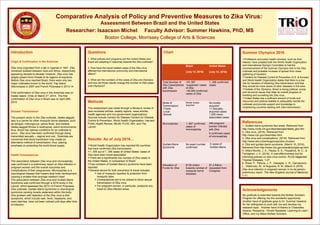
World Health Organization has reported 65 countries
that have confirmed Zika transmission
1, 305 out of 1, 306 cases of United States’ cases of
Zika have been travel-associated
There are a significantly low number of Zika cases in
the United States, in comparison to Brazil
Few numbers of Guillain-Barre’s syndrome have been
reported
General advice for both prevention & travel includes:
 Use of mosquito repellent & protection from
mosquito bites
 Contraceptives are to be utilized to block sexual
transmission of Zika virus
 For pregnant women, in particular, postpone any
travel to Zika-infected areas
Brazil
(July 13, 2016)
United States
(July 13, 2016)
Total Number of
Zika Cases/places
with Zika
transmission
>91,387
‘suspected’ cases
of Zika
~40,000 confirmed
cases of Zika
1, 306 confirmed
cases
Mode of
Transmission:
-Travel
-Local
-Sexual
Mostly locally-
acquired
No locally-
acquired
11 Sexually-
acquired cases
1,305 travel-
associated cases
Microcephaly 1, 687 confirmed
cases of
microcephaly
346 pregnant
women infected
with Zika
9 confirmed cases
of microcephaly
Guillain-Barre
Syndrome
No exact number
confirmed
5 cases of
Guillain-Barre
Allocation of
Funds for Zika
$136 million
towards combat of
mosquito borne
diseases
$1.2 Billion
requested from
Congress
Introduction
Origin & Confirmation in the Americas
Zika virus originated from a lab in Uganda in 1947. Zika
remained isolated between Asia and Africa, respectively
appearing decade-to-decade; however, Zika virus has
largely posed minor threats to its regions of exposure.
Before Zika virus reached Brazil, there were only two
major outbreaks known to the world: Yap Island
(Micronesia) in 2007 and French Polynesia in 2013-14.
First confirmation of Zika virus in the Americas was on
Easter Island, Chile on March 3rd
, 2014. The first
confirmation of Zika virus in Brazil was on April 29th,
2015.
Disease Transmission
The present vector in the Zika outbreak, Aedes aegypti,
also is a carrier for other mosquito borne diseases, such
as dengue, chikungunya, yellow fever, and malaria.
Aedes aegypti thrives in subtropical, warm environments;
thus, Brazil has optimal conditions for an outbreak to
occur. Zika virus has been confirmed through being
transmitted sexually – vaginal and oral. Scientists are
concerned that blood transfusion may create an
alternative method of transmission; thus, placing
emphasis on protecting the world blood supply.
Health Consequences
The association between Zika virus and microcephaly
was confirmed in a preliminary report on Zika infection in
pregnant women and the overall outcomes and
complications of their pregnancies. Microcephaly is a
neurological disease that impairs fetal brain development,
causing a smaller-than-average newborn head.
The association between Zika virus and Guillain-Barre
Syndrome was confirmed through a 2016 study in the
Lancet, which assessed the 2013-14 French Polynesia
Zika outbreak. Guillain-Barre Syndrome is neurological
syndrome causing muscle weakness within the body.
One problem with detection of the Zika virus is that
symptoms, which include rash, fever, headache, and
even diarrhea, have not been noticed until days after time
of infection.
Acknowledgements
Grants, people who helped you with study here
References
Citations here
Questions
1. What policies and programs are the United States and
Brazil are adopting in response towards the Zika
outbreak?
2. How have the travel-related cases of the Zika virus
affected the international community and international
affairs?
3. What are the numbers of the cases of Zika pre-
Olympics and how did those results change Zika cases
change post-Olympics?
Introduction
Origin & Confirmation in the Americas
Zika virus originated from a lab in Uganda in 1947. Zika
remained isolated between Asia and Africa, respectively
appearing decade-to-decade; however, Zika virus has
largely posed minor threats to its regions of exposure.
Before Zika virus reached Brazil, there were only two
major outbreaks known to the world: Yap Island
(Micronesia) in 2007 and French Polynesia in 2013-14.
First confirmation of Zika virus in the Americas was on
Easter Island, Chile on March 3rd
, 2016. The first
confirmation of Zika virus in Brazil was on April 29th,
2016.
Disease Transmission
The present vector in the Zika outbreak, Aedes aegypti,
also is a carrier for other mosquito borne diseases, such
as dengue, chikungunya, yellow fever, and malaria.
Aedes aegypti thrives in subtropical, warm environments;
thus, Brazil has optimal conditions for an outbreak to
occur. Zika virus has been confirmed through being
transmitted sexually – vaginal, oral, and sexual
intercourse. Research done by saying that blood
transfusion creates an alternative method of transmission;
thus, placing emphasis on protecting the world blood
supply.
Health Consequences
Microcephaly is a neurological disease that impairs fetal
brain development, causing a smaller-than-average
newborn head. The association between Zika virus and
microcephaly was confirmed in a preliminary report on
Zika infection in pregnant women and the overall
outcomes and complications of their pregnancies.
Guillain-Barre Syndrome is neurological syndrome
causing muscle weakness within the body. The
association between Zika virus and GBS was confirmed
through a 2016 study in the Lancet, which assessed the
2013-14 French Polynesia Zika outbreak.
One problem with detection of the Zika virus is that
symptoms, which include rash, fever, headache, and even
diarrhea, have not been noticed until days after time of
infection.
Methods
This assessment was made through a literature review of
peer-reviewed articles, weekly reports, news articles,
health agencies and non-government organizations.
Sources include Centers for Disease Centers for
Disease Control & Prevention, World Health
Organization, Harvard Public Health Review, NEJM,
PLOS, NIH, and The Lancet.
.
Results: As of July 2016…
 World Health Organization has reported 65 countries
that have confirmed Zika transmission
 1, 305 out of 1, 306 cases of United States’ cases of
Zika have been travel-associated
 Few numbers of Guillain-Barre’s syndrome have been
reported
 General advice for both prevention & travel includes:
Use of mosquito repellent & protection from
mosquito bites
Contraceptives are to be utilized to block sexual
transmission of Zika virus
For pregnant women, in particular, postpone any
travel to Zika-infected areas
Results
.
Summer Olympics 2016
Text here
Comparative Analysis of Policy and Preventive Measures to Zika Virus:
Assessment Between Brazil and the United States
Researcher: Isaacson Michel Faculty Advisor: Summer Hawkins, PhD, MS
Boston College, Morrissey College of Arts & Sciences

McNair Poster Board Presentation. Isaacson Michel

  • 1.
    Acknowledgements My gratitude isextended towards the McNair Scholars Program for offering me this wonderful opportunity. Another hand of gratitude goes to Dr. Summer Hawkins for her willingness to work with me and develop my research topic. Another hand of thanks to Chasneika Astacio, Rossanna , Hiroshi Nazakato, Learning to Learn Office, and my fellow McNair Scholars. References 1. Guillain-barre syndrome fact sheet. Retrieved from http://www.ninds.nih.gov/disorders/gbs/detail_gbs.htm 2. Zika virus. (2016). Retrieved from http://www.cdc.gov/zika/index.html 3. Zika virus and complications. (2016). Retrieved from http://www.who.int/emergencies/zika-virus/en/ 4. Zika and guillain-barre syndrome. (March 10, 2016). Retrieved from http://www.cdc.gov/zika/about/gbs-qa.html 5. Alfaro-Murillo, J. A., Parpia, A. S., Fitzpatrick, M. C., & Tamagnan, J. A. (2016). A cost-effectiveness tool for informing policies on zika virus control. PLOS Neglected Tropical Diseases, 1-27. 6. Brasil, P., Pereira, J. P., Gabaglia, C. R., Damasceno, L., Wakimoto, M., & Nogueira, R. M. (March 4, 2016). Zika virus infection in pregnant women in rio de janeiro - preliminary report. The New England Journal of Medicine, 1-11. Introduction Origin & Confirmation in the Americas Zika virus originated from a lab in Uganda in 1947. Zika remained isolated between Asia and Africa, respectively appearing decade-to-decade; however, Zika virus has largely posed minor threats to its regions of exposure. Before Zika virus reached Brazil, there were only two major outbreaks known to the world: Yap Island (Micronesia) in 2007 and French Polynesia in 2013-14. First confirmation of Zika virus in the Americas was on Easter Island, Chile on March 3rd , 2016. The first confirmation of Zika virus in Brazil was on April 29th, 2016. Disease Transmission The present vector in the Zika outbreak, Aedes aegypti, also is a carrier for other mosquito borne diseases, such as dengue, chikungunya, yellow fever, and malaria. Aedes aegypti thrives in subtropical, warm environments; thus, Brazil has optimal conditions for an outbreak to occur. Zika virus has been confirmed through being transmitted sexually – vaginal, oral, and sexual intercourse. Research done by saying that blood transfusion creates an alternative method of transmission; thus, placing emphasis on protecting the world blood supply. Health Consequences Microcephaly is a neurological disease that impairs fetal brain development, causing a smaller-than-average newborn head. The association between Zika virus and microcephaly was confirmed in a preliminary report on Zika infection in pregnant women and the overall outcomes and complications of their pregnancies. Guillain-Barre Syndrome is neurological syndrome causing muscle weakness within the body. The association between Zika virus and GBS was confirmed through a 2016 study in the Lancet, which assessed the 2013-14 French Polynesia Zika outbreak. One problem with detection of the Zika virus is that symptoms, which include rash, fever, headache, and even diarrhea, have not been noticed until days after time of infection. Chart Summer Olympics 2016 Professors and public health scholars, such as Amir Attaran, have pressed both the World Health Organization and International Olympic Committee to halt the commencement of the Summer Olympics due to the Zika outbreak and probable increase of spread from mass gathering of travelers. Centers for Disease Control & Prevention (U.S. & Europe) and World Health Organization states that there is a low- risk for travelers of obtaining Zika transmission and that they should be more aware of other diseases in the area. Outside of the Olympics, Brazil is facing political, social, and structural issues that deter its overall progress of handling and surveilling the Zika virus. United States has a sufficient amount of funds and resources and political stability to adequately handle the outbreak and provide support and knowledge to neighboring countries dealing with Zika transmission. Comparative Analysis of Policy and Preventive Measures to Zika Virus: Assessment Between Brazil and the United States Researcher: Isaacson Michel Faculty Advisor: Summer Hawkins, PhD, MS Boston College, Morrissey College of Arts & Sciences Questions   1. What policies and programs are the United States and Brazil are adopting in response towards the Zika outbreak? 2. How have the travel-related cases of the Zika virus affected the international community and international affairs? 3. What are the numbers of the cases of Zika pre-Olympics and how did those results change the number of Zika cases post-Olympics? Methods This assessment was made through a literature review of peer-reviewed articles, weekly reports, news articles, health agencies and non-government organizations. Sources include Centers for Disease Centers for Disease Control & Prevention, World Health Organization, Harvard Public Health Review, NEJM, PLOS, NIH, and The Lancet. Results: As of July 2016… World Health Organization has reported 65 countries that have confirmed Zika transmission 1, 305 out of 1, 306 cases of United States’ cases of Zika have been travel-associated There are a significantly low number of Zika cases in the United States, in comparison to Brazil Few numbers of Guillain-Barre’s syndrome have been reported General advice for both prevention & travel includes:  Use of mosquito repellent & protection from mosquito bites  Contraceptives are to be utilized to block sexual transmission of Zika virus  For pregnant women, in particular, postpone any travel to Zika-infected areas Brazil (July 13, 2016) United States (July 13, 2016) Total Number of Zika Cases/places with Zika transmission >91,387 ‘suspected’ cases of Zika ~40,000 confirmed cases of Zika 1, 306 confirmed cases Mode of Transmission: -Travel -Local -Sexual Mostly locally- acquired No locally- acquired 11 Sexually- acquired cases 1,305 travel- associated cases Microcephaly 1, 687 confirmed cases of microcephaly 346 pregnant women infected with Zika 9 confirmed cases of microcephaly Guillain-Barre Syndrome No exact number confirmed 5 cases of Guillain-Barre Allocation of Funds for Zika $136 million towards combat of mosquito borne diseases $1.2 Billion requested from Congress Introduction Origin & Confirmation in the Americas Zika virus originated from a lab in Uganda in 1947. Zika remained isolated between Asia and Africa, respectively appearing decade-to-decade; however, Zika virus has largely posed minor threats to its regions of exposure. Before Zika virus reached Brazil, there were only two major outbreaks known to the world: Yap Island (Micronesia) in 2007 and French Polynesia in 2013-14. First confirmation of Zika virus in the Americas was on Easter Island, Chile on March 3rd , 2014. The first confirmation of Zika virus in Brazil was on April 29th, 2015. Disease Transmission The present vector in the Zika outbreak, Aedes aegypti, also is a carrier for other mosquito borne diseases, such as dengue, chikungunya, yellow fever, and malaria. Aedes aegypti thrives in subtropical, warm environments; thus, Brazil has optimal conditions for an outbreak to occur. Zika virus has been confirmed through being transmitted sexually – vaginal and oral. Scientists are concerned that blood transfusion may create an alternative method of transmission; thus, placing emphasis on protecting the world blood supply. Health Consequences The association between Zika virus and microcephaly was confirmed in a preliminary report on Zika infection in pregnant women and the overall outcomes and complications of their pregnancies. Microcephaly is a neurological disease that impairs fetal brain development, causing a smaller-than-average newborn head. The association between Zika virus and Guillain-Barre Syndrome was confirmed through a 2016 study in the Lancet, which assessed the 2013-14 French Polynesia Zika outbreak. Guillain-Barre Syndrome is neurological syndrome causing muscle weakness within the body. One problem with detection of the Zika virus is that symptoms, which include rash, fever, headache, and even diarrhea, have not been noticed until days after time of infection.
  • 2.
    Acknowledgements Grants, people whohelped you with study here References Citations here Questions 1. What policies and programs are the United States and Brazil are adopting in response towards the Zika outbreak? 2. How have the travel-related cases of the Zika virus affected the international community and international affairs? 3. What are the numbers of the cases of Zika pre- Olympics and how did those results change Zika cases change post-Olympics? Introduction Origin & Confirmation in the Americas Zika virus originated from a lab in Uganda in 1947. Zika remained isolated between Asia and Africa, respectively appearing decade-to-decade; however, Zika virus has largely posed minor threats to its regions of exposure. Before Zika virus reached Brazil, there were only two major outbreaks known to the world: Yap Island (Micronesia) in 2007 and French Polynesia in 2013-14. First confirmation of Zika virus in the Americas was on Easter Island, Chile on March 3rd , 2016. The first confirmation of Zika virus in Brazil was on April 29th, 2016. Disease Transmission The present vector in the Zika outbreak, Aedes aegypti, also is a carrier for other mosquito borne diseases, such as dengue, chikungunya, yellow fever, and malaria. Aedes aegypti thrives in subtropical, warm environments; thus, Brazil has optimal conditions for an outbreak to occur. Zika virus has been confirmed through being transmitted sexually – vaginal, oral, and sexual intercourse. Research done by saying that blood transfusion creates an alternative method of transmission; thus, placing emphasis on protecting the world blood supply. Health Consequences Microcephaly is a neurological disease that impairs fetal brain development, causing a smaller-than-average newborn head. The association between Zika virus and microcephaly was confirmed in a preliminary report on Zika infection in pregnant women and the overall outcomes and complications of their pregnancies. Guillain-Barre Syndrome is neurological syndrome causing muscle weakness within the body. The association between Zika virus and GBS was confirmed through a 2016 study in the Lancet, which assessed the 2013-14 French Polynesia Zika outbreak. One problem with detection of the Zika virus is that symptoms, which include rash, fever, headache, and even diarrhea, have not been noticed until days after time of infection. Methods This assessment was made through a literature review of peer-reviewed articles, weekly reports, news articles, health agencies and non-government organizations. Sources include Centers for Disease Centers for Disease Control & Prevention, World Health Organization, Harvard Public Health Review, NEJM, PLOS, NIH, and The Lancet. . Results: As of July 2016…  World Health Organization has reported 65 countries that have confirmed Zika transmission  1, 305 out of 1, 306 cases of United States’ cases of Zika have been travel-associated  Few numbers of Guillain-Barre’s syndrome have been reported  General advice for both prevention & travel includes: Use of mosquito repellent & protection from mosquito bites Contraceptives are to be utilized to block sexual transmission of Zika virus For pregnant women, in particular, postpone any travel to Zika-infected areas Results . Summer Olympics 2016 Text here Comparative Analysis of Policy and Preventive Measures to Zika Virus: Assessment Between Brazil and the United States Researcher: Isaacson Michel Faculty Advisor: Summer Hawkins, PhD, MS Boston College, Morrissey College of Arts & Sciences