Enhancing Engagement and Promoting
Peer-Assisted Learning through the
Implementation of Asynchronous Online
Discussion Boards
Dr Hayley McGrice Ms Trisha Franceschilli
Dr Terry Bennett Dr Karina Riggs
2
• Course and study design
• Case Study One: Faculty of Science Undergraduates
– 2nd Year Genes and Inheritance Students
• Analytics of student usage and behaviours
• Analysis of Student Survey Data
• Case Study Two: Discussion Board implementation in a large class
– 1st year Statics course; Faculty of Engineering Computing and Mathematical
Sciences
Presentation Outline
Rationale
• As a result of the 24/7 accessibility to information and student LMS platforms, student
email reliance on academics has significantly increased in recent years
– Students often having unrealistic expectations in terms of the response times
– Many of the questions sent to academics could easily be answered by their peers.
• Peer assisted learning is the concept of students teaching other students, a concept that is
not new and has probably been occurring in all streams of higher education since time
immemorial.
– It is widely recognised that students often learn more efficiently from their peers.
– Largely due to students relating to the language employed by peers
“it was pitched at exactly the right level”.
• Students construct and acquire in-depth knowledge by participating in discussions,
debating, questioning, inquiring and explaining,
– Leads to active and engaged learning and helps to create and sustain a learning community.
3
(Glynn et al. 2006, Topping 2008)
Glynn, L. G., MacFarlane, A., Kelly, M., Cantillon, P., & Murphy, A. W. Helping each
other to learn--a process evaluation of peer assisted learning. BMC Med Educ, 6,
18, 2006
Topping K. Peer-assisted learning: a planning and implementation framework.
Guide supplement 30.1--viewpoint. Medical teacher 30(4):440, 2008.
Case Study One: Design
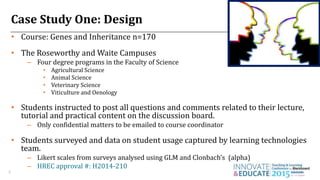
• Course: Genes and Inheritance n=170
• The Roseworthy and Waite Campuses
– Four degree programs in the Faculty of Science
• Agricultural Science
• Animal Science
• Veterinary Science
• Viticulture and Oenology
• Students instructed to post all questions and comments related to their lecture,
tutorial and practical content on the discussion board.
– Only confidential matters to be emailed to course coordinator
• Students surveyed and data on student usage captured by learning technologies
team.
– Likert scales from surveys analysed using GLM and Clonbach’s (alpha)
– HREC approval #: H2014-210
4
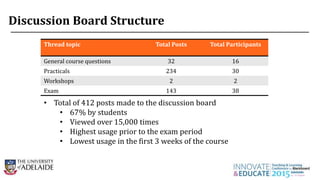
Thread topic Total Posts Total Participants
General course questions 32 16
Practicals 234 30
Workshops 2 2
Exam 143 38
• Total of 412 posts made to the discussion board
• 67% by students
• Viewed over 15,000 times
• Highest usage prior to the exam period
• Lowest usage in the first 3 weeks of the course
Discussion Board Structure
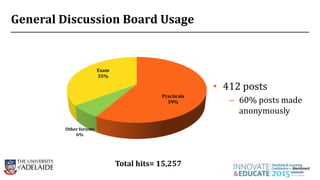
Total hits= 15,257
General Discussion Board Usage
• 412 posts
– 60% posts made
anonymously
Practicals
59%
Other forums
6%
Exam
35%
Student Survey Questions: Likert Scale
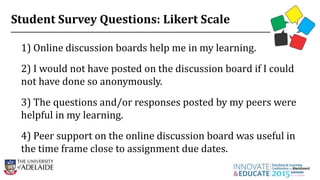
1) Online discussion boards help me in my learning.
2) I would not have posted on the discussion board if I could
not have done so anonymously.
3) The questions and/or responses posted by my peers were
helpful in my learning.
4) Peer support on the online discussion board was useful in
the time frame close to assignment due dates.
7
Study Design cont.
• Data also collected on:
– sex
– age
– international student status
– years at university
– degree program
8
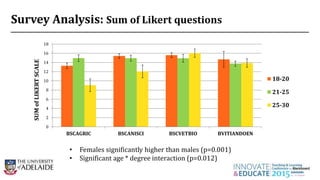
Survey Analysis: Sum of Likert questions
9
0
2
4
6
8
10
12
14
16
18
BSCAGRIC BSCANISCI BSCVETBIO BVITIANDOEN
SUMofLIKERTSCALE
18-20
21-25
25-30
• Females significantly higher than males (p=0.001)
• Significant age * degree interaction (p=0.012)
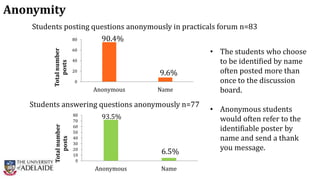
Students posting questions anonymously in practicals forum n=83
0
20
40
60
80
Anonymous Name
Totalnumber
posts
90.4%
9.6%
Students answering questions anonymously n=77
0
10
20
30
40
50
60
70
80
Anonymous Name
Totalnumber
posts
93.5%
6.5%
• The students who choose
to be identified by name
often posted more than
once to the discussion
board.
• Anonymous students
would often refer to the
identifiable poster by
name and send a thank
you message.
Anonymity
Anonymity
11
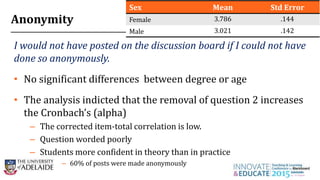
I would not have posted on the discussion board if I could not have
done so anonymously.
• No significant differences between degree or age
• The analysis indicted that the removal of question 2 increases
the Cronbach’s (alpha)
– The corrected item-total correlation is low.
– Question worded poorly
– Students more confident in theory than in practice
– 60% of posts were made anonymously
Sex Mean Std Error
Female 3.786 .144
Male 3.021 .142
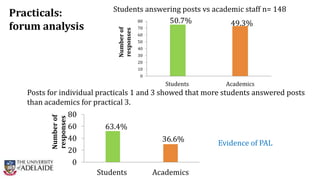
Students answering posts vs academic staff n= 148
0
10
20
30
40
50
60
70
80
Students Academics
Numberof
responses
49.3%50.7%
Posts for individual practicals 1 and 3 showed that more students answered posts
than academics for practical 3.
0
20
40
60
80
Students Academics
Numberof
responses
63.4%
36.6%
Practicals:
forum analysis
Evidence of PAL
0
5
10
15
20
25
30
35
40
45
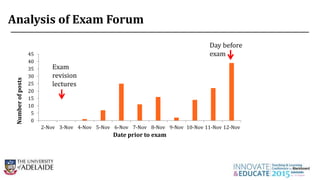
2-Nov 3-Nov 4-Nov 5-Nov 6-Nov 7-Nov 8-Nov 9-Nov 10-Nov 11-Nov 12-Nov
Numberofposts
Date prior to exam
Exam
revision
lectures
Day before
exam
Analysis of Exam Forum
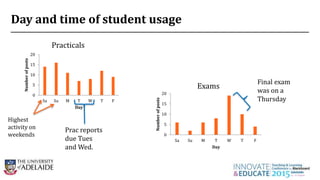
Day and time of student usage
14
0
5
10
15
20
Sa Su M T W T F
Numberofposts
Day
Practicals
0
5
10
15
20
Sa Su M T W T F
Numberofposts
Day
Exams
Final exam
was on a
Thursday
Prac reports
due Tues
and Wed.
Highest
activity on
weekends
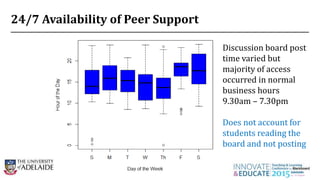
24/7 Availability of Peer Support
15
Discussion board post
time varied but
majority of access
occurred in normal
business hours
9.30am – 7.30pm
Does not account for
students reading the
board and not posting
0
5
10
15
20
25
30
35
40
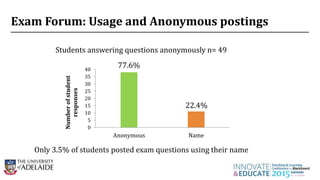
Anonymous Name
Numberofstudent
responses
Students answering questions anonymously n= 49
77.6%
22.4%
Only 3.5% of students posted exam questions using their name
Exam Forum: Usage and Anonymous postings
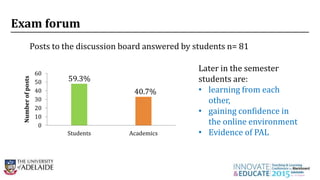
0
10
20
30
40
50
60
Students Academics
Numberofposts
40.7%
Posts to the discussion board answered by students n= 81
59.3%
Later in the semester
students are:
• learning from each
other,
• gaining confidence in
the online environment
• Evidence of PAL
Exam forum
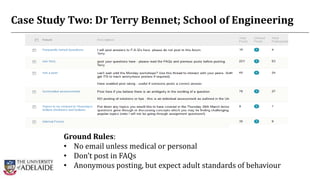
Case Study Two: Dr Terry Bennet; School of Engineering
Ground Rules:
• No email unless medical or personal
• Don’t post in FAQs
• Anonymous posting, but expect adult standards of behaviour
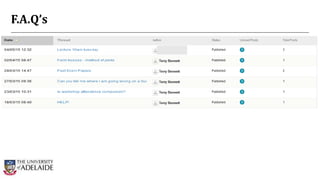
F.A.Q’s
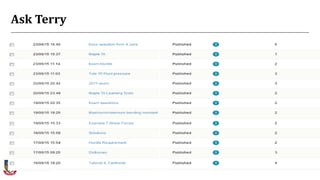
Ask Terry
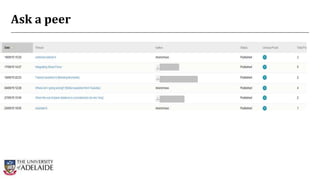
Ask a peer
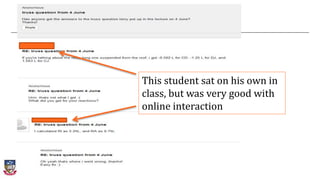
This student sat on his own in
class, but was very good with
online interaction
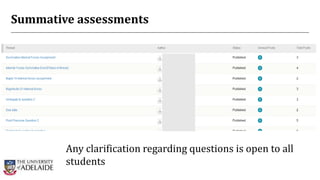
Summative assessments
Any clarification regarding questions is open to all
students
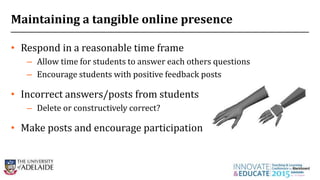
Maintaining a tangible online presence
• Respond in a reasonable time frame
– Allow time for students to answer each others questions
– Encourage students with positive feedback posts
• Incorrect answers/posts from students
– Delete or constructively correct?
• Make posts and encourage participation
24
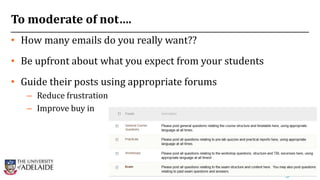
To moderate of not….
• How many emails do you really want??
• Be upfront about what you expect from your students
• Guide their posts using appropriate forums
– Reduce frustration
– Improve buy in
25
Coinage??
• What are you trying to achieve?
– Improve online engagement
– Reduce email traffic to academics
• Marks = motivation
– Do you want to force students to post
• Overall we found no need to force students to participate
26
Selling the System
• Benefits to students
– Help outside of contact hours, esp. weekends before assignments due.
– Everyone has access to the same information
– No such thing as a dumb question
• Pay off to the Academics
– We observed a massive reduction in email traffic
– Answer each question ONCE!!! (in theory anyway)
– Students often find the answers without having to ask or post
• See one…….do one……teach one
27
Acknowledgements
• Dr Michelle Hebart (statistical analysis)
• Ms Trisha Franceschilli, eLearning advisor (our blackboard muscle)
• Mr Jason Chan eLearning advisor (our data ninja)
• Department of the Vice-Chancellor (Academic)
– Expanded practice in online learning innovative
– eAssessment by design initiative
– eAssessment community of practice; DVCA
• Students of the 2014 G&I course.
28
Discussion
Comments
Contributions
29

Enhancing Engagement and Promoting Peer-Assisted Learning through the Implementation of Asynchronous Online Discussion Boards - Dr Hayley McGrice, Ms Trisha Franceschilli, Dr Terry Bennett and Dr Karina Riggs, University of Adelaide. | ANZTLC15

  • 1.
    Enhancing Engagement andPromoting Peer-Assisted Learning through the Implementation of Asynchronous Online Discussion Boards Dr Hayley McGrice Ms Trisha Franceschilli Dr Terry Bennett Dr Karina Riggs
  • 2.
    2 • Course andstudy design • Case Study One: Faculty of Science Undergraduates – 2nd Year Genes and Inheritance Students • Analytics of student usage and behaviours • Analysis of Student Survey Data • Case Study Two: Discussion Board implementation in a large class – 1st year Statics course; Faculty of Engineering Computing and Mathematical Sciences Presentation Outline
  • 3.
    Rationale • As aresult of the 24/7 accessibility to information and student LMS platforms, student email reliance on academics has significantly increased in recent years – Students often having unrealistic expectations in terms of the response times – Many of the questions sent to academics could easily be answered by their peers. • Peer assisted learning is the concept of students teaching other students, a concept that is not new and has probably been occurring in all streams of higher education since time immemorial. – It is widely recognised that students often learn more efficiently from their peers. – Largely due to students relating to the language employed by peers “it was pitched at exactly the right level”. • Students construct and acquire in-depth knowledge by participating in discussions, debating, questioning, inquiring and explaining, – Leads to active and engaged learning and helps to create and sustain a learning community. 3 (Glynn et al. 2006, Topping 2008) Glynn, L. G., MacFarlane, A., Kelly, M., Cantillon, P., & Murphy, A. W. Helping each other to learn--a process evaluation of peer assisted learning. BMC Med Educ, 6, 18, 2006 Topping K. Peer-assisted learning: a planning and implementation framework. Guide supplement 30.1--viewpoint. Medical teacher 30(4):440, 2008.
  • 4.
    Case Study One:Design • Course: Genes and Inheritance n=170 • The Roseworthy and Waite Campuses – Four degree programs in the Faculty of Science • Agricultural Science • Animal Science • Veterinary Science • Viticulture and Oenology • Students instructed to post all questions and comments related to their lecture, tutorial and practical content on the discussion board. – Only confidential matters to be emailed to course coordinator • Students surveyed and data on student usage captured by learning technologies team. – Likert scales from surveys analysed using GLM and Clonbach’s (alpha) – HREC approval #: H2014-210 4
  • 5.
    Thread topic TotalPosts Total Participants General course questions 32 16 Practicals 234 30 Workshops 2 2 Exam 143 38 • Total of 412 posts made to the discussion board • 67% by students • Viewed over 15,000 times • Highest usage prior to the exam period • Lowest usage in the first 3 weeks of the course Discussion Board Structure
  • 6.
    Total hits= 15,257 GeneralDiscussion Board Usage • 412 posts – 60% posts made anonymously Practicals 59% Other forums 6% Exam 35%
  • 7.
    Student Survey Questions:Likert Scale 1) Online discussion boards help me in my learning. 2) I would not have posted on the discussion board if I could not have done so anonymously. 3) The questions and/or responses posted by my peers were helpful in my learning. 4) Peer support on the online discussion board was useful in the time frame close to assignment due dates. 7
  • 8.
    Study Design cont. •Data also collected on: – sex – age – international student status – years at university – degree program 8
  • 9.
    Survey Analysis: Sumof Likert questions 9 0 2 4 6 8 10 12 14 16 18 BSCAGRIC BSCANISCI BSCVETBIO BVITIANDOEN SUMofLIKERTSCALE 18-20 21-25 25-30 • Females significantly higher than males (p=0.001) • Significant age * degree interaction (p=0.012)
  • 10.
    Students posting questionsanonymously in practicals forum n=83 0 20 40 60 80 Anonymous Name Totalnumber posts 90.4% 9.6% Students answering questions anonymously n=77 0 10 20 30 40 50 60 70 80 Anonymous Name Totalnumber posts 93.5% 6.5% • The students who choose to be identified by name often posted more than once to the discussion board. • Anonymous students would often refer to the identifiable poster by name and send a thank you message. Anonymity
  • 11.
    Anonymity 11 I would nothave posted on the discussion board if I could not have done so anonymously. • No significant differences between degree or age • The analysis indicted that the removal of question 2 increases the Cronbach’s (alpha) – The corrected item-total correlation is low. – Question worded poorly – Students more confident in theory than in practice – 60% of posts were made anonymously Sex Mean Std Error Female 3.786 .144 Male 3.021 .142
  • 12.
    Students answering postsvs academic staff n= 148 0 10 20 30 40 50 60 70 80 Students Academics Numberof responses 49.3%50.7% Posts for individual practicals 1 and 3 showed that more students answered posts than academics for practical 3. 0 20 40 60 80 Students Academics Numberof responses 63.4% 36.6% Practicals: forum analysis Evidence of PAL
  • 13.
    0 5 10 15 20 25 30 35 40 45 2-Nov 3-Nov 4-Nov5-Nov 6-Nov 7-Nov 8-Nov 9-Nov 10-Nov 11-Nov 12-Nov Numberofposts Date prior to exam Exam revision lectures Day before exam Analysis of Exam Forum
  • 14.
    Day and timeof student usage 14 0 5 10 15 20 Sa Su M T W T F Numberofposts Day Practicals 0 5 10 15 20 Sa Su M T W T F Numberofposts Day Exams Final exam was on a Thursday Prac reports due Tues and Wed. Highest activity on weekends
  • 15.
    24/7 Availability ofPeer Support 15 Discussion board post time varied but majority of access occurred in normal business hours 9.30am – 7.30pm Does not account for students reading the board and not posting
  • 16.
    0 5 10 15 20 25 30 35 40 Anonymous Name Numberofstudent responses Students answeringquestions anonymously n= 49 77.6% 22.4% Only 3.5% of students posted exam questions using their name Exam Forum: Usage and Anonymous postings
  • 17.
    0 10 20 30 40 50 60 Students Academics Numberofposts 40.7% Posts tothe discussion board answered by students n= 81 59.3% Later in the semester students are: • learning from each other, • gaining confidence in the online environment • Evidence of PAL Exam forum
  • 18.
    Case Study Two:Dr Terry Bennet; School of Engineering Ground Rules: • No email unless medical or personal • Don’t post in FAQs • Anonymous posting, but expect adult standards of behaviour
  • 19.
  • 20.
  • 21.
  • 22.
    This student saton his own in class, but was very good with online interaction
  • 23.
    Summative assessments Any clarificationregarding questions is open to all students
  • 24.
    Maintaining a tangibleonline presence • Respond in a reasonable time frame – Allow time for students to answer each others questions – Encourage students with positive feedback posts • Incorrect answers/posts from students – Delete or constructively correct? • Make posts and encourage participation 24
  • 25.
    To moderate ofnot…. • How many emails do you really want?? • Be upfront about what you expect from your students • Guide their posts using appropriate forums – Reduce frustration – Improve buy in 25
  • 26.
    Coinage?? • What areyou trying to achieve? – Improve online engagement – Reduce email traffic to academics • Marks = motivation – Do you want to force students to post • Overall we found no need to force students to participate 26
  • 27.
    Selling the System •Benefits to students – Help outside of contact hours, esp. weekends before assignments due. – Everyone has access to the same information – No such thing as a dumb question • Pay off to the Academics – We observed a massive reduction in email traffic – Answer each question ONCE!!! (in theory anyway) – Students often find the answers without having to ask or post • See one…….do one……teach one 27
  • 28.
    Acknowledgements • Dr MichelleHebart (statistical analysis) • Ms Trisha Franceschilli, eLearning advisor (our blackboard muscle) • Mr Jason Chan eLearning advisor (our data ninja) • Department of the Vice-Chancellor (Academic) – Expanded practice in online learning innovative – eAssessment by design initiative – eAssessment community of practice; DVCA • Students of the 2014 G&I course. 28
  • 29.