CURRICULUM VITAE
SUMMARY
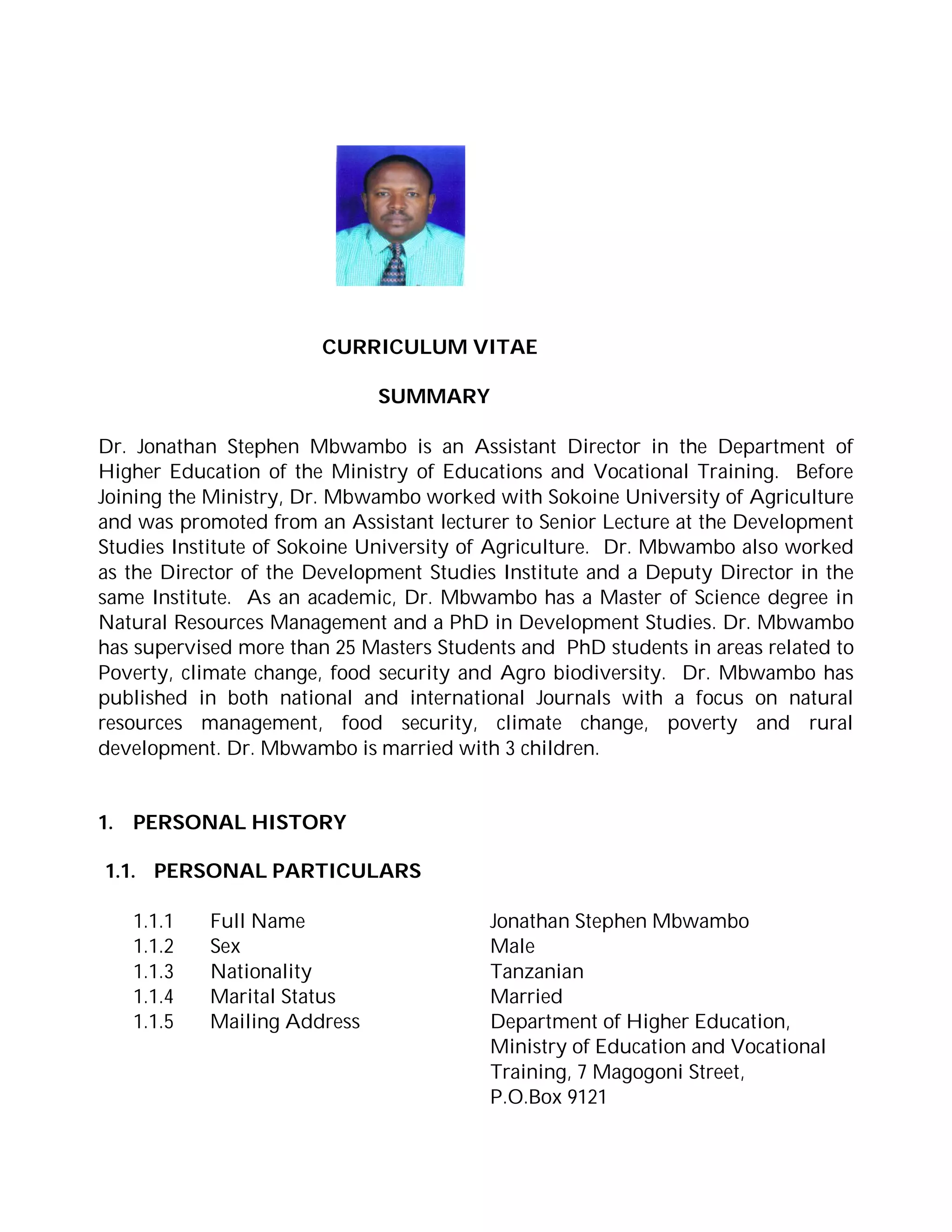
Dr. Jonathan Stephen Mbwambo is an Assistant Director in the Department of
Higher Education of the Ministry of Educations and Vocational Training. Before
Joining the Ministry, Dr. Mbwambo worked with Sokoine University of Agriculture
and was promoted from an Assistant lecturer to Senior Lecture at the Development
Studies Institute of Sokoine University of Agriculture. Dr. Mbwambo also worked
as the Director of the Development Studies Institute and a Deputy Director in the
same Institute. As an academic, Dr. Mbwambo has a Master of Science degree in
Natural Resources Management and a PhD in Development Studies. Dr. Mbwambo
has supervised more than 25 Masters Students and PhD students in areas related to
Poverty, climate change, food security and Agro biodiversity. Dr. Mbwambo has
published in both national and international Journals with a focus on natural
resources management, food security, climate change, poverty and rural
development. Dr. Mbwambo is married with 3 children.
1. PERSONAL HISTORY
1.1. PERSONAL PARTICULARS
1.1.1 Full Name Jonathan Stephen Mbwambo
1.1.2 Sex Male
1.1.3 Nationality Tanzanian
1.1.4 Marital Status Married
1.1.5 Mailing Address Department of Higher Education,
Ministry of Education and Vocational
Training, 7 Magogoni Street,
P.O.Box 9121
2
11479 DAR ES SALAAM
1.1.6 Telephone Office+255-023 2604645
Mobile 0748 410 599
1.1.7 Email jonahtz@yahoo.com;
mbwambojs@suanet.ac.tz
mbwambojs@gmail.com
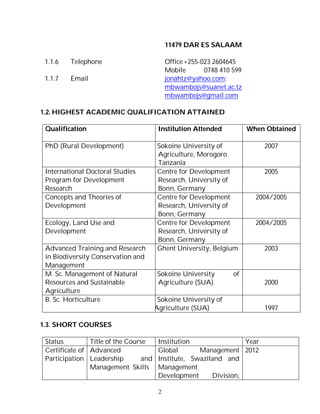
1.2. HIGHEST ACADEMIC QUALIFICATION ATTAINED
Qualification Institution Attended When Obtained
PhD (Rural Development) Sokoine University of
Agriculture, Morogoro
Tanzania
2007
International Doctoral Studies
Program for Development
Research
Centre for Development
Research, University of
Bonn, Germany
2005
Concepts and Theories of
Development
Centre for Development
Research, University of
Bonn, Germany
2004/2005
Ecology, Land Use and
Development
Centre for Development
Research, University of
Bonn, Germany
2004/2005
Advanced Training and Research
in Biodiversity Conservation and
Management
Ghent University, Belgium 2003
M. Sc. Management of Natural
Resources and Sustainable
Agriculture
Sokoine University of
Agriculture (SUA) 2000
B. Sc. Horticulture Sokoine University of
Agriculture (SUA) 1997
1.3. SHORT COURSES
Status Title of the Course Institution Year
Certificate of
Participation
Advanced
Leadership and
Management Skills
Global Management
Institute, Swaziland and
Management
Development Division,
2012
3
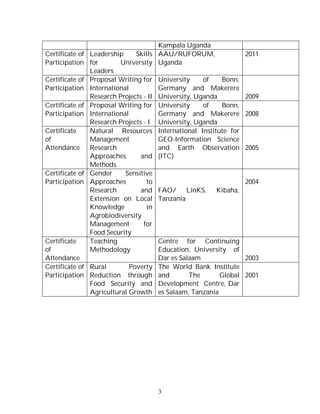
Kampala Uganda
Certificate of
Participation
Leadership Skills
for University
Leaders
AAU/RUFORUM,
Uganda
2011
Certificate of
Participation
Proposal Writing for
International
Research Projects - II
University of Bonn,
Germany and Makerere
University, Uganda 2009
Certificate of
Participation
Proposal Writing for
International
Research Projects - I
University of Bonn,
Germany and Makerere
University, Uganda
2008
Certificate
of
Attendance
Natural Resources
Management
Research
Approaches and
Methods
International Institute for
GEO-Information Science
and Earth Observation
(ITC)
2005
Certificate of
Participation
Gender Sensitive
Approaches to
Research and
Extension on Local
Knowledge in
Agrobiodiversity
Management for
Food Security
FAO/ LinKS, Kibaha,
Tanzania
2004
Certificate
of
Attendance
Teaching
Methodology
Centre for Continuing
Education, University of
Dar es Salaam 2003
Certificate of
Participation
Rural Poverty
Reduction through
Food Security and
Agricultural Growth
The World Bank Institute
and The Global
Development Centre, Dar
es Salaam, Tanzania
2001
4
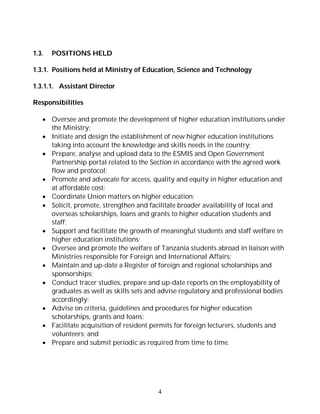
1.3. POSITIONS HELD
1.3.1. Positions held at Ministry of Education, Science and Technology
1.3.1.1. Assistant Director
Responsibilities
 Oversee and promote the development of higher education institutions under
the Ministry;
 Initiate and design the establishment of new higher education institutions
taking into account the knowledge and skills needs in the country;
 Prepare, analyse and upload data to the ESMIS and Open Government
Partnership portal related to the Section in accordance with the agreed work
flow and protocol;
 Promote and advocate for access, quality and equity in higher education and
at affordable cost;
 Coordinate Union matters on higher education;
 Solicit, promote, strengthen and facilitate broader availability of local and
overseas scholarships, loans and grants to higher education students and
staff;
 Support and facilitate the growth of meaningful students and staff welfare in
higher education institutions;
 Oversee and promote the welfare of Tanzania students abroad in liaison with
Ministries responsible for Foreign and International Affairs;
 Maintain and up-date a Register of foreign and regional scholarships and
sponsorships;
 Conduct tracer studies, prepare and up-date reports on the employability of
graduates as well as skills sets and advise regulatory and professional bodies
accordingly;
 Advise on criteria, guidelines and procedures for higher education
scholarships, grants and loans;
 Facilitate acquisition of resident permits for foreign lecturers, students and
volunteers; and
 Prepare and submit periodic as required from time to time.
5
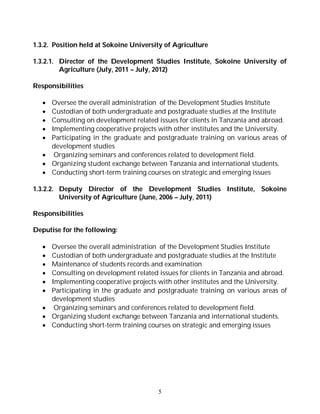
1.3.2. Position held at Sokoine University of Agriculture
1.3.2.1. Director of the Development Studies Institute, Sokoine University of
Agriculture (July, 2011 – July, 2012)
Responsibilities
 Oversee the overall administration of the Development Studies Institute
 Custodian of both undergraduate and postgraduate studies at the Institute
 Consulting on development related issues for clients in Tanzania and abroad.
 Implementing cooperative projects with other institutes and the University.
 Participating in the graduate and postgraduate training on various areas of
development studies
 Organizing seminars and conferences related to development field.
 Organizing student exchange between Tanzania and international students.
 Conducting short-term training courses on strategic and emerging issues
1.3.2.2. Deputy Director of the Development Studies Institute, Sokoine
University of Agriculture (June, 2006 – July, 2011)
Responsibilities
Deputise for the following:
 Oversee the overall administration of the Development Studies Institute
 Custodian of both undergraduate and postgraduate studies at the Institute
 Maintenance of students records and examination
 Consulting on development related issues for clients in Tanzania and abroad.
 Implementing cooperative projects with other institutes and the University.
 Participating in the graduate and postgraduate training on various areas of
development studies
 Organizing seminars and conferences related to development field.
 Organizing student exchange between Tanzania and international students.
 Conducting short-term training courses on strategic and emerging issues
6
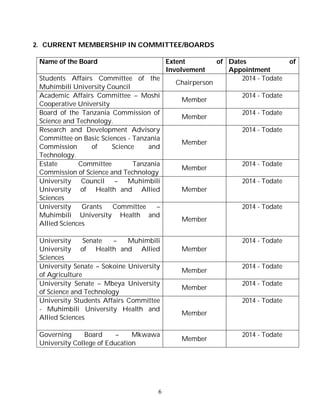
2. CURRENT MEMBERSHIP IN COMMITTEE/BOARDS
Name of the Board Extent of
Involvement
Dates of
Appointment
Students Affairs Committee of the
Muhimbili University Council
Chairperson
2014 - Todate
Academic Affairs Committee – Moshi
Cooperative University
Member
2014 - Todate
Board of the Tanzania Commission of
Science and Technology.
Member
2014 - Todate
Research and Development Advisory
Committee on Basic Sciences - Tanzania
Commission of Science and
Technology.
Member
2014 - Todate
Estate Committee Tanzania
Commission of Science and Technology
Member
2014 - Todate
University Council – Muhimbili
University of Health and Allied
Sciences
Member
2014 - Todate
University Grants Committee –
Muhimbili University Health and
Allied Sciences
Member
2014 - Todate
University Senate – Muhimbili
University of Health and Allied
Sciences
Member
2014 - Todate
University Senate – Sokoine University
of Agriculture
Member
2014 - Todate
University Senate – Mbeya University
of Science and Technology
Member
2014 - Todate
University Students Affairs Committee
- Muhimbili University Health and
Allied Sciences
Member
2014 - Todate
Governing Board – Mkwawa
University College of Education
Member
2014 - Todate
7
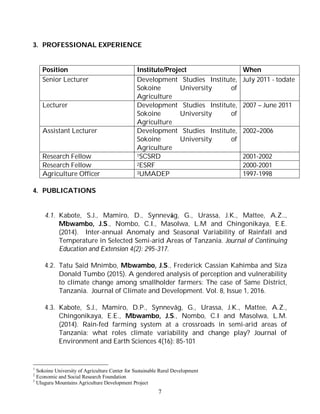
3. PROFESSIONAL EXPERIENCE
Position Institute/Project When
Senior Lecturer Development Studies Institute,
Sokoine University of
Agriculture
July 2011 - todate
Lecturer Development Studies Institute,
Sokoine University of
Agriculture
2007 – June 2011
Assistant Lecturer Development Studies Institute,
Sokoine University of
Agriculture
2002–2006
Research Fellow 1SCSRD 2001-2002
Research Fellow 2ESRF 2000-2001
Agriculture Officer 3UMADEP 1997-1998
4. PUBLICATIONS
4.1. Kabote, S.J., Mamiro, D., Synnevåg, G., Urassa, J.K., Mattee, A.Z..,
Mbwambo, J.S., Nombo, C.I., Masolwa, L.M and Chingonikaya, E.E.
(2014). Inter-annual Anomaly and Seasonal Variability of Rainfall and
Temperature in Selected Semi-arid Areas of Tanzania. Journal of Continuing
Education and Extension 4(2): 295-317.
4.2. Tatu Said Mnimbo, Mbwambo, J.S., Frederick Cassian Kahimba and Siza
Donald Tumbo (2015). A gendered analysis of perception and vulnerability
to climate change among smallholder farmers: The case of Same District,
Tanzania. Journal of Climate and Development. Vol. 8, Issue 1, 2016.
4.3. Kabote, S.J., Mamiro, D.P., Synnevåg, G., Urassa, J.K., Mattee, A.Z.,
Chingonikaya, E.E., Mbwambo, J.S., Nombo, C.I and Masolwa, L.M.
(2014). Rain-fed farming system at a crossroads in semi-arid areas of
Tanzania: what roles climate variability and change play? Journal of
Environment and Earth Sciences 4(16): 85-101
1
Sokoine University of Agriculture Center for Sustainable Rural Development
2
Economic and Social Research Foundation
3
Uluguru Mountains Agriculture Development Project
8
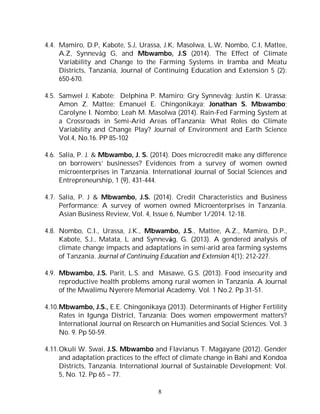
4.4. Mamiro, D.P, Kabote, S.J, Urassa, J.K, Masolwa, L.W, Nombo, C.I, Mattee,
A.Z, Synnevåg G, and Mbwambo, J.S (2014). The Effect of Climate
Variability and Change to the Farming Systems in Iramba and Meatu
Districts, Tanzania, Journal of Continuing Education and Extension 5 (2):
650-670.
4.5. Samwel J. Kabote; Delphina P. Mamiro; Gry Synnevåg; Justin K. Urassa;
Amon Z. Mattee; Emanuel E. Chingonikaya; Jonathan S. Mbwambo;
Carolyne I. Nombo; Leah M. Masolwa (2014). Rain-Fed Farming System at
a Crossroads in Semi-Arid Areas ofTanzania: What Roles do Climate
Variability and Change Play? Journal of Environment and Earth Science
Vol.4, No.16. PP 85-102
4.6. Salia, P. J. & Mbwambo, J. S. (2014). Does microcredit make any difference
on borrowers’ businesses? Evidences from a survey of women owned
microenterprises in Tanzania. International Journal of Social Sciences and
Entrepreneurship, 1 (9), 431-444.
4.7. Salia, P. J & Mbwambo, J.S. (2014). Credit Characteristics and Business
Performance: A survey of women owned Microenterprises in Tanzania.
Asian Business Review, Vol. 4, Issue 6, Number 1/2014. 12-18.
4.8. Nombo, C.I., Urassa, J.K., Mbwambo, J.S., Mattee, A.Z., Mamiro, D.P.,
Kabote, S.J., Matata, L and Synnevåg, G. (2013). A gendered analysis of
climate change impacts and adaptations in semi-arid area farming systems
of Tanzania. Journal of Continuing Education and Extension 4(1): 212-227.
4.9. Mbwambo, J.S. Parit, L.S. and Masawe, G.S. (2013). Food insecurity and
reproductive health problems among rural women in Tanzania. A Journal
of the Mwalimu Nyerere Memorial Academy. Vol. 1 No.2. Pp 31-51.
4.10.Mbwambo, J.S., E.E. Chingonikaya (2013). Determinants of Higher Fertility
Rates in Igunga District, Tanzania: Does women empowerment matters?
International Journal on Research on Humanities and Social Sciences. Vol. 3
No. 9. Pp 50-59.
4.11.Okuli W. Swai, J.S. Mbwambo and Flavianus T. Magayane (2012). Gender
and adaptation practices to the effect of climate change in Bahi and Kondoa
Districts, Tanzania. International Journal of Sustainable Development; Vol.
5, No. 12. Pp 65 – 77.
9
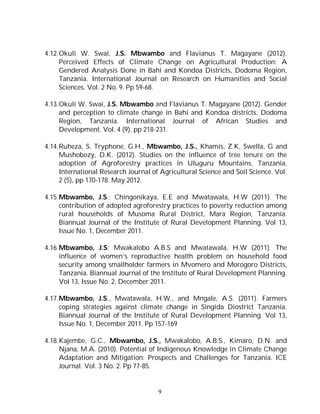
4.12.Okuli W. Swai, J.S. Mbwambo and Flavianus T. Magayane (2012).
Perceived Effects of Climate Change on Agricultural Production: A
Gendered Analysis Done in Bahi and Kondoa Districts, Dodoma Region,
Tanzania. International Journal on Research on Humanities and Social
Sciences. Vol. 2 No. 9. Pp 59-68.
4.13.Okuli W. Swai, J.S. Mbwambo and Flavianus T. Magayane (2012). Gender
and perception to climate change in Bahi and Kondoa districts, Dodoma
Region, Tanzania. International Journal of African Studies and
Development. Vol. 4 (9), pp 218-231.
4.14.Ruheza, S. Tryphone, G.H., Mbwambo, J.S., Khamis, Z.K, Swella, G and
Mushobozy, D.K. (2012). Studies on the influence of tree tenure on the
adoption of Agroforestry practices in Uluguru Mountains, Tanzania.
International Research Journal of Agricultural Science and Soil Science. Vol.
2 (5), pp 170-178. May 2012.
4.15.Mbwambo, J.S.; Chingonikaya, E.E and Mwatawala, H.W (2011). The
contribution of adopted agroforestry practices to poverty reduction among
rural households of Musoma Rural District, Mara Region, Tanzania.
Biannual Journal of the Institute of Rural Development Planning. Vol 13,
Issue No. 1, December 2011.
4.16.Mbwambo, J.S; Mwakalobo A.B.S and Mwatawala, H.W (2011). The
influence of women’s reproductive health problem on household food
security among smallholder farmers in Mvomero and Morogoro Districts,
Tanzania. Biannual Journal of the Institute of Rural Development Planning.
Vol 13, Issue No. 2, December 2011.
4.17.Mbwambo, J.S., Mwatawala, H.W., and Mngale, A.S. (2011). Farmers
coping strategies against climate change in Singida Diostrict Tanzania.
Biannual Journal of the Institute of Rural Development Planning. Vol 13,
Issue No. 1, December 2011. Pp 157-169
4.18.Kajembe, G.C., Mbwambo, J.S., Mwakalobo, A.B.S., Kimaro, D.N. and
Njana, M.A. (2010). Potential of Indigenous Knowledge in Climate Change
Adaptation and Mitigation: Prospects and Challenges for Tanzania. ICE
Journal. Vol. 3 No. 2. Pp 77-85.
10
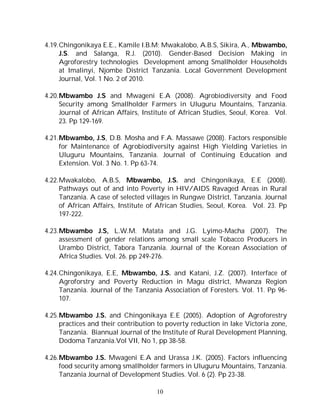
4.19.Chingonikaya E.E., Kamile I.B.M; Mwakalobo, A.B.S, Sikira, A., Mbwambo,
J.S. and Salanga, R.J. (2010). Gender-Based Decision Making in
Agroforestry technologies Development among Smallholder Households
at Imalinyi, Njombe District Tanzania. Local Government Development
Journal, Vol. 1 No. 2 of 2010.
4.20.Mbwambo J.S and Mwageni E.A (2008). Agrobiodiversity and Food
Security among Smallholder Farmers in Uluguru Mountains, Tanzania.
Journal of African Affairs, Institute of African Studies, Seoul, Korea. Vol.
23. Pp 129-169.
4.21.Mbwambo, J.S, D.B. Mosha and F.A. Massawe (2008). Factors responsible
for Maintenance of Agrobiodiversity against High Yielding Varieties in
Uluguru Mountains, Tanzania. Journal of Continuing Education and
Extension. Vol. 3 No. 1. Pp 63-74.
4.22.Mwakalobo, A.B.S, Mbwambo, J.S. and Chingonikaya, E.E (2008).
Pathways out of and into Poverty in HIV/AIDS Ravaged Areas in Rural
Tanzania. A case of selected villages in Rungwe District, Tanzania. Journal
of African Affairs, Institute of African Studies, Seoul, Korea. Vol. 23. Pp
197-222.
4.23.Mbwambo J.S, L.W.M. Matata and J.G. Lyimo-Macha (2007). The
assessment of gender relations among small scale Tobacco Producers in
Urambo District, Tabora Tanzania. Journal of the Korean Association of
Africa Studies. Vol. 26. pp 249-276.
4.24.Chingonikaya, E.E, Mbwambo, J.S. and Katani, J.Z. (2007). Interface of
Agroforstry and Poverty Reduction in Magu district, Mwanza Region
Tanzania. Journal of the Tanzania Association of Foresters. Vol. 11. Pp 96-
107.
4.25.Mbwambo J.S. and Chingonikaya E.E (2005). Adoption of Agroforestry
practices and their contribution to poverty reduction in lake Victoria zone,
Tanzania. Biannual Journal of the Institute of Rural Development Planning,
Dodoma Tanzania.Vol VII, No 1, pp 38-58.
4.26.Mbwambo J.S. Mwageni E.A and Urassa J.K. (2005). Factors influencing
food security among smallholder farmers in Uluguru Mountains, Tanzania.
Tanzania Journal of Development Studies. Vol. 6 (2). Pp 23-38.
11
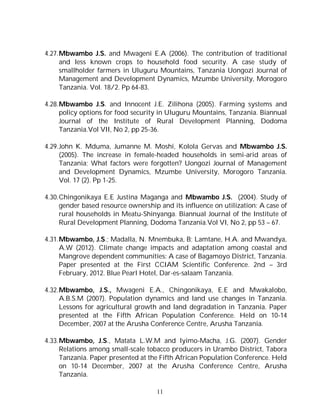
4.27.Mbwambo J.S. and Mwageni E.A (2006). The contribution of traditional
and less known crops to household food security. A case study of
smallholder farmers in Uluguru Mountains, Tanzania Uongozi Journal of
Management and Development Dynamics, Mzumbe University, Morogoro
Tanzania. Vol. 18/2. Pp 64-83.
4.28.Mbwambo J.S. and Innocent J.E. Zilihona (2005). Farming systems and
policy options for food security in Uluguru Mountains, Tanzania. Biannual
Journal of the Institute of Rural Development Planning, Dodoma
Tanzania.Vol VII, No 2, pp 25-36.
4.29.John K. Mduma, Jumanne M. Moshi, Kolola Gervas and Mbwambo J.S.
(2005). The increase in female-headed households in semi-arid areas of
Tanzania; What factors were forgotten? Uongozi Journal of Management
and Development Dynamics, Mzumbe University, Morogoro Tanzania.
Vol. 17 (2). Pp 1-25.
4.30.Chingonikaya E.E Justina Maganga and Mbwambo J.S. (2004). Study of
gender based resource ownership and its influence on utilization: A case of
rural households in Meatu-Shinyanga. Biannual Journal of the Institute of
Rural Development Planning, Dodoma Tanzania.Vol VI, No 2, pp 53 – 67.
4.31.Mbwambo, J.S.; Madalla, N. Mnembuka, B; Lamtane, H.A. and Mwandya,
A.W (2012). Climate change impacts and adaptation among coastal and
Mangrove dependent communities: A case of Bagamoyo District, Tanzania.
Paper presented at the First CCIAM Scientific Conference. 2nd – 3rd
February, 2012. Blue Pearl Hotel, Dar-es-salaam Tanzania.
4.32.Mbwambo, J.S., Mwageni E.A., Chingonikaya, E.E and Mwakalobo,
A.B.S.M (2007). Population dynamics and land use changes in Tanzania.
Lessons for agricultural growth and land degradation in Tanzania. Paper
presented at the Fifth African Population Conference. Held on 10-14
December, 2007 at the Arusha Conference Centre, Arusha Tanzania.
4.33.Mbwambo, J.S., Matata L.W.M and lyimo-Macha, J.G. (2007). Gender
Relations among small-scale tobacco producers in Urambo District, Tabora
Tanzania. Paper presented at the Fifth African Population Conference. Held
on 10-14 December, 2007 at the Arusha Conference Centre, Arusha
Tanzania.
12
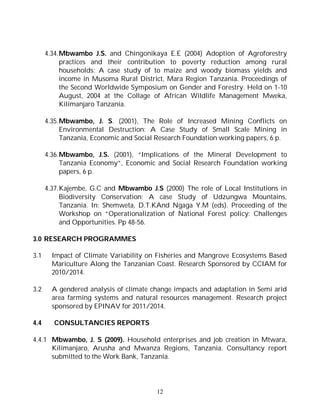
4.34.Mbwambo J.S. and Chingonikaya E.E (2004) Adoption of Agroforestry
practices and their contribution to poverty reduction among rural
households: A case study of to maize and woody biomass yields and
income in Musoma Rural District, Mara Region Tanzania. Proceedings of
the Second Worldwide Symposium on Gender and Forestry. Held on 1-10
August, 2004 at the Collage of African Wildlife Management Mweka,
Kilimanjaro Tanzania.
4.35.Mbwambo, J. S. (2001), The Role of Increased Mining Conflicts on
Environmental Destruction: A Case Study of Small Scale Mining in
Tanzania, Economic and Social Research Foundation working papers, 6 p.
4.36.Mbwambo, J.S. (2001), “Implications of the Mineral Development to
Tanzania Economy”, Economic and Social Research Foundation working
papers, 6 p.
4.37.Kajembe, G.C and Mbwambo J.S (2000) The role of Local Institutions in
Biodiversity Conservation: A case Study of Udzungwa Mountains,
Tanzania. In: Shemweta, D.T.KAnd Ngaga Y.M (eds). Proceeding of the
Workshop on “Operationalization of National Forest policy: Challenges
and Opportunities. Pp 48-56.
3.0 RESEARCH PROGRAMMES
3.1 Impact of Climate Variability on Fisheries and Mangrove Ecosystems Based
Mariculture Along the Tanzanian Coast. Research Sponsored by CCIAM for
2010/2014.
3.2 A gendered analysis of climate change impacts and adaptation in Semi arid
area farming systems and natural resources management. Research project
sponsored by EPINAV for 2011/2014.
4.4 CONSULTANCIES REPORTS
4.4.1 Mbwambo, J. S (2009). Household enterprises and job creation in Mtwara,
Kilimanjaro, Arusha and Mwanza Regions, Tanzania. Consultancy report
submitted to the Work Bank, Tanzania.
13
4.4.2 Mbwambo J.S. F. Kessy and Msongwe, Y. (2008). The assessment of Rural
Water and Supply and Sanitation Projects in Mvomero, Morogoro Rural,
Kilosa and Rufiji Districts, Tanzania. Consultancy report submitted to the
Work Bank, Tanzania.
4.4.3 Mbwambo J.S. (2007). Evaluation of the impact of Health Sector Reforms in
Kasulu, Nzega, Morogoro Rural and Mkuranga Districts. Consultancy report
submitted to the Economic and Social Research Foundation (ESRF).
4.4.4 Mbwambo J.S. (2004). Strategies for equal gender involvement in the
decision-making process on the use of natural resources in Uluguru
Mountains. Consultancy report submitted to the Wildlife Conservation
Society of Tanzania and the Uluguru Mountains Biodiversity Conservation
Project.
4.4.5 Mbwambo J.S (2004). Socioeconomic and baseline information for Mlali
Division, Mvomero District. Consultancy report submitted to the Uluguru
Mountains Agricultural Development Program (UMADEP) of Sokoine
University of Agriculture, Morogoro Tanzania.
4.5 Conferences/Workshops/Seminars attended
4.5.1 Regional Conference on Africa’s Transformation: Leveraging Partnership
with Korea. 26-29th June, 2015. Radisson Blu Hotel, Addis Ababa, Ethiopea
4.5.2 Innovation Africa Summit, 18th – 20th November 2014. Serena Hotel, Kigali
Ruanda.
4.5.3 The 2014 UNESCO Conference on Education for Sustainable Development.
10th – 12th November, 2014. Aichi-Nagoya, Japan.
4.5.4 Sixth Ordinary sessions of Ministers of Education of the African Union
(COMEDAF VI), 21-25, April 2014, Yaounde, Cameroon
4.5.5 The 12th Meeting of the Sectoral Council of Education, Science and
Technology, Culture and Sports. 29 September -3 October, 2014. Arusha,
Tanzania.
4.5.6 The 6th Higher Education Forum. Naura Springs, Arusha Tanzania.
14
4.5.7 The East Africa Higher Education Forum. 24th -26th October, 2012. Naura
Springs, Arusha.
4.5.8 DAAD Summer School on “Recording, Monitoring and Managing
Biodiversity – Implementation Oriented Research. International Summer
School held from 28th September to 4th October, 2009 at Kassel University,
Germany.
4.5.9 Tropentag, 2009. International Conference on Biophysical and Socio-economic
Frame Conditions for Sustainable Management of Natural Resources. October
6th – 8th, 2009. University of Hamburg, Germany.
4.5.10 International Training Workshop on Proposal Writing for International
Research Projects – Part II. Workshop held in Naivasha, Kenya from 07th -12th
June, 2009. Organised by Makerere University, Uganda, Free University of
Berlin, the University of Hoheinheim, University of Kessel and the University
of Bonn, German. Supported by the German Ministry of Economic Co-
operation and Development
4.5.11 International Training Workshop on Proposal Writing for International
Research Projects – Part I. Workshop held in Entebe, Uganda from 08th -12th
December, 2008. Organised by Makerere University, Uganda, Free University
of Berlin, the University of Hoheinheim, University of Kessel and the
University of Bonn, German. Supported by the German Ministry of Economic
Co-operation and Development.
4.5.12 International Training Workshop on Data Exploration and Resampling
Methods in Applied Statistics. Training workshop held in Dar-es-Salaam,
Tanzania from 22nd – 26th , April, 2008. Organised and supported by Research
on Poverty Alleviation (REPOA), Dar-es-Salaam, Tanzania.
4.5.13 Ecosystem function analysis and valuation as a tool in planning, management
and decision-making. Seminar presented at ZEF. 14 March.2005
4.5.6 Synergie Soziale Buildung and ZEF Training Workshop on Intercultural
Competence held from 17-20 December, 2004 at the Centre for Development
Research (ZEF), University of Bonn, Germany.
4.5.7 Diversity in economics-waste or survival strategy. Seminar presented at ZEF.
15 Nov.2004.
15
4.5.8 Democracy in Central Asia. What International Organizations Can Do and
What They Cannot Do. Seminar presented at ZEF. 26th October, 2004.
4.5.9 FAO-LinKS Training Workshop Gender Sensitive Approaches to Research
and Extension on Local Knowledge in Agrobiodiversity Management and
Food Security. Held at Kibaha Conference Centre from 12-23 July 2004.
4.5.10 Local Knowledge, Agrobiodiversity, Gender and Food Security. International
Training Workshop Organized by LinKs (T) and FAO. Held on 5-6 April 2004
at TANESCO Training Centre, Morogoro Tanzania.
4.5.11 Training workshop on Macroeconomic Modelling. Held at Bagamoyo
Paradise Resort, Dec. 3-8 2001.
4.5.12 The Second Worldwide Symposium on Gender and Forestry. Held on 1-10
August 2004 at the Collage of African Wildlife Management Mweka,
Kilimanjaro Tanzania.
4.5.13 Conflicts Reduction in Natural Resources Management. International
Research Workshop Organized by ASARECA/ECAPAPA. Held on 29-31
March 2004 at Windsor Hotel, Entebe Uganda.
4.5.14 Research on Poverty Alleviation (REPOA). An International Research
Workshop Organised by REPOA. Held on 24-26 March, 2004 at White Sands
Hotel, Dar-es-salaam Tanzania.
4.5.15 IDRC/ASARECA/ECAPAPA Stakeholder and Social Information System
Workshop. Held on 23-28 November, 2003. Nairobi Kenya.
4.5.16 Habitat Fragmentation Effects and Remedies. International Symposium
Organized by Royal Society of Natural Sciences, Dodonea. Held on 23rd Nov.
2002 at Free University of Brussels, Belgium.
4.5.17 Scientific and Social Aspects of Global Changes: Worldwide Environmental
Changes. Seminar organised by University of Antwerp and IGBP Brussels.
Held on 20th September 2002. University of Antwerp, Belgium.
16
4.5.18 Rainforests and Biodiversity. Seminar Organised by Faculty of Agriculture,
Department of Biology, Gent University. Held on 4th-6th November 2002 at the
University of Ghent, Belgium.
4.5.19 Biodiversity Convention of Rio and other International Treaties as a Basis for
Nature Conservation. Organised and held at the Institute of Nature
Conservation, Brussels, on 19 Nov. 2002.
4.5.20 Ancient Lakes Biodiversity and Environmental Changes. Seminar Organised
by Faculty of Agriculture, Department of Biology, Gent University. Held on
14-15th October 2002. Gent Belgium.
4.5.21 Training workshop on Macroeconomic Modelling. Held at Bagamoyo
Paradise Resort, Dec. 3-8 2001.
4.5.22 Workshop on “Operationalization of National Forest policy: Challenges And
Opportunities” held at Sokoine University of Agriculture, Morogoro,
Tanzania, February 28, 2000.
4.5.23 Tanzania land Policy Formulation and Legislation Workshop held at Sokoine
University of Agriculture, Morogoro, Tanzania. February 19-20, 1999.
4.5.24 Follow-up Workshop on Natural Crop Protection. International workshop
held at NAM hotel, 21-24 February. 1998. Dodoma, Tanzania.
5.0 Reference
1. Prof. E. A. Mwageni
Ardhi University
P.O. 35176
Dar-es-Salaam
Telephone: 255 22 2775446
Mobile; 0754 311 456 or 255 715 311 456 0r 255 784 333 611
Email:mwageni@aru.ac.tz or mwageni@suanet.ac.tz
2. Prof. G.C. Kajembe
Sokoine University of Agriculture
Faculty of Forest and Nature Conservation
P.O. 3013
17
Morogoro
Telephone: 255 23 2604741 or 255 23 2604555
Mobile: 0754 497 530
Email: kajembe@suanet.ac.tz
3. Prof. A.Z. Mattee
Sokoine University of Agriculture
Department of Agricultural Education and Extension
P.O.Box 3024
Morogoro
Telephone: 255 23 2604646
Mobile: 0754 380474
Declaration
I, Dr. Mbwambo, J.S. declares that the information provided here is true to the best
of my knowledge.
____ ____ 16 MARCH 2016
Signature Date

MBWAMBO CV 2016

  • 1.
    CURRICULUM VITAE SUMMARY Dr. JonathanStephen Mbwambo is an Assistant Director in the Department of Higher Education of the Ministry of Educations and Vocational Training. Before Joining the Ministry, Dr. Mbwambo worked with Sokoine University of Agriculture and was promoted from an Assistant lecturer to Senior Lecture at the Development Studies Institute of Sokoine University of Agriculture. Dr. Mbwambo also worked as the Director of the Development Studies Institute and a Deputy Director in the same Institute. As an academic, Dr. Mbwambo has a Master of Science degree in Natural Resources Management and a PhD in Development Studies. Dr. Mbwambo has supervised more than 25 Masters Students and PhD students in areas related to Poverty, climate change, food security and Agro biodiversity. Dr. Mbwambo has published in both national and international Journals with a focus on natural resources management, food security, climate change, poverty and rural development. Dr. Mbwambo is married with 3 children. 1. PERSONAL HISTORY 1.1. PERSONAL PARTICULARS 1.1.1 Full Name Jonathan Stephen Mbwambo 1.1.2 Sex Male 1.1.3 Nationality Tanzanian 1.1.4 Marital Status Married 1.1.5 Mailing Address Department of Higher Education, Ministry of Education and Vocational Training, 7 Magogoni Street, P.O.Box 9121
  • 2.
    2 11479 DAR ESSALAAM 1.1.6 Telephone Office+255-023 2604645 Mobile 0748 410 599 1.1.7 Email jonahtz@yahoo.com; mbwambojs@suanet.ac.tz mbwambojs@gmail.com 1.2. HIGHEST ACADEMIC QUALIFICATION ATTAINED Qualification Institution Attended When Obtained PhD (Rural Development) Sokoine University of Agriculture, Morogoro Tanzania 2007 International Doctoral Studies Program for Development Research Centre for Development Research, University of Bonn, Germany 2005 Concepts and Theories of Development Centre for Development Research, University of Bonn, Germany 2004/2005 Ecology, Land Use and Development Centre for Development Research, University of Bonn, Germany 2004/2005 Advanced Training and Research in Biodiversity Conservation and Management Ghent University, Belgium 2003 M. Sc. Management of Natural Resources and Sustainable Agriculture Sokoine University of Agriculture (SUA) 2000 B. Sc. Horticulture Sokoine University of Agriculture (SUA) 1997 1.3. SHORT COURSES Status Title of the Course Institution Year Certificate of Participation Advanced Leadership and Management Skills Global Management Institute, Swaziland and Management Development Division, 2012
  • 3.
    3 Kampala Uganda Certificate of Participation LeadershipSkills for University Leaders AAU/RUFORUM, Uganda 2011 Certificate of Participation Proposal Writing for International Research Projects - II University of Bonn, Germany and Makerere University, Uganda 2009 Certificate of Participation Proposal Writing for International Research Projects - I University of Bonn, Germany and Makerere University, Uganda 2008 Certificate of Attendance Natural Resources Management Research Approaches and Methods International Institute for GEO-Information Science and Earth Observation (ITC) 2005 Certificate of Participation Gender Sensitive Approaches to Research and Extension on Local Knowledge in Agrobiodiversity Management for Food Security FAO/ LinKS, Kibaha, Tanzania 2004 Certificate of Attendance Teaching Methodology Centre for Continuing Education, University of Dar es Salaam 2003 Certificate of Participation Rural Poverty Reduction through Food Security and Agricultural Growth The World Bank Institute and The Global Development Centre, Dar es Salaam, Tanzania 2001
  • 4.
    4 1.3. POSITIONS HELD 1.3.1.Positions held at Ministry of Education, Science and Technology 1.3.1.1. Assistant Director Responsibilities  Oversee and promote the development of higher education institutions under the Ministry;  Initiate and design the establishment of new higher education institutions taking into account the knowledge and skills needs in the country;  Prepare, analyse and upload data to the ESMIS and Open Government Partnership portal related to the Section in accordance with the agreed work flow and protocol;  Promote and advocate for access, quality and equity in higher education and at affordable cost;  Coordinate Union matters on higher education;  Solicit, promote, strengthen and facilitate broader availability of local and overseas scholarships, loans and grants to higher education students and staff;  Support and facilitate the growth of meaningful students and staff welfare in higher education institutions;  Oversee and promote the welfare of Tanzania students abroad in liaison with Ministries responsible for Foreign and International Affairs;  Maintain and up-date a Register of foreign and regional scholarships and sponsorships;  Conduct tracer studies, prepare and up-date reports on the employability of graduates as well as skills sets and advise regulatory and professional bodies accordingly;  Advise on criteria, guidelines and procedures for higher education scholarships, grants and loans;  Facilitate acquisition of resident permits for foreign lecturers, students and volunteers; and  Prepare and submit periodic as required from time to time.
  • 5.
    5 1.3.2. Position heldat Sokoine University of Agriculture 1.3.2.1. Director of the Development Studies Institute, Sokoine University of Agriculture (July, 2011 – July, 2012) Responsibilities  Oversee the overall administration of the Development Studies Institute  Custodian of both undergraduate and postgraduate studies at the Institute  Consulting on development related issues for clients in Tanzania and abroad.  Implementing cooperative projects with other institutes and the University.  Participating in the graduate and postgraduate training on various areas of development studies  Organizing seminars and conferences related to development field.  Organizing student exchange between Tanzania and international students.  Conducting short-term training courses on strategic and emerging issues 1.3.2.2. Deputy Director of the Development Studies Institute, Sokoine University of Agriculture (June, 2006 – July, 2011) Responsibilities Deputise for the following:  Oversee the overall administration of the Development Studies Institute  Custodian of both undergraduate and postgraduate studies at the Institute  Maintenance of students records and examination  Consulting on development related issues for clients in Tanzania and abroad.  Implementing cooperative projects with other institutes and the University.  Participating in the graduate and postgraduate training on various areas of development studies  Organizing seminars and conferences related to development field.  Organizing student exchange between Tanzania and international students.  Conducting short-term training courses on strategic and emerging issues
  • 6.
    6 2. CURRENT MEMBERSHIPIN COMMITTEE/BOARDS Name of the Board Extent of Involvement Dates of Appointment Students Affairs Committee of the Muhimbili University Council Chairperson 2014 - Todate Academic Affairs Committee – Moshi Cooperative University Member 2014 - Todate Board of the Tanzania Commission of Science and Technology. Member 2014 - Todate Research and Development Advisory Committee on Basic Sciences - Tanzania Commission of Science and Technology. Member 2014 - Todate Estate Committee Tanzania Commission of Science and Technology Member 2014 - Todate University Council – Muhimbili University of Health and Allied Sciences Member 2014 - Todate University Grants Committee – Muhimbili University Health and Allied Sciences Member 2014 - Todate University Senate – Muhimbili University of Health and Allied Sciences Member 2014 - Todate University Senate – Sokoine University of Agriculture Member 2014 - Todate University Senate – Mbeya University of Science and Technology Member 2014 - Todate University Students Affairs Committee - Muhimbili University Health and Allied Sciences Member 2014 - Todate Governing Board – Mkwawa University College of Education Member 2014 - Todate
  • 7.
    7 3. PROFESSIONAL EXPERIENCE PositionInstitute/Project When Senior Lecturer Development Studies Institute, Sokoine University of Agriculture July 2011 - todate Lecturer Development Studies Institute, Sokoine University of Agriculture 2007 – June 2011 Assistant Lecturer Development Studies Institute, Sokoine University of Agriculture 2002–2006 Research Fellow 1SCSRD 2001-2002 Research Fellow 2ESRF 2000-2001 Agriculture Officer 3UMADEP 1997-1998 4. PUBLICATIONS 4.1. Kabote, S.J., Mamiro, D., Synnevåg, G., Urassa, J.K., Mattee, A.Z.., Mbwambo, J.S., Nombo, C.I., Masolwa, L.M and Chingonikaya, E.E. (2014). Inter-annual Anomaly and Seasonal Variability of Rainfall and Temperature in Selected Semi-arid Areas of Tanzania. Journal of Continuing Education and Extension 4(2): 295-317. 4.2. Tatu Said Mnimbo, Mbwambo, J.S., Frederick Cassian Kahimba and Siza Donald Tumbo (2015). A gendered analysis of perception and vulnerability to climate change among smallholder farmers: The case of Same District, Tanzania. Journal of Climate and Development. Vol. 8, Issue 1, 2016. 4.3. Kabote, S.J., Mamiro, D.P., Synnevåg, G., Urassa, J.K., Mattee, A.Z., Chingonikaya, E.E., Mbwambo, J.S., Nombo, C.I and Masolwa, L.M. (2014). Rain-fed farming system at a crossroads in semi-arid areas of Tanzania: what roles climate variability and change play? Journal of Environment and Earth Sciences 4(16): 85-101 1 Sokoine University of Agriculture Center for Sustainable Rural Development 2 Economic and Social Research Foundation 3 Uluguru Mountains Agriculture Development Project
  • 8.
    8 4.4. Mamiro, D.P,Kabote, S.J, Urassa, J.K, Masolwa, L.W, Nombo, C.I, Mattee, A.Z, Synnevåg G, and Mbwambo, J.S (2014). The Effect of Climate Variability and Change to the Farming Systems in Iramba and Meatu Districts, Tanzania, Journal of Continuing Education and Extension 5 (2): 650-670. 4.5. Samwel J. Kabote; Delphina P. Mamiro; Gry Synnevåg; Justin K. Urassa; Amon Z. Mattee; Emanuel E. Chingonikaya; Jonathan S. Mbwambo; Carolyne I. Nombo; Leah M. Masolwa (2014). Rain-Fed Farming System at a Crossroads in Semi-Arid Areas ofTanzania: What Roles do Climate Variability and Change Play? Journal of Environment and Earth Science Vol.4, No.16. PP 85-102 4.6. Salia, P. J. & Mbwambo, J. S. (2014). Does microcredit make any difference on borrowers’ businesses? Evidences from a survey of women owned microenterprises in Tanzania. International Journal of Social Sciences and Entrepreneurship, 1 (9), 431-444. 4.7. Salia, P. J & Mbwambo, J.S. (2014). Credit Characteristics and Business Performance: A survey of women owned Microenterprises in Tanzania. Asian Business Review, Vol. 4, Issue 6, Number 1/2014. 12-18. 4.8. Nombo, C.I., Urassa, J.K., Mbwambo, J.S., Mattee, A.Z., Mamiro, D.P., Kabote, S.J., Matata, L and Synnevåg, G. (2013). A gendered analysis of climate change impacts and adaptations in semi-arid area farming systems of Tanzania. Journal of Continuing Education and Extension 4(1): 212-227. 4.9. Mbwambo, J.S. Parit, L.S. and Masawe, G.S. (2013). Food insecurity and reproductive health problems among rural women in Tanzania. A Journal of the Mwalimu Nyerere Memorial Academy. Vol. 1 No.2. Pp 31-51. 4.10.Mbwambo, J.S., E.E. Chingonikaya (2013). Determinants of Higher Fertility Rates in Igunga District, Tanzania: Does women empowerment matters? International Journal on Research on Humanities and Social Sciences. Vol. 3 No. 9. Pp 50-59. 4.11.Okuli W. Swai, J.S. Mbwambo and Flavianus T. Magayane (2012). Gender and adaptation practices to the effect of climate change in Bahi and Kondoa Districts, Tanzania. International Journal of Sustainable Development; Vol. 5, No. 12. Pp 65 – 77.
  • 9.
    9 4.12.Okuli W. Swai,J.S. Mbwambo and Flavianus T. Magayane (2012). Perceived Effects of Climate Change on Agricultural Production: A Gendered Analysis Done in Bahi and Kondoa Districts, Dodoma Region, Tanzania. International Journal on Research on Humanities and Social Sciences. Vol. 2 No. 9. Pp 59-68. 4.13.Okuli W. Swai, J.S. Mbwambo and Flavianus T. Magayane (2012). Gender and perception to climate change in Bahi and Kondoa districts, Dodoma Region, Tanzania. International Journal of African Studies and Development. Vol. 4 (9), pp 218-231. 4.14.Ruheza, S. Tryphone, G.H., Mbwambo, J.S., Khamis, Z.K, Swella, G and Mushobozy, D.K. (2012). Studies on the influence of tree tenure on the adoption of Agroforestry practices in Uluguru Mountains, Tanzania. International Research Journal of Agricultural Science and Soil Science. Vol. 2 (5), pp 170-178. May 2012. 4.15.Mbwambo, J.S.; Chingonikaya, E.E and Mwatawala, H.W (2011). The contribution of adopted agroforestry practices to poverty reduction among rural households of Musoma Rural District, Mara Region, Tanzania. Biannual Journal of the Institute of Rural Development Planning. Vol 13, Issue No. 1, December 2011. 4.16.Mbwambo, J.S; Mwakalobo A.B.S and Mwatawala, H.W (2011). The influence of women’s reproductive health problem on household food security among smallholder farmers in Mvomero and Morogoro Districts, Tanzania. Biannual Journal of the Institute of Rural Development Planning. Vol 13, Issue No. 2, December 2011. 4.17.Mbwambo, J.S., Mwatawala, H.W., and Mngale, A.S. (2011). Farmers coping strategies against climate change in Singida Diostrict Tanzania. Biannual Journal of the Institute of Rural Development Planning. Vol 13, Issue No. 1, December 2011. Pp 157-169 4.18.Kajembe, G.C., Mbwambo, J.S., Mwakalobo, A.B.S., Kimaro, D.N. and Njana, M.A. (2010). Potential of Indigenous Knowledge in Climate Change Adaptation and Mitigation: Prospects and Challenges for Tanzania. ICE Journal. Vol. 3 No. 2. Pp 77-85.
  • 10.
    10 4.19.Chingonikaya E.E., KamileI.B.M; Mwakalobo, A.B.S, Sikira, A., Mbwambo, J.S. and Salanga, R.J. (2010). Gender-Based Decision Making in Agroforestry technologies Development among Smallholder Households at Imalinyi, Njombe District Tanzania. Local Government Development Journal, Vol. 1 No. 2 of 2010. 4.20.Mbwambo J.S and Mwageni E.A (2008). Agrobiodiversity and Food Security among Smallholder Farmers in Uluguru Mountains, Tanzania. Journal of African Affairs, Institute of African Studies, Seoul, Korea. Vol. 23. Pp 129-169. 4.21.Mbwambo, J.S, D.B. Mosha and F.A. Massawe (2008). Factors responsible for Maintenance of Agrobiodiversity against High Yielding Varieties in Uluguru Mountains, Tanzania. Journal of Continuing Education and Extension. Vol. 3 No. 1. Pp 63-74. 4.22.Mwakalobo, A.B.S, Mbwambo, J.S. and Chingonikaya, E.E (2008). Pathways out of and into Poverty in HIV/AIDS Ravaged Areas in Rural Tanzania. A case of selected villages in Rungwe District, Tanzania. Journal of African Affairs, Institute of African Studies, Seoul, Korea. Vol. 23. Pp 197-222. 4.23.Mbwambo J.S, L.W.M. Matata and J.G. Lyimo-Macha (2007). The assessment of gender relations among small scale Tobacco Producers in Urambo District, Tabora Tanzania. Journal of the Korean Association of Africa Studies. Vol. 26. pp 249-276. 4.24.Chingonikaya, E.E, Mbwambo, J.S. and Katani, J.Z. (2007). Interface of Agroforstry and Poverty Reduction in Magu district, Mwanza Region Tanzania. Journal of the Tanzania Association of Foresters. Vol. 11. Pp 96- 107. 4.25.Mbwambo J.S. and Chingonikaya E.E (2005). Adoption of Agroforestry practices and their contribution to poverty reduction in lake Victoria zone, Tanzania. Biannual Journal of the Institute of Rural Development Planning, Dodoma Tanzania.Vol VII, No 1, pp 38-58. 4.26.Mbwambo J.S. Mwageni E.A and Urassa J.K. (2005). Factors influencing food security among smallholder farmers in Uluguru Mountains, Tanzania. Tanzania Journal of Development Studies. Vol. 6 (2). Pp 23-38.
  • 11.
    11 4.27.Mbwambo J.S. andMwageni E.A (2006). The contribution of traditional and less known crops to household food security. A case study of smallholder farmers in Uluguru Mountains, Tanzania Uongozi Journal of Management and Development Dynamics, Mzumbe University, Morogoro Tanzania. Vol. 18/2. Pp 64-83. 4.28.Mbwambo J.S. and Innocent J.E. Zilihona (2005). Farming systems and policy options for food security in Uluguru Mountains, Tanzania. Biannual Journal of the Institute of Rural Development Planning, Dodoma Tanzania.Vol VII, No 2, pp 25-36. 4.29.John K. Mduma, Jumanne M. Moshi, Kolola Gervas and Mbwambo J.S. (2005). The increase in female-headed households in semi-arid areas of Tanzania; What factors were forgotten? Uongozi Journal of Management and Development Dynamics, Mzumbe University, Morogoro Tanzania. Vol. 17 (2). Pp 1-25. 4.30.Chingonikaya E.E Justina Maganga and Mbwambo J.S. (2004). Study of gender based resource ownership and its influence on utilization: A case of rural households in Meatu-Shinyanga. Biannual Journal of the Institute of Rural Development Planning, Dodoma Tanzania.Vol VI, No 2, pp 53 – 67. 4.31.Mbwambo, J.S.; Madalla, N. Mnembuka, B; Lamtane, H.A. and Mwandya, A.W (2012). Climate change impacts and adaptation among coastal and Mangrove dependent communities: A case of Bagamoyo District, Tanzania. Paper presented at the First CCIAM Scientific Conference. 2nd – 3rd February, 2012. Blue Pearl Hotel, Dar-es-salaam Tanzania. 4.32.Mbwambo, J.S., Mwageni E.A., Chingonikaya, E.E and Mwakalobo, A.B.S.M (2007). Population dynamics and land use changes in Tanzania. Lessons for agricultural growth and land degradation in Tanzania. Paper presented at the Fifth African Population Conference. Held on 10-14 December, 2007 at the Arusha Conference Centre, Arusha Tanzania. 4.33.Mbwambo, J.S., Matata L.W.M and lyimo-Macha, J.G. (2007). Gender Relations among small-scale tobacco producers in Urambo District, Tabora Tanzania. Paper presented at the Fifth African Population Conference. Held on 10-14 December, 2007 at the Arusha Conference Centre, Arusha Tanzania.
  • 12.
    12 4.34.Mbwambo J.S. andChingonikaya E.E (2004) Adoption of Agroforestry practices and their contribution to poverty reduction among rural households: A case study of to maize and woody biomass yields and income in Musoma Rural District, Mara Region Tanzania. Proceedings of the Second Worldwide Symposium on Gender and Forestry. Held on 1-10 August, 2004 at the Collage of African Wildlife Management Mweka, Kilimanjaro Tanzania. 4.35.Mbwambo, J. S. (2001), The Role of Increased Mining Conflicts on Environmental Destruction: A Case Study of Small Scale Mining in Tanzania, Economic and Social Research Foundation working papers, 6 p. 4.36.Mbwambo, J.S. (2001), “Implications of the Mineral Development to Tanzania Economy”, Economic and Social Research Foundation working papers, 6 p. 4.37.Kajembe, G.C and Mbwambo J.S (2000) The role of Local Institutions in Biodiversity Conservation: A case Study of Udzungwa Mountains, Tanzania. In: Shemweta, D.T.KAnd Ngaga Y.M (eds). Proceeding of the Workshop on “Operationalization of National Forest policy: Challenges and Opportunities. Pp 48-56. 3.0 RESEARCH PROGRAMMES 3.1 Impact of Climate Variability on Fisheries and Mangrove Ecosystems Based Mariculture Along the Tanzanian Coast. Research Sponsored by CCIAM for 2010/2014. 3.2 A gendered analysis of climate change impacts and adaptation in Semi arid area farming systems and natural resources management. Research project sponsored by EPINAV for 2011/2014. 4.4 CONSULTANCIES REPORTS 4.4.1 Mbwambo, J. S (2009). Household enterprises and job creation in Mtwara, Kilimanjaro, Arusha and Mwanza Regions, Tanzania. Consultancy report submitted to the Work Bank, Tanzania.
  • 13.
    13 4.4.2 Mbwambo J.S.F. Kessy and Msongwe, Y. (2008). The assessment of Rural Water and Supply and Sanitation Projects in Mvomero, Morogoro Rural, Kilosa and Rufiji Districts, Tanzania. Consultancy report submitted to the Work Bank, Tanzania. 4.4.3 Mbwambo J.S. (2007). Evaluation of the impact of Health Sector Reforms in Kasulu, Nzega, Morogoro Rural and Mkuranga Districts. Consultancy report submitted to the Economic and Social Research Foundation (ESRF). 4.4.4 Mbwambo J.S. (2004). Strategies for equal gender involvement in the decision-making process on the use of natural resources in Uluguru Mountains. Consultancy report submitted to the Wildlife Conservation Society of Tanzania and the Uluguru Mountains Biodiversity Conservation Project. 4.4.5 Mbwambo J.S (2004). Socioeconomic and baseline information for Mlali Division, Mvomero District. Consultancy report submitted to the Uluguru Mountains Agricultural Development Program (UMADEP) of Sokoine University of Agriculture, Morogoro Tanzania. 4.5 Conferences/Workshops/Seminars attended 4.5.1 Regional Conference on Africa’s Transformation: Leveraging Partnership with Korea. 26-29th June, 2015. Radisson Blu Hotel, Addis Ababa, Ethiopea 4.5.2 Innovation Africa Summit, 18th – 20th November 2014. Serena Hotel, Kigali Ruanda. 4.5.3 The 2014 UNESCO Conference on Education for Sustainable Development. 10th – 12th November, 2014. Aichi-Nagoya, Japan. 4.5.4 Sixth Ordinary sessions of Ministers of Education of the African Union (COMEDAF VI), 21-25, April 2014, Yaounde, Cameroon 4.5.5 The 12th Meeting of the Sectoral Council of Education, Science and Technology, Culture and Sports. 29 September -3 October, 2014. Arusha, Tanzania. 4.5.6 The 6th Higher Education Forum. Naura Springs, Arusha Tanzania.
  • 14.
    14 4.5.7 The EastAfrica Higher Education Forum. 24th -26th October, 2012. Naura Springs, Arusha. 4.5.8 DAAD Summer School on “Recording, Monitoring and Managing Biodiversity – Implementation Oriented Research. International Summer School held from 28th September to 4th October, 2009 at Kassel University, Germany. 4.5.9 Tropentag, 2009. International Conference on Biophysical and Socio-economic Frame Conditions for Sustainable Management of Natural Resources. October 6th – 8th, 2009. University of Hamburg, Germany. 4.5.10 International Training Workshop on Proposal Writing for International Research Projects – Part II. Workshop held in Naivasha, Kenya from 07th -12th June, 2009. Organised by Makerere University, Uganda, Free University of Berlin, the University of Hoheinheim, University of Kessel and the University of Bonn, German. Supported by the German Ministry of Economic Co- operation and Development 4.5.11 International Training Workshop on Proposal Writing for International Research Projects – Part I. Workshop held in Entebe, Uganda from 08th -12th December, 2008. Organised by Makerere University, Uganda, Free University of Berlin, the University of Hoheinheim, University of Kessel and the University of Bonn, German. Supported by the German Ministry of Economic Co-operation and Development. 4.5.12 International Training Workshop on Data Exploration and Resampling Methods in Applied Statistics. Training workshop held in Dar-es-Salaam, Tanzania from 22nd – 26th , April, 2008. Organised and supported by Research on Poverty Alleviation (REPOA), Dar-es-Salaam, Tanzania. 4.5.13 Ecosystem function analysis and valuation as a tool in planning, management and decision-making. Seminar presented at ZEF. 14 March.2005 4.5.6 Synergie Soziale Buildung and ZEF Training Workshop on Intercultural Competence held from 17-20 December, 2004 at the Centre for Development Research (ZEF), University of Bonn, Germany. 4.5.7 Diversity in economics-waste or survival strategy. Seminar presented at ZEF. 15 Nov.2004.
  • 15.
    15 4.5.8 Democracy inCentral Asia. What International Organizations Can Do and What They Cannot Do. Seminar presented at ZEF. 26th October, 2004. 4.5.9 FAO-LinKS Training Workshop Gender Sensitive Approaches to Research and Extension on Local Knowledge in Agrobiodiversity Management and Food Security. Held at Kibaha Conference Centre from 12-23 July 2004. 4.5.10 Local Knowledge, Agrobiodiversity, Gender and Food Security. International Training Workshop Organized by LinKs (T) and FAO. Held on 5-6 April 2004 at TANESCO Training Centre, Morogoro Tanzania. 4.5.11 Training workshop on Macroeconomic Modelling. Held at Bagamoyo Paradise Resort, Dec. 3-8 2001. 4.5.12 The Second Worldwide Symposium on Gender and Forestry. Held on 1-10 August 2004 at the Collage of African Wildlife Management Mweka, Kilimanjaro Tanzania. 4.5.13 Conflicts Reduction in Natural Resources Management. International Research Workshop Organized by ASARECA/ECAPAPA. Held on 29-31 March 2004 at Windsor Hotel, Entebe Uganda. 4.5.14 Research on Poverty Alleviation (REPOA). An International Research Workshop Organised by REPOA. Held on 24-26 March, 2004 at White Sands Hotel, Dar-es-salaam Tanzania. 4.5.15 IDRC/ASARECA/ECAPAPA Stakeholder and Social Information System Workshop. Held on 23-28 November, 2003. Nairobi Kenya. 4.5.16 Habitat Fragmentation Effects and Remedies. International Symposium Organized by Royal Society of Natural Sciences, Dodonea. Held on 23rd Nov. 2002 at Free University of Brussels, Belgium. 4.5.17 Scientific and Social Aspects of Global Changes: Worldwide Environmental Changes. Seminar organised by University of Antwerp and IGBP Brussels. Held on 20th September 2002. University of Antwerp, Belgium.
  • 16.
    16 4.5.18 Rainforests andBiodiversity. Seminar Organised by Faculty of Agriculture, Department of Biology, Gent University. Held on 4th-6th November 2002 at the University of Ghent, Belgium. 4.5.19 Biodiversity Convention of Rio and other International Treaties as a Basis for Nature Conservation. Organised and held at the Institute of Nature Conservation, Brussels, on 19 Nov. 2002. 4.5.20 Ancient Lakes Biodiversity and Environmental Changes. Seminar Organised by Faculty of Agriculture, Department of Biology, Gent University. Held on 14-15th October 2002. Gent Belgium. 4.5.21 Training workshop on Macroeconomic Modelling. Held at Bagamoyo Paradise Resort, Dec. 3-8 2001. 4.5.22 Workshop on “Operationalization of National Forest policy: Challenges And Opportunities” held at Sokoine University of Agriculture, Morogoro, Tanzania, February 28, 2000. 4.5.23 Tanzania land Policy Formulation and Legislation Workshop held at Sokoine University of Agriculture, Morogoro, Tanzania. February 19-20, 1999. 4.5.24 Follow-up Workshop on Natural Crop Protection. International workshop held at NAM hotel, 21-24 February. 1998. Dodoma, Tanzania. 5.0 Reference 1. Prof. E. A. Mwageni Ardhi University P.O. 35176 Dar-es-Salaam Telephone: 255 22 2775446 Mobile; 0754 311 456 or 255 715 311 456 0r 255 784 333 611 Email:mwageni@aru.ac.tz or mwageni@suanet.ac.tz 2. Prof. G.C. Kajembe Sokoine University of Agriculture Faculty of Forest and Nature Conservation P.O. 3013
  • 17.
    17 Morogoro Telephone: 255 232604741 or 255 23 2604555 Mobile: 0754 497 530 Email: kajembe@suanet.ac.tz 3. Prof. A.Z. Mattee Sokoine University of Agriculture Department of Agricultural Education and Extension P.O.Box 3024 Morogoro Telephone: 255 23 2604646 Mobile: 0754 380474 Declaration I, Dr. Mbwambo, J.S. declares that the information provided here is true to the best of my knowledge. ____ ____ 16 MARCH 2016 Signature Date