Thermal Organics
a friend to all Farmers of the World Company
By Max Jackson
Contemporary Control Systems: ACCT- 6302 – 2015
Mission Statement
The Mission of Thermal Organics is to develop Viable,
“Sustainable & Affective” pesticide that not only kills of the
insects that destroy and lay waste to the farmers crops of the
world before harvest and after harvest season, but at the same
time, protect the environment and create a better brand of
product for the farmer that will give them a sizable return on
investment and do it in a socially responsible manner that not
only reduces environmental harm to the land the farmer grows on
but also provide a better outlook on the financial costs of food
supply to the world, while at the same time emphasizing the
elimination of toxins, growth hormones and antibiotics that
commonly found in some pesticides.
Vision Statement
“The Vision of Thermal Organics is to produce a pesticides that
will not only be considered environmentally friendly and
protect the crop of the farmer but will also provide nutrients in
form of liquid proteins that will enrich the soil that the farmer
currently farms on. It is by doing this, we believe that we will
not only feed America but we can also feed the world.”
By chemically engineering and producing such pesticides that
have such enriched liquid proteins benefits, we feel that we can
have an industry affect on farmers that currently use hazardous
chemical pesticides that are not only harming the foods we eat
but at the same time the global environment.
The Pitch
Based on studies, by 2050, it is believed that the global population will have increased
and is expected to jump to staggering rate from 7 Billion People of the world to 9.5 Billion
people in the world. That is a lot of mouths to feed according to some farmers. 2050! 7
Billion People of the world to 9.5 Billion people! Not only this, but according to the 2012
Organization for Economic Co-operation and Development and the United Nation’s Food
and Agricultural Organization feel that food production must increase by 60% to 70% in the
next 50 years to meet and stay at pace with the projected global demand. This will put
massive amounts of pressure on all farmers. Not just in the US, but the World. Food
Production is critical and is the key element that will make this happen along with we feel
is a Global Partnership. The sad truth is if farmers and the governments don’t start working
now on viable solutions that will sustain current food productions in order for it to be even
be long term, the additional 2.4 billion people will create massive pressure on food
resources and does not sit well for future food security. The biggest problem for farmers is
that the majority of commercial pesticides in use contain what is called DDT, are no longer
on the market, but others remain in use. The concentrations of DDT is higher than most
pesticides, and because a lot of farmers tend to use DDT and other pesticides like it, the
farmer and general public faces a significant health risk. For example, studies show that
The Pitch
First all life is made what is called DNA (Deoxyribonucleic Acid), which chief building block
of all life. Each strain of DNA is composed of genes. These genes carry instructions and
determine how an organism or in this case in orange, in apple or how anything will grow,
live and even look. By Genetic Engineering, we propose using and converting cells from
the high-density DNA which can be used to replace the current method in use, DDT,
centrifuging the cells through a high concentration process that is not used in commercial
farming as a means of protecting the a farmers harvest. This particular process which is not
in used would cultivate more than 400 million acres of farmland worldwide are now used
not just to grow traditional crops such as fruits and vegetable but also cotton, corn,
soybeans and rice. For example, just in the United States, soybeans, corn and cotton make
up 93%, 88% and 94% of the total acreage of the respective crop for most farms. With
Genetic Engineering, we at Thermal Organics feel we can increase these numbers by
tenfold. Furthermore, a majority of the crops grown today are in some cases only
engineered to be resistant to just every day problems that the farmers experience on a
regular basis however, such as high humidity, dry air and even bugs. With Genetic
Engineered Pesticides, the farmer would no longer have to deal with issues that concern
bugs, herbicides, fungicides but it will also enrich the ground allowing a better and
sustainable product that the farmer can be proud of over time. No only this, but by means
of the Genetic Engineering this means no more chemicals in use like DDT, which means
current crops that were once treated with DDT would no longer needed due to Genetic
Engineering because those crops would be able to withstand being sprayed with DDT or
other weed killers or pesticides leading to crops and plants in the field to wither or even
die while at the same time some of the crops in some regions of the world would be
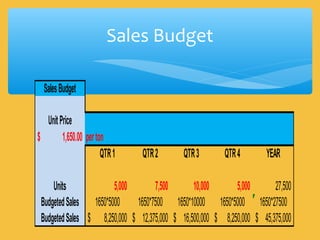
Sales Budget
SalesBudget
UnitPrice
1,650.00$ perton
QTR1 QTR2 QTR3 QTR4 YEAR
Units 5,000 7,500 10,000 5,000 27,500
BudgetedSales 1650*5000 1650*7500 1650*10000 1650*5000 1650*27500
BudgetedSales 8,250,000$ 12,375,000$ 16,500,000$ 8,250,000$ 45,375,000$
Production Budget
Production Budget
Beg Finished Good Inv 500
Ending Inv Factor 0.1
QTR 1 of Next YR 6000
QTR 1 QTR 2 QTR 3 QTR 4 YEAR
Sales in Units 5,000 7,500 10,000 5,000 27,500
Desired End Inv 750 1,000 500 600 600
Less: Beg INV 500 750 1,000 500 500
Prod Budget Units 5,250 7,750 9,500 5,100 27,600
Direct Labor Budget
Direct Labor Budget
HrsDir Labor/Unit 25
Hourly Labor Rate 22.00$
QTR1 QTR2 QTR3 QTR4 YEAR
Units toProduce 5,250 7,750 9,500 4,560 27,060
Hrs Dir Labor/Unit 25.00 25.00 25.00 25.00 25.00
TotalHrsNeeded 131,250 193,750 237,500 114,000 676,500
HourlyLabor Rate 22.00$ 22.00$ 22.00$ 22.00$ 22.00$
TtlDir Labor Cost 2,887,500$ 4,262,500$ 5,225,000$ 2,508,000$ 14,883,000$
Materials Purchases Budget A
Direct Material Purchases Budget Material A
Material A per Unit 1 Cost A 250 Inventory
Factor
10%
Beg Inv A 250 End Inv A 300
Commercialized DNA QTR 1 QTR 2 QTR 3 QTR 4 YEAR
Units to Produce 5,250 7,750 9,500 4,560 27,060
Direct Mat Per Unit 1 1 1 1 1
Prod needs for A 5,250 7,750 9,500 4,560 27,060
Desired Ending Inv 775 950 456 300 300
Total Needs for A 6,025 8,700 9,956 4,860 27,360
Less: Beg Inv 250 775 950 456 250
Dir Mat A to purchase 5,775 7,925 9,006 4,404 27,110
Unit Cost Item A 250.00$ 250.00$ 250.00$ 250.00$ 250.00$
Ttl Purchase Cost 1,443,750$ 1,981,250$ 2,251,500$ 1,101,000$ 6,777,500$
Materials Purchases Budget B
Direct Material Purcahses Budget Material B
Material.B per Unit 1 Cost B 325 Inventory Factor 10%
Beg Inv B 250 End Inv B 300
DNA CENTRUGING QTR 1 QTR 2 QTR 3 QTR 4 YEAR
Units to Produce 5,250 7,750 9,500 4,560 27,060
Direct Mat Per Unit 1 1 1 1 1
Prod needs for B 5,250 7,750 9,500 4,560 27,060
Desired Ending Inv 775 950 456 300 300
Totaol Needs for B 6,025 8,700 9,956 4,860 27,360
Less: Beg Inv 250 775 950 456 250
Dir Mat B to purchase 5,775 7,925 9,006 4,404 27,110
Unit Cost Item B 325.00$ 325.00$ 325.00$ 325.00$ 325.00$
Ttl Purchase Cost B 1,876,875$ 2,575,625$ 2,926,950$ 1,431,300$ 8,810,750$
Ttl Purchase Cost A 1,443,750$ 1,981,250$ 2,251,500$ 1,101,000$ 6,777,500$
Ttl Purchase Cost B 1,876,875$ 2,575,625$ 2,926,950$ 1,431,300$ 8,810,750$
Ttl Direct Mat Purch Cst 3,320,625$ 4,556,875$ 5,178,450$ 2,532,300$ 15,588,250$
Overhead Budget
OverheadBudget
Var Overheadper Labor/Hr 5.00$
FixedOver head/Qtr 200,000.00$
QTR1 QTR2 QTR3 QTR4 YEAR
BudgeedDir Lab/Hr 131,250 193,750 237,500 114,000 676,500
HrsDir Labor/Unit 5.00 5.00 5.00 5.00 5.00
BudgetedVar/Ov 656,250$ 968,750$ 1,187,500$ 570,000$ 3,382,500$
FixedOverhead 200,000$ 200,000$ 200,000$ 200,000$ 800,000$
TTlOverhead 856,250$ 1,168,750$ 1,387,500$ 770,000$ 4,182,500$
Selling and Administrative Budget
S&AEXPENSEBUDGET
1 2 3 4 ProForma
PlannedSalesinUnits 5,000 7,500 10,000 5,000 27,500
VariableS&AExpensesperUnit $110 $110 $110 $110 $110
TotalVariableS&AExpense $550,000 $825,000 $1,100,000 $550,000 $3,025,000
FixedS&AExpense * 325,000 325,000 325,000 325,000 1,300,000
TotalS&AExpense $875,000 $1,150,000 $1,425,000 $875,000 $4,325,000
Quarter
Cost of Goods Sold Budget
COGS
1 2 3 4 Pro Forma
Direct Materials Used $3,320,625 $4,556,875 $5,209,500 $2,811,750 $15,898,750
Direct Labor Used $2,887,500 $4,262,500 $5,225,000 $2,805,000 $15,180,000
Overhead $856,250 $1,168,750 $1,387,500 $837,500 $4,250,000
Budgeted Manufacturing Costs $7,064,375 $9,988,125 $11,822,000 $6,454,250 $35,328,750
Beginning Finished Goods Inventory $825,000 $1,237,500 $1,650,000 $825,000 $825,000
Goods Available for Sale $7,064,375 $9,988,125 $11,822,000 $6,454,250 $35,328,750
Less: Ending Finished Goods Inventory -$1,237,500 -$1,650,000 -$825,000 -$990,000 $990,000
Budgeted Cost of Goods Sold $9,126,875 $12,875,625 $14,297,000 $8,269,250 $35,163,750
Quarter
Pro Forma Income Statement
Sales Revenue $45,375,000
Cost of Goods Sold -35,163,750
Gross Margin $10,211,250
Selling and Administrative
Expenses -4,325,000
Income from Operations $5,886,250
Depreciation Expense -225,000
Net Income $5,661,250
Pro Forma Balance Sheet
Assets: Liabilities and Shareholder's Equity:
Cash $5,000,000 Liabilities:
Accounts Receivable $2,750,000 Accounts Payable - Direct Materials $937,250
Direct Materials Inventory $172,500 Line-of-Credit Payable $3,000,000
Finished Goods Inventory $990,000 Total Liabilities $3,937,250
Property, Plant and Equipment $4,500,000 Shareholder's Equity:
Accumulated Depreciation (this period only) ($225,000) Capital Stock $2,000,000
Net Property, Plant and Equipment $4,275,000 Retained Earnings $6,250,250
Total Assets $13,187,500 Total Shareholder's Equity $8,250,250
Total Liabilities and Shareholder's Equity $12,187,500
Organizational Structure
CEO
VP Operations VP Marketing Comptroller
Organizational Structure
CEO- Work with Board of Directors to formulate both Mission and Vision Statements
and to develop corporate strategy. Communicate mission, vision and strategy to
management team.
VP Operations- translate strategy into tactical processes in order to meet corporate
objectives while adhering to vision and mission statements. Determine operational
performance metrics.
VP Marketing- set sales goals and budget. Determine performance metrics for sales
and marketing staff
Controller- Develop management control systems. Manage internal control,
efficiency of management system, accuracy of information and monitor and mitigate
risk.
The long term strategy of Thermal Organics would be to
patent the process on which we feel would make us the only
company in the industry to have a unique process that does
what it says it does regarding crop protection. The second
strategy would be to license the technology worldwide so
that Genetic Engineered Crop Production could be used and
produced and incorporated within all domestic and global
operations of farming through out the world and to the
point where the Genetic Engineered Process is the only
process for the environment.
Long Term Strategy

maxjacksonpptpresentationproject_acct33032015__0361379 (1)

  • 1.
    Thermal Organics a friendto all Farmers of the World Company By Max Jackson Contemporary Control Systems: ACCT- 6302 – 2015
  • 2.
    Mission Statement The Missionof Thermal Organics is to develop Viable, “Sustainable & Affective” pesticide that not only kills of the insects that destroy and lay waste to the farmers crops of the world before harvest and after harvest season, but at the same time, protect the environment and create a better brand of product for the farmer that will give them a sizable return on investment and do it in a socially responsible manner that not only reduces environmental harm to the land the farmer grows on but also provide a better outlook on the financial costs of food supply to the world, while at the same time emphasizing the elimination of toxins, growth hormones and antibiotics that commonly found in some pesticides.
  • 3.
    Vision Statement “The Visionof Thermal Organics is to produce a pesticides that will not only be considered environmentally friendly and protect the crop of the farmer but will also provide nutrients in form of liquid proteins that will enrich the soil that the farmer currently farms on. It is by doing this, we believe that we will not only feed America but we can also feed the world.” By chemically engineering and producing such pesticides that have such enriched liquid proteins benefits, we feel that we can have an industry affect on farmers that currently use hazardous chemical pesticides that are not only harming the foods we eat but at the same time the global environment.
  • 4.
    The Pitch Based onstudies, by 2050, it is believed that the global population will have increased and is expected to jump to staggering rate from 7 Billion People of the world to 9.5 Billion people in the world. That is a lot of mouths to feed according to some farmers. 2050! 7 Billion People of the world to 9.5 Billion people! Not only this, but according to the 2012 Organization for Economic Co-operation and Development and the United Nation’s Food and Agricultural Organization feel that food production must increase by 60% to 70% in the next 50 years to meet and stay at pace with the projected global demand. This will put massive amounts of pressure on all farmers. Not just in the US, but the World. Food Production is critical and is the key element that will make this happen along with we feel is a Global Partnership. The sad truth is if farmers and the governments don’t start working now on viable solutions that will sustain current food productions in order for it to be even be long term, the additional 2.4 billion people will create massive pressure on food resources and does not sit well for future food security. The biggest problem for farmers is that the majority of commercial pesticides in use contain what is called DDT, are no longer on the market, but others remain in use. The concentrations of DDT is higher than most pesticides, and because a lot of farmers tend to use DDT and other pesticides like it, the farmer and general public faces a significant health risk. For example, studies show that
  • 5.
    The Pitch First alllife is made what is called DNA (Deoxyribonucleic Acid), which chief building block of all life. Each strain of DNA is composed of genes. These genes carry instructions and determine how an organism or in this case in orange, in apple or how anything will grow, live and even look. By Genetic Engineering, we propose using and converting cells from the high-density DNA which can be used to replace the current method in use, DDT, centrifuging the cells through a high concentration process that is not used in commercial farming as a means of protecting the a farmers harvest. This particular process which is not in used would cultivate more than 400 million acres of farmland worldwide are now used not just to grow traditional crops such as fruits and vegetable but also cotton, corn, soybeans and rice. For example, just in the United States, soybeans, corn and cotton make up 93%, 88% and 94% of the total acreage of the respective crop for most farms. With Genetic Engineering, we at Thermal Organics feel we can increase these numbers by tenfold. Furthermore, a majority of the crops grown today are in some cases only engineered to be resistant to just every day problems that the farmers experience on a regular basis however, such as high humidity, dry air and even bugs. With Genetic Engineered Pesticides, the farmer would no longer have to deal with issues that concern bugs, herbicides, fungicides but it will also enrich the ground allowing a better and sustainable product that the farmer can be proud of over time. No only this, but by means of the Genetic Engineering this means no more chemicals in use like DDT, which means current crops that were once treated with DDT would no longer needed due to Genetic Engineering because those crops would be able to withstand being sprayed with DDT or other weed killers or pesticides leading to crops and plants in the field to wither or even die while at the same time some of the crops in some regions of the world would be
  • 6.
    Sales Budget SalesBudget UnitPrice 1,650.00$ perton QTR1QTR2 QTR3 QTR4 YEAR Units 5,000 7,500 10,000 5,000 27,500 BudgetedSales 1650*5000 1650*7500 1650*10000 1650*5000 1650*27500 BudgetedSales 8,250,000$ 12,375,000$ 16,500,000$ 8,250,000$ 45,375,000$
  • 7.
    Production Budget Production Budget BegFinished Good Inv 500 Ending Inv Factor 0.1 QTR 1 of Next YR 6000 QTR 1 QTR 2 QTR 3 QTR 4 YEAR Sales in Units 5,000 7,500 10,000 5,000 27,500 Desired End Inv 750 1,000 500 600 600 Less: Beg INV 500 750 1,000 500 500 Prod Budget Units 5,250 7,750 9,500 5,100 27,600
  • 8.
    Direct Labor Budget DirectLabor Budget HrsDir Labor/Unit 25 Hourly Labor Rate 22.00$ QTR1 QTR2 QTR3 QTR4 YEAR Units toProduce 5,250 7,750 9,500 4,560 27,060 Hrs Dir Labor/Unit 25.00 25.00 25.00 25.00 25.00 TotalHrsNeeded 131,250 193,750 237,500 114,000 676,500 HourlyLabor Rate 22.00$ 22.00$ 22.00$ 22.00$ 22.00$ TtlDir Labor Cost 2,887,500$ 4,262,500$ 5,225,000$ 2,508,000$ 14,883,000$
  • 9.
    Materials Purchases BudgetA Direct Material Purchases Budget Material A Material A per Unit 1 Cost A 250 Inventory Factor 10% Beg Inv A 250 End Inv A 300 Commercialized DNA QTR 1 QTR 2 QTR 3 QTR 4 YEAR Units to Produce 5,250 7,750 9,500 4,560 27,060 Direct Mat Per Unit 1 1 1 1 1 Prod needs for A 5,250 7,750 9,500 4,560 27,060 Desired Ending Inv 775 950 456 300 300 Total Needs for A 6,025 8,700 9,956 4,860 27,360 Less: Beg Inv 250 775 950 456 250 Dir Mat A to purchase 5,775 7,925 9,006 4,404 27,110 Unit Cost Item A 250.00$ 250.00$ 250.00$ 250.00$ 250.00$ Ttl Purchase Cost 1,443,750$ 1,981,250$ 2,251,500$ 1,101,000$ 6,777,500$
  • 10.
    Materials Purchases BudgetB Direct Material Purcahses Budget Material B Material.B per Unit 1 Cost B 325 Inventory Factor 10% Beg Inv B 250 End Inv B 300 DNA CENTRUGING QTR 1 QTR 2 QTR 3 QTR 4 YEAR Units to Produce 5,250 7,750 9,500 4,560 27,060 Direct Mat Per Unit 1 1 1 1 1 Prod needs for B 5,250 7,750 9,500 4,560 27,060 Desired Ending Inv 775 950 456 300 300 Totaol Needs for B 6,025 8,700 9,956 4,860 27,360 Less: Beg Inv 250 775 950 456 250 Dir Mat B to purchase 5,775 7,925 9,006 4,404 27,110 Unit Cost Item B 325.00$ 325.00$ 325.00$ 325.00$ 325.00$ Ttl Purchase Cost B 1,876,875$ 2,575,625$ 2,926,950$ 1,431,300$ 8,810,750$ Ttl Purchase Cost A 1,443,750$ 1,981,250$ 2,251,500$ 1,101,000$ 6,777,500$ Ttl Purchase Cost B 1,876,875$ 2,575,625$ 2,926,950$ 1,431,300$ 8,810,750$ Ttl Direct Mat Purch Cst 3,320,625$ 4,556,875$ 5,178,450$ 2,532,300$ 15,588,250$
  • 11.
    Overhead Budget OverheadBudget Var OverheadperLabor/Hr 5.00$ FixedOver head/Qtr 200,000.00$ QTR1 QTR2 QTR3 QTR4 YEAR BudgeedDir Lab/Hr 131,250 193,750 237,500 114,000 676,500 HrsDir Labor/Unit 5.00 5.00 5.00 5.00 5.00 BudgetedVar/Ov 656,250$ 968,750$ 1,187,500$ 570,000$ 3,382,500$ FixedOverhead 200,000$ 200,000$ 200,000$ 200,000$ 800,000$ TTlOverhead 856,250$ 1,168,750$ 1,387,500$ 770,000$ 4,182,500$
  • 12.
    Selling and AdministrativeBudget S&AEXPENSEBUDGET 1 2 3 4 ProForma PlannedSalesinUnits 5,000 7,500 10,000 5,000 27,500 VariableS&AExpensesperUnit $110 $110 $110 $110 $110 TotalVariableS&AExpense $550,000 $825,000 $1,100,000 $550,000 $3,025,000 FixedS&AExpense * 325,000 325,000 325,000 325,000 1,300,000 TotalS&AExpense $875,000 $1,150,000 $1,425,000 $875,000 $4,325,000 Quarter
  • 13.
    Cost of GoodsSold Budget COGS 1 2 3 4 Pro Forma Direct Materials Used $3,320,625 $4,556,875 $5,209,500 $2,811,750 $15,898,750 Direct Labor Used $2,887,500 $4,262,500 $5,225,000 $2,805,000 $15,180,000 Overhead $856,250 $1,168,750 $1,387,500 $837,500 $4,250,000 Budgeted Manufacturing Costs $7,064,375 $9,988,125 $11,822,000 $6,454,250 $35,328,750 Beginning Finished Goods Inventory $825,000 $1,237,500 $1,650,000 $825,000 $825,000 Goods Available for Sale $7,064,375 $9,988,125 $11,822,000 $6,454,250 $35,328,750 Less: Ending Finished Goods Inventory -$1,237,500 -$1,650,000 -$825,000 -$990,000 $990,000 Budgeted Cost of Goods Sold $9,126,875 $12,875,625 $14,297,000 $8,269,250 $35,163,750 Quarter
  • 14.
    Pro Forma IncomeStatement Sales Revenue $45,375,000 Cost of Goods Sold -35,163,750 Gross Margin $10,211,250 Selling and Administrative Expenses -4,325,000 Income from Operations $5,886,250 Depreciation Expense -225,000 Net Income $5,661,250
  • 15.
    Pro Forma BalanceSheet Assets: Liabilities and Shareholder's Equity: Cash $5,000,000 Liabilities: Accounts Receivable $2,750,000 Accounts Payable - Direct Materials $937,250 Direct Materials Inventory $172,500 Line-of-Credit Payable $3,000,000 Finished Goods Inventory $990,000 Total Liabilities $3,937,250 Property, Plant and Equipment $4,500,000 Shareholder's Equity: Accumulated Depreciation (this period only) ($225,000) Capital Stock $2,000,000 Net Property, Plant and Equipment $4,275,000 Retained Earnings $6,250,250 Total Assets $13,187,500 Total Shareholder's Equity $8,250,250 Total Liabilities and Shareholder's Equity $12,187,500
  • 16.
  • 17.
    Organizational Structure CEO- Workwith Board of Directors to formulate both Mission and Vision Statements and to develop corporate strategy. Communicate mission, vision and strategy to management team. VP Operations- translate strategy into tactical processes in order to meet corporate objectives while adhering to vision and mission statements. Determine operational performance metrics. VP Marketing- set sales goals and budget. Determine performance metrics for sales and marketing staff Controller- Develop management control systems. Manage internal control, efficiency of management system, accuracy of information and monitor and mitigate risk.
  • 18.
    The long termstrategy of Thermal Organics would be to patent the process on which we feel would make us the only company in the industry to have a unique process that does what it says it does regarding crop protection. The second strategy would be to license the technology worldwide so that Genetic Engineered Crop Production could be used and produced and incorporated within all domestic and global operations of farming through out the world and to the point where the Genetic Engineered Process is the only process for the environment. Long Term Strategy