MAXIMIZING 360s WITH
COMPETENCY-BASED ‘MICRO’ LEARNING
TODAY’S PRESENTERS:
Steve Griffin, Psy.D.
VP of Strategy & Consulting
sgriffin@thinkwiseinc.com
Bill Bergstrom
President & COO
bbergstrom@thinkwiseinc.com
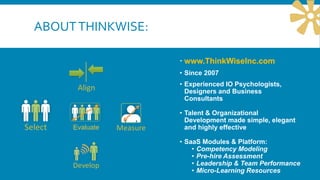
ABOUTTHINKWISE:
 www.ThinkWiseInc.com
• Since 2007
• Experienced IO Psychologists,
Designers and Business
Consultants
• Talent & Organizational
Development made simple, elegant
and highly effective
• SaaS Modules & Platform:
• Competency Modeling
• Pre-hire Assessment
• Leadership & Team Performance
• Micro-Learning Resources
TODAY’STOPICS:
 Explore trends impacting 360s vs. Performance Reviews
 Examine the value of competencies on organizational
performance
 Understand the value of individual development over time
 Explore how micro learning maximizes the development
experience of your employees
 Learn about new assessment approaches that will drive
team, individual & organizational success
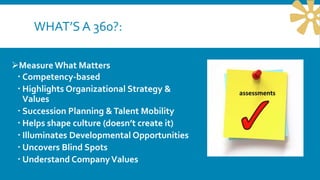
Measure What Matters
 Competency-based
 Highlights Organizational Strategy &
Values
 Succession Planning &Talent Mobility
 Helps shape culture (doesn’t create it)
 Illuminates Developmental Opportunities
 Uncovers Blind Spots
 Understand CompanyValues
WHAT’S A 360?:
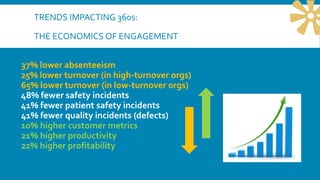
TRENDS IMPACTING 360s:
THE ECONOMICS OF ENGAGEMENT
37% lower absenteeism
25% lower turnover (in high-turnover orgs)
65% lower turnover (in low-turnover orgs)
48% fewer safety incidents
41% fewer patient safety incidents
41% fewer quality incidents (defects)
10% higher customer metrics
21% higher productivity
22% higher profitability
TRENDS IMPACTING 360s:
THE ECONOMICS OF ENGAGEMENT
50% left a job “to get away
from their manager.”
TRENDS IMPACTING 360s:
THE ECONOMICS OF ENGAGEMENT
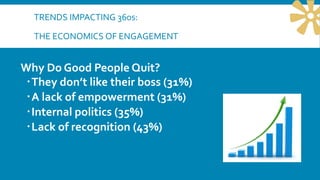
Why Do Good People Quit?
They don’t like their boss (31%)
A lack of empowerment (31%)
Internal politics (35%)
Lack of recognition (43%)
TRENDS IMPACTING 360s:
ACCENTURE’S JOURNEY
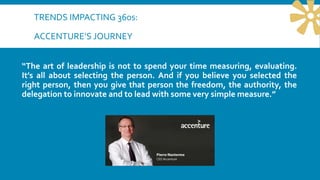
“The art of leadership is not to spend your time measuring, evaluating.
It’s all about selecting the person. And if you believe you selected the
right person, then you give that person the freedom, the authority, the
delegation to innovate and to lead with some very simple measure.”
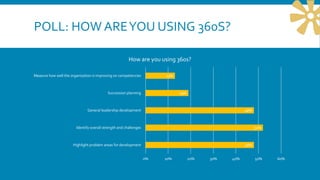
POLL: HOW AREYOU USING 360S?
48%
52%
48%
19%
13%
0% 10% 20% 30% 40% 50% 60%
Highlight problem areas for development
Identify overall strength and challenges
General leadership development
Succession planning
Measure how well the organization is improving on competencies
How are you using 360s?
WHY DO ANYTHING?
 For the most part, organizations cannot afford to sit back and do nothing –this is
extremely costly
 Rather, the benefit is giving someone the feedback they need to grow and this in turn
benefits the organization.The organization is allowing themselves an opportunity to
make progress in multipliers.
 The research on raters doing performance reviews has demonstrated the rating is
merely insight into the rater, not the participant receiving the review
 This fact demoralizes the intent at the front end –why bother?
 Multiple-raters in a 360 survey however can provide reinforcement of a message
 There is a difference in 1-person telling me I need to improve at ‘X,” versus 7 people
telling me I need to make improvements. It literally speaks volumes.
COMPETENCIES, DEFINED…
 The Competency-Based Approach is a research-supported approach based on the
primary goal of defining the critical behaviors needed for effective and superior
individual and organizational performance.
 Simply defined, a competency is a set of related behaviors that
 impact job performance;
 can be measured against established standards; and
 can be improved through training and development.
COMPETENCIES @WORK
 For competencies to work in your organization, you have to align your
competency model with your business strategy or risk the flavor of the month
syndrome.
 Only after this is implemented, aligning your 360s to competencies becomes an easier
experience.
 In order to do this, you must take the time to determine which major themes of
behavior or competencies — e.g., innovation, customer engagement, action
orientation — need to be demonstrated across your organization in order for your
business strategy to work.
THEVALUE OF COMPETENCIES
 In a study of mid-management, managers related competencies to high
performance.This was also related to maintaining a competitive advantage (King,
Fowler, & Zeithaml, 2001).
 According to Bain & Company, competencies allow for organizations to identify
strengths, which can be leveraged and used to understand priorities.
 In our own conversations with customers, organizations want to be able to
measure what they are good at, find ways to hone those skills (e.g., mentors) and
also improve/enhance brand affinity –this in turn helps with recruiting.
 SHRM (2008) has gone on to mention that “organizations can better identify and
develop their next generation of leaders.”
 Essentially admitting that without competencies, you are blind to your success and
leave chance to govern your leadership.
DATA’SVALUE
 Without information we are left guessing what is necessary, assuming what is
right, and charging ahead without understanding the need(s)
 Since many have seen the value of an annual performance review diminish, you
still need a means to understand how to best support professional growth in
others
 You also want the data you collect to have meaning for the person as well as
senior leadership
 It is important that the data used tie to your company’s strategy as tool to gauge
success
FEEDBACK IS IMPORTANT!
 Between 1995 and 2002, 360 feedback programs jumped from 40% to 90%
(Linman, 2006)
 Differences between an annual performance review and 360 feedback:
 360s target development, they establish (when done properly) a coaching culture and
can better attract talent.
 360s take current information and make it forward looking.This is why 360s are better
than the standard performance review for growing your people
 Do not confuse the point being made: 360s should NOT be your annual review,
but the feedback aspect of performance reviews has much to be desired –and
does not inspire change, nor will it.
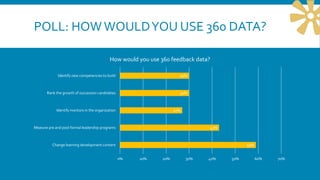
POLL: HOW WOULDYOU USE 360 DATA?
59%
43%
27%
30%
30%
0% 10% 20% 30% 40% 50% 60% 70%
Change learning development content
Measure pre and post formal leadership programs
Identify mentors in the organization
Rank the growth of succession candidates
Identify new competencies to build
How would you use 360 feedback data?
INDIVIDUAL DEVELOPMENTVALUE:
“One way to stay out front is (to have) a
business strategy that maximizes
connections between lifelong learning and
workforce productivity.”
INDIVIDUAL DEVELOPMENTVALUE:
2.5 years between technical KSA gaps
Consistency of “Soft Skill” gaps
INDIVIDUAL DEVELOPMENTVALUE:
A strong positive culture, firmly grounded in a
meaningful purpose.
Real chances to grow professionally.
The opportunity to work with people you like
and respect.
Work that requires you to stretch your brain
and skills.
INDIVIDUAL DEVELOPMENTVALUE:
Team Impact:
“Senior executives recognize that team performance
plays a critical role in creating and growing
organizational value. Developing high-performing
teams requires time and a disciplined approach to
improving performance at both the team and
individual levels. “
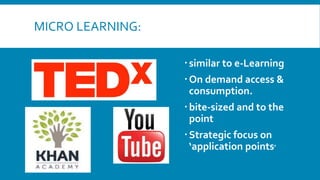
MICRO LEARNING:
similar to e-Learning
On demand access &
consumption.
bite-sized and to the
point
Strategic focus on
‘application points’
MAXIMIZING MICRO LEARNING:
Empowerment
Blended Learning Content
Compliance vs. Developmental Learning
Push vs. Pull Learning
LMS?
Accountability
MAXIMIZING MICRO LEARNING:
Learning with “Work” in mind
Teamwork
Work hours
Work language
Work goals
THANKYOU!
 Visit www.thinkwiseinc.com
 For more interaction withThinkWise, look at following
 LinkedIn
 Subscribe to our newsletter
 Email us directly
 sgriffin@thinkwiseinc.com
 bbergstrom@thinkwiseinc.com

Maximize your 360 with competency based micro-learning

  • 1.
  • 2.
    TODAY’S PRESENTERS: Steve Griffin,Psy.D. VP of Strategy & Consulting sgriffin@thinkwiseinc.com Bill Bergstrom President & COO bbergstrom@thinkwiseinc.com
  • 3.
    ABOUTTHINKWISE:  www.ThinkWiseInc.com • Since2007 • Experienced IO Psychologists, Designers and Business Consultants • Talent & Organizational Development made simple, elegant and highly effective • SaaS Modules & Platform: • Competency Modeling • Pre-hire Assessment • Leadership & Team Performance • Micro-Learning Resources
  • 4.
    TODAY’STOPICS:  Explore trendsimpacting 360s vs. Performance Reviews  Examine the value of competencies on organizational performance  Understand the value of individual development over time  Explore how micro learning maximizes the development experience of your employees  Learn about new assessment approaches that will drive team, individual & organizational success
  • 5.
    Measure What Matters Competency-based  Highlights Organizational Strategy & Values  Succession Planning &Talent Mobility  Helps shape culture (doesn’t create it)  Illuminates Developmental Opportunities  Uncovers Blind Spots  Understand CompanyValues WHAT’S A 360?:
  • 6.
    TRENDS IMPACTING 360s: THEECONOMICS OF ENGAGEMENT 37% lower absenteeism 25% lower turnover (in high-turnover orgs) 65% lower turnover (in low-turnover orgs) 48% fewer safety incidents 41% fewer patient safety incidents 41% fewer quality incidents (defects) 10% higher customer metrics 21% higher productivity 22% higher profitability
  • 7.
    TRENDS IMPACTING 360s: THEECONOMICS OF ENGAGEMENT 50% left a job “to get away from their manager.”
  • 8.
    TRENDS IMPACTING 360s: THEECONOMICS OF ENGAGEMENT Why Do Good People Quit? They don’t like their boss (31%) A lack of empowerment (31%) Internal politics (35%) Lack of recognition (43%)
  • 9.
    TRENDS IMPACTING 360s: ACCENTURE’SJOURNEY “The art of leadership is not to spend your time measuring, evaluating. It’s all about selecting the person. And if you believe you selected the right person, then you give that person the freedom, the authority, the delegation to innovate and to lead with some very simple measure.”
  • 10.
    POLL: HOW AREYOUUSING 360S? 48% 52% 48% 19% 13% 0% 10% 20% 30% 40% 50% 60% Highlight problem areas for development Identify overall strength and challenges General leadership development Succession planning Measure how well the organization is improving on competencies How are you using 360s?
  • 11.
    WHY DO ANYTHING? For the most part, organizations cannot afford to sit back and do nothing –this is extremely costly  Rather, the benefit is giving someone the feedback they need to grow and this in turn benefits the organization.The organization is allowing themselves an opportunity to make progress in multipliers.  The research on raters doing performance reviews has demonstrated the rating is merely insight into the rater, not the participant receiving the review  This fact demoralizes the intent at the front end –why bother?  Multiple-raters in a 360 survey however can provide reinforcement of a message  There is a difference in 1-person telling me I need to improve at ‘X,” versus 7 people telling me I need to make improvements. It literally speaks volumes.
  • 12.
    COMPETENCIES, DEFINED…  TheCompetency-Based Approach is a research-supported approach based on the primary goal of defining the critical behaviors needed for effective and superior individual and organizational performance.  Simply defined, a competency is a set of related behaviors that  impact job performance;  can be measured against established standards; and  can be improved through training and development.
  • 13.
    COMPETENCIES @WORK  Forcompetencies to work in your organization, you have to align your competency model with your business strategy or risk the flavor of the month syndrome.  Only after this is implemented, aligning your 360s to competencies becomes an easier experience.  In order to do this, you must take the time to determine which major themes of behavior or competencies — e.g., innovation, customer engagement, action orientation — need to be demonstrated across your organization in order for your business strategy to work.
  • 14.
    THEVALUE OF COMPETENCIES In a study of mid-management, managers related competencies to high performance.This was also related to maintaining a competitive advantage (King, Fowler, & Zeithaml, 2001).  According to Bain & Company, competencies allow for organizations to identify strengths, which can be leveraged and used to understand priorities.  In our own conversations with customers, organizations want to be able to measure what they are good at, find ways to hone those skills (e.g., mentors) and also improve/enhance brand affinity –this in turn helps with recruiting.  SHRM (2008) has gone on to mention that “organizations can better identify and develop their next generation of leaders.”  Essentially admitting that without competencies, you are blind to your success and leave chance to govern your leadership.
  • 15.
    DATA’SVALUE  Without informationwe are left guessing what is necessary, assuming what is right, and charging ahead without understanding the need(s)  Since many have seen the value of an annual performance review diminish, you still need a means to understand how to best support professional growth in others  You also want the data you collect to have meaning for the person as well as senior leadership  It is important that the data used tie to your company’s strategy as tool to gauge success
  • 16.
    FEEDBACK IS IMPORTANT! Between 1995 and 2002, 360 feedback programs jumped from 40% to 90% (Linman, 2006)  Differences between an annual performance review and 360 feedback:  360s target development, they establish (when done properly) a coaching culture and can better attract talent.  360s take current information and make it forward looking.This is why 360s are better than the standard performance review for growing your people  Do not confuse the point being made: 360s should NOT be your annual review, but the feedback aspect of performance reviews has much to be desired –and does not inspire change, nor will it.
  • 17.
    POLL: HOW WOULDYOUUSE 360 DATA? 59% 43% 27% 30% 30% 0% 10% 20% 30% 40% 50% 60% 70% Change learning development content Measure pre and post formal leadership programs Identify mentors in the organization Rank the growth of succession candidates Identify new competencies to build How would you use 360 feedback data?
  • 18.
    INDIVIDUAL DEVELOPMENTVALUE: “One wayto stay out front is (to have) a business strategy that maximizes connections between lifelong learning and workforce productivity.”
  • 19.
    INDIVIDUAL DEVELOPMENTVALUE: 2.5 yearsbetween technical KSA gaps Consistency of “Soft Skill” gaps
  • 20.
    INDIVIDUAL DEVELOPMENTVALUE: A strongpositive culture, firmly grounded in a meaningful purpose. Real chances to grow professionally. The opportunity to work with people you like and respect. Work that requires you to stretch your brain and skills.
  • 21.
    INDIVIDUAL DEVELOPMENTVALUE: Team Impact: “Seniorexecutives recognize that team performance plays a critical role in creating and growing organizational value. Developing high-performing teams requires time and a disciplined approach to improving performance at both the team and individual levels. “
  • 22.
    MICRO LEARNING: similar toe-Learning On demand access & consumption. bite-sized and to the point Strategic focus on ‘application points’
  • 23.
    MAXIMIZING MICRO LEARNING: Empowerment BlendedLearning Content Compliance vs. Developmental Learning Push vs. Pull Learning LMS? Accountability
  • 24.
    MAXIMIZING MICRO LEARNING: Learningwith “Work” in mind Teamwork Work hours Work language Work goals
  • 26.
    THANKYOU!  Visit www.thinkwiseinc.com For more interaction withThinkWise, look at following  LinkedIn  Subscribe to our newsletter  Email us directly  sgriffin@thinkwiseinc.com  bbergstrom@thinkwiseinc.com