GROUP MEMBERS
• DIPESH BAING
• GITANJALI GAWANDE
• AMIT KAMBLE
• SHRUTI KULKARNI
• UMA PATADE
• SAMEER SAVLA
INTRODUCTION
• Mauritius is an island nation off the southeast
coast of the African continent in the southwest
Indian Ocean.
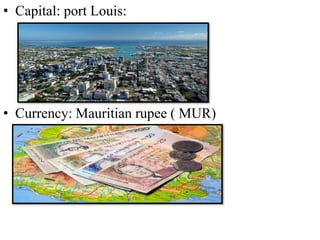
• Capital: port Louis:
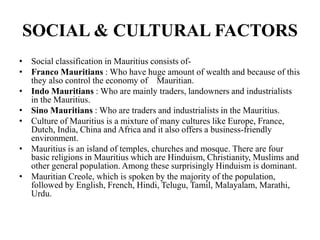
• Currency: Mauritian rupee ( MUR)
STEPIN
• S-SOCIAL
• T-TECHNOLOGY
• E-ECONOMIC
• P-POLITICAL
• I-INTERNATIONAL TRADING
• N-NATURAL SCENARIO
SOCIAL & CULTURAL FACTORS
• Social classification in Mauritius consists of-
• Franco Mauritians : Who have huge amount of wealth and because of this
they also control the economy of Mauritian.
• Indo Mauritians : Who are mainly traders, landowners and industrialists
in the Mauritius.
• Sino Mauritians : Who are traders and industrialists in the Mauritius.
• Culture of Mauritius is a mixture of many cultures like Europe, France,
Dutch, India, China and Africa and it also offers a business-friendly
environment.
• Mauritius is an island of temples, churches and mosque. There are four
basic religions in Mauritius which are Hinduism, Christianity, Muslims and
other general population. Among these surprisingly Hinduism is dominant.
• Mauritian Creole, which is spoken by the majority of the population,
followed by English, French, Hindi, Telugu, Tamil, Malayalam, Marathi,
Urdu.
• The Sundowner is one of the most delicious Mauritian traditions.
• Mauritius has one of the highest literacy rates among developing countries,
at over 95% for those aged under 30. Its education system is highly
developed and is free to university level.
• Food in Daily Life- Mauritius is known for its seafood. The foods in
Mauritius are as varied as the cultures. Chinese mostly own the restaurants
in the cities. Street food also is quite common for snacks and includes
samosas, roti, curried rolls, soups, and noodles. At home, rice is the most
common staple. Local vegetables are eaten readily and include chokos, red
pumpkins, squash, and greens.
• The main festivals celebrated are Cavadee, Chinese Spring Festival,
Christmas, Diwali, Easter, Eid-ul-Fitr, Ganesh Chaturthi, Holi, Maha
Shivaratri, Ugadi, etc.
• The national sport of Mauritius is football.
• Traditional buying methods is more preferred rather online in Mauritians’
lifestyle.
TECHNOLOGY:ICT INDUSTRY’S
CONTRIBUTION
• With a contribution to Mauritius’ Gross Domestic Product (GDP) at
6.8%, the Information, Communication and Technology (ICT) sector,
is poised to become the 3rd economic pillar of the island.
• Foreign direct investments have played a key role in ICT development
in the island economy so far, with a healthy mix of large
multinationals and local players operating in Mauritius, providing
employment to over 19,000 persons in the industry.
• Global players such as Accenture, Ceridian, TNT, Microsoft, Huawei,
Orange Business Services, Pactera, Besedo and Infosys amongst
others have established their operations in Mauritius.
ICT sector overview
• As a dynamic sector, the ICT has been able to diversify and set itself
as a potential sector for further economic development. The ICT
sector is currently the third pillar of the economy with a contribution
to GDP standing at 6.8%.
• Several measures have been implemented such as democratising
access to the internet, setting up of computer clubs on a regional basis
and the WIFI Mauritius Programme
• As many as 264 computer clubs are operational in Mauritius and free
WIFI zones have been set up around the island in a bid to bridge the
digital divide and to make internet a basic citizen’s right. Mauritius is
also now one of the best-connected countries with 54.1% internet
penetration in the region, compared to the African continent’s rate
standing at 13%.
The sector has developed distinctive strengths in Telecoms, BFSI, IT
Application Development as well as Maintenance support.
Business opportunities exist in the following segments:
• BPO Voice – Call Centres
• BPO Non-Voice – Back Office, Payroll, Finance & accounting
outsourcing, Legal Process Outsourcing
• Information Technology Outsourcing – software development, Mobile
apps development, Web development, E-commerce, Multimedia
• IT Services – Data Centres, Disaster Recovery, Training, Consultancy
• Telecommunication
• ICT Trade – retail and wholesale
The country offers the following key attributes for ICT
and BPO activities:
• Proven test bed for new technologies
• Pool of multilingual, educated and adaptable IT
professionals
• Excellent collaborative business environment
• Competitive cost to quality proposition
• Reliable and redundant international connectivity with
two international submarine networks
E- Economic Environment
• Mauritius is an upper middle income country.
• UNDP ranked Mauritius the highest among the
sub-Saharan African countries and 63rd in the
overall ranking.
• Mauritius has a relatively diversified, export-
oriented economy that continues to be based
on 4 pillars: sugar, textiles and clothing,
tourism and financial services.
• Efforts are also being made to develop
Mauritius into a cyber island and to make
information and communication
technology(ICT) the fifth pillar of the
economy
• Size of economy: Top 3 trade partners (2014):
India, China, France.
• Top 3 Exports goods (2014): Apparels,
Electrical machinery.
• GDP Per Capita: 9,202.52 USD (2013)
• Gross Domestic product: 11.93 billion USD
(2013)
• Gross National income:22.32 billion PPP
dollars (2013)
• Nature and trends of foreign trade
• Domestic demand and supply conditions
Politics and Government
Official Name: Republic of Mauritius
Form of State: Republic within the Commonwealth
Independence: 12 March 1968
Legal System: The Mauritian legal system is based on
English common law, the Napoleonic Code and the
1968 constitution.
National Legislature: National Assembly; 62 members
elected by universal suffrage every five years, in 20
three-member constituencies on the island of Mauritius
and one two-member constituency on Rodrigues, plus
up to eight “best losers”.
Head of State: The Head of State is the President, elected by a simple majority of
the National Assembly. On 29 May 2015 President Rajkeswur Purryag
resigned and Vice-President Monique Ohsan-Bellepeau became acting
President. On 4 June 2015 Dr Ameenah Gurib-Fakim was unanimously
elected President by the National Assembly.
Main political parties Government: Alliance de l’avenir coalition formed by the
Labour Party and Parti mauricien social démocrate (PMSD), plus the
Mouvement rodriguais (MR). Other parties in parliament: Mouvement
militant mauricien (MMM), Mouvement socialiste militant (MSM),
Mouvement mauricien social democrat (MMSD), Organisation du peuple
rodriguais, Front solidarité mauricienne
International organization participation: ACP, AFDB, AOSIS, AU, COMESA,
CPLP (associate), FAO, G-77, IAEA, IBRD, ICAO, ICCT, ICRM, IDA,
IFAD, IFC, IFRCS, IHO, ILO, IMF, IMO, IMSO, INOC, Interpol, IOC, IOM,
IPU, ISO, ITSO, ITU, ITUC, MIGA, NAM, OIF, OPCW, PCA, SAARC
(observer), SADC, UN, UNCTAD, UNESCO, UNIDO, UNWTO, UPU,
WCO, WFTU, WHO, WIPO, WMO, WTO
INTERNATIONAL TRADE
• Mauritius' main exports are sugar, tea, coffee,
textiles, knitwear, time pieces, tobaccos, cut
and uncut diamond, electric appliance & parts.
• Mauritius imports include chemical products,
cement , cotton , gemstones, iron steel and
petroleum products.
TRADE POLICY & TRADING
PARTNERS
• Mauritius' participation in multilateral trading
system & in various regional agreements reflects
its interests as a small, export-oriented economy
with advantages in few product, sugar, textiles
and clothing.
• The resultant reduction of duty and tax
concessions could contribute to reducing public
deficit and facilitating further tariff reforms,
which are currently hampered by fiscal concerns
as customs duties account for about 50% of tax
revenue.
CUSTOMS & DUTIES
• A value-added tax are 12% levied on all
imports petroleum, Vehicles, alcohol,
cigarettes, and furniture have a special excise
duties of up to 360%.
• Most of the imports require a license and state
enterprises control to import of rice, flour,
petroleum, wheat, cement, tea, tobacco, and
sugar.
TARIFF BARRIERS
• Mauritius has a three column tariff based on the
Harmonized System. Most duties are ad valorem, assessed
on the Cost, Insurance and Freight (CIF) value and specific
rates are assessed according to the specified unit of
measure.
• Customs duty is applicable on imported goods and the rates
vary from 0 to 15% on the CIF value. Under the Customs
Tariff Act, the Customs Department administers numerous
schemes of exemption and concession of duty to various
sectors of agriculture, industry and travellers.
• Drawback is allowed on goods that have been imported for
the purpose of undergoing processing and thereafter
exported. Provisions are also made for the temporary
admission of goods.
NON TARIFF BARRIERS
• Mauritian operators seem to encounter no major NTBs
regarding trade with SADC & COMESA regions from the
domestic perspective. The only problems mentioned
concerned the signatures on the certificates of origin.
• In fact most of the measures that have been & are being
implemented regarding import end export restrictions tend
to be those applicable at international levels.
• Mauritius is considering the possibility of adopting safety
norms regarding electrical products.
• Some of them are not likely to be liberalized soon but
products such as wheat flour is being considered. For
products such as potatoes & other vegetables, import
permits are provided whenever there is a shortage.
NATURAL SCENARIO
• Mauritius is sub-tropical and suffers periodic droughts. It is of volcanic
origin and has varying landscapes.
• Around 46% of the land area is agricultural, 20% built-up, 2% roads, and
the remainder is forest, scrubland, grasslands, reservoirs, ponds, swamps
and rock.
• The bulk of cultivable land is under sugarcane cultivation and is harvested
between June and November.
• Food crops and fruit are harvested throughout the year.
• The main minerals in Mauritius are basalts produced from local coral
limestone and coral sand. There are also polymetallic nodules that occur on
the ocean floor at about 4,000 m depth around Mauritius. They contain
more than 15% of both iron and manganese and more than 0.35% cobalt.
• Mauritius is also one of 20 countries participating in the Africa Adaptation
Programme, to build adaptation into its institutional framework and core
development strategies.
THANK YOU!!........
VISIT AGAIN

Mauritius

  • 2.
    GROUP MEMBERS • DIPESHBAING • GITANJALI GAWANDE • AMIT KAMBLE • SHRUTI KULKARNI • UMA PATADE • SAMEER SAVLA
  • 3.
    INTRODUCTION • Mauritius isan island nation off the southeast coast of the African continent in the southwest Indian Ocean.
  • 4.
    • Capital: portLouis: • Currency: Mauritian rupee ( MUR)
  • 5.
    STEPIN • S-SOCIAL • T-TECHNOLOGY •E-ECONOMIC • P-POLITICAL • I-INTERNATIONAL TRADING • N-NATURAL SCENARIO
  • 6.
    SOCIAL & CULTURALFACTORS • Social classification in Mauritius consists of- • Franco Mauritians : Who have huge amount of wealth and because of this they also control the economy of Mauritian. • Indo Mauritians : Who are mainly traders, landowners and industrialists in the Mauritius. • Sino Mauritians : Who are traders and industrialists in the Mauritius. • Culture of Mauritius is a mixture of many cultures like Europe, France, Dutch, India, China and Africa and it also offers a business-friendly environment. • Mauritius is an island of temples, churches and mosque. There are four basic religions in Mauritius which are Hinduism, Christianity, Muslims and other general population. Among these surprisingly Hinduism is dominant. • Mauritian Creole, which is spoken by the majority of the population, followed by English, French, Hindi, Telugu, Tamil, Malayalam, Marathi, Urdu.
  • 7.
    • The Sundowneris one of the most delicious Mauritian traditions. • Mauritius has one of the highest literacy rates among developing countries, at over 95% for those aged under 30. Its education system is highly developed and is free to university level. • Food in Daily Life- Mauritius is known for its seafood. The foods in Mauritius are as varied as the cultures. Chinese mostly own the restaurants in the cities. Street food also is quite common for snacks and includes samosas, roti, curried rolls, soups, and noodles. At home, rice is the most common staple. Local vegetables are eaten readily and include chokos, red pumpkins, squash, and greens. • The main festivals celebrated are Cavadee, Chinese Spring Festival, Christmas, Diwali, Easter, Eid-ul-Fitr, Ganesh Chaturthi, Holi, Maha Shivaratri, Ugadi, etc. • The national sport of Mauritius is football. • Traditional buying methods is more preferred rather online in Mauritians’ lifestyle.
  • 8.
    TECHNOLOGY:ICT INDUSTRY’S CONTRIBUTION • Witha contribution to Mauritius’ Gross Domestic Product (GDP) at 6.8%, the Information, Communication and Technology (ICT) sector, is poised to become the 3rd economic pillar of the island. • Foreign direct investments have played a key role in ICT development in the island economy so far, with a healthy mix of large multinationals and local players operating in Mauritius, providing employment to over 19,000 persons in the industry. • Global players such as Accenture, Ceridian, TNT, Microsoft, Huawei, Orange Business Services, Pactera, Besedo and Infosys amongst others have established their operations in Mauritius.
  • 9.
    ICT sector overview •As a dynamic sector, the ICT has been able to diversify and set itself as a potential sector for further economic development. The ICT sector is currently the third pillar of the economy with a contribution to GDP standing at 6.8%. • Several measures have been implemented such as democratising access to the internet, setting up of computer clubs on a regional basis and the WIFI Mauritius Programme • As many as 264 computer clubs are operational in Mauritius and free WIFI zones have been set up around the island in a bid to bridge the digital divide and to make internet a basic citizen’s right. Mauritius is also now one of the best-connected countries with 54.1% internet penetration in the region, compared to the African continent’s rate standing at 13%.
  • 10.
    The sector hasdeveloped distinctive strengths in Telecoms, BFSI, IT Application Development as well as Maintenance support. Business opportunities exist in the following segments: • BPO Voice – Call Centres • BPO Non-Voice – Back Office, Payroll, Finance & accounting outsourcing, Legal Process Outsourcing • Information Technology Outsourcing – software development, Mobile apps development, Web development, E-commerce, Multimedia • IT Services – Data Centres, Disaster Recovery, Training, Consultancy • Telecommunication • ICT Trade – retail and wholesale
  • 11.
    The country offersthe following key attributes for ICT and BPO activities: • Proven test bed for new technologies • Pool of multilingual, educated and adaptable IT professionals • Excellent collaborative business environment • Competitive cost to quality proposition • Reliable and redundant international connectivity with two international submarine networks
  • 12.
    E- Economic Environment •Mauritius is an upper middle income country. • UNDP ranked Mauritius the highest among the sub-Saharan African countries and 63rd in the overall ranking. • Mauritius has a relatively diversified, export- oriented economy that continues to be based on 4 pillars: sugar, textiles and clothing, tourism and financial services.
  • 13.
    • Efforts arealso being made to develop Mauritius into a cyber island and to make information and communication technology(ICT) the fifth pillar of the economy • Size of economy: Top 3 trade partners (2014): India, China, France. • Top 3 Exports goods (2014): Apparels, Electrical machinery.
  • 14.
    • GDP PerCapita: 9,202.52 USD (2013) • Gross Domestic product: 11.93 billion USD (2013) • Gross National income:22.32 billion PPP dollars (2013) • Nature and trends of foreign trade • Domestic demand and supply conditions
  • 15.
    Politics and Government OfficialName: Republic of Mauritius Form of State: Republic within the Commonwealth Independence: 12 March 1968 Legal System: The Mauritian legal system is based on English common law, the Napoleonic Code and the 1968 constitution. National Legislature: National Assembly; 62 members elected by universal suffrage every five years, in 20 three-member constituencies on the island of Mauritius and one two-member constituency on Rodrigues, plus up to eight “best losers”.
  • 16.
    Head of State:The Head of State is the President, elected by a simple majority of the National Assembly. On 29 May 2015 President Rajkeswur Purryag resigned and Vice-President Monique Ohsan-Bellepeau became acting President. On 4 June 2015 Dr Ameenah Gurib-Fakim was unanimously elected President by the National Assembly. Main political parties Government: Alliance de l’avenir coalition formed by the Labour Party and Parti mauricien social démocrate (PMSD), plus the Mouvement rodriguais (MR). Other parties in parliament: Mouvement militant mauricien (MMM), Mouvement socialiste militant (MSM), Mouvement mauricien social democrat (MMSD), Organisation du peuple rodriguais, Front solidarité mauricienne International organization participation: ACP, AFDB, AOSIS, AU, COMESA, CPLP (associate), FAO, G-77, IAEA, IBRD, ICAO, ICCT, ICRM, IDA, IFAD, IFC, IFRCS, IHO, ILO, IMF, IMO, IMSO, INOC, Interpol, IOC, IOM, IPU, ISO, ITSO, ITU, ITUC, MIGA, NAM, OIF, OPCW, PCA, SAARC (observer), SADC, UN, UNCTAD, UNESCO, UNIDO, UNWTO, UPU, WCO, WFTU, WHO, WIPO, WMO, WTO
  • 17.
    INTERNATIONAL TRADE • Mauritius'main exports are sugar, tea, coffee, textiles, knitwear, time pieces, tobaccos, cut and uncut diamond, electric appliance & parts. • Mauritius imports include chemical products, cement , cotton , gemstones, iron steel and petroleum products.
  • 18.
    TRADE POLICY &TRADING PARTNERS • Mauritius' participation in multilateral trading system & in various regional agreements reflects its interests as a small, export-oriented economy with advantages in few product, sugar, textiles and clothing. • The resultant reduction of duty and tax concessions could contribute to reducing public deficit and facilitating further tariff reforms, which are currently hampered by fiscal concerns as customs duties account for about 50% of tax revenue.
  • 19.
    CUSTOMS & DUTIES •A value-added tax are 12% levied on all imports petroleum, Vehicles, alcohol, cigarettes, and furniture have a special excise duties of up to 360%. • Most of the imports require a license and state enterprises control to import of rice, flour, petroleum, wheat, cement, tea, tobacco, and sugar.
  • 20.
    TARIFF BARRIERS • Mauritiushas a three column tariff based on the Harmonized System. Most duties are ad valorem, assessed on the Cost, Insurance and Freight (CIF) value and specific rates are assessed according to the specified unit of measure. • Customs duty is applicable on imported goods and the rates vary from 0 to 15% on the CIF value. Under the Customs Tariff Act, the Customs Department administers numerous schemes of exemption and concession of duty to various sectors of agriculture, industry and travellers. • Drawback is allowed on goods that have been imported for the purpose of undergoing processing and thereafter exported. Provisions are also made for the temporary admission of goods.
  • 21.
    NON TARIFF BARRIERS •Mauritian operators seem to encounter no major NTBs regarding trade with SADC & COMESA regions from the domestic perspective. The only problems mentioned concerned the signatures on the certificates of origin. • In fact most of the measures that have been & are being implemented regarding import end export restrictions tend to be those applicable at international levels. • Mauritius is considering the possibility of adopting safety norms regarding electrical products. • Some of them are not likely to be liberalized soon but products such as wheat flour is being considered. For products such as potatoes & other vegetables, import permits are provided whenever there is a shortage.
  • 22.
    NATURAL SCENARIO • Mauritiusis sub-tropical and suffers periodic droughts. It is of volcanic origin and has varying landscapes. • Around 46% of the land area is agricultural, 20% built-up, 2% roads, and the remainder is forest, scrubland, grasslands, reservoirs, ponds, swamps and rock. • The bulk of cultivable land is under sugarcane cultivation and is harvested between June and November. • Food crops and fruit are harvested throughout the year. • The main minerals in Mauritius are basalts produced from local coral limestone and coral sand. There are also polymetallic nodules that occur on the ocean floor at about 4,000 m depth around Mauritius. They contain more than 15% of both iron and manganese and more than 0.35% cobalt. • Mauritius is also one of 20 countries participating in the Africa Adaptation Programme, to build adaptation into its institutional framework and core development strategies.
  • 23.