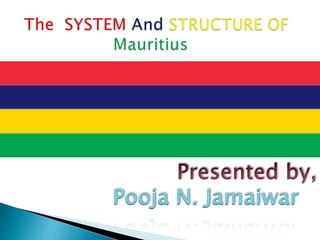
Pooja N. Jamaiwar
1 Etymology :-
2 History :-
3 Politics :-
1 Parliament
2 Government
3 Rule of law
4 Foreign relations
5 Military
4 Geography :-
1 Environment
2 Biodiversity
3 Districts
5 Demographics :-
1 Language
2 Education
6 Economy :-
1 Tourism
2 cultural , Festival
3 sports
 Mauritius, officially the Republic of Mauritius, is an
island nation in the Indian Ocean about 2,000
kilometres off the southeast coast of the African
continent.
 Capital: Port Louis
 Dialing code: +230
 Currency: Mauritian rupee
 Government: Parliamentary republic
 Continent: Africa
 Colleges and Universities: University of Mauritius,
 The first historical evidence of the existence of an
island now known as Mauritius is on a map
produced by the Italian cartographer Alberto
Cantino in 1502.
 In 1598 a Dutch squadron under Admiral Wybrand
Van Warwyck landed at Grand Port and named the
island Mauritius.
 On 3 December 1810 the French formally
surrendered after the Napoleonic wars. Under
British rule, the island's name reverted to Mauritius
.
The island of Mauritius was unknown and uninhabited
before its first recorded visit during the Middle Ages by
Arab sailors, who named it Dina Arobi.
The first Dutch settlement lasted only twenty years.
 Several attempts were made —subsequently, but the
settlements never developed enough to produce dividends
and the Dutch abandoned Mauritius in 1710.
From 1767 to 1810, except for a brief period during the
French Revolution when the inhabitants set up a
government virtually independent of France, the island
was controlled by officials appointed by the French
Government.
Mauritius was proclaimed a republic twenty four years
after independence on 12 March 1992
 The politics of Mauritius take place in a
framework of a parliamentary representative
democratic republic.
 In which the President is the head of state and
the Prime Minister is the head of government
who is assisted by a Council of Ministers.
 Mauritius has a multi-party system.
 Executive power is exercised by the
Government.
 Legislative power is vested in both the
Government and the National Assembly.
 The absolute power is split between two
positions: the President and the Prime Minister.
 Mauritius is a democracy with a Government
elected every five years.
 The most recent General Election was held on 5
May 2010 in all the 20 mainland constituencies, as
well as the constituency covering the island of
Rodrigues.
 The 2012 Ibrahim Index of African Governance
ranked Mauritius first in good governance.
 According to the 2011 Democracy Index compiled
by the Economist Intelligence Unit that measures
the state of democracy in 167 countries.
 Mauritius ranks 24th worldwide and is the only
African country with Full Democracy.
 Laws governing the Mauritian penal system are derived
partly from old French codes and English law.
 The crime rate reduced from 4.3 per 1,000 population in
2009 to 3.6 per 1,000 population in 2010.
 The Constitution of Mauritius states that for purposes of
separation of powers, the judiciary is independent.
 According to The Heritage Foundation the trials are fair
and the legal system is generally non-discriminatory and
transparent.
 The Independent Commission Against Corruption
investigates offenses and can confiscate the proceeds of
corruption and money laundering. Mauritius is one of
Africa's least corrupt countries
 Mauritius has strong and friendly relations with various
African, American, Asian, European and Oceania
countries.
 It is a member of the World Trade Organization, the
Commonwealth of Nations, La Francophonie, the African
Union, the Southern Africa Development Community
(SADC).
 The Indian Ocean Commission, COMESA and formed the
Indian Ocean Rim Association.
 on Western markets have led to close ties with the
European Union .
 Relations with China and India are strong for both
historical and commercial reasons.
 All military, police, and security functions in
Mauritius are carried out by 10,000 active-duty
personnel under the command of the
Commissioner of Police.
 The 8,000-member National Police Force is
responsible for domestic law enforcement.
 The 1,500-member Special Mobile Force (SMF)
and the 500-member National Coast Guard are
the only two paramilitary units in Mauritius.
 Both units are composed of police officers on
lengthy rotations to those services.
 The total land area of the country is 2,040 km2.
 which is the 180st largest nation in the world by size.
 The island of Mauritius is relatively young geologically,
having been created by volcanic activity some 8 million
years ago.
 Together with Saint Brandon, Réunion and Rodrigues,
the island is part of the Mascarene Islands.
 The United States established a military base on the
biggest island, Mauritius is surrounded by more than 150
kilometres (93 miles) of white sandy beaches and the
lagoons are protected from the open sea by the world's
third largest coral reef, which surrounds the island
 The environment in Mauritius is typically tropical in
the coastal regions with forests in the mountainous
areas
 Seasonal cyclones are destructive to the flora and
fauna, although they recover quickly.
 Mauritius ranked second in an air quality index
released by the World Health Organization in 2011.
 There are 2 seasons: a warm humid summer from
November to April, with a mean temperature of
24.7° and a relatively cool dry winter from June to
September with a mean temperature of 20.4°.
 :-The tropical beach at Trou-aux-Biches
(The Mauritius ornate
day gecko)
(The now-
extinct Dodo
bird)
The country is home to some of the world's rarest plants and
animals but human habitation and the introduction of non-native
species have threatened its indigenous flora and fauna.
 The island of Mauritius was the home of a previously unknown
species of bird, the Dodo. Dodos were descendent of a type of
pigeon which settled in Mauritius over 4 million years ago.
[The dodo is prominently featured as a supporter of the national
Coat of arms of Mauritius.
 Mauritius is divided into nine districts which
consist of different cities, towns and villages.
 The island of Rodrigues used to be the country's
tenth district before it gained autonomous status
in October 2002.
 The population estimate (as of 1 July 2013) for the
whole republic is 1,295,789 .
 The female population outnumbered.
 The male population by about 19,937.
 According to the 2011 census made by Statistics
Mauritius, Hinduism is the largest religion at 49%,
followed by Christianity with 32%, Islam with 17%
and Buddhism at 0.4% in terms of number of
adherents.
 Being both an English-speaking and French-
speaking nation.
 Mauritius is a member of both the Commonwealth
of Nations and the Francophonie.
 The Mauritian constitution makes no mention of
an official language.
 It is only in the Parliament that the official
language is English.
 French is mostly used in the media and literature.
 Some ancestral languages which are also spoken in
Mauritius include Arabic, Bhojpuri, Cantonese,
Hakka Chinese, Hindi, Marathi, Mandarin, Sanskrit,
Tamil, Telugu and Urdu
 The government of Mauritius provides free
education to its citizens from pre-primary to
tertiary level.
 Since July 2005, the government introduced free
transport for all students.
 For the year 2013, government expenditure on
education was estimated at about Rs 13,5 million,
representing 13% of total expenditure.
 The O-Level and A-Level examinations are carried
out by the University of Cambridge through
University of Cambridge International
Examinations.
 Since independence in 1968, Mauritius has
developed from a low-income, agriculture-based
economy to a middle-income diversified economy.
 The economy is based on tourism, textiles, sugar,
and financial services.
 In recent years, information and communication
technology, seafood, hospitality and property
development, healthcare, renewable energy, and
education and training have emerged as important
sectors,
 Mauritius has one of the largest Exclusive
Economic Zones in the world, in 2012 the
government announced its intention to develop the
Ocean Economy..
The Gross Domestic Product (GDP) in Mauritius expanded
1.30 percent in the third quarter of 2012 over the previous
quarter.
 GDP Growth Rate in Mauritius is reported by the Statistics
Mauritius. From 2000 until 2012 Mauritius GDP Annual
Growth Rate
 The Gross Domestic Product (GDP) in Mauritius is expected
to grow 3.20 percent in 2013 from the previous year.
 GDP Annual Growth Rate in Mauritius is reported by the
Central Statistics Office, Mauritius. From 2001 until 2013,
 Mauritius GDP Annual Growth Rate averaged 3.9 Percent
reaching an all time high of 9.8 Percent in March of 2003
and a record low of -0.8 Percent in March of 2005.
 The inflation rate in Mauritius was recorded at 3.90
percent in February of 2014.
 Inflation Rate in Mauritius is reported by the
Central Statistics Office, Mauritius.
 Inflation Rate in Mauritius averaged 6.78 Percent
from 1988 until 2014,
 Seafood is an important component in the
Cuisine of Mauritius.
 There are Hindu festivals, Chinese festivals,
Muslim festivals, as well as Christian festivals.
 There are 15 annual public holidays in Mauritius.
 The national sport of Mauritius is football.
 and the national team is the Club M, other
popular sports in Mauritius include cycling, table
tennis, badminton, volleyball, basketball,
handball, boxing, judo, karate, taekwondo,
weightlifting, bodybuilding and athletics.
 Mauritius won its first Olympic medal at the
2008 Summer Olympics in Beijing when boxer
Bruno Julie won the bronze medal.
Maritius

Maritius

  • 1.
  • 2.
    1 Etymology :- 2History :- 3 Politics :- 1 Parliament 2 Government 3 Rule of law 4 Foreign relations 5 Military 4 Geography :- 1 Environment 2 Biodiversity 3 Districts 5 Demographics :- 1 Language 2 Education 6 Economy :- 1 Tourism 2 cultural , Festival 3 sports
  • 3.
     Mauritius, officiallythe Republic of Mauritius, is an island nation in the Indian Ocean about 2,000 kilometres off the southeast coast of the African continent.  Capital: Port Louis  Dialing code: +230  Currency: Mauritian rupee  Government: Parliamentary republic  Continent: Africa  Colleges and Universities: University of Mauritius,
  • 4.
     The firsthistorical evidence of the existence of an island now known as Mauritius is on a map produced by the Italian cartographer Alberto Cantino in 1502.  In 1598 a Dutch squadron under Admiral Wybrand Van Warwyck landed at Grand Port and named the island Mauritius.  On 3 December 1810 the French formally surrendered after the Napoleonic wars. Under British rule, the island's name reverted to Mauritius .
  • 5.
    The island ofMauritius was unknown and uninhabited before its first recorded visit during the Middle Ages by Arab sailors, who named it Dina Arobi. The first Dutch settlement lasted only twenty years.  Several attempts were made —subsequently, but the settlements never developed enough to produce dividends and the Dutch abandoned Mauritius in 1710. From 1767 to 1810, except for a brief period during the French Revolution when the inhabitants set up a government virtually independent of France, the island was controlled by officials appointed by the French Government. Mauritius was proclaimed a republic twenty four years after independence on 12 March 1992
  • 6.
     The politicsof Mauritius take place in a framework of a parliamentary representative democratic republic.  In which the President is the head of state and the Prime Minister is the head of government who is assisted by a Council of Ministers.  Mauritius has a multi-party system.  Executive power is exercised by the Government.  Legislative power is vested in both the Government and the National Assembly.  The absolute power is split between two positions: the President and the Prime Minister.
  • 7.
     Mauritius isa democracy with a Government elected every five years.  The most recent General Election was held on 5 May 2010 in all the 20 mainland constituencies, as well as the constituency covering the island of Rodrigues.  The 2012 Ibrahim Index of African Governance ranked Mauritius first in good governance.  According to the 2011 Democracy Index compiled by the Economist Intelligence Unit that measures the state of democracy in 167 countries.  Mauritius ranks 24th worldwide and is the only African country with Full Democracy.
  • 8.
     Laws governingthe Mauritian penal system are derived partly from old French codes and English law.  The crime rate reduced from 4.3 per 1,000 population in 2009 to 3.6 per 1,000 population in 2010.  The Constitution of Mauritius states that for purposes of separation of powers, the judiciary is independent.  According to The Heritage Foundation the trials are fair and the legal system is generally non-discriminatory and transparent.  The Independent Commission Against Corruption investigates offenses and can confiscate the proceeds of corruption and money laundering. Mauritius is one of Africa's least corrupt countries
  • 9.
     Mauritius hasstrong and friendly relations with various African, American, Asian, European and Oceania countries.  It is a member of the World Trade Organization, the Commonwealth of Nations, La Francophonie, the African Union, the Southern Africa Development Community (SADC).  The Indian Ocean Commission, COMESA and formed the Indian Ocean Rim Association.  on Western markets have led to close ties with the European Union .  Relations with China and India are strong for both historical and commercial reasons.
  • 10.
     All military,police, and security functions in Mauritius are carried out by 10,000 active-duty personnel under the command of the Commissioner of Police.  The 8,000-member National Police Force is responsible for domestic law enforcement.  The 1,500-member Special Mobile Force (SMF) and the 500-member National Coast Guard are the only two paramilitary units in Mauritius.  Both units are composed of police officers on lengthy rotations to those services.
  • 11.
     The totalland area of the country is 2,040 km2.  which is the 180st largest nation in the world by size.  The island of Mauritius is relatively young geologically, having been created by volcanic activity some 8 million years ago.  Together with Saint Brandon, Réunion and Rodrigues, the island is part of the Mascarene Islands.  The United States established a military base on the biggest island, Mauritius is surrounded by more than 150 kilometres (93 miles) of white sandy beaches and the lagoons are protected from the open sea by the world's third largest coral reef, which surrounds the island
  • 12.
     The environmentin Mauritius is typically tropical in the coastal regions with forests in the mountainous areas  Seasonal cyclones are destructive to the flora and fauna, although they recover quickly.  Mauritius ranked second in an air quality index released by the World Health Organization in 2011.  There are 2 seasons: a warm humid summer from November to April, with a mean temperature of 24.7° and a relatively cool dry winter from June to September with a mean temperature of 20.4°.  :-The tropical beach at Trou-aux-Biches
  • 13.
    (The Mauritius ornate daygecko) (The now- extinct Dodo bird) The country is home to some of the world's rarest plants and animals but human habitation and the introduction of non-native species have threatened its indigenous flora and fauna.  The island of Mauritius was the home of a previously unknown species of bird, the Dodo. Dodos were descendent of a type of pigeon which settled in Mauritius over 4 million years ago. [The dodo is prominently featured as a supporter of the national Coat of arms of Mauritius.
  • 14.
     Mauritius isdivided into nine districts which consist of different cities, towns and villages.  The island of Rodrigues used to be the country's tenth district before it gained autonomous status in October 2002.
  • 15.
     The populationestimate (as of 1 July 2013) for the whole republic is 1,295,789 .  The female population outnumbered.  The male population by about 19,937.  According to the 2011 census made by Statistics Mauritius, Hinduism is the largest religion at 49%, followed by Christianity with 32%, Islam with 17% and Buddhism at 0.4% in terms of number of adherents.
  • 16.
     Being bothan English-speaking and French- speaking nation.  Mauritius is a member of both the Commonwealth of Nations and the Francophonie.  The Mauritian constitution makes no mention of an official language.  It is only in the Parliament that the official language is English.  French is mostly used in the media and literature.  Some ancestral languages which are also spoken in Mauritius include Arabic, Bhojpuri, Cantonese, Hakka Chinese, Hindi, Marathi, Mandarin, Sanskrit, Tamil, Telugu and Urdu
  • 17.
     The governmentof Mauritius provides free education to its citizens from pre-primary to tertiary level.  Since July 2005, the government introduced free transport for all students.  For the year 2013, government expenditure on education was estimated at about Rs 13,5 million, representing 13% of total expenditure.  The O-Level and A-Level examinations are carried out by the University of Cambridge through University of Cambridge International Examinations.
  • 18.
     Since independencein 1968, Mauritius has developed from a low-income, agriculture-based economy to a middle-income diversified economy.  The economy is based on tourism, textiles, sugar, and financial services.  In recent years, information and communication technology, seafood, hospitality and property development, healthcare, renewable energy, and education and training have emerged as important sectors,  Mauritius has one of the largest Exclusive Economic Zones in the world, in 2012 the government announced its intention to develop the Ocean Economy..
  • 19.
    The Gross DomesticProduct (GDP) in Mauritius expanded 1.30 percent in the third quarter of 2012 over the previous quarter.  GDP Growth Rate in Mauritius is reported by the Statistics Mauritius. From 2000 until 2012 Mauritius GDP Annual Growth Rate  The Gross Domestic Product (GDP) in Mauritius is expected to grow 3.20 percent in 2013 from the previous year.  GDP Annual Growth Rate in Mauritius is reported by the Central Statistics Office, Mauritius. From 2001 until 2013,  Mauritius GDP Annual Growth Rate averaged 3.9 Percent reaching an all time high of 9.8 Percent in March of 2003 and a record low of -0.8 Percent in March of 2005.
  • 20.
     The inflationrate in Mauritius was recorded at 3.90 percent in February of 2014.  Inflation Rate in Mauritius is reported by the Central Statistics Office, Mauritius.  Inflation Rate in Mauritius averaged 6.78 Percent from 1988 until 2014,
  • 21.
     Seafood isan important component in the Cuisine of Mauritius.  There are Hindu festivals, Chinese festivals, Muslim festivals, as well as Christian festivals.  There are 15 annual public holidays in Mauritius.  The national sport of Mauritius is football.  and the national team is the Club M, other popular sports in Mauritius include cycling, table tennis, badminton, volleyball, basketball, handball, boxing, judo, karate, taekwondo, weightlifting, bodybuilding and athletics.  Mauritius won its first Olympic medal at the 2008 Summer Olympics in Beijing when boxer Bruno Julie won the bronze medal.