Novel Current Collector for
Rechargeable Batteries
David Llanos, Nick Montes, Theodore Wou
MATSCI 303: PROJECT 2
Content
• Proposal Description & Schematic
• Background & Significance
• Specific Aims & Proposed Experiments
• Key Technical Challenges
3
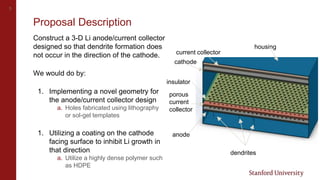
Proposal Description
Construct a 3-D Li anode/current collector
designed so that dendrite formation does
not occur in the direction of the cathode.
We would do by:
1. Implementing a novel geometry for
the anode/current collector design
a. Holes fabricated using lithography
or sol-gel templates
1. Utilizing a coating on the cathode
facing surface to inhibit Li growth in
that direction
a. Utilize a highly dense polymer such
as HDPE
cathode
current collector
insulator
porous
current
collector
anode
dendrites
housing
4
Background & Significance
Z. Li et al. / J. Power Sources 254 (2014)
168-182
❖ Reviewed failure mechanisms of lithium metal and
lithium-ion anodes batteries, and methods to prevent
dendrite formation.
Yang, C.-P. et al.. Nat. Commun. 6:8058
❖ Showed that a 3D current collector with a submicron
skeleton and high electroactive surface area can
significantly improve the electrochemical deposition
behaviour of Li.
Körner, C. and Singer, R. F. (2000), Adv.
Eng. Mater., 2: 159–165.
❖ Reviewed the merits of various fabrication techniques of
porous metals, with particular emphasis placed on the
demands of the various applications and the suitability of
each process to meet these demands.
5
Specific Aims & Proposed Experiments
Demonstrate prevention of
dendrite formation in direction of
cathode
Demonstrate improved cyclability
of lithium metal batteries
Big Picture:
▪ Improved applications for
energy storage
› Grid storage
› Automotive
Testing of different current collector
geometries (e.g. metal foams)
• Cyclability analysis
• Imaging of pores to monitor
dendrite growth as a function of
cycles (SEM)
• Power density
6
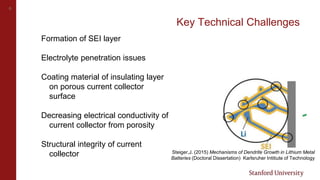
Key Technical Challenges
Formation of SEI layer
Electrolyte penetration issues
Coating material of insulating layer
on porous current collector
surface
Decreasing electrical conductivity of
current collector from porosity
Structural integrity of current
collector Steiger,J. (2015) Mechanisms of Dendrite Growth in Lithium Metal
Batteries (Doctoral Dissertation) Karlsruher Intitiute of Technology
References
[1]: Yang, C.-P. et al. Accommodating lithium into 3D current collectors with
a submicron skeleton towards long-life lithium metal anodes. Nat.
Commun. 6:8058 doi: 10.1038/ncomms9058 (2015).
[2]: Körner, C. and Singer, R. F. (2000), Processing of Metal Foams—
Challenges and Opportunities. Adv. Eng. Mater., 2: 159–165. doi:
10.1002/(SICI)1527-2648(200004)2:4<159::AID-ADEM159>3.0.CO;2-O
[3]: Li, Z. et al. A review of lithium deposition in lithium-ion and lithium metal
secondary batteries, J. Power Sources, 254, 168-182,
http://dx.doi.org/10.1016/j.jpowsour.2013.12.099 (2014)

MATSCI 303 Project II Presentation

  • 1.
    Novel Current Collectorfor Rechargeable Batteries David Llanos, Nick Montes, Theodore Wou MATSCI 303: PROJECT 2
  • 2.
    Content • Proposal Description& Schematic • Background & Significance • Specific Aims & Proposed Experiments • Key Technical Challenges
  • 3.
    3 Proposal Description Construct a3-D Li anode/current collector designed so that dendrite formation does not occur in the direction of the cathode. We would do by: 1. Implementing a novel geometry for the anode/current collector design a. Holes fabricated using lithography or sol-gel templates 1. Utilizing a coating on the cathode facing surface to inhibit Li growth in that direction a. Utilize a highly dense polymer such as HDPE cathode current collector insulator porous current collector anode dendrites housing
  • 4.
    4 Background & Significance Z.Li et al. / J. Power Sources 254 (2014) 168-182 ❖ Reviewed failure mechanisms of lithium metal and lithium-ion anodes batteries, and methods to prevent dendrite formation. Yang, C.-P. et al.. Nat. Commun. 6:8058 ❖ Showed that a 3D current collector with a submicron skeleton and high electroactive surface area can significantly improve the electrochemical deposition behaviour of Li. Körner, C. and Singer, R. F. (2000), Adv. Eng. Mater., 2: 159–165. ❖ Reviewed the merits of various fabrication techniques of porous metals, with particular emphasis placed on the demands of the various applications and the suitability of each process to meet these demands.
  • 5.
    5 Specific Aims &Proposed Experiments Demonstrate prevention of dendrite formation in direction of cathode Demonstrate improved cyclability of lithium metal batteries Big Picture: ▪ Improved applications for energy storage › Grid storage › Automotive Testing of different current collector geometries (e.g. metal foams) • Cyclability analysis • Imaging of pores to monitor dendrite growth as a function of cycles (SEM) • Power density
  • 6.
    6 Key Technical Challenges Formationof SEI layer Electrolyte penetration issues Coating material of insulating layer on porous current collector surface Decreasing electrical conductivity of current collector from porosity Structural integrity of current collector Steiger,J. (2015) Mechanisms of Dendrite Growth in Lithium Metal Batteries (Doctoral Dissertation) Karlsruher Intitiute of Technology
  • 7.
    References [1]: Yang, C.-P.et al. Accommodating lithium into 3D current collectors with a submicron skeleton towards long-life lithium metal anodes. Nat. Commun. 6:8058 doi: 10.1038/ncomms9058 (2015). [2]: Körner, C. and Singer, R. F. (2000), Processing of Metal Foams— Challenges and Opportunities. Adv. Eng. Mater., 2: 159–165. doi: 10.1002/(SICI)1527-2648(200004)2:4<159::AID-ADEM159>3.0.CO;2-O [3]: Li, Z. et al. A review of lithium deposition in lithium-ion and lithium metal secondary batteries, J. Power Sources, 254, 168-182, http://dx.doi.org/10.1016/j.jpowsour.2013.12.099 (2014)