MATLAB Linear Algebra1st Edition Cesar Lopez -
Downloadable PDF 2025
https://ebookfinal.com/download/matlab-linear-algebra-1st-edition-cesar-
lopez/
Visit ebookfinal.com today to download the complete set of
ebooks or textbooks
2.
Here are somerecommended products that we believe you will be
interested in. You can click the link to download.
Linear algebra done wrong Treil S
https://ebookfinal.com/download/linear-algebra-done-wrong-treil-s/
Handbook of Linear Algebra 1st Edition Leslie Hogben
https://ebookfinal.com/download/handbook-of-linear-algebra-1st-
edition-leslie-hogben/
Applied Linear Algebra 1st Edition Peter J. Olver
https://ebookfinal.com/download/applied-linear-algebra-1st-edition-
peter-j-olver/
Elementary Linear Algebra Fourth Edition Stephen Andrilli
https://ebookfinal.com/download/elementary-linear-algebra-fourth-
edition-stephen-andrilli/
3.
Elementary Linear Algebra7th Edition Ron Larson
https://ebookfinal.com/download/elementary-linear-algebra-7th-edition-
ron-larson/
Linear algebra concepts and methods 1st Edition Martin
Anthony
https://ebookfinal.com/download/linear-algebra-concepts-and-
methods-1st-edition-martin-anthony/
Linear Algebra Pure Applied 1st Edition Edgar G. Goodaire
https://ebookfinal.com/download/linear-algebra-pure-applied-1st-
edition-edgar-g-goodaire/
Elementary Linear Algebra First Canadian Edition Stewart
Venit
https://ebookfinal.com/download/elementary-linear-algebra-first-
canadian-edition-stewart-venit/
Solutions to Linear Algebra Fourth Edition Jephian Lin
https://ebookfinal.com/download/solutions-to-linear-algebra-fourth-
edition-jephian-lin/
5.
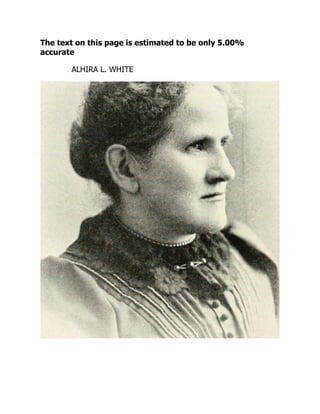
MATLAB Linear Algebra1st Edition Cesar Lopez
Digital Instant Download
Author(s): Cesar Lopez
ISBN(s): 9781484203231, 1484203232
Edition: 1
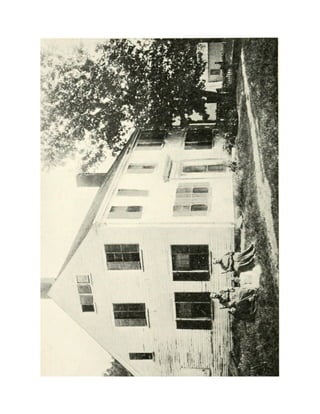
File Details: PDF, 6.20 MB
Year: 2014
Language: english
7.
For your convenienceApress has placed some of the front
matter material after the index. Please use the Bookmarks
and Contents at a Glance links to access them.
8.
iii
Contents at aGlance
About the Author�����������������������������������������������������������������������������������������������������������������ix
Chapter 1: MATLAB Introduction and Working Environment
⌀
■ ���������������������������������������������1
Chapter 2: Variables, Numbers, Operators and Functions
⌀
■ �����������������������������������������������25
Chapter 3: Curves in Explicit, Parametric and Polar Coordinates. Surfaces
⌀
■
��������������������79
Chapter 4: Algebraic Expressions, Polynomials, Equations and Systems
⌀
■ ���������������������137
Chapter 5: Matrices, Vector Spaces and Linear Applications
⌀
■
����������������������������������������201
9.
1
Chapter 1
MATLAB Introductionand Working
Environment
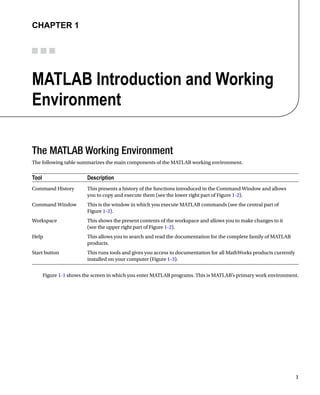
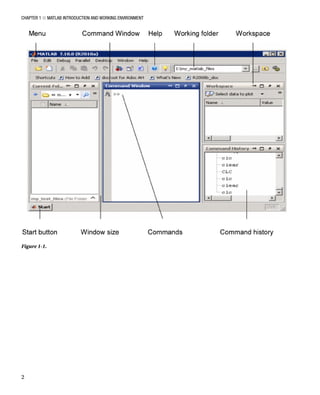
The MATLAB Working Environment
The following table summarizes the main components of the MATLAB working environment.
Tool Description
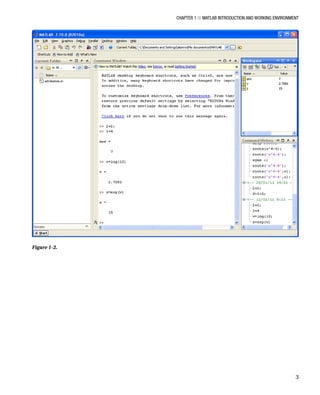
Command History This presents a history of the functions introduced in the Command Window and allows
you to copy and execute them (see the lower right part of Figure€1-2).
Command Window This is the window in which you execute MATLAB commands (see the central part of
Figure€1-2).
Workspace This shows the present contents of the workspace and allows you to make changes to it
(see the upper right part of Figure€1-2).
Help This allows you to search and read the documentation for the complete family of MATLAB
products.
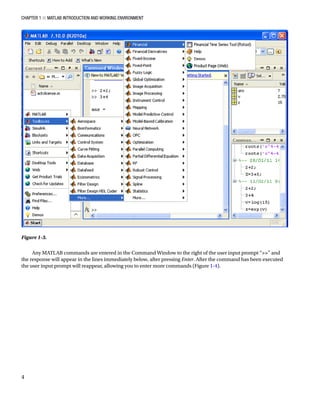
Start button This runs tools and gives you access to documentation for all MathWorks products currently
installed on your computer (Figure€1-3).
Figure€1-1 shows the screen in which you enter MATLAB programs. This is MATLAB’s primary work environment.
10.
Chapter 1 ■MATLAB Introduction and Working Environment
2
Figure 1-1.
11.
Chapter 1 ■MATLAB Introduction and Working Environment
3
Figure 1-2.
12.
Chapter 1 ■MATLAB Introduction and Working Environment
4
Figure 1-3.╇€
Any MATLAB commands are entered in the Command Window to the right of the user input prompt “” and
the response will appear in the lines immediately below, after pressing Enter. After the command has been executed
the user input prompt will reappear, allowing you to enter more commands (Figure€1-4).
13.
Chapter 1 ■MATLAB Introduction and Working Environment
5
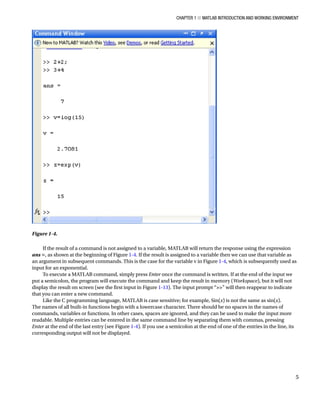
If the result of a command is not assigned to a variable, MATLAB will return the response using the expression
ans =, as shown at the beginning of Figure€1-4. If the result is assigned to a variable then we can use that variable as
an argument in subsequent commands. This is the case for the variable v in Figure€1-4, which is subsequently used as
input for an exponential.
To execute a MATLAB command, simply press Enter once the command is written. If at the end of the input we
put a semicolon, the program will execute the command and keep the result in memory (Workspace), but it will not
display the result on screen (see the first input in Figure€1-13). The input prompt “” will then reappear to indicate
that you can enter a new command.
Like the C programming language, MATLAB is case sensitive; for example, Sin(x) is not the same as sin(x).
The names of all built-in functions begin with a lowercase character. There should be no spaces in the names of
commands, variables or functions. In other cases, spaces are ignored, and they can be used to make the input more
readable. Multiple entries can be entered in the same command line by separating them with commas, pressing
Enter at the end of the last entry (see Figure€1-4). If you use a semicolon at the end of one of the entries in the line, its
corresponding output will not be displayed.
Figure 1-4.╇€
14.
Chapter 1 ■MATLAB Introduction and Working Environment
6
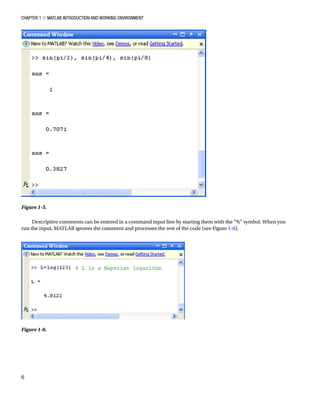
Descriptive comments can be entered in a command input line by starting them with the “%” symbol. When you
run the input, MATLAB ignores the comment and processes the rest of the code (see Figure€1-6).
Figure 1-6.╇€
Figure 1-5.╇€
15.
Chapter 1 ■MATLAB Introduction and Working Environment
7
To simplify the process of entering script to be evaluated by the MATLAB interpreter (via the Command Window
prompt), you can use the arrow keys. For example, if you press the up arrow key once, you will recover the last entry
you submitted. If you press the up key twice, you will recover the penultimate entry you submitted, and so on.
If you type a sequence of characters in the input area and then press the up arrow key, you will recover the last
entry you submitted that begins with the specified string.
Commands entered during a MATLAB session are temporarily stored in the buffer (Workspace) until you end the
session, at which time they can be permanently stored in a file or are permanently lost.
Below is a summary of the keys that can be used in MATLAB’s input area (command line), together with
their functions:
Up arrow (Ctrl-P) Retrieves the previous entry.
Down arrow (Ctrl-N) Retrieves the following entry.
Left arrow (Ctrl-B) Moves the cursor one character to the left.
Right arrow (Ctrl-F) Moves the cursor one character to the right.
CTRL-left arrow Moves the cursor one word to the left.
CTRL-right arrow Moves the cursor one word to the right.
Home (Ctrl-A) Moves the cursor to the beginning of the line.
End (Ctrl-E) Moves the cursor to the end of the current line.
Escape Clears the command line.
Delete (Ctrl-D) Deletes the character indicated by the cursor.
Backspace Deletes the character to the left of the cursor.
CTRL-K Deletes (kills) the current line.
The command clc clears the command window, but does not delete the contents of the work area (the contents
remain in the memory).
Help in MATLAB
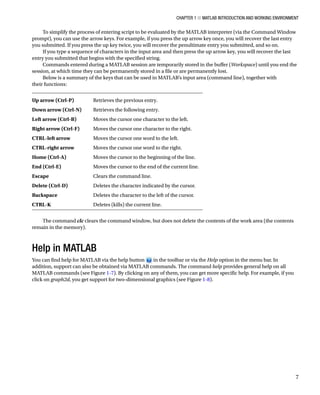
You can find help for MATLAB via the help button in the toolbar or via the Help option in the menu bar. In
addition, support can also be obtained via MATLAB commands. The command help provides general help on all
MATLAB commands (see Figure€1-7). By clicking on any of them, you can get more specific help. For example, if you
click on graph2d, you get support for two-dimensional graphics (see Figure€1-8).
16.
Chapter 1 ■MATLAB Introduction and Working Environment
8
Figure 1-8.
Figure 1-7.
17.
Chapter 1 ■MATLAB Introduction and Working Environment
9
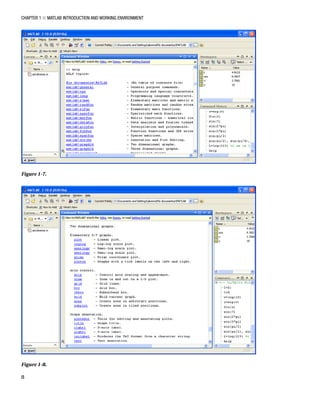
You can ask for help about a specific command command (Figure€1-9) or on any topic topic (Figure€1-10) by using
the command help command or help topic.
Figure 1-9.╇€
Figure 1-10.╇€
18.
Chapter 1 ■MATLAB Introduction and Working Environment
10
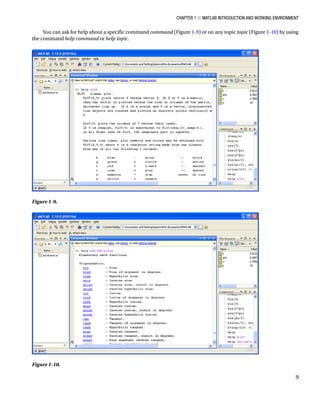
The command lookfor string allows you to find all those MATLAB functions or commands that refer to or contain
the string string. This command is very useful when there is no direct support for the specified string, or to view the
help for all commands related to the given string. For example, if we want to find help for all commands that contain
the sequence inv, we can use the command lookfor inv (Figure€1-11).
Numerical Computation with MATLAB
You can use MATLAB as a powerful numerical computer. While most calculators handle numbers only to a preset
degree of precision, MATLAB performs exact calculations to any desired degree of precision. In addition, unlike
calculators, we can perform operations not only with individual numbers, but also with objects such as arrays.
Most of the topics of classical numerical analysis are treated by this software. It supports matrix calculus, statistics,
interpolation, least squares fitting, numerical integration, minimization of functions, linear programming, numerical
and algebraic solutions of differential equations and a long list of further methods that we’ll meet as this book progresses.
Here are some examples of numerical calculations with MATLAB. (As we know, to obtain the results it is
necessary to press Enter once the desired command has been entered after the prompt “”
.)
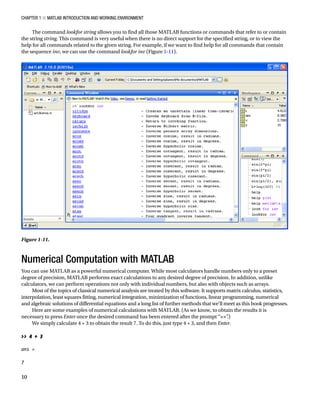
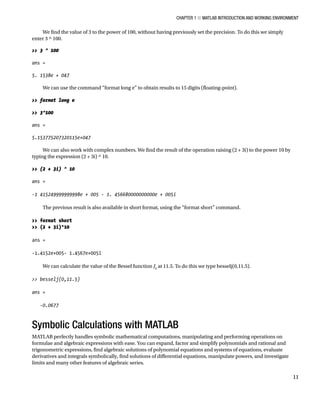
We simply calculate 4 + 3 to obtain the result 7. To do this, just type 4 + 3, and then Enter.
â•›
4 + 3
â•›
ans =
â•›
7
â•›
Figure 1-11.╇€
19.
Chapter 1 ■MATLAB Introduction and Working Environment
11
We find the value of 3 to the power of 100, without having previously set the precision. To do this we simply
enter 3 ^ 100.
3 ^ 100
ans =
5. 1538e + 047
We can use the command “format long e” to obtain results to 15 digits (floating-point).
format long e
3^100
ans =
5.153775207320115e+047
We can also work with complex numbers. We find the result of the operation raising (2 + 3i) to the power 10 by
typing the expression (2 + 3i) ^ 10.
(2 + 3i) ^ 10
ans =
-1 415249999999998e + 005 - 1. 456680000000000e + 005i
The previous result is also available in short format, using the “format short” command.
format short
(2 + 3i)^10
ans =
-1.4152e+005- 1.4567e+005i
We can calculate the value of the Bessel function J0
at 11.5. To do this we type besselj(0,11.5).
besselj(0,11.5)
ans =
-0.0677
Symbolic Calculations with MATLAB
MATLAB perfectly handles symbolic mathematical computations, manipulating and performing operations on
formulae and algebraic expressions with ease. You can expand, factor and simplify polynomials and rational and
trigonometric expressions, find algebraic solutions of polynomial equations and systems of equations, evaluate
derivatives and integrals symbolically, find solutions of differential equations, manipulate powers, and investigate
limits and many other features of algebraic series.
20.
Chapter 1 ■MATLAB Introduction and Working Environment
12
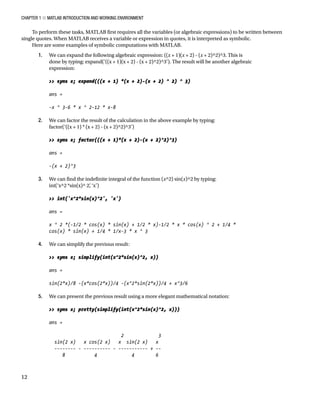
To perform these tasks, MATLAB first requires all the variables (or algebraic expressions) to be written between
single quotes. When MATLAB receives a variable or expression in quotes, it is interpreted as symbolic.
Here are some examples of symbolic computations with MATLAB.
1. We can expand the following algebraic expression: ((x + 1)(x + 2) - (x + 2)^2)^3. This is
done by typing: expand(‘((x + 1)(x + 2) - (x + 2)^2)^3’). The result will be another algebraic
expression:
syms x; expand(((x + 1) *(x + 2)-(x + 2) ^ 2) ^ 3)
ans =
-x ^ 3-6 * x ^ 2-12 * x-8
2. We can factor the result of the calculation in the above example by typing:
factor(‘((x + 1) * (x + 2) - (x + 2)^2)^3’)
syms x; factor(((x + 1)*(x + 2)-(x + 2)^2)^3)
ans =
-(x + 2)^3
3. We can find the indefinite integral of the function (x^2) sin(x)^2 by typing:
int(‘x^2 *sin(x)^ 2’
, ‘x’)
int('x^2*sin(x)^2', 'x')
ans =
x ^ 2 *(-1/2 * cos(x) * sin(x) + 1/2 * x)-1/2 * x * cos(x) ^ 2 + 1/4 *
cos(x) * sin(x) + 1/4 * 1/x-3 * x ^ 3
4. We can simplify the previous result:
syms x; simplify(int(x^2*sin(x)^2, x))
ans =
sin(2*x)/8 -(x*cos(2*x))/4 -(x^2*sin(2*x))/4 + x^3/6
5. We can present the previous result using a more elegant mathematical notation:
syms x; pretty(simplify(int(x^2*sin(x)^2, x)))
ans =
2 3
sin(2 x) x cos(2 x) x sin(2 x) x
-------- - ---------- - ----------- + --
8 4 4 6
21.
Chapter 1 ■MATLAB Introduction and Working Environment
13
6. We can solve the equation 3ax - 7 x^2 + x^3 = 0 (where a is a parameter):
â•›
solve('3*a*x-7*x^2 + x^3 = 0', 'x')
â•›
ans =
â•›
[ 0]
[7/2 + 1/2 *(49-12*a) ^(1/2)]
[7/2-1/2 *(49-12*a) ^(1/2)]
â•›
On the other hand, MATLAB can use the Maple program libraries to work with symbolic math, and can thus
extend its field of action. In this way, MATLAB can be used to work on such topics as differential forms, Euclidean
geometry, projective geometry, statistics, etc.
At the same time, Maple can also benefit from MATLAB’s powers of numerical calculation, which might be used,
for example, in combination with the Maple libraries (combinatorics, optimization, number theory, etc.)
Graphics with MATLAB
MATLAB can generate two- and three-dimensional graphs, as well as contour and density plots. You can graphically
represent data lists, controlling colors, shading and other graphics features. Animated graphics are also supported.
Graphics produced by MATLAB are portable to other programs.
Some examples of MATLAB graphics are given below.
1. We can represent the function xsin(1/x) for x ranging between -p/4 and p/4, taking 300
equidistant points in the interval. See Figure€1-12.
â•›
x = linspace(-pi/4,pi/4,300);
y = x.*sin(1./x);
plot(x,y)
â•›
Figure 1-12.╇€
22.
Chapter 1 ■MATLAB Introduction and Working Environment
14
2. We can give the above graph a title and label the axes, and we can add a grid. See Figure€1-13.
â•›
x = linspace(-pi/4,pi/4,300);
y = x.*sin(1./x);
plot(x,y);
grid;
xlabel('Independent variable X');
ylabel('Dependent variable Y');
title('The function y=xsin(1/x)')
â•›
Figure 1-13.╇€
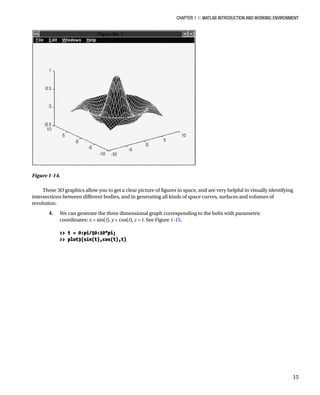
3. We can generate a graph of the surface defined by the function z = sin(sqrt(x^2 + y^2)) /
sqrt(x^2 + y^2), where x and y vary over the interval (-7.5, 7.5), taking equally spaced
points 0.5 apart. See Figure€1-14.
â•›
x = -7.5:. 5:7.5;
y = x;
[X, Y] = meshgrid(x,y);
Z = sin(sqrt(X.^2+Y.^2))./sqrt(X.^2+Y.^2);
surf(X, Y, Z)
â•›
23.
Chapter 1 ■MATLAB Introduction and Working Environment
15
These 3D graphics allow you to get a clear picture of figures in space, and are very helpful in visually identifying
intersections between different bodies, and in generating all kinds of space curves, surfaces and volumes of
revolution.
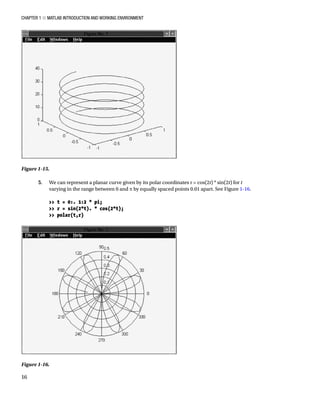
4. We can generate the three dimensional graph corresponding to the helix with parametric
coordinates: x = sin(t), y = cos(t), z = t. See Figure€1-15.
â•›
t = 0:pi/50:10*pi;
plot3(sin(t),cos(t),t)
â•›
Figure 1-14.╇€
24.
Chapter 1 ■MATLAB Introduction and Working Environment
16
5. We can represent a planar curve given by its polar coordinates r = cos(2t) * sin(2t) for t
varying in the range between 0 and p by equally spaced points 0.01 apart. See Figure€1-16.
â•›
t = 0:. 1:2 * pi;
r = sin(2*t). * cos(2*t);
polar(t,r)
â•›
Figure 1-15.╇€
Figure 1-16.╇€
25.
Chapter 1 ■MATLAB Introduction and Working Environment
17
6. We can make a graph of a symbolic function using the command “ezplot”
. See Figure€1-17.
â•›
y = 'x^3/(x^2-1)';
ezplot(y,[-5,5])
â•›
Figure 1-17.╇€
We will go into these concepts in more detail in the chapter on graphics.
General Notation
As for any program, the best way to learn MATLAB is to use it. By practicing on examples you become familiar with
the syntax and notation peculiar to MATLAB. Each example we give consists of the header with the user input prompt
“” followed by the MATLAB response on the next line. See Figure€1-18.
This book wasproduced in EPUB format by the Internet Archive.
The book pages were scanned and converted to EPUB format
automatically. This process relies on optical character recognition,
and is somewhat susceptible to errors. The book may not offer the
correct reading sequence, and there may be weird characters, non-
words, and incorrect guesses at structure. Some page numbers and
headers or footers may remain from the scanned page. The process
which identifies images might have found stray marks on the page
which are not actually images from the book. The hidden page
numbering which may be available to your ereader corresponds to
the numbered pages in the print edition, but is not an exact match;
page numbers will increment at the same rate as the corresponding
print edition, but we may have started numbering before the print
book's visible page numbers. The Internet Archive is working to
improve the scanning process and resulting books, but in the
meantime, we hope that this book will be useful to you.
The Internet Archive was founded in 1996 to build an Internet
library and to promote universal access to all knowledge. The
Archive's purposes include offering permanent access for
researchers, historians, scholars, people with disabilities, and the
general public to historical collections that exist in digital format. The
Internet Archive includes texts, audio, moving images, and software
as well as archived web pages, and provides specialized services for
information access for the blind and other persons with disabilities.
Created with hocr-to-epub (v.1.0.0)
33.
The text onthis page is estimated to be only 0.77%
accurate
^^ ^ / '., -?■ ^ * ^ •'^ s^ V ,0 0,, X-t - °.' --^^^ ^f
tf '^ ^'^ •/. - ^ A^ •; c^-^ sX^'^. ^^% '' ^^'% ° . V . •
x'^' v/ 'ti. V x^~^ '''^^. ■ '% f / ^^ » ^ o^. J r .
34.
The text onthis page is estimated to be only 0.31%
accurate
^ o o , ^ x^^ °^. ''^ .^' ,/% V^ '.' '/, 'c o. .-oo 0^ .^
^^. '^l .# r. / ■% J V ■^o 0^ ^*' %. '-n^ v^ O ' 0^' V ';^- ■ -f..
v-^^ ^ ^0 ^.. vT-^ .0^ •^ir .^ r. k, 'U ^'■' '■'■'■ v- ^ V 1 '
/ v Oo. ■^ ^ ^ .^^^ -.o^^ 1 » o '-. ^v. ^^ v ■'•= ' 9
'^y^^s A ,0 0. -^^ s i -n^. -r'00'= .5 -V Vv .-^^ nO^v-^ o 0^
•^ -s. .^^ ./ •^^ ''■'. ,v^ U ,V .^■^ ct
35.
The text onthis page is estimated to be only 2.33%
accurate
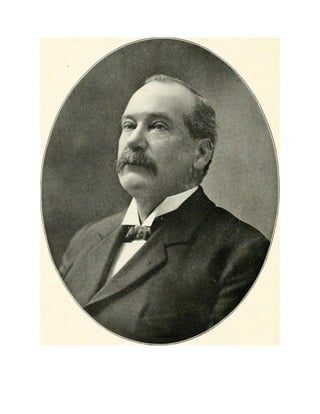
ANUKEW JACKSON MOUUUON
37.
GENEALOGY OF THEDESCENDANTS OF Nicholas Hodsdon-
Hodgdon OF HiNGHAM, Mass, and Kitteky, Maine. 1635-1904.
PUBLISHED BY Andrew Jackson Hodgdon EDITED BY Almira Larkin
White OF HAVERHILL, MASSACHUSETHS. HAVERHILL, MASS. PRESS
OF NICHOLS, THE PRINTER 1904
38.
The text onthis page is estimated to be only 0.00%
accurate
/
39.
PREFACE. This workhas taken a considerable part of ni)-
time for nearly ten years, and has been quite expensive in many
ways. If a full year's time and the expenditure of two thousand
dollars could have been given in addition for research in England,
the comi)lete English record of the family could have been secured,
but I have not felt that I could afford either time or expense. I
started with the idea, simply, of tracing my own line of ancestry, but
have found this pleasant work leading me into so many other
different lines that as a record of the Hodgdon family in America it is
more complete than was at first intended. Thanks are due to
Frederick M. Hodgdon of Haverhill, Mass., also to Fordyce C. B.
Hodgdon of Key West, Fla., who have kindly offered to share in the
expense of publication ; also to Miss Almira L. White of Haverhill for
the able and conscientious manner in which she has edited the
book, and to all others who have kindly furnished information and
pictures. In the years of expansion of this country the Hodgdon
family has had its share, and in the pursuit of industry and
commerce has gone into many of the states of the union. Naturally
the tracing of genealogical records has, therefore, met with some
difficulties and the result is likely to fall short of being absolutely
complete and perfect. The following record is, however, the result of
careful and persistent inquiry, and no line has been left until
satisfactory information has been secured, or the futility of further
inquiry demonstrated. I trust that the book will meet with the
approbation of the members of the Hodgdon family, that they may
take pleasure in its reading, as I have in its preparation. ANDREW J.
HODGDON.
40.
The text onthis page is estimated to be only 0.00%
accurate
/'T^ 8^|j^*w-^IW*^^^^'»^T|S'lfc?ill^^^lnt nf
TJnftj^^ini.
41.
EXPLANATIONS. In arrangingthis work it has been my
object to give all the authentic history and genealogy of the first hve
generations of Nicholas Hodsdon and his descendants in the plainest
manner. The work is carried forwartl in the usual form to the fifth
generation, then we have onl}' attempted to trace the families of
Maj. Caleb and his brothers, Israel, Peter and John, and his sister,
Abigail (ITodgdon) Peaslee. We find the name variously spelled and
have copied it in every instance as we found it, one brother using
the s and the other theg. The Arms of Hodsdon of Hodsdon, County
Hertfordshire, England, were procured from Cullerton's Heraldic
Office, London. They are inserted as the Arms of the family in
England ; although, for want of time and money, we have been
unable to trace the English ancestry of Nicholas Hodsdon. Arms :
Argent, a bend wavy gules, between two hoi-se shoes azure. Crest :
A man's head couped at the shoulders prosier, vested argent, on the
head a cap or. Motto : Aninio et fide (By courage and faith). I have
made use of no unusual abbreviations, using those of months and
states, also, b., born ; bapt.,' baptized ; m., married ; d., died; p.,
page; vol., volume; dau., daughter. Each member is numbered at
birth, and when the name is followed by -|- it will be found again in
its proper place with the birth number in a bracket at the right of the
name. If no -|- follows, all I could learn is recorded at the birth. The
small sui:)erior figure at the end of each name denotes the
generation. EDITOR.
42.
ILLUSTRATIONS, Andrew J.Hodgdon (Frontispiece) Arms
of Hodsdon of Hodsdon Almira L. White . . . • Nicholas Hodsdon
Homestead Homestead of James Gowen . Homestead of Maj. Caleb
Hodgdon Israel Hodgdon Moses Hodgdon Mrs. Moses Hodgdon
Hanson Hodgdon William C. Hodgdon John Hodgdon . Mr. and Mrs.
Moses Hodgdon, Jr. Homestead of Moses Hodgdon, Jr Charles N.
Hodgdon James C. S. Hodgdon David T. P. Hodgdon FoRDiCE C. B.
Hodgdon Frederick M. Hodgdon Edward J. Hodgdon Shedd Boys
Homestead of John Hodgdon Charles Hodsdon Mrs. Irene (Hodsdon)
White Timothy F. White . Charles H.White . Mrs. Charles H. White .
White Family . PAGE. 5 9 11 56 66 69 72 73 74 75 76 80 81 82 83
84 86 94 95 96 108 III 112 113 118 119 129
43.
The text onthis page is estimated to be only 5.00%
accurate
ALHIRA L. WHITE
44.
GENEALOGY OF THEHODSDON OR HODGDON FA^ILY 1.
Nicholas Hodsdon of Hingham, Mass, 1635; and in 1636, the town of
Hingham, granted him a house lot in the center of the town, and
later, two or more meadows were granted him in the same town;
reference is made to these meadows, in a deed given by Samuel
Ward of Charlestown, Mass., to Edward Wilder, Mar. 30, 1665.
(Suffolk deeds, Vol. 4, p. 282.) Nicholas was made freeman Mar. 9,
1636-7, (in the record the name is given as Hudson), he remained in
Hingham until alxuit 1650, when in company with John Winchester,
Thomas Hammond, John Parker, Vincent Druce and others, he
purchased large tracts of land at Cambridge Hill, now Newton, Mass.,
near the line which divides Brookline and Newton. Nicholas Hodsdin
at Mr. Hibbins farme in Boston in Suffolk, hath souled to Thomas
Hammond and Vincent Bruse (Druce ) both of Hingham, in the same
County, a parcell of land containing sixty seaven acres more or less,
lying on Cambridge Hill adjoining to John Parker's to the North,
Northwest and Northeast of the said John Parker's with thirteen
acres more or less of meadow belonging thereunto, the which land
was by the Towne of Cambridge given to Robert Bradish. Also
sixteen acres in Boston bounds next to Cambridge Hill to the South
of it, and to the East
45.
10 GENEALOGY OFTHE and North cast of Mr. Hibbins' land,
to have and to hold Dated, Feb. 4, 1650; recorded, Aug. 20, 1651.
Middlesex Ciinty deeds, Vol. I; p. 24. Nicholas Modsdon of Boston
to John Parker of Cambridge a just third part of all the lands bought
by him of Robert Bradish. Wife Elizabeth gives her consent and
yields up her right, Mar. 20, 1651. Dated, Aug. 6, 16 — ; recorded.
May 24, 1656. Middlesex County deeds. We find no deed or land
grant between the above date and Oct. 15, 1656, when he received
a grant of land from the town of Kittery. Me., but seems to have
been living there prior to that date as see grant below. Granted,
lotted and layed out by the Selectmen for Kittery unto Nicholas
Hodsdon, his heirs and assigns forever, a lot of land above his
house, bounded on the South side by Miles Thompson's land as may
appear by several marked trees which go upon the line south east
and by east unto the woods one hundred and sixty poles unto a tree
marked four ways, and from said tree to go upon the line north and
south and by east unto a marked tree Standing by the brook of
Birchen Poynt and to come down the said brook unto the water or
river, which brook is the bounds of said lot. Dated Oct. 15, 1656.
Kittery town records, p. 9. Dec. 13, 1669, Nicholas received another
grant of land from the town of Kittery, this lot being sixty poles in
length, and adjoining Birchen Point Brook. This lot was laid out Jan.
1672. In 1673, Nicholas received still another grant of land from the
town, which was for 100 acres of land. This grant however was not
laid out during his lifetime, but was sold by his descendants at
various times. The following deposition of Nicholas and his wife is of
interest, and shows that at the time they settled at Kittery, they
resided at Quamphegon : The deposition of Nicholasse Hodesden
and his wife, aged 40
46.
The text onthis page is estimated to be only 6.17%
accurate
e e , E C9 u. z o Q a o r -J o r (J ■a c o 9 z LU o en h
z oa o o 3 C 1 U
49.
HODSDON OR IIODGDONFAMILY. 11 years and upwards.
These deponents being sworne saith that fifteene or sixteene yeares
agoe that Thomas Spensecr being at Quamphegon at the house wee
lived in sayd, that he had given the one half part of the mill timber
thereunto belonging, being one quarter part of the mill unto Daniell
Goodin for his dafters portion. Nicholas Hodsden his wife replied
said, neybouer Spenser I wish you well to consider what )ou doe. for
you had many children every one would have a littcll and you
cannot give every one such a Portion, and he answered said, that
she was the eldest dafter hee had don yt farthensaith not.
Dated, Apr. 18, 1670. Nicholas purchased several lots of land in the
vicinity of Birchen Point Brook. Peter Wittum sold him forty acres of
upland and swamp, butting upon the land of said Nicholas, and
running back to Rocky Hills. John Wincoll sold Nicholas one
Tenement with about 30 acres of land, bounded by land of Miles
Thompson on the South, the River on the West and Birchen Brook
and Coe on the North and highway that leadeth toward Sturgeon
Creeke. Dated June 16, 1674. The farm which Nicholas occupied
the latter part of his life, is undoubtedly the one just montioned as
having been i:)urchased of John Wincoll in 1674. It is situated upon
the easterly side of the Piscataqua river, which divides Kittery from
Dover. It is located in the extreme southerly part of South Berwick,
and is bounded on the North by Birchen Point Brook ; on the south
by the farm formerly owned by Miles Thompson. This last mentioned
farm was bounded on the south by Thomj^son's Brook, which Brook
divides the towns of Eliot and South Berwick. The homestead, as will
be noticed later, was given by Nicholas to his son Benoni, from
whom it descended in regular gradation to John and Henry
Hodsdon; who sold it to Theo. F. and Thomas Jewett, May 17, 1828,
(York deeds, Vol. 130. p. 82.) at which time the estate passed out of
the Hodsdon family. The Jewetts sold the entire farm to William
Flynn by deed of Jan. 28, 1850,
50.
12 GENEALOGY OFTHE (York deeds, 'ol. 210, p. 449.) and
it is still occupied by the widow and children of Mr. Flynn.
Agreement Ijetween Nicholas Hodsdon of Kittery, husbandman, and
Benoni Hodsdon, son of said Nicholas, agrees that Bcnoni shall
during the Natural life of Nicholas, have, hold and use in Partnership
with his father, all that farm that his father has for several years lived
upon, with all lands, medows, Orchards, Marshes, garden and all the
privileges thereunto belonging or in any wise appertaining without
any division of lands or houses, but in partnership and the same
shall hold during the Natural life of said Nicholas. It is agreed that all
of the stock of any nature heretofore belonging to the said Nicholas
or Benoni are to be one half the said Nicholas and the other half the
said Benoni. The said Benc^ni agrees to take the best of care of the
farm and pay all charges and any profit arising from the product of
the farm to be equally divided every year. It is agreed after the
death of Nicholas the goods and implements of the farm shall belong
to Benoni. Dated, Dec. 9, 1678. York deeds. Vol. 3, p. 41. Nicholas
Hodgsden of Kittery for iJ130 sells his son Benoni, all that my
mansion or dwelling house and all barnes and edifices. All of which I
heretofore purchased of John Wincoll, containing 40 acres. Also 56
acres of land long since Granted unto me by the town of Kittery;
Bounded by the great River Pischataqua, or at least a branch thereof
on the West, and with a fresh brook on ye North, which brooke
devides between my lands and one Left. Playstead's land, late
deceased. And on ye East with certain marked trees, and on the
South with land of Miles Thompson. except about seven acres given
John Morrell and his wife Sarah. Ik-noni to proide for Nicholas and
his wife Elizabeth. Benoni to pay her £( yearly during her natural
life. Dated, Oct. 22, 1678.
51.
HODSDON Ok IIODCDONKAMILV. IJ York deeds, Vol. 3, p.
31. The seven acres given to John Morrell and his wife Sarah, were
deeded them by Nicholas and his wife Elizabeth, Dec. 3. 1674. The
lot was situated in the northeast corner of the homestead, and was
bounded on the north by JiirclTcn Point I'look. Aiicv beini;- owned
b)- various parties, the lot was purchased by IV-noni Ilodsdon in 17
03, when the entire homestead was once more owned by one of the
Hodsdon family, where it reiv.ained for tlie succeedine: 125 fc
years. Nicholas Hodsdon m. about 1639, Esther Wines, a cousin of
Faintnot Wines of Charlestown, as proved b- the foljowin*;-:
Faintnot Wines, Flaxdresser, inhabitant of Charlestown, Mass., 1635,
with wife Bridget. He d. Feb, 25, 1664. will dated Sept. 1, 1663,
proved June 20, 1665. Devised legacies to five of Nicholas
Hodgdon's children by his cousin Esther Wines. Wife Esther d. in
Hingham, Mass., Nov. 29, 1647, and he m. (2) between May 25,
164S, and Oct. 2, 1650, Elizabeth, widow of John Needham, as
proved by the following, from Aspinwall Notarial Records : 25. 3.
1648, I did testifie unto a Lee of the Attorney made from Eliz.
Needham to John Scarlet to recei-e all such goods ns were due or
belonging to her husband in Virginia. She being credibly informed of
his death. p. 128. 2. 8. 1650, Nicholas Hodsdon and Eliz. his wife
(formeily wife of John Needham) did make ordeine c : Peter
Irackett of Braintre in N. E, theire true lawful Attorney to ask c
: of Capt. Varvell or any other in whose hands maybe certaine goods
of her former husband John Needham, shipped aboard the sliip[) of
the said Capt. Varvell to carry to V^irginia, ^ of the receipt to give
acquittance c : also to compound c : to apjiear in an' Court or
Courts c : generally to doe all things c : with power to
substitute c : ratifying c : p. 324. The place and date of death of
Nicholas and Elizabeth is unknown. They were probably buried in the
graveyard which was laid out on a portion of the homestead, to
which reference is made in the deed given May 17, 1828.
Reserving and excepting fp-m this conveyance one eighth of an acre
on the homestead (irst
52.
Welcome to ourwebsite – the ideal destination for book lovers and
knowledge seekers. With a mission to inspire endlessly, we offer a
vast collection of books, ranging from classic literary works to
specialized publications, self-development books, and children's
literature. Each book is a new journey of discovery, expanding
knowledge and enriching the soul of the reade
Our website is not just a platform for buying books, but a bridge
connecting readers to the timeless values of culture and wisdom. With
an elegant, user-friendly interface and an intelligent search system,
we are committed to providing a quick and convenient shopping
experience. Additionally, our special promotions and home delivery
services ensure that you save time and fully enjoy the joy of reading.
Let us accompany you on the journey of exploring knowledge and
personal growth!
ebookfinal.com


![Chapter 1 ■ MATLAB Introduction and Working Environment
13
6. We can solve the equation 3ax - 7 x^2 + x^3 = 0 (where a is a parameter):
â•›
solve('3*a*x-7*x^2 + x^3 = 0', 'x')
â•›
ans =
â•›
[ 0]
[7/2 + 1/2 *(49-12*a) ^(1/2)]
[7/2-1/2 *(49-12*a) ^(1/2)]
â•›
On the other hand, MATLAB can use the Maple program libraries to work with symbolic math, and can thus
extend its field of action. In this way, MATLAB can be used to work on such topics as differential forms, Euclidean
geometry, projective geometry, statistics, etc.
At the same time, Maple can also benefit from MATLAB’s powers of numerical calculation, which might be used,
for example, in combination with the Maple libraries (combinatorics, optimization, number theory, etc.)
Graphics with MATLAB
MATLAB can generate two- and three-dimensional graphs, as well as contour and density plots. You can graphically
represent data lists, controlling colors, shading and other graphics features. Animated graphics are also supported.
Graphics produced by MATLAB are portable to other programs.
Some examples of MATLAB graphics are given below.
1. We can represent the function xsin(1/x) for x ranging between -p/4 and p/4, taking 300
equidistant points in the interval. See Figure€1-12.
â•›
x = linspace(-pi/4,pi/4,300);
y = x.*sin(1./x);
plot(x,y)
â•›
Figure 1-12.╇€](https://image.slidesharecdn.com/75201-250725182325-dc15ed70/85/MATLAB-Linear-Algebra-1st-Edition-Cesar-Lopez-21-320.jpg)
![Chapter 1 ■ MATLAB Introduction and Working Environment
14
2. We can give the above graph a title and label the axes, and we can add a grid. See Figure€1-13.
â•›
x = linspace(-pi/4,pi/4,300);
y = x.*sin(1./x);
plot(x,y);
grid;
xlabel('Independent variable X');
ylabel('Dependent variable Y');
title('The function y=xsin(1/x)')
â•›
Figure 1-13.╇€
3. We can generate a graph of the surface defined by the function z = sin(sqrt(x^2 + y^2)) /
sqrt(x^2 + y^2), where x and y vary over the interval (-7.5, 7.5), taking equally spaced
points 0.5 apart. See Figure€1-14.
â•›
x = -7.5:. 5:7.5;
y = x;
[X, Y] = meshgrid(x,y);
Z = sin(sqrt(X.^2+Y.^2))./sqrt(X.^2+Y.^2);
surf(X, Y, Z)
â•›](https://image.slidesharecdn.com/75201-250725182325-dc15ed70/85/MATLAB-Linear-Algebra-1st-Edition-Cesar-Lopez-22-320.jpg)
![Chapter 1 ■ MATLAB Introduction and Working Environment
17
6. We can make a graph of a symbolic function using the command “ezplot”
. See Figure€1-17.
â•›
y = 'x^3/(x^2-1)';
ezplot(y,[-5,5])
â•›
Figure 1-17.╇€
We will go into these concepts in more detail in the chapter on graphics.
General Notation
As for any program, the best way to learn MATLAB is to use it. By practicing on examples you become familiar with
the syntax and notation peculiar to MATLAB. Each example we give consists of the header with the user input prompt
“” followed by the MATLAB response on the next line. See Figure€1-18.](https://image.slidesharecdn.com/75201-250725182325-dc15ed70/85/MATLAB-Linear-Algebra-1st-Edition-Cesar-Lopez-25-320.jpg)