From Nanomedicine to Nanohealth
Conceptualizing the biomedical model proposed by the
                 nanotech revolution

Mathieu Noury (PhD candidate)
Université de Montréal
Université de Paris – Ouest

Email : mathieu.noury@umontreal.ca
Summary
Nanomedicine and nanohealth. What is the difference?

A transversal medicine

An enhancement medicine

A global medicine

Conclusion
Nanomedicine and Nanohealth


‘‘The aim of nanomedicine maybe broadly defined as the
    comprehensive monitoring, repair, and improvement of all
    human biological systems, working from molecular level using
    engineered devices and nanostructures to achieve medical
    benefit”


   European Science Foundation. (February 2005). ESF Scientific Forward Look on
   Nanomedicine, Strasbourg: ESF, p. 2.
Roco, M., Mirkin, C., &Hersam, M. (2010). Nanotechnology Research Directions for Societal
Needs in 2020. US: Springer, p. 272.
Nanomedicine and Nanohealth


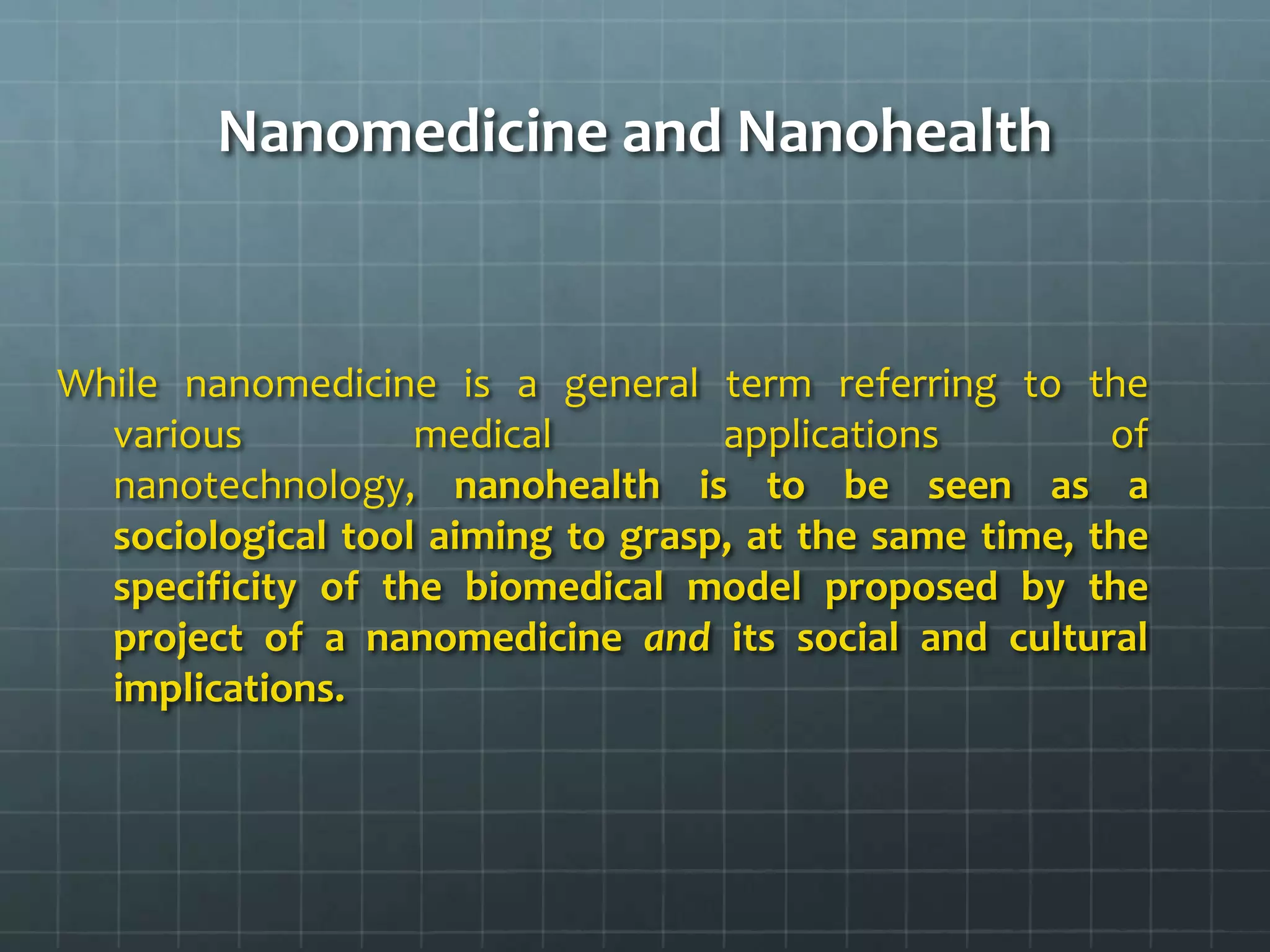
While nanomedicine is a general term referring to the
  various          medical         applications         of
  nanotechnology, nanohealth is to be seen as a
  sociological tool aiming to grasp, at the same time, the
  specificity of the biomedical model proposed by the
  project of a nanomedicine and its social and cultural
  implications.
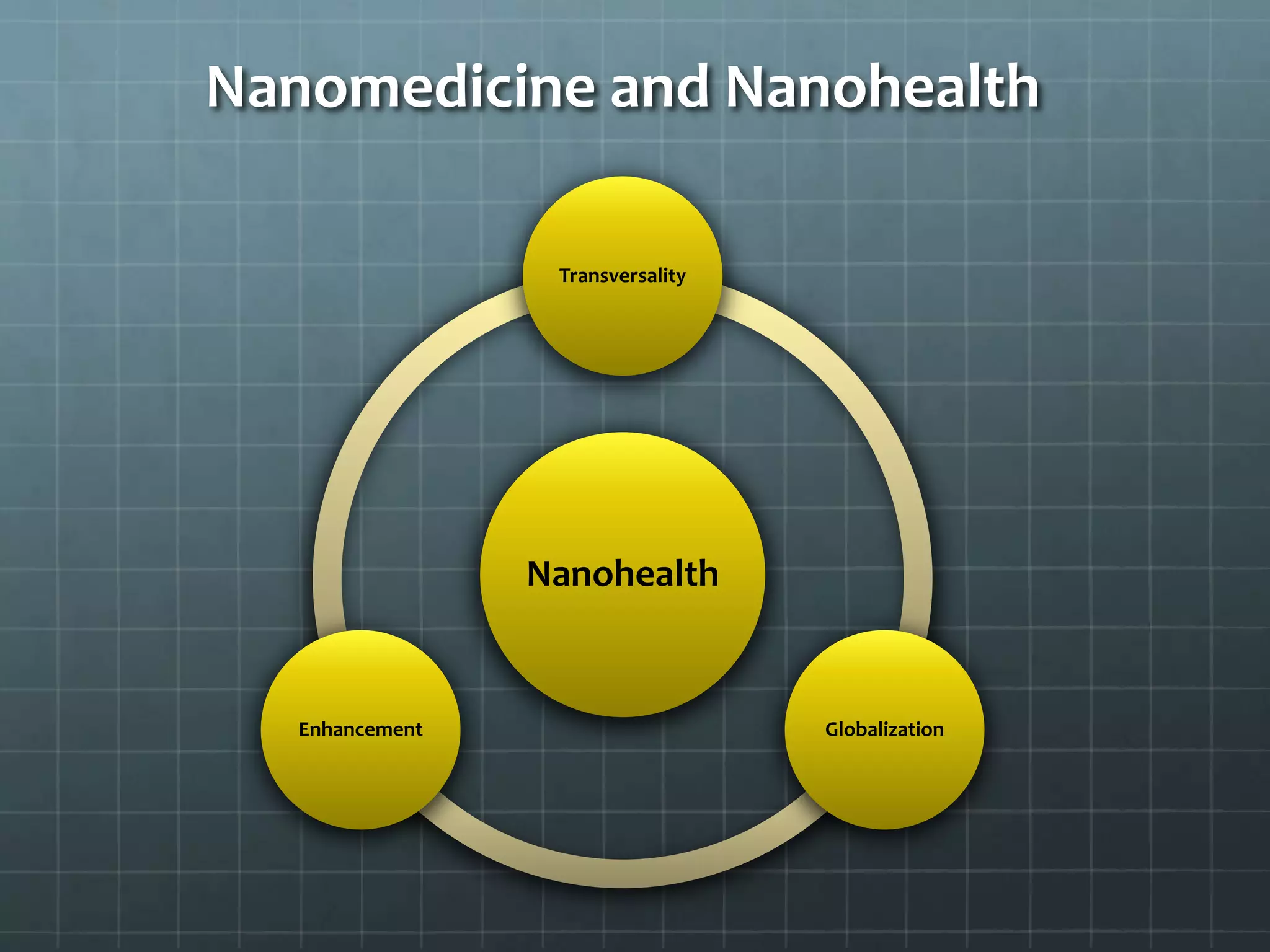
Nanomedicine and Nanohealth

                  Transversality


                 Nanohealth


   Enhancement                     Globalization
1. A transversal model


            Predictive
            medicine


 Regenerative        Personalized
   medicine           medicine
1. A transversal model
                             Predictive Medicine


‘‘In nanodiagnostic, the ultimate goal is to identify disease
    at the earliest stage possible, ideally at the level of a
    single cell’’


European Technology Platform on Nanomedicine. (September 2005). Vision Paper and Basis for a
    Strategic Research Agenda for Nanomedicine. Luxembourg: ETPN & European Commission, p. 6.
1. A transversal model
                             Personalized Medicine

‘‘Nanotechnology enables further refinement of diagnostic
    techniques, leading to high throughput screening (to test one
    sample for numerous diseases, or screen large numbers of
    samples for one disease) and ultimately point-of-care
    diagnostics. These technological advancements pave the way
    towards major changes in the way drugs can be prescribed in
    future, by enabling the goal of personalized medicine that is
    tailored to individual needs’’.


   European Technology Platform on Nanomedicine. (September 2005). Vision Paper and Basis for a
   Strategic Research Agenda for Nanomedicine. Luxembourg: ETPN & European Commission, p. 15.
1. A transversal model
                               Regenerative Medicine

‘‘Regenerative Medicine addresses the repair, replacement or
   regeneration of damaged tissues or organs via a
   combination of technological approaches. They can be
   divided into two sub-areas: smart biomaterials and
   advanced cell therapy. Ultimately, it is envisaged as being
   able to cure specific diseases or repairing damaged tissues,
   such as cartilage, bone, teeth, muscle, or nerves’’.


ETPN. (2009). Roadmaps in nanomedicine: towards 2020. Luxembourg: ETPN &EuropeanComission, p. 31.
1. A transversal model
                          Regenerative Medicine


‘‘The body of the tissue engineering model does not simply
    spontaneously heal, but requires an elaborate apparatus
    for properly enframing the regenerative potential of
    cells and tissues’’.


Thacker, E. (2005). The Global Genome. Biotechnology, Politics, and Culture. Cambridge: MIT
    Press, p. 261.
2. An enhancement medicine

‘‘contemporary medical technologies do not seek
    merely to cure diseases once they have manifested
    themselves, but to control the vital processes of the
    body and mind. They are […] technologies of
    optimization’’.


Rose, N. (2007) The Politics of Life Itself. Biomedicine, Power, and Subjectivity in the
    Twenty-First Century, Princeton: Princeton University Press, p. 16.
2. An enhancement medicine

“regenerative medicine and nanomedicine have the potential
       to improve the health of Canadians and change the way
       our health care system protects,   maintains and restores
       health”.

      “[Nanomedicine] focuses on strategies that promote health
      and prevent disease. Its ultimate goal is to develop innovative
      and socially validated treatment approaches that will improve
      the quality of life of individuals and populations”.


       Canadian Institutes of Health Research. (2006). Regenerative medicine &
       Nanomedicine: Investing today in the promise of tomorrow, Ottawa: CIHR, p. 6-7.
2. An enhancement medicine

‘‘The medicalization and disease-mongering phenomenon
    increases and moves toward the transhumanization of
    medicalization, where enhancing, improving and
    modifying the human body beyond its species-typical
    boundaries is part of the concept of being healthy’’.


Wolbring, G. (2005). The triangle of enhancement medicine, disabled people, and the concept of health :
    a new challenge for HTA, health research, and health policy. Edmonton: Alberta Heritage
    Foundation for Medical Research, p. 3.
3. A global medicine


  Major governmental investments in
nanotechnology (including nanomedicine)
3. A global medicine


Nanomedicine indicates the centrality of what many
  people has starting to call an “economic-industrial-
  technological-scientific-complex”                of
  technoscience, which has replaced the declining
  “military-industrial complex.”
3. A global medicine

“The OECD Project supposes the bioeconomy to be the aggregate set of
   economic operations in a societythat use the latent value incumbent in
   biological products and processes to capture new growth and welfare
   benefits for citizens and nations. […] The bioeconomy is made possible
   by the recent and continuing surge in the scientific knowledge and
   technical competences that can be directed to harness biological
   processes for practical applications.
    […] Unsurprisingly therefore, strategic interest is growing in the
    biosciences in both OECD and non-OECD countries. Indeed, the
    bioeconomy is growing faster in China, India and Singapore than in many
    OECD countries and the lead position occupied by OECD countries in most
    fields is being challenge”.


OECD. (2006). The Bioeconomy to 2030: Designing a Policy Agenda. Paris: OECD, p. 1-2
3. A global medicine


R.: Canada has an opportunity to take a leader role in regenerative
medicine. If we don’t do it, someone else will. If someone else does it, we
will still pay for it and we won’t take as much of the economic benefits. So
you cannot stop it. No one cares of Canada, no ones worldwide cares of
Canada funds it or not. At the end, everyone would want its benefit. So if
we have an opportunity to become a significant player, and something has
going to happen anyways, we should take it.

M.: Do you think there is a worldwide pressure to develop this…

R.: …it’s not so much a pressure, it’s a race.
Conclusion

Mathieu Noury_From nanomedicine to nanohealth conceptualizing the biomedical model proposed by the nanotech revolution

  • 1.
    From Nanomedicine toNanohealth Conceptualizing the biomedical model proposed by the nanotech revolution Mathieu Noury (PhD candidate) Université de Montréal Université de Paris – Ouest Email : mathieu.noury@umontreal.ca
  • 2.
    Summary Nanomedicine and nanohealth.What is the difference? A transversal medicine An enhancement medicine A global medicine Conclusion
  • 3.
    Nanomedicine and Nanohealth ‘‘Theaim of nanomedicine maybe broadly defined as the comprehensive monitoring, repair, and improvement of all human biological systems, working from molecular level using engineered devices and nanostructures to achieve medical benefit” European Science Foundation. (February 2005). ESF Scientific Forward Look on Nanomedicine, Strasbourg: ESF, p. 2.
  • 4.
    Roco, M., Mirkin,C., &Hersam, M. (2010). Nanotechnology Research Directions for Societal Needs in 2020. US: Springer, p. 272.
  • 5.
    Nanomedicine and Nanohealth Whilenanomedicine is a general term referring to the various medical applications of nanotechnology, nanohealth is to be seen as a sociological tool aiming to grasp, at the same time, the specificity of the biomedical model proposed by the project of a nanomedicine and its social and cultural implications.
  • 6.
    Nanomedicine and Nanohealth Transversality Nanohealth Enhancement Globalization
  • 7.
    1. A transversalmodel Predictive medicine Regenerative Personalized medicine medicine
  • 8.
    1. A transversalmodel Predictive Medicine ‘‘In nanodiagnostic, the ultimate goal is to identify disease at the earliest stage possible, ideally at the level of a single cell’’ European Technology Platform on Nanomedicine. (September 2005). Vision Paper and Basis for a Strategic Research Agenda for Nanomedicine. Luxembourg: ETPN & European Commission, p. 6.
  • 9.
    1. A transversalmodel Personalized Medicine ‘‘Nanotechnology enables further refinement of diagnostic techniques, leading to high throughput screening (to test one sample for numerous diseases, or screen large numbers of samples for one disease) and ultimately point-of-care diagnostics. These technological advancements pave the way towards major changes in the way drugs can be prescribed in future, by enabling the goal of personalized medicine that is tailored to individual needs’’. European Technology Platform on Nanomedicine. (September 2005). Vision Paper and Basis for a Strategic Research Agenda for Nanomedicine. Luxembourg: ETPN & European Commission, p. 15.
  • 10.
    1. A transversalmodel Regenerative Medicine ‘‘Regenerative Medicine addresses the repair, replacement or regeneration of damaged tissues or organs via a combination of technological approaches. They can be divided into two sub-areas: smart biomaterials and advanced cell therapy. Ultimately, it is envisaged as being able to cure specific diseases or repairing damaged tissues, such as cartilage, bone, teeth, muscle, or nerves’’. ETPN. (2009). Roadmaps in nanomedicine: towards 2020. Luxembourg: ETPN &EuropeanComission, p. 31.
  • 11.
    1. A transversalmodel Regenerative Medicine ‘‘The body of the tissue engineering model does not simply spontaneously heal, but requires an elaborate apparatus for properly enframing the regenerative potential of cells and tissues’’. Thacker, E. (2005). The Global Genome. Biotechnology, Politics, and Culture. Cambridge: MIT Press, p. 261.
  • 12.
    2. An enhancementmedicine ‘‘contemporary medical technologies do not seek merely to cure diseases once they have manifested themselves, but to control the vital processes of the body and mind. They are […] technologies of optimization’’. Rose, N. (2007) The Politics of Life Itself. Biomedicine, Power, and Subjectivity in the Twenty-First Century, Princeton: Princeton University Press, p. 16.
  • 13.
    2. An enhancementmedicine “regenerative medicine and nanomedicine have the potential to improve the health of Canadians and change the way our health care system protects, maintains and restores health”. “[Nanomedicine] focuses on strategies that promote health and prevent disease. Its ultimate goal is to develop innovative and socially validated treatment approaches that will improve the quality of life of individuals and populations”. Canadian Institutes of Health Research. (2006). Regenerative medicine & Nanomedicine: Investing today in the promise of tomorrow, Ottawa: CIHR, p. 6-7.
  • 14.
    2. An enhancementmedicine ‘‘The medicalization and disease-mongering phenomenon increases and moves toward the transhumanization of medicalization, where enhancing, improving and modifying the human body beyond its species-typical boundaries is part of the concept of being healthy’’. Wolbring, G. (2005). The triangle of enhancement medicine, disabled people, and the concept of health : a new challenge for HTA, health research, and health policy. Edmonton: Alberta Heritage Foundation for Medical Research, p. 3.
  • 15.
    3. A globalmedicine Major governmental investments in nanotechnology (including nanomedicine)
  • 16.
    3. A globalmedicine Nanomedicine indicates the centrality of what many people has starting to call an “economic-industrial- technological-scientific-complex” of technoscience, which has replaced the declining “military-industrial complex.”
  • 17.
    3. A globalmedicine “The OECD Project supposes the bioeconomy to be the aggregate set of economic operations in a societythat use the latent value incumbent in biological products and processes to capture new growth and welfare benefits for citizens and nations. […] The bioeconomy is made possible by the recent and continuing surge in the scientific knowledge and technical competences that can be directed to harness biological processes for practical applications. […] Unsurprisingly therefore, strategic interest is growing in the biosciences in both OECD and non-OECD countries. Indeed, the bioeconomy is growing faster in China, India and Singapore than in many OECD countries and the lead position occupied by OECD countries in most fields is being challenge”. OECD. (2006). The Bioeconomy to 2030: Designing a Policy Agenda. Paris: OECD, p. 1-2
  • 18.
    3. A globalmedicine R.: Canada has an opportunity to take a leader role in regenerative medicine. If we don’t do it, someone else will. If someone else does it, we will still pay for it and we won’t take as much of the economic benefits. So you cannot stop it. No one cares of Canada, no ones worldwide cares of Canada funds it or not. At the end, everyone would want its benefit. So if we have an opportunity to become a significant player, and something has going to happen anyways, we should take it. M.: Do you think there is a worldwide pressure to develop this… R.: …it’s not so much a pressure, it’s a race.
  • 19.