Digital Plan - 4
Preliminary Information
Name: BSD
Roll No.: 1642-
Subject: Mathematics
Class: IX
Topic: Areas
Duration: 45 min
Method: Digital Plan
Academic Standards
1. Problem Solving – Student will be able to solve problems
based on areas of parallelogram and triangle
2. Reasoning Proof – Students will be able to ask for reasoning
and proof of how the area is calculated for parallelograms and
triangles
3. Communication – Students will be able to communicate the
definitions of a parallelogram, triangle and congruency
4. Connection – Student will be able to connect the area
formulae to the real-life objects
5. Visualization and Representation – Student will be able to
visualize the different parallelograms and triangles, and
represent them accordingly
AREAS OF
PARALLELOGRAMS AND
TRIANGLES
Content Analysis
 Definition of a Parallelogram
 Properties of a Parallelogram
 Area of Parallelogram
 Definition of a Triangle
 Properties of a Triangle
 Area of Triangle
 Congruency
 Theorems related to Congruency
PARALLELOGRAM
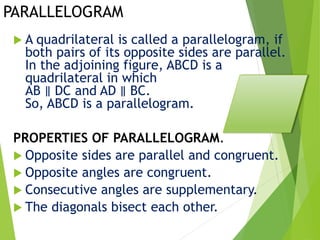
 A quadrilateral is called a parallelogram, if
both pairs of its opposite sides are parallel.
In the adjoining figure, ABCD is a
quadrilateral in which
AB ∥ DC and AD ∥ BC.
So, ABCD is a parallelogram.
PROPERTIES OF PARALLELOGRAM.
 Opposite sides are parallel and congruent.
 Opposite angles are congruent.
 Consecutive angles are supplementary.
 The diagonals bisect each other.
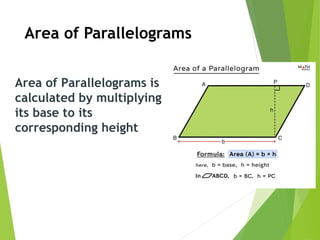
Area of Parallelograms
Area of Parallelograms is
calculated by multiplying
its base to its
corresponding height
TRIANGLE
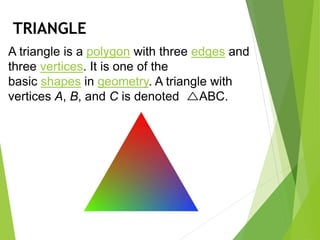
A triangle is a polygon with three edges and
three vertices. It is one of the
basic shapes in geometry. A triangle with
vertices A, B, and C is denoted ABC.
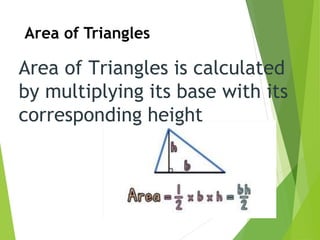
Area of Triangles
Area of Triangles is calculated
by multiplying its base with its
corresponding height
•The part of the plane enclosed by a simple closed
figure is called a planar region corresponding to that
figure. The magnitude or measure of this planar region
is called its area. This magnitude or measure is always
expressed with the help of a number (in some unit)
such as 5 cm2 ,8m2 ,3 hectares , etc. so, we can say
that area of a figure is a number (in some unit)
associated with the part of the plane enclosed by the
figure with the following two properties:
•(1) If A and B are two congruent figures, then ar(A) =
ar(B)
•(2) If a planar region formed by a figure T is made up
of two non-overlapping planar regions formed by
figures P and Q, then ar(T)= ar(P) + ar(Q)
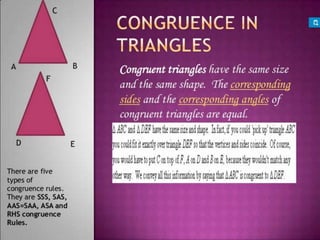
In geometry, two figures or objects
are congruent if they have the
same shape and size, or if one has the same
shape and size as the mirror image of the
other.
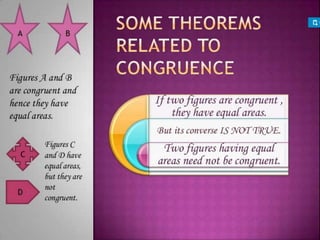
•If two figures A and B are congruent, they
must have equal areas. However, the
converse of this statement is not true.
•Two figures having equal areas need not be
congruent.
COGRUENCY
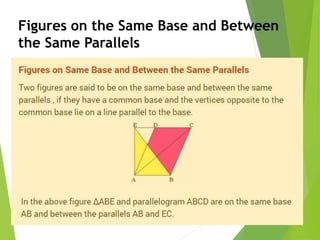
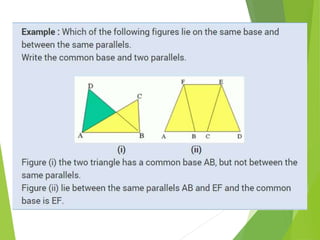
Figures on the Same Base and Between
the Same Parallels
Mathematics Grade 9 Areas Digital Plan - 4.ppt

Mathematics Grade 9 Areas Digital Plan - 4.ppt

  • 1.
    Digital Plan -4 Preliminary Information Name: BSD Roll No.: 1642- Subject: Mathematics Class: IX Topic: Areas Duration: 45 min Method: Digital Plan
  • 2.
    Academic Standards 1. ProblemSolving – Student will be able to solve problems based on areas of parallelogram and triangle 2. Reasoning Proof – Students will be able to ask for reasoning and proof of how the area is calculated for parallelograms and triangles 3. Communication – Students will be able to communicate the definitions of a parallelogram, triangle and congruency 4. Connection – Student will be able to connect the area formulae to the real-life objects 5. Visualization and Representation – Student will be able to visualize the different parallelograms and triangles, and represent them accordingly
  • 3.
  • 4.
    Content Analysis  Definitionof a Parallelogram  Properties of a Parallelogram  Area of Parallelogram  Definition of a Triangle  Properties of a Triangle  Area of Triangle  Congruency  Theorems related to Congruency
  • 5.
    PARALLELOGRAM  A quadrilateralis called a parallelogram, if both pairs of its opposite sides are parallel. In the adjoining figure, ABCD is a quadrilateral in which AB ∥ DC and AD ∥ BC. So, ABCD is a parallelogram. PROPERTIES OF PARALLELOGRAM.  Opposite sides are parallel and congruent.  Opposite angles are congruent.  Consecutive angles are supplementary.  The diagonals bisect each other.
  • 6.
    Area of Parallelograms Areaof Parallelograms is calculated by multiplying its base to its corresponding height
  • 7.
    TRIANGLE A triangle isa polygon with three edges and three vertices. It is one of the basic shapes in geometry. A triangle with vertices A, B, and C is denoted ABC.
  • 8.
    Area of Triangles Areaof Triangles is calculated by multiplying its base with its corresponding height
  • 9.
    •The part ofthe plane enclosed by a simple closed figure is called a planar region corresponding to that figure. The magnitude or measure of this planar region is called its area. This magnitude or measure is always expressed with the help of a number (in some unit) such as 5 cm2 ,8m2 ,3 hectares , etc. so, we can say that area of a figure is a number (in some unit) associated with the part of the plane enclosed by the figure with the following two properties: •(1) If A and B are two congruent figures, then ar(A) = ar(B) •(2) If a planar region formed by a figure T is made up of two non-overlapping planar regions formed by figures P and Q, then ar(T)= ar(P) + ar(Q)
  • 10.
    In geometry, twofigures or objects are congruent if they have the same shape and size, or if one has the same shape and size as the mirror image of the other. •If two figures A and B are congruent, they must have equal areas. However, the converse of this statement is not true. •Two figures having equal areas need not be congruent. COGRUENCY
  • 13.
    Figures on theSame Base and Between the Same Parallels