QUARTER 3
MATHEMATICS 9
LEARNING COMPETENCIES
Solves problems involving parallelograms,
trapezoids and kites. (M9GE-IIIe-1)
Quadrilaterals
All About
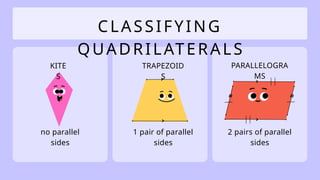
CLASSIFYING
QUADRILATERALS
TRAPEZOID
S
PARALLELOGRA
MS
1 pair of parallel
sides
2 pairs of parallel
sides
KITE
S
no parallel
sides
CLASSIFYING
QUADRILATERALS
RECTANGLE
S
SQUARE
S
2 pairs of parallel
sides
4 right angles
2 pairs of parallel sides
4 right angles
equal sides
RHOMBU
S
2 pairs of parallel
sides
equal sides
QUADRILATERAL
S
KITE PARALLELOGRA
M
TRAPEZOID
RHOMBU
S
RECTANGL
E
SQUARE
T H E O R E M S O F A R E C T A N G L E
Theorem 1:
A rectangle is a
parallelogram.
ABCD is a rectangle if
and only if AC BD.
≅
A B
C
D
A rectangle is a two-dimensional shape with four sides and four right angles (90 ). The
∘
opposite sides of a rectangle are equal in length and parallel to each other. Theorem 1 can
be proven by showing that a parallelogram with one right angle has four
right angles.
T H E O R E M S O F A R E C T A N G L E
Solution:
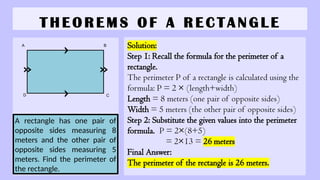
Step 1: Recall the formula for the perimeter of a
rectangle.
The perimeter P of a rectangle is calculated using the
formula: P = 2 × (length+width)
Length = 8 meters (one pair of opposite sides)
Width = 5 meters (the other pair of opposite sides)
Step 2: Substitute the given values into the perimeter
formula. P = 2×(8+5)
= 2×13 = 26 meters
Final Answer:
The perimeter of the rectangle is 26 meters.
A rectangle has one pair of
opposite sides measuring 8
meters and the other pair of
opposite sides measuring 5
meters. Find the perimeter of
the rectangle.
A B
C
D
T H E O R E M S O F A R E C T A N G L E
Solution:
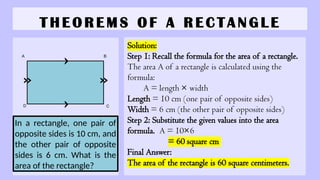
Step 1: Recall the formula for the area of a rectangle.
The area A of a rectangle is calculated using the
formula:
A = length × width
Length = 10 cm (one pair of opposite sides)
Width = 6 cm (the other pair of opposite sides)
Step 2: Substitute the given values into the area
formula. A = 10×6
= 60 square cm
Final Answer:
The area of the rectangle is 60 square centimeters.
In a rectangle, one pair of
opposite sides is 10 cm, and
the other pair of opposite
sides is 6 cm. What is the
area of the rectangle?
A B
C
D
T H E O R E M S O F A R E C T A N G L E
Solution:
Step 1: Recall the formulas for the area and perimeter
of a rectangle.
Area of a rectangle = length × width
Perimeter of a rectangle = 2 × (length + width)
Step 2: Substitute the given values into the formulas.
Length = 12 meters Width = 5 meters
To find the Area: Area = length×width
= 12×5 = 60 square meters
To find the Perimeter: Perimeter = 2×(length+width)
= 2×(12+5)
= 2×17 = 34 meters
A rectangle has a length of
12 meters and a width of 5
meters. Find the area and
perimeter of the rectangle.
A B
C
D
T H E O R E M S O F A R E C T A N G L E
Solution:
Given: Area of rectangular fence = 500 sq. ft.
Width = 20 ft.
As per the formula of area, we have;
Area = length x width
500 sq. ft. = length x 20 ft.
Length = 500/20
= 25 ft.
The area of a rectangular
fence is 500 square feet. If
the width of the fence is 20
feet, then find its length.
A B
C
D
T H E O R E M S O F A R E C T A N G L E
Theorem 2:
The diagonals of a
rectangle are congruent.
ABCD is a rectangle if
and only if AC BD.
≅
A B
C
D
Theorem 2 can be proven by showing that the diagonals of a
rectangle are equal in length. The converse of Theorem 2 states that
if a parallelogram has congruent diagonals, then it is a rectangle.
T H E O R E M S O F A R E C T A N G L E
Solution:
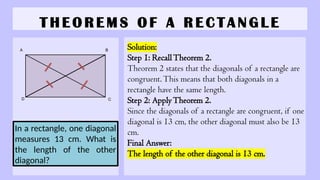
Step 1: RecallTheorem 2.
Theorem 2 states that the diagonals of a rectangle are
congruent.This means that both diagonals in a
rectangle have the same length.
Step 2: ApplyTheorem 2.
Since the diagonals of a rectangle are congruent, if one
diagonal is 13 cm, the other diagonal must also be 13
cm.
Final Answer:
The length of the other diagonal is 13 cm.
In a rectangle, one diagonal
measures 13 cm. What is
the length of the other
diagonal?
A B
C
D
T H E O R E M S O F A R E C T A N G L E
Solution:
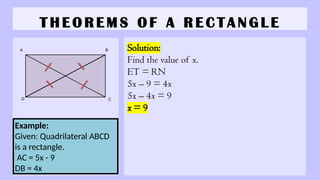
Find the value of x.
ET = RN
5x – 9 = 4x
5x – 4x = 9
x = 9
Example:
Given: Quadrilateral ABCD
is a rectangle.
AC = 5x - 9
DB = 4x
A B
C
D
T H E O R E M S O F A R E C T A N G L E
Solution:
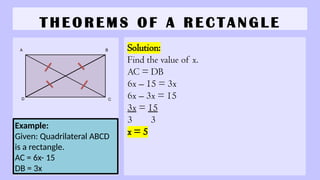
Find the value of x.
AC = DB
6x – 15 = 3x
6x – 3x = 15
3x = 15
3 3
x = 5
Example:
Given: Quadrilateral ABCD
is a rectangle.
AC = 6x- 15
DB = 3x
A B
C
D
T H E O R E M S O F A R E C T A N G L E
Solution:
Find the value of x.
AC = DB
10x + 3 = 4x + 21
10x – 4x = 21 – 3
6x = 18
6 6
x = 3
Example:
Given: Quadrilateral ABCD
is a rectangle.
AC = 10x + 3
DB = 4x + 21
A B
C
D
T H A N K Y O U !

Mathematics 9_3rd Quarter Lesson: Solving Rectangle

  • 1.
  • 2.
    LEARNING COMPETENCIES Solves problemsinvolving parallelograms, trapezoids and kites. (M9GE-IIIe-1)
  • 3.
  • 4.
    CLASSIFYING QUADRILATERALS TRAPEZOID S PARALLELOGRA MS 1 pair ofparallel sides 2 pairs of parallel sides KITE S no parallel sides
  • 5.
    CLASSIFYING QUADRILATERALS RECTANGLE S SQUARE S 2 pairs ofparallel sides 4 right angles 2 pairs of parallel sides 4 right angles equal sides RHOMBU S 2 pairs of parallel sides equal sides
  • 6.
  • 7.
    T H EO R E M S O F A R E C T A N G L E Theorem 1: A rectangle is a parallelogram. ABCD is a rectangle if and only if AC BD. ≅ A B C D A rectangle is a two-dimensional shape with four sides and four right angles (90 ). The ∘ opposite sides of a rectangle are equal in length and parallel to each other. Theorem 1 can be proven by showing that a parallelogram with one right angle has four right angles.
  • 8.
    T H EO R E M S O F A R E C T A N G L E Solution: Step 1: Recall the formula for the perimeter of a rectangle. The perimeter P of a rectangle is calculated using the formula: P = 2 × (length+width) Length = 8 meters (one pair of opposite sides) Width = 5 meters (the other pair of opposite sides) Step 2: Substitute the given values into the perimeter formula. P = 2×(8+5) = 2×13 = 26 meters Final Answer: The perimeter of the rectangle is 26 meters. A rectangle has one pair of opposite sides measuring 8 meters and the other pair of opposite sides measuring 5 meters. Find the perimeter of the rectangle. A B C D
  • 9.
    T H EO R E M S O F A R E C T A N G L E Solution: Step 1: Recall the formula for the area of a rectangle. The area A of a rectangle is calculated using the formula: A = length × width Length = 10 cm (one pair of opposite sides) Width = 6 cm (the other pair of opposite sides) Step 2: Substitute the given values into the area formula. A = 10×6 = 60 square cm Final Answer: The area of the rectangle is 60 square centimeters. In a rectangle, one pair of opposite sides is 10 cm, and the other pair of opposite sides is 6 cm. What is the area of the rectangle? A B C D
  • 10.
    T H EO R E M S O F A R E C T A N G L E Solution: Step 1: Recall the formulas for the area and perimeter of a rectangle. Area of a rectangle = length × width Perimeter of a rectangle = 2 × (length + width) Step 2: Substitute the given values into the formulas. Length = 12 meters Width = 5 meters To find the Area: Area = length×width = 12×5 = 60 square meters To find the Perimeter: Perimeter = 2×(length+width) = 2×(12+5) = 2×17 = 34 meters A rectangle has a length of 12 meters and a width of 5 meters. Find the area and perimeter of the rectangle. A B C D
  • 11.
    T H EO R E M S O F A R E C T A N G L E Solution: Given: Area of rectangular fence = 500 sq. ft. Width = 20 ft. As per the formula of area, we have; Area = length x width 500 sq. ft. = length x 20 ft. Length = 500/20 = 25 ft. The area of a rectangular fence is 500 square feet. If the width of the fence is 20 feet, then find its length. A B C D
  • 12.
    T H EO R E M S O F A R E C T A N G L E Theorem 2: The diagonals of a rectangle are congruent. ABCD is a rectangle if and only if AC BD. ≅ A B C D Theorem 2 can be proven by showing that the diagonals of a rectangle are equal in length. The converse of Theorem 2 states that if a parallelogram has congruent diagonals, then it is a rectangle.
  • 13.
    T H EO R E M S O F A R E C T A N G L E Solution: Step 1: RecallTheorem 2. Theorem 2 states that the diagonals of a rectangle are congruent.This means that both diagonals in a rectangle have the same length. Step 2: ApplyTheorem 2. Since the diagonals of a rectangle are congruent, if one diagonal is 13 cm, the other diagonal must also be 13 cm. Final Answer: The length of the other diagonal is 13 cm. In a rectangle, one diagonal measures 13 cm. What is the length of the other diagonal? A B C D
  • 14.
    T H EO R E M S O F A R E C T A N G L E Solution: Find the value of x. ET = RN 5x – 9 = 4x 5x – 4x = 9 x = 9 Example: Given: Quadrilateral ABCD is a rectangle. AC = 5x - 9 DB = 4x A B C D
  • 15.
    T H EO R E M S O F A R E C T A N G L E Solution: Find the value of x. AC = DB 6x – 15 = 3x 6x – 3x = 15 3x = 15 3 3 x = 5 Example: Given: Quadrilateral ABCD is a rectangle. AC = 6x- 15 DB = 3x A B C D
  • 16.
    T H EO R E M S O F A R E C T A N G L E Solution: Find the value of x. AC = DB 10x + 3 = 4x + 21 10x – 4x = 21 – 3 6x = 18 6 6 x = 3 Example: Given: Quadrilateral ABCD is a rectangle. AC = 10x + 3 DB = 4x + 21 A B C D
  • 17.
    T H AN K Y O U !