CO_Q4_Mathematics 9_ Module 4
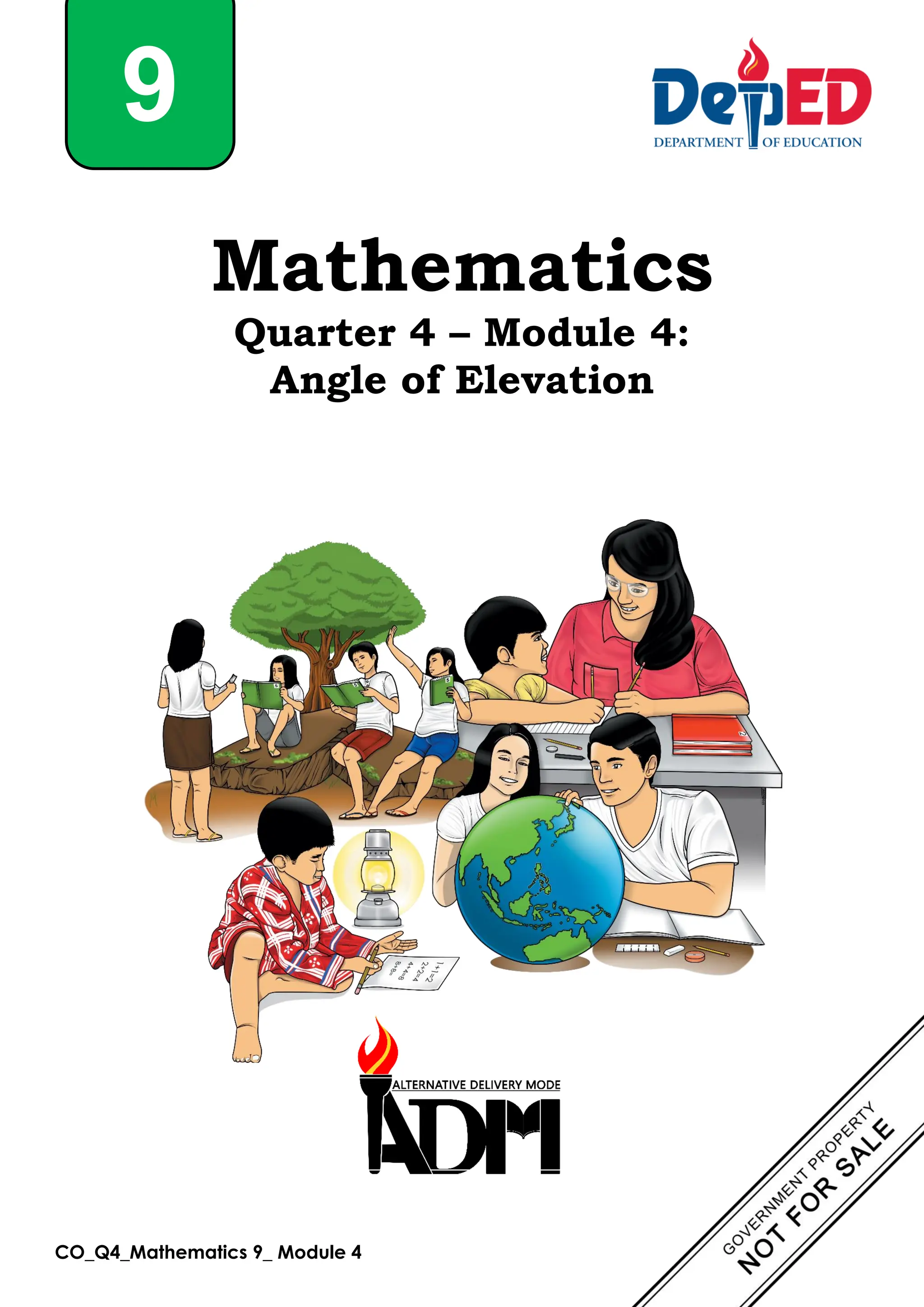
Mathematics
Quarter 4 – Module 4:
Angle of Elevation
9
Mathematics – Grade 9
Alternative Delivery Mode
Quarter 4 – Module 4: Angle of Elevation
First Edition, 2020
Republic Act 8293, section 176 states that: No copyright shall subsist in any work of
the Government of the Philippines. However, prior approval of the government agency or
office wherein the work is created shall be necessary for exploitation of such work for profit.
Such agency or office may, among other things, impose as a condition the payment of
royalties.
Borrowed materials (i.e., songs, stories, poems, pictures, photos, brand names,
trademarks, etc.) included in this module are owned by their respective copyright holders.
Every effort has been exerted to locate and seek permission to use these materials from
their respective copyright owners. The publisher and authors do not represent nor claim
ownership over them.
Published by the Department of Education
Secretary: Leonor Magtolis Briones
Undersecretary: Diosdado M. San Antonio
Printed in the Philippines by _________________________
Department of Education - National Capital Region (NCR)
Office Address: Misamis St., Brgy. Bago Bantay, Quezon City
Telefax: (632) 8926-2213 /8929-4330 /8920-1490 and 8929-4348
E-mail Address: ncr@deped.gov.ph
Development Team of the Module
Writers: Haydee C. Batoon, Rachelle T. Tranquilo and Marissa S. Penaflor
Editors: Edwin M. Yap and Elma A. Panuncio
Validators: Remylinda T. Soriano, Angelita Z. Modesto and George B. Borromeo
Illustrators: Haydee C. Batoon, Rachelle T. Tranquilo and Marissa S. Penaflor
Layout Artists: Haydee C. Batoon Rachelle T. Tranquilo
Marissa S. Penaflor Alfaith G. Poblete
Management Team:
Malcolm S. Garma Genia V. Santos
Dennis M. Mendoza Maria Magdalena M. Lim
Aida H. Rondilla Lucky S. Carpio
9
Mathematics
Quarter 4 – Module 4:
Angle of Elevation
Introductory Message
This Self-Learning Module (SLM) is prepared so that you, our dear learners,
can continue your studies and learn while at home. Activities, questions,
directions, exercises, and discussions are carefully stated for you to understand
each lesson.
Each SLM is composed of different parts. Each part shall guide you step-by-
step as you discover and understand the lesson prepared for you.
Pre-tests are provided to measure your prior knowledge on lessons in each
SLM. This will tell you if you need to proceed on completing this module or if you
need to ask your facilitator or your teacher’s assistance for better understanding of
the lesson. At the end of each module, you need to answer the post-test to self-
check your learning. Answer keys are provided for each activity and test. We trust
that you will be honest in using these.
In addition to the material in the main text, Notes to the Teacher are also
provided to our facilitators and parents for strategies and reminders on how they
can best help you on your home-based learning.
Please use this module with care. Do not put unnecessary marks on any
part of this SLM. Use a separate sheet of paper in answering the exercises and
tests. And read the instructions carefully before performing each task.
If you have any questions in using this SLM or any difficulty in answering
the tasks in this module, do not hesitate to consult your teacher or facilitator.
Thank you.
1
CO_Q4_Mathematics 9_ Module 4
What I Need to Know
This module was designed and written with you in mind. It is here to
help you master Angle of Elevation. The scope of this module permits it to
be used in many different learning situations. The language used recognizes
the diverse vocabulary level of students. The lessons are arranged to follow
the standard sequence of the course. But the order in which you read them
can be changed to correspond with the textbook you are now using.
After going through this module, you are expected to:
 solve problems involving angles of elevation (M9GE-IVd-45.1)
2
CO_Q4_Mathematics 9_ Module 4
What I Know
DIRECTIONS: Answer each of the following items and write the letter of the correct
answer on your answer sheet.
1) SOH-CAH-TOA is the mnemonic used in solving the solutions of ______ using
the trigonometric functions.
A. Obtuse Triangle C. Right Triangle
B. Acute Triangle D. All the above
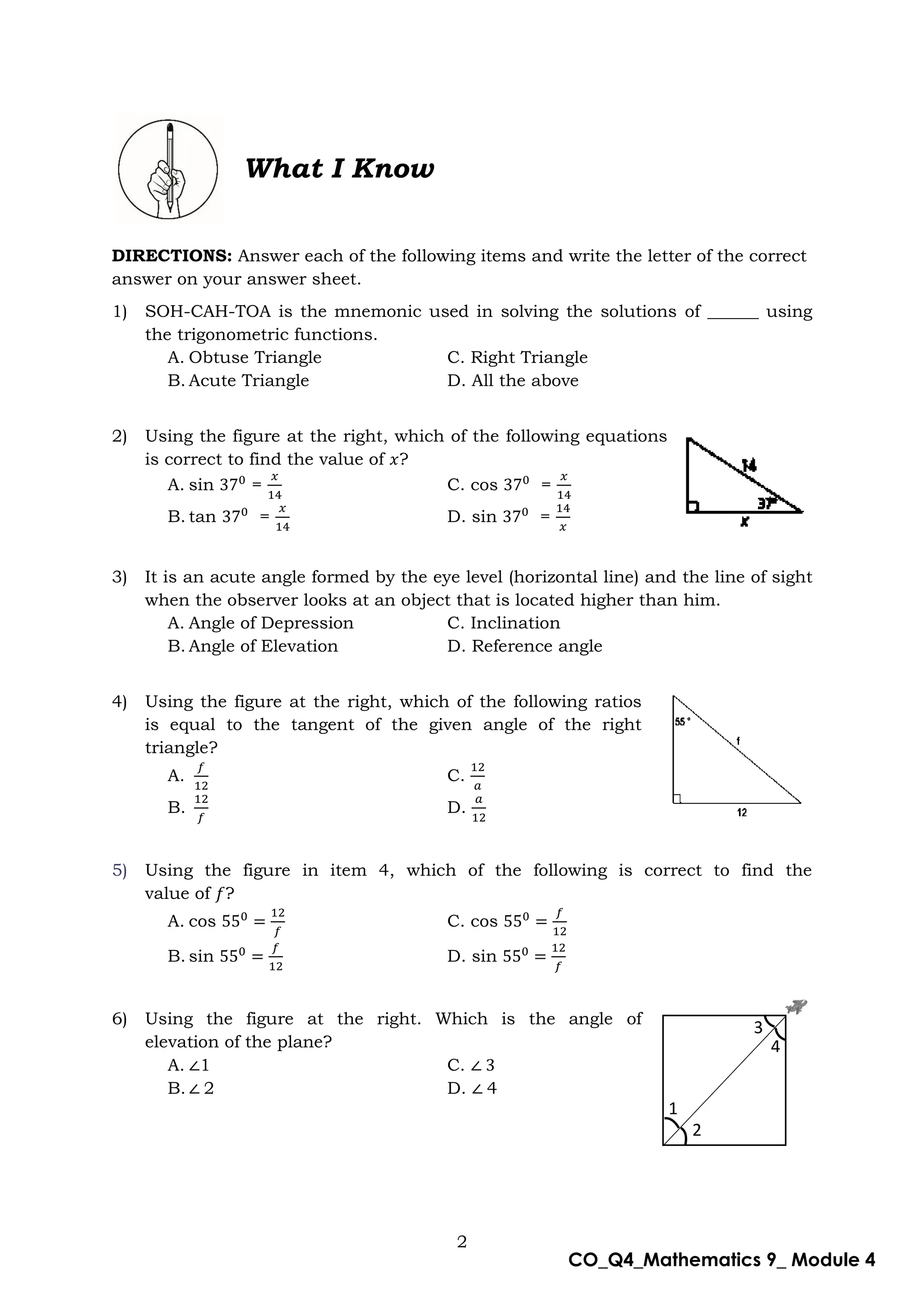
2) Using the figure at the right, which of the following equations
is correct to find the value of ?
A. sin = C. cos =
B. tan = D. sin =
3) It is an acute angle formed by the eye level (horizontal line) and the line of sight
when the observer looks at an object that is located higher than him.
A. Angle of Depression C. Inclination
B. Angle of Elevation D. Reference angle
4) Using the figure at the right, which of the following ratios
is equal to the tangent of the given angle of the right
triangle?
A. C.
B. D.
5) Using the figure in item 4, which of the following is correct to find the
value of ?
A. cos C. cos
B. sin D. sin
6) Using the figure at the right. Which is the angle of
elevation of the plane?
A. 1 C.
B. 2 D. 4
1
2
4
3
3
CO_Q4_Mathematics 9_ Module 4
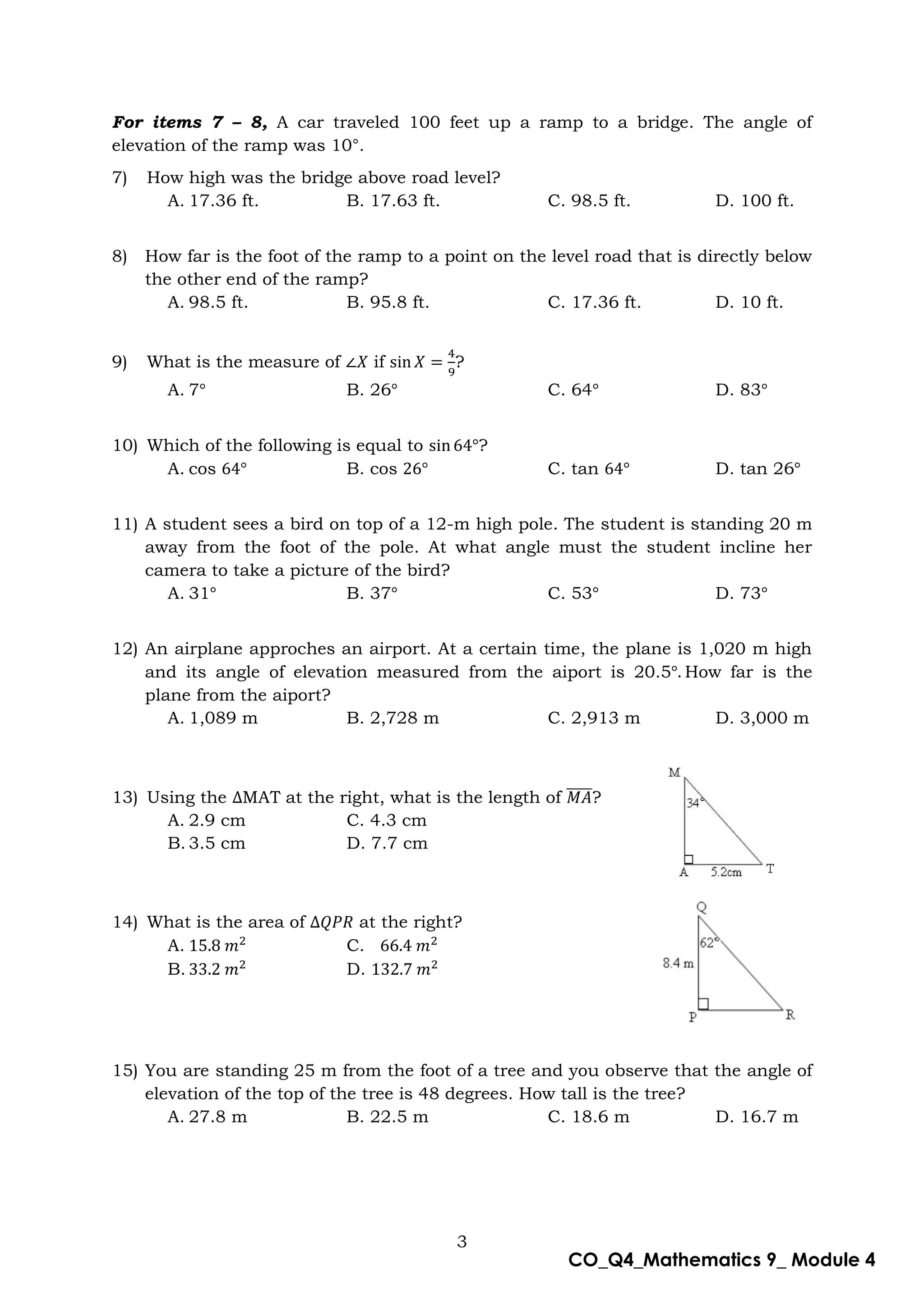
For items 7 – 8, A car traveled 100 feet up a ramp to a bridge. The angle of
elevation of the ramp was 10°.
7) How high was the bridge above road level?
A. 17.36 ft. B. 17.63 ft. C. 98.5 ft. D. 100 ft.
8) How far is the foot of the ramp to a point on the level road that is directly below
the other end of the ramp?
A. 98.5 ft. B. 95.8 ft. C. 17.36 ft. D. 10 ft.
9) What is the measure of if ?
A. 7 B. 26 C. 64 D. 83
10) Which of the following is equal to ?
A. cos B. cos C. tan D. tan 26
11) A student sees a bird on top of a 12-m high pole. The student is standing 20 m
away from the foot of the pole. At what angle must the student incline her
camera to take a picture of the bird?
A. 31 B. 37 C. 53 D. 73
12) An airplane approches an airport. At a certain time, the plane is 1,020 m high
and its angle of elevation measured from the aiport is 20.5 How far is the
plane from the aiport?
A. 1,089 m B. 2,728 m C. 2,913 m D. 3,000 m
13) Using the ∆MAT at the right, what is the length of ̅̅̅̅̅?
A. 2.9 cm C. 4.3 cm
B. 3.5 cm D. 7.7 cm
14) What is the area of ∆ at the right?
A. C.
B. D.
15) You are standing 25 m from the foot of a tree and you observe that the angle of
elevation of the top of the tree is 48 degrees. How tall is the tree?
A. 27.8 m B. 22.5 m C. 18.6 m D. 16.7 m
4
CO_Q4_Mathematics 9_ Module 4
Lesson
1 Angle of Elevation
In this lesson you will study how to illustrate and solve problems involving
angle of elevation. You will be given an opportunity to do activities that will help
you identify and define angle of elevation through illustrations. Also, you will learn
that in solving problems you need to draw a detailed diagram to help you visualize
them. Those concepts that you have just learned about right triangles and
trigonometric functions will help you to get through the next lesson.
What’s In
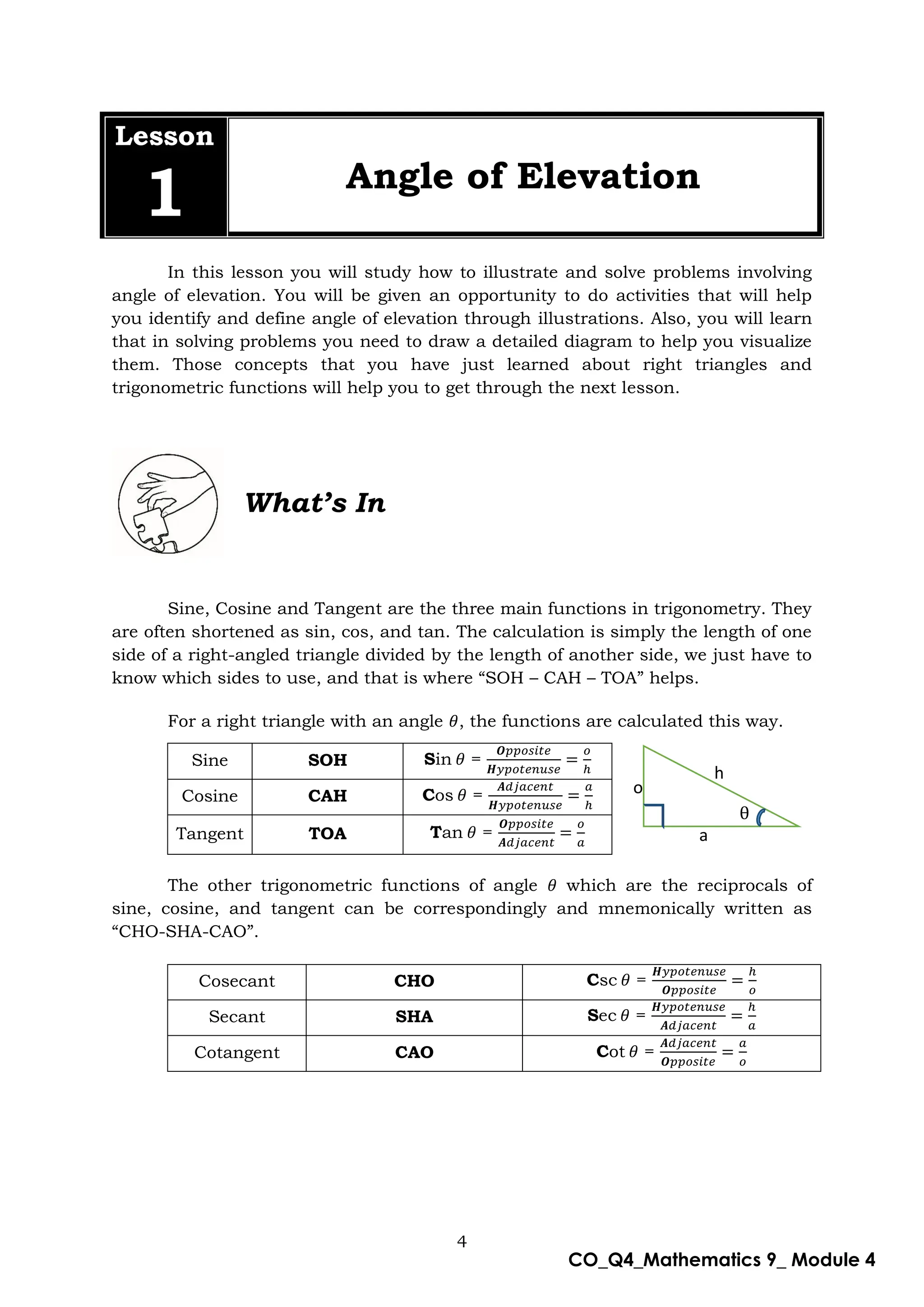
Sine, Cosine and Tangent are the three main functions in trigonometry. They
are often shortened as sin, cos, and tan. The calculation is simply the length of one
side of a right-angled triangle divided by the length of another side, we just have to
know which sides to use, and that is where “SOH – CAH – TOA” helps.
For a right triangle with an angle , the functions are calculated this way.
Sine SOH Sin =
Cosine CAH Cos =
Tangent TOA Tan =
The other trigonometric functions of angle which are the reciprocals of
sine, cosine, and tangent can be correspondingly and mnemonically written as
“CHO-SHA-CAO”.
Cosecant CHO Csc =
Secant SHA Sec =
Cotangent CAO Cot =
h
θ
a
o
5
CO_Q4_Mathematics 9_ Module 4
TRY IT!
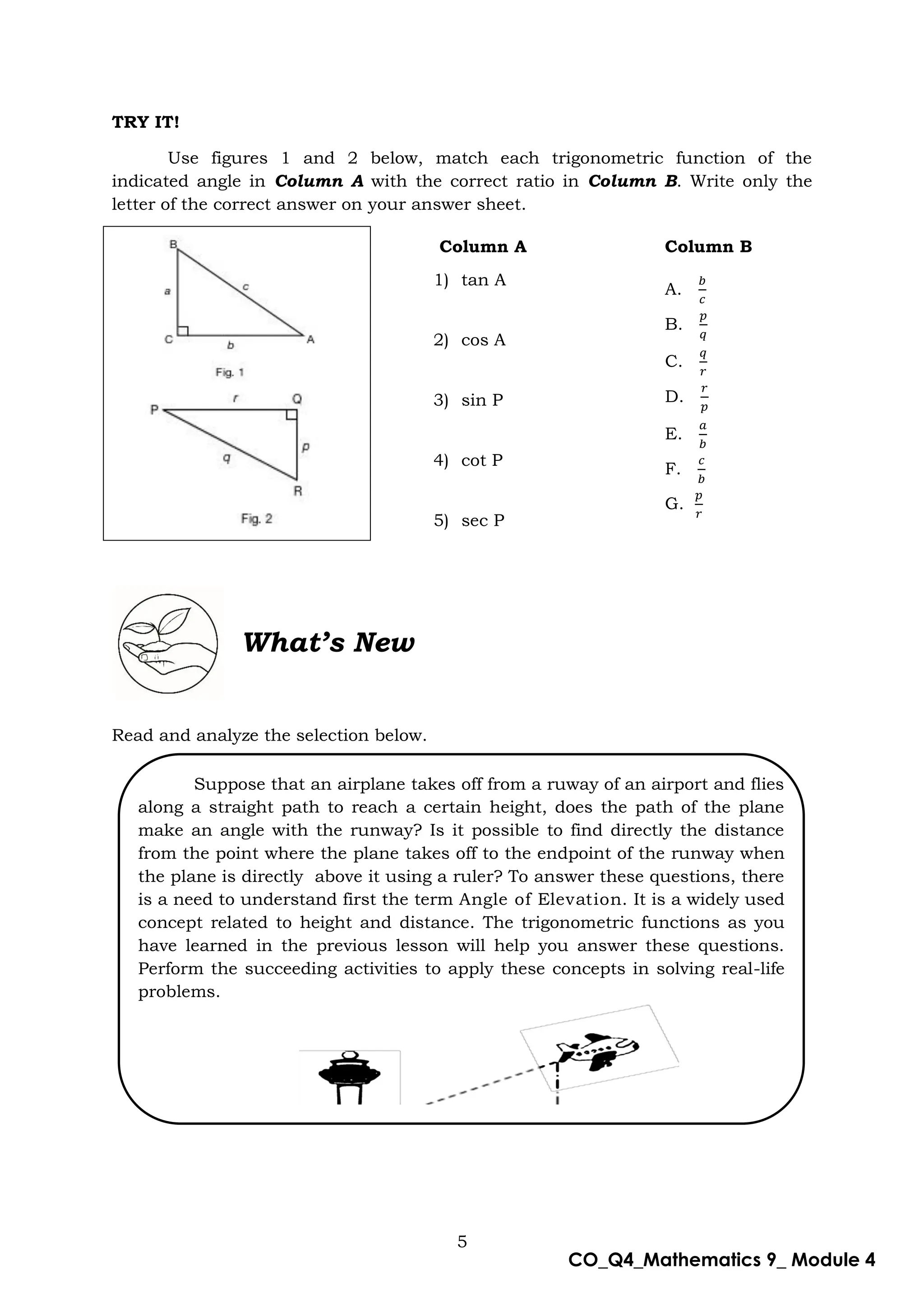
Use figures 1 and 2 below, match each trigonometric function of the
indicated angle in Column A with the correct ratio in Column B. Write only the
letter of the correct answer on your answer sheet.
Column A Column B
1) tan A
2) cos A
3) sin P
4) cot P
5) sec P
A.
B.
C.
D.
E.
F.
G.
What’s New
Read and analyze the selection below.
Suppose that an airplane takes off from a ruway of an airport and flies
along a straight path to reach a certain height, does the path of the plane
make an angle with the runway? Is it possible to find directly the distance
from the point where the plane takes off to the endpoint of the runway when
the plane is directly above it using a ruler? To answer these questions, there
is a need to understand first the term Angle of Elevation. It is a widely used
concept related to height and distance. The trigonometric functions as you
have learned in the previous lesson will help you answer these questions.
Perform the succeeding activities to apply these concepts in solving real-life
problems.
6
CO_Q4_Mathematics 9_ Module 4
What is It
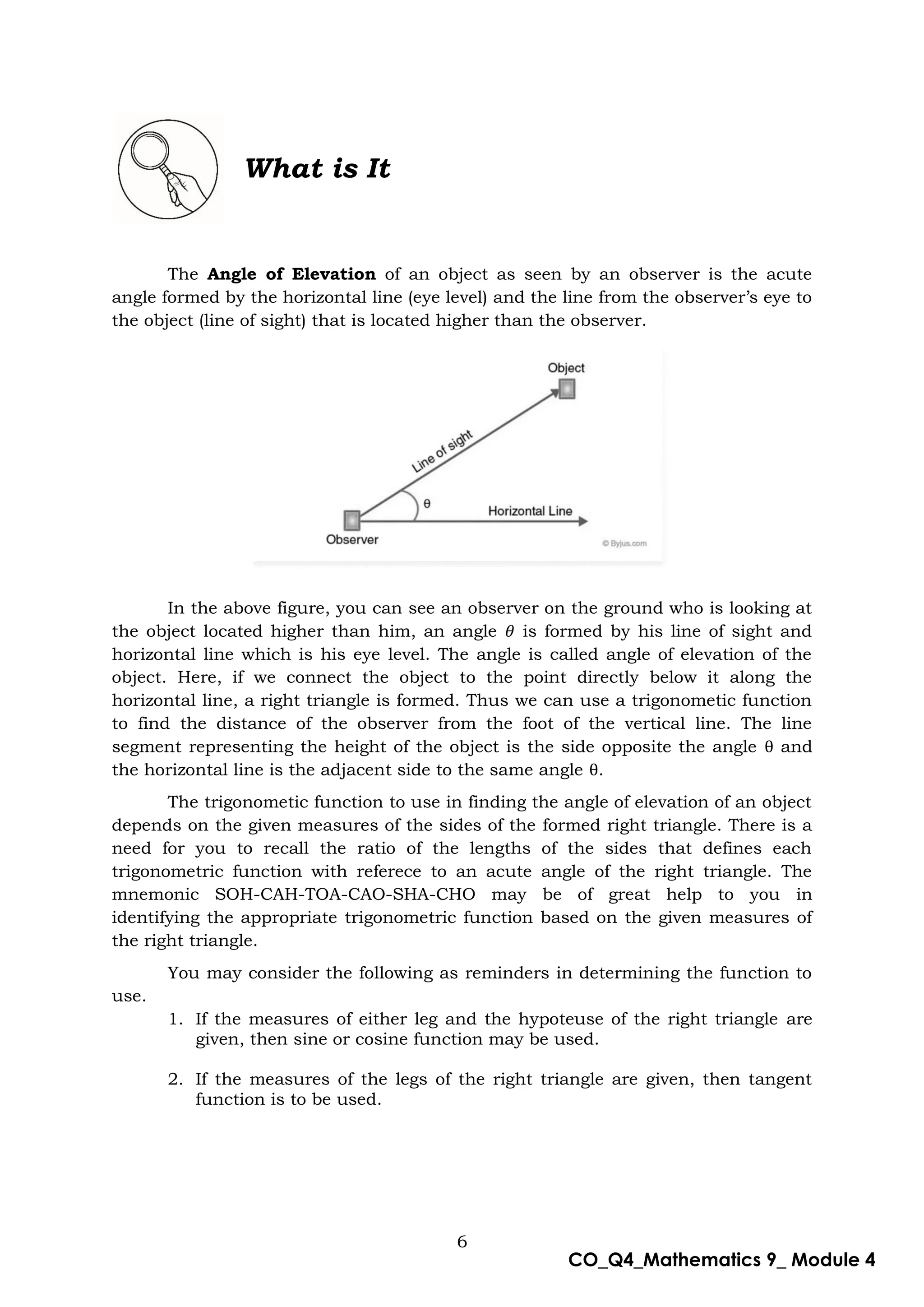
The Angle of Elevation of an object as seen by an observer is the acute
angle formed by the horizontal line (eye level) and the line from the observer’s eye to
the object (line of sight) that is located higher than the observer.
In the above figure, you can see an observer on the ground who is looking at
the object located higher than him, an angle is formed by his line of sight and
horizontal line which is his eye level. The angle is called angle of elevation of the
object. Here, if we connect the object to the point directly below it along the
horizontal line, a right triangle is formed. Thus we can use a trigonometic function
to find the distance of the observer from the foot of the vertical line. The line
segment representing the height of the object is the side opposite the angle θ and
the horizontal line is the adjacent side to the same angle θ.
The trigonometic function to use in finding the angle of elevation of an object
depends on the given measures of the sides of the formed right triangle. There is a
need for you to recall the ratio of the lengths of the sides that defines each
trigonometric function with referece to an acute angle of the right triangle. The
mnemonic SOH-CAH-TOA-CAO-SHA-CHO may be of great help to you in
identifying the appropriate trigonometric function based on the given measures of
the right triangle.
You may consider the following as reminders in determining the function to
use.
1. If the measures of either leg and the hypoteuse of the right triangle are
given, then sine or cosine function may be used.
2. If the measures of the legs of the right triangle are given, then tangent
function is to be used.
7
CO_Q4_Mathematics 9_ Module 4
Let us have some situational problems that involve angle of elevation. Proper
understanding and interpretation to the problem is necessary for you to come up
with proper illustration. Usually, limited understanding and wrong interpretation to
the problem lead to incorrect illustration which gives you lower chance to answer
and solve the give problem correctly.
EXAMPLE 1
Solution:
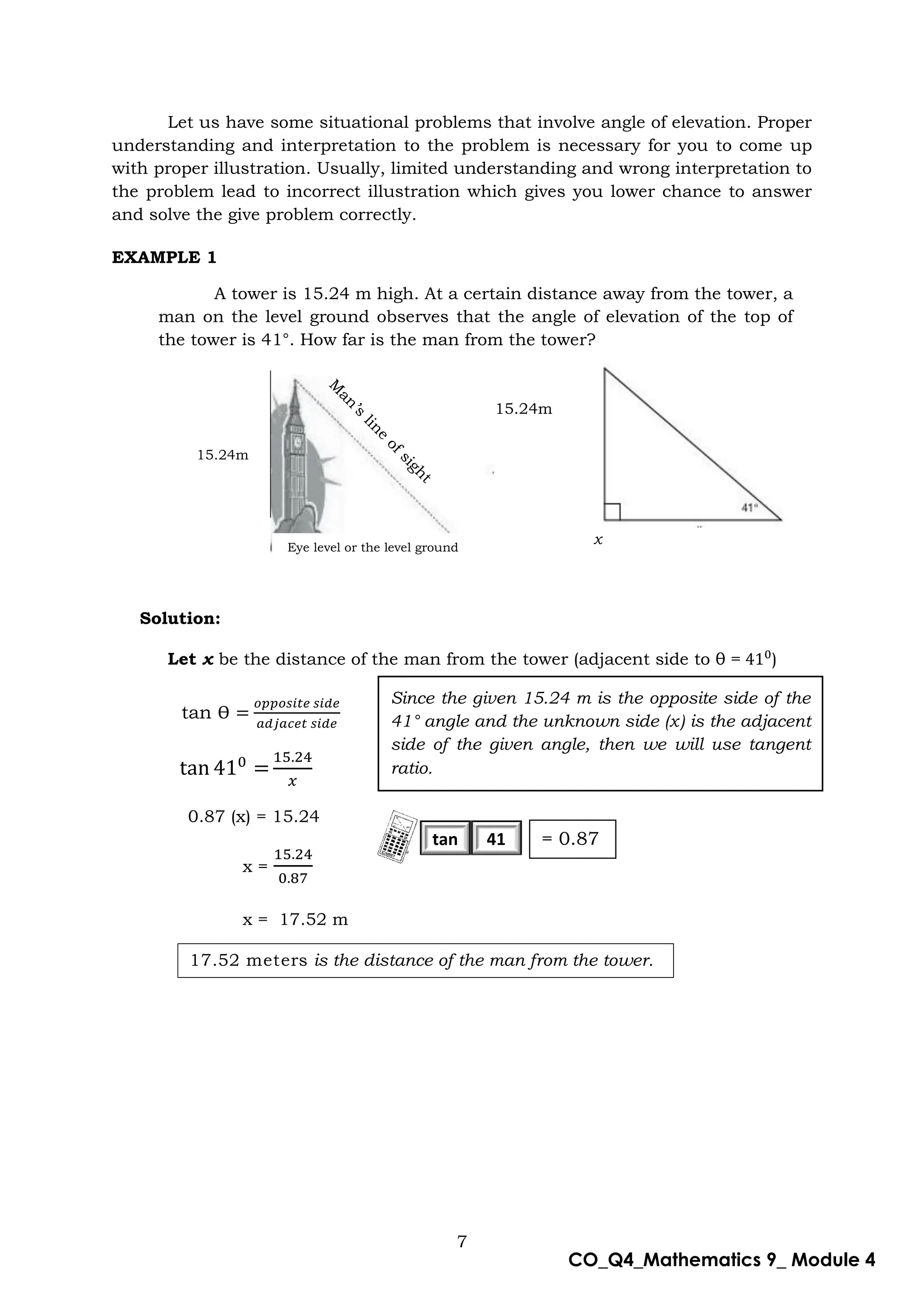
Let x be the distance of the man from the tower (adjacent side to θ = )
0.87 (x) = 15.24
x =
x = 17.52 m
17.52 meters is the distance of the man from the tower.
tan Ɵ =
𝑜𝑝𝑝𝑜𝑠𝑖𝑡𝑒 𝑠𝑖𝑑𝑒
𝑎𝑑𝑗𝑎𝑐𝑒𝑡 𝑠𝑖𝑑𝑒
Since the given 15.24 m is the opposite side of the
41° angle and the unknown side (x) is the adjacent
side of the given angle, then we will use tangent
ratio.
tan 41
15.24m
A tower is 15.24 m high. At a certain distance away from the tower, a
man on the level ground observes that the angle of elevation of the top of
the tower is 41°. How far is the man from the tower?
15.24m
Eye level or the level ground
x
= 0.87
8
CO_Q4_Mathematics 9_ Module 4
EXAMPLE 2
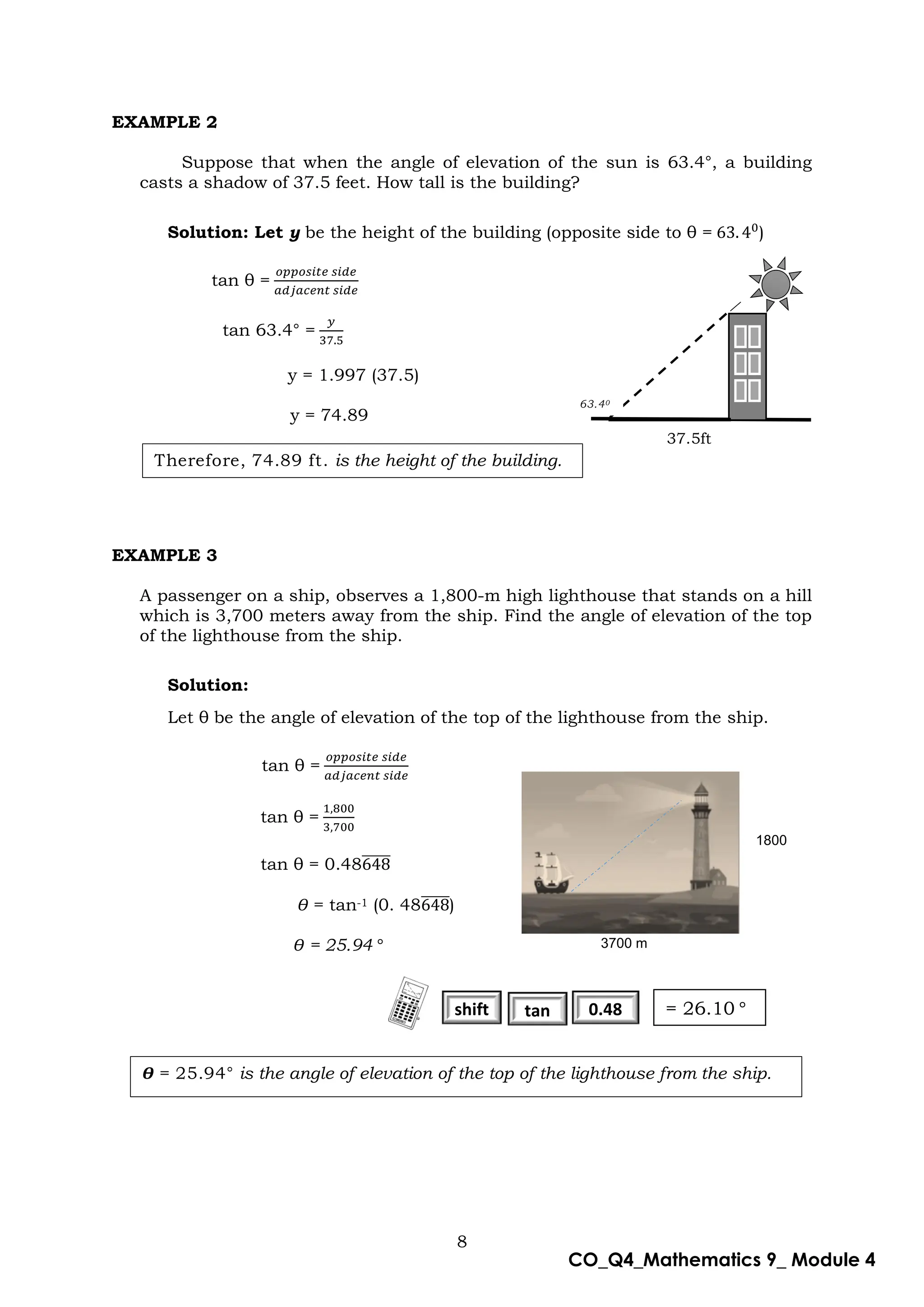
Suppose that when the angle of elevation of the sun is 63.4°, a building
casts a shadow of 37.5 feet. How tall is the building?
Solution: Let y be the height of the building (opposite side to θ = )
tan θ =
tan 63.4° =
y = 1.997 (37.5)
y = 74.89
EXAMPLE 3
A passenger on a ship, observes a 1,800-m high lighthouse that stands on a hill
which is 3,700 meters away from the ship. Find the angle of elevation of the top
of the lighthouse from the ship.
Solution:
Let θ be the angle of elevation of the top of the lighthouse from the ship.
tan θ =
tan θ =
tan θ = 0.48̅̅̅̅̅
Ɵ = tan-1 (0. 48̅̅̅̅̅)
Ɵ = 25.94
37.5ft
Therefore, 74.89 ft. is the height of the building.
Ɵ = 25.94° is the angle of elevation of the top of the lighthouse from the ship.
shift tan 0.48
7
3700 m
1800
m
= 26.10
63.40
9
CO_Q4_Mathematics 9_ Module 4
Therefore, 831 ft. is the height of the mountain.
EXAMPLE 4
A person standing 400 ft away from the
base of a mountain measures the angle of
elevation of the top of the mountain to be 25˚
He then walks 500 ft straight farther and finds
the angle of elevation of the top of the
mountain to be 20˚. How tall is the mountain?
Solution:
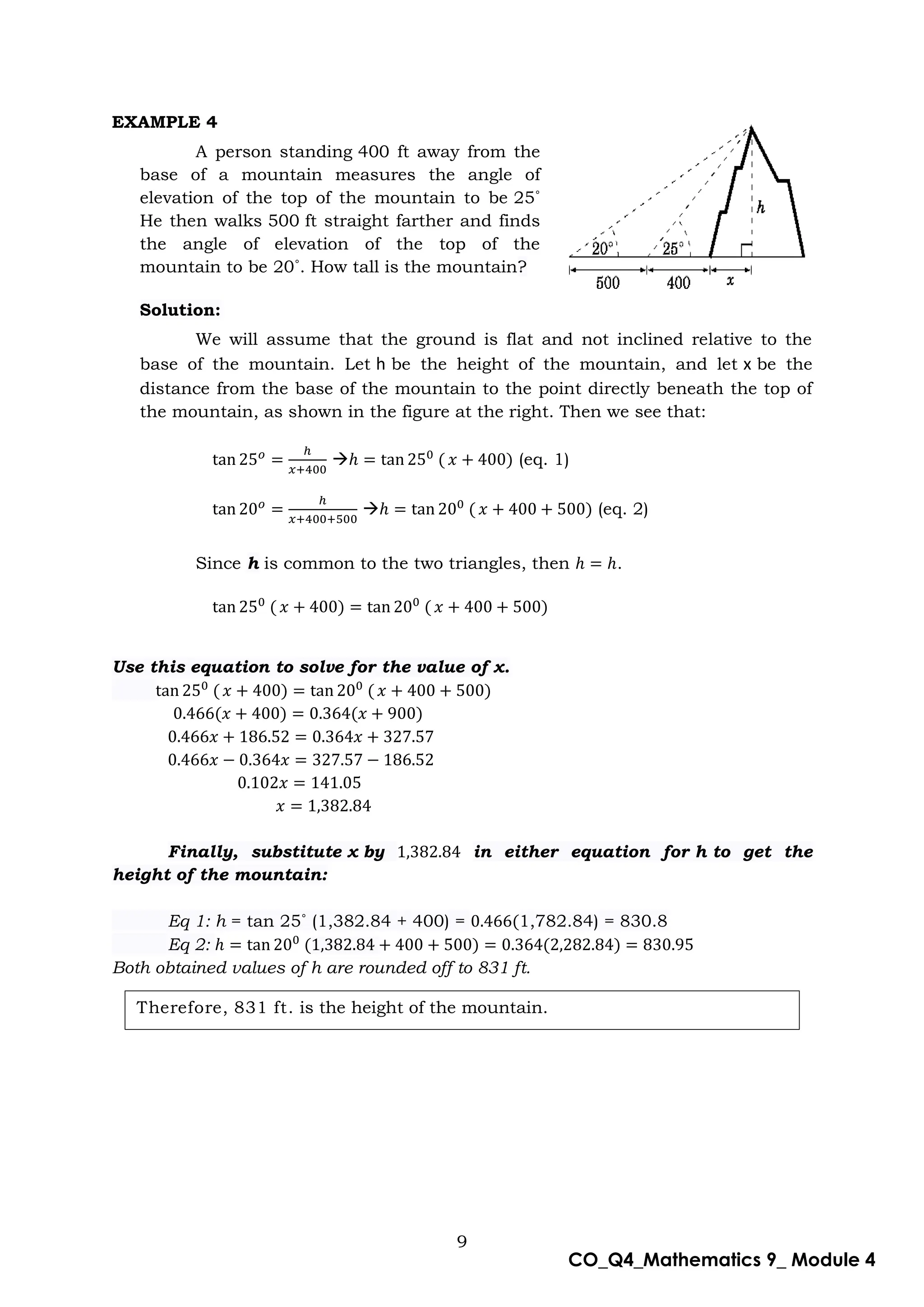
We will assume that the ground is flat and not inclined relative to the
base of the mountain. Let h be the height of the mountain, and let x be the
distance from the base of the mountain to the point directly beneath the top of
the mountain, as shown in the figure at the right. Then we see that:
 (eq. 1)
 (eq. 2)
Since h is common to the two triangles, then .
Use this equation to solve for the value of x.
Finally, substitute x by in either equation for h to get the
height of the mountain:
Eq 1: h = tan 25˚ (1,382.84 + 400) = 1,782.84) = 830.8
Eq 2:
Both obtained values of h are rounded off to 831 ft.
10
CO_Q4_Mathematics 9_ Module 4
What’s More
A. In a separate sheet, solve each problem involving angle of elevation.
Show your computations and label your final answer properly.
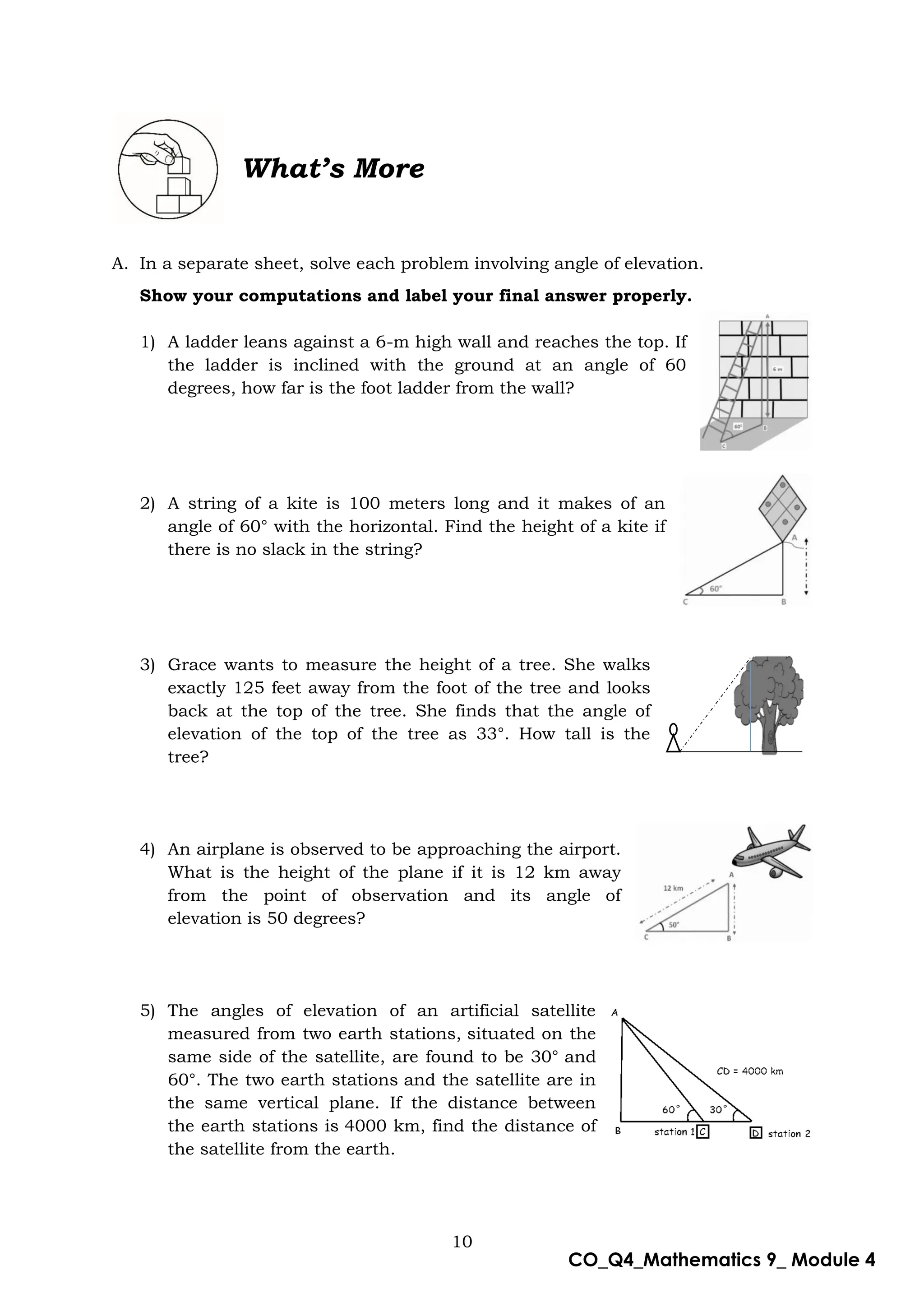
1) A ladder leans against a 6-m high wall and reaches the top. If
the ladder is inclined with the ground at an angle of 60
degrees, how far is the foot ladder from the wall?
2) A string of a kite is 100 meters long and it makes of an
angle of 60° with the horizontal. Find the height of a kite if
there is no slack in the string?
3) Grace wants to measure the height of a tree. She walks
exactly 125 feet away from the foot of the tree and looks
back at the top of the tree. She finds that the angle of
elevation of the top of the tree as 33°. How tall is the
tree?
4) An airplane is observed to be approaching the airport.
What is the height of the plane if it is 12 km away
from the point of observation and its angle of
elevation is 50 degrees?
5) The angles of elevation of an artificial satellite
measured from two earth stations, situated on the
same side of the satellite, are found to be 30° and
60°. The two earth stations and the satellite are in
the same vertical plane. If the distance between
the earth stations is 4000 km, find the distance of
the satellite from the earth.
11
CO_Q4_Mathematics 9_ Module 4
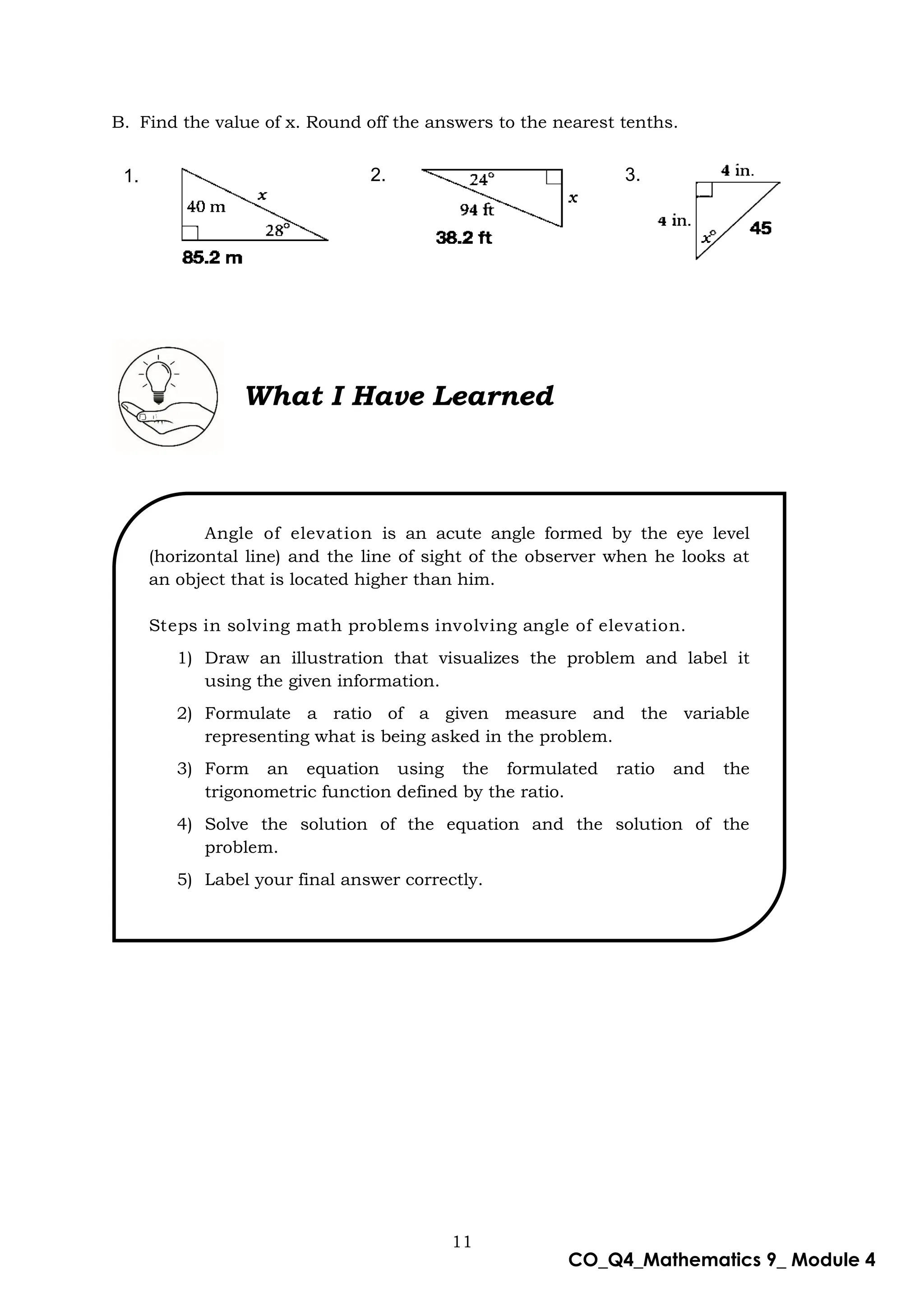
B. Find the value of x. Round off the answers to the nearest tenths.
What I Have Learned
Angle of elevation is an acute angle formed by the eye level
(horizontal line) and the line of sight of the observer when he looks at
an object that is located higher than him.
Steps in solving math problems involving angle of elevation.
1) Draw an illustration that visualizes the problem and label it
using the given information.
2) Formulate a ratio of a given measure and the variable
representing what is being asked in the problem.
3) Form an equation using the formulated ratio and the
trigonometric function defined by the ratio.
4) Solve the solution of the equation and the solution of the
problem.
5) Label your final answer correctly.
1. 2. 3.
12
CO_Q4_Mathematics 9_ Module 4
What I Can Do
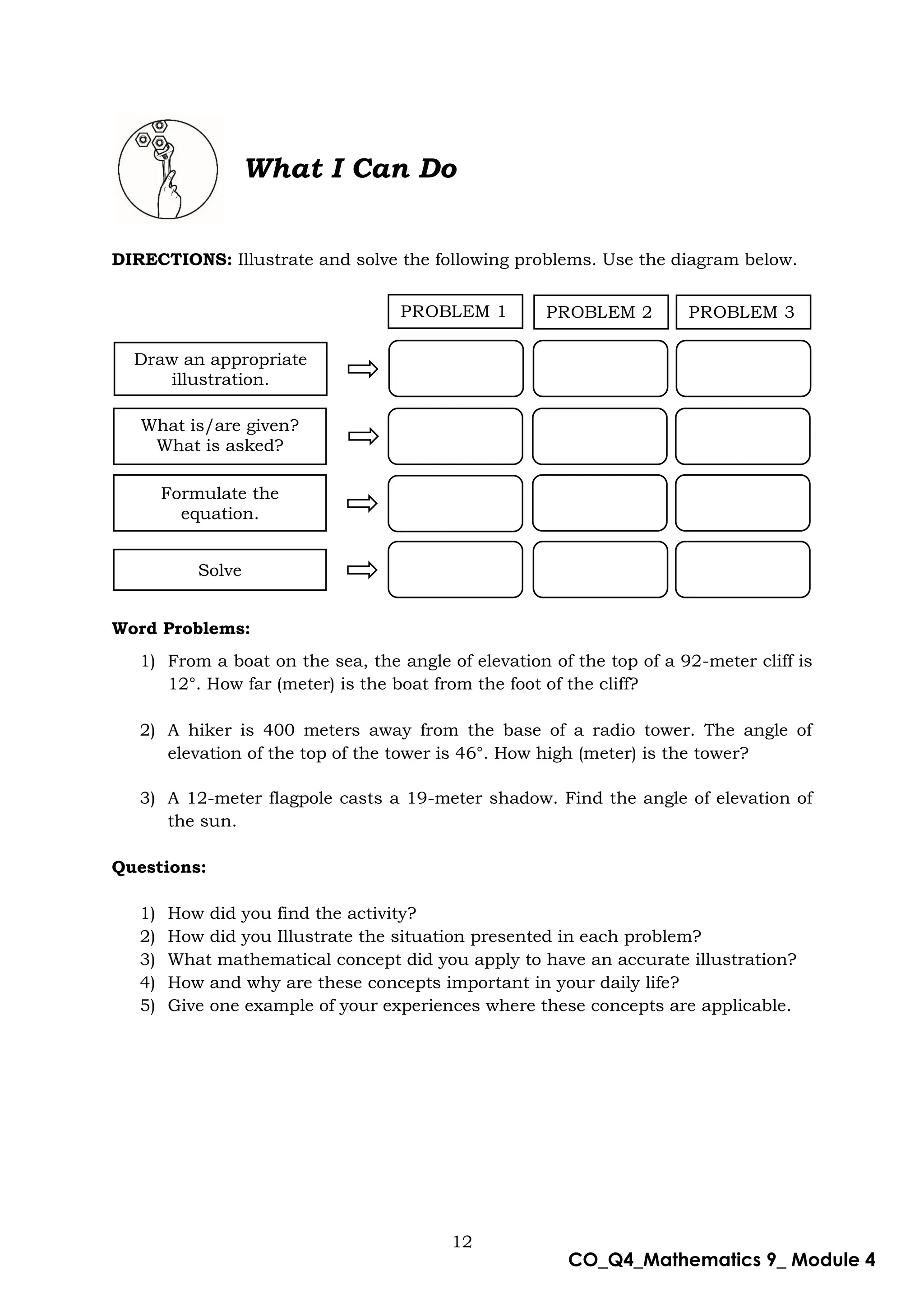
DIRECTIONS: Illustrate and solve the following problems. Use the diagram below.
Word Problems:
1) From a boat on the sea, the angle of elevation of the top of a 92-meter cliff is
12°. How far (meter) is the boat from the foot of the cliff?
2) A hiker is 400 meters away from the base of a radio tower. The angle of
elevation of the top of the tower is 46°. How high (meter) is the tower?
3) A 12-meter flagpole casts a 19-meter shadow. Find the angle of elevation of
the sun.
Questions:
1) How did you find the activity?
2) How did you Illustrate the situation presented in each problem?
3) What mathematical concept did you apply to have an accurate illustration?
4) How and why are these concepts important in your daily life?
5) Give one example of your experiences where these concepts are applicable.
PROBLEM 1
1
PROBLEM 2 PROBLEM 3
Draw an appropriate
illustration.
What is/are given?
What is asked?
Formulate the
equation.
Solve
13
CO_Q4_Mathematics 9_ Module 4
Assessment
DIRECTIONS: Read and answer each of the following items accurately. Write the
letter of the correct answer on your answer sheet.
1) Cos P of the right triangle PQR with right angle at Q is ______.
A. B. C. D.
2) Consider a right triangle PQR with right angle at Q, if |PQ|=27 cm and
|QR|=17 cm, then the measure of angle P is ______.
A. 32.19˚ B. 45.19˚ C. 49.58˚ D. 62.46˚
3) Consider a right triangle ABC with right angle at B, if |AB|=5 cm, |AC|=13
cm, and |BC|=12 cm, what is the value sin A?
A. B. C. D.
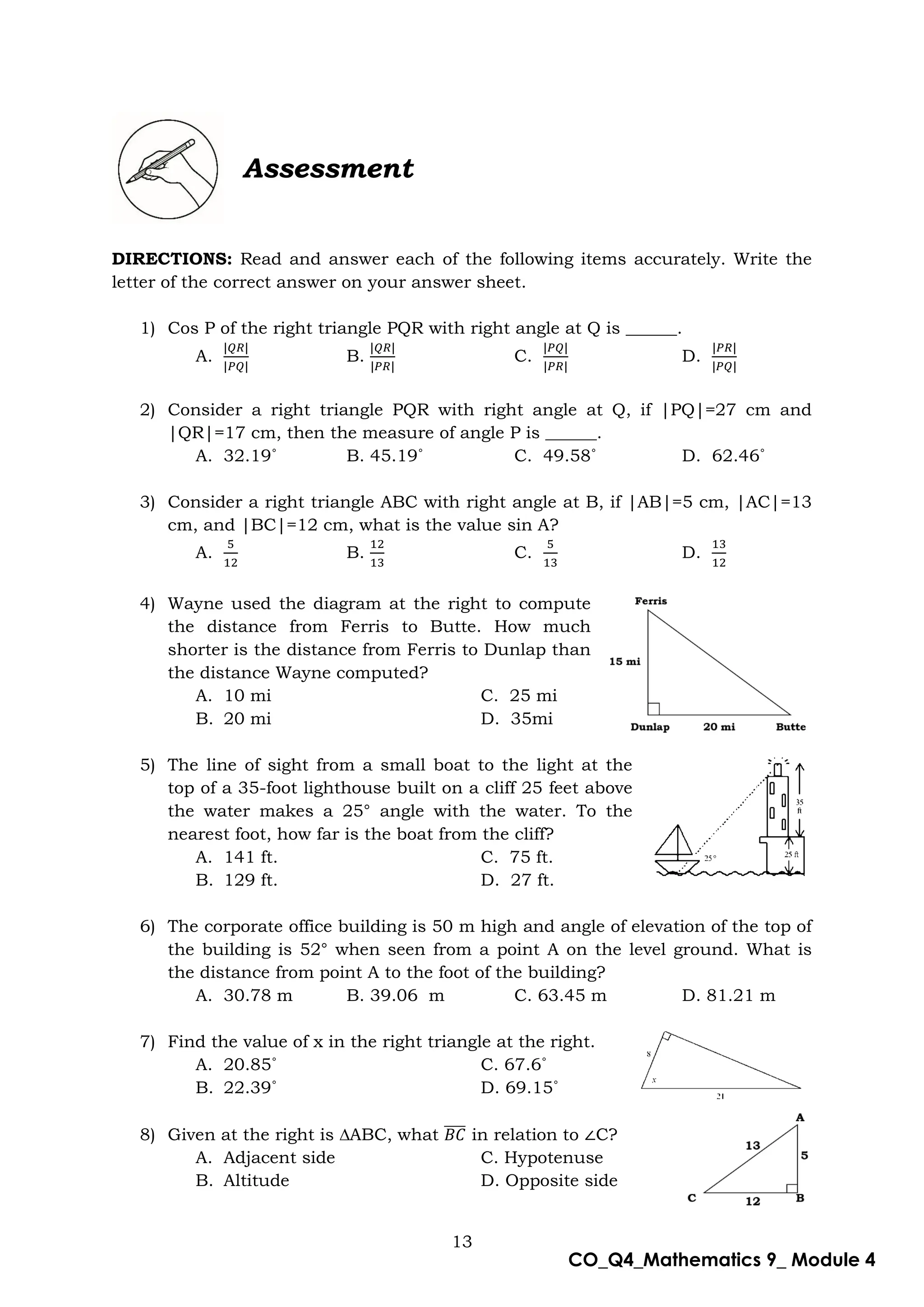
4) Wayne used the diagram at the right to compute
the distance from Ferris to Butte. How much
shorter is the distance from Ferris to Dunlap than
the distance Wayne computed? SH
A. 10 mi C. 25 mi
B. 20 mi D. 35mi
5) The line of sight from a small boat to the light at the
top of a 35-foot lighthouse built on a cliff 25 feet above
the water makes a 25° angle with the water. To the
nearest foot, how far is the boat from the cliff?
A. 141 ft. C. 75 ft.
B. 129 ft. D. 27 ft.
6) The corporate office building is 50 m high and angle of elevation of the top of
the building is 52° when seen from a point A on the level ground. What is
the distance from point A to the foot of the building?
A. 30.78 m B. 39.06 m C. 63.45 m D. 81.21 m
7) Find the value of x in the right triangle at the right.
A. 20.85˚ C. 67.6˚
B. 22.39˚ D. 69.15˚
8) Given at the right is ∆ABC, what ̅̅̅̅ in relation to C?
A. Adjacent side C. Hypotenuse
B. Altitude D. Opposite side
14
CO_Q4_Mathematics 9_ Module 4
Image by: onlinemath4all.com
Image by: mathbitsnotebook.com
Image by:
mathbitsnotebook.comawat
For numbers 9-10, consider the problem that follows:
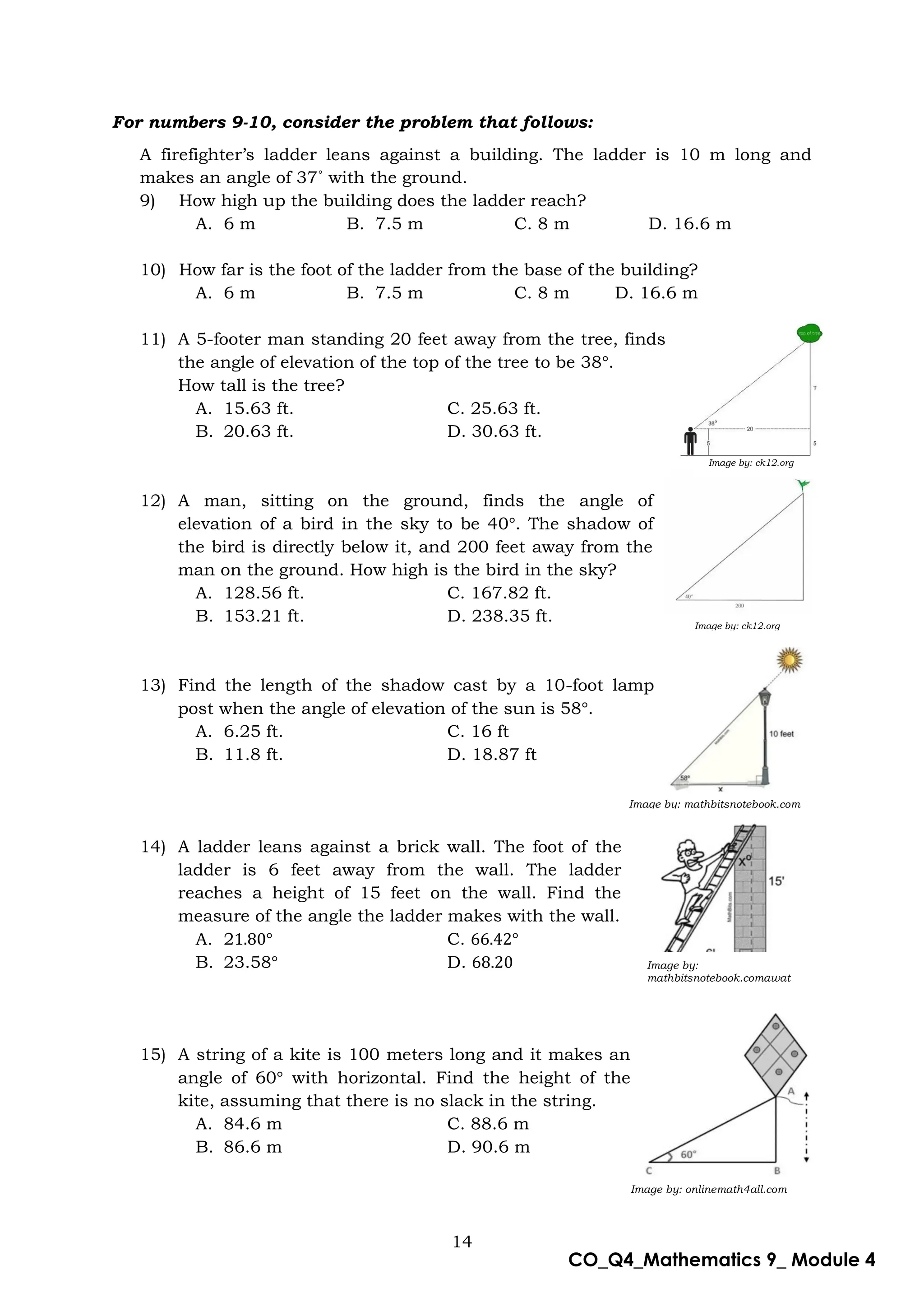
A firefighter’s ladder leans against a building. The ladder is 10 m long and
makes an angle of 37˚ with the ground.
9) How high up the building does the ladder reach?
A. 6 m B. 7.5 m C. 8 m D. 16.6 m
10) How far is the foot of the ladder from the base of the building?
A. 6 m B. 7.5 m C. 8 m D. 16.6 m
11) A 5-footer man standing 20 feet away from the tree, finds
the angle of elevation of the top of the tree to be 38 .
How tall is the tree?
A. 15.63 ft. C. 25.63 ft.
B. 20.63 ft. D. 30.63 ft.
12) A man, sitting on the ground, finds the angle of
elevation of a bird in the sky to be 40 . The shadow of
the bird is directly below it, and 200 feet away from the
man on the ground. How high is the bird in the sky?
A. 128.56 ft. C. 167.82 ft.
B. 153.21 ft. D. 238.35 ft.
13) Find the length of the shadow cast by a 10-foot lamp
post when the angle of elevation of the sun is 58 .
A. 6.25 ft. C. 16 ft
B. 11.8 ft. D. 18.87 ft
14) A ladder leans against a brick wall. The foot of the
ladder is 6 feet away from the wall. The ladder
reaches a height of 15 feet on the wall. Find the
measure of the angle the ladder makes with the wall.
A. 2 C.
B. 23.58 D.
15) A string of a kite is 100 meters long and it makes an
angle of 60 with horizontal. Find the height of the
kite, assuming that there is no slack in the string.
A. 84.6 m C. 88.6 m
B. 86.6 m D. 90.6 m
Image by: ck12.org
Image by: ck12.org
15
CO_Q4_Mathematics 9_ Module 4
Additional Activities
Consider the given situation and answer the following questions below.
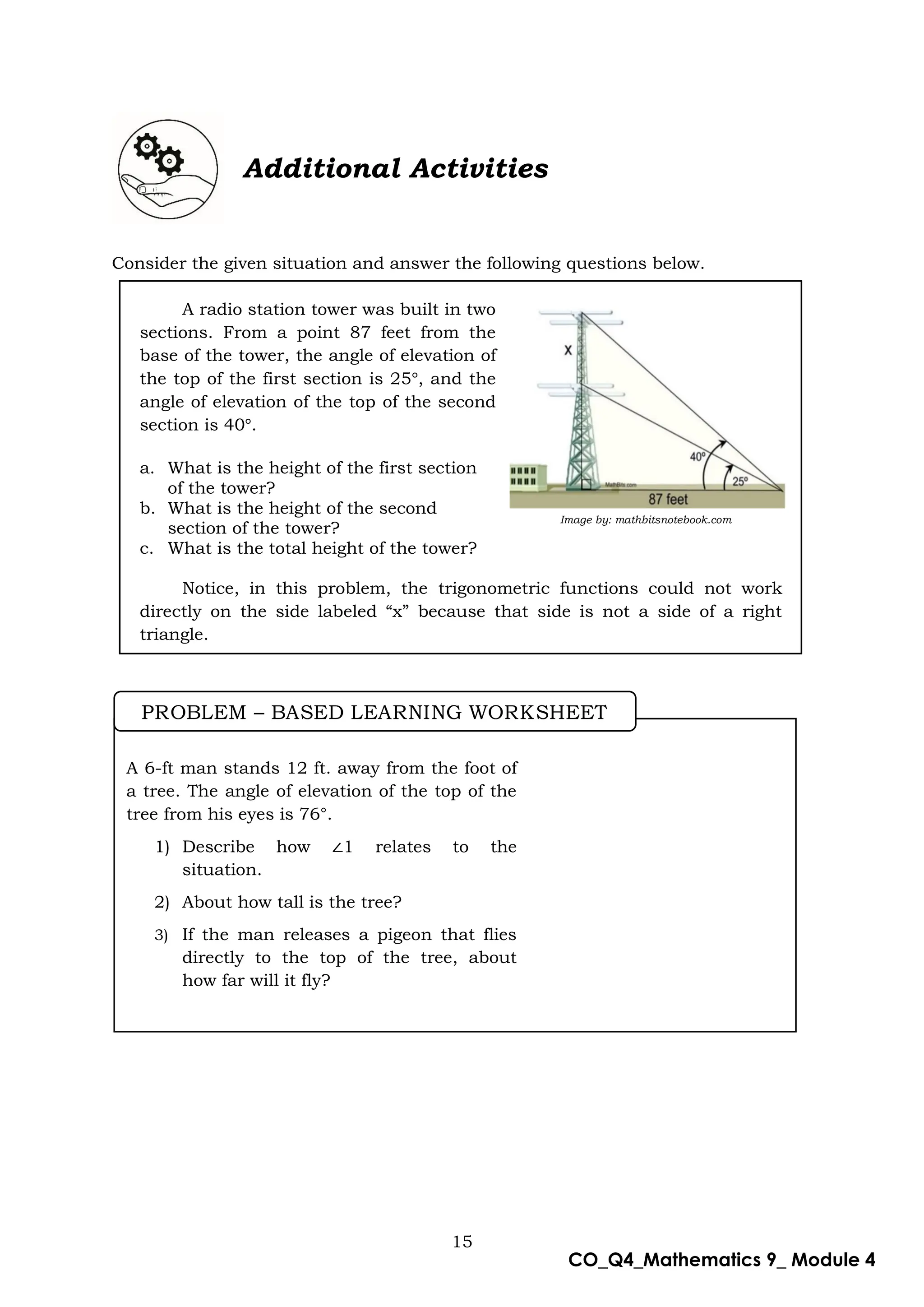
A radio station tower was built in two
sections. From a point 87 feet from the
base of the tower, the angle of elevation of
the top of the first section is 25 , and the
angle of elevation of the top of the second
section is 40 .
a. What is the height of the first section
of the tower?
b. What is the height of the second
section of the tower?
c. What is the total height of the tower?
Notice, in this problem, the trigonometric functions could not work
directly on the side labeled “x” because that side is not a side of a right
triangle.
Image by: mathbitsnotebook.com
A 6-ft man stands 12 ft. away from the foot of
a tree. The angle of elevation of the top of the
tree from his eyes is 76°.
1) Describe how 1 relates to the
situation.
2) About how tall is the tree?
3) If the man releases a pigeon that flies
directly to the top of the tree, about
how far will it fly?
PROBLEM – BASED LEARNING WORKSHEET
16
CO_Q4_Mathematics 9_ Module 4
Answer Key
ADDITIONAL
ACTIVITIES
A.
40.57
ft.
B.
32.43
ft.
C.
73
ft.
WHAT
I
KNOW
1.
C
6.
B
11.
A
2.
C
7.
A
12.
C
3.
B
8.
A
13.
D
4.
C
9.
B
14.
C
5.
D
10.
B
15.
A
WHAT’S
IN
1.
E
2.
A
3.
B
4.
D
5.
C
WHAT’S
MORE
A.
1.
3.464
m
B.
6.
85.2
m
2.
86.60
m
7.
38.2
ft.
3.
81.18
ft
8.
4.
9.192
km
5.
3464
km
ASSESSMENT
1.
C
6.
B
11.
B
2.
A
7.
C
12.
C
3.
B
8.
A
13.
A
4.
A
9.
A
14.
A
5.
B
10.
C
15.
B
PROBLEM
-
BASED
LEARNING
WORKSHEET
1.
Angle
of
elevation
of
the
top
of
the
tree
2.
54.13
ft.
3.
49.60
ft.
17
CO_Q4_Mathematics 9_ Module 4
References
Gladys C. Nivera, Minie Rose C. Lapinid (2013) Grade 9 Mathematics Patterns and
Practicalities, Salesiana BOOKS by Don Bosco Press, Inc. Chino Roces
Avenues, Makati City, Philippines
Orlando A. Oronce, Marilyn O. Mendoza (2010) Work text in Mathematics e-math
Advanced Algebra and Trigonometry, Rex Book Store 856 Nicanor Reyes, Sr.
Street 1977 C.M. Recto Avenue, Manila, Philippines
To further explore the concept learned today and if it possible to connect the
internet, you may visit the following links:
Problems and Illustrations
https://www.slideshare.net/mobile/ihadieedilissa24/math-9-module-7
https://www.onlinemathlearning,com/angle-of-elevation.html
https://youtu.be/U2KgVpoRAdc
https://youtu.be/3H28-wzsF3s
http://khsmath.weebly.com/uploads/5/3/6/7/5367131/angles_of_elevatio
n_8-5.pdf
https://holyspiritmath1201.weebly.com/uploads/3/8/8/0/38800305/mat
h_1201_trigonometry_sample_test.pdf
E-Search
18
CO_Q4_Mathematics 9_ Module 4
For inquiries or feedback, please write or call:
Department of Education - Bureau of Learning Resources (DepEd-BLR)
Ground Floor, Bonifacio Bldg., DepEd Complex
Meralco Avenue, Pasig City, Philippines 1600
Telefax: (632) 8634-1072; 8634-1054; 8631-4985
Email Address: blr.lrqad@deped.gov.ph * blr.lrpd@deped.gov.ph

MATHEMATHICS9-QUARTER4-MODULE4.pdf.2024/

  • 1.
    CO_Q4_Mathematics 9_ Module4 Mathematics Quarter 4 – Module 4: Angle of Elevation 9
  • 2.
    Mathematics – Grade9 Alternative Delivery Mode Quarter 4 – Module 4: Angle of Elevation First Edition, 2020 Republic Act 8293, section 176 states that: No copyright shall subsist in any work of the Government of the Philippines. However, prior approval of the government agency or office wherein the work is created shall be necessary for exploitation of such work for profit. Such agency or office may, among other things, impose as a condition the payment of royalties. Borrowed materials (i.e., songs, stories, poems, pictures, photos, brand names, trademarks, etc.) included in this module are owned by their respective copyright holders. Every effort has been exerted to locate and seek permission to use these materials from their respective copyright owners. The publisher and authors do not represent nor claim ownership over them. Published by the Department of Education Secretary: Leonor Magtolis Briones Undersecretary: Diosdado M. San Antonio Printed in the Philippines by _________________________ Department of Education - National Capital Region (NCR) Office Address: Misamis St., Brgy. Bago Bantay, Quezon City Telefax: (632) 8926-2213 /8929-4330 /8920-1490 and 8929-4348 E-mail Address: ncr@deped.gov.ph Development Team of the Module Writers: Haydee C. Batoon, Rachelle T. Tranquilo and Marissa S. Penaflor Editors: Edwin M. Yap and Elma A. Panuncio Validators: Remylinda T. Soriano, Angelita Z. Modesto and George B. Borromeo Illustrators: Haydee C. Batoon, Rachelle T. Tranquilo and Marissa S. Penaflor Layout Artists: Haydee C. Batoon Rachelle T. Tranquilo Marissa S. Penaflor Alfaith G. Poblete Management Team: Malcolm S. Garma Genia V. Santos Dennis M. Mendoza Maria Magdalena M. Lim Aida H. Rondilla Lucky S. Carpio
  • 3.
    9 Mathematics Quarter 4 –Module 4: Angle of Elevation
  • 4.
    Introductory Message This Self-LearningModule (SLM) is prepared so that you, our dear learners, can continue your studies and learn while at home. Activities, questions, directions, exercises, and discussions are carefully stated for you to understand each lesson. Each SLM is composed of different parts. Each part shall guide you step-by- step as you discover and understand the lesson prepared for you. Pre-tests are provided to measure your prior knowledge on lessons in each SLM. This will tell you if you need to proceed on completing this module or if you need to ask your facilitator or your teacher’s assistance for better understanding of the lesson. At the end of each module, you need to answer the post-test to self- check your learning. Answer keys are provided for each activity and test. We trust that you will be honest in using these. In addition to the material in the main text, Notes to the Teacher are also provided to our facilitators and parents for strategies and reminders on how they can best help you on your home-based learning. Please use this module with care. Do not put unnecessary marks on any part of this SLM. Use a separate sheet of paper in answering the exercises and tests. And read the instructions carefully before performing each task. If you have any questions in using this SLM or any difficulty in answering the tasks in this module, do not hesitate to consult your teacher or facilitator. Thank you.
  • 5.
    1 CO_Q4_Mathematics 9_ Module4 What I Need to Know This module was designed and written with you in mind. It is here to help you master Angle of Elevation. The scope of this module permits it to be used in many different learning situations. The language used recognizes the diverse vocabulary level of students. The lessons are arranged to follow the standard sequence of the course. But the order in which you read them can be changed to correspond with the textbook you are now using. After going through this module, you are expected to:  solve problems involving angles of elevation (M9GE-IVd-45.1)
  • 6.
    2 CO_Q4_Mathematics 9_ Module4 What I Know DIRECTIONS: Answer each of the following items and write the letter of the correct answer on your answer sheet. 1) SOH-CAH-TOA is the mnemonic used in solving the solutions of ______ using the trigonometric functions. A. Obtuse Triangle C. Right Triangle B. Acute Triangle D. All the above 2) Using the figure at the right, which of the following equations is correct to find the value of ? A. sin = C. cos = B. tan = D. sin = 3) It is an acute angle formed by the eye level (horizontal line) and the line of sight when the observer looks at an object that is located higher than him. A. Angle of Depression C. Inclination B. Angle of Elevation D. Reference angle 4) Using the figure at the right, which of the following ratios is equal to the tangent of the given angle of the right triangle? A. C. B. D. 5) Using the figure in item 4, which of the following is correct to find the value of ? A. cos C. cos B. sin D. sin 6) Using the figure at the right. Which is the angle of elevation of the plane? A. 1 C. B. 2 D. 4 1 2 4 3
  • 7.
    3 CO_Q4_Mathematics 9_ Module4 For items 7 – 8, A car traveled 100 feet up a ramp to a bridge. The angle of elevation of the ramp was 10°. 7) How high was the bridge above road level? A. 17.36 ft. B. 17.63 ft. C. 98.5 ft. D. 100 ft. 8) How far is the foot of the ramp to a point on the level road that is directly below the other end of the ramp? A. 98.5 ft. B. 95.8 ft. C. 17.36 ft. D. 10 ft. 9) What is the measure of if ? A. 7 B. 26 C. 64 D. 83 10) Which of the following is equal to ? A. cos B. cos C. tan D. tan 26 11) A student sees a bird on top of a 12-m high pole. The student is standing 20 m away from the foot of the pole. At what angle must the student incline her camera to take a picture of the bird? A. 31 B. 37 C. 53 D. 73 12) An airplane approches an airport. At a certain time, the plane is 1,020 m high and its angle of elevation measured from the aiport is 20.5 How far is the plane from the aiport? A. 1,089 m B. 2,728 m C. 2,913 m D. 3,000 m 13) Using the ∆MAT at the right, what is the length of ̅̅̅̅̅? A. 2.9 cm C. 4.3 cm B. 3.5 cm D. 7.7 cm 14) What is the area of ∆ at the right? A. C. B. D. 15) You are standing 25 m from the foot of a tree and you observe that the angle of elevation of the top of the tree is 48 degrees. How tall is the tree? A. 27.8 m B. 22.5 m C. 18.6 m D. 16.7 m
  • 8.
    4 CO_Q4_Mathematics 9_ Module4 Lesson 1 Angle of Elevation In this lesson you will study how to illustrate and solve problems involving angle of elevation. You will be given an opportunity to do activities that will help you identify and define angle of elevation through illustrations. Also, you will learn that in solving problems you need to draw a detailed diagram to help you visualize them. Those concepts that you have just learned about right triangles and trigonometric functions will help you to get through the next lesson. What’s In Sine, Cosine and Tangent are the three main functions in trigonometry. They are often shortened as sin, cos, and tan. The calculation is simply the length of one side of a right-angled triangle divided by the length of another side, we just have to know which sides to use, and that is where “SOH – CAH – TOA” helps. For a right triangle with an angle , the functions are calculated this way. Sine SOH Sin = Cosine CAH Cos = Tangent TOA Tan = The other trigonometric functions of angle which are the reciprocals of sine, cosine, and tangent can be correspondingly and mnemonically written as “CHO-SHA-CAO”. Cosecant CHO Csc = Secant SHA Sec = Cotangent CAO Cot = h θ a o
  • 9.
    5 CO_Q4_Mathematics 9_ Module4 TRY IT! Use figures 1 and 2 below, match each trigonometric function of the indicated angle in Column A with the correct ratio in Column B. Write only the letter of the correct answer on your answer sheet. Column A Column B 1) tan A 2) cos A 3) sin P 4) cot P 5) sec P A. B. C. D. E. F. G. What’s New Read and analyze the selection below. Suppose that an airplane takes off from a ruway of an airport and flies along a straight path to reach a certain height, does the path of the plane make an angle with the runway? Is it possible to find directly the distance from the point where the plane takes off to the endpoint of the runway when the plane is directly above it using a ruler? To answer these questions, there is a need to understand first the term Angle of Elevation. It is a widely used concept related to height and distance. The trigonometric functions as you have learned in the previous lesson will help you answer these questions. Perform the succeeding activities to apply these concepts in solving real-life problems.
  • 10.
    6 CO_Q4_Mathematics 9_ Module4 What is It The Angle of Elevation of an object as seen by an observer is the acute angle formed by the horizontal line (eye level) and the line from the observer’s eye to the object (line of sight) that is located higher than the observer. In the above figure, you can see an observer on the ground who is looking at the object located higher than him, an angle is formed by his line of sight and horizontal line which is his eye level. The angle is called angle of elevation of the object. Here, if we connect the object to the point directly below it along the horizontal line, a right triangle is formed. Thus we can use a trigonometic function to find the distance of the observer from the foot of the vertical line. The line segment representing the height of the object is the side opposite the angle θ and the horizontal line is the adjacent side to the same angle θ. The trigonometic function to use in finding the angle of elevation of an object depends on the given measures of the sides of the formed right triangle. There is a need for you to recall the ratio of the lengths of the sides that defines each trigonometric function with referece to an acute angle of the right triangle. The mnemonic SOH-CAH-TOA-CAO-SHA-CHO may be of great help to you in identifying the appropriate trigonometric function based on the given measures of the right triangle. You may consider the following as reminders in determining the function to use. 1. If the measures of either leg and the hypoteuse of the right triangle are given, then sine or cosine function may be used. 2. If the measures of the legs of the right triangle are given, then tangent function is to be used.
  • 11.
    7 CO_Q4_Mathematics 9_ Module4 Let us have some situational problems that involve angle of elevation. Proper understanding and interpretation to the problem is necessary for you to come up with proper illustration. Usually, limited understanding and wrong interpretation to the problem lead to incorrect illustration which gives you lower chance to answer and solve the give problem correctly. EXAMPLE 1 Solution: Let x be the distance of the man from the tower (adjacent side to θ = ) 0.87 (x) = 15.24 x = x = 17.52 m 17.52 meters is the distance of the man from the tower. tan Ɵ = 𝑜𝑝𝑝𝑜𝑠𝑖𝑡𝑒 𝑠𝑖𝑑𝑒 𝑎𝑑𝑗𝑎𝑐𝑒𝑡 𝑠𝑖𝑑𝑒 Since the given 15.24 m is the opposite side of the 41° angle and the unknown side (x) is the adjacent side of the given angle, then we will use tangent ratio. tan 41 15.24m A tower is 15.24 m high. At a certain distance away from the tower, a man on the level ground observes that the angle of elevation of the top of the tower is 41°. How far is the man from the tower? 15.24m Eye level or the level ground x = 0.87
  • 12.
    8 CO_Q4_Mathematics 9_ Module4 EXAMPLE 2 Suppose that when the angle of elevation of the sun is 63.4°, a building casts a shadow of 37.5 feet. How tall is the building? Solution: Let y be the height of the building (opposite side to θ = ) tan θ = tan 63.4° = y = 1.997 (37.5) y = 74.89 EXAMPLE 3 A passenger on a ship, observes a 1,800-m high lighthouse that stands on a hill which is 3,700 meters away from the ship. Find the angle of elevation of the top of the lighthouse from the ship. Solution: Let θ be the angle of elevation of the top of the lighthouse from the ship. tan θ = tan θ = tan θ = 0.48̅̅̅̅̅ Ɵ = tan-1 (0. 48̅̅̅̅̅) Ɵ = 25.94 37.5ft Therefore, 74.89 ft. is the height of the building. Ɵ = 25.94° is the angle of elevation of the top of the lighthouse from the ship. shift tan 0.48 7 3700 m 1800 m = 26.10 63.40
  • 13.
    9 CO_Q4_Mathematics 9_ Module4 Therefore, 831 ft. is the height of the mountain. EXAMPLE 4 A person standing 400 ft away from the base of a mountain measures the angle of elevation of the top of the mountain to be 25˚ He then walks 500 ft straight farther and finds the angle of elevation of the top of the mountain to be 20˚. How tall is the mountain? Solution: We will assume that the ground is flat and not inclined relative to the base of the mountain. Let h be the height of the mountain, and let x be the distance from the base of the mountain to the point directly beneath the top of the mountain, as shown in the figure at the right. Then we see that:  (eq. 1)  (eq. 2) Since h is common to the two triangles, then . Use this equation to solve for the value of x. Finally, substitute x by in either equation for h to get the height of the mountain: Eq 1: h = tan 25˚ (1,382.84 + 400) = 1,782.84) = 830.8 Eq 2: Both obtained values of h are rounded off to 831 ft.
  • 14.
    10 CO_Q4_Mathematics 9_ Module4 What’s More A. In a separate sheet, solve each problem involving angle of elevation. Show your computations and label your final answer properly. 1) A ladder leans against a 6-m high wall and reaches the top. If the ladder is inclined with the ground at an angle of 60 degrees, how far is the foot ladder from the wall? 2) A string of a kite is 100 meters long and it makes of an angle of 60° with the horizontal. Find the height of a kite if there is no slack in the string? 3) Grace wants to measure the height of a tree. She walks exactly 125 feet away from the foot of the tree and looks back at the top of the tree. She finds that the angle of elevation of the top of the tree as 33°. How tall is the tree? 4) An airplane is observed to be approaching the airport. What is the height of the plane if it is 12 km away from the point of observation and its angle of elevation is 50 degrees? 5) The angles of elevation of an artificial satellite measured from two earth stations, situated on the same side of the satellite, are found to be 30° and 60°. The two earth stations and the satellite are in the same vertical plane. If the distance between the earth stations is 4000 km, find the distance of the satellite from the earth.
  • 15.
    11 CO_Q4_Mathematics 9_ Module4 B. Find the value of x. Round off the answers to the nearest tenths. What I Have Learned Angle of elevation is an acute angle formed by the eye level (horizontal line) and the line of sight of the observer when he looks at an object that is located higher than him. Steps in solving math problems involving angle of elevation. 1) Draw an illustration that visualizes the problem and label it using the given information. 2) Formulate a ratio of a given measure and the variable representing what is being asked in the problem. 3) Form an equation using the formulated ratio and the trigonometric function defined by the ratio. 4) Solve the solution of the equation and the solution of the problem. 5) Label your final answer correctly. 1. 2. 3.
  • 16.
    12 CO_Q4_Mathematics 9_ Module4 What I Can Do DIRECTIONS: Illustrate and solve the following problems. Use the diagram below. Word Problems: 1) From a boat on the sea, the angle of elevation of the top of a 92-meter cliff is 12°. How far (meter) is the boat from the foot of the cliff? 2) A hiker is 400 meters away from the base of a radio tower. The angle of elevation of the top of the tower is 46°. How high (meter) is the tower? 3) A 12-meter flagpole casts a 19-meter shadow. Find the angle of elevation of the sun. Questions: 1) How did you find the activity? 2) How did you Illustrate the situation presented in each problem? 3) What mathematical concept did you apply to have an accurate illustration? 4) How and why are these concepts important in your daily life? 5) Give one example of your experiences where these concepts are applicable. PROBLEM 1 1 PROBLEM 2 PROBLEM 3 Draw an appropriate illustration. What is/are given? What is asked? Formulate the equation. Solve
  • 17.
    13 CO_Q4_Mathematics 9_ Module4 Assessment DIRECTIONS: Read and answer each of the following items accurately. Write the letter of the correct answer on your answer sheet. 1) Cos P of the right triangle PQR with right angle at Q is ______. A. B. C. D. 2) Consider a right triangle PQR with right angle at Q, if |PQ|=27 cm and |QR|=17 cm, then the measure of angle P is ______. A. 32.19˚ B. 45.19˚ C. 49.58˚ D. 62.46˚ 3) Consider a right triangle ABC with right angle at B, if |AB|=5 cm, |AC|=13 cm, and |BC|=12 cm, what is the value sin A? A. B. C. D. 4) Wayne used the diagram at the right to compute the distance from Ferris to Butte. How much shorter is the distance from Ferris to Dunlap than the distance Wayne computed? SH A. 10 mi C. 25 mi B. 20 mi D. 35mi 5) The line of sight from a small boat to the light at the top of a 35-foot lighthouse built on a cliff 25 feet above the water makes a 25° angle with the water. To the nearest foot, how far is the boat from the cliff? A. 141 ft. C. 75 ft. B. 129 ft. D. 27 ft. 6) The corporate office building is 50 m high and angle of elevation of the top of the building is 52° when seen from a point A on the level ground. What is the distance from point A to the foot of the building? A. 30.78 m B. 39.06 m C. 63.45 m D. 81.21 m 7) Find the value of x in the right triangle at the right. A. 20.85˚ C. 67.6˚ B. 22.39˚ D. 69.15˚ 8) Given at the right is ∆ABC, what ̅̅̅̅ in relation to C? A. Adjacent side C. Hypotenuse B. Altitude D. Opposite side
  • 18.
    14 CO_Q4_Mathematics 9_ Module4 Image by: onlinemath4all.com Image by: mathbitsnotebook.com Image by: mathbitsnotebook.comawat For numbers 9-10, consider the problem that follows: A firefighter’s ladder leans against a building. The ladder is 10 m long and makes an angle of 37˚ with the ground. 9) How high up the building does the ladder reach? A. 6 m B. 7.5 m C. 8 m D. 16.6 m 10) How far is the foot of the ladder from the base of the building? A. 6 m B. 7.5 m C. 8 m D. 16.6 m 11) A 5-footer man standing 20 feet away from the tree, finds the angle of elevation of the top of the tree to be 38 . How tall is the tree? A. 15.63 ft. C. 25.63 ft. B. 20.63 ft. D. 30.63 ft. 12) A man, sitting on the ground, finds the angle of elevation of a bird in the sky to be 40 . The shadow of the bird is directly below it, and 200 feet away from the man on the ground. How high is the bird in the sky? A. 128.56 ft. C. 167.82 ft. B. 153.21 ft. D. 238.35 ft. 13) Find the length of the shadow cast by a 10-foot lamp post when the angle of elevation of the sun is 58 . A. 6.25 ft. C. 16 ft B. 11.8 ft. D. 18.87 ft 14) A ladder leans against a brick wall. The foot of the ladder is 6 feet away from the wall. The ladder reaches a height of 15 feet on the wall. Find the measure of the angle the ladder makes with the wall. A. 2 C. B. 23.58 D. 15) A string of a kite is 100 meters long and it makes an angle of 60 with horizontal. Find the height of the kite, assuming that there is no slack in the string. A. 84.6 m C. 88.6 m B. 86.6 m D. 90.6 m Image by: ck12.org Image by: ck12.org
  • 19.
    15 CO_Q4_Mathematics 9_ Module4 Additional Activities Consider the given situation and answer the following questions below. A radio station tower was built in two sections. From a point 87 feet from the base of the tower, the angle of elevation of the top of the first section is 25 , and the angle of elevation of the top of the second section is 40 . a. What is the height of the first section of the tower? b. What is the height of the second section of the tower? c. What is the total height of the tower? Notice, in this problem, the trigonometric functions could not work directly on the side labeled “x” because that side is not a side of a right triangle. Image by: mathbitsnotebook.com A 6-ft man stands 12 ft. away from the foot of a tree. The angle of elevation of the top of the tree from his eyes is 76°. 1) Describe how 1 relates to the situation. 2) About how tall is the tree? 3) If the man releases a pigeon that flies directly to the top of the tree, about how far will it fly? PROBLEM – BASED LEARNING WORKSHEET
  • 20.
    16 CO_Q4_Mathematics 9_ Module4 Answer Key ADDITIONAL ACTIVITIES A. 40.57 ft. B. 32.43 ft. C. 73 ft. WHAT I KNOW 1. C 6. B 11. A 2. C 7. A 12. C 3. B 8. A 13. D 4. C 9. B 14. C 5. D 10. B 15. A WHAT’S IN 1. E 2. A 3. B 4. D 5. C WHAT’S MORE A. 1. 3.464 m B. 6. 85.2 m 2. 86.60 m 7. 38.2 ft. 3. 81.18 ft 8. 4. 9.192 km 5. 3464 km ASSESSMENT 1. C 6. B 11. B 2. A 7. C 12. C 3. B 8. A 13. A 4. A 9. A 14. A 5. B 10. C 15. B PROBLEM - BASED LEARNING WORKSHEET 1. Angle of elevation of the top of the tree 2. 54.13 ft. 3. 49.60 ft.
  • 21.
    17 CO_Q4_Mathematics 9_ Module4 References Gladys C. Nivera, Minie Rose C. Lapinid (2013) Grade 9 Mathematics Patterns and Practicalities, Salesiana BOOKS by Don Bosco Press, Inc. Chino Roces Avenues, Makati City, Philippines Orlando A. Oronce, Marilyn O. Mendoza (2010) Work text in Mathematics e-math Advanced Algebra and Trigonometry, Rex Book Store 856 Nicanor Reyes, Sr. Street 1977 C.M. Recto Avenue, Manila, Philippines To further explore the concept learned today and if it possible to connect the internet, you may visit the following links: Problems and Illustrations https://www.slideshare.net/mobile/ihadieedilissa24/math-9-module-7 https://www.onlinemathlearning,com/angle-of-elevation.html https://youtu.be/U2KgVpoRAdc https://youtu.be/3H28-wzsF3s http://khsmath.weebly.com/uploads/5/3/6/7/5367131/angles_of_elevatio n_8-5.pdf https://holyspiritmath1201.weebly.com/uploads/3/8/8/0/38800305/mat h_1201_trigonometry_sample_test.pdf E-Search
  • 22.
    18 CO_Q4_Mathematics 9_ Module4 For inquiries or feedback, please write or call: Department of Education - Bureau of Learning Resources (DepEd-BLR) Ground Floor, Bonifacio Bldg., DepEd Complex Meralco Avenue, Pasig City, Philippines 1600 Telefax: (632) 8634-1072; 8634-1054; 8631-4985 Email Address: blr.lrqad@deped.gov.ph * blr.lrpd@deped.gov.ph