CO_Q3_Mathematics 5_ Module 6
Mathematics
Quarter 3 – Module 6:
Visualizing, Identifying and
Describing Polygons with 5 or
More Sides
5
Mathematics – Grade 5
Alternative Delivery Mode
Quarter 3 – Module 6: Visualizing, Identifying and Describing Polygons with 5 or More
Sides
First Edition, 2020
Republic Act 8293, section 176 states that: No copyright shall subsist in any work of
the Government of the Philippines. However, prior approval of the government agency or office
wherein the work is created shall be necessary for exploitation of such work for profit. Such
agency or office may, among other things, impose as a condition the payment of royalties.
Borrowed materials (i.e., songs, stories, poems, pictures, photos, brand names,
trademarks, etc.) included in this module are owned by their respective copyright holders.
Every effort has been exerted to locate and seek permission to use these materials from their
respective copyright owners. The publisher and authors do not represent nor claim ownership
over them.
Published by the Department of Education
Secretary: Leonor Magtolis Briones
Undersecretary: Diosdado M. San Antonio
Printed in the Philippines by ________________________
Department of Education – Region VIII
Office Address: DepEd Regional Office No. 8
Candahug, Palo, Leyte
Telefax: (053)-832- 2997
E-mail Address: region8@deped.gpv.ph
Development Team of the Module
Writers: Egie B. Tamoyang
Editors: Nian L. Atis, Santiago Fabula, Jr.
Reviewers: Rolando Lacbo, Janet Pepito
Illustrator: - Noel E. Sagayap
Layout Artist: Razle L. Jabelo, Jaycee B. Barcelona
Management Team: Ma. Gemma M. Ledesma, Arnulfo R. Balane, Rosemarie M. Guino
Joy B. Bihag, Ryan R. Tiu, Sarah S. Cabaluna,
Thelma Cabadsan-Quitalig, Elena S. De Luna,
Renato S. Cagomoc, Noel E. Sagayap, Geraldine P. Sumbise
Joshua Sherwin T. Lim
5
Mathematics
Quarter 3 – Module 6:
Visualizing, Identifying and
Describing Polygons with 5 or
More Sides
Introductory Message
This Self-Learning Module (SLM) is prepared so that you, our dear learners,
can continue your studies and learn while at home. Activities, questions, directions,
exercises, and discussions are carefully stated for you to understand each lesson.
Each SLM is composed of different parts. Each part shall guide you step-by-
step as you discover and understand the lesson prepared for you.
Pre-tests are provided to measure your prior knowledge on lessons in each
SLM. This will tell you if you need to proceed on completing this module or if you
need to ask your facilitator or your teacher’s assistance for better understanding of
the lesson. At the end of each module, you need to answer the post-test to self-check
your learning. Answer keys are provided for each activity and test. We trust that you
will be honest in using these.
In addition to the material in the main text, Notes to the Teacher are also
provided to our facilitators and parents for strategies and reminders on how they can
best help you on your home-based learning.
Please use this module with care. Do not put unnecessary marks on any part
of this SLM. Use a separate sheet of paper in answering the exercises and tests. And
read the instructions carefully before performing each task.
If you have any questions in using this SLM or any difficulty in answering the
tasks in this module, do not hesitate to consult your teacher or facilitator.
Thank you.
1 CO_Q3_Mathematics 5_ Module 6
What I Need to Know
Good day Mathletes! In this module, you are going to gain an understanding
on visualizing, identifying and describing polygons with 5 or more sides. You will also
realize the importance of polygons in our day-to-day living. Moreover, you will surely
enjoy the fun and challenging activities which are provided for you to strengthen your
understanding of the lesson.
When you finish up this module, you will be able to:
1. visualize polygons with five or more sides;
2. identify polygons with five or more sides; and
3. describe polygons with five or more sides.
Let us first check what you know about polygons.
2 CO_Q3_Mathematics 5_ Module 6
What I Know
Directions: Read and understand the given. Choose the letter that corresponds to
the correct answer. Write the letters of your answers on a separate sheet of paper.
1) Which of the following illustrates a 12-sided polygon?
A. B. C. D.
2) Which of the following illustrates a hexagon?
A. B. C. D.
3) Which of the following is not true about polygons?
A. Polygons have more than two (2) sides.
B. Polygons are 2-dimensional geometric figures.
C. Polygons are 3-dimensional geometric figures.
D. Polygons can be classified by the number of their vertices.
4) What do you call a 5-sided polygon?
A. a hexagon B. a pentagon C. a heptagon D. a nonagon
5) What polygon is illustrated by the figure on the right?
A. a hexagon B. a pentagon C. a heptagon D. a nonagon
6) Which of the following has exactly 5 angles?
A. a hexagon B. a pentagon C. a heptagon D. a nonagon
7) What is the exact number of vertices of an octagon?
A. five (5) B. six (6) C. eight (8) D. nine (9)
8) What is the exact number of line segments that are connected to each vertex
of a pentagon?
A. one (1) B. two (2) C. three (3) D. five (5)
9) Which of the following is a six-sided polygon?
A. a hexagon B. a pentagon C. a heptagon D. a dodecagon
10) What do you call a ten-sided polygon?
A. a hexagon B. a pentagon C. a heptagon D. a decagon
Please check your answers against the ANSWER KEY on page 14.
3 CO_Q3_Mathematics 5_ Module 6
Lesson
1
Visualizing, identifying and
describing polygons with 5
or more sides
Mastery on polygons is not only an important part of mathematics, but it is
also an important part of daily living. It helps you become acquainted with the
applications of polygons in science, engineering, art, design and social studies.
Are you ready to explore the lesson? So, let’s proceed.
What’s In
Let us review the previous lesson. Can you still recall the steps on solving
routine problems and different methods/strategies on solving non-routine problems
involving percentage?
Let us consider the next word problem. We solve it using the steps on solving
routine problems.
Example 1
In a church organization with 100 members, each is required to donate 10%
from their monthly salary or any form of income which can be 3,000.00 pesos and
above. What is the maximum length of time it would take to save 1 500 000 pesos if
all of the 100 members contributed monthly?
Solution:
Understand the problem.
 Know what is asked.
We are asked to find the maximum length of time needed for the 100
church members to save 1.5M pesos.
 Know the given facts.
There are 100 members.
Each monthly salary/income of 3,000 pesos and above is with required
donation of 10%.
The target amount is 1.5 million pesos
Plan.
 Determine the operations to be used.
Multiplication and division are the needed operations.
 Write the number sentence.
0.10 x 3000 = N = percentage of the income
4 CO_Q3_Mathematics 5_ Module 6
N x 100 = amount of donations per month
1,500,000 ÷ amount of donations per month = number of months to
complete the needed amount
Show your solution.
50
0.10 300 30000 1 500 000
x 3000 x 100 1 500 00
300.00 30000 0
0
0
Check and look back.
 Verify if your answer makes sense.
4.1666…
30000 12 50.0000
x 50 (months) 48
1 500 000 20
12
80
72
80
State the complete answer.
Try the next problem. Decide for yourself if you will use 2 or 3 strategies in solving
non-routine problem.
Example 2
Eric hosted a children’s party. He counted the persons who attended the event
and found out that 60% of 200 visitors were female. How many visitors were female?
You can solve by drawing an illustration first.
20 20 20 20 20 20 20 20 20 20
In the given problem, 60% can also be represented in fractional form as
6
10
Since there were 200 persons who attended the party, we simply divide it into 10
regions. So, each regions represents 20 persons. If one shaded region represents 20
persons, then 6 shaded regions represents 120 persons. It means that 120 female
attended the children’s party.
If each of the 100 members donated monthly and the minimum income is 3 000
pesos, then it will take a maximum of 50 months or 4 years and 2 months to
complete the 1.5 million pesos for the reconstruction of the church.
1 year = 12 months
4 years = 48 months
50 months
= 48 months + 2 months
= 4 years and 2 months
5 CO_Q3_Mathematics 5_ Module 6
What’s New
In the previous lessons, you were taught on how to solve routine and non-
routine problems involving percentage. This module is going to teach and guide you
on how to visualize, identify and describe polygons with 5 sides or more.
Always remember that polygons are closed plane figures that are formed by
the line segments that meet only at their endpoints. The line segments are the sides.
The endpoints where the sides meet are the vertices.
Polygons are classified according to the number of their sides, vertices and
angles.
Example 3
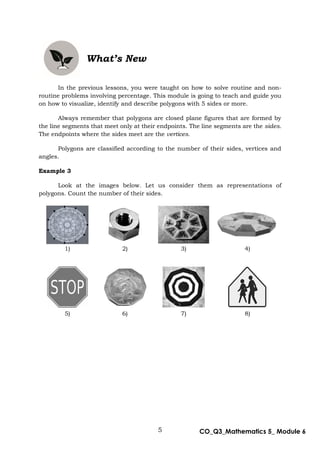
Look at the images below. Let us consider them as representations of
polygons. Count the number of their sides.
1) 2) 3) 4)
5) 6) 7) 8)
6 CO_Q3_Mathematics 5_ Module 6
What is It
Everyday, we encounter representations of polygons in many different forms,
colors and sizes, even in the streets or inside our homes. Thus, knowing and
identifying shapes and angles are not enough. It is also important to master the skills
in visualizing, naming and describing polygons with 5 sides or more, so that we can
easily recognize them wherever we go, in whatever form and shape they are having.
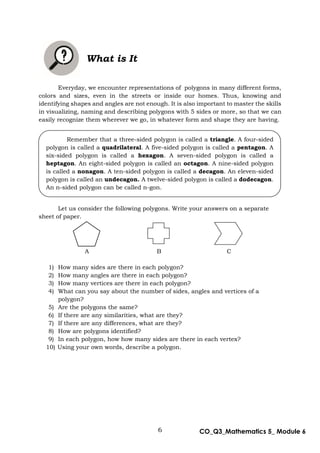
Let us consider the following polygons. Write your answers on a separate
sheet of paper.
A B C
1) How many sides are there in each polygon?
2) How many angles are there in each polygon?
3) How many vertices are there in each polygon?
4) What can you say about the number of sides, angles and vertices of a
polygon?
5) Are the polygons the same?
6) If there are any similarities, what are they?
7) If there are any differences, what are they?
8) How are polygons identified?
9) In each polygon, how how many sides are there in each vertex?
10) Using your own words, describe a polygon.
Remember that a three-sided polygon is called a triangle. A four-sided
polygon is called a quadrilateral. A five-sided polygon is called a pentagon. A
six-sided polygon is called a hexagon. A seven-sided polygon is called a
heptagon. An eight-sided polygon is called an octagon. A nine-sided polygon
is called a nonagon. A ten-sided polygon is called a decagon. An eleven-sided
polygon is called an undecagon. A twelve-sided polygon is called a dodecagon.
An n-sided polygon can be called n-gon.
7 CO_Q3_Mathematics 5_ Module 6
Consider the different polygons below and their identifications.
FIGURE NAME NUMBER OF SIDES
Triangle 3
Quadrilateral 4
Pentagon 5
Hexagon 6
Heptagon 7
Octagon
8
Nonagon
9
Decagon
10
Undecagon 11
Dodecagon 12
8 CO_Q3_Mathematics 5_ Module 6
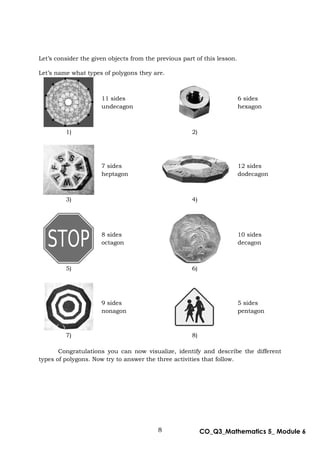
Let’s consider the given objects from the previous part of this lesson.
Let’s name what types of polygons they are.
11 sides
undecagon
6 sides
hexagon
1) 2)
7 sides
heptagon
12 sides
dodecagon
3) 4)
8 sides
octagon
10 sides
decagon
5) 6)
9 sides
nonagon
5 sides
pentagon
7) 8)
Congratulations you can now visualize, identify and describe the different
types of polygons. Now try to answer the three activities that follow.
9 CO_Q3_Mathematics 5_ Module 6
What’s More
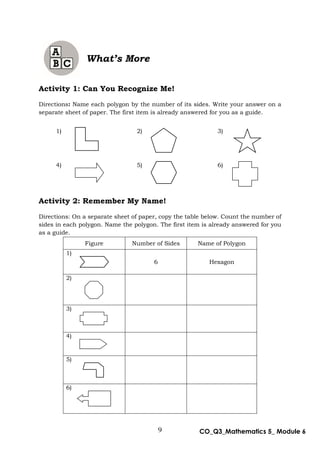
Activity 1: Can You Recognize Me!
Directions: Name each polygon by the number of its sides. Write your answer on a
separate sheet of paper. The first item is already answered for you as a guide.
1) 2) 3)
4) 5) 6)
Activity 2: Remember My Name!
Directions: On a separate sheet of paper, copy the table below. Count the number of
sides in each polygon. Name the polygon. The first item is already answered for you
as a guide.
Figure Number of Sides Name of Polygon
1)
6 Hexagon
2)
3)
4)
5)
6)
10 CO_Q3_Mathematics 5_ Module 6
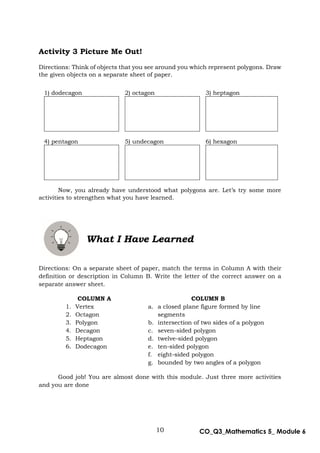
Activity 3 Picture Me Out!
Directions: Think of objects that you see around you which represent polygons. Draw
the given objects on a separate sheet of paper.
1) dodecagon 2) octagon 3) heptagon
4) pentagon 5) undecagon 6) hexagon
Now, you already have understood what polygons are. Let’s try some more
activities to strengthen what you have learned.
What I Have Learned
Directions: On a separate sheet of paper, match the terms in Column A with their
definition or description in Column B. Write the letter of the correct answer on a
separate answer sheet.
COLUMN A COLUMN B
1. Vertex
2. Octagon
3. Polygon
4. Decagon
5. Heptagon
6. Dodecagon
a. a closed plane figure formed by line
segments
b. intersection of two sides of a polygon
c. seven-sided polygon
d. twelve-sided polygon
e. ten-sided polygon
f. eight-sided polygon
g. bounded by two angles of a polygon
Good job! You are almost done with this module. Just three more activities
and you are done
11 CO_Q3_Mathematics 5_ Module 6
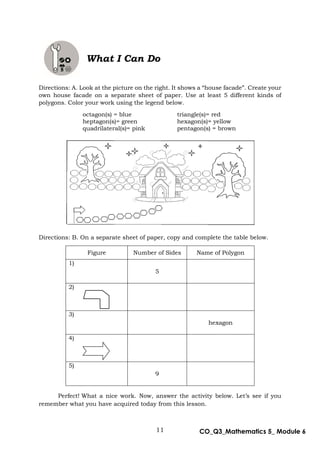
What I Can Do
Directions: A. Look at the picture on the right. It shows a “house facade”. Create your
own house facade on a separate sheet of paper. Use at least 5 different kinds of
polygons. Color your work using the legend below.
octagon(s) = blue
heptagon(s)= green
quadrilateral(s)= pink
triangle(s)= red
hexagon(s)= yellow
pentagon(s) = brown
Directions: B. On a separate sheet of paper, copy and complete the table below.
Figure Number of Sides Name of Polygon
1)
5
2)
3)
hexagon
4)
5)
9
Perfect! What a nice work. Now, answer the activity below. Let’s see if you
remember what you have acquired today from this lesson.
12 CO_Q3_Mathematics 5_ Module 6
Please check your answers with the ANSWER KEY on page 14.
Got a score of 8-10? CONGRATULATIONS! Job well done. See you in the next
module. If below 8, you may have to go over the lessons and the exercises again.
Assessment
Directions: A. Identify the following geometric shapes. Choose the letter that
corresponds to the correct answer. Write your answers on a separate sheet of paper.
1) A. heptagon
B. pentagon
C. hexagon
D. dodecagon
2) A. pentagon
B. nonagon
C. octagon
D. hexagon
3) A. nonagon
B. octagon
C. heptagon
D. dodecagon
4) A. pentagon
B. heptagon
C. octagon
D. hexagon
5) A. dodecagon
B. undecagon
C. nonagon
D. octagon
Directions: B. Read each item carefully. Choose the letter that corresponds to the
correct answer. Write your answers on a separate sheet of paper.
6) Which of the following is the exact number of sides of a pentagon?
A. three (3) B. five (5) C. seven (7) D. nine (9)
7) Which of the following has exactly 7 angles?
A. A hexagon B. A pentagon C. A heptagon D. An octagon
8) Which of the following is an eight-sided polygon?
A. A triangle B. A heptagon C. An octagon D. A nonagon
9) Which of the following has exactly 12 angles?
A. A nonagon B. A decagon C. An undecagon D. A dodecagon
10)Which of the following is not true about polygons?
A. Polygons have more than two (2) angles.
B. Polygons are 2-dimensional geometric figures.
C. Polygons are 3-dimensional geometric figures.
D. Each vertex of a polygon has exactly two-line segments.
13 CO_Q3_Mathematics 5_ Module 6
Additional Activities
Directions: A. Read the following carefully. Do what is asked. Use a separate sheet of
paper for your work.
A polygon with equal sides and equal angles is a regular polygon.
A tessellation is created when a shape is repeated over and over again covering a
plane without any gaps or overlaps. Tiling is another word for a tessellation.
The three regular triangles form a tessellation.
Squares form tessellation.
What are other polygons, with 5 or more sides, that can form tessellation? Illustrate
your findings.
Directions: B. Read the following carefully. Do what is asked. Use a separate sheet
of paper for your work.
Consider the following polygons.
A B C
1) What kind of polygons are they? How do you identify them?
2) How is A different from B?
3) How is B similar to A?
4) State the similarities of the three polygons, if any.
5) State the differences of the three polygons, If any.
14 CO_Q3_Mathematics 5_ Module 6
Answer Key
Additional
Activities
A.
Answers
vary.
B.
1)
They
are
hexagons.
2)
A
is
a
regular
polygon.
B
is
not
a
regular
polygon.
Other
differences
can
be
pointed
out.
3)
Both
are
hexagons.
4)
They
are
all
hexagons.
5)
They
have
different
lengths
of
sides
and
different
measures
of
angles.
Assessment
1.
B
2.
D
3.
C
4.
C
5.
A
6.
B
7.
C
8.
C
9.
D
10.
C
What
I
Can
Do
A.
Answers
vary
B.
The
figures
may
vary.
1.
pentagon
2.
7
sides,
heptagon
3.
6
sides,
hexagon
4.
8
sides,
octagon
5.
nonagon
What’s
I
Have
Learned
1.
B
2.
F
3.
A
4.
E
5.
C
6.
D
What’s
More
Activity
1:
1.
Hexagon
2.
Pentagon,
5
sided
3.
Decagon,
10-sided
4.
Heptagon,
7-sided
5.
Hexagon,
6-sided
6.
Dodecagon,
12
sided
Activity
2:
1.
Hexagon,
6-sided
2.
Octagon,
8-sided
3.
Dodecagon,
12-sided
4.
Pentagon
,5-sided
5.
Heptagon,
7-sided
6.
undecagon-
11-sided
Activity
3:
Answers
vary
per
learner
What
is
it
Example
1
For
1,
2
and
3,
A=
5
B
=
12
C=
6
4.
They
are
the
same.
5.
No.
6.
They
are
all
polygons.
7.
They
have
different
exact
numbers
of
sides.
8.
They
are
identified
with
the
number
of
their
sides,
angles
or
vertices.
9.
Two
10.
Answers
vary.
Example
2
There
are
120
female
attendees
in
the
children’s
party
What's
In
Example
1
The
length
of
time
needed
for
the
100
church
members
to
save
1.5M
pesos
is
50
months
or
4
years
and
2
months
Example
2
there
are
120
female
attendees
in
the
children’s
party
What
I
Know
1.
B
2.
A
3.
C
4.
B
5.
C
6.
B
7.
C
8.
B
9.
A
10.
D
15 CO_Q3_Mathematics 5_ Module 6
References
Khan Academy. n.d. Khan Academy | Free Online Courses, Lessons & Practice.
[online] Available at: <https://www.khanacademy.org/> [Accessed 11 August
2020].
Study.com. Accessed: August 4, 2020. https://study.com/academy/lesson/what-
is-a-polygon-definition-shapes-angles.html.
“Identifying and Describing Polygons.” math solutions, founded by marilyn burns,
from houghton mifflin harcourt. Accessed: August 4, 2020.
https://mathsolutions.com/ms_classroom_lessons/identifying-and-
describing-polygons/.
K to 12 Grade 5 Curriculum Guide, p 61, Lesson Guide in Elementary
Mathematics 5, p. 350-357
For inquiries or feedback, please write or call:
Department of Education - Bureau of Learning Resources (DepEd-BLR)
Ground Floor, Bonifacio Bldg., DepEd Complex
Meralco Avenue, Pasig City, Philippines 1600
Telefax: (632) 8634-1072; 8634-1054; 8631-4985
Email Address: blr.lrqad@deped.gov.ph * blr.lrpd@deped.gov.ph

MATH5 Q3 MODULE6 Visualizing, Identifying and describing polygons

  • 1.
    CO_Q3_Mathematics 5_ Module6 Mathematics Quarter 3 – Module 6: Visualizing, Identifying and Describing Polygons with 5 or More Sides 5
  • 2.
    Mathematics – Grade5 Alternative Delivery Mode Quarter 3 – Module 6: Visualizing, Identifying and Describing Polygons with 5 or More Sides First Edition, 2020 Republic Act 8293, section 176 states that: No copyright shall subsist in any work of the Government of the Philippines. However, prior approval of the government agency or office wherein the work is created shall be necessary for exploitation of such work for profit. Such agency or office may, among other things, impose as a condition the payment of royalties. Borrowed materials (i.e., songs, stories, poems, pictures, photos, brand names, trademarks, etc.) included in this module are owned by their respective copyright holders. Every effort has been exerted to locate and seek permission to use these materials from their respective copyright owners. The publisher and authors do not represent nor claim ownership over them. Published by the Department of Education Secretary: Leonor Magtolis Briones Undersecretary: Diosdado M. San Antonio Printed in the Philippines by ________________________ Department of Education – Region VIII Office Address: DepEd Regional Office No. 8 Candahug, Palo, Leyte Telefax: (053)-832- 2997 E-mail Address: region8@deped.gpv.ph Development Team of the Module Writers: Egie B. Tamoyang Editors: Nian L. Atis, Santiago Fabula, Jr. Reviewers: Rolando Lacbo, Janet Pepito Illustrator: - Noel E. Sagayap Layout Artist: Razle L. Jabelo, Jaycee B. Barcelona Management Team: Ma. Gemma M. Ledesma, Arnulfo R. Balane, Rosemarie M. Guino Joy B. Bihag, Ryan R. Tiu, Sarah S. Cabaluna, Thelma Cabadsan-Quitalig, Elena S. De Luna, Renato S. Cagomoc, Noel E. Sagayap, Geraldine P. Sumbise Joshua Sherwin T. Lim
  • 3.
    5 Mathematics Quarter 3 –Module 6: Visualizing, Identifying and Describing Polygons with 5 or More Sides
  • 4.
    Introductory Message This Self-LearningModule (SLM) is prepared so that you, our dear learners, can continue your studies and learn while at home. Activities, questions, directions, exercises, and discussions are carefully stated for you to understand each lesson. Each SLM is composed of different parts. Each part shall guide you step-by- step as you discover and understand the lesson prepared for you. Pre-tests are provided to measure your prior knowledge on lessons in each SLM. This will tell you if you need to proceed on completing this module or if you need to ask your facilitator or your teacher’s assistance for better understanding of the lesson. At the end of each module, you need to answer the post-test to self-check your learning. Answer keys are provided for each activity and test. We trust that you will be honest in using these. In addition to the material in the main text, Notes to the Teacher are also provided to our facilitators and parents for strategies and reminders on how they can best help you on your home-based learning. Please use this module with care. Do not put unnecessary marks on any part of this SLM. Use a separate sheet of paper in answering the exercises and tests. And read the instructions carefully before performing each task. If you have any questions in using this SLM or any difficulty in answering the tasks in this module, do not hesitate to consult your teacher or facilitator. Thank you.
  • 5.
    1 CO_Q3_Mathematics 5_Module 6 What I Need to Know Good day Mathletes! In this module, you are going to gain an understanding on visualizing, identifying and describing polygons with 5 or more sides. You will also realize the importance of polygons in our day-to-day living. Moreover, you will surely enjoy the fun and challenging activities which are provided for you to strengthen your understanding of the lesson. When you finish up this module, you will be able to: 1. visualize polygons with five or more sides; 2. identify polygons with five or more sides; and 3. describe polygons with five or more sides. Let us first check what you know about polygons.
  • 6.
    2 CO_Q3_Mathematics 5_Module 6 What I Know Directions: Read and understand the given. Choose the letter that corresponds to the correct answer. Write the letters of your answers on a separate sheet of paper. 1) Which of the following illustrates a 12-sided polygon? A. B. C. D. 2) Which of the following illustrates a hexagon? A. B. C. D. 3) Which of the following is not true about polygons? A. Polygons have more than two (2) sides. B. Polygons are 2-dimensional geometric figures. C. Polygons are 3-dimensional geometric figures. D. Polygons can be classified by the number of their vertices. 4) What do you call a 5-sided polygon? A. a hexagon B. a pentagon C. a heptagon D. a nonagon 5) What polygon is illustrated by the figure on the right? A. a hexagon B. a pentagon C. a heptagon D. a nonagon 6) Which of the following has exactly 5 angles? A. a hexagon B. a pentagon C. a heptagon D. a nonagon 7) What is the exact number of vertices of an octagon? A. five (5) B. six (6) C. eight (8) D. nine (9) 8) What is the exact number of line segments that are connected to each vertex of a pentagon? A. one (1) B. two (2) C. three (3) D. five (5) 9) Which of the following is a six-sided polygon? A. a hexagon B. a pentagon C. a heptagon D. a dodecagon 10) What do you call a ten-sided polygon? A. a hexagon B. a pentagon C. a heptagon D. a decagon Please check your answers against the ANSWER KEY on page 14.
  • 7.
    3 CO_Q3_Mathematics 5_Module 6 Lesson 1 Visualizing, identifying and describing polygons with 5 or more sides Mastery on polygons is not only an important part of mathematics, but it is also an important part of daily living. It helps you become acquainted with the applications of polygons in science, engineering, art, design and social studies. Are you ready to explore the lesson? So, let’s proceed. What’s In Let us review the previous lesson. Can you still recall the steps on solving routine problems and different methods/strategies on solving non-routine problems involving percentage? Let us consider the next word problem. We solve it using the steps on solving routine problems. Example 1 In a church organization with 100 members, each is required to donate 10% from their monthly salary or any form of income which can be 3,000.00 pesos and above. What is the maximum length of time it would take to save 1 500 000 pesos if all of the 100 members contributed monthly? Solution: Understand the problem.  Know what is asked. We are asked to find the maximum length of time needed for the 100 church members to save 1.5M pesos.  Know the given facts. There are 100 members. Each monthly salary/income of 3,000 pesos and above is with required donation of 10%. The target amount is 1.5 million pesos Plan.  Determine the operations to be used. Multiplication and division are the needed operations.  Write the number sentence. 0.10 x 3000 = N = percentage of the income
  • 8.
    4 CO_Q3_Mathematics 5_Module 6 N x 100 = amount of donations per month 1,500,000 ÷ amount of donations per month = number of months to complete the needed amount Show your solution. 50 0.10 300 30000 1 500 000 x 3000 x 100 1 500 00 300.00 30000 0 0 0 Check and look back.  Verify if your answer makes sense. 4.1666… 30000 12 50.0000 x 50 (months) 48 1 500 000 20 12 80 72 80 State the complete answer. Try the next problem. Decide for yourself if you will use 2 or 3 strategies in solving non-routine problem. Example 2 Eric hosted a children’s party. He counted the persons who attended the event and found out that 60% of 200 visitors were female. How many visitors were female? You can solve by drawing an illustration first. 20 20 20 20 20 20 20 20 20 20 In the given problem, 60% can also be represented in fractional form as 6 10 Since there were 200 persons who attended the party, we simply divide it into 10 regions. So, each regions represents 20 persons. If one shaded region represents 20 persons, then 6 shaded regions represents 120 persons. It means that 120 female attended the children’s party. If each of the 100 members donated monthly and the minimum income is 3 000 pesos, then it will take a maximum of 50 months or 4 years and 2 months to complete the 1.5 million pesos for the reconstruction of the church. 1 year = 12 months 4 years = 48 months 50 months = 48 months + 2 months = 4 years and 2 months
  • 9.
    5 CO_Q3_Mathematics 5_Module 6 What’s New In the previous lessons, you were taught on how to solve routine and non- routine problems involving percentage. This module is going to teach and guide you on how to visualize, identify and describe polygons with 5 sides or more. Always remember that polygons are closed plane figures that are formed by the line segments that meet only at their endpoints. The line segments are the sides. The endpoints where the sides meet are the vertices. Polygons are classified according to the number of their sides, vertices and angles. Example 3 Look at the images below. Let us consider them as representations of polygons. Count the number of their sides. 1) 2) 3) 4) 5) 6) 7) 8)
  • 10.
    6 CO_Q3_Mathematics 5_Module 6 What is It Everyday, we encounter representations of polygons in many different forms, colors and sizes, even in the streets or inside our homes. Thus, knowing and identifying shapes and angles are not enough. It is also important to master the skills in visualizing, naming and describing polygons with 5 sides or more, so that we can easily recognize them wherever we go, in whatever form and shape they are having. Let us consider the following polygons. Write your answers on a separate sheet of paper. A B C 1) How many sides are there in each polygon? 2) How many angles are there in each polygon? 3) How many vertices are there in each polygon? 4) What can you say about the number of sides, angles and vertices of a polygon? 5) Are the polygons the same? 6) If there are any similarities, what are they? 7) If there are any differences, what are they? 8) How are polygons identified? 9) In each polygon, how how many sides are there in each vertex? 10) Using your own words, describe a polygon. Remember that a three-sided polygon is called a triangle. A four-sided polygon is called a quadrilateral. A five-sided polygon is called a pentagon. A six-sided polygon is called a hexagon. A seven-sided polygon is called a heptagon. An eight-sided polygon is called an octagon. A nine-sided polygon is called a nonagon. A ten-sided polygon is called a decagon. An eleven-sided polygon is called an undecagon. A twelve-sided polygon is called a dodecagon. An n-sided polygon can be called n-gon.
  • 11.
    7 CO_Q3_Mathematics 5_Module 6 Consider the different polygons below and their identifications. FIGURE NAME NUMBER OF SIDES Triangle 3 Quadrilateral 4 Pentagon 5 Hexagon 6 Heptagon 7 Octagon 8 Nonagon 9 Decagon 10 Undecagon 11 Dodecagon 12
  • 12.
    8 CO_Q3_Mathematics 5_Module 6 Let’s consider the given objects from the previous part of this lesson. Let’s name what types of polygons they are. 11 sides undecagon 6 sides hexagon 1) 2) 7 sides heptagon 12 sides dodecagon 3) 4) 8 sides octagon 10 sides decagon 5) 6) 9 sides nonagon 5 sides pentagon 7) 8) Congratulations you can now visualize, identify and describe the different types of polygons. Now try to answer the three activities that follow.
  • 13.
    9 CO_Q3_Mathematics 5_Module 6 What’s More Activity 1: Can You Recognize Me! Directions: Name each polygon by the number of its sides. Write your answer on a separate sheet of paper. The first item is already answered for you as a guide. 1) 2) 3) 4) 5) 6) Activity 2: Remember My Name! Directions: On a separate sheet of paper, copy the table below. Count the number of sides in each polygon. Name the polygon. The first item is already answered for you as a guide. Figure Number of Sides Name of Polygon 1) 6 Hexagon 2) 3) 4) 5) 6)
  • 14.
    10 CO_Q3_Mathematics 5_Module 6 Activity 3 Picture Me Out! Directions: Think of objects that you see around you which represent polygons. Draw the given objects on a separate sheet of paper. 1) dodecagon 2) octagon 3) heptagon 4) pentagon 5) undecagon 6) hexagon Now, you already have understood what polygons are. Let’s try some more activities to strengthen what you have learned. What I Have Learned Directions: On a separate sheet of paper, match the terms in Column A with their definition or description in Column B. Write the letter of the correct answer on a separate answer sheet. COLUMN A COLUMN B 1. Vertex 2. Octagon 3. Polygon 4. Decagon 5. Heptagon 6. Dodecagon a. a closed plane figure formed by line segments b. intersection of two sides of a polygon c. seven-sided polygon d. twelve-sided polygon e. ten-sided polygon f. eight-sided polygon g. bounded by two angles of a polygon Good job! You are almost done with this module. Just three more activities and you are done
  • 15.
    11 CO_Q3_Mathematics 5_Module 6 What I Can Do Directions: A. Look at the picture on the right. It shows a “house facade”. Create your own house facade on a separate sheet of paper. Use at least 5 different kinds of polygons. Color your work using the legend below. octagon(s) = blue heptagon(s)= green quadrilateral(s)= pink triangle(s)= red hexagon(s)= yellow pentagon(s) = brown Directions: B. On a separate sheet of paper, copy and complete the table below. Figure Number of Sides Name of Polygon 1) 5 2) 3) hexagon 4) 5) 9 Perfect! What a nice work. Now, answer the activity below. Let’s see if you remember what you have acquired today from this lesson.
  • 16.
    12 CO_Q3_Mathematics 5_Module 6 Please check your answers with the ANSWER KEY on page 14. Got a score of 8-10? CONGRATULATIONS! Job well done. See you in the next module. If below 8, you may have to go over the lessons and the exercises again. Assessment Directions: A. Identify the following geometric shapes. Choose the letter that corresponds to the correct answer. Write your answers on a separate sheet of paper. 1) A. heptagon B. pentagon C. hexagon D. dodecagon 2) A. pentagon B. nonagon C. octagon D. hexagon 3) A. nonagon B. octagon C. heptagon D. dodecagon 4) A. pentagon B. heptagon C. octagon D. hexagon 5) A. dodecagon B. undecagon C. nonagon D. octagon Directions: B. Read each item carefully. Choose the letter that corresponds to the correct answer. Write your answers on a separate sheet of paper. 6) Which of the following is the exact number of sides of a pentagon? A. three (3) B. five (5) C. seven (7) D. nine (9) 7) Which of the following has exactly 7 angles? A. A hexagon B. A pentagon C. A heptagon D. An octagon 8) Which of the following is an eight-sided polygon? A. A triangle B. A heptagon C. An octagon D. A nonagon 9) Which of the following has exactly 12 angles? A. A nonagon B. A decagon C. An undecagon D. A dodecagon 10)Which of the following is not true about polygons? A. Polygons have more than two (2) angles. B. Polygons are 2-dimensional geometric figures. C. Polygons are 3-dimensional geometric figures. D. Each vertex of a polygon has exactly two-line segments.
  • 17.
    13 CO_Q3_Mathematics 5_Module 6 Additional Activities Directions: A. Read the following carefully. Do what is asked. Use a separate sheet of paper for your work. A polygon with equal sides and equal angles is a regular polygon. A tessellation is created when a shape is repeated over and over again covering a plane without any gaps or overlaps. Tiling is another word for a tessellation. The three regular triangles form a tessellation. Squares form tessellation. What are other polygons, with 5 or more sides, that can form tessellation? Illustrate your findings. Directions: B. Read the following carefully. Do what is asked. Use a separate sheet of paper for your work. Consider the following polygons. A B C 1) What kind of polygons are they? How do you identify them? 2) How is A different from B? 3) How is B similar to A? 4) State the similarities of the three polygons, if any. 5) State the differences of the three polygons, If any.
  • 18.
    14 CO_Q3_Mathematics 5_Module 6 Answer Key Additional Activities A. Answers vary. B. 1) They are hexagons. 2) A is a regular polygon. B is not a regular polygon. Other differences can be pointed out. 3) Both are hexagons. 4) They are all hexagons. 5) They have different lengths of sides and different measures of angles. Assessment 1. B 2. D 3. C 4. C 5. A 6. B 7. C 8. C 9. D 10. C What I Can Do A. Answers vary B. The figures may vary. 1. pentagon 2. 7 sides, heptagon 3. 6 sides, hexagon 4. 8 sides, octagon 5. nonagon What’s I Have Learned 1. B 2. F 3. A 4. E 5. C 6. D What’s More Activity 1: 1. Hexagon 2. Pentagon, 5 sided 3. Decagon, 10-sided 4. Heptagon, 7-sided 5. Hexagon, 6-sided 6. Dodecagon, 12 sided Activity 2: 1. Hexagon, 6-sided 2. Octagon, 8-sided 3. Dodecagon, 12-sided 4. Pentagon ,5-sided 5. Heptagon, 7-sided 6. undecagon- 11-sided Activity 3: Answers vary per learner What is it Example 1 For 1, 2 and 3, A= 5 B = 12 C= 6 4. They are the same. 5. No. 6. They are all polygons. 7. They have different exact numbers of sides. 8. They are identified with the number of their sides, angles or vertices. 9. Two 10. Answers vary. Example 2 There are 120 female attendees in the children’s party What's In Example 1 The length of time needed for the 100 church members to save 1.5M pesos is 50 months or 4 years and 2 months Example 2 there are 120 female attendees in the children’s party What I Know 1. B 2. A 3. C 4. B 5. C 6. B 7. C 8. B 9. A 10. D
  • 19.
    15 CO_Q3_Mathematics 5_Module 6 References Khan Academy. n.d. Khan Academy | Free Online Courses, Lessons & Practice. [online] Available at: <https://www.khanacademy.org/> [Accessed 11 August 2020]. Study.com. Accessed: August 4, 2020. https://study.com/academy/lesson/what- is-a-polygon-definition-shapes-angles.html. “Identifying and Describing Polygons.” math solutions, founded by marilyn burns, from houghton mifflin harcourt. Accessed: August 4, 2020. https://mathsolutions.com/ms_classroom_lessons/identifying-and- describing-polygons/. K to 12 Grade 5 Curriculum Guide, p 61, Lesson Guide in Elementary Mathematics 5, p. 350-357
  • 20.
    For inquiries orfeedback, please write or call: Department of Education - Bureau of Learning Resources (DepEd-BLR) Ground Floor, Bonifacio Bldg., DepEd Complex Meralco Avenue, Pasig City, Philippines 1600 Telefax: (632) 8634-1072; 8634-1054; 8631-4985 Email Address: blr.lrqad@deped.gov.ph * blr.lrpd@deped.gov.ph