Math 7_Week 3_AbsoluteValue,Operations on Integers_Calumpit NHS.pdf
1.
7 Mathematics
Quarter 1-Module 3
Absolute Value
M7NS-Ic-1
Operations on Integers
M7NS-Ic-d-1
GOVERNM
ENT PROPERTY
NOT FOR
SALE
2.
Mathematics - Grade7
Alternative Delivery Mode
Quarter 1 - Absolute Value and Operations on Integers
First Edition, 2020
Republic Act 8293, section 176 states that: No copyright shall subsist in any work of the
Government of the Philippines. However, prior approval of the government agency or office wherein
the work is created shall be necessary for exploitation of such work for profit. Such agency or office
may, among other things, impose as a condition the payment of royalties.
Borrowed materials (i.e., songs, stories, poems, pictures, photos, brand names, trademarks, etc.)
included in this book are owned by their respective copyright holders. Every effort has been exerted
to locate and seek permission to use these materials from their respective copyright owners. The
publisher and authors do not represent nor claim ownership over them.
Published by the Department of Education - Region III
Secretary : Leonor M. Briones
Undersecretary : Diosdado M. San Antonio
Development Team of the Module
Author : Ma.Teresa C. Manansala
Language Reviewer : Cherrylou C. Dela Cruz
Content Editor : Cynthia V. Aguinalgo
Illustrator : Ma.Teresa C. Manansala
Layout Artist : Ma.Teresa C. Manansala
Management Team
Gregorio C. Quinto, Jr., EdD
Chief, Curriculum Implementation Division
Rainelda M. Blanco, PhD
Education Program Supervisor - LRMDS
Agnes R. Bernardo, PhD
EPS-Division ADM Coordinator
Glenda S. Constantino
Project Development Officer II
Joannarie C. Garcia
Librarian II
Department of Education, Schools Division of Bulacan
Curriculum Implementation Division
Learning Resource Management and Development System (LRMDS)
Capitol Compound, Guinhawa St., City of Malolos, Bulacan
Email Address: lrmdsbulacan@deped.gov.ph
Francisco B. Macale
Mathematics, Division Focal Person
Introductory Message
1
For thefacilitator:
Welcome to the Mathematics Supplementary Learning Resources on Absolute Value
and Operations on Integers.
This module was collaboratively designed, developed and reviewed by educators from
public institutions to assist you, the teacher or facilitator, in helping the learners meet the
standards set by the K to 12 Curriculum while overcoming their personal, social, and
economic constraints in schooling.
This learning resource hopes to engage the learners into guided and independent
learning activities at their own pace and time. Furthermore, this also aims to help learners
acquire the needed 21st century skills while taking into consideration their needs and
circumstances.
In addition to the material in the main text, you will also see this box in the body of the
module:
Notes to the Teacher
This contains helpful tips or strategies that
will help you in guiding the learners.
As a facilitator, you are expected to orient the learners on how to use this module. You
also need to keep track of the learners’ progress while allowing them to manage their
own learning. Furthermore, you are expected to encourage and assist the learners as
they do the tasks included in the module.
For the learner:
Welcome to the Mathematics 7 Supplementary Learning Resources on Absolute Value
and Operations on Integers.
This module was designed to provide you with fun and meaningful opportunities for
guided and independent learning at your own pace and time. You will be enabled to
process the contents of the learning resource while being an active learner.
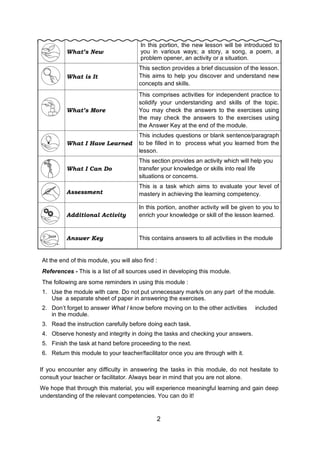
This module has the following parts and corresponding icons:
What I Need to Know
This will give you an idea of the skills or
competencies you are expected to learn in the
module.
What I Know
This part includes an activity that aims to check
what you already know about the lesson to take.
If you get all the answers correctly (100%),you
may decide to skip this module
What’s in
This is a brief drill or review to help you link the
current lesson with the previous one.
5.
At the endof this module, you will also find :
References - This is a list of all sources used in developing this module.
The following are some reminders in using this module :
1. Use the module with care. Do not put unnecessary mark/s on any part of the module.
Use a separate sheet of paper in answering the exercises.
2. Don’t forget to answer What I know before moving on to the other activities included
in the module.
3. Read the instruction carefully before doing each task.
4. Observe honesty and integrity in doing the tasks and checking your answers.
5. Finish the task at hand before proceeding to the next.
6. Return this module to your teacher/facilitator once you are through with it.
What’s New
In this portion, the new lesson will be introduced to
you in various ways; a story, a song, a poem, a
problem opener, an activity or a situation.
What is It
This section provides a brief discussion of the lesson.
This aims to help you discover and understand new
concepts and skills.
What’s More
This comprises activities for independent practice to
solidify your understanding and skills of the topic.
You may check the answers to the exercises using
the may check the answers to the exercises using
the Answer Key at the end of the module.
What I Have Learned
This includes questions or blank sentence/paragraph
to be filled in to process what you learned from the
lesson.
What I Can Do
This section provides an activity which will help you
transfer your knowledge or skills into real life
situations or concerns.
Assessment
This is a task which aims to evaluate your level of
mastery in achieving the learning competency.
Additional Activity
In this portion, another activity will be given to you to
enrich your knowledge or skill of the lesson learned.
Answer Key This contains answers to all activities in the module
If you encounter any difficulty in answering the tasks in this module, do not hesitate to
consult your teacher or facilitator. Always bear in mind that you are not alone.
We hope that through this material, you will experience meaningful learning and gain deep
understanding of the relevant competencies. You can do it!
2
6.
What I Needto know
What I Know
Choose the letter of the correct answer. Write your answer on a separate piece
of paper.
1. The sum of –2 and –6 is ________
a.8 b. -8 c. +8 d. none of these
2. The sum +10 and –12 the result is _______
a. 2 b. -2 c. +22 d. -22
3. To add two numbers having the same sign, Find ____ and prefix the common
sign.
a. Sum of their absolute values
b. Difference of their absolute values
c. Product of their absolute values
d. Quotient of their absolute values
4. In the sentence +8 - (-4) = 12, Which is the subtrahend?
a. 8 b -4 c. 12 d. none of these
5. The additive inverse of –4 is _______
a. +4 b. -4 c. 1/4 d. -1/4
6. The difference of -7 and –4 is _______
a. 3 b. -3 c. -11 d. 11
This module provides varied activities that will help you learn about
the absolute value of a number and the four fundamental operations on
integers. This material will assist you to gain knowledge and skills in
solving real life problems involving the four mathematical operations on
signed numbers.
The lessons included in this module are the following:
1. Absolute value of the number.
2. Addition of Integers
3. Subtraction of Integers
4. Multiplication of Integers
5. Division of Integers
At the end of this module, you are expected to;
1. Perform operation on integers.
2. Solve simple word problem involving operation on integers.
3
7.
7. To subtracttwo integers, ______ the minuend to the additive inverse of the
subtrahend.
a. Add b. Subtract c. Multiply d. Divide
8. What is the balance when you borrow Php 150.00 and then paying Php 75.00
a. Php 75.00 b. Php. 225.00 c. Php 70.00 d. Php 220.00
9. The product of two negative integers is always _________
a. Negative b. Positive c. Zero d. Can’t be determined
10. The product of (-6) and ( + 6) is ________
a. 12 b. 36 c. -12 d. -36
11. What is the result when –63 is divided by 7 and the quotient is added to 5?
a. 4 b. -14 c. -4 d. 14
12. The quotient of a positive and negative integers is _______
a. Negative b. Positive c. Zero d. None of these
13. Paul went to a drug store with Php 2500.00 on his wallet. He bought 3 boxes of
face mask costing Php 550.00 each. How much does he have left?
a. 550 b. 650 c. 750 d. 850
14.The distance between the given number from zero on the number line is
called _______
a. Positive b. Negative c. Origin d. Absolute value
15.Find is the value of N in the sentence, -8 = N
a. 8 b. -8 c. +8 d. none of these
-3 -2 -1 0 1 2 3
The number line is a useful tool in comparing positive and negative numbers.
How do we compare two integers ? Which is greater –2 or 2 ?
Recall these...
Positive numbers is always greater in value than the negative numbers.
The numbers at the right side of the other is greater than in value than the left side.
In comparing two negative numbers, the smaller the number the greater the value.
Exercises:
Write < , > , or = in each blank to make each expressions true.
1. +6 ____ +1 3. 1 _____ -10 5. -1 _____ +1
2. -14 ____ -16 4. -8 _____ 0
4
What’s In
8.
-3 -2 -10 1 2 3
3 units away from 0 3 units away from 0
5
Integers or signed numbers belong to the set of Real Number system. The set of
integers includes counting numbers and these are 1, 2, 3, 4, …; zero (0); and the
negatives or opposites of the counting numbers which are -1, -2, -3, -4, …Thus, if
we are talking of the set of all integers, we may denote this using the following set
notation:
{… , -4, -3, -3, -1, 0, 1, 2, 3, 4, …}
Here are some important things that we must remember about integers:
A number line can be used to show the set of integers.
The positive integers, {+1, +2, +3, +4, …}, are located at the right of
zero (0) on the number line,
Negative numbers , {-1, -2, -3, -4, …} are located at the left of zero (0) on
the number line.
Zero is neutral which means that it is neither positive nor negative.
A number with no sign on it is positive.
Let us consider the integers on the number line. How far is +3 away from zero? How
about -3?
Based on the figure, both -3 and +3 are 3 units away from zero. Therefore,
and
Examples:
1. This means that -5 is 5 units to the left of zero.
2.
.
What’s New
What is It
Absolute Value of a Number
This means that is 13 units to the right of zero.
The absolute value of a number is the distance of the number from zero,
also known as the origin. It is denoted by two vertical bars like this ǀ ǀ.
This means that +8 is 8 units to the right of zero.
3.
9.
2 units
- 10 1 2 3 4 5 6
3 units
4 units
2 units
- 1 0 1 2 3 4 5
5 units
4 units
6
Addition of Integers
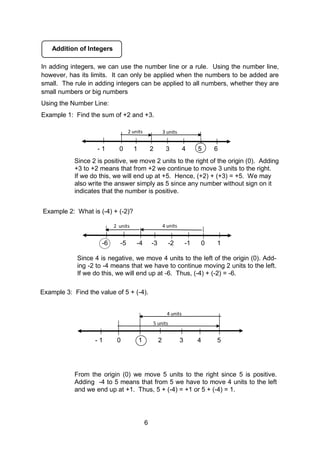
Since 2 is positive, we move 2 units to the right of the origin (0). Adding
+3 to +2 means that from +2 we continue to move 3 units to the right.
If we do this, we will end up at +5. Hence, (+2) + (+3) = +5. We may
also write the answer simply as 5 since any number without sign on it
indicates that the number is positive.
In adding integers, we can use the number line or a rule. Using the number line,
however, has its limits. It can only be applied when the numbers to be added are
small. The rule in adding integers can be applied to all numbers, whether they are
small numbers or big numbers
Using the Number Line:
Example 1: Find the sum of +2 and +3.
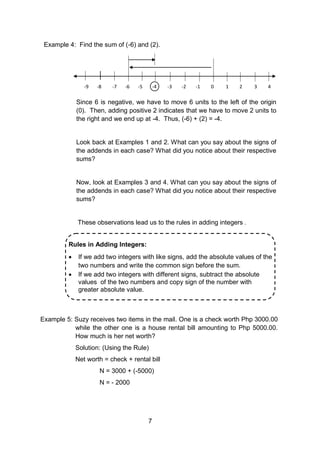
Example 2: What is (-4) + (-2)?
Since 4 is negative, we move 4 units to the left of the origin (0). Add-
ing -2 to -4 means that we have to continue moving 2 units to the left.
If we do this, we will end up at -6. Thus, (-4) + (-2) = -6.
-6 -5 -4 -3 -2 -1 0 1
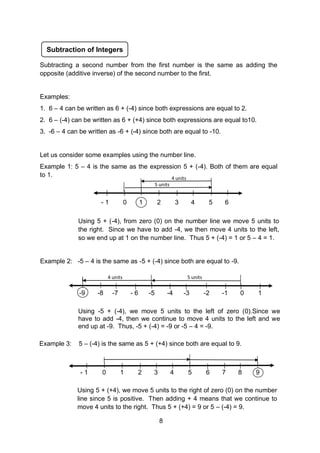
Example 3: Find the value of 5 + (-4).
From the origin (0) we move 5 units to the right since 5 is positive.
Adding -4 to 5 means that from 5 we have to move 4 units to the left
and we end up at +1. Thus, 5 + (-4) = +1 or 5 + (-4) = 1.
10.
7
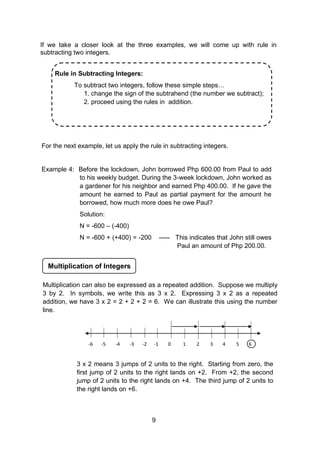
Example 4: Findthe sum of (-6) and (2).
-9 -8 -7 -6 -5 -4 -3 -2 -1 0 1 2 3 4
Since 6 is negative, we have to move 6 units to the left of the origin
(0). Then, adding positive 2 indicates that we have to move 2 units to
the right and we end up at -4. Thus, (-6) + (2) = -4.
Look back at Examples 1 and 2. What can you say about the signs of
the addends in each case? What did you notice about their respective
sums?
Now, look at Examples 3 and 4. What can you say about the signs of
the addends in each case? What did you notice about their respective
sums?
These observations lead us to the rules in adding integers .
Example 5: Suzy receives two items in the mail. One is a check worth Php 3000.00
while the other one is a house rental bill amounting to Php 5000.00.
How much is her net worth?
Solution: (Using the Rule)
Net worth = check + rental bill
N = 3000 + (-5000)
N = - 2000
Rules in Adding Integers:
If we add two integers with like signs, add the absolute values of the
two numbers and write the common sign before the sum.
If we add two integers with different signs, subtract the absolute
values of the two numbers and copy sign of the number with
greater absolute value.
11.
5 units
4 units
Subtractionof Integers
Using -5 + (-4), we move 5 units to the left of zero (0).Since we
have to add -4, then we continue to move 4 units to the left and we
end up at -9. Thus, -5 + (-4) = -9 or -5 – 4 = -9.
Using 5 + (-4), from zero (0) on the number line we move 5 units to
the right. Since we have to add -4, we then move 4 units to the left,
so we end up at 1 on the number line. Thus 5 + (-4) = 1 or 5 – 4 = 1.
Example 2: -5 – 4 is the same as -5 + (-4) since both are equal to -9.
- 1 0 1 2 3 4 5 6
-9 -8 -7 - 6 -5 -4 -3 -2 -1 0 1
5 units
4 units
Example 3: 5 – (-4) is the same as 5 + (+4) since both are equal to 9.
Using 5 + (+4), we move 5 units to the right of zero (0) on the number
line since 5 is positive. Then adding + 4 means that we continue to
move 4 units to the right. Thus 5 + (+4) = 9 or 5 – (-4) = 9.
- 1 0 1 2 3 4 5 6 7 8 9
Subtracting a second number from the first number is the same as adding the
opposite (additive inverse) of the second number to the first.
Examples:
1. 6 – 4 can be written as 6 + (-4) since both expressions are equal to 2.
2. 6 – (-4) can be written as 6 + (+4) since both expressions are equal to10.
3. -6 – 4 can be written as -6 + (-4) since both are equal to -10.
Let us consider some examples using the number line.
Example 1: 5 – 4 is the same as the expression 5 + (-4). Both of them are equal
to 1.
8
12.
If we takea closer look at the three examples, we will come up with rule in
subtracting two integers.
For the next example, let us apply the rule in subtracting integers.
Example 4: Before the lockdown, John borrowed Php 600.00 from Paul to add
to his weekly budget. During the 3-week lockdown, John worked as
a gardener for his neighbor and earned Php 400.00. If he gave the
amount he earned to Paul as partial payment for the amount he
borrowed, how much more does he owe Paul?
Solution:
N = -600 – (-400)
N = -600 + (+400) = -200 ----- This indicates that John still owes
Paul an amount of Php 200.00.
Multiplication of Integers
Multiplication can also be expressed as a repeated addition. Suppose we multiply
3 by 2. In symbols, we write this as 3 x 2. Expressing 3 x 2 as a repeated
addition, we have 3 x 2 = 2 + 2 + 2 = 6. We can illustrate this using the number
line.
3 x 2 means 3 jumps of 2 units to the right. Starting from zero, the
first jump of 2 units to the right lands on +2. From +2, the second
jump of 2 units to the right lands on +4. The third jump of 2 units to
the right lands on +6.
-6 -5 -4 -3 -2 -1 0 1 2 3 4 5 6
Rule in Subtracting Integers:
To subtract two integers, follow these simple steps…
1. change the sign of the subtrahend (the number we subtract);
2. proceed using the rules in addition.
9
13.
-6 -5 -4-3 -2 -1 0 1 2 3 4 5 6
-6 -5 -4 -3 -2 -1 0 1 2 3 4 5 6
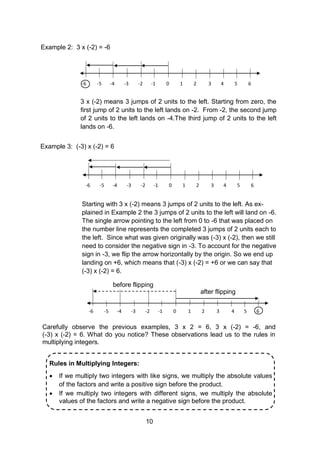
Example 2: 3 x (-2) = -6
3 x (-2) means 3 jumps of 2 units to the left. Starting from zero, the
first jump of 2 units to the left lands on -2. From -2, the second jump
of 2 units to the left lands on -4.The third jump of 2 units to the left
lands on -6.
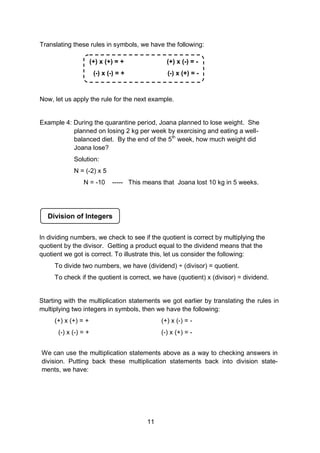
Example 3: (-3) x (-2) = 6
Starting with 3 x (-2) means 3 jumps of 2 units to the left. As ex-
plained in Example 2 the 3 jumps of 2 units to the left will land on -6.
The single arrow pointing to the left from 0 to -6 that was placed on
the number line represents the completed 3 jumps of 2 units each to
the left. Since what was given originally was (-3) x (-2), then we still
need to consider the negative sign in -3. To account for the negative
sign in -3, we flip the arrow horizontally by the origin. So we end up
landing on +6, which means that (-3) x (-2) = +6 or we can say that
(-3) x (-2) = 6.
-6 -5 -4 -3 -2 -1 0 1 2 3 4 5 6
before flipping
after flipping
Carefully observe the previous examples, 3 x 2 = 6, 3 x (-2) = -6, and
(-3) x (-2) = 6. What do you notice? These observations lead us to the rules in
multiplying integers.
Rules in Multiplying Integers:
If we multiply two integers with like signs, we multiply the absolute values
of the factors and write a positive sign before the product.
If we multiply two integers with different signs, we multiply the absolute
values of the factors and write a negative sign before the product.
10
14.
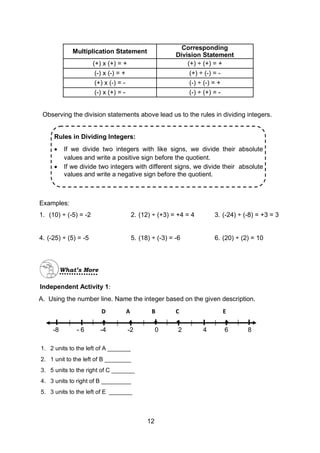
Translating these rulesin symbols, we have the following:
Now, let us apply the rule for the next example.
Example 4: During the quarantine period, Joana planned to lose weight. She
planned on losing 2 kg per week by exercising and eating a well-
balanced diet. By the end of the 5th
week, how much weight did
Joana lose?
Solution:
N = (-2) x 5
N = -10 ----- This means that Joana lost 10 kg in 5 weeks.
(+) x (+) = + (+) x (-) = -
(-) x (-) = + (-) x (+) = -
Division of Integers
In dividing numbers, we check to see if the quotient is correct by multiplying the
quotient by the divisor. Getting a product equal to the dividend means that the
quotient we got is correct. To illustrate this, let us consider the following:
To divide two numbers, we have (dividend) ÷ (divisor) = quotient.
To check if the quotient is correct, we have (quotient) x (divisor) = dividend.
Starting with the multiplication statements we got earlier by translating the rules in
multiplying two integers in symbols, then we have the following:
(+) x (+) = + (+) x (-) = -
(-) x (-) = + (-) x (+) = -
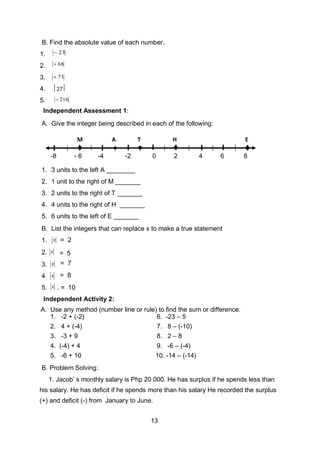
We can use the multiplication statements above as a way to checking answers in
division. Putting back these multiplication statements back into division state-
ments, we have:
11
15.
12
1. 2 unitsto the left of A _______
2. 1 unit to the left of B ________
3. 5 units to the right of C _______
4. 3 units to right of B _________
5. 3 units to the left of E _______
A. Using the number line. Name the integer based on the given description.
Independent Activity 1:
D A B C E
-8 - 6 -4 -2 0 2 4 6 8
Multiplication Statement
Corresponding
Division Statement
(+) x (+) = + (+) ÷ (+) = +
(-) x (-) = + (+) ÷ (-) = -
(+) x (-) = - (-) ÷ (-) = +
(-) x (+) = - (-) ÷ (+) = -
Observing the division statements above lead us to the rules in dividing integers.
Rules in Dividing Integers:
If we divide two integers with like signs, we divide their absolute
values and write a positive sign before the quotient.
If we divide two integers with different signs, we divide their absolute
values and write a negative sign before the quotient.
Examples:
1. (10) ÷ (-5) = -2 2. (12) ÷ (+3) = +4 = 4 3. (-24) ÷ (-8) = +3 = 3
4. (-25) ÷ (5) = -5 5. (18) ÷ (-3) = -6 6. (20) ÷ (2) = 10
What’s More
16.
B. Find theabsolute value of each number.
1.
2.
3.
4. 27
5.
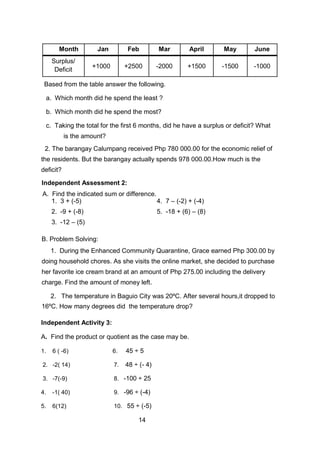
1. Jacob’ s monthly salary is Php 20 000. He has surplus if he spends less than
his salary. He has deficit if he spends more than his salary He recorded the surplus
(+) and deficit (-) from January to June.
13
-8 - 6 -4 -2 0 2 4 6 8
M A T H E
x = 2
= 5
= 7
= 8
23
68
71
216
Independent Assessment 1:
A. Give the integer being described in each of the following:
1. 3 units to the left A ________
2. 1 unit to the right of M _______
3. 2 units to the right of T _______
4. 4 units to the right of H _______
5. 6 units to the left of E _______
B. List the integers that can replace x to make a true statement
1.
2.
3.
4
5. . = 10
Independent Activity 2:
x
x
x
x
A. Use any method (number line or rule) to find the sum or difference.
1. -2 + (-2) 6. -23 – 5
2. 4 + (-4) 7. 8 – (-10)
3. -3 + 9 8. 2 – 8
4. (-4) + 4 9. -6 – (-4)
5. -6 + 10 10. -14 – (-14)
B. Problem Solving:
17.
Month Jan FebMar April May June
Surplus/
Deficit
+1000 +2500 -2000 +1500 -1500 -1000
14
Based from the table answer the following.
a. Which month did he spend the least ?
b. Which month did he spend the most?
c. Taking the total for the first 6 months, did he have a surplus or deficit? What
is the amount?
2. The barangay Calumpang received Php 780 000.00 for the economic relief of
the residents. But the barangay actually spends 978 000.00.How much is the
deficit?
Independent Assessment 2:
A. Find the indicated sum or difference.
1. 3 + (-5) 4. 7 – (-2) + (-4)
2. -9 + (-8) 5. -18 + (6) – (8)
3. -12 – (5)
B. Problem Solving:
1. During the Enhanced Community Quarantine, Grace earned Php 300.00 by
doing household chores. As she visits the online market, she decided to purchase
her favorite ice cream brand at an amount of Php 275.00 including the delivery
charge. Find the amount of money left.
2. The temperature in Baguio City was 20ºC. After several hours,it dropped to
16ºC. How many degrees did the temperature drop?
Independent Activity 3:
A. Find the product or quotient as the case may be.
1. 6 ( -6) 6. 45 ÷ 5
2. -2( 14) 7. 48 ÷ (- 4)
3. -7(-9) 8. -100 ÷ 25
4. -1( 40) 9. -96 ÷ (-4)
5. 6(12) 10. 55 ÷ (-5)
18.
B. Problem Solving:
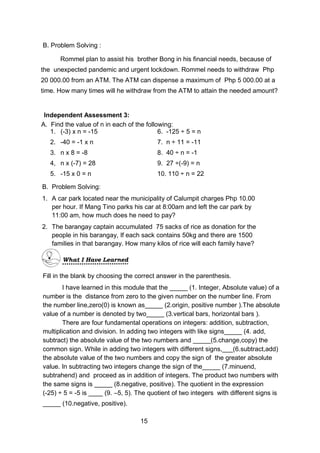
Rommel plan to assist his brother Bong in his financial needs, because of
the unexpected pandemic and urgent lockdown. Rommel needs to withdraw Php
20 000.00 from an ATM. The ATM can dispense a maximum of Php 5 000.00 at a
time. How many times will he withdraw from the ATM to attain the needed amount?
Fill in the blank by choosing the correct answer in the parenthesis.
I have learned in this module that the _____ (1. Integer, Absolute value) of a
number is the distance from zero to the given number on the number line. From
the number line,zero(0) is known as_____ (2.origin, positive number ).The absolute
value of a number is denoted by two_____ (3.vertical bars, horizontal bars ).
There are four fundamental operations on integers: addition, subtraction,
multiplication and division. In adding two integers with like signs_____ (4. add,
subtract) the absolute value of the two numbers and _____(5.change,copy) the
common sign. While in adding two integers with different signs,___(6.subtract,add)
the absolute value of the two numbers and copy the sign of the greater absolute
value. In subtracting two integers change the sign of the_____ (7.minuend,
subtrahend) and proceed as in addition of integers. The product two numbers with
the same signs is _____ (8.negative, positive). The quotient in the expression
(-25) ÷ 5 = -5 is ____ (9. –5, 5). The quotient of two integers with different signs is
_____ (10.negative, positive).
A. Find the value of n in each of the following:
1. (-3) x n = -15 6. -125 ÷ 5 = n
2. -40 = -1 x n 7. n ÷ 11 = -11
3. n x 8 = -8 8. 40 ÷ n = -1
4, n x (-7) = 28 9. 27 ÷(-9) = n
5. -15 x 0 = n 10. 110 ÷ n = 22
Independent Assessment 3:
B. Problem Solving:
1. A car park located near the municipality of Calumpit charges Php 10.00
per hour. If Mang Tino parks his car at 8:00am and left the car park by
11:00 am, how much does he need to pay?
2. The barangay captain accumulated 75 sacks of rice as donation for the
people in his barangay, If each sack contains 50kg and there are 1500
families in that barangay. How many kilos of rice will each family have?
What I Have Learned
15
19.
Expression CODE
1. (-8)+ (-2) O
2. 10 + ( -6) V
3. (-4) + (-2) + 2 L
4. -6 - 9 C
5. -15 - (-2) A
6. 9- (-7) N
7. 10(-7) O
8. (-12)(-1) N
9. 2(-15) O
10. (-16)÷ (-2) R
11. 8 ÷ (-8) V
12. -100 ÷ (-10) E
13. -12(6) I
14. 20 ÷ 4 R
15. 45 ÷ 5 S
16. 10 + (-10) U
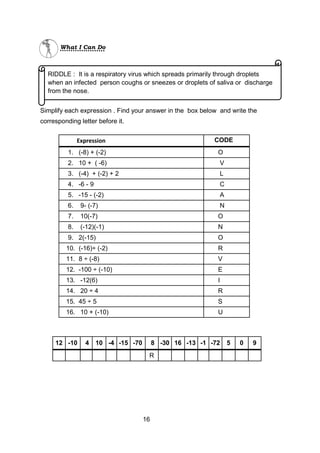
RIDDLE : It is a respiratory virus which spreads primarily through droplets
when an infected person coughs or sneezes or droplets of saliva or discharge
from the nose.
12 -10 4 10 -4 -15 -70 8 -30 16 -13 -1 -72 5 0 9
R
Simplify each expression . Find your answer in the box below and write the
corresponding letter before it.
16
What I Can Do
20.
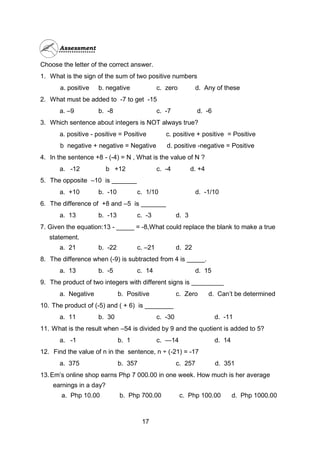
Choose the letterof the correct answer.
1. What is the sign of the sum of two positive numbers
a. positive b. negative c. zero d. Any of these
2. What must be added to -7 to get -15
a. –9 b. -8 c. -7 d. -6
3. Which sentence about integers is NOT always true?
a. positive - positive = Positive c. positive + positive = Positive
b negative + negative = Negative d. positive -negative = Positive
4. In the sentence +8 - (-4) = N , What is the value of N ?
a. -12 b +12 c. -4 d. +4
5. The opposite –10 is _______
a. +10 b. -10 c. 1/10 d. -1/10
6. The difference of +8 and –5 is _______
a. 13 b. -13 c. -3 d. 3
7. Given the equation:13 - _____ = -8,What could replace the blank to make a true
statement.
a. 21 b. -22 c. –21 d. 22
8. The difference when (-9) is subtracted from 4 is _____.
a. 13 b. -5 c. 14 d. 15
9. The product of two integers with different signs is _________
a. Negative b. Positive c. Zero d. Can’t be determined
10. The product of (-5) and ( + 6) is ________
a. 11 b. 30 c. -30 d. -11
11. What is the result when –54 is divided by 9 and the quotient is added to 5?
a. -1 b. 1 c. —14 d. 14
12. Find the value of n in the sentence, n ÷ (-21) = -17
a. 375 b. 357 c. 257 d. 351
13.Em’s online shop earns Php 7 000.00 in one week. How much is her average
earnings in a day?
a. Php 10.00 b. Php 700.00 c. Php 100.00 d. Php 1000.00
17
Assessment
21.
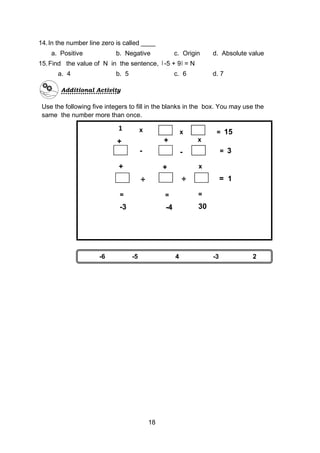
Use the followingfive integers to fill in the blanks in the box. You may use the
same the number more than once.
-6 -5 4 -3 2
1
= 15
= 3
= 1
÷ ÷
- -
=
30
=
-4
=
-3
18
x
14.In the number line zero is called ____
a. Positive b. Negative c. Origin d. Absolute value
15.Find the value of N in the sentence, -5 + 9 = N
a. 4 b. 5 c. 6 d. 7
+
+
+
x
x
+
x
Additional Activity
References
Acelajado, Maxima J..Elementary Algebra: New High School Mathematics 1, Second
Edition. Makati City, Philippines: Diwa Scholastic Press Inc. 2008.
Pascual, Ferdinand C, Castaniares, L.iezel G., Galangue,Gilda C..Worktext Mathematics
Simplified Concepts and Structures. Manila, Philippines: Innovative Educational
Materials,Inc.2001.
Oronce, Orlando A..Mendoza, Marilyn O.. Worktext in Mathematics: E - Math 7 Third
Edtion. Mania ,Philippines: Rex Book Store. 2012.
21
Nievera, Gladys C..Grade 7 Mathematics: Pattern and Practicalities. Philippines:
Selesiana Bools by Don Bosco Press,Inc. 2012.
25.
For Inquiries orfeedback, please write or call:
Department of Education, Schools Division of Bulacan
Curriculum Implementation Division
Learning Resource Management and Development System (LRMDS)
Capitol Compound, Guinhawa St., City of Malolos, Bulacan
Email address: lrmdsbulacan@deped.gov.ph