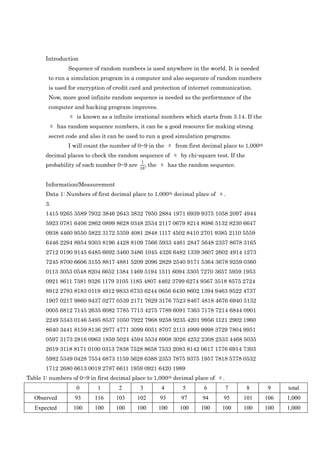
1) The document examines whether the digits of pi have a random sequence by counting the occurrences of numbers 0-9 in the first 1,000 decimal places of pi and performing a chi-square test.
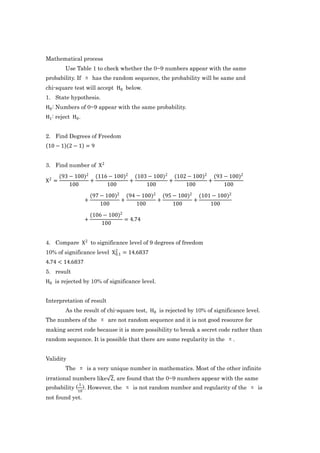
2) The results of the chi-square test show that the null hypothesis that each number 0-9 appears with equal probability can be rejected at the 10% significance level, indicating the sequence of digits in pi is not truly random.
3) Therefore, pi is not considered a good source of random numbers that could be used for encryption or other applications requiring a random sequence. Some regularity may exist in the digits of pi.


![2_Classification_of_Numbers_and_Set_Notation_HW[1]](https://cdn.slidesharecdn.com/ss_thumbnails/9752699-111018121019-phpapp01-thumbnail.jpg?width=640&height=640&fit=bounds)


