MATERNAL MORTALITY IN
GESTATIONAL HYPERTENSION
INTRODUCTION
• Women with elevated blood pressure during
pregnancy have a significant maternal and fetal
mortality and morbidity. It becomes a nightmare
for an obstetrician to deal with a PIH patient.
• Aetiopathogenesis of PIH should be fully
understood before scientific foundations of
preventive modalities can be laid. The basic
defect lies in placental ischemia followed by
release of oxidative stress markers in maternal
tissues causing vasospasm and various lesions of
preeclampsia in various target organs leading to
clinical syndrome of disease.
• Inspite of constant research in PIH, we
obstetricians still fall short in saving few patients
of severe PIH, especially with multiorgan failure.
Inspite of constant vigilance and active
management there are few patients who die
because of various complications of PIH.
MATERIAL AND METHOD
• At KRH, Gwalior, a tertiary referral centre, I have
done a retrospective study of 532 PIH patients, of
these 15 patients died.
• Following study is done over a period of 2 yrs in
order to understand the shortcomings in our
healthcare setup, that we fail to save these women.
The cause specific mortality rate came out to be
1.18/1000 live births.
• The case records of every patient was critically
analysed to observe various details as age, marital
life, occupation, education, gestational age, duration
of stay, antepartum delay in delivery, condition of
patient during admission, various drugs given and
finally cause of death.
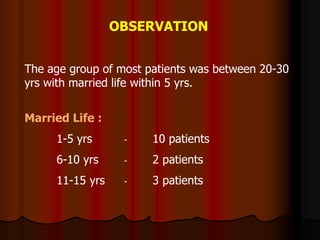
OBSERVATION
The age group of most patients was between 20-30
yrs with married life within 5 yrs.
Married Life :
1-5 yrs - 10 patients
6-10 yrs - 2 patients
11-15 yrs - 3 patients
13 patients were of labour class out of 15
Occupation:
Labour class – 13th
Business class – 2 patients
Education:
Husband < 12th standard – 13 patients
Graduate – 2 patients
Wife < 12th – 15 patients
Most of the patients came to hospital when they
were near term and interestingly all of them were
unbooked.
Gestational age
11 patients survived for < 24 hrs in hospital and 10
out of these were in multiorgan failure. 4 patients
survived for > 24 hrs.
Duration of study
< 28 wks 28-34 wks 34-37 wks 37-41 wks 41-peurperium
1 13 patients 1
0-2 hrs 2-6 hrs 6-24 hrs > 24 hrs
4 patients 4 patients 3 patients 4 patients
Antepartum delay in delivery since admission
• Out of these, 1st patient came to the hospital
with severe PIH. Her blood pressure on admission
was 140/100. She was taken for LSCS 4 hrs after
induction of labour. During operation clear ascitic
fluid was drained out from peritoneal cavity and
24 hrs after operation she was bleeding from
stitch line and her abdominal girth as increasing.
She ultimately went into DIC after 27 hrs of
admission.
0-2 hrs 2-6 hrs 6-12 hrs > 12 hrs
3 patients 5 patients 2 patients 2 patients
• Another patient came with full term pregnancy
with history of preeclampsia. She was febrile
with poor GC and pin point pupils not reacting to
light, and her temperature could not be
controlled with antipyretics and cold sponging
and her B.P. remained at 160/100 even after
vigorous drug treatment and this patient died
because of pontine haemorrhage.
• Third patient came in postpartum shock with
sever PIH, her B.P. was 200/120 despite of
giving all kinds of antihypertensives and
anticonvulsants.
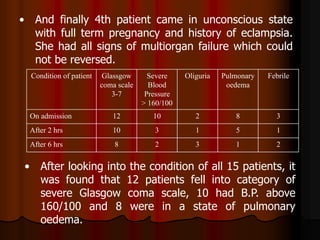
• And finally 4th patient came in unconscious state
with full term pregnancy and history of eclampsia.
She had all signs of multiorgan failure which could
not be reversed.
Condition of patient Glassgow
coma scale
3-7
Severe
Blood
Pressure
> 160/100
Oliguria Pulmonary
oedema
Febrile
On admission 12 10 2 8 3
After 2 hrs 10 3 1 5 1
After 6 hrs 8 2 3 1 2
• After looking into the condition of all 15 patients, it
was found that 12 patients fell into category of
severe Glasgow coma scale, 10 had B.P. above
160/100 and 8 were in a state of pulmonary
oedema.
Drugs given
Diuretics Antihypertensives Anticonvulsant Prophy-
lactic
MgSO4
Sedatives
Labetalol Depin MgSO4 Epsolin Diazepam Penthothal
Na
On
admission
7 2 1 7 1 - 1
At 2 hrs 1 1 3
At 6 hrs 2 1
• Finally we found that most of our PIH patient died
because of pulmonary oedema and cerebral
haemorrhage, 2 patients went into DIC, and none of
the patients died because of renal failure alone
although many were in renal dysfunction.
CONCLUSION
• Inspite of vigorous efforts, significant number
of mortality still occur in PIH patients.
• All patients who died were unbooked.
Therefore still we are lagging behind in giving
proper antenatal care to rural population.
SUGGESTIONS
• Proper critical care unit must be attached to
government hospitals to deal with patients
of multiorgan failure, as the outcome of
these patients in normal routine setup is
quite poor.
THANKS

maternal mortality in ga.PPT

  • 1.
  • 2.
    INTRODUCTION • Women withelevated blood pressure during pregnancy have a significant maternal and fetal mortality and morbidity. It becomes a nightmare for an obstetrician to deal with a PIH patient. • Aetiopathogenesis of PIH should be fully understood before scientific foundations of preventive modalities can be laid. The basic defect lies in placental ischemia followed by release of oxidative stress markers in maternal tissues causing vasospasm and various lesions of preeclampsia in various target organs leading to clinical syndrome of disease.
  • 3.
    • Inspite ofconstant research in PIH, we obstetricians still fall short in saving few patients of severe PIH, especially with multiorgan failure. Inspite of constant vigilance and active management there are few patients who die because of various complications of PIH.
  • 4.
    MATERIAL AND METHOD •At KRH, Gwalior, a tertiary referral centre, I have done a retrospective study of 532 PIH patients, of these 15 patients died. • Following study is done over a period of 2 yrs in order to understand the shortcomings in our healthcare setup, that we fail to save these women. The cause specific mortality rate came out to be 1.18/1000 live births. • The case records of every patient was critically analysed to observe various details as age, marital life, occupation, education, gestational age, duration of stay, antepartum delay in delivery, condition of patient during admission, various drugs given and finally cause of death.
  • 5.
    OBSERVATION The age groupof most patients was between 20-30 yrs with married life within 5 yrs. Married Life : 1-5 yrs - 10 patients 6-10 yrs - 2 patients 11-15 yrs - 3 patients
  • 6.
    13 patients wereof labour class out of 15 Occupation: Labour class – 13th Business class – 2 patients Education: Husband < 12th standard – 13 patients Graduate – 2 patients Wife < 12th – 15 patients
  • 7.
    Most of thepatients came to hospital when they were near term and interestingly all of them were unbooked. Gestational age 11 patients survived for < 24 hrs in hospital and 10 out of these were in multiorgan failure. 4 patients survived for > 24 hrs. Duration of study < 28 wks 28-34 wks 34-37 wks 37-41 wks 41-peurperium 1 13 patients 1 0-2 hrs 2-6 hrs 6-24 hrs > 24 hrs 4 patients 4 patients 3 patients 4 patients
  • 8.
    Antepartum delay indelivery since admission • Out of these, 1st patient came to the hospital with severe PIH. Her blood pressure on admission was 140/100. She was taken for LSCS 4 hrs after induction of labour. During operation clear ascitic fluid was drained out from peritoneal cavity and 24 hrs after operation she was bleeding from stitch line and her abdominal girth as increasing. She ultimately went into DIC after 27 hrs of admission. 0-2 hrs 2-6 hrs 6-12 hrs > 12 hrs 3 patients 5 patients 2 patients 2 patients
  • 9.
    • Another patientcame with full term pregnancy with history of preeclampsia. She was febrile with poor GC and pin point pupils not reacting to light, and her temperature could not be controlled with antipyretics and cold sponging and her B.P. remained at 160/100 even after vigorous drug treatment and this patient died because of pontine haemorrhage. • Third patient came in postpartum shock with sever PIH, her B.P. was 200/120 despite of giving all kinds of antihypertensives and anticonvulsants.
  • 10.
    • And finally4th patient came in unconscious state with full term pregnancy and history of eclampsia. She had all signs of multiorgan failure which could not be reversed. Condition of patient Glassgow coma scale 3-7 Severe Blood Pressure > 160/100 Oliguria Pulmonary oedema Febrile On admission 12 10 2 8 3 After 2 hrs 10 3 1 5 1 After 6 hrs 8 2 3 1 2 • After looking into the condition of all 15 patients, it was found that 12 patients fell into category of severe Glasgow coma scale, 10 had B.P. above 160/100 and 8 were in a state of pulmonary oedema.
  • 11.
    Drugs given Diuretics AntihypertensivesAnticonvulsant Prophy- lactic MgSO4 Sedatives Labetalol Depin MgSO4 Epsolin Diazepam Penthothal Na On admission 7 2 1 7 1 - 1 At 2 hrs 1 1 3 At 6 hrs 2 1 • Finally we found that most of our PIH patient died because of pulmonary oedema and cerebral haemorrhage, 2 patients went into DIC, and none of the patients died because of renal failure alone although many were in renal dysfunction.
  • 12.
    CONCLUSION • Inspite ofvigorous efforts, significant number of mortality still occur in PIH patients. • All patients who died were unbooked. Therefore still we are lagging behind in giving proper antenatal care to rural population.
  • 13.
    SUGGESTIONS • Proper criticalcare unit must be attached to government hospitals to deal with patients of multiorgan failure, as the outcome of these patients in normal routine setup is quite poor.
  • 14.