Masters on the move  –  Finnish university graduates  and their regional mobility  five years after graduation ECER 28.09.2009, University of Vienna, Austria  Antero Puhakka, Juhani Rautopuro & Visa Tuominen (University of Eastern Finland)
Starting points  University education increases human capital Increased human capital will help regions to prosper Studying in an investment in the future Graduates look for jobs where they can utilise the skills and knowledge learned at the university University education should benefit the whole nation, not just certain growth areas
Graduate migration Previously find in Finland Graduates more mobile than rest of the population Concentration to cities Certain university regions lose graduates  Brain-drain ? Usually analysed by looking at the university region Problematic, most students have to move from their home region for studies We will analyse migration by emphasising graduate's residential regions before studies
Data and analysis  National survey 2008 Aarresaari-network (Academic career services) 16 Finnish universities (only art universities missing) Respondents graduates in 2003 Only Master of art or equivalent degree holders 6701 respondents in study (56 % all graduates) Quantitative analysis Descriptive statistics, frequencies, percentages, arithmetic mean, median and standard deviation Chi-square-test with residual-examination
Research questions What kind of migration patterns exist? Regional inspection, the location before studies Mainly at the provincial level  Inspected locations 1) residential location before studies 2) study location 3) location of first job after graduation 4) location of job five years after graduation 5) residential location five years after graduation Are graduates returning to their previous regions?
Classifications Migration classification (based on Kodrycki 2000) 1) Non-migrants 2) Returnees 3) Leavers 4) University-migrants 5) Repeat-migrants Statistical Classification of municipalities urban, semi-urban, countryside Travel-to-work-area (TWA)
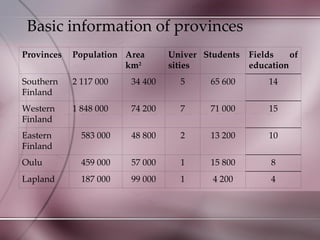
Basic information of provinces 4 4 200 1 99 000 187 000 Lapland 8 15 800 1 57 000 459 000 Oulu 10 13 200 2 48 800 583 000 Eastern Finland 15 71 000 7 74 200 1 848 000 Western Finland 14 65 600 5 34 400 2 117 000 Southern Finland Fields of education Students Universities Area km 2 Population  Provinces
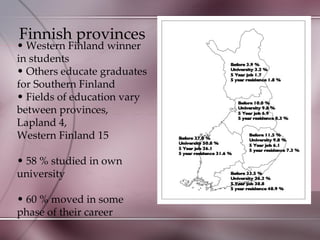
Finnish provinces Western Finland winner in students Others educate graduates for Southern Finland Fields of education vary between provinces, Lapland 4,  Western Finland 15 58 % studied in own university 60 % moved in some phase of their career
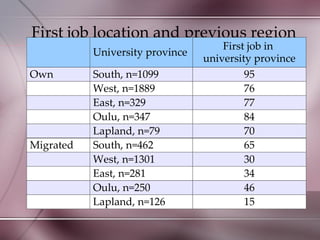
First job location and previous region University province First job in  university province Own  South, n=1099 95 West, n=1889 76 East, n=329 77 Oulu, n=347 84 Lapland, n=79 70 Migrated South, n=462 65 West, n=1301 30 East, n=281 34 Oulu, n=250 46 Lapland, n=126 15
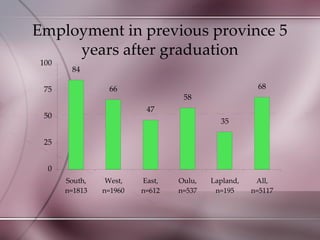
Employment in previous province 5 years after graduation
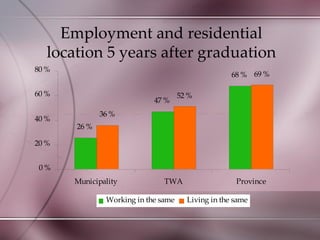
Employment and residential location 5 years after graduation
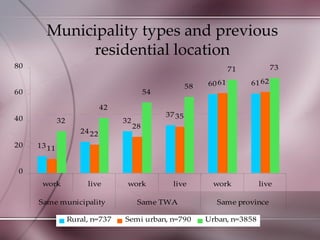
Municipality types and previous residential location
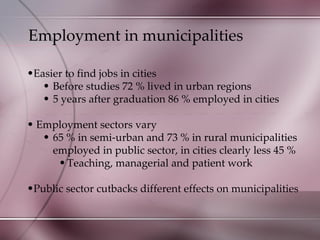
Employment in municipalities Easier to find jobs in cities Before studies 72 % lived in urban regions  5 years after graduation 86 % employed in cities Employment sectors vary 65 % in semi-urban and 73 % in rural municipalities employed in public sector, in cities clearly less 45 % Teaching, managerial and patient work Public sector cutbacks different effects on municipalities
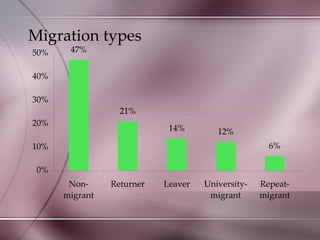
Migration types
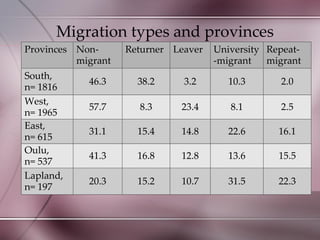
Migration types and provinces Provinces Non- migrant Returner Leaver University -migrant Repeat- migrant  South, n= 1816 46.3 38.2 3.2 10.3 2.0 West, n= 1965 57.7 8.3 23.4 8.1 2.5 East,  n= 615 31.1 15.4 14.8 22.6 16.1 Oulu, n= 537 41.3 16.8 12.8 13.6 15.5 Lapland, n= 197 20.3 15.2 10.7 31.5 22.3
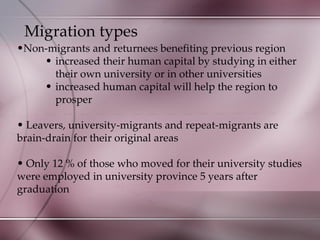
Migration types Non-migrants and returnees benefiting previous region increased their human capital by studying in either their own university or in other universities increased human capital will help the region to prosper Leavers, university-migrants and repeat-migrants are brain-drain for their original areas Only 12 % of those who moved for their university studies were employed in university province 5 years after graduation
Conclusion The previous living area attracts  graduates Concentration of jobs to Southern Finland Rural and semi-urban municipalities are losers, they do not have employment possibilites which could take advantage of the increased human capital of their previous residents Would the concentration of university education to Southern Finland  benefit the whole nation?

Masters on the move

  • 1.
    Masters on themove – Finnish university graduates and their regional mobility five years after graduation ECER 28.09.2009, University of Vienna, Austria Antero Puhakka, Juhani Rautopuro & Visa Tuominen (University of Eastern Finland)
  • 2.
    Starting points University education increases human capital Increased human capital will help regions to prosper Studying in an investment in the future Graduates look for jobs where they can utilise the skills and knowledge learned at the university University education should benefit the whole nation, not just certain growth areas
  • 3.
    Graduate migration Previouslyfind in Finland Graduates more mobile than rest of the population Concentration to cities Certain university regions lose graduates Brain-drain ? Usually analysed by looking at the university region Problematic, most students have to move from their home region for studies We will analyse migration by emphasising graduate's residential regions before studies
  • 4.
    Data and analysis National survey 2008 Aarresaari-network (Academic career services) 16 Finnish universities (only art universities missing) Respondents graduates in 2003 Only Master of art or equivalent degree holders 6701 respondents in study (56 % all graduates) Quantitative analysis Descriptive statistics, frequencies, percentages, arithmetic mean, median and standard deviation Chi-square-test with residual-examination
  • 5.
    Research questions Whatkind of migration patterns exist? Regional inspection, the location before studies Mainly at the provincial level Inspected locations 1) residential location before studies 2) study location 3) location of first job after graduation 4) location of job five years after graduation 5) residential location five years after graduation Are graduates returning to their previous regions?
  • 6.
    Classifications Migration classification(based on Kodrycki 2000) 1) Non-migrants 2) Returnees 3) Leavers 4) University-migrants 5) Repeat-migrants Statistical Classification of municipalities urban, semi-urban, countryside Travel-to-work-area (TWA)
  • 7.
    Basic information ofprovinces 4 4 200 1 99 000 187 000 Lapland 8 15 800 1 57 000 459 000 Oulu 10 13 200 2 48 800 583 000 Eastern Finland 15 71 000 7 74 200 1 848 000 Western Finland 14 65 600 5 34 400 2 117 000 Southern Finland Fields of education Students Universities Area km 2 Population Provinces
  • 8.
    Finnish provinces WesternFinland winner in students Others educate graduates for Southern Finland Fields of education vary between provinces, Lapland 4, Western Finland 15 58 % studied in own university 60 % moved in some phase of their career
  • 9.
    First job locationand previous region University province First job in university province Own South, n=1099 95 West, n=1889 76 East, n=329 77 Oulu, n=347 84 Lapland, n=79 70 Migrated South, n=462 65 West, n=1301 30 East, n=281 34 Oulu, n=250 46 Lapland, n=126 15
  • 10.
    Employment in previousprovince 5 years after graduation
  • 11.
    Employment and residentiallocation 5 years after graduation
  • 12.
    Municipality types andprevious residential location
  • 13.
    Employment in municipalitiesEasier to find jobs in cities Before studies 72 % lived in urban regions 5 years after graduation 86 % employed in cities Employment sectors vary 65 % in semi-urban and 73 % in rural municipalities employed in public sector, in cities clearly less 45 % Teaching, managerial and patient work Public sector cutbacks different effects on municipalities
  • 14.
  • 15.
    Migration types andprovinces Provinces Non- migrant Returner Leaver University -migrant Repeat- migrant South, n= 1816 46.3 38.2 3.2 10.3 2.0 West, n= 1965 57.7 8.3 23.4 8.1 2.5 East, n= 615 31.1 15.4 14.8 22.6 16.1 Oulu, n= 537 41.3 16.8 12.8 13.6 15.5 Lapland, n= 197 20.3 15.2 10.7 31.5 22.3
  • 16.
    Migration types Non-migrantsand returnees benefiting previous region increased their human capital by studying in either their own university or in other universities increased human capital will help the region to prosper Leavers, university-migrants and repeat-migrants are brain-drain for their original areas Only 12 % of those who moved for their university studies were employed in university province 5 years after graduation
  • 17.
    Conclusion The previousliving area attracts graduates Concentration of jobs to Southern Finland Rural and semi-urban municipalities are losers, they do not have employment possibilites which could take advantage of the increased human capital of their previous residents Would the concentration of university education to Southern Finland benefit the whole nation?