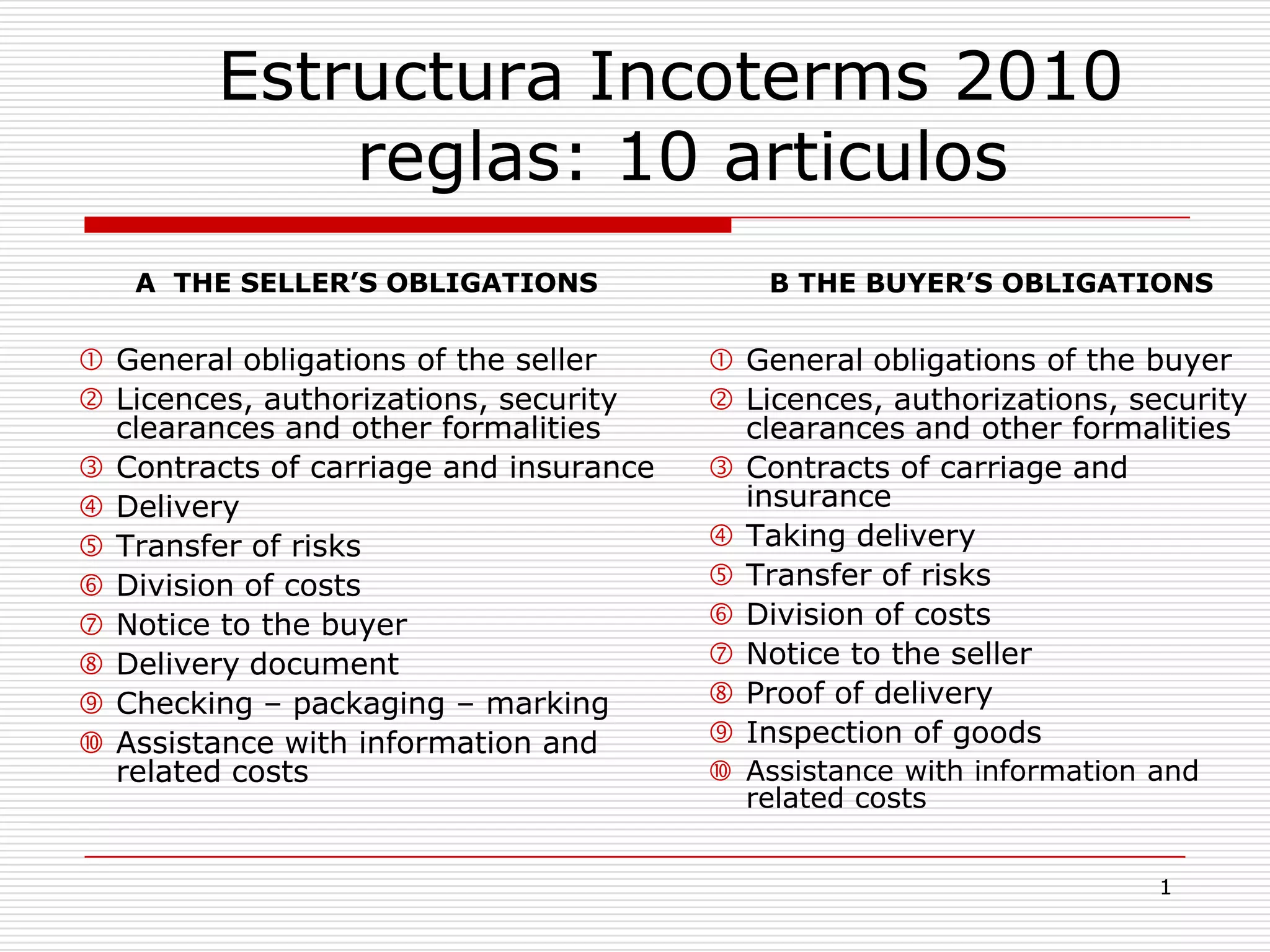
Estructura Incoterms 2010
reglas: 10 articulos
1
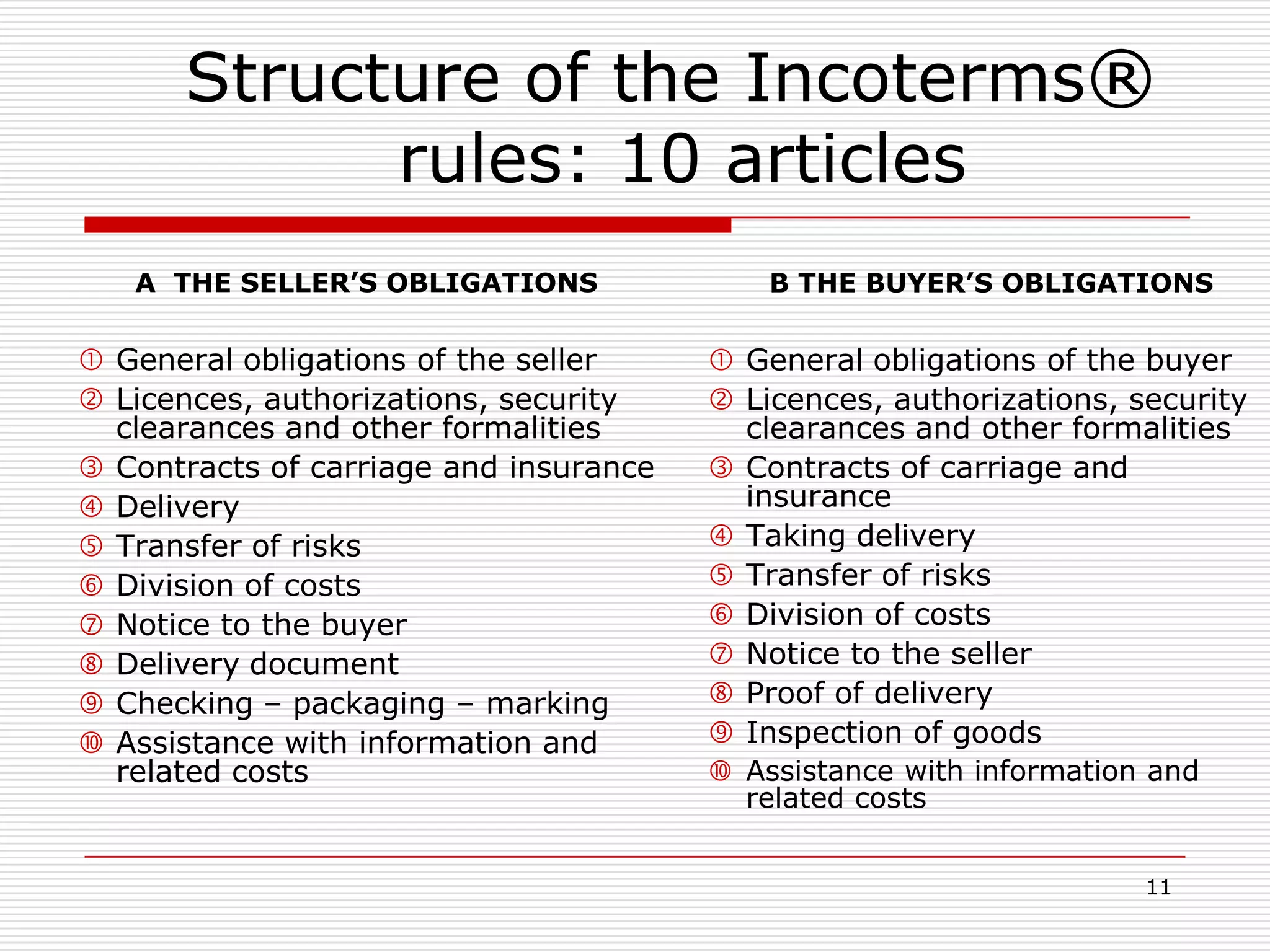
A THE SELLER’S OBLIGATIONS
 General obligations of the seller
 Licences, authorizations, security
clearances and other formalities
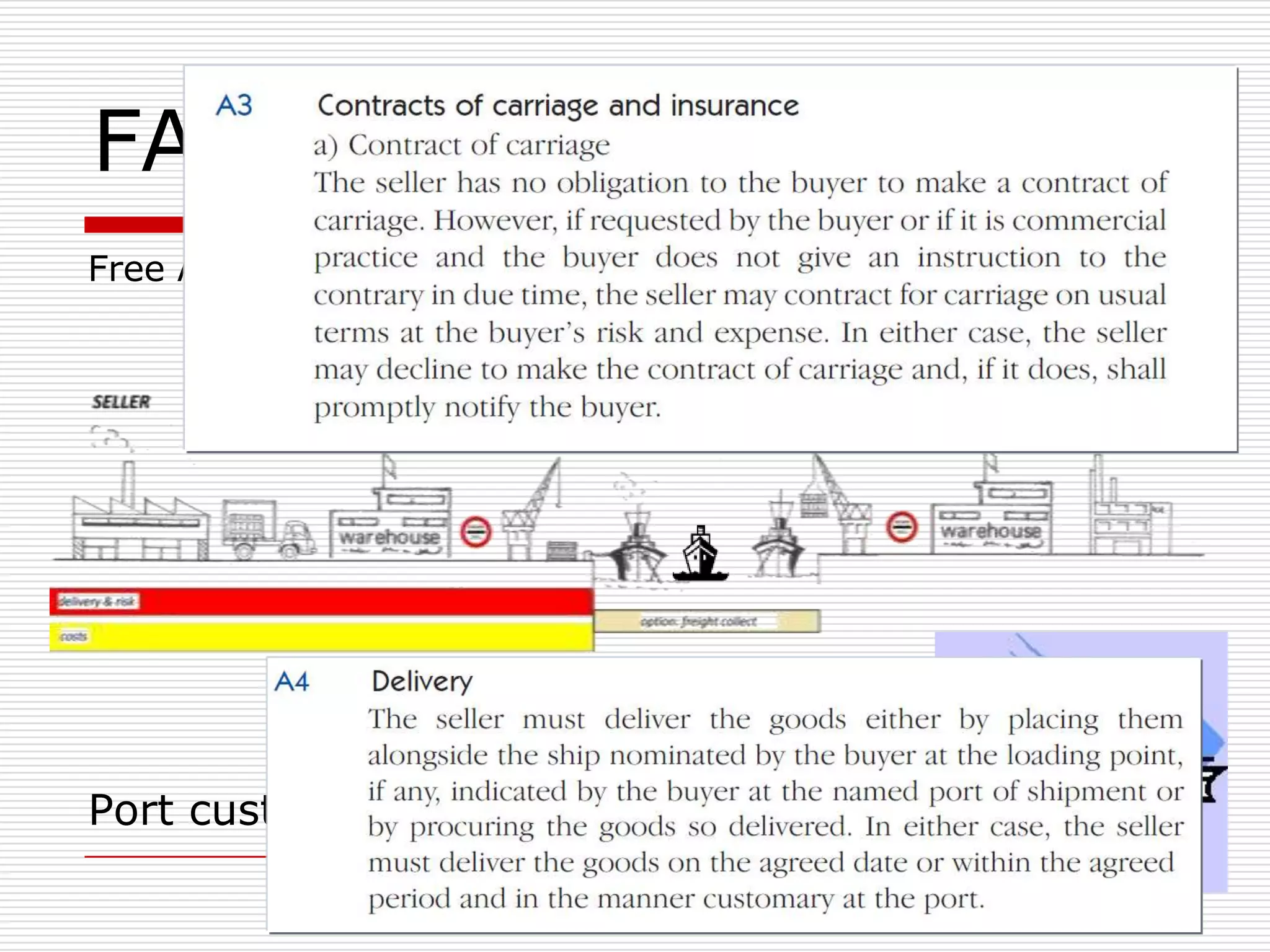
 Contracts of carriage and insurance
 Delivery
 Transfer of risks
 Division of costs
 Notice to the buyer
 Delivery document
 Checking – packaging – marking
 Assistance with information and
related costs
B THE BUYER’S OBLIGATIONS
 General obligations of the buyer
 Licences, authorizations, security
clearances and other formalities
 Contracts of carriage and
insurance
 Taking delivery
 Transfer of risks
 Division of costs
 Notice to the seller
 Proof of delivery
 Inspection of goods
 Assistance with information and
related costs
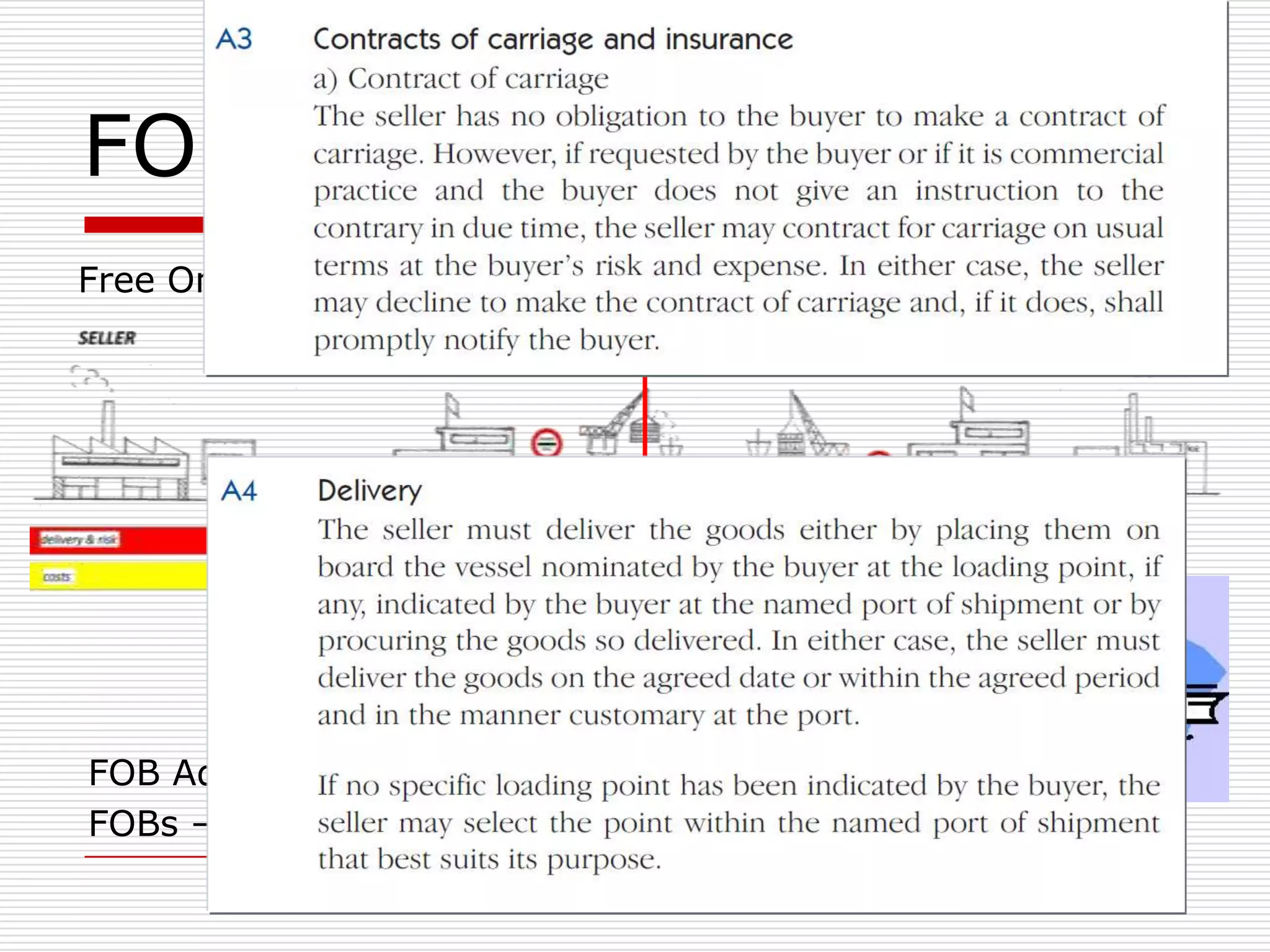
FAS & FOB
2
¿Por qué están usando las
reglas de Incoterms en forma
‘incorrecta’?
BATALLA ABOGADOS
Is ICC ‘right’ in labelling
them ‘wrong’?
3
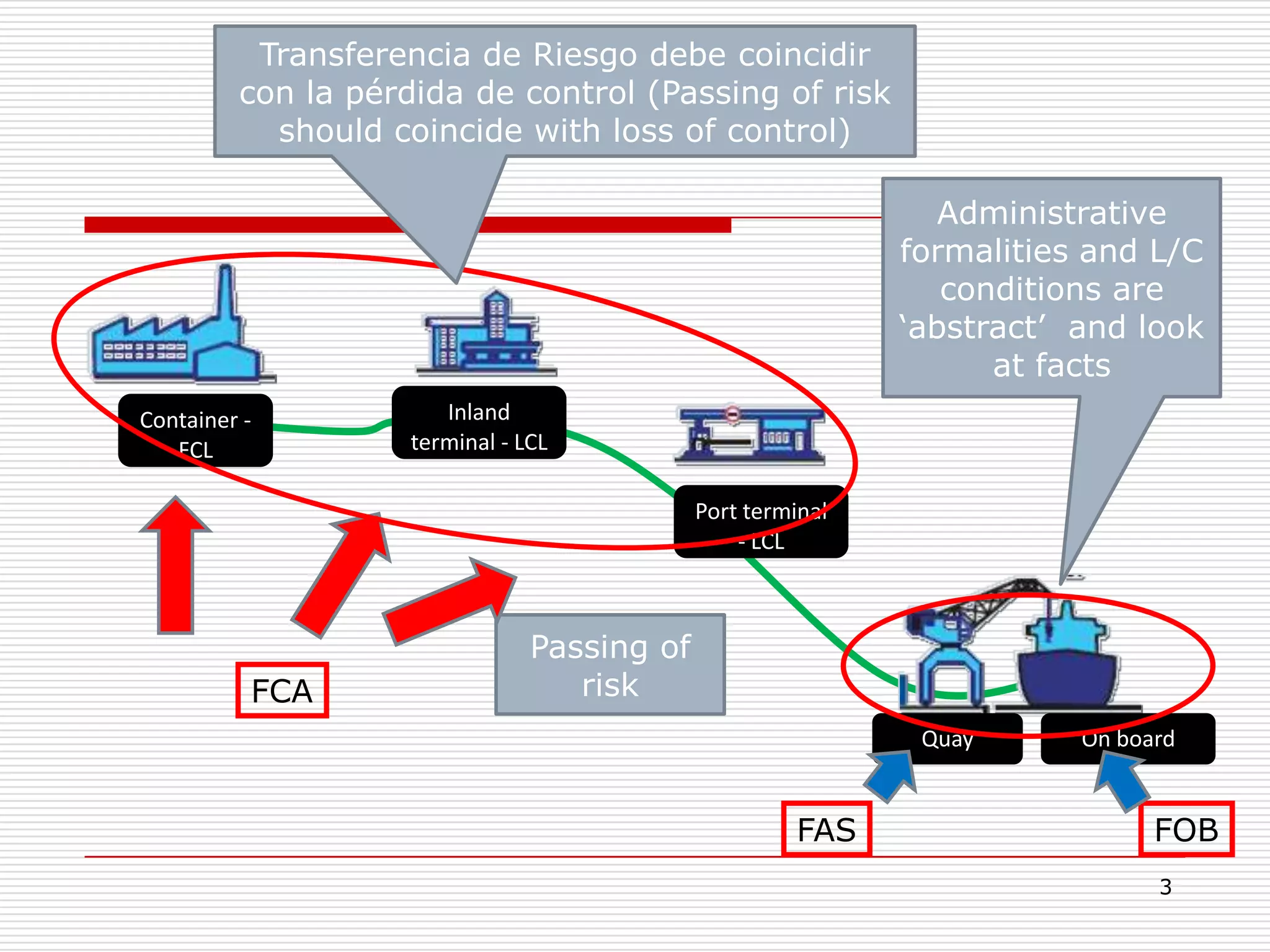
Container -
FCL
Inland
terminal - LCL
Port terminal
- LCL
Quay On board
Passing of
riskFCA
FOB
Transferencia de Riesgo debe coincidir
con la pérdida de control (Passing of risk
should coincide with loss of control)
Administrative
formalities and L/C
conditions are
‘abstract’ and look
at facts
FAS
4
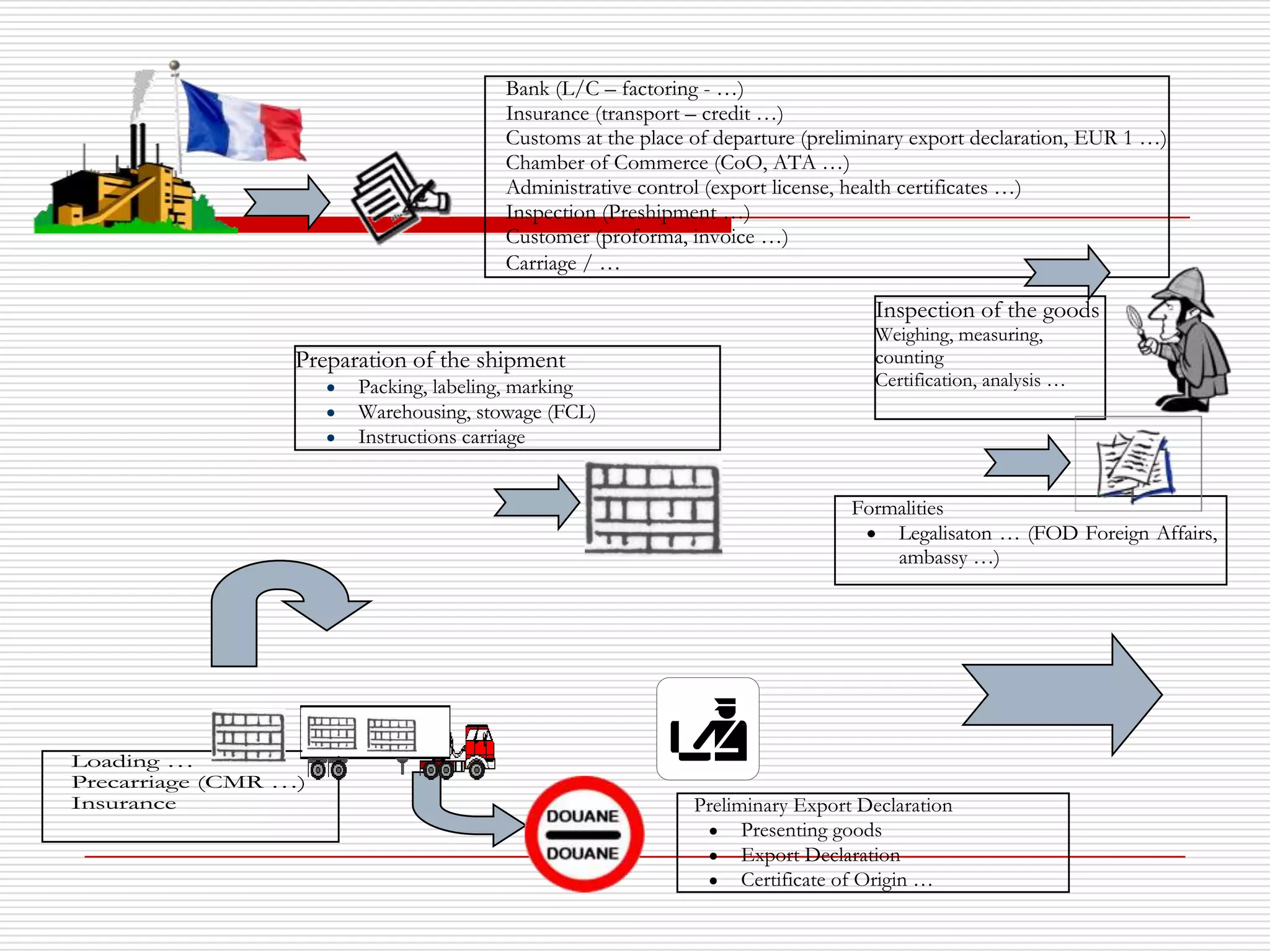
Bank (L/C – factoring - …)
Insurance (transport – credit …)
Customs at the place of departure (preliminary export declaration, EUR 1 …)
Chamber of Commerce (CoO, ATA …)
Administrative control (export license, health certificates …)
Inspection (Preshipment …)
Customer (proforma, invoice …)
Carriage / …
Inspection of the goods
Weighing, measuring,
counting
Certification, analysis …
Preparation of the shipment
Packing, labeling, marking
Warehousing, stowage (FCL)
Instructions carriage
Preliminary Export Declaration
Presenting goods
Export Declaration
Certificate of Origin …
Loading …
Precarriage (CMR …)
Insurance
Formalities
Legalisaton … (FOD Foreign Affairs,
ambassy …)
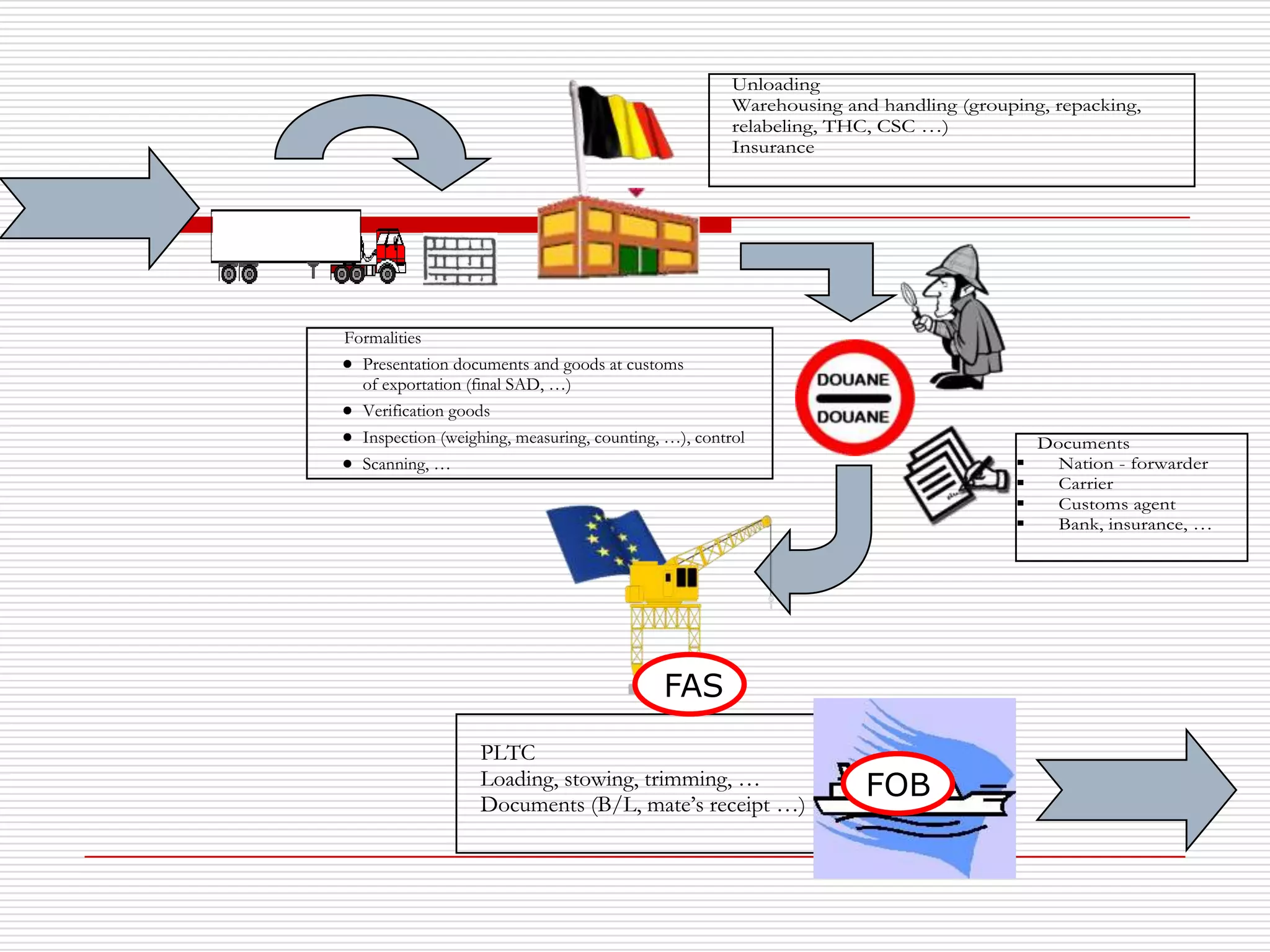
Unloading
Warehousing and handling (grouping, repacking,
relabeling, THC, CSC …)
Insurance
Formalities
Presentation documents and goods at customs
of exportation (final SAD, …)
Verification goods
Inspection (weighing, measuring, counting, …), control
Scanning, …
Documents
 Nation - forwarder
 Carrier
 Customs agent
 Bank, insurance, …
PLTC
Loading, stowing, trimming, …
Documents (B/L, mate’s receipt …)
FAS
FOB
FAS (… named port of shipment)
7
Port customs
Free Alongside Ship – franco al costado del buque
8
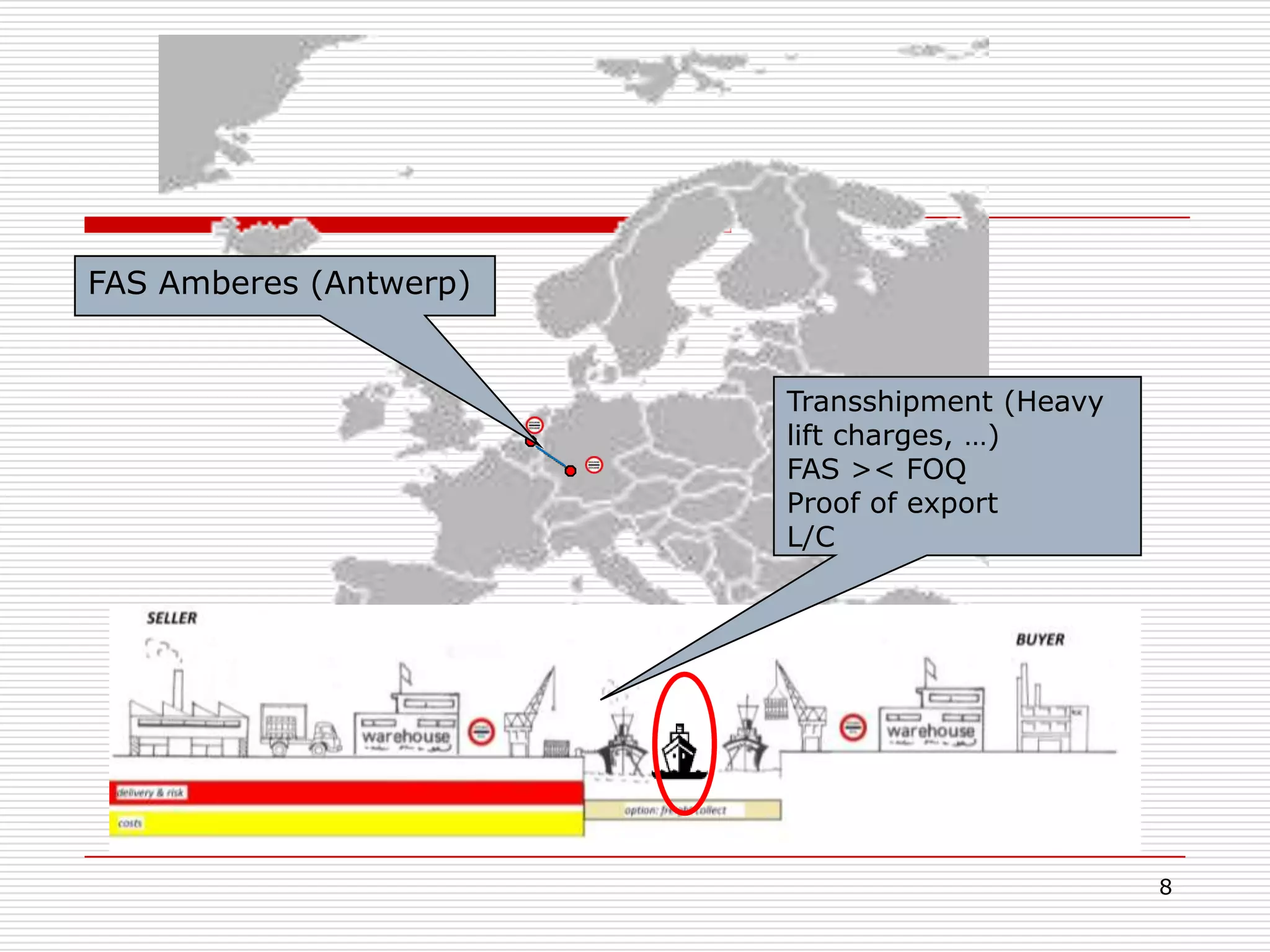
FAS Amberes (Antwerp)
Transshipment (Heavy
lift charges, …)
FAS >< FOQ
Proof of export
L/C
FOB (… named port of shipment)
9
FOB Additional Service – FOB + I / C&I –
FOBs – FOBst – Port customs …
Free On Board – franco a bordo
10
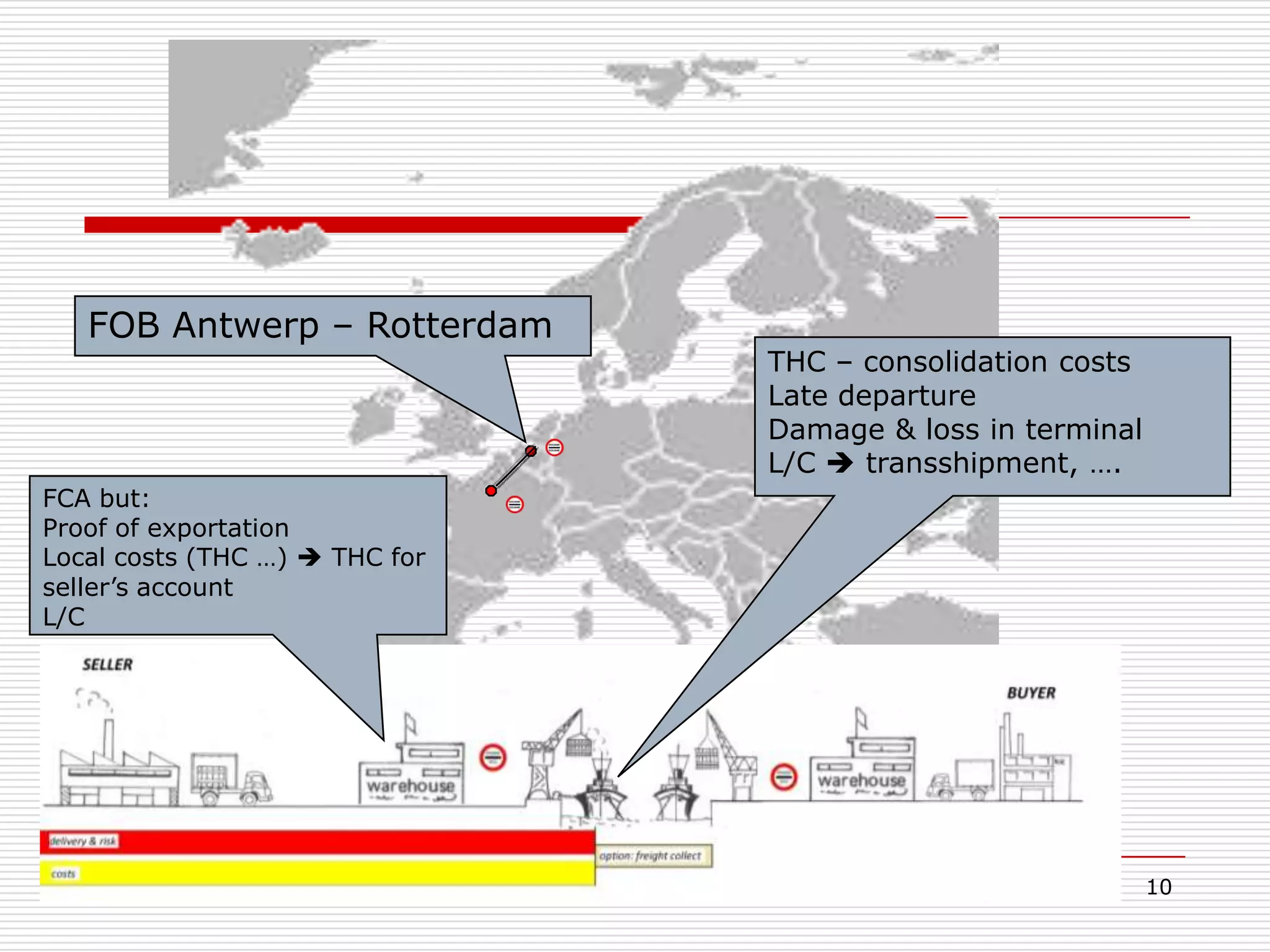
FOB Antwerp – Rotterdam
THC – consolidation costs
Late departure
Damage & loss in terminal
L/C  transshipment, ….
FCA but:
Proof of exportation
Local costs (THC …)  THC for
seller’s account
L/C
Structure of the Incoterms®
rules: 10 articles
11
A THE SELLER’S OBLIGATIONS
 General obligations of the seller
 Licences, authorizations, security
clearances and other formalities
 Contracts of carriage and insurance
 Delivery
 Transfer of risks
 Division of costs
 Notice to the buyer
 Delivery document
 Checking – packaging – marking
 Assistance with information and
related costs
B THE BUYER’S OBLIGATIONS
 General obligations of the buyer
 Licences, authorizations, security
clearances and other formalities
 Contracts of carriage and
insurance
 Taking delivery
 Transfer of risks
 Division of costs
 Notice to the seller
 Proof of delivery
 Inspection of goods
 Assistance with information and
related costs
12
Incoterms and
transfer of title
 Delivery vs. legal ownership
 Delivery  Incoterms ® Rules
 Legal ownership  contract  national law
 Legal title – economic ownership (title –
property – ownership)
 B/L’s
 Leasing - retention of title – consignment
stock
 Contract – Accounting – Customs – VAT
- …
Product sales will be recorded as revenue upon passage of title of
goods from the company to a third party customer. All sales should be
made on shipping terms of "FOB shipping point". Accordingly,
passage of title is deemed to occur upon physical delivery of goods to
a common carrier. All invoices should specify in the conditions of sale
that title to the goods shall pass to the buyer upon delivery to the
carrier (i.e., shipping terms are FOB shipping point). In international
markets, the terms utilized to convey "FOB shipping point" may be
different (e.g. CIF, EXW, FCA). We should not sell products on terms
that are legally considered to be "FOB destination point."
VAT art. 14.1 Directive 2006/112/EC.
"Supply of goods" shall mean the transfer of the right to dispose
of tangible property as owner.
IAS 18.14:
Revenue arising from the sale of goods should be recognised when
all of the following criteria have been satisfied: [IAS 18.14]
1. the seller has transferred to the buyer the significant risks and
rewards of ownership
2. the seller retains neither continuing managerial involvement to
the degree usually associated with ownership nor effective
control over the goods sold
3. the amount of revenue can be measured reliably
4. it is probable that the economic benefits associated with the
transaction will flow to the seller, and
5. the costs incurred or to be incurred in respect of the transaction
can be measured reliably

Masterclass fasfo bdraft[1]

  • 1.
    Estructura Incoterms 2010 reglas:10 articulos 1 A THE SELLER’S OBLIGATIONS  General obligations of the seller  Licences, authorizations, security clearances and other formalities  Contracts of carriage and insurance  Delivery  Transfer of risks  Division of costs  Notice to the buyer  Delivery document  Checking – packaging – marking  Assistance with information and related costs B THE BUYER’S OBLIGATIONS  General obligations of the buyer  Licences, authorizations, security clearances and other formalities  Contracts of carriage and insurance  Taking delivery  Transfer of risks  Division of costs  Notice to the seller  Proof of delivery  Inspection of goods  Assistance with information and related costs
  • 2.
    FAS & FOB 2 ¿Porqué están usando las reglas de Incoterms en forma ‘incorrecta’? BATALLA ABOGADOS Is ICC ‘right’ in labelling them ‘wrong’?
  • 3.
    3 Container - FCL Inland terminal -LCL Port terminal - LCL Quay On board Passing of riskFCA FOB Transferencia de Riesgo debe coincidir con la pérdida de control (Passing of risk should coincide with loss of control) Administrative formalities and L/C conditions are ‘abstract’ and look at facts FAS
  • 4.
  • 5.
    Bank (L/C –factoring - …) Insurance (transport – credit …) Customs at the place of departure (preliminary export declaration, EUR 1 …) Chamber of Commerce (CoO, ATA …) Administrative control (export license, health certificates …) Inspection (Preshipment …) Customer (proforma, invoice …) Carriage / … Inspection of the goods Weighing, measuring, counting Certification, analysis … Preparation of the shipment Packing, labeling, marking Warehousing, stowage (FCL) Instructions carriage Preliminary Export Declaration Presenting goods Export Declaration Certificate of Origin … Loading … Precarriage (CMR …) Insurance Formalities Legalisaton … (FOD Foreign Affairs, ambassy …)
  • 6.
    Unloading Warehousing and handling(grouping, repacking, relabeling, THC, CSC …) Insurance Formalities Presentation documents and goods at customs of exportation (final SAD, …) Verification goods Inspection (weighing, measuring, counting, …), control Scanning, … Documents  Nation - forwarder  Carrier  Customs agent  Bank, insurance, … PLTC Loading, stowing, trimming, … Documents (B/L, mate’s receipt …) FAS FOB
  • 7.
    FAS (… namedport of shipment) 7 Port customs Free Alongside Ship – franco al costado del buque
  • 8.
    8 FAS Amberes (Antwerp) Transshipment(Heavy lift charges, …) FAS >< FOQ Proof of export L/C
  • 9.
    FOB (… namedport of shipment) 9 FOB Additional Service – FOB + I / C&I – FOBs – FOBst – Port customs … Free On Board – franco a bordo
  • 10.
    10 FOB Antwerp –Rotterdam THC – consolidation costs Late departure Damage & loss in terminal L/C  transshipment, …. FCA but: Proof of exportation Local costs (THC …)  THC for seller’s account L/C
  • 11.
    Structure of theIncoterms® rules: 10 articles 11 A THE SELLER’S OBLIGATIONS  General obligations of the seller  Licences, authorizations, security clearances and other formalities  Contracts of carriage and insurance  Delivery  Transfer of risks  Division of costs  Notice to the buyer  Delivery document  Checking – packaging – marking  Assistance with information and related costs B THE BUYER’S OBLIGATIONS  General obligations of the buyer  Licences, authorizations, security clearances and other formalities  Contracts of carriage and insurance  Taking delivery  Transfer of risks  Division of costs  Notice to the seller  Proof of delivery  Inspection of goods  Assistance with information and related costs
  • 12.
  • 13.
    Incoterms and transfer oftitle  Delivery vs. legal ownership  Delivery  Incoterms ® Rules  Legal ownership  contract  national law  Legal title – economic ownership (title – property – ownership)  B/L’s  Leasing - retention of title – consignment stock  Contract – Accounting – Customs – VAT - … Product sales will be recorded as revenue upon passage of title of goods from the company to a third party customer. All sales should be made on shipping terms of "FOB shipping point". Accordingly, passage of title is deemed to occur upon physical delivery of goods to a common carrier. All invoices should specify in the conditions of sale that title to the goods shall pass to the buyer upon delivery to the carrier (i.e., shipping terms are FOB shipping point). In international markets, the terms utilized to convey "FOB shipping point" may be different (e.g. CIF, EXW, FCA). We should not sell products on terms that are legally considered to be "FOB destination point." VAT art. 14.1 Directive 2006/112/EC. "Supply of goods" shall mean the transfer of the right to dispose of tangible property as owner. IAS 18.14: Revenue arising from the sale of goods should be recognised when all of the following criteria have been satisfied: [IAS 18.14] 1. the seller has transferred to the buyer the significant risks and rewards of ownership 2. the seller retains neither continuing managerial involvement to the degree usually associated with ownership nor effective control over the goods sold 3. the amount of revenue can be measured reliably 4. it is probable that the economic benefits associated with the transaction will flow to the seller, and 5. the costs incurred or to be incurred in respect of the transaction can be measured reliably