Global to Local
Research, Practice,
Innovation
Alzheimer’s Scotland 2016
Centre for Global Mental Health
King’s College London
martin.prince@kcl.ac.uk
Prof. Martin Prince
(no conflicts of interest)
Agenda
• Background
– Global Action against Dementia
– Why low and middle income countries matter
– What have we achieved so far?
• Scope for prevention
• Is dementia declining?
– Prevalence, incidence, survival with dementia,
numbers
• A public health approach to treatment and
care
• Where do we go from here?
Global
Observatory
for Ageing
and Dementia
Care
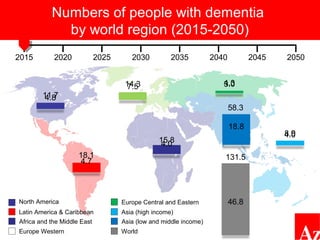
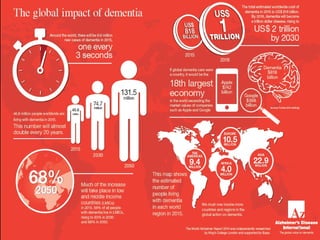
Numbers of people with dementia
by world region (2015-2050)
Europe Western
Europe Central and EasternNorth America
Latin America & Caribbean
Africa and the Middle East
Asia (high income)
Asia (low and middle income)
World
7.5
4.7
18.1
46.8
131.5
4.0
4.3
18.8
4.0
2015 2020 2025 2030 2035 2040 2045 2050
4.811.7
14.3
15.8
3.0
58.3
8.9
5
What has been achieved?
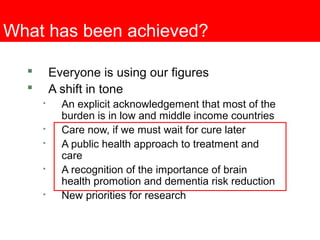
 Everyone is using our figures
 A shift in tone

An explicit acknowledgement that most of the
burden is in low and middle income countries

Care now, if we must wait for cure later

A public health approach to treatment and
care

A recognition of the importance of brain
health promotion and dementia risk reduction

New priorities for research
What has been achieved?
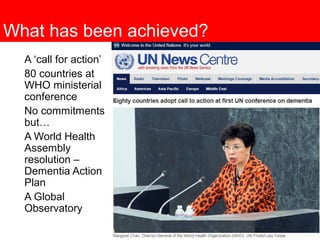
A ‘call for action’
80 countries at
WHO ministerial
conference
No commitments
but…
A World Health
Assembly
resolution –
Dementia Action
Plan
A Global
Observatory
Potential for risk reduction
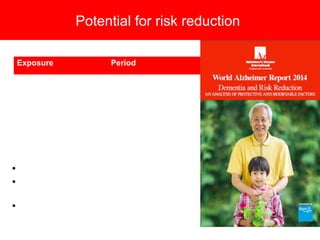
Exposure Period
Education Early life
Hypertension Midlife
Diabetes Mid- to late-life
Smoking Mid- to late-life
• Cognitive/ brain reserve (education)
• Vascular disease (hypertension,
smoking, diabetes)
• Specific effects on AD pathology??
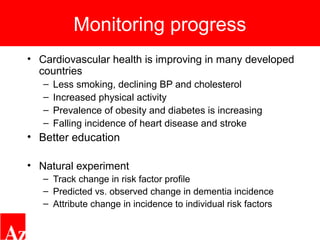
Monitoring progress
• Cardiovascular health is improving in many developed
countries
– Less smoking, declining BP and cholesterol
– Increased physical activity
– Prevalence of obesity and diabetes is increasing
– Falling incidence of heart disease and stroke
• Better education
• Natural experiment
– Track change in risk factor profile
– Predicted vs. observed change in dementia incidence
– Attribute change in incidence to individual risk factors
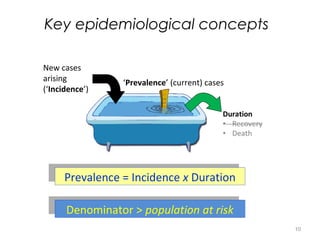
Prevalence = Incidence x DurationPrevalence = Incidence x Duration
‘Prevalence’ (current) cases
New cases
arising
(‘Incidence’)
Key epidemiological concepts
Denominator > population at riskDenominator > population at risk
10
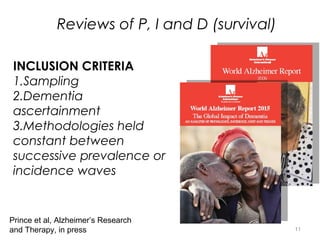
INCLUSION CRITERIA
1.Sampling
2.Dementia
ascertainment
3.Methodologies held
constant between
successive prevalence or
incidence waves
Reviews of P, I and D (survival)
11
Prince et al, Alzheimer’s Research
and Therapy, in press
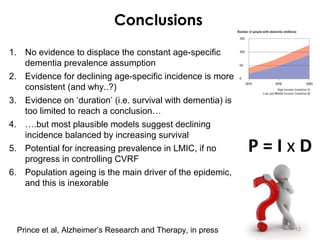
Conclusions
1. No evidence to displace the constant age-specific
dementia prevalence assumption
2. Evidence for declining age-specific incidence is more
consistent (and why..?)
3. Evidence on ‘duration’ (i.e. survival with dementia) is
too limited to reach a conclusion…
4. ….but most plausible models suggest declining
incidence balanced by increasing survival
5. Potential for increasing prevalence in LMIC, if no
progress in controlling CVRF
6. Population ageing is the main driver of the epidemic,
and this is inexorable
P = I x D
12Prince et al, Alzheimer’s Research and Therapy, in press
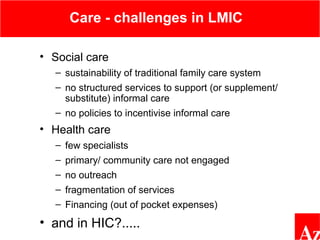
Care - challenges in LMIC
• Social care
– sustainability of traditional family care system
– no structured services to support (or supplement/
substitute) informal care
– no policies to incentivise informal care
• Health care
– few specialists
– primary/ community care not engaged
– no outreach
– fragmentation of services
– Financing (out of pocket expenses)
• and in HIC?.....
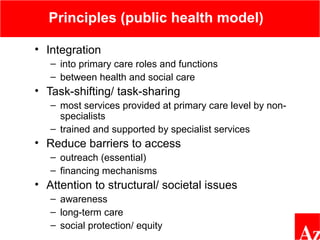
Principles (public health model)
• Integration
– into primary care roles and functions
– between health and social care
• Task-shifting/ task-sharing
– most services provided at primary care level by non-
specialists
– trained and supported by specialist services
• Reduce barriers to access
– outreach (essential)
– financing mechanisms
• Attention to structural/ societal issues
– awareness
– long-term care
– social protection/ equity
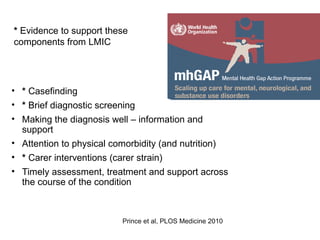
Packages of care for dementia
• * Casefinding
• * Brief diagnostic screening
• Making the diagnosis well – information and
support
• Attention to physical comorbidity (and nutrition)
• * Carer interventions (carer strain)
• Timely assessment, treatment and support across
the course of the condition
Prince et al, PLOS Medicine 2010
* Evidence to support these
components from LMIC
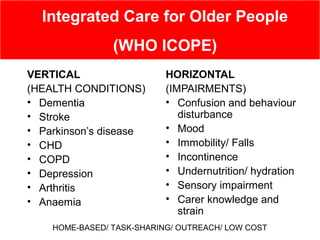
VERTICAL
(HEALTH CONDITIONS)
• Dementia
• Stroke
• Parkinson’s disease
• CHD
• COPD
• Depression
• Arthritis
• Anaemia
HORIZONTAL
(IMPAIRMENTS)
• Confusion and behaviour
disturbance
• Mood
• Immobility/ Falls
• Incontinence
• Undernutrition/ hydration
• Sensory impairment
• Carer knowledge and
strain
Integrated Care for Older People
(WHO ICOPE)
HOME-BASED/ TASK-SHARING/ OUTREACH/ LOW COST
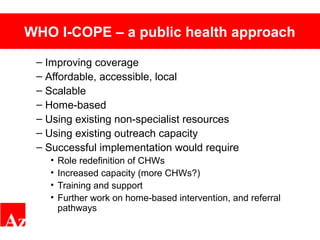
WHO I-COPE – a public health approach
– Improving coverage
– Affordable, accessible, local
– Scalable
– Home-based
– Using existing non-specialist resources
– Using existing outreach capacity
– Successful implementation would require
• Role redefinition of CHWs
• Increased capacity (more CHWs?)
• Training and support
• Further work on home-based intervention, and referral
pathways
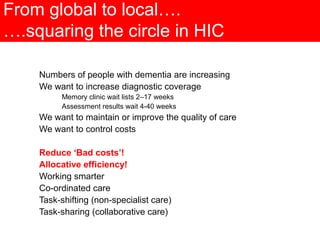
From global to local….
….squaring the circle in HIC
Numbers of people with dementia are increasing
We want to increase diagnostic coverage
Memory clinic wait lists 2–17 weeks
Assessment results wait 4-40 weeks
We want to maintain or improve the quality of care
We want to control costs
Reduce ‘Bad costs’!
Allocative efficiency!
Working smarter
Co-ordinated care
Task-shifting (non-specialist care)
Task-sharing (collaborative care)
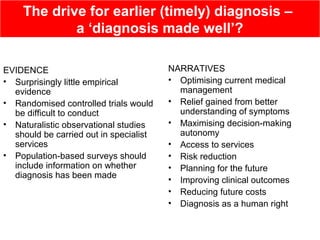
The drive for earlier (timely) diagnosis –
a ‘diagnosis made well’?
EVIDENCE
• Surprisingly little empirical
evidence
• Randomised controlled trials would
be difficult to conduct
• Naturalistic observational studies
should be carried out in specialist
services
• Population-based surveys should
include information on whether
diagnosis has been made
NARRATIVES
• Optimising current medical
management
• Relief gained from better
understanding of symptoms
• Maximising decision-making
autonomy
• Access to services
• Risk reduction
• Planning for the future
• Improving clinical outcomes
• Reducing future costs
• Diagnosis as a human right
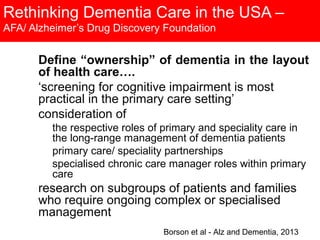
Rethinking Dementia Care in the USA –
AFA/ Alzheimer’s Drug Discovery Foundation
Define “ownership” of dementia in the layout
of health care….
‘screening for cognitive impairment is most
practical in the primary care setting’
consideration of
the respective roles of primary and speciality care in
the long-range management of dementia patients
primary care/ speciality partnerships
specialised chronic care manager roles within primary
care
research on subgroups of patients and families
who require ongoing complex or specialised
management
Borson et al - Alz and Dementia, 2013
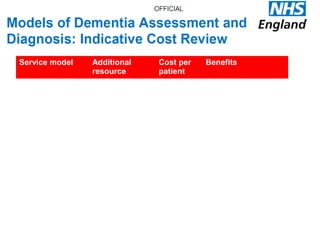
Service model Additional
resource
Cost per
patient
Benefits
PHC managed
with
specialist
input
Care facilitator £396 Local
High attendance
High diagnostic
coverage
Low hospital care
costs
Specialist
managed with
PHC input
GP with special
interest
£877 Easy access
Continuity of care
Specialist None £491 Single attendance
Referral to cluster
pathway
NHS England Commissioning Guidance 2015
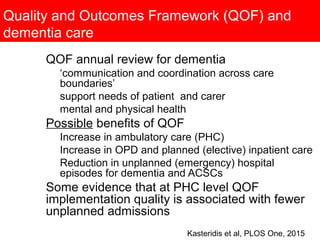
Quality and Outcomes Framework (QOF) and
dementia care
QOF annual review for dementia
‘communication and coordination across care
boundaries’
support needs of patient and carer
mental and physical health
Possible benefits of QOF
Increase in ambulatory care (PHC)
Increase in OPD and planned (elective) inpatient care
Reduction in unplanned (emergency) hospital
episodes for dementia and ACSCs
Some evidence that at PHC level QOF
implementation quality is associated with fewer
unplanned admissions
Kasteridis et al, PLOS One, 2015
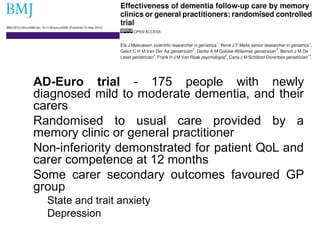
AD-Euro trial - 175 people with newly
diagnosed mild to moderate dementia, and their
carers
Randomised to usual care provided by a
memory clinic or general practitioner
Non-inferiority demonstrated for patient QoL and
carer competence at 12 months
Some carer secondary outcomes favoured GP
group
State and trait anxiety
Depression
Conclusions - what next?
 A WHO Dementia Action Plan
 A WHO Observatory to monitor progress
 Implementation and evaluation of evidence-based,
scaleable, packages of care in resource poor settings
 Are we ‘resource poor’ in HIC too?
 Models of care too reliant on specialist services?
 More of a role for primary care services?

Diagnosis

Continuing care

Integrated and holistic care (WHO I-COPE?)

Care coordination

Martin Prince

  • 1.
    Global to Local Research,Practice, Innovation Alzheimer’s Scotland 2016 Centre for Global Mental Health King’s College London martin.prince@kcl.ac.uk Prof. Martin Prince (no conflicts of interest)
  • 2.
    Agenda • Background – GlobalAction against Dementia – Why low and middle income countries matter – What have we achieved so far? • Scope for prevention • Is dementia declining? – Prevalence, incidence, survival with dementia, numbers • A public health approach to treatment and care • Where do we go from here?
  • 3.
  • 4.
    Numbers of peoplewith dementia by world region (2015-2050) Europe Western Europe Central and EasternNorth America Latin America & Caribbean Africa and the Middle East Asia (high income) Asia (low and middle income) World 7.5 4.7 18.1 46.8 131.5 4.0 4.3 18.8 4.0 2015 2020 2025 2030 2035 2040 2045 2050 4.811.7 14.3 15.8 3.0 58.3 8.9
  • 5.
  • 6.
    What has beenachieved?  Everyone is using our figures  A shift in tone  An explicit acknowledgement that most of the burden is in low and middle income countries  Care now, if we must wait for cure later  A public health approach to treatment and care  A recognition of the importance of brain health promotion and dementia risk reduction  New priorities for research
  • 7.
    What has beenachieved? A ‘call for action’ 80 countries at WHO ministerial conference No commitments but… A World Health Assembly resolution – Dementia Action Plan A Global Observatory
  • 8.
    Potential for riskreduction Exposure Period Education Early life Hypertension Midlife Diabetes Mid- to late-life Smoking Mid- to late-life • Cognitive/ brain reserve (education) • Vascular disease (hypertension, smoking, diabetes) • Specific effects on AD pathology??
  • 9.
    Monitoring progress • Cardiovascularhealth is improving in many developed countries – Less smoking, declining BP and cholesterol – Increased physical activity – Prevalence of obesity and diabetes is increasing – Falling incidence of heart disease and stroke • Better education • Natural experiment – Track change in risk factor profile – Predicted vs. observed change in dementia incidence – Attribute change in incidence to individual risk factors
  • 10.
    Prevalence = Incidencex DurationPrevalence = Incidence x Duration ‘Prevalence’ (current) cases New cases arising (‘Incidence’) Key epidemiological concepts Denominator > population at riskDenominator > population at risk 10
  • 11.
    INCLUSION CRITERIA 1.Sampling 2.Dementia ascertainment 3.Methodologies held constantbetween successive prevalence or incidence waves Reviews of P, I and D (survival) 11 Prince et al, Alzheimer’s Research and Therapy, in press
  • 12.
    Conclusions 1. No evidenceto displace the constant age-specific dementia prevalence assumption 2. Evidence for declining age-specific incidence is more consistent (and why..?) 3. Evidence on ‘duration’ (i.e. survival with dementia) is too limited to reach a conclusion… 4. ….but most plausible models suggest declining incidence balanced by increasing survival 5. Potential for increasing prevalence in LMIC, if no progress in controlling CVRF 6. Population ageing is the main driver of the epidemic, and this is inexorable P = I x D 12Prince et al, Alzheimer’s Research and Therapy, in press
  • 13.
    Care - challengesin LMIC • Social care – sustainability of traditional family care system – no structured services to support (or supplement/ substitute) informal care – no policies to incentivise informal care • Health care – few specialists – primary/ community care not engaged – no outreach – fragmentation of services – Financing (out of pocket expenses) • and in HIC?.....
  • 14.
    Principles (public healthmodel) • Integration – into primary care roles and functions – between health and social care • Task-shifting/ task-sharing – most services provided at primary care level by non- specialists – trained and supported by specialist services • Reduce barriers to access – outreach (essential) – financing mechanisms • Attention to structural/ societal issues – awareness – long-term care – social protection/ equity
  • 15.
    Packages of carefor dementia • * Casefinding • * Brief diagnostic screening • Making the diagnosis well – information and support • Attention to physical comorbidity (and nutrition) • * Carer interventions (carer strain) • Timely assessment, treatment and support across the course of the condition Prince et al, PLOS Medicine 2010 * Evidence to support these components from LMIC
  • 16.
    VERTICAL (HEALTH CONDITIONS) • Dementia •Stroke • Parkinson’s disease • CHD • COPD • Depression • Arthritis • Anaemia HORIZONTAL (IMPAIRMENTS) • Confusion and behaviour disturbance • Mood • Immobility/ Falls • Incontinence • Undernutrition/ hydration • Sensory impairment • Carer knowledge and strain Integrated Care for Older People (WHO ICOPE) HOME-BASED/ TASK-SHARING/ OUTREACH/ LOW COST
  • 18.
    WHO I-COPE –a public health approach – Improving coverage – Affordable, accessible, local – Scalable – Home-based – Using existing non-specialist resources – Using existing outreach capacity – Successful implementation would require • Role redefinition of CHWs • Increased capacity (more CHWs?) • Training and support • Further work on home-based intervention, and referral pathways
  • 19.
    From global tolocal…. ….squaring the circle in HIC Numbers of people with dementia are increasing We want to increase diagnostic coverage Memory clinic wait lists 2–17 weeks Assessment results wait 4-40 weeks We want to maintain or improve the quality of care We want to control costs Reduce ‘Bad costs’! Allocative efficiency! Working smarter Co-ordinated care Task-shifting (non-specialist care) Task-sharing (collaborative care)
  • 20.
    The drive forearlier (timely) diagnosis – a ‘diagnosis made well’? EVIDENCE • Surprisingly little empirical evidence • Randomised controlled trials would be difficult to conduct • Naturalistic observational studies should be carried out in specialist services • Population-based surveys should include information on whether diagnosis has been made NARRATIVES • Optimising current medical management • Relief gained from better understanding of symptoms • Maximising decision-making autonomy • Access to services • Risk reduction • Planning for the future • Improving clinical outcomes • Reducing future costs • Diagnosis as a human right
  • 21.
    Rethinking Dementia Carein the USA – AFA/ Alzheimer’s Drug Discovery Foundation Define “ownership” of dementia in the layout of health care…. ‘screening for cognitive impairment is most practical in the primary care setting’ consideration of the respective roles of primary and speciality care in the long-range management of dementia patients primary care/ speciality partnerships specialised chronic care manager roles within primary care research on subgroups of patients and families who require ongoing complex or specialised management Borson et al - Alz and Dementia, 2013
  • 22.
    Service model Additional resource Costper patient Benefits PHC managed with specialist input Care facilitator £396 Local High attendance High diagnostic coverage Low hospital care costs Specialist managed with PHC input GP with special interest £877 Easy access Continuity of care Specialist None £491 Single attendance Referral to cluster pathway NHS England Commissioning Guidance 2015
  • 23.
    Quality and OutcomesFramework (QOF) and dementia care QOF annual review for dementia ‘communication and coordination across care boundaries’ support needs of patient and carer mental and physical health Possible benefits of QOF Increase in ambulatory care (PHC) Increase in OPD and planned (elective) inpatient care Reduction in unplanned (emergency) hospital episodes for dementia and ACSCs Some evidence that at PHC level QOF implementation quality is associated with fewer unplanned admissions Kasteridis et al, PLOS One, 2015
  • 24.
    AD-Euro trial -175 people with newly diagnosed mild to moderate dementia, and their carers Randomised to usual care provided by a memory clinic or general practitioner Non-inferiority demonstrated for patient QoL and carer competence at 12 months Some carer secondary outcomes favoured GP group State and trait anxiety Depression
  • 25.
    Conclusions - whatnext?  A WHO Dementia Action Plan  A WHO Observatory to monitor progress  Implementation and evaluation of evidence-based, scaleable, packages of care in resource poor settings  Are we ‘resource poor’ in HIC too?  Models of care too reliant on specialist services?  More of a role for primary care services?  Diagnosis  Continuing care  Integrated and holistic care (WHO I-COPE?)  Care coordination

Editor's Notes

  • #6 This is the type of information that is conveyed by descriptive epidemiology, which has enormously influenced policy and public health in recent years – including awareness etc.
  • #11 To resolve this important, apparent contradiction let me introduce you to 2 important concepts in Epidemiology: Prevalence Incidence There are 2 key measures of disease FREQUENCY: prevalence : frequency of existing cases Incidence : occurrence of new cases > We will come back to the fact that P = I x Duration....
  • #12 The best overview is therefore given by a review of the studies that looked at changes, or trends, in P, I and D (survival). The key inclusion criteria is that in order to make appropriate comparisons these studies should have used the ‘same’ methods between the various waves. ACTION > SPECIFY THE INCLUSION CRITERIA !!!! (mention that this was done in 2009 (WAR) and repeated in 2015 but also updated LAST WEEK!! (after few studies have been finally published)