Enterprise Middleware for the 21st Century


                 Professor Mark Little

                        Red Hat
Overview

• Where are we today and why?
• Mobile and Cloud
      – Ubiquitous computing in the large
• Hardware and software forces in action
• Letʼs avoid reinventing the wheel yet again
      – Though we may need to invent some spokes
• The death of middleware or an evolutionary
  jump?
• What does this mean for todayʼs middleware
  offerings?
      – Is Java EE dead?
      – Can open source help?
• JBoss plans

  2                                                Red Hat
A Brief History of Distributed
            Systems
• Distributed systems are essentially the same
  today as 20 years ago
      – The development model has not really changed
• Message passing-to-RPC-to-Objects-to-
  Components-to-Services-to-…
      – Living in the shadow of the past
• The underlying enterprise requirements have not
  changed
      – Messaging, transactions, security, …
• Many successful years ahead providing current
  infrastructures …


  3                                                    Red Hat
But … the times have changed

• There are already more mobile devices than
  computers
• There are 4x more processors on the planet than
  people
      – Most have TCP stacks
         • dsPIC33FJ12GP 16-bit microcontroller has as much
           horsepower as a VAX (40MIPs), can handle 16+ sensors, and
           is 1/8 the size of a penny
      – Ubiquitous computing is here to stay
      – 20 million iPads already
      – 1 in 2 Americans predicated to have smart phones by the
        end of 2011 compared to 1 in 10 in 2008
• Multi-core technologies will only increase
• Machine-to-Machine communication will
  dominate all other traffic

  4                                                          Red Hat
Thin clients or rich clients?

• Thin clients have certain advantages
      – Easier to manage, less to go wrong
      – More scalable architectures
      – Rely on “good enough” connectivity or periodic
        connectedness
• Rich clients have certain advantages
      – Your data is where you need it, when you need it
      – Able to execute a wider range of applications
      – Can run disconnected and be useful for a long period of time
• Thin clients are typically the domain of
  constrained devices
      – But the definition of constrained is relative


  5                                                         Red Hat
30 years ago …

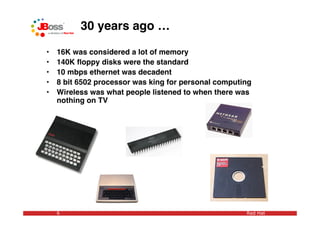
•   16K was considered a lot of memory
•   140K floppy disks were the standard
•   10 mbps ethernet was decadent
•   8 bit 6502 processor was king for personal computing
•   Wireless was what people listened to when there was
    nothing on TV


    6                                                 Red Hat
Today …

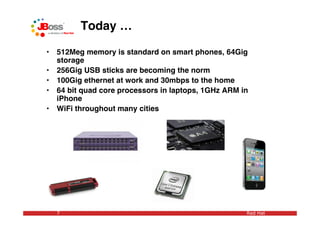
•   512Meg memory is standard on smart phones, 64Gig
    storage
•   256Gig USB sticks are becoming the norm
•   100Gig ethernet at work and 30mbps to the home
•   64 bit quad core processors in laptops, 1GHz ARM in
    iPhone
•   WiFi throughout many cities


    7                                                 Red Hat
Laptops and Linux and Java, Oh
            my!
• The laptop concept originally devised for children
      – Dynabook in 1968
      – Initially considered for word processing and learning
• Now laptops replace desktop
      – More power than early mainframes
• Arguably Java and Linux helped to popularise
  middleware
      – Drive it to the masses
• But Java is not cool any more
      – Ruby, Scala, Erlang, JavaScript, …
• Coolness is iPhones, Androids, HTML5, …
• Those are the new frontiers of application
  development
  8                                                             Red Hat
“Non-middleware” devices

•   Basic word processors on PCs
        – Publisher-quality implementations now on laptops
•   Basic doc readers on smart phones
        – Editors canʼt be far off
•   Games pushing the envelope from Pong through Space
    Invaders to CoD
        – MVCC
        – Distributed systems
        – Grids
            • PSP, Nintendo
•   Mobile devices contain more and more personal data
        – Wallets via NFC
        – Documents, photos, etc.
•   Disconnected operation is the normal situation
        – C.f. 1980ʼs research


    9                                                        Red Hat
Application requirements

 • Types of applications increasing in complexity
     – Auctions
     – Online purchases
     – Distributed peer-to-peer interactions
 • Enterprise requirements becoming a necessity
     –   Security and identity
     –   High performance, low latency, reliable messaging
     –   Database updates with transactions
     –   Workflows as inter-app interactions increase


10                                                           Red Hat
What about Cloud?

 • One (virtual) computer system that is able to …
     – Cope with arbitrary loads and applications
          • “Run my applications securely when I want you to.”
     –   Managed by someone else
     –   Secure
     –   Reliable
     –   Cheap (cost effective)
 • “Emulate the system I would deploy locally if I
   could afford it.”


11                                                               Red Hat
Different flavours of Cloud?

 • Public Clouds important
 • Private Clouds probably more important
     – Security and data consistency implications
 • But Ubiquitous Cloud may become a reality
     – Many devices are predicted to have processors/sensors in
       the future
     – It will be cheaper to give them “high end”/off-the-shelf
       processors/memory than bespoke dye-factories
         • In the next few years your light bulb or washing machine may
           be as powerful and capable as your laptop today
     – Tapping into this local cloud could be possible
         • Whether intended originally or not!


12                                                                   Red Hat
Cloud = death of middleware?

 • <sarcasm>Yeah, right!</sarcasm>
 • Many commonalities between “traditional”
   middleware and PaaS
 • In the Java world extending EE would suffice for
   many applications
     – Virtual middleware stack
     – Add billing
 • But lack of standards for Cloud means Wild West
     – But it doesnʼt have to be this way!


13                                              Red Hat
Revolution?

 •   Many existing applications want to be cloud-enabled
 •   Should not require reimplementing existing infrastructual investments
      – Databases
           • NoSQL versus RDBMS?
           • Use the right tool for the right job
 •   The industry has spent 40+ years designing enterprise infrastructures
      – Many of them work well!
 •   However, middleware today is often not designed for Cloud
      – Large scale
      – Autonomous
 •   But things are common, or similar enough
      – Security
      – Transactions
 •   But new capabilities and approaches are required
      –   Much 80s and 90s research is now applicable


14                                                                   Red Hat
Present and future Cloud

 • Build on existing implementations where
   possible
 • We must provide a natural upgrade path for
   existing users
     – We cannot afford to repeat the DCE/CORBA, DCOM/.NET
       or CORBA/J(2)EE days
 • If the answer is “Cloud 2011” the question is
   wrong!
     – Todayʼs Cloud is not the final solution, itʼs just another step
 • Today “Cloud” means “servers”
     – It should be wider


15                                                                 Red Hat
So what does this all mean?

 •   Middleware is needed whatever the deployment
     environment
     – Mainframes, servers, laptops etc.
     – HTML5
     – Constrained devices? Huh?
 •   Donʼt tie the definition of middleware to an implementation
     – “Middleware is that s/w which sits between the OS and the
       application.”
 •   But mobile and cloud are potentially new silos for
     developers to work within!
 •   Middleware elitism?
     – Mainframe versus mini versus desktop versus laptop?
 •   Enterprise requirements transcend deployment realities


16                                                                 Red Hat
Middleware for tomorrow

 • Stop designing just for today or yesterday
 • Flexible
     – Different environments (not all Java)
     – Different component implementations
     – Cannot assume a single stack
        • Or that users will want the full stack from any single vendor
        • Mix-n-match
 • Adaptable
     – Dynamic and static
     – Applications could migrate between environments
 •   Reliable
 •   Securable
 •   Available
 •   Scalable

17                                                                        Red Hat
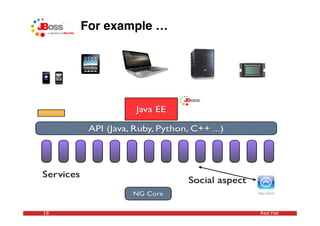
For example …


18                   Red Hat
The open source approach?

 • Open source makes middleware available to
   everyone
 • Open source has many of the technologies to
   help developers on a range of platforms
     – HornetQ, Infinispan, Camel, RESTeasy, Seam, …
 • This is more like building a new jigsaw puzzle
   from the same pieces
     – And incorporating existing completed jigsaws!
 • We need to facilitate approaches that build on
   what we have already
     – No more reinventing the wheel
         • Sharing of experiences as well as code
     – Makes it easier to transition, understand etc.
         • Easier for others to get involved


19                                                      Red Hat
Conclusions

 •   Cloud will increase and evolve
     – Already evolved from Grid and ubiquitous computing
 •   Mobile is going to impact far more people than Cloud
 •   Enterprise middleware applications arenʼt going away
 •   The industry cannot afford to track multiple platforms
 •   Middleware components should be available to all
     developers
     – Maybe even adaptable middleware stacks
 •   The network connectivity laptops have today should be the
     vision for applications, wherever they reside
 •   The next decade will be defined by the mobile generation
 •   And what about JBoss ..?


20                                                            Red Hat

MarkLittle_EnterpriseMiddlewareForThe21stCentury

  • 1.
    Enterprise Middleware forthe 21st Century Professor Mark Little Red Hat
  • 2.
    Overview • Where arewe today and why? • Mobile and Cloud – Ubiquitous computing in the large • Hardware and software forces in action • Letʼs avoid reinventing the wheel yet again – Though we may need to invent some spokes • The death of middleware or an evolutionary jump? • What does this mean for todayʼs middleware offerings? – Is Java EE dead? – Can open source help? • JBoss plans 2 Red Hat
  • 3.
    A Brief Historyof Distributed Systems • Distributed systems are essentially the same today as 20 years ago – The development model has not really changed • Message passing-to-RPC-to-Objects-to- Components-to-Services-to-… – Living in the shadow of the past • The underlying enterprise requirements have not changed – Messaging, transactions, security, … • Many successful years ahead providing current infrastructures … 3 Red Hat
  • 4.
    But … thetimes have changed • There are already more mobile devices than computers • There are 4x more processors on the planet than people – Most have TCP stacks • dsPIC33FJ12GP 16-bit microcontroller has as much horsepower as a VAX (40MIPs), can handle 16+ sensors, and is 1/8 the size of a penny – Ubiquitous computing is here to stay – 20 million iPads already – 1 in 2 Americans predicated to have smart phones by the end of 2011 compared to 1 in 10 in 2008 • Multi-core technologies will only increase • Machine-to-Machine communication will dominate all other traffic 4 Red Hat
  • 5.
    Thin clients orrich clients? • Thin clients have certain advantages – Easier to manage, less to go wrong – More scalable architectures – Rely on “good enough” connectivity or periodic connectedness • Rich clients have certain advantages – Your data is where you need it, when you need it – Able to execute a wider range of applications – Can run disconnected and be useful for a long period of time • Thin clients are typically the domain of constrained devices – But the definition of constrained is relative 5 Red Hat
  • 6.
    30 years ago… • 16K was considered a lot of memory • 140K floppy disks were the standard • 10 mbps ethernet was decadent • 8 bit 6502 processor was king for personal computing • Wireless was what people listened to when there was nothing on TV 6 Red Hat
  • 7.
    Today … • 512Meg memory is standard on smart phones, 64Gig storage • 256Gig USB sticks are becoming the norm • 100Gig ethernet at work and 30mbps to the home • 64 bit quad core processors in laptops, 1GHz ARM in iPhone • WiFi throughout many cities 7 Red Hat
  • 8.
    Laptops and Linuxand Java, Oh my! • The laptop concept originally devised for children – Dynabook in 1968 – Initially considered for word processing and learning • Now laptops replace desktop – More power than early mainframes • Arguably Java and Linux helped to popularise middleware – Drive it to the masses • But Java is not cool any more – Ruby, Scala, Erlang, JavaScript, … • Coolness is iPhones, Androids, HTML5, … • Those are the new frontiers of application development 8 Red Hat
  • 9.
    “Non-middleware” devices • Basic word processors on PCs – Publisher-quality implementations now on laptops • Basic doc readers on smart phones – Editors canʼt be far off • Games pushing the envelope from Pong through Space Invaders to CoD – MVCC – Distributed systems – Grids • PSP, Nintendo • Mobile devices contain more and more personal data – Wallets via NFC – Documents, photos, etc. • Disconnected operation is the normal situation – C.f. 1980ʼs research 9 Red Hat
  • 10.
    Application requirements •Types of applications increasing in complexity – Auctions – Online purchases – Distributed peer-to-peer interactions • Enterprise requirements becoming a necessity – Security and identity – High performance, low latency, reliable messaging – Database updates with transactions – Workflows as inter-app interactions increase 10 Red Hat
  • 11.
    What about Cloud? • One (virtual) computer system that is able to … – Cope with arbitrary loads and applications • “Run my applications securely when I want you to.” – Managed by someone else – Secure – Reliable – Cheap (cost effective) • “Emulate the system I would deploy locally if I could afford it.” 11 Red Hat
  • 12.
    Different flavours ofCloud? • Public Clouds important • Private Clouds probably more important – Security and data consistency implications • But Ubiquitous Cloud may become a reality – Many devices are predicted to have processors/sensors in the future – It will be cheaper to give them “high end”/off-the-shelf processors/memory than bespoke dye-factories • In the next few years your light bulb or washing machine may be as powerful and capable as your laptop today – Tapping into this local cloud could be possible • Whether intended originally or not! 12 Red Hat
  • 13.
    Cloud = deathof middleware? • <sarcasm>Yeah, right!</sarcasm> • Many commonalities between “traditional” middleware and PaaS • In the Java world extending EE would suffice for many applications – Virtual middleware stack – Add billing • But lack of standards for Cloud means Wild West – But it doesnʼt have to be this way! 13 Red Hat
  • 14.
    Revolution? • Many existing applications want to be cloud-enabled • Should not require reimplementing existing infrastructual investments – Databases • NoSQL versus RDBMS? • Use the right tool for the right job • The industry has spent 40+ years designing enterprise infrastructures – Many of them work well! • However, middleware today is often not designed for Cloud – Large scale – Autonomous • But things are common, or similar enough – Security – Transactions • But new capabilities and approaches are required – Much 80s and 90s research is now applicable 14 Red Hat
  • 15.
    Present and futureCloud • Build on existing implementations where possible • We must provide a natural upgrade path for existing users – We cannot afford to repeat the DCE/CORBA, DCOM/.NET or CORBA/J(2)EE days • If the answer is “Cloud 2011” the question is wrong! – Todayʼs Cloud is not the final solution, itʼs just another step • Today “Cloud” means “servers” – It should be wider 15 Red Hat
  • 16.
    So what doesthis all mean? • Middleware is needed whatever the deployment environment – Mainframes, servers, laptops etc. – HTML5 – Constrained devices? Huh? • Donʼt tie the definition of middleware to an implementation – “Middleware is that s/w which sits between the OS and the application.” • But mobile and cloud are potentially new silos for developers to work within! • Middleware elitism? – Mainframe versus mini versus desktop versus laptop? • Enterprise requirements transcend deployment realities 16 Red Hat
  • 17.
    Middleware for tomorrow • Stop designing just for today or yesterday • Flexible – Different environments (not all Java) – Different component implementations – Cannot assume a single stack • Or that users will want the full stack from any single vendor • Mix-n-match • Adaptable – Dynamic and static – Applications could migrate between environments • Reliable • Securable • Available • Scalable 17 Red Hat
  • 18.
  • 19.
    The open sourceapproach? • Open source makes middleware available to everyone • Open source has many of the technologies to help developers on a range of platforms – HornetQ, Infinispan, Camel, RESTeasy, Seam, … • This is more like building a new jigsaw puzzle from the same pieces – And incorporating existing completed jigsaws! • We need to facilitate approaches that build on what we have already – No more reinventing the wheel • Sharing of experiences as well as code – Makes it easier to transition, understand etc. • Easier for others to get involved 19 Red Hat
  • 20.
    Conclusions • Cloud will increase and evolve – Already evolved from Grid and ubiquitous computing • Mobile is going to impact far more people than Cloud • Enterprise middleware applications arenʼt going away • The industry cannot afford to track multiple platforms • Middleware components should be available to all developers – Maybe even adaptable middleware stacks • The network connectivity laptops have today should be the vision for applications, wherever they reside • The next decade will be defined by the mobile generation • And what about JBoss ..? 20 Red Hat