This Presentation Courtesy of the
                          International SOA Symposium
                          October 7-8, 2008 Amsterdam Arena
                          www.soasymposium.com
                          info@soasymposium.com


                                       Founding Sponsors


Platinum Sponsors


Gold Sponsors       Silver Sponsors
Using REST and WS-* for SOA


                  Dr Mark Little
     Technical Development Manager, Red Hat
Background

• Research into fault-tolerant distributed systems
  since 1986
      – Arjuna, Argus, Isis/Horus, Emerald, Xerox, …
      – DCE, DCOM, CORBA, JavaRMI, HTTP, Web Services, …
• Active in OMG, OASIS, W3C, JCP, GGF, OSGi and
  others
• Involved with Web Services since 1999
      – Co-author of a number of WS-* specifications and standards
• Involved with REST/HTTP since at least 2000
      – W3Objects
• IBM, Arjuna Solutions, Bluestone, HP, Arjuna
  Technologies, JBoss, Red Hat
• Newcastle University


  2                                                       Red Hat
Overview
• SOA in a nutshell
• WS-* and REST
• Where should you start?
   – Donʼt panic!
• One size does not fit all
   – Donʼt believe everything you read
• Bridging the divide
   – Can REST be used with WS-*?


   3                                     Red Hat
The debate

• Actually more about WS-* and RESTful HTTP
  (REST/HTTP)
      – REST is a valid approach to SOA
• No REST bashing
      – REST is a valid architectural approach
      – HTTP is one way of implementing it
• No WS-* bashing
      – And specifically no WSDL bashing please
• These types of debate have raged throughout
  history
      – BetaMax vs VHS
      – Blu-Ray vs HD-DVD
• Hybrid systems are the norm
      – Very few places can afford to rip-n-replace

  4                                                   Red Hat
SOA in a nutshell

• SOA is an architectural style to achieve loose
  coupling
      – A service is a unit of work done by a service provider to
        achieve desired end results for a consumer

• SOA is deliberately not prescriptive about what
  happens behind service endpoints
      – We are only concerned with the transfer of structured
        data between parties
• SOA turns business functions into services that can
  be reused and accessed through standard interfaces.
      – Should be accessible through different applications
        over a variety of channels


  5                                                       Red Hat
Achieving loose coupling

• SOA employs two architectural constraints
      – A small set of simple and ubiquitous interfaces to all
        participating software agents. Only generic semantics are
        encoded at the interfaces. The interfaces should be
        universally available for all providers and consumers
      – Descriptive messages constrained by an extensible schema
        delivered through the interfaces. No, or only minimal, system
        behavior is prescribed by messages. A schema limits the
        vocabulary and structure of messages. An extensible
        schema allows new versions of services to be introduced
        without breaking existing services


  6                                                          Red Hat
Implementing SOA

• Many different possible approaches to SOA
      – CORBA
      – J(2)EE
         • JMS
• Two most popular approaches are
      – WS-*
      – REST
         • Actually an architecture in its own right (not tied to HTTP)
         • Much more solidly defined than SOA
• Which is the right approach?
      – Why should there be only one?


  7                                                                 Red Hat
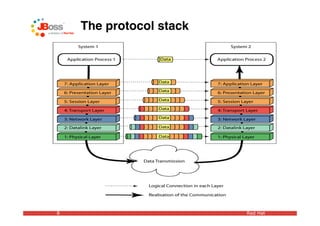
The protocol stack


8                        Red Hat
Distributed Systems

• Same fundamental laws
      – Develop “entity”
          • Define the UOW it supports
      – Search for “entity”
          • Agree “entity” offers the desired capability or UOW
      – Request “entity” to perform UOW
          • Create a network-transferable message
          • Send the message
      – Maybe try to make the remote interaction appear local
      – Maybe do some “enterprise” work as well
          • Security, transactions, replication etc.
              – Contextualization of messages


  9                                                               Red Hat
The most popular (by demand)

 •   Client and server technologies based on RPC
      – Hide distribution
      – Make remote service invocation look the same as local
        component invocation
      – In use since the 1970’s
 •   Unfortunately this leads to tightly coupled applications
      – Changes to the IDL require re-generation of stubs
          • And dissemination of new code
          • Or errors will occur during interactions

      – Such applications can be brittle
          • Hard to control the infrastructure as needed
          • No quiescent period


10                                                              Red Hat
Degrees of coupling

 • At the one extreme
     – Defining specific service interfaces, akin to IDL
         • Easier to reason about the service
         • Limits the amount of freedom in changing the implementation
 • At the other extreme
     – Single operation (e.g., doWork)
         • More flexibility is changing the implementation
             – Well, almost …
         • More difficult to determine service functionality a priori
             – Need more service metadata
 • There are degrees of coupling and you should
   choose the level that is right for you
     – Not specific to distributed systems


11                                                                      Red Hat
Distributed Systems 101

 • The same requirements are present throughout
   the stack
     – Split differently between the infrastructure and the
       “application”
 • Uniform interface allows for generic
   infrastructural support
     – Caching, extremely loose coupling
     – Can push more requirements on to the “developer”
     – Requires more from external contract meta-data
 • Specific interface allows for more limited generic
   support
     – Targeted caching, application semantics
     – Impacts less on the “developer” but may cost in terms of
       flexibility


12                                                                Red Hat
So what do we need for SOA?

 • An architectural approach that supports
     – Loose coupling
     – Enterprise capabilities
         • Security, reliable messaging, fault tolerance
     – Different invocation mechanisms
         • UDP, TCP, HTTP, JMS, IIOP
     – Integration with back-end “legacy” systems
     – Standards based
 • Things that would be nice (not architecture)
     – Easy to use and administer
     – Good tooling


13                                                         Red Hat
REST

 • Defined by Roy Fielding in his PhD
     – One of a range of approaches
 • Core set of architectural principles
     – Identify all resources/entities
     – Link resource together
         • Hypermedia as the engine of application state
     – Use standard methods for interacting with resources
     – Multiple resource representation
     – Stateless communication
 • Not tied to HTTP


14                                                           Red Hat
REST/HTTP in a nutshell

 •   RESTful HTTP
     – Just because you use HTTP does not mean you are using REST
 •   Original HTTP specification talked about adding new
     commands
     – GET only in 0.9
     – GET, HEAD, POST, extension-method in 1.0
     – Now we have up to 8 different verbs
          • Changes to “interface” occur but users aren’t affected
 •   Many good distributed systems characteristics
     –   OPTIONS
     –   Try-before-you-buy
     –   Caching
     –   Scalability
 •   HTTP is NOT a transport


15                                                                   Red Hat
Human driven?

 • Often stated that REST is only suitable for
   hypertext
     – “Because thatʼs the way the majority of the Web works”
 • Weak argument
     – Itʼs still a distributed system, just based on resources
     – OK, humans fill in the “gaps” in contract definition
     – Extra infrastructure support could help
         • Anyone remember URN name servers (1994/1995)?
         • But now we have Google!
 • Not enough “application” standards
     – Good point
 • Lack of good tooling
     – Well … JAX-RS, WCF, …

16                                                                Red Hat
Standards

 • The Web is a series of standards
     – URIs
     – HTTP
     – HTML
 • Universal adoption has to count for something!
 • REST/HTTP is ubiquitous
     – Communication interoperability, which is a good start
         • Also why WS-* standardized on HTTP
     – But application semantic interoperability is not there (yet)
         • Take a minimum of 5 years to do


17                                                                    Red Hat
Enterprise ready?

 • DʼOh!
     – Take a look at the world!
 • Enterprise capabilities
     – Reliable messaging
     – Some fault tolerance
         •   No transactions
         •   Workflow
         •   404 rules!
         •   Stale links
 • Components are there, just not necessarily used
 • But … itʼs not that easy!
     – Human interaction style can sometimes confuse


18                                                     Red Hat
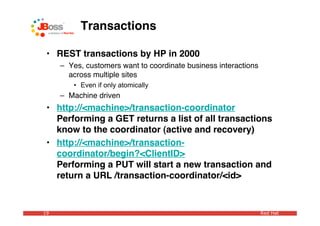
Transactions

 • REST transactions by HP in 2000
     – Yes, customers want to coordinate business interactions
       across multiple sites
        • Even if only atomically
     – Machine driven
 • http://<machine>/transaction-coordinator
   Performing a GET returns a list of all transactions
   know to the coordinator (active and recovery)
 • http://<machine>/transaction-
   coordinator/begin?<ClientID>
   Performing a PUT will start a new transaction and
   return a URL /transaction-coordinator/<id>


19                                                               Red Hat
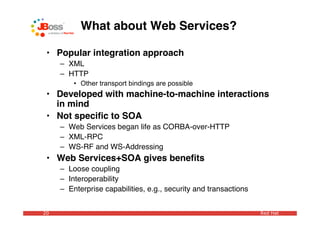
What about Web Services?

 • Popular integration approach
     – XML
     – HTTP
         • Other transport bindings are possible
 • Developed with machine-to-machine interactions
   in mind
 • Not specific to SOA
     – Web Services began life as CORBA-over-HTTP
     – XML-RPC
     – WS-RF and WS-Addressing
 • Web Services+SOA gives benefits
     – Loose coupling
     – Interoperability
     – Enterprise capabilities, e.g., security and transactions


20                                                                Red Hat
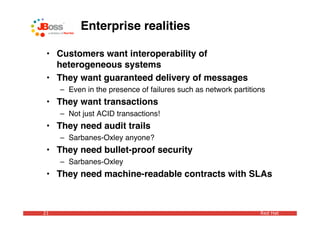
Enterprise realities

 • Customers want interoperability of
   heterogeneous systems
 • They want guaranteed delivery of messages
     – Even in the presence of failures such as network partitions
 • They want transactions
     – Not just ACID transactions!
 • They need audit trails
     – Sarbanes-Oxley anyone?
 • They need bullet-proof security
     – Sarbanes-Oxley
 • They need machine-readable contracts with SLAs


21                                                              Red Hat
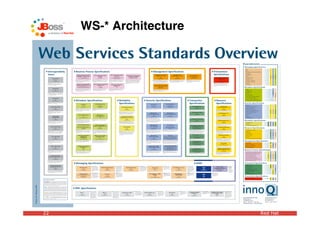
WS-* Architecture


22                       Red Hat
Fault tolerance

 • WS-* has driven protocol interoperability
     – More so than CORBA, DCE, Java
 • Native data and protocol bridging
 • Clearly defined semantics for transactions,
   security, reliable messaging
     – Not specific to HTTP


23                                              Red Hat
WS-* backlash?

 • “Itʼs too complex”
     – Complicated problems often require complex solutions
 • “Itʼs using HTTP as a transport!”
     – Get over it! Mistakes happen.
 • “It doesnʼt offer anything better than REST/HTTP”
     – Short-sightedness works in both directions
 • “It doesnʼt leverage the Web”
     – Valid point for Web deployments
     – Not so valid for every other type of deployment


24                                                            Red Hat
SOA: REST or WS-*?

 • SOAP/HTTP
     – WS-* vendors have spent a lot of time ensuring it integrates
       with legacy systems
         • How many people remember that WS-* is supposed to also be
           about Internet scale computing?
     – Thatʼs important for out-of-the-box and interoperable
       deployments
     – But REST as a general architectural approach has merits
 • REST/HTTP has “simplicity” and (relative) ease of
   use
     – No vendor-lockin at the infrastructure level
     – Is precisely for Internet scale computing as well
     – Remember that a lot of cool Web applications arenʼt
       RESTful

25                                                               Red Hat
What can REST learn from WS-*?

 • Uniform interface isnʼt enough for complex
   application requirements
     – Standardize on the application protocol semantics
     – Ad hoc does not scale and leads to interoperability
       nightmares
 • Use outside of the browser
     – Yes, there are examples and implementations, but they are
       the exception to the rule
 • Just because the Web “works” is not sufficient
   reason to assume itʼs right for everything
     – HTTP versus IIOP?


26                                                           Red Hat
Industrial realities

 • WS-* captured the mind-set
 • REST is gaining momentum
 • But …
     – Large investment in WS-* and application-level standards
       are important
     – Probably too much effort to assume the same will happen in
       REST/HTTP
        • At least not with a big bang approach
     – More customers persuaded by WS-*
        • It’s familiar (JEE, .NET, DCOM, DCE)
        • But they want future proof
 • Combinations of WS-* and REST are beginning to
   evolve
     – May lead to standards

27                                                            Red Hat
What can WS-* learn from REST?

 • Donʼt abuse transports, they donʼt like it!
 • Adopt SOA principles
     – No more WS-RF please!
     – WS-Context in favour of WS-Addressing “extensions”
 • Late binding is good
     – But extremely late binding can be a burden
 • Occams Razor
     – Simple but no simpler
 • Infrastructure support for common
   services/resources simplifies development
 • The Web uses HTTP


28                                                          Red Hat
What should you use?

 • If it needs to be on the Web
     – REST/HTTP
 • If it needs to be interoperable with arbitrary
   vendors
     – WS-* for standards
     – Or persuade vendors to work on standards for REST
 • If you must use HTTP
     – Consider REST before WS-*
         • But understand all of the implications
 • If integrating with back-end systems out-of-the-
   box
     – WS-* has a lot of out-of-the-box solutions


29                                                         Red Hat
The combination

 • WS-* used within the firewall
     – REST principles could still help
     – SOAP is not fast and neither is HTTP
 • REST/HTTP for between firewalls
     – Improved application protocol standards
 • Bridge between WS-* and REST/HTTP
     – Leverage all of HTTP where possible
     – Definitely not easy to do, but …
 • WS-* between firewalls?
     – Unlikely to see massive adoption


30                                               Red Hat
Conclusions

 •   What have we learnt from the last 40 years?
     – One size does not fit all!
     – Use the right tool for the right job
         • If all you’ve got is a hammer then of course everything looks like a nail!
 •   Just because you are using HTTP does not mean you are
     using REST
 •   Just because you are using WS-* does not mean you are
     developing with SOA


31                                                                              Red Hat

Mark Little R E S Tand W S Star

  • 1.
    This Presentation Courtesyof the International SOA Symposium October 7-8, 2008 Amsterdam Arena www.soasymposium.com info@soasymposium.com Founding Sponsors Platinum Sponsors Gold Sponsors Silver Sponsors
  • 2.
    Using REST andWS-* for SOA Dr Mark Little Technical Development Manager, Red Hat
  • 3.
    Background • Research intofault-tolerant distributed systems since 1986 – Arjuna, Argus, Isis/Horus, Emerald, Xerox, … – DCE, DCOM, CORBA, JavaRMI, HTTP, Web Services, … • Active in OMG, OASIS, W3C, JCP, GGF, OSGi and others • Involved with Web Services since 1999 – Co-author of a number of WS-* specifications and standards • Involved with REST/HTTP since at least 2000 – W3Objects • IBM, Arjuna Solutions, Bluestone, HP, Arjuna Technologies, JBoss, Red Hat • Newcastle University 2 Red Hat
  • 4.
    Overview • SOA ina nutshell • WS-* and REST • Where should you start? – Donʼt panic! • One size does not fit all – Donʼt believe everything you read • Bridging the divide – Can REST be used with WS-*? 3 Red Hat
  • 5.
    The debate • Actuallymore about WS-* and RESTful HTTP (REST/HTTP) – REST is a valid approach to SOA • No REST bashing – REST is a valid architectural approach – HTTP is one way of implementing it • No WS-* bashing – And specifically no WSDL bashing please • These types of debate have raged throughout history – BetaMax vs VHS – Blu-Ray vs HD-DVD • Hybrid systems are the norm – Very few places can afford to rip-n-replace 4 Red Hat
  • 6.
    SOA in anutshell • SOA is an architectural style to achieve loose coupling – A service is a unit of work done by a service provider to achieve desired end results for a consumer • SOA is deliberately not prescriptive about what happens behind service endpoints – We are only concerned with the transfer of structured data between parties • SOA turns business functions into services that can be reused and accessed through standard interfaces. – Should be accessible through different applications over a variety of channels 5 Red Hat
  • 7.
    Achieving loose coupling •SOA employs two architectural constraints – A small set of simple and ubiquitous interfaces to all participating software agents. Only generic semantics are encoded at the interfaces. The interfaces should be universally available for all providers and consumers – Descriptive messages constrained by an extensible schema delivered through the interfaces. No, or only minimal, system behavior is prescribed by messages. A schema limits the vocabulary and structure of messages. An extensible schema allows new versions of services to be introduced without breaking existing services 6 Red Hat
  • 8.
    Implementing SOA • Manydifferent possible approaches to SOA – CORBA – J(2)EE • JMS • Two most popular approaches are – WS-* – REST • Actually an architecture in its own right (not tied to HTTP) • Much more solidly defined than SOA • Which is the right approach? – Why should there be only one? 7 Red Hat
  • 9.
  • 10.
    Distributed Systems • Samefundamental laws – Develop “entity” • Define the UOW it supports – Search for “entity” • Agree “entity” offers the desired capability or UOW – Request “entity” to perform UOW • Create a network-transferable message • Send the message – Maybe try to make the remote interaction appear local – Maybe do some “enterprise” work as well • Security, transactions, replication etc. – Contextualization of messages 9 Red Hat
  • 11.
    The most popular(by demand) • Client and server technologies based on RPC – Hide distribution – Make remote service invocation look the same as local component invocation – In use since the 1970’s • Unfortunately this leads to tightly coupled applications – Changes to the IDL require re-generation of stubs • And dissemination of new code • Or errors will occur during interactions – Such applications can be brittle • Hard to control the infrastructure as needed • No quiescent period 10 Red Hat
  • 12.
    Degrees of coupling • At the one extreme – Defining specific service interfaces, akin to IDL • Easier to reason about the service • Limits the amount of freedom in changing the implementation • At the other extreme – Single operation (e.g., doWork) • More flexibility is changing the implementation – Well, almost … • More difficult to determine service functionality a priori – Need more service metadata • There are degrees of coupling and you should choose the level that is right for you – Not specific to distributed systems 11 Red Hat
  • 13.
    Distributed Systems 101 • The same requirements are present throughout the stack – Split differently between the infrastructure and the “application” • Uniform interface allows for generic infrastructural support – Caching, extremely loose coupling – Can push more requirements on to the “developer” – Requires more from external contract meta-data • Specific interface allows for more limited generic support – Targeted caching, application semantics – Impacts less on the “developer” but may cost in terms of flexibility 12 Red Hat
  • 14.
    So what dowe need for SOA? • An architectural approach that supports – Loose coupling – Enterprise capabilities • Security, reliable messaging, fault tolerance – Different invocation mechanisms • UDP, TCP, HTTP, JMS, IIOP – Integration with back-end “legacy” systems – Standards based • Things that would be nice (not architecture) – Easy to use and administer – Good tooling 13 Red Hat
  • 15.
    REST • Definedby Roy Fielding in his PhD – One of a range of approaches • Core set of architectural principles – Identify all resources/entities – Link resource together • Hypermedia as the engine of application state – Use standard methods for interacting with resources – Multiple resource representation – Stateless communication • Not tied to HTTP 14 Red Hat
  • 16.
    REST/HTTP in anutshell • RESTful HTTP – Just because you use HTTP does not mean you are using REST • Original HTTP specification talked about adding new commands – GET only in 0.9 – GET, HEAD, POST, extension-method in 1.0 – Now we have up to 8 different verbs • Changes to “interface” occur but users aren’t affected • Many good distributed systems characteristics – OPTIONS – Try-before-you-buy – Caching – Scalability • HTTP is NOT a transport 15 Red Hat
  • 17.
    Human driven? •Often stated that REST is only suitable for hypertext – “Because thatʼs the way the majority of the Web works” • Weak argument – Itʼs still a distributed system, just based on resources – OK, humans fill in the “gaps” in contract definition – Extra infrastructure support could help • Anyone remember URN name servers (1994/1995)? • But now we have Google! • Not enough “application” standards – Good point • Lack of good tooling – Well … JAX-RS, WCF, … 16 Red Hat
  • 18.
    Standards • TheWeb is a series of standards – URIs – HTTP – HTML • Universal adoption has to count for something! • REST/HTTP is ubiquitous – Communication interoperability, which is a good start • Also why WS-* standardized on HTTP – But application semantic interoperability is not there (yet) • Take a minimum of 5 years to do 17 Red Hat
  • 19.
    Enterprise ready? •DʼOh! – Take a look at the world! • Enterprise capabilities – Reliable messaging – Some fault tolerance • No transactions • Workflow • 404 rules! • Stale links • Components are there, just not necessarily used • But … itʼs not that easy! – Human interaction style can sometimes confuse 18 Red Hat
  • 20.
    Transactions • RESTtransactions by HP in 2000 – Yes, customers want to coordinate business interactions across multiple sites • Even if only atomically – Machine driven • http://<machine>/transaction-coordinator Performing a GET returns a list of all transactions know to the coordinator (active and recovery) • http://<machine>/transaction- coordinator/begin?<ClientID> Performing a PUT will start a new transaction and return a URL /transaction-coordinator/<id> 19 Red Hat
  • 21.
    What about WebServices? • Popular integration approach – XML – HTTP • Other transport bindings are possible • Developed with machine-to-machine interactions in mind • Not specific to SOA – Web Services began life as CORBA-over-HTTP – XML-RPC – WS-RF and WS-Addressing • Web Services+SOA gives benefits – Loose coupling – Interoperability – Enterprise capabilities, e.g., security and transactions 20 Red Hat
  • 22.
    Enterprise realities •Customers want interoperability of heterogeneous systems • They want guaranteed delivery of messages – Even in the presence of failures such as network partitions • They want transactions – Not just ACID transactions! • They need audit trails – Sarbanes-Oxley anyone? • They need bullet-proof security – Sarbanes-Oxley • They need machine-readable contracts with SLAs 21 Red Hat
  • 23.
  • 24.
    Fault tolerance •WS-* has driven protocol interoperability – More so than CORBA, DCE, Java • Native data and protocol bridging • Clearly defined semantics for transactions, security, reliable messaging – Not specific to HTTP 23 Red Hat
  • 25.
    WS-* backlash? •“Itʼs too complex” – Complicated problems often require complex solutions • “Itʼs using HTTP as a transport!” – Get over it! Mistakes happen. • “It doesnʼt offer anything better than REST/HTTP” – Short-sightedness works in both directions • “It doesnʼt leverage the Web” – Valid point for Web deployments – Not so valid for every other type of deployment 24 Red Hat
  • 26.
    SOA: REST orWS-*? • SOAP/HTTP – WS-* vendors have spent a lot of time ensuring it integrates with legacy systems • How many people remember that WS-* is supposed to also be about Internet scale computing? – Thatʼs important for out-of-the-box and interoperable deployments – But REST as a general architectural approach has merits • REST/HTTP has “simplicity” and (relative) ease of use – No vendor-lockin at the infrastructure level – Is precisely for Internet scale computing as well – Remember that a lot of cool Web applications arenʼt RESTful 25 Red Hat
  • 27.
    What can RESTlearn from WS-*? • Uniform interface isnʼt enough for complex application requirements – Standardize on the application protocol semantics – Ad hoc does not scale and leads to interoperability nightmares • Use outside of the browser – Yes, there are examples and implementations, but they are the exception to the rule • Just because the Web “works” is not sufficient reason to assume itʼs right for everything – HTTP versus IIOP? 26 Red Hat
  • 28.
    Industrial realities •WS-* captured the mind-set • REST is gaining momentum • But … – Large investment in WS-* and application-level standards are important – Probably too much effort to assume the same will happen in REST/HTTP • At least not with a big bang approach – More customers persuaded by WS-* • It’s familiar (JEE, .NET, DCOM, DCE) • But they want future proof • Combinations of WS-* and REST are beginning to evolve – May lead to standards 27 Red Hat
  • 29.
    What can WS-*learn from REST? • Donʼt abuse transports, they donʼt like it! • Adopt SOA principles – No more WS-RF please! – WS-Context in favour of WS-Addressing “extensions” • Late binding is good – But extremely late binding can be a burden • Occams Razor – Simple but no simpler • Infrastructure support for common services/resources simplifies development • The Web uses HTTP 28 Red Hat
  • 30.
    What should youuse? • If it needs to be on the Web – REST/HTTP • If it needs to be interoperable with arbitrary vendors – WS-* for standards – Or persuade vendors to work on standards for REST • If you must use HTTP – Consider REST before WS-* • But understand all of the implications • If integrating with back-end systems out-of-the- box – WS-* has a lot of out-of-the-box solutions 29 Red Hat
  • 31.
    The combination •WS-* used within the firewall – REST principles could still help – SOAP is not fast and neither is HTTP • REST/HTTP for between firewalls – Improved application protocol standards • Bridge between WS-* and REST/HTTP – Leverage all of HTTP where possible – Definitely not easy to do, but … • WS-* between firewalls? – Unlikely to see massive adoption 30 Red Hat
  • 32.
    Conclusions • What have we learnt from the last 40 years? – One size does not fit all! – Use the right tool for the right job • If all you’ve got is a hammer then of course everything looks like a nail! • Just because you are using HTTP does not mean you are using REST • Just because you are using WS-* does not mean you are developing with SOA 31 Red Hat