Marketing Strategy – An Overview
Raymond Corey, HBS Note 9-500-005, 1999
TakeAway Points
Marketing Strategy – An Overview, Raymond Corey, HBS Note 9-500-005, 1999
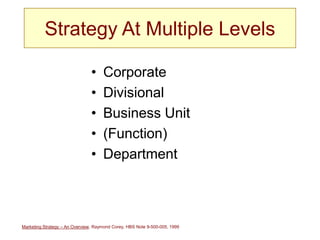
Strategy At Multiple Levels
• Corporate
• Divisional
• Business Unit
• (Function)
• Department
Marketing Strategy – An Overview, Raymond Corey, HBS Note 9-500-005, 1999
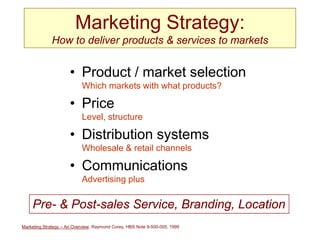
Marketing Strategy:
How to deliver products & services to markets
• Product / market selection
Which markets with what products?
• Price
Level, structure
• Distribution systems
Wholesale & retail channels
• Communications
Advertising plus
Pre- & Post-sales Service, Branding, Location
Marketing Strategy – An Overview, Raymond Corey, HBS Note 9-500-005, 1999
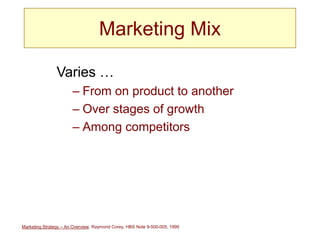
Marketing Mix
Varies …
– From on product to another
– Over stages of growth
– Among competitors
Marketing Strategy – An Overview, Raymond Corey, HBS Note 9-500-005, 1999
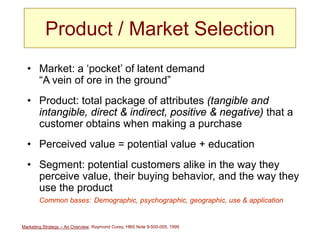
Product / Market Selection
• Market: a ‘pocket’ of latent demand
“A vein of ore in the ground”
• Product: total package of attributes (tangible and
intangible, direct & indirect, positive & negative) that a
customer obtains when making a purchase
• Perceived value = potential value + education
• Segment: potential customers alike in the way they
perceive value, their buying behavior, and the way they
use the product
Common bases: Demographic, psychographic, geographic, use & application
Marketing Strategy – An Overview, Raymond Corey, HBS Note 9-500-005, 1999
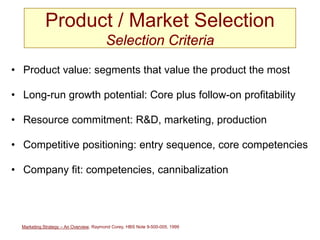
Product / Market Selection
Selection Criteria
• Product value: segments that value the product the most
• Long-run growth potential: Core plus follow-on profitability
• Resource commitment: R&D, marketing, production
• Competitive positioning: entry sequence, core competencies
• Company fit: competencies, cannibalization
Marketing Strategy – An Overview, Raymond Corey, HBS Note 9-500-005, 1999
Price Elements
• Base level
• Structure
• Discounts
• Terms & conditions
• Promotions
Marketing Strategy – An Overview, Raymond Corey, HBS Note 9-500-005, 1999
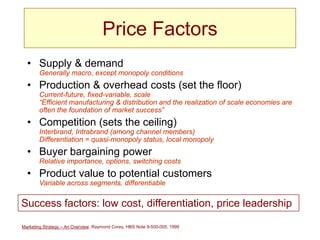
Price Factors
• Supply & demand
Generally macro, except monopoly conditions
• Production & overhead costs (set the floor)
Current-future, fixed-variable, scale
“Efficient manufacturing & distribution and the realization of scale economies are
often the foundation of market success”
• Competition (sets the ceiling)
Interbrand, Intrabrand (among channel members)
Differentiation = quasi-monopoly status, local monopoly
• Buyer bargaining power
Relative importance, options, switching costs
• Product value to potential customers
Variable across segments, differentiable
Success factors: low cost, differentiation, price leadership
Marketing Strategy – An Overview, Raymond Corey, HBS Note 9-500-005, 1999
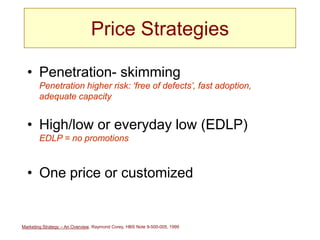
Price Strategies
• Penetration- skimming
Penetration higher risk: ‘free of defects’, fast adoption,
adequate capacity
• High/low or everyday low (EDLP)
EDLP = no promotions
• One price or customized
Marketing Strategy – An Overview, Raymond Corey, HBS Note 9-500-005, 1999
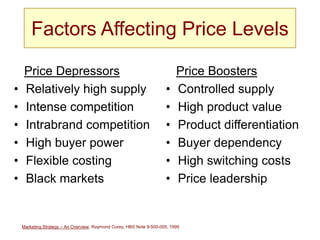
Factors Affecting Price Levels
Price Depressors
• Relatively high supply
• Intense competition
• Intrabrand competition
• High buyer power
• Flexible costing
• Black markets
Price Boosters
• Controlled supply
• High product value
• Product differentiation
• Buyer dependency
• High switching costs
• Price leadership
Marketing Strategy – An Overview, Raymond Corey, HBS Note 9-500-005, 1999
Distribution
• Direct-indirect
• Owned-franchised-open
• Selective-intense
Marketing Strategy – An Overview, Raymond Corey, HBS Note 9-500-005, 1999
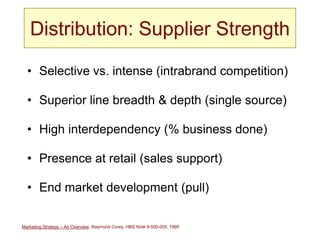
Distribution: Supplier Strength
• Selective vs. intense (intrabrand competition)
• Superior line breadth & depth (single source)
• High interdependency (% business done)
• Presence at retail (sales support)
• End market development (pull)
Marketing Strategy – An Overview, Raymond Corey, HBS Note 9-500-005, 1999
Market Communications Objectives
• Create awareness
• Establish product superiority
• Indicate where to buy
• Reinforce purchase decision
• Suggest follow-ons

Marketing Strategy An Overview.pdf

  • 1.
    Marketing Strategy –An Overview Raymond Corey, HBS Note 9-500-005, 1999 TakeAway Points
  • 2.
    Marketing Strategy –An Overview, Raymond Corey, HBS Note 9-500-005, 1999 Strategy At Multiple Levels • Corporate • Divisional • Business Unit • (Function) • Department
  • 3.
    Marketing Strategy –An Overview, Raymond Corey, HBS Note 9-500-005, 1999 Marketing Strategy: How to deliver products & services to markets • Product / market selection Which markets with what products? • Price Level, structure • Distribution systems Wholesale & retail channels • Communications Advertising plus Pre- & Post-sales Service, Branding, Location
  • 4.
    Marketing Strategy –An Overview, Raymond Corey, HBS Note 9-500-005, 1999 Marketing Mix Varies … – From on product to another – Over stages of growth – Among competitors
  • 5.
    Marketing Strategy –An Overview, Raymond Corey, HBS Note 9-500-005, 1999 Product / Market Selection • Market: a ‘pocket’ of latent demand “A vein of ore in the ground” • Product: total package of attributes (tangible and intangible, direct & indirect, positive & negative) that a customer obtains when making a purchase • Perceived value = potential value + education • Segment: potential customers alike in the way they perceive value, their buying behavior, and the way they use the product Common bases: Demographic, psychographic, geographic, use & application
  • 6.
    Marketing Strategy –An Overview, Raymond Corey, HBS Note 9-500-005, 1999 Product / Market Selection Selection Criteria • Product value: segments that value the product the most • Long-run growth potential: Core plus follow-on profitability • Resource commitment: R&D, marketing, production • Competitive positioning: entry sequence, core competencies • Company fit: competencies, cannibalization
  • 7.
    Marketing Strategy –An Overview, Raymond Corey, HBS Note 9-500-005, 1999 Price Elements • Base level • Structure • Discounts • Terms & conditions • Promotions
  • 8.
    Marketing Strategy –An Overview, Raymond Corey, HBS Note 9-500-005, 1999 Price Factors • Supply & demand Generally macro, except monopoly conditions • Production & overhead costs (set the floor) Current-future, fixed-variable, scale “Efficient manufacturing & distribution and the realization of scale economies are often the foundation of market success” • Competition (sets the ceiling) Interbrand, Intrabrand (among channel members) Differentiation = quasi-monopoly status, local monopoly • Buyer bargaining power Relative importance, options, switching costs • Product value to potential customers Variable across segments, differentiable Success factors: low cost, differentiation, price leadership
  • 9.
    Marketing Strategy –An Overview, Raymond Corey, HBS Note 9-500-005, 1999 Price Strategies • Penetration- skimming Penetration higher risk: ‘free of defects’, fast adoption, adequate capacity • High/low or everyday low (EDLP) EDLP = no promotions • One price or customized
  • 10.
    Marketing Strategy –An Overview, Raymond Corey, HBS Note 9-500-005, 1999 Factors Affecting Price Levels Price Depressors • Relatively high supply • Intense competition • Intrabrand competition • High buyer power • Flexible costing • Black markets Price Boosters • Controlled supply • High product value • Product differentiation • Buyer dependency • High switching costs • Price leadership
  • 11.
    Marketing Strategy –An Overview, Raymond Corey, HBS Note 9-500-005, 1999 Distribution • Direct-indirect • Owned-franchised-open • Selective-intense
  • 12.
    Marketing Strategy –An Overview, Raymond Corey, HBS Note 9-500-005, 1999 Distribution: Supplier Strength • Selective vs. intense (intrabrand competition) • Superior line breadth & depth (single source) • High interdependency (% business done) • Presence at retail (sales support) • End market development (pull)
  • 13.
    Marketing Strategy –An Overview, Raymond Corey, HBS Note 9-500-005, 1999 Market Communications Objectives • Create awareness • Establish product superiority • Indicate where to buy • Reinforce purchase decision • Suggest follow-ons