Shopper, Buyer, and Consumer
• People do not buy products, they buy benefits
(Practical / Unusual)
• Shoppers go into the marketplace through various
means; they can be “just looking” or purposeful
• Buyers complete the exchange transaction
• The shopper is often the buyer, but not always
• Consumers actually use or possess that which is
“purchased”
2
Shopper, Buyer, and Consumer
• “Influencers” exert various levels of power
over the choices a person makes in certain
product categories.
• Different types of people seek different
benefits.
• A watch (Student vs Gift)
• The marketplace is anywhere that a
transaction can be completed.
3
Consumer
Behaviour……..what is it?
All such activities done by a consumer, while
obtaining , consuming and disposing of products
and services. This includes the decision making
processes that precede and follow such actions.
4
Subject draws its concepts from:
 Psychology
 Sociology
 Anthropology
 Economics
 Marketing
5
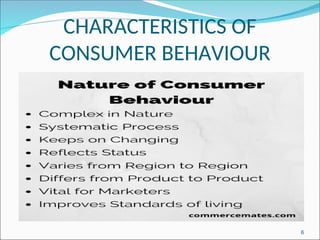
CHARACTERISTICS OF
CONSUMER BEHAVIOUR
6
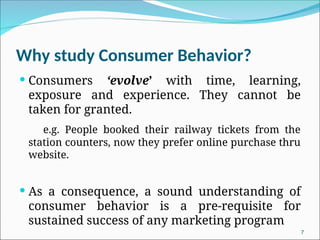
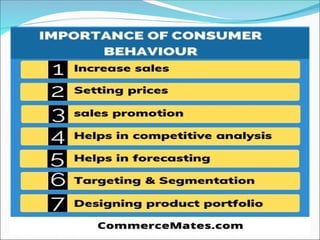
Why study Consumer Behavior?
 Consumers ‘evolve’ with time, learning,
exposure and experience. They cannot be
taken for granted.
e.g. People booked their railway tickets from the
station counters, now they prefer online purchase thru
website.
 As a consequence, a sound understanding of
consumer behavior is a pre-requisite for
sustained success of any marketing program
7
8
9
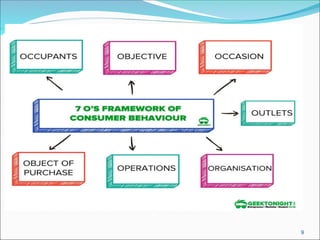
Occupants
 Who buys, Who constitutes the market?
10
Objects
 What does the market buy?
11
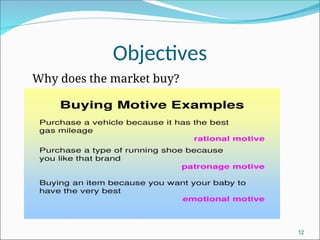
Objectives
Why does the market buy?
12
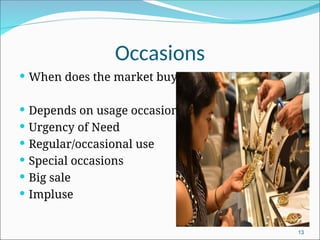
Occasions
 When does the market buy?
 Depends on usage occasions
 Urgency of Need
 Regular/occasional use
 Special occasions
 Big sale
 Impluse
13
Outlets
 Where does the market buy?
 Mom-and-pop Stores. These are small family-owned
businesses, which sell a small collection of goods to
the customers. ...
 Department stores. Department stores are general
merchandisers. ...
 Category Killers. ...
 Malls. ...
 Discount Stores. ...
 Supermarkets. ... Street vendors. ... Hypermarkets.
14
Operations
 How does the market buy?
15
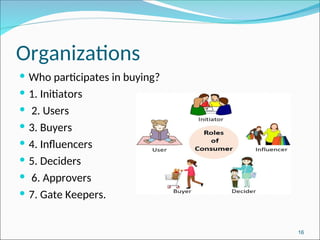
Organizations
 Who participates in buying?
 1. Initiators
 2. Users
 3. Buyers
 4. Influencers
 5. Deciders
 6. Approvers
 7. Gate Keepers.
16
17
The Consumer Decision-Making Process
• Consumer decision models
describe the processes
consumers go through before,
during, and after making a
purchase.
18
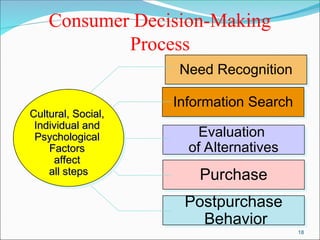
Consumer Decision-Making
Process
Postpurchase
Behavior
Purchase
Evaluation
of Alternatives
Information Search
Need Recognition
Cultural, Social,
Cultural, Social,
Individual and
Individual and
Psychological
Psychological
Factors
Factors
affect
affect
all steps
all steps
19
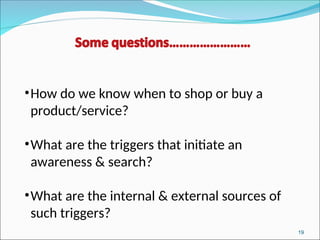
•How do we know when to shop or buy a
product/service?
•What are the triggers that initiate an
awareness & search?
•What are the internal & external sources of
such triggers?
20
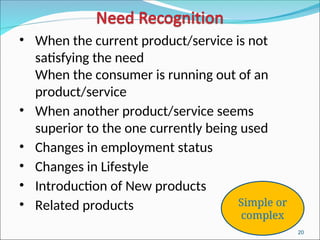
• When the current product/service is not
satisfying the need
When the consumer is running out of an
product/service
• When another product/service seems
superior to the one currently being used
• Changes in employment status
• Changes in Lifestyle
• Introduction of New products
• Related products Simple or
complex
21
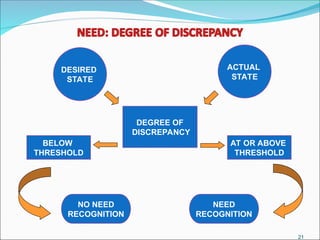
DEGREE OF
DISCREPANCY
DESIRED
STATE
ACTUAL
STATE
BELOW
THRESHOLD
AT OR ABOVE
THRESHOLD
NO NEED
RECOGNITION
NEED
RECOGNITION
22
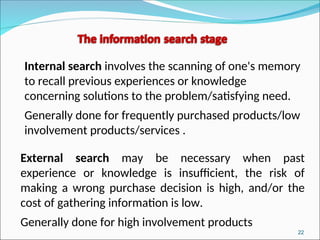
Internal search involves the scanning of one's memory
to recall previous experiences or knowledge
concerning solutions to the problem/satisfying need.
Generally done for frequently purchased products/low
involvement products/services .
External search may be necessary when past
experience or knowledge is insufficient, the risk of
making a wrong purchase decision is high, and/or the
cost of gathering information is low.
Generally done for high involvement products
23
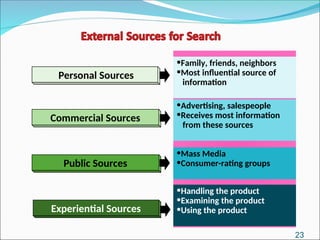
•Family, friends, neighbors
•Most influential source of
information
•Advertising, salespeople
•Receives most information
from these sources
•Mass Media
•Consumer-rating groups
•Handling the product
•Examining the product
•Using the product
Personal Sources
Commercial Sources
Public Sources
Experiential Sources
24
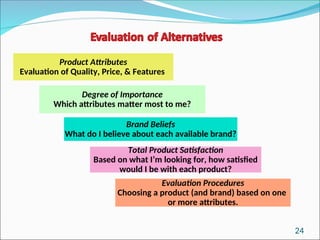
Product Attributes
Evaluation of Quality, Price, & Features
Degree of Importance
Which attributes matter most to me?
Brand Beliefs
What do I believe about each available brand?
Total Product Satisfaction
Based on what I’m looking for, how satisfied
would I be with each product?
Evaluation Procedures
Choosing a product (and brand) based on one
or more attributes.
25
26
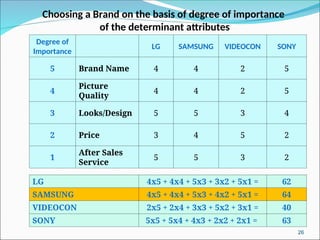
Degree of
Importance
LG SAMSUNG VIDEOCON SONY
5 Brand Name 4 4 2 5
4
Picture
Quality
4 4 2 5
3 Looks/Design 5 5 3 4
2 Price 3 4 5 2
1
After Sales
Service
5 5 3 2
LG 4x5 + 4x4 + 5x3 + 3x2 + 5x1 = 62
SAMSUNG 4x5 + 4x4 + 5x3 + 4x2 + 5x1 = 64
VIDEOCON 2x5 + 2x4 + 3x3 + 5x2 + 3x1 = 40
SONY 5x5 + 5x4 + 4x3 + 2x2 + 2x1 = 63
Choosing a Brand on the basis of degree of importance
of the determinant attributes
27
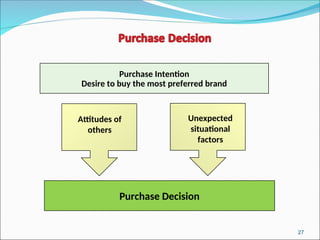
Purchase Intention
Desire to buy the most preferred brand
Purchase Decision
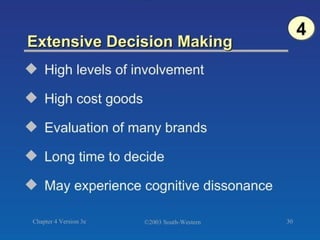
Attitudes of
others
Unexpected
situational
factors
28
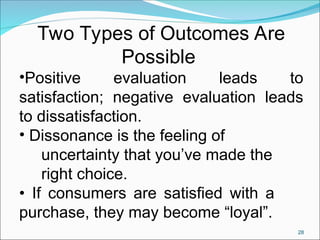
Two Types of Outcomes Are
Possible
•Positive evaluation leads to
satisfaction; negative evaluation leads
to dissatisfaction.
• Dissonance is the feeling of
uncertainty that you’ve made the
right choice.
• If consumers are satisfied with a
purchase, they may become “loyal”.
29
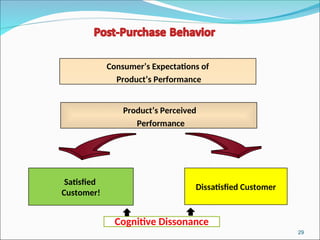
Consumer’s Expectations of
Product’s Performance
Dissatisfied Customer
Satisfied
Customer!
Product’s Perceived
Performance
Cognitive Dissonance
30
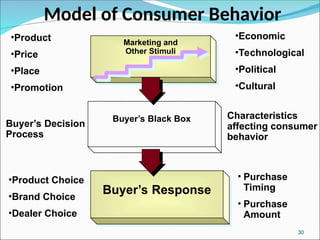
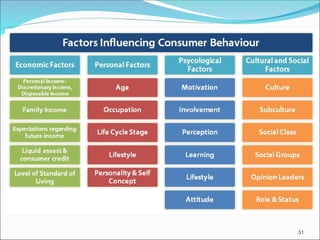
Model of Consumer Behavior
Marketing and
Other Stimuli
Buyer’s Black Box
Buyer’s Response
•Product
•Price
•Place
•Promotion
•Economic
•Technological
•Political
•Cultural
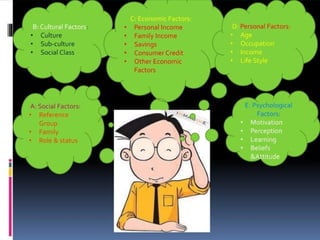
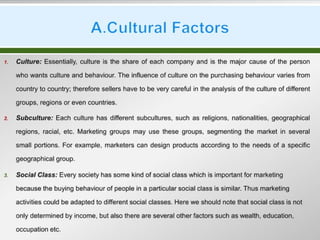
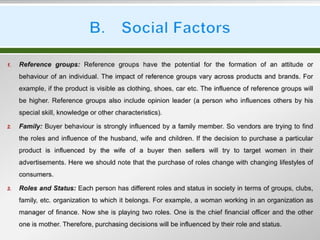
Characteristics
affecting consumer
behavior
Buyer’s Decision
Process
•Product Choice
•Brand Choice
•Dealer Choice
• Purchase
Timing
• Purchase
Amount
31
Marketing management: CONSUMER BEHAVIOUR.ppt

Marketing management: CONSUMER BEHAVIOUR.ppt

  • 2.
    Shopper, Buyer, andConsumer • People do not buy products, they buy benefits (Practical / Unusual) • Shoppers go into the marketplace through various means; they can be “just looking” or purposeful • Buyers complete the exchange transaction • The shopper is often the buyer, but not always • Consumers actually use or possess that which is “purchased” 2
  • 3.
    Shopper, Buyer, andConsumer • “Influencers” exert various levels of power over the choices a person makes in certain product categories. • Different types of people seek different benefits. • A watch (Student vs Gift) • The marketplace is anywhere that a transaction can be completed. 3
  • 4.
    Consumer Behaviour……..what is it? Allsuch activities done by a consumer, while obtaining , consuming and disposing of products and services. This includes the decision making processes that precede and follow such actions. 4
  • 5.
    Subject draws itsconcepts from:  Psychology  Sociology  Anthropology  Economics  Marketing 5
  • 6.
  • 7.
    Why study ConsumerBehavior?  Consumers ‘evolve’ with time, learning, exposure and experience. They cannot be taken for granted. e.g. People booked their railway tickets from the station counters, now they prefer online purchase thru website.  As a consequence, a sound understanding of consumer behavior is a pre-requisite for sustained success of any marketing program 7
  • 8.
  • 9.
  • 10.
    Occupants  Who buys,Who constitutes the market? 10
  • 11.
    Objects  What doesthe market buy? 11
  • 12.
  • 13.
    Occasions  When doesthe market buy?  Depends on usage occasions  Urgency of Need  Regular/occasional use  Special occasions  Big sale  Impluse 13
  • 14.
    Outlets  Where doesthe market buy?  Mom-and-pop Stores. These are small family-owned businesses, which sell a small collection of goods to the customers. ...  Department stores. Department stores are general merchandisers. ...  Category Killers. ...  Malls. ...  Discount Stores. ...  Supermarkets. ... Street vendors. ... Hypermarkets. 14
  • 15.
    Operations  How doesthe market buy? 15
  • 16.
    Organizations  Who participatesin buying?  1. Initiators  2. Users  3. Buyers  4. Influencers  5. Deciders  6. Approvers  7. Gate Keepers. 16
  • 17.
    17 The Consumer Decision-MakingProcess • Consumer decision models describe the processes consumers go through before, during, and after making a purchase.
  • 18.
    18 Consumer Decision-Making Process Postpurchase Behavior Purchase Evaluation of Alternatives InformationSearch Need Recognition Cultural, Social, Cultural, Social, Individual and Individual and Psychological Psychological Factors Factors affect affect all steps all steps
  • 19.
    19 •How do weknow when to shop or buy a product/service? •What are the triggers that initiate an awareness & search? •What are the internal & external sources of such triggers?
  • 20.
    20 • When thecurrent product/service is not satisfying the need When the consumer is running out of an product/service • When another product/service seems superior to the one currently being used • Changes in employment status • Changes in Lifestyle • Introduction of New products • Related products Simple or complex
  • 21.
    21 DEGREE OF DISCREPANCY DESIRED STATE ACTUAL STATE BELOW THRESHOLD AT ORABOVE THRESHOLD NO NEED RECOGNITION NEED RECOGNITION
  • 22.
    22 Internal search involvesthe scanning of one's memory to recall previous experiences or knowledge concerning solutions to the problem/satisfying need. Generally done for frequently purchased products/low involvement products/services . External search may be necessary when past experience or knowledge is insufficient, the risk of making a wrong purchase decision is high, and/or the cost of gathering information is low. Generally done for high involvement products
  • 23.
    23 •Family, friends, neighbors •Mostinfluential source of information •Advertising, salespeople •Receives most information from these sources •Mass Media •Consumer-rating groups •Handling the product •Examining the product •Using the product Personal Sources Commercial Sources Public Sources Experiential Sources
  • 24.
    24 Product Attributes Evaluation ofQuality, Price, & Features Degree of Importance Which attributes matter most to me? Brand Beliefs What do I believe about each available brand? Total Product Satisfaction Based on what I’m looking for, how satisfied would I be with each product? Evaluation Procedures Choosing a product (and brand) based on one or more attributes.
  • 25.
  • 26.
    26 Degree of Importance LG SAMSUNGVIDEOCON SONY 5 Brand Name 4 4 2 5 4 Picture Quality 4 4 2 5 3 Looks/Design 5 5 3 4 2 Price 3 4 5 2 1 After Sales Service 5 5 3 2 LG 4x5 + 4x4 + 5x3 + 3x2 + 5x1 = 62 SAMSUNG 4x5 + 4x4 + 5x3 + 4x2 + 5x1 = 64 VIDEOCON 2x5 + 2x4 + 3x3 + 5x2 + 3x1 = 40 SONY 5x5 + 5x4 + 4x3 + 2x2 + 2x1 = 63 Choosing a Brand on the basis of degree of importance of the determinant attributes
  • 27.
    27 Purchase Intention Desire tobuy the most preferred brand Purchase Decision Attitudes of others Unexpected situational factors
  • 28.
    28 Two Types ofOutcomes Are Possible •Positive evaluation leads to satisfaction; negative evaluation leads to dissatisfaction. • Dissonance is the feeling of uncertainty that you’ve made the right choice. • If consumers are satisfied with a purchase, they may become “loyal”.
  • 29.
    29 Consumer’s Expectations of Product’sPerformance Dissatisfied Customer Satisfied Customer! Product’s Perceived Performance Cognitive Dissonance
  • 30.
    30 Model of ConsumerBehavior Marketing and Other Stimuli Buyer’s Black Box Buyer’s Response •Product •Price •Place •Promotion •Economic •Technological •Political •Cultural Characteristics affecting consumer behavior Buyer’s Decision Process •Product Choice •Brand Choice •Dealer Choice • Purchase Timing • Purchase Amount
  • 31.