





Group of people sharing a common

need.

In marketing, market refers to the group of
consumers or organizations that is interested
in the product, has the resources to purchase
the product and is permitted by law and
regulations to acquire the product.
Marketing is a process of creation, stimulation
and fulfillment of wants and demands
profitably.
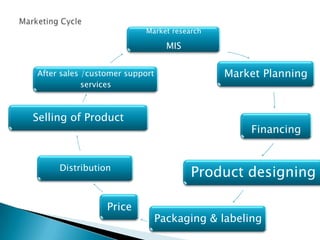
Marketing is a never ending cyclic process; it
starts before manufacturing of product and
does not end even after consumption.
.


Marketing is about identifying and meeting
human and social needs.

“meeting needs profitably”.


Marketing is to identify a product for a
market. It is not a battle among products it’s
a battle among perception.
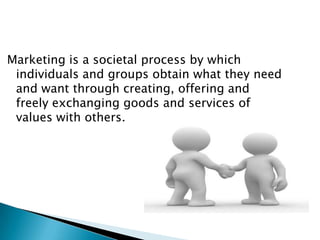
Marketing is a societal process by which
individuals and groups obtain what they need
and want through creating, offering and
freely exchanging goods and services of
values with others.
Market research

MIS
After sales /customer support
services

Selling of Product

Distribution

Price

Market Planning

Financing

Product designing
Packaging & labeling


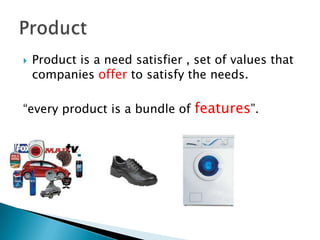
Product is a need satisfier , set of values that
companies offer to satisfy the needs.

“every product is a bundle of features”.
Characteristics: degree of a product.
- basic things.

Features: when we talk about any specific
individual. Eg. Maggi.

Attributes: they are those features which
delivers benefits to one defined group of
consumers. For eg.maggi
Quality : it is the ability of any product to
satisfy its user.
- Fitness of use.




Satisfaction: It is a felt mental stage which is
a result of actual performance and expected
performance.




A marketer is someone who seeks a response
– attention, a purchase, a vote- from another
party, called the prospect.
One that sells goods or services in or to a
market, especially one that markets a
specified commodity.
Someone who promotes or exchanges goods
or services for money.
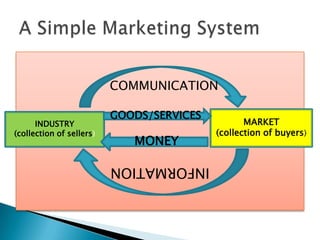
COMMUNICATION

MONEY

INFORMATION

INDUSTRY
(collection of sellers)

GOODS/SERVICES

MARKET
(collection of buyers)
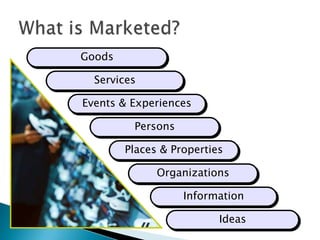
Goods
Services
Events & Experiences

Persons
Places & Properties
Organizations
Information

Ideas
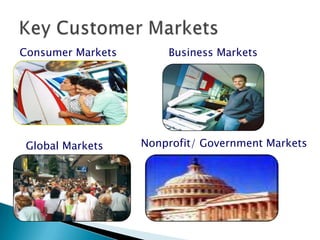
Consumer Markets

Global Markets

Business Markets

Nonprofit/ Government Markets


Consumer markets are the markets for
products and services bought by individuals
for their own or family use. It can be
categorized as:

Consumer Durable goods
 White goods
 Brown goods
 Grey goods
Non durables Goods- FMCG, semi durables
Transportation/ Service Market-Postal Services,
Courier Services, Dentist, Logistic Services
 Business

organization
other business.

 Not

sell

to

to final consumer.

 These

other businesses use what
they have bought to make new
products.






Selling finished goods. E.g. Office furniture,
ACs, computer systems, Inverters.
Selling raw materials. E.g.- steel, coal, gas,
timber, engine, computer parts etc.
Selling services to business. E.g.- waste
disposal, legal services , security, accounting.


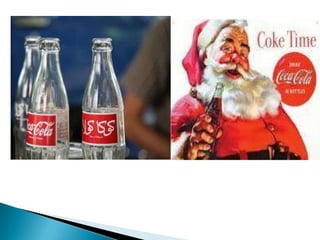
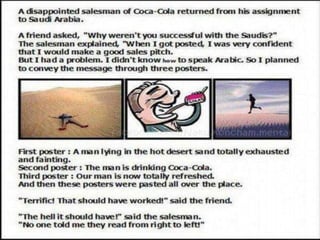
Companies selling goods to global marketplaces.

Faces additional decisions and challenges.
Which country to enter, how to enter (exporter, joint
venture partner, contract manufacturer, solo
manufacturer), how to adapt their products and
services’ features to each country, what marketing
mix strategies to use. Which decisions to be made
according to legal, cultural and political system of
that country.



Companies selling their goods to nonprofit
organization such as temples, universities,
charitable organizations or govt. agencies.

Carefully pricing has to be done as these
organizations have limited purchasing power.
Much govt. purchasing calls for bids with the
lowest bid being favored.
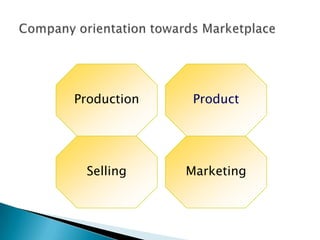
Production

Product

Selling

Marketing
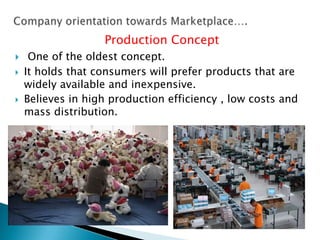
Production Concept





One of the oldest concept.
It holds that consumers will prefer products that are
widely available and inexpensive.
Believes in high production efficiency , low costs and
mass distribution.




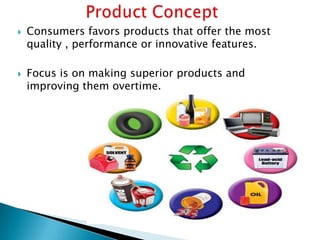
Consumers favors products that offer the most
quality , performance or innovative features.
Focus is on making superior products and
improving them overtime.


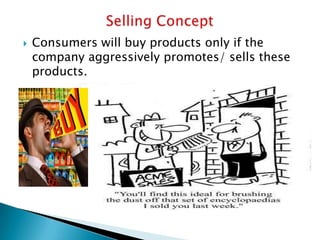
Consumers will buy products only if the
company aggressively promotes/ sells these
products.


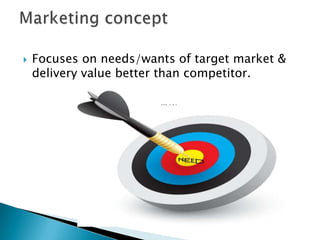
Focuses on needs/wants of target market &
delivery value better than competitor.
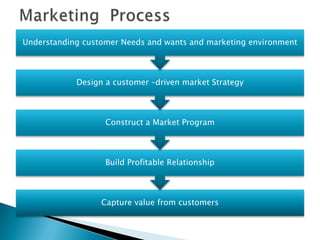
Understanding customer Needs and wants and marketing environment

Design a customer –driven market Strategy

Construct a Market Program

Build Profitable Relationship

Capture value from customers
o
o
o
o
o
o
o

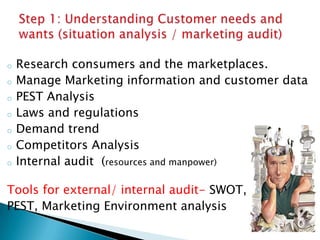
Research consumers and the marketplaces.
Manage Marketing information and customer data
PEST Analysis
Laws and regulations
Demand trend
Competitors Analysis
Internal audit (resources and manpower)

Tools for external/ internal audit- SWOT,
PEST, Marketing Environment analysis
o

o

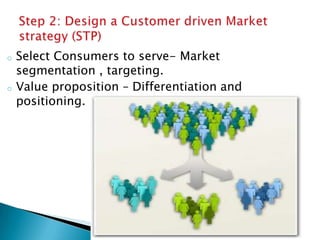
Select Consumers to serve- Market
segmentation , targeting.
Value proposition – Differentiation and
positioning.







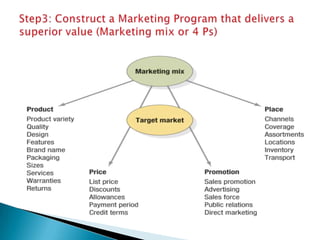
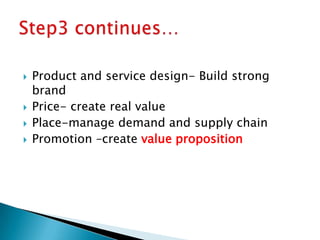
Product and service design- Build strong
brand
Price- create real value
Place-manage demand and supply chain
Promotion –create value proposition
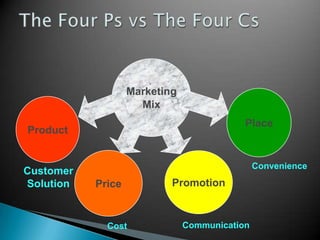
Marketing
Mix
Place

Product

Customer
Solution

Convenience

Price

Cost

Promotion

Communication




Customer relationship management with
chosen customers
Product relationship management with
chosen suppliers







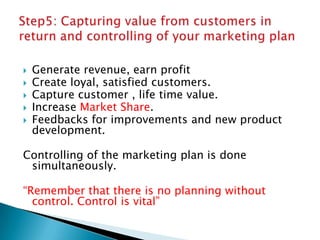
Generate revenue, earn profit
Create loyal, satisfied customers.
Capture customer , life time value.
Increase Market Share.
Feedbacks for improvements and new product
development.

Controlling of the marketing plan is done
simultaneously.

“Remember that there is no planning without
control. Control is vital”
“MIS consists of people, equipment and
procedure to gather, sort , analyze, evaluate
and distribute needed timely and accurate
information to marketing decision makers.”
A MIS relies on Internal company records,
Marketing Intelligence system and MR.
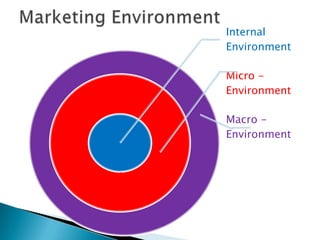
Internal
Environment

Micro Environment
Macro Environment







Management
Men
Money
Material
Machine

As marketers we call the purpose of managing
internal change as Internal Marketing. Marketer
has to make changes in 5 M s according to
his marketing decision.
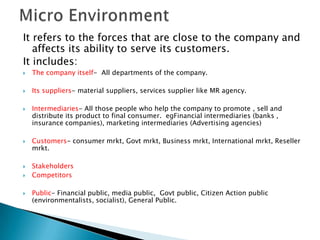
It refers to the forces that are close to the company and
affects its ability to serve its customers.
It includes:


The company itself- All departments of the company.



Its suppliers- material suppliers, services supplier like MR agency.










Intermediaries- All those people who help the company to promote , sell and
distribute its product to final consumer. egFinancial intermediaries (banks ,
insurance companies), marketing intermediaries (Advertising agencies)
Customers- consumer mrkt, Govt mrkt, Business mrkt, International mrkt, Reseller
mrkt.
Stakeholders
Competitors

Public- Financial public, media public, Govt public, Citizen Action public
(environmentalists, socialist), General Public.








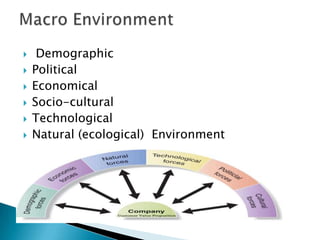
Demographic
Political
Economical
Socio-cultural
Technological
Natural (ecological) Environment
When dealing with the marketing environment
it is important for a company to become
proactive. By doing so, they can create the
kind of environment that they will prosper in
and can become more efficient by marketing
in areas with the greatest customer potential.
It is important to place equal emphasis on
both the macro and microenvironment and to
react accordingly to changes within them.
Thank You

Marketing basics

  • 2.
      Group of peoplesharing a common need. In marketing, market refers to the group of consumers or organizations that is interested in the product, has the resources to purchase the product and is permitted by law and regulations to acquire the product.
  • 4.
    Marketing is aprocess of creation, stimulation and fulfillment of wants and demands profitably. Marketing is a never ending cyclic process; it starts before manufacturing of product and does not end even after consumption. .
  • 5.
     Marketing is aboutidentifying and meeting human and social needs. “meeting needs profitably”.  Marketing is to identify a product for a market. It is not a battle among products it’s a battle among perception.
  • 6.
    Marketing is asocietal process by which individuals and groups obtain what they need and want through creating, offering and freely exchanging goods and services of values with others.
  • 7.
    Market research MIS After sales/customer support services Selling of Product Distribution Price Market Planning Financing Product designing Packaging & labeling
  • 8.
     Product is aneed satisfier , set of values that companies offer to satisfy the needs. “every product is a bundle of features”.
  • 9.
    Characteristics: degree ofa product. - basic things. Features: when we talk about any specific individual. Eg. Maggi. Attributes: they are those features which delivers benefits to one defined group of consumers. For eg.maggi
  • 10.
    Quality : itis the ability of any product to satisfy its user. - Fitness of use.   Satisfaction: It is a felt mental stage which is a result of actual performance and expected performance.
  • 11.
      A marketer issomeone who seeks a response – attention, a purchase, a vote- from another party, called the prospect. One that sells goods or services in or to a market, especially one that markets a specified commodity. Someone who promotes or exchanges goods or services for money.
  • 12.
  • 13.
    Goods Services Events & Experiences Persons Places& Properties Organizations Information Ideas
  • 14.
    Consumer Markets Global Markets BusinessMarkets Nonprofit/ Government Markets
  • 15.
     Consumer markets arethe markets for products and services bought by individuals for their own or family use. It can be categorized as: Consumer Durable goods  White goods  Brown goods  Grey goods Non durables Goods- FMCG, semi durables Transportation/ Service Market-Postal Services, Courier Services, Dentist, Logistic Services
  • 16.
     Business organization other business. Not sell to to final consumer.  These other businesses use what they have bought to make new products.
  • 17.
       Selling finished goods.E.g. Office furniture, ACs, computer systems, Inverters. Selling raw materials. E.g.- steel, coal, gas, timber, engine, computer parts etc. Selling services to business. E.g.- waste disposal, legal services , security, accounting.
  • 18.
     Companies selling goodsto global marketplaces. Faces additional decisions and challenges. Which country to enter, how to enter (exporter, joint venture partner, contract manufacturer, solo manufacturer), how to adapt their products and services’ features to each country, what marketing mix strategies to use. Which decisions to be made according to legal, cultural and political system of that country. 
  • 21.
     Companies selling theirgoods to nonprofit organization such as temples, universities, charitable organizations or govt. agencies. Carefully pricing has to be done as these organizations have limited purchasing power. Much govt. purchasing calls for bids with the lowest bid being favored.
  • 22.
  • 23.
    Production Concept    One ofthe oldest concept. It holds that consumers will prefer products that are widely available and inexpensive. Believes in high production efficiency , low costs and mass distribution.
  • 24.
      Consumers favors productsthat offer the most quality , performance or innovative features. Focus is on making superior products and improving them overtime.
  • 25.
     Consumers will buyproducts only if the company aggressively promotes/ sells these products.
  • 26.
     Focuses on needs/wantsof target market & delivery value better than competitor.
  • 27.
    Understanding customer Needsand wants and marketing environment Design a customer –driven market Strategy Construct a Market Program Build Profitable Relationship Capture value from customers
  • 28.
    o o o o o o o Research consumers andthe marketplaces. Manage Marketing information and customer data PEST Analysis Laws and regulations Demand trend Competitors Analysis Internal audit (resources and manpower) Tools for external/ internal audit- SWOT, PEST, Marketing Environment analysis
  • 29.
    o o Select Consumers toserve- Market segmentation , targeting. Value proposition – Differentiation and positioning.
  • 31.
        Product and servicedesign- Build strong brand Price- create real value Place-manage demand and supply chain Promotion –create value proposition
  • 32.
  • 33.
      Customer relationship managementwith chosen customers Product relationship management with chosen suppliers
  • 34.
         Generate revenue, earnprofit Create loyal, satisfied customers. Capture customer , life time value. Increase Market Share. Feedbacks for improvements and new product development. Controlling of the marketing plan is done simultaneously. “Remember that there is no planning without control. Control is vital”
  • 35.
    “MIS consists ofpeople, equipment and procedure to gather, sort , analyze, evaluate and distribute needed timely and accurate information to marketing decision makers.” A MIS relies on Internal company records, Marketing Intelligence system and MR.
  • 36.
  • 37.
         Management Men Money Material Machine As marketers wecall the purpose of managing internal change as Internal Marketing. Marketer has to make changes in 5 M s according to his marketing decision.
  • 38.
    It refers tothe forces that are close to the company and affects its ability to serve its customers. It includes:  The company itself- All departments of the company.  Its suppliers- material suppliers, services supplier like MR agency.      Intermediaries- All those people who help the company to promote , sell and distribute its product to final consumer. egFinancial intermediaries (banks , insurance companies), marketing intermediaries (Advertising agencies) Customers- consumer mrkt, Govt mrkt, Business mrkt, International mrkt, Reseller mrkt. Stakeholders Competitors Public- Financial public, media public, Govt public, Citizen Action public (environmentalists, socialist), General Public.
  • 39.
  • 40.
    When dealing withthe marketing environment it is important for a company to become proactive. By doing so, they can create the kind of environment that they will prosper in and can become more efficient by marketing in areas with the greatest customer potential. It is important to place equal emphasis on both the macro and microenvironment and to react accordingly to changes within them.
  • 42.

Editor's Notes

  • #4 Unless there is need no one will have demand.
  • #26 The idea in marketing that if customers are left to themselves, they will not make the effort to buy a company's products. Therefore, it dictates, companies must be aggressive in pushing their sales.