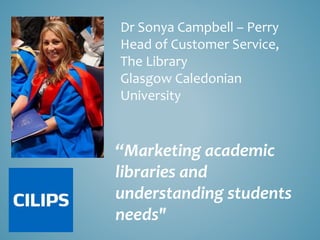
Dr Sonya Campbell – Perry
Head of Customer Service,
The Library
Glasgow Caledonian
University
“Marketing academic
libraries and
understanding students
needs"
“Do you know what ‘they’
want, and can you actually
give them it?”
Higher education (HE) has become
a crowded global marketplace
and, as such, is not immune to
changes affecting 21st century
society–—an increasingly global,
digital, and dynamic environment.
There is a general consensus that
the future of academia is and will
be complicated, challenging, and
uncertain; some authors view this
future with optimism, whereas
others foresee doomsday scenarios
(Pucciarelli & Kaplan, 2016).
THE CURRENT
CLIMATE-
GLOBAL HE
Libraries and library
professionals face multiple
challenges in meeting user
needs in the second decade of
the new millennium. This is
particularly true in academic
libraries where students and
faculty demand and expect
fast, easy, and seamless access
to information as well as
flexible, comfortable places to
work alone as well as
collaboratively with colleagues,
friends, classmates, and
instructors (Seal, 2015).
THE CURRENT
CLIMATE –
GLOBAL
LIBRARIES
WORKSHOP OUTLINE
Understanding your
‘customer’ needs
and expectations
• Who are they? Are they
just students?
• How do you find out
what they want?
• What do they want
versus what you think
they want?
• Why does it actually
matter?
Telling your customers
(and everyone else)
what you can deliver
• How do you manage
different expectations?
• How do you deliver
great services on a
budget?
• How do you become
consistent and
comfortable enough
about your services to
shout about what you
do?
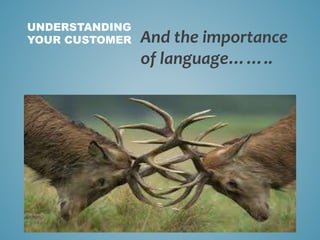
And the importance
of language……..
UNDERSTANDING
YOUR CUSTOMER
Research has shown that students
can and do feel they are, at times, a
customer within their student
experience (Dougas & Douglas,
2015; Tomlinson, 2016; Millward,
2016).
Cuthbert (2010) states that HE has a
distorted view of how other sectors
behave toward their customers,
and as a result ‘..generalise
inappropriately from experience as
customer in other settings’
(Cuthbert, 2010, p.12).
IF THEY
THINK THEY
ARE
CUSTOMERS?
WHO AM I
TO
DISAGREE?
‘..the goal should be to
understand the unique
and particular status of
the students as a
customer, which is one
that by necessity must
bridge the
public/private nexus.”
(Pitman, 2016, p.357)
STUDENTS
AS
CUSTOMERS
Customer Service
Excellence defines in
Criterion 1 that you
provide high levels
of customer insight
and can evidence
how you know who
your customers are.
WHO ARE
YOUR OTHER
CUSTOMERS?
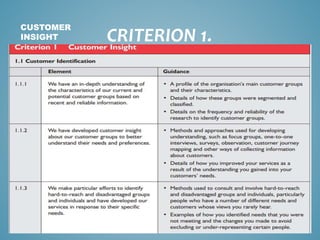
CUSTOMER
INSIGHT CRITERION 1.
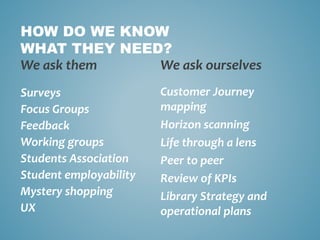
HOW DO WE KNOW
WHAT THEY NEED?
We ask them
Surveys
Focus Groups
Feedback
Working groups
Students Association
Student employability
Mystery shopping
UX
We ask ourselves
Customer Journey
mapping
Horizon scanning
Life through a lens
Peer to peer
Review of KPIs
Library Strategy and
operational plans
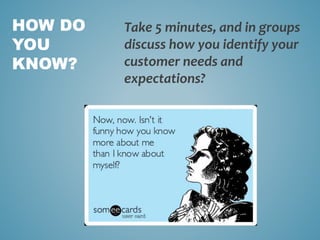
Take 5 minutes, and in groups
discuss how you identify your
customer needs and
expectations?
HOW DO
YOU
KNOW?
Students tell us they want:
The three A’s (and 1 C)-
Access, Attentiveness,
Availability & Communication
(Douglas et. al.,2015)
[Understanding student satisfaction and dissatisfaction: an interpretive
study in the UK HE context].
We say they need four C’s
Library professionals have always given
customer service high priority, and through
the information commons (IC) model they
have seen an opportunity not only to meet,
but exceed, the expectations of library
users by fulfilling the IC’s “4 C philosophy”
of connectivity, collaboration, creation of
knowledge, and community” (Seal, 2015)
Why
does it
matter ?
Bad experiences drive customers
away – fast.
• Globally, consumers would stop
doing business with a company
due to unfriendly service (60%),
unknowledgeable employees
(46%), and lack of company trust
(50%).
• Speed and efficiency (80%);
knowledgeable and helpful
employees (78%); and convenience
(77%) universally matter most.
[pwc.com, 2018]
DELIVERING
EXCELLENT
EXPERIENCES
Satisfied students can be more self-confident (Hasan & Subhani,
2016).
Gibbs (2015) suggests that satisfied students are more likely to be
happier students, and as direct a result are more deeply engaged
with their role as a learner, than those being made to feel unhappy
by their student experience. This suggests that in order to increase
student engagement with learning, universities should be paying
attention to satisfying student expectations, in order to support
successful learning outcomes.
There is a need for HEIs to ensure they are well positioned in a
competitive market place and so must deliver quality services to
gain competitive advantage. For this to occur institutions need to
understand the expectations and experiences of their students or
customers, in order that any expectation gaps are identified and
resolved (Giannakis & Bullivant, 2016).
MARKETING YOUR
EXCELLENT
SERVICES
“In a connected world,
customers are no longer
willing to wait to get
answers. They want to be
able to reach out in an
ever-increasing number of
methods, including phone,
email and social media
channels. You need to
monitor all of them, and
constantly be on the
lookout for what
customers are saying
about you” (Forbes.com,
2018).
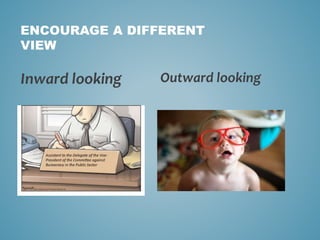
ENCOURAGE A DIFFERENT
VIEW
Inward looking Outward looking
• They deliver the
experience
• They identify the
problems & barriers to
excellence
• They identify the future
developments and
innovations to
continuously improve
• They are your service
experience
BE
CAREFUL
WHICH
LENS YOU
PROVIDE
YOUR
STAFF
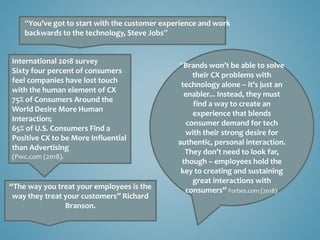
“The way you treat your employees is the
way they treat your customers” Richard
Branson.
“Brands won’t be able to solve
their CX problems with
technology alone – it’s just an
enabler... Instead, they must
find a way to create an
experience that blends
consumer demand for tech
with their strong desire for
authentic, personal interaction.
They don’t need to look far,
though – employees hold the
key to creating and sustaining
great interactions with
consumers” Forbes.com (2018).
“You’ve got to start with the customer experience and work
backwards to the technology, Steve Jobs”
International 2018 survey
Sixty four percent of consumers
feel companies have lost touch
with the human element of CX
75% of Consumers Around the
World Desire More Human
Interaction;
65% of U.S. Consumers Find a
Positive CX to be More Influential
than Advertising
(Pwc.com (2018).
Staff provide the story for
your customers to talk
about. They are ‘the
organisation’ from your
customers viewpoint.
STAFF ARE THE KEY TO A
SUCCESSFUL MARKETING
CAMPAIGN
In his book Descartes Error, Damasio (2018),
argues that emotion is a necessary ingredient
to almost all decisions. When we are
confronted with a decision, emotions from
previous, related experiences affix values to
the options we are considering. These
emotions create preferences, which lead to our
decisions, and how we feel about our choices.
An important foundation to build an
organisations emotional link to its customers
can be found in its ‘narrative’— the story that
communicates ‘who’ it is, what it means to the
consumer, and why the consumer should care.
This story is the basis for brand marketing and
promotion (Forbes.com, 2018).
STUDENTS
READ AND
EXPERIENCE
THE STORY
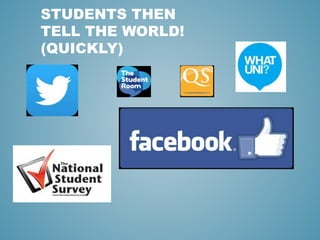
STUDENTS THEN
TELL THE WORLD!
(QUICKLY)
1. Understand who are your
customers. Spend time on their
journeys by using Journey
Mapping. Make the time to map
out the important/main customer
journeys, and identify where your
customer may need some
assistance. What are your touch
points, are there any PAIN points?
All of these events trigger unique
opportunities to provide an
excellence service and tell a
fabulous story about your excellent
services which can then be retold
by your customers!
IN
SUMMARY:
SOME
ACTIONS
2. Identify Target KPIs And Internal SLAs. What
does excellent service look like? Set up your targets
and metrics to deliver what you understand to be
your customers expectations. By defining these
internal metrics, you show staff what an excellent
service looks like. A word of caution, ensure staff
are equipped and able to deliver the processes and
tasks you will hold them accountable for delivering,
otherwise metrics will not achieved, staff will
become demotivated and ultimately your service
delivery will suffer and customer expectations will
not be met.
3. Budget: Many organisations treat customer
support as a cost centre. However, if you
structure your team and your messaging
properly, you can boost your customer loyalty,
and have customer support be a marketing
function rather than an afterthought.
Culturally all members of your team should be
viewed as customer facing and therefore
responsible for the marketing of your service.
4. Understand your Staff: Your
service and the resulting satisfaction
from your service is only as good as
your staff allow it to be. Your focus
needs to be on your staff journey
first. Do they know what excellent
service looks like? Do they find it easy
to deliver excellent service? Are they
trained? Are they empowered? Are
they motivated and engaged?
SIMPLES!

Marketing academic libraries and understanding user needs

  • 1.
    Dr Sonya Campbell– Perry Head of Customer Service, The Library Glasgow Caledonian University “Marketing academic libraries and understanding students needs"
  • 2.
    “Do you knowwhat ‘they’ want, and can you actually give them it?”
  • 3.
    Higher education (HE)has become a crowded global marketplace and, as such, is not immune to changes affecting 21st century society–—an increasingly global, digital, and dynamic environment. There is a general consensus that the future of academia is and will be complicated, challenging, and uncertain; some authors view this future with optimism, whereas others foresee doomsday scenarios (Pucciarelli & Kaplan, 2016). THE CURRENT CLIMATE- GLOBAL HE
  • 4.
    Libraries and library professionalsface multiple challenges in meeting user needs in the second decade of the new millennium. This is particularly true in academic libraries where students and faculty demand and expect fast, easy, and seamless access to information as well as flexible, comfortable places to work alone as well as collaboratively with colleagues, friends, classmates, and instructors (Seal, 2015). THE CURRENT CLIMATE – GLOBAL LIBRARIES
  • 6.
    WORKSHOP OUTLINE Understanding your ‘customer’needs and expectations • Who are they? Are they just students? • How do you find out what they want? • What do they want versus what you think they want? • Why does it actually matter? Telling your customers (and everyone else) what you can deliver • How do you manage different expectations? • How do you deliver great services on a budget? • How do you become consistent and comfortable enough about your services to shout about what you do?
  • 7.
    And the importance oflanguage…….. UNDERSTANDING YOUR CUSTOMER
  • 8.
    Research has shownthat students can and do feel they are, at times, a customer within their student experience (Dougas & Douglas, 2015; Tomlinson, 2016; Millward, 2016). Cuthbert (2010) states that HE has a distorted view of how other sectors behave toward their customers, and as a result ‘..generalise inappropriately from experience as customer in other settings’ (Cuthbert, 2010, p.12). IF THEY THINK THEY ARE CUSTOMERS?
  • 9.
  • 10.
    ‘..the goal shouldbe to understand the unique and particular status of the students as a customer, which is one that by necessity must bridge the public/private nexus.” (Pitman, 2016, p.357) STUDENTS AS CUSTOMERS
  • 11.
    Customer Service Excellence definesin Criterion 1 that you provide high levels of customer insight and can evidence how you know who your customers are. WHO ARE YOUR OTHER CUSTOMERS?
  • 12.
  • 13.
    HOW DO WEKNOW WHAT THEY NEED? We ask them Surveys Focus Groups Feedback Working groups Students Association Student employability Mystery shopping UX We ask ourselves Customer Journey mapping Horizon scanning Life through a lens Peer to peer Review of KPIs Library Strategy and operational plans
  • 14.
    Take 5 minutes,and in groups discuss how you identify your customer needs and expectations? HOW DO YOU KNOW?
  • 15.
    Students tell usthey want: The three A’s (and 1 C)- Access, Attentiveness, Availability & Communication (Douglas et. al.,2015) [Understanding student satisfaction and dissatisfaction: an interpretive study in the UK HE context].
  • 20.
    We say theyneed four C’s Library professionals have always given customer service high priority, and through the information commons (IC) model they have seen an opportunity not only to meet, but exceed, the expectations of library users by fulfilling the IC’s “4 C philosophy” of connectivity, collaboration, creation of knowledge, and community” (Seal, 2015)
  • 22.
  • 23.
    Bad experiences drivecustomers away – fast. • Globally, consumers would stop doing business with a company due to unfriendly service (60%), unknowledgeable employees (46%), and lack of company trust (50%). • Speed and efficiency (80%); knowledgeable and helpful employees (78%); and convenience (77%) universally matter most. [pwc.com, 2018] DELIVERING EXCELLENT EXPERIENCES
  • 24.
    Satisfied students canbe more self-confident (Hasan & Subhani, 2016). Gibbs (2015) suggests that satisfied students are more likely to be happier students, and as direct a result are more deeply engaged with their role as a learner, than those being made to feel unhappy by their student experience. This suggests that in order to increase student engagement with learning, universities should be paying attention to satisfying student expectations, in order to support successful learning outcomes. There is a need for HEIs to ensure they are well positioned in a competitive market place and so must deliver quality services to gain competitive advantage. For this to occur institutions need to understand the expectations and experiences of their students or customers, in order that any expectation gaps are identified and resolved (Giannakis & Bullivant, 2016).
  • 25.
    MARKETING YOUR EXCELLENT SERVICES “In aconnected world, customers are no longer willing to wait to get answers. They want to be able to reach out in an ever-increasing number of methods, including phone, email and social media channels. You need to monitor all of them, and constantly be on the lookout for what customers are saying about you” (Forbes.com, 2018).
  • 26.
    ENCOURAGE A DIFFERENT VIEW Inwardlooking Outward looking
  • 27.
    • They deliverthe experience • They identify the problems & barriers to excellence • They identify the future developments and innovations to continuously improve • They are your service experience BE CAREFUL WHICH LENS YOU PROVIDE YOUR STAFF
  • 28.
    “The way youtreat your employees is the way they treat your customers” Richard Branson. “Brands won’t be able to solve their CX problems with technology alone – it’s just an enabler... Instead, they must find a way to create an experience that blends consumer demand for tech with their strong desire for authentic, personal interaction. They don’t need to look far, though – employees hold the key to creating and sustaining great interactions with consumers” Forbes.com (2018). “You’ve got to start with the customer experience and work backwards to the technology, Steve Jobs” International 2018 survey Sixty four percent of consumers feel companies have lost touch with the human element of CX 75% of Consumers Around the World Desire More Human Interaction; 65% of U.S. Consumers Find a Positive CX to be More Influential than Advertising (Pwc.com (2018).
  • 29.
    Staff provide thestory for your customers to talk about. They are ‘the organisation’ from your customers viewpoint. STAFF ARE THE KEY TO A SUCCESSFUL MARKETING CAMPAIGN
  • 30.
    In his bookDescartes Error, Damasio (2018), argues that emotion is a necessary ingredient to almost all decisions. When we are confronted with a decision, emotions from previous, related experiences affix values to the options we are considering. These emotions create preferences, which lead to our decisions, and how we feel about our choices. An important foundation to build an organisations emotional link to its customers can be found in its ‘narrative’— the story that communicates ‘who’ it is, what it means to the consumer, and why the consumer should care. This story is the basis for brand marketing and promotion (Forbes.com, 2018). STUDENTS READ AND EXPERIENCE THE STORY
  • 31.
    STUDENTS THEN TELL THEWORLD! (QUICKLY)
  • 32.
    1. Understand whoare your customers. Spend time on their journeys by using Journey Mapping. Make the time to map out the important/main customer journeys, and identify where your customer may need some assistance. What are your touch points, are there any PAIN points? All of these events trigger unique opportunities to provide an excellence service and tell a fabulous story about your excellent services which can then be retold by your customers! IN SUMMARY: SOME ACTIONS
  • 33.
    2. Identify TargetKPIs And Internal SLAs. What does excellent service look like? Set up your targets and metrics to deliver what you understand to be your customers expectations. By defining these internal metrics, you show staff what an excellent service looks like. A word of caution, ensure staff are equipped and able to deliver the processes and tasks you will hold them accountable for delivering, otherwise metrics will not achieved, staff will become demotivated and ultimately your service delivery will suffer and customer expectations will not be met.
  • 34.
    3. Budget: Manyorganisations treat customer support as a cost centre. However, if you structure your team and your messaging properly, you can boost your customer loyalty, and have customer support be a marketing function rather than an afterthought. Culturally all members of your team should be viewed as customer facing and therefore responsible for the marketing of your service.
  • 35.
    4. Understand yourStaff: Your service and the resulting satisfaction from your service is only as good as your staff allow it to be. Your focus needs to be on your staff journey first. Do they know what excellent service looks like? Do they find it easy to deliver excellent service? Are they trained? Are they empowered? Are they motivated and engaged?
  • 36.

Editor's Notes

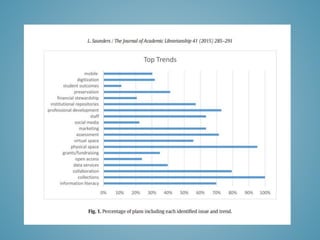
  • #6 According to this analysis, collections, physical space, collaboration, and instruction are the most frequent focus of academic library strategic plans, followed by staffing issues, marketing, assessment, and virtual Space (Saunders, 2015)
  • #8 Ok Im going to use the customer word, but in order to move away to a degree from that discussion we are going to have a 5 minute chat in groups about what you think and why? I appreciate that this is still a highly controversial statement to use, but as I have been a customer service manage in HE for 13 years then I am going to use the word customer to convey the potential diversity of our customer/user/member base within academic libraries rather that just student.
  • #9 Sweet dreams are made of this Who am I to disagree? I travel the world And the seven seas, Everybody's looking for something.
  • #17 Access Defined as the physical approachability of the service location, the ease of finding a way around the environment, ease of contact with staff.
  • #18 Attentiveness (helpfulness): Willingness of staff to provide help or give the impression of being interested in and providing support to the student.
  • #19 Availability: The amount of time that each staff member can give to a student. This included availability of other service goods, including PCs, books, food in the café and parking.
  • #20 This was defined as the ability of the university to communicate with their students in a language they understand
  • #22 There needs to be a balance achieved that supports your customers achieve most of their expectations. However excellent customer service manages customer expectations and delivers excellent customer experiences.
  • #23 So if you can identify what customers want, and you can identify a route that you can get them their, why should you bother?
  • #24 Out with the sector CX is important because…
  • #25 Within our sector excellent experiences and satisfied students lead to …
  • #26 So you know who they are and what they want, but how do you give everyone what they want without the social media backlash?
  • #27 you must understand your environment, your customer and communicate effectiveley. McCaffery 2010 explains that to be successful in managing and effective leadership in HE you must understand your institutional context. Panda (2014) states that collaboration is key