Introduction
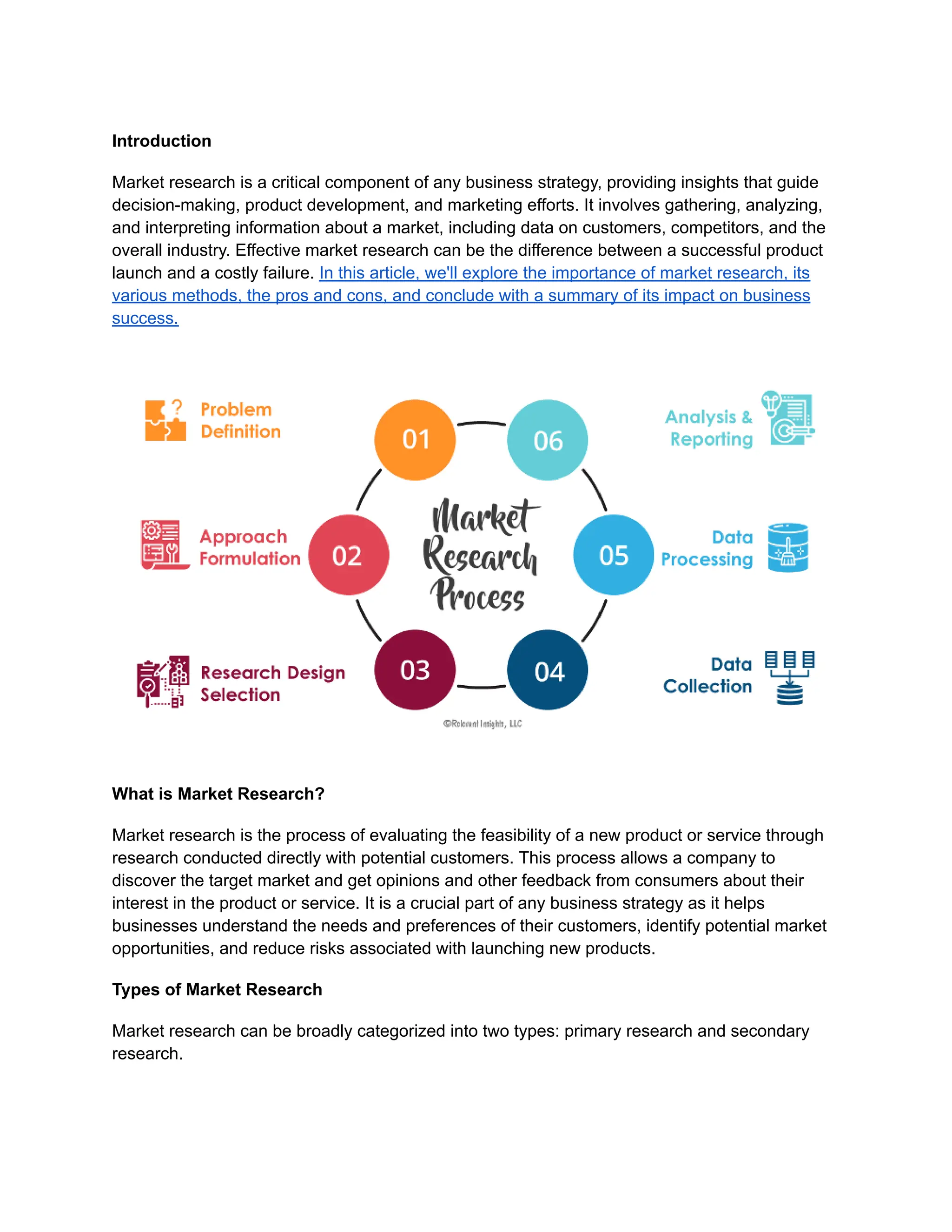
Market research is a critical component of any business strategy, providing insights that guide
decision-making, product development, and marketing efforts. It involves gathering, analyzing,
and interpreting information about a market, including data on customers, competitors, and the
overall industry. Effective market research can be the difference between a successful product
launch and a costly failure. In this article, we'll explore the importance of market research, its
various methods, the pros and cons, and conclude with a summary of its impact on business
success.
What is Market Research?
Market research is the process of evaluating the feasibility of a new product or service through
research conducted directly with potential customers. This process allows a company to
discover the target market and get opinions and other feedback from consumers about their
interest in the product or service. It is a crucial part of any business strategy as it helps
businesses understand the needs and preferences of their customers, identify potential market
opportunities, and reduce risks associated with launching new products.
Types of Market Research
Market research can be broadly categorized into two types: primary research and secondary
research.
1. Primary Research: This is the process of gathering new data that has not been
collected before. It involves direct interaction with the target audience through methods
such as surveys, interviews, focus groups, and observations.
○ Surveys: Surveys are one of the most common tools used in primary research.
They involve asking questions to a group of people, either online, over the phone,
or in person, to gather information about their preferences, behaviors, and
opinions.
○ Interviews: Interviews involve direct one-on-one interaction with respondents.
They can be structured, semi-structured, or unstructured and are useful for
gathering in-depth information.
○ Focus Groups: A focus group is a moderated discussion with a small group of
people from the target market. It helps businesses understand consumer
attitudes, perceptions, and motivations.
○ Observations: Observation involves monitoring consumer behavior in a natural
or controlled environment without direct interaction. This method helps gather
unbiased data on how customers interact with products or services.
2. Secondary Research: This involves analyzing data that has already been collected and
published. Secondary research can include reports, studies, industry statistics, and
academic papers.
○ Internal Sources: These include data that the company already has, such as
sales records, customer databases, and previous research reports.
○ External Sources: External sources include published research reports, industry
journals, government publications, and data from market research firms.
Importance of Market Research
Market research is essential for several reasons:
1. Understanding Consumer Needs: Market research helps businesses understand what
consumers want and need. By identifying customer preferences, businesses can
develop products and services that meet these needs, leading to higher customer
satisfaction and loyalty.
2. Identifying Market Opportunities: Through market research, businesses can identify
gaps in the market or underserved segments. This enables them to explore new
opportunities, enter new markets, and expand their customer base.
3. Reducing Risk: Market research provides valuable insights that reduce the risks
associated with launching new products or entering new markets. It helps businesses
avoid costly mistakes by testing concepts and understanding market demand before
investing heavily.
4. Benchmarking and Competitor Analysis: Market research enables businesses to
benchmark their performance against competitors and industry standards. It provides
insights into competitors' strengths and weaknesses, helping companies refine their
strategies and gain a competitive edge.
5. Improving Marketing Strategies: With a deep understanding of the target market,
businesses can create more effective marketing campaigns. Market research helps in
identifying the right channels, messaging, and tactics to reach and engage customers.
6. Guiding Business Decisions: Data-driven insights from market research inform critical
business decisions, such as pricing, product development, and distribution. This ensures
that decisions are based on evidence rather than assumptions.
Methods of Conducting Market Research
Market research can be conducted using various methods, depending on the goals, budget, and
resources available. Here are some common methods:
1. Quantitative Research: Quantitative research involves collecting numerical data that
can be analyzed statistically. It is useful for understanding market trends, measuring
customer satisfaction, and making predictions.
○ Surveys: As mentioned earlier, surveys are a common quantitative research
method. They can be conducted online, over the phone, or in person and are
useful for gathering data from a large sample size.
○ Experiments: Experiments involve manipulating one variable to observe its
effect on another. This method is often used in product testing and pricing
research.
○ Secondary Data Analysis: Analyzing existing data from sources such as sales
records, market reports, and government statistics can provide valuable
quantitative insights.
2. Qualitative Research: Qualitative research focuses on understanding the underlying
reasons, opinions, and motivations behind consumer behavior. It is useful for exploring
new ideas and gaining deeper insights.
○ Interviews: In-depth interviews provide rich qualitative data that helps
businesses understand consumer perspectives.
○ Focus Groups: Focus groups encourage discussion among participants,
providing insights into consumer attitudes and emotions.
○ Ethnographic Research: Ethnographic research involves observing consumers
in their natural environment to understand how they use products or services in
real life.
3. Mixed-Methods Research: This approach combines both quantitative and qualitative
research methods to provide a comprehensive understanding of the market. For
example, a business might start with qualitative research to explore ideas and then use
quantitative research to test those ideas on a larger scale.
Pros of Market Research
1. Informed Decision-Making: Market research provides businesses with data-driven
insights that guide strategic decisions. It reduces the uncertainty and risk associated with
launching new products, entering new markets, or making significant investments.
2. Competitive Advantage: By understanding the market and consumer preferences,
businesses can identify opportunities that their competitors may have missed. This
enables them to differentiate themselves and gain a competitive edge.
3. Improved Product Development: Market research helps businesses develop products
and services that meet customer needs. By testing concepts and gathering feedback,
companies can refine their offerings before launching them, increasing the chances of
success.
4. Customer Satisfaction and Loyalty: Understanding consumer needs and preferences
allows businesses to create products, services, and marketing strategies that resonate
with their target audience. This leads to higher customer satisfaction, loyalty, and
retention.
5. Efficient Resource Allocation: Market research helps businesses allocate resources
more effectively by identifying the most promising market opportunities and customer
segments. This ensures that marketing budgets, product development efforts, and other
resources are directed where they will have the greatest impact.
6. Risk Mitigation: By identifying potential risks and challenges in the market, businesses
can develop contingency plans and strategies to mitigate these risks. This proactive
approach reduces the likelihood of costly mistakes and failures.
7. Better Marketing Strategies: Market research provides insights into consumer
behavior, preferences, and buying patterns. This information helps businesses create
more targeted and effective marketing campaigns that resonate with their audience.
8. Enhanced Communication: Market research can reveal the language, messaging, and
communication channels that resonate most with the target audience. This enables
businesses to craft more compelling messages and engage customers more effectively.
Cons of Market Research
1. Costly: Conducting comprehensive market research can be expensive, especially for
small businesses with limited budgets. The costs can include hiring research firms,
purchasing data, and conducting surveys or focus groups.
2. Time-Consuming: Market research can take a significant amount of time, especially
when conducting primary research. This can delay product launches or other business
initiatives.
3. Data Overload: Market research can generate a large amount of data, which can be
overwhelming to analyze and interpret. Businesses may struggle to identify the most
relevant insights, leading to analysis paralysis.
4. Inaccurate or Biased Data: The accuracy of market research depends on the quality of
the data collected. If the sample size is too small, the questions are poorly designed, or
the data is outdated, the results may be inaccurate or biased, leading to misguided
decisions.
5. Changing Markets: Markets can change rapidly due to technological advancements,
economic shifts, or changes in consumer behavior. This means that the insights gained
from market research may become outdated quickly, requiring businesses to conduct
research regularly.
6. Limited Scope: Market research may not always capture the full picture. For example,
qualitative research may provide deep insights but may not be representative of the
entire market. Conversely, quantitative research may provide a broad overview but may
miss the nuances of consumer behavior.
7. Dependency on Respondents: The quality of market research often depends on the
willingness and honesty of respondents. If respondents are not truthful or engaged, the
data collected may be unreliable.
8. Potential for Misinterpretation: The results of market research can be misinterpreted if
the data is not analyzed correctly. This can lead to incorrect conclusions and poor
decision-making.
Summary
Market research is a powerful tool that provides businesses with valuable insights into their
target market, customers, and competitors. It helps companies make informed decisions, reduce
risks, and identify new opportunities. The different methods of market research, including
primary and secondary research, quantitative and qualitative research, offer businesses various
ways to gather and analyze data.
The advantages of market research include informed decision-making, competitive advantage,
improved product development, customer satisfaction, efficient resource allocation, risk
mitigation, better marketing strategies, and enhanced communication. However, there are also
challenges, such as the cost, time-consuming nature, potential for data overload, inaccurate or
biased data, changing markets, limited scope, dependency on respondents, and the risk of
misinterpretation.
In conclusion, while market research is not without its drawbacks, its benefits far outweigh the
disadvantages when conducted effectively. Businesses that invest in market research are better
positioned to understand their market, meet customer needs, and achieve long

Market Research_ A Comprehensive Guide.pdf

  • 1.
    Introduction Market research isa critical component of any business strategy, providing insights that guide decision-making, product development, and marketing efforts. It involves gathering, analyzing, and interpreting information about a market, including data on customers, competitors, and the overall industry. Effective market research can be the difference between a successful product launch and a costly failure. In this article, we'll explore the importance of market research, its various methods, the pros and cons, and conclude with a summary of its impact on business success. What is Market Research? Market research is the process of evaluating the feasibility of a new product or service through research conducted directly with potential customers. This process allows a company to discover the target market and get opinions and other feedback from consumers about their interest in the product or service. It is a crucial part of any business strategy as it helps businesses understand the needs and preferences of their customers, identify potential market opportunities, and reduce risks associated with launching new products. Types of Market Research Market research can be broadly categorized into two types: primary research and secondary research.
  • 2.
    1. Primary Research:This is the process of gathering new data that has not been collected before. It involves direct interaction with the target audience through methods such as surveys, interviews, focus groups, and observations. ○ Surveys: Surveys are one of the most common tools used in primary research. They involve asking questions to a group of people, either online, over the phone, or in person, to gather information about their preferences, behaviors, and opinions. ○ Interviews: Interviews involve direct one-on-one interaction with respondents. They can be structured, semi-structured, or unstructured and are useful for gathering in-depth information. ○ Focus Groups: A focus group is a moderated discussion with a small group of people from the target market. It helps businesses understand consumer attitudes, perceptions, and motivations. ○ Observations: Observation involves monitoring consumer behavior in a natural or controlled environment without direct interaction. This method helps gather unbiased data on how customers interact with products or services. 2. Secondary Research: This involves analyzing data that has already been collected and published. Secondary research can include reports, studies, industry statistics, and academic papers. ○ Internal Sources: These include data that the company already has, such as sales records, customer databases, and previous research reports. ○ External Sources: External sources include published research reports, industry journals, government publications, and data from market research firms. Importance of Market Research Market research is essential for several reasons: 1. Understanding Consumer Needs: Market research helps businesses understand what consumers want and need. By identifying customer preferences, businesses can develop products and services that meet these needs, leading to higher customer satisfaction and loyalty. 2. Identifying Market Opportunities: Through market research, businesses can identify gaps in the market or underserved segments. This enables them to explore new opportunities, enter new markets, and expand their customer base. 3. Reducing Risk: Market research provides valuable insights that reduce the risks associated with launching new products or entering new markets. It helps businesses avoid costly mistakes by testing concepts and understanding market demand before investing heavily. 4. Benchmarking and Competitor Analysis: Market research enables businesses to benchmark their performance against competitors and industry standards. It provides insights into competitors' strengths and weaknesses, helping companies refine their strategies and gain a competitive edge.
  • 3.
    5. Improving MarketingStrategies: With a deep understanding of the target market, businesses can create more effective marketing campaigns. Market research helps in identifying the right channels, messaging, and tactics to reach and engage customers. 6. Guiding Business Decisions: Data-driven insights from market research inform critical business decisions, such as pricing, product development, and distribution. This ensures that decisions are based on evidence rather than assumptions. Methods of Conducting Market Research Market research can be conducted using various methods, depending on the goals, budget, and resources available. Here are some common methods: 1. Quantitative Research: Quantitative research involves collecting numerical data that can be analyzed statistically. It is useful for understanding market trends, measuring customer satisfaction, and making predictions. ○ Surveys: As mentioned earlier, surveys are a common quantitative research method. They can be conducted online, over the phone, or in person and are useful for gathering data from a large sample size. ○ Experiments: Experiments involve manipulating one variable to observe its effect on another. This method is often used in product testing and pricing research. ○ Secondary Data Analysis: Analyzing existing data from sources such as sales records, market reports, and government statistics can provide valuable quantitative insights. 2. Qualitative Research: Qualitative research focuses on understanding the underlying reasons, opinions, and motivations behind consumer behavior. It is useful for exploring new ideas and gaining deeper insights. ○ Interviews: In-depth interviews provide rich qualitative data that helps businesses understand consumer perspectives. ○ Focus Groups: Focus groups encourage discussion among participants, providing insights into consumer attitudes and emotions. ○ Ethnographic Research: Ethnographic research involves observing consumers in their natural environment to understand how they use products or services in real life. 3. Mixed-Methods Research: This approach combines both quantitative and qualitative research methods to provide a comprehensive understanding of the market. For example, a business might start with qualitative research to explore ideas and then use quantitative research to test those ideas on a larger scale. Pros of Market Research 1. Informed Decision-Making: Market research provides businesses with data-driven insights that guide strategic decisions. It reduces the uncertainty and risk associated with launching new products, entering new markets, or making significant investments.
  • 4.
    2. Competitive Advantage:By understanding the market and consumer preferences, businesses can identify opportunities that their competitors may have missed. This enables them to differentiate themselves and gain a competitive edge. 3. Improved Product Development: Market research helps businesses develop products and services that meet customer needs. By testing concepts and gathering feedback, companies can refine their offerings before launching them, increasing the chances of success. 4. Customer Satisfaction and Loyalty: Understanding consumer needs and preferences allows businesses to create products, services, and marketing strategies that resonate with their target audience. This leads to higher customer satisfaction, loyalty, and retention. 5. Efficient Resource Allocation: Market research helps businesses allocate resources more effectively by identifying the most promising market opportunities and customer segments. This ensures that marketing budgets, product development efforts, and other resources are directed where they will have the greatest impact. 6. Risk Mitigation: By identifying potential risks and challenges in the market, businesses can develop contingency plans and strategies to mitigate these risks. This proactive approach reduces the likelihood of costly mistakes and failures. 7. Better Marketing Strategies: Market research provides insights into consumer behavior, preferences, and buying patterns. This information helps businesses create more targeted and effective marketing campaigns that resonate with their audience. 8. Enhanced Communication: Market research can reveal the language, messaging, and communication channels that resonate most with the target audience. This enables businesses to craft more compelling messages and engage customers more effectively. Cons of Market Research 1. Costly: Conducting comprehensive market research can be expensive, especially for small businesses with limited budgets. The costs can include hiring research firms, purchasing data, and conducting surveys or focus groups. 2. Time-Consuming: Market research can take a significant amount of time, especially when conducting primary research. This can delay product launches or other business initiatives. 3. Data Overload: Market research can generate a large amount of data, which can be overwhelming to analyze and interpret. Businesses may struggle to identify the most relevant insights, leading to analysis paralysis. 4. Inaccurate or Biased Data: The accuracy of market research depends on the quality of the data collected. If the sample size is too small, the questions are poorly designed, or the data is outdated, the results may be inaccurate or biased, leading to misguided decisions. 5. Changing Markets: Markets can change rapidly due to technological advancements, economic shifts, or changes in consumer behavior. This means that the insights gained from market research may become outdated quickly, requiring businesses to conduct research regularly.
  • 5.
    6. Limited Scope:Market research may not always capture the full picture. For example, qualitative research may provide deep insights but may not be representative of the entire market. Conversely, quantitative research may provide a broad overview but may miss the nuances of consumer behavior. 7. Dependency on Respondents: The quality of market research often depends on the willingness and honesty of respondents. If respondents are not truthful or engaged, the data collected may be unreliable. 8. Potential for Misinterpretation: The results of market research can be misinterpreted if the data is not analyzed correctly. This can lead to incorrect conclusions and poor decision-making. Summary Market research is a powerful tool that provides businesses with valuable insights into their target market, customers, and competitors. It helps companies make informed decisions, reduce risks, and identify new opportunities. The different methods of market research, including primary and secondary research, quantitative and qualitative research, offer businesses various ways to gather and analyze data. The advantages of market research include informed decision-making, competitive advantage, improved product development, customer satisfaction, efficient resource allocation, risk mitigation, better marketing strategies, and enhanced communication. However, there are also challenges, such as the cost, time-consuming nature, potential for data overload, inaccurate or biased data, changing markets, limited scope, dependency on respondents, and the risk of misinterpretation. In conclusion, while market research is not without its drawbacks, its benefits far outweigh the disadvantages when conducted effectively. Businesses that invest in market research are better positioned to understand their market, meet customer needs, and achieve long