Market research
Market research
 “Market research is defined as the process of evaluating the
feasibility of a new product or service, through research
conducted directly with potential consumers.”
 Market research allows organizations or businesses to discover
their target market, collect and document opinions and make
informed decisions.
 Market research can be conducted directly by organizations or
companies or can be outsourced to agencies which have
expertise in this process.
Objectives if Market Research
 Administrative: Help a company or business development, through proper planning,
organization, and both human and material resources control, and thus satisfy all
specific needs within the market, at the right time.
 Social: Satisfy customer’s specific needs through a required product or service. The
product or service should comply with the requirements and preferences of a
customer when it’s consumed.
 Economical: Determine the economical degree of success or failure a company can
have while being new to the market, or otherwise introducing new products or
services, and thus providing certainty to all actions to be implemented.
Why is market research important?
1. Valuable information: It provides information and opportunities about the value of existing
and new products, thus, helping businesses plan and strategize accordingly.
2. Customer-centric: It helps to determine what the customers need and want. Marketing is
customer-centric and understanding the customers and their needs will help businesses design
products or services that best suit them.
3. Forecasts: By understanding the needs of customers, businesses can also forecast their
production and sales. Market research also helps in determining optimum inventory stock.
4. Competitive advantage: To stay ahead of competitors market research is a vital tool to carry
out comparative studies. Businesses can devise business strategies that can help them stay
ahead of their competitors.
Market Research Information and Data
There are two types of market research information:
1. Primary information
2. Secondary information
Types of data collected through both primary and secondary sources can
be:
1. Qualitative Data
2. Quantitative Data
Sources of Market Research Data/Types of Market
Research
1. Primary Market Research:
Focus groups:
Focus group is one of the commonly used qualitative research methods. Focus group is a small group of people (6-10)
who typically respond to online surveys sent to them. The best part about focus group is the information can be
collected remotely, can be done without personally interacting with the group members. However, this is a more
expensive method as it is used to collect complex information.
Feasibility Studies
A feasibility study is a great market research option for businesses looking to open a new location or start a new
business. Certainly, these are major undertakings for any organization, therefore it is important to make strategic and
smart decisions with the help of unique, local data.
Feasibility Study consist of 3 major components.
 Syndicated research. Research first evaluates the demographic data among the
specific community in which your new business or located will be marketed in.
This helps us understand changing populations and supply and demand.
 Competitive assessment. Who will be the biggest competition? What gaps are
there in the market? What are the strengths and weaknesses of your top
competitors? A competitive assessment with our Albany feasibility study
company will help answer these important questions.
 Market survey. The third component of a feasibility study highlights the
potential appeal, barriers, and expected usage of your new business concept or
location.
One-to-one interview:
 As the name suggests this method involves personal interaction in the form of an
interview, where the researcher asks a series of questions to collect information or
data from the respondents. The questions are mostly open ended questions and
asked in a way to facilitate responses.
Ethnographic research:
 This type of in-depth research is conducted in the natural settings of the
respondents. This method requires the interviewer to adapt himself/herself to the
natural environment of the respondents which could be a city or a remote village.
Ethnographic research can last from a few days to a few years.
2. Secondary Market Research:
i. Public sources: Public sources like library are an awesome way of gathering free
information. Government libraries usually offer services free of cost and a
researcher can document available information.
ii. Commercial sources: Commercial source although reliable are expensive. Local
newspapers, magazines, journal, television media are great commercial sources to
collect information.
iii. Educational Institutions: Although not a very popular source of collecting
information, most universities and educational institutions are a rich source of
information as many research projects are carried out there than any business
sector.
Factors investigated through Market Research
 Market information
 Market segmentation
 Market trends
 SWOT analysis
 PEST analysis
 Brand health tracking, and also
 Advertisement research, Audience research, Competitor analysis, Customer analysis
(Segmentation of target customers), Marketing mix modelling, Product research, Risk
analysis, Simulated test marketing
Steps for conducting Market Research
 Step #1: Define the Problem
 Step #2: Define the Sample
 Step #3: Carry out data collection
 Step #4: Analyze the results
 Step #5: Make the Research Report
 Step #6: Make Decisions
How to create your market research plan
1. Conduct a comprehensive situation analysis
2. Develop clear marketing objectives
3. Make a financial plan.
4. Determine your target audience.
5. List your research methods.
6. Establish a timeline.
7. Acknowledge ethical concerns.
Consumer Segmentation
Geographic Segmentation
- Regions, locality,city etc.
Demographic Segmentation
- Age, gender, income
Psychographic Segmentation
-Social class, lifestyle, personality characteristics
Behavioural Segmentation
-Occasion, user status, usage rate, loyality status
Requirements for Effective
Segmentation
 Measurable
 Accessible
 Substantial
 Differentiable
 Actionable
Targeting Segments
 Differentiated Marketing- target several
markets and design several offers for each.
 Undifferntiatiated – Mass Marketing
 Concentrated Marketing-Niche
 Micromarketing- Local and Individual
Marketing
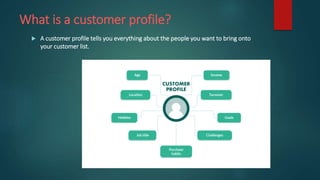
What is a customer profile?
 A customer profile tells you everything about the people you want to bring onto
your customer list.
 It includes common details they tend to share, such as
their:
• Age
• Location
• Hobbies
• Job title
• Income
• Purchasing habits
• Goals or motivations
• Challenges or pain points
 A B2B customer profile should also include the
firmographic data of their targets—such as their company
size, employee count, or annual turnover.
 Customer profiles are often referred to as buyer personas
or user profiles. Each term essentially means the same
thing: A single document that lists key demographics,
interests, and behaviors of your target customers.
Sources of Consumer information
Below are 7 key information sources that can help you build accurate
customer personas:
Customer Interviews
Trade Research organizations
Customer surveys
Marketing intelligence platforms
Online research panels
Internal experts
Outsourcing providers

Marketing Research.pptx

  • 1.
  • 2.
    Market research  “Marketresearch is defined as the process of evaluating the feasibility of a new product or service, through research conducted directly with potential consumers.”  Market research allows organizations or businesses to discover their target market, collect and document opinions and make informed decisions.  Market research can be conducted directly by organizations or companies or can be outsourced to agencies which have expertise in this process.
  • 3.
    Objectives if MarketResearch  Administrative: Help a company or business development, through proper planning, organization, and both human and material resources control, and thus satisfy all specific needs within the market, at the right time.  Social: Satisfy customer’s specific needs through a required product or service. The product or service should comply with the requirements and preferences of a customer when it’s consumed.  Economical: Determine the economical degree of success or failure a company can have while being new to the market, or otherwise introducing new products or services, and thus providing certainty to all actions to be implemented.
  • 4.
    Why is marketresearch important? 1. Valuable information: It provides information and opportunities about the value of existing and new products, thus, helping businesses plan and strategize accordingly. 2. Customer-centric: It helps to determine what the customers need and want. Marketing is customer-centric and understanding the customers and their needs will help businesses design products or services that best suit them. 3. Forecasts: By understanding the needs of customers, businesses can also forecast their production and sales. Market research also helps in determining optimum inventory stock. 4. Competitive advantage: To stay ahead of competitors market research is a vital tool to carry out comparative studies. Businesses can devise business strategies that can help them stay ahead of their competitors.
  • 5.
    Market Research Informationand Data There are two types of market research information: 1. Primary information 2. Secondary information Types of data collected through both primary and secondary sources can be: 1. Qualitative Data 2. Quantitative Data
  • 6.
    Sources of MarketResearch Data/Types of Market Research 1. Primary Market Research: Focus groups: Focus group is one of the commonly used qualitative research methods. Focus group is a small group of people (6-10) who typically respond to online surveys sent to them. The best part about focus group is the information can be collected remotely, can be done without personally interacting with the group members. However, this is a more expensive method as it is used to collect complex information. Feasibility Studies A feasibility study is a great market research option for businesses looking to open a new location or start a new business. Certainly, these are major undertakings for any organization, therefore it is important to make strategic and smart decisions with the help of unique, local data.
  • 7.
    Feasibility Study consistof 3 major components.  Syndicated research. Research first evaluates the demographic data among the specific community in which your new business or located will be marketed in. This helps us understand changing populations and supply and demand.  Competitive assessment. Who will be the biggest competition? What gaps are there in the market? What are the strengths and weaknesses of your top competitors? A competitive assessment with our Albany feasibility study company will help answer these important questions.  Market survey. The third component of a feasibility study highlights the potential appeal, barriers, and expected usage of your new business concept or location.
  • 8.
    One-to-one interview:  Asthe name suggests this method involves personal interaction in the form of an interview, where the researcher asks a series of questions to collect information or data from the respondents. The questions are mostly open ended questions and asked in a way to facilitate responses. Ethnographic research:  This type of in-depth research is conducted in the natural settings of the respondents. This method requires the interviewer to adapt himself/herself to the natural environment of the respondents which could be a city or a remote village. Ethnographic research can last from a few days to a few years.
  • 9.
    2. Secondary MarketResearch: i. Public sources: Public sources like library are an awesome way of gathering free information. Government libraries usually offer services free of cost and a researcher can document available information. ii. Commercial sources: Commercial source although reliable are expensive. Local newspapers, magazines, journal, television media are great commercial sources to collect information. iii. Educational Institutions: Although not a very popular source of collecting information, most universities and educational institutions are a rich source of information as many research projects are carried out there than any business sector.
  • 10.
    Factors investigated throughMarket Research  Market information  Market segmentation  Market trends  SWOT analysis  PEST analysis  Brand health tracking, and also  Advertisement research, Audience research, Competitor analysis, Customer analysis (Segmentation of target customers), Marketing mix modelling, Product research, Risk analysis, Simulated test marketing
  • 11.
    Steps for conductingMarket Research  Step #1: Define the Problem  Step #2: Define the Sample  Step #3: Carry out data collection  Step #4: Analyze the results  Step #5: Make the Research Report  Step #6: Make Decisions
  • 12.
    How to createyour market research plan 1. Conduct a comprehensive situation analysis 2. Develop clear marketing objectives 3. Make a financial plan. 4. Determine your target audience. 5. List your research methods. 6. Establish a timeline. 7. Acknowledge ethical concerns.
  • 13.
    Consumer Segmentation Geographic Segmentation -Regions, locality,city etc. Demographic Segmentation - Age, gender, income Psychographic Segmentation -Social class, lifestyle, personality characteristics Behavioural Segmentation -Occasion, user status, usage rate, loyality status
  • 14.
    Requirements for Effective Segmentation Measurable  Accessible  Substantial  Differentiable  Actionable
  • 15.
    Targeting Segments  DifferentiatedMarketing- target several markets and design several offers for each.  Undifferntiatiated – Mass Marketing  Concentrated Marketing-Niche  Micromarketing- Local and Individual Marketing
  • 16.
    What is acustomer profile?  A customer profile tells you everything about the people you want to bring onto your customer list.
  • 17.
     It includescommon details they tend to share, such as their: • Age • Location • Hobbies • Job title • Income • Purchasing habits • Goals or motivations • Challenges or pain points
  • 18.
     A B2Bcustomer profile should also include the firmographic data of their targets—such as their company size, employee count, or annual turnover.  Customer profiles are often referred to as buyer personas or user profiles. Each term essentially means the same thing: A single document that lists key demographics, interests, and behaviors of your target customers.
  • 19.
    Sources of Consumerinformation Below are 7 key information sources that can help you build accurate customer personas: Customer Interviews Trade Research organizations Customer surveys Marketing intelligence platforms Online research panels Internal experts Outsourcing providers