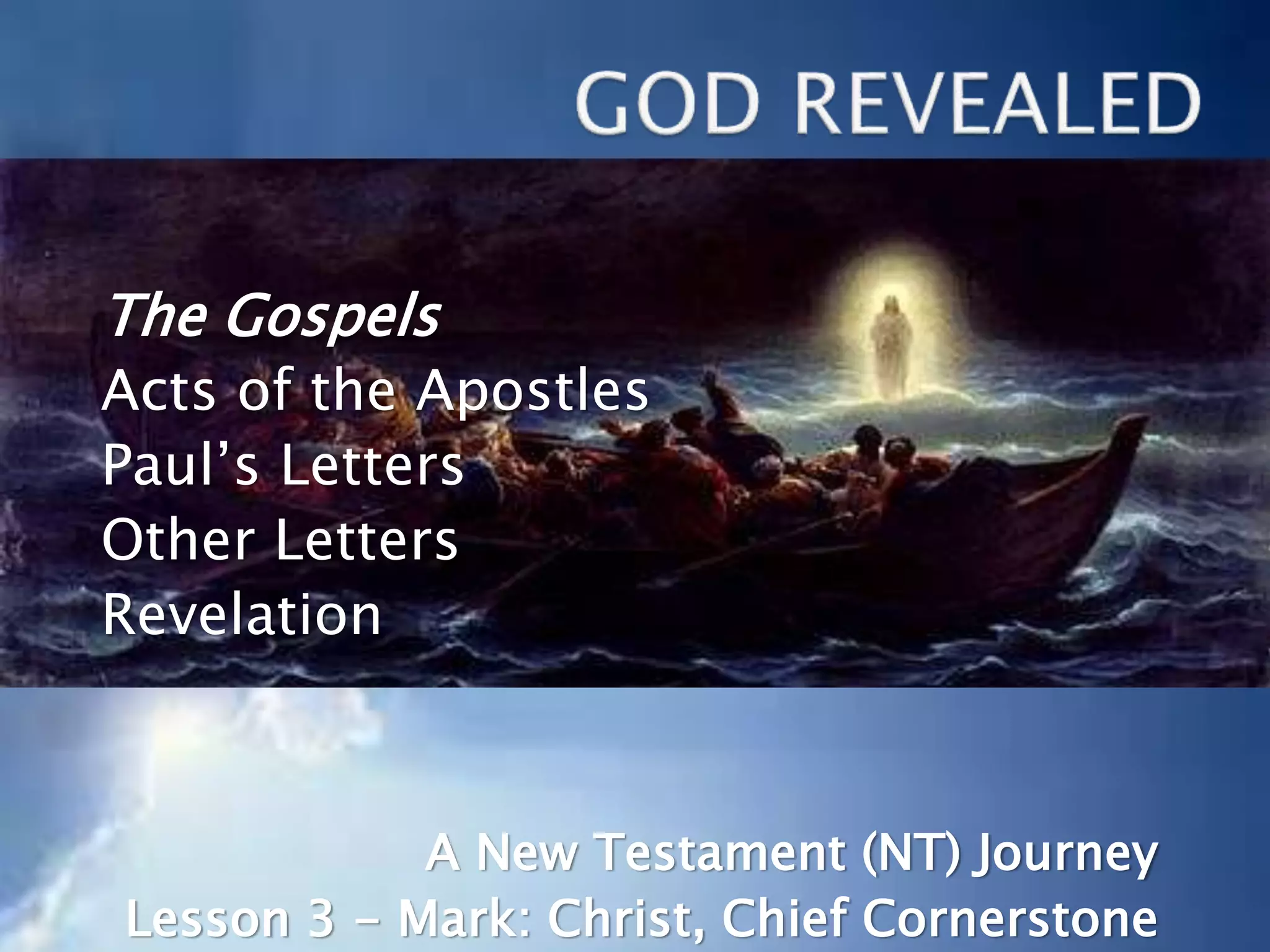
The Gospels
Acts of the Apostles
Paul’s Letters
Other Letters
Revelation
A New Testament (NT) Journey
Lesson 3 - Mark: Christ, Chief Cornerstone
 Matthew: God’s
Kingdom
 Mark: Christ, Chief
Cornerstone
 Luke: Son of Man
Seeks and Saves
 John: Life to the Full
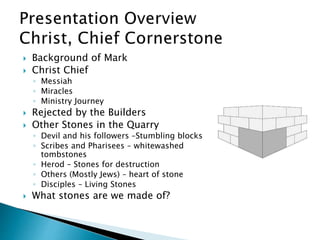
 Background of Mark
 Christ Chief
◦ Messiah
◦ Miracles
◦ Ministry Journey
 Rejected by the Builders
 Other Stones in the Quarry
◦ Devil and his followers –Stumbling blocks
◦ Scribes and Pharisees – whitewashed
tombstones
◦ Herod – Stones for destruction
◦ Others (Mostly Jews) – heart of stone
◦ Disciples – Living Stones
 What stones are we made of?
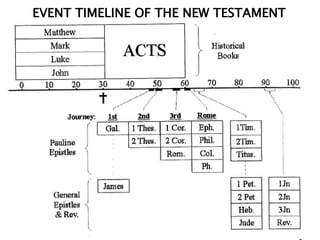
EVENT TIMELINE OF THE NEW TESTAMENT
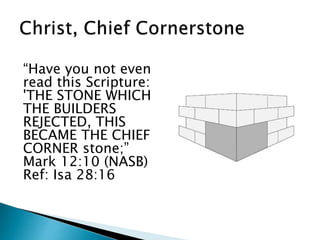
“Have you not even
read this Scripture:
'THE STONE WHICH
THE BUILDERS
REJECTED, THIS
BECAME THE CHIEF
CORNER stone;”
Mark 12:10 (NASB)
Ref: Isa 28:16
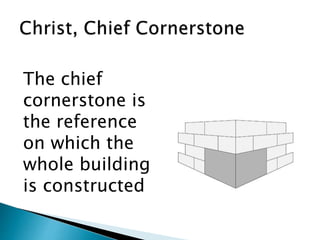
The chief
cornerstone is
the reference
on which the
whole building
is constructed
 Shortest of the synoptic gospels written
about 64 A.D.
 Author, John Mark who accompanied Paul and
Barnabas on their mission trips.
 Possibly written at the urging of Peter (his
companion in Rome), based on Peter’s first
hand experiences with Jesus.
 Written in Greek directed to the Gentiles. [1]
 Acknowledged Son of God by:
◦ Mark ( Mark 1:1)
◦ Holy Spirit at the baptism Mark
1:11
◦ God at the transfiguration Mark 9:7
◦ Peter at his confession Mark 8:11
◦ Demons Mark 5:7
◦ Himself before high priest Mark
14:61, etc.
 Interestingly, Christ always
addresses himself as Son of
Man, possibly, so as not to
aggravate religious leaders,
possibly also prophetically.
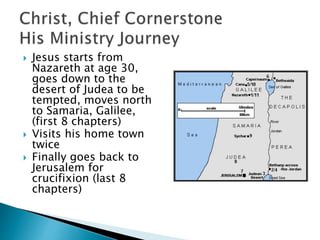
 Jesus starts from
Nazareth at age 30,
goes down to the
desert of Judea to be
tempted, moves north
to Samaria, Galilee,
(first 8 chapters)
 Visits his home town
twice
 Finally goes back to
Jerusalem for
crucifixion (last 8
chapters)
 27 miracles, far more
than other gospels.
 Power over the sea, the
dead, the demons, etc.
 The word “immediately”
is used often indicating
urgency, spontaneity
 Teaching is less, focus is
on activity.
 Dynamic display of
divine power, met
with great opposition.
 Source - Jewish
religious leaders
 Opposition covers a
bulk of the gospel.
 Apt responses from
Christ hoping to win
over stony hearted.
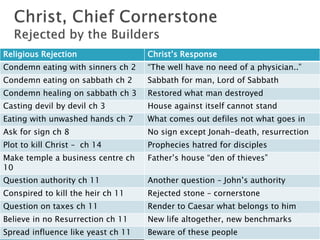
Religious Rejection Christ’s Response
Condemn eating with sinners ch 2 “The well have no need of a physician..”
Condemn eating on sabbath ch 2 Sabbath for man, Lord of Sabbath
Condemn healing on sabbath ch 3 Restored what man destroyed
Casting devil by devil ch 3 House against itself cannot stand
Eating with unwashed hands ch 7 What comes out defiles not what goes in
Ask for sign ch 8 No sign except Jonah-death, resurrection
Plot to kill Christ – ch 14 Prophecies hatred for disciples
Make temple a business centre ch
10
Father’s house “den of thieves”
Question authority ch 11 Another question – John’s authority
Conspired to kill the heir ch 11 Rejected stone – cornerstone
Question on taxes ch 11 Render to Caesar what belongs to him
Believe in no Resurrection ch 11 New life altogether, new benchmarks
Spread influence like yeast ch 11 Beware of these people
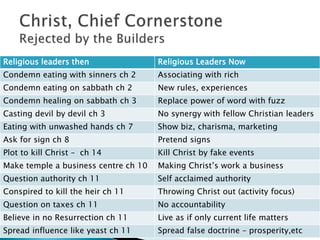
Religious leaders then Religious Leaders Now
Condemn eating with sinners ch 2 Associating with rich
Condemn eating on sabbath ch 2 New rules, experiences
Condemn healing on sabbath ch 3 Replace power of word with fuzz
Casting devil by devil ch 3 No synergy with fellow Christian leaders
Eating with unwashed hands ch 7 Show biz, charisma, marketing
Ask for sign ch 8 Pretend signs
Plot to kill Christ – ch 14 Kill Christ by fake events
Make temple a business centre ch 10 Making Christ’s work a business
Question authority ch 11 Self acclaimed authority
Conspired to kill the heir ch 11 Throwing Christ out (activity focus)
Question on taxes ch 11 No accountability
Believe in no Resurrection ch 11 Live as if only current life matters
Spread influence like yeast ch 11 Spread false doctrine – prosperity,etc
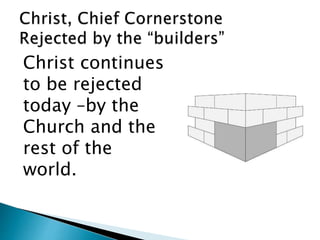
Christ continues
to be rejected
today –by the
Church and the
rest of the
world.
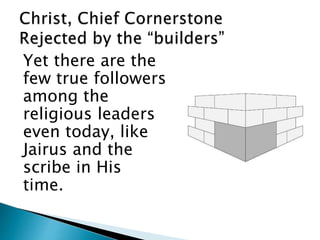
Yet there are the
few true followers
among the
religious leaders
even today, like
Jairus and the
scribe in His
time.
In His time as now, Christ was accepted by the few
true seekers from all walks of life
 Scribe (who asked greatest commandment)
 Centurian (a Roman)
 Jarius the Jew
 Samaritan – crumbs
 Leper
 paralytic (historically, the Roman leader second
most powerful in world)
 Disciples
Note: From the ministry journey and reach, Jesus
reached Jerusalem, Judea, Samaria and uttermost
parts of the world – as He calls us too.
 What caused the intense blindness of
religious leaders (then and now)?
 How are we in danger of partial blindness
based on same causes?
 What attitudes do we see in the sincere
followers in Christ’s time that we can
emulate?
 Satan and his followers –millstones around
the neck; Lk 17:2, Mk 9:42
 Scribes and Pharisees – whitewashed
tombstones – Matt 23:27, Mk 7:15
 Herod – Stones of destruction – Luke 18:41-
44, Mk 13:2
 Others (mostly Jews) – heart of stone – Ezek
11:19
 Disciples – Living Stones – 1 Peter 2:5
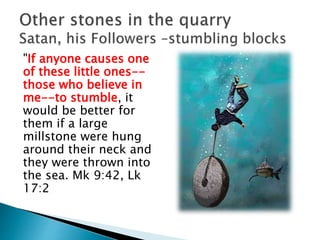
"If anyone causes one
of these little ones--
those who believe in
me--to stumble, it
would be better for
them if a large
millstone were hung
around their neck and
they were thrown into
the sea. Mk 9:42, Lk
17:2
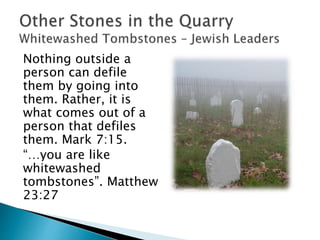
Nothing outside a
person can defile
them by going into
them. Rather, it is
what comes out of a
person that defiles
them. Mark 7:15.
“…you are like
whitewashed
tombstones”. Matthew
23:27
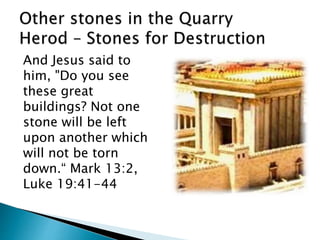
And Jesus said to
him, "Do you see
these great
buildings? Not one
stone will be left
upon another which
will not be torn
down.“ Mark 13:2,
Luke 19:41-44
Stones of the Temple
built by Herod weighed
between few tons to
160,000 pounds. They
were heaved 50 feet
over the Western
support wall onto the
street below, during
the destruction of the
Temple by the Romans
on August 10, 70 AD.
[2]
Soldiers set the fire to
Herod’s Temple. To
recover the gold that
melted between the
stones, they pried
every block apart and
literally left not one
stone on another [2]
as Jesus had
prophesied
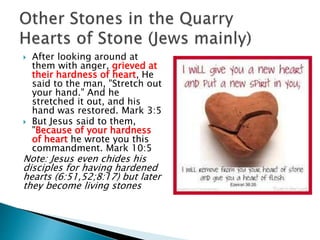
 After looking around at
them with anger, grieved at
their hardness of heart, He
said to the man, "Stretch out
your hand." And he
stretched it out, and his
hand was restored. Mark 3:5
 But Jesus said to them,
"Because of your hardness
of heart he wrote you this
commandment. Mark 10:5
Note: Jesus even chides his
disciples for having hardened
hearts (6:51,52;8:17) but later
they become living stones
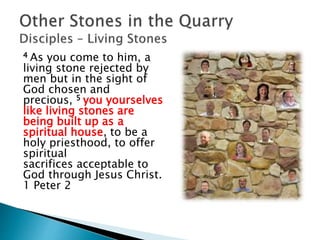
4 As you come to him, a
living stone rejected by
men but in the sight of
God chosen and
precious, 5 you yourselves
like living stones are
being built up as a
spiritual house, to be a
holy priesthood, to offer
spiritual
sacrifices acceptable to
God through Jesus Christ.
1 Peter 2
 In what ways can we behave like
whitewashed tombstone, stones of
destruction or have a heart of stone even as
Christians?
 What steps can we take to increase our
composition to be living stones?
 As Christ’s living stones, what can we
expect living as His disciple?
1. Biblehub.com
2. http://www.egrc.net/articles/Rock/Land_L
essons/StonesDestruction.html

Mark - Christ, Chief Cornerstone v. 2

  • 1.
    The Gospels Acts ofthe Apostles Paul’s Letters Other Letters Revelation A New Testament (NT) Journey Lesson 3 - Mark: Christ, Chief Cornerstone
  • 2.
     Matthew: God’s Kingdom Mark: Christ, Chief Cornerstone  Luke: Son of Man Seeks and Saves  John: Life to the Full
  • 3.
     Background ofMark  Christ Chief ◦ Messiah ◦ Miracles ◦ Ministry Journey  Rejected by the Builders  Other Stones in the Quarry ◦ Devil and his followers –Stumbling blocks ◦ Scribes and Pharisees – whitewashed tombstones ◦ Herod – Stones for destruction ◦ Others (Mostly Jews) – heart of stone ◦ Disciples – Living Stones  What stones are we made of?
  • 4.
    EVENT TIMELINE OFTHE NEW TESTAMENT
  • 5.
    “Have you noteven read this Scripture: 'THE STONE WHICH THE BUILDERS REJECTED, THIS BECAME THE CHIEF CORNER stone;” Mark 12:10 (NASB) Ref: Isa 28:16
  • 6.
    The chief cornerstone is thereference on which the whole building is constructed
  • 7.
     Shortest ofthe synoptic gospels written about 64 A.D.  Author, John Mark who accompanied Paul and Barnabas on their mission trips.  Possibly written at the urging of Peter (his companion in Rome), based on Peter’s first hand experiences with Jesus.  Written in Greek directed to the Gentiles. [1]
  • 8.
     Acknowledged Sonof God by: ◦ Mark ( Mark 1:1) ◦ Holy Spirit at the baptism Mark 1:11 ◦ God at the transfiguration Mark 9:7 ◦ Peter at his confession Mark 8:11 ◦ Demons Mark 5:7 ◦ Himself before high priest Mark 14:61, etc.  Interestingly, Christ always addresses himself as Son of Man, possibly, so as not to aggravate religious leaders, possibly also prophetically.
  • 9.
     Jesus startsfrom Nazareth at age 30, goes down to the desert of Judea to be tempted, moves north to Samaria, Galilee, (first 8 chapters)  Visits his home town twice  Finally goes back to Jerusalem for crucifixion (last 8 chapters)
  • 10.
     27 miracles,far more than other gospels.  Power over the sea, the dead, the demons, etc.  The word “immediately” is used often indicating urgency, spontaneity  Teaching is less, focus is on activity.
  • 11.
     Dynamic displayof divine power, met with great opposition.  Source - Jewish religious leaders  Opposition covers a bulk of the gospel.  Apt responses from Christ hoping to win over stony hearted.
  • 12.
    Religious Rejection Christ’sResponse Condemn eating with sinners ch 2 “The well have no need of a physician..” Condemn eating on sabbath ch 2 Sabbath for man, Lord of Sabbath Condemn healing on sabbath ch 3 Restored what man destroyed Casting devil by devil ch 3 House against itself cannot stand Eating with unwashed hands ch 7 What comes out defiles not what goes in Ask for sign ch 8 No sign except Jonah-death, resurrection Plot to kill Christ – ch 14 Prophecies hatred for disciples Make temple a business centre ch 10 Father’s house “den of thieves” Question authority ch 11 Another question – John’s authority Conspired to kill the heir ch 11 Rejected stone – cornerstone Question on taxes ch 11 Render to Caesar what belongs to him Believe in no Resurrection ch 11 New life altogether, new benchmarks Spread influence like yeast ch 11 Beware of these people
  • 13.
    Religious leaders thenReligious Leaders Now Condemn eating with sinners ch 2 Associating with rich Condemn eating on sabbath ch 2 New rules, experiences Condemn healing on sabbath ch 3 Replace power of word with fuzz Casting devil by devil ch 3 No synergy with fellow Christian leaders Eating with unwashed hands ch 7 Show biz, charisma, marketing Ask for sign ch 8 Pretend signs Plot to kill Christ – ch 14 Kill Christ by fake events Make temple a business centre ch 10 Making Christ’s work a business Question authority ch 11 Self acclaimed authority Conspired to kill the heir ch 11 Throwing Christ out (activity focus) Question on taxes ch 11 No accountability Believe in no Resurrection ch 11 Live as if only current life matters Spread influence like yeast ch 11 Spread false doctrine – prosperity,etc
  • 14.
    Christ continues to berejected today –by the Church and the rest of the world.
  • 15.
    Yet there arethe few true followers among the religious leaders even today, like Jairus and the scribe in His time.
  • 16.
    In His timeas now, Christ was accepted by the few true seekers from all walks of life  Scribe (who asked greatest commandment)  Centurian (a Roman)  Jarius the Jew  Samaritan – crumbs  Leper  paralytic (historically, the Roman leader second most powerful in world)  Disciples Note: From the ministry journey and reach, Jesus reached Jerusalem, Judea, Samaria and uttermost parts of the world – as He calls us too.
  • 17.
     What causedthe intense blindness of religious leaders (then and now)?  How are we in danger of partial blindness based on same causes?  What attitudes do we see in the sincere followers in Christ’s time that we can emulate?
  • 18.
     Satan andhis followers –millstones around the neck; Lk 17:2, Mk 9:42  Scribes and Pharisees – whitewashed tombstones – Matt 23:27, Mk 7:15  Herod – Stones of destruction – Luke 18:41- 44, Mk 13:2  Others (mostly Jews) – heart of stone – Ezek 11:19  Disciples – Living Stones – 1 Peter 2:5
  • 19.
    "If anyone causesone of these little ones-- those who believe in me--to stumble, it would be better for them if a large millstone were hung around their neck and they were thrown into the sea. Mk 9:42, Lk 17:2
  • 20.
    Nothing outside a personcan defile them by going into them. Rather, it is what comes out of a person that defiles them. Mark 7:15. “…you are like whitewashed tombstones”. Matthew 23:27
  • 21.
    And Jesus saidto him, "Do you see these great buildings? Not one stone will be left upon another which will not be torn down.“ Mark 13:2, Luke 19:41-44
  • 22.
    Stones of theTemple built by Herod weighed between few tons to 160,000 pounds. They were heaved 50 feet over the Western support wall onto the street below, during the destruction of the Temple by the Romans on August 10, 70 AD. [2]
  • 23.
    Soldiers set thefire to Herod’s Temple. To recover the gold that melted between the stones, they pried every block apart and literally left not one stone on another [2] as Jesus had prophesied
  • 24.
     After lookingaround at them with anger, grieved at their hardness of heart, He said to the man, "Stretch out your hand." And he stretched it out, and his hand was restored. Mark 3:5  But Jesus said to them, "Because of your hardness of heart he wrote you this commandment. Mark 10:5 Note: Jesus even chides his disciples for having hardened hearts (6:51,52;8:17) but later they become living stones
  • 25.
    4 As youcome to him, a living stone rejected by men but in the sight of God chosen and precious, 5 you yourselves like living stones are being built up as a spiritual house, to be a holy priesthood, to offer spiritual sacrifices acceptable to God through Jesus Christ. 1 Peter 2
  • 26.
     In whatways can we behave like whitewashed tombstone, stones of destruction or have a heart of stone even as Christians?  What steps can we take to increase our composition to be living stones?  As Christ’s living stones, what can we expect living as His disciple?
  • 27.

Editor's Notes

  • #8 Synoptic gospels are Matthew, Mark and Luke
  • #9 Daniel refers to jesus as son of man
  • #12 Pharisees, Scribes and Saducees. (The “Far u see and the Sad u see”)
  • #21 "Woe to you, scribes and Pharisees, hypocrites! For you are like whitewashed tombs which on the outside appear beautiful, but inside they are full of dead men's bones and all uncleanness. Matt 23:27
  • #22 "When He approached Jerusalem, He saw the city and wept over it, saying, 'If you had known in this day, even you, the things which make for peace! But now they have been hidden from your eyes. For the days will come upon you when your enemies will throw up a barricade against you, and surround you and hem you in on every side, and they will level you to the ground and your children within you, and they will not leave in you one stone upon another, because you did not recognize the time of your visitation.'" Luke 19:41-44