By Marc Garcia
About the Diamond
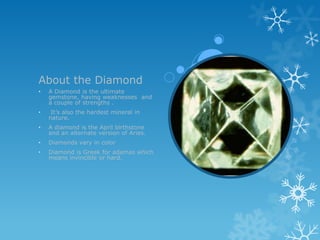
•   A Diamond is the ultimate
    gemstone, having weaknesses and
    a couple of strengths .
•    It’s also the hardest mineral in
    nature.
•   A diamond is the April birthstone
    and an alternate version of Aries.
•   Diamonds vary in color
•   Diamond is Greek for adamas which
    means invincible or hard.
More about the
diamond
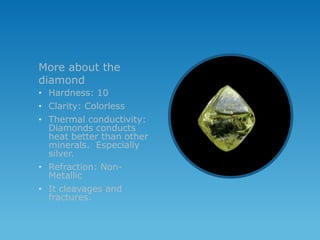
• Hardness: 10
• Clarity: Colorless
• Thermal conductivity:
  Diamonds conducts
  heat better than other
  minerals. Especially
  silver.
• Refraction: Non-
  Metallic
• It cleavages and
  fractures.
Where Diamonds
came from?
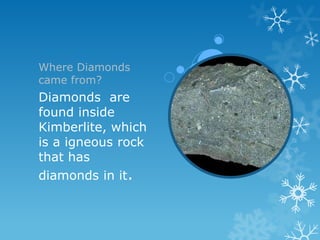
Diamonds are
found inside
Kimberlite, which
is a igneous rock
that has
diamonds in it.
Diamond Colors
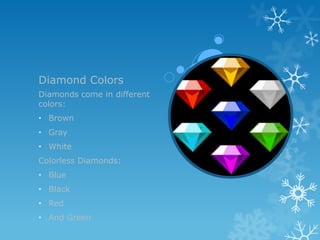
Diamonds come in different
colors:
• Brown
• Gray
• White
Colorless Diamonds:
• Blue
• Black
• Red
• And Green
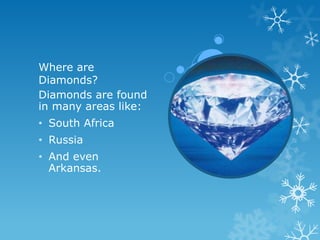
Where are
Diamonds?
Diamonds are found
in many areas like:
• South Africa
• Russia
• And even
  Arkansas.
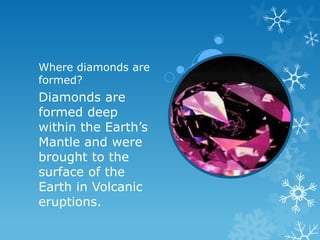
Where diamonds are
formed?
Diamonds are
formed deep
within the Earth’s
Mantle and were
brought to the
surface of the
Earth in Volcanic
eruptions.
Uses for Diamonds
The uses of diamonds are:

• Diamond Windows
• Diamond Speaker
  domes
• Heat Sinks
• Microchips
• Diamond Saws
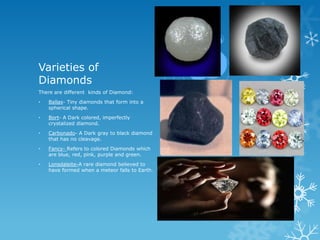
Varieties of
Diamonds
There are different kinds of Diamond:
•   Ballas- Tiny diamonds that form into a
    spherical shape.
•   Bort- A Dark colored, imperfectly
    crystalized diamond.
•   Carbonado- A Dark gray to black diamond
    that has no cleavage.
•   Fancy- Refers to colored Diamonds which
    are blue, red, pink, purple and green.
•   Lonsdaleite-A rare diamond believed to
    have formed when a meteor falls to Earth.
The End!!!!

Marc garcia diamonds

  • 1.
  • 2.
    About the Diamond • A Diamond is the ultimate gemstone, having weaknesses and a couple of strengths . • It’s also the hardest mineral in nature. • A diamond is the April birthstone and an alternate version of Aries. • Diamonds vary in color • Diamond is Greek for adamas which means invincible or hard.
  • 3.
    More about the diamond •Hardness: 10 • Clarity: Colorless • Thermal conductivity: Diamonds conducts heat better than other minerals. Especially silver. • Refraction: Non- Metallic • It cleavages and fractures.
  • 4.
    Where Diamonds came from? Diamondsare found inside Kimberlite, which is a igneous rock that has diamonds in it.
  • 5.
    Diamond Colors Diamonds comein different colors: • Brown • Gray • White Colorless Diamonds: • Blue • Black • Red • And Green
  • 6.
    Where are Diamonds? Diamonds arefound in many areas like: • South Africa • Russia • And even Arkansas.
  • 7.
    Where diamonds are formed? Diamondsare formed deep within the Earth’s Mantle and were brought to the surface of the Earth in Volcanic eruptions.
  • 8.
    Uses for Diamonds Theuses of diamonds are: • Diamond Windows • Diamond Speaker domes • Heat Sinks • Microchips • Diamond Saws
  • 9.
    Varieties of Diamonds There aredifferent kinds of Diamond: • Ballas- Tiny diamonds that form into a spherical shape. • Bort- A Dark colored, imperfectly crystalized diamond. • Carbonado- A Dark gray to black diamond that has no cleavage. • Fancy- Refers to colored Diamonds which are blue, red, pink, purple and green. • Lonsdaleite-A rare diamond believed to have formed when a meteor falls to Earth.
  • 10.