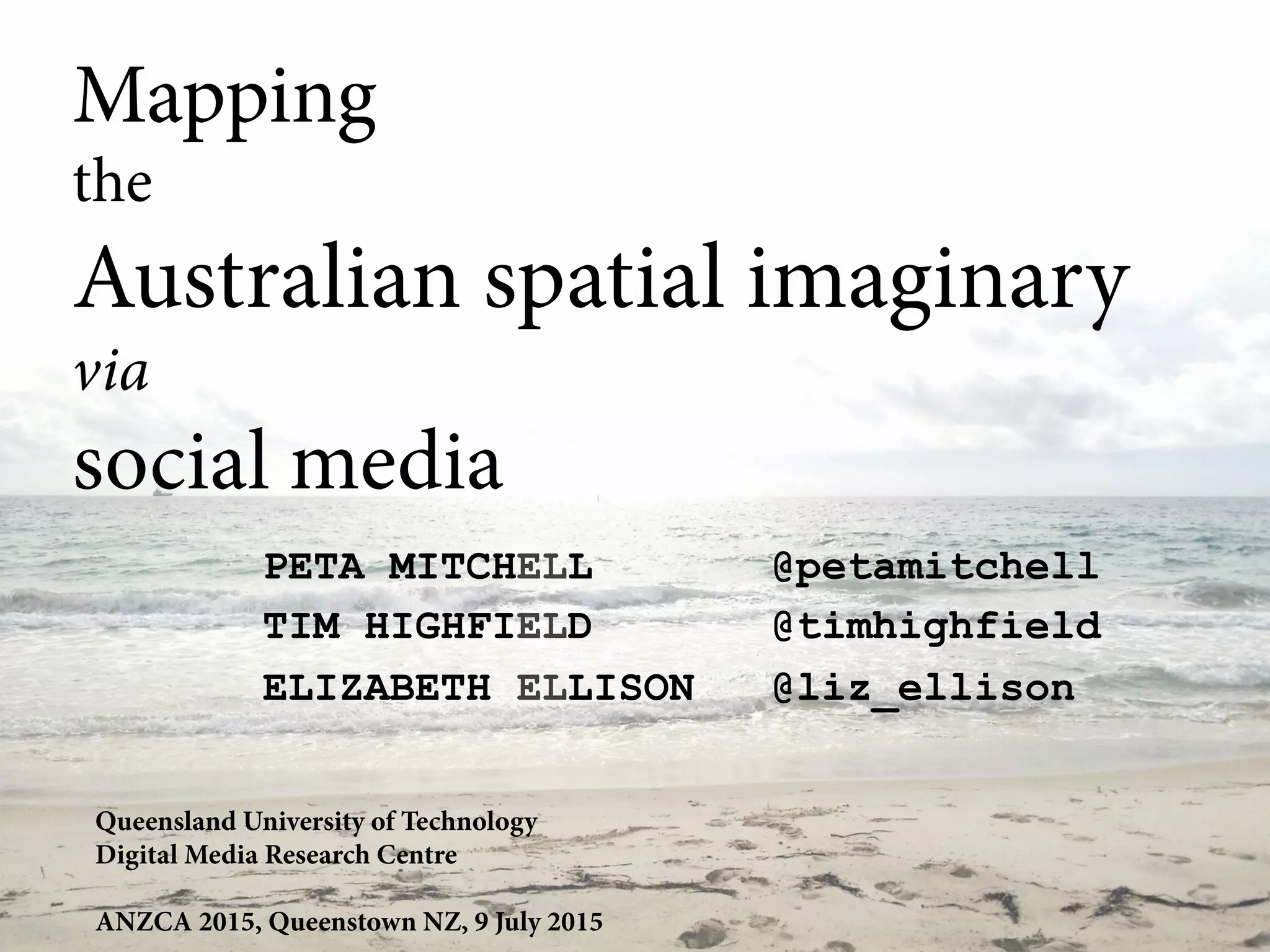
Mapping
the
Australian spatial imaginary
via
social media
PETA MITCHELL @petamitchell
TIM HIGHFIELD @timhighfield
ELIZABETH ELLISON @liz_ellison
Queensland University of Technology
Digital Media Research Centre
ANZCA 2015, Queenstown NZ, 9 July 2015
Overview
This is a position paper, setting out our aims and rationale for
a project that brings together cultural studies, digital
methods, social and digital media, and cultural
geography…
Our proposal brings into dialogue two areas of research that
have to date had little or nothing to say to one another,
namely social media research and the branch of Australian
studies typified by its focus on spatial enquiry
Mapping the Australian spatial imaginary via social media | ANZCA 2015, Queenstown NZ, 9 July 2015
@petamitchell + @timhighfield + @liz_ellison 02
Aims + rationale
The project builds on the premise that georeferenced social
media data constitute ‘spatial stories’:
acutely involved in place-making through tweets,
Instagram posts, and other place-related online activity
The enacting of the Australian spatial imaginary through
social media: moving beyond ‘iconic’, distinctive, or singular
narratives within national imaginary to socially mediated
micronarratives of space that contribute to a socially
mediated spatial imaginary
Mapping the Australian spatial imaginary via social media | ANZCA 2015, Queenstown NZ, 9 July 2015
@petamitchell + @timhighfield + @liz_ellison 03
Representing space/place
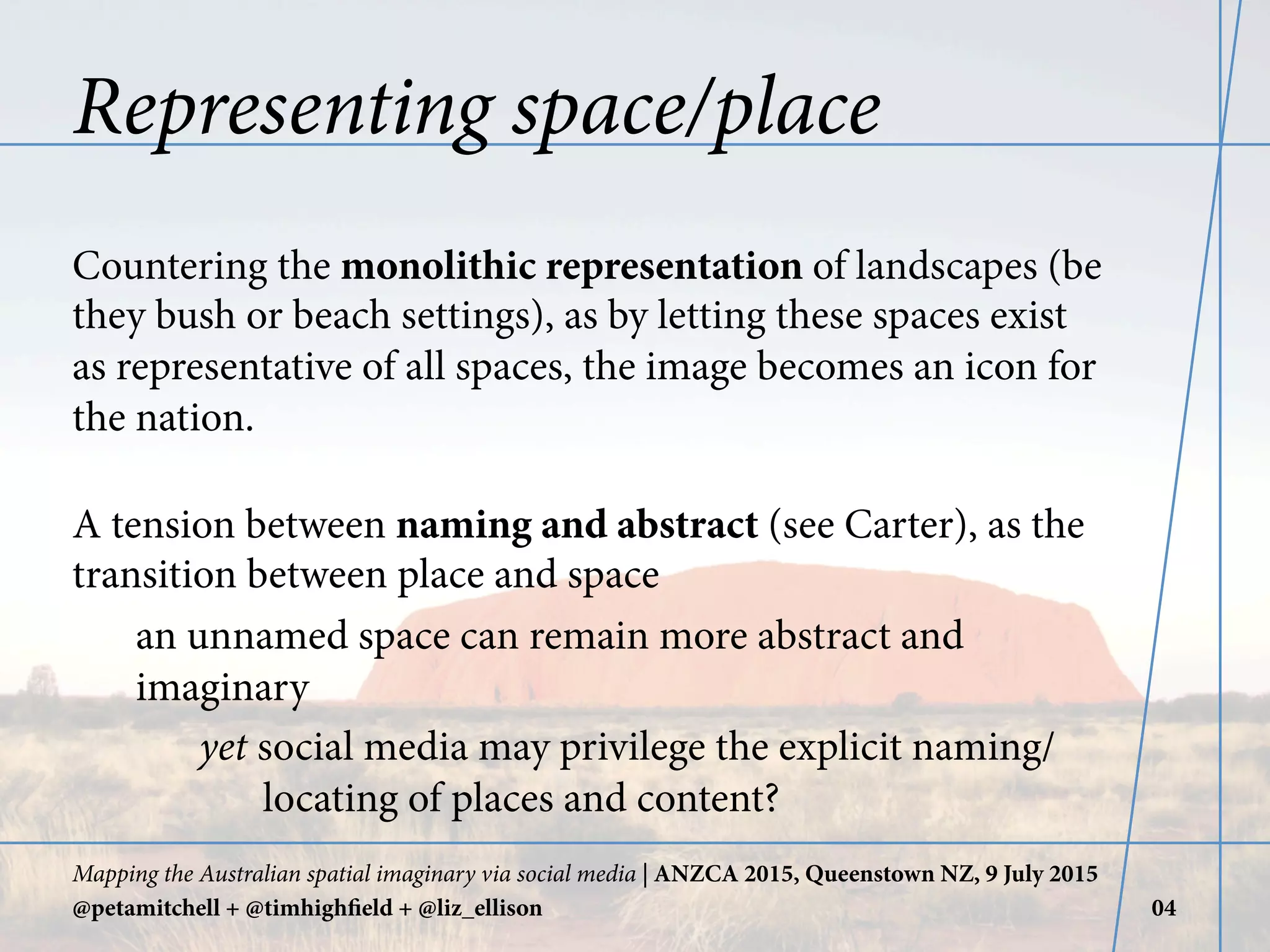
Countering the monolithic representation of landscapes (be
they bush or beach settings), as by letting these spaces exist
as representative of all spaces, the image becomes an icon for
the nation.
A tension between naming and abstract (see Carter), as the
transition between place and space
an unnamed space can remain more abstract and
imaginary
yet social media may privilege the explicit naming/
locating of places and content?
Mapping the Australian spatial imaginary via social media | ANZCA 2015, Queenstown NZ, 9 July 2015
@petamitchell + @timhighfield + @liz_ellison 04
Representing space/place
Looking beyond the myths and tropes, our aim is to
challenge these abstract spaces as identified in, for example,
tourist representations, instead trying to capture the more
‘expressive’ places.
Our work is located in the everyday or ordinary, rather than
the mythic;
the difference between the perceived and conceived and
the lived spaces
Mapping the Australian spatial imaginary via social media | ANZCA 2015, Queenstown NZ, 9 July 2015
@petamitchell + @timhighfield + @liz_ellison 05
The spatial turn(s)
Research into mediated representations of Australian space
has focused on narrative, fictional, or aesthetic texts or has
taken a ‘spatial history’ approach to examine the cultural
construction of Australian regional or national space
This body of research is both evidence of and a continuing
response to the ‘spatial turn’ noted by Edward Soja and
Fredric Jameson in the late 1980s and early 1990s
(a movement that Australian spatial studies was at the
forefront of).
Mapping the Australian spatial imaginary via social media | ANZCA 2015, Queenstown NZ, 9 July 2015
@petamitchell + @timhighfield + @liz_ellison 06
Geosocial media
A more recent second—digital—spatial turn, particularly
evident in the rise of ‘geosocial’ media.
Locative media, platforms and services shaping experience
of place (e.g. Foursquare), geodata within everyday social
media
Ambient geographic information (Stefanidis, Crooks, and
Radzikowski, 2013), as distinct from volunteered geographic
information and crowdsourced (and explicit) geosocial
content.
Mapping the Australian spatial imaginary via social media | ANZCA 2015, Queenstown NZ, 9 July 2015
@petamitchell + @timhighfield + @liz_ellison 07
Methods + platforms
TrISMA: Tracking Infrastructure for Social Media in Australia
(ARC LIEF, 2014-2015)
Treating everyday social media as ‘geosocial’ (but with limits)
Twitter
Tags, keywords, geolocation (limited) – filtering posts from
Australian users
Instagram
Tags, geolocation (higher percentage of location data in
Instagram media)
Mapping the Australian spatial imaginary via social media | ANZCA 2015, Queenstown NZ, 9 July 2015
@petamitchell + @timhighfield + @liz_ellison 08
Pilot: G20 on Twitter
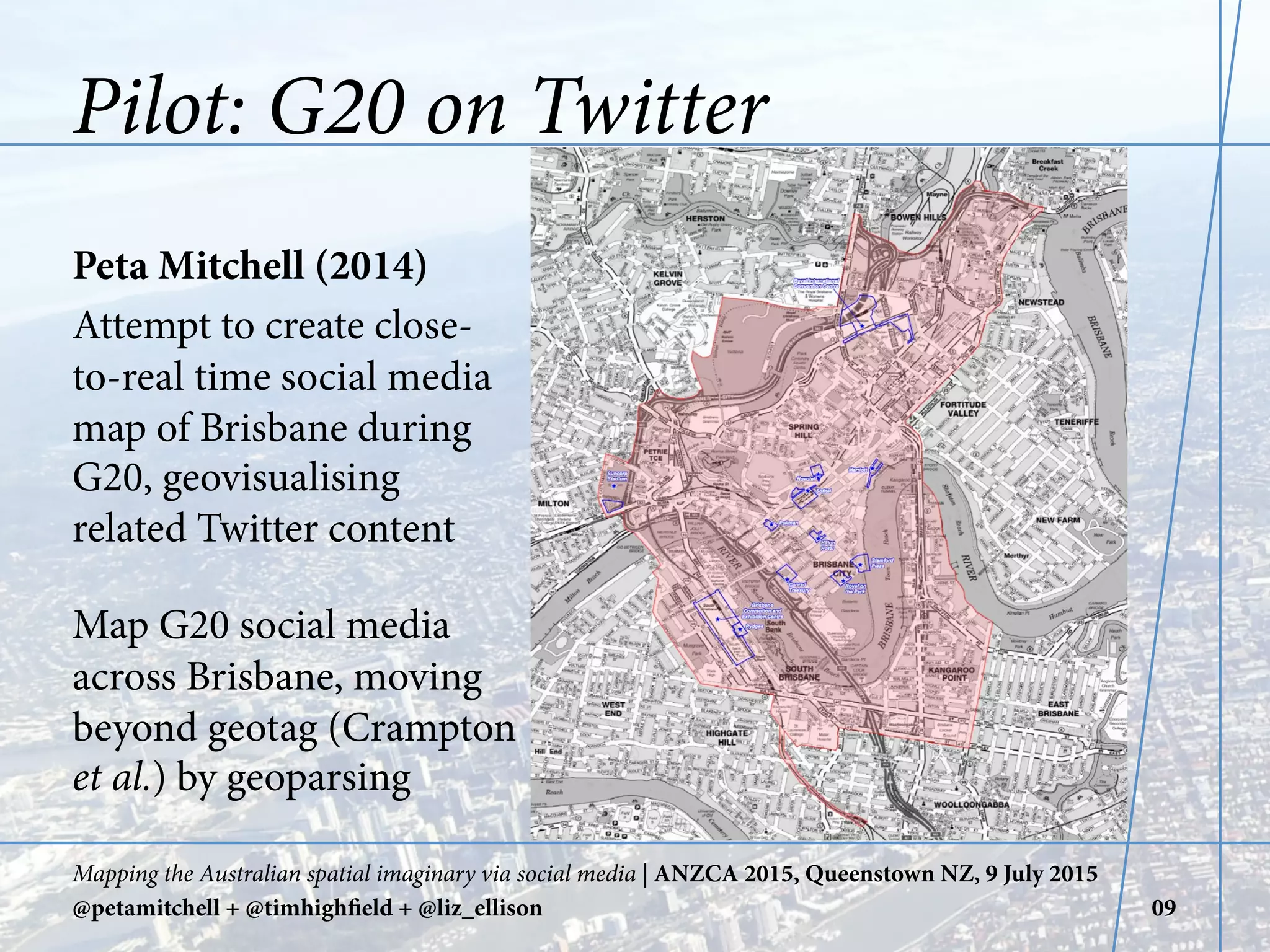
Peta Mitchell (2014)
Attempt to create close-
to-real time social media
map of Brisbane during
G20, geovisualising
related Twitter content
Map G20 social media
across Brisbane, moving
beyond geotag (Crampton
et al.) by geoparsing
Mapping the Australian spatial imaginary via social media | ANZCA 2015, Queenstown NZ, 9 July 2015
@petamitchell + @timhighfield + @liz_ellison 09
Pilot: G20 on Twitter
Mapping the Australian spatial imaginary via social media | ANZCA 2015, Queenstown NZ, 9 July 2015
@petamitchell + @timhighfield + @liz_ellison 10
Pilot: G20 on Twitter
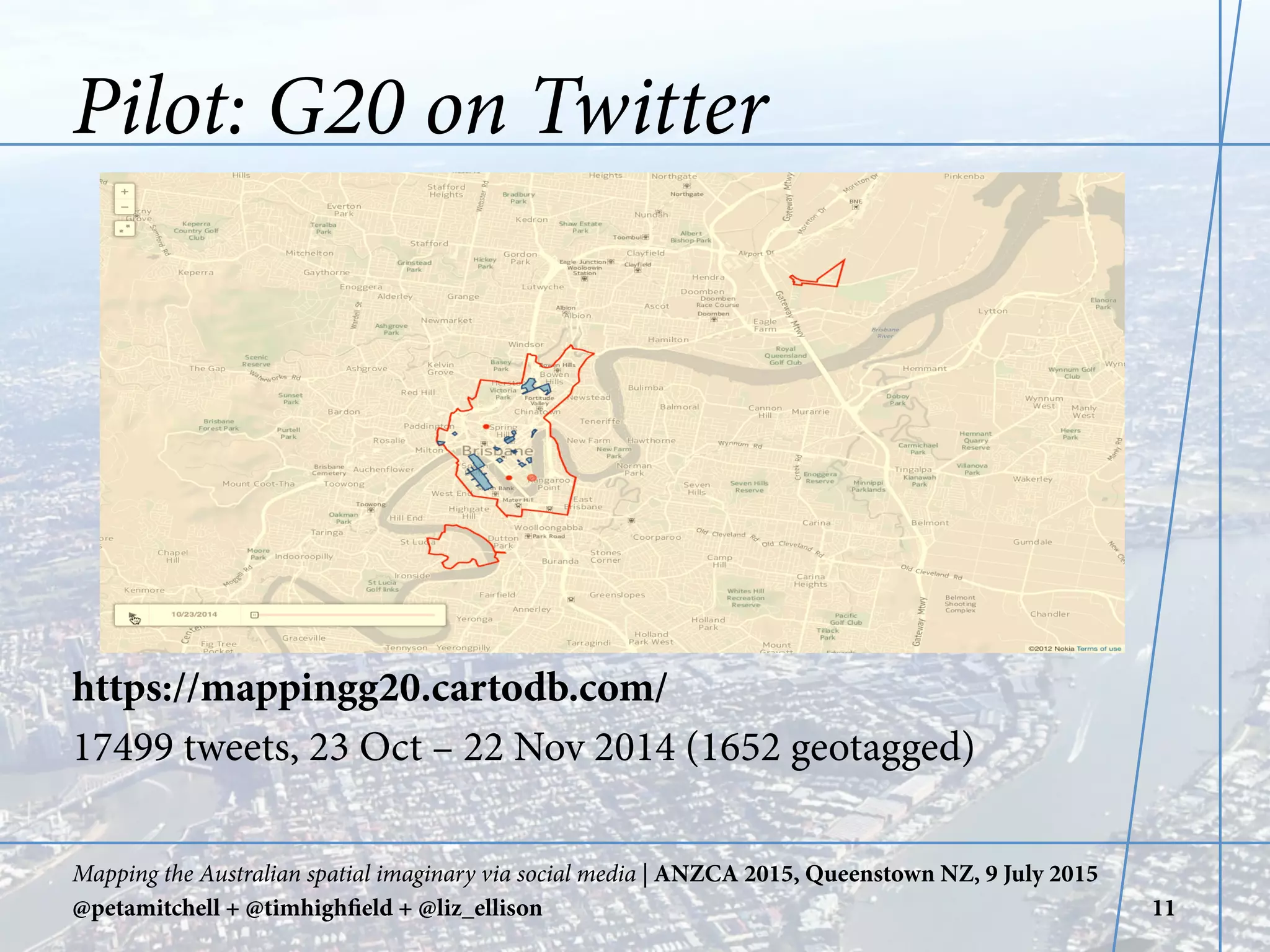
https://mappingg20.cartodb.com/
17499 tweets, 23 Oct – 22 Nov 2014 (1652 geotagged)
Mapping the Australian spatial imaginary via social media | ANZCA 2015, Queenstown NZ, 9 July 2015
@petamitchell + @timhighfield + @liz_ellison 11


Pilot: #thisisqueensland
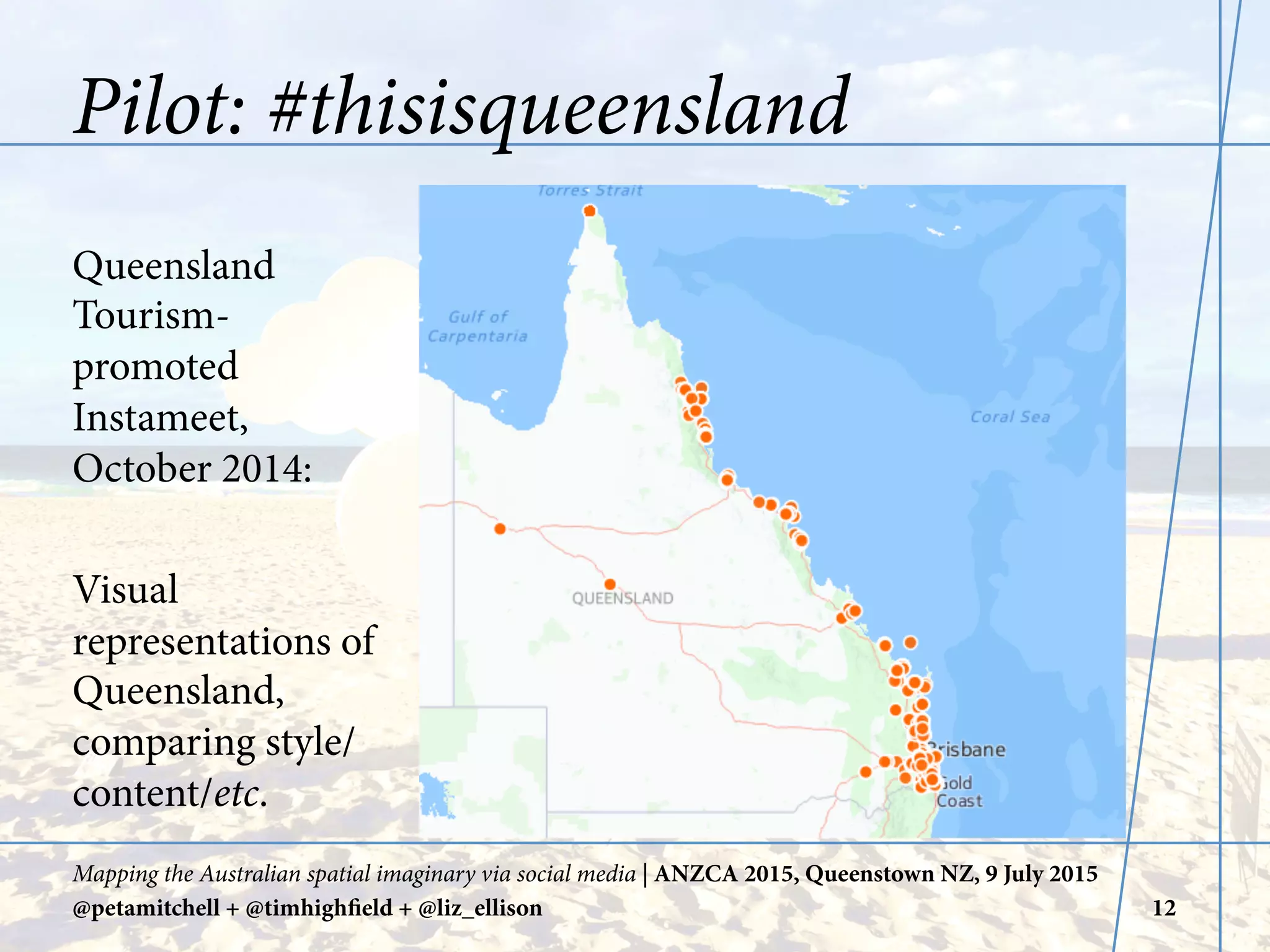
Queensland
Tourism-
promoted
Instameet,
October 2014:
Visual
representations of
Queensland,
comparing style/
content/etc.
Mapping the Australian spatial imaginary via social media | ANZCA 2015, Queenstown NZ, 9 July 2015
@petamitchell + @timhighfield + @liz_ellison 12
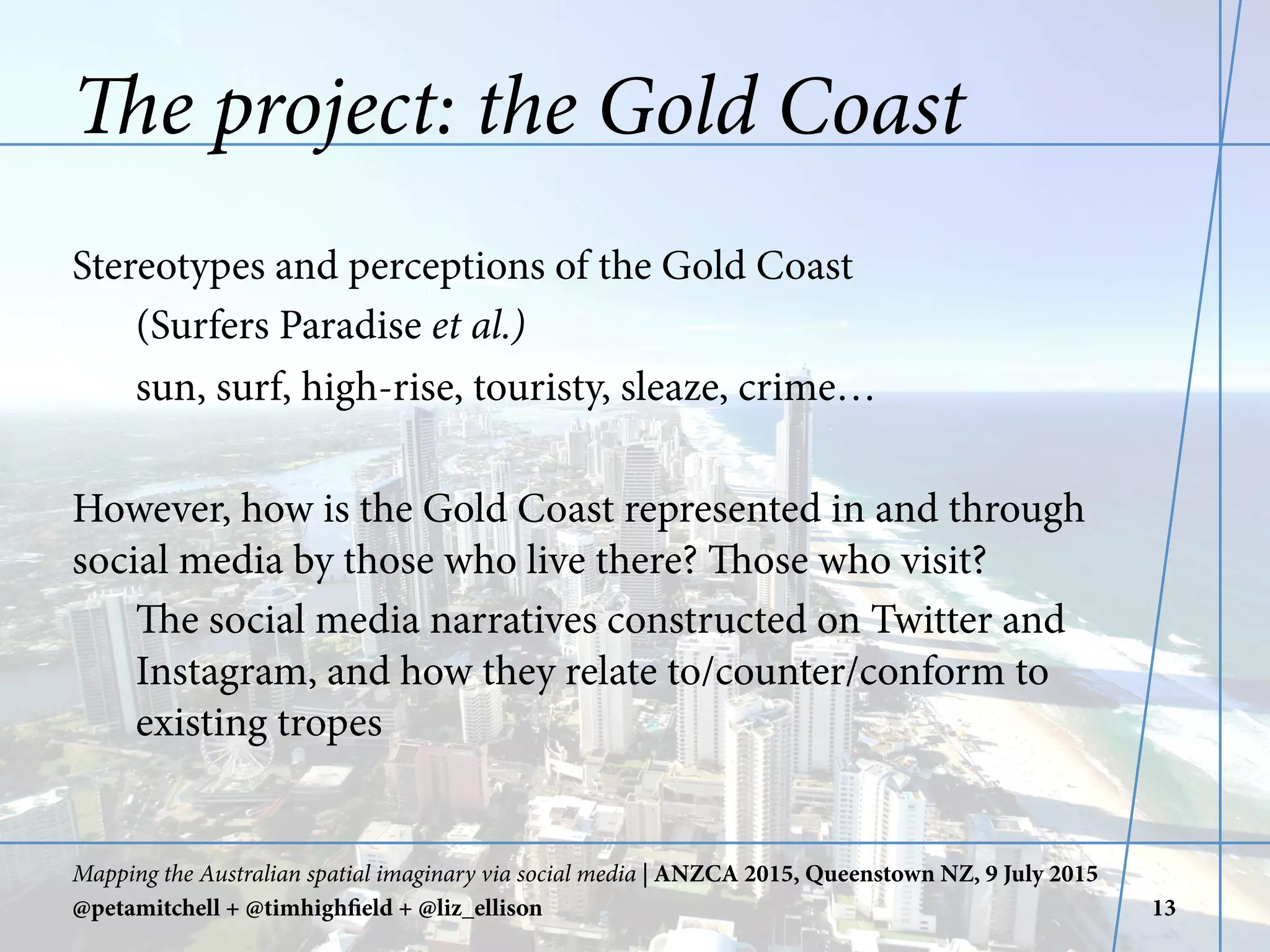
The project: the Gold Coast
Stereotypes and perceptions of the Gold Coast
(Surfers Paradise et al.)
sun, surf, high-rise, touristy, sleaze, crime…
However, how is the Gold Coast represented in and through
social media by those who live there? Those who visit?
The social media narratives constructed on Twitter and
Instagram, and how they relate to/counter/conform to
existing tropes
Mapping the Australian spatial imaginary via social media | ANZCA 2015, Queenstown NZ, 9 July 2015
@petamitchell + @timhighfield + @liz_ellison 13
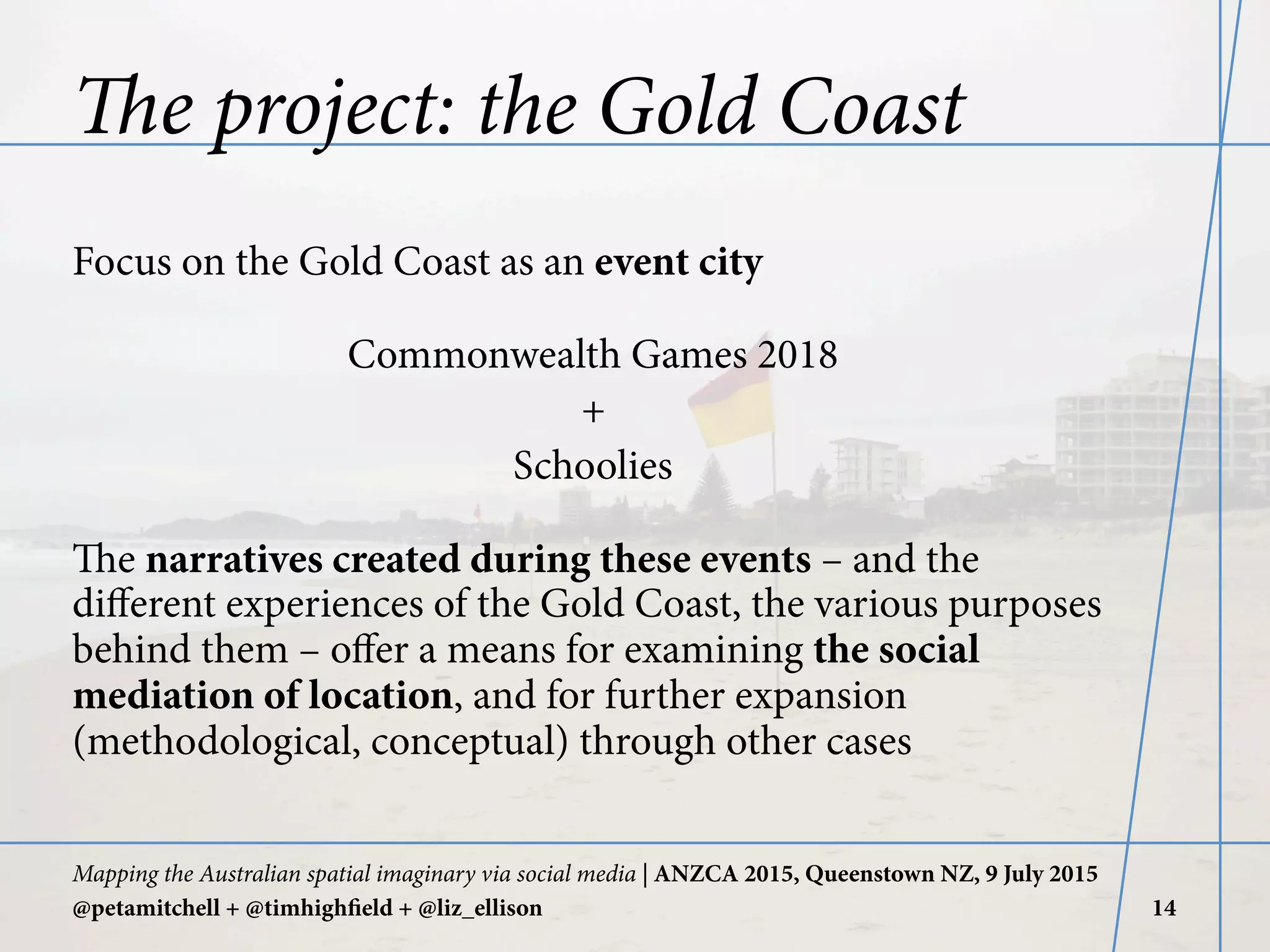
The project: the Gold Coast
Focus on the Gold Coast as an event city
Commonwealth Games 2018
+
Schoolies
The narratives created during these events – and the
different experiences of the Gold Coast, the various purposes
behind them – offer a means for examining the social
mediation of location, and for further expansion
(methodological, conceptual) through other cases
Mapping the Australian spatial imaginary via social media | ANZCA 2015, Queenstown NZ, 9 July 2015
@petamitchell + @timhighfield + @liz_ellison 14
Thanks!
Questions and such:
Peta Mitchell peta.mitchell@qut.edu.au @petamitchell
Tim Highfield t.highfield@qut.edu.au @timhighfield
Elizabeth Ellison er.ellison@qut.edu.au @liz_ellison
QUT Digital Media Research Centre
qut.edu.au/research/dmrc @qutdmrc

Mapping the Australian spatial imaginary via social media

  • 1.
    Mapping the Australian spatial imaginary via socialmedia PETA MITCHELL @petamitchell TIM HIGHFIELD @timhighfield ELIZABETH ELLISON @liz_ellison Queensland University of Technology Digital Media Research Centre ANZCA 2015, Queenstown NZ, 9 July 2015
  • 2.
    Overview This is aposition paper, setting out our aims and rationale for a project that brings together cultural studies, digital methods, social and digital media, and cultural geography… Our proposal brings into dialogue two areas of research that have to date had little or nothing to say to one another, namely social media research and the branch of Australian studies typified by its focus on spatial enquiry Mapping the Australian spatial imaginary via social media | ANZCA 2015, Queenstown NZ, 9 July 2015 @petamitchell + @timhighfield + @liz_ellison 02
  • 3.
    Aims + rationale Theproject builds on the premise that georeferenced social media data constitute ‘spatial stories’: acutely involved in place-making through tweets, Instagram posts, and other place-related online activity The enacting of the Australian spatial imaginary through social media: moving beyond ‘iconic’, distinctive, or singular narratives within national imaginary to socially mediated micronarratives of space that contribute to a socially mediated spatial imaginary Mapping the Australian spatial imaginary via social media | ANZCA 2015, Queenstown NZ, 9 July 2015 @petamitchell + @timhighfield + @liz_ellison 03
  • 4.
    Representing space/place Countering themonolithic representation of landscapes (be they bush or beach settings), as by letting these spaces exist as representative of all spaces, the image becomes an icon for the nation. A tension between naming and abstract (see Carter), as the transition between place and space an unnamed space can remain more abstract and imaginary yet social media may privilege the explicit naming/ locating of places and content? Mapping the Australian spatial imaginary via social media | ANZCA 2015, Queenstown NZ, 9 July 2015 @petamitchell + @timhighfield + @liz_ellison 04
  • 5.
    Representing space/place Looking beyondthe myths and tropes, our aim is to challenge these abstract spaces as identified in, for example, tourist representations, instead trying to capture the more ‘expressive’ places. Our work is located in the everyday or ordinary, rather than the mythic; the difference between the perceived and conceived and the lived spaces Mapping the Australian spatial imaginary via social media | ANZCA 2015, Queenstown NZ, 9 July 2015 @petamitchell + @timhighfield + @liz_ellison 05
  • 6.
    The spatial turn(s) Researchinto mediated representations of Australian space has focused on narrative, fictional, or aesthetic texts or has taken a ‘spatial history’ approach to examine the cultural construction of Australian regional or national space This body of research is both evidence of and a continuing response to the ‘spatial turn’ noted by Edward Soja and Fredric Jameson in the late 1980s and early 1990s (a movement that Australian spatial studies was at the forefront of). Mapping the Australian spatial imaginary via social media | ANZCA 2015, Queenstown NZ, 9 July 2015 @petamitchell + @timhighfield + @liz_ellison 06
  • 7.
    Geosocial media A morerecent second—digital—spatial turn, particularly evident in the rise of ‘geosocial’ media. Locative media, platforms and services shaping experience of place (e.g. Foursquare), geodata within everyday social media Ambient geographic information (Stefanidis, Crooks, and Radzikowski, 2013), as distinct from volunteered geographic information and crowdsourced (and explicit) geosocial content. Mapping the Australian spatial imaginary via social media | ANZCA 2015, Queenstown NZ, 9 July 2015 @petamitchell + @timhighfield + @liz_ellison 07
  • 8.
    Methods + platforms TrISMA:Tracking Infrastructure for Social Media in Australia (ARC LIEF, 2014-2015) Treating everyday social media as ‘geosocial’ (but with limits) Twitter Tags, keywords, geolocation (limited) – filtering posts from Australian users Instagram Tags, geolocation (higher percentage of location data in Instagram media) Mapping the Australian spatial imaginary via social media | ANZCA 2015, Queenstown NZ, 9 July 2015 @petamitchell + @timhighfield + @liz_ellison 08
  • 9.
    Pilot: G20 onTwitter Peta Mitchell (2014) Attempt to create close- to-real time social media map of Brisbane during G20, geovisualising related Twitter content Map G20 social media across Brisbane, moving beyond geotag (Crampton et al.) by geoparsing Mapping the Australian spatial imaginary via social media | ANZCA 2015, Queenstown NZ, 9 July 2015 @petamitchell + @timhighfield + @liz_ellison 09
  • 10.
    Pilot: G20 onTwitter Mapping the Australian spatial imaginary via social media | ANZCA 2015, Queenstown NZ, 9 July 2015 @petamitchell + @timhighfield + @liz_ellison 10
  • 11.
    Pilot: G20 onTwitter https://mappingg20.cartodb.com/ 17499 tweets, 23 Oct – 22 Nov 2014 (1652 geotagged) Mapping the Australian spatial imaginary via social media | ANZCA 2015, Queenstown NZ, 9 July 2015 @petamitchell + @timhighfield + @liz_ellison 11    
  • 12.
    Pilot: #thisisqueensland Queensland Tourism- promoted Instameet, October 2014: Visual representationsof Queensland, comparing style/ content/etc. Mapping the Australian spatial imaginary via social media | ANZCA 2015, Queenstown NZ, 9 July 2015 @petamitchell + @timhighfield + @liz_ellison 12
  • 13.
    The project: theGold Coast Stereotypes and perceptions of the Gold Coast (Surfers Paradise et al.) sun, surf, high-rise, touristy, sleaze, crime… However, how is the Gold Coast represented in and through social media by those who live there? Those who visit? The social media narratives constructed on Twitter and Instagram, and how they relate to/counter/conform to existing tropes Mapping the Australian spatial imaginary via social media | ANZCA 2015, Queenstown NZ, 9 July 2015 @petamitchell + @timhighfield + @liz_ellison 13
  • 14.
    The project: theGold Coast Focus on the Gold Coast as an event city Commonwealth Games 2018 + Schoolies The narratives created during these events – and the different experiences of the Gold Coast, the various purposes behind them – offer a means for examining the social mediation of location, and for further expansion (methodological, conceptual) through other cases Mapping the Australian spatial imaginary via social media | ANZCA 2015, Queenstown NZ, 9 July 2015 @petamitchell + @timhighfield + @liz_ellison 14
  • 15.
    Thanks! Questions and such: PetaMitchell peta.mitchell@qut.edu.au @petamitchell Tim Highfield t.highfield@qut.edu.au @timhighfield Elizabeth Ellison er.ellison@qut.edu.au @liz_ellison QUT Digital Media Research Centre qut.edu.au/research/dmrc @qutdmrc