CONDITIONALS
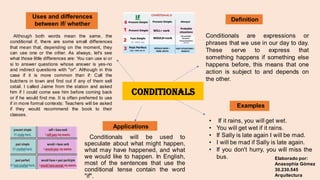
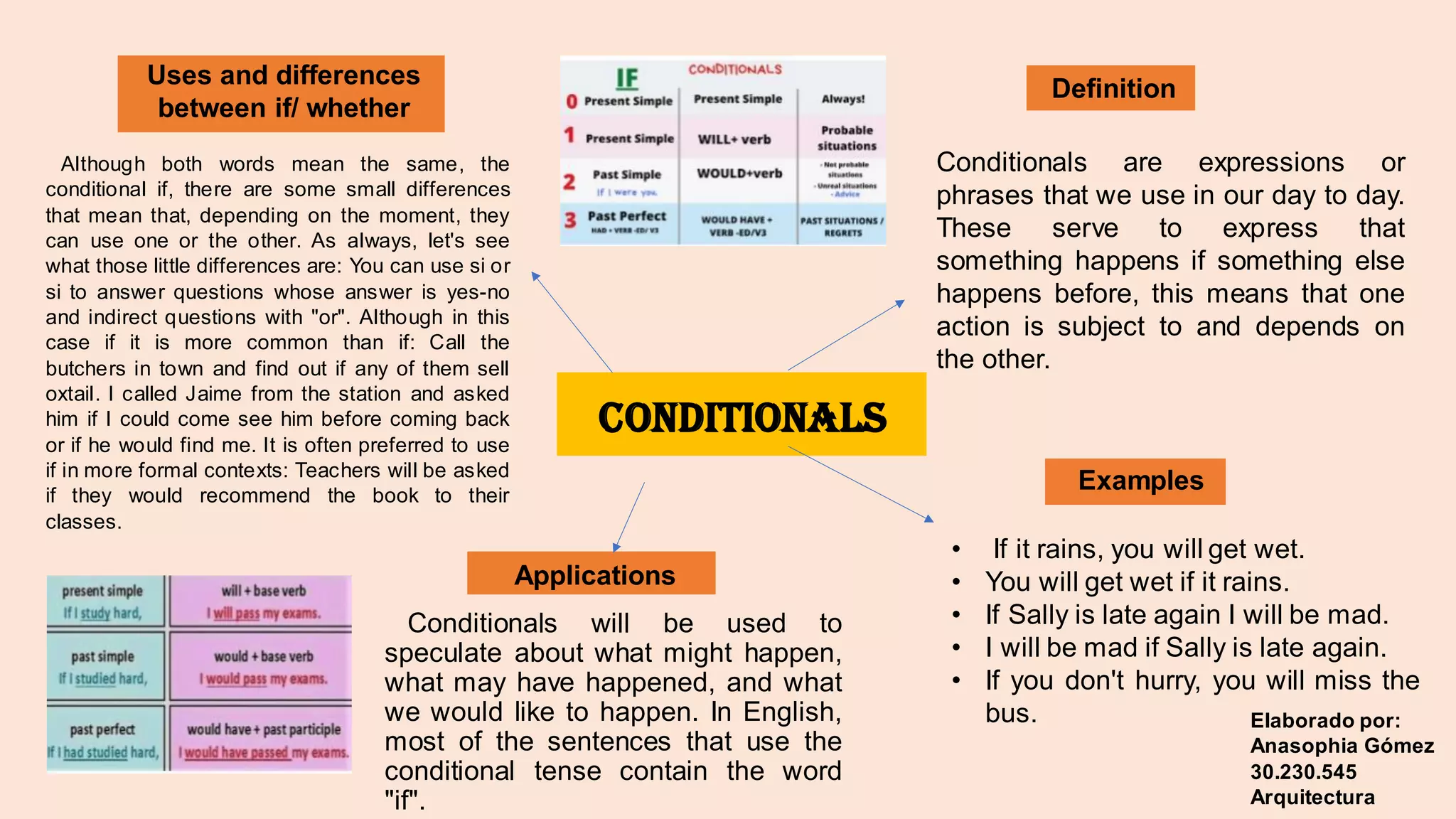
Conditionals will be used to
speculate about what might happen,
what may have happened, and what
we would like to happen. In English,
most of the sentences that use the
conditional tense contain the word
"if".
Definition
Examples
• If it rains, you will get wet.
• You will get wet if it rains.
• If Sally is late again I will be mad.
• I will be mad if Sally is late again.
• If you don't hurry, you will miss the
bus.
Conditionals are expressions or
phrases that we use in our day to day.
These serve to express that
something happens if something else
happens before, this means that one
action is subject to and depends on
the other.
Applications
Although both words mean the same, the
conditional if, there are some small differences
that mean that, depending on the moment, they
can use one or the other. As always, let's see
what those little differences are: You can use si or
si to answer questions whose answer is yes-no
and indirect questions with "or". Although in this
case if it is more common than if: Call the
butchers in town and find out if any of them sell
oxtail. I called Jaime from the station and asked
him if I could come see him before coming back
or if he would find me. It is often preferred to use
if in more formal contexts: Teachers will be asked
if they would recommend the book to their
classes.
Uses and differences
between if/ whether
Elaborado por:
Anasophia Gómez
30.230.545
Arquitectura

Map of conditionals.pdf

  • 1.
    CONDITIONALS Conditionals will beused to speculate about what might happen, what may have happened, and what we would like to happen. In English, most of the sentences that use the conditional tense contain the word "if". Definition Examples • If it rains, you will get wet. • You will get wet if it rains. • If Sally is late again I will be mad. • I will be mad if Sally is late again. • If you don't hurry, you will miss the bus. Conditionals are expressions or phrases that we use in our day to day. These serve to express that something happens if something else happens before, this means that one action is subject to and depends on the other. Applications Although both words mean the same, the conditional if, there are some small differences that mean that, depending on the moment, they can use one or the other. As always, let's see what those little differences are: You can use si or si to answer questions whose answer is yes-no and indirect questions with "or". Although in this case if it is more common than if: Call the butchers in town and find out if any of them sell oxtail. I called Jaime from the station and asked him if I could come see him before coming back or if he would find me. It is often preferred to use if in more formal contexts: Teachers will be asked if they would recommend the book to their classes. Uses and differences between if/ whether Elaborado por: Anasophia Gómez 30.230.545 Arquitectura