MAP-21 Overview

• 2 year bill
• October 1, 2012- September 30, 2014
• Extends funding at current level


  Themes
  • Consolidate programs
  • Streamline project delivery
  • Give states more flexibility
MAP-21 Changes to
                 Biking and Walking
• Transportation Alternatives
  – Eligible activities
  – Funding and opt outs
  – Distribution of Funds

• Changes to other funding programs
  –   Highway Safety Improvement Program
  –   STP
  –   CMAQ
  –   Federal Lands
Transportation Alternatives

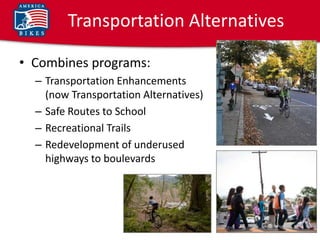
• Combines programs:
  – Transportation Enhancements
    (now Transportation Alternatives)
  – Safe Routes to School
  – Recreational Trails
  – Redevelopment of underused
    highways to boulevards
Transportation Alternatives
                     (formerly TE)
Changes eligibilities from Transportation Enhancements
ADDS:                        SUBTRACTS

• Safe Routes for Non-       • Funding For Bicycle and
  Drivers (networks)           Pedestrian Education
• ANY Environmental          • Streetscaping
  Mitigation                 • Acquisition of Scenic or
• Scenic Byway uses            Historic sites
                             • Transportation
                               Museums
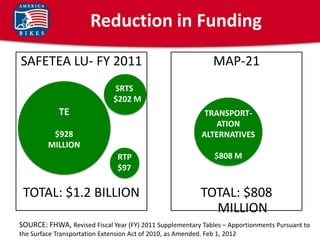
Reduction in Funding
SAFETEA LU- FY 2011                                              MAP-21
                               SRTS
                               $202 M
             TE                                               TRANSPORT-
                                                                 ATION
          $928                                               ALTERNATIVES
         MILLION
                                 RTP                             $808 M
                                 $97

 TOTAL: $1.2 BILLION                                         TOTAL: $808
                                                               MILLION
SOURCE: FHWA, Revised Fiscal Year (FY) 2011 Supplementary Tables – Apportionments Pursuant to
the Surface Transportation Extension Act of 2010, as Amended. Feb 1, 2012
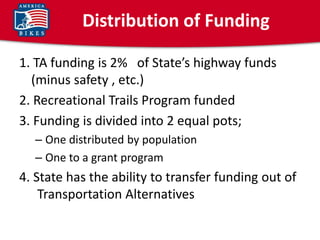
Distribution of Funding

1. TA funding is 2% of State’s highway funds
  (minus safety , etc.)
2. Recreational Trails Program funded
3. Funding is divided into 2 equal pots;
  – One distributed by population
  – One to a grant program
4. State has the ability to transfer funding out of
    Transportation Alternatives
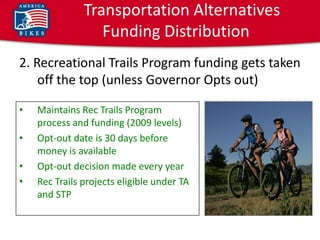
Transportation Alternatives
                  Funding Distribution
2. Recreational Trails Program funding gets taken
    off the top (unless Governor Opts out)

•   Maintains Rec Trails Program
    process and funding (2009 levels)
•   Opt-out date is 30 days before
    money is available
•   Opt-out decision made every year
•   Rec Trails projects eligible under TA
    and STP
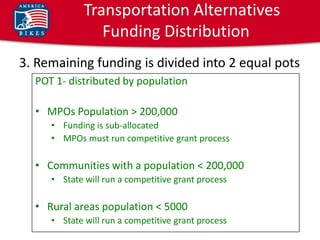
Transportation Alternatives
                Funding Distribution
3. Remaining funding is divided into 2 equal pots
  POT 1- distributed by population

  • MPOs Population > 200,000
     • Funding is sub-allocated
     • MPOs must run competitive grant process

  • Communities with a population < 200,000
     • State will run a competitive grant process

  • Rural areas population < 5000
     • State will run a competitive grant process
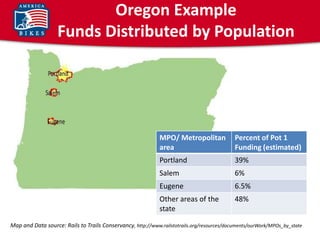
Oregon Example
                   Funds Distributed by Population


                                                             MPO/ Metropolitan              Percent of Pot 1
                                                             area                           Funding (estimated)
                                                             Portland                       39%
                                                             Salem                          6%
                                                             Eugene                         6.5%
                                                             Other areas of the             48%
                                                             state

Map and Data source: Rails to Trails Conservancy, http://www.railstotrails.org/resources/documents/ourWork/MPOs_by_state
Transportation Alternatives
               Funding Distribution
3. Remaining funding is divided into 2 equal pots
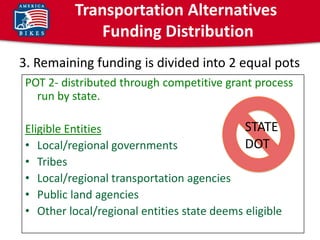
 POT 2- distributed through competitive grant process
   run by state.

 Eligible Entities                           STATE
 • Local/regional governments                DOT
 • Tribes
 • Local/regional transportation agencies
 • Public land agencies
 • Other local/regional entities state deems eligible
State Ability to Transfer Funds

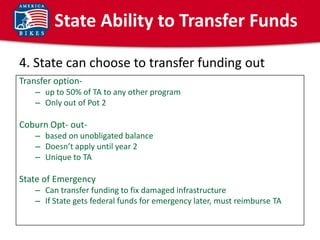
4. State can choose to transfer funding out
Transfer option-
    – up to 50% of TA to any other program
    – Only out of Pot 2

Coburn Opt- out-
    – based on unobligated balance
    – Doesn’t apply until year 2
    – Unique to TA

State of Emergency
    – Can transfer funding to fix damaged infrastructure
    – If State gets federal funds for emergency later, must reimburse TA
Other MAP-21 Changes to
              Biking and Walking
• Coordinators:
  – Bicycle and Pedestrian Coordinators are still
    required
  – Safe Routes to School Coordinators eligible


• Clearinghouses- Not funded in MAP-21
  – Bicycle Pedestrian Information Center
     • Under contract until Summer 2013
  – Safe Routes to School National Center
     • Under contract until January 2013
Eligibility in Other Programs

•   Expediting Project Delivery
•   Highway Safety Improvement Program (HSIP)
•   Surface Transportation Program (STP)
•   Congestion Mitigation and Air Quality (CMAQ)
•   Federal Lands Programs
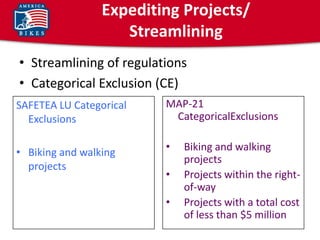
Expediting Projects/
                    Streamlining
• Streamlining of regulations
• Categorical Exclusion (CE)
SAFETEA LU Categorical   MAP-21
  Exclusions              CategoricalExclusions


• Biking and walking     •   Biking and walking
                             projects
  projects
                         •   Projects within the right-
                             of-way
                         •   Projects with a total cost
                             of less than $5 million
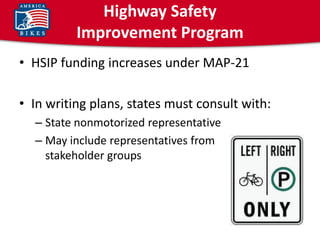
Highway Safety
          Improvement Program
• HSIP funding increases under MAP-21

• In writing plans, states must consult with:
  – State nonmotorized representative
  – May include representatives from
    stakeholder groups
Highway Safety
              Improvement Program
• New data and research requirements for
  states
  – nonmotorized crash data
  – motor vehicle crashes that include pedestrians
    and bicyclists
  – Crash frequency and crash rate data
  – Identify roadway elements/ features
     • that constitute hazard...
     • [and/or] safe conditions
Surface Transportation
                  Program (STP)

• Higher funding, more competition on non sub-
  allocated funds
• Sub-allocation to metropolitan areas
   – Same dollar amount as before

Eligibility:
•Transportation Alternatives activities eligible
•Rec Trails projects eligible
•SRTS not listed as eligible, but similar projects fit under Safe
Routes for non-drivers
Congestion Mitigation and
           Air Quality (CMAQ)
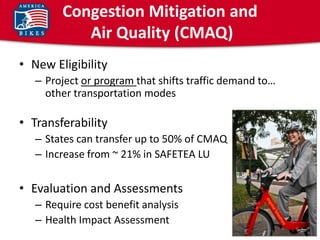
• New Eligibility
   – Project or program that shifts traffic demand to…
     other transportation modes

• Transferability
   – States can transfer up to 50% of CMAQ
   – Increase from ~ 21% in SAFETEA LU


• Evaluation and Assessments
   – Require cost benefit analysis
   – Health Impact Assessment
Federal Lands
                          Program
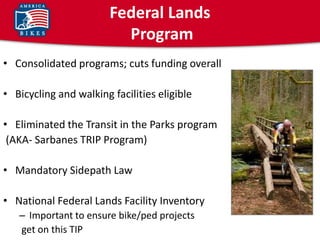
• Consolidated programs; cuts funding overall

• Bicycling and walking facilities eligible

• Eliminated the Transit in the Parks program
 (AKA- Sarbanes TRIP Program)

• Mandatory Sidepath Law

• National Federal Lands Facility Inventory
   – Important to ensure bike/ped projects
   get on this TIP
Summary
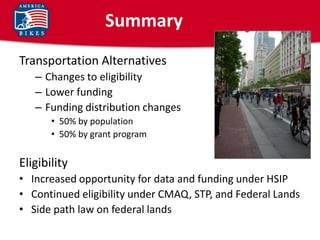
Transportation Alternatives
   – Changes to eligibility
   – Lower funding
   – Funding distribution changes
       • 50% by population
       • 50% by grant program


Eligibility
• Increased opportunity for data and funding under HSIP
• Continued eligibility under CMAQ, STP, and Federal Lands
• Side path law on federal lands

Map 21 webinar 081312

  • 1.
    MAP-21 Overview • 2year bill • October 1, 2012- September 30, 2014 • Extends funding at current level Themes • Consolidate programs • Streamline project delivery • Give states more flexibility
  • 2.
    MAP-21 Changes to Biking and Walking • Transportation Alternatives – Eligible activities – Funding and opt outs – Distribution of Funds • Changes to other funding programs – Highway Safety Improvement Program – STP – CMAQ – Federal Lands
  • 3.
    Transportation Alternatives • Combinesprograms: – Transportation Enhancements (now Transportation Alternatives) – Safe Routes to School – Recreational Trails – Redevelopment of underused highways to boulevards
  • 4.
    Transportation Alternatives (formerly TE) Changes eligibilities from Transportation Enhancements ADDS: SUBTRACTS • Safe Routes for Non- • Funding For Bicycle and Drivers (networks) Pedestrian Education • ANY Environmental • Streetscaping Mitigation • Acquisition of Scenic or • Scenic Byway uses Historic sites • Transportation Museums
  • 5.
    Reduction in Funding SAFETEALU- FY 2011 MAP-21 SRTS $202 M TE TRANSPORT- ATION $928 ALTERNATIVES MILLION RTP $808 M $97 TOTAL: $1.2 BILLION TOTAL: $808 MILLION SOURCE: FHWA, Revised Fiscal Year (FY) 2011 Supplementary Tables – Apportionments Pursuant to the Surface Transportation Extension Act of 2010, as Amended. Feb 1, 2012
  • 6.
    Distribution of Funding 1.TA funding is 2% of State’s highway funds (minus safety , etc.) 2. Recreational Trails Program funded 3. Funding is divided into 2 equal pots; – One distributed by population – One to a grant program 4. State has the ability to transfer funding out of Transportation Alternatives
  • 7.
    Transportation Alternatives Funding Distribution 2. Recreational Trails Program funding gets taken off the top (unless Governor Opts out) • Maintains Rec Trails Program process and funding (2009 levels) • Opt-out date is 30 days before money is available • Opt-out decision made every year • Rec Trails projects eligible under TA and STP
  • 8.
    Transportation Alternatives Funding Distribution 3. Remaining funding is divided into 2 equal pots POT 1- distributed by population • MPOs Population > 200,000 • Funding is sub-allocated • MPOs must run competitive grant process • Communities with a population < 200,000 • State will run a competitive grant process • Rural areas population < 5000 • State will run a competitive grant process
  • 9.
    Oregon Example Funds Distributed by Population MPO/ Metropolitan Percent of Pot 1 area Funding (estimated) Portland 39% Salem 6% Eugene 6.5% Other areas of the 48% state Map and Data source: Rails to Trails Conservancy, http://www.railstotrails.org/resources/documents/ourWork/MPOs_by_state
  • 10.
    Transportation Alternatives Funding Distribution 3. Remaining funding is divided into 2 equal pots POT 2- distributed through competitive grant process run by state. Eligible Entities STATE • Local/regional governments DOT • Tribes • Local/regional transportation agencies • Public land agencies • Other local/regional entities state deems eligible
  • 11.
    State Ability toTransfer Funds 4. State can choose to transfer funding out Transfer option- – up to 50% of TA to any other program – Only out of Pot 2 Coburn Opt- out- – based on unobligated balance – Doesn’t apply until year 2 – Unique to TA State of Emergency – Can transfer funding to fix damaged infrastructure – If State gets federal funds for emergency later, must reimburse TA
  • 12.
    Other MAP-21 Changesto Biking and Walking • Coordinators: – Bicycle and Pedestrian Coordinators are still required – Safe Routes to School Coordinators eligible • Clearinghouses- Not funded in MAP-21 – Bicycle Pedestrian Information Center • Under contract until Summer 2013 – Safe Routes to School National Center • Under contract until January 2013
  • 13.
    Eligibility in OtherPrograms • Expediting Project Delivery • Highway Safety Improvement Program (HSIP) • Surface Transportation Program (STP) • Congestion Mitigation and Air Quality (CMAQ) • Federal Lands Programs
  • 14.
    Expediting Projects/ Streamlining • Streamlining of regulations • Categorical Exclusion (CE) SAFETEA LU Categorical MAP-21 Exclusions CategoricalExclusions • Biking and walking • Biking and walking projects projects • Projects within the right- of-way • Projects with a total cost of less than $5 million
  • 15.
    Highway Safety Improvement Program • HSIP funding increases under MAP-21 • In writing plans, states must consult with: – State nonmotorized representative – May include representatives from stakeholder groups
  • 16.
    Highway Safety Improvement Program • New data and research requirements for states – nonmotorized crash data – motor vehicle crashes that include pedestrians and bicyclists – Crash frequency and crash rate data – Identify roadway elements/ features • that constitute hazard... • [and/or] safe conditions
  • 17.
    Surface Transportation Program (STP) • Higher funding, more competition on non sub- allocated funds • Sub-allocation to metropolitan areas – Same dollar amount as before Eligibility: •Transportation Alternatives activities eligible •Rec Trails projects eligible •SRTS not listed as eligible, but similar projects fit under Safe Routes for non-drivers
  • 18.
    Congestion Mitigation and Air Quality (CMAQ) • New Eligibility – Project or program that shifts traffic demand to… other transportation modes • Transferability – States can transfer up to 50% of CMAQ – Increase from ~ 21% in SAFETEA LU • Evaluation and Assessments – Require cost benefit analysis – Health Impact Assessment
  • 19.
    Federal Lands Program • Consolidated programs; cuts funding overall • Bicycling and walking facilities eligible • Eliminated the Transit in the Parks program (AKA- Sarbanes TRIP Program) • Mandatory Sidepath Law • National Federal Lands Facility Inventory – Important to ensure bike/ped projects get on this TIP
  • 20.
    Summary Transportation Alternatives – Changes to eligibility – Lower funding – Funding distribution changes • 50% by population • 50% by grant program Eligibility • Increased opportunity for data and funding under HSIP • Continued eligibility under CMAQ, STP, and Federal Lands • Side path law on federal lands