Trends of Cotton in India with Focus on Punjab with respect to Yield, Production, Area & Export                                   Presented By:                                      Mandeep Singh                            MBA- 2B
Introduction to The Company
Envision Exports Pvt. Ltd. is in operation since 1994, with its head office in Ludhiana (India) and an associate office in Bangladesh. The company is engaged in Textile Sourcing Business of Fibers, Yarns, fabrics and garments from Suppliers spread over to India, Indonesia, China and Bangladesh.
MISSIONTo assimilate knowledge, To develop capabilities, & to manage collective enterprise to profitably tap global commercial advantages
BUSINESSA servicing and sourcing solution for textile needs, meeting the demands and requirements of the prestigious customers from all over the world.
PHILOSOPHYServices approach to customers’ needs Assured & committed services to customersLong term association based on mutual trust & confidenceReliable Textile sourcing solutionsSensitive Approach to Buyer’s needs
PRODUCTSFibersRegular Yarns Special Yarns
SERVICESTo give complete yarns & fabrics sourcing for all varieties, adding to customer’s convenience.To provide weekly/ fortnightly market information which to their experience supports a lot in customers buying decisions.To provide complete sampling support to all of their customers.They have a dedicated desk for shipment follow - ups. Customers are updated through SMS, E-Mailing & can track shipments with a personal username & password over their website
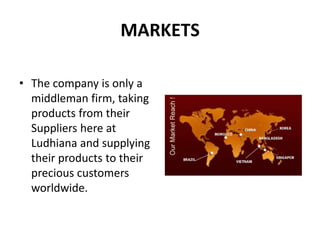
MARKETSThe company is only a middleman firm, taking products from their Suppliers here at Ludhiana and supplying their products to their precious customers worldwide.
SWOT ANALYSIS
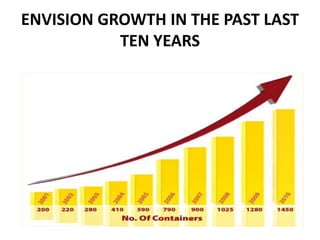
ENVISION GROWTH IN THE PAST LAST TEN YEARS
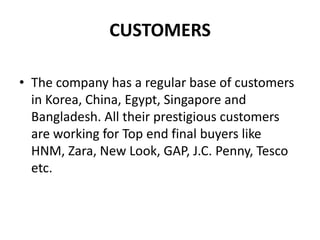
CUSTOMERSThe company has a regular base of customers in Korea, China, Egypt, Singapore and Bangladesh. All their prestigious customers are working for Top end final buyers like HNM, Zara, New Look, GAP, J.C. Penny, Tesco etc.
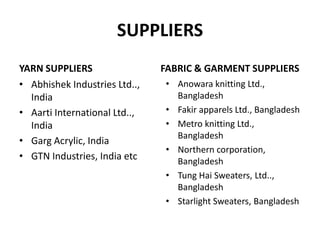
SUPPLIERSYARN SUPPLIERSAbhishek Industries Ltd.., IndiaAarti International Ltd.., IndiaGarg Acrylic, IndiaGTN Industries, India etcFABRIC & GARMENT SUPPLIERSAnowara knitting Ltd., BangladeshFakir apparels Ltd., BangladeshMetro knitting Ltd., BangladeshNorthern corporation, BangladeshTung Hai Sweaters, Ltd.., BangladeshStarlight Sweaters, Bangladesh
ORGANIZATION CHART
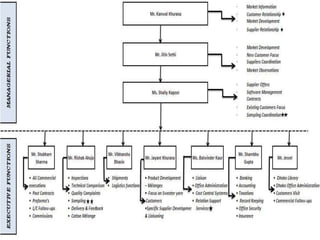
DEPARTMENTSManagerial  departmentMr. KanwalKhurana: He is the director and heads the overall organization. He administers the organization and sees the overall functions. Marketing DepartmentMr. JitinSethi. His main focus is how to develop a new market. He coordinates the working of various suppliers and focus on creating new customers. He keeps an eye on all the happenings around the market
Shipment Department: ShallyKapoor: She handles all the suppliers’ offers. She focuses on various contracts of the company and manages the existing customers of the company Mr. Shubham Sharma: - He handles all the commercial executions, post contracts. He also takes care of all the procedures related to LC mainly on its follow up and various commissions. Mr. VibhanshuBhasin: He deals with all the logistic functions and takes care of all the shipment. 
Technical Department:Mr. RishabAhuja: He takes care of all activities related to inspections. He handles all the complaints related to quality.  Accounts:Mr. Shambhu Gupta handles the activities related to accounts and takes care of banking, accounting and taxation. He keeps all the accounts of the company and maintains office security and insurance.BalwinderKaur: She handles all the office administration and cost control systems. She deals with all liaison work and relation support services.
FINANCIAL STATEMENT ANALYSISRatio Analysis is one of the most powerful tools of financial analysis. It is used as a device to analyze and interpret the financial health of an enterprise
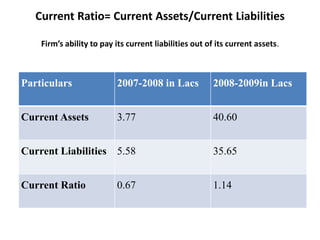
Current Ratio= CurrentAssets/CurrentLiabilitiesFirm’s ability to pay its current liabilities out of its current assets.
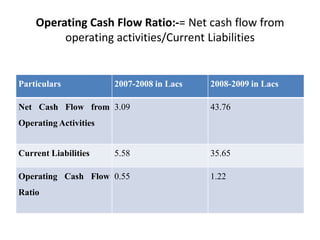
Operating Cash Flow Ratio:-= Net cash flow from operating activities/Current Liabilities
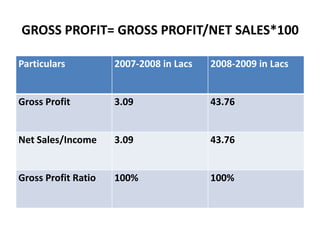
GROSS PROFIT= GROSS PROFIT/NET SALES*100
INTRODUCTIONTO COTTON
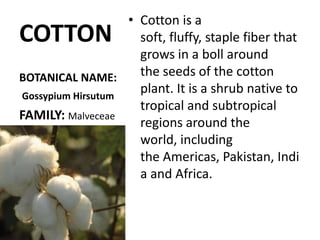
COTTONCotton is a soft, fluffy, staple fiber that grows in a boll around the seeds of the cotton plant. It is a shrub native to tropical and subtropical regions around the world, including the Americas, Pakistan, India and Africa.BOTANICAL NAME:GossypiumHirsutumFAMILY: Malveceae
CHEMICAL COMPOSITION of COTTONCellulose 91%Water 7.85%Protoplasm, Pectin 0.55%Waxes, Fatty substances 0.40%Mineral Salts 0.20%
TYPES of COTTONEGYPTIAN COTTONSEA ISLAND COTTONPIMA COTTON ASIATIC COTTONAMERICAN UPLAND COTTONCANTON COTTON 	ORGANIC COTTON
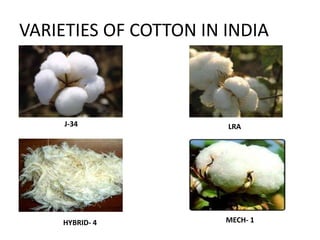
VARIETIES OF COTTON IN INDIAJ-34LRAMECH- 1HYBRID- 4
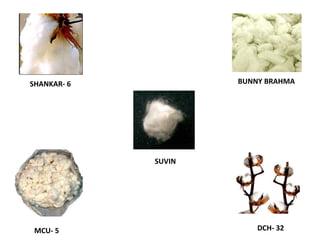
BUNNY BRAHMASHANKAR- 6SUVINDCH- 32MCU- 5
BT COTTONA genetically modified cotton to reduce heavy reliance on pesticides.A chemical harmful only to a small fraction of insects, most notably the larvae of moths and butterflies, beetles, and flies, and harmless to other forms of life
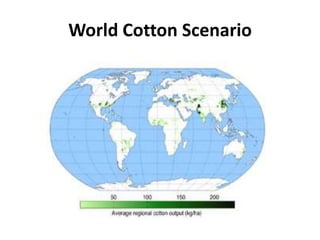
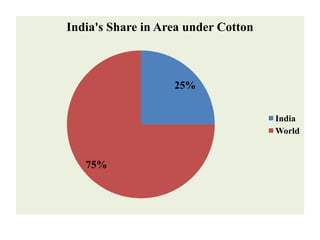
World Cotton Scenario
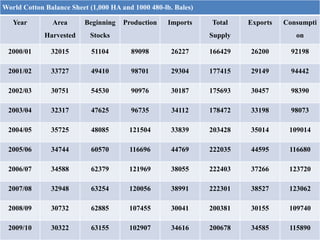
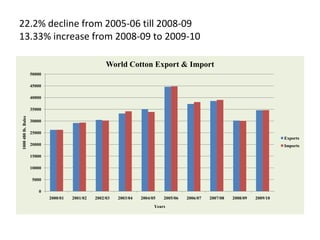
22.2% decline from 2005-06 till 2008-0913.33% increase from 2008-09 to 2009-10
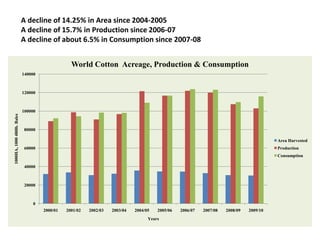
 A decline of 14.25% in Area since 2004-2005A decline of 15.7% in Production since 2006-07A decline of about 6.5% in Consumption since 2007-08
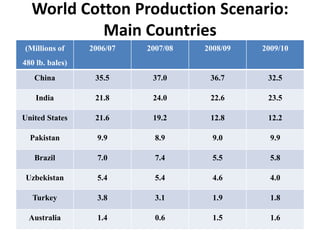
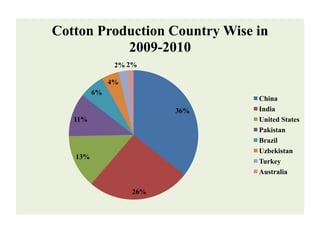
World Cotton Production Scenario: Main Countries
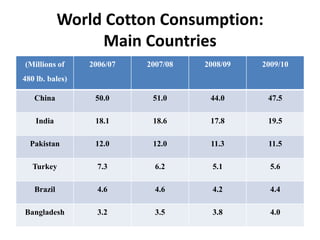
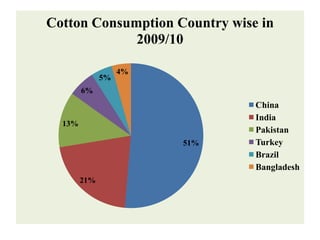
World Cotton Consumption:Main Countries
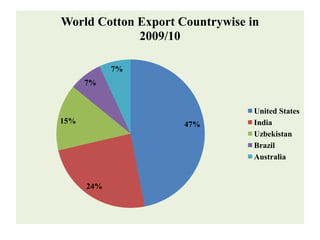
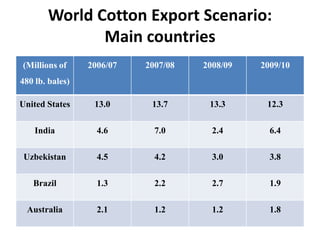
World Cotton Export Scenario: Main countries
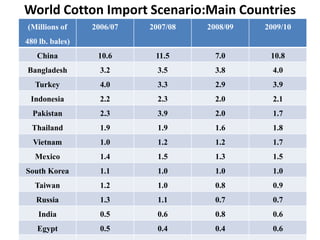
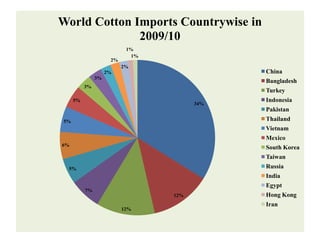
World Cotton Import Scenario:MainCountries
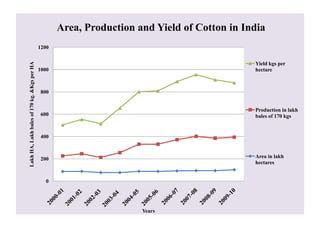
Indian Cotton Scenario
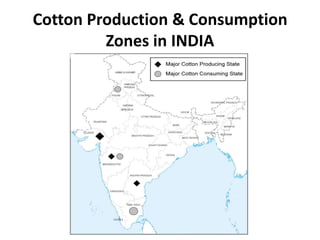
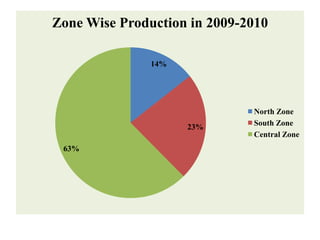
Cotton Production & Consumption Zones in INDIA
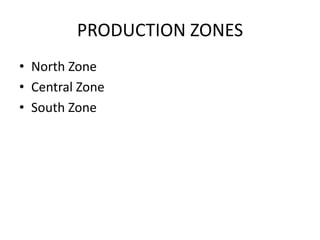
PRODUCTION ZONESNorth ZoneCentral ZoneSouth Zone
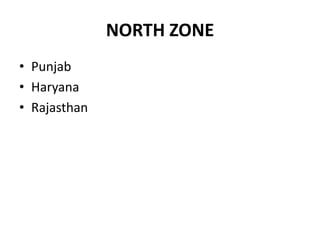
NORTH ZONEPunjabHaryanaRajasthan
Central ZoneGujaratMaharashtraMadhya Pradesh
SOUTH ZONEAndhra PradeshKarnatakaTamil Nadu
Cotton Role in Indian EconomyCotton & other textiles account for 1/3 of total exports.Cotton & textiles account for about 32% of foreign exchange earnings.Employment to about 60 million people directly or indirectly.Accounts for 7.5 % of total GDP.
GINNING SCENARIOGinning:  A mechanical treatment for cotton before it is converted into Yarn.Ginning in India is in poor condition.Over 3500 factories are in India, out of which only 2600 are under ginning operation.
TRASHTrash: The seed cottonIndianTrash scenario is good.Hand picked cotton in India has less trash as comparison to the machine picked cotton in USA, Australia, Uzbekistan and other countries.
CONTAMINATIONForeign content or impurity materialse.g. Alien fibers, colored threads, cloth pieces, human hair, plastic films, paper bits, metallic objects, oil, grease etc. Many of top Indian Varieties are most contaminated.
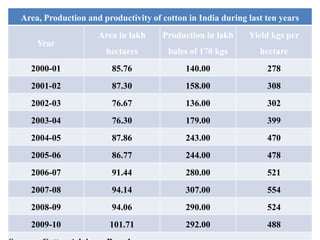
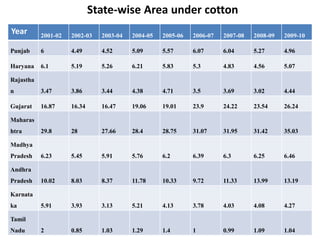
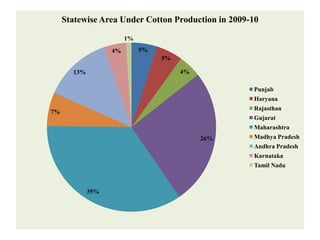
State-wise Area under cotton
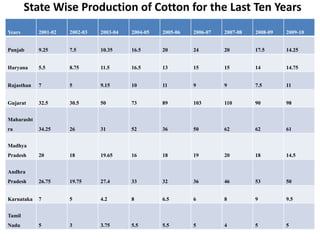
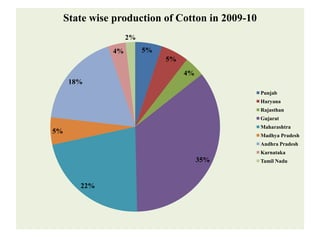
State Wise Production of Cotton for the Last Ten Years
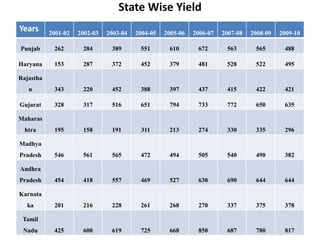
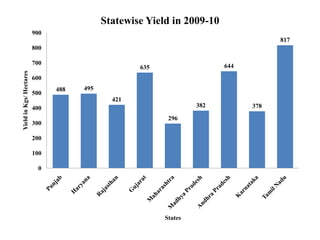
State Wise Yield
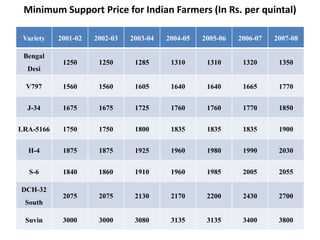
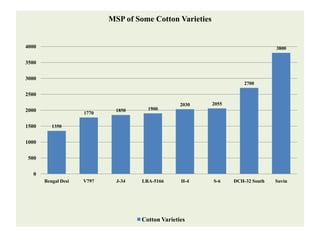
Minimum Support Price for Indian Farmers (In Rs. per quintal)
Cotton Scenario in Punjab
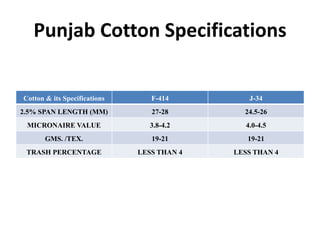
Punjab Cotton Specifications
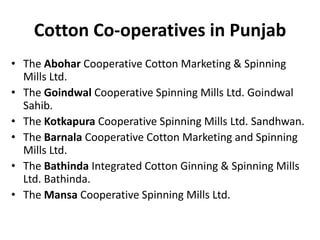
Cotton Co-operatives in PunjabThe Abohar Cooperative Cotton Marketing & Spinning Mills Ltd.The Goindwal Cooperative Spinning Mills Ltd. Goindwal Sahib.The KotkapuraCooperative Spinning Mills Ltd. Sandhwan.The BarnalaCooperative Cotton Marketing and Spinning Mills Ltd.The BathindaIntegrated Cotton Ginning & Spinning Mills Ltd. Bathinda.The Mansa Cooperative Spinning Mills Ltd. 
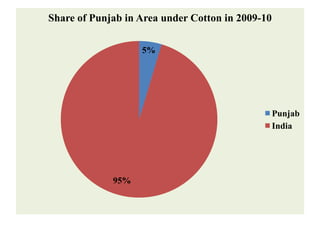
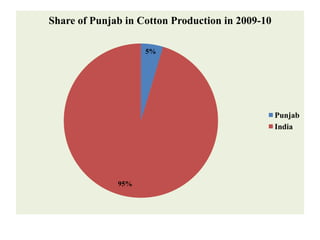
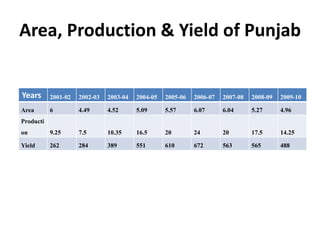
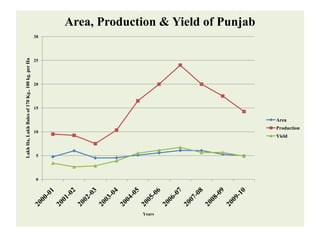
Area, Production & Yield of Punjab
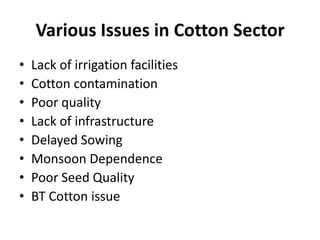
Various Issues in Cotton SectorLack of irrigation facilitiesCotton contaminationPoor qualityLack of infrastructureDelayed SowingMonsoon DependencePoor Seed QualityBT Cotton issue
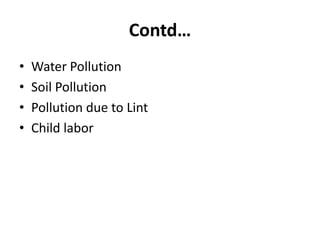
Contd…Water PollutionSoil PollutionPollution due to LintChild labor
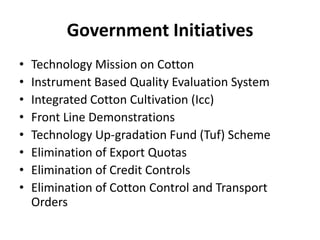
Government InitiativesTechnology Mission on CottonInstrument Based Quality Evaluation SystemIntegrated Cotton Cultivation (Icc) Front Line DemonstrationsTechnology Up-gradation Fund (Tuf) SchemeElimination of Export QuotasElimination of Credit ControlsElimination of Cotton Control and Transport Orders
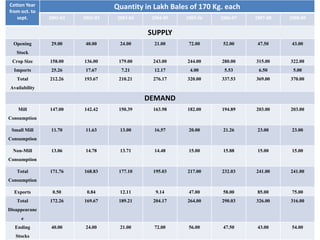
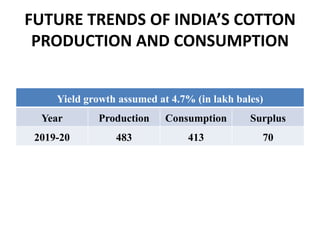
FUTURE TRENDS OF INDIA’S COTTON PRODUCTION AND CONSUMPTION
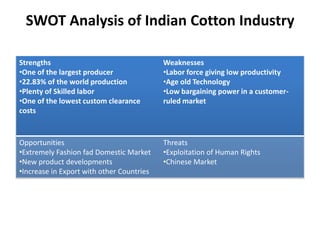
SWOT Analysis of Indian Cotton Industry
TITLE: “Trends of Cotton in India with special focus on Punjab with respect to Yield, Acreage, Production and Export.”
Objectives of StudyTo study the Growth Trend of cotton in Punjab.To know the factors affecting the prices of cotton.To study the export trend of raw cotton.
RESEARCH METHODOLOGYA research methodology defines what the activity of research is, how to proceed, how to measure progress, and what constitutes success.Research Design: Descriptive researchSampling:Snowball SamplingCluster Sampling
Universe: Totality of items in any field of enquiry. All cotton ginners & dealers who deals in cotton are the universe of studyPopulation: Total of items about which information is desired. All the cotton traders & ginners who deal in cotton in Bathinda are the population of the study.Sample Unit: Every single individual cotton dealer & ginners who gave responses to me.Sample Size: 20 Cotton traders & ginners.
Source of Data Primary source:In primary data collection, person collects the data himself using methods such as interviews and questionnaires.Primary data is collected through questionnaires by visiting different cotton traders & ginners. Secondary sourceSecondary data is data that has already been collected by someone else for a different purpose.Secondary data was collected from journals and websites.
Limitations of the StudyThe study is limited due to time constraint.The sample size is very small.The respondents were too busy to response.Language Barrier also limits the reach of the study.Earlier balance sheets were not provided as the company was earlier a proprietor firm.
Data Analysis and Interpretation
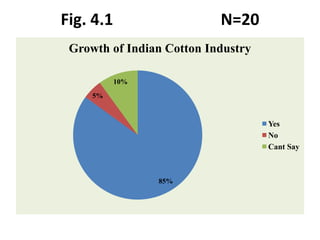
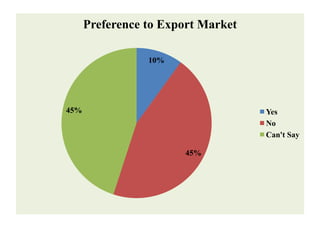
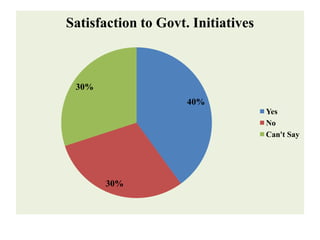
Fig. 4.1				N=20
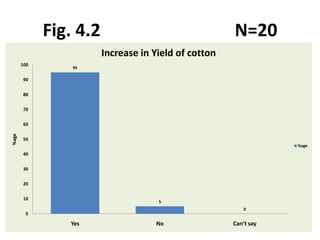
Fig. 4.2					N=20
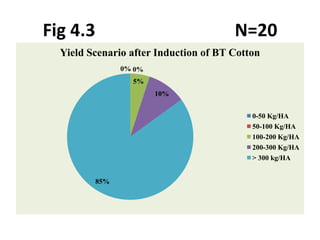
Fig 4.3					N=20
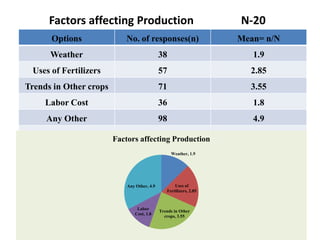
Factors affecting Production		N-20
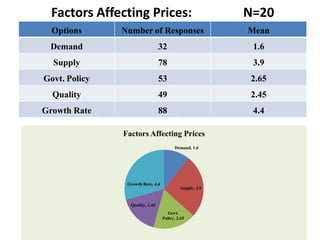
Factors Affecting Prices:		N=20
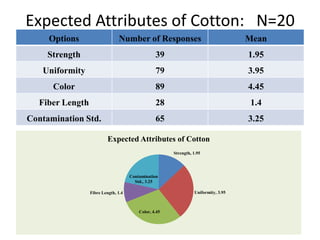
Expected Attributes of Cotton:   N=20
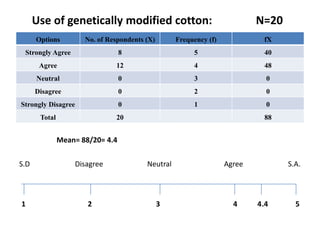
Use of genetically modified cotton:		N=20Mean= 88/20= 4.4S.D	            Disagree		Neutral		       Agree		       S.A.1                                  2                                   3                                        4           4.4               5
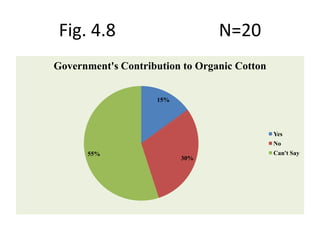
Fig. 4.8				N=20
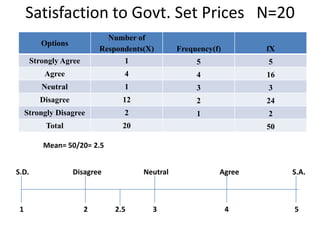
Satisfaction to Govt. Set Prices   N=20Mean= 50/20= 2.5       S.D.                        Disagree                       Neutral                            Agree                             S.A.1		         2               2.5               3                                     4                                    5
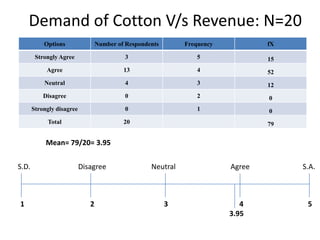
Demand of Cotton V/s Revenue: N=20Mean= 79/20= 3.95        S.D.		      Disagree	           Neutral                              Agree                             S.A.     1                                    2                                      3                                       4                                   5                                                                                                                                 3.95
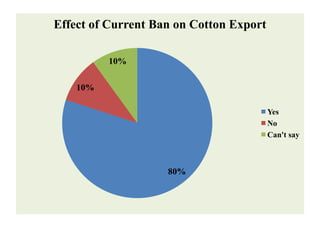
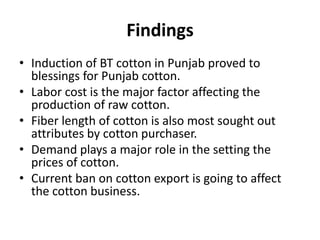
FindingsInduction of BT cotton in Punjab proved to blessings for Punjab cotton.Labor cost is the major factor affecting the production of raw cotton.Fiber length of cotton is also most sought out attributes by cotton purchaser.Demand plays a major role in the setting the prices of cotton.Current ban on cotton export is going to affect the cotton business.
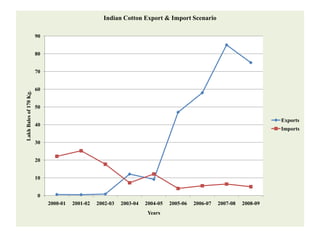
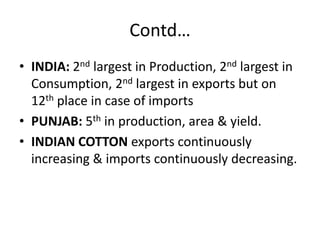
Contd…INDIA: 2nd largest in Production, 2nd largest in Consumption, 2nd largest in exports but on 12th place in case of importsPUNJAB: 5th in production, area & yield.INDIAN COTTON exports continuously increasing & imports continuously decreasing.
CONCLUSIONCotton & Textile Industry being the second largest sector in Indian economy....in particular Punjab plays a very important role in export of cotton, as introduction of BT cotton proved to be a boon for the cotton producers. The Fiber length of the cotton plays an important role in the market as its demand is more by the purchaser resulting in day to day increase in prices of essential things and the labor cost is affecting the cotton production now.
Mandeep summer training report

Mandeep summer training report

  • 1.
    Trends of Cottonin India with Focus on Punjab with respect to Yield, Production, Area & Export Presented By: Mandeep Singh MBA- 2B
  • 2.
  • 3.
    Envision Exports Pvt.Ltd. is in operation since 1994, with its head office in Ludhiana (India) and an associate office in Bangladesh. The company is engaged in Textile Sourcing Business of Fibers, Yarns, fabrics and garments from Suppliers spread over to India, Indonesia, China and Bangladesh.
  • 4.
    MISSIONTo assimilate knowledge,To develop capabilities, & to manage collective enterprise to profitably tap global commercial advantages
  • 5.
    BUSINESSA servicing andsourcing solution for textile needs, meeting the demands and requirements of the prestigious customers from all over the world.
  • 6.
    PHILOSOPHYServices approach tocustomers’ needs Assured & committed services to customersLong term association based on mutual trust & confidenceReliable Textile sourcing solutionsSensitive Approach to Buyer’s needs
  • 7.
  • 8.
    SERVICESTo give completeyarns & fabrics sourcing for all varieties, adding to customer’s convenience.To provide weekly/ fortnightly market information which to their experience supports a lot in customers buying decisions.To provide complete sampling support to all of their customers.They have a dedicated desk for shipment follow - ups. Customers are updated through SMS, E-Mailing & can track shipments with a personal username & password over their website
  • 9.
    MARKETSThe company isonly a middleman firm, taking products from their Suppliers here at Ludhiana and supplying their products to their precious customers worldwide.
  • 10.
  • 11.
    ENVISION GROWTH INTHE PAST LAST TEN YEARS
  • 12.
    CUSTOMERSThe company hasa regular base of customers in Korea, China, Egypt, Singapore and Bangladesh. All their prestigious customers are working for Top end final buyers like HNM, Zara, New Look, GAP, J.C. Penny, Tesco etc.
  • 13.
    SUPPLIERSYARN SUPPLIERSAbhishek IndustriesLtd.., IndiaAarti International Ltd.., IndiaGarg Acrylic, IndiaGTN Industries, India etcFABRIC & GARMENT SUPPLIERSAnowara knitting Ltd., BangladeshFakir apparels Ltd., BangladeshMetro knitting Ltd., BangladeshNorthern corporation, BangladeshTung Hai Sweaters, Ltd.., BangladeshStarlight Sweaters, Bangladesh
  • 14.
  • 16.
    DEPARTMENTSManagerial departmentMr.KanwalKhurana: He is the director and heads the overall organization. He administers the organization and sees the overall functions. Marketing DepartmentMr. JitinSethi. His main focus is how to develop a new market. He coordinates the working of various suppliers and focus on creating new customers. He keeps an eye on all the happenings around the market
  • 17.
    Shipment Department: ShallyKapoor:She handles all the suppliers’ offers. She focuses on various contracts of the company and manages the existing customers of the company Mr. Shubham Sharma: - He handles all the commercial executions, post contracts. He also takes care of all the procedures related to LC mainly on its follow up and various commissions. Mr. VibhanshuBhasin: He deals with all the logistic functions and takes care of all the shipment. 
  • 18.
    Technical Department:Mr. RishabAhuja:He takes care of all activities related to inspections. He handles all the complaints related to quality.  Accounts:Mr. Shambhu Gupta handles the activities related to accounts and takes care of banking, accounting and taxation. He keeps all the accounts of the company and maintains office security and insurance.BalwinderKaur: She handles all the office administration and cost control systems. She deals with all liaison work and relation support services.
  • 19.
    FINANCIAL STATEMENT ANALYSISRatioAnalysis is one of the most powerful tools of financial analysis. It is used as a device to analyze and interpret the financial health of an enterprise
  • 20.
    Current Ratio= CurrentAssets/CurrentLiabilitiesFirm’sability to pay its current liabilities out of its current assets.
  • 21.
    Operating Cash FlowRatio:-= Net cash flow from operating activities/Current Liabilities
  • 22.
    GROSS PROFIT= GROSSPROFIT/NET SALES*100
  • 23.
  • 24.
    COTTONCotton is a soft,fluffy, staple fiber that grows in a boll around the seeds of the cotton plant. It is a shrub native to tropical and subtropical regions around the world, including the Americas, Pakistan, India and Africa.BOTANICAL NAME:GossypiumHirsutumFAMILY: Malveceae
  • 25.
    CHEMICAL COMPOSITION ofCOTTONCellulose 91%Water 7.85%Protoplasm, Pectin 0.55%Waxes, Fatty substances 0.40%Mineral Salts 0.20%
  • 26.
    TYPES of COTTONEGYPTIANCOTTONSEA ISLAND COTTONPIMA COTTON ASIATIC COTTONAMERICAN UPLAND COTTONCANTON COTTON ORGANIC COTTON
  • 27.
    VARIETIES OF COTTONIN INDIAJ-34LRAMECH- 1HYBRID- 4
  • 28.
  • 29.
    BT COTTONA geneticallymodified cotton to reduce heavy reliance on pesticides.A chemical harmful only to a small fraction of insects, most notably the larvae of moths and butterflies, beetles, and flies, and harmless to other forms of life
  • 30.
  • 32.
    22.2% decline from2005-06 till 2008-0913.33% increase from 2008-09 to 2009-10
  • 33.
    A declineof 14.25% in Area since 2004-2005A decline of 15.7% in Production since 2006-07A decline of about 6.5% in Consumption since 2007-08
  • 34.
    World Cotton ProductionScenario: Main Countries
  • 36.
  • 38.
    World Cotton ExportScenario: Main countries
  • 40.
    World Cotton ImportScenario:MainCountries
  • 42.
  • 44.
    Cotton Production &Consumption Zones in INDIA
  • 45.
  • 46.
  • 47.
  • 48.
  • 50.
    Cotton Role inIndian EconomyCotton & other textiles account for 1/3 of total exports.Cotton & textiles account for about 32% of foreign exchange earnings.Employment to about 60 million people directly or indirectly.Accounts for 7.5 % of total GDP.
  • 51.
    GINNING SCENARIOGinning: A mechanical treatment for cotton before it is converted into Yarn.Ginning in India is in poor condition.Over 3500 factories are in India, out of which only 2600 are under ginning operation.
  • 52.
    TRASHTrash: The seedcottonIndianTrash scenario is good.Hand picked cotton in India has less trash as comparison to the machine picked cotton in USA, Australia, Uzbekistan and other countries.
  • 53.
    CONTAMINATIONForeign content orimpurity materialse.g. Alien fibers, colored threads, cloth pieces, human hair, plastic films, paper bits, metallic objects, oil, grease etc. Many of top Indian Varieties are most contaminated.
  • 56.
  • 58.
    State Wise Productionof Cotton for the Last Ten Years
  • 60.
  • 64.
    Minimum Support Pricefor Indian Farmers (In Rs. per quintal)
  • 66.
  • 67.
  • 68.
    Cotton Co-operatives inPunjabThe Abohar Cooperative Cotton Marketing & Spinning Mills Ltd.The Goindwal Cooperative Spinning Mills Ltd. Goindwal Sahib.The KotkapuraCooperative Spinning Mills Ltd. Sandhwan.The BarnalaCooperative Cotton Marketing and Spinning Mills Ltd.The BathindaIntegrated Cotton Ginning & Spinning Mills Ltd. Bathinda.The Mansa Cooperative Spinning Mills Ltd. 
  • 71.
    Area, Production &Yield of Punjab
  • 73.
    Various Issues inCotton SectorLack of irrigation facilitiesCotton contaminationPoor qualityLack of infrastructureDelayed SowingMonsoon DependencePoor Seed QualityBT Cotton issue
  • 74.
  • 75.
    Government InitiativesTechnology Missionon CottonInstrument Based Quality Evaluation SystemIntegrated Cotton Cultivation (Icc) Front Line DemonstrationsTechnology Up-gradation Fund (Tuf) SchemeElimination of Export QuotasElimination of Credit ControlsElimination of Cotton Control and Transport Orders
  • 76.
    FUTURE TRENDS OFINDIA’S COTTON PRODUCTION AND CONSUMPTION
  • 77.
    SWOT Analysis ofIndian Cotton Industry
  • 78.
    TITLE: “Trends ofCotton in India with special focus on Punjab with respect to Yield, Acreage, Production and Export.”
  • 79.
    Objectives of StudyTostudy the Growth Trend of cotton in Punjab.To know the factors affecting the prices of cotton.To study the export trend of raw cotton.
  • 80.
    RESEARCH METHODOLOGYA researchmethodology defines what the activity of research is, how to proceed, how to measure progress, and what constitutes success.Research Design: Descriptive researchSampling:Snowball SamplingCluster Sampling
  • 81.
    Universe: Totality ofitems in any field of enquiry. All cotton ginners & dealers who deals in cotton are the universe of studyPopulation: Total of items about which information is desired. All the cotton traders & ginners who deal in cotton in Bathinda are the population of the study.Sample Unit: Every single individual cotton dealer & ginners who gave responses to me.Sample Size: 20 Cotton traders & ginners.
  • 82.
    Source of DataPrimary source:In primary data collection, person collects the data himself using methods such as interviews and questionnaires.Primary data is collected through questionnaires by visiting different cotton traders & ginners. Secondary sourceSecondary data is data that has already been collected by someone else for a different purpose.Secondary data was collected from journals and websites.
  • 83.
    Limitations of theStudyThe study is limited due to time constraint.The sample size is very small.The respondents were too busy to response.Language Barrier also limits the reach of the study.Earlier balance sheets were not provided as the company was earlier a proprietor firm.
  • 84.
    Data Analysis andInterpretation
  • 85.
  • 86.
  • 87.
  • 88.
  • 89.
  • 90.
  • 91.
    Use of geneticallymodified cotton: N=20Mean= 88/20= 4.4S.D Disagree Neutral Agree S.A.1 2 3 4 4.4 5
  • 92.
  • 93.
    Satisfaction to Govt.Set Prices N=20Mean= 50/20= 2.5 S.D. Disagree Neutral Agree S.A.1 2 2.5 3 4 5
  • 95.
    Demand of CottonV/s Revenue: N=20Mean= 79/20= 3.95 S.D. Disagree Neutral Agree S.A. 1 2 3 4 5 3.95
  • 99.
    FindingsInduction of BTcotton in Punjab proved to blessings for Punjab cotton.Labor cost is the major factor affecting the production of raw cotton.Fiber length of cotton is also most sought out attributes by cotton purchaser.Demand plays a major role in the setting the prices of cotton.Current ban on cotton export is going to affect the cotton business.
  • 100.
    Contd…INDIA: 2nd largestin Production, 2nd largest in Consumption, 2nd largest in exports but on 12th place in case of importsPUNJAB: 5th in production, area & yield.INDIAN COTTON exports continuously increasing & imports continuously decreasing.
  • 101.
    CONCLUSIONCotton & TextileIndustry being the second largest sector in Indian economy....in particular Punjab plays a very important role in export of cotton, as introduction of BT cotton proved to be a boon for the cotton producers. The Fiber length of the cotton plays an important role in the market as its demand is more by the purchaser resulting in day to day increase in prices of essential things and the labor cost is affecting the cotton production now.