Managing training
materials beyond
individual projects
Vasso Kalaitzi, LIBER
Ellen Leenarts, DANS - KNAW
Prague, April 10th 2019
libereurope.eu
CC BY
Training information produced by EU
funded projects and organisations
- Learning materials (e.g. on Open Science, RDM, FAIR data, etc)
- Info related to training events
- Training networks
- Procedures
• Generic and interdisciplinary materials
• Re-used and re-branded materials
“
libereurope.eu
CC BY
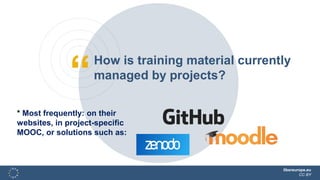
How is training material currently
managed by projects?
* Most frequently: on their
websites, in project-specific
MOOC, or solutions such as:
libereurope.eu
CC BY
What are the wishes of the
researchers/targets of
training?
The starting point is/should be the communities’ and
end users’ needs
-Better equipped discipline-specific and across disciplines
RDM support
-OS support
-Openly available and reusable material
-Where to find the material
-Repositories and where to find them
-Curricula for researchers/data supporters/data
stewards/librarians, etc
-Cataloguing of training with rich metadata for sustainable
access and OS in practice
libereurope.eu
CC BY
What are the wishes of
the projects?
- Uptake of project solutions
- Sharing of project results with branding
- Measurable results/Impact
- Provide sustainable information
But also
*Build on existing materials with other and/or
improved generic content and/or domain and/or
discipline specific content
*Create project-specific material, if needed (for
example, on how to use project tools, or targeted
to developers
libereurope.eu
CC BY
What are the issues
identified?1
How can training material be organized across projects? What needs
to be taken into account? (e.g. Avoid duplication)
2
How can it be more visible/findable by other projects and
researchers? (FAIR training)
3
What about long-term sustainability after the end of a project?
(storage, keeping material up to date, managing networks, etc) How
and who? EOSC Portal as a catalogue of catalogues?
4
What about options like the Elixir Training eSupport
System (https://tess.elixir-europe.org/) ?
*To be taken into account at the
stage of the proposal!
libereurope.eu
CC BY
Join us for the
SSHOC SSH Training
Network
Broaden your network.
Share knowledge.
Be empowered with skills and expertise
Everyone in the SSH community is
welcome!
https://www.sshopencloud.eu/
info@sshopencloud.eu
@SSHOpenCloud
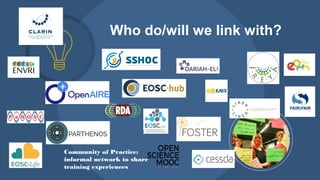
Who do/will we link with?
Community of Practice:
informal network to share
training experiences
Thanks!
Questions?
Vasso.kalaitzi@kb.nl ; ellen.leenarts@dans.knaw.nl
Credits: These slides are CC BY. Photographs by LIBER, LILLIAD Learning Centre
Innovation, Cantonal and University Library of Lausanne. Template by SlidesCarnival.
Thanks!
Questions?
Vasso.kalaitzi@kb.nl ; ellen.leenarts@dans.knaw.nl
Credits: These slides are CC BY. Photographs by LIBER, LILLIAD Learning Centre
Innovation, Cantonal and University Library of Lausanne. Template by SlidesCarnival.

Managing training materials beyond individual projects

  • 1.
    Managing training materials beyond individualprojects Vasso Kalaitzi, LIBER Ellen Leenarts, DANS - KNAW Prague, April 10th 2019
  • 2.
    libereurope.eu CC BY Training informationproduced by EU funded projects and organisations - Learning materials (e.g. on Open Science, RDM, FAIR data, etc) - Info related to training events - Training networks - Procedures • Generic and interdisciplinary materials • Re-used and re-branded materials
  • 3.
    “ libereurope.eu CC BY How istraining material currently managed by projects? * Most frequently: on their websites, in project-specific MOOC, or solutions such as:
  • 4.
    libereurope.eu CC BY What arethe wishes of the researchers/targets of training? The starting point is/should be the communities’ and end users’ needs -Better equipped discipline-specific and across disciplines RDM support -OS support -Openly available and reusable material -Where to find the material -Repositories and where to find them -Curricula for researchers/data supporters/data stewards/librarians, etc -Cataloguing of training with rich metadata for sustainable access and OS in practice
  • 5.
    libereurope.eu CC BY What arethe wishes of the projects? - Uptake of project solutions - Sharing of project results with branding - Measurable results/Impact - Provide sustainable information But also *Build on existing materials with other and/or improved generic content and/or domain and/or discipline specific content *Create project-specific material, if needed (for example, on how to use project tools, or targeted to developers
  • 6.
    libereurope.eu CC BY What arethe issues identified?1 How can training material be organized across projects? What needs to be taken into account? (e.g. Avoid duplication) 2 How can it be more visible/findable by other projects and researchers? (FAIR training) 3 What about long-term sustainability after the end of a project? (storage, keeping material up to date, managing networks, etc) How and who? EOSC Portal as a catalogue of catalogues? 4 What about options like the Elixir Training eSupport System (https://tess.elixir-europe.org/) ? *To be taken into account at the stage of the proposal!
  • 7.
    libereurope.eu CC BY Join usfor the SSHOC SSH Training Network Broaden your network. Share knowledge. Be empowered with skills and expertise Everyone in the SSH community is welcome! https://www.sshopencloud.eu/ info@sshopencloud.eu @SSHOpenCloud
  • 8.
    Who do/will welink with? Community of Practice: informal network to share training experiences
  • 9.
    Thanks! Questions? Vasso.kalaitzi@kb.nl ; ellen.leenarts@dans.knaw.nl Credits:These slides are CC BY. Photographs by LIBER, LILLIAD Learning Centre Innovation, Cantonal and University Library of Lausanne. Template by SlidesCarnival.
  • 10.
    Thanks! Questions? Vasso.kalaitzi@kb.nl ; ellen.leenarts@dans.knaw.nl Credits:These slides are CC BY. Photographs by LIBER, LILLIAD Learning Centre Innovation, Cantonal and University Library of Lausanne. Template by SlidesCarnival.