Managing Conservation in Museums 2nd Edition Suzanne Keene
1.
Managing Conservation inMuseums 2nd Edition
Suzanne Keene pdf download
https://ebookgate.com/product/managing-conservation-in-
museums-2nd-edition-suzanne-keene/
Get Instant Ebook Downloads – Browse at https://ebookgate.com
2.
Instant digital products(PDF, ePub, MOBI) available
Download now and explore formats that suit you...
Museums in Motion An Introduction to the History and
Functions of Museums 2nd Edition Edward P. Alexander
https://ebookgate.com/product/museums-in-motion-an-introduction-to-
the-history-and-functions-of-museums-2nd-edition-edward-p-alexander/
ebookgate.com
Endurance Sports Nutrition 2nd Edition Suzanne Girard
Eberle
https://ebookgate.com/product/endurance-sports-nutrition-2nd-edition-
suzanne-girard-eberle/
ebookgate.com
Handbook of Test Development 2nd Edition Suzanne Lane
https://ebookgate.com/product/handbook-of-test-development-2nd-
edition-suzanne-lane/
ebookgate.com
America s College Museums Handbook Directory 2nd ed 2nd
Edition Victor J. Danilov
https://ebookgate.com/product/america-s-college-museums-handbook-
directory-2nd-ed-2nd-edition-victor-j-danilov/
ebookgate.com
3.
Designing in Ivoryand White Suzanne Perron Gowns from the
Inside Out 1st Edition Suzanne Perron
https://ebookgate.com/product/designing-in-ivory-and-white-suzanne-
perron-gowns-from-the-inside-out-1st-edition-suzanne-perron/
ebookgate.com
Personal Conflict Management Theory and Practice 2nd
Edition Suzanne Mccorkle
https://ebookgate.com/product/personal-conflict-management-theory-and-
practice-2nd-edition-suzanne-mccorkle/
ebookgate.com
Energy Conservation Guidebook 2nd ed Edition Dale R.
Patrick
https://ebookgate.com/product/energy-conservation-guidebook-2nd-ed-
edition-dale-r-patrick/
ebookgate.com
Architectural Tiles Conservation and Restoration 2nd
Edition Lesley Durbin
https://ebookgate.com/product/architectural-tiles-conservation-and-
restoration-2nd-edition-lesley-durbin/
ebookgate.com
Managing sport facilities 2nd Edition Gil Fried
https://ebookgate.com/product/managing-sport-facilities-2nd-edition-
gil-fried/
ebookgate.com
Contents
Preface ix
Acknowledgements xi
1Introduction 1
Collections, conservation, and management 1
Museums 3
Management and information 6
Case study 9
References 10
2 Museums, collections, and people 12
Museums 12
Paradigms for collections 16
Museum users and their needs 20
Conservation and museums 23
Professional roles 24
References 29
3 Management and information 32
Views from general management studies 32
Information in management 36
The management of museums 40
Issues in museum management 43
Conclusions 45
References 46
4 Management tools: quantitative planning 48
Management science and conservation 48
Conservation costs and benefits 50
Deciding priorities 53
Quantifying collections preservation 56
Quantification: do we need it? 60
Conclusions 61
References 61
11.
5 Management tools:options and priorities 63
Risk analysis 63
Contextual analysis: PEST and SWOT 68
Strategy development 68
Case study 72
Conclusions 75
References 76
6
A systems view of museums 79
The systems approach 79
The soft systems methodology 81
Museums as systems 84
Real world and system contrast 94
The changing scene 95
References 96
7 The preservation system 97
The real world: the Rich Picture and Analyses 1, 2 and 3 98
Relevant systems 99
Root definitions 100
The conceptual model 101
Real world and system contrast 104
From analysis into management 104
Conclusions 108
References 110
8 Preservation 114
Preservation standards and policies 115
Reviews and reports 116
Case study 118
Environmental monitoring 119
Presenting and using environmental data 123
Case study 132
Tales of the environment 134
Conclusions 135
References 136
9 Collections condition 139
Surveying collections 139
Existing work 142
Defining the data 142
The audit method 148
Gathering the data: the survey itself 152
Analysing and presenting data 153
Reporting audit results 155
Monitoring condition over time 157
vi Contents
12.
Case study 157
Conclusions159
References 160
10 Direction and strategy 172
Terminology 172
Statements of purpose 173
Policies 174
Strategy and planning 175
Approaches to strategic planning 176
Case study 181
Performance 183
Conclusions 186
References 187
11 Planning and monitoring work 195
Planning work and communicating plans 195
Management-by-objectives 199
Project planning 201
Allocating resources 203
Monitoring and reporting 204
Presenting and using management information 205
Case study 207
Planning for skills and quality 212
Conclusions 212
References 213
12 Conservation and digitization 215
Conservation records on computer 215
Information for preservation 216
The conservation information requirement 217
Case study 222
Digital preservation 224
Case study 228
References 229
13 Future, present, past 239
Information for all 239
The value of information 240
Evaluation 242
Case study 244
Conclusions: a new view 247
Future developments 248
References 249
Index 251
Contents vii
Preface
The first editionof this book was written in order to open up the box of
tools labelled ‘management’ for conservators and other preservation
professionals to make use of if they wished. At that time many of these
notions were unfamiliar in this context. Now, we hear daily and hourly
about the principles and concepts of management, applied to everything
from opera houses to primary schools.
These ideas and techniques are not a universal solution. I hope they
will equip people who are managing preservation with some useful ideas
and techniques. This book is written partly in order to set out a sceptical
view of attitudes to running cultural organizations, and so I also hope
that it will encourage people to challenge some of the concepts from
commercial management, such as performance measurement, that can be
positively damaging.
Above all my wish is that it will contribute to the preservation of the
objects and collections for the enjoyment of everyone.
Suzanne Keene
Note: the website of information supplementing this book will be
found at:
www.suzannekeene.info/conserve
Acknowledgements
I am mostgrateful to my colleagues in the Science Museum and in the
Museum of London: in particular, Hazel Newey, Jackie Britton, Ann
Newmark and Peter Meehan from the Science Museum, and Kate Starling
and Helen Ganiaris at the Museum of London. They provided much of
the material for this book, and they played a major part in developing the
ideas and practices depicted in it.
I also acknowledge the part that the collections and objects have played
in these museums, in that they so vividly illustrate success or failure in
managing preservation.
1 Introduction
The focusof this book is on managing the preservation of collections. It
argues that information is fundamental to achieving this. Such information
must be based on values; it must serve objectives; and it must be useful to
the people doing the work. Collections preservation is set within the
context of museums in the early twenty-first century. The central point of
the museum is shifting from the collections to the services that museums
provide for people. However, museum collections are larger and more
extensive than ever, and pressures for higher standards and greater
efficiency are unrelenting. At the same time, the arrival of the Internet and
the World Wide Web has dramatically altered the context for museums.
In this complex, rapidly changing world, issues cannot be addressed in
isolation. Everything is connected to and dependent on everything else.
The collections and their preservation cannot be viewed as an end in
themselves, isolated from the other purposes and functions of museums.
This is why conservation in museums needs to be viewed in a systemic
way. One of the things that this book does is to advocate the systems
approach and show how it can usefully be applied to the management of
conservation in museums.
Collections, conservation and management
Museum collections everywhere are large and growing larger. It is a
primary function of museums to develop and add to collections.
Collections are held for a variety of purposes ranging from demonstra-
tion, as is the case for many industrial and agricultural collections; to a
record of the history of a place; to viewing and enjoyment, as in art
galleries and collections, to an archive for study and learning.
The tasks involved in conservation are perhaps uniquely varied.
Practical skill is still essential, and most conservators spend most of
their time on actively ‘treating’ objects: removing dirt and deposits that
cause damage, strengthening them using physical support or consolida-
tion with resins, removing the chemical products or agents of decay, as
in acid paper.
19.
But creating theconditions for preservation, rather than curing ills once
they become apparent, is assuming an ever-greater importance in the
conservator’s role. Nowadays, the principles of preservation are widely
recognized and understood, and expressed in many documents and
approaches: as standards, as performance indicators, and as management
tools such as the Best Value review process for museums.
Conservation can also make an important contribution to the education
and interpretation functions of museums. This is well illustrated by the
Conservation Centre of the National Museums and Galleries on Mersey-
side, and by a number of popular exhibitions and exhibits on museum
conservation.
In response to the same pressures for higher standards and the ever-
growing scale of the task, collections management has emerged as yet
another specialist area in museums. Collections management encom-
passes all the processes of organizing, caring for, and accounting for
collections; each object is managed ‘from cradle to grave’. The pattern of
employment of conservators is changing, too. In America it has long been
usual not to employ conservators, but for registrars or collections
managers to commission conservation treatment from conservators
working freelance or in independent practices. Even the development of
strategy for the care and preservation of collections may be outsourced.
This is probably partly because many American museums are not owned
and managed directly within the public sector. In the UK it has been the
norm in the public sector for staff to be employed, rather than services to
be outsourced, but this is changing in museums as in other public sector
services (Winsor, 1998).
The importance of managing collections as museums’ primary asset,
which they may use as the basis for the services they offer, is generally well
recognized and there is a receptive climate for using management
techniques to do this more effectively. In many respects conservators have
led the way. Conservators have been among the first museum profession-
als to express as usable standards their scientific knowledge of risk and the
agents of deterioration and how to avoid it. They have also understood the
necessity to document and record work affecting objects and collections.
This book aims to describe some perspectives and techniques from
management that can turn these orderly practices and records into
information, strategies, and a better understanding that will assist the
preservation of collections. Conservation requires a broad range of
technical knowledge: of the diagnosis of chemical decay and in how it can
be arrested or reversed, skills in physical treatment, and experience in the
recreation of a preservation environment – temperature, humidity,
oxygen and gaseous composition, dust exclusion, and light control. But
essential though these technical skills are, they are useless without the
high level ability to create the organization and the social system of
2 Introduction
20.
people in it;to plan, monitor, and undertake the initial work, and to
maintain these conditions indefinitely. This task in turn is impossible
without planning, specifying, recording, and monitoring. Those who
wish to preserve collections must take the broadest possible view of the
objectives and the strategies that can be used for this to be accomplished.
They must test, by collecting and analysing information, whether the real
world, which they hope to manage, is as they envisaged in their plans
and concepts, and thus identify the necessary actions. Otherwise they
may find to their surprise that ‘inadequate attention to methods of
avoiding duplication and the implications for collections management
have, at least in some instances, turned the dream into a nightmare’
(Davies, 1992).
Museums
Museums are significant economically and socially. Their economic
importance derives principally from their role as an attraction for
tourism, which across the world is a driver of economic growth. They
serve economic purposes in other ways too: through the goods and
services they purchase and through the high standards they set for design
and construction. They provide a market for creative industries such as
arts and crafts, as part of their exhibitions and displays and also through
adding to their collections, and they may also provide a marketplace for
creative arts through their retail activities. They are playing a similar role
in the new market for services for digitization and information and
communication technology.
Socially, museums serve significant purposes; they are an expression of
community and civic pride, from the grand city museums of nineteenth
century England to the wonderful local museums that can be found in so
many small towns in America. Research has shown that museums really
do provide education and learning, and that they can help people who
feel excluded from society develop a sense of self worth and pride. They
can play a part in preserving and nourishing the continuance of local
memories and knowledge. And most important, they provide
enjoyment.
In many countries, the role of museums is changing. They are
becoming orientated outwards towards people, rather than inwards
towards their collections. The crystallizing moment for this was perhaps
the opening of the Te Papa Tongarewa Museum, the new national
museum for New Zealand, in 1998. Its first stated principle is:
Te Papa will engage New Zealanders in the exploration of their
cultural identity and the natural environment through exhibitions
Introduction 3
21.
and other programmesfocused on New Zealand, its place in the
Pacific and the world. A range of educational and cultural services
will be provided for all people who live in New Zealand or who
visit it.
In the post-colonial age, local groups are demanding the return of
material assembled and exported by rich Western countries in earlier
times. This has met with a varied response, but has forced museums at
least to consider their stance. In Australia, the Heritage Collections
Council has developed a programme of support for Aborigine people to
transfer to them the skills to preserve objects returned to them. The stance
of the UK government has been clear, even strident; museums must
deliver on the fronts of education and social inclusion.
The nature of museums is changing in response to pressures on them
to take on new roles. Among heritage marketing consultants in the UK
there is a body of opinion that believes that museums have to respond to
the publics demand for experiences. Museums, they say, should see
themselves as destinations rather than simply as places and exhibitions to
visit. It is fashionable in some circles to see museums as competing for
customers alongside shopping malls and theme parks, and to urge them
to imitate these venues in what they offer their public. Certainly, many
museums are paying much more attention than they used to in finding
out what their audiences want, and evaluating whether what they
provide is satisfactory.
In some places, however, museums retain their traditional character-
istics. In many countries one can easily encounter the ‘dingy places with
different kinds of bits’ so vividly portrayed by respondents to a survey of
London museums in 1991 (Trevelyan, 1991). The initiated can find objects
themselves inspiration enough, but in some ways these museums,
untouched by global trends for sophistication and the attention of
designers, are like the Sleeping Beauty – one wonders if they awaken,
what will they become?
There has been a considerable increase in funding in some countries. In
the UK the Heritage Lottery Fund has helped museums to build new
exhibitions and sometimes stores. Other high profile capital projects
achieve global fame, such as the Tate Modern, the Gulbenkian Museum in
Bilbao and the many museums developed as grands projects in Paris
during President Mitterrand’s term of office. However, in the UK at least,
resources for the ongoing operation of these new buildings has not
followed, and all too often new initiatives have simply stretched already
inadequate resources further, as did the sharp increase in the number of
small museums between 1965 and 1990.
Where do these new trends leave the collections? Are they becoming
redundant? Would this book be more useful if it were a manual for
4 Introduction
22.
collections disposal? Itmight be thought that pressures to provide
services to people would detract from resources for collections. But in the
UK, for example, there is absolutely no evidence that when collections
were the focus of the museum, and when funding was relatively less
stretched, they were better cared for: on the contrary, as a series of
surveys in the 1980s and 1990s showed (Winsor, 1998). Indeed, the major
(and worrying) change detected in later surveys was that conservators
were less well educated and trained: on the whole, the impression is that
collections are now better cared for. The promulgation and awareness of
standards is having an effect (e.g. Paine, 1992–1998; MGC, 1995; NPS,
2001: Part I and Appendix F). Many of the capital projects in museums
include wonderful new facilities for storing the collections and providing
access to them. A good example is the Conservatoire des Arts et Métiers
in Paris. Its building was completely redeveloped for new displays, and
a brand new store was constructed where the rest of the collections could
be stored, studied, and cared for. On a local level, Oxfordshire County
Council invested in a new, accessible store for its museum service even
before the Heritage Lottery Fund arrived to provide funding.
The conservation profession can take major credit for this. Con-
servators have developed scientifically based standards, and promul-
gated them so that they are widely accepted by governments, funding
bodies, and even insurers. This has been supported by official actions and
schemes, such as the Museum Assessment Program in the USA and the
Museum Registration Scheme in the UK. Conservators have continued
the emphasis on proper education and skills, and worked with education
providers to make sure that training is available. They have worked
efficiently, effectively, and imaginatively within the limits of the available
resources, and responded to market pressures to privatize their services,
and to act in the interests of the wider purposes of museums rather than
simply as the guardians of the objects.
So what is the place of the collections in this new world? Collections
are still vitally important to museums and they still form the founda-
tion of the Museums Association’s mission statement: ‘Museums use
collections to enable people . . .’. The well researched report, on regional
museums, Renaissance in the regions, from Resource, the UK policy and
strategy organization, strongly supports this line. It portrays collections
as the vital asset that museums can draw on and use to deliver their
services, while at the same time castigating those museum professionals
who ‘see their task as being to preserve the collections for some
unspecified, indeterminate future’ (Resource, 2001). Their collections are
what distinguish museums from schools, science centres, or indeed,
shopping malls. Collections force museums to look to the long term.
The collections may sometimes be perceived as a millstone, but the
need to provide responsible stewardship for these valuable public assets
Introduction 5
23.
brings with ita permanence and seriousness of purpose possessed by
few other organizations.
With this large and enormously valuable treasure, museums should
surely use their collections not only as the basis for public activities, but
also as a high profile public attraction in its own right. There are plenty
of examples to show that people love this sort of thing. The York
Archaeological Trust runs its publicly accessible Archaeological
Research Centre (ARC), which has been a great success, and conserva-
tion touring exhibitions like Stop the Rot are wonderfully popular. In
America, the new Udvar-Hazy centre at Washington Dulles airport will
soon replace the Smithsonian Institution’s Garber Center, where the
public can tour the collections and view conservation. The acclaimed
Conservation Centre of the National Museums and Galleries on Mer-
seyside has contributed substantially to the NMGM’s success in
Liverpool.
Management and information
Museum and conservation management should be seen in the context of
the wider world. The body of general knowledge and understanding of
organizations and their management needs to be appreciated. The
development of this body of knowledge has been accelerated by the
popularity of business schools and educational programmes. There is an
enormous amount of literature on the subject, describing approaches that
range from the highly analytical and directive (as in scientific manage-
ment, where people are seen as cogs in a machine) to the inspirational
and intuitive (such as work on motivation and leadership). An interesting
approach is a review of different metaphors that can be used to describe
organizations, such as the machine, the system, etc. (Clutterbuck and
Crainer, 1990; Morgan, 1986).
Information lies at the heart of management. Without information on
what is happening in an organization how can it be managed? How can
anyone tell whether it is reaching its objectives? This need for information
is not universally realized. Even household name organizations overlook
this seemingly obvious requirement. And further, providing information
demonstrates to the people in the organization that what they are doing
is important enough for the organization to wish to monitor it. This will
be especially significant for highly educated professionals such as
conservators. Griffin (1987) identifies the organizational culture in
museums as a ‘professional bureaucracy’. Members of such organizations
are apt to feel a greater allegiance to their specialist profession than to the
organization that employs them (Mintzberg, 1992: Ch. 10). This simply
means that their employer needs to pay more attention to making these
6 Introduction
24.
valuable people feelthat they have an important part to play, and
showing them that they do so.
A wealth of information-based techniques has been developed in
management studies and science, which could be applied to the
management of conservation. Management science encompasses work on
mathematical and computerized aids to planning and decision-making
generally, some of which are used in operations research. Operations
research is derived from the concepts embodied in engineering systems;
a problem is identified, and a variety of mathematical modelling
techniques are then employed to solve it. A variety of quantitative
methods are potentially useful, for instance, cost-benefit analysis, risk
analysis, and strategic planning. These methods are useful for solving
problems if the situation is taken as given, but many public-sector
organizational situations do not lend themselves to such a convergent
approach, especially at a time of change, when existing ways of doing
things may need radical review. The solution to the problem may lie not
in fixing the existing function, but in reviewing the earlier objective or
taking an entirely different approach to achieving it. Non-quantitative
analytical methods also exist, some of which are very simple, such as the
well-known techniques of SWOT and PEST analysis (strengths, weak-
nesses, opportunities, threats and the context: political, economic, social,
technical). More sophisticated techniques include robustness and strate-
gic choice analysis.
Understanding the task
Before investigating how management information tools can be applied
in a ‘problem situation’, techniques need to be employed to aid the full
understanding of that situation. A museum may be funded publicly or
privately; it may be a national museum, a local authority museum, or a
private museum, and have the appropriate constitution; it may have
varied collections, or be extremely specialist. Yet all these institutions
have basic functions in common, and they have to respond to not
dissimilar pressures from their organizational environment.
One way to develop greater understanding and insight is to envisage the
abstract systems, which might be used to describe museums of whatever
type. System thinking is a major analytical tool. Many writers demonstrate
that it is pervasive in management research. One such approach, the soft
systems analysis methodology, is a powerful method of enquiry into
aspects of the world such as organizations. It was selected as the principle
analytical tool used in this book, since it is particularly designed for
situations where ‘the problem’ is hard to define (Checkland, 1999).
The information requirements for museum preservation are quite
complex, since collections serve several purposes, and are subject to
Introduction 7
25.
different, usually conflicting,priorities. Soft systems analysis is used to
analyse the processes of collections preservation. The analysis primarily
focuses on information needs, but analysing the system also gives the
opportunity to compare the actual organization of conservation/preser-
vation with the system needs shown in the conceptual system, and thus
to diagnose deficiencies.
Using information
Information for managing conservation is needed at all levels, ranging
from the management of work with the individual to the setting of long-
term directions and strategies with the museum’s senior management.
Data are more easily obtained than ever before, due to the use of
computers, but analysing the data so that they give useful information is
as difficult as ever. Conservators are very good at collecting data – on
conservation treatments, on the museum environment, on the condition
of objects – but less inclined to analyse it and to make use of the results.
However, high-level analysis and presentation can have a dramatic
impact on organizational thinking.
To determine what information we need to serve our aims, we have to
determine what those aims really are. Writers on strategic planning (e.g.
Bowman and Asch, 1987: 380) recognize that this will be particularly
difficult for public sector organizations like museums, because they
typically have multiple objectives, many of them measurable only
qualitatively, not quantitatively. Also, the information must serve the
people of the organization. Sir John Hunt, in Managing people at work (1979,
145–46), observes that quantitative approaches imply strong central
control, and reflect the elitist Anglo-American view of managers, not
shared, he suggests, in other countries such as Germany or Japan. This view
is expanded by Hampden-Turner and Trompenaars (1994), who show that
there is a whole spectrum of views in different countries, east and west, of
what management consists of and how it should be undertaken.
Information, however, is useful not just to inform managers of what
their subordinates are doing. Its real power is to inform the people, at all
levels of the organization, on the factors that determine whether
objectives are being met and corporate values realized. If people are cut
off from information on whether they are succeeding in their work or not,
they could become demotivated and uninvolved; conversely, timely
feedback can have a powerful motivating effect.
One of the major success factors identified by Peters, in Thriving on chaos,
is to measure what’s important, choose one or two measures that count
(Peters, 1987: 585). Simple, important measures can be appropriate for
many conservation functions, particularly on the broad preservation of the
collections through providing proper storage and display conditions.
8 Introduction
26.
Strategic directions needto be set before detailed plans can be
developed. There are various useful approaches to strategic planning.
Performance measurement as applied to museums is particularly
discussed. This is in general terms the means of telling whether an
organization is achieving its objectives; an essential component of
management information systems. There is a strong case for developing
performance measures for conservation. If the collections of museums are
fundamental to their operations, then a means must be found of assessing
whether they are being preserved, and as Griffin (1987) says,
It is not enough simply to believe that there are benefits. One must
display those benefits – using words and symbols, which are at
least familiar, if not appealing – to those who can be persuaded to
pay for them.
Such measures can be appropriate for many conservation functions,
particularly on the broad preservation of the collections through
providing proper storage and display conditions.
The new view of the role of museum collections, which is developed
through the soft systems analysis in Chapters 6 and 7, assists an
understanding of the objectives of and reasons for conservation. It can lead
to a better understanding of the way in which the different components of
the task – planning, environmental control, condition monitoring, and
conservation treatment – complement each other in a unified system. It is
obvious that information for managing is essential. Finally, the use of
information for managing conservation is reviewed and evaluated.
Case study
The affairs of the Historic City Museum are used to illustrate many of the
examples in this book. The Historic City Museum is a composite of many
other museums in the UK, in America, in Canada, and of others existing
only in the imagination.
Historic City Museum is a large museum with a long and proud
tradition. It was established in 1850 as an expression of civic pride in the
city, for the education and entertainment of the citizens. It has two
outposts, the Workplace Project, in an industrial area which is now being
revived, and the City Art Gallery, which is run as a quasi-autonomous
organizational unit in a separate building. An archaeology unit funded
from developers and from English Heritage undertakes archaeological
excavations in the city and its surrounding area.
The Conservation Department was created in 1960 by moving some of
the general technicians out of the museum’s Technicians Department and
giving them some extra training in, and special responsibility for,
Introduction 9
27.
conservation. During thelate 1980s the department consolidated its
professional presence in the museum, and changed from providing a
reactive service to curators on request to taking an independent,
proactive view in the preservation of the collections. It began to set out its
own viewpoint on museum matters generally whenever consultation was
invited. The department compiled and presented reports on important
topics such as the quality of storage and the condition of the collections,
and it put forward work programmes based on the collections priorities
that it identified itself, rather than just reacting to proposals from the
other parts of the museum.
The Conservation Department now has an equal status with the
curatorial and collections management departments. It consists of about
fifteen staff, some on the museum’s staff complement, some on fixed-term
contracts funded by the excavation unit or through other specific short-
term projects. By publishing research and development, attending and
speaking at conferences, and visiting other museums its members
establish and maintain its excellent international reputation for innova-
tion both in the practice of conservation and in its management.
The museum has a busy programme of exhibitions, outreach projects,
archaeological publications, loans, educational events, and other inter-
pretive activities. It is recent policy to improve the care and management
of its collections as well, so the climate for outgoing conservation
activities is good. However, conservation naturally has to bid for
resources and priorities against other museum activities.
In this book we will see how the conservators in the Historic City
Museum use some of the management and information tools that are
discussed. However, conservation in their museum is being affected by
the changing context for the Historic City Museum, and there are many
questions over the future development of the Conservation Department
and its role in the museum.
References
Bowman, C. and Asch, D. (1987). Strategic management. Basingstoke: Macmillan.
Checkland, P. (1999). Systems thinking, systems practice. Second edition. Chichester:
John Wiley.
Clutterbuck, D. and Crainer, S. (1990). Makers of management. Basingstoke:
Macmillan.
Davies, S. (1992). Industrial and social history collections: the context. In Collecting
for the 21st century. A survey of industrial and social history collections in the
museums of Yorkshire and Humberside (J. Kenyon, ed.). Leeds, Yorkshire, and
Humberside Museums Service.
Griffin, D.J.G. (1987). Managing in the museum organization: I. Leadership and
communication. Int. J. of Museum Management and Curatorship 6, 387–398.
10 Introduction
28.
Hampden-Turner, C. andTrompenaars, F. (1994). The seven cultures of capitalism.
London: Piatkus.
Hunt, Sir J. (1979). Managing people at work. London: Pan Books (paperback edition
1981).
MGC (1995). Registration scheme for museums in the UK. Guidelines for registration.
London: Museums and Galleries Commission.
Mintzberg, H. (1992). Structure in fives. New Jersey: Prentice Hall International.
Morgan, G. (1986). Images of organization. London: Sage Publications.
NPS (2001). The Museum Handbook. United States of America National Park
Service.
Paine, C., ed. (1992–1998). Standards in the museum care of . . . collections. London:
Museums and Galleries Commission.
Peters, T. (1987). Thriving on chaos. New York: Harper Perennial.
Resource, 2001. Renaissance in the regions: a new vision for England’s museums.
London: Resource.
Trevelyan, V., ed. (1991). Dingy places with different kinds of bits: an attitudes survey
of London museums amongst non-visitors. Report commissioned by the London
Museums Consultative Committee. London: London Museums Service.
Winsor, P. (1998). Conservation in the United Kingdom. Cultural Trends, 33,
3–34.
Introduction 11
29.
2 Museums, collections,and people
In this chapter, the nature and roles of museums are discussed. What
functions do they fulfil, and what are the important statistics relating to
them: numbers, visitors, and economics? The purposes of holding
collections, and the roles played by different museum professionals, are
reviewed. Finally, the nature of conservation work itself is explored.
Museums
Purposes of museums
In 1983 Weil inventoried the roles of art museums, in his compilation of
essays, Beauty and the beasts (1983a). They are, he says, for recreation;
temples of contemplation; education; connoisseurship in the sense that
they portray the highest standards; symbols of power; centres of
scholarship; embodiments of bureaucracy (because of the need for
continuity); agents of social change; representatives of the artists whose
work is displayed; patrons; and caretakers of public patrimony. Since the
mid 1990s opinion worldwide has turned against this view, which is seen
as exclusive, elitist, and perpetuating the privileges of class. ‘Heritage’
has been redefined as meaning the representation of a sanitized version of
history. Bennett (1995) has described the development of museums,
rooted in education and public enlightenment, but also in shopping.
Hewison in his book The heritage industry (1987) was among the first to
claim that excessive public interest in the ‘heritage’ promotes con-
servative politics and national stagnation; encourages ‘a respect for
privacy and private ownership, and a disinclination to question the
privileges of class’. Merriman diagnosed the hidden agenda of museums
as being to legitimize affluence by promoting an appropriate lifestyle:
encouraging people to acquire ‘cultural capital’ (Merriman, 1991).
Museums for the twenty-first century are meant to have a strongly
educational role; to encourage their audiences to be active and partici-
pative rather than passively receptive; to engage with their commu-
nities and work towards social inclusion. As in the days of their
30.
foundation, their ultimatepurpose is to encourage those who are
economically, socially, and educationally disadvantaged to conform to
desirable social norms. Above all, if museums have been in the past
centred inwards around their collections, now their focus must be
outwards, on people.
The focus on people and interaction extends to a museum’s aspira-
tions for visitors. Publicly funded museums in general are under great
pressure to increase or maintain the number of people who visit them,
to attract audiences that are more representative of society as a whole,
and to raise income from commercial activities to supplement public
funding. Public expectation has to a degree changed; people are used
to highly sophisticated productions through television, films, and theme
parks. Worldwide, visitors want an experience, not just a visit to a
museum and this means in many cases drastically changing the nature
of what museums offer. A good example was the Museum of London
exhibition in 2000, High Street Londinium, of findings from excavations
of Roman London. Where once showcases would have been constructed
to display objects, here the display was mainly of replica objects in a
reconstructed Roman street, with houses and workshops. While this
was still very recognizable as a museum exhibition, at the extreme is
Sovereign Hill, near Ballarat, in Australia, where a nineteenth century
gold mining town has been recreated, complete with gold panning
experience and shops selling craft products made on the premises.
(However, it is difficult to disapprove of anything that is so exuberant
and so much fun!)
Some people object to this approach as dumbing down; withdrawing
from providing information of any real interest. It should be noted that in
the UK by far the most popular museums in the 1990s had been the
British Museum and the National Gallery. Both of these rely on academic
displays with a heavy emphasis on objects and relatively little inter-
pretation (however it should be noted that neither charged for entry
during this period, unlike most of the other national museums).
Numbers of museums
Rapid growth has been a dominant characteristic of museums and their
operations since the late nineteenth century, and particularly in the 1970s
and 1980s. As surveys and reports have established (Resource, 2001),
there are about 2000 museums in the UK. The growth in numbers has
been phenomenal; in 1887 there were but 217; in 1987 a new one was
opening about every two weeks, with the total number almost double
that in 1971. The rate of increase stabilized in the 1990s, and there is now
a view that there should be fewer museums. In the UK the total number
of visitors remains flat or is slowly decreasing.
Museums, collections, and people 13
31.
The size ofcollections
The growth in museum collections has paralleled their increased numbers.
Even in the nineteenth century, one of the British Museum’s famous
curators, Franks, was proud to have enlarged the collections of the British
and MedievalAntiquities Department from 154 feet of cases in 1851 to 2250
whole cases in 1896, cited by Sir David Wilson (1989). Sir David points to
collecting as one of the mainsprings of a museum: ‘A museum which does
not collect is a dead museum.’ This statement is, no doubt, disputed by the
directors of the many thriving closed collections, such as the Wallace
Collection, the Dulwich Picture Gallery, and others. Social history
museums have increased their collections particularly rapidly, as Collecting
for the 21st century, the survey of industrial and technological museums in
Yorkshire and Humberside (Kenyon, 1992), shows. In the Science Museum,
until the 1950s, all of the collections were housed in its main South
Kensington site. Now, they are stored on four major sites, including two
new museums. Many museum collections are now numerically enormous.
The Museum of London holds about one million objects, and as
demonstrated in Figure 2.1, the vast majority of these have been acquired
14 Museums, collections, and people
Fig. 2.1 The growth of the collections of the Museum of London
32.
since about 1960;the British Museum about six million; the Natural
History Museum a staggering seventy million specimens. Even quite
modest local museums often have tens or hundreds of thousands of
individual objects, especially if they include paper-based collections such
as photographs. About half the objects in the museums in the Yorkshire
and Humberside survey are paper-based ones, and the same is certainly
true of most local history museums (Kenyon, 1992).
Simply providing storage for these large collections has become a
considerable function of museums and a call on their resources.
Accounting for organizing, recording, storing, and preserving these
assemblages requires a professional and strategic approach, as museums
are subject to more and more stringent standards for the care of these
public assets, alongside pressures to increase and widen their audiences
and services.
Economics and museums
In macro-economic terms the cost of museums is not large, but they do
have economic significance. They have a great many visitors: in the UK,
about 57 million in 1977; 72 million in 1989; 80 million in 1991; but falling
back to 77 million by 2001 (Merriman, 1991; MGC, 1992; Resource, 2001).
The British Museum and the National Gallery are consistently among the
top five most visited attractions in Britain, with around four to five
million visitors annually. Tourism is one of the most important industries
in the UK, and a considerable generator of income from abroad. In 1999
the industry as a whole was worth £63.9 billion, supported about 1.8
million jobs, and visitors from overseas spent £12.5 billion (English
Tourist Board, 2001). Museums are an important component of the UK’s
attraction to tourists. Nearly a third of all museum visits, and 44 per cent
of those in London, were by overseas tourists (Myerscough, 1988;
Resource, 2001).
The number of visits to museums in the UK fell during the 1990s, as did
those to other heritage attractions. In 1999 a MORI survey for Resource
found that while in 1991, 42 per cent of the population had visited a
museum, by 1999 this had fallen to 32 per cent. However, this still meant
that during 1999 nearly three out of ten people had visited a museum
(MORI, 2001).
Museums in almost all countries are expected to generate income from
their visitors to supplement any public funding they receive. This they do
through commercial activities such as shops, hire of their galleries, and
charging for services. In some cases they charge admission, although this
is subject to political policies. In Canada even the quasi-government
Canadian Conservation Institute is expected to provide commercial
services, which it successfully does, and in the Natural History Museum,
Museums, collections, and people 15
33.
London, collections staffare set targets for income generation through
consultancy and services.
Perspectives on collections
Despite all the pressures to offer a combination of theme park and three-
dimensional television experience to their visitors, the existence of
museums and galleries is still substantially based on their collections.
Their permanent collections are what distinguish them from schools,
theme parks, or car showrooms. The collections still form the basis for
most museum activities, however diverse, and high standards are set for
the preservation and care of these public assets. For example in the UK
through the local authority Best Value scheme and government funding
agreements for the national museums. However, it might now be difficult
to defend the statement confidently made in the first edition of this book
in 1996 that ‘preserving the collections is fundamental to all other
museum activities’.
Preservation is not the only basic museum function. The two major
imperatives which are always cited in the statutes or other instruments
establishing museums are, on the one hand, to preserve and care for
collections, and on the other, to display them and use them in other ways
to entertain, educate, and enlighten (ICOM, 1990). The conflict, or
contradiction, has in the past been seen as between preservation and
exhibition and access, or use of the object. These contradictory objectives
are most obviously expressed in resource conflicts, for funding, for staff,
and for influence in the organization. If the most important museum
outcomes are to do with people, visits, and services, and maintaining the
collections is a boring ‘must do’ with little political payoff, then the
management and preservation of the collections will not be a priority for
finance, nor for senior staff attention.
Paradigms for collections
There is a tremendous variation between the different types of collection.
As museum functions and priorities shift and change, these variations
become more marked.
The national museums in Britain offer, in a sense, paradigms for the
uses of collections. An important part of the role of national museums is
to act as centres of excellence and sources of expert advice. They provide
examples to local, specialist, and regional museums. Three of these
museums strike one as being as different as they could possibly be. These
are the Science Museum, the Natural History Museum, and the National
Gallery. Examining the uses and perceptions of the collections in these
16 Museums, collections, and people
34.
museums may helpus to understand the contradictions found in other
museums.
The Science Museum is used as the example for museums of industry
and machinery, where public enlightenment through the active demon-
stration of scientific principles, sometimes employing objects, is the
paramount objective.
The National Gallery is the art museum par excellence. Here, visual
perception and the aesthetic experience reign; the object must speak for
itself and it must be in such condition that nothing will interfere with the
viewer’s experience.
The Natural History Museum stands as an exemplar for museum
collections that constitute archives of record. Many of its displays use not
objects but graphics, or three dimensional constructions and interactive
computer screens, along with other interactive devices to put across
concepts and ideas. Nevertheless, it is a great research institution as well
as a museum, with collections of objects numbering tens of millions, and
its activities go far beyond and have a deeper significance than its public
displays.
What makes these three institutions so different from each other, and
from the other national museums? One fundamental difference is the size
of their collections. The Natural History Museum holds about 70 million
objects, the Science Museum 300,000 (leaving aside paper-based and
photographic collections), and the National Gallery some 2200. There is
naturally an inverse ratio between the size of the collections and the
proportion on display. The National Gallery has all 2200 pictures on
show, the Science Museum shows about 10 per cent of its objects, and the
Natural History Museum shows less than 0.1 per cent of its objects in its
public galleries.
If the purposes for which these three museums hold collections are
arranged around a triangle (Fig. 2.2), other museums can be placed
within it (Fig. 2.3). For example, archaeological collections are like natural
history collections and like archives of documents: most of the objects are
being kept as a source of scientifically valid evidence about the past. In
the early days of Rescue, the archaeological pressure group, the
destruction of sites without excavation was often compared to tearing up
historical manuscripts. Archaeological objects represent the last physical
remnants of ‘manuscripts’, which have been destroyed through excava-
tion. For natural history and archaeological objects alike, as for archives,
their context is all-important. Just as unbroken ownership must be
demonstrable for documents in an archive, so the connection of object
and context must be unimpeachable if these collections are to constitute
reliable evidence. If conservation treatment or other physical intervention
has altered the nature of the object then its worth as evidence is severely
diminished.
Museums, collections, and people 17
35.
The Science Museum:
Todemonstrate function
COLLECTIONS
PURPOSE
The National History Museum:
To be used as evidence
The National Gallery:
To be displayed
Turning to picture collections, the purpose of these is overwhelmingly
to provide a visual experience: they share with collections of furniture
and other objects a prime purpose of display for appreciation.
Collections where demonstration is the objective include many of those
in agricultural, industrial, and transport museums. One might add to
these, buildings themselves, since many historic buildings are used to
demonstrate a past way of life and function. Particularly good examples
are those at the Welsh National Folk Museum (St. Fagans), and of course
National Trust properties.
18 Museums, collections, and people
Fig. 2.2 The purposes of museum collections
Fig. 2.3 Types of museum versus the purposes for which they hold collections
36.
However, museums ingeneral are moving towards the demonstration
paradigm, as they strive to involve people and make use of their
substantial collections resources. Calls to create access to collections are a
vague but important indication of policy that says that collections are for
a purpose, and that if they are not on display then their usefulness must
be demonstrated in other ways, whether through digitization or through
open or accessible storage. Collections that are primarily archives of
evidence will not lend themselves to this approach; they are not in
themselves attractive and may need a strong and cogent defence.
Implications for museum management
The divergent uses which museums make of their collections naturally
have far-reaching consequences for the preservation of the collections and
the nature of the conservation activities devoted to them. Although those
who run museums are obviously aware of the differences between them,
there is little acknowledgement that the divergence is so fundamental.
Certainly the public is not aware of the differences in approach. This is
regularly demonstrated in government reports and policies; for example
the UK Auditor General’s report in 1987, and in 1999, the UK Department
for Culture Media and Sport’s performance indicator for ‘proportion of
collections on display’ – clearly a meaningless statistic for many
important collections.
Most museums do not, of course, conform closely to any one of these
three paradigms. They will be somewhere in the middle of the triangle.
Nothing in a museum collection was actually designed to be there (except
possibly by hopeful or well-known artists). Especially in the case of local
history, or social history museums, different parts of their collections will
follow different models, or be required to serve more than one purpose at
once. The various curators responsible for the different collections will
tend to base their approach on that of their role model, the corresponding
national museum. It is not surprising that the individuals concerned,
such as art curators or archaeology curators, often find it difficult to share
a common approach within one institution. They are likely to fundament-
ally disagree on what a proper museum ought to be doing, and this
disagreement will probably not be recognized as such.
Implications for preservation
The demonstration approach will have especially important consequences
for the preservation of collections, if by ‘collections’ one means
assemblages of real, historic, objects. This has been well explored by Peter
Mann, using as examples the treatment of historic cars (Mann, 1989). If
objects are likely to end up partly or even entirely as replicas then why not
Museums, collections, and people 19
37.
resolve the dilemmaby building accurate replicas in the first place? There
are many other possible approaches, such as creating special handling or
teaching collections not intended for permanent preservation. The
Museums and Galleries Commission’s Standards for the care of larger and
working objects proposed ways of resolving this dilemma, for example by
deciding ahead of time a point at which an original object would no longer
be operated because of wear and the need for replacement parts.
The effects of the display approach can be just as destructive as
demonstration. Objects can only be displayed if they are lit, and light
falling on an object causes fading and other damage. Deterioration is not
perceived to be happening, however. It happens slowly, and we can retain
only imperfect memories of images and colours, and so we cannot
compare the present state of a picture with what it was like in the past.
Art curators and critics are often unwilling to accept that pictures should
be displayed at low or controlled light levels. To them, their collections
exist for display. But the image, which is the point of the display and the
source of the experience, is almost certain to be drastically altered if it is
exposed to sufficient light energy. Fading is completely irreversible and
destructive of the object’s nature and is one of the greatest catastrophes
that can befall an object.
Preservation is more likely to rule the day when a collection is held as
an archive. There are often millions of objects in collections like these
however – natural history specimens, paper, or archaeology archives.
They take much up-front investment to organize and inventory, and are
expensive in storage materials, which must all be of archival quality. Once
organized, however, they require little upkeep, and because the aim is to
maintain them as unchanged evidence they need the minimum of
remedial conservation treatment.
The push for access – accessible collections storage – is sometimes seen
as compromising the preservation of objects. Yet the necessary improve-
ments to storage buildings and conditions are likely to far outweigh any
disadvantages of slight changes in humidity or light exposure.
Museum users and their needs
So far only the attitudes of the holders of the collections, the museum
professionals, have been discussed, but what about the users, the public?
People are becoming both more and less sophisticated in what they
expect of museums. On the one hand, there are many shows, such as the
Victoria and Albert’s Grinling Gibbons and Art Nouveau exhibitions, and
the overwhelming success of Tate Modern, that demonstrate that
substantial numbers of people want and enjoy a detailed, accurate,
academic and scientific treatment of objects. McGregor (1999) has put up
20 Museums, collections, and people
38.
an eloquent defenceof the serious approach, which can only be provided
by preserving objects as evidence. On the other hand, the growth of
simulated historical experience exhibits, science experiences such as the
Science Museum’s Wellcome Wing and La Villette in Paris, and other
‘demonstration’ museums, indicates the reverse – that many people want
museums primarily as entertainment. Perhaps it is simply that people
want a wide range of education and entertainment, which is being
provided by all these different museums, and above all they want
something new.
The public is also said to want access to collections. New developments
such as the Oxford County Museum Service’s Standlake Store and the
London Transport Museum’s accessible store are designed expressly for
visits. Large object collections like the Science Museum’s at Wroughton
Airfield are opened regularly for the same purpose.
There are a great variety of collections users and uses, from scholars to
primary school children; from film producers to learned societies.
Obviously, some users will want to benefit from the collections in one
way, some another. Scholars will want to use the collections as evidence;
film producers will be after objects for demonstration. Is there in fact a
conflict between the short-term wishes of one particular set of users and
the hypothetical needs of other future possible users? Perhaps not:
Resource’s report, Renaissance in the regions (2001), criticizes those who
champion preservation at all costs with no idea what it is for. However
the report also sees the collections as major assets needing proper care if
they are to be useful and accessible, and it recognizes that these functions,
like regional museums generally, are drastically undefended.
Shifting priorities
Pressures for accountability in museums counterbalance the pressure for
short-term service objectives. In the UK this is exerted by regulatory
bodies such as the National Audit Office, QUEST (the standards body for
the government Department for Culture, Media and Sport) and the Audit
Commission for local government. The collections are, in the end, a
publicly owned resource. In the USA the National Park Service has a
strong accountability role. Again in the UK, the museum registration
scheme is placing an emphasis on the preservation and archive function
of museums.
In the USA, as so often, there is more open and vigorous debate on the
importance of caring for collections, and this has even occasionally been
pursued in the courts. It has been demonstrated there that concepts such as
‘due care’, ‘fiduciary responsibility’, and ‘standards in the industry’ can be
applied just as well to the responsibility of museums to preserve their
collections as to the activities of many other institutions (Weil, 1983b).
Museums, collections, and people 21
39.
Conservation and preservation,however, like museums themselves,
are not universally seen as a good thing. Conservation in museums is
often perceived as being puritanical and restrictive, insisting on preserva-
tion at the expense of natural enjoyment and use.
Conserve or restore?
The distinction here may be invisible to most members of the public (unless
they are art critics), but it can be the subject of quite intense debate within
museums (Pye, 2001). At one pole are those who support the minimalist
approach to conservation – do as little as possible – at the other, there are
those who wish to restore the object to working order, replace parts, and
repaint it. In the first case, only the work which is essential to the
preservation of the object is undertaken, and additions are clearly
distinguished from the original; in the second the object is made to look like
and function as new. The private sector (whether independent museums,
private collectors, private conservators or restorers) is often identified as
the ‘restoration’ camp. These issues are discussed from a variety of
viewpoints in the papers from a workshop on the conservation of scientific
instruments (IMSS, 2000). A rare example of this debate surfacing publicly
was a court case held in 1989, when Edward Hubbard refused to honour a
contract he had entered into to purchase a vintage Bentley because he
considered the car to have been so heavily restored that it was no longer
genuine. (In fact, he lost the case, though this was because he was held to
have known about its state before he bought the car.)
When particular courses of action are debated for a particular object,
the greatest number of options is left open if each party has the right of
veto in favour of the option that affects the original nature of the object
least. More thorough replacement, more extensive restoration can always
be done later; but once original parts have been removed or altered then
they can never be recovered. Objects, which have been restored to a
supposed earlier state, are objects where someone else has already
decided what they looked like. The collections of the Science Museum
provide many examples of the consequence of a past policy of thorough
restoration. Objects now being prepared for exhibition or loan, or just for
preservation, are often found to have been in the past repainted in the
museum workshops, to have had parts replaced or re-engineered. The
Science Museum for the present adopts a strictly conservation policy,
although it is likely that this will from time to time be reviewed. It was
awarded a National Conservation Award prize in recognition of its
conservation stance for work on its 1895 Panhard et Levassor car.
The minimalist approach to conservation is the one that leaves the
widest range of options open for other and future uses of the collections.
Perhaps because of the rise of theme parks and heritage experiences,
22 Museums, collections, and people
40.
perhaps because ofactive advocacy by the conservation profession,
perhaps because of awareness of the need for authenticity in matters
virtual, museums do seem to be more conscious of their preservation role.
If they give up on their collections as the real thing what have they left as
their defining characteristic?
Museums, collections, and people 23
Conservation and museums
The national and international scene
In some countries, overviews of the preservation and conservation of
collections are maintained at a national level. In Canada, the Canadian
Conservation Institute was established to do just this, to provide advice
to all Canadian museums, to develop standards, to research treatments
and causes of deterioration, and also to provide conservation services. It
continues to operate successfully, although it is now required to raise
income from charges for publications and services. The Dutch govern-
ment famously instigated the Delta Plan in 1991, in which the entire
publicly owned national collections were surveyed and categorized, and
basic collections care undertaken (van Dijken et al, 2001; Cannon-Brookes,
1994). A national conservation centre has now been established for the
Netherlands. In Australia, the Heritage Collections Council takes a
national overview of an interesting combination of digitization and
conservation, and has published a national policy for conservation (CMC,
1995). The USA has had a network of subsidized regional conservation
centres since the 1950s (Winsor, 1998). The UK has seen a series of surveys
of conservation needs and conservators comprehensively reviewed, and
described by Winsor (1998). For a time the UK had a government funded
conservation centre that provided advocacy and advice, and ran a register
of recognized conservators, but that has now ceased.
Internationally, the Conservation Committee is by far the largest
specialist committee of the International Council of Museums (ICOM). It
holds triennial conferences for its twelve or thirteen specialist conserva-
tion groups and these are major drivers of conservation research and
development, and of international communication. The International
Committee for Conservation (IIC) publishes a professional journal and
holds biennial conferences on a particular theme. Most countries with
museum provision have national conservation groups or committees.
Codes and ethics
Various organizations concerned with heritage define conservation in
their statutes and instruments of government (Bell, 1997; Sease 1998).
Definitions and guidelines for conservation in museums centre around
41.
two themes: first,the nature of the work carried out on objects,
conservation versus restoration; and secondly, the role of the conservator
or other agent charged with carrying out the work.
The Burra Charter, drawn up by the Australian International Commit-
tee on Sites and Monuments (ICOMOS, undated), refers to the conserva-
tion of sites and the built heritage. Its principles can well be applied to
other areas of material heritage:
1.4 Conservation means all the processes of looking after a place
so as to retain its cultural significance. It includes maintenance
and may according to circumstance include preservation,
restoration, reconstruction, and adaptation and will be com-
monly a combination of more than one of these.
1.5 Maintenance means the continuous protective care of the
fabric, contents, and setting of a place, and is to be dis-
tinguished from repair. Repair involves restoration or recon-
struction and it should be treated accordingly.
1.6 Preservation means maintaining the fabric of a place in its
existing state and retarding deterioration.
1.7 Restoration means returning a place as nearly as possible to a
known earlier state and is distinguished by the introduction of
materials (new or old) into the fabric. This is not to be confused
with either re-creation or conjectural reconstruction, which are
outside the scope of this charter.
2.1 . . . cultural significance means ‘aesthetic, historic, scientific or
social value for past, present or future generations’.
Article 2. The aim of conservation is to retain the cultural
significance of a place and must include provision for its
security, its maintenance, and its future.
Each of these definitions draws a clear distinction between preservation
and restoration. It should be noted that the Burra Charter takes account
of the cultural context of the object (site or building) and all conservation
decisions must be based on this information. These issues are very well
reviewed by Elizabeth Pye (Pye, 2001: Chs 4 and 6).
Professional roles
A book on conservation management would be dull without a discussion
of the actors in the situation – the professionals involved. Strife between
24 Museums, collections, and people
42.
conservators and curatorsis said to be traditional. Curators are felt to be
defending a power base, symbolized by the object, which they feel
conservators are attacking. They do not like to feel that they have to ask
the permission of conservators to acquire or display or loan an object (or,
indeed, of education staff in designing an exhibition).
Conservators are in general highly educated, well trained, profession-
ally organized, and confident. Conservators are expected to possess a
blend of historic and scientific knowledge, manual dexterity, and craft
skills that must be extremely rare in employment in the twenty-first
century. Not only that, but they are also expected to be good at managing
tasks, resources, and people. Until the arrival of collections managers,
conservators were the only group in museums other than the curators,
which had objects at the centre of its work and training.
Curators, historically, have been the most powerful and best-paid caste
in the museum working community. But division of labour between
individuals with differing expertise is one of the characteristics of
workplace organization in the twentieth and twenty-first centuries. As
museums have grown, their collections have grown, and their public has
become more demanding, other disciplines have been employed to
undertake some of the tasks formerly performed by curators, or under
their direction – designers, educationalists, administrators, conservators,
and latterly, registrars and collections managers. Curators have at the
same time lost the automatic right to the top jobs in museums. The
director of the Natural History Museum was before that a university
academic; of the National Maritime Museum, a serving officer in the
Royal Navy; of the National Museums of Wales, a conservator.
Of course, there is a huge variation in the nature of jobs labelled
‘curator’; it is often used almost in an ethnic sense, when people refer to
‘curators’ collectively. In small museums, the person who does every-
thing is likely to be called the curator. They would probably comment
that doing everything does not necessarily make one powerful or well
paid. It is only in large museums that there are enough staff for a range
of professional specialists to be employed. The word may in fact have
outlived its usefulness. The Victoria and Albert Museum’s director,
Elizabeth Esteve-Coll, ran into trouble over this suggestion, of course, in
her failed attempt to re-badge the curators as researchers. Ironically, a
hundred yards away in the Natural History Museum, collections staff
have specialized, but it is the ‘curators’ who are the underclass,
performing collections management functions, while the powerful group
are the research scientists.
Museums as organizations are social constructs, and the people who
run them form a working community. What those people decide to do,
and how they perceive their roles, will have far more influence on the
nature of the museum, what it does, and the services it provides than will
Museums, collections, and people 25
43.
any mission statementor management philosophy. Handy has described
different organizational cultures (1996). He sees four types of organiza-
tional culture, each personified as one of the Greek gods (the gods of
management) – the power culture (Zeus), the role culture (Apollo), the
task culture (Athene), and the people culture (Dionysus). Different work
groups may well have different perceptions of organizational culture, and
it may be that curators see themselves in terms of a steady state
Apollonian role culture, or possibly as unmanaged Dionysian stars, while
conservators, relatively newly arrived entrepreneurial team players, act
as efficient, busy, task orientated Athenians.
The earlier view of relationships is depicted in Figure 6.3. On the one
hand is the conservator, who really likes working on individual objects at
the bench. The conservator is swamped with requests from curators for
objects to be conserved. The work is being undertaken for curators’ high-
profile activities, for which the conservator will gain little credit. The
conservator is worrying about the state of the stored collections, and
thinks they would be better shut away in darkness.
On the other side of the diagram are curators. They are defending a
castle that is being undermined by conservators and others. Presiding
over the scene are government departments, who prefer to provide
funding for exhibitions and not for stores and collections care. At the
bottom of the heap are the visitors, who are oblivious to the dramas being
enacted in the rest of the organization.
This is a caricature, of course, and it is in many ways becoming
outdated. The sheer scale of the tasks involved in preserving huge
collections has meant that in many organizations conservators are
playing a more proactive management role, and playing it very well. The
National Trust, the Museum of London, most of the national museums,
all expect this.
Few people are politically incorrect enough to attack conservators in
print, while it seems to be open field to attack curators:
Why, for example, nearly half a century after the importance of
documentation and retrieval systems was first widely understood
and accepted in the domain, are curators still complaining about
lack of adequate collections data and information?
(Resource, 2001: p. 74)
In general we [curators] do not really apply the concept of
collections research, which illuminates the objects, and gives
perspectives, which on the one hand can guide us towards
selectivity rather than random in gathering, and on the other opens
new paths of knowledge.
(Fenton, 1992)
26 Museums, collections, and people
44.
In the past,access to collections and interpretation of them has been
tightly controlled by a curatorial caste. In the future, this will
change: controllers will become facilitators, and connoisseurs will
become educators.
(Resource, 2001: p. 46)
What should be the role of curators? Few (though some) would still claim
to be the surrogate owner of the collections, king of all they survey.
Curating an exhibition has become a glamorous and high profile thing to
do. It seems obvious that curators should be the knowledge bearers, the
people who know the history of the collections and objects and what they
signify. Without that, the collections are nothing; they might as well be the
contents of a junk shop. But the collections have to be accessible, and the
knowledge and information has to be available to all.
It seems best to leave the last word on this to Julian Spalding, museum
director. He has explicitly recognized the turf wars that exist between
conservators and curators. His remedy is very simple: conservators
should have total responsibility for, and charge of, the physical
collections, and curators should stop seeing themselves as the owners of
the collections and concentrate on understanding how to communicate
with the public. Conservators should be responsible not just for keeping
the object safe, but for making it safely accessible, too (Spalding, 1999).
The fatal triangle
The relationship of the professional to the object is another focus of
conflict. There are countless examples of conservators past and undoubt-
edly present doing things to objects that have damaged them or altered
them in undesirable ways. These are matched by curators insisting on
exactly this sort of work being done, or on displaying objects in
conditions in which damage is certain. The curator adopts a role of
pseudo-ownership; the conservator, that of carer, almost parent. Ashley-
Smith has discussed the way in which conservators personify objects
(1982: Ch. 1). On a rational level, curators may justifiably be concerned
that their proper concern and responsibilities for the object may be
overlooked, and conservators, that their careful and painstaking work
will be wasted due to careless handling or inappropriate storage or
display. A situation needing a rare degree of trust and communication
from both sides, indeed!
When a conservator works on an object it is entirely within their power,
intentionally or unintentionally, whatever the specification for the work
may have been, to alter it in many drastic and fundamental ways.
Cannon-Brookes proposed some years ago that the curator was responsi-
ble for ‘what’ should be done, the conservator merely ‘how’ (1976). This
Museums, collections, and people 27
45.
proposition is unsustainable.‘What’ must depend on a diagnosis of what
is the matter, and this diagnosis depends on the skill of the conservator.
Curators may wish to control the ‘what’, but in the real world the only
effective way to do this is through the wide promulgation of an agreed
system of ethics. Practitioners have a right to a say in what they do; for
example, they are entitled to set and maintain professional standards
(Ashley Smith, 1982).
What should be the functions of the participants in this triangle? There
are two separate bodies of knowledge and areas of responsibility, and
they exist because museum objects exist in two metaphorical dimensions:
the physical dimension, and the intellectual or information dimension. If
the object’s existence in either dimension is damaged, then the other,
sooner or later, will be affected also. Conservators should have expert
knowledge of the physical existence of the object: diagnosis of ills and of
the alternative treatments available, the effects that a particular treatment
will have, of its likely success, of the risks it carries, and of the ways in
which it may affect the object’s historic integrity and authenticity; they
must communicate this knowledge. The curator must know what
constitutes the intellectual dimension of the object: why is it in the
collection, what is significant about it, and why it is like it is. Both these
fields of expertise should be brought to bear in deciding what should be
done to the object and both participants have a duty to make sure that
they acquire and maintain the necessary knowledge. And either
professional party should have the right to veto active conservation
intervention in favour of passive maintenance of the object, as discussed
above.
What is conservation?
It is often more productive to concentrate on what needs to be done,
rather on principles and processes. (Perhaps this is an Athenian task
orientated conservator writing here!) The conservator is supposed to be
the expert in maintaining the physical dimension of the object, how to
retard deterioration and remedy its effects, but how is this done?
The survey of conservators and facilities carried out by UKIC in 1987
established the amount of time conservators spent then on various
activities (see Table 2.1) (Corfield et al., 1997). It is likely, however, that the
balance of time differs between conservators employed in museums and
those working in private practice. It also seems likely that more time is now
spent on various aspects of managing preservation and collections care.
However, the table gives a flavour of how conservation time may be spent.
The book published by the Getty Conservation Institute, The nature of
conservation: a race against time, discusses the crucial role that science plays
in conservation, the rigorous training required, the nature of conservation
28 Museums, collections, and people
46.
services, and therole of the conservator and their colleagues (Ward, 1986).
Gignac in reviewing this work discovers ‘the multiple aspects of
conservation, a subtle and complex process, that can be as varied and
brilliantly fascinating as there are past and present cultures on earth, and
yet, simultaneously, as practical and straightforward as good house-
keeping’ (Gignac, 1988).
The processes of conservation have so many facets that it is difficult to
convey the full range of knowledge and skill that is included, from the
diagnosing of chemical decay or hidden physical stress; the patient,
painstaking removal of dirt, soil or corrosion to reveal the soul, though
not often the exact original appearance of the object; the surveying of
whole collections to find out which of their members are the most
vulnerable and the weakest; the monitoring of the environment and the
understanding of the subtle influence of the results; and the constant
communication, diplomatic negotiation and persuasion necessary in
order to represent the object’s best interests. It is this great variety of
activities, skills, and work that must be represented in the information
and understanding needed to manage conservation.
References
Ashley-Smith, J. (1982). The ethics of conservation. The Conservator, 6, 1–5.
Australia ICOMOS (undated). The charter for the conservation of places of cultural
significance (The Burra Charter). Australia International Committee on Sites and
Monuments.
Bell, D. (1997). Guide to international conservation charters. Technical Advice Note 8.
Edinburgh, Historic Scotland.
Museums, collections, and people 29
Table 2.1 Proportion of work time spent by conservators on different activities
(from Corfield et al., 1987)
% of work time
Conservation treatment and documentation 55
Technical and scientific examination 13
Teaching 5
Display 5
Conservation research 5
Environmental control and monitoring 4
Photography 3
Enquiries from the public 3
Supervising volunteers 2
Casting, and other methods of reproducing objects 1
Curatorial activities 1
47.
Bennett, T. (1995)The birth of the museum: history, theory, and politics. London:
Routledge.
Cannon-Brookes, P. (1976). The art curator and the conservator. Museums Journal
75, 161–162.
Cannon-Brookes, P. (1994). The ‘Delta Plan’ for the preservation of cultural
heritage in the Netherlands. Museum Management and Curatorship, 12,
303–307.
CMC (1995). National Conservation and Preservation Policy. Cultural Ministers
Council, Australia.
Corfield, M., Keene, S. et al., eds (1987). The survey. London: UKIC.
English Tourist Board, 2001. TIPS: the Tourism Industry Professionals Site. URL:
http://ips.bta.org.uk/ (Accessed: July 2001).
Fenton, S. (1992). Collections research: local, national, and international per-
spectives. In Manual of curatorship (J. Thompson, ed.) Ch. 49. Second edition.
Oxford: Butterworth-Heinemann.
Gignac, G. (1988). Book review: The nature of conservation. Journal of IIC Canadian
Group, 13, 32–34.
Handy, C. (1996). Gods of management. Oxford: OUP.
Hewison, R. (1987). The heritage industry. London: Methuen.
IMSS (2000). Scientific instruments: appearance and evidence. Papers from a workshop,
the restoration of scientific instruments, Florence, 1998. Florence: Istituto e Museo di
Storia della Scienza.
ICOM (1990). Statutes. Paris, International Council of Museums.
Kenyon, J. (1992). Collecting for the 21st century. A survey of industrial and social
history collections in the museums of Yorkshire and Humberside. Leeds: Yorkshire
and Humberside Museums Service.
Mann, P.R. (1989). Working exhibits and the destruction of evidence in the Science
Museum. Museum Management and Curatorship, 8, 369–387.
McGregor, N. (1999). Scholarship and the public. In Collections management (A.
Fahy, ed.). London: Routledge.
Merriman, N. (1991). Beyond the glass case. Leicester: Leicester University Press.
MGC (1992). Museums matter. London: Museums and Galleries Commission.
MORI (2001). Visitors to museums and galleries in the UK. Research study conducted for
Resource. London: Resource.
Myerscough, J. (1988). The economic importance of the arts in Britain. London: Policy
Studies Institute.
Pye, E. (2001). Caring for the past: issues in conservation for archaeology and museums.
London: James and James.
Resource, 2001. Renaissance in the regions: a new vision for England’s museums.
London: Resource.
Sease, C. (1998). Codes of ethics for conservation. International Journal of Cultural
Property, 7, 98–114.
Spalding, J. (1999). Creative management in museums. In Management in museums
(K. Moore, ed). London: Athlone Press.
van Dijken, K. et al. (2001). Management and conservation in the Dutch Delta: the
Delta Plan for the preservation of the cultural heritage evaluated. Zoetermeer, 100bv:
Institute for Research on Public Expenditure.
30 Museums, collections, and people
48.
Ward, P. (1986).The nature of conservation: a race against time. Marina del Rey Ca:
Getty Conservation Institute.
Weil, S.E. (1983a). Beauty and the beasts. Washington D.C.: Smithsonian Institution
Press.
Weil, S.E. (1983b). Breaches of trust: remedies and standards in the American
private art museum. Int. J. of Museum Management and Curatorship, 2, 53–70.
Wilson, Sir D. (1989). The British Museum: purpose and politics. London: British
Museum Publications.
Winsor, P. (1998). Conservation in the United Kingdom. Cultural Trends, 33,
3–34.
Museums, collections, and people 31
49.
3 Management andinformation
In this chapter, the development of general management thinking and the
place of information in it are reviewed. Important approaches are
discussed. The climate for management in museums is described; as in
other areas of the public services, it is subject to rapid and accelerating
changes. This has had deep and far-reaching effects on the ways in which
museums manage their affairs and on how the different professionals
involved perceive their roles.
Views from general management studies
Management theories
Management theories are a great source of income for consultants and for
the business schools that supply them. The management guru is a well-
recognized species. However cynical we may feel, however, some people
have analysed and described organizations and the ways in which they
work in ways that do offer helpful insights. Museums really are quite
complex organizations. Conservation is at the cusp of several different
functions, and it can be helpful to be aware of these perceptions.
Many different views have been developed to explain the complexity
of organizations, and how people can best be managed to obtain the
desired results (Clutterbuck and Crainer, 1990). Machiavelli wrote on the
management of states in the fifteenth century and is still frequently
quoted today. There have been a number of specific approaches to
management during the nineteenth and twentieth centuries. Taylor, in the
early 1900s, developed the theory of ‘scientific management’, a view of
workers as mechanical parts of the production machine, in which
physical work is separated from any mental interpretation. He concen-
trated on the extremely precise specification of work as a number of
separate tasks that led to the production line, work-study, and piecework.
Henri Fayol, who depicted organizations in terms of hierarchical line
management, accountability, and structures, originated the term ‘bureau-
cracy’. In America, in the Second World War, operations research (also
This ebook isfor the use of anyone anywhere in the United
States and most other parts of the world at no cost and with
almost no restrictions whatsoever. You may copy it, give it away
or re-use it under the terms of the Project Gutenberg License
included with this ebook or online at www.gutenberg.org. If you
are not located in the United States, you will have to check the
laws of the country where you are located before using this
eBook.
Title: Grand moving diorama of Hindostan
displaying the scenery of the Hoogly, the Bhagirathi,
and the Ganges, from Fort William, Bengal, to
Gangoutri, in the Himalaya
Author: Fanny Parkes Parlby
Illustrator: Louis Haghe
William Adolphus Knell
Philip Phillips
Release date: July 29, 2019 [eBook #60006]
Most recently updated: October 17, 2024
Language: English
Credits: Produced by Richard Tonsing, Chris Curnow and the
Online
Distributed Proofreading Team at http://www.pgdp.net
(This
file was produced from images generously made
available
by The Internet Archive)
*** START OF THE PROJECT GUTENBERG EBOOK GRAND MOVING
DIORAMA OF HINDOSTAN ***
GRAND MOVING DIORAMAOF
HINDOSTĀN,
DISPLAYING THE SCENERY OF THE HOOGLY, THE BHĀGĪRATHĪ, AND THE GANGES,
FROM FORT WILLIAM, BENGAL, TO GANGOUTRĪ,
IN THE HIMALAYA.
BY
Visitors to the Diorama are allowed to inspect
THE MUSEUM.
London:
PUBLISHED AT THE ASIATIC GALLERY, BAKER STREET BAZĀR.
Price One Shilling.
THE DIORAMA OFHINDOSTĀN
Has been Painted by
Mr. PHILIP PHILLIPS;
The FIGURES and ANIMALS by Mr. LOUIS HAGHE;
The SHIPPING by Mr. KNELL.
The whole of the Scenes of the Diorama have been arranged by
Lieutenant Colonel Luard, from his own original and unpublished
sketches, taken during a residence of fourteen years in India; aided
by the kindness of friends, who have placed at his disposal the
original sketches of
The late Sir Charles D’Oyly, Bart.,
The late James Prinsep, Esq.,
The late Captain Prinsep,
The late Colonel Edward Smith,
Major White,
William Prinsep, Esq.,
George Chinnery, Esq.,
Welby Jackson, Esq.,
and the Author of “Wanderings of a Pilgrim, during Four-and-
Twenty Years, in the East.”
60.
LIST OF PLATES.
No.Page
1 Fort William, Bengal 9
2 Prinsep’s Ghāt 11
3 The Fakīr 16
4 Barrackpore 24
5 The Elephant Establishment 27
6 Sīckrī-Galī 32
7 The Foolish Fakīr 35
8 The Minarets 42
9 The Satī 58
10 Hurdwar 62
11 Simla—The Conical Hill 65
12 Gangoutrī 67
61.
INTRODUCTION.
In the monthof October, 1589, a body of English merchants
addressed a memorial to her majesty, Queen Elizabeth, requesting
licence to equip three ships for the purpose of trading to the East
Indies: this request appears to have been favourably received, and in
1591 the first English commercial voyage was commenced in three
vessels. It proved a disastrous one; but considerable experience was
obtained, and the ardour of the English merchants was but little
damped by the result.
In 1599 an association of merchant adventurers was formed in
London, with a capital of 30,000l., for the purpose of trading “to the
East Indies and countries thereabout;” and the royal assent was
applied for and obtained to this project, “intended for the honour of
their native country, and the advancement of trade and
merchandise within the realm of England.” The Charter was dated,
31st December, 1600. This association, which may be looked upon as
the foundation of the present East India Company, led to a
succession of voyages more or less fortunate, which, before long,
resulted in the Company obtaining establishments at various places
on the coast of the Peninsula, as well as among the eastern islands.
The Presidencies of Madras and Bombay were first established; but
that of Bengal, although the latest, was soon rendered by
circumstances the most important of the three, and is now the seat of
the supreme government of India.
On the 20th December, 1687, Mr. Job Charnock, the agent for the
Kossimbazār factory on the Hoogly, finding it no longer safe to
remain at that place, moved down to the village of Chuttanuttee, on
the present site of Calcutta, with all the ships, troops, and property,
where they commenced to intrench themselves. They were
afterwards forced to move down the river to Ingellee, in which
62.
pestilential climate thewhole force would have been carried off, had
not the Emperor Aurungzebe made overtures to Mr. Charnock and
allowed him to return to Chuttanuttee. In 1691 they were allowed to
form a settlement there: it increased rapidly, and was permanently
fixed upon as the head-quarters of the Company’s establishments in
Bengal.
Chuttanuttee occupied the site of the present native portion of the
city; Govindpoor stood where the new Fort William is erected; and
the European part of the city, including the site of the old Fort, is
built within the precincts of Kalleeghatta, hence originated the
modern appellation of Calcutta; and as the founder of that city, Mr.
Job Charnock’s name will probably be remembered as long as the
British Empire in India shall exist. He died in 1692, and was buried
in the old Cemetery, where his tomb is yet to be seen in the old
burying-ground of St. John’s Cathedral, being one of the few allowed
to remain when that building was erected.
In 1695, a rebellion having broken out in Bengal, the local
government applied to the Nawāb for permission to put their
factories in a state of defence, and on the request not being positively
refused, they hastened to erect walls of masonry, with bastions or
flanking towers at the angles, round their several factories, and thus
originated the fortifications of Calcutta. In 1699, Sir Charles Eyre was
re-appointed to the charge of Bengal, which was then for the first
time raised to the rank of a Presidency. Orders were issued that the
fortifications should be strengthened and rendered regular, so as to
afford a safe retreat for all their servants and property; and it was
recommended to give the outline of the buildings the form of a
pentagon, if possible, that being at the time considered the strongest
figure of defence. In 1701–2, the court issued orders that the Fort
should be made a regular pentagon with bastions, and the works be
made extensive enough to accommodate all the establishments of the
out-factories. In the year 1707–8, the rival interests of the “Old
London” and the new “English Company” were merged into “The
United Company of Merchants trading to the East Indies.”
In 1742, the Mahrattas devastated the whole province, and sacked
the town of Hoogly. On this occasion, the English applied for and
obtained permission to dig a ditch and throw up an intrenchment
round their settlement, which, if completed, would have extended
63.
more than sevenmiles. When little more than three miles of the
ditch were completed, finding that the Mahrattas did not advance,
the work was discontinued: it was, however, always known
afterwards as the Mahratta Ditch; some traces of which still remain—
hence the people of Calcutta are sometimes called the Ditchers.
The Nawāb Sooraj-oo-Dowlah succeeded to the government of
Bengal in 1756. He entertained the greatest dislike to the English,
and determined, if possible, to expel them from the country. In June,
1756, he appeared before the factory at Kossimbazār, and the place
not being tenable, it surrendered. The Nawāb advanced with
expedition and attacked Calcutta, which surrendered on the 20th.
Mr. Holwell, with a party amounting to 146 persons, were thrown
into the Black Hole—the history of which is too well known to need
repetition. The Nawāb having ransacked Calcutta, changed its name
to Alīnuggur, and flattering himself he had for ever extirpated the
English power, thought it unnecessary to follow up the small party of
refugees assembled at Fultah. In December, 1756, an armament,
under the command of Colonel Robert Clive, arrived at Fultah, and
recaptured Calcutta, where they found the greater part of the
merchandise that had been left there, it having been reserved for the
use of the Nawāb.
64.
DIORAMA OF HINDOSTĀN.
Thesubject of the Diorama which we shall have the honour to
explain, is the course of the Ganges from its source to Fort William,
Bengal:—its picturesque scenery, the towns and temples on its banks,
the religious ceremonies, and the customs of the inhabitants, both
Hindū and Musalmān, will be pourtrayed. This noble river,
considered the most sacred in Hindostān, takes its rise at Gangoutrī,
in the Himalaya, and issues from the mountains upon the plains near
Hurdwar. It passes within a few miles of Meerut, flowing on to
Furrackabad, Cawnpore, and Allahabad; at the latter, it joins the
Jumna, the first river of importance with which it unites. Hence its
course becomes more winding, its bed wider, and the united streams
flow past Mirzapūr, Chunar, Benares, and Ghazipūr. A little above
Chupra, the River Ghogra falls into the Ganges on the left bank; and
below Arrah, on the opposite bank, is its junction with the Soane. At
Hājīpūr, the Gunduk increases the powerful stream, which flows on
and passes Patna, Monghir, Bhagulpūr, Colgong, and Rajmahal, until
it reaches Gopalgunj, at which place a branch of the Ganges quits the
main stream, and flowing by Sooty and Moorshedabad is called the
Bhāgīrathī, until it reaches Nuddea. The main stream of the Ganges
running to the eastward, joins the Berhampootra, and after its union
with that river, falls into the Bay of Bengal. This, the main stream of
the Ganges, is not looked upon with equal veneration by the Hindūs
as the branch before-mentioned, which, flowing by Sooty and
Moorshedabad, is called the Bhāgīrathī, until it reaches Nuddea, at
which place it is joined by the Jellinghy, and the united currents flow
on, passing Calcutta, to the island of Sāgar, under the name of the
Hoogly. Prior to the commencement of the nineteenth century, the
Ganges had been traced by Hindū pilgrims from Hindostān into the
snowy mountains that run in a direction north-west to south-east on
the frontiers of India. We will now ascend the stream, stopping, as is
65.
the custom withpilgrims, at the junction of rivers, and other sacred
places, considered peculiarly holy by the Hindūs, until we reach the
last shrine, Gangoutrī, the source of the Holy River.
FORT WILLIAM.
Fort William, the citadel of Calcutta, is situated on the left bank of
the Hoogly, about a quarter of a mile below the town; it is a
European fortification, and was called Fort William in honour of his
majesty King William the Third. This Citadel was commenced by
Lord Clive soon after the Battle of Plassey, which was fought in 1757;
it is capable of containing 15,000 men, and the works are so
extensive, that 10,000 would be required to defend them efficiently.
The works do not make an imposing appearance from without, nor
are they perceptible until closely approached: this excites great
surprise in the natives coming from the interior, who always connect
the idea of great strength with great elevation. It is of octagonal
form; five of the faces are regular, while the forms of the other three
next the river are according to local circumstances.
The Esplanade, Chowringhee, and the site of Fort William were, so
late as 1756, a complete jungle, interspersed with a few huts, and
small pieces of grazing and arable land.
The view now presented shows a part of the rampart of Fort
William; the Hoogly flows beneath, Calcutta appears in the distance,
stretching from Chandpaul Ghāt to Chowringhee Road; the situation
66.
of the Ghātis marked by the high chimney of the building,
containing a steam engine for raising water.
The next building in the back ground is the Bank of Bengal; the
long colonnade is in front of the Supreme Court of Judicature; and to
the right is the Cathedral of St. John, which stands partly on the site
of the old Cemetery. In clearing away the ground for its foundation,
the tomb of Mr. Job Charnock, the founder of Calcutta, was
discovered: he died in 1692. The tomb of Mr. Hamilton was also
found, and is now placed in the same building with that of Mr.
Charnock. Mr. Hamilton was surgeon to the embassy sent to the
court of the Emperor Furrookhseer, and the Company are indebted
to him for having induced the Emperor to grant them many
privileges, and to confirm all former ones: he died in 1717. Mr. Speke
was also buried in the old Cemetery, and his tomb, with those before-
mentioned, is one of the few allowed to remain there on the erection
of St. John’s Cathedral, where they are still to be seen. The first stone
of St. John’s Cathedral, in Council House Street, was laid on the 6th
of April, 1781. On a plate of copper, graved in the stone, is the
following inscription:—“The first stone of this sacred building, raised
by the liberal and voluntary subscription of British subjects and
others, was laid, under the auspices of the Honourable Warren
Hastings, Esq., Governor-General of India, on the 6th day of April,
1784, and the thirteenth year of his Government.”
The architect was Lieutenant James Agg, of the Engineer Corps.
On the 24th of June, 1787, the Church was consecrated and
dedicated to St. John. Sir John Zoffani, the celebrated artist,
bestowed the altar-piece, representing the Last Supper.
The Town Hall, a fine building, is rendered conspicuous by its
Doric portico; it was erected by the inhabitants of Calcutta in 1804:
the Government Treasury succeeds it, and in the distance is the spire
of St. Andrew’s Church, in the Lall Bazār.
The Government House, the principal building in Calcutta, was
erected about the year 1804, during the administration of the
Marquis Wellesley; the architect was Captain Wyatt, of the
Engineers. The entrances, or great gateways, are each crowned by a
lion, and are continually the resting-places of the Hargīla, the
gigantic crane, commonly called the Adjutant.
67.
The Column onthe right was erected to the memory of Major-
General Sir David Auchterlony, on account of his distinguished
services. It is 160 feet in height, and stands on the Esplanade in front
of the town.
Hargīlas or Adjutants are numerous in the Fort, and so tame, that
they will allow men to pass very near them and show no signs of fear;
they stalk about the Esplanade, and rest in the most picturesque
manner on the highest buildings in the city.
The officer, with his bearer holding a chatr, or native umbrella, to
protect him from the sun, is watching some monkeys; and a griffin,
as a young cadet is called for the first year, is amusing himself with
teazing one.
PRINSEP’S GHĀT.
The audience are now requested to imagine they have embarked
upon the Hoogly, off Prinsep’s Ghāt, the first landing-place of
importance that is met with on approaching the City of Palaces.
James Prinsep, Esq., died in 1840, and his fellow-citizens in Calcutta
erected this ghāt to his memory, as having been one of the leaders of
science in India, the promoter of every good work, a faithful and
useful public servant, and a warm and true friend. The building in
the distance is St. Peter’s, the garrison Church in the Fort, and the
vessel passing up the river is complimented by a salute from its
battery. Beyond the flag-staff is the Semaphore, or telegraph, a high
tower from which intelligence is conveyed by signals.
68.
THE WATER GATE.
TheWater Gate of Fort William is now before you, and the
horsemen are on the Esplanade,—a road extending by the river side,
from Chandpaul Ghāt, to Garden Reach. This is the favourite ride
and drive, during the early morning and in the cool of the evening, of
all the inhabitants of Calcutta. A dinghī, a native boat covered with
matting, is going up the river, filled with gharas, or jars of coarse,
red earthenware, used for holding water.
The Governor-General’s pleasure boat, called the Sona makhī, or
golden fly, is moored beyond; she has beautiful accommodations,
and is perfectly suited to the river and the climate. From this point is
seen the Government House: the edifice is a noble one, and
particularly well adapted in its plan and interior arrangements to the
climate. The external view is grand and imposing, and it is a fit and
proper residence for the supreme ruler of our Indian possessions. Its
two entrances or gateways are shown, and the line of houses,
inhabited by Europeans, in Esplanade Row, in front of which is the
Auchterlony Monument.
The long line of vessels so closely moored off the bank, are boats,
called Budjerows; they are commanded by a native called a Sarhang
or Mānghī, and carry 12, 14, 16, or 18 oars, and are generally used by
persons going to the upper provinces.
BĀBŪ GHĀT.
This building was erected by a wealthy native gentleman, and
therefore termed Bābū Ghāt—the title Bābū, given by Hindūs, is
equivalent to Mr. or to Esq., and is now as common as the latter
terms are among us. Numerous small boats are crowding by the
steps, and a dinghī has just put off. A ferry boat with passengers is
crossing from the opposite side of the river, in which a chaukidār, or
native policeman, is conspicuous, with his sword and shield. The
Bengālīs generally carry chatrs (umbrellas) during the heat of the
day, made of matting, or covered with red calico.
69.
The street nowvisible is Esplanade Row, which runs from
Chandpaul Ghāt by the Government House to Chowringhee Road; it
is full of fine houses belonging to Europeans.
CHANDPAUL GHĀT.
The people are seen crowding on Chandpaul Ghāt; and the low,
semicircular building at the summit, is the Police Station. The
octagonal building with its long chimney contains a steam-engine,
used for raising water from the river, for the supply of the town,
watering the roads, &c.; but the water used for drinking and culinary
purposes, is brought from the tanks by water-carriers. It is believed
that this was the first steam-engine set up in Bengal. The water
passes from the engine-well into a large brick-built reservoir, and
from it into aqueducts constructed on one side of the road. The Bank
of Bengal is on the other side of the road called the Strand, and the
high pillars of its verandahs face the Esplanade.
Colvin’s Buildings appear to great advantage; they are lofty and
spacious. Three merchant vessels are anchored off the Strand, and to
each of their chain cables a piece of wood is attached, in a manner
that prevents the water-rats from getting up them into the vessels. A
native fishing-boat with her immense net fixed upon two bamboos, is
making for the ghāt—perhaps bearing a freight of Tapsi Mach, or
mango fish (so called because they come in with the mango season);
hence the Hindustanī proverb, “Mangoes and fish meet of necessity.”
They are the great luxury of the Calcutta epicures, who make parties
to Budge-budge down the river to enjoy the mango fish, as those of
London resort to Blackwall for white-bait.
From the Bankshall a red boat (No. 7) is going out with a pilot to
some vessel in the river. Bankshall is said to be a Dutch name for the
chief landing-place, which was afterwards converted into the East
India Company’s marine and pilot depôt.
THE STEAM MILLS.
70.
The fine buildingsthat now meet the eye are the Strand Mills, the
property of the late Mr. Smithson, who erected them for the purpose
of grinding corn by means of steam engines. It is said the speculation
proved a failure, because the natives will not send their wheat to be
ground in a mill in which it is mixed with the wheat of people of
another caste, and with that sent by Europeans. It is the custom in
Hindostan for each family to grind its own corn at home between two
circular stones called chakkī, and this work is usually performed by
the women. It was proposed to the King of Oude to erect steam mills
for grinding corn in his dominions; but he refused to comply with the
request, because it would throw the old women with their chakkīs
out of work.
On the right is a daunā or donī, a country vessel, a coaster and
trader, commanded by a Sarhang;—the crew are natives; the vessel
is short, thick, clumsy, and marvellously ugly.
THE MINT.
The Taksāl, or Mint, a fine edifice of the Doric order, was planned
and erected by Colonel Forbes, the present Mint master. The wide-
ranging buildings of the new Mint, with their tall chimneys, appear
to great advantage when viewed from the river. The Bengal
Government set the first example of introducing extensive
machinery, in the erection of the new Mint of Calcutta, which is filled
with the best specimens of the skill and genius of Messrs. Watt and
Co.; and the politeness of the Mint and Assay masters insures easy
access to view the fine and ample machinery.
A Chinese junk on the right adds greatly to the picturesque beauty
of the river, on which Arab grabs, and vessels from all parts of the
world, are crowded together. An eye is painted on each side the bows
of the Chinese junk, to enable the spirit of the vessel to see her way
across the deep.
In the foreground is the hulk of a country ship under repair,
beyond which are three vessels from Malacca.
71.
BENGAL COTTAGE SCENERY.
Thescene now changes to the right bank, the opposite side of the
river, at sunset. On the landing-place are natives bathing, and every
where the margin of the water is studded with human beings. One
man is filling his gharas (earthen water vessels), which he carries
suspended by ropes from a bamboo poised on his shoulder. Bengalī
women are bringing empty water jars to fill at the river side, and in
the shade a woman is returning from the holy stream on her way to
some idol, bearing on her hand a brass tray containing a small vessel
filled with water, and oil, and rice, and flowers for pūjā—that is,
worship. A Dhobī is washing clothes by dipping them in the river,
and beating them on a rough piece of slanting board, the custom of
the washermen in the East.
The shop of a Modī, a grain merchant and seller of fruit, is now
before you. Oranges, melons, limes, jackfruit, pummelos, pine-
apples, all that is offered for sale in such abundance and at so small a
price in this country are displayed at various seasons most invitingly.
The fruit-seller is a very pious man, if we may judge from the
pictures of the Hindū deities stuck on the wall of his shop, but which
are too much in the shade to be very distinct. On the bamboo support
of his thatch is a painting of Hūnūmān, the monkey god, in which he
is represented bearing off on his shoulders the god Rām, and Sīta the
beloved, from Ceylon: a fac-simile of this painting is in the Pilgrim’s
Museum, being one of 32 paintings of the gods purchased at the
Great Fair at Allahabad for one rupee!
The natives are particularly fond of pigeons: they roost during the
day on a frame-work, supported on a bamboo, as here pourtrayed;
and the great delight of the pigeon-fancier is to fly his flock against
that of another, making his birds wheel and turn, ascend and
descend, and obey his every wish, by directing their course with a
long thin bamboo. You continually see men and boys of an evening
standing on the house-tops, amusing themselves with flying their
pigeons.
72.
THE FAKĪR.
The groupin the foreground represents a Bābū, a native
gentleman, awaiting the cool of the evening before he enters his
palanquin; an attendant is supporting a chatr, or native umbrella,
over his head, and the bearers with the palanquin are in attendance.
In front is a Muhammadan Fakīr leading a white bull fancifully
adorned with peacocks’ feathers, cowrie shells, coloured worsted
tassels, bits of brightly-coloured cloth, and brass bells; the plume on
the top of his neck is the tail of the yāk, the cow of Tartary, much
used in Hindostān in the adornment of holy bulls and of horses. In
the back-ground is an Hindū temple, gilded by the rays of the setting
sun.
The portico or entrance to the house of an opulent Bābū, a Bengalī
gentleman, now appears; it is of native architecture, singular and
handsome; the ornaments of some of the pillars are most elaborate,
and it is remarkable that each has a separate design.
THE NĀCH.
The scene now represents the interior of the building during the
celebration of the festival of the Dūrga-pūjā, or Dasera, held in
honour of the goddess Dūrga, and the performance of a nāch by the
dancing-girls of Hindostān. During the Dūrga-pūjā holidays, which
73.
last eight orten days, the Hindūs lay aside all kind of business, save
what necessity renders indispensable to pursue, and shops and
offices are shut up while that great religious ceremonial is in course
of being observed.
The house, as is generally the case, is a four-sided building, having
an area in the middle, on one side of which the image of the goddess
is raised on a throne, and some Brahmans are in attendance. The
area is open to the sky, and a temporary ceiling is formed by
fastening ropes across from wall to wall, over which a cotton carpet
of native manufacture, called shatranjī, is spread, thus forming a
roof; the floor is also covered with a gay cloth of the same
manufacture, and a Persian carpet.
The goddess Dūrga, in whose honour this festival is held, derives
her name from the giant Dūrgŭ, whom she is represented in the act
of slaying with a trident as he issues from the neck of a buffalo,
whose head she has cut off. The image is that of a yellow woman with
ten arms, which are stretched out and filled with instruments of war.
This goddess has a thousand names, and has assumed innumerable
forms.
The bright half of the month Aswina, the first of the Hindū lunar
year, is peculiarly devoted to Dūrga. The first nine nights are allotted
to her decoration; on the sixth she is awakened; on the seventh she is
invited to a bower formed of the leaves of nine plants, of which the
bilwa is the chief. The seventh, eighth, and ninth are the great days;
on the last, the victims which are immolated to her honour must be
killed with one blow only from a sharp sword or axe. The next day
the goddess is reverently dismissed, and her image is cast into the
river, which finishes the festival of the Dasera.
The black figure at the side of the goddess is that of Krishnŭ, one
of the most popular gods of the Hindū Pantheon; he is greatly
worshipped in Bengal, as well as in all parts of Hindostān, a great
proportion of the Hindū population being devoted to him, and he is
especially beloved by the women. A black marble figure of this
popular deity stands in the Pilgrim’s Museum, as well as a small
brazen one of Dūrga; the latter is very ancient. Immense sums are
expended by wealthy Bengalīs during the Dūrga-pūjā.
The Bābū is conversing with his European guests, and offering
flowers to one of the ladies, who, seated on a sofa, is talking to those
74.
around her, andwitnessing the nāch. The dancing-girls wear a very
full petticoat of fine-coloured muslin, trimmed with deep borders of
gold and silver, full satin trowsers which all but cover their naked
and jewelled feet; and the dopatta, a large veil worn over the head, is
highly embroidered. Various ornaments of native jewellery adorn
their persons; their anklets are formed of numerous small brass bells
that sound in time with their steps in the measured dance, and rings
adorn their toes. In the thumb ring, which is about two inches in
diameter, a bit of looking-glass is inserted, in which the nāch-girl
often looks to see if her tresses are in order, and to adjust her flowing
drapery. They dance, or rather move in a circle, attitudinizing and
making the small brass bells fastened to their ankles sound in unison
with their movements. Several men, the musicians of the party,
attend each set of nāch-girls; they play on divers curiously-shaped
native instruments.
In the hands of one of the native servants, standing near the steps,
is a silver tray containing a gulab-dānī (a gold or silver vessel used in
sprinkling rose-water on departing guests), and the smaller vessel at
its side, of elegant form, contains the ’atr of roses, which is placed on
their hands at the same time.
Before the temples of Dūrga thousands of animals are annually
slaughtered and offered to her image. In the portico is represented
the sacrifice of a goat; the officiating Brahman, after bathing it, either
in the river or in the house, puts his left hand on its forehead, marks
its horns and forehead with red-lead, and repeats an invocation, in
which he offers it up to the goddess thus: “O goddess, I sacrifice this
goat to thee, that I may live in thy heaven to the end of ten years.” He
then reads an incantation in its ear, and puts flowers and sprinkles
water on its head. The instrument with which the animal is to be
killed is next consecrated; the goat’s head is then put into an upright
post, excavated at the top so as to admit the neck between its forks,
the body remaining on one side the post and the head on the other;
after which the executioner cuts off the head with one blow. After all
the animals have been thus killed, and some of the flesh and the
heads carried before the image, the officiating Brahman repeats
certain prayers over these offerings and presents them to the
goddess.
75.
The square pillarsof the building are of pure Hindostānī
architecture, very singular, and elaborately carved.
OFFERING OF LIGHTS TO THE RIVER.
Having witnessed the nāch and some of the ceremonies of the
Dūrga-pūjā festival, we now quit the illuminated area, and pass into
the beautiful, the delicious moonlight of the East. Some Bengalī huts
are beneath the trees; a chaukīdar, or native watchman, is standing
before his hut, formed of straw and bamboo, on which his shield is
hung; and a native beyond is cooking his evening meal.
The soft moonlight falls upon the river, and upon its bank several
Bengalī women are sending off little paper boats, each containing a
lamp. With what earnestness they watch these little fire-fly boats, in
which they have adventured their happiness, as they float down the
stream! If at the moment the paper boat disappears in the distance
the lamp is still burning, the wish of the votary will be crowned with
success; but, if the lamp be extinguished, the hope for which the
offering was made will be doomed to disappointment. With what
eagerness does the mother watch the little light, to know if her child
will or will not recover from sickness! At times, the river is covered
with fleets of these little lamps, hurried along by the rapid stream.
Even when it is not in honour of any particular festival, natives may
be seen offering lamps to Ganga (the Ganges), the sacred river.
A pataīla (a country vessel), and two oolāks are now in view; the
natives always moor their vessels during the night, it being
dangerous to proceed on the river during the hours of darkness.
THE MURDA GHĀT.
We now cross to the opposite side, the left bank of the Hoogly, to a
murda ghāt, a spot where the funeral rites of the Hindūs are
performed. The nearest relative, as is the custom, is stirring up the
body, and pushing it into the flames with a long pole; much oil and
76.
ghī (clarified butter)is poured over the wood, to make it burn
fiercely: in all probability the son of the deceased is performing the
ceremony. We read of the Romans burning their dead, regard it in a
classical light, and think of it without disgust; but when we see the
ceremony really performed, it is very painful: nevertheless, a sort of
absurdity is mixed with it in the mind, as “Stir him up with the long
pole” flashes across the memory. On the conclusion of the ceremony,
the relatives bathe and return to their homes. The charpāī, or native
bed, on which the corpse is carried down to the river side, being
reckoned unclean, is generally thrown into the stream, or left on the
bank. If a large quantity of wood and ghī be consumed, we may
imagine the deceased to have been a rich man; the relatives of the
very poor scarcely do more than scorch the body, and throw it into
the river, where it floats swollen and scorched—a horrible sight. The
burning of the body is one of the first ceremonies the Hindūs
perform for the help of the dead in a future state. If this ceremony
have not been attended to, the rites for the repose of the soul cannot
be performed.
Perched on the house-top are three vultures, and an hargīla, or
adjutant, awaiting the time that they may pounce upon the remains
of the corpse, when it is consigned to the holy river. These insatiate
birds of prey perch upon the abutting walls, waiting their
opportunity to descend; whilst others, repulsed by the attendants of
the funeral fires, fly heavily across the river, passing across the native
boats, through the tattered sails of which you might almost mark
their flight. It is a sickening sight, rendered infinitely more sickening
by the abominable effluvium which issues from the bank of death, in
spite of the scented wood and other odoriferous substances, that are
placed upon the funeral pile of a rich Hindū, and burnt with the
body. This custom illustrates the text, “So shall they burn odours for
thee.” (Jeremiah xxxiv. 5.) The Hindūs believe, that persons for
whom funeral rites have not been performed, wander as ghosts, and
find no rest.
An English gentleman travelling dāk is standing on the bank; he
has just crossed over, and is watching the bearers who are getting his
palanquin out of the boat. Dāk journeys are usually performed,
during the hot weather, by night, and the traveller rests at some
77.
house during theday. Of a moonlight night a dāk trip is far from
being disagreeable.
THE PĪPAL TREE.
A Bengali village now appears beneath a group of cocoa-nut trees,
beyond which the Pīpal-tree (ficus religiosa) is seen, with its roots
exposed, the earth having been washed from them during the rains
by the rising of the river. This tree is particularly venerated by the
Hindūs; they believe its sacred branches to be the residence of the
gods, and will never cut a branch to the injury of the tree. In front, a
Hindū is sitting at worship by the side of the river; a charpāī, on
which probably a corpse has been brought to be burned, is near the
spot, also a skull and some bones: skulls are continually seen on the
banks of the river.
PANHUTTĪ.
The picturesque and singular group of Bengalī temples that now
open on our view are at Panhuttī—a spot well known to the English
as the Grove; it is about half way between Calcutta and Barrackpore.
The Budjerow which is coming down the stream is apparently
tenanted by a European gentleman; his khidmutgar (a servant who
waits at table) is in the forepart of the vessel, and the cook-boat is
astern—the sails of the latter in the torn and worn-out state in which
they are so continually seen.
THE WELL, AND PALM TREES.
The bamboo stage is erected for the purpose of watering the land.
The river water is collected in a deep pool, between two brick walls,
across which a small stage is fixed, on which a man stands, and his
business is to empty the leathern skin which comes up full of water
78.
Welcome to OurBookstore - The Ultimate Destination for Book Lovers
Are you passionate about books and eager to explore new worlds of
knowledge? At our website, we offer a vast collection of books that
cater to every interest and age group. From classic literature to
specialized publications, self-help books, and children’s stories, we
have it all! Each book is a gateway to new adventures, helping you
expand your knowledge and nourish your soul
Experience Convenient and Enjoyable Book Shopping Our website is more
than just an online bookstore—it’s a bridge connecting readers to the
timeless values of culture and wisdom. With a sleek and user-friendly
interface and a smart search system, you can find your favorite books
quickly and easily. Enjoy special promotions, fast home delivery, and
a seamless shopping experience that saves you time and enhances your
love for reading.
Let us accompany you on the journey of exploring knowledge and
personal growth!
ebookgate.com






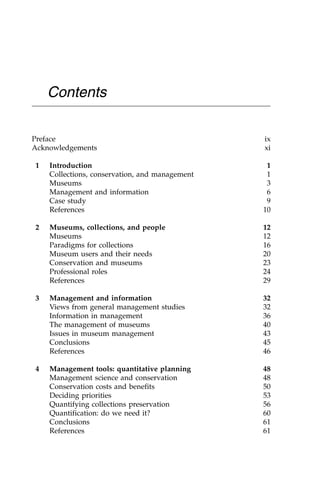
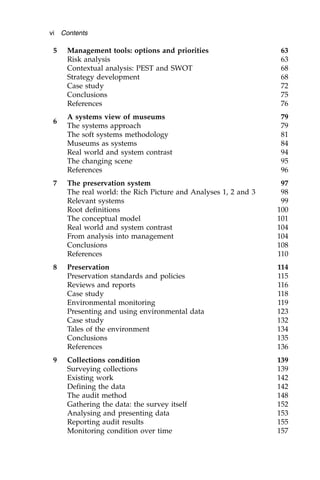
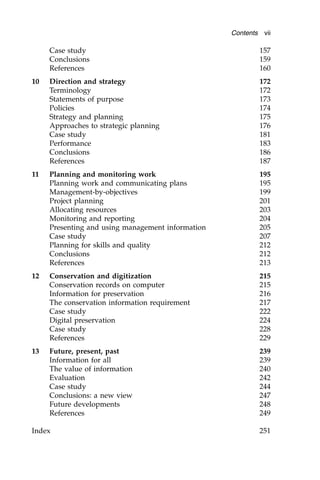

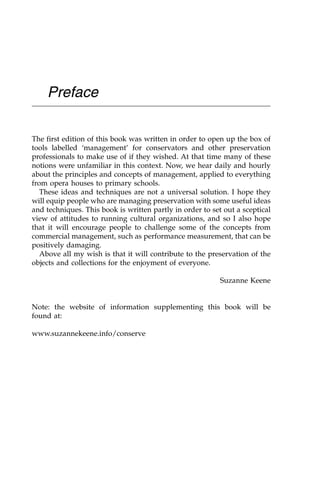


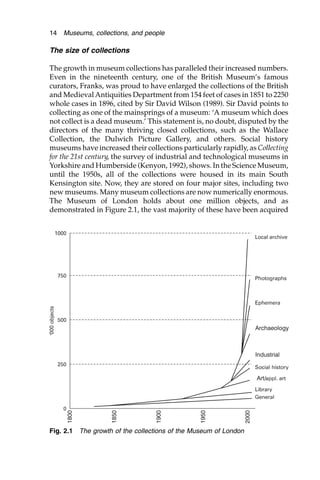
![any mission statement or management philosophy. Handy has described
different organizational cultures (1996). He sees four types of organiza-
tional culture, each personified as one of the Greek gods (the gods of
management) – the power culture (Zeus), the role culture (Apollo), the
task culture (Athene), and the people culture (Dionysus). Different work
groups may well have different perceptions of organizational culture, and
it may be that curators see themselves in terms of a steady state
Apollonian role culture, or possibly as unmanaged Dionysian stars, while
conservators, relatively newly arrived entrepreneurial team players, act
as efficient, busy, task orientated Athenians.
The earlier view of relationships is depicted in Figure 6.3. On the one
hand is the conservator, who really likes working on individual objects at
the bench. The conservator is swamped with requests from curators for
objects to be conserved. The work is being undertaken for curators’ high-
profile activities, for which the conservator will gain little credit. The
conservator is worrying about the state of the stored collections, and
thinks they would be better shut away in darkness.
On the other side of the diagram are curators. They are defending a
castle that is being undermined by conservators and others. Presiding
over the scene are government departments, who prefer to provide
funding for exhibitions and not for stores and collections care. At the
bottom of the heap are the visitors, who are oblivious to the dramas being
enacted in the rest of the organization.
This is a caricature, of course, and it is in many ways becoming
outdated. The sheer scale of the tasks involved in preserving huge
collections has meant that in many organizations conservators are
playing a more proactive management role, and playing it very well. The
National Trust, the Museum of London, most of the national museums,
all expect this.
Few people are politically incorrect enough to attack conservators in
print, while it seems to be open field to attack curators:
Why, for example, nearly half a century after the importance of
documentation and retrieval systems was first widely understood
and accepted in the domain, are curators still complaining about
lack of adequate collections data and information?
(Resource, 2001: p. 74)
In general we [curators] do not really apply the concept of
collections research, which illuminates the objects, and gives
perspectives, which on the one hand can guide us towards
selectivity rather than random in gathering, and on the other opens
new paths of knowledge.
(Fenton, 1992)
26 Museums, collections, and people](https://image.slidesharecdn.com/90002-250408160932-79e6a7ef/85/Managing-Conservation-in-Museums-2nd-Edition-Suzanne-Keene-43-320.jpg)
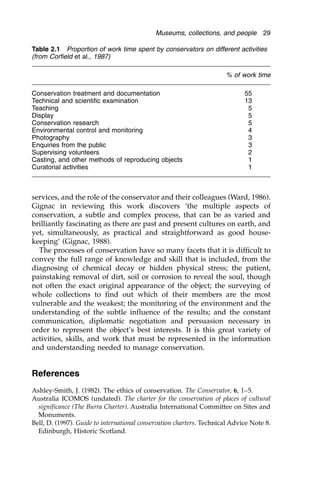




![This ebook is for the use of anyone anywhere in the United
States and most other parts of the world at no cost and with
almost no restrictions whatsoever. You may copy it, give it away
or re-use it under the terms of the Project Gutenberg License
included with this ebook or online at www.gutenberg.org. If you
are not located in the United States, you will have to check the
laws of the country where you are located before using this
eBook.
Title: Grand moving diorama of Hindostan
displaying the scenery of the Hoogly, the Bhagirathi,
and the Ganges, from Fort William, Bengal, to
Gangoutri, in the Himalaya
Author: Fanny Parkes Parlby
Illustrator: Louis Haghe
William Adolphus Knell
Philip Phillips
Release date: July 29, 2019 [eBook #60006]
Most recently updated: October 17, 2024
Language: English
Credits: Produced by Richard Tonsing, Chris Curnow and the
Online
Distributed Proofreading Team at http://www.pgdp.net
(This
file was produced from images generously made
available
by The Internet Archive)
*** START OF THE PROJECT GUTENBERG EBOOK GRAND MOVING
DIORAMA OF HINDOSTAN ***](https://image.slidesharecdn.com/90002-250408160932-79e6a7ef/85/Managing-Conservation-in-Museums-2nd-Edition-Suzanne-Keene-55-320.jpg)