Managing A Microsoft Windows Server 2003 Network
Enhanced 1st Edition M John Schitka download
https://ebookbell.com/product/managing-a-microsoft-windows-
server-2003-network-enhanced-1st-edition-m-john-schitka-2502800
Explore and download more ebooks at ebookbell.com
Here are some recommended products that we believe you will be
interested in. You can click the link to download.
Implementing Managing And Maintaining A Microsoft Windows Server 2003
Network Infrastructure J C Mackin
https://ebookbell.com/product/implementing-managing-and-maintaining-a-
microsoft-windows-server-2003-network-infrastructure-j-c-
mackin-4124456
70291 Implementing Managing And Maintaining A Microsoft Windows Server
2003 Network Infrastructure Package Microsoft Official Academic Course
Series 1st Edition Microsoft Official Academic Course
https://ebookbell.com/product/70291-implementing-managing-and-
maintaining-a-microsoft-windows-server-2003-network-infrastructure-
package-microsoft-official-academic-course-series-1st-edition-
microsoft-official-academic-course-4855948
Mcsamcse Selfpaced Training Kit Exam 70291 Implementing Managing And
Maintaining A Microsoft Windows Server 2003 Network Infrastructure
Implementing Servertm 2003 Network Infrastructure Jc Mackin
https://ebookbell.com/product/mcsamcse-selfpaced-training-kit-
exam-70291-implementing-managing-and-maintaining-a-microsoft-windows-
server-2003-network-infrastructure-implementing-servertm-2003-network-
infrastructure-jc-mackin-1368768
Mcsamcse 70291 Exam Cram Implementing Managing And Maintaining A
Microsoft Windows Server 2003 Network Infrastructure 2nd Edition Diana
Huggins
https://ebookbell.com/product/mcsamcse-70291-exam-cram-implementing-
managing-and-maintaining-a-microsoft-windows-server-2003-network-
infrastructure-2nd-edition-diana-huggins-10882038
Mcsa Mcse 70291 Exam Prep Implementing Managing And Maintaining A
Microsoft Windows Server 2003 Network Infrastructure 2nd Edition Will
Schmied
https://ebookbell.com/product/mcsa-mcse-70291-exam-prep-implementing-
managing-and-maintaining-a-microsoft-windows-server-2003-network-
infrastructure-2nd-edition-will-schmied-1714700
Microsoft Official Academic Course Managing And Maintaining A
Microsoft Windows Server 2003 Environment Exam 70290 Craig Zacker
https://ebookbell.com/product/microsoft-official-academic-course-
managing-and-maintaining-a-microsoft-windows-server-2003-environment-
exam-70290-craig-zacker-1424352
Insiderschoice To Mcsa Exam 70292 Windows Server 2003 Certification
Managing And Maintaining A Microsoft Windows Server 2003 Environment
For An Mcsa Certified On Windows Second Edition 1st Edition Deborah
Timmons Jada Brocksoldavini
https://ebookbell.com/product/insiderschoice-to-mcsa-
exam-70292-windows-server-2003-certification-managing-and-maintaining-
a-microsoft-windows-server-2003-environment-for-an-mcsa-certified-on-
windows-second-edition-1st-edition-deborah-timmons-jada-
brocksoldavini-51418502
Mcsamcse Selfpaced Training Kit Managing And Maintaining A Microsoft
Windows Server 2003 Exam 70290 Dan Holme
https://ebookbell.com/product/mcsamcse-selfpaced-training-kit-
managing-and-maintaining-a-microsoft-windows-
server-2003-exam-70290-dan-holme-923600
Mcsa Mcse Selfpaced Training Kit Exam 70290 Managing And Maintaining A
Microsoft Windows Server 2003 Environment Second Edition 2nd Dan Holme
https://ebookbell.com/product/mcsa-mcse-selfpaced-training-kit-
exam-70290-managing-and-maintaining-a-microsoft-windows-
server-2003-environment-second-edition-2nd-dan-holme-2184546
MCSE Guide to
Managing a Microsoft®
Windows®
Server 2003
Network, Enhanced
Jason W. Eckert
M. John Schitka
Brian McCann
Australia • Canada • Mexico • Singapore • Spain • United Kingdom • United States
MCSE Guide to Managing a Microsoft®
Windows®
Server 2003 Network, Enhanced
is published by Thomson Course Technology
Managing Editor:
William Pitkin III
Product Manager:
Nick Lombardi
Production Editors:
Elena Montillo
Kelly Robinson
Manufacturing Coordinator:
Melissa Hulse
MQA Technical Leader:
Christian Kunciw
Senior Marketing Manager:
Karen Seitz
Associate Product Manager:
Sarah Santoro
Editorial Assistant:
Jenny Smith
Cover Design:
Steven Deschene
Text Designer:
GEX Publishing Services
Compositor:
GEX Publishing Services
Copy Editor:
Mary Kemper
Proofreadrer:
Chris Smith
Indexer:
Paul Kish
COPYRIGHT © 2006 Thomson Course
Technology, a division of Thomson Learn-
ing, Inc. Thomson Learning™ is a trade-
mark used herein under license.
Printed in Canada
1 2 3 4 5 6 7 8 9 QWT 09 08 07 06 05
For more information, contact Course
Technology, 25 Thomson Place, Boston,
Massachusetts, 02210.
Or find us on the World Wide Web at:
www.course.com
ALL RIGHTS RESERVED. No part of this
work covered by the copyright hereon
may be reproduced or used in any
form or by any means—graphic, elec-
tronic, or mechanical, including photo-
copying, recording, taping, Web
distribution, or information storage and
retrieval systems—without the written
permission of the publisher.
For permission to use material from this
text or product, submit a request online
at www.thomsonrights.com. Any addi-
tional questions about permissions can be
submitted by e-mail to
thomsonrights@thomson.com.
Disclaimer
Thomson Course Technology reserves the
right to revise this publication and make
changes from time to time in its content
without notice.
ISBN 0-619-21753-7
BRIEF
Contents
CHAPTER ONE
Networking Overview 1
CHAPTER TWO
Configuring Network Protocols 27
CHAPTER THREE
TCP/IP Architecture 71
CHAPTER FOUR
Dynamic Host Configuration Protocol 99
CHAPTER FIVE
Managing and Monitoring DHCP 135
CHAPTER SIX
Name Resolution 157
CHAPTER SEVEN
Domain Name System 191
CHAPTER EIGHT
Windows Internet Naming Service 241
CHAPTER NINE
Securing Network Traffic Using IPSec 267
CHAPTER TEN
Remote Access 311
CHAPTER ELEVEN
Internet Authentication Service 369
CHAPTER TWELVE
Routing 395
CHAPTER THIRTEEN
Security Templates 435
CHAPTER FOURTEEN
Troubleshooting Windows Server 2003 Networks 461
APPENDIX A
Exam Objectives for MCSE/MCSA Certification 501
APPENDIX B
Detailed Lab Setup Guide 507
APPENDIX C
Expanded Chapter Summaries 511
Practice Exam 543
GLOSSARY 553
INDEX 567
iv MCSE Guide to Managing a Microsoft®
Windows®
Server 2003 Network
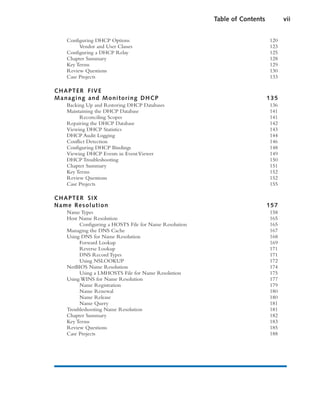
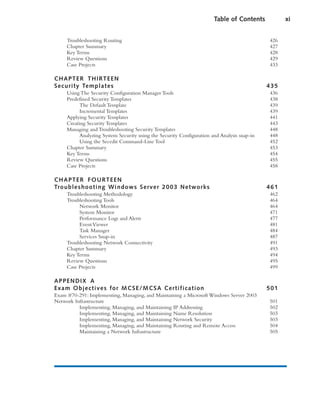
TABLE OF
Contents
INTRODUCTION XIII
CHAPTER ONE
Networking Overview 1
Defining Networks 2
Windows Server 2003 Editions 2
Web Edition 2
Standard Edition 3
Enterprise Edition 3
Datacenter Edition 4
Network Types and Protocols 8
Network Architecture 10
The OSI Model 11
The Windows Network Architecture 12
Common Network Services 14
Chapter Summary 18
Key Terms 18
Review Questions 21
Case Projects 24
CHAPTER TWO
Configuring Network Protocols 27
Overview of TCP/IP 28
Defining TCP/IP Parameters 29
IP Addresses 29
Subnet Masks 30
Default Gateway 32
DNS 34
WINS 35
Configuring TCP/IP Parameters 36
Working with TCP/IP Networks 40
IP Address Classes 40
Classless Inter-domain Routing 42
Reserved Addresses 42
Subnetting TCP/IP Networks 44
Reducing Collisions 44
Limiting Broadcasts 44
Controlling Traffic 45
Conversion between Binary and Decimal 45
Working with Binary IP Addresses and Subnet Masks 46
Creating Subnets 48
Supernetting TCP/IP Networks 51
Reasons for Supernetting 52
Configuring Other Protocols 53
IPX/SPX 53
Appletalk 56
Obsolete Protocols 57
Configuring Protocol Bindings 57
Chapter Summary 59
Key Terms 60
Review Questions 63
Case Projects 68
CHAPTER THREE
TCP/IP Architecture 71
TCP/IP Architecture Overview 72
Application Layer Protocols 73
HTTP 73
FTP 74
Telnet 75
SMTP 75
POP3 76
IMAP4 76
Transport Layer Protocols 76
TCP 78
UDP 82
TCP versus UDP 84
Internet Layer Protocols 84
IP 84
RIP and OSPF 84
ICMP 85
IGMP 87
ARP 87
Network Interface Layer Protocols 90
Chapter Summary 92
Key Terms 92
Review Questions 94
Case Projects 98
CHAPTER FOUR
Dynamic Host Configuration Protocol 99
DHCP Overview 100
Leasing an IP Address 101
Renewing an IP Address 102
Installing and Authorizing the DHCP Service 104
Installing the DHCP Service 104
Authorizing the DHCP Service 105
Configuring DHCP Scopes 110
Superscopes 113
Multicast Scopes 116
Creating DHCP Reservations 117
vi MCSE Guide to Managing a Microsoft®
Windows®
Server 2003 Network
Configuring DHCP Options 120
Vendor and User Classes 123
Configuring a DHCP Relay 125
Chapter Summary 128
Key Terms 129
Review Questions 130
Case Projects 133
CHAPTER FIVE
Managing and Monitoring DHCP 135
Backing Up and Restoring DHCP Databases 136
Maintaining the DHCP Database 141
Reconciling Scopes 141
Repairing the DHCP Database 142
Viewing DHCP Statistics 143
DHCP Audit Logging 144
Conflict Detection 146
Configuring DHCP Bindings 148
Viewing DHCP Events in EventViewer 149
DHCP Troubleshooting 150
Chapter Summary 151
Key Terms 152
Review Questions 152
Case Projects 155
CHAPTER SIX
Name Resolution 157
Name Types 158
Host Name Resolution 165
Configuring a HOSTS File for Name Resolution 165
Managing the DNS Cache 167
Using DNS for Name Resolution 168
Forward Lookup 169
Reverse Lookup 171
DNS Record Types 171
Using NSLOOKUP 172
NetBIOS Name Resolution 174
Using a LMHOSTS File for Name Resolution 175
Using WINS for Name Resolution 177
Name Registration 179
Name Renewal 180
Name Release 180
Name Query 181
Troubleshooting Name Resolution 181
Chapter Summary 182
Key Terms 183
Review Questions 185
Case Projects 188
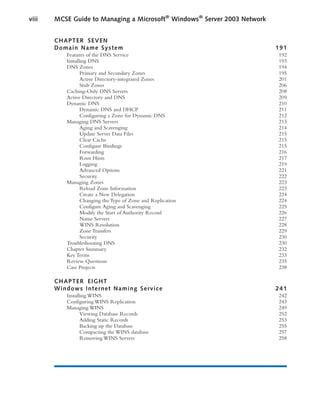
Table of Contents vii
CHAPTER SEVEN
Domain Name System 191
Features of the DNS Service 192
Installing DNS 193
DNS Zones 194
Primary and Secondary Zones 195
Active Directory-integrated Zones 201
Stub Zones 206
Caching-Only DNS Servers 208
Active Directory and DNS 209
Dynamic DNS 210
Dynamic DNS and DHCP 211
Configuring a Zone for Dynamic DNS 212
Managing DNS Servers 213
Aging and Scavenging 214
Update Server Data Files 215
Clear Cache 215
Configure Bindings 215
Forwarding 216
Root Hints 217
Logging 219
Advanced Options 221
Security 222
Managing Zones 223
Reload Zone Information 223
Create a New Delegation 224
Changing the Type of Zone and Replication 224
Configure Aging and Scavenging 225
Modify the Start of Authority Record 226
Name Servers 227
WINS Resolution 228
Zone Transfers 229
Security 230
Troubleshooting DNS 230
Chapter Summary 232
Key Terms 233
Review Questions 235
Case Projects 238
CHAPTER EIGHT
Windows Internet Naming Service 241
Installing WINS 242
Configuring WINS Replication 243
Managing WINS 249
Viewing Database Records 252
Adding Static Records 253
Backing up the Database 255
Compacting the WINS database 257
Removing WINS Servers 258
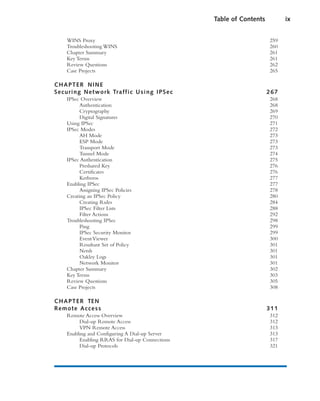
viii MCSE Guide to Managing a Microsoft®
Windows®
Server 2003 Network
WINS Proxy 259
Troubleshooting WINS 260
Chapter Summary 261
Key Terms 261
Review Questions 262
Case Projects 265
CHAPTER NINE
Securing Network Traffic Using IPSec 267
IPSec Overview 268
Authentication 268
Cryptography 269
Digital Signatures 270
Using IPSec 271
IPSec Modes 272
AH Mode 273
ESP Mode 273
Transport Mode 273
Tunnel Mode 274
IPSec Authentication 275
Preshared Key 276
Certificates 276
Kerberos 277
Enabling IPSec 277
Assigning IPSec Policies 278
Creating an IPSec Policy 280
Creating Rules 284
IPSec Filter Lists 288
Filter Actions 292
Troubleshooting IPSec 298
Ping 299
IPSec Security Monitor 299
EventViewer 300
Resultant Set of Policy 301
Netsh 301
Oakley Logs 301
Network Monitor 301
Chapter Summary 302
Key Terms 303
Review Questions 305
Case Projects 308
CHAPTER TEN
Remote Access 311
Remote Access Overview 312
Dial-up Remote Access 312
VPN Remote Access 313
Enabling and Configuring A Dial-up Server 313
Enabling RRAS for Dial-up Connections 317
Dial-up Protocols 321
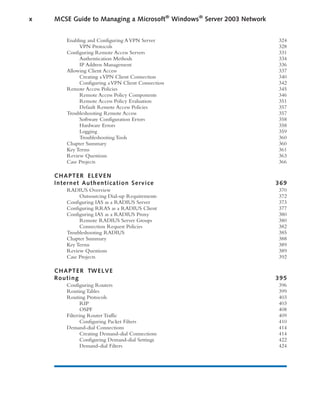
Table of Contents ix
Enabling and Configuring AVPN Server 324
VPN Protocols 328
Configuring Remote Access Servers 331
Authentication Methods 334
IP Address Management 336
Allowing Client Access 337
Creating aVPN Client Connection 340
Configuring aVPN Client Connection 342
Remote Access Policies 345
Remote Access Policy Components 346
Remote Access Policy Evaluation 351
Default Remote Access Policies 357
Troubleshooting Remote Access 357
Software Configuration Errors 358
Hardware Errors 358
Logging 359
Troubleshooting Tools 360
Chapter Summary 360
Key Terms 361
Review Questions 363
Case Projects 366
CHAPTER ELEVEN
Internet Authentication Service 369
RADIUS Overview 370
Outsourcing Dial-up Requirements 372
Configuring IAS as a RADIUS Server 373
Configuring RRAS as a RADIUS Client 377
Configuring IAS as a RADIUS Proxy 380
Remote RADIUS Server Groups 380
Connection Request Policies 382
Troubleshooting RADIUS 385
Chapter Summary 388
Key Terms 389
Review Questions 389
Case Projects 392
CHAPTER TWELVE
Routing 395
Configuring Routers 396
Routing Tables 399
Routing Protocols 403
RIP 403
OSPF 408
Filtering Router Traffic 409
Configuring Packet Filters 410
Demand-dial Connections 414
Creating Demand-dial Connections 414
Configuring Demand-dial Settings 422
Demand-dial Filters 424
x MCSE Guide to Managing a Microsoft®
Windows®
Server 2003 Network
Troubleshooting Routing 426
Chapter Summary 427
Key Terms 428
Review Questions 429
Case Projects 433
CHAPTER THIRTEEN
Security Templates 435
Using The Security Configuration Manager Tools 436
Predefined Security Templates 438
The Default Template 439
Incremental Templates 439
Applying Security Templates 441
Creating Security Templates 443
Managing and Troubleshooting Security Templates 448
Analyzing System Security using the Security Configuration and Analysis snap-in 448
Using the Secedit Command-Line Tool 452
Chapter Summary 453
Key Terms 454
Review Questions 455
Case Projects 458
CHAPTER FOURTEEN
Troubleshooting Windows Server 2003 Networks 461
Troubleshooting Methodology 462
Troubleshooting Tools 464
Network Monitor 464
System Monitor 471
Performance Logs and Alerts 477
EventViewer 481
Task Manager 484
Services Snap-in 487
Troubleshooting Network Connectivity 491
Chapter Summary 493
Key Terms 494
Review Questions 495
Case Projects 499
APPENDIX A
Exam Objectives for MCSE/MCSA Certification 501
Exam #70-291: Implementing, Managing, and Maintaining a Microsoft Windows Server 2003
Network Infrastructure 501
Implementing, Managing, and Maintaining IP Addressing 502
Implementing, Managing, and Maintaining Name Resolution 503
Implementing, Managing, and Maintaining Network Security 503
Implementing, Managing, and Maintaining Routing and Remote Access 504
Maintaining a Network Infrastructure 505
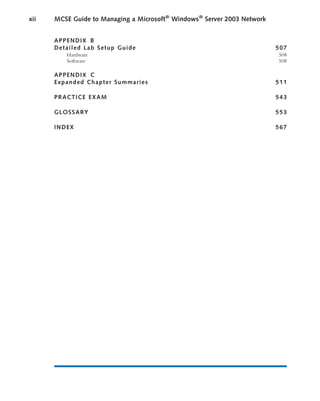
Table of Contents xi
APPENDIX B
Detailed Lab Setup Guide 507
Hardware 508
Software 508
APPENDIX C
Expanded Chapter Summaries 511
PRACTICE EXAM 543
GLOSSARY 553
INDEX 567
xii MCSE Guide to Managing a Microsoft®
Windows®
Server 2003 Network
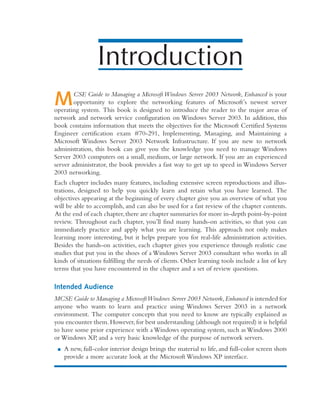
Introduction
MCSE Guide to Managing a Microsoft Windows Server 2003 Network, Enhanced is your
opportunity to explore the networking features of Microsoft’s newest server
operating system. This book is designed to introduce the reader to the major areas of
network and network service configuration on Windows Server 2003. In addition, this
book contains information that meets the objectives for the Microsoft Certified Systems
Engineer certification exam #70-291, Implementing, Managing, and Maintaining a
Microsoft Windows Server 2003 Network Infrastructure. If you are new to network
administration, this book can give you the knowledge you need to manage Windows
Server 2003 computers on a small, medium, or large network. If you are an experienced
server administrator, the book provides a fast way to get up to speed in Windows Server
2003 networking.
Each chapter includes many features, including extensive screen reproductions and illus-
trations, designed to help you quickly learn and retain what you have learned. The
objectives appearing at the beginning of every chapter give you an overview of what you
will be able to accomplish, and can also be used for a fast review of the chapter contents.
At the end of each chapter,there are chapter summaries for more in-depth point-by-point
review. Throughout each chapter, you’ll find many hands-on activities, so that you can
immediately practice and apply what you are learning. This approach not only makes
learning more interesting, but it helps prepare you for real-life administration activities.
Besides the hands-on activities, each chapter gives you experience through realistic case
studies that put you in the shoes of a Windows Server 2003 consultant who works in all
kinds of situations fulfilling the needs of clients. Other learning tools include a list of key
terms that you have encountered in the chapter and a set of review questions.
Intended Audience
MCSE Guide to Managing a MicrosoftWindows Server 2003 Network,Enhanced is intended for
anyone who wants to learn and practice using Windows Server 2003 in a network
environment. The computer concepts that you need to know are typically explained as
you encounter them.However,for best understanding (although not required) it is helpful
to have some prior experience with a Windows operating system, such as Windows 2000
or Windows XP, and a very basic knowledge of the purpose of network servers.
■ A new, full-color interior design brings the material to life, and full-color screen shots
provide a more accurate look at the Microsoft Windows XP interface.
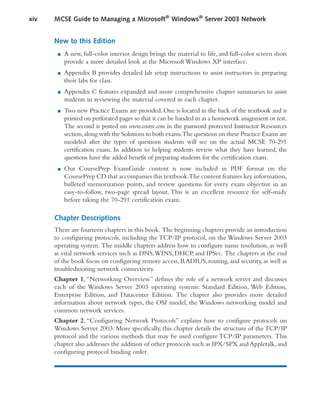
New to this Edition
■ A new, full-color interior design brings the material to life, and full-color screen shots
provide a more detailed look at the Microsoft Windows XP interface.
■ Appendix B provides detailed lab setup instructions to assist instructors in preparing
their labs for class.
■ Appendix C features expanded and more comprehensive chapter summaries to assist
students in reviewing the material covered in each chapter.
■ Two new Practice Exams are provided. One is located in the back of the textbook and is
printed on perforated pages so that it can be handed in as a homework assignment or test.
The second is posted on www.course.com in the password protected Instructor Resources
section,along with the Solutions to both exams.The questions on these Practice Exams are
modeled after the types of questions students will see on the actual MCSE 70-291
certification exam. In addition to helping students review what they have learned, the
questions have the added benefit of preparing students for the certification exam.
■ Our CoursePrep ExamGuide content is now included in PDF format on the
CoursePrep CD that accompanies this textbook.The content features key information,
bulleted memorization points, and review questions for every exam objective in an
easy-to-follow, two-page spread layout. This is an excellent resource for self-study
before taking the 70-291 certification exam.
Chapter Descriptions
There are fourteen chapters in this book. The beginning chapters provide an introduction
to configuring protocols, including the TCP/IP protocol, on the Windows Server 2003
operating system. The middle chapters address how to configure name resolution, as well
as vital network services such as DNS,WINS, DHCP, and IPSec. The chapters at the end
of the book focus on configuring remote access, RADIUS, routing, and security, as well as
troubleshooting network connectivity.
Chapter 1, “Networking Overview” defines the role of a network server and discusses
each of the Windows Server 2003 operating systems: Standard Edition, Web Edition,
Enterprise Edition, and Datacenter Edition. The chapter also provides more detailed
information about network types, the OSI model, the Windows networking model and
common network services.
Chapter 2, “Configuring Network Protocols” explains how to configure protocols on
Windows Server 2003. More specifically, this chapter details the structure of the TCP/IP
protocol and the various methods that may be used configure TCP/IP parameters. This
chapter also addresses the addition of other protocols such as IPX/SPX and Appletalk,and
configuring protocol binding order.
xiv MCSE Guide to Managing a Microsoft®
Windows®
Server 2003 Network
Chapter 3, “TCP/IP Architecture” examines the structure of the TCP/IP protocol
suite and how it relates to the OSI model. In addition, this chapter focuses on the
structure of the protocols used at theTransport,Internet,and Network Interface layers.
Chapter 4,“Dynamic Host Configuration Protocol”explains how DHCP may be used to
simplify network administration as well as how to configure it onWindows Server 2003.
This chapter discusses the installation of the DHCP service,the creation of DHCP scopes
and the configuration of DHCP server options, reservations, classes, and DHCP relay
agents.
Chapter 5, “Managing and Monitoring DHCP” teaches you how to manage the
DHCP database. This includes DHCP database backup, scope maintenance, as well as
gathering DHCP statistics, reading event logs and audit logs to troubleshoot common
problems related to the DHCP service.
Chapter 6, “Name Resolution” provides information about the different types of
names used on Windows networks and how to configure them. In addition, you learn
how to manage host name and NetBIOS name resolution on the network.
Chapter 7,“Domain Name System” shows you how to configure the DNS service on
Windows Server 2003.More specifically,you learn how to install the DNS service,as well
as how to plan,create,and manage DNS zones. Also,this chapter discusses the integration
of DNS and Active Directory, as well as common DNS troubleshooting tools and
procedures.
Chapter 8,“Windows Internet Naming Service”focuses on how to install and configure
the WINS service on a Windows Server 2003 network to provide NetBIOS name
resolution. WINS replication, proxy agents, and troubleshooting procedures are also
addressed.
Chapter 9, “Securing Network Traffic Using IPSec” enables you to learn how to
configure IPSec onWindows Server 2003 to provide security for theTCP/IP protocol.
You learn the different modes and authentication types that IPSec uses, how to create
IPSec policies, and how to apply IPSec policies to a computer. In addition, you learn
how to troubleshoot computers that use IPSec.
Chapter 10,“Remote Access”discusses the use of remote access on aWindows Server
2003 network.More specifically,you learn how to configure the Routing and Remote
Access service on Windows Server 2003 to allow dial-up and VPN connections. As
well, you learn how to use RRAS policies to restrict remote access connections.
Chapter 11,“Internet Authentication Service” teaches you how the Internet Authen-
tication Service may be used onWindows Server 2003 to create RADIUS servers and
centralize the authentication and logging among several remote access servers. More
specifically, you learn how to configure Windows Server 2003 as a RADIUS server,
RADIUS client, and a RADIUS proxy.
Introduction xv
Chapter 12, “Routing” examines how Windows Server 2003 can provide routing for
different IP networks. The first half of this chapter introduces you to the structure of
routing tables and the different methods that can be used to create routing table entries.
Common routing protocols, packet filters, and demand-dial routing are introduced in the
second half of this chapter.
Chapter 13,“SecurityTemplates” teaches you how to create and apply security templates to
computers on a Windows Server 2003 network to maximize network security. This chapter
introduces you to default security templates and their application,as well as how to create and
modify security templates to meet organizational needs.
Chapter 14,“Troubleshooting Windows Server 2003 Networks” enables you to develop
problem-solving strategies for handling server difficulties. Specifically, you learn how to
resolve connectivity problems, monitor key services, and use standard utilities to trouble-
shoot various networking-related problems.
Features and Approach
MCSE Guide to Managing a Microsoft Windows Server 2003 Network, Enhanced is one in a
series of CourseTechnology Hands-on books that differ from other server and networking
books by offering a unique hands-on approach and orientation to real-world situations and
problem solving. To help you comprehend how Microsoft Windows Server 2003 and
network management concepts and techniques are applied in real-world organizations,this
book incorporates the following features:
■ Chapter Objectives — Each chapter begins with a detailed list of the concepts to be
mastered. This list gives you a quick reference to the chapter’s contents and is a useful
study aid.
■ Activities — Hands-on activities are incorporated throughout the text, giving you
practice in setting up, managing, and troubleshooting a network system. The activities
give you a strong foundation for carrying out network administration tasks in the real
world. Because of this book’s progressive nature, completing the hands-on activities is
essential before moving on to the end-of-chapter projects and subsequent chapters.
■ Chapter Summary — Each chapter’s text is followed by a summary of the concepts
introduced in that chapter. These summaries provide a helpful way to recap and revisit
the ideas covered in each chapter.
■ Key Terms — All of the terms within the chapter that were introduced with boldfaced
text are gathered together in the KeyTerms list at the end of the chapter. This provides you
with a method of checking your understanding of all the terms introduced.
■ Review Questions — The end-of-chapter assessment begins with a set of review
questions that reinforce the ideas introduced in each chapter. Answering these ques-
tions will ensure that you have mastered the important concepts.
xvi MCSE Guide to Managing a Microsoft®
Windows®
Server 2003 Network
■ Case Projects — Each chapter closes with a section that proposes certain
situations. You are asked to evaluate the situations and decide upon the course of
action to be taken to remedy the problems described. This valuable tool will help
you sharpen your decision-making and troubleshooting skills, which are important
aspects of network administration.
■ Tear-Out Practice Exam — A 50 question tear-out practice exam is included in
the back of the text. The questions are modeled after the actual MCSE certification
exam and are on perforated pages so students can hand them in as an assignment or
an exam. The answers to the Practice Exam are included as part of the Instructor
Resources.
■ On the CD ROM — The CD-ROM includes CoursePrep®
test preparation
software,which provides sample MCSE exam questions mirroring the look and feel
of the MCSE exams. The CD also contains a complete CoursePrep ExamGuide
workbook in PDF format. It devotes an entire two-page spread to every exam
objective, featuring bulleted memorization points and review questions for self-
study before exam day.
Text and Graphic Conventions
Additional information and exercises have been added to this book to help you better
understand what’s being discussed in the chapter. Icons throughout the text alert you
to these additional materials. The icons used in this book are described below.
Tips offer extra information on resources, how to attack problems, and time-saving
shortcuts.
Notes present additional helpful material related to the subject being discussed.
The Caution icon identifies important information about potential mistakes or hazards.
Each Activity in this book is preceded by the Activity icon.
Introduction xvii
Case project icons mark the end-of-chapter case projects, which are scenario-based assign-
ments that ask you to independently apply what you have learned in the chapter.
Instructor Resources
The following supplemental materials are available when this book is used in a classroom
setting. All of the supplements available with this book are provided to the instructor on a
single CD-ROM.
Electronic Instructor’s Manual. The Instructor’s Manual that accompanies this text-
book includes additional instructional material to assist in class preparation, including
suggestions for classroom activities, discussion topics, and additional activities.
Solutions. Solutions are provided for the end-of-chapter material, including Review
Questions, and, where applicable, Hands-on Activities and Case Projects. Solutions to the
Practice Exams are also included.
ExamView®
. This textbook is accompanied by ExamView, a powerful testing software
package that allows instructors to create and administer printed, computer (LAN-based),
and Internet exams. ExamView includes hundreds of questions that correspond to the
topics covered in this text, enabling students to generate detailed study guides that include
page references for further review. The computer-based and Internet testing components
allow students to take exams at their computers and also save the instructor time by grading
each exam automatically.
Practice Exam. A second 50-question Practice Exam is included as part of the Instructor
Resources.Like theTear-out Practice Exam in the text,the questions are modeled after the
actual MCSE certification exam. The answers to this exam are also included as part of the
Instructor Resources.
PowerPoint presentations. This book comes with Microsoft PowerPoint slides for each
chapter. These are included as a teaching aid for classroom presentation, to make available to
students on the network for chapter review, or to be printed for classroom distribution.
Instructors, please feel at liberty to add your own slides for additional topics you introduce to
the class.
Figure files. All of the figures and tables in the book are reproduced on the Instructor’s
Resource CD, in bitmap format. Similar to the PowerPoint presentations, these are
included as a teaching aid for classroom presentation, to make available to students for
review, or to be printed for classroom distribution.
xviii MCSE Guide to Managing a Microsoft®
Windows®
Server 2003 Network
Minimum Lab Requirements
■ Hardware
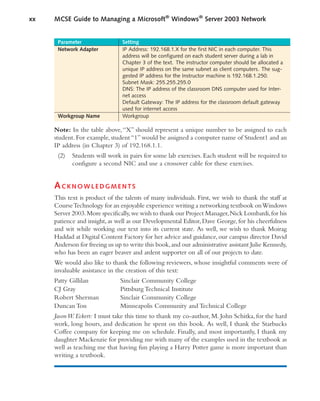
All hardware in the computer should be listed on the Hardware Compatibility List
available at www.microsoft.com.
Component Requirement
CPU Pentium 133 MHz (550 MHz or higher is recommended)
Memory 128 MB RAM (256 MB RAM recommended)
Disk Space 2 GB of free space (4 GB of free space recommended)
Drives CD-ROM
Floppy Disk
Networking Two network interface cards per computer for network communications
and labs
Internet access via a router or NAT device
All lab computers should be networked.
Students will work in pairs for some lab exercises.
Every computer should have two network adapters.
A crossover cable is required for each pair of computers during later
exercises.
■ Software
Microsoft Windows Server 2003 Enterprise Edition
The latest Windows Server 2003 Service Pack (if available)
■ Set Up Instructions
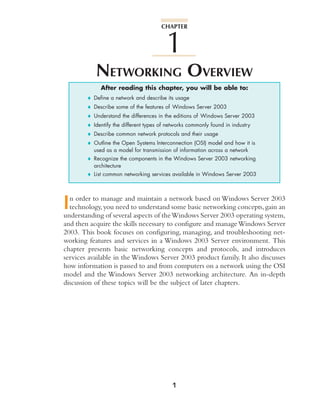
To successfully complete the Activities, set up the classroom computers as listed below:
(1) Ensure that all hardware used in the classroom is compatible with Windows
Server 2003. To do this, it may be necessary to perform a test installation. Once
the installation process is complete, use Device Manager to ensure that all
devices are functioning correctly.
Windows Server 2003 will be installed onto drive C: of the instructor and student
servers in the first chapter. The following specific parameters will be configured on
individual servers during and after the installation process:
Parameter Setting
Disk Partitioning Students create a 2-GB NTFS partition during the installation process.
Computer Names Instructor (instructor computer), StudentX (student servers)
Administrator Password Secret
Components Default Settings
Introduction xix
Parameter Setting
Network Adapter IP Address: 192.168.1.X for the first NIC in each computer. This
address will be configured on each student server during a lab in
Chapter 3 of the text. The instructor computer should be allocated a
unique IP address on the same subnet as client computers. The sug-
gested IP address for the Instructor machine is 192.168.1.250.
Subnet Mask: 255.255.255.0
DNS: The IP address of the classroom DNS computer used for Inter-
net access
Default Gateway: The IP address for the classroom default gateway
used for internet access
Workgroup Name Workgroup
Note: In the table above,“X” should represent a unique number to be assigned to each
student. For example, student “1” would be assigned a computer name of Student1 and an
IP address (in Chapter 3) of 192.168.1.1.
(2) Students will work in pairs for some lab exercises. Each student will be required to
configure a second NIC and use a crossover cable for these exercises.
ACKNOWLEDGMENTS
This text is product of the talents of many individuals. First, we wish to thank the staff at
CourseTechnology for an enjoyable experience writing a networking textbook onWindows
Server 2003.More specifically,we wish to thank our Project Manager,Nick Lombardi,for his
patience and insight, as well as our Developmental Editor, Dave George, for his cheerfulness
and wit while working our text into its current state. As well, we wish to thank Moirag
Haddad at Digital Content Factory for her advice and guidance,our campus director David
Anderson for freeing us up to write this book,and our administrative assistant Julie Kennedy,
who has been an eager beaver and ardent supporter on all of our projects to date.
We would also like to thank the following reviewers, whose insightful comments were of
invaluable assistance in the creation of this text:
Patty Gillilan Sinclair Community College
CJ Gray Pittsburg Technical Institute
Robert Sherman Sinclair Community College
Duncan Ton Minneapolis Community and Technical College
JasonW
. Eckert: I must take this time to thank my co-author, M. John Schitka, for the hard
work, long hours, and dedication he spent on this book. As well, I thank the Starbucks
Coffee company for keeping me on schedule. Finally, and most importantly, I thank my
daughter Mackenzie for providing me with many of the examples used in the textbook as
well as teaching me that having fun playing a Harry Potter game is more important than
writing a textbook.
xx MCSE Guide to Managing a Microsoft®
Windows®
Server 2003 Network
M. John Schitka: First I want to thank my mentor and co-author Jason W. Eckert for his
insight, patience, and wisdom during the long hours and late nights that went into the
creation of this book.More importantly,I must thank my wife Jill,and children Kyra,Luke,
and Noah for their support, tolerance, and patience during the time it took to write the
book. Hopefully the readers will find it enlightening and of benefit in their educational
journey.
Readers are encouraged to e-mail comments, questions, and suggestions regarding
MCSE Guide to Managing a Microsoft Windows Server 2003 Network to the authors:
Jason W. Eckert: jasonec@trios.com
M. John Schitka: johnsc@trios.com
DEDICATION
In memory of Wallace Weber
Introduction xxi
This page intentionally left blank
NETWORKING OVERVIEW
After reading this chapter, you will be able to:
♦ Define a network and describe its usage
♦ Describe some of the features of Windows Server 2003
♦ Understand the differences in the editions of Windows Server 2003
♦ Identify the different types of networks commonly found in industry
♦ Describe common network protocols and their usage
♦ Outline the Open Systems Interconnection (OSI) model and how it is
used as a model for transmission of information across a network
♦ Recognize the components in the Windows Server 2003 networking
architecture
♦ List common networking services available in Windows Server 2003
In order to manage and maintain a network based on Windows Server 2003
technology,you need to understand some basic networking concepts,gain an
understanding of several aspects of theWindows Server 2003 operating system,
and then acquire the skills necessary to configure and manageWindows Server
2003. This book focuses on configuring, managing, and troubleshooting net-
working features and services in a Windows 2003 Server environment. This
chapter presents basic networking concepts and protocols, and introduces
services available in the Windows Server 2003 product family. It also discusses
how information is passed to and from computers on a network using the OSI
model and the Windows Server 2003 networking architecture. An in-depth
discussion of these topics will be the subject of later chapters.
CHAPTER
1
1
DEFINING NETWORKS
Most functions that computers perform today involve the sharing and exchange of infor-
mation between computers. Information is usually transmitted from computer to computer
via media such as fiber-optic, telephone, coaxial, shielded twisted-pair (STP) or unshielded
twisted-pair (UTP) cable,though it can also be transmitted via wireless media such as radio,
microwaves,or infrared waves.This media typically attaches to the computer via a peripheral
card known as an adapter, such as a network interface card (NIC) or modem device.
Two or more computers connected with media that can exchange information are called a
network. Computers on a network that share information or other resources, such as
printers, are called servers, whereas computers that access those resources are referred to as
clients. A single computer may be referred to as both a server and a client if it shares
resources to other computers on a network as well as accesses resources on other computers
on the network.
Windows Server 2003 is an operating system designed to share many resources to other
operating systems on a network;thus it is often called a network operating system (NOS).
Windows Server 2003 is the latest NOS from Microsoft. It retains and enhances the
functionality and services found on Microsoft’s previous NOS releases,Windows 2000 and
Windows NT4.
WINDOWS SERVER 2003 EDITIONS
There are multiple versions (or editions) of Windows Server 2003.Each version is designed
to meet the needs of certain market segments that Microsoft has targeted. The four versions
are: Web Edition, Standard Edition, Enterprise Edition, and Datacenter Edition. The
following section will explore their features and differences.
Web Edition
Windows Server 2003,Web Edition,is a lower-cost version of Windows Server 2003 that is
optimized to be a dedicated Web server. This version is meant to counter Linux in the
market for utility servers. Windows Server 2003,Web Edition, provides the easy manage-
ability and performance of Windows without the complexity of Linux.
Some unique features of Web Edition are:
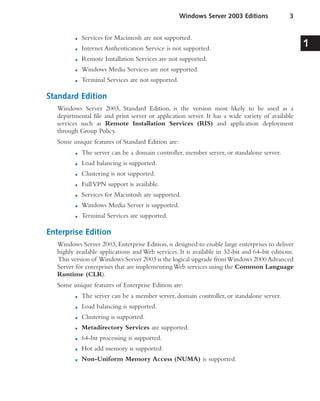
■ The server must be a member server or standalone server.
■ Load balancing is supported.
■ Clustering is not supported.
■ Virtual private network (VPN) support is limited.
2 Chapter 1 Networking Overview
■ Services for Macintosh are not supported.
■ Internet Authentication Service is not supported.
■ Remote Installation Services are not supported.
■ Windows Media Services are not supported.
■ Terminal Services are not supported.
Standard Edition
Windows Server 2003, Standard Edition, is the version most likely to be used as a
departmental file and print server or application server. It has a wide variety of available
services such as Remote Installation Services (RIS) and application deployment
through Group Policy.
Some unique features of Standard Edition are:
■ The server can be a domain controller, member server, or standalone server.
■ Load balancing is supported.
■ Clustering is not supported.
■ FullVPN support is available.
■ Services for Macintosh are supported.
■ Windows Media Server is supported.
■ Terminal Services are supported.
Enterprise Edition
Windows Server 2003, Enterprise Edition, is designed to enable large enterprises to deliver
highly available applications and Web services. It is available in 32-bit and 64-bit editions.
This version of Windows Server 2003 is the logical upgrade fromWindows 2000 Advanced
Server for enterprises that are implementing Web services using the Common Language
Runtime (CLR).
Some unique features of Enterprise Edition are:
■ The server can be a member server, domain controller, or standalone server.
■ Load balancing is supported.
■ Clustering is supported.
■ Metadirectory Services are supported.
■ 64-bit processing is supported.
■ Hot add memory is supported.
■ Non-Uniform Memory Access (NUMA) is supported.
Windows Server 2003 Editions 3
1
Datacenter Edition
Windows Server 2003, Datacenter Edition, is designed for mission-critical applications that
require the highest levels of availability and scalability. It is available in 32-bit and 64-bit
editions.
Unlike other versions of Windows Server 2003, Datacenter Edition cannot be bought as
retail software. It can only be bought through qualified Microsoft partners. Most of the
Microsoft partners are original equipment manufacturers (OEMs). Microsoft partners
submit a server and drivers to Microsoft for testing. Only after Microsoft has approved the
hardware and driver combination can it be sold to customers.
A team from Microsoft and the Microsoft partner provide support.Only this team is allowed
to install and support Datacenter Edition. The customer can add users and make application
adjustments, but cannot add, update, or remove drivers and hardware.
Some unique features of Datacenter Edition are:
■ The server can be a member server, domain controller, or standalone server.
■ Load balancing is supported.
■ Clustering is supported.
■ Metadirectory Services are not supported.
■ 64-bit processing is supported.
■ Hot add memory is supported.
■ Non-Uniform Memory Access (NUMA) is supported.
■ Datacenter program is required.
■ Internet Connection Firewall (ICF) is not supported.
Since each edition of Windows Server 2003 has different features and purposes, the
minimum hardware requirement for each also differs. Also, since Windows Server 2003 is
available on the Intel 32-bit Pentium platform as well as the Intel 64-bit Itanium platform,
minimum requirements are different for each platform as well. Table 1-1 compares the
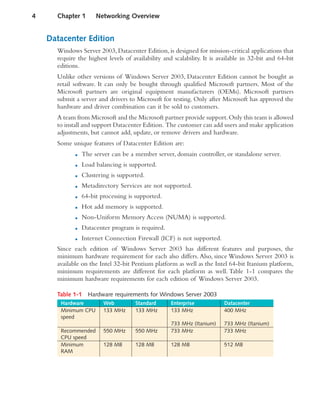
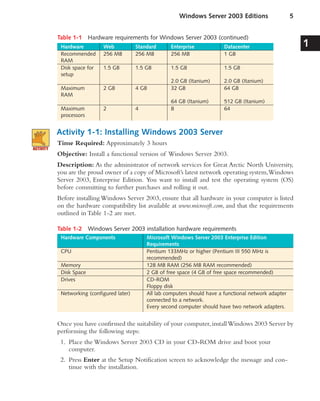
minimum hardware requirements for each edition of Windows Server 2003.
Table 1-1 Hardware requirements for Windows Server 2003
Hardware Web Standard Enterprise Datacenter
Minimum CPU
speed
133 MHz 133 MHz 133 MHz
733 MHz (Itanium)
400 MHz
733 MHz (Itanium)
Recommended
CPU speed
550 MHz 550 MHz 733 MHz 733 MHz
Minimum
RAM
128 MB 128 MB 128 MB 512 MB
4 Chapter 1 Networking Overview
Table 1-1 Hardware requirements for Windows Server 2003 (continued)
Hardware Web Standard Enterprise Datacenter
Recommended
RAM
256 MB 256 MB 256 MB 1 GB
Disk space for
setup
1.5 GB 1.5 GB 1.5 GB
2.0 GB (Itanium)
1.5 GB
2.0 GB (Itanium)
Maximum
RAM
2 GB 4 GB 32 GB
64 GB (Itanium)
64 GB
512 GB (Itanium)
Maximum
processors
2 4 8 64
Activity 1-1: Installing Windows 2003 Server
Time Required: Approximately 3 hours
Objective: Install a functional version of Windows Server 2003.
Description: As the administrator of network services for Great Arctic North University,
you are the proud owner of a copy of Microsoft’s latest network operating system,Windows
Server 2003, Enterprise Edition. You want to install and test the operating system (OS)
before committing to further purchases and rolling it out.
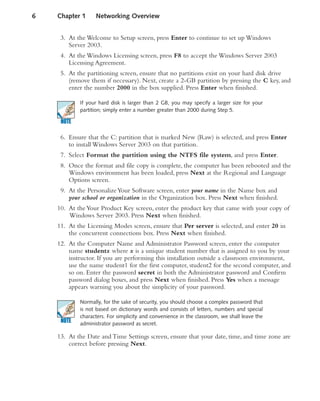
Before installing Windows Server 2003, ensure that all hardware in your computer is listed
on the hardware compatibility list available at www.microsoft.com, and that the requirements
outlined in Table 1-2 are met.
Table 1-2 Windows Server 2003 installation hardware requirements
Hardware Components Microsoft Windows Server 2003 Enterprise Edition
Requirements
CPU Pentium 133MHz or higher (Pentium III 550 MHz is
recommended)
Memory 128 MB RAM (256 MB RAM recommended)
Disk Space 2 GB of free space (4 GB of free space recommended)
Drives CD-ROM
Floppy disk
Networking (configured later) All lab computers should have a functional network adapter
connected to a network.
Every second computer should have two network adapters.
Once you have confirmed the suitability of your computer, installWindows 2003 Server by
performing the following steps:
1. Place the Windows Server 2003 CD in your CD-ROM drive and boot your
computer.
2. Press Enter at the Setup Notification screen to acknowledge the message and con-
tinue with the installation.
Windows Server 2003 Editions 5
1
3. At the Welcome to Setup screen, press Enter to continue to set up Windows
Server 2003.
4. At the Windows Licensing screen, press F8 to accept the Windows Server 2003
Licensing Agreement.
5. At the partitioning screen, ensure that no partitions exist on your hard disk drive
(remove them if necessary). Next, create a 2-GB partition by pressing the C key, and
enter the number 2000 in the box supplied. Press Enter when finished.
If your hard disk is larger than 2 GB, you may specify a larger size for your
partition; simply enter a number greater than 2000 during Step 5.
6. Ensure that the C: partition that is marked New (Raw) is selected, and press Enter
to install Windows Server 2003 on that partition.
7. Select Format the partition using the NTFS file system, and press Enter.
8. Once the format and file copy is complete, the computer has been rebooted and the
Windows environment has been loaded, press Next at the Regional and Language
Options screen.
9. At the PersonalizeYour Software screen, enter your name in the Name box and
your school or organization in the Organization box. Press Next when finished.
10. At theYour Product Key screen, enter the product key that came with your copy of
Windows Server 2003. Press Next when finished.
11. At the Licensing Modes screen, ensure that Per server is selected, and enter 20 in
the concurrent connections box. Press Next when finished.
12. At the Computer Name and Administrator Password screen, enter the computer
name studentx where x is a unique student number that is assigned to you by your
instructor. If you are performing this installation outside a classroom environment,
use the name student1 for the first computer, student2 for the second computer, and
so on. Enter the password secret in both the Administrator password and Confirm
password dialog boxes, and press Next when finished. Press Yes when a message
appears warning you about the simplicity of your password.
Normally, for the sake of security, you should choose a complex password that
is not based on dictionary words and consists of letters, numbers and special
characters. For simplicity and convenience in the classroom, we shall leave the
administrator password as secret.
13. At the Date and Time Settings screen, ensure that your date, time, and time zone are
correct before pressing Next.
6 Chapter 1 Networking Overview
14. At the Networking Settings screen, ensure that Typical settings is selected, and
press Next.
15. At the Workgroup or Computer Domain screen, verify that No, this computer is
not on a network, or is on a network without a domain is selected and that
the name of the workgroup is WORKGROUP. Press Next.
16. After the installation has been completed, your computer will automatically reboot.
Remove the CD-ROM from your CD-ROM drive.
17. At the login dialog box, press Ctrl+Alt+Del simultaneously and ensure that
Administrator is listed as the user name. Enter secret as the password, and
press Enter.
18. When the ManageYour Server screen appears, select the Don’t display this page
at logon checkbox in the bottom-left corner of window, and close the window.
19. Navigate to Start, All Programs, Activate Windows.When the Activate Windows
wizard appears, follow the directions to activate your copy of Windows Server 2003.
Activity 1-2: Determine the Currently Installed Version of Win-
dows Server 2003
Time Required: 10 minutes
Objective: Find the edition of Windows Server 2003 that is installed on a running server.
Description:You are a new network administrator at Great Arctic North University. One
of the departments has a computer running Windows Server 2003 that was installed on a
trial basis by someone who has since left the university. No one knows what version it is.
You need to get a proper inventory before the full roll out of Windows 2003 Server.In this
activity, you will identify the edition of Windows Server 2003 that is running on a given
machine.
1. If necessary, start your server and log on as Administrator.
2. Click the Start button, and click ManageYour Server.
3. In the Tools and Updates box, click Computer and Domain Name
Information.
4. Click the General Tab.
5. Observe and record the version of Windows Server 2003 that is installed.
6. Close all windows.
Windows Server 2003 Editions 7
1
Activity 1-3: Discover the Features of Windows Server 2003
Enterprise Edition
Time Required: 15 minutes
Objective: Identify the unique features of Windows Server 2003, Enterprise Edition.
Description: You are a member of the Information Technology (IT) development and
deployment team at GreatArctic North University and are evaluating the need forWindows
Server 2003, Enterprise Edition servers. In this activity, you will use the Microsoft Web site
to find more information on Windows Server 2003, Enterprise Edition.
1. If necessary, start your server and log on as Administrator.
2. Click the Start button, point to All Programs, and click Internet Explorer. If this
is the first time Internet Explorer has been started, then a warning window will
appear. In the warning window, click In the future, do not show this message,
and click OK.
3. Type www.microsoft.com/windowsserver2003 in the Address box, and press
Enter. If this is the first Web site you are visiting, then you will receive a warning
about blocked content. In the warning window, click Continue to prompt when
Web site content is blocked to deselect it, and click Close.
4. Click the Product Information link.
5. Click the Product Overviews link.
6. Click the Windows Server 2003, Enterprise Edition Overview link.
7. Review the information and close Internet Explorer when you are finished.
NETWORK TYPES AND PROTOCOLS
Networks that connect computers within close proximity are called local area networks
(LANs).LANs are the most common type of network used today;they are used to connect
computers within a particular building or location such as doctor’s office, school, or office
building. They normally utilize twisted-pair cabling or a small wireless network, as well as
switches,hubs and routers to connect the computers.Networks that connect computers that
are separated by moderate distances (usually within the same city) are called metropolitan
area networks (MANs). A MAN is a network that connects computers in the same region
such as a computer network used by different police offices in the same city. Networks that
span larger distances than MANs are called wide area networks (WANs) and typically
connect computers between cities,across countries,or even around the world. Technologies
such as fiber-optic, satellite, asynchronous transfer mode (ATM), and frame relay are used to
carry WAN traffic.WANs are often used to connect disparate LANs.
Many companies use LANs to allow employees to connect to databases and other shared
resources, such as printers. Home users may also use LANs to connect several home
8 Chapter 1 Networking Overview
computers, or aWAN to connect home computers to an Internet service provider (ISP) to
gain access to resources (such as Web sites) on the worldwide public network called the
Internet.
The Internet (Internetwork) is merely many public networks that are
interconnected; both home and company networks may be part of the Internet.
Special computers called routers transfer information from one network to
another.
Computers that are connected via network media still require a method for sending and
receiving information to and from other computers on the network.This is achieved by
using a network protocol that formats information into packages of information called
packets, as well as a media access method that can send these packets onto the media
itself.
There are many different network protocols that one may configure in Windows Server
2003 including, but not limited to:
■ TCP/IP (Transmission Control Protocol/Internet Protocol) Version 4
(commonly called IPv4).
■ TCP/IP (Transmission Control Protocol/Internet Protocol) Version 6
(commonly called IPv6).
■ IPX/SPX (Internetwork Packet eXchange/Sequenced Packet
eXchange)
■ AppleTalk
The most common LAN protocol used today isTCP/IPVersion 4 (IPv4); it is the standard
protocol used to transmit information across the Internet and the one discussed in this
textbook. IPv4 is normally referred to as TCP/IP without referencing a version number.
IPv6 is a newer version of TCP/IP and offers a number of enhancements. The most
important enhancement is the expansion of the number of computers that are allowed to
participate on a network such as the Internet. It is not commonly in use yet, but will be in
the next 5 to 10 years.
Internetwork Packet eXchange/Sequenced Packet eXchange (IPX/SPX) is used primarily
for backward compatibility with older networks running Novell Netware. Some older
applications also require IPX/SPX.AppleTalk is used to communicate with Apple Macin-
tosh computers.
When transmitting information across a WAN, you may also use a WAN
protocol in addition to a specific LAN protocol to format packets for safer
transmission. The most common WAN protocol used today is PPP (Point-to-
Point Protocol); it will be discussed in a later chapter.
Network Types and Protocols 9
1
Once a protocol is used to format data into packets, those packets must be placed on the
network media itself via a media access method.Although there are many media access
methods available,the most common one used to sendTCP/IP packets onto network media
is called Ethernet; it ensures that any TCP/IP packets are retransmitted onto the network
if a network error occurs. Another popular media access method is called Token Ring,
which allows the computer that has a special token the ability to transmit information on a
network. The media access method is usually contained within the hardware on the NIC
or modem.
Activity 1-4: Viewing Available Protocols
Time Required: 15 minutes
Objective:Verify the protocols available for installation.
Description: As part of the network design team for Great Arctic North University, you
need to verify the protocols that are available for Windows Server 2003 and report back to
the team as part of the planning process for network services design. You must review the
list of available protocols in the properties of a network connection and compile a report as
to what is available.
1. Turn on your server and log on as Administrator, if necessary.
2. To open the properties of your local area network connection click Start, point to
Control Panel, point to Network Connections, right-click Local Area
Connection, and then click Properties.
3. Notice that the TCP/IP protocol is already installed.
4. Click the Install button.
5. Click Protocol, and click Add.
6. Notice that TCP/IP is not in the list because it is already installed.
7. Make a list of what other protocols are available
8. Click Cancel to close the Select Network Protocol window.
9. Click Cancel to close the Select Network Component Type window.
10. Click Cancel to close the Local Area Connection Properties window.
11. Click Close to close the Status window.
NETWORK ARCHITECTURE
Network architecture refers to the various hardware and software components that allow
computers on a network to transfer information among themselves. In order to understand
how Windows Server 2003 communicates with other computers on a network, you must
10 Chapter 1 Networking Overview
first examine the different steps that computers use to send information across a network as
well as the different software components that Microsoft provides to achieve these steps.
The OSI Model
The Open System Interconnection (OSI) model is a seven-layer model that is
commonly used to explain the different components that computers use when sending or
receiving data from one computer to another across a network.Figure 1-1 shows how these
seven layers are used when a client computer requests information from another computer
such as a Web server.
Say, for example, that the leftmost computer in Figure 1-1 is a server computer, and that it
is sending information such as aWeb page to the client computer on the right.The program
that is sending the Web page will interact with software at the Application layer first.The
Application layer redirects this information to the Presentation layer, which converts the
information into a form that is easier to manipulate by the lower layers. Next, this
information is sent to the Session layer that attaches a logical session identifier to it for
uniqueness and synchronization. The Transport layer then accepts this information and
divides it up into packets of information.These packets are then sent to the Network layer
where they are addressed for the remote computer,and then to the Data Link layer that sends
it to the Physical layer using a media access method such as Ethernet.The Physical layer
comprises the network interface,which sends the data on to the network media to the client
computer.
The client computer receives the data at its Physical layer and then sends it to the Media
Access layer,which interprets the data,performs an error check,and sends it to the Network
layer in packets.The Network layer determines whether the packets are addressed to the
client computer; if they are, the packets are sent to the Transport layer where packets are
checked to ensure that they are complete. These packets are then reassembled into their
original data and sent to the Session layer for synchronization and then to the Presentation
layer that formats the data for use by applications.TheApplication layer then delivers the data
in its proper form to the application on the client computer that requested it.
Application
Presentation
Session
Transport
Network
Data Link
Physical
Application
Presentation
Session
Transport
Network
Media Access
Physical
Network
Figure 1-1 The OSI model
Network Architecture 11
1
The Windows Network Architecture
Windows Server 2003 provides four main software components that comprise the OSI
model:client,service,protocol,and adapter.Client software makes requests for resources on
servers on the network. Service software on those servers responds to requests from client
software and provides access to resources, such asWeb pages, for example. To communicate,
the client and service software must use a common protocol,which defines the language that
the client and service use. The adapter is the driver for the network card or modem. The
operating system uses the network driver to communicate with the network card.
Windows Server 2003 also has two interfaces to make it easier for developers to create
clients, services, protocols, and adapter software. The Network Driver Interface Speci-
fication (NDIS) resides between protocols and the adapter software. The Transport
Driver Interface (TDI) resides between clients and protocols, as well as between services
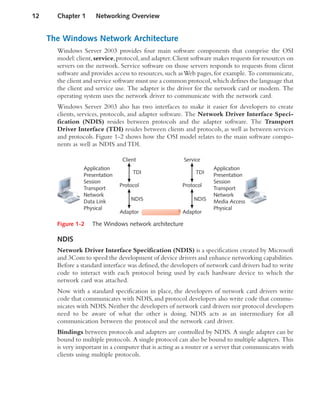
and protocols. Figure 1-2 shows how the OSI model relates to the main software compo-
nents as well as NDIS and TDI.
NDIS
Network Driver Interface Specification (NDIS) is a specification created by Microsoft
and 3Com to speed the development of device drivers and enhance networking capabilities.
Before a standard interface was defined,the developers of network card drivers had to write
code to interact with each protocol being used by each hardware device to which the
network card was attached.
Now with a standard specification in place, the developers of network card drivers write
code that communicates with NDIS, and protocol developers also write code that commu-
nicates with NDIS. Neither the developers of network card drivers nor protocol developers
need to be aware of what the other is doing. NDIS acts as an intermediary for all
communication between the protocol and the network card driver.
Bindings between protocols and adapters are controlled by NDIS. A single adapter can be
bound to multiple protocols. A single protocol can also be bound to multiple adapters. This
is very important in a computer that is acting as a router or a server that communicates with
clients using multiple protocols.
Application
Presentation
Session
Transport
Network
Data Link
Physical
Client
Protocol
Adaptor
TDI
NDIS
Service
Protocol
Adaptor
TDI
NDIS
Application
Presentation
Session
Transport
Network
Media Access
Physical
Figure 1-2 The Windows network architecture
12 Chapter 1 Networking Overview
Windows Server 2003 uses NDIS version 5.1. Network drivers written for NDIS 4.0 or
later are also supported. InWindows 9x operating systems, NDIS 4.0 was included, starting
with Windows 95 OSR2. Windows NT 4.0 was the first NT-based operating system to
support NDIS 4.0. Network drivers written for these operating systems or later versions
should function properly in Windows Server 2003.
Windows Server 2003 does not support the use of ISA network cards.
TDI
The Transport Driver Interface (TDI) layer provides clients and services with access to
network resources. Applications talk to the TDI layer and the TDI layer passes on the
requests to the protocols.
TDI emulates two network access mechanisms: Network Basic Input Output System
(NetBIOS) and Windows Sockets (WinSock). NetBIOS is an older network interface
that is used byWindows 9x andWindows NT to access network resources. WinSock is used
by Internet applications such as Internet Explorer and Outlook Express to access network
resources. Starting with Windows 2000,WinSock can also be used by Windows to access
Active Directory–based resources. Windows Sockets Direct (WinSock Direct) is a new
enhancement to WinSock that is used to access resources on system area networks.
Developers write services and clients that communicate with NetBIOS or WinSock to
access network resources. The applications communicate with the TDI layer, which emu-
lates these interfaces. Developers creating protocols code them to communicate with the
TDI layer. For a client and service to communicate, they must both be using the same
network access mechanism and protocol.
Activity 1-5: Research Networking Architecture
Time Required: 15 minutes
Objective: Use the Windows Server 2003 Help and Support utility to glean additional
information about NDIS and TDI.
Description: You are one of the Network administrative team at Great Arctic North
University. One of the students has contacted you and wants to use you as a resource to
further her learning.She is curious about the NDIS andTDI,and you are meeting with her
in 45 minutes. You want to be sure you understand the difference between theTDI layer and
NDIS. You decide to use the Help and Support utility built into Windows Server 2003 to
discover more information.
1. Start your server and log in as Administrator, if necessary.
2. Click Start, and then click Help and Support.
Network Architecture 13
1
3. Click the Index button.
4. Type glossary in the Type in the keyword to find box.
5. Double-click the main glossary item.
6. Click the N button in the browse pane.
7. Scroll the browse pane to Network Driver Interface Specification (NDIS), and
read the description and make notes.
8. Click the T button in the browse pane.
9. Scroll the browse pane to Transport Driver Interface (TDI), and read the
description and make notes.
10. Close the Help and Support window.
COMMON NETWORK SERVICES
Recall from the previous section that services running on servers are used to provide
information to clients across the network. There are a wide variety of network services
available inWindows Server 2003 that you may utilize and configure.Most of these services
are updated versions of those available on Windows 2000 and Windows NT and will be
discussed in depth in later chapters of this textbook. Here is a list of some features and
services you will learn about in this book:
Dynamic Host Configuration Protocol (DHCP) is an automated mechanism used to
assign IP addresses to client computers. Automating this process saves hours of work for a
network administrator. In addition to assigning the IP address, DHCP can also provide IP
configuration options such as subnet masks, the default gateway, and DNS servers.
Domain Name System (DNS) is a service that converts host names to IP addresses.
Client computers require this to access resources through a host name. Active Directory uses
DNS to store service location information.
Windows Internet Naming Service (WINS) converts NetBIOS names to IP addresses.
Client computers require this to access resources through a NetBIOS name. Windows 9x
and NT use WINS for service location.
Routing and Remote Access Service (RRAS) allows Windows Server 2003 to act as a
router, VPN server, and dial-in server. Windows Server 2003 can route IPv4, IPv6,
IPX/SPX, and AppleTalk packets. Point-to-Point Tunneling Protocol (PPTP) and
LayerTwoTunneling Protocol/IP Security (L2TP/IPSec) connections are supported
for VPN access. The L2TP/IPSec VPN has been improved to allow connections through
Network Address Translation (NAT). A dial-in server allows remote users to connect to
office networks using a modem and phone line.
Network Address Translation (NAT) allows an entire office of computers to share a
single IP address when accessing the Internet.If Windows Server 2003 is used as a router to
14 Chapter 1 Networking Overview
connect with an ISP,then only a single IP address is required. As packets are routed through
the server running NAT, packet headers are modified to look as though the router created
them. When response packets return, the router delivers them to the proper host on the
internal network.
Internet Connection Sharing (ICS) is an automated way to set up DHCP, NAT, and a
DNS proxy for small networks. DHCP automatically provides IP addresses and configura-
tion options that define the ICS server as both the default gateway and the DNS server. The
DNS proxy takes client DNS requests and forwards them to the DNS server it is configured
to use. NAT allows all of the client computers to share a single IP address from an ISP.
Internet Authentication Service (IAS) allows a company to use Active Directory for
centralized authentication of remote access clients on many different remote access servers.
A company using IAS can have remote users dial in to an ISP and use the user ID and
password of their Active Directory account for authentication. In addition, IAS can central-
ize the logging of internal dial-up servers.
IP Security (IPSec) is an enhancement to IPv4 that creates secure IP-based
communications. In Authentication Headers (AH) mode, IPSec digitally signs packets
to verify they were not modified in transit. In Encapsulating Security Payload (ESP)
mode, IPSec digitally signs packets and encrypts the data to ensure that only the proper
recipient can read the information.
Internet Connection Firewall (ICF) is a simple firewall that is suitable for small
businesses usingWindows Server 2003 as the router connecting to their ISP.ICF can be used
in conjunction with ICS, RRAS, and NAT. It works with LAN, dial-up, virtual private
network (VPN), and PPPOE connections. If there is already a firewall between the office
network and the Internet, then ICF is not required.
Public key infrastructure (PKI) is an increasingly important part of network and
Internet security. Certificates can be used to secure e-mail and Web sites or to provide
authentication using smart cards. Windows Server 2003 can generate and manage certifi-
cates for internal use.
Network load balancing has been added as a standard feature to all versions of Windows
Server 2003. In high-traffic environments, a single server may not be able to keep up with
the level of service that is required. This is particularly likely forWeb-based applications that
may be available to thousands of users. Load balancing transparently spreads the traffic
between two or more servers. From the client perspective, it appears as if there is still only
one server.
Automated System Recovery allows a single step recovery of the operating system,
system state, and hardware configuration.
The default configuration for Internet Information Server (IIS) 6.0 is locked down to
be more secure. In addition, it offers enhanced scalability and improved load balancing.
Common Network Services 15
1
Internet Protocol version 6 (IPv6) is the future of Internet connectivity and will replace
the current Internet Protocol version 4 (IPv4) protocol over time. The implementation
of IPv6 is designed to allow for backward compatibility with networks still running IPv4.
Point-to-Point Protocol over Ethernet (PPPoE) is used by many high-speed Internet
service providers (ISPs) to control traffic on their networks. Windows Server 2003 can
access these networks without installing third-party client software.
For network bridging,Windows NT/2000 Server could be used as a router but not as a
bridge.In smaller networks,Windows Server 2003 can be used as a bridge to allow multiple
network segments to communicate without introducing the complexity of routing.
Windows Server 2003 has built in support for wireless networks. This includes extensions
to Group Policy that can push out wireless configuration information to clients and a
Microsoft Management Console (MMC) snap-in to view wireless access statistics on
clients or access points.
IP Security (IPSec) has been enhanced to allow transmission of encrypted packets through
Network Address Translation (NAT). Management of IPSec can now be accomplished
through the command-line utility NETSH.
Volume Shadow Copy is a new feature that is used by backup software to make a copy of
files to be backed up. This system allows files to be backed up when they are open,allowing
an administrator to back up files while they are in use without errors.
Windows Server 2003 includes the ability to provide streaming audio and video using
Windows Media Services. This is used in combination with Windows Media Player on
the client computers.
The Enterprise and Datacenter versions of Windows Server 2003 support 64-bit processing
on Intel Itanium Processors.
Several services and features are installed and enabled by default at installation. This setup
can be modified by choices made during installation, particularly if a custom (rather than a
typical) installation is performed. In addition, services can be installed or removed after
installation. The next two exercises will explore what services are currently installed and
what services are available for you to install on your Windows Server 2003 computer.
Activity 1-6: Viewing the Status of Services Installed on a Win-
dows Server 2003 Computer
Time Required: 15 minutes
Objective: Identify installed network services currently enabled on your server.
Description:You are a new network administrator at Great Arctic North University. One
of the departments is having trouble connecting to one of its servers. Because some staff
members in the department have permission to configure the server as needed, you think
that the Internet Connection Firewall might have been inadvertently installed and
16 Chapter 1 Networking Overview
configured. In this activity, you will verify that ICF is not running and see what other
services are running or stopped on the server.
1. If necessary, start your server and log on as Administrator.
2. Click Start, point to Administrative Tools, and click Services.
3. Locate and double-click the Internet Connection Firewall (ICF) / Internet
Connection Sharing (ICS) service. (The services should be listed in alphabetical
order.)
4. Verify that the status of the service is stopped and the Startup type is Disabled. This
means that the service is not currently running and will not start when the server is
rebooted.
5. Read and explore the list. What services are listed? Do any have the Startup type
listed as Disabled? List five. Are these services started or stopped? Why? Do any of
the services have the Startup type listed as Automatic? List five. Are these services
started or stopped? Why?
6. Click Cancel to close the properties window.
7. Close the Services window.
Activity 1-7: View Networking Services Available for Installation
Time Required: 10 minutes
Objective:View the network services that are available for installation on your Windows
Server 2003 computer.
Description: You are a network administrator at Great Arctic North University. The
university is designing a new network. For your planning process, you need to identify the
network services that are available to install on theWindows Server 2003 computers.In this
activity,you will use Add/Remove Programs to see which network services are available for
installation.
1. If necessary, start your server and log on as Administrator.
2. Click Start, point to Control Panel, and click Add or Remove Programs.
3. Click Add/Remove Windows Components.
4. Scroll through the list to see which services are available. Make a list of three avail-
able services.
5. Click Networking Services, and click the Details button.
6. View the Networking Services, and then click Cancel to close the Networking Ser-
vices window.
7. Click Cancel to close the Windows Components Wizard.
8. Close the Add or Remove Programs window.
Common Network Services 17
1
CHAPTER SUMMARY
Windows Server 2003 is the latest version of the Windows network operating system
released by Microsoft. There are many new features, including enhanced Active Direc-
tory, the .NET Framework, Web Services, IPv6, network bridging, PPPOE support,
built-in wireless support, Internet Connection Firewall, and 64-bit support.
There are four different editions of Windows Server 2003: Web Edition, Standard
Edition,Enterprise Edition,and Datacenter Edition.Each is designed to work in a certain
environment and support different hardware.
Networks consist of two or more computers that share information.Small,medium-sized
and large networks are often referred to as LANs, MANs, and WANs, respectively.
Information must be formatted using a network protocol before being sent onto the
network itself. Four network protocols are supported by Windows Server 2003: IPv4,
IPv6, IPX/SPX, and AppleTalk.
OSI is a general network architecture model that describes how information is sent to and
received from a network.TheWindows Server 2003 network architecture is composed of
four main networking components that fit the OSI model:clients,services,protocols,and
network adapters.
TheTDI layer resides between clients and protocols or between services and protocols.It
emulates NetBIOS and WinSock.
NDIS is responsible for binding protocols to network adapters. It also makes the
development of protocols and network adapter drivers easier by providing a consistent
interface.
Many network services are available in Windows Server 2003, including: DHCP, DNS,
WINS, RRAS, IAS, NAT, ICS, ICF, IPSec, and PKI.
KEY TERMS
adapter — The networking component that represents the network interface card and
driver.
AppleTalk — A protocol that is used when communicating with Apple Macintosh
computers.
Authentication Headers (AH) mode — An IPSec operating mode that digitally signs
packets but does not encrypt them.
Automated System Recovery — A part of the Backup utility in Windows 2003 that
allows for the backup and restoration of the operating system, system services and disks,
though it should only be used as a final resort.
binding — The process of configuring a network protocol to use a network adapter.
bridge — A network component that controls the movement of packets between network
segments based on MAC addresses.
18 Chapter 1 Networking Overview
certificate — A combination of a public key and a private key that can be used to encrypt
or digitally sign information.
client — A computer that requests resources across a network. Client software refers to the
software on the client computer that performs the request.
Common Language Runtime (CLR) — A common component that runs code
developed for the .NET framework regardless of the language in which it is written.
Domain Name System (DNS) — A service used by clients running TCP/IP to resolve
host names to IP addresses. Active Directory uses DNS to store service location
information.
Dynamic Host Configuration Protocol (DHCP) — A service used by the Windows
operating system to automatically assign IP addressing information to clients.
Encapsulating Security Payload (ESP) mode — The mode used to encapsulate and
encrypt the data portion of a packet to provide a secure and confidential means of
communication.
Ethernet — The most popular media access method used today on networks.
Internet — A worldwide public network.
Internet Authentication Service (IAS) —The Microsoft implementation of a RADIUS
server. It allows distributed authentication for remote access clients.
Internet Connection Firewall (ICF) — A simple firewall suitable for home use or small
offices when connecting to the Internet.
Internet Connection Sharing (ICS) — An automated way to configure DHCP, NAT,
and DNS proxy to share a single IP address and configuration information from an ISP.
Internet Information Services (IIS) — A popular suite of Internet services that includes
a Web server and FTP server.
Internet Protocol version 4 (IPv4) — This is the version of the Internet protocol (IP)
that is used on the Internet. It is the IP part of TCP/IP.
Internet Protocol version 6 (IPv6) — An updated version of Internet protocol that uses
128-bit addresses and provides many new features.
Internet service provider (ISP) — A company that sells Internet access.
Internetwork Packet eXchange/Sequenced Packet eXchange (IPX/SPX) — The
protocol required to communicate with servers running Novell NetWare 4 and earlier.
IP Security (IPSec) — A service used with IPv4 to prevent eavesdropping on commu-
nication and to prevent data from being modified in transit.
Itanium — A 64-bit processor family manufactured by Intel.
LayerTwoTunneling Protocol (L2TP) — A protocol that places packets inside an L2TP
packet to move them across an IP-based network. This can be used to move IPX or
AppleTalk packets through a network that is not configured to support them.
Linux — An open source operating system that is very similar to UNIX.
local area network (LAN) — A network where computers are located in close physical
proximity of one another.
media — The material used to transfer information between computers.
media access method —The method used to send data that is formatted using a protocol
to a network interface so that it may be transmitted to other computers.
Key Terms 19
1
Metadirectory Services — A service in Windows that synchronizes Active Directory
content with other directories and databases.
metropolitan area network (MAN) — A network where computers are located in the
same city or geographic region.
Microsoft Management Console (MMC) — The generic utility used to manage most
features and components of Windows Server 2003.Snap-ins are required to give MMC the
functionality to manage components.
network — Two or more computers that share information.
Network Address Translation (NAT) — A service that allows multiple computers to
access the Internet by sharing a single public IP address.
network architecture —The physical layout and arrangement of the various components,
hardware and software that make up a computer network.
Network Basic Input/Output System (NetBIOS) — An older interface used by
programmers to access network resources.
Network Driver Interface Specification (NDIS) — An interface for developers that
resides between protocols and adapters. It controls the bindings between protocols and
adapters.
network load balancing — When two or more computers share a single IP address to
provide a service to clients. The load-balanced computers share the responsibility of
providing the service.
network operating system (NOS) — An operating system that is optimized to act as a
server rather than a client.
Non-Uniform Memory Access (NUMA) — A memory architecture for servers with
multiple processors. It adds a third level of cache memory on motherboards.
Open Systems Interconnection (OSI) model — An industry standard that is used as a
reference point to compare different networking technologies and protocols.
packet —The smallest unit of information that has been formatted by a network protocol
for transmission across a network.
Point-to-Point Protocol (PPP) — The most common WAN protocol used today.
Point-to-Point Protocol over Ethernet (PPPoE) — A protocol used by some high-
speed ISPs to authenticate and control IP traffic on their network.
Point-to-Point Tunneling Protocol (PPTP) — A protocol that can be used to provide
VPN connectivity between a Windows client and VPN server. PPTP is supported by
Windows 95 and later.
protocol — The language that two computers use to communicate on a network. Two
computers must use the same protocol to communicate.
public key infrastructure (PKI) — A system to create and manage public keys, private
keys, and certificates.
Remote Installation Services (RIS) — A service in Windows that automates the
installation of Windows 2000 Professional or Windows XP Professional on client
workstations.
router — A network device that forwards packets from one network to another. TCP/IP,
IPX/SPX, and AppleTalk can be routed.
20 Chapter 1 Networking Overview
Routing and Remote Access Service (RRAS) — A service in Windows that controls
routing, dial-in access, andVPN access on a Windows Server 2003.
server — A computer that hosts resources for other computers on a network.
service — A networking component that provides information to network clients. Each
service communicates with corresponding client software.
Token Ring — A common media access method that allows each computer equal access
to the network.
Transmission Control Protocol/Internet Protocol (TCP/IP) — The standard pro-
tocol used to send information across the Internet.
Transport Device Interface (TDI) — A software layer that exists between client or
service software and protocols. Clients and services use this layer to access network
resources.
virtual private network (VPN) — Encrypted communication across a public network.
Volume Shadow Copy — Allows the Backup Utility to copy files even if they are open,
and also allows users and applications to access the data during the backup procedure.
wide area network (WAN) — A network where computers are separated by large
physical distances.
Windows Internet Naming Service (WINS) — A service used to resolve NetBIOS
names to IP addresses as well as store NetBIOS service information.
Windows Media Services — A service that provides streaming audio and video to clients.
Windows Sockets (WinSock) — A programming interface used by developers to access
TCP/IP based services.
REVIEW QUESTIONS
1. What does the acronym NIC stand for?
a. network installation and configuration
b. network IP configuration
c. network interface card
d. Nothing; a NIC is what connects a computer.
2. A WAN covers a greater geographic area than a LAN. True or false?
3. What is the standard protocol used for communication on the Internet?
a. TCP/IP
b. IPX
c. DLC
d. AppleTalk
Review Questions 21
1
4. Which of the following editions of Windows Server 2003 cannot be bought as retail
software?
a. Web Edition
b. Standard Edition
c. Enterprise Edition
d. Datacenter Edition
5. Which of the following editions of Windows Server 2003 supports clustering?
(Choose all that apply.)
a. Web Edition
b. Standard Edition
c. Enterprise Edition
d. Datacenter Edition
6. Which of the following new features of Windows Server 2003 allows servers to con-
nect to high-speed Internet service providers without adding third-party software?
a. wireless support
b. PPPoE
c. Internet Connection Firewall (ICF)
d. Windows Media Services
7. The TDI layer allows multiple protocols to be bound to a network adapter. True
or false?
8. How many processors does Windows Server 2003, Enterprise Edition support?
a. 2
b. 4
c. 8
d. 16
e. 32
9. What is the maximum amount of RAM that can be used in Windows Server 2003,
Standard Edition?
a. 2 GB
b. 4 GB
c. 32 GB
d. 128 GB
10. A network that consists of computers that are separated by large physical distances is
called a LAN. True or false?
22 Chapter 1 Networking Overview
11. Which of the following network components requests services across the network?
a. client
b. service
c. protocol
d. NDIS
e. TDI
12. Which of the following network components emulates NetBIOS?
a. client
b. service
c. protocol
d. NDIS
e. TDI
13. What term describes the manner in which information is sent onto a network
interface?
a. protocol
b. media access method
c. TDI
d. client
14. What model is commonly used to describe network architecture?
a. TDI
b. NAT
c. OSI
d. NDIS
15. Which of the following network services automatically assigns IP addresses and con-
figuration information to client computers?
a. NAT
b. WINS
c. DHCP
d. PPTP
16. The OSI model consists of four layers.True or false?
17. Which of the following network services is used for remote authentication?
a. IAS
b. DNS
c. ICF
d. ICS
Review Questions 23
1
18. Which of the following services allows an office of computers to connect to the
Internet using a single IP address? (Choose all that apply.)
a. DNS
b. DHCP
c. NAT
d. ICS
e. ICF
19. WINS is used by a client to convert host names to IP addresses. True or false?
20. Which of the following is a feature of NDIS? (Choose all that apply.)
a. It acts as an intermediary for communications between protocols and network card
drivers.
b. It allows multiple protocols to be bound to a single adapter.
c. It provides clients and services with access to network resources.
d. It is the language clients and services use to communicate.
CASE PROJECTS
Case Project 1-1: Choosing a Network Operating System
As the person in charge of implementing network services for Great Arctic North Univer-
sity,you are responsible for orderingWindows Server 2003 for the faculties. To decide what
software needs to be ordered, you are meeting with the head of each faculty. Create a
document describing the benefits and drawbacks to each edition of Windows Server 2003
and when it is appropriate to use each. You can distribute this document to each faculty
head before the meetings.
Case Project 1-2: Choosing Network Services
You are a member of the IT team at Great Arctic North University. The university is
designing a new network. As part of the planning process, you are meeting with the rest of
the IT Department to brainstorm on what services may be required on the network. Make
a list of the network services that you think may be required and describe why.
Case Project 1-3: Choosing Network Drivers
You are one of the network administrators at Great Arctic North University. A colleague is
concerned that some network card drivers will not function after the existingWindows NT
and Windows 2000 servers are upgraded to Windows Server 2003. What can you tell your
colleague about network driver compatibility with previous versions of Windows and the
role that NDIS plays in this?
24 Chapter 1 Networking Overview
Case Project 1-4: Researching Features of Network Services
You are a network administrator at Great Arctic North University. As part of the ongoing
professional development program, you are to give one of a series a brief presentations to
interested faculty. Your presentation is to be on the features of three network services
available with Windows Server 2003. Choose three network services you generated during
Activity 1-7 (redo the lab if necessary),and research them using the Help and Support utility
built in to Windows Server 2003 to prepare your report.
Case Projects 25
1
This page intentionally left blank
CONFIGURING NETWORK
PROTOCOLS
After reading this chapter, you will be able to:
♦ Understand TCP/IP addressing
♦ Define TCP/IP parameters
♦ Configure TCP/IP parameters
♦ Work with TCP/IP networks
♦ Understand the process of subnetting a TCP/IP network
♦ Supernet several smaller networks
♦ Configure other network protocols
♦ Use bindings to optimize network connectivity
As described in Chapter 1, Windows has four main components that are
used to send information across a network: clients, services, protocols, and
adapters. The client and service software are designed to talk to each other. In
the case of Windows Server 2003, the server service software may talk to the
workstation (or client) service of another computer using another operating
system such as Windows XP. For the client and service to be able to commu-
nicate with each other, they must speak the same language. From a computer’s
perspective this means that they must be using the same protocol. The most
common protocol used today is TCP/IP; however, other protocols include
IPX/SPX (NWLink) and AppleTalk. In this chapter you will explore the
different protocols that are available for Windows Server 2003 and their
configuration.
CHAPTER
2
27
Other documents randomly have
different content
The Project Gutenberg eBook of Palóc
népköltemények
This ebook is for the use of anyone anywhere in the United
States and most other parts of the world at no cost and with
almost no restrictions whatsoever. You may copy it, give it away
or re-use it under the terms of the Project Gutenberg License
included with this ebook or online at www.gutenberg.org. If you
are not located in the United States, you will have to check the
laws of the country where you are located before using this
eBook.
Title: Palóc népköltemények
Compiler: Gyula Pap
Release date: September 12, 2012 [eBook #40740]
Most recently updated: October 23, 2024
Language: Hungarian
Credits: Produced by Albert László, Ildikó Róth, Tamás Róth and
the
Hungarian Distributed Proofreading Team at
http://dphu.aladar.hu (This book was produced from
scanned
images of public domain material from the Google
Books
project.)
*** START OF THE PROJECT GUTENBERG EBOOK PALÓC
NÉPKÖLTEMÉNYEK ***
Megjegyzés: Az eredeti képek elérhetők innen:
http://books.google.hu/books?id=FKQWAAAAYAAJ
Facebook oldalunk:
http://www.facebook.com/PGHungarianTeam
PALÓC
NÉPKÖLTEMÉNYEK.
GYÜJTÖTTE ÉS KIADTA
PAP GYULA.
SÁROSPATAK.
NYOMTATTA FORSTER R. A REF. FŐISKOLA BETŰIVEL.
1865.
Támadj fel meséid szép álmával,
Szineidnek tündérpompájával,
Magyarok elsülyedt dalkora!
Toldy Ferenc irod. arck.
KÁROLY TESTVÉREMNEK.
Előszó.
Nógrádból a palócföldről egy csomó vadvirágot vesz e könyvben
a t. közönség.
Nincs helye, hogy előszavunkban e gyüjtemény érdemét,
jelességét hangoztassuk, a nép költészet becsét elismerte az
eszthetika, a nyelvtan, s ezzel együtt az irodalomtörténet; inkább ide
iktatunk nehány vonást e sajátos ősi népfajról, hogy tájékozhassa
magát a más vidéken lakó olvasó, s hogy álláspontot szerezhessen s
kellőleg méltányolhassa, ki netalán a palóc népköltészetet fogja tenni
tanulmánya tárgyává.
Forduljunk először is a történelemhez! Mit látunk a palócnép
hajdanáról feljegyezve?
Toldy Ferenc (A magyar irodalom története első kötet. Pest.
Emich Gusztáv bizománya 1851. 21 lap) így ír róla: „Már a tizedik
század közepe felé találjuk Constantinus Porphyrogenitus bizanti
császárnál a magyar nyelvjárások legrégibb nyomdokát. Nyilván
mondja t. i. ez, hogy a kazarok közt belső háború támadván, a
meggyőzöttek egy része a magyarokhoz futott s köztök
letelepedvén, K a b a r o k n a k (kétségkivül K ó b o r o k n a k )
neveztettek; s hogy ezek a magyarokat kazar nyelvre tanítván,
beszélik ugy mond mind maig ugyanazon dialectust, de élnek a
m a g y a r o k m á s i k n y e l v é v e l i s . Tekintetbe vevén már
most a legujabb történet nyomozásoknak, főleg Horváth Istvánéinak
eredményeit, alig kételkedhetünk többé, hogy itt a kazar nyelv alatt
egyenesen a palóc nyelvjárást kell érteni, melyen valamint régenten
a palócok, besenyők, kunok, kazarok, jászok és székelyek szólottak,
ugy mai napiglan szólnak azoknak külön időkben magyarországba
letelepült utódaik mindenütt hol nagyobb tömegekben laknak, habár
nagyobb kisebb eltérésekkel. Ezekhez képest a palóc dialectus, mely
régi épségében leginkább a Gömör, Borsod, Nógrád és Hevesmegyék
összeszögellő hegyes vidékein maradt fen, hol előkelőleg palócnak
neveztetik s határozottabban közép palócnak hívathatik, a nevezett
törzsökök különbsége szerint mai nap is több ágakra oszlik, milyenek
az éjszaki vagy is barkó Gömörben; a déli palóc vagy göcsei
Szalában s részint Somogyban és Veszprémben is; a duna drávai
palóc Baranyában s az ormányságban a Dráva mellett, a csángó
Moldvában; a székely Erdélyben; végre a jász-kun, de a mely a XVII.
század óta nagy részben elváltozott. Alig hibázunk, ha e palóc
nyelvjárásban keressük a közönségesen elveszettnek tartott hun
vagy kun nyelvet; mindenesetre az közelebb áll a hun-magyar néptő
régi nyelvéhez, melylyel részint még a XI. század emlékeiben is
találkozunk, mint ama másik nyelvjárás, melyet Constantinus a
magyarok másik nyelvének nevez, s melyet mi elökelőleg magyar,
vagy különböztetés okáért u j m a g y a r n a k nevezhetünk.“
Im e szavakból láthatni, hogy a palóc név hajdani keletében nem
mintegy speciális népágazat kizárólagos jelzője tekintendő, de gyüjtő
név levén magába foglalta a székely, csángó, jász-kun sat.
népcsoportokat is.
Gyüjteményünk keletkezéshelye Nógrádmegye Salgóvidéke – e
tájnak kíván tűköre lenni, következéskép csak a nógrádi palóc
ismertetését adhatjuk im e csekély vázlatban.
Vallásukra nézve általán a római hitet követik, honnan helylyel
közzel ha találkozunk ágostai és helvét vallású községekkel bizton rá
mondhatjuk, hogy az előbbi szláv, utóbbi pedig a Toldy által felfogott
u j m a g y a r néphez – ha tetszik nemzethez – sorolandó. Az egész
palócság ismeretes vallásosságáról s szigorú erkölcsösségéről. Az
ünnepnapokat hűségesen megszentelik, templomba szorgalmasan
eljárnak. Felette szent nálok a hajadoni szűzesség, honnét 1850-ig
igen kevés eset volt rá, hogy a hajadon elveszítette volna szívének
zománcát lelkének tisztaságát; ma az ily eset nem ép ritkaság,
honnét nem igen hibázunk, ha alapokát a házasság korlátozása és a
szabadságos katonák tulnyomó számában keresendjük. Általában
még most is uralg közöttök a régi patriarkális élet, az ugynevezett
volt jobbágyok most is többnyire együtt lakoznak, némely faluban
harminc negyven tagból álló család is tartózkodik egy fedél alatt;
választván tekintettel a korra és ügyességre egy gazdát s egy
gazdasszonyt, előbbit a kölső ügyvitel, utóbbit a belső gondokra,
rendelkezésre. A gazdának – korra való tekintet nélkűl minden
családtag kész köteles hódoló szolgája. Ő köt minden űzletet, vesz,
ad, az engedetlent meg is fenyíti, mit az – sorsában megnyugodva
tűrni tartozik. A komolyabb ügyeknél p. u. ingó, vagy ingatlan
eladásánál az éltesebbek tanácsát s beleegyezését is tartozik kikérni.
Az egyes köz tag jogi cselekménye – ha az a többség, s a gazda
tudta s beleegyezése nélkül vitetett véghez, érvénytelennek
nyilváníttatik. Ő vesz a többieknek ruhát, s egyébb szükséges
tárgyakat, ő szemeli ki a házasulandó suhancnak jövendőbeli
hitestársát, ő a parancs, a többi, hogy szavaival éljünk: „ a z é n
c s e l é d e m .“
A gazda mezei munkát – kivált tehetősebb családoknál soha –
csak igen ritka esetben végez, farag szerszámfát, vagy az épületen,
kerten igazit egyet mást, oltogat, nyes, s a többieknek kiadja a napi
múnkát. Bizonyos időkben az egyes hadak, vagy felekezetek
éltesebbjei meg is szokják számoltatni a gazdát. Ha nagyon
részeges, vagy felette hanyag leteszik, s helyette a legalkalmasbbat
választják. Különben a gazdai hivatal élethosszig a végső
tehetlenedésig folytattatik.
Ime mintha csak a vérszerződés lebegne szemeink előtt! Ismerek
egy volt jobbágy családot, mindössze valami 30 tagból, négy
felekezetből állhat az egész, s az a különös, hogy az egyes
felekezetek egymás iránt való rokonságukat sem tudják kimutatni.
Bátran eljegyezhetnék egymást, de nem teszik, véteknek tartván
ugyanazon családból házasodni.
Egy név, egy jelleg, egy erkölcs, egy tűzhely köti össze őket
századok óta!
Egy pár évtől gyakoriak a válakozások. A család két, három sat.
felekezetekre oszolva egymástól külön szakad, érdekből, hogy
emancipálhassák magokat a gazda önkénye alól, s hogy több
vagyont produkálhassanak. Ám – figyelve őket – a tapasztalat azt
mutatja, hogy az elválást elszegényedés szokta követni.
Családi életük magán hordja a régi magyar életnek képét,
kinyomatát. A férfi tegezi nejét, a nő k i e d -nek (kendnek) szólítja
férjét, a gyermekek é l d e s s z ü l é i m névvel tisztelik szüléiket. A
lakszobában, mit közönségesen h á z n a k neveznek, semmi
butorzat sincs egy asztalon, hosszúlócán s óriási kemencén kivül. A
téli estéket többnyire a kemence előtt töltik, az asszonyok fonogatva,
a férfiak pedig pipázva s beszélgetve. Beszélgetésök tárgyát a
faluban előjött apró események, házasságok, időjárás s a termények
minéműsége teszi. Éjfél után elszállingóznak a hálókomrába, –
miután jósort imádkozott, többnyire legutólszor tér nyugalomra a
legöregebb nő, a családfő neje, vagy a gazdasszony; már akkor van
1–2 óra is midőn ez lefekszik, és a hajnali első kakasszóláskor már
ismét talpon van, legelőször tüzet gyujt a kemencébe, aztán felkölti
a többieket is s hozzáfognak a fonáshoz. Egy kettő még álmos is
közűlök, s kegyetleneket ásít, száját kezével veregetvén.
A fiatalságnak a hosszas téli estéken egyetlen mulató helye a
fonóház. Ez közönségesen egy kibérlett hely, melyet a tél beálltával
közös akarattal bérlenek ki, s érte mindenik tartozik fizetni valamit,
vagy nehány fő kendert, vagy búzát, főzeléket ( á z a l é k ) sat.
A mint a lányok dolgaikat végzik, cifra guzsalyaikat magokhoz
vévén itt jelennek meg, hol már akkor nehány éltes asszony is helyet
foglalt a kemence előtt; midőn jó sokan összegyűltek, dalólni
kezdenek, s ekkor a legények is szállingóznak befele, mindenik szive
választottja mellett foglalván helyet; s jaj azon leánynak kinek a
fonóházban nincs mulattatója! Fel sem veszik mintha ott se volna,
vagy csak lenézés tárgyául tűzik ki a többi leányok. A legények
megérkeztével van dal, meg dal, tréfa, egyik élc a másikat éri, végre
ebbe is bele unván, a kemence megől megszólal az öreg mesélő,
hogy az ifjabbak képzelődését a tündér világ bájkörébe
kalandoztassa, ezen aztán itt ott jót kacagnak, majd sóhajtanak,
olykor könnyeznek, míg ismét a legderültebb nevetésben törnek ki.
Ilyesmik történnek a fonóházban, ezenkivül itt történnek az
ismeretségek, itt köttetik a szerelem; mert a fonóházban más
falubeli legények is megjelennek. Két óratájban aztán szétoszlanak,
haza mentökben mindenik lát egy egy kisértetet elhaladni maga előtt
s ezt másnap reggel még esküvel is kész bebizonyitani.
Téli időben naponként csak kétszer étkeznek reggel és este; a
mikor a ház gazdasszonya feltálalja az eledelt, aztán legelőször a
családfő megszegi a kenyeret s azt tovább adván a férfi nép a
közöstálból hozzálát az étkezéshez. Asszony ritkán ül az asztal mellé,
kiki magának szed egy tálkára s azt elfordulva a többitől mintegy
észrevétlenül akarja megélvezni. Legfelötlőbb étkezési módjuk:
először a keményebb tésztás vagy husféle eledeleket költik el s csak
azután kerül a sor a levesre, mit ők általán lé néven neveznek; innen
azon enyelgő megjegyzés a lakodalomról: „ o l y a n h i r e s
l a k z i j a v ó t h o g y a l é i s h é t f é l y i v ó t b e n n e .“
Legkedvesebb eledelök a hus, aztán a g a n c a , b u k t a
(mindkettő tészta étek) végül a m á k o s f e r e n t ő (mely hasonlit
a réteshez primitiv kiadásban) s a m á k o s c s i k (mákos metélt).
Mindezek lakomáknál, keresztelőknél, stb. különösen szerepelnek s
kivált a mákosferentő lakodalomból el nem maradhat.
Testökre nézve mindkét nembeliek eléggé kifejlettek, a nők
különösen eredeti magyar s hóditó külsejüek. A leány tiszta, öltözete
ragyogó, kedveli a magossarku piros csizmát, rózsaszinkelméket,
hajafürtébe isten tudja mennyi cifra pántlikát befűz, nyakán
g a r á l y i s t (nyakék) ujjain öt hat rézgyűrőt (gyűrű) visel, mikkel
többnyire mátkája szokta megajándékozni. Ha templomba megy,
rézkapcsos imakönyvét százszorszép kendőjébe hajtja s hóna alá
helyezi, másik kezébe piros csizmáját fogja s így ballag a távolabb
eső filialis helyekről is mezitláb, s csak a templomajtó előtt huzván
fel csizmáját. Fiatal menyecske legfőbb díszruhája a rókásmente. A
nők többnyire fiatal korukban szoknak férjhez menni, s a
csinosságot, tisztaságot mindig, a szépséget pedig igen sokáig
megtartják. A férjezett nő még jó darabig le nem veti cifra ruháit, s
csak midőn a 35–40 évet betöltötte, ölt komolyabb barna szinü
öltözéket. Férjét felette becsüli, örömest tűri szitkait, gáncsait sőt
veréseit is, csak férje tul ne lépjen a házasság céljának korlátain.
A férfiak szinte eléggé kifejlettek szép külsejüek. Megtermettebb
szállasabb legénységet alig látni országszerte mint itt. Az öregek
általán vállig érő göndör hajat viselnek, bajusz, vagy barkó felette
ritkaság az egész vidéken, tiszta sima arcot szeretnek hordani. A
fiatalság öltözete kanász kalap, bőujju ing, pitykés veres mellény,
térdigérő bő gatya, cifra szűr, hosszu száru csizma. Kedvenc
bokrétájuk az árvalányhaj s az ugynevezett s z e n t k u t i
b o k r é t a . Melynek története következő: május első reggelén a
legény májfát állit a kedves ablaka elé, a lány annál jobban örül
mennél magasabb az oda állitott fa; mert a fa nagysága többnyire a
legény szerelmének fokozata, Pünköst napján aztán – mikor
országos bucsu zarándokol a Verebély helység mellett levő szentkuti
kolostorhoz – a szerelmespár is hűségesen lerándul, s itt a leány
mintegy viszonzásul a májfáért csinált virágból himzett bokrétát vesz
szeretőjének, melyet az jövő májusig, vagy ha addig éppen véghez
menne, lakodalmáig hord. Ha azonban az ifjunak komoly szándékai
vannak az éj leple alatt egyszer kétszer megjelenik a lányos háznál;
később bemutatja magát a szülőknek is, s ha ezek szivesen látják,
kérőket indit a házhoz, a kik ékes szavakban előadják kivánságukat,
ha meghallgattatnak nem sokára megtörténik a k e n d ő l a k á s ,
mely nem áll egyébből minthogy a szerelmesek kendőt cserélnek
melybe diót vagy almát kötöttek.
Ezentul jegyeseknek tekintetnek.
A lakodalmat szüret után tartják, meg. Az esketésre kitűzött nap
előtt a n a g y n á s z összejárja a falut s a vendégeket behivja. Más
nap a n a g y n á s z felkerekedvén összegyült népével, elbúcsúzik s
zene kisérettel utnak indul a menyasszony házafelé, itt megállnak a
kapu előtt s csupán a vőfély megy be egyedűl felszólitván a
menyasszonyt az indulásra, ki nyoszolyó asszonya s leányaival
atyafiaitól kisértetve, kimegy és a násznéphez csatlakozik, egyenesen
a hitletételre menendő. Mely meglevén atyai házához
visszakisértetik; hol rövid reggelit kapván a násznép visszatér a
vőlegény házához, a menyasszony pedig odahaza marad, mig nem
hosszas kérések és ceremóniák után csakugyan elszállitják a
vőlegény lakására, hol az örömatya a kapunál várja menyét, s nem is
hinné az ember, mely édesded gyöngéd érzelmek előadásával jelenti
örömét s fogadja azt, kitől fia boldogulását, háza gyarapodását,
szerencséjét és fényét mint az Isten áldását várja; kézen fogva viszi
be házába és bemutatja nejének, fiainak s atyafiainak, s ez által be
van igtatva nemzetségébe s él a szülött jogaival holtaig, sőt férje
halála után is mig más házasságra nem lép.
Most bevégzett s tökéletes az öröm s lakják a lakodalmat,
melyhez minden hivatalos tehetsége szerint adakozott.
Ebéd alatt szolgál a vőfély, behordván az ételeket, mely
alkalommal minden ételt megdicsér többnyire cikornyás versekben.
Estebéd után a vőfély három szál gyertyát fogva balkeze ujjai
közé a menyasszonyt a komrába viszi, hol leveszi fejéről a pártát s
által adja a fektető vagy nyoszolyó asszonynak. A vőfély a pártát
fokosára veszi és árulgatja s ekkor mondja el vig szavakkal az
ugynevezett fektető verset melyet mindnyájan nagy figyelemmel
hallgatnak.
Másnap reggel a kiadó háztól két asszony megy felkölteni a
menyasszonyt, ki már akkor valamely zugban ül; ezek a féketőt
fejére kötvén, az uj házasokat kalácscsal és mézes pálinkával
megajándékozzák.
Ezalatt megérkezik a h é r é s z (a kiadó ház vendégei menyegzői
ajándokokkal) s kérdezik a nagynászt, hogy nem tévedt-é ide egy
gyönyörű aranybárányka? A nagynász igennel felel, de először
kivánja tőlök jeleit tudni, ekkor aztán előhoz egy öreg vagy görbe
hátu egyént s kérdezi hogy nem ez volna-é voltaképen kit keresnek?
Azok ezt természetesen visszaküldik állitván hogy az övék ép és szép
volt, s midőn ezután a valódit eléjök állitják mindnyájan kezet fognak
vele s tehetségök szerint megjutalmazzák.
Több helyen a lakzi egy hétig is el tart, mig nem ismét a kis
hérész következik, melyben az előbbihez csaknem hasonlók
történnek.
Ennyit a lakadalomról.
Az öregek félre tevén a cifra öltözetet, többnyire egyszerű, kék
szegélyzetű szűrt, gyolcs vagy legalább jól kifehéritett vászon gúnyát
s télbe néhol szűrnadrágot is hordanak, mit ők h u n y a néven
neveznek.
Miveltségi álláspontjuk még sok kivánni valót hagy fen, a férfiak
között igen ritka a ki olvasni, még ritkább a ki irni tud. A nők
legalább tanulnak annyit, hogy saját könyvükből tudnak akadozva
imádkozni. Irodalomról, könyves miveltségről furcsa fogalommal
birnak, nyomtatványok alatt nem képzelnek mást mint politikai
ujságot és imádságos könyvet, a ki e hiedelmükből ki akarná
vetkeztetni, bizony falra hányná a borsót. Csak egy példát jegyzek
ide! Egy izben mezei munkát dolgoztatván, hogy a hosszu nap
unalmát elűzhessem, könyveimhez voltam kénytelen folyamodni.
Este egy éltes palóc igy szólt hozzám: „ b i j o n y ( b i z o n y ) a z
u r m á ’ ( m á r ) c s a k u g y a n a m e m b e ( m e n y b e )
m e h e t h a m i n d e n n a p e n n y i t i m á d k o z i k .“
Még ma is közönséges rovással élnek kénytelenségből. Erre
jegyzik jövedelmeiket, kiadásaikat. Világitóul mécsest, vagy bikkfából
hasgatott s jól kiszáraztott ugynevezett f á k l y á t használnak.
Politikai miveltségük legdicsérendőbb, az uri rendet becsülik,
tanácsait szivesen fogadják s ügyeiket készek a szerint irányozni.
Általában egy lelkes arisztokracia mellett soha sem engedik magukat
alacsony eszközzé silányitani; példa rá hogy az egész országban
sehol sem történnek oly barátságos tagositások mint a palócságon.
Ezelőtt kedvenc zenéjök a duda volt, de ez már nagyobb részt
kiveszett, s mai napság itt ott látni csak egy egy szomoru dudást
pedig még ezelőtt néhány évvel is ez mulattatá őket lakomájokban,
ezen járta a lakodalmasnép ugy a sebes kopogót, mint a szomoru
verbunkot.
A férfiak kivált az éltesbek ritkán dalolnak, az ifjabbak is
többnyire csak áldomás közben, vagy ha mezei munkát dolgoznak
magánosan. Ellenben az asszonyszemélyek semmi cselekményt sem
végeznek nóta nélkül. Felette kedvelik a szomoru dalokat, dallamaik
kevésbé változatosak, többnyire vontatottak, de érzésben, hatásban
felül mulhatlanok! Részemről mi sem tud annyira meginditani mintha
csendes, holdas éjszakán nehány palóc lánykát hallok dalolni. Ime
mily hasznot tenne a Kisfaluditársaság nemzeti zenészetünknek, ha
gondoskodnék a különböző lokalitások szerint a dallamok hangjegyre
tevéséről! Hogy zeneszerzőink kik többnyire városon lakva,
hallhatnának olykor olykor egy, kristály tiszta hangot a nép ajkairól s
istenesen neki feküdhetnének a népzenészet tanulmányának!
Bizonyára sok gyöngy vesz igy el a feledés tengerében. Aztán a
népköltészetben a dallam annyira össze van forrva a szöveggel, hogy
egymás nélkül nem is boncolandó. Egyik kiegésziti a másik hiányait,
eltakarja fogyatkozásait s mint férj és feleség csak együtt képeznek
egy testet és egy lelket. Máskép van a műzenészetnél; itt többnyire
más szerzi a szöveget, más a dallamot, s a szöveg csak nem mindig
másodrendű dolog. A népnél a dallam a szöveggel egyszerre jő, mint
napból a világosság és melegség, mint Jupiter agyából Minerva
páncélosan derekasan megteremve.
Ime, oda értem hogy a nyelvjárásról is elmondhatom
mondandóimat!
Figyelmes fül közönségesen három a-t különböztethet meg. Első
a tiszta, második a hosszu vagy ékezett s harmadik a közép a,
melyet az l előtt au, ó, vagy av-nak is ejtenek ki p. u. eme versben
„A kanász az erdőben
A baltával játszik,
Ugy forgatja a baltát
Csak az éle látszik.“
A b a l t á t háromfélekép is mondják. Irjuk ide legalább
egyfélekép:
A kanász az erdőbe’
A bautávó játszik,
Ugy forgatja a baútát
Csak az élyi látszik.
E-t négyet lehet megkülönböztetni. Van rövid e, hosszu e és
rövid é, hosszu é.
Kár hogy e hangokat betűk nemléte miatt nem lehet jelölni.
Az i-t gyakran felcserélik az e-vel és viszont, p. u. csillag helyett
csellag, biró helyett béró, gyik helyett gyék, fejér helyett fejir
stb.
Az ó néha uó-, néha ou-ra változik, p. u. luó (ló), fokóu (fakó).
Az u o-ra változik bizonyos esetekben p. u. uronk urunk helyett.
Az ü némely szavaknál i-re, a minőséget kifejező mellékneveknél
ő-re változik p. u. gyimőcs (gyümölcs), aranyfejő (aranyfejű),
éleshegyő (éleshegyű) aztán hegedő (hegedű) gyűrő (gyűrű)
helyett stb.
A mássalhangzók közzűl:
A d az i előtt állandólag gy-re változik p. u. diák, dió, disznó,
dicsekszik, dicsér helyett lesz gyiák, gyesznó (itt az i e-re
változik) gyicsekszik, gyicsér.
A g néha t-re néha pedig a gy g-re változik p. u. legédesebb,
legjobb helyett, letéldesebb, letjobb, gyenge helyett genge.
A meg szóban a g betű ha igével van összetéve azon igének első
betűjévé válik melylyel egybe van ragadva p. u. megveszem,
megjárom, meghuzom: mevveszem, mejjárom, mehhuzom.
A j olykor gy-re keményedik p. u. jer helyett gyer, (innen a
palóc igy szólitja meg egymást: „gyerjék má’ sógor“ jőjjön már
sógor helyett. Ennek ellentéte az ered szó honnan igy is mondják
egymásnak „eregygyék má’ bátya“ stb) jőjj helyett győjj.
Az l gyakran ly-re lágyul p. u. éle (valaminek) igy ejtetik ki élyi,
néha u-ra p. u. szalma helyett lesz szauma. Szóvégéről mindig,
szóközépről pedig gyakran kihagyatik p. u. a Szász Ferenc cimű dal
11–12. során e helyett:
Jól tudod hogy a halálért
Halált kell szenvedni.
Ez áll:
Jó’ tudod hogy a haláé
Halá’t kell szenvedni.
E szónak: halál még a többeséből is kihagyatik az utolsó l p. u. a
második mesében:
Jaj de szépen süt az hód az hódvilág,
Jaj de szépen masirolnak a halák.
( h a l á l o k helyett).
Továbbá: szál, száll, szél, tál, kanál, ól helyett szá, szá, szé,
tá, kaná, ó-t hangoztatnak.
Az n az infinitivus végén mindég ny p. u. menni, enni helyett
mennyi, ennyi, e végzetet gyűjteményünkből szebb hangzás
kedveért jónak láttuk kihagyni.
Az ny hasonlit a francia orrhanghoz p. u. szegény, legény, igy
ejtetik: szegén, legén.
Az r a szók végén szinte gyakorta kihagyatik p. u. má’ bá’, már,
bár helyett.
A t az i előtt rendesen ty-re változik p. u. tiz, titok, tilalom lesz
tyiz, tyitok, tyilalom.
Nem hagyhatjuk itt érintetlen Toldy-nak azon állitását, miszerint a
palóc az igék határozott módú harmadik személyét alhangú szókban
is i raggal képzi. Ennek több évi tapasztalatból ellene kell szólanunk:
a palóc (legalább N ó g r á d , H e v e s , G ö m ö r s B o r s o d
összeszögellő bércein) sehol sem conjugál: a d i , v á g i , d o b i
formára, hanem kimondja kereken: a d j a , v á g j a , d o b j a ; ugy
beszél a zempléni, abauji köznép, de világért sem a palóc.
Ennyit a dialektusról, a többi önként ki fog tűnni a figyelmes
olvasó előtt, mivel a költeményeket igyekeztünk nagyobbrészt
eredeti kiejtésben nyomda alá bocsátani. Mindent úgy írtam le a
mint találtam, se el nem vettem belőle, se ki nem toldozgattam
egyiket a másikból. Sokan mondták, hogy az olyan apró négy soros
dalocskákat hagyjam ki gyüjteményemből. Én nem fogadtam meg
tanácsukat; mert ki tudja egy négy soros dalocskában is nincs-é
magva, embriója egy műegésznek, ha nem is egy K a l e v a l á n a k ,
de legalább egy csinos kerekded románcnak vagy balladának. Ime
tekintélyes gyüjtőnk Erdélyi János csak 8–10 sort adott D é v a
v á r a é p í t é s é r ő l s már Kriza János és F. Szabó Sámuel urak
gyönyörű balladákat fedeztek fel róla. Végre egy négy soros dalocska
is lehet mű egész!
Soraimat Erdélyi ime kenetes soraival rekesztem be: „Akár ki
szerzette igen szépek vannak a nép költemények közt; mert
különben micsoda érdek kötötte volna ugy a nép nyelvére, hogy
századokig énekelje azokat? Ha szeretettel vagyunk poroslevelekhez,
söt egy lópatkóhoz is, mely a régi apák idejéből való, nem arany
volna e minden szó azon dalból, mely őseink szivének is örömet
szerzett? De az idő anyagi szellemet öltött, s eltiprással fenyegeti a
hagyományokat; azért annál ébrebben kell lenni azoknak, kiket Isten
adván beléjök lelkéből való lelket, a népek szívének éltetőiként
küldött a világra, hogy megőrizzék, mit a nép eddig megőrze, a tiszta
és igaz nyelvet s annak emlékeit.“
Végezetre el nem mulaszthatom, hogy Erdélyi János urnak hálás
köszönetemet ne nyilvánítsam azon szíves sorokért, melyekkel jelen
gyüjteményt előfizetési ivemen, az olvasó közönség pártoló
figyélmébe ajánlotta. Ez a törekvésnek valódi irányadója, jutalma.
Kívánom, tartson meg ezentúl is jóemlékébe’, szíves indúlatába’.
Sárospatak. 1865.
P. Gy.
NÉPKÖLTEMÉNYEK.
1. Szép piros Örzsébet.
Elattalak férhe’
Szép piros Örzsébet.
Szép fejír legényhe’,
Orczája oly fejir
Mint a fejir hattyú,
Még anná’ fejirebb
Mint a báránygyapjú.
Elmegyen Örzsébet
Cínteremkomrába,
Felőtözik czifrán
Ződ selyem ruhába.
Hányja a zsebibe
Számtalan pótráját,
Kerülyi, fordolja.
A szegények házát.
Szegények, szegények,
Isten szegényei!
Kérjétek az istent,
Hogy engem vegyen el!
Mikó’ hitre menek
Hideg borzongasson,
Mikó’ hitet mondok,
Szörnyen ki is fogjon!
Kocsisom, kocsisom,
Én első kocsisom!
Vágd meg azt a lovat
Hadd ugorjon hármat.
Kocsisom, kocsisom,
Én első kocsisom,
Adj egy pohár vizet!
Szörnyet halok szomjan.
– De nem vizet adok,
Ha piros bort adok.
– Mikulám, Mikulám,
Én német Mikulám,
Adj egy pohár vizet!
Szörnyet halok szomjan.
– De nem vizet adok,
Ha piros bort adok.
– Fiam, éldes fiam
Én német Mikulám
Mi menyasszonyt hoztá’
Hogy nem szó’ én hozzám?
Se kezit nem nyujtja,
Se szavat nem adja,
Lábát se mozdétja.
Menyem, édes menyem,
Szép piros Örzsébet,
Nem is ösmertelek,
Mégis szerettelek.
Sok szép vendégeim
Gyászba őtöztetted,
Fiamot, magamat
Mekkeserítetted!
2. Szász Ferenc.
Én Nyirba indoltam,
Két kisasszonyt hor’tam,
Visszafelé gyövetelen
Egy zsidót megő’tem.
Megő’tem a zsidót
Tyizenkét forinté’,
Elvesztettem a lelkemet
Egy pogány zsidóé’.
– Szász Ferenc, a zsidót
Hogy merted megő’ni?
Jó’ tudod, hogy a halá’é’
Halá’t kell szenvedni?
De akkó’ Szász Ferenc
Nem tudja mit tegyen,
A megő’t zsidó legényé’
Katonának megyen.
Katona vagyok má’
Senkitő’ se félek,
A mit cselekettem
Mindent kibeszélek.
Akkó’ Szász Ferencrő’
Lehányták a mundért.
Kezit, lábát, nyakát
Keresztvasba tették.
Agygyig a béróná’
Vason várakozott
Míg az igaz törvény
Igazságot hozott.
Három szó’gabéró
Ugy végezte sorát,
Hogy az akasztófán
Szé’ fujja ruháját.
Három eladó lyány
Le akarta vágni,
Vice szó’gabéró
Nem akarta hagyni.
Verje meg az isten
Vice szó’gabérót!
Hogy jobban könyörőtt
Egy rosz pogány zsidót.
Ne sirass má’ engem
Többet éldes anyám!
A te sok szép átkod
Szállott má’ én reám.
Ne veress má’ engem
Többet az Istenvel!
Jaj keserves annak
Kit az isten mevver!
3. A három árva.
A temető árokjába
Kiballagott három árva.
– Keljen kend fel éldes anyám,
Lerongyollott az én ruhám!
– Nem kelhetek éldes lyányom,
Szanaszét van minden csontom.
Van má’ nektek mostohátok,
A ki gondot visel rátok.
Mikó’ a fejetek féslyik,
Két orcátok pofonverik.
Mikó’ a levest beviszik,
Három árvát kikergetyik.
4. Nagy Jancsi.
Ki hallotta annak hírit nem régen,
Hogy Nagy Jancsit agyon vágták Bikkvő’gyön?
Ugy levágta Barna Andris egyszerre,
Mingyá’ leboró’t a ház közepire.
Oda ugrott az ő kedves pajtása,
De má’ akkó’ nem segithetett rajta,
Ugy meffürdött maga piros véribe,
Mint mikó’ az anyja meffürösztötte.
Feötették a háromlovas kocsira,
Ugy vitték ki a hármas kis határra.
Mé’tóságos grófné azt nem engette,
Magáho’ Kis Terennére vitette.
A ki őtet kimosdatta a vérbő’
Ágygya meg a szentlélek az egekbő’!!
5.
Angyalom, angyalom,
Mi bajod érkezett?
Talán a vacsorád
Nem jó ézűn esett?
Itt van egy pohár bor
Igyá’ hát belőle!
Szomoró a szived –
Mevvidámol tőle.
Nem kell nekem borod,
Csak te magad igyá’!
Szüzliány koromba
Hogyha nem sajná’tá’.
Sajná’talak babám
Mikó’ mecscsaltalak –
De má’ most az isten
Viselje gondodat!
– Kertek alatt lakom
Keress meg galambom!
Csendes folyóviznek
Csak zúgását hallom.
Két ut van előttem –
Melyiken indoljak?
Kettő a szeretőm
Melyikhe’ fordoljak.
Az egyikhe’ menek –
A másik haragszik.
Igy hát az én szivem
Soha mennem1) nyugszik.
6.
Jaj istenem, bó’dogtalan órába
Indó’tam ki Gyöngyösrő’ Pásztohára.
Zsidó legényt felvettem a kocsimra,
A szurdokba megő’tem bánatomra.
A hogy én a zsidó legényt megő’tem,
Aranyórát, magyar ruhát elvettem.
Aranyórát od’attam a rózsámnak,
Vele együtt a garisba csukattak.
Má’ Pásztohán kimeszeöték azt a fát,
Kire szegény katonát felakasztják.
Fujja a szé’ pamuk ingit, gatyáját,
Veri öszsze rézsarkantyus csizmáját.
Keresztény közt csak egy vót a pártfogóm,
Akit anyám én mellettem egyet szó’t,
Akit anyám én mellettem egyet szó’t:
Hogy akaszszák fel én mellém a zsidót.
Piros borvav, bárányhusvav é’tem én –
Az urakvav egy pohárbó’ ittam én.
Az urakvav ettem, ittam egy tá’bó’,
Mégis ki kellett mú’nom e világbó’.
7. Darvas Kis Kelemen.
Táncó’nak, táncónak
A sári legények
A sári ivóba.
Köztök van, köztök van
Darvas Kis Kelemen.
Nem eszik, nem iszik,
Sem a táncba nem á’.
Elmentek, elmentek
A sári legények
Sári béróného’,
Sallai Katáho’:
– Jó napot, jó napot
Jó sári béróné,
Elgyöttőnk, elgyöttőnk
Sári béróného’,
Sallai Katáho’.
– Anyám, éldes anyám,
Gazdag éldes anyám,
Hozza be hát nekem
Azt a bályi ruhám!
Aranyfejő pártám,
Kis kamuka szoknyám,
Keskeny talpó csizmám!
– Elmentek, elmentek
A sári legények
A sári ivóba.
– Gyere hát táncó’ni
Sári béró lyánya
Sallai szép Kata!
– Nem menek, nem menek,
Darvas Kis Kelemen
Piszkos a te ruhád,
Szennyes leszek tőle.
– Másodszor is mondom
Gyere hát táncó’ni
Sári béró lyánya
Sallai szép Kata!
– Nem menek, nem menek
Darvas Kis Kelemen,
Piszkos a te ruhád,
Szennyes leszek tőle.
– Még harmadszor mondom
Gyere táncba, gyere!
Sallai Szép Kata!
Csufot tetté’ rajtam,
Csufot teszek rajtad.
– Anyám, éldes anyám
Hozza be hát nekem
Azt a bályi ruhám!
A selyem kalapom,
A bársony kabátom,
A zsebit rakja meg
Aranyvav ezüstvev!
Gyere hát táncó’ni
Sári béró lyánya
Sallai szép Kata!
Muzsikás, muzsikás,
Tyizenkét muzsikás,
Ha este mehhuzod
Regvő legyen végi.
Ha regvő mehhúzod
Este legyen végi!
– Ereszsz eö ereszsz eö
Darvas Kis Kelemen!
Aranyfejő pártám
A fejembe dagadt.
– Dehogy eresztelek,
Hétszer kérettelek –
Ha nekem nem adtak,
Másnak se adjanak!
Muzsikás, muzsikás,
Tyizenkét muzsikás,
Ha regvő mehhuzod
Este legyen végi.
Ha este mehhuzod
Regvő legyen végi!
– Ereszsz eö ereszsz eö
Darvas Kis Kelemen!
Kis kamuka szoknyám
Derekamra dagadt.
– Dehogy eresztelek,
Hétszer kérettelek, –
Ha nekem nem adtak,
Másnak se, adjanak.
Muzsikás, muzsikás,
Tyizenkét muzsikás,
Ha regvő mehhuzod,
Este legyen végi.
Ha este mehhuzod,
Regvő legyen végi.
– Ereszsz eö, ereszsz eö
Darvas Kis Kelemen!
Vékony talpó csizmám
Telyi alutt vérvev!
Dehogy eresztelek,
Hétszer kérettelek,
Ha nekem nem adtak,
Másnak se adjanak.
Muzsikás, muzsikás,
Tyizenkét muzsikás,
Ha regvő mehhuzod,
Este legyen végi.
Ha este mehhuzod
Regvő legyen végi.
– Ereszsz eö ereszsz eö,
Darvas Kis Kelemen!
Jaj má’ oda vagyok,
Mingyá’ szörnyűt halok.
Fogjatok meg engem
Jó lyány pajtásnéim!
Vigyetek eö engem
Sári béróného’
Az éldes anyámho’.
Nyis’ ki anyám, nyis’ ki
Leveles kapudot!
Vesd me’ nekem, vesd me’
A fekő ágyamot!
Keresd is ki nekem
A haló ruhámot.
– Anyám, éldes anyám,
Ugyan kinek húzzák
A hármas harangot?
– Fiam, éldes fiam
Darvas Kis Kelemen,
Sári béró lyánynak
Sallai Katának.
– Jó napot, jó napot
Jó sári béróné!
Elgyöttem még egyszer
Sári béróného’
Sallai Katáho’.2)
8. Fekete Miklós.
Véres a Fekete Miklós gatyája,
Véres lehet, mevverték a csárdába.
– Kilenc zsandár véres testem mevverte,
A tyizegyik a babámot ölelte.
– Béró uram, agyon isten jó napot!
– Agyon isten éldes fiam, mi bajod?
– Béró uram, nagy is az én esetem,
Kilenc zsandár véres testem mevverte!
– – – – –
Nem akarnék a babámtó’ mevvá’ni,
Az irigy is akár mit mond felőle,
A halá’ se választhat el ő tőle.
9. Fehér Anna.
– Béró, béró, Horvát béró
Tá’ aranyat, tá’ ezüstöt,
Csak ereszd ki a bátyámat!
– Nem keö nekem Fehér Anna
Tá’ ezüstöd, tá’ aranyad…
Welcome to our website – the perfect destination for book lovers and
knowledge seekers. We believe that every book holds a new world,
offering opportunities for learning, discovery, and personal growth.
That’s why we are dedicated to bringing you a diverse collection of
books, ranging from classic literature and specialized publications to
self-development guides and children's books.
More than just a book-buying platform, we strive to be a bridge
connecting you with timeless cultural and intellectual values. With an
elegant, user-friendly interface and a smart search system, you can
quickly find the books that best suit your interests. Additionally,
our special promotions and home delivery services help you save time
and fully enjoy the joy of reading.
Join us on a journey of knowledge exploration, passion nurturing, and
personal growth every day!
ebookbell.com

Managing A Microsoft Windows Server 2003 Network Enhanced 1st Edition M John Schitka
  • 1.
    Managing A MicrosoftWindows Server 2003 Network Enhanced 1st Edition M John Schitka download https://ebookbell.com/product/managing-a-microsoft-windows- server-2003-network-enhanced-1st-edition-m-john-schitka-2502800 Explore and download more ebooks at ebookbell.com
  • 2.
    Here are somerecommended products that we believe you will be interested in. You can click the link to download. Implementing Managing And Maintaining A Microsoft Windows Server 2003 Network Infrastructure J C Mackin https://ebookbell.com/product/implementing-managing-and-maintaining-a- microsoft-windows-server-2003-network-infrastructure-j-c- mackin-4124456 70291 Implementing Managing And Maintaining A Microsoft Windows Server 2003 Network Infrastructure Package Microsoft Official Academic Course Series 1st Edition Microsoft Official Academic Course https://ebookbell.com/product/70291-implementing-managing-and- maintaining-a-microsoft-windows-server-2003-network-infrastructure- package-microsoft-official-academic-course-series-1st-edition- microsoft-official-academic-course-4855948 Mcsamcse Selfpaced Training Kit Exam 70291 Implementing Managing And Maintaining A Microsoft Windows Server 2003 Network Infrastructure Implementing Servertm 2003 Network Infrastructure Jc Mackin https://ebookbell.com/product/mcsamcse-selfpaced-training-kit- exam-70291-implementing-managing-and-maintaining-a-microsoft-windows- server-2003-network-infrastructure-implementing-servertm-2003-network- infrastructure-jc-mackin-1368768 Mcsamcse 70291 Exam Cram Implementing Managing And Maintaining A Microsoft Windows Server 2003 Network Infrastructure 2nd Edition Diana Huggins https://ebookbell.com/product/mcsamcse-70291-exam-cram-implementing- managing-and-maintaining-a-microsoft-windows-server-2003-network- infrastructure-2nd-edition-diana-huggins-10882038
  • 3.
    Mcsa Mcse 70291Exam Prep Implementing Managing And Maintaining A Microsoft Windows Server 2003 Network Infrastructure 2nd Edition Will Schmied https://ebookbell.com/product/mcsa-mcse-70291-exam-prep-implementing- managing-and-maintaining-a-microsoft-windows-server-2003-network- infrastructure-2nd-edition-will-schmied-1714700 Microsoft Official Academic Course Managing And Maintaining A Microsoft Windows Server 2003 Environment Exam 70290 Craig Zacker https://ebookbell.com/product/microsoft-official-academic-course- managing-and-maintaining-a-microsoft-windows-server-2003-environment- exam-70290-craig-zacker-1424352 Insiderschoice To Mcsa Exam 70292 Windows Server 2003 Certification Managing And Maintaining A Microsoft Windows Server 2003 Environment For An Mcsa Certified On Windows Second Edition 1st Edition Deborah Timmons Jada Brocksoldavini https://ebookbell.com/product/insiderschoice-to-mcsa- exam-70292-windows-server-2003-certification-managing-and-maintaining- a-microsoft-windows-server-2003-environment-for-an-mcsa-certified-on- windows-second-edition-1st-edition-deborah-timmons-jada- brocksoldavini-51418502 Mcsamcse Selfpaced Training Kit Managing And Maintaining A Microsoft Windows Server 2003 Exam 70290 Dan Holme https://ebookbell.com/product/mcsamcse-selfpaced-training-kit- managing-and-maintaining-a-microsoft-windows- server-2003-exam-70290-dan-holme-923600 Mcsa Mcse Selfpaced Training Kit Exam 70290 Managing And Maintaining A Microsoft Windows Server 2003 Environment Second Edition 2nd Dan Holme https://ebookbell.com/product/mcsa-mcse-selfpaced-training-kit- exam-70290-managing-and-maintaining-a-microsoft-windows- server-2003-environment-second-edition-2nd-dan-holme-2184546
  • 6.
    MCSE Guide to Managinga Microsoft® Windows® Server 2003 Network, Enhanced Jason W. Eckert M. John Schitka Brian McCann Australia • Canada • Mexico • Singapore • Spain • United Kingdom • United States
  • 7.
    MCSE Guide toManaging a Microsoft® Windows® Server 2003 Network, Enhanced is published by Thomson Course Technology Managing Editor: William Pitkin III Product Manager: Nick Lombardi Production Editors: Elena Montillo Kelly Robinson Manufacturing Coordinator: Melissa Hulse MQA Technical Leader: Christian Kunciw Senior Marketing Manager: Karen Seitz Associate Product Manager: Sarah Santoro Editorial Assistant: Jenny Smith Cover Design: Steven Deschene Text Designer: GEX Publishing Services Compositor: GEX Publishing Services Copy Editor: Mary Kemper Proofreadrer: Chris Smith Indexer: Paul Kish COPYRIGHT © 2006 Thomson Course Technology, a division of Thomson Learn- ing, Inc. Thomson Learning™ is a trade- mark used herein under license. Printed in Canada 1 2 3 4 5 6 7 8 9 QWT 09 08 07 06 05 For more information, contact Course Technology, 25 Thomson Place, Boston, Massachusetts, 02210. Or find us on the World Wide Web at: www.course.com ALL RIGHTS RESERVED. No part of this work covered by the copyright hereon may be reproduced or used in any form or by any means—graphic, elec- tronic, or mechanical, including photo- copying, recording, taping, Web distribution, or information storage and retrieval systems—without the written permission of the publisher. For permission to use material from this text or product, submit a request online at www.thomsonrights.com. Any addi- tional questions about permissions can be submitted by e-mail to thomsonrights@thomson.com. Disclaimer Thomson Course Technology reserves the right to revise this publication and make changes from time to time in its content without notice. ISBN 0-619-21753-7
  • 8.
    BRIEF Contents CHAPTER ONE Networking Overview1 CHAPTER TWO Configuring Network Protocols 27 CHAPTER THREE TCP/IP Architecture 71 CHAPTER FOUR Dynamic Host Configuration Protocol 99 CHAPTER FIVE Managing and Monitoring DHCP 135 CHAPTER SIX Name Resolution 157 CHAPTER SEVEN Domain Name System 191 CHAPTER EIGHT Windows Internet Naming Service 241 CHAPTER NINE Securing Network Traffic Using IPSec 267 CHAPTER TEN Remote Access 311 CHAPTER ELEVEN Internet Authentication Service 369 CHAPTER TWELVE Routing 395 CHAPTER THIRTEEN Security Templates 435 CHAPTER FOURTEEN Troubleshooting Windows Server 2003 Networks 461
  • 9.
    APPENDIX A Exam Objectivesfor MCSE/MCSA Certification 501 APPENDIX B Detailed Lab Setup Guide 507 APPENDIX C Expanded Chapter Summaries 511 Practice Exam 543 GLOSSARY 553 INDEX 567 iv MCSE Guide to Managing a Microsoft® Windows® Server 2003 Network
  • 10.
    TABLE OF Contents INTRODUCTION XIII CHAPTERONE Networking Overview 1 Defining Networks 2 Windows Server 2003 Editions 2 Web Edition 2 Standard Edition 3 Enterprise Edition 3 Datacenter Edition 4 Network Types and Protocols 8 Network Architecture 10 The OSI Model 11 The Windows Network Architecture 12 Common Network Services 14 Chapter Summary 18 Key Terms 18 Review Questions 21 Case Projects 24 CHAPTER TWO Configuring Network Protocols 27 Overview of TCP/IP 28 Defining TCP/IP Parameters 29 IP Addresses 29 Subnet Masks 30 Default Gateway 32 DNS 34 WINS 35 Configuring TCP/IP Parameters 36 Working with TCP/IP Networks 40 IP Address Classes 40 Classless Inter-domain Routing 42 Reserved Addresses 42 Subnetting TCP/IP Networks 44 Reducing Collisions 44 Limiting Broadcasts 44 Controlling Traffic 45 Conversion between Binary and Decimal 45 Working with Binary IP Addresses and Subnet Masks 46 Creating Subnets 48
  • 11.
    Supernetting TCP/IP Networks51 Reasons for Supernetting 52 Configuring Other Protocols 53 IPX/SPX 53 Appletalk 56 Obsolete Protocols 57 Configuring Protocol Bindings 57 Chapter Summary 59 Key Terms 60 Review Questions 63 Case Projects 68 CHAPTER THREE TCP/IP Architecture 71 TCP/IP Architecture Overview 72 Application Layer Protocols 73 HTTP 73 FTP 74 Telnet 75 SMTP 75 POP3 76 IMAP4 76 Transport Layer Protocols 76 TCP 78 UDP 82 TCP versus UDP 84 Internet Layer Protocols 84 IP 84 RIP and OSPF 84 ICMP 85 IGMP 87 ARP 87 Network Interface Layer Protocols 90 Chapter Summary 92 Key Terms 92 Review Questions 94 Case Projects 98 CHAPTER FOUR Dynamic Host Configuration Protocol 99 DHCP Overview 100 Leasing an IP Address 101 Renewing an IP Address 102 Installing and Authorizing the DHCP Service 104 Installing the DHCP Service 104 Authorizing the DHCP Service 105 Configuring DHCP Scopes 110 Superscopes 113 Multicast Scopes 116 Creating DHCP Reservations 117 vi MCSE Guide to Managing a Microsoft® Windows® Server 2003 Network
  • 12.
    Configuring DHCP Options120 Vendor and User Classes 123 Configuring a DHCP Relay 125 Chapter Summary 128 Key Terms 129 Review Questions 130 Case Projects 133 CHAPTER FIVE Managing and Monitoring DHCP 135 Backing Up and Restoring DHCP Databases 136 Maintaining the DHCP Database 141 Reconciling Scopes 141 Repairing the DHCP Database 142 Viewing DHCP Statistics 143 DHCP Audit Logging 144 Conflict Detection 146 Configuring DHCP Bindings 148 Viewing DHCP Events in EventViewer 149 DHCP Troubleshooting 150 Chapter Summary 151 Key Terms 152 Review Questions 152 Case Projects 155 CHAPTER SIX Name Resolution 157 Name Types 158 Host Name Resolution 165 Configuring a HOSTS File for Name Resolution 165 Managing the DNS Cache 167 Using DNS for Name Resolution 168 Forward Lookup 169 Reverse Lookup 171 DNS Record Types 171 Using NSLOOKUP 172 NetBIOS Name Resolution 174 Using a LMHOSTS File for Name Resolution 175 Using WINS for Name Resolution 177 Name Registration 179 Name Renewal 180 Name Release 180 Name Query 181 Troubleshooting Name Resolution 181 Chapter Summary 182 Key Terms 183 Review Questions 185 Case Projects 188 Table of Contents vii
  • 13.
    CHAPTER SEVEN Domain NameSystem 191 Features of the DNS Service 192 Installing DNS 193 DNS Zones 194 Primary and Secondary Zones 195 Active Directory-integrated Zones 201 Stub Zones 206 Caching-Only DNS Servers 208 Active Directory and DNS 209 Dynamic DNS 210 Dynamic DNS and DHCP 211 Configuring a Zone for Dynamic DNS 212 Managing DNS Servers 213 Aging and Scavenging 214 Update Server Data Files 215 Clear Cache 215 Configure Bindings 215 Forwarding 216 Root Hints 217 Logging 219 Advanced Options 221 Security 222 Managing Zones 223 Reload Zone Information 223 Create a New Delegation 224 Changing the Type of Zone and Replication 224 Configure Aging and Scavenging 225 Modify the Start of Authority Record 226 Name Servers 227 WINS Resolution 228 Zone Transfers 229 Security 230 Troubleshooting DNS 230 Chapter Summary 232 Key Terms 233 Review Questions 235 Case Projects 238 CHAPTER EIGHT Windows Internet Naming Service 241 Installing WINS 242 Configuring WINS Replication 243 Managing WINS 249 Viewing Database Records 252 Adding Static Records 253 Backing up the Database 255 Compacting the WINS database 257 Removing WINS Servers 258 viii MCSE Guide to Managing a Microsoft® Windows® Server 2003 Network
  • 14.
    WINS Proxy 259 TroubleshootingWINS 260 Chapter Summary 261 Key Terms 261 Review Questions 262 Case Projects 265 CHAPTER NINE Securing Network Traffic Using IPSec 267 IPSec Overview 268 Authentication 268 Cryptography 269 Digital Signatures 270 Using IPSec 271 IPSec Modes 272 AH Mode 273 ESP Mode 273 Transport Mode 273 Tunnel Mode 274 IPSec Authentication 275 Preshared Key 276 Certificates 276 Kerberos 277 Enabling IPSec 277 Assigning IPSec Policies 278 Creating an IPSec Policy 280 Creating Rules 284 IPSec Filter Lists 288 Filter Actions 292 Troubleshooting IPSec 298 Ping 299 IPSec Security Monitor 299 EventViewer 300 Resultant Set of Policy 301 Netsh 301 Oakley Logs 301 Network Monitor 301 Chapter Summary 302 Key Terms 303 Review Questions 305 Case Projects 308 CHAPTER TEN Remote Access 311 Remote Access Overview 312 Dial-up Remote Access 312 VPN Remote Access 313 Enabling and Configuring A Dial-up Server 313 Enabling RRAS for Dial-up Connections 317 Dial-up Protocols 321 Table of Contents ix
  • 15.
    Enabling and ConfiguringAVPN Server 324 VPN Protocols 328 Configuring Remote Access Servers 331 Authentication Methods 334 IP Address Management 336 Allowing Client Access 337 Creating aVPN Client Connection 340 Configuring aVPN Client Connection 342 Remote Access Policies 345 Remote Access Policy Components 346 Remote Access Policy Evaluation 351 Default Remote Access Policies 357 Troubleshooting Remote Access 357 Software Configuration Errors 358 Hardware Errors 358 Logging 359 Troubleshooting Tools 360 Chapter Summary 360 Key Terms 361 Review Questions 363 Case Projects 366 CHAPTER ELEVEN Internet Authentication Service 369 RADIUS Overview 370 Outsourcing Dial-up Requirements 372 Configuring IAS as a RADIUS Server 373 Configuring RRAS as a RADIUS Client 377 Configuring IAS as a RADIUS Proxy 380 Remote RADIUS Server Groups 380 Connection Request Policies 382 Troubleshooting RADIUS 385 Chapter Summary 388 Key Terms 389 Review Questions 389 Case Projects 392 CHAPTER TWELVE Routing 395 Configuring Routers 396 Routing Tables 399 Routing Protocols 403 RIP 403 OSPF 408 Filtering Router Traffic 409 Configuring Packet Filters 410 Demand-dial Connections 414 Creating Demand-dial Connections 414 Configuring Demand-dial Settings 422 Demand-dial Filters 424 x MCSE Guide to Managing a Microsoft® Windows® Server 2003 Network
  • 16.
    Troubleshooting Routing 426 ChapterSummary 427 Key Terms 428 Review Questions 429 Case Projects 433 CHAPTER THIRTEEN Security Templates 435 Using The Security Configuration Manager Tools 436 Predefined Security Templates 438 The Default Template 439 Incremental Templates 439 Applying Security Templates 441 Creating Security Templates 443 Managing and Troubleshooting Security Templates 448 Analyzing System Security using the Security Configuration and Analysis snap-in 448 Using the Secedit Command-Line Tool 452 Chapter Summary 453 Key Terms 454 Review Questions 455 Case Projects 458 CHAPTER FOURTEEN Troubleshooting Windows Server 2003 Networks 461 Troubleshooting Methodology 462 Troubleshooting Tools 464 Network Monitor 464 System Monitor 471 Performance Logs and Alerts 477 EventViewer 481 Task Manager 484 Services Snap-in 487 Troubleshooting Network Connectivity 491 Chapter Summary 493 Key Terms 494 Review Questions 495 Case Projects 499 APPENDIX A Exam Objectives for MCSE/MCSA Certification 501 Exam #70-291: Implementing, Managing, and Maintaining a Microsoft Windows Server 2003 Network Infrastructure 501 Implementing, Managing, and Maintaining IP Addressing 502 Implementing, Managing, and Maintaining Name Resolution 503 Implementing, Managing, and Maintaining Network Security 503 Implementing, Managing, and Maintaining Routing and Remote Access 504 Maintaining a Network Infrastructure 505 Table of Contents xi
  • 17.
    APPENDIX B Detailed LabSetup Guide 507 Hardware 508 Software 508 APPENDIX C Expanded Chapter Summaries 511 PRACTICE EXAM 543 GLOSSARY 553 INDEX 567 xii MCSE Guide to Managing a Microsoft® Windows® Server 2003 Network
  • 18.
    Introduction MCSE Guide toManaging a Microsoft Windows Server 2003 Network, Enhanced is your opportunity to explore the networking features of Microsoft’s newest server operating system. This book is designed to introduce the reader to the major areas of network and network service configuration on Windows Server 2003. In addition, this book contains information that meets the objectives for the Microsoft Certified Systems Engineer certification exam #70-291, Implementing, Managing, and Maintaining a Microsoft Windows Server 2003 Network Infrastructure. If you are new to network administration, this book can give you the knowledge you need to manage Windows Server 2003 computers on a small, medium, or large network. If you are an experienced server administrator, the book provides a fast way to get up to speed in Windows Server 2003 networking. Each chapter includes many features, including extensive screen reproductions and illus- trations, designed to help you quickly learn and retain what you have learned. The objectives appearing at the beginning of every chapter give you an overview of what you will be able to accomplish, and can also be used for a fast review of the chapter contents. At the end of each chapter,there are chapter summaries for more in-depth point-by-point review. Throughout each chapter, you’ll find many hands-on activities, so that you can immediately practice and apply what you are learning. This approach not only makes learning more interesting, but it helps prepare you for real-life administration activities. Besides the hands-on activities, each chapter gives you experience through realistic case studies that put you in the shoes of a Windows Server 2003 consultant who works in all kinds of situations fulfilling the needs of clients. Other learning tools include a list of key terms that you have encountered in the chapter and a set of review questions. Intended Audience MCSE Guide to Managing a MicrosoftWindows Server 2003 Network,Enhanced is intended for anyone who wants to learn and practice using Windows Server 2003 in a network environment. The computer concepts that you need to know are typically explained as you encounter them.However,for best understanding (although not required) it is helpful to have some prior experience with a Windows operating system, such as Windows 2000 or Windows XP, and a very basic knowledge of the purpose of network servers. ■ A new, full-color interior design brings the material to life, and full-color screen shots provide a more accurate look at the Microsoft Windows XP interface.
  • 19.
    New to thisEdition ■ A new, full-color interior design brings the material to life, and full-color screen shots provide a more detailed look at the Microsoft Windows XP interface. ■ Appendix B provides detailed lab setup instructions to assist instructors in preparing their labs for class. ■ Appendix C features expanded and more comprehensive chapter summaries to assist students in reviewing the material covered in each chapter. ■ Two new Practice Exams are provided. One is located in the back of the textbook and is printed on perforated pages so that it can be handed in as a homework assignment or test. The second is posted on www.course.com in the password protected Instructor Resources section,along with the Solutions to both exams.The questions on these Practice Exams are modeled after the types of questions students will see on the actual MCSE 70-291 certification exam. In addition to helping students review what they have learned, the questions have the added benefit of preparing students for the certification exam. ■ Our CoursePrep ExamGuide content is now included in PDF format on the CoursePrep CD that accompanies this textbook.The content features key information, bulleted memorization points, and review questions for every exam objective in an easy-to-follow, two-page spread layout. This is an excellent resource for self-study before taking the 70-291 certification exam. Chapter Descriptions There are fourteen chapters in this book. The beginning chapters provide an introduction to configuring protocols, including the TCP/IP protocol, on the Windows Server 2003 operating system. The middle chapters address how to configure name resolution, as well as vital network services such as DNS,WINS, DHCP, and IPSec. The chapters at the end of the book focus on configuring remote access, RADIUS, routing, and security, as well as troubleshooting network connectivity. Chapter 1, “Networking Overview” defines the role of a network server and discusses each of the Windows Server 2003 operating systems: Standard Edition, Web Edition, Enterprise Edition, and Datacenter Edition. The chapter also provides more detailed information about network types, the OSI model, the Windows networking model and common network services. Chapter 2, “Configuring Network Protocols” explains how to configure protocols on Windows Server 2003. More specifically, this chapter details the structure of the TCP/IP protocol and the various methods that may be used configure TCP/IP parameters. This chapter also addresses the addition of other protocols such as IPX/SPX and Appletalk,and configuring protocol binding order. xiv MCSE Guide to Managing a Microsoft® Windows® Server 2003 Network
  • 20.
    Chapter 3, “TCP/IPArchitecture” examines the structure of the TCP/IP protocol suite and how it relates to the OSI model. In addition, this chapter focuses on the structure of the protocols used at theTransport,Internet,and Network Interface layers. Chapter 4,“Dynamic Host Configuration Protocol”explains how DHCP may be used to simplify network administration as well as how to configure it onWindows Server 2003. This chapter discusses the installation of the DHCP service,the creation of DHCP scopes and the configuration of DHCP server options, reservations, classes, and DHCP relay agents. Chapter 5, “Managing and Monitoring DHCP” teaches you how to manage the DHCP database. This includes DHCP database backup, scope maintenance, as well as gathering DHCP statistics, reading event logs and audit logs to troubleshoot common problems related to the DHCP service. Chapter 6, “Name Resolution” provides information about the different types of names used on Windows networks and how to configure them. In addition, you learn how to manage host name and NetBIOS name resolution on the network. Chapter 7,“Domain Name System” shows you how to configure the DNS service on Windows Server 2003.More specifically,you learn how to install the DNS service,as well as how to plan,create,and manage DNS zones. Also,this chapter discusses the integration of DNS and Active Directory, as well as common DNS troubleshooting tools and procedures. Chapter 8,“Windows Internet Naming Service”focuses on how to install and configure the WINS service on a Windows Server 2003 network to provide NetBIOS name resolution. WINS replication, proxy agents, and troubleshooting procedures are also addressed. Chapter 9, “Securing Network Traffic Using IPSec” enables you to learn how to configure IPSec onWindows Server 2003 to provide security for theTCP/IP protocol. You learn the different modes and authentication types that IPSec uses, how to create IPSec policies, and how to apply IPSec policies to a computer. In addition, you learn how to troubleshoot computers that use IPSec. Chapter 10,“Remote Access”discusses the use of remote access on aWindows Server 2003 network.More specifically,you learn how to configure the Routing and Remote Access service on Windows Server 2003 to allow dial-up and VPN connections. As well, you learn how to use RRAS policies to restrict remote access connections. Chapter 11,“Internet Authentication Service” teaches you how the Internet Authen- tication Service may be used onWindows Server 2003 to create RADIUS servers and centralize the authentication and logging among several remote access servers. More specifically, you learn how to configure Windows Server 2003 as a RADIUS server, RADIUS client, and a RADIUS proxy. Introduction xv
  • 21.
    Chapter 12, “Routing”examines how Windows Server 2003 can provide routing for different IP networks. The first half of this chapter introduces you to the structure of routing tables and the different methods that can be used to create routing table entries. Common routing protocols, packet filters, and demand-dial routing are introduced in the second half of this chapter. Chapter 13,“SecurityTemplates” teaches you how to create and apply security templates to computers on a Windows Server 2003 network to maximize network security. This chapter introduces you to default security templates and their application,as well as how to create and modify security templates to meet organizational needs. Chapter 14,“Troubleshooting Windows Server 2003 Networks” enables you to develop problem-solving strategies for handling server difficulties. Specifically, you learn how to resolve connectivity problems, monitor key services, and use standard utilities to trouble- shoot various networking-related problems. Features and Approach MCSE Guide to Managing a Microsoft Windows Server 2003 Network, Enhanced is one in a series of CourseTechnology Hands-on books that differ from other server and networking books by offering a unique hands-on approach and orientation to real-world situations and problem solving. To help you comprehend how Microsoft Windows Server 2003 and network management concepts and techniques are applied in real-world organizations,this book incorporates the following features: ■ Chapter Objectives — Each chapter begins with a detailed list of the concepts to be mastered. This list gives you a quick reference to the chapter’s contents and is a useful study aid. ■ Activities — Hands-on activities are incorporated throughout the text, giving you practice in setting up, managing, and troubleshooting a network system. The activities give you a strong foundation for carrying out network administration tasks in the real world. Because of this book’s progressive nature, completing the hands-on activities is essential before moving on to the end-of-chapter projects and subsequent chapters. ■ Chapter Summary — Each chapter’s text is followed by a summary of the concepts introduced in that chapter. These summaries provide a helpful way to recap and revisit the ideas covered in each chapter. ■ Key Terms — All of the terms within the chapter that were introduced with boldfaced text are gathered together in the KeyTerms list at the end of the chapter. This provides you with a method of checking your understanding of all the terms introduced. ■ Review Questions — The end-of-chapter assessment begins with a set of review questions that reinforce the ideas introduced in each chapter. Answering these ques- tions will ensure that you have mastered the important concepts. xvi MCSE Guide to Managing a Microsoft® Windows® Server 2003 Network
  • 22.
    ■ Case Projects— Each chapter closes with a section that proposes certain situations. You are asked to evaluate the situations and decide upon the course of action to be taken to remedy the problems described. This valuable tool will help you sharpen your decision-making and troubleshooting skills, which are important aspects of network administration. ■ Tear-Out Practice Exam — A 50 question tear-out practice exam is included in the back of the text. The questions are modeled after the actual MCSE certification exam and are on perforated pages so students can hand them in as an assignment or an exam. The answers to the Practice Exam are included as part of the Instructor Resources. ■ On the CD ROM — The CD-ROM includes CoursePrep® test preparation software,which provides sample MCSE exam questions mirroring the look and feel of the MCSE exams. The CD also contains a complete CoursePrep ExamGuide workbook in PDF format. It devotes an entire two-page spread to every exam objective, featuring bulleted memorization points and review questions for self- study before exam day. Text and Graphic Conventions Additional information and exercises have been added to this book to help you better understand what’s being discussed in the chapter. Icons throughout the text alert you to these additional materials. The icons used in this book are described below. Tips offer extra information on resources, how to attack problems, and time-saving shortcuts. Notes present additional helpful material related to the subject being discussed. The Caution icon identifies important information about potential mistakes or hazards. Each Activity in this book is preceded by the Activity icon. Introduction xvii
  • 23.
    Case project iconsmark the end-of-chapter case projects, which are scenario-based assign- ments that ask you to independently apply what you have learned in the chapter. Instructor Resources The following supplemental materials are available when this book is used in a classroom setting. All of the supplements available with this book are provided to the instructor on a single CD-ROM. Electronic Instructor’s Manual. The Instructor’s Manual that accompanies this text- book includes additional instructional material to assist in class preparation, including suggestions for classroom activities, discussion topics, and additional activities. Solutions. Solutions are provided for the end-of-chapter material, including Review Questions, and, where applicable, Hands-on Activities and Case Projects. Solutions to the Practice Exams are also included. ExamView® . This textbook is accompanied by ExamView, a powerful testing software package that allows instructors to create and administer printed, computer (LAN-based), and Internet exams. ExamView includes hundreds of questions that correspond to the topics covered in this text, enabling students to generate detailed study guides that include page references for further review. The computer-based and Internet testing components allow students to take exams at their computers and also save the instructor time by grading each exam automatically. Practice Exam. A second 50-question Practice Exam is included as part of the Instructor Resources.Like theTear-out Practice Exam in the text,the questions are modeled after the actual MCSE certification exam. The answers to this exam are also included as part of the Instructor Resources. PowerPoint presentations. This book comes with Microsoft PowerPoint slides for each chapter. These are included as a teaching aid for classroom presentation, to make available to students on the network for chapter review, or to be printed for classroom distribution. Instructors, please feel at liberty to add your own slides for additional topics you introduce to the class. Figure files. All of the figures and tables in the book are reproduced on the Instructor’s Resource CD, in bitmap format. Similar to the PowerPoint presentations, these are included as a teaching aid for classroom presentation, to make available to students for review, or to be printed for classroom distribution. xviii MCSE Guide to Managing a Microsoft® Windows® Server 2003 Network
  • 24.
    Minimum Lab Requirements ■Hardware All hardware in the computer should be listed on the Hardware Compatibility List available at www.microsoft.com. Component Requirement CPU Pentium 133 MHz (550 MHz or higher is recommended) Memory 128 MB RAM (256 MB RAM recommended) Disk Space 2 GB of free space (4 GB of free space recommended) Drives CD-ROM Floppy Disk Networking Two network interface cards per computer for network communications and labs Internet access via a router or NAT device All lab computers should be networked. Students will work in pairs for some lab exercises. Every computer should have two network adapters. A crossover cable is required for each pair of computers during later exercises. ■ Software Microsoft Windows Server 2003 Enterprise Edition The latest Windows Server 2003 Service Pack (if available) ■ Set Up Instructions To successfully complete the Activities, set up the classroom computers as listed below: (1) Ensure that all hardware used in the classroom is compatible with Windows Server 2003. To do this, it may be necessary to perform a test installation. Once the installation process is complete, use Device Manager to ensure that all devices are functioning correctly. Windows Server 2003 will be installed onto drive C: of the instructor and student servers in the first chapter. The following specific parameters will be configured on individual servers during and after the installation process: Parameter Setting Disk Partitioning Students create a 2-GB NTFS partition during the installation process. Computer Names Instructor (instructor computer), StudentX (student servers) Administrator Password Secret Components Default Settings Introduction xix
  • 25.
    Parameter Setting Network AdapterIP Address: 192.168.1.X for the first NIC in each computer. This address will be configured on each student server during a lab in Chapter 3 of the text. The instructor computer should be allocated a unique IP address on the same subnet as client computers. The sug- gested IP address for the Instructor machine is 192.168.1.250. Subnet Mask: 255.255.255.0 DNS: The IP address of the classroom DNS computer used for Inter- net access Default Gateway: The IP address for the classroom default gateway used for internet access Workgroup Name Workgroup Note: In the table above,“X” should represent a unique number to be assigned to each student. For example, student “1” would be assigned a computer name of Student1 and an IP address (in Chapter 3) of 192.168.1.1. (2) Students will work in pairs for some lab exercises. Each student will be required to configure a second NIC and use a crossover cable for these exercises. ACKNOWLEDGMENTS This text is product of the talents of many individuals. First, we wish to thank the staff at CourseTechnology for an enjoyable experience writing a networking textbook onWindows Server 2003.More specifically,we wish to thank our Project Manager,Nick Lombardi,for his patience and insight, as well as our Developmental Editor, Dave George, for his cheerfulness and wit while working our text into its current state. As well, we wish to thank Moirag Haddad at Digital Content Factory for her advice and guidance,our campus director David Anderson for freeing us up to write this book,and our administrative assistant Julie Kennedy, who has been an eager beaver and ardent supporter on all of our projects to date. We would also like to thank the following reviewers, whose insightful comments were of invaluable assistance in the creation of this text: Patty Gillilan Sinclair Community College CJ Gray Pittsburg Technical Institute Robert Sherman Sinclair Community College Duncan Ton Minneapolis Community and Technical College JasonW . Eckert: I must take this time to thank my co-author, M. John Schitka, for the hard work, long hours, and dedication he spent on this book. As well, I thank the Starbucks Coffee company for keeping me on schedule. Finally, and most importantly, I thank my daughter Mackenzie for providing me with many of the examples used in the textbook as well as teaching me that having fun playing a Harry Potter game is more important than writing a textbook. xx MCSE Guide to Managing a Microsoft® Windows® Server 2003 Network
  • 26.
    M. John Schitka:First I want to thank my mentor and co-author Jason W. Eckert for his insight, patience, and wisdom during the long hours and late nights that went into the creation of this book.More importantly,I must thank my wife Jill,and children Kyra,Luke, and Noah for their support, tolerance, and patience during the time it took to write the book. Hopefully the readers will find it enlightening and of benefit in their educational journey. Readers are encouraged to e-mail comments, questions, and suggestions regarding MCSE Guide to Managing a Microsoft Windows Server 2003 Network to the authors: Jason W. Eckert: jasonec@trios.com M. John Schitka: johnsc@trios.com DEDICATION In memory of Wallace Weber Introduction xxi
  • 27.
  • 28.
    NETWORKING OVERVIEW After readingthis chapter, you will be able to: ♦ Define a network and describe its usage ♦ Describe some of the features of Windows Server 2003 ♦ Understand the differences in the editions of Windows Server 2003 ♦ Identify the different types of networks commonly found in industry ♦ Describe common network protocols and their usage ♦ Outline the Open Systems Interconnection (OSI) model and how it is used as a model for transmission of information across a network ♦ Recognize the components in the Windows Server 2003 networking architecture ♦ List common networking services available in Windows Server 2003 In order to manage and maintain a network based on Windows Server 2003 technology,you need to understand some basic networking concepts,gain an understanding of several aspects of theWindows Server 2003 operating system, and then acquire the skills necessary to configure and manageWindows Server 2003. This book focuses on configuring, managing, and troubleshooting net- working features and services in a Windows 2003 Server environment. This chapter presents basic networking concepts and protocols, and introduces services available in the Windows Server 2003 product family. It also discusses how information is passed to and from computers on a network using the OSI model and the Windows Server 2003 networking architecture. An in-depth discussion of these topics will be the subject of later chapters. CHAPTER 1 1
  • 29.
    DEFINING NETWORKS Most functionsthat computers perform today involve the sharing and exchange of infor- mation between computers. Information is usually transmitted from computer to computer via media such as fiber-optic, telephone, coaxial, shielded twisted-pair (STP) or unshielded twisted-pair (UTP) cable,though it can also be transmitted via wireless media such as radio, microwaves,or infrared waves.This media typically attaches to the computer via a peripheral card known as an adapter, such as a network interface card (NIC) or modem device. Two or more computers connected with media that can exchange information are called a network. Computers on a network that share information or other resources, such as printers, are called servers, whereas computers that access those resources are referred to as clients. A single computer may be referred to as both a server and a client if it shares resources to other computers on a network as well as accesses resources on other computers on the network. Windows Server 2003 is an operating system designed to share many resources to other operating systems on a network;thus it is often called a network operating system (NOS). Windows Server 2003 is the latest NOS from Microsoft. It retains and enhances the functionality and services found on Microsoft’s previous NOS releases,Windows 2000 and Windows NT4. WINDOWS SERVER 2003 EDITIONS There are multiple versions (or editions) of Windows Server 2003.Each version is designed to meet the needs of certain market segments that Microsoft has targeted. The four versions are: Web Edition, Standard Edition, Enterprise Edition, and Datacenter Edition. The following section will explore their features and differences. Web Edition Windows Server 2003,Web Edition,is a lower-cost version of Windows Server 2003 that is optimized to be a dedicated Web server. This version is meant to counter Linux in the market for utility servers. Windows Server 2003,Web Edition, provides the easy manage- ability and performance of Windows without the complexity of Linux. Some unique features of Web Edition are: ■ The server must be a member server or standalone server. ■ Load balancing is supported. ■ Clustering is not supported. ■ Virtual private network (VPN) support is limited. 2 Chapter 1 Networking Overview
  • 30.
    ■ Services forMacintosh are not supported. ■ Internet Authentication Service is not supported. ■ Remote Installation Services are not supported. ■ Windows Media Services are not supported. ■ Terminal Services are not supported. Standard Edition Windows Server 2003, Standard Edition, is the version most likely to be used as a departmental file and print server or application server. It has a wide variety of available services such as Remote Installation Services (RIS) and application deployment through Group Policy. Some unique features of Standard Edition are: ■ The server can be a domain controller, member server, or standalone server. ■ Load balancing is supported. ■ Clustering is not supported. ■ FullVPN support is available. ■ Services for Macintosh are supported. ■ Windows Media Server is supported. ■ Terminal Services are supported. Enterprise Edition Windows Server 2003, Enterprise Edition, is designed to enable large enterprises to deliver highly available applications and Web services. It is available in 32-bit and 64-bit editions. This version of Windows Server 2003 is the logical upgrade fromWindows 2000 Advanced Server for enterprises that are implementing Web services using the Common Language Runtime (CLR). Some unique features of Enterprise Edition are: ■ The server can be a member server, domain controller, or standalone server. ■ Load balancing is supported. ■ Clustering is supported. ■ Metadirectory Services are supported. ■ 64-bit processing is supported. ■ Hot add memory is supported. ■ Non-Uniform Memory Access (NUMA) is supported. Windows Server 2003 Editions 3 1
  • 31.
    Datacenter Edition Windows Server2003, Datacenter Edition, is designed for mission-critical applications that require the highest levels of availability and scalability. It is available in 32-bit and 64-bit editions. Unlike other versions of Windows Server 2003, Datacenter Edition cannot be bought as retail software. It can only be bought through qualified Microsoft partners. Most of the Microsoft partners are original equipment manufacturers (OEMs). Microsoft partners submit a server and drivers to Microsoft for testing. Only after Microsoft has approved the hardware and driver combination can it be sold to customers. A team from Microsoft and the Microsoft partner provide support.Only this team is allowed to install and support Datacenter Edition. The customer can add users and make application adjustments, but cannot add, update, or remove drivers and hardware. Some unique features of Datacenter Edition are: ■ The server can be a member server, domain controller, or standalone server. ■ Load balancing is supported. ■ Clustering is supported. ■ Metadirectory Services are not supported. ■ 64-bit processing is supported. ■ Hot add memory is supported. ■ Non-Uniform Memory Access (NUMA) is supported. ■ Datacenter program is required. ■ Internet Connection Firewall (ICF) is not supported. Since each edition of Windows Server 2003 has different features and purposes, the minimum hardware requirement for each also differs. Also, since Windows Server 2003 is available on the Intel 32-bit Pentium platform as well as the Intel 64-bit Itanium platform, minimum requirements are different for each platform as well. Table 1-1 compares the minimum hardware requirements for each edition of Windows Server 2003. Table 1-1 Hardware requirements for Windows Server 2003 Hardware Web Standard Enterprise Datacenter Minimum CPU speed 133 MHz 133 MHz 133 MHz 733 MHz (Itanium) 400 MHz 733 MHz (Itanium) Recommended CPU speed 550 MHz 550 MHz 733 MHz 733 MHz Minimum RAM 128 MB 128 MB 128 MB 512 MB 4 Chapter 1 Networking Overview
  • 32.
    Table 1-1 Hardwarerequirements for Windows Server 2003 (continued) Hardware Web Standard Enterprise Datacenter Recommended RAM 256 MB 256 MB 256 MB 1 GB Disk space for setup 1.5 GB 1.5 GB 1.5 GB 2.0 GB (Itanium) 1.5 GB 2.0 GB (Itanium) Maximum RAM 2 GB 4 GB 32 GB 64 GB (Itanium) 64 GB 512 GB (Itanium) Maximum processors 2 4 8 64 Activity 1-1: Installing Windows 2003 Server Time Required: Approximately 3 hours Objective: Install a functional version of Windows Server 2003. Description: As the administrator of network services for Great Arctic North University, you are the proud owner of a copy of Microsoft’s latest network operating system,Windows Server 2003, Enterprise Edition. You want to install and test the operating system (OS) before committing to further purchases and rolling it out. Before installing Windows Server 2003, ensure that all hardware in your computer is listed on the hardware compatibility list available at www.microsoft.com, and that the requirements outlined in Table 1-2 are met. Table 1-2 Windows Server 2003 installation hardware requirements Hardware Components Microsoft Windows Server 2003 Enterprise Edition Requirements CPU Pentium 133MHz or higher (Pentium III 550 MHz is recommended) Memory 128 MB RAM (256 MB RAM recommended) Disk Space 2 GB of free space (4 GB of free space recommended) Drives CD-ROM Floppy disk Networking (configured later) All lab computers should have a functional network adapter connected to a network. Every second computer should have two network adapters. Once you have confirmed the suitability of your computer, installWindows 2003 Server by performing the following steps: 1. Place the Windows Server 2003 CD in your CD-ROM drive and boot your computer. 2. Press Enter at the Setup Notification screen to acknowledge the message and con- tinue with the installation. Windows Server 2003 Editions 5 1
  • 33.
    3. At theWelcome to Setup screen, press Enter to continue to set up Windows Server 2003. 4. At the Windows Licensing screen, press F8 to accept the Windows Server 2003 Licensing Agreement. 5. At the partitioning screen, ensure that no partitions exist on your hard disk drive (remove them if necessary). Next, create a 2-GB partition by pressing the C key, and enter the number 2000 in the box supplied. Press Enter when finished. If your hard disk is larger than 2 GB, you may specify a larger size for your partition; simply enter a number greater than 2000 during Step 5. 6. Ensure that the C: partition that is marked New (Raw) is selected, and press Enter to install Windows Server 2003 on that partition. 7. Select Format the partition using the NTFS file system, and press Enter. 8. Once the format and file copy is complete, the computer has been rebooted and the Windows environment has been loaded, press Next at the Regional and Language Options screen. 9. At the PersonalizeYour Software screen, enter your name in the Name box and your school or organization in the Organization box. Press Next when finished. 10. At theYour Product Key screen, enter the product key that came with your copy of Windows Server 2003. Press Next when finished. 11. At the Licensing Modes screen, ensure that Per server is selected, and enter 20 in the concurrent connections box. Press Next when finished. 12. At the Computer Name and Administrator Password screen, enter the computer name studentx where x is a unique student number that is assigned to you by your instructor. If you are performing this installation outside a classroom environment, use the name student1 for the first computer, student2 for the second computer, and so on. Enter the password secret in both the Administrator password and Confirm password dialog boxes, and press Next when finished. Press Yes when a message appears warning you about the simplicity of your password. Normally, for the sake of security, you should choose a complex password that is not based on dictionary words and consists of letters, numbers and special characters. For simplicity and convenience in the classroom, we shall leave the administrator password as secret. 13. At the Date and Time Settings screen, ensure that your date, time, and time zone are correct before pressing Next. 6 Chapter 1 Networking Overview
  • 34.
    14. At theNetworking Settings screen, ensure that Typical settings is selected, and press Next. 15. At the Workgroup or Computer Domain screen, verify that No, this computer is not on a network, or is on a network without a domain is selected and that the name of the workgroup is WORKGROUP. Press Next. 16. After the installation has been completed, your computer will automatically reboot. Remove the CD-ROM from your CD-ROM drive. 17. At the login dialog box, press Ctrl+Alt+Del simultaneously and ensure that Administrator is listed as the user name. Enter secret as the password, and press Enter. 18. When the ManageYour Server screen appears, select the Don’t display this page at logon checkbox in the bottom-left corner of window, and close the window. 19. Navigate to Start, All Programs, Activate Windows.When the Activate Windows wizard appears, follow the directions to activate your copy of Windows Server 2003. Activity 1-2: Determine the Currently Installed Version of Win- dows Server 2003 Time Required: 10 minutes Objective: Find the edition of Windows Server 2003 that is installed on a running server. Description:You are a new network administrator at Great Arctic North University. One of the departments has a computer running Windows Server 2003 that was installed on a trial basis by someone who has since left the university. No one knows what version it is. You need to get a proper inventory before the full roll out of Windows 2003 Server.In this activity, you will identify the edition of Windows Server 2003 that is running on a given machine. 1. If necessary, start your server and log on as Administrator. 2. Click the Start button, and click ManageYour Server. 3. In the Tools and Updates box, click Computer and Domain Name Information. 4. Click the General Tab. 5. Observe and record the version of Windows Server 2003 that is installed. 6. Close all windows. Windows Server 2003 Editions 7 1
  • 35.
    Activity 1-3: Discoverthe Features of Windows Server 2003 Enterprise Edition Time Required: 15 minutes Objective: Identify the unique features of Windows Server 2003, Enterprise Edition. Description: You are a member of the Information Technology (IT) development and deployment team at GreatArctic North University and are evaluating the need forWindows Server 2003, Enterprise Edition servers. In this activity, you will use the Microsoft Web site to find more information on Windows Server 2003, Enterprise Edition. 1. If necessary, start your server and log on as Administrator. 2. Click the Start button, point to All Programs, and click Internet Explorer. If this is the first time Internet Explorer has been started, then a warning window will appear. In the warning window, click In the future, do not show this message, and click OK. 3. Type www.microsoft.com/windowsserver2003 in the Address box, and press Enter. If this is the first Web site you are visiting, then you will receive a warning about blocked content. In the warning window, click Continue to prompt when Web site content is blocked to deselect it, and click Close. 4. Click the Product Information link. 5. Click the Product Overviews link. 6. Click the Windows Server 2003, Enterprise Edition Overview link. 7. Review the information and close Internet Explorer when you are finished. NETWORK TYPES AND PROTOCOLS Networks that connect computers within close proximity are called local area networks (LANs).LANs are the most common type of network used today;they are used to connect computers within a particular building or location such as doctor’s office, school, or office building. They normally utilize twisted-pair cabling or a small wireless network, as well as switches,hubs and routers to connect the computers.Networks that connect computers that are separated by moderate distances (usually within the same city) are called metropolitan area networks (MANs). A MAN is a network that connects computers in the same region such as a computer network used by different police offices in the same city. Networks that span larger distances than MANs are called wide area networks (WANs) and typically connect computers between cities,across countries,or even around the world. Technologies such as fiber-optic, satellite, asynchronous transfer mode (ATM), and frame relay are used to carry WAN traffic.WANs are often used to connect disparate LANs. Many companies use LANs to allow employees to connect to databases and other shared resources, such as printers. Home users may also use LANs to connect several home 8 Chapter 1 Networking Overview
  • 36.
    computers, or aWANto connect home computers to an Internet service provider (ISP) to gain access to resources (such as Web sites) on the worldwide public network called the Internet. The Internet (Internetwork) is merely many public networks that are interconnected; both home and company networks may be part of the Internet. Special computers called routers transfer information from one network to another. Computers that are connected via network media still require a method for sending and receiving information to and from other computers on the network.This is achieved by using a network protocol that formats information into packages of information called packets, as well as a media access method that can send these packets onto the media itself. There are many different network protocols that one may configure in Windows Server 2003 including, but not limited to: ■ TCP/IP (Transmission Control Protocol/Internet Protocol) Version 4 (commonly called IPv4). ■ TCP/IP (Transmission Control Protocol/Internet Protocol) Version 6 (commonly called IPv6). ■ IPX/SPX (Internetwork Packet eXchange/Sequenced Packet eXchange) ■ AppleTalk The most common LAN protocol used today isTCP/IPVersion 4 (IPv4); it is the standard protocol used to transmit information across the Internet and the one discussed in this textbook. IPv4 is normally referred to as TCP/IP without referencing a version number. IPv6 is a newer version of TCP/IP and offers a number of enhancements. The most important enhancement is the expansion of the number of computers that are allowed to participate on a network such as the Internet. It is not commonly in use yet, but will be in the next 5 to 10 years. Internetwork Packet eXchange/Sequenced Packet eXchange (IPX/SPX) is used primarily for backward compatibility with older networks running Novell Netware. Some older applications also require IPX/SPX.AppleTalk is used to communicate with Apple Macin- tosh computers. When transmitting information across a WAN, you may also use a WAN protocol in addition to a specific LAN protocol to format packets for safer transmission. The most common WAN protocol used today is PPP (Point-to- Point Protocol); it will be discussed in a later chapter. Network Types and Protocols 9 1
  • 37.
    Once a protocolis used to format data into packets, those packets must be placed on the network media itself via a media access method.Although there are many media access methods available,the most common one used to sendTCP/IP packets onto network media is called Ethernet; it ensures that any TCP/IP packets are retransmitted onto the network if a network error occurs. Another popular media access method is called Token Ring, which allows the computer that has a special token the ability to transmit information on a network. The media access method is usually contained within the hardware on the NIC or modem. Activity 1-4: Viewing Available Protocols Time Required: 15 minutes Objective:Verify the protocols available for installation. Description: As part of the network design team for Great Arctic North University, you need to verify the protocols that are available for Windows Server 2003 and report back to the team as part of the planning process for network services design. You must review the list of available protocols in the properties of a network connection and compile a report as to what is available. 1. Turn on your server and log on as Administrator, if necessary. 2. To open the properties of your local area network connection click Start, point to Control Panel, point to Network Connections, right-click Local Area Connection, and then click Properties. 3. Notice that the TCP/IP protocol is already installed. 4. Click the Install button. 5. Click Protocol, and click Add. 6. Notice that TCP/IP is not in the list because it is already installed. 7. Make a list of what other protocols are available 8. Click Cancel to close the Select Network Protocol window. 9. Click Cancel to close the Select Network Component Type window. 10. Click Cancel to close the Local Area Connection Properties window. 11. Click Close to close the Status window. NETWORK ARCHITECTURE Network architecture refers to the various hardware and software components that allow computers on a network to transfer information among themselves. In order to understand how Windows Server 2003 communicates with other computers on a network, you must 10 Chapter 1 Networking Overview
  • 38.
    first examine thedifferent steps that computers use to send information across a network as well as the different software components that Microsoft provides to achieve these steps. The OSI Model The Open System Interconnection (OSI) model is a seven-layer model that is commonly used to explain the different components that computers use when sending or receiving data from one computer to another across a network.Figure 1-1 shows how these seven layers are used when a client computer requests information from another computer such as a Web server. Say, for example, that the leftmost computer in Figure 1-1 is a server computer, and that it is sending information such as aWeb page to the client computer on the right.The program that is sending the Web page will interact with software at the Application layer first.The Application layer redirects this information to the Presentation layer, which converts the information into a form that is easier to manipulate by the lower layers. Next, this information is sent to the Session layer that attaches a logical session identifier to it for uniqueness and synchronization. The Transport layer then accepts this information and divides it up into packets of information.These packets are then sent to the Network layer where they are addressed for the remote computer,and then to the Data Link layer that sends it to the Physical layer using a media access method such as Ethernet.The Physical layer comprises the network interface,which sends the data on to the network media to the client computer. The client computer receives the data at its Physical layer and then sends it to the Media Access layer,which interprets the data,performs an error check,and sends it to the Network layer in packets.The Network layer determines whether the packets are addressed to the client computer; if they are, the packets are sent to the Transport layer where packets are checked to ensure that they are complete. These packets are then reassembled into their original data and sent to the Session layer for synchronization and then to the Presentation layer that formats the data for use by applications.TheApplication layer then delivers the data in its proper form to the application on the client computer that requested it. Application Presentation Session Transport Network Data Link Physical Application Presentation Session Transport Network Media Access Physical Network Figure 1-1 The OSI model Network Architecture 11 1
  • 39.
    The Windows NetworkArchitecture Windows Server 2003 provides four main software components that comprise the OSI model:client,service,protocol,and adapter.Client software makes requests for resources on servers on the network. Service software on those servers responds to requests from client software and provides access to resources, such asWeb pages, for example. To communicate, the client and service software must use a common protocol,which defines the language that the client and service use. The adapter is the driver for the network card or modem. The operating system uses the network driver to communicate with the network card. Windows Server 2003 also has two interfaces to make it easier for developers to create clients, services, protocols, and adapter software. The Network Driver Interface Speci- fication (NDIS) resides between protocols and the adapter software. The Transport Driver Interface (TDI) resides between clients and protocols, as well as between services and protocols. Figure 1-2 shows how the OSI model relates to the main software compo- nents as well as NDIS and TDI. NDIS Network Driver Interface Specification (NDIS) is a specification created by Microsoft and 3Com to speed the development of device drivers and enhance networking capabilities. Before a standard interface was defined,the developers of network card drivers had to write code to interact with each protocol being used by each hardware device to which the network card was attached. Now with a standard specification in place, the developers of network card drivers write code that communicates with NDIS, and protocol developers also write code that commu- nicates with NDIS. Neither the developers of network card drivers nor protocol developers need to be aware of what the other is doing. NDIS acts as an intermediary for all communication between the protocol and the network card driver. Bindings between protocols and adapters are controlled by NDIS. A single adapter can be bound to multiple protocols. A single protocol can also be bound to multiple adapters. This is very important in a computer that is acting as a router or a server that communicates with clients using multiple protocols. Application Presentation Session Transport Network Data Link Physical Client Protocol Adaptor TDI NDIS Service Protocol Adaptor TDI NDIS Application Presentation Session Transport Network Media Access Physical Figure 1-2 The Windows network architecture 12 Chapter 1 Networking Overview
  • 40.
    Windows Server 2003uses NDIS version 5.1. Network drivers written for NDIS 4.0 or later are also supported. InWindows 9x operating systems, NDIS 4.0 was included, starting with Windows 95 OSR2. Windows NT 4.0 was the first NT-based operating system to support NDIS 4.0. Network drivers written for these operating systems or later versions should function properly in Windows Server 2003. Windows Server 2003 does not support the use of ISA network cards. TDI The Transport Driver Interface (TDI) layer provides clients and services with access to network resources. Applications talk to the TDI layer and the TDI layer passes on the requests to the protocols. TDI emulates two network access mechanisms: Network Basic Input Output System (NetBIOS) and Windows Sockets (WinSock). NetBIOS is an older network interface that is used byWindows 9x andWindows NT to access network resources. WinSock is used by Internet applications such as Internet Explorer and Outlook Express to access network resources. Starting with Windows 2000,WinSock can also be used by Windows to access Active Directory–based resources. Windows Sockets Direct (WinSock Direct) is a new enhancement to WinSock that is used to access resources on system area networks. Developers write services and clients that communicate with NetBIOS or WinSock to access network resources. The applications communicate with the TDI layer, which emu- lates these interfaces. Developers creating protocols code them to communicate with the TDI layer. For a client and service to communicate, they must both be using the same network access mechanism and protocol. Activity 1-5: Research Networking Architecture Time Required: 15 minutes Objective: Use the Windows Server 2003 Help and Support utility to glean additional information about NDIS and TDI. Description: You are one of the Network administrative team at Great Arctic North University. One of the students has contacted you and wants to use you as a resource to further her learning.She is curious about the NDIS andTDI,and you are meeting with her in 45 minutes. You want to be sure you understand the difference between theTDI layer and NDIS. You decide to use the Help and Support utility built into Windows Server 2003 to discover more information. 1. Start your server and log in as Administrator, if necessary. 2. Click Start, and then click Help and Support. Network Architecture 13 1
  • 41.
    3. Click theIndex button. 4. Type glossary in the Type in the keyword to find box. 5. Double-click the main glossary item. 6. Click the N button in the browse pane. 7. Scroll the browse pane to Network Driver Interface Specification (NDIS), and read the description and make notes. 8. Click the T button in the browse pane. 9. Scroll the browse pane to Transport Driver Interface (TDI), and read the description and make notes. 10. Close the Help and Support window. COMMON NETWORK SERVICES Recall from the previous section that services running on servers are used to provide information to clients across the network. There are a wide variety of network services available inWindows Server 2003 that you may utilize and configure.Most of these services are updated versions of those available on Windows 2000 and Windows NT and will be discussed in depth in later chapters of this textbook. Here is a list of some features and services you will learn about in this book: Dynamic Host Configuration Protocol (DHCP) is an automated mechanism used to assign IP addresses to client computers. Automating this process saves hours of work for a network administrator. In addition to assigning the IP address, DHCP can also provide IP configuration options such as subnet masks, the default gateway, and DNS servers. Domain Name System (DNS) is a service that converts host names to IP addresses. Client computers require this to access resources through a host name. Active Directory uses DNS to store service location information. Windows Internet Naming Service (WINS) converts NetBIOS names to IP addresses. Client computers require this to access resources through a NetBIOS name. Windows 9x and NT use WINS for service location. Routing and Remote Access Service (RRAS) allows Windows Server 2003 to act as a router, VPN server, and dial-in server. Windows Server 2003 can route IPv4, IPv6, IPX/SPX, and AppleTalk packets. Point-to-Point Tunneling Protocol (PPTP) and LayerTwoTunneling Protocol/IP Security (L2TP/IPSec) connections are supported for VPN access. The L2TP/IPSec VPN has been improved to allow connections through Network Address Translation (NAT). A dial-in server allows remote users to connect to office networks using a modem and phone line. Network Address Translation (NAT) allows an entire office of computers to share a single IP address when accessing the Internet.If Windows Server 2003 is used as a router to 14 Chapter 1 Networking Overview
  • 42.
    connect with anISP,then only a single IP address is required. As packets are routed through the server running NAT, packet headers are modified to look as though the router created them. When response packets return, the router delivers them to the proper host on the internal network. Internet Connection Sharing (ICS) is an automated way to set up DHCP, NAT, and a DNS proxy for small networks. DHCP automatically provides IP addresses and configura- tion options that define the ICS server as both the default gateway and the DNS server. The DNS proxy takes client DNS requests and forwards them to the DNS server it is configured to use. NAT allows all of the client computers to share a single IP address from an ISP. Internet Authentication Service (IAS) allows a company to use Active Directory for centralized authentication of remote access clients on many different remote access servers. A company using IAS can have remote users dial in to an ISP and use the user ID and password of their Active Directory account for authentication. In addition, IAS can central- ize the logging of internal dial-up servers. IP Security (IPSec) is an enhancement to IPv4 that creates secure IP-based communications. In Authentication Headers (AH) mode, IPSec digitally signs packets to verify they were not modified in transit. In Encapsulating Security Payload (ESP) mode, IPSec digitally signs packets and encrypts the data to ensure that only the proper recipient can read the information. Internet Connection Firewall (ICF) is a simple firewall that is suitable for small businesses usingWindows Server 2003 as the router connecting to their ISP.ICF can be used in conjunction with ICS, RRAS, and NAT. It works with LAN, dial-up, virtual private network (VPN), and PPPOE connections. If there is already a firewall between the office network and the Internet, then ICF is not required. Public key infrastructure (PKI) is an increasingly important part of network and Internet security. Certificates can be used to secure e-mail and Web sites or to provide authentication using smart cards. Windows Server 2003 can generate and manage certifi- cates for internal use. Network load balancing has been added as a standard feature to all versions of Windows Server 2003. In high-traffic environments, a single server may not be able to keep up with the level of service that is required. This is particularly likely forWeb-based applications that may be available to thousands of users. Load balancing transparently spreads the traffic between two or more servers. From the client perspective, it appears as if there is still only one server. Automated System Recovery allows a single step recovery of the operating system, system state, and hardware configuration. The default configuration for Internet Information Server (IIS) 6.0 is locked down to be more secure. In addition, it offers enhanced scalability and improved load balancing. Common Network Services 15 1
  • 43.
    Internet Protocol version6 (IPv6) is the future of Internet connectivity and will replace the current Internet Protocol version 4 (IPv4) protocol over time. The implementation of IPv6 is designed to allow for backward compatibility with networks still running IPv4. Point-to-Point Protocol over Ethernet (PPPoE) is used by many high-speed Internet service providers (ISPs) to control traffic on their networks. Windows Server 2003 can access these networks without installing third-party client software. For network bridging,Windows NT/2000 Server could be used as a router but not as a bridge.In smaller networks,Windows Server 2003 can be used as a bridge to allow multiple network segments to communicate without introducing the complexity of routing. Windows Server 2003 has built in support for wireless networks. This includes extensions to Group Policy that can push out wireless configuration information to clients and a Microsoft Management Console (MMC) snap-in to view wireless access statistics on clients or access points. IP Security (IPSec) has been enhanced to allow transmission of encrypted packets through Network Address Translation (NAT). Management of IPSec can now be accomplished through the command-line utility NETSH. Volume Shadow Copy is a new feature that is used by backup software to make a copy of files to be backed up. This system allows files to be backed up when they are open,allowing an administrator to back up files while they are in use without errors. Windows Server 2003 includes the ability to provide streaming audio and video using Windows Media Services. This is used in combination with Windows Media Player on the client computers. The Enterprise and Datacenter versions of Windows Server 2003 support 64-bit processing on Intel Itanium Processors. Several services and features are installed and enabled by default at installation. This setup can be modified by choices made during installation, particularly if a custom (rather than a typical) installation is performed. In addition, services can be installed or removed after installation. The next two exercises will explore what services are currently installed and what services are available for you to install on your Windows Server 2003 computer. Activity 1-6: Viewing the Status of Services Installed on a Win- dows Server 2003 Computer Time Required: 15 minutes Objective: Identify installed network services currently enabled on your server. Description:You are a new network administrator at Great Arctic North University. One of the departments is having trouble connecting to one of its servers. Because some staff members in the department have permission to configure the server as needed, you think that the Internet Connection Firewall might have been inadvertently installed and 16 Chapter 1 Networking Overview
  • 44.
    configured. In thisactivity, you will verify that ICF is not running and see what other services are running or stopped on the server. 1. If necessary, start your server and log on as Administrator. 2. Click Start, point to Administrative Tools, and click Services. 3. Locate and double-click the Internet Connection Firewall (ICF) / Internet Connection Sharing (ICS) service. (The services should be listed in alphabetical order.) 4. Verify that the status of the service is stopped and the Startup type is Disabled. This means that the service is not currently running and will not start when the server is rebooted. 5. Read and explore the list. What services are listed? Do any have the Startup type listed as Disabled? List five. Are these services started or stopped? Why? Do any of the services have the Startup type listed as Automatic? List five. Are these services started or stopped? Why? 6. Click Cancel to close the properties window. 7. Close the Services window. Activity 1-7: View Networking Services Available for Installation Time Required: 10 minutes Objective:View the network services that are available for installation on your Windows Server 2003 computer. Description: You are a network administrator at Great Arctic North University. The university is designing a new network. For your planning process, you need to identify the network services that are available to install on theWindows Server 2003 computers.In this activity,you will use Add/Remove Programs to see which network services are available for installation. 1. If necessary, start your server and log on as Administrator. 2. Click Start, point to Control Panel, and click Add or Remove Programs. 3. Click Add/Remove Windows Components. 4. Scroll through the list to see which services are available. Make a list of three avail- able services. 5. Click Networking Services, and click the Details button. 6. View the Networking Services, and then click Cancel to close the Networking Ser- vices window. 7. Click Cancel to close the Windows Components Wizard. 8. Close the Add or Remove Programs window. Common Network Services 17 1
  • 45.
    CHAPTER SUMMARY Windows Server2003 is the latest version of the Windows network operating system released by Microsoft. There are many new features, including enhanced Active Direc- tory, the .NET Framework, Web Services, IPv6, network bridging, PPPOE support, built-in wireless support, Internet Connection Firewall, and 64-bit support. There are four different editions of Windows Server 2003: Web Edition, Standard Edition,Enterprise Edition,and Datacenter Edition.Each is designed to work in a certain environment and support different hardware. Networks consist of two or more computers that share information.Small,medium-sized and large networks are often referred to as LANs, MANs, and WANs, respectively. Information must be formatted using a network protocol before being sent onto the network itself. Four network protocols are supported by Windows Server 2003: IPv4, IPv6, IPX/SPX, and AppleTalk. OSI is a general network architecture model that describes how information is sent to and received from a network.TheWindows Server 2003 network architecture is composed of four main networking components that fit the OSI model:clients,services,protocols,and network adapters. TheTDI layer resides between clients and protocols or between services and protocols.It emulates NetBIOS and WinSock. NDIS is responsible for binding protocols to network adapters. It also makes the development of protocols and network adapter drivers easier by providing a consistent interface. Many network services are available in Windows Server 2003, including: DHCP, DNS, WINS, RRAS, IAS, NAT, ICS, ICF, IPSec, and PKI. KEY TERMS adapter — The networking component that represents the network interface card and driver. AppleTalk — A protocol that is used when communicating with Apple Macintosh computers. Authentication Headers (AH) mode — An IPSec operating mode that digitally signs packets but does not encrypt them. Automated System Recovery — A part of the Backup utility in Windows 2003 that allows for the backup and restoration of the operating system, system services and disks, though it should only be used as a final resort. binding — The process of configuring a network protocol to use a network adapter. bridge — A network component that controls the movement of packets between network segments based on MAC addresses. 18 Chapter 1 Networking Overview
  • 46.
    certificate — Acombination of a public key and a private key that can be used to encrypt or digitally sign information. client — A computer that requests resources across a network. Client software refers to the software on the client computer that performs the request. Common Language Runtime (CLR) — A common component that runs code developed for the .NET framework regardless of the language in which it is written. Domain Name System (DNS) — A service used by clients running TCP/IP to resolve host names to IP addresses. Active Directory uses DNS to store service location information. Dynamic Host Configuration Protocol (DHCP) — A service used by the Windows operating system to automatically assign IP addressing information to clients. Encapsulating Security Payload (ESP) mode — The mode used to encapsulate and encrypt the data portion of a packet to provide a secure and confidential means of communication. Ethernet — The most popular media access method used today on networks. Internet — A worldwide public network. Internet Authentication Service (IAS) —The Microsoft implementation of a RADIUS server. It allows distributed authentication for remote access clients. Internet Connection Firewall (ICF) — A simple firewall suitable for home use or small offices when connecting to the Internet. Internet Connection Sharing (ICS) — An automated way to configure DHCP, NAT, and DNS proxy to share a single IP address and configuration information from an ISP. Internet Information Services (IIS) — A popular suite of Internet services that includes a Web server and FTP server. Internet Protocol version 4 (IPv4) — This is the version of the Internet protocol (IP) that is used on the Internet. It is the IP part of TCP/IP. Internet Protocol version 6 (IPv6) — An updated version of Internet protocol that uses 128-bit addresses and provides many new features. Internet service provider (ISP) — A company that sells Internet access. Internetwork Packet eXchange/Sequenced Packet eXchange (IPX/SPX) — The protocol required to communicate with servers running Novell NetWare 4 and earlier. IP Security (IPSec) — A service used with IPv4 to prevent eavesdropping on commu- nication and to prevent data from being modified in transit. Itanium — A 64-bit processor family manufactured by Intel. LayerTwoTunneling Protocol (L2TP) — A protocol that places packets inside an L2TP packet to move them across an IP-based network. This can be used to move IPX or AppleTalk packets through a network that is not configured to support them. Linux — An open source operating system that is very similar to UNIX. local area network (LAN) — A network where computers are located in close physical proximity of one another. media — The material used to transfer information between computers. media access method —The method used to send data that is formatted using a protocol to a network interface so that it may be transmitted to other computers. Key Terms 19 1
  • 47.
    Metadirectory Services —A service in Windows that synchronizes Active Directory content with other directories and databases. metropolitan area network (MAN) — A network where computers are located in the same city or geographic region. Microsoft Management Console (MMC) — The generic utility used to manage most features and components of Windows Server 2003.Snap-ins are required to give MMC the functionality to manage components. network — Two or more computers that share information. Network Address Translation (NAT) — A service that allows multiple computers to access the Internet by sharing a single public IP address. network architecture —The physical layout and arrangement of the various components, hardware and software that make up a computer network. Network Basic Input/Output System (NetBIOS) — An older interface used by programmers to access network resources. Network Driver Interface Specification (NDIS) — An interface for developers that resides between protocols and adapters. It controls the bindings between protocols and adapters. network load balancing — When two or more computers share a single IP address to provide a service to clients. The load-balanced computers share the responsibility of providing the service. network operating system (NOS) — An operating system that is optimized to act as a server rather than a client. Non-Uniform Memory Access (NUMA) — A memory architecture for servers with multiple processors. It adds a third level of cache memory on motherboards. Open Systems Interconnection (OSI) model — An industry standard that is used as a reference point to compare different networking technologies and protocols. packet —The smallest unit of information that has been formatted by a network protocol for transmission across a network. Point-to-Point Protocol (PPP) — The most common WAN protocol used today. Point-to-Point Protocol over Ethernet (PPPoE) — A protocol used by some high- speed ISPs to authenticate and control IP traffic on their network. Point-to-Point Tunneling Protocol (PPTP) — A protocol that can be used to provide VPN connectivity between a Windows client and VPN server. PPTP is supported by Windows 95 and later. protocol — The language that two computers use to communicate on a network. Two computers must use the same protocol to communicate. public key infrastructure (PKI) — A system to create and manage public keys, private keys, and certificates. Remote Installation Services (RIS) — A service in Windows that automates the installation of Windows 2000 Professional or Windows XP Professional on client workstations. router — A network device that forwards packets from one network to another. TCP/IP, IPX/SPX, and AppleTalk can be routed. 20 Chapter 1 Networking Overview
  • 48.
    Routing and RemoteAccess Service (RRAS) — A service in Windows that controls routing, dial-in access, andVPN access on a Windows Server 2003. server — A computer that hosts resources for other computers on a network. service — A networking component that provides information to network clients. Each service communicates with corresponding client software. Token Ring — A common media access method that allows each computer equal access to the network. Transmission Control Protocol/Internet Protocol (TCP/IP) — The standard pro- tocol used to send information across the Internet. Transport Device Interface (TDI) — A software layer that exists between client or service software and protocols. Clients and services use this layer to access network resources. virtual private network (VPN) — Encrypted communication across a public network. Volume Shadow Copy — Allows the Backup Utility to copy files even if they are open, and also allows users and applications to access the data during the backup procedure. wide area network (WAN) — A network where computers are separated by large physical distances. Windows Internet Naming Service (WINS) — A service used to resolve NetBIOS names to IP addresses as well as store NetBIOS service information. Windows Media Services — A service that provides streaming audio and video to clients. Windows Sockets (WinSock) — A programming interface used by developers to access TCP/IP based services. REVIEW QUESTIONS 1. What does the acronym NIC stand for? a. network installation and configuration b. network IP configuration c. network interface card d. Nothing; a NIC is what connects a computer. 2. A WAN covers a greater geographic area than a LAN. True or false? 3. What is the standard protocol used for communication on the Internet? a. TCP/IP b. IPX c. DLC d. AppleTalk Review Questions 21 1
  • 49.
    4. Which ofthe following editions of Windows Server 2003 cannot be bought as retail software? a. Web Edition b. Standard Edition c. Enterprise Edition d. Datacenter Edition 5. Which of the following editions of Windows Server 2003 supports clustering? (Choose all that apply.) a. Web Edition b. Standard Edition c. Enterprise Edition d. Datacenter Edition 6. Which of the following new features of Windows Server 2003 allows servers to con- nect to high-speed Internet service providers without adding third-party software? a. wireless support b. PPPoE c. Internet Connection Firewall (ICF) d. Windows Media Services 7. The TDI layer allows multiple protocols to be bound to a network adapter. True or false? 8. How many processors does Windows Server 2003, Enterprise Edition support? a. 2 b. 4 c. 8 d. 16 e. 32 9. What is the maximum amount of RAM that can be used in Windows Server 2003, Standard Edition? a. 2 GB b. 4 GB c. 32 GB d. 128 GB 10. A network that consists of computers that are separated by large physical distances is called a LAN. True or false? 22 Chapter 1 Networking Overview
  • 50.
    11. Which ofthe following network components requests services across the network? a. client b. service c. protocol d. NDIS e. TDI 12. Which of the following network components emulates NetBIOS? a. client b. service c. protocol d. NDIS e. TDI 13. What term describes the manner in which information is sent onto a network interface? a. protocol b. media access method c. TDI d. client 14. What model is commonly used to describe network architecture? a. TDI b. NAT c. OSI d. NDIS 15. Which of the following network services automatically assigns IP addresses and con- figuration information to client computers? a. NAT b. WINS c. DHCP d. PPTP 16. The OSI model consists of four layers.True or false? 17. Which of the following network services is used for remote authentication? a. IAS b. DNS c. ICF d. ICS Review Questions 23 1
  • 51.
    18. Which ofthe following services allows an office of computers to connect to the Internet using a single IP address? (Choose all that apply.) a. DNS b. DHCP c. NAT d. ICS e. ICF 19. WINS is used by a client to convert host names to IP addresses. True or false? 20. Which of the following is a feature of NDIS? (Choose all that apply.) a. It acts as an intermediary for communications between protocols and network card drivers. b. It allows multiple protocols to be bound to a single adapter. c. It provides clients and services with access to network resources. d. It is the language clients and services use to communicate. CASE PROJECTS Case Project 1-1: Choosing a Network Operating System As the person in charge of implementing network services for Great Arctic North Univer- sity,you are responsible for orderingWindows Server 2003 for the faculties. To decide what software needs to be ordered, you are meeting with the head of each faculty. Create a document describing the benefits and drawbacks to each edition of Windows Server 2003 and when it is appropriate to use each. You can distribute this document to each faculty head before the meetings. Case Project 1-2: Choosing Network Services You are a member of the IT team at Great Arctic North University. The university is designing a new network. As part of the planning process, you are meeting with the rest of the IT Department to brainstorm on what services may be required on the network. Make a list of the network services that you think may be required and describe why. Case Project 1-3: Choosing Network Drivers You are one of the network administrators at Great Arctic North University. A colleague is concerned that some network card drivers will not function after the existingWindows NT and Windows 2000 servers are upgraded to Windows Server 2003. What can you tell your colleague about network driver compatibility with previous versions of Windows and the role that NDIS plays in this? 24 Chapter 1 Networking Overview
  • 52.
    Case Project 1-4:Researching Features of Network Services You are a network administrator at Great Arctic North University. As part of the ongoing professional development program, you are to give one of a series a brief presentations to interested faculty. Your presentation is to be on the features of three network services available with Windows Server 2003. Choose three network services you generated during Activity 1-7 (redo the lab if necessary),and research them using the Help and Support utility built in to Windows Server 2003 to prepare your report. Case Projects 25 1
  • 53.
  • 54.
    CONFIGURING NETWORK PROTOCOLS After readingthis chapter, you will be able to: ♦ Understand TCP/IP addressing ♦ Define TCP/IP parameters ♦ Configure TCP/IP parameters ♦ Work with TCP/IP networks ♦ Understand the process of subnetting a TCP/IP network ♦ Supernet several smaller networks ♦ Configure other network protocols ♦ Use bindings to optimize network connectivity As described in Chapter 1, Windows has four main components that are used to send information across a network: clients, services, protocols, and adapters. The client and service software are designed to talk to each other. In the case of Windows Server 2003, the server service software may talk to the workstation (or client) service of another computer using another operating system such as Windows XP. For the client and service to be able to commu- nicate with each other, they must speak the same language. From a computer’s perspective this means that they must be using the same protocol. The most common protocol used today is TCP/IP; however, other protocols include IPX/SPX (NWLink) and AppleTalk. In this chapter you will explore the different protocols that are available for Windows Server 2003 and their configuration. CHAPTER 2 27
  • 55.
    Other documents randomlyhave different content
  • 59.
    The Project GutenbergeBook of Palóc népköltemények
  • 60.
    This ebook isfor the use of anyone anywhere in the United States and most other parts of the world at no cost and with almost no restrictions whatsoever. You may copy it, give it away or re-use it under the terms of the Project Gutenberg License included with this ebook or online at www.gutenberg.org. If you are not located in the United States, you will have to check the laws of the country where you are located before using this eBook. Title: Palóc népköltemények Compiler: Gyula Pap Release date: September 12, 2012 [eBook #40740] Most recently updated: October 23, 2024 Language: Hungarian Credits: Produced by Albert László, Ildikó Róth, Tamás Róth and the Hungarian Distributed Proofreading Team at http://dphu.aladar.hu (This book was produced from scanned images of public domain material from the Google Books project.) *** START OF THE PROJECT GUTENBERG EBOOK PALÓC NÉPKÖLTEMÉNYEK ***
  • 61.
    Megjegyzés: Az eredetiképek elérhetők innen: http://books.google.hu/books?id=FKQWAAAAYAAJ Facebook oldalunk: http://www.facebook.com/PGHungarianTeam PALÓC NÉPKÖLTEMÉNYEK. GYÜJTÖTTE ÉS KIADTA PAP GYULA. SÁROSPATAK. NYOMTATTA FORSTER R. A REF. FŐISKOLA BETŰIVEL. 1865.
  • 62.
    Támadj fel meséidszép álmával, Szineidnek tündérpompájával, Magyarok elsülyedt dalkora! Toldy Ferenc irod. arck. KÁROLY TESTVÉREMNEK.
  • 63.
    Előszó. Nógrádból a palócföldrőlegy csomó vadvirágot vesz e könyvben a t. közönség. Nincs helye, hogy előszavunkban e gyüjtemény érdemét, jelességét hangoztassuk, a nép költészet becsét elismerte az eszthetika, a nyelvtan, s ezzel együtt az irodalomtörténet; inkább ide iktatunk nehány vonást e sajátos ősi népfajról, hogy tájékozhassa magát a más vidéken lakó olvasó, s hogy álláspontot szerezhessen s kellőleg méltányolhassa, ki netalán a palóc népköltészetet fogja tenni tanulmánya tárgyává. Forduljunk először is a történelemhez! Mit látunk a palócnép hajdanáról feljegyezve? Toldy Ferenc (A magyar irodalom története első kötet. Pest. Emich Gusztáv bizománya 1851. 21 lap) így ír róla: „Már a tizedik század közepe felé találjuk Constantinus Porphyrogenitus bizanti császárnál a magyar nyelvjárások legrégibb nyomdokát. Nyilván mondja t. i. ez, hogy a kazarok közt belső háború támadván, a meggyőzöttek egy része a magyarokhoz futott s köztök letelepedvén, K a b a r o k n a k (kétségkivül K ó b o r o k n a k ) neveztettek; s hogy ezek a magyarokat kazar nyelvre tanítván, beszélik ugy mond mind maig ugyanazon dialectust, de élnek a m a g y a r o k m á s i k n y e l v é v e l i s . Tekintetbe vevén már most a legujabb történet nyomozásoknak, főleg Horváth Istvánéinak eredményeit, alig kételkedhetünk többé, hogy itt a kazar nyelv alatt egyenesen a palóc nyelvjárást kell érteni, melyen valamint régenten a palócok, besenyők, kunok, kazarok, jászok és székelyek szólottak, ugy mai napiglan szólnak azoknak külön időkben magyarországba letelepült utódaik mindenütt hol nagyobb tömegekben laknak, habár nagyobb kisebb eltérésekkel. Ezekhez képest a palóc dialectus, mely
  • 64.
    régi épségében leginkábba Gömör, Borsod, Nógrád és Hevesmegyék összeszögellő hegyes vidékein maradt fen, hol előkelőleg palócnak neveztetik s határozottabban közép palócnak hívathatik, a nevezett törzsökök különbsége szerint mai nap is több ágakra oszlik, milyenek az éjszaki vagy is barkó Gömörben; a déli palóc vagy göcsei Szalában s részint Somogyban és Veszprémben is; a duna drávai palóc Baranyában s az ormányságban a Dráva mellett, a csángó Moldvában; a székely Erdélyben; végre a jász-kun, de a mely a XVII. század óta nagy részben elváltozott. Alig hibázunk, ha e palóc nyelvjárásban keressük a közönségesen elveszettnek tartott hun vagy kun nyelvet; mindenesetre az közelebb áll a hun-magyar néptő régi nyelvéhez, melylyel részint még a XI. század emlékeiben is találkozunk, mint ama másik nyelvjárás, melyet Constantinus a magyarok másik nyelvének nevez, s melyet mi elökelőleg magyar, vagy különböztetés okáért u j m a g y a r n a k nevezhetünk.“ Im e szavakból láthatni, hogy a palóc név hajdani keletében nem mintegy speciális népágazat kizárólagos jelzője tekintendő, de gyüjtő név levén magába foglalta a székely, csángó, jász-kun sat. népcsoportokat is. Gyüjteményünk keletkezéshelye Nógrádmegye Salgóvidéke – e tájnak kíván tűköre lenni, következéskép csak a nógrádi palóc ismertetését adhatjuk im e csekély vázlatban. Vallásukra nézve általán a római hitet követik, honnan helylyel közzel ha találkozunk ágostai és helvét vallású községekkel bizton rá mondhatjuk, hogy az előbbi szláv, utóbbi pedig a Toldy által felfogott u j m a g y a r néphez – ha tetszik nemzethez – sorolandó. Az egész palócság ismeretes vallásosságáról s szigorú erkölcsösségéről. Az ünnepnapokat hűségesen megszentelik, templomba szorgalmasan eljárnak. Felette szent nálok a hajadoni szűzesség, honnét 1850-ig igen kevés eset volt rá, hogy a hajadon elveszítette volna szívének zománcát lelkének tisztaságát; ma az ily eset nem ép ritkaság, honnét nem igen hibázunk, ha alapokát a házasság korlátozása és a szabadságos katonák tulnyomó számában keresendjük. Általában még most is uralg közöttök a régi patriarkális élet, az ugynevezett
  • 65.
    volt jobbágyok mostis többnyire együtt lakoznak, némely faluban harminc negyven tagból álló család is tartózkodik egy fedél alatt; választván tekintettel a korra és ügyességre egy gazdát s egy gazdasszonyt, előbbit a kölső ügyvitel, utóbbit a belső gondokra, rendelkezésre. A gazdának – korra való tekintet nélkűl minden családtag kész köteles hódoló szolgája. Ő köt minden űzletet, vesz, ad, az engedetlent meg is fenyíti, mit az – sorsában megnyugodva tűrni tartozik. A komolyabb ügyeknél p. u. ingó, vagy ingatlan eladásánál az éltesebbek tanácsát s beleegyezését is tartozik kikérni. Az egyes köz tag jogi cselekménye – ha az a többség, s a gazda tudta s beleegyezése nélkül vitetett véghez, érvénytelennek nyilváníttatik. Ő vesz a többieknek ruhát, s egyébb szükséges tárgyakat, ő szemeli ki a házasulandó suhancnak jövendőbeli hitestársát, ő a parancs, a többi, hogy szavaival éljünk: „ a z é n c s e l é d e m .“ A gazda mezei munkát – kivált tehetősebb családoknál soha – csak igen ritka esetben végez, farag szerszámfát, vagy az épületen, kerten igazit egyet mást, oltogat, nyes, s a többieknek kiadja a napi múnkát. Bizonyos időkben az egyes hadak, vagy felekezetek éltesebbjei meg is szokják számoltatni a gazdát. Ha nagyon részeges, vagy felette hanyag leteszik, s helyette a legalkalmasbbat választják. Különben a gazdai hivatal élethosszig a végső tehetlenedésig folytattatik. Ime mintha csak a vérszerződés lebegne szemeink előtt! Ismerek egy volt jobbágy családot, mindössze valami 30 tagból, négy felekezetből állhat az egész, s az a különös, hogy az egyes felekezetek egymás iránt való rokonságukat sem tudják kimutatni. Bátran eljegyezhetnék egymást, de nem teszik, véteknek tartván ugyanazon családból házasodni. Egy név, egy jelleg, egy erkölcs, egy tűzhely köti össze őket századok óta! Egy pár évtől gyakoriak a válakozások. A család két, három sat. felekezetekre oszolva egymástól külön szakad, érdekből, hogy
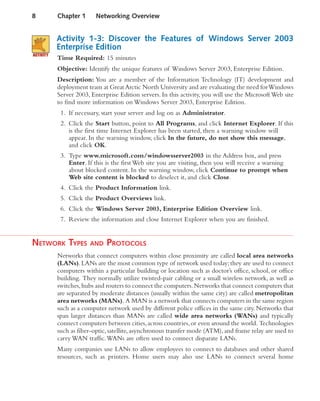
  • 66.
    emancipálhassák magokat agazda önkénye alól, s hogy több vagyont produkálhassanak. Ám – figyelve őket – a tapasztalat azt mutatja, hogy az elválást elszegényedés szokta követni. Családi életük magán hordja a régi magyar életnek képét, kinyomatát. A férfi tegezi nejét, a nő k i e d -nek (kendnek) szólítja férjét, a gyermekek é l d e s s z ü l é i m névvel tisztelik szüléiket. A lakszobában, mit közönségesen h á z n a k neveznek, semmi butorzat sincs egy asztalon, hosszúlócán s óriási kemencén kivül. A téli estéket többnyire a kemence előtt töltik, az asszonyok fonogatva, a férfiak pedig pipázva s beszélgetve. Beszélgetésök tárgyát a faluban előjött apró események, házasságok, időjárás s a termények minéműsége teszi. Éjfél után elszállingóznak a hálókomrába, – miután jósort imádkozott, többnyire legutólszor tér nyugalomra a legöregebb nő, a családfő neje, vagy a gazdasszony; már akkor van 1–2 óra is midőn ez lefekszik, és a hajnali első kakasszóláskor már ismét talpon van, legelőször tüzet gyujt a kemencébe, aztán felkölti a többieket is s hozzáfognak a fonáshoz. Egy kettő még álmos is közűlök, s kegyetleneket ásít, száját kezével veregetvén. A fiatalságnak a hosszas téli estéken egyetlen mulató helye a fonóház. Ez közönségesen egy kibérlett hely, melyet a tél beálltával közös akarattal bérlenek ki, s érte mindenik tartozik fizetni valamit, vagy nehány fő kendert, vagy búzát, főzeléket ( á z a l é k ) sat. A mint a lányok dolgaikat végzik, cifra guzsalyaikat magokhoz vévén itt jelennek meg, hol már akkor nehány éltes asszony is helyet foglalt a kemence előtt; midőn jó sokan összegyűltek, dalólni kezdenek, s ekkor a legények is szállingóznak befele, mindenik szive választottja mellett foglalván helyet; s jaj azon leánynak kinek a fonóházban nincs mulattatója! Fel sem veszik mintha ott se volna, vagy csak lenézés tárgyául tűzik ki a többi leányok. A legények megérkeztével van dal, meg dal, tréfa, egyik élc a másikat éri, végre ebbe is bele unván, a kemence megől megszólal az öreg mesélő, hogy az ifjabbak képzelődését a tündér világ bájkörébe kalandoztassa, ezen aztán itt ott jót kacagnak, majd sóhajtanak, olykor könnyeznek, míg ismét a legderültebb nevetésben törnek ki.
  • 67.
    Ilyesmik történnek afonóházban, ezenkivül itt történnek az ismeretségek, itt köttetik a szerelem; mert a fonóházban más falubeli legények is megjelennek. Két óratájban aztán szétoszlanak, haza mentökben mindenik lát egy egy kisértetet elhaladni maga előtt s ezt másnap reggel még esküvel is kész bebizonyitani. Téli időben naponként csak kétszer étkeznek reggel és este; a mikor a ház gazdasszonya feltálalja az eledelt, aztán legelőször a családfő megszegi a kenyeret s azt tovább adván a férfi nép a közöstálból hozzálát az étkezéshez. Asszony ritkán ül az asztal mellé, kiki magának szed egy tálkára s azt elfordulva a többitől mintegy észrevétlenül akarja megélvezni. Legfelötlőbb étkezési módjuk: először a keményebb tésztás vagy husféle eledeleket költik el s csak azután kerül a sor a levesre, mit ők általán lé néven neveznek; innen azon enyelgő megjegyzés a lakodalomról: „ o l y a n h i r e s l a k z i j a v ó t h o g y a l é i s h é t f é l y i v ó t b e n n e .“ Legkedvesebb eledelök a hus, aztán a g a n c a , b u k t a (mindkettő tészta étek) végül a m á k o s f e r e n t ő (mely hasonlit a réteshez primitiv kiadásban) s a m á k o s c s i k (mákos metélt). Mindezek lakomáknál, keresztelőknél, stb. különösen szerepelnek s kivált a mákosferentő lakodalomból el nem maradhat. Testökre nézve mindkét nembeliek eléggé kifejlettek, a nők különösen eredeti magyar s hóditó külsejüek. A leány tiszta, öltözete ragyogó, kedveli a magossarku piros csizmát, rózsaszinkelméket, hajafürtébe isten tudja mennyi cifra pántlikát befűz, nyakán g a r á l y i s t (nyakék) ujjain öt hat rézgyűrőt (gyűrű) visel, mikkel többnyire mátkája szokta megajándékozni. Ha templomba megy, rézkapcsos imakönyvét százszorszép kendőjébe hajtja s hóna alá helyezi, másik kezébe piros csizmáját fogja s így ballag a távolabb eső filialis helyekről is mezitláb, s csak a templomajtó előtt huzván fel csizmáját. Fiatal menyecske legfőbb díszruhája a rókásmente. A nők többnyire fiatal korukban szoknak férjhez menni, s a csinosságot, tisztaságot mindig, a szépséget pedig igen sokáig megtartják. A férjezett nő még jó darabig le nem veti cifra ruháit, s csak midőn a 35–40 évet betöltötte, ölt komolyabb barna szinü
  • 68.
    öltözéket. Férjét felettebecsüli, örömest tűri szitkait, gáncsait sőt veréseit is, csak férje tul ne lépjen a házasság céljának korlátain. A férfiak szinte eléggé kifejlettek szép külsejüek. Megtermettebb szállasabb legénységet alig látni országszerte mint itt. Az öregek általán vállig érő göndör hajat viselnek, bajusz, vagy barkó felette ritkaság az egész vidéken, tiszta sima arcot szeretnek hordani. A fiatalság öltözete kanász kalap, bőujju ing, pitykés veres mellény, térdigérő bő gatya, cifra szűr, hosszu száru csizma. Kedvenc bokrétájuk az árvalányhaj s az ugynevezett s z e n t k u t i b o k r é t a . Melynek története következő: május első reggelén a legény májfát állit a kedves ablaka elé, a lány annál jobban örül mennél magasabb az oda állitott fa; mert a fa nagysága többnyire a legény szerelmének fokozata, Pünköst napján aztán – mikor országos bucsu zarándokol a Verebély helység mellett levő szentkuti kolostorhoz – a szerelmespár is hűségesen lerándul, s itt a leány mintegy viszonzásul a májfáért csinált virágból himzett bokrétát vesz szeretőjének, melyet az jövő májusig, vagy ha addig éppen véghez menne, lakodalmáig hord. Ha azonban az ifjunak komoly szándékai vannak az éj leple alatt egyszer kétszer megjelenik a lányos háznál; később bemutatja magát a szülőknek is, s ha ezek szivesen látják, kérőket indit a házhoz, a kik ékes szavakban előadják kivánságukat, ha meghallgattatnak nem sokára megtörténik a k e n d ő l a k á s , mely nem áll egyébből minthogy a szerelmesek kendőt cserélnek melybe diót vagy almát kötöttek. Ezentul jegyeseknek tekintetnek. A lakodalmat szüret után tartják, meg. Az esketésre kitűzött nap előtt a n a g y n á s z összejárja a falut s a vendégeket behivja. Más nap a n a g y n á s z felkerekedvén összegyült népével, elbúcsúzik s zene kisérettel utnak indul a menyasszony házafelé, itt megállnak a kapu előtt s csupán a vőfély megy be egyedűl felszólitván a menyasszonyt az indulásra, ki nyoszolyó asszonya s leányaival atyafiaitól kisértetve, kimegy és a násznéphez csatlakozik, egyenesen a hitletételre menendő. Mely meglevén atyai házához visszakisértetik; hol rövid reggelit kapván a násznép visszatér a
  • 69.
    vőlegény házához, amenyasszony pedig odahaza marad, mig nem hosszas kérések és ceremóniák után csakugyan elszállitják a vőlegény lakására, hol az örömatya a kapunál várja menyét, s nem is hinné az ember, mely édesded gyöngéd érzelmek előadásával jelenti örömét s fogadja azt, kitől fia boldogulását, háza gyarapodását, szerencséjét és fényét mint az Isten áldását várja; kézen fogva viszi be házába és bemutatja nejének, fiainak s atyafiainak, s ez által be van igtatva nemzetségébe s él a szülött jogaival holtaig, sőt férje halála után is mig más házasságra nem lép. Most bevégzett s tökéletes az öröm s lakják a lakodalmat, melyhez minden hivatalos tehetsége szerint adakozott. Ebéd alatt szolgál a vőfély, behordván az ételeket, mely alkalommal minden ételt megdicsér többnyire cikornyás versekben. Estebéd után a vőfély három szál gyertyát fogva balkeze ujjai közé a menyasszonyt a komrába viszi, hol leveszi fejéről a pártát s által adja a fektető vagy nyoszolyó asszonynak. A vőfély a pártát fokosára veszi és árulgatja s ekkor mondja el vig szavakkal az ugynevezett fektető verset melyet mindnyájan nagy figyelemmel hallgatnak. Másnap reggel a kiadó háztól két asszony megy felkölteni a menyasszonyt, ki már akkor valamely zugban ül; ezek a féketőt fejére kötvén, az uj házasokat kalácscsal és mézes pálinkával megajándékozzák. Ezalatt megérkezik a h é r é s z (a kiadó ház vendégei menyegzői ajándokokkal) s kérdezik a nagynászt, hogy nem tévedt-é ide egy gyönyörű aranybárányka? A nagynász igennel felel, de először kivánja tőlök jeleit tudni, ekkor aztán előhoz egy öreg vagy görbe hátu egyént s kérdezi hogy nem ez volna-é voltaképen kit keresnek? Azok ezt természetesen visszaküldik állitván hogy az övék ép és szép volt, s midőn ezután a valódit eléjök állitják mindnyájan kezet fognak vele s tehetségök szerint megjutalmazzák.
  • 70.
    Több helyen alakzi egy hétig is el tart, mig nem ismét a kis hérész következik, melyben az előbbihez csaknem hasonlók történnek. Ennyit a lakadalomról. Az öregek félre tevén a cifra öltözetet, többnyire egyszerű, kék szegélyzetű szűrt, gyolcs vagy legalább jól kifehéritett vászon gúnyát s télbe néhol szűrnadrágot is hordanak, mit ők h u n y a néven neveznek. Miveltségi álláspontjuk még sok kivánni valót hagy fen, a férfiak között igen ritka a ki olvasni, még ritkább a ki irni tud. A nők legalább tanulnak annyit, hogy saját könyvükből tudnak akadozva imádkozni. Irodalomról, könyves miveltségről furcsa fogalommal birnak, nyomtatványok alatt nem képzelnek mást mint politikai ujságot és imádságos könyvet, a ki e hiedelmükből ki akarná vetkeztetni, bizony falra hányná a borsót. Csak egy példát jegyzek ide! Egy izben mezei munkát dolgoztatván, hogy a hosszu nap unalmát elűzhessem, könyveimhez voltam kénytelen folyamodni. Este egy éltes palóc igy szólt hozzám: „ b i j o n y ( b i z o n y ) a z u r m á ’ ( m á r ) c s a k u g y a n a m e m b e ( m e n y b e ) m e h e t h a m i n d e n n a p e n n y i t i m á d k o z i k .“ Még ma is közönséges rovással élnek kénytelenségből. Erre jegyzik jövedelmeiket, kiadásaikat. Világitóul mécsest, vagy bikkfából hasgatott s jól kiszáraztott ugynevezett f á k l y á t használnak. Politikai miveltségük legdicsérendőbb, az uri rendet becsülik, tanácsait szivesen fogadják s ügyeiket készek a szerint irányozni. Általában egy lelkes arisztokracia mellett soha sem engedik magukat alacsony eszközzé silányitani; példa rá hogy az egész országban sehol sem történnek oly barátságos tagositások mint a palócságon. Ezelőtt kedvenc zenéjök a duda volt, de ez már nagyobb részt kiveszett, s mai napság itt ott látni csak egy egy szomoru dudást pedig még ezelőtt néhány évvel is ez mulattatá őket lakomájokban,
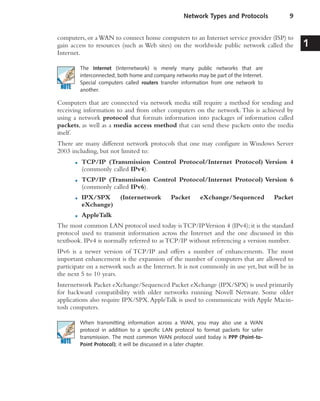
  • 71.
    ezen járta alakodalmasnép ugy a sebes kopogót, mint a szomoru verbunkot. A férfiak kivált az éltesbek ritkán dalolnak, az ifjabbak is többnyire csak áldomás közben, vagy ha mezei munkát dolgoznak magánosan. Ellenben az asszonyszemélyek semmi cselekményt sem végeznek nóta nélkül. Felette kedvelik a szomoru dalokat, dallamaik kevésbé változatosak, többnyire vontatottak, de érzésben, hatásban felül mulhatlanok! Részemről mi sem tud annyira meginditani mintha csendes, holdas éjszakán nehány palóc lánykát hallok dalolni. Ime mily hasznot tenne a Kisfaluditársaság nemzeti zenészetünknek, ha gondoskodnék a különböző lokalitások szerint a dallamok hangjegyre tevéséről! Hogy zeneszerzőink kik többnyire városon lakva, hallhatnának olykor olykor egy, kristály tiszta hangot a nép ajkairól s istenesen neki feküdhetnének a népzenészet tanulmányának! Bizonyára sok gyöngy vesz igy el a feledés tengerében. Aztán a népköltészetben a dallam annyira össze van forrva a szöveggel, hogy egymás nélkül nem is boncolandó. Egyik kiegésziti a másik hiányait, eltakarja fogyatkozásait s mint férj és feleség csak együtt képeznek egy testet és egy lelket. Máskép van a műzenészetnél; itt többnyire más szerzi a szöveget, más a dallamot, s a szöveg csak nem mindig másodrendű dolog. A népnél a dallam a szöveggel egyszerre jő, mint napból a világosság és melegség, mint Jupiter agyából Minerva páncélosan derekasan megteremve. Ime, oda értem hogy a nyelvjárásról is elmondhatom mondandóimat! Figyelmes fül közönségesen három a-t különböztethet meg. Első a tiszta, második a hosszu vagy ékezett s harmadik a közép a, melyet az l előtt au, ó, vagy av-nak is ejtenek ki p. u. eme versben „A kanász az erdőben A baltával játszik, Ugy forgatja a baltát Csak az éle látszik.“
  • 72.
    A b al t á t háromfélekép is mondják. Irjuk ide legalább egyfélekép: A kanász az erdőbe’ A bautávó játszik, Ugy forgatja a baútát Csak az élyi látszik. E-t négyet lehet megkülönböztetni. Van rövid e, hosszu e és rövid é, hosszu é. Kár hogy e hangokat betűk nemléte miatt nem lehet jelölni. Az i-t gyakran felcserélik az e-vel és viszont, p. u. csillag helyett csellag, biró helyett béró, gyik helyett gyék, fejér helyett fejir stb. Az ó néha uó-, néha ou-ra változik, p. u. luó (ló), fokóu (fakó). Az u o-ra változik bizonyos esetekben p. u. uronk urunk helyett. Az ü némely szavaknál i-re, a minőséget kifejező mellékneveknél ő-re változik p. u. gyimőcs (gyümölcs), aranyfejő (aranyfejű), éleshegyő (éleshegyű) aztán hegedő (hegedű) gyűrő (gyűrű) helyett stb. A mássalhangzók közzűl: A d az i előtt állandólag gy-re változik p. u. diák, dió, disznó, dicsekszik, dicsér helyett lesz gyiák, gyesznó (itt az i e-re változik) gyicsekszik, gyicsér. A g néha t-re néha pedig a gy g-re változik p. u. legédesebb, legjobb helyett, letéldesebb, letjobb, gyenge helyett genge. A meg szóban a g betű ha igével van összetéve azon igének első betűjévé válik melylyel egybe van ragadva p. u. megveszem, megjárom, meghuzom: mevveszem, mejjárom, mehhuzom.
  • 73.
    A j olykorgy-re keményedik p. u. jer helyett gyer, (innen a palóc igy szólitja meg egymást: „gyerjék má’ sógor“ jőjjön már sógor helyett. Ennek ellentéte az ered szó honnan igy is mondják egymásnak „eregygyék má’ bátya“ stb) jőjj helyett győjj. Az l gyakran ly-re lágyul p. u. éle (valaminek) igy ejtetik ki élyi, néha u-ra p. u. szalma helyett lesz szauma. Szóvégéről mindig, szóközépről pedig gyakran kihagyatik p. u. a Szász Ferenc cimű dal 11–12. során e helyett: Jól tudod hogy a halálért Halált kell szenvedni. Ez áll: Jó’ tudod hogy a haláé Halá’t kell szenvedni. E szónak: halál még a többeséből is kihagyatik az utolsó l p. u. a második mesében: Jaj de szépen süt az hód az hódvilág, Jaj de szépen masirolnak a halák. ( h a l á l o k helyett). Továbbá: szál, száll, szél, tál, kanál, ól helyett szá, szá, szé, tá, kaná, ó-t hangoztatnak. Az n az infinitivus végén mindég ny p. u. menni, enni helyett mennyi, ennyi, e végzetet gyűjteményünkből szebb hangzás kedveért jónak láttuk kihagyni. Az ny hasonlit a francia orrhanghoz p. u. szegény, legény, igy ejtetik: szegén, legén. Az r a szók végén szinte gyakorta kihagyatik p. u. má’ bá’, már, bár helyett.
  • 74.
    A t azi előtt rendesen ty-re változik p. u. tiz, titok, tilalom lesz tyiz, tyitok, tyilalom. Nem hagyhatjuk itt érintetlen Toldy-nak azon állitását, miszerint a palóc az igék határozott módú harmadik személyét alhangú szókban is i raggal képzi. Ennek több évi tapasztalatból ellene kell szólanunk: a palóc (legalább N ó g r á d , H e v e s , G ö m ö r s B o r s o d összeszögellő bércein) sehol sem conjugál: a d i , v á g i , d o b i formára, hanem kimondja kereken: a d j a , v á g j a , d o b j a ; ugy beszél a zempléni, abauji köznép, de világért sem a palóc. Ennyit a dialektusról, a többi önként ki fog tűnni a figyelmes olvasó előtt, mivel a költeményeket igyekeztünk nagyobbrészt eredeti kiejtésben nyomda alá bocsátani. Mindent úgy írtam le a mint találtam, se el nem vettem belőle, se ki nem toldozgattam egyiket a másikból. Sokan mondták, hogy az olyan apró négy soros dalocskákat hagyjam ki gyüjteményemből. Én nem fogadtam meg tanácsukat; mert ki tudja egy négy soros dalocskában is nincs-é magva, embriója egy műegésznek, ha nem is egy K a l e v a l á n a k , de legalább egy csinos kerekded románcnak vagy balladának. Ime tekintélyes gyüjtőnk Erdélyi János csak 8–10 sort adott D é v a v á r a é p í t é s é r ő l s már Kriza János és F. Szabó Sámuel urak gyönyörű balladákat fedeztek fel róla. Végre egy négy soros dalocska is lehet mű egész! Soraimat Erdélyi ime kenetes soraival rekesztem be: „Akár ki szerzette igen szépek vannak a nép költemények közt; mert különben micsoda érdek kötötte volna ugy a nép nyelvére, hogy századokig énekelje azokat? Ha szeretettel vagyunk poroslevelekhez, söt egy lópatkóhoz is, mely a régi apák idejéből való, nem arany volna e minden szó azon dalból, mely őseink szivének is örömet szerzett? De az idő anyagi szellemet öltött, s eltiprással fenyegeti a hagyományokat; azért annál ébrebben kell lenni azoknak, kiket Isten adván beléjök lelkéből való lelket, a népek szívének éltetőiként küldött a világra, hogy megőrizzék, mit a nép eddig megőrze, a tiszta és igaz nyelvet s annak emlékeit.“
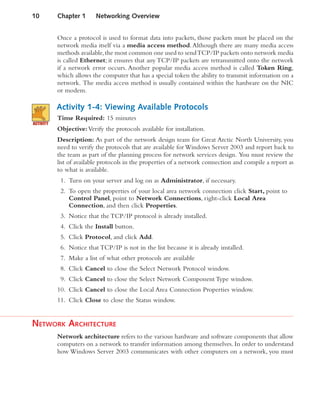
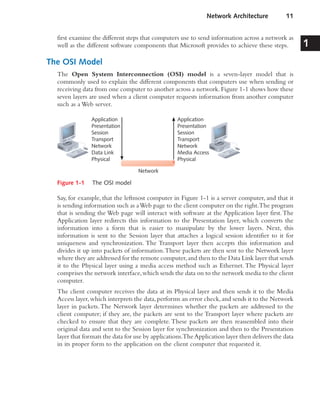
  • 75.
    Végezetre el nemmulaszthatom, hogy Erdélyi János urnak hálás köszönetemet ne nyilvánítsam azon szíves sorokért, melyekkel jelen gyüjteményt előfizetési ivemen, az olvasó közönség pártoló figyélmébe ajánlotta. Ez a törekvésnek valódi irányadója, jutalma. Kívánom, tartson meg ezentúl is jóemlékébe’, szíves indúlatába’. Sárospatak. 1865. P. Gy.
  • 76.
    NÉPKÖLTEMÉNYEK. 1. Szép pirosÖrzsébet. Elattalak férhe’ Szép piros Örzsébet. Szép fejír legényhe’, Orczája oly fejir Mint a fejir hattyú, Még anná’ fejirebb Mint a báránygyapjú. Elmegyen Örzsébet Cínteremkomrába, Felőtözik czifrán Ződ selyem ruhába. Hányja a zsebibe Számtalan pótráját, Kerülyi, fordolja. A szegények házát. Szegények, szegények, Isten szegényei! Kérjétek az istent, Hogy engem vegyen el! Mikó’ hitre menek Hideg borzongasson, Mikó’ hitet mondok, Szörnyen ki is fogjon! Kocsisom, kocsisom, Én első kocsisom!
  • 77.
    Vágd meg azta lovat Hadd ugorjon hármat. Kocsisom, kocsisom, Én első kocsisom, Adj egy pohár vizet! Szörnyet halok szomjan. – De nem vizet adok, Ha piros bort adok. – Mikulám, Mikulám, Én német Mikulám, Adj egy pohár vizet! Szörnyet halok szomjan. – De nem vizet adok, Ha piros bort adok. – Fiam, éldes fiam Én német Mikulám Mi menyasszonyt hoztá’ Hogy nem szó’ én hozzám? Se kezit nem nyujtja, Se szavat nem adja, Lábát se mozdétja. Menyem, édes menyem, Szép piros Örzsébet, Nem is ösmertelek, Mégis szerettelek. Sok szép vendégeim Gyászba őtöztetted, Fiamot, magamat Mekkeserítetted! 2. Szász Ferenc. Én Nyirba indoltam, Két kisasszonyt hor’tam,
  • 78.
    Visszafelé gyövetelen Egy zsidótmegő’tem. Megő’tem a zsidót Tyizenkét forinté’, Elvesztettem a lelkemet Egy pogány zsidóé’. – Szász Ferenc, a zsidót Hogy merted megő’ni? Jó’ tudod, hogy a halá’é’ Halá’t kell szenvedni? De akkó’ Szász Ferenc Nem tudja mit tegyen, A megő’t zsidó legényé’ Katonának megyen. Katona vagyok má’ Senkitő’ se félek, A mit cselekettem Mindent kibeszélek. Akkó’ Szász Ferencrő’ Lehányták a mundért. Kezit, lábát, nyakát Keresztvasba tették. Agygyig a béróná’ Vason várakozott Míg az igaz törvény Igazságot hozott. Három szó’gabéró Ugy végezte sorát, Hogy az akasztófán Szé’ fujja ruháját.
  • 79.
    Három eladó lyány Leakarta vágni, Vice szó’gabéró Nem akarta hagyni. Verje meg az isten Vice szó’gabérót! Hogy jobban könyörőtt Egy rosz pogány zsidót. Ne sirass má’ engem Többet éldes anyám! A te sok szép átkod Szállott má’ én reám. Ne veress má’ engem Többet az Istenvel! Jaj keserves annak Kit az isten mevver! 3. A három árva. A temető árokjába Kiballagott három árva. – Keljen kend fel éldes anyám, Lerongyollott az én ruhám! – Nem kelhetek éldes lyányom, Szanaszét van minden csontom. Van má’ nektek mostohátok, A ki gondot visel rátok. Mikó’ a fejetek féslyik, Két orcátok pofonverik.
  • 80.
    Mikó’ a levestbeviszik, Három árvát kikergetyik. 4. Nagy Jancsi. Ki hallotta annak hírit nem régen, Hogy Nagy Jancsit agyon vágták Bikkvő’gyön? Ugy levágta Barna Andris egyszerre, Mingyá’ leboró’t a ház közepire. Oda ugrott az ő kedves pajtása, De má’ akkó’ nem segithetett rajta, Ugy meffürdött maga piros véribe, Mint mikó’ az anyja meffürösztötte. Feötették a háromlovas kocsira, Ugy vitték ki a hármas kis határra. Mé’tóságos grófné azt nem engette, Magáho’ Kis Terennére vitette. A ki őtet kimosdatta a vérbő’ Ágygya meg a szentlélek az egekbő’!! 5. Angyalom, angyalom, Mi bajod érkezett? Talán a vacsorád Nem jó ézűn esett? Itt van egy pohár bor Igyá’ hát belőle! Szomoró a szived – Mevvidámol tőle.
  • 81.
    Nem kell nekemborod, Csak te magad igyá’! Szüzliány koromba Hogyha nem sajná’tá’. Sajná’talak babám Mikó’ mecscsaltalak – De má’ most az isten Viselje gondodat! – Kertek alatt lakom Keress meg galambom! Csendes folyóviznek Csak zúgását hallom. Két ut van előttem – Melyiken indoljak? Kettő a szeretőm Melyikhe’ fordoljak. Az egyikhe’ menek – A másik haragszik. Igy hát az én szivem Soha mennem1) nyugszik. 6. Jaj istenem, bó’dogtalan órába Indó’tam ki Gyöngyösrő’ Pásztohára. Zsidó legényt felvettem a kocsimra, A szurdokba megő’tem bánatomra. A hogy én a zsidó legényt megő’tem, Aranyórát, magyar ruhát elvettem. Aranyórát od’attam a rózsámnak,
  • 82.
    Vele együtt agarisba csukattak. Má’ Pásztohán kimeszeöték azt a fát, Kire szegény katonát felakasztják. Fujja a szé’ pamuk ingit, gatyáját, Veri öszsze rézsarkantyus csizmáját. Keresztény közt csak egy vót a pártfogóm, Akit anyám én mellettem egyet szó’t, Akit anyám én mellettem egyet szó’t: Hogy akaszszák fel én mellém a zsidót. Piros borvav, bárányhusvav é’tem én – Az urakvav egy pohárbó’ ittam én. Az urakvav ettem, ittam egy tá’bó’, Mégis ki kellett mú’nom e világbó’. 7. Darvas Kis Kelemen. Táncó’nak, táncónak A sári legények A sári ivóba. Köztök van, köztök van Darvas Kis Kelemen. Nem eszik, nem iszik, Sem a táncba nem á’. Elmentek, elmentek A sári legények Sári béróného’, Sallai Katáho’: – Jó napot, jó napot Jó sári béróné, Elgyöttőnk, elgyöttőnk Sári béróného’,
  • 83.
    Sallai Katáho’. – Anyám,éldes anyám, Gazdag éldes anyám, Hozza be hát nekem Azt a bályi ruhám! Aranyfejő pártám, Kis kamuka szoknyám, Keskeny talpó csizmám! – Elmentek, elmentek A sári legények A sári ivóba. – Gyere hát táncó’ni Sári béró lyánya Sallai szép Kata! – Nem menek, nem menek, Darvas Kis Kelemen Piszkos a te ruhád, Szennyes leszek tőle. – Másodszor is mondom Gyere hát táncó’ni Sári béró lyánya Sallai szép Kata! – Nem menek, nem menek Darvas Kis Kelemen, Piszkos a te ruhád, Szennyes leszek tőle. – Még harmadszor mondom Gyere táncba, gyere! Sallai Szép Kata! Csufot tetté’ rajtam, Csufot teszek rajtad. – Anyám, éldes anyám Hozza be hát nekem Azt a bályi ruhám! A selyem kalapom,
  • 84.
    A bársony kabátom, Azsebit rakja meg Aranyvav ezüstvev! Gyere hát táncó’ni Sári béró lyánya Sallai szép Kata! Muzsikás, muzsikás, Tyizenkét muzsikás, Ha este mehhuzod Regvő legyen végi. Ha regvő mehhúzod Este legyen végi! – Ereszsz eö ereszsz eö Darvas Kis Kelemen! Aranyfejő pártám A fejembe dagadt. – Dehogy eresztelek, Hétszer kérettelek – Ha nekem nem adtak, Másnak se adjanak! Muzsikás, muzsikás, Tyizenkét muzsikás, Ha regvő mehhuzod Este legyen végi. Ha este mehhuzod Regvő legyen végi! – Ereszsz eö ereszsz eö Darvas Kis Kelemen! Kis kamuka szoknyám Derekamra dagadt. – Dehogy eresztelek, Hétszer kérettelek, – Ha nekem nem adtak, Másnak se, adjanak. Muzsikás, muzsikás, Tyizenkét muzsikás,
  • 85.
    Ha regvő mehhuzod, Estelegyen végi. Ha este mehhuzod, Regvő legyen végi. – Ereszsz eö, ereszsz eö Darvas Kis Kelemen! Vékony talpó csizmám Telyi alutt vérvev! Dehogy eresztelek, Hétszer kérettelek, Ha nekem nem adtak, Másnak se adjanak. Muzsikás, muzsikás, Tyizenkét muzsikás, Ha regvő mehhuzod, Este legyen végi. Ha este mehhuzod Regvő legyen végi. – Ereszsz eö ereszsz eö, Darvas Kis Kelemen! Jaj má’ oda vagyok, Mingyá’ szörnyűt halok. Fogjatok meg engem Jó lyány pajtásnéim! Vigyetek eö engem Sári béróného’ Az éldes anyámho’. Nyis’ ki anyám, nyis’ ki Leveles kapudot! Vesd me’ nekem, vesd me’ A fekő ágyamot! Keresd is ki nekem A haló ruhámot. – Anyám, éldes anyám, Ugyan kinek húzzák A hármas harangot?
  • 86.
    – Fiam, éldesfiam Darvas Kis Kelemen, Sári béró lyánynak Sallai Katának. – Jó napot, jó napot Jó sári béróné! Elgyöttem még egyszer Sári béróného’ Sallai Katáho’.2) 8. Fekete Miklós. Véres a Fekete Miklós gatyája, Véres lehet, mevverték a csárdába. – Kilenc zsandár véres testem mevverte, A tyizegyik a babámot ölelte. – Béró uram, agyon isten jó napot! – Agyon isten éldes fiam, mi bajod? – Béró uram, nagy is az én esetem, Kilenc zsandár véres testem mevverte! – – – – – Nem akarnék a babámtó’ mevvá’ni, Az irigy is akár mit mond felőle, A halá’ se választhat el ő tőle. 9. Fehér Anna. – Béró, béró, Horvát béró Tá’ aranyat, tá’ ezüstöt, Csak ereszd ki a bátyámat! – Nem keö nekem Fehér Anna Tá’ ezüstöd, tá’ aranyad…
  • 87.
    Welcome to ourwebsite – the perfect destination for book lovers and knowledge seekers. We believe that every book holds a new world, offering opportunities for learning, discovery, and personal growth. That’s why we are dedicated to bringing you a diverse collection of books, ranging from classic literature and specialized publications to self-development guides and children's books. More than just a book-buying platform, we strive to be a bridge connecting you with timeless cultural and intellectual values. With an elegant, user-friendly interface and a smart search system, you can quickly find the books that best suit your interests. Additionally, our special promotions and home delivery services help you save time and fully enjoy the joy of reading. Join us on a journey of knowledge exploration, passion nurturing, and personal growth every day! ebookbell.com